Transitioning to Value Based Care: 
Tennessee Oncology 
A Case Study 
Presentation to Norris Cotton Cancer Center 
Grand Rounds 
October 7, 2014 
Wes Chapman
Disclosure Statement 
• I do not have any financial interests. 
• I do not intend to discuss off-label or 
investigational use(s) of a product or 
device. 
• I attest that I am not receiving direct 
payments from a commercial entity with 
respect to this activity.
“Oncologists should become value-based 
providers by eliminating unnecessary tests, 
prescribing cheaper alternatives when 
therapeutic equivalents exist, and keep calling 
for payment reform” 
Ezekiel J. Emanuel, MD, PhD 
ASCO Annual meeting, 2014
Tennessee Oncology at a Glance 
• Community oncology “mega-practice” – 85 physicians, 25+ 
locations, 40+% state market share, 70+% market share in 
service area 
• Nashville based – 3 hospital system market 
– HCA, Ascension affiliate (St. Thomas), Vanderbilt 
• Long-standing referral relationships with HCA & Ascension 
• Very large clinical trial presence through Sarah Cannon 
(SCRI) – 2nd largest Phase 1 unit in US 
• QOPI certified, Aria (Varian) EMR in all practices, 
standardized billing through GE Centricity 
• Participates in Mission Point ACO via St. Thomas
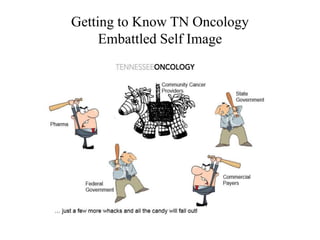
Getting to Know TN Oncology 
Embattled Self Image
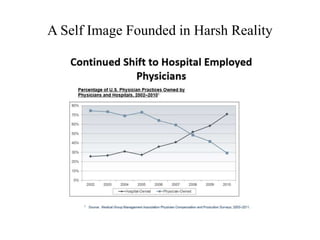
A Self Image Founded in Harsh Reality
7 
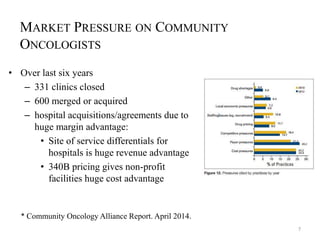
MARKET PRESSURE ON COMMUNITY 
ONCOLOGISTS 
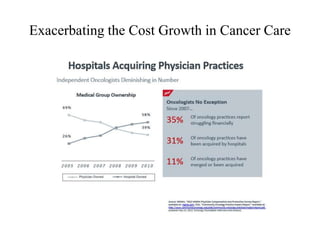
• Over last six years 
– 331 clinics closed 
– 600 merged or acquired 
– hospital acquisitions/agreements due to 
huge margin advantage: 
• Site of service differentials for 
hospitals is huge revenue advantage 
• 340B pricing gives non-profit 
facilities huge cost advantage 
* Community Oncology Alliance Report. April 2014.
Exacerbating the Cost Growth in Cancer Care
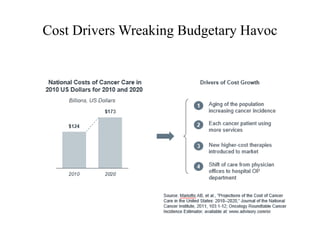
Cost Drivers Wreaking Budgetary Havoc
10 
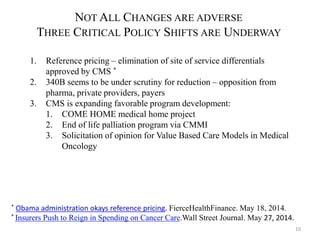
NOTALL CHANGES ARE ADVERSE 
THREE CRITICAL POLICY SHIFTS ARE UNDERWAY 
1. Reference pricing – elimination of site of service differentials 
approved by CMS * 
2. 340B seems to be under scrutiny for reduction – opposition from 
pharma, private providers, payers 
3. CMS is expanding favorable program development: 
1. COME HOME medical home project 
2. End of life palliation program via CMMI 
3. Solicitation of opinion for Value Based Care Models in Medical 
Oncology 
* Obama administration okays reference pricing. FierceHealthFinance. May 18, 2014. 
* Insurers Push to Reign in Spending on Cancer Care.Wall Street Journal. May 27, 2014.
Adapting to a Changing Environment
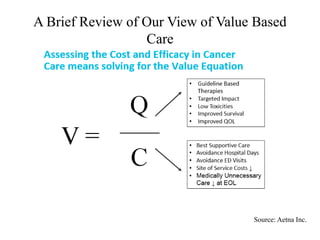
A Brief Review of Our View of Value Based 
Care 
Source: Aetna Inc.
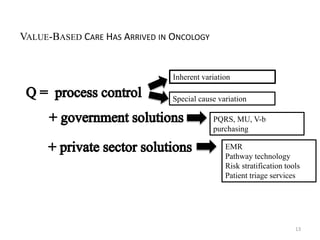
VALUE-BASED CARE HAS ARRIVED IN ONCOLOGY 
13 
Inherent variation 
Special cause variation 
PQRS, MU, V-b 
purchasing 
EMR 
Pathway technology 
Risk stratification tools 
Patient triage services
14 
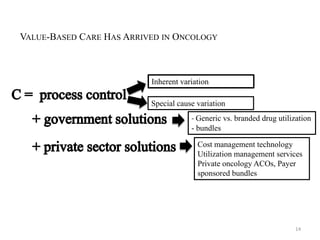
VALUE-BASED CARE HAS ARRIVED IN ONCOLOGY 
Inherent variation 
Special cause variation 
- Generic vs. branded drug utilization 
- bundles 
Cost management technology 
Utilization management services 
Private oncology ACOs, Payer 
sponsored bundles
15 
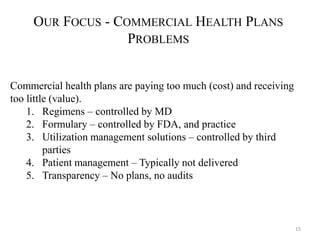
OUR FOCUS - COMMERCIAL HEALTH PLANS 
PROBLEMS 
Commercial health plans are paying too much (cost) and receiving 
too little (value). 
1. Regimens – controlled by MD 
2. Formulary – controlled by FDA, and practice 
3. Utilization management solutions – controlled by third 
parties 
4. Patient management – Typically not delivered 
5. Transparency – No plans, no audits
16 
PAYER SELF IMAGE – PAINFUL LOSS OF 
CONTROL 
1. Reporting requirements without control 
• Publicly transparent quality scores (NCQUA HEDIS scores) 
2. Provider reluctance to adopt: 
A. Payment for value models 
B. Payment for savings models 
C. ACOs 
3. Oncologists “control hearts & minds” 
4. No auditability of pathways, 
bundled payments or otherwise
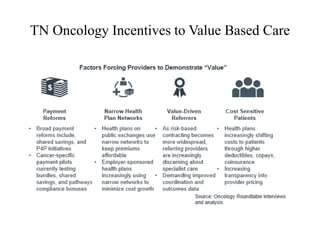
TN Oncology Incentives to Value Based Care
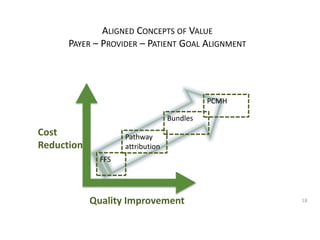
ALIGNED CONCEPTS OF VALUE 
PAYER – PROVIDER – PATIENT GOAL ALIGNMENT 
18 
Cost 
Reduction 
FFS 
Pathway 
attribution 
Bundles 
Quality Improvement 
PCMH
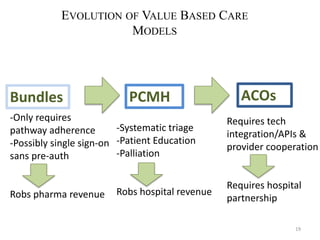
EVOLUTION OF VALUE BASED CARE 
MODELS 
19 
Bundles PCMH ACOs 
-Only requires 
pathway adherence 
-Possibly single sign-on 
sans pre-auth 
Robs pharma revenue 
-Systematic triage 
-Patient Education 
-Palliation 
Robs hospital revenue 
Requires tech 
integration/APIs & 
provider cooperation 
Requires hospital 
partnership
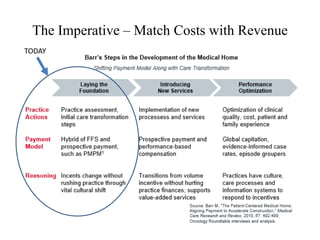
The Imperative – Match Costs with Revenue 
TODAY
MULTIPLE INDUSTRY-WIDE VALUE-BASED 
CARE REQUIREMENTS ARE HERE… 
21 
• Commercial payer programs are also growing: 
• National plans: WellPoint, Aetna, Cigna 
• Regional plans: Regence BCBS, Highmark BCBS, BCBS TN
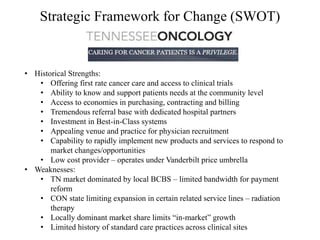
Strategic Framework for Change (SWOT) 
• Historical Strengths: 
• Offering first rate cancer care and access to clinical trials 
• Ability to know and support patients needs at the community level 
• Access to economies in purchasing, contracting and billing 
• Tremendous referral base with dedicated hospital partners 
• Investment in Best-in-Class systems 
• Appealing venue and practice for physician recruitment 
• Capability to rapidly implement new products and services to respond to 
market changes/opportunities 
• Low cost provider – operates under Vanderbilt price umbrella 
• Weaknesses: 
• TN market dominated by local BCBS – limited bandwidth for payment 
reform 
• CON state limiting expansion in certain related service lines – radiation 
therapy 
• Locally dominant market share limits “in-market” growth 
• Limited history of standard care practices across clinical sites
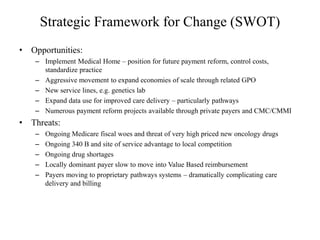
Strategic Framework for Change (SWOT) 
• Opportunities: 
– Implement Medical Home – position for future payment reform, control costs, 
standardize practice 
– Aggressive movement to expand economies of scale through related GPO 
– New service lines, e.g. genetics lab 
– Expand data use for improved care delivery – particularly pathways 
– Numerous payment reform projects available through private payers and CMC/CMMI 
• Threats: 
– Ongoing Medicare fiscal woes and threat of very high priced new oncology drugs 
– Ongoing 340 B and site of service advantage to local competition 
– Ongoing drug shortages 
– Locally dominant payer slow to move into Value Based reimbursement 
– Payers moving to proprietary pathways systems – dramatically complicating care 
delivery and billing
Changes to Survive/Thrive 
• Done: Service Line Expansion 
– Expanded Laboratory capability 
– Specialty pharmacy for orals 
– Led formation of Nationwide Oncology GPO (RainTree Oncology) 50+ 
practices, 500+ MDs 
– Genetics Laboratory (Pending) 
– Continued geographic growth (Chattanooga) 
• Consider: Aggressive move to Oncology Patient Centered Medical 
Home via NCQA accreditation as PCSP 
– Adoption of Clinical Pathways 
– Incorporation of Care Plans into practice, patient, referrals 
– Development of Triage/Patient Management System 
– Dramatic expansion of palliative care program including CMMI Grant 
• Required with Medical Home: Negotiate changed payment systems 
with Payers based on ACO or bundles model – if you can’t do this, 
you will go broke!
Consideration: Do Oncology PCMHs Actually 
Improve Care or Reduce Costs? 
Evidence & Expert Opinion 
• Costs Savings - Evidence 
– Multi-year, 5 site study through UnitedHealthcare (1): 
• All sites PCMHs (3 were members of COME HOME project & RainTree) 
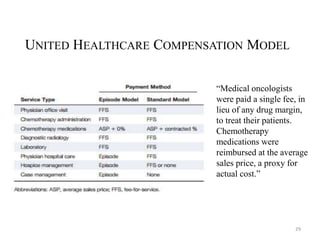
• Sites paid a fixed fee per patient – no mark-up on drugs 
• Savings based on total cost of care – breast , colon & lung cancer 
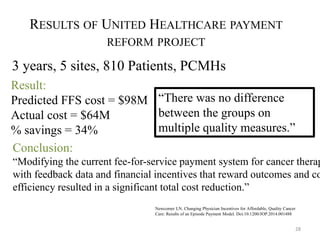
• Savings of 34% of expected costs ($34 million) 
• Savings from hospitalizations and therapeutic radiology 
– Movement to Pathways systems seems to offer 15% savings on Drugs 
year 1, 6% additional year 2. (2) 
– Come Home savings of $33.5 million based over 3 years and 7 
practices – (percentage not given) (3)
Consideration: Do Oncology PCMHs Actually 
Improve Care or Reduce Costs? 
Evidence 
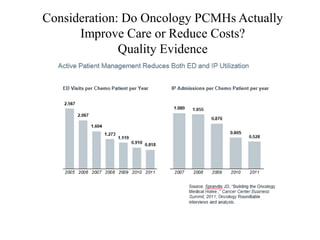
• Quality – Evidence Positive for Oncology Medical Homes 
– Reported Practice Results (4): 
• ED visits reduced 68% 
• Hospital Admissions reduced 51% 
• Avg. LOS reduced 21% 
• Out Patient visits cut by 22% for all hematology & oncology 
• Savings of $11,955 per chemotherapy patient 
• Quality – Mixed Reviews – Particularly Primary Care 
– “Despite widespread enthusiasm for the medical home concept, few peer-reviewed 
publications have found that transforming primary care practices into 
medical homes (as defined by common recognition tools and in typical practice 
settings) produces measurable improvements in the quality and efficiency of 
care.” (5)
Consideration: Do Oncology PCMHs Actually 
Improve Care or Reduce Costs? 
Quality Evidence
RESULTS OF UNITED HEALTHCARE PAYMENT 
REFORM PROJECT 
28 
3 years, 5 sites, 810 Patients, PCMHs 
Result: 
Predicted FFS cost = $98M 
Actual cost = $64M 
% savings = 34% 
“There was no difference 
between the groups on 
multiple quality measures.” 
Conclusion: 
“Modifying the current fee-for-service payment system for cancer therapy 
with feedback data and financial incentives that reward outcomes and cost 
efficiency resulted in a significant total cost reduction.” 
Newcomer LN. Changing Physician Incentives for Affordable, Quality Cancer 
Care: Results of an Episode Payment Model. Doi:10.1200/JOP.2014.001488
UNITED HEALTHCARE COMPENSATION MODEL 
“Medical oncologists 
were paid a single fee, in 
lieu of any drug margin, 
to treat their patients. 
Chemotherapy 
medications were 
reimbursed at the average 
sales price, a proxy for 
actual cost.” 
29
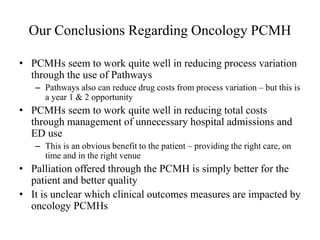
Our Conclusions Regarding Oncology PCMH 
• PCMHs seem to work quite well in reducing process variation 
through the use of Pathways 
– Pathways also can reduce drug costs from process variation – but this is 
a year 1 & 2 opportunity 
• PCMHs seem to work quite well in reducing total costs 
through management of unnecessary hospital admissions and 
ED use 
– This is an obvious benefit to the patient – providing the right care, on 
time and in the right venue 
• Palliation offered through the PCMH is simply better for the 
patient and better quality 
• It is unclear which clinical outcomes measures are impacted by 
oncology PCMHs
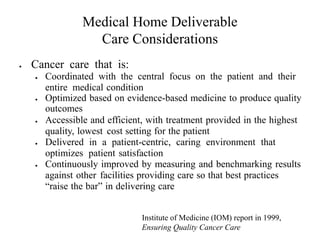
Medical Home Deliverable 
Care Considerations 
 Cancer care that is: 
 Coordinated with the central focus on the patient and their 
entire medical condition 
 Optimized based on evidence-based medicine to produce quality 
outcomes 
 Accessible and efficient, with treatment provided in the highest 
quality, lowest cost setting for the patient 
 Delivered in a patient-centric, caring environment that 
optimizes patient satisfaction 
 Continuously improved by measuring and benchmarking results 
against other facilities providing care so that best practices 
“raise the bar” in delivering care 
Institute of Medicine (IOM) report in 1999, 
Ensuring Quality Cancer Care
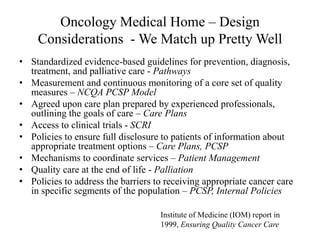
Oncology Medical Home – Design 
Considerations -We Match up Pretty Well 
• Standardized evidence-based guidelines for prevention, diagnosis, 
treatment, and palliative care - Pathways 
• Measurement and continuous monitoring of a core set of quality 
measures – NCQA PCSP Model 
• Agreed upon care plan prepared by experienced professionals, 
outlining the goals of care – Care Plans 
• Access to clinical trials - SCRI 
• Policies to ensure full disclosure to patients of information about 
appropriate treatment options – Care Plans, PCSP 
• Mechanisms to coordinate services – Patient Management 
• Quality care at the end of life - Palliation 
• Policies to address the barriers to receiving appropriate cancer care 
in specific segments of the population – PCSP, Internal Policies 
Institute of Medicine (IOM) report in 
1999, Ensuring Quality Cancer Care
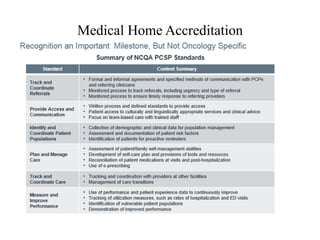
Medical Home Accreditation
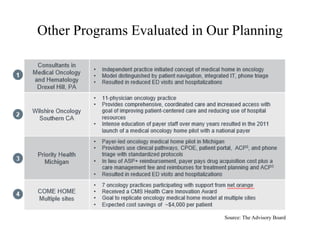
Other Programs Evaluated in Our Planning 
Source: The Advisory Board
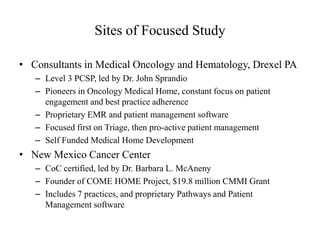
Sites of Focused Study 
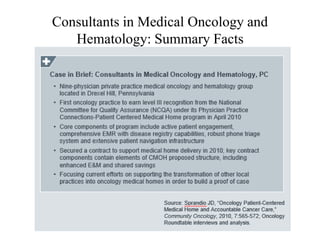
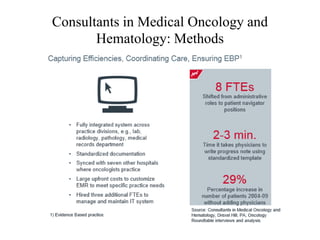
• Consultants in Medical Oncology and Hematology, Drexel PA 
– Level 3 PCSP, led by Dr. John Sprandio 
– Pioneers in Oncology Medical Home, constant focus on patient 
engagement and best practice adherence 
– Proprietary EMR and patient management software 
– Focused first on Triage, then pro-active patient management 
– Self Funded Medical Home Development 
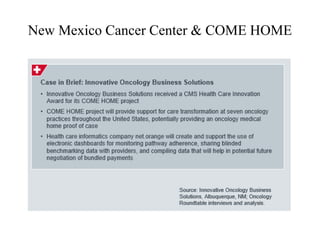
• New Mexico Cancer Center 
– CoC certified, led by Dr. Barbara L. McAneny 
– Founder of COME HOME Project, $19.8 million CMMI Grant 
– Includes 7 practices, and proprietary Pathways and Patient 
Management software
Consultants in Medical Oncology and 
Hematology: Summary Facts
Consultants in Medical Oncology and 
Hematology: Methods
New Mexico Cancer Center & COME HOME
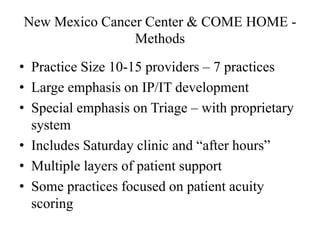
New Mexico Cancer Center & COME HOME - 
Methods 
• Practice Size 10-15 providers – 7 practices 
• Large emphasis on IP/IT development 
• Special emphasis on Triage – with proprietary 
system 
• Includes Saturday clinic and “after hours” 
• Multiple layers of patient support 
• Some practices focused on patient acuity 
scoring
Our Distillation: 4 Pillars of our Medical Home 
• Pathways: NCCN compliant Pathways are the base level 
requirement for our PCMH, Rx, Genetics and Diagnostic imaging 
– Have to be: 
• Rigorously and systematically maintained 
• Independent of any payer organization 
• Cloud based 
• Linked to our Aria EMR 
• Capable of practice level customization 
• Capable of producing supportive care pathways as well 
• Capable of easily dealing with our clinical trial volume 
• Capable of producing Care Plans 
– Key metrics: 90% Attribution, 80% Compliance
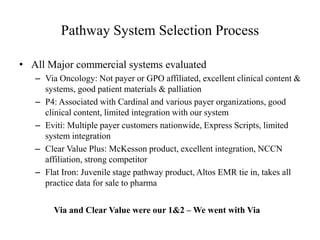
Pathway System Selection Process 
• All Major commercial systems evaluated 
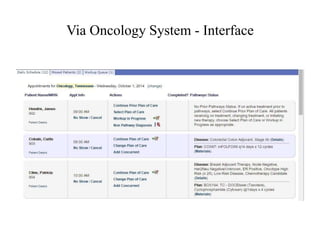
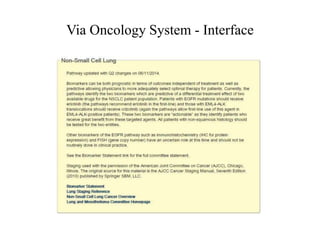
– Via Oncology: Not payer or GPO affiliated, excellent clinical content & 
systems, good patient materials & palliation 
– P4: Associated with Cardinal and various payer organizations, good 
clinical content, limited integration with our system 
– Eviti: Multiple payer customers nationwide, Express Scripts, limited 
system integration 
– Clear Value Plus: McKesson product, excellent integration, NCCN 
affiliation, strong competitor 
– Flat Iron: Juvenile stage pathway product, Altos EMR tie in, takes all 
practice data for sale to pharma 
Via and Clear Value were our 1&2 –We went with Via
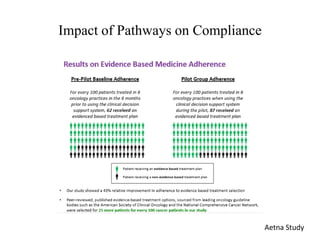
Impact of Pathways on Compliance 
Aetna Study
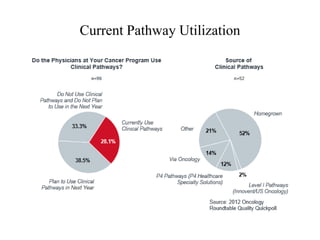
Current Pathway Utilization
Via Oncology System - Interface
Care Plans 
• Care plans: A documented account of care shared with the Patient, Payer 
and other Providers at transition of care. Form a fundamental information 
tool with: 
– Payers: 
• Care plans form the basis for attribution and compliance metrics 
• All payer expectations are driven by care plans and subsequent reports/audits 
• Flexibility in plan design important 
– Patients: 
• Plans for the fundamental curriculum around which patient education takes place 
• Plans form the basis for subsequent patient management 
– Referrals: 
• Plans are the fundamental information tool for MU compliance 
• Plans facilitate continuity of care 
• Key Metric: Shared with the Patient, Payer and other Providers at 90% of 
transitions of care, includes all care provided by the practice and additional 
elements as mandated by Meaningful Use.
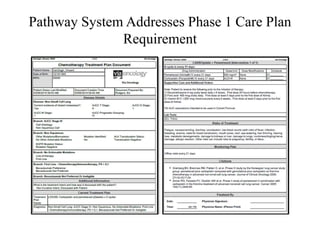
Pathway System Addresses Phase 1 Care Plan 
Requirement
Patient Management 
• Reactive (triage) and proactive management of disease between office 
visits; systematic response to patient concerns, including non-oncology. 
Goals: Improved patient care; improved outcomes; reduced cost; increased 
adherence to care plans. Compliance 
• Key considerations: 
– Must offer triage first, then proactive patient management 
– Must integrate with phone and data management systems 
– Triage must conform with best practices, and integrate smoothly with scheduling 
– Must include multi-modal including phone, text, email 
– Must support development of supportive care pathways with automatic notifications and 
work lists 
– Must integrate with Pharmacy 
• This is a team sport – must include all members of the care team 
• Key Metric: Control 90% of ED and hospital use
Patient Management - System Use Cases 
• Provider 
– Triage: Safe, timely intuitive triage 
– Patient management: Supportive care based on predictive pathways 
– Risk analysis based on clinical data 
– Frequent periodic patient status/distress reporting 
• Payer 
– Timely reports on: triage, status variation, pathway adjustment 
• Patient 
– Meaningful and timely educational materials 
– Direct access to supportive care 
– Meaningful information regarding status
Triage/Engagement Considerations 
Telephonic Triage is a requirement for “Stage 1” Medical 
Home Development 
Triage Has three fundamental components 
 1) Patient engagement and symptom/situation description 
 2) Tier the patients condition based on objective criteria, reflecting 
symptoms, history and risk 
 3) Direct the patient to the most appropriate medical care 
Triage frequently means late stage correction of a problem - 
anticipation, training, education should eliminate most triage 
Triage system needs to be built to accommodate: 
 1) Broader patient engagement requirements – e.g. status reporting 
 2) Prospective tiering and planning based on treatment and status 
 3) Demographic data inputs from EMR
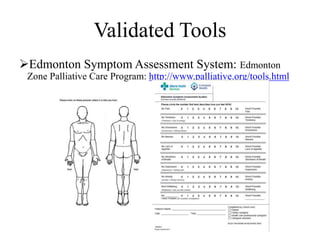
Validated Tools 
Edmonton Symptom Assessment System: Edmonton 
Zone Palliative Care Program: http://www.palliative.org/tools.html
Validated Tools 
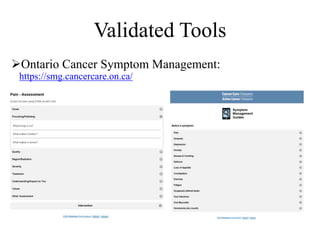
Ontario Cancer Symptom Management: 
https://smg.cancercare.on.ca/
Validated Tools 
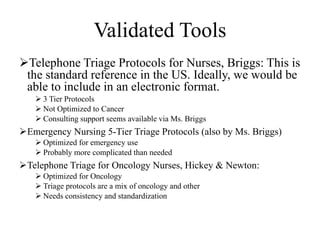
Telephone Triage Protocols for Nurses, Briggs: This is 
the standard reference in the US. Ideally, we would be 
able to include in an electronic format. 
 3 Tier Protocols 
 Not Optimized to Cancer 
 Consulting support seems available via Ms. Briggs 
Emergency Nursing 5-Tier Triage Protocols (also by Ms. Briggs) 
 Optimized for emergency use 
 Probably more complicated than needed 
Telephone Triage for Oncology Nurses, Hickey & Newton: 
 Optimized for Oncology 
 Triage protocols are a mix of oncology and other 
 Needs consistency and standardization
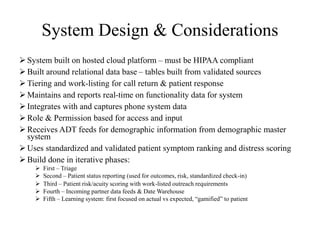
System Design & Considerations 
 System built on hosted cloud platform – must be HIPAA compliant 
 Built around relational data base – tables built from validated sources 
 Tiering and work-listing for call return & patient response 
 Maintains and reports real-time on functionality data for system 
 Integrates with and captures phone system data 
 Role & Permission based for access and input 
 Receives ADT feeds for demographic information from demographic master 
system 
 Uses standardized and validated patient symptom ranking and distress scoring 
 Build done in iterative phases: 
 First – Triage 
 Second – Patient status reporting (used for outcomes, risk, standardized check-in) 
 Third – Patient risk/acuity scoring with work-listed outreach requirements 
 Fourth – Incoming partner data feeds & Date Warehouse 
 Fifth – Learning system: first focused on actual vs expected, “gamified” to patient
Patient Management – Predictive Analytics 
• Initial Objective – Risk for Hospitalization 
• Key design consideration – based on clinical (EMR) 
rather than payer data 
• Must be based on experience in medical oncology – 
general system not relevant for our needs 
• Depends on data partnerships with referral hospitals 
• Evaluated 15-20 systems 
• Chose Clinicast – group spun out of Kaiser
Palliation 
• Integral part of patient management – we use for all 
patients (certain clinics), beginning with the first visit 
• Difficult to justify at the practice level outside of 
Value Based Care payment model 
• Moving to patient resources from the pathways 
system 
• Really depends on good patient management tools 
• We applied to participate in the CMMI new palliation 
model with a local hospice
57 
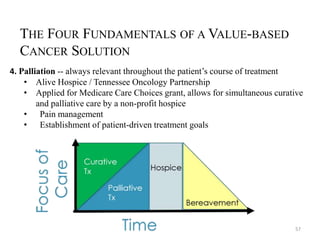
THE FOUR FUNDAMENTALS OF A VALUE-BASED 
CANCER SOLUTION 
4. Palliation -- always relevant throughout the patient’s course of treatment 
• Alive Hospice / Tennessee Oncology Partnership 
• Applied for Medicare Care Choices grant, allows for simultaneous curative 
and palliative care by a non-profit hospice 
• Pain management 
• Establishment of patient-driven treatment goals
58 
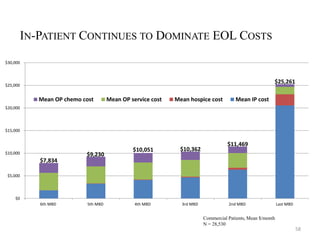
IN-PATIENT CONTINUES TO DOMINATE EOL COSTS 
Mean OP chemo cost Mean OP service cost Mean hospice cost Mean IP cost 
$7,834 
$9,230 
$10,051 $10,362 
$11,469 
$25,261 
$30,000 
$25,000 
$20,000 
$15,000 
$10,000 
$5,000 
$0 
6th MBD 5th MBD 4th MBD 3rd MBD 2nd MBD Last MBD 
Commercial Patients, Mean $/month 
N = 28,530
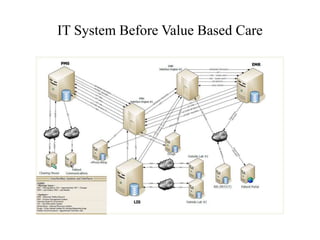
IT System Before Value Based Care
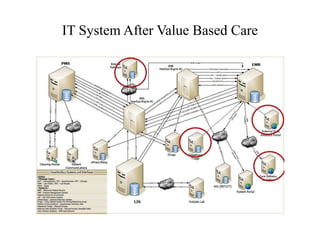
IT System After Value Based Care
The Alternative to Physician Directed Value Based 
Care – Aggressive Expansion by PA Companies 
PA Company Planning documents
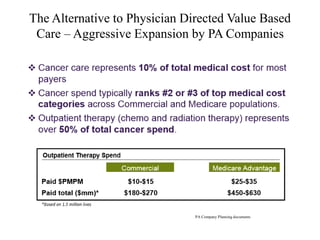
The Alternative to Physician Directed Value Based 
Care – Aggressive Expansion by PA Companies 
PA Company Planning documents
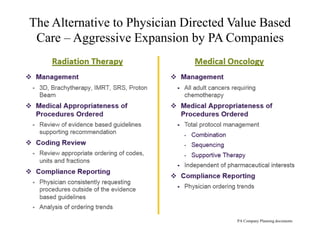
The Alternative to Physician Directed Value Based 
Care – Aggressive Expansion by PA Companies 
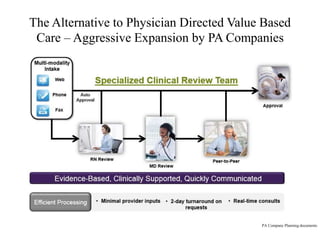
PA Company Planning documents
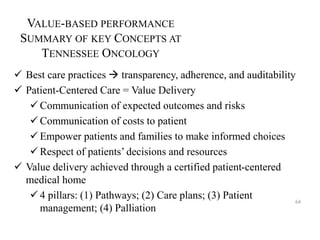
VALUE-BASED PERFORMANCE 
SUMMARY OF KEY CONCEPTS AT 
TENNESSEE ONCOLOGY 
 Best care practices  transparency, adherence, and auditability 
 Patient-Centered Care = Value Delivery 
Communication of expected outcomes and risks 
 Communication of costs to patient 
Empower patients and families to make informed choices 
 Respect of patients’ decisions and resources 
 Value delivery achieved through a certified patient-centered 
medical home 
 4 pillars: (1) Pathways; (2) Care plans; (3) Patient 
management; (4) Palliation 
64
Citations 
1. Newcomer LN et al: Changing Physician Incentives: An Episode Payment Model. JOP.ASCO. July 14,2014, Published ahead 
of Print. 
2. Feinberg B et al. Third-Party Validation of Observed Savings From an Oncology Pathways Program. American Journal of 
Managed Care. Volume 19, Special Issue 4. May/June 2013 
3. Oncology Business News, August 2014 
4. DOI: 10.1200/jop.2014.001386; published ahead of print at jop.ascopubs.org on March 11,2014. 
5. Friedberg MW, Schneider EC, Rosenthal MB, Volpp KG, Werner RM. Association Between Participation in a Multipayer 
Medical Home Intervention and Changes in Quality, Utilization, and Costs of Care. JAMA. 2014;311(8):815-825. 
doi:10.1001/jama.2014.353.

Transitioning to Value Based Care: Tennessee Oncology, A Case Study

  • 1.
    Transitioning to ValueBased Care: Tennessee Oncology A Case Study Presentation to Norris Cotton Cancer Center Grand Rounds October 7, 2014 Wes Chapman
  • 2.
    Disclosure Statement •I do not have any financial interests. • I do not intend to discuss off-label or investigational use(s) of a product or device. • I attest that I am not receiving direct payments from a commercial entity with respect to this activity.
  • 3.
    “Oncologists should becomevalue-based providers by eliminating unnecessary tests, prescribing cheaper alternatives when therapeutic equivalents exist, and keep calling for payment reform” Ezekiel J. Emanuel, MD, PhD ASCO Annual meeting, 2014
  • 4.
    Tennessee Oncology ata Glance • Community oncology “mega-practice” – 85 physicians, 25+ locations, 40+% state market share, 70+% market share in service area • Nashville based – 3 hospital system market – HCA, Ascension affiliate (St. Thomas), Vanderbilt • Long-standing referral relationships with HCA & Ascension • Very large clinical trial presence through Sarah Cannon (SCRI) – 2nd largest Phase 1 unit in US • QOPI certified, Aria (Varian) EMR in all practices, standardized billing through GE Centricity • Participates in Mission Point ACO via St. Thomas
  • 5.
    Getting to KnowTN Oncology Embattled Self Image
  • 6.
    A Self ImageFounded in Harsh Reality
  • 7.
    7 MARKET PRESSUREON COMMUNITY ONCOLOGISTS • Over last six years – 331 clinics closed – 600 merged or acquired – hospital acquisitions/agreements due to huge margin advantage: • Site of service differentials for hospitals is huge revenue advantage • 340B pricing gives non-profit facilities huge cost advantage * Community Oncology Alliance Report. April 2014.
  • 8.
    Exacerbating the CostGrowth in Cancer Care
  • 9.
    Cost Drivers WreakingBudgetary Havoc
  • 10.
    10 NOTALL CHANGESARE ADVERSE THREE CRITICAL POLICY SHIFTS ARE UNDERWAY 1. Reference pricing – elimination of site of service differentials approved by CMS * 2. 340B seems to be under scrutiny for reduction – opposition from pharma, private providers, payers 3. CMS is expanding favorable program development: 1. COME HOME medical home project 2. End of life palliation program via CMMI 3. Solicitation of opinion for Value Based Care Models in Medical Oncology * Obama administration okays reference pricing. FierceHealthFinance. May 18, 2014. * Insurers Push to Reign in Spending on Cancer Care.Wall Street Journal. May 27, 2014.
  • 11.
    Adapting to aChanging Environment
  • 12.
    A Brief Reviewof Our View of Value Based Care Source: Aetna Inc.
  • 13.
    VALUE-BASED CARE HASARRIVED IN ONCOLOGY 13 Inherent variation Special cause variation PQRS, MU, V-b purchasing EMR Pathway technology Risk stratification tools Patient triage services
  • 14.
    14 VALUE-BASED CAREHAS ARRIVED IN ONCOLOGY Inherent variation Special cause variation - Generic vs. branded drug utilization - bundles Cost management technology Utilization management services Private oncology ACOs, Payer sponsored bundles
  • 15.
    15 OUR FOCUS- COMMERCIAL HEALTH PLANS PROBLEMS Commercial health plans are paying too much (cost) and receiving too little (value). 1. Regimens – controlled by MD 2. Formulary – controlled by FDA, and practice 3. Utilization management solutions – controlled by third parties 4. Patient management – Typically not delivered 5. Transparency – No plans, no audits
  • 16.
    16 PAYER SELFIMAGE – PAINFUL LOSS OF CONTROL 1. Reporting requirements without control • Publicly transparent quality scores (NCQUA HEDIS scores) 2. Provider reluctance to adopt: A. Payment for value models B. Payment for savings models C. ACOs 3. Oncologists “control hearts & minds” 4. No auditability of pathways, bundled payments or otherwise
  • 17.
    TN Oncology Incentivesto Value Based Care
  • 18.
    ALIGNED CONCEPTS OFVALUE PAYER – PROVIDER – PATIENT GOAL ALIGNMENT 18 Cost Reduction FFS Pathway attribution Bundles Quality Improvement PCMH
  • 19.
    EVOLUTION OF VALUEBASED CARE MODELS 19 Bundles PCMH ACOs -Only requires pathway adherence -Possibly single sign-on sans pre-auth Robs pharma revenue -Systematic triage -Patient Education -Palliation Robs hospital revenue Requires tech integration/APIs & provider cooperation Requires hospital partnership
  • 20.
    The Imperative –Match Costs with Revenue TODAY
  • 21.
    MULTIPLE INDUSTRY-WIDE VALUE-BASED CARE REQUIREMENTS ARE HERE… 21 • Commercial payer programs are also growing: • National plans: WellPoint, Aetna, Cigna • Regional plans: Regence BCBS, Highmark BCBS, BCBS TN
  • 22.
    Strategic Framework forChange (SWOT) • Historical Strengths: • Offering first rate cancer care and access to clinical trials • Ability to know and support patients needs at the community level • Access to economies in purchasing, contracting and billing • Tremendous referral base with dedicated hospital partners • Investment in Best-in-Class systems • Appealing venue and practice for physician recruitment • Capability to rapidly implement new products and services to respond to market changes/opportunities • Low cost provider – operates under Vanderbilt price umbrella • Weaknesses: • TN market dominated by local BCBS – limited bandwidth for payment reform • CON state limiting expansion in certain related service lines – radiation therapy • Locally dominant market share limits “in-market” growth • Limited history of standard care practices across clinical sites
  • 23.
    Strategic Framework forChange (SWOT) • Opportunities: – Implement Medical Home – position for future payment reform, control costs, standardize practice – Aggressive movement to expand economies of scale through related GPO – New service lines, e.g. genetics lab – Expand data use for improved care delivery – particularly pathways – Numerous payment reform projects available through private payers and CMC/CMMI • Threats: – Ongoing Medicare fiscal woes and threat of very high priced new oncology drugs – Ongoing 340 B and site of service advantage to local competition – Ongoing drug shortages – Locally dominant payer slow to move into Value Based reimbursement – Payers moving to proprietary pathways systems – dramatically complicating care delivery and billing
  • 24.
    Changes to Survive/Thrive • Done: Service Line Expansion – Expanded Laboratory capability – Specialty pharmacy for orals – Led formation of Nationwide Oncology GPO (RainTree Oncology) 50+ practices, 500+ MDs – Genetics Laboratory (Pending) – Continued geographic growth (Chattanooga) • Consider: Aggressive move to Oncology Patient Centered Medical Home via NCQA accreditation as PCSP – Adoption of Clinical Pathways – Incorporation of Care Plans into practice, patient, referrals – Development of Triage/Patient Management System – Dramatic expansion of palliative care program including CMMI Grant • Required with Medical Home: Negotiate changed payment systems with Payers based on ACO or bundles model – if you can’t do this, you will go broke!
  • 25.
    Consideration: Do OncologyPCMHs Actually Improve Care or Reduce Costs? Evidence & Expert Opinion • Costs Savings - Evidence – Multi-year, 5 site study through UnitedHealthcare (1): • All sites PCMHs (3 were members of COME HOME project & RainTree) • Sites paid a fixed fee per patient – no mark-up on drugs • Savings based on total cost of care – breast , colon & lung cancer • Savings of 34% of expected costs ($34 million) • Savings from hospitalizations and therapeutic radiology – Movement to Pathways systems seems to offer 15% savings on Drugs year 1, 6% additional year 2. (2) – Come Home savings of $33.5 million based over 3 years and 7 practices – (percentage not given) (3)
  • 26.
    Consideration: Do OncologyPCMHs Actually Improve Care or Reduce Costs? Evidence • Quality – Evidence Positive for Oncology Medical Homes – Reported Practice Results (4): • ED visits reduced 68% • Hospital Admissions reduced 51% • Avg. LOS reduced 21% • Out Patient visits cut by 22% for all hematology & oncology • Savings of $11,955 per chemotherapy patient • Quality – Mixed Reviews – Particularly Primary Care – “Despite widespread enthusiasm for the medical home concept, few peer-reviewed publications have found that transforming primary care practices into medical homes (as defined by common recognition tools and in typical practice settings) produces measurable improvements in the quality and efficiency of care.” (5)
  • 27.
    Consideration: Do OncologyPCMHs Actually Improve Care or Reduce Costs? Quality Evidence
  • 28.
    RESULTS OF UNITEDHEALTHCARE PAYMENT REFORM PROJECT 28 3 years, 5 sites, 810 Patients, PCMHs Result: Predicted FFS cost = $98M Actual cost = $64M % savings = 34% “There was no difference between the groups on multiple quality measures.” Conclusion: “Modifying the current fee-for-service payment system for cancer therapy with feedback data and financial incentives that reward outcomes and cost efficiency resulted in a significant total cost reduction.” Newcomer LN. Changing Physician Incentives for Affordable, Quality Cancer Care: Results of an Episode Payment Model. Doi:10.1200/JOP.2014.001488
  • 29.
    UNITED HEALTHCARE COMPENSATIONMODEL “Medical oncologists were paid a single fee, in lieu of any drug margin, to treat their patients. Chemotherapy medications were reimbursed at the average sales price, a proxy for actual cost.” 29
  • 30.
    Our Conclusions RegardingOncology PCMH • PCMHs seem to work quite well in reducing process variation through the use of Pathways – Pathways also can reduce drug costs from process variation – but this is a year 1 & 2 opportunity • PCMHs seem to work quite well in reducing total costs through management of unnecessary hospital admissions and ED use – This is an obvious benefit to the patient – providing the right care, on time and in the right venue • Palliation offered through the PCMH is simply better for the patient and better quality • It is unclear which clinical outcomes measures are impacted by oncology PCMHs
  • 31.
    Medical Home Deliverable Care Considerations  Cancer care that is:  Coordinated with the central focus on the patient and their entire medical condition  Optimized based on evidence-based medicine to produce quality outcomes  Accessible and efficient, with treatment provided in the highest quality, lowest cost setting for the patient  Delivered in a patient-centric, caring environment that optimizes patient satisfaction  Continuously improved by measuring and benchmarking results against other facilities providing care so that best practices “raise the bar” in delivering care Institute of Medicine (IOM) report in 1999, Ensuring Quality Cancer Care
  • 32.
    Oncology Medical Home– Design Considerations -We Match up Pretty Well • Standardized evidence-based guidelines for prevention, diagnosis, treatment, and palliative care - Pathways • Measurement and continuous monitoring of a core set of quality measures – NCQA PCSP Model • Agreed upon care plan prepared by experienced professionals, outlining the goals of care – Care Plans • Access to clinical trials - SCRI • Policies to ensure full disclosure to patients of information about appropriate treatment options – Care Plans, PCSP • Mechanisms to coordinate services – Patient Management • Quality care at the end of life - Palliation • Policies to address the barriers to receiving appropriate cancer care in specific segments of the population – PCSP, Internal Policies Institute of Medicine (IOM) report in 1999, Ensuring Quality Cancer Care
  • 33.
  • 34.
    Other Programs Evaluatedin Our Planning Source: The Advisory Board
  • 35.
    Sites of FocusedStudy • Consultants in Medical Oncology and Hematology, Drexel PA – Level 3 PCSP, led by Dr. John Sprandio – Pioneers in Oncology Medical Home, constant focus on patient engagement and best practice adherence – Proprietary EMR and patient management software – Focused first on Triage, then pro-active patient management – Self Funded Medical Home Development • New Mexico Cancer Center – CoC certified, led by Dr. Barbara L. McAneny – Founder of COME HOME Project, $19.8 million CMMI Grant – Includes 7 practices, and proprietary Pathways and Patient Management software
  • 36.
    Consultants in MedicalOncology and Hematology: Summary Facts
  • 37.
    Consultants in MedicalOncology and Hematology: Methods
  • 38.
    New Mexico CancerCenter & COME HOME
  • 39.
    New Mexico CancerCenter & COME HOME - Methods • Practice Size 10-15 providers – 7 practices • Large emphasis on IP/IT development • Special emphasis on Triage – with proprietary system • Includes Saturday clinic and “after hours” • Multiple layers of patient support • Some practices focused on patient acuity scoring
  • 40.
    Our Distillation: 4Pillars of our Medical Home • Pathways: NCCN compliant Pathways are the base level requirement for our PCMH, Rx, Genetics and Diagnostic imaging – Have to be: • Rigorously and systematically maintained • Independent of any payer organization • Cloud based • Linked to our Aria EMR • Capable of practice level customization • Capable of producing supportive care pathways as well • Capable of easily dealing with our clinical trial volume • Capable of producing Care Plans – Key metrics: 90% Attribution, 80% Compliance
  • 41.
    Pathway System SelectionProcess • All Major commercial systems evaluated – Via Oncology: Not payer or GPO affiliated, excellent clinical content & systems, good patient materials & palliation – P4: Associated with Cardinal and various payer organizations, good clinical content, limited integration with our system – Eviti: Multiple payer customers nationwide, Express Scripts, limited system integration – Clear Value Plus: McKesson product, excellent integration, NCCN affiliation, strong competitor – Flat Iron: Juvenile stage pathway product, Altos EMR tie in, takes all practice data for sale to pharma Via and Clear Value were our 1&2 –We went with Via
  • 42.
    Impact of Pathwayson Compliance Aetna Study
  • 43.
  • 44.
  • 45.
  • 46.
    Care Plans •Care plans: A documented account of care shared with the Patient, Payer and other Providers at transition of care. Form a fundamental information tool with: – Payers: • Care plans form the basis for attribution and compliance metrics • All payer expectations are driven by care plans and subsequent reports/audits • Flexibility in plan design important – Patients: • Plans for the fundamental curriculum around which patient education takes place • Plans form the basis for subsequent patient management – Referrals: • Plans are the fundamental information tool for MU compliance • Plans facilitate continuity of care • Key Metric: Shared with the Patient, Payer and other Providers at 90% of transitions of care, includes all care provided by the practice and additional elements as mandated by Meaningful Use.
  • 47.
    Pathway System AddressesPhase 1 Care Plan Requirement
  • 48.
    Patient Management •Reactive (triage) and proactive management of disease between office visits; systematic response to patient concerns, including non-oncology. Goals: Improved patient care; improved outcomes; reduced cost; increased adherence to care plans. Compliance • Key considerations: – Must offer triage first, then proactive patient management – Must integrate with phone and data management systems – Triage must conform with best practices, and integrate smoothly with scheduling – Must include multi-modal including phone, text, email – Must support development of supportive care pathways with automatic notifications and work lists – Must integrate with Pharmacy • This is a team sport – must include all members of the care team • Key Metric: Control 90% of ED and hospital use
  • 49.
    Patient Management -System Use Cases • Provider – Triage: Safe, timely intuitive triage – Patient management: Supportive care based on predictive pathways – Risk analysis based on clinical data – Frequent periodic patient status/distress reporting • Payer – Timely reports on: triage, status variation, pathway adjustment • Patient – Meaningful and timely educational materials – Direct access to supportive care – Meaningful information regarding status
  • 50.
    Triage/Engagement Considerations TelephonicTriage is a requirement for “Stage 1” Medical Home Development Triage Has three fundamental components  1) Patient engagement and symptom/situation description  2) Tier the patients condition based on objective criteria, reflecting symptoms, history and risk  3) Direct the patient to the most appropriate medical care Triage frequently means late stage correction of a problem - anticipation, training, education should eliminate most triage Triage system needs to be built to accommodate:  1) Broader patient engagement requirements – e.g. status reporting  2) Prospective tiering and planning based on treatment and status  3) Demographic data inputs from EMR
  • 51.
    Validated Tools EdmontonSymptom Assessment System: Edmonton Zone Palliative Care Program: http://www.palliative.org/tools.html
  • 52.
    Validated Tools OntarioCancer Symptom Management: https://smg.cancercare.on.ca/
  • 53.
    Validated Tools TelephoneTriage Protocols for Nurses, Briggs: This is the standard reference in the US. Ideally, we would be able to include in an electronic format.  3 Tier Protocols  Not Optimized to Cancer  Consulting support seems available via Ms. Briggs Emergency Nursing 5-Tier Triage Protocols (also by Ms. Briggs)  Optimized for emergency use  Probably more complicated than needed Telephone Triage for Oncology Nurses, Hickey & Newton:  Optimized for Oncology  Triage protocols are a mix of oncology and other  Needs consistency and standardization
  • 54.
    System Design &Considerations  System built on hosted cloud platform – must be HIPAA compliant  Built around relational data base – tables built from validated sources  Tiering and work-listing for call return & patient response  Maintains and reports real-time on functionality data for system  Integrates with and captures phone system data  Role & Permission based for access and input  Receives ADT feeds for demographic information from demographic master system  Uses standardized and validated patient symptom ranking and distress scoring  Build done in iterative phases:  First – Triage  Second – Patient status reporting (used for outcomes, risk, standardized check-in)  Third – Patient risk/acuity scoring with work-listed outreach requirements  Fourth – Incoming partner data feeds & Date Warehouse  Fifth – Learning system: first focused on actual vs expected, “gamified” to patient
  • 55.
    Patient Management –Predictive Analytics • Initial Objective – Risk for Hospitalization • Key design consideration – based on clinical (EMR) rather than payer data • Must be based on experience in medical oncology – general system not relevant for our needs • Depends on data partnerships with referral hospitals • Evaluated 15-20 systems • Chose Clinicast – group spun out of Kaiser
  • 56.
    Palliation • Integralpart of patient management – we use for all patients (certain clinics), beginning with the first visit • Difficult to justify at the practice level outside of Value Based Care payment model • Moving to patient resources from the pathways system • Really depends on good patient management tools • We applied to participate in the CMMI new palliation model with a local hospice
  • 57.
    57 THE FOURFUNDAMENTALS OF A VALUE-BASED CANCER SOLUTION 4. Palliation -- always relevant throughout the patient’s course of treatment • Alive Hospice / Tennessee Oncology Partnership • Applied for Medicare Care Choices grant, allows for simultaneous curative and palliative care by a non-profit hospice • Pain management • Establishment of patient-driven treatment goals
  • 58.
    58 IN-PATIENT CONTINUESTO DOMINATE EOL COSTS Mean OP chemo cost Mean OP service cost Mean hospice cost Mean IP cost $7,834 $9,230 $10,051 $10,362 $11,469 $25,261 $30,000 $25,000 $20,000 $15,000 $10,000 $5,000 $0 6th MBD 5th MBD 4th MBD 3rd MBD 2nd MBD Last MBD Commercial Patients, Mean $/month N = 28,530
  • 59.
    IT System BeforeValue Based Care
  • 60.
    IT System AfterValue Based Care
  • 61.
    The Alternative toPhysician Directed Value Based Care – Aggressive Expansion by PA Companies PA Company Planning documents
  • 62.
    The Alternative toPhysician Directed Value Based Care – Aggressive Expansion by PA Companies PA Company Planning documents
  • 63.
    The Alternative toPhysician Directed Value Based Care – Aggressive Expansion by PA Companies PA Company Planning documents
  • 64.
    VALUE-BASED PERFORMANCE SUMMARYOF KEY CONCEPTS AT TENNESSEE ONCOLOGY  Best care practices  transparency, adherence, and auditability  Patient-Centered Care = Value Delivery Communication of expected outcomes and risks  Communication of costs to patient Empower patients and families to make informed choices  Respect of patients’ decisions and resources  Value delivery achieved through a certified patient-centered medical home  4 pillars: (1) Pathways; (2) Care plans; (3) Patient management; (4) Palliation 64
  • 65.
    Citations 1. NewcomerLN et al: Changing Physician Incentives: An Episode Payment Model. JOP.ASCO. July 14,2014, Published ahead of Print. 2. Feinberg B et al. Third-Party Validation of Observed Savings From an Oncology Pathways Program. American Journal of Managed Care. Volume 19, Special Issue 4. May/June 2013 3. Oncology Business News, August 2014 4. DOI: 10.1200/jop.2014.001386; published ahead of print at jop.ascopubs.org on March 11,2014. 5. Friedberg MW, Schneider EC, Rosenthal MB, Volpp KG, Werner RM. Association Between Participation in a Multipayer Medical Home Intervention and Changes in Quality, Utilization, and Costs of Care. JAMA. 2014;311(8):815-825. doi:10.1001/jama.2014.353.

Editor's Notes