PHILIPPINE PROFESSIONAL STANDARDS
FOR TEACHER (PPST)
MODULE 6
OBJECTIVES:
At the end of this module, the students are expected
to:
1. Discuss the Philippine Professional Standards for
Teacher.
2. Explain Career Stage 1-Beginning Teachers
Competencies.
TOPICS TO BE DISCUSS BY THE
FACILITATORS:
1. DepEd Order #42 s, 2017
2. Role of Teachers
3. Professional Standards for Teacher
4. Teacher Quality in the Philippines
5. The 7 Domains
6. Career Stages
DEPED ORDER # 42, S. 2017
NATIONAL ADOPTION AND
IMPLEMENTATION OF THE
PHILIPPINE PROFESSIONAL
STANDARDS FOR TEACHERS
DepEd Order #42 s, 2017
1. In line with the new professional standards for teachers, the
Department of Education (DepEd), through the Teacher
Education Council (TEC), issues this DepEd Order entitled
National Adoption and Implementation of the Philippine
Professional Standards for Teachers (PPST).
2. The DepEd recognizes the importance of professional
standards in the continuing professional development and
advancement of teachers based on the principle of lifelong
learning. It is committed to supporting teachers, and taking
cognizance of unequivocal evidence that good teachers are
vital to raising student achievement. Quality learning is
contingent upon quality teaching. Hence, enhancing teacher
quality becomes of utmost importance for long term and
sustainable nation building.
DepEd Order #42 s, 2017
3. The changes brought about by various national and global
frameworks such as the K to 12 Reform, ASEAN Integration,
globalization, and the changing character of the 21st century
learners necessitate the improvements and call for the
rethinking of the National Competency-Based Teacher
Standards (NCBTS); hence, the development of the PPST.
DepEd Order #42 s, 2017
4. The PPST aims to:
a. Set out clear expectations of teachers along well-defined
career stages of professional development from beginning to
distinguished practice;
b. Engage teachers to actively embrace a continuing effort in
attaining proficiency; and
DepEd Order #42 s, 2017
c. Apply a uniform measure to assess teacher performance,
identify needs, and provide support for professional
development.
d. Provides a basis for building public confidence in and
support for the work of teachers.
DepEd Order #42 s, 2017
5. The PPST shall be used as a basis for all learning and
development programs for teachers to ensure that teachers
are properly equipped to effectively implement the K to 12
Program. It can also be used for the selection and promotion
of teachers. All performance appraisals for teachers shall be
based on this set of standards.
DepEd Order #42 s, 2017
6. The regional offices shall be supported by their training and
development personnel to organize and orient all the schools
divisions within their jurisdiction for the PPST. In addition, it
shall take charge of the monitoring and evaluation at the
division level implementation. The schools division office shall
have the same functions and responsibilities in the school
districts and secondary schools.
DepEd Order #42 s, 2017
7. Reporting of the orientation and related activities shall be
done by the regional office to the Office of the Secretary
through the Teacher Education Council.
DepEd Order #42 s, 2017
8. Immediate dissemination of and strict compliance with this
Order is directed.
DepEd Order #42 s, 2017
ROLE OF TEACHERS
ROLE OF TEACHERS
Teachers play a crucial role in nation building.
Through quality teachers, the Philippines can
develop holistic learners who are steeped in
values, equipped with 21st century skills, and
able to propel the country to development and
progress. This is in consonance with the
Department of Education vision of producing:
“Filipinos who passionately love their country
and whose values and competencies enable
them to realize their full potential and
contribute meaningfully to building the nation”
(DepED Order No. 36, s. 2013).
Evidences show unequivocally that good teachers are vital to
raising student achievement, i.e., quality learning is contingent
upon quality teaching.
The changes brought about by various national and global
frameworks such as the K to 12 Reform and the ASEAN
integration, globalization, and the changing character of the
21st century learners necessitate improvement and adaptability
of education, and a call for the rethinking of the current teacher
standards.
ROLE OF TEACHERS
PROFESSIONAL STANDARDS
FOR TEACHER
PROFESSIONAL STANDARDS FOR TEACHER
The Philippine Government has consistently
pursued teacher quality reforms through a
number of initiatives. As a framework of
teacher quality, the National Competency-
Based Teacher Standards (NCBTS) was
institutionalized through CHED Memorandum
Order No. 52, s. 2007 and DepED Order No. 32,
s. 2009.
It emerged as part of the implementation of the Basic
Education Sector Reform Agenda (BESRA), and was
facilitated by drawing on the learning considerations of
programs, such as the Basic Education Assistance for
Mindanao (BEAM), the Strengthening Implementation of
Visayas Education (STRIVE) project and the Third Elementary
Education Project (TEEP).
PROFESSIONAL STANDARDS FOR TEACHER
The K to 12 Reform (R.A. 10533) in 2013 has changed the
landscape of teacher quality requirements in the Philippines.
The reform process warrants an equivalent supportive focus
on teacher quality – high quality teachers who are properly
equipped and prepared to assume the roles and functions of a
K to 12 teacher
PROFESSIONAL STANDARDS FOR TEACHER
The Philippine Professional Standards for Teachers, which is
built on NCBTS, complements the reform initiatives on
teacher quality from pre-service education to in-service
training. It articulates what constitutes teacher quality in the K
to 12 Reform through well-defined domains, strands, and
indicators that provide measures of professional learning,
competent practice, and effective engagement.
PROFESSIONAL STANDARDS FOR TEACHER
This set of standards makes explicit what teachers should know,
be able to do and value to achieve competence, improved student
learning outcomes, and eventually quality education. It is founded
on teaching philosophies of learner-centeredness, lifelong
learning, and inclusivity/inclusiveness, among others. The
professional standards, therefore, become a public statement of
professional accountability that can help teachers reflect on and
assess their own practices as they aspire for personal growth and
professional development.
PROFESSIONAL STANDARDS FOR TEACHER
TEACHER QUALITY IN THE
PHILIPPINES
TEACHER QUALITY IN THE PHILIPPINES
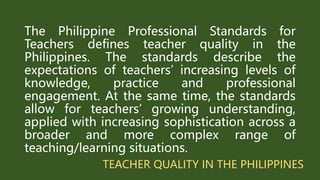
The Philippine Professional Standards for
Teachers defines teacher quality in the
Philippines. The standards describe the
expectations of teachers’ increasing levels of
knowledge, practice and professional
engagement. At the same time, the standards
allow for teachers’ growing understanding,
applied with increasing sophistication across a
broader and more complex range of
teaching/learning situations.
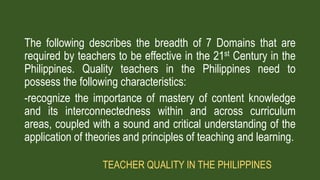
The following describes the breadth of 7 Domains that are
required by teachers to be effective in the 21st Century in the
Philippines. Quality teachers in the Philippines need to
possess the following characteristics:
-recognize the importance of mastery of content knowledge
and its interconnectedness within and across curriculum
areas, coupled with a sound and critical understanding of the
application of theories and principles of teaching and learning.
TEACHER QUALITY IN THE PHILIPPINES
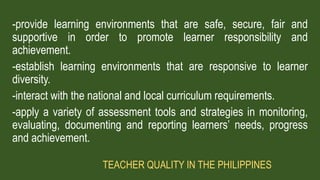
-provide learning environments that are safe, secure, fair and
supportive in order to promote learner responsibility and
achievement.
-establish learning environments that are responsive to learner
diversity.
-interact with the national and local curriculum requirements.
-apply a variety of assessment tools and strategies in monitoring,
evaluating, documenting and reporting learners’ needs, progress
and achievement.
TEACHER QUALITY IN THE PHILIPPINES
-establish school-community partnerships aimed at enriching
the learning environment, as well as the community’s
engagement in the educative process.
-value personal growth and professional development and
exhibit high personal regard for the profession by maintaining
qualities that uphold the dignity of teaching such as caring
attitude, respect and integrity.
TEACHER QUALITY IN THE PHILIPPINES
THE SEVEN DOMAINS
THE SEVEN DOMAINS
The 7 Domains collectively comprise 37
strands that refer to more specific dimensions
of teacher practices.
Domain 1, Content Knowledge and Pedagogy, is composed of
seven strands:
1. Content knowledge and its application within and across
curriculum areas
2. Research-based knowledge and principles of teaching and
learning
3. Positive use of ICT
4. Strategies for promoting literacy and numeracy
THE SEVEN DOMAINS
5. Strategies for developing critical and creative thinking, as
well as other higher-order thinking skills
6. Mother Tongue, Filipino and English in teaching and
learning Classroom communication strategies
7. Classroom Communication Strategies
THE SEVEN DOMAINS
Domain 2, Learning Environment, consists of six strands:
1. Learner safety and security
2. Fair learning environment
3. Management of classroom structure and activities
4. Support for learner participation
5. Promotion of purposive learning
6. Management of learner behavior
THE SEVEN DOMAINS
Domain 3, Diversity of Learners, consists of five strands:
1. Learners’ gender, needs, strengths, interests and
experiences
2. Learners’ linguistic, cultural, socio-economic and religious
backgrounds
3. Learners with disabilities, giftedness and talents
4. Learners in difficult circumstances
5. Learners from indigenous groups
THE SEVEN DOMAINS
Domain 4, Curriculum and Planning, includes five strands:
1. Planning and management of teaching and learning
process
2. Learning outcomes aligned with learning competencies
3. Relevance and responsiveness of learning programs
THE SEVEN DOMAINS
4. Professional collaboration to enrich teaching practice
5. Teaching and learning resources including ICT
THE SEVEN DOMAINS
Domain 5, Assessment and Reporting, is composed of five
strands:
1. Design, selection, organization and utilization of
assessment strategies
2. Monitoring and evaluation of learner progress and
achievement
3. Feedback to improve learning
THE SEVEN DOMAINS
4. Communication of learner needs, progress and
achievement to key stakeholders
5. Use of assessment data to enhance teaching and learning
practices and programs
THE SEVEN DOMAINS
Domain 6, Community Linkages and Professional
Engagement, consists of four strands:
1. Establishment of learning environments that are responsive
to community contexts
2. Engagement of parents and the wider school community in
the educative process
3. Professional ethics
4. School policies and procedures
THE SEVEN DOMAINS
Domain 7, Personal Growth and Professional
Development, contains five strands:
1. Philosophy of teaching
2. Dignity of teaching as a profession
3. Professional links with colleagues
4. Professional reflection and learning to improve practice
5. Professional development goals
THE SEVEN DOMAINS
CAREER STAGES
CAREER STAGES
Teacher professional development happens in
a continuum from beginning to exemplary
practice.
The following statements, which define the
work of teachers at different career stages,
make explicit the elements of high-quality
teaching for the 21st century. They comprise
descriptors that have been informed by
teachers’ understandings of what is required at
each of the four Career Stages.
Career Stage 1 or Beginning Teachers have gained the
qualifications recognized for entry into the teaching
profession. They have a strong understanding of the
subjects/areas in which they are trained in terms of content
knowledge and pedagogy. They possess the requisite
knowledge, skills and values that support the teaching and
learning process.
CAREER STAGES
They manage learning programs and have strategies that
promote learning based on the learning needs of their
students. They seek advice from experienced colleagues to
consolidate their teaching practice.
CAREER STAGES
Career Stage 2 or Proficient Teachers are professionally
independent in the application of skills vital to the teaching
and learning process. They provide focused teaching
programs that meet curriculum and assessment requirements.
They display skills in planning, implementing, and managing
learning programs.
CAREER STAGES
They actively engage in collaborative learning with the
professional community and other stakeholders for mutual
growth and advancement. They are reflective practitioners
who continually consolidate the knowledge, skills and
practices of Career Stage 1 teachers.
CAREER STAGES
Career Stage 3 or Highly Proficient Teachers consistently
display a high level of performance in their teaching practice.
They manifest an in-depth and sophisticated understanding of
the teaching and learning process. They have high education-
focused situation cognition, are more adept in problem solving
and optimize opportunities gained from experience.
CAREER STAGES
Career Stage 3 Teachers work collaboratively with colleagues
and provide them support and mentoring to enhance their
learning and practice. They continually seek to develop their

professional knowledge and practice by reflecting on their own
needs, and those of their colleagues and students.
CAREER STAGES
Career Stage 4 or Distinguished Teachers embody the highest
standard for teaching grounded in global best practices. They
exhibit exceptional capacity to improve their own teaching
practice and that of others. They are recognized as leaders in
education, contributors to the profession and initiators of
collaborations and partnerships. They create lifelong impact in
the lives of colleagues, students and others.
CAREER STAGES
They consistently seek professional advancement and
relevance in pursuit of teaching quality and excellence. They
exhibit commitment to inspire the education community and
stakeholders for the improvement of education provision in the
Philippines.
CAREER STAGES
THANK YOU FOR LISTENING!

Professional Education 2 The Teaching Profession

  • 1.
  • 2.
    OBJECTIVES: At the endof this module, the students are expected to: 1. Discuss the Philippine Professional Standards for Teacher. 2. Explain Career Stage 1-Beginning Teachers Competencies.
  • 3.
    TOPICS TO BEDISCUSS BY THE FACILITATORS: 1. DepEd Order #42 s, 2017 2. Role of Teachers 3. Professional Standards for Teacher 4. Teacher Quality in the Philippines 5. The 7 Domains 6. Career Stages
  • 4.
    DEPED ORDER #42, S. 2017 NATIONAL ADOPTION AND IMPLEMENTATION OF THE PHILIPPINE PROFESSIONAL STANDARDS FOR TEACHERS
  • 5.
    DepEd Order #42s, 2017 1. In line with the new professional standards for teachers, the Department of Education (DepEd), through the Teacher Education Council (TEC), issues this DepEd Order entitled National Adoption and Implementation of the Philippine Professional Standards for Teachers (PPST).
  • 6.
    2. The DepEdrecognizes the importance of professional standards in the continuing professional development and advancement of teachers based on the principle of lifelong learning. It is committed to supporting teachers, and taking cognizance of unequivocal evidence that good teachers are vital to raising student achievement. Quality learning is contingent upon quality teaching. Hence, enhancing teacher quality becomes of utmost importance for long term and sustainable nation building. DepEd Order #42 s, 2017
  • 7.
    3. The changesbrought about by various national and global frameworks such as the K to 12 Reform, ASEAN Integration, globalization, and the changing character of the 21st century learners necessitate the improvements and call for the rethinking of the National Competency-Based Teacher Standards (NCBTS); hence, the development of the PPST. DepEd Order #42 s, 2017
  • 8.
    4. The PPSTaims to: a. Set out clear expectations of teachers along well-defined career stages of professional development from beginning to distinguished practice; b. Engage teachers to actively embrace a continuing effort in attaining proficiency; and DepEd Order #42 s, 2017
  • 9.
    c. Apply auniform measure to assess teacher performance, identify needs, and provide support for professional development. d. Provides a basis for building public confidence in and support for the work of teachers. DepEd Order #42 s, 2017
  • 10.
    5. The PPSTshall be used as a basis for all learning and development programs for teachers to ensure that teachers are properly equipped to effectively implement the K to 12 Program. It can also be used for the selection and promotion of teachers. All performance appraisals for teachers shall be based on this set of standards. DepEd Order #42 s, 2017
  • 11.
    6. The regionaloffices shall be supported by their training and development personnel to organize and orient all the schools divisions within their jurisdiction for the PPST. In addition, it shall take charge of the monitoring and evaluation at the division level implementation. The schools division office shall have the same functions and responsibilities in the school districts and secondary schools. DepEd Order #42 s, 2017
  • 12.
    7. Reporting ofthe orientation and related activities shall be done by the regional office to the Office of the Secretary through the Teacher Education Council. DepEd Order #42 s, 2017
  • 13.
    8. Immediate disseminationof and strict compliance with this Order is directed. DepEd Order #42 s, 2017
  • 14.
  • 15.
    ROLE OF TEACHERS Teachersplay a crucial role in nation building. Through quality teachers, the Philippines can develop holistic learners who are steeped in values, equipped with 21st century skills, and able to propel the country to development and progress. This is in consonance with the Department of Education vision of producing: “Filipinos who passionately love their country and whose values and competencies enable them to realize their full potential and contribute meaningfully to building the nation” (DepED Order No. 36, s. 2013).
  • 16.
    Evidences show unequivocallythat good teachers are vital to raising student achievement, i.e., quality learning is contingent upon quality teaching. The changes brought about by various national and global frameworks such as the K to 12 Reform and the ASEAN integration, globalization, and the changing character of the 21st century learners necessitate improvement and adaptability of education, and a call for the rethinking of the current teacher standards. ROLE OF TEACHERS
  • 17.
  • 18.
    PROFESSIONAL STANDARDS FORTEACHER The Philippine Government has consistently pursued teacher quality reforms through a number of initiatives. As a framework of teacher quality, the National Competency- Based Teacher Standards (NCBTS) was institutionalized through CHED Memorandum Order No. 52, s. 2007 and DepED Order No. 32, s. 2009.
  • 19.
    It emerged aspart of the implementation of the Basic Education Sector Reform Agenda (BESRA), and was facilitated by drawing on the learning considerations of programs, such as the Basic Education Assistance for Mindanao (BEAM), the Strengthening Implementation of Visayas Education (STRIVE) project and the Third Elementary Education Project (TEEP). PROFESSIONAL STANDARDS FOR TEACHER
  • 20.
    The K to12 Reform (R.A. 10533) in 2013 has changed the landscape of teacher quality requirements in the Philippines. The reform process warrants an equivalent supportive focus on teacher quality – high quality teachers who are properly equipped and prepared to assume the roles and functions of a K to 12 teacher PROFESSIONAL STANDARDS FOR TEACHER
  • 21.
    The Philippine ProfessionalStandards for Teachers, which is built on NCBTS, complements the reform initiatives on teacher quality from pre-service education to in-service training. It articulates what constitutes teacher quality in the K to 12 Reform through well-defined domains, strands, and indicators that provide measures of professional learning, competent practice, and effective engagement. PROFESSIONAL STANDARDS FOR TEACHER
  • 22.
    This set ofstandards makes explicit what teachers should know, be able to do and value to achieve competence, improved student learning outcomes, and eventually quality education. It is founded on teaching philosophies of learner-centeredness, lifelong learning, and inclusivity/inclusiveness, among others. The professional standards, therefore, become a public statement of professional accountability that can help teachers reflect on and assess their own practices as they aspire for personal growth and professional development. PROFESSIONAL STANDARDS FOR TEACHER
  • 23.
    TEACHER QUALITY INTHE PHILIPPINES
  • 24.
    TEACHER QUALITY INTHE PHILIPPINES The Philippine Professional Standards for Teachers defines teacher quality in the Philippines. The standards describe the expectations of teachers’ increasing levels of knowledge, practice and professional engagement. At the same time, the standards allow for teachers’ growing understanding, applied with increasing sophistication across a broader and more complex range of teaching/learning situations.
  • 25.
    The following describesthe breadth of 7 Domains that are required by teachers to be effective in the 21st Century in the Philippines. Quality teachers in the Philippines need to possess the following characteristics: -recognize the importance of mastery of content knowledge and its interconnectedness within and across curriculum areas, coupled with a sound and critical understanding of the application of theories and principles of teaching and learning. TEACHER QUALITY IN THE PHILIPPINES
  • 26.
    -provide learning environmentsthat are safe, secure, fair and supportive in order to promote learner responsibility and achievement. -establish learning environments that are responsive to learner diversity. -interact with the national and local curriculum requirements. -apply a variety of assessment tools and strategies in monitoring, evaluating, documenting and reporting learners’ needs, progress and achievement. TEACHER QUALITY IN THE PHILIPPINES
  • 27.
    -establish school-community partnershipsaimed at enriching the learning environment, as well as the community’s engagement in the educative process. -value personal growth and professional development and exhibit high personal regard for the profession by maintaining qualities that uphold the dignity of teaching such as caring attitude, respect and integrity. TEACHER QUALITY IN THE PHILIPPINES
  • 28.
  • 29.
    THE SEVEN DOMAINS The7 Domains collectively comprise 37 strands that refer to more specific dimensions of teacher practices.
  • 30.
    Domain 1, ContentKnowledge and Pedagogy, is composed of seven strands: 1. Content knowledge and its application within and across curriculum areas 2. Research-based knowledge and principles of teaching and learning 3. Positive use of ICT 4. Strategies for promoting literacy and numeracy THE SEVEN DOMAINS
  • 31.
    5. Strategies fordeveloping critical and creative thinking, as well as other higher-order thinking skills 6. Mother Tongue, Filipino and English in teaching and learning Classroom communication strategies 7. Classroom Communication Strategies THE SEVEN DOMAINS
  • 32.
    Domain 2, LearningEnvironment, consists of six strands: 1. Learner safety and security 2. Fair learning environment 3. Management of classroom structure and activities 4. Support for learner participation 5. Promotion of purposive learning 6. Management of learner behavior THE SEVEN DOMAINS
  • 33.
    Domain 3, Diversityof Learners, consists of five strands: 1. Learners’ gender, needs, strengths, interests and experiences 2. Learners’ linguistic, cultural, socio-economic and religious backgrounds 3. Learners with disabilities, giftedness and talents 4. Learners in difficult circumstances 5. Learners from indigenous groups THE SEVEN DOMAINS
  • 34.
    Domain 4, Curriculumand Planning, includes five strands: 1. Planning and management of teaching and learning process 2. Learning outcomes aligned with learning competencies 3. Relevance and responsiveness of learning programs THE SEVEN DOMAINS
  • 35.
    4. Professional collaborationto enrich teaching practice 5. Teaching and learning resources including ICT THE SEVEN DOMAINS
  • 36.
    Domain 5, Assessmentand Reporting, is composed of five strands: 1. Design, selection, organization and utilization of assessment strategies 2. Monitoring and evaluation of learner progress and achievement 3. Feedback to improve learning THE SEVEN DOMAINS
  • 37.
    4. Communication oflearner needs, progress and achievement to key stakeholders 5. Use of assessment data to enhance teaching and learning practices and programs THE SEVEN DOMAINS
  • 38.
    Domain 6, CommunityLinkages and Professional Engagement, consists of four strands: 1. Establishment of learning environments that are responsive to community contexts 2. Engagement of parents and the wider school community in the educative process 3. Professional ethics 4. School policies and procedures THE SEVEN DOMAINS
  • 39.
    Domain 7, PersonalGrowth and Professional Development, contains five strands: 1. Philosophy of teaching 2. Dignity of teaching as a profession 3. Professional links with colleagues 4. Professional reflection and learning to improve practice 5. Professional development goals THE SEVEN DOMAINS
  • 40.
  • 41.
    CAREER STAGES Teacher professionaldevelopment happens in a continuum from beginning to exemplary practice. The following statements, which define the work of teachers at different career stages, make explicit the elements of high-quality teaching for the 21st century. They comprise descriptors that have been informed by teachers’ understandings of what is required at each of the four Career Stages.
  • 42.
    Career Stage 1or Beginning Teachers have gained the qualifications recognized for entry into the teaching profession. They have a strong understanding of the subjects/areas in which they are trained in terms of content knowledge and pedagogy. They possess the requisite knowledge, skills and values that support the teaching and learning process. CAREER STAGES
  • 43.
    They manage learningprograms and have strategies that promote learning based on the learning needs of their students. They seek advice from experienced colleagues to consolidate their teaching practice. CAREER STAGES
  • 44.
    Career Stage 2or Proficient Teachers are professionally independent in the application of skills vital to the teaching and learning process. They provide focused teaching programs that meet curriculum and assessment requirements. They display skills in planning, implementing, and managing learning programs. CAREER STAGES
  • 45.
    They actively engagein collaborative learning with the professional community and other stakeholders for mutual growth and advancement. They are reflective practitioners who continually consolidate the knowledge, skills and practices of Career Stage 1 teachers. CAREER STAGES
  • 46.
    Career Stage 3or Highly Proficient Teachers consistently display a high level of performance in their teaching practice. They manifest an in-depth and sophisticated understanding of the teaching and learning process. They have high education- focused situation cognition, are more adept in problem solving and optimize opportunities gained from experience. CAREER STAGES
  • 47.
    Career Stage 3Teachers work collaboratively with colleagues and provide them support and mentoring to enhance their learning and practice. They continually seek to develop their professional knowledge and practice by reflecting on their own needs, and those of their colleagues and students. CAREER STAGES
  • 48.
    Career Stage 4or Distinguished Teachers embody the highest standard for teaching grounded in global best practices. They exhibit exceptional capacity to improve their own teaching practice and that of others. They are recognized as leaders in education, contributors to the profession and initiators of collaborations and partnerships. They create lifelong impact in the lives of colleagues, students and others. CAREER STAGES
  • 49.
    They consistently seekprofessional advancement and relevance in pursuit of teaching quality and excellence. They exhibit commitment to inspire the education community and stakeholders for the improvement of education provision in the Philippines. CAREER STAGES
  • 50.
    THANK YOU FORLISTENING!