A Supersonic
Introduction to Social
Entrepreneurship
Michael D. DeLapa
DeLapa Consulting
www.mdelapa.com
April 2015
Innovative Solutions to
Social Problems
Entrepreneur
• Opportunities
• See
• Seize
• Create
• Risks
• Whatever (but not really)
Today
• What is a social entrepreneur
• How does entrepreneurship work
• What skills are needed
• LandWatch case study
• What I have learned
• Questions & discussion: opportunities for social change in
Rome
I’m curious …
• Something is screwed up
• Someone should do something about it
• I wonder why no one hasn’t?
“Heroes are not giant statues framed against a
red sky. They are people who say; This is my
community, and it’s my responsibility to make
it better.” – Tom McCall
What is a social entrepreneur?
Social entrepreneurs are individuals with innovative
solutions to society's most pressing social problems. [They
are ambitious and persistent, tackling major social issues
and offering new ideas for wide-scale change.]
Ashoka (innovators for the public)
[https://www.ashoka.org/social_entrepreneur]
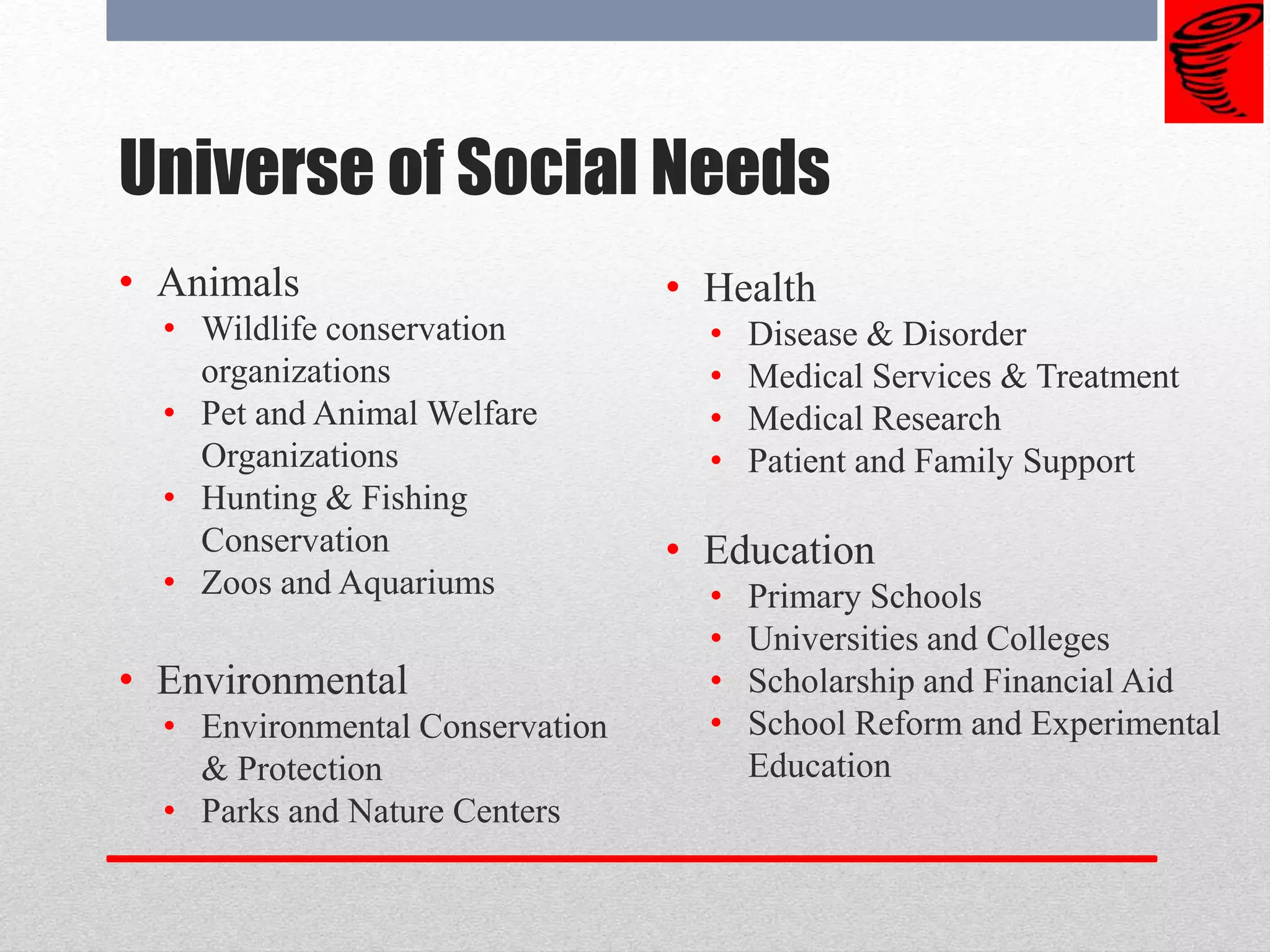
Universe of Social Needs
• Animals
• Wildlife conservation
organizations
• Pet and Animal Welfare
Organizations
• Hunting & Fishing
Conservation
• Zoos and Aquariums
• Environmental
• Environmental Conservation
& Protection
• Parks and Nature Centers
• Health
• Disease & Disorder
• Medical Services & Treatment
• Medical Research
• Patient and Family Support
• Education
• Primary Schools
• Universities and Colleges
• Scholarship and Financial Aid
• School Reform and Experimental
Education
Universe of Need (more …)
• International
• Development
• Disaster Relief &
Humanitarian
• Peace & Human Rights
• Conservation
• Child Sponsorship
• Arts & Culture
• Museums & Art Galleries
• Performing Arts
• Libraries & Historical Societies
• Public Broadcasting and Media
• More
• Youth
• Seniors
• Law & civil rights
• Sports
http://topnonprofits.com/lists/types-of-charities/
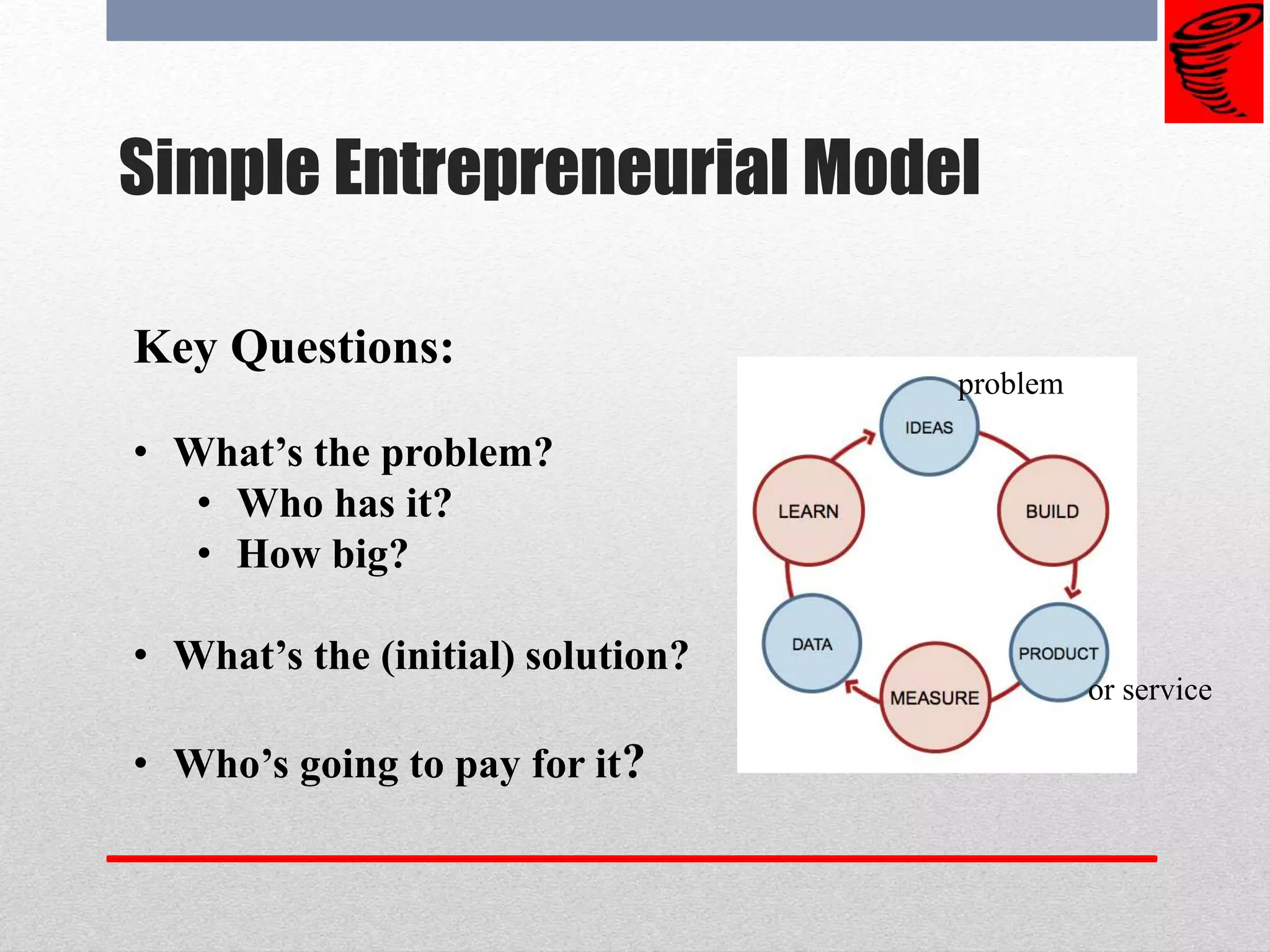
Simple Entrepreneurial Model
or service
Key Questions:
• What’s the problem?
• Who has it?
• How big?
• What’s the (initial) solution?
• Who’s going to pay for it?
problem
Key Skills of an Entrepreneur
• Reading, analysis, & critical thinking
• Communication, writing & public speaking
• Fundraising
• Accounting & financial management
• Project/product management
• Sales, marketing, creativity & persuasion
• Human relations, team-building & motivation
• But …
•Tenacity
One path … mine
• High school - Study & compete
• College - Think critically
• First job - Live independently & lead
• MBA - Management & networking
• Politics – Get things done
• “Sea Studios” - Filmmaking, community organizing &
environmental entrepreneurship
• “Silicon Valley” - Technology entrepreneurship,
consulting & coaching
• Rome – Exploration, learning & consulting
Your path
• Different from mine
• No “right” path
• More is better
• Skills
• Languages
• Experiences
• Professional contacts (“friends”)
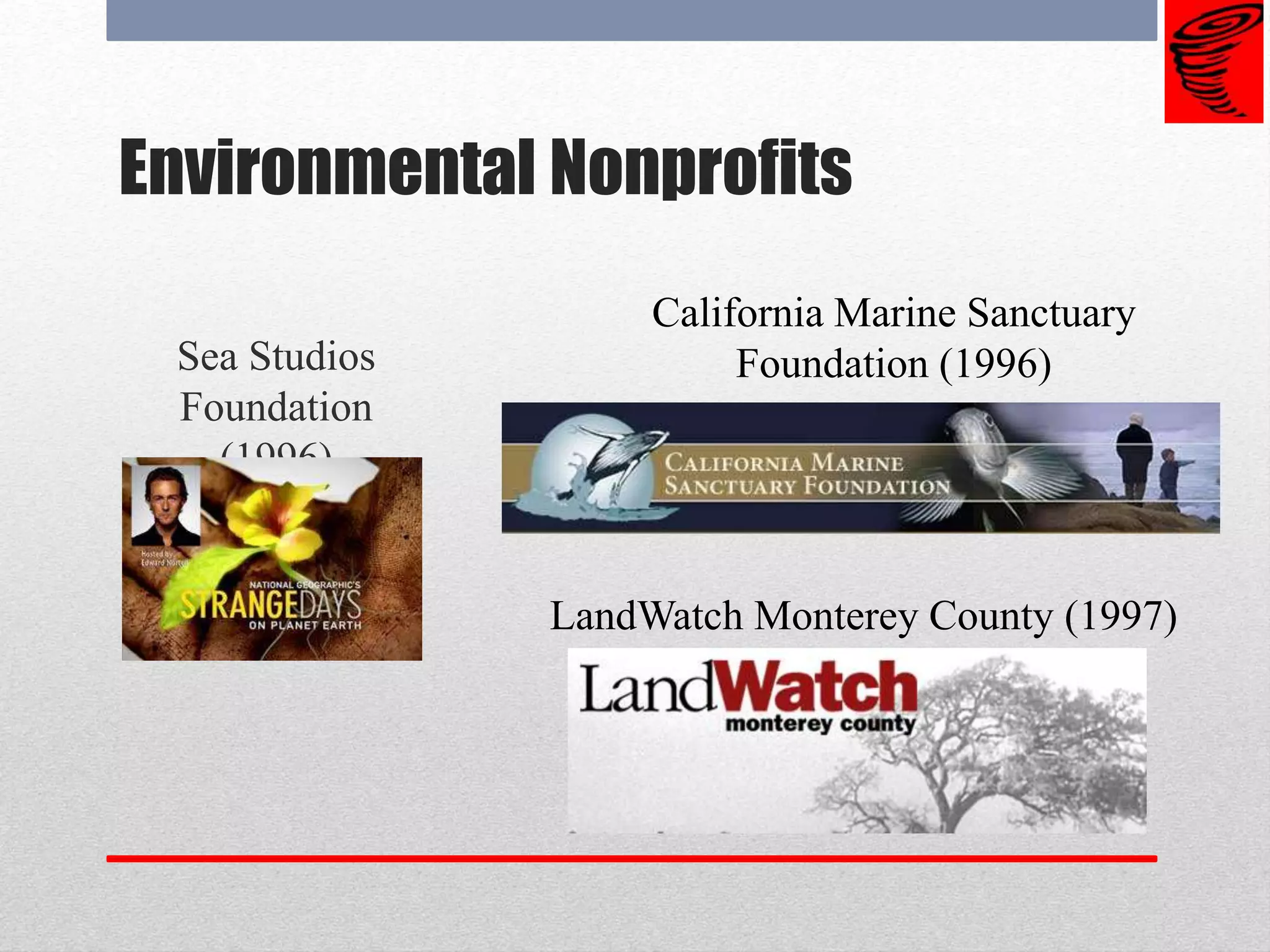
Environmental Nonprofits
Sea Studios
Foundation
(1996)
California Marine Sanctuary
Foundation (1996)
LandWatch Monterey County (1997)
Case Study – LandWatch 1997
• Problem: Sprawl
• Solution: Citizen involvement
Sprawl ➜loss of farmland & o.s.
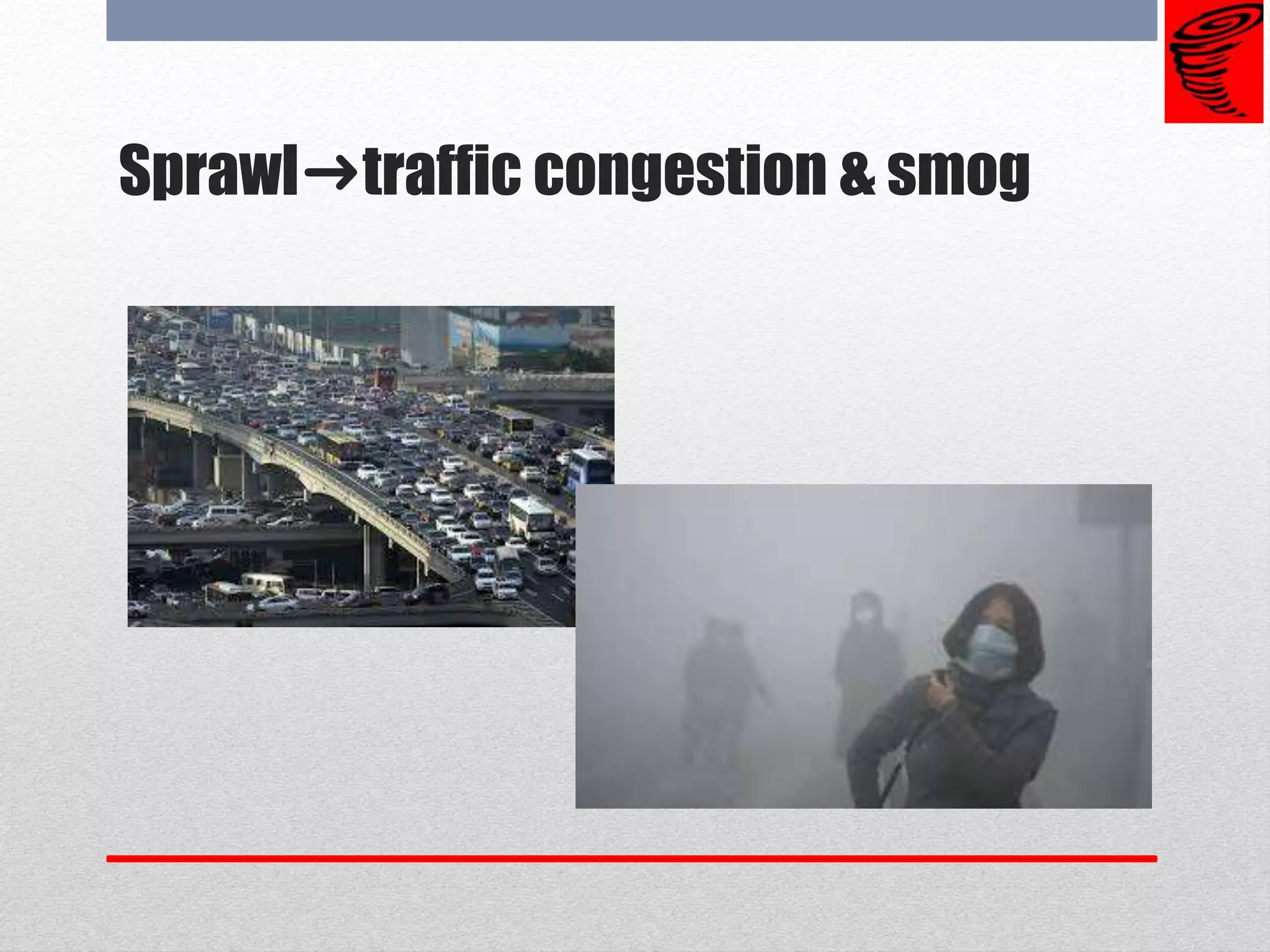
Sprawl➜traffic congestion & smog
Sprawl is the problem, but why?
• Bad planning
• Developers who have money
• Unaware voters
• Unaccountable elected officials
• Mis-representative government
• Who has it? How big?
• Everywhere in California (and most of America).
What’s the solution?
• Smart growth policies
• Professional staff to watchdog
• Organized citizens to exert political pressure (counter $)
• Transparency and light
Who’s going to pay
• First money – visionaries
• Second money – foundations
• Persistent money - individuals
Why has it been successful for ~ 20
years?
• Compelling, persistent problem
• Great leadership
• Fundraising
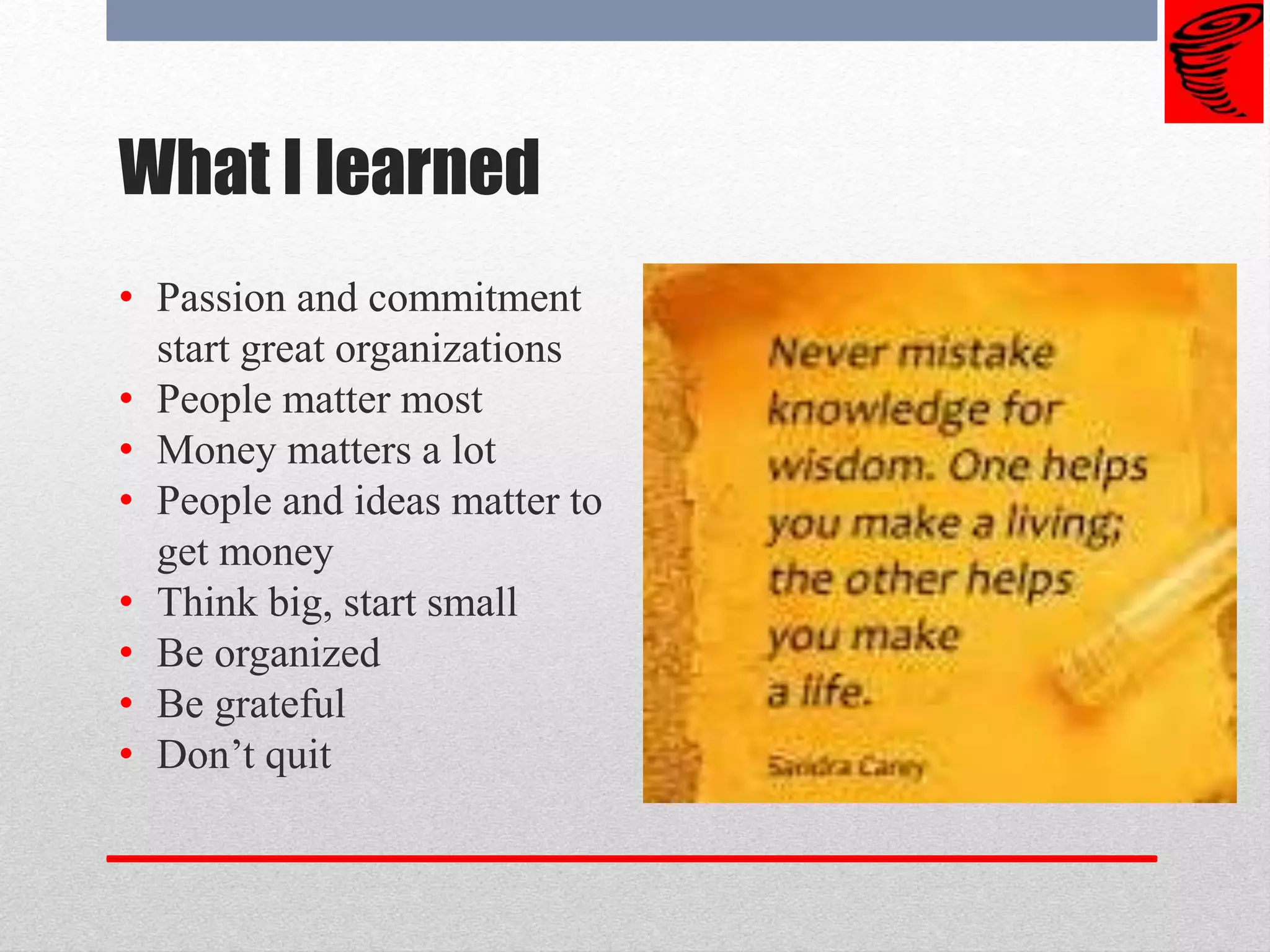
What I learned
• Passion and commitment
start great organizations
• People matter most
• Money matters a lot
• People and ideas matter to
get money
• Think big, start small
• Be organized
• Be grateful
• Don’t quit
Do what you enjoy
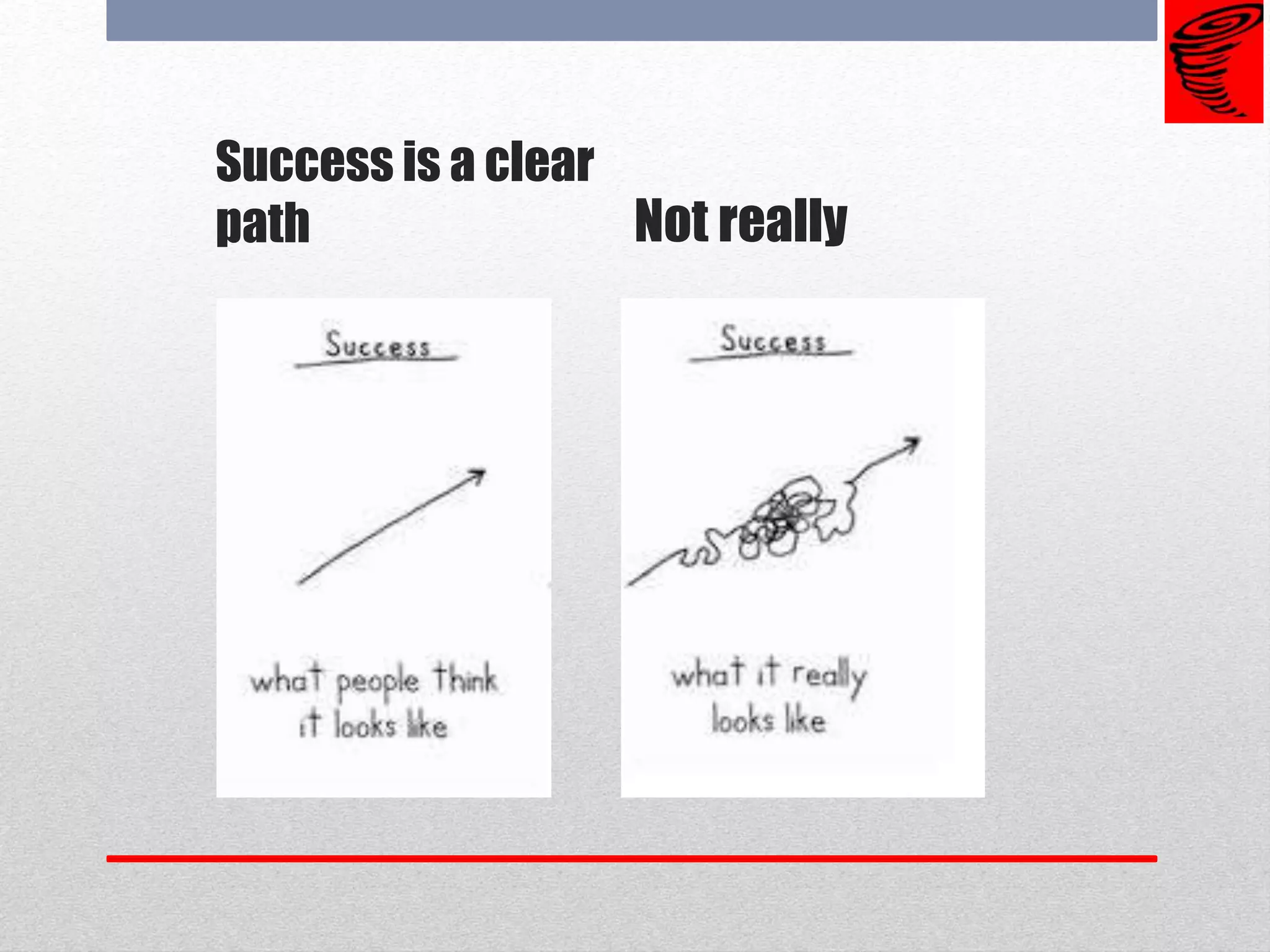
Success is a clear
path Not really
Failure is critical to success
Finito
• Questions?
• What needs do you see for social change in Rome?
• What’s your idea for a social enterprise?
• Further reading.
My ideas
• Clean up the Tiber
• Raise awareness about litter
• Develop public sand volleyball courts
• Nonprofit to support public spaces (e.g., parks)
• Create a culture of giving by reforming laws to encourage
tax-deductible gift
Further Reading & Watching
• Washington: A Life (Ron Chernow)
• Desert Solitaire (Edward Abbey)
• A Soldier of the Great War (Mark Helprin)
• The River Why (David James Duncan)
• Timmy and Rocky, The Short and Long of It (DeLapa
Consulting Blog)
• 10 Most Important Books That You Don’t Read in High
School (DeLapa Consulting Blog)
• “Inspiration” Tag (DeLapa Consulting Blog)
Further Reading & Watching
• Man’s Search for Meaning (Viktor Frankl)
• The Last Lecture (Randy Pausch and Jeffrey Zaslow)
• Randy Pausch Last Lecture: Achieving Your Childhood
Dreams (video on YouTube)
• Zen and the Art of Motorcycle Maintenance: An Inquiry
Into Values (Robert M. Pirsig)
• 3 Things I Learned While My Plane Crashed (Ric Elias
video on Ted.com)

Supersonic Introduction to Social Entrepreneurship

  • 1.
    A Supersonic Introduction toSocial Entrepreneurship Michael D. DeLapa DeLapa Consulting www.mdelapa.com April 2015 Innovative Solutions to Social Problems
  • 2.
    Entrepreneur • Opportunities • See •Seize • Create • Risks • Whatever (but not really)
  • 3.
    Today • What isa social entrepreneur • How does entrepreneurship work • What skills are needed • LandWatch case study • What I have learned • Questions & discussion: opportunities for social change in Rome
  • 4.
    I’m curious … •Something is screwed up • Someone should do something about it • I wonder why no one hasn’t? “Heroes are not giant statues framed against a red sky. They are people who say; This is my community, and it’s my responsibility to make it better.” – Tom McCall
  • 5.
    What is asocial entrepreneur? Social entrepreneurs are individuals with innovative solutions to society's most pressing social problems. [They are ambitious and persistent, tackling major social issues and offering new ideas for wide-scale change.] Ashoka (innovators for the public) [https://www.ashoka.org/social_entrepreneur]
  • 6.
    Universe of SocialNeeds • Animals • Wildlife conservation organizations • Pet and Animal Welfare Organizations • Hunting & Fishing Conservation • Zoos and Aquariums • Environmental • Environmental Conservation & Protection • Parks and Nature Centers • Health • Disease & Disorder • Medical Services & Treatment • Medical Research • Patient and Family Support • Education • Primary Schools • Universities and Colleges • Scholarship and Financial Aid • School Reform and Experimental Education
  • 7.
    Universe of Need(more …) • International • Development • Disaster Relief & Humanitarian • Peace & Human Rights • Conservation • Child Sponsorship • Arts & Culture • Museums & Art Galleries • Performing Arts • Libraries & Historical Societies • Public Broadcasting and Media • More • Youth • Seniors • Law & civil rights • Sports http://topnonprofits.com/lists/types-of-charities/
  • 8.
    Simple Entrepreneurial Model orservice Key Questions: • What’s the problem? • Who has it? • How big? • What’s the (initial) solution? • Who’s going to pay for it? problem
  • 9.
    Key Skills ofan Entrepreneur • Reading, analysis, & critical thinking • Communication, writing & public speaking • Fundraising • Accounting & financial management • Project/product management • Sales, marketing, creativity & persuasion • Human relations, team-building & motivation • But … •Tenacity
  • 10.
    One path …mine • High school - Study & compete • College - Think critically • First job - Live independently & lead • MBA - Management & networking • Politics – Get things done • “Sea Studios” - Filmmaking, community organizing & environmental entrepreneurship • “Silicon Valley” - Technology entrepreneurship, consulting & coaching • Rome – Exploration, learning & consulting
  • 11.
    Your path • Differentfrom mine • No “right” path • More is better • Skills • Languages • Experiences • Professional contacts (“friends”)
  • 12.
    Environmental Nonprofits Sea Studios Foundation (1996) CaliforniaMarine Sanctuary Foundation (1996) LandWatch Monterey County (1997)
  • 13.
    Case Study –LandWatch 1997 • Problem: Sprawl • Solution: Citizen involvement
  • 14.
    Sprawl ➜loss offarmland & o.s.
  • 15.
  • 16.
    Sprawl is theproblem, but why? • Bad planning • Developers who have money • Unaware voters • Unaccountable elected officials • Mis-representative government • Who has it? How big? • Everywhere in California (and most of America).
  • 17.
    What’s the solution? •Smart growth policies • Professional staff to watchdog • Organized citizens to exert political pressure (counter $) • Transparency and light
  • 18.
    Who’s going topay • First money – visionaries • Second money – foundations • Persistent money - individuals
  • 19.
    Why has itbeen successful for ~ 20 years? • Compelling, persistent problem • Great leadership • Fundraising
  • 20.
    What I learned •Passion and commitment start great organizations • People matter most • Money matters a lot • People and ideas matter to get money • Think big, start small • Be organized • Be grateful • Don’t quit
  • 21.
  • 22.
    Success is aclear path Not really
  • 23.
  • 24.
    Finito • Questions? • Whatneeds do you see for social change in Rome? • What’s your idea for a social enterprise? • Further reading.
  • 25.
    My ideas • Cleanup the Tiber • Raise awareness about litter • Develop public sand volleyball courts • Nonprofit to support public spaces (e.g., parks) • Create a culture of giving by reforming laws to encourage tax-deductible gift
  • 26.
    Further Reading &Watching • Washington: A Life (Ron Chernow) • Desert Solitaire (Edward Abbey) • A Soldier of the Great War (Mark Helprin) • The River Why (David James Duncan) • Timmy and Rocky, The Short and Long of It (DeLapa Consulting Blog) • 10 Most Important Books That You Don’t Read in High School (DeLapa Consulting Blog) • “Inspiration” Tag (DeLapa Consulting Blog)
  • 27.
    Further Reading &Watching • Man’s Search for Meaning (Viktor Frankl) • The Last Lecture (Randy Pausch and Jeffrey Zaslow) • Randy Pausch Last Lecture: Achieving Your Childhood Dreams (video on YouTube) • Zen and the Art of Motorcycle Maintenance: An Inquiry Into Values (Robert M. Pirsig) • 3 Things I Learned While My Plane Crashed (Ric Elias video on Ted.com)

Editor's Notes

  • #2 Good morning. I’ve very happy to here today to talk with you about entrepreneurship. While I’ll be focusing on social entrepreneurship, much of what I’ll say also applies to for-profit entrepreneurs.   This is actually my fourth time in front of St. Stephen’s students. I first substituted as a PE teacher. Then I led a basketball clinic. And after that I talk two classes of environmental science. And now I’m here in front of the entire school.   And that’s a bit of a metaphor about how entrepreneurship works. You see an opportunity and take it. And then you see another one. And the next thing you know, you’ve got a big opportunity.   So what’s next? Well, as an entrepreneur I think, maybe I’ll start my own school. Don’t worry Mr. Mayer, it won’t be in Rome because you’re doing such a great job with St. Stephen’s.
  • #3  Every opportunity leads to something new. Entrepreneurs see and seize opportunities. And that’s why I’m excited to talk with you about the newness of social entrepreneurship.
  • #4 We have limited time, so today will be a quick overview of the topic.
  • #5 Who has ever thought
  • #6 Solutions don’t need to be the most innovative, but they need to be effective Social problems don’t need to be most pressing, but they need to be important
  • #9 Iteration Ideas, solutions evolve Learning critical
  • #13 Most of my experience is with environmental startups – that is, organizations that aim to improve the natural environment and consequently human health and well being Founded three within a two year period, but I’ve served on the board of many others, seen organizations thrive and fail
  • #14 Overview History: Founded in 1997, conceived in 1989 Vision: Model for county-level smart growth Mission: See above What did we see in 1989?
  • #15 Struggle throughout California for the preservation of farmland and open space. Generally, being lost to development that is called “sprawl.” What you would visual when you think of Los Angeles.
  • #16 Related to sprawl is transportation. Sprawl creates traffic congestions, and it makes public transportation difficult or impossible.
  • #19 Big question Peter/Gillian story Packard Today
  • #23 How did I become a social entrepreneur? What skills does it require?