A panel discussion with Marty Martin of the Martin Law Firm, Dan Moore of the Redwoods Group and Jeff Stern of TROSA August 11, 2011  Session Two: How do organizations pursue social enterprise? Social Enterprise: Expanding Philanthropy's Boundaries (II)
How could we pursue Social Enterprise? Please have questions ready for the panel – your participation helps us! Reviewing terms and legal forms Examples of success Panel Discussion
Social Enterprise:  an organization or venture that achieves its primary social or environmental mission using business methods. Definition from the Social Enterprise Alliance
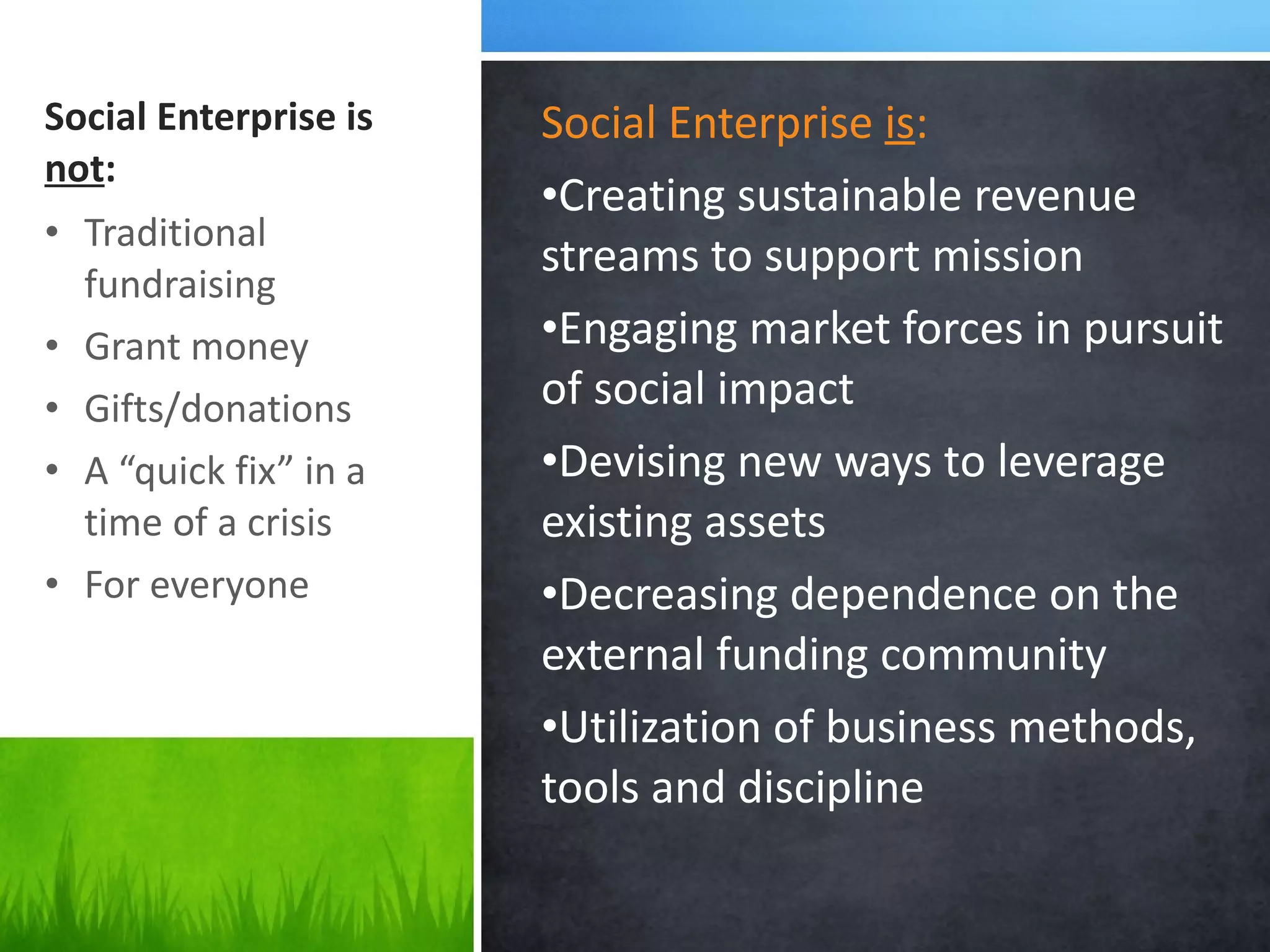
Social Enterprise is  not : Social Enterprise  is : Creating sustainable revenue streams to support mission Engaging market forces in pursuit of social impact Devising new ways to leverage  existing assets  Decreasing dependence on the external funding community Utilization of business methods, tools and discipline Traditional fundraising Grant money Gifts/donations A  “quick fix” in a time of a crisis  For everyone
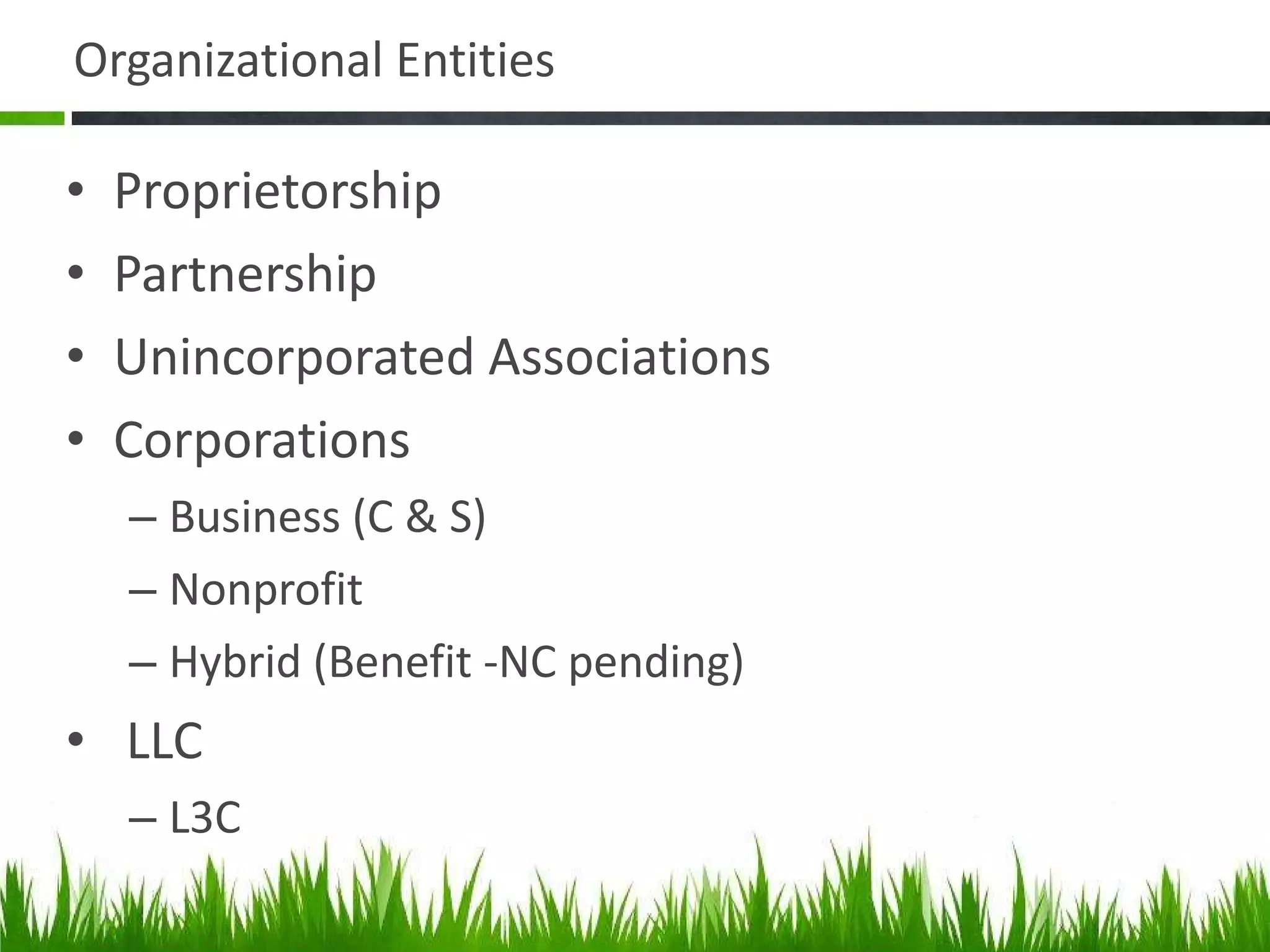
Organizational Entities Proprietorship Partnership Unincorporated Associations Corporations Business (C & S)  Nonprofit Hybrid (Benefit -NC pending) LLC L3C
Examples of Success What does a successful social enterprise look like? We have two on this panel…
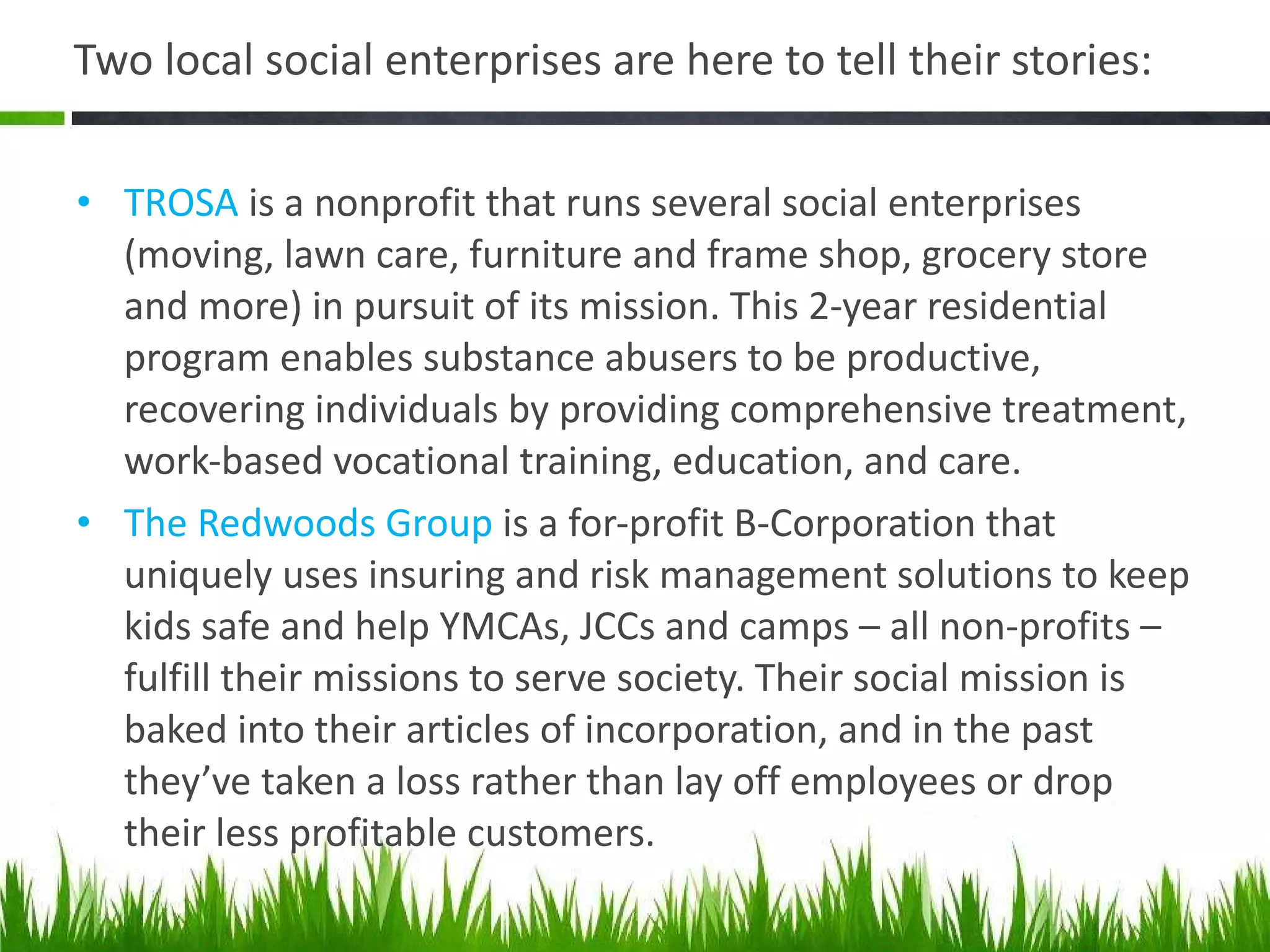
Two local social enterprises are here to tell their stories: TROSA  is a nonprofit that runs several social enterprises (moving, lawn care, furniture and frame shop, grocery store and more) in pursuit of its mission. This 2-year residential program enables substance abusers to be productive, recovering individuals by providing comprehensive treatment, work-based vocational training, education, and care.  The Redwoods Group  is a for-profit B-Corporation that uniquely uses insuring and risk management solutions to keep kids safe and help YMCAs, JCCs and camps – all non-profits – fulfill their missions to serve society. Their social mission is baked into their articles of incorporation, and in the past they’ve taken a loss rather than lay off employees or drop their less profitable customers.
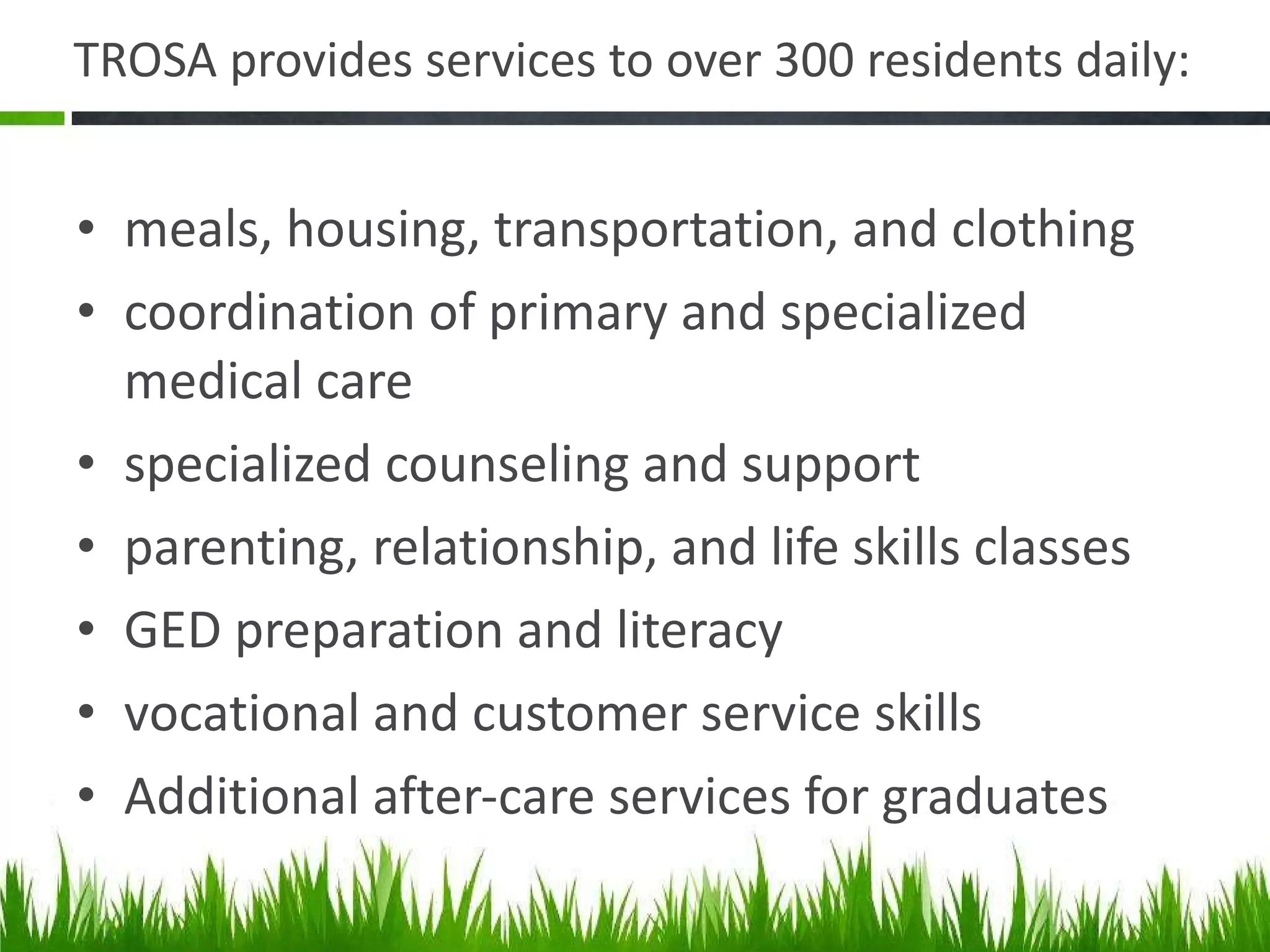
TROSA provides services to over 300 residents daily: meals, housing, transportation, and clothing coordination of primary and specialized medical care specialized counseling and support parenting, relationship, and life skills classes GED preparation and literacy vocational and customer service skills Additional after-care services for graduates
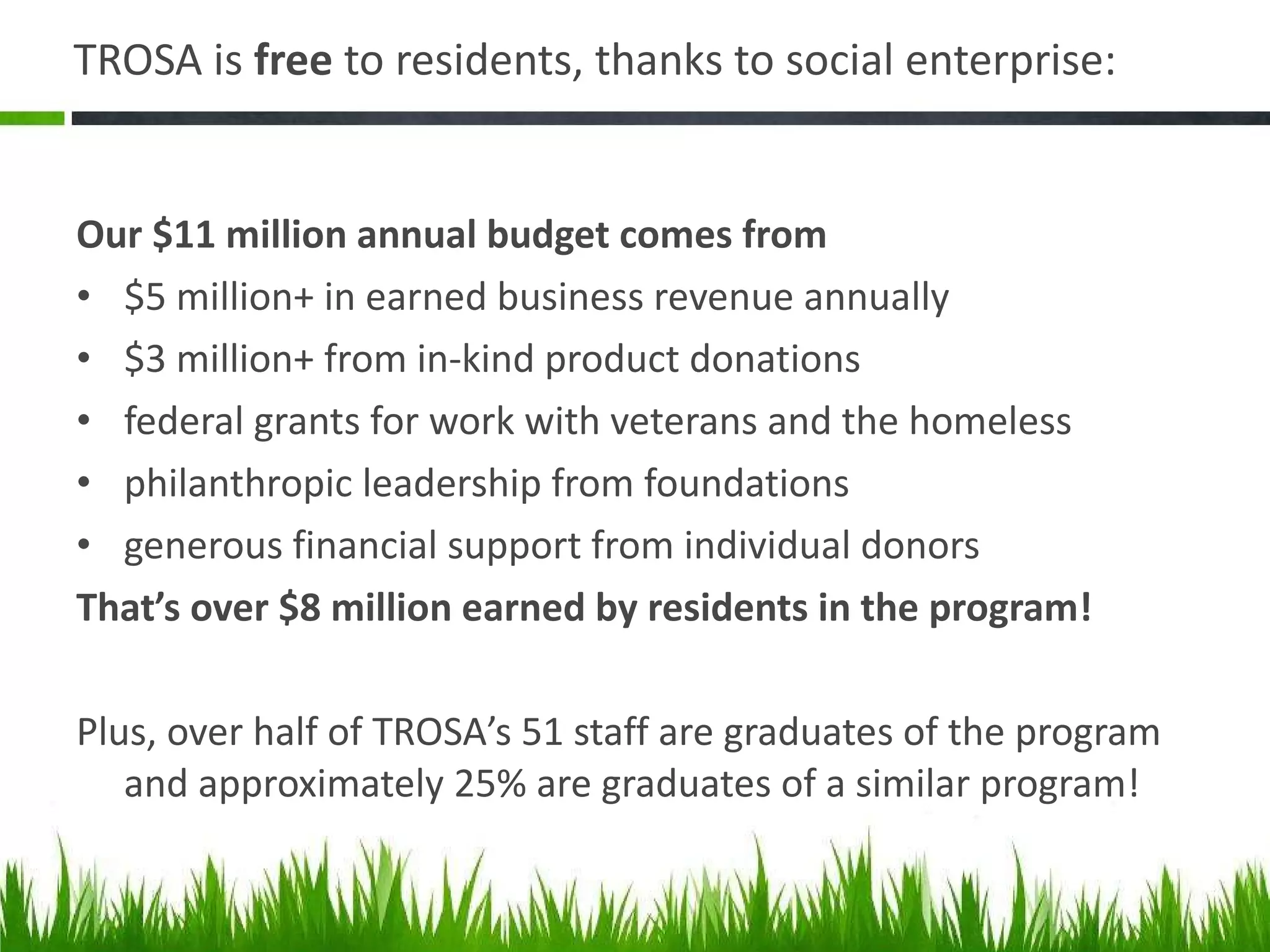
TROSA is  free  to residents, thanks to social enterprise: Our $11 million annual budget comes from $5 million+ in earned business revenue annually $3 million+ from in-kind product donations federal grants for work with veterans and the homeless philanthropic leadership from foundations generous financial support from individual donors That ’s over $8 million earned by residents in the program! Plus, over half of TROSA ’s 51 staff are graduates of the program and approximately 25% are graduates of a similar program!
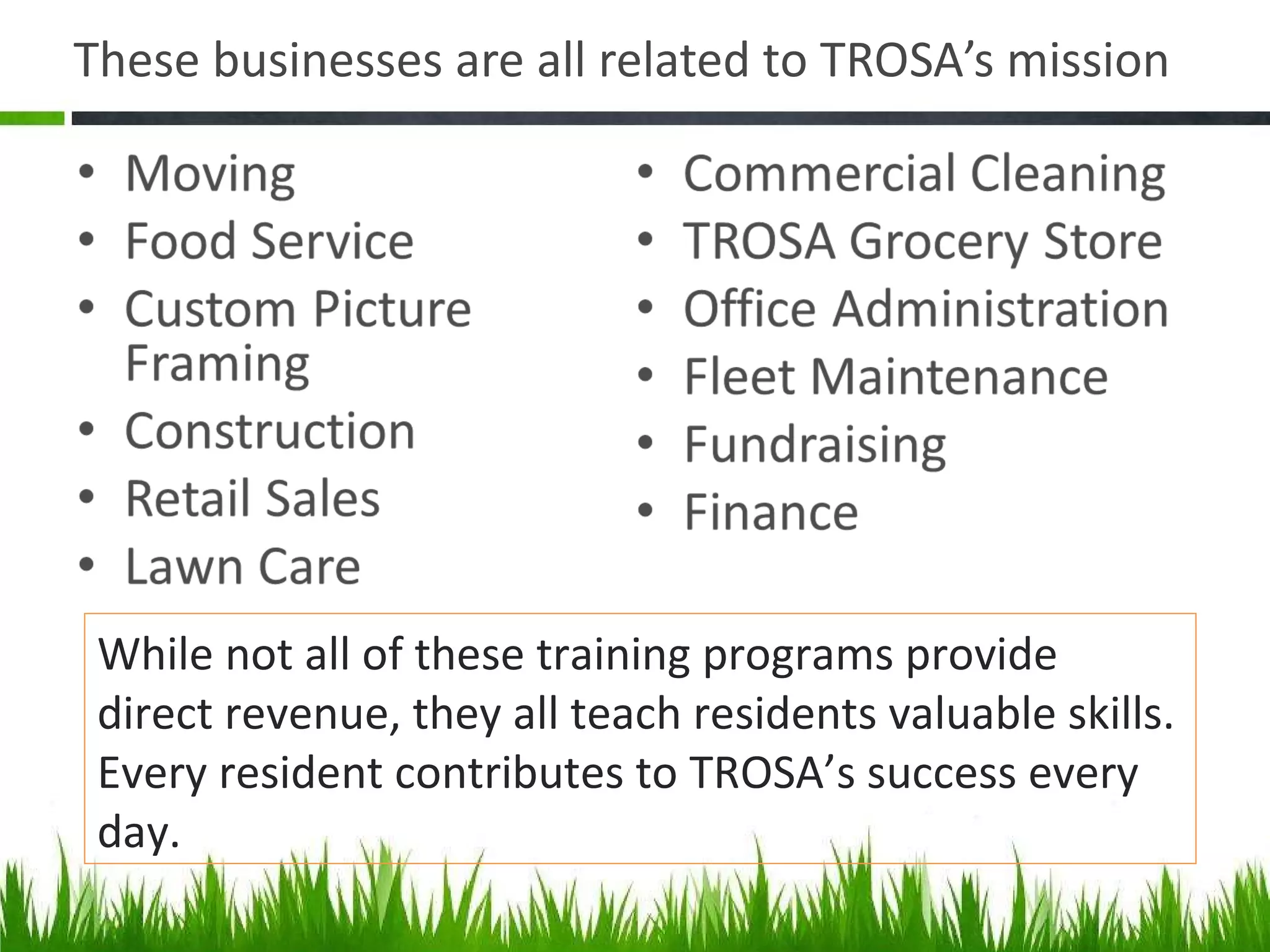
These businesses are all related to TROSA ’s mission While not all of these training programs provide direct revenue, they all teach residents valuable skills. Every resident contributes to TROSA ’s success every day.
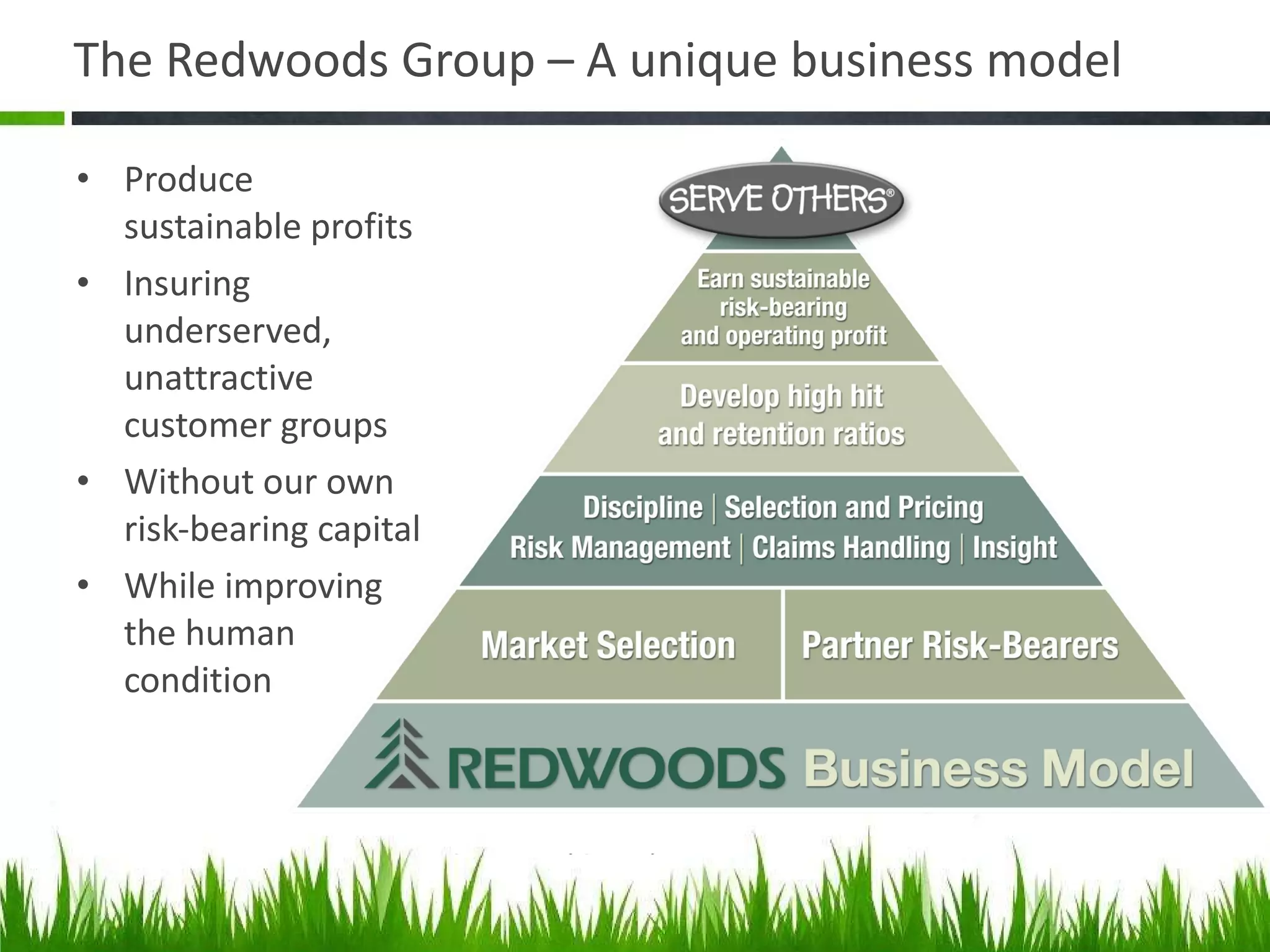
The Redwoods Group – A unique business model Produce sustainable profits Insuring underserved, unattractive customer groups Without our own risk-bearing capital While improving the human condition
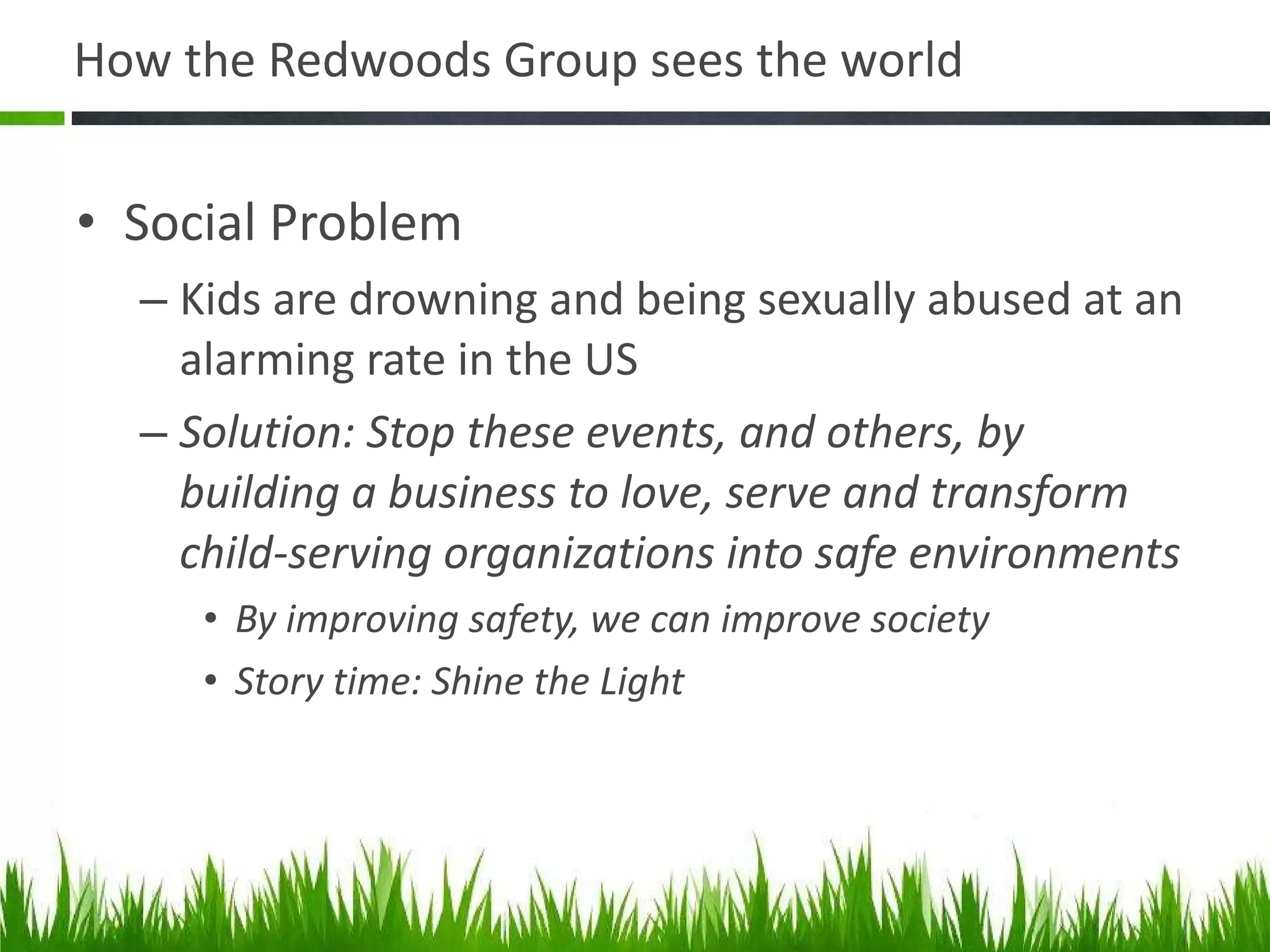
How the Redwoods Group sees the world Social Problem Kids are drowning and being sexually abused at an alarming rate in the US Solution: Stop these events, and others, by building a business to love, serve and transform child-serving organizations into safe environments By improving safety, we can improve society Story time: Shine the Light
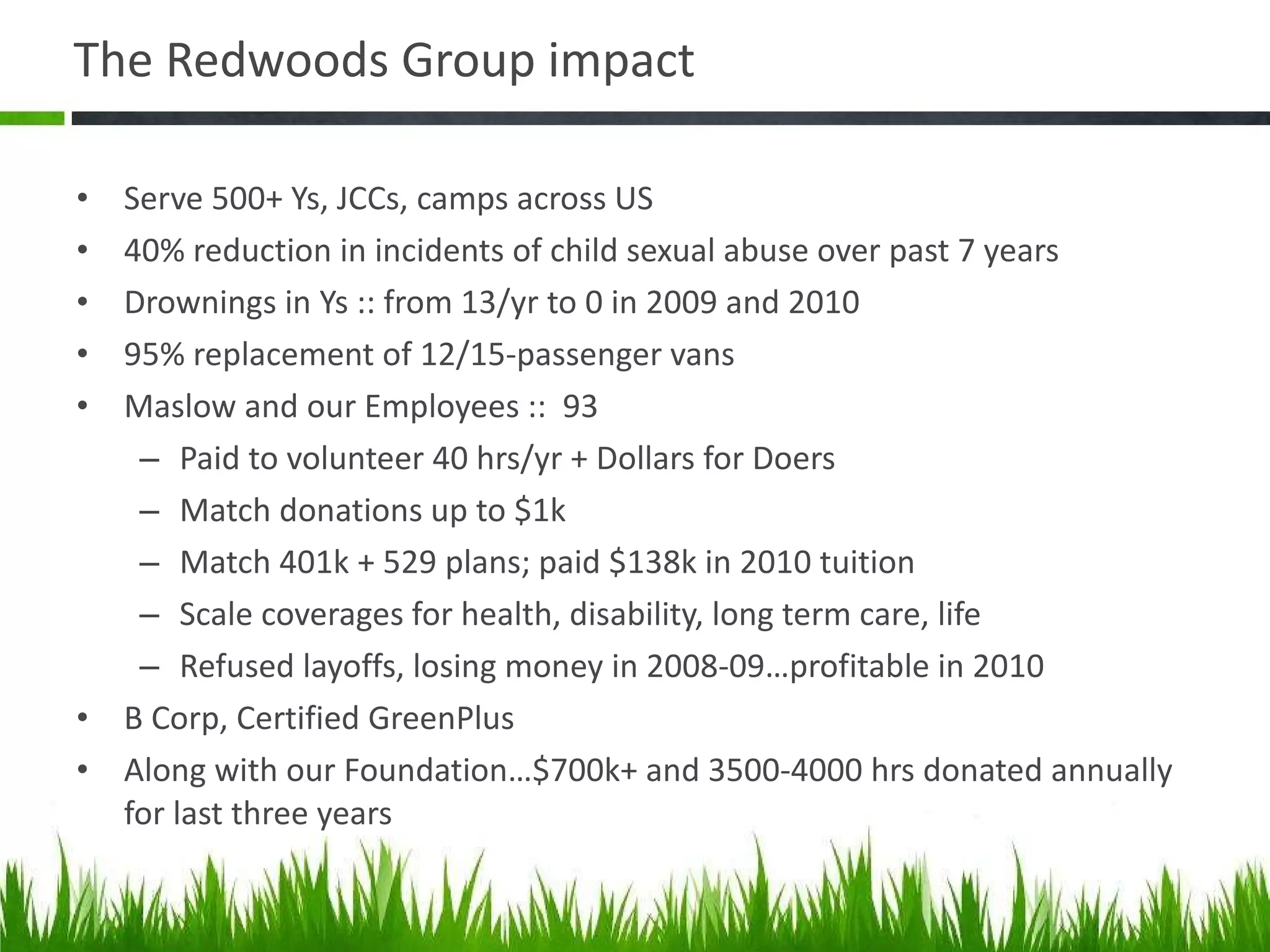
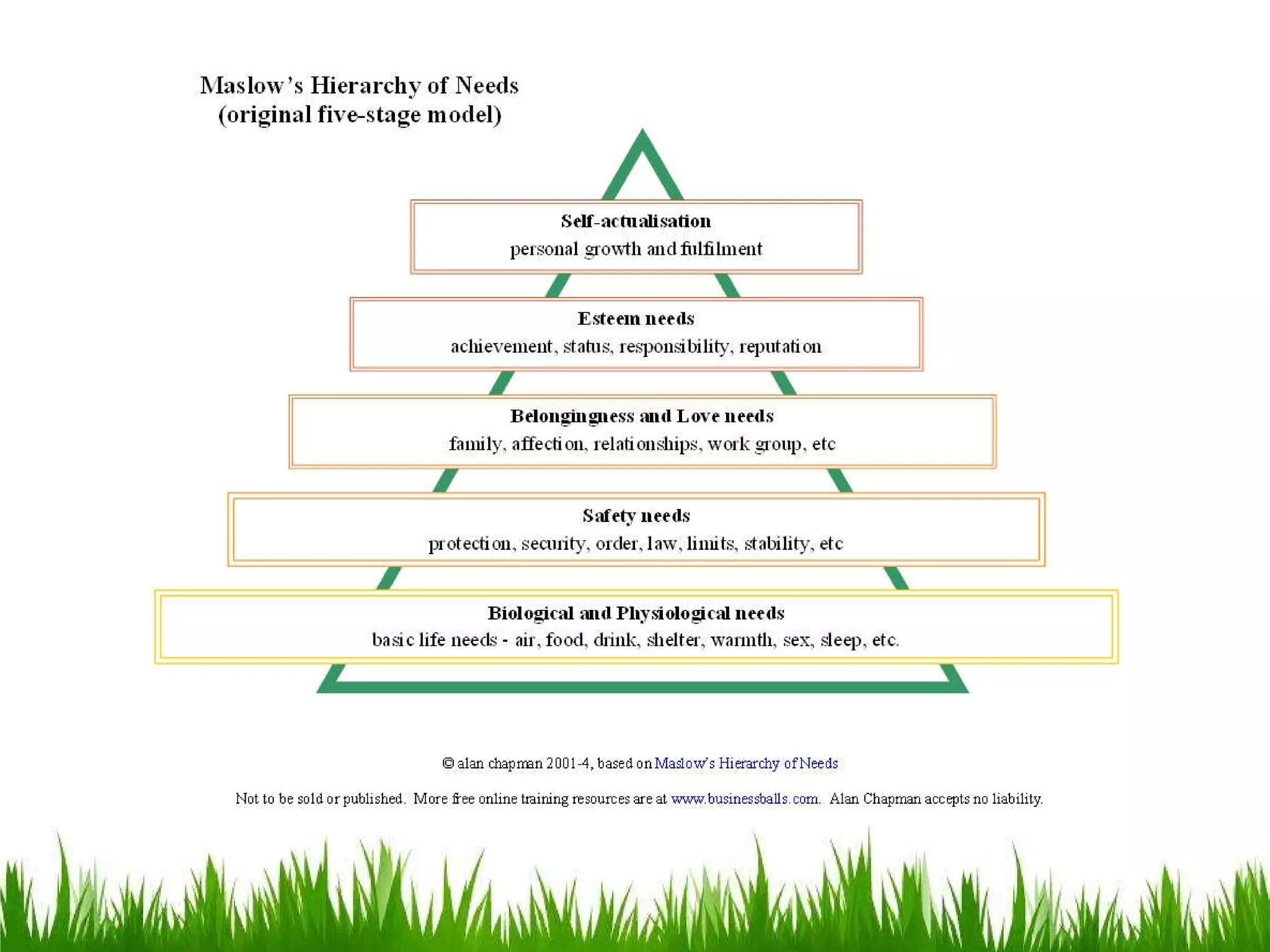
The Redwoods Group impact Serve 500+ Ys, JCCs, camps across US 40% reduction in incidents of child sexual abuse over past 7 years Drownings in Ys :: from 13/yr to 0 in  2009 and 2010 95% replacement of 12/15-passenger vans Maslow and our Employees ::  93  Paid to volunteer 40 hrs/yr + Dollars for Doers  Match donations up to $1k Match 401k + 529 plans; paid $138k in 2010 tuition Scale coverages for health, disability, long term care, life Refused layoffs, losing money in 2008-09…profitable in 2010 B Corp, Certified GreenPlus Along with our Foundation…$700k+ and 3500-4000 hrs donated annually for last three years
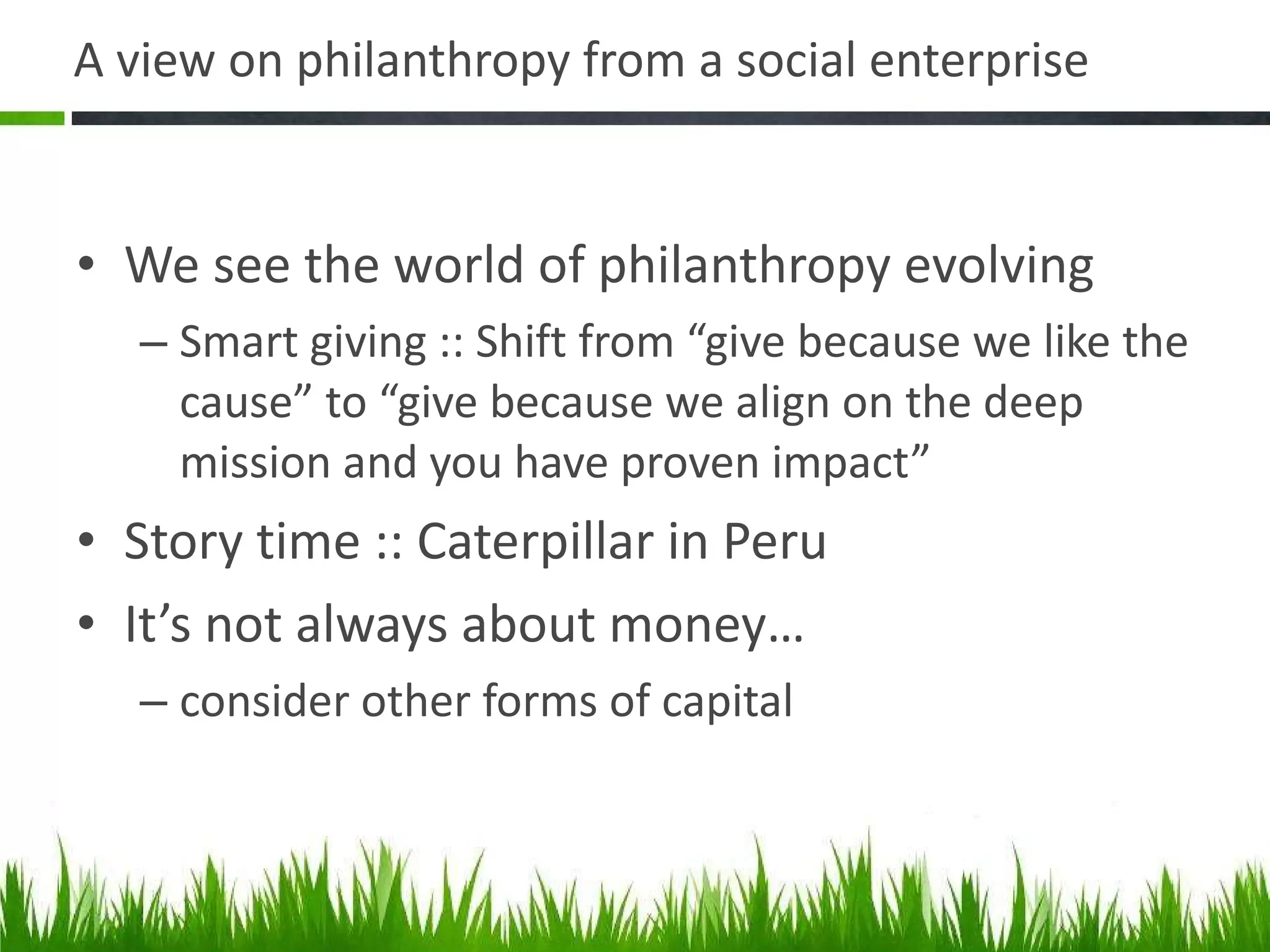
A view on philanthropy from a social enterprise We see the world of philanthropy evolving Smart giving :: Shift from “give because we like the cause” to “give because we align on the deep mission and you have proven impact” Story time :: Caterpillar in Peru It’s not always about money… consider other forms of capital
The Growth Philanthropist “ Philanthropic families are looking to  scale demonstrable solutions  so they can reach millions of people, but they need a reliable way to do it. The need for scaling is painfully clear.  But we need a mechanism and a solution.” Doug Bauer, senior vice president of Rockefeller Philanthropy Advisors
What attracts growth philanthropists? Growing indifference to non- or for-profit status Growth philanthropists seek: Solutions to important social problems Sound, sustainable business models Scale
4 lessons learned in running a social enterprise  Constant focus on mission Solve the social problem Scale the solution Progressive employment practices
 
4 lessons learned in running a social enterprise  Constant focus on mission Progressive employment practices Care for this precious asset Transparency – open book mgmt Job security/oppty for advancement Competitive salaries Strong, subsidized family benefits
4 lessons learned in running a social enterprise  Constant focus on mission Progressive employment practices Conservative financial practices Reserve against volatility Match revenues and expenses Invest carefully in operations Limit use of debt Make mission-consistent investments Collaborate with mission-aligned partners
4 lessons learned in running a social enterprise  Constant focus on mission Progressive employment practices Conservative financial practices Never compromise mission because of perception of limited resources Safety is mission Engage constituents in safety equation Safety mission is not limited to YMCA buildings or programs Community safety is goal
Panel Discussion:  Questions? Comments? Ideas? If you don ’t have questions, we’ll go through the business planning process… Discussion time!
Additional Resources Social Enterprise Database:  http://www.communitywealth.com/Directory%20of%20Social%20Enterprises.htm CASE (Center for the Advancement of Social Entrepreneurship) :  www.caseatduke.org SocialEdge :  www.socialedge.org Social Enterprise Alliance :  www.se-alliance.org REDF :  www.redf.org/learn-from-redf Stanford Social Innovation Review :  http://www.ssireview.org/ NC Fourth Sector Cluster Initiative:  http://www.fourthsectornc.org Social Enterprise Network of the Triangle (SENT):  http://www.se-triangle.org
Jeff Stern http://www.jeffstern.org  will have links to this presentation on slideshare plus my email, twitter, etc.  Email me at TROSA using jstern@trosainc.org or see http://www.trosainc.org Thanks for your time today. If you want to get in touch: Marty Martin, JD MPA Martin Law Firm, Counsel for Nonprofit, Tax-exempt and Social Enterprise Organizations [email_address] www.martinlegalhelp.com Blog: thenonprofitmentor.com Dan Moore The Redwoods Group  Chief Marketing Officer  [email_address] http://www.redwoodsgroup.com/ Blog:  http://blog.redwoodsgroup.com/ The Redwoods Group – Serve Others
Really?  No more questions? In that case, we have some slides that talk about the business planning process for social enterprise in nonprofits…
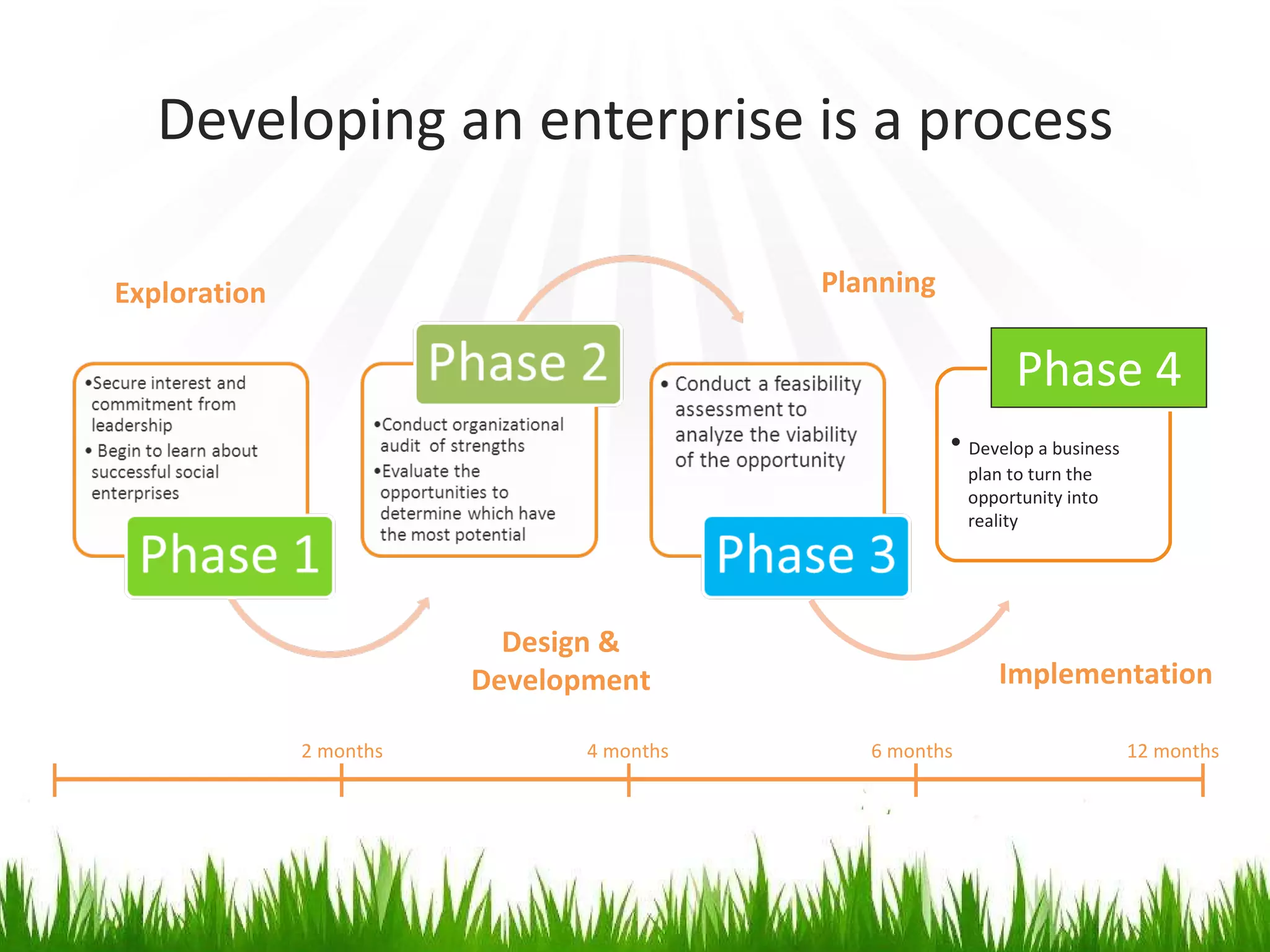
Developing an enterprise is a process Exploration Planning Design & Development Implementation 2 months 4 months 6 months 12 months Develop a business  plan to turn the  opportunity into  reality Phase 4
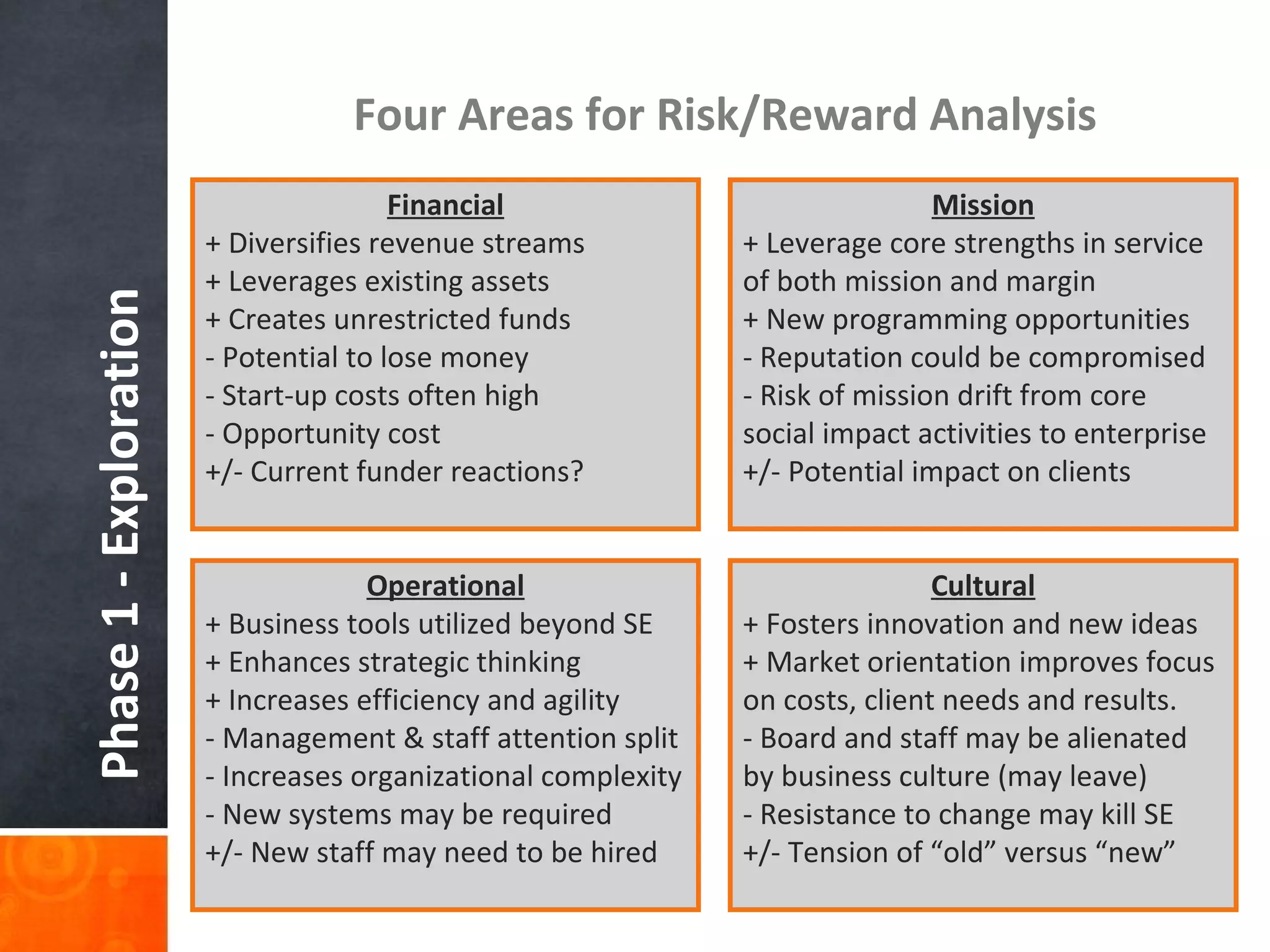
Phase 1 - Exploration Four Areas for Risk/Reward Analysis Operational + Business tools utilized beyond SE  + Enhances strategic thinking + Increases efficiency and agility - Management & staff attention split - Increases organizational complexity - New systems may be required +/- New staff may need to be hired Cultural + Fosters innovation and new ideas + Market orientation improves focus on costs, client needs and results. - Board and staff may be alienated by business culture (may leave)  - Resistance to change may kill SE +/- Tension of  “old” versus “new” Mission + Leverage core strengths in service of both mission and margin + New programming opportunities - Reputation could be compromised - Risk of mission drift from core social impact activities to enterprise  +/- Potential impact on clients Financial + Diversifies revenue streams  + Leverages existing assets  + Creates unrestricted funds  - Potential to lose money  - Start-up costs often high - Opportunity cost  +/- Current funder reactions?
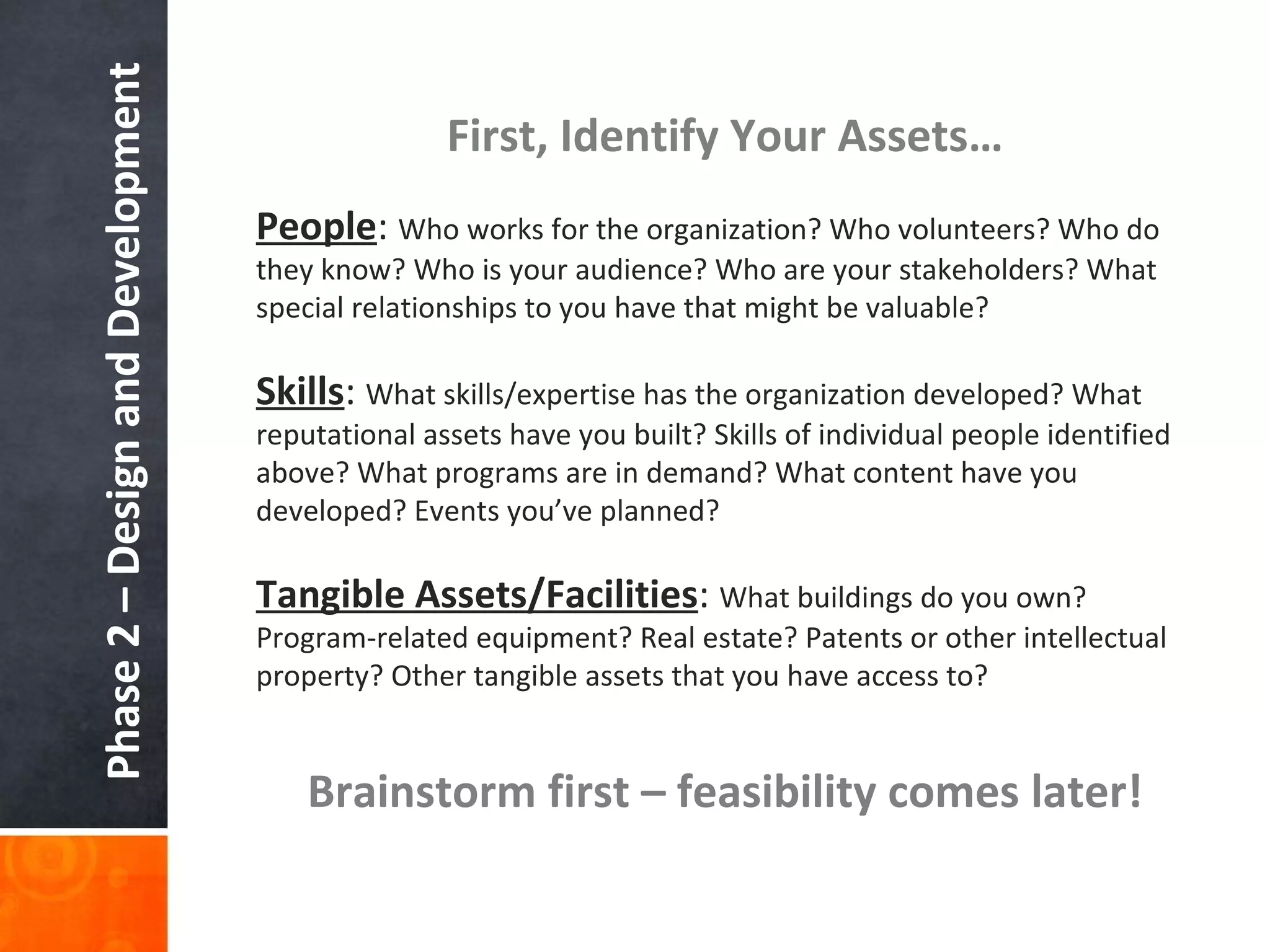
Phase 2 – Design and Development First, Identify Your Assets… Brainstorm first – feasibility comes later! People :  Who works for the organization? Who volunteers? Who do they know? Who is your audience? Who are your stakeholders? What special relationships to you have that might be valuable? Skills :  What skills/expertise has the organization developed? What reputational assets have you built? Skills of individual people identified above? What programs are in demand? What content have you developed? Events you ’ve planned? Tangible Assets/Facilities :  What buildings do you own? Program-related equipment? Real estate? Patents or other intellectual property? Other tangible assets that you have access to?
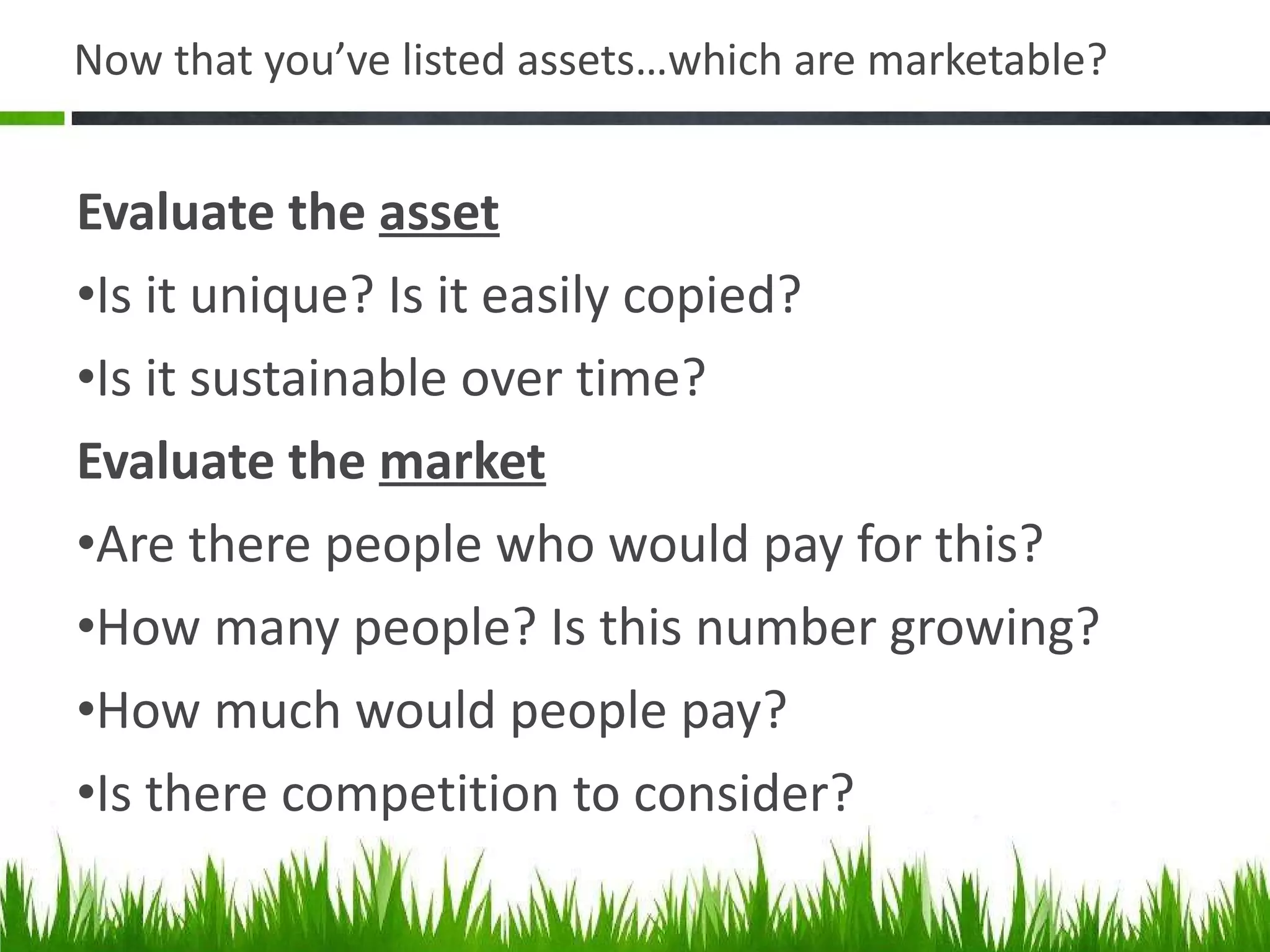
Now that you ’ve listed assets…which are marketable? Evaluate the  asset Is it unique? Is it easily copied?  Is it sustainable over time?  Evaluate the  market Are there people who would pay for this?  How many people? Is this number growing? How much would people pay? Is there competition to consider?
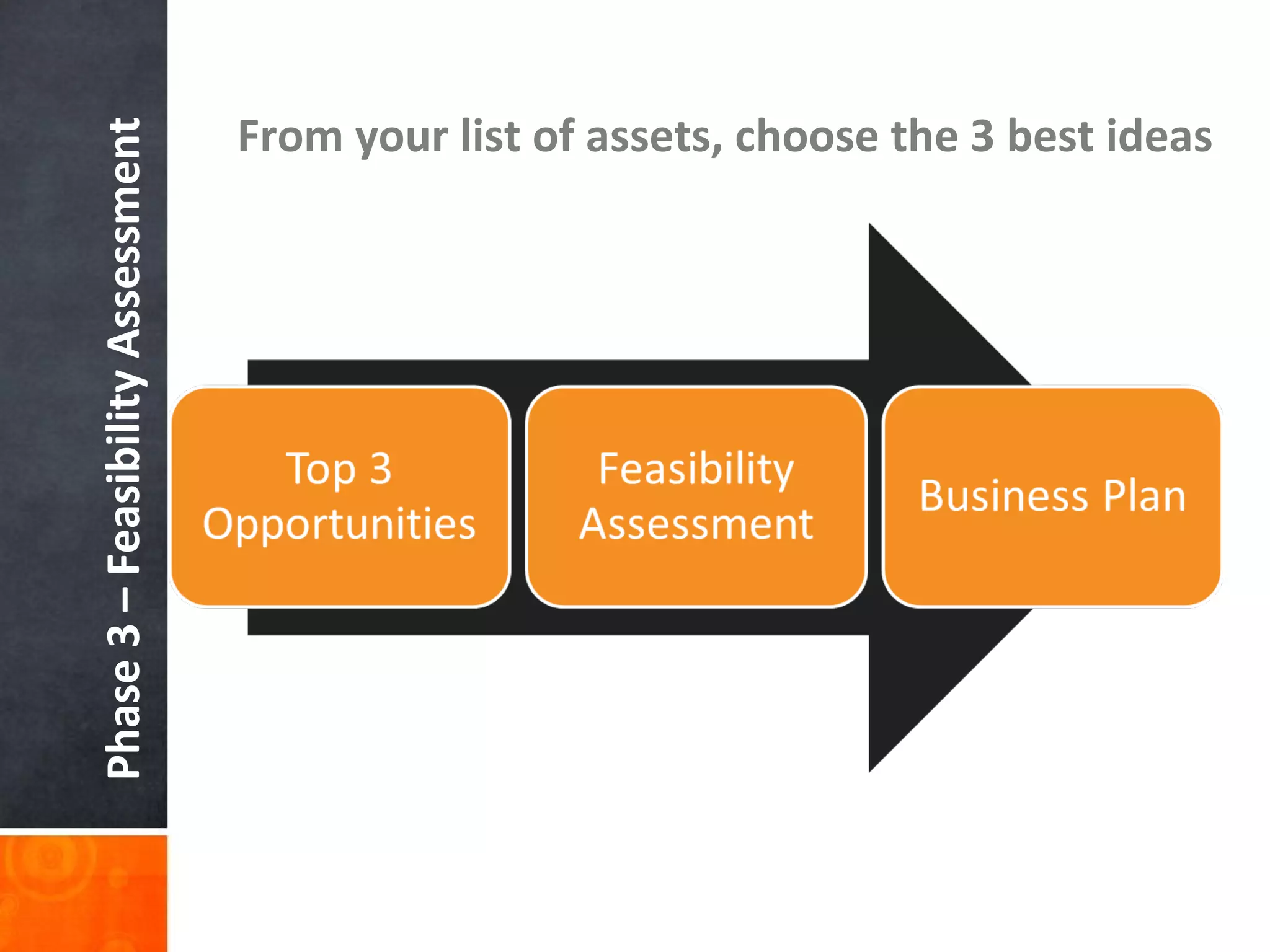
Phase 3 – Feasibility Assessment From your list of assets, choose the 3 best ideas
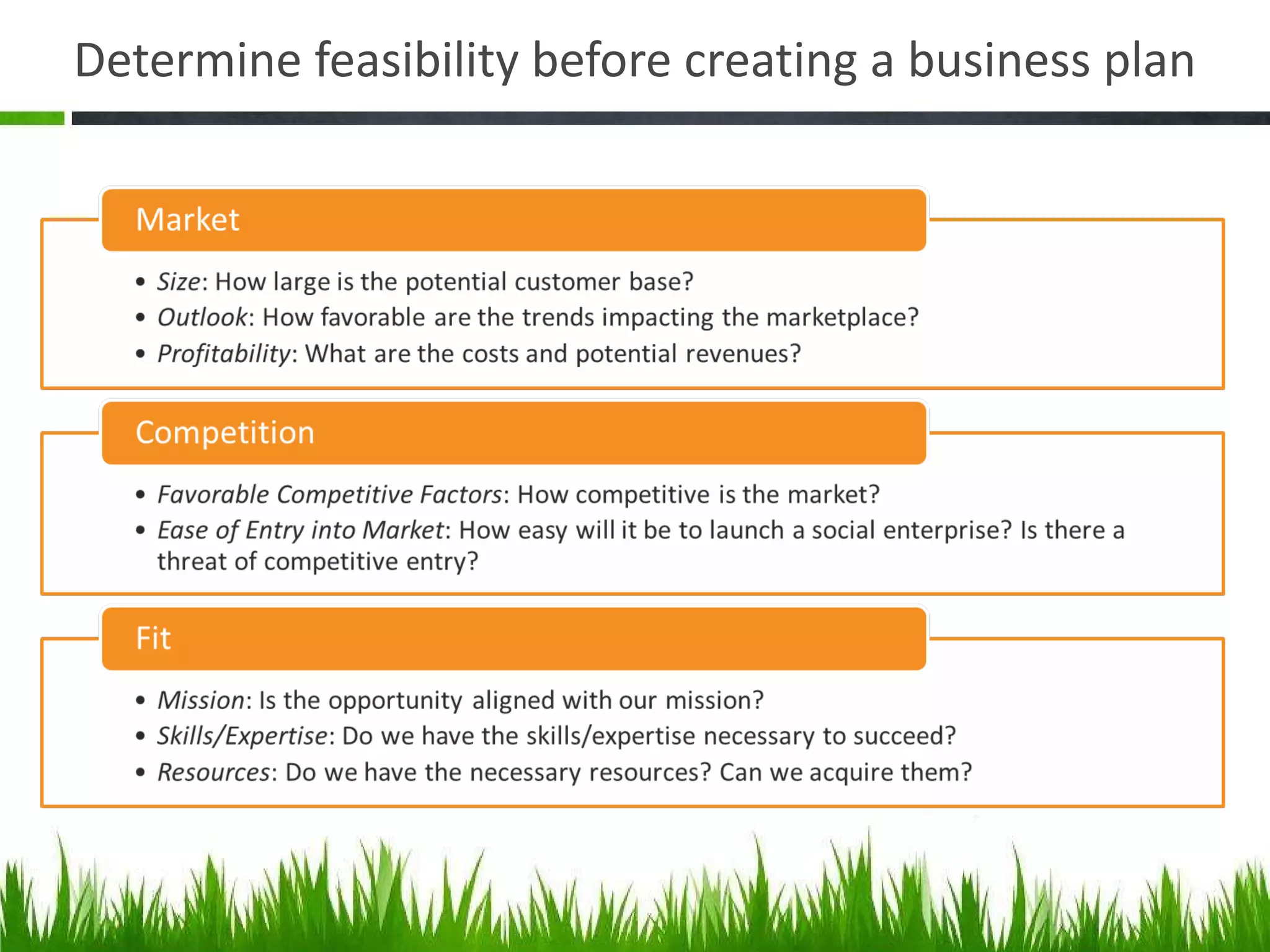
Determine feasibility before creating a business plan
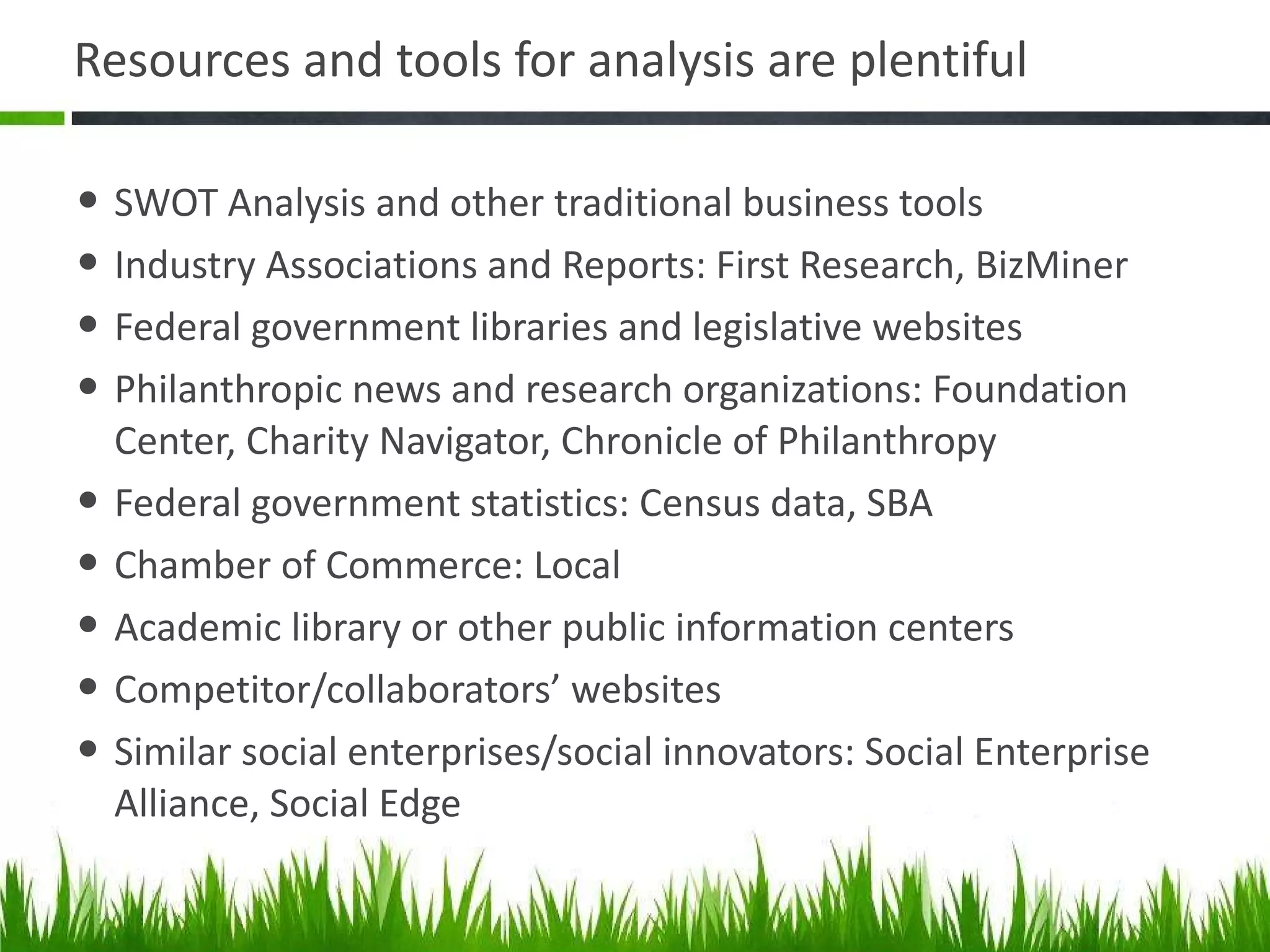
Resources and tools for analysis are plentiful SWOT Analysis and other traditional business tools Industry Associations and Reports: First Research, BizMiner Federal government libraries and legislative websites Philanthropic news and research organizations: Foundation Center, Charity Navigator, Chronicle of Philanthropy Federal government statistics: Census data, SBA Chamber of Commerce: Local  Academic library or other public information centers Competitor/collaborators ’ websites Similar social enterprises/social innovators: Social Enterprise Alliance, Social Edge
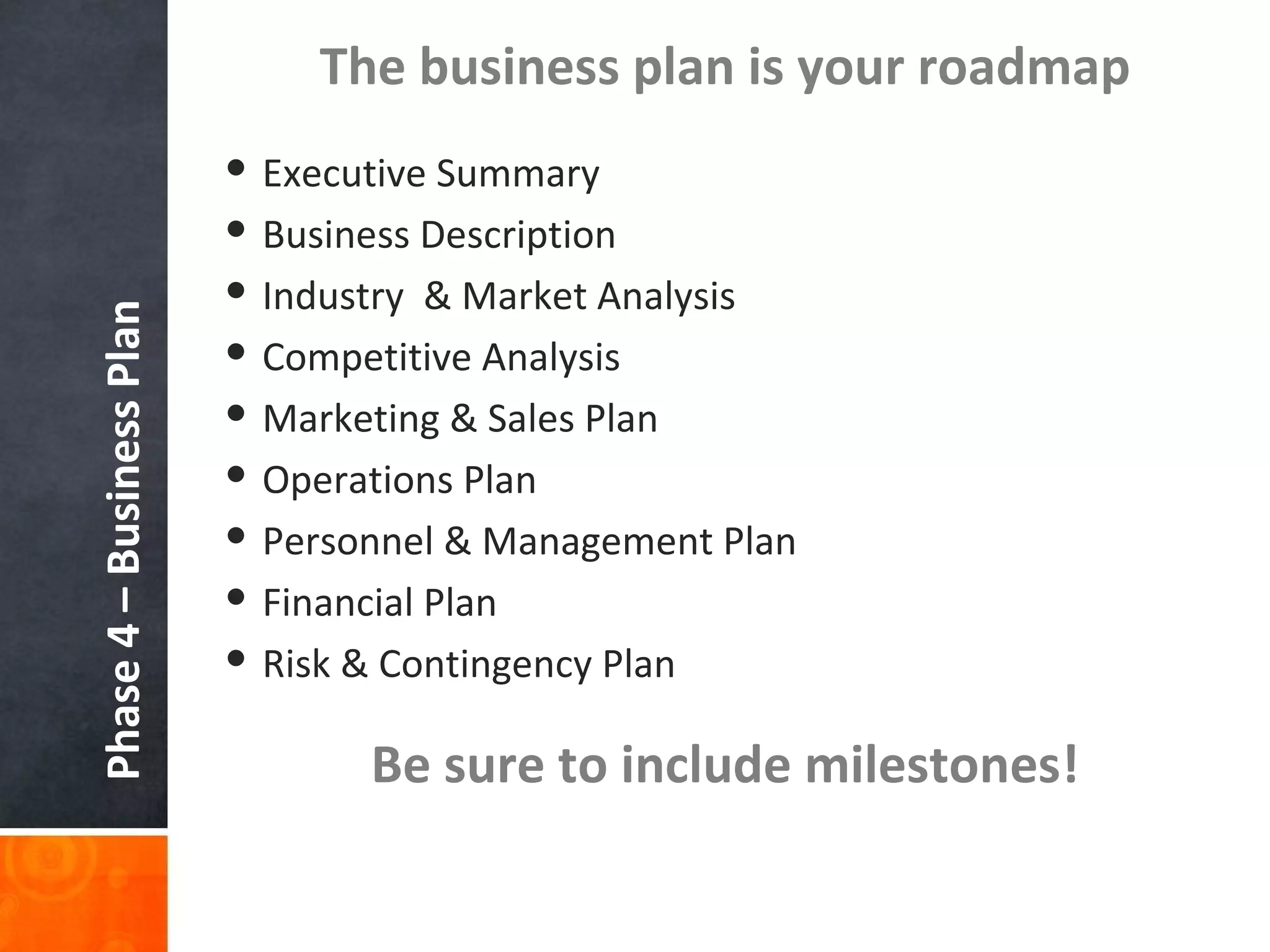
Phase 4 – Business Plan The business plan is your roadmap Executive Summary Business Description  Industry  & Market Analysis Competitive Analysis Marketing & Sales Plan Operations Plan Personnel & Management Plan Financial Plan Risk & Contingency Plan Be sure to include milestones!
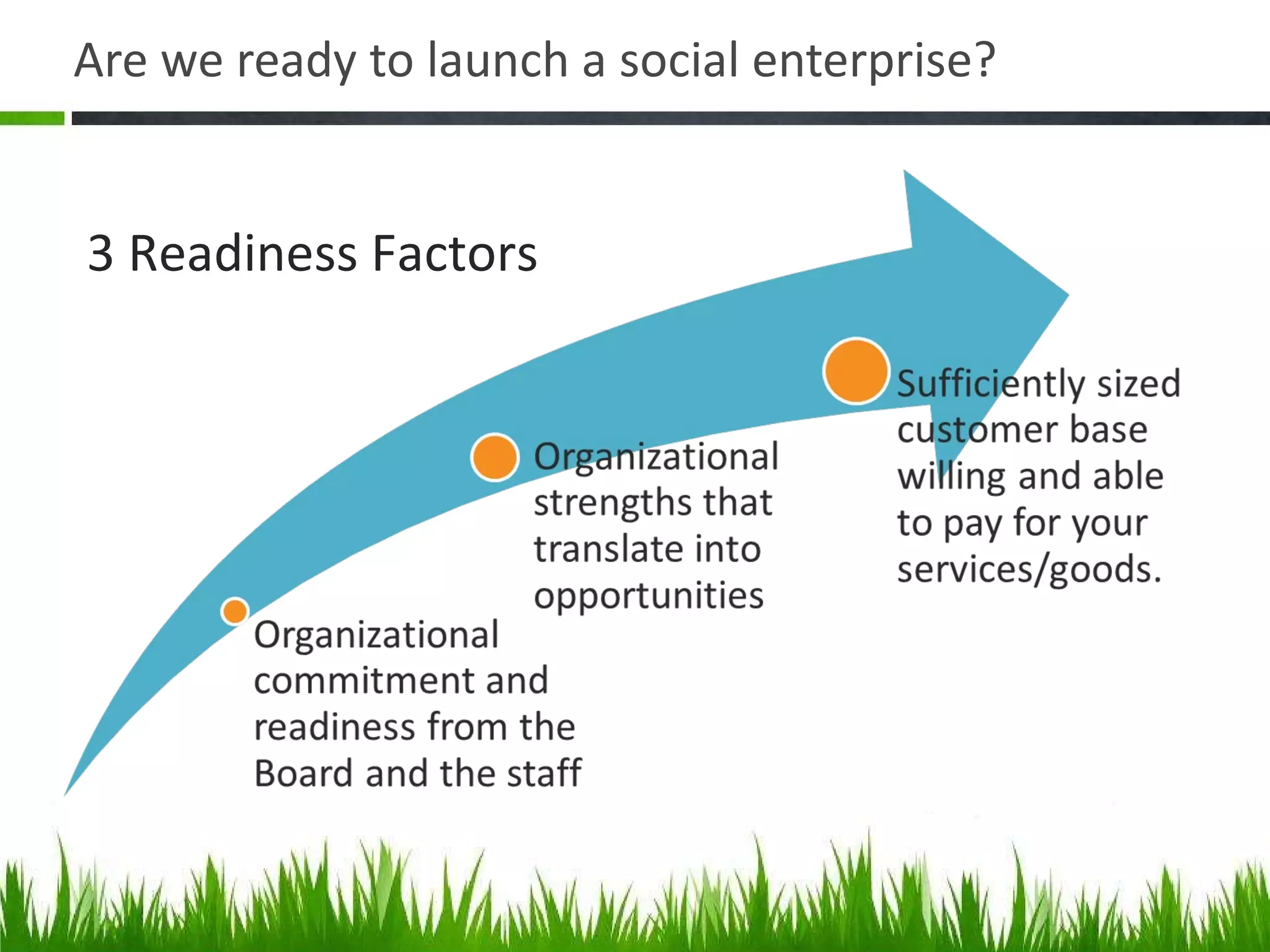
Are we ready to launch a social enterprise? 3 Readiness Factors

Social enterprise for afp conference session two final

  • 1.
    A panel discussionwith Marty Martin of the Martin Law Firm, Dan Moore of the Redwoods Group and Jeff Stern of TROSA August 11, 2011 Session Two: How do organizations pursue social enterprise? Social Enterprise: Expanding Philanthropy's Boundaries (II)
  • 2.
    How could wepursue Social Enterprise? Please have questions ready for the panel – your participation helps us! Reviewing terms and legal forms Examples of success Panel Discussion
  • 3.
    Social Enterprise: an organization or venture that achieves its primary social or environmental mission using business methods. Definition from the Social Enterprise Alliance
  • 4.
    Social Enterprise is not : Social Enterprise is : Creating sustainable revenue streams to support mission Engaging market forces in pursuit of social impact Devising new ways to leverage existing assets Decreasing dependence on the external funding community Utilization of business methods, tools and discipline Traditional fundraising Grant money Gifts/donations A “quick fix” in a time of a crisis For everyone
  • 5.
    Organizational Entities ProprietorshipPartnership Unincorporated Associations Corporations Business (C & S) Nonprofit Hybrid (Benefit -NC pending) LLC L3C
  • 6.
    Examples of SuccessWhat does a successful social enterprise look like? We have two on this panel…
  • 7.
    Two local socialenterprises are here to tell their stories: TROSA is a nonprofit that runs several social enterprises (moving, lawn care, furniture and frame shop, grocery store and more) in pursuit of its mission. This 2-year residential program enables substance abusers to be productive, recovering individuals by providing comprehensive treatment, work-based vocational training, education, and care. The Redwoods Group is a for-profit B-Corporation that uniquely uses insuring and risk management solutions to keep kids safe and help YMCAs, JCCs and camps – all non-profits – fulfill their missions to serve society. Their social mission is baked into their articles of incorporation, and in the past they’ve taken a loss rather than lay off employees or drop their less profitable customers.
  • 8.
    TROSA provides servicesto over 300 residents daily: meals, housing, transportation, and clothing coordination of primary and specialized medical care specialized counseling and support parenting, relationship, and life skills classes GED preparation and literacy vocational and customer service skills Additional after-care services for graduates
  • 9.
    TROSA is free to residents, thanks to social enterprise: Our $11 million annual budget comes from $5 million+ in earned business revenue annually $3 million+ from in-kind product donations federal grants for work with veterans and the homeless philanthropic leadership from foundations generous financial support from individual donors That ’s over $8 million earned by residents in the program! Plus, over half of TROSA ’s 51 staff are graduates of the program and approximately 25% are graduates of a similar program!
  • 10.
    These businesses areall related to TROSA ’s mission While not all of these training programs provide direct revenue, they all teach residents valuable skills. Every resident contributes to TROSA ’s success every day.
  • 11.
    The Redwoods Group– A unique business model Produce sustainable profits Insuring underserved, unattractive customer groups Without our own risk-bearing capital While improving the human condition
  • 12.
    How the RedwoodsGroup sees the world Social Problem Kids are drowning and being sexually abused at an alarming rate in the US Solution: Stop these events, and others, by building a business to love, serve and transform child-serving organizations into safe environments By improving safety, we can improve society Story time: Shine the Light
  • 13.
    The Redwoods Groupimpact Serve 500+ Ys, JCCs, camps across US 40% reduction in incidents of child sexual abuse over past 7 years Drownings in Ys :: from 13/yr to 0 in 2009 and 2010 95% replacement of 12/15-passenger vans Maslow and our Employees :: 93 Paid to volunteer 40 hrs/yr + Dollars for Doers Match donations up to $1k Match 401k + 529 plans; paid $138k in 2010 tuition Scale coverages for health, disability, long term care, life Refused layoffs, losing money in 2008-09…profitable in 2010 B Corp, Certified GreenPlus Along with our Foundation…$700k+ and 3500-4000 hrs donated annually for last three years
  • 14.
    A view onphilanthropy from a social enterprise We see the world of philanthropy evolving Smart giving :: Shift from “give because we like the cause” to “give because we align on the deep mission and you have proven impact” Story time :: Caterpillar in Peru It’s not always about money… consider other forms of capital
  • 15.
    The Growth Philanthropist“ Philanthropic families are looking to scale demonstrable solutions so they can reach millions of people, but they need a reliable way to do it. The need for scaling is painfully clear.  But we need a mechanism and a solution.” Doug Bauer, senior vice president of Rockefeller Philanthropy Advisors
  • 16.
    What attracts growthphilanthropists? Growing indifference to non- or for-profit status Growth philanthropists seek: Solutions to important social problems Sound, sustainable business models Scale
  • 17.
    4 lessons learnedin running a social enterprise Constant focus on mission Solve the social problem Scale the solution Progressive employment practices
  • 18.
  • 19.
    4 lessons learnedin running a social enterprise Constant focus on mission Progressive employment practices Care for this precious asset Transparency – open book mgmt Job security/oppty for advancement Competitive salaries Strong, subsidized family benefits
  • 20.
    4 lessons learnedin running a social enterprise Constant focus on mission Progressive employment practices Conservative financial practices Reserve against volatility Match revenues and expenses Invest carefully in operations Limit use of debt Make mission-consistent investments Collaborate with mission-aligned partners
  • 21.
    4 lessons learnedin running a social enterprise Constant focus on mission Progressive employment practices Conservative financial practices Never compromise mission because of perception of limited resources Safety is mission Engage constituents in safety equation Safety mission is not limited to YMCA buildings or programs Community safety is goal
  • 22.
    Panel Discussion: Questions? Comments? Ideas? If you don ’t have questions, we’ll go through the business planning process… Discussion time!
  • 23.
    Additional Resources SocialEnterprise Database: http://www.communitywealth.com/Directory%20of%20Social%20Enterprises.htm CASE (Center for the Advancement of Social Entrepreneurship) : www.caseatduke.org SocialEdge : www.socialedge.org Social Enterprise Alliance : www.se-alliance.org REDF : www.redf.org/learn-from-redf Stanford Social Innovation Review : http://www.ssireview.org/ NC Fourth Sector Cluster Initiative: http://www.fourthsectornc.org Social Enterprise Network of the Triangle (SENT): http://www.se-triangle.org
  • 24.
    Jeff Stern http://www.jeffstern.org will have links to this presentation on slideshare plus my email, twitter, etc. Email me at TROSA using jstern@trosainc.org or see http://www.trosainc.org Thanks for your time today. If you want to get in touch: Marty Martin, JD MPA Martin Law Firm, Counsel for Nonprofit, Tax-exempt and Social Enterprise Organizations [email_address] www.martinlegalhelp.com Blog: thenonprofitmentor.com Dan Moore The Redwoods Group Chief Marketing Officer [email_address] http://www.redwoodsgroup.com/ Blog: http://blog.redwoodsgroup.com/ The Redwoods Group – Serve Others
  • 25.
    Really? Nomore questions? In that case, we have some slides that talk about the business planning process for social enterprise in nonprofits…
  • 26.
    Developing an enterpriseis a process Exploration Planning Design & Development Implementation 2 months 4 months 6 months 12 months Develop a business plan to turn the opportunity into reality Phase 4
  • 27.
    Phase 1 -Exploration Four Areas for Risk/Reward Analysis Operational + Business tools utilized beyond SE + Enhances strategic thinking + Increases efficiency and agility - Management & staff attention split - Increases organizational complexity - New systems may be required +/- New staff may need to be hired Cultural + Fosters innovation and new ideas + Market orientation improves focus on costs, client needs and results. - Board and staff may be alienated by business culture (may leave) - Resistance to change may kill SE +/- Tension of “old” versus “new” Mission + Leverage core strengths in service of both mission and margin + New programming opportunities - Reputation could be compromised - Risk of mission drift from core social impact activities to enterprise +/- Potential impact on clients Financial + Diversifies revenue streams + Leverages existing assets + Creates unrestricted funds - Potential to lose money - Start-up costs often high - Opportunity cost +/- Current funder reactions?
  • 28.
    Phase 2 –Design and Development First, Identify Your Assets… Brainstorm first – feasibility comes later! People : Who works for the organization? Who volunteers? Who do they know? Who is your audience? Who are your stakeholders? What special relationships to you have that might be valuable? Skills : What skills/expertise has the organization developed? What reputational assets have you built? Skills of individual people identified above? What programs are in demand? What content have you developed? Events you ’ve planned? Tangible Assets/Facilities : What buildings do you own? Program-related equipment? Real estate? Patents or other intellectual property? Other tangible assets that you have access to?
  • 29.
    Now that you’ve listed assets…which are marketable? Evaluate the asset Is it unique? Is it easily copied? Is it sustainable over time? Evaluate the market Are there people who would pay for this? How many people? Is this number growing? How much would people pay? Is there competition to consider?
  • 30.
    Phase 3 –Feasibility Assessment From your list of assets, choose the 3 best ideas
  • 31.
    Determine feasibility beforecreating a business plan
  • 32.
    Resources and toolsfor analysis are plentiful SWOT Analysis and other traditional business tools Industry Associations and Reports: First Research, BizMiner Federal government libraries and legislative websites Philanthropic news and research organizations: Foundation Center, Charity Navigator, Chronicle of Philanthropy Federal government statistics: Census data, SBA Chamber of Commerce: Local Academic library or other public information centers Competitor/collaborators ’ websites Similar social enterprises/social innovators: Social Enterprise Alliance, Social Edge
  • 33.
    Phase 4 –Business Plan The business plan is your roadmap Executive Summary Business Description Industry & Market Analysis Competitive Analysis Marketing & Sales Plan Operations Plan Personnel & Management Plan Financial Plan Risk & Contingency Plan Be sure to include milestones!
  • 34.
    Are we readyto launch a social enterprise? 3 Readiness Factors

Editor's Notes

  • #2 This presentation is based on slides from a class given by Social Enterprise Network of the Triangle (SENT – http://www.se-triangle.org) through Duke ’s Certificate Program in Nonprofit Management. That 4-hour class has been condensed into a one-hour presentation for this talk. Prior slides were put together by Suzanne Steffens Smith, Ruth Peebles and Agnes Vishnevkin. Much credit for the quality in this presentation goes to them – all errors and omissions I claim as my own.
  • #13 Dan can talk about the focus on mission Dan can talk about the struggle and trade-offs Dan can talk about success and longevity
  • #15 Caterpillar in Peru. The group’s biggest concern was access to health. Cat gave them equipment only on loan to extend roads to give access to healthcare (get to he town within 1 day instead of 6 to get to the clinic). Folks were dying walking circuitous routes to get to the clinic. IT wasn’t a complex solution requiring technology and pharmaceuticals. It was simply getting to the clinic fast enough.
  • #21 Limit the use of debt Make mission-consistent investments Collaborate with mission partners Including other Ys, other agencies