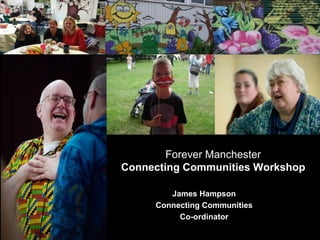
HELPING LOCAL PEOPLE DO
EXTRAORDINARY THINGS.
James Hampson
Connecting Communities
Co-ordinator
Forever Manchester
Connecting Communities Workshop
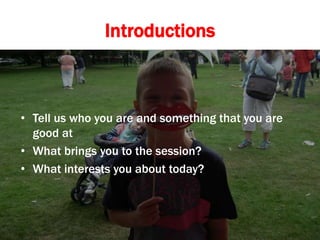
Introductions
• Tell us who you are and something that you are
good at
• What brings you to the session?
• What interests you about today?
Forever Manchester
• Community Foundation for Greater Manchester
• Been active for 26 Years
• Raise and distribute funds to communities of Greater
Manchester
• 2011 We discovered a different way of working
• Developed the UK’s first dedicated ABCD Community
Building Team
• We work with Communities to help them do “Extraordinary
things together”
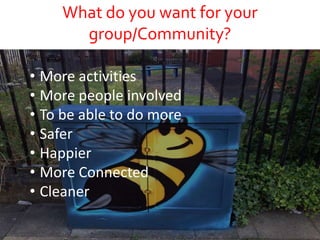
What do you want for your
group/Community?
• More activities
• More people involved
• To be able to do more
• Safer
• Happier
• More Connected
• Cleaner
Principals of Community Building
 Start with discovering people’s strengths
 Start with relationship building
 Local led action is more durable and sustainable
than professional programmes
 When the conversation shifts from “isn’t it awful” to
“what’s possible?” Real community building begins
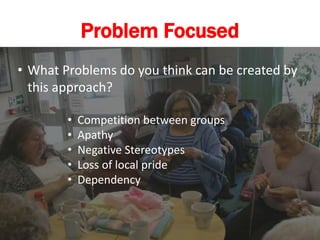
Problem Focused
• What Problems do you think can be created by
this approach?
• Competition between groups
• Apathy
• Negative Stereotypes
• Loss of local pride
• Dependency
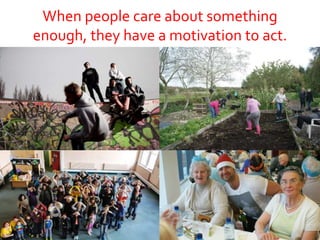
When people care about something
enough, they have a motivation to act.
What is Asset Based Community
Development?
• ABCD is a different way of viewing communities
• It encourages people to think about and explore
what skills and talents are already in the community
• Communities and everyone in them are better off
when they work together and share these skills
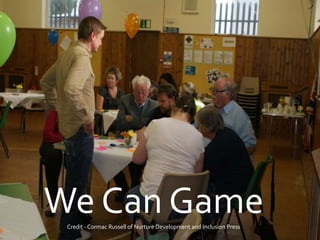
We Can GameCredit - Cormac Russell of Nurture Development and Inclusion Press
TheWe Can Game
• The game can be used to get people thinking
differently about their capacities/assets
• Can begin the process of asset mapping individuals
• It can start to identify people to invite in to our
community efforts
• Google “We Can Game”
A shopping list
What are Assets?
There are 4 key Assets in every community…
1) Individuals
2) Associations
3) Institutions
4) Physical Assets
5) Connections
What are Assets?
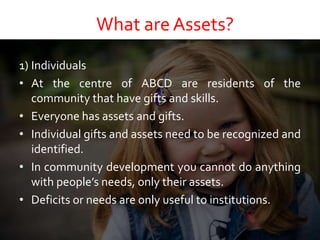
1) Individuals
• At the centre of ABCD are residents of the
community that have gifts and skills.
• Everyone has assets and gifts.
• Individual gifts and assets need to be recognized and
identified.
• In community development you cannot do anything
with people’s needs, only their assets.
• Deficits or needs are only useful to institutions.
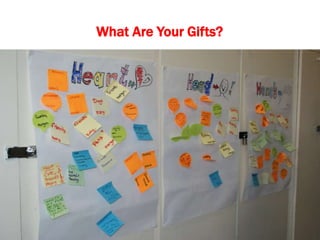
What Are Your Gifts?
Assets of the Head
• Take 3 Post–It Notes
• Write your name on each note
• Write down 3 Gifts of the Head, one on each note
– Things I know something about and would enjoy
talking about with others
Assets of the Heart
• Take 3 more Post–It Notes
• Write your name on each note
• Write down 3 Gifts of the Heart, one on each note
-Things I am passionate about, things that
make me take action
Assets of the Hands
• Take 3 more Post–It Notes
• Write your name on each note
• Write down 3 Gifts of the Hands, one on each note
– Things or skills I know how to do and could
potentially share with others
– Things you can make, fix, build or produce
Head, Heart, Hands
• This is a good exercise to do with groups
• Can start a conversation about ideas
• Start connections around mutual gifts
• Creates Conversation
• Fun way to discover individuals community assets
• Can be used to make connections between people
(more on this later)
What are Assets?
2) Associations
• Small formal and informal groups of people
• Clubs working with a common interest as volunteers
are called associations in ABCD and are critical to
community mobilization.
• They are coming together around a common
interest by their individual choice
Community Associations
• Every effort should be made to contact and include
as many as possible
• Associations can take on new roles e.g. Community
Funday
• Informal Associations are as useful as formal
associations
Community Associations
• Get things Started!
• Buildings
• Resources
• Create Space
• Experience e.g. funding applications
• Skills and talents of members
• Encourage others to get involved
• CollectiveVoice
What are Assets?
3) Institutions/Service providers
• Paid groups of people who generally are
professionals who are structurally organized are
called institutions.
• They include government agencies and private
business, as well as schools, etc.
• They can all be valuable resources.
• The assets of these institutions help the community
capture valuable resources and establish a sense of
civic responsibility.
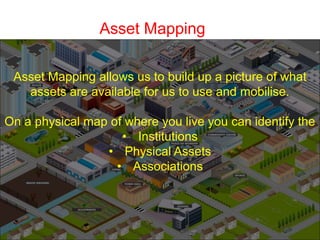
Asset Mapping
Asset Mapping allows us to build up a picture of what
assets are available for us to use and mobilise.
On a physical map of where you live you can identify the
• Institutions
• Physical Assets
• Associations
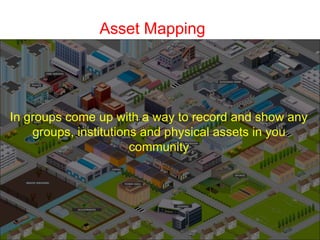
Asset Mapping
In groups come up with a way to record and show any
groups, institutions and physical assets in you
community
Asset Mapping
• This exercise is especially effective with small groups of residents
• Asset Mapping is a good way of getting people talking
• An Asset Map can be useful in inspiring community action and
involvement
• Informal groups who regularly meet are worth adding and connecting
• Make sure that the map is visible and accessible by everyone in the
community
• Always review and add to the map
The Power of Two
• If one person spent one day having a conversation to
two people about what they could create (1+2)
• If the next day, those two people each had a
conversation with two different people (1+2+2+2)
• And so forth
• Then in 10 days, 2047 people would be having a
conversation
• In 15 days, 65,536 people would be in conversation
• In 20 days, 2 million people would be in conversation
Asset Based Community Development Institute
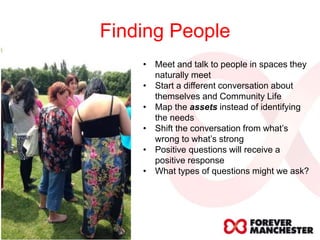
Finding People
• Meet and talk to people in spaces they
naturally meet
• Start a different conversation about
themselves and Community Life
• Map the assets instead of identifying
the needs
• Shift the conversation from what’s
wrong to what’s strong
• Positive questions will receive a
positive response
• What types of questions might we ask?
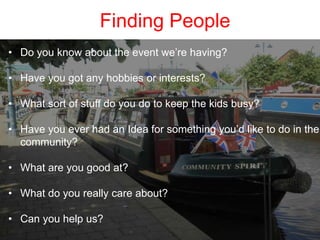
Finding People
• Do you know about the event we’re having?
• Have you got any hobbies or interests?
• What sort of stuff do you do to keep the kids busy?
• Have you ever had an Idea for something you’d like to do in the
community?
• What are you good at?
• What do you really care about?
• Can you help us?
What are Assets?
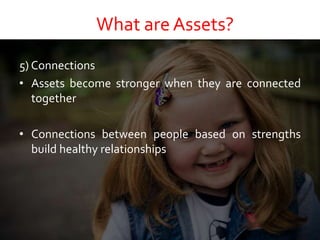
5) Connections
• Assets become stronger when they are connected
together
• Connections between people based on strengths
build healthy relationships
Connecting
• Connecting Community Assets is the key to
Community Building
• Quite simply it is the building of relationships
between different members of the community for
shared benefits
• Relationships are built on shared and compatible
strengths
• Connections should be made between all
members and organisations in the community
• Ideas and Community Projects are perfect arenas
for people to build Connections
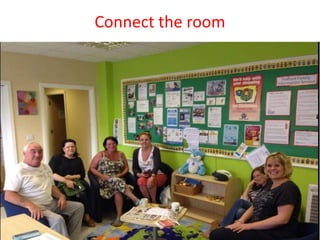
Connect the room
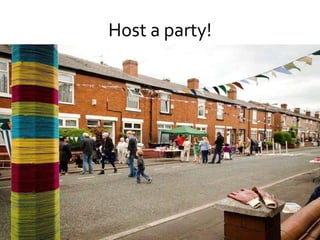
Host a party!
Stories
• Community Stories can help to create a
shared history and sense of belonging
• Stories can motivate and inspire others
• Tell of a time when people came
together and achieved something
extraordinary
• Sharing success continues and builds
community momentum
Do you really need funding?
At sometimes all groups will need funds to make
themselves bigger and better but first consider this
• By looking around the community you can make your
money go further
• Do local businesses want to sponsor you?
• Can you add a small fee?
• Are you raising money to give to someone else?
• Benefits include
• More people involved
• Raises local awareness
• Funding can help others in the community
Fundraising
• What do you fundraise for?
• How do you fundraise?
• Where do you get donations from?
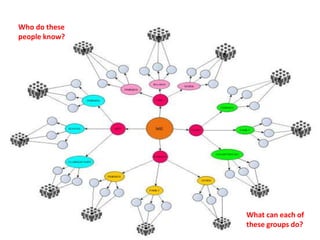
What can each of
these groups do?
Who do these
people know?
Summary
• Start with discovering Strengths
• Connect with as many people in the area as possible
• Local led action is more durable and sustainable that
professional led action
• Become comfortable telling your stories
• HAVE FUN AND MAKE NOISE
How you can help Forever Manchester
• Fundraise and donate to us!
• Self Fundraise
• Spread the word about us
• Tell us your stories

Connecting Communities Presentation

  • 1.
    HELPING LOCAL PEOPLEDO EXTRAORDINARY THINGS. James Hampson Connecting Communities Co-ordinator Forever Manchester Connecting Communities Workshop
  • 2.
    Introductions • Tell uswho you are and something that you are good at • What brings you to the session? • What interests you about today?
  • 3.
    Forever Manchester • CommunityFoundation for Greater Manchester • Been active for 26 Years • Raise and distribute funds to communities of Greater Manchester • 2011 We discovered a different way of working • Developed the UK’s first dedicated ABCD Community Building Team • We work with Communities to help them do “Extraordinary things together”
  • 4.
    What do youwant for your group/Community? • More activities • More people involved • To be able to do more • Safer • Happier • More Connected • Cleaner
  • 5.
    Principals of CommunityBuilding  Start with discovering people’s strengths  Start with relationship building  Local led action is more durable and sustainable than professional programmes  When the conversation shifts from “isn’t it awful” to “what’s possible?” Real community building begins
  • 6.
    Problem Focused • WhatProblems do you think can be created by this approach? • Competition between groups • Apathy • Negative Stereotypes • Loss of local pride • Dependency
  • 7.
    When people careabout something enough, they have a motivation to act.
  • 8.
    What is AssetBased Community Development? • ABCD is a different way of viewing communities • It encourages people to think about and explore what skills and talents are already in the community • Communities and everyone in them are better off when they work together and share these skills
  • 9.
    We Can GameCredit- Cormac Russell of Nurture Development and Inclusion Press
  • 10.
    TheWe Can Game •The game can be used to get people thinking differently about their capacities/assets • Can begin the process of asset mapping individuals • It can start to identify people to invite in to our community efforts • Google “We Can Game”
  • 11.
  • 12.
    What are Assets? Thereare 4 key Assets in every community… 1) Individuals 2) Associations 3) Institutions 4) Physical Assets 5) Connections
  • 13.
    What are Assets? 1)Individuals • At the centre of ABCD are residents of the community that have gifts and skills. • Everyone has assets and gifts. • Individual gifts and assets need to be recognized and identified. • In community development you cannot do anything with people’s needs, only their assets. • Deficits or needs are only useful to institutions.
  • 14.
  • 15.
    Assets of theHead • Take 3 Post–It Notes • Write your name on each note • Write down 3 Gifts of the Head, one on each note – Things I know something about and would enjoy talking about with others
  • 16.
    Assets of theHeart • Take 3 more Post–It Notes • Write your name on each note • Write down 3 Gifts of the Heart, one on each note -Things I am passionate about, things that make me take action
  • 17.
    Assets of theHands • Take 3 more Post–It Notes • Write your name on each note • Write down 3 Gifts of the Hands, one on each note – Things or skills I know how to do and could potentially share with others – Things you can make, fix, build or produce
  • 18.
    Head, Heart, Hands •This is a good exercise to do with groups • Can start a conversation about ideas • Start connections around mutual gifts • Creates Conversation • Fun way to discover individuals community assets • Can be used to make connections between people (more on this later)
  • 19.
    What are Assets? 2)Associations • Small formal and informal groups of people • Clubs working with a common interest as volunteers are called associations in ABCD and are critical to community mobilization. • They are coming together around a common interest by their individual choice
  • 20.
    Community Associations • Everyeffort should be made to contact and include as many as possible • Associations can take on new roles e.g. Community Funday • Informal Associations are as useful as formal associations
  • 21.
    Community Associations • Getthings Started! • Buildings • Resources • Create Space • Experience e.g. funding applications • Skills and talents of members • Encourage others to get involved • CollectiveVoice
  • 22.
    What are Assets? 3)Institutions/Service providers • Paid groups of people who generally are professionals who are structurally organized are called institutions. • They include government agencies and private business, as well as schools, etc. • They can all be valuable resources. • The assets of these institutions help the community capture valuable resources and establish a sense of civic responsibility.
  • 23.
    Asset Mapping Asset Mappingallows us to build up a picture of what assets are available for us to use and mobilise. On a physical map of where you live you can identify the • Institutions • Physical Assets • Associations
  • 24.
    Asset Mapping In groupscome up with a way to record and show any groups, institutions and physical assets in you community
  • 25.
    Asset Mapping • Thisexercise is especially effective with small groups of residents • Asset Mapping is a good way of getting people talking • An Asset Map can be useful in inspiring community action and involvement • Informal groups who regularly meet are worth adding and connecting • Make sure that the map is visible and accessible by everyone in the community • Always review and add to the map
  • 26.
    The Power ofTwo • If one person spent one day having a conversation to two people about what they could create (1+2) • If the next day, those two people each had a conversation with two different people (1+2+2+2) • And so forth • Then in 10 days, 2047 people would be having a conversation • In 15 days, 65,536 people would be in conversation • In 20 days, 2 million people would be in conversation Asset Based Community Development Institute
  • 27.
    Finding People • Meetand talk to people in spaces they naturally meet • Start a different conversation about themselves and Community Life • Map the assets instead of identifying the needs • Shift the conversation from what’s wrong to what’s strong • Positive questions will receive a positive response • What types of questions might we ask?
  • 28.
    Finding People • Doyou know about the event we’re having? • Have you got any hobbies or interests? • What sort of stuff do you do to keep the kids busy? • Have you ever had an Idea for something you’d like to do in the community? • What are you good at? • What do you really care about? • Can you help us?
  • 29.
    What are Assets? 5)Connections • Assets become stronger when they are connected together • Connections between people based on strengths build healthy relationships
  • 30.
    Connecting • Connecting CommunityAssets is the key to Community Building • Quite simply it is the building of relationships between different members of the community for shared benefits • Relationships are built on shared and compatible strengths • Connections should be made between all members and organisations in the community • Ideas and Community Projects are perfect arenas for people to build Connections
  • 31.
  • 32.
  • 33.
    Stories • Community Storiescan help to create a shared history and sense of belonging • Stories can motivate and inspire others • Tell of a time when people came together and achieved something extraordinary • Sharing success continues and builds community momentum
  • 34.
    Do you reallyneed funding? At sometimes all groups will need funds to make themselves bigger and better but first consider this • By looking around the community you can make your money go further • Do local businesses want to sponsor you? • Can you add a small fee? • Are you raising money to give to someone else? • Benefits include • More people involved • Raises local awareness • Funding can help others in the community
  • 35.
    Fundraising • What doyou fundraise for? • How do you fundraise? • Where do you get donations from?
  • 36.
    What can eachof these groups do? Who do these people know?
  • 37.
    Summary • Start withdiscovering Strengths • Connect with as many people in the area as possible • Local led action is more durable and sustainable that professional led action • Become comfortable telling your stories • HAVE FUN AND MAKE NOISE
  • 38.
    How you canhelp Forever Manchester • Fundraise and donate to us! • Self Fundraise • Spread the word about us • Tell us your stories

Editor's Notes

  • #30 Explain what different assets can be connected