SUPERSIZED IMBALANCE:
POST-2015 ELECTION, WHAT
FOUNDATIONS SHOULD KNOW
EPIP/NCRP Webinar
January 9th, 2015
Hosts: Michael Barham and Christine Reeves
2
Emerging Practitioners in
Philanthropy (EPIP) is a
national network of
foundation professionals and
social entrepreneurs who
strive for excellence in the
practice of philanthropy.
3
We are an inclusive group
of highly skilled & effective
Change Makers committed
to working together to
build a just, equitable,
& sustainable society.
4
We provide a platform
for our community to:
Connect
with others
Learn &
practice
leadership skills
Voice
emerging,
transformative
thoughts in the
social sector
Join EPIP!
If you’re not yet a member, join us!
More information on our site at
www.epip.org/membership
or contact
michael@epip.org
Announcements
•  EPIP National Conference – Save the Date!
•  May 13th-14th
•  New Orleans, LA
•  Next EPIP Webinar - Wednesday, February 4th, 3pm ET
•  Black Male Achievement: An Exploration of Systemic and
Capacity Building Solutions
•  Foundation Center, Open Society Foundations, PolicyLink,
CLASP
•  MC MaL
•  January: Communications
•  All Events
•  epip.org/events
Housekeeping
•  All attendees on mute during the presentation
•  Use the question box for technical difficulties
•  We’ll save time for Q&A
•  We’ll be recording this webinar, visit our website to
view
•  Complete the post-webinar survey!
Supersized Imbalance:
Post-2014 Election,
What Foundations Should Know
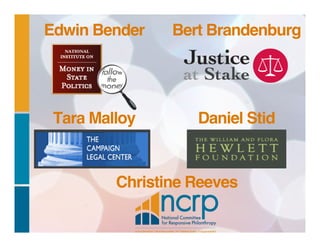
Christine Reeves!
Edwin Bender!
Daniel Stid!Tara Malloy!
Bert Brandenburg!
Goals for Our Time Today
Frame
Overview of NIMSP Tool
#1: Who Gives to Influence Policy?
(Example: Fracking)
#2: Legislative Action in the States
(Example: ACA Health Policy)
#3: Judicial Independence
(Example: Money in Judicial Elections)
#4: Defending & Enforcing Campaign Finance
(Example: Sun Act)
#5: How Election Data Informs the Hewlett Foundation
(Example: Madison Initiative Program)
FRAME
ICEBREAKER!
FollowTheMoney.org
Tracking political donations in all 50 states
National Institute on Money in State Politics EPIP/NCRP JAN. 2015
We Connect the Dots in 50 States
Ballot measures
Judicial candidates
Statewide candidates
Legislative candidates
Federal candidates
Political parties
Lobbyists & clients
FollowTheMoney.org
Tracking political donations in all 50 states
National Institute on Money in State Politics EPIP/NCRP JAN. 2015
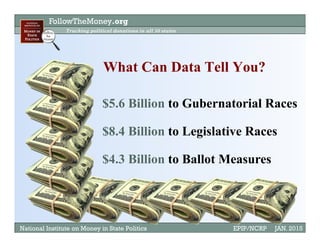
What Can Data Tell You?
$5.6 Billion to Gubernatorial Races
$8.4 Billion to Legislative Races
$4.3 Billion to Ballot Measures
FollowTheMoney.org
Tracking political donations in all 50 states
National Institute on Money in State Politics EPIP/NCRP JAN. 2015
Our Data Tells You
Who gave?
How much?
To whom?
When?
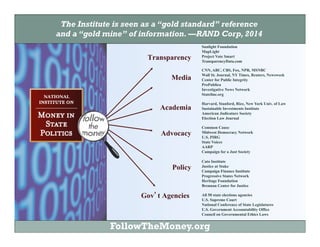
The Institute is seen as a “gold standard” reference
and a “gold mine” of information. —RAND Corp, 2014
FollowTheMoney.org
Transparency
Media
Academia
Advocacy
Policy
Gov t Agencies
Sunlight Foundation
MapLight
Project Vote Smart
TransparencyData.com
CNN, ABC, CBS, Fox, NPR, MSNBC
Wall St. Journal, NY Times, Reuters, Newsweek
Center for Public Integrity
ProPublica
Investigative News Network
Stateline.org
Harvard, Stanford, Rice, New York Univ. of Law
Sustainable Investments Institute
American Judicature Society
Election Law Journal
Common Cause
Midwest Democracy Network
U.S. PIRG
State Voices
AARP
Campaign for a Just Society
Cato Institute
Justice at Stake
Campaign Finance Institute
Progressive States Network
Heritage Foundation
Brennan Center for Justice
All 50 state elections agencies
U.S. Supreme Court
National Conference of State Legislatures
U.S. Government Accountability Office
Council on Governmental Ethics Laws
FollowTheMoney.org
Tracking political donations in all 50 states
National Institute on Money in State Politics EPIP/NCRP JAN. 2015
Identify special interest money
Data = Informed Power Mapping
Who may wish to influence public policy?
How much did they give to people in positions of power?
FollowTheMoney.org
Tracking political donations in all 50 states
National Institute on Money in State Politics EPIP/NCRP JAN. 2015
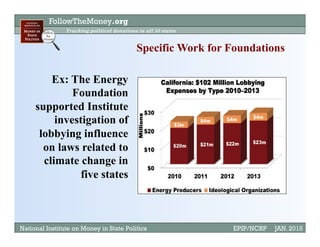
Specific Work for Foundations
Ex: The Energy
Foundation
supported Institute
investigation of
lobbying influence
on laws related to
climate change in
five states
FollowTheMoney.org
Tracking political donations in all 50 states
National Institute on Money in State Politics EPIP/NCRP JAN. 2015
Legislative Power Mapping
Focus on
special interest
contributors
Ex: Oil & Gas
FollowTheMoney.org
Tracking political donations in all 50 states
National Institute on Money in State Politics EPIP/NCRP JAN. 2015
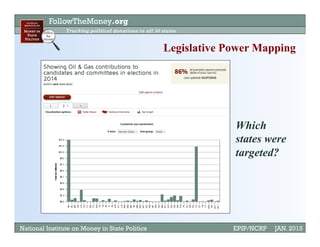
Legislative Power Mapping
Which
states were
targeted?
FollowTheMoney.org
Tracking political donations in all 50 states
National Institute on Money in State Politics EPIP/NCRP JAN. 2015
Legislative Power Mapping
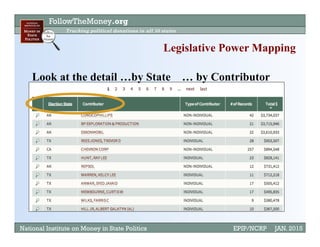
Look at the detail …by State … by Contributor
FollowTheMoney.org
Tracking political donations in all 50 states
National Institute on Money in State Politics EPIP/NCRP JAN. 2015
Legislative Power Mapping
Is your focus on
healthcare?
Health-related
political giving to
state legislators
is on the rise
nationwide
$74M
$36M
$49M
$62M
FollowTheMoney.org
Tracking political donations in all 50 states
National Institute on Money in State Politics EPIP/NCRP JAN. 2015
Specific Work for Foundations
Ex: The California
Endowment asked the
Institute to document
the record-breaking
pace of the California
medical insurance
industry’s political
contributions to affect
2014 state elections.
FollowTheMoney.org
Tracking political donations in all 50 states
National Institute on Money in State Politics EPIP/NCRP JAN. 2015
Legislative Power Mapping
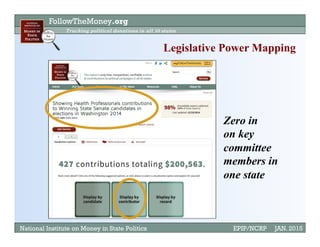
Zero in
on key
committee
members in
one state
FollowTheMoney.org
Tracking political donations in all 50 states
National Institute on Money in State Politics EPIP/NCRP JAN. 2015
Legislative Power Mapping
Who gave
them the
most?
FollowTheMoney.org
Tracking political donations in all 50 states
National Institute on Money in State Politics EPIP/NCRP JAN. 2015
Legislative Power Mapping
… how much?
… from?
… to?
Save your searches and download results
FollowTheMoney.org
Tracking political donations in all 50 states
National Institute on Money in State Politics EPIP/NCRP JAN. 2015
Legislative Power Mapping
Narrow your focus
to who has the
power in
committee
(2015 legislative committees
coming soon!)
FollowTheMoney.org
Tracking political donations in all 50 states
National Institute on Money in State Politics EPIP/NCRP JAN. 2015
Contact Edwin Bender
406-449-2480
edwinb@followthemoney.org
Follow us! Facebook.com/FollowTheMoney.org
Twitter: @MoneyInPolitics
Want to Learn More?
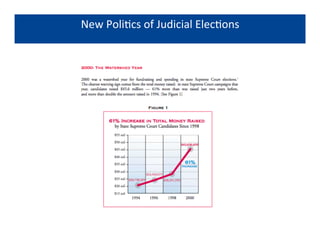
New$Poli)cs$of$Judicial$Elec)ons$
Tara Malloy!
The Disclosure Deficit:
Anonymous Campaign Spending after Citizens United
and its Effects
Citizens United v. FEC!
Five Justices struck down the federal restrictions on
corporate spending to influence elections.!
All but Justice Thomas voted to uphold disclosure.!
The Aftermath of Citizens United
Elec)on$Year$ Total$(non8party)$outside$spending$
2006$ $69,535,000$
2008$ $338,400,000$
Ci#zens(United(
2010$ $309,834,000$
2012$ $1,038,737,000$
2014$ $560,637,000$
Information from the Center for Responsive Politics
Biggest “Dark Money” Groups, 2014
Group Spending
US Chamber of Commerce $35,464,243
Crossroads GPS $26,015,161
NRA Institute for Legislative Action $12,117,487
Patriot Majority USA $10,652,298
American Action Network $8,958,129
Information from the Center for Responsive Politics
Section 501(c) groups
•  A 501(c)(3) organization is a public charity or private foundation (e.g., Boy
Scouts of America, Heritage Foundation, churches). A 501(c)(3) is
prohibited from participating or intervening in any political campaign for a
candidate for public office.
•  A 501(c)(4) is a social welfare organization (e.g., NRA, Sierra Club). Donors
also need not be publicly disclosed under the tax law. Unlike (c)(3)s, these
groups can participate in political campaign activity for candidates for
public office, provided that this is not their primary activity. Examples of
such (c)(4)s are Crossroads GPS and American Action Network.
•  501(c)(5)s are labor organizations and 501(c)(6)s are trade associations.
They are also not required to publicly disclose their donors under the tax
law. Similarly to 501(c)(4)s, these groups can engage in political campaign
activity provided that it is not their primary activity. Both of these types of
groups were very involved in the 2010 elections; according to the Center for
Responsive Politics, the most active (c)(5) was the Service Employees
International Union and the most active (c)(6) was the U.S. Chamber of
Commerce.
Declining Disclosure
1 Figure: Campaign Legal Center. Data: Center for Responsive Politics.!
0%!
10%!
20%!
30%!
40%!
50%!
60%!
70%!
2008! 2012!
Portion of Outside
Spending Disclosed1
65 %!
41 %!
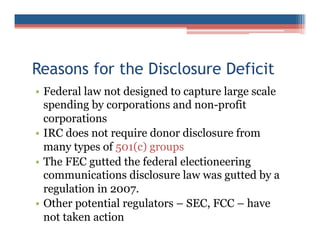
Reasons for the Disclosure Deficit
•  Federal law not designed to capture large scale
spending by corporations and non-profit
corporations
•  IRC does not require donor disclosure from
many types of 501(c) groups
•  The FEC gutted the federal electioneering
communications disclosure law was gutted by a
regulation in 2007.
•  Other potential regulators – SEC, FCC – have
not taken action
Multi-prong Approach to
Improving Transparency
a. Legisla)ve$Ac)on$(DISCLOSE$Act)$
b. Affirma)ve$Li)ga)on$(Van$Hollen$v.$
FEC)$
c. Administra)ve$Prac)ce$(IRS,$FEC)$$
d. Defensive$Li)ga)on$
The Hewlett
Foundation’s
Madison Initiative
Our goal: help create conditions
in which Congress and its
members can negotiate and
compromise in ways that work
for most Americans
Ingredients for Impact:
Foundations Building
Nonprofit Capacity
& Real Results
#2014GEO 

@NCRP!

EPIP/NCRP Webinar | Supersized Imbalance: Post-2014 Election, What Foundations Should Know

  • 1.
    SUPERSIZED IMBALANCE: POST-2015 ELECTION,WHAT FOUNDATIONS SHOULD KNOW EPIP/NCRP Webinar January 9th, 2015 Hosts: Michael Barham and Christine Reeves
  • 2.
    2 Emerging Practitioners in Philanthropy(EPIP) is a national network of foundation professionals and social entrepreneurs who strive for excellence in the practice of philanthropy.
  • 3.
    3 We are aninclusive group of highly skilled & effective Change Makers committed to working together to build a just, equitable, & sustainable society.
  • 4.
    4 We provide aplatform for our community to: Connect with others Learn & practice leadership skills Voice emerging, transformative thoughts in the social sector
  • 5.
    Join EPIP! If you’renot yet a member, join us! More information on our site at www.epip.org/membership or contact michael@epip.org
  • 6.
    Announcements •  EPIP NationalConference – Save the Date! •  May 13th-14th •  New Orleans, LA •  Next EPIP Webinar - Wednesday, February 4th, 3pm ET •  Black Male Achievement: An Exploration of Systemic and Capacity Building Solutions •  Foundation Center, Open Society Foundations, PolicyLink, CLASP •  MC MaL •  January: Communications •  All Events •  epip.org/events
  • 7.
    Housekeeping •  All attendeeson mute during the presentation •  Use the question box for technical difficulties •  We’ll save time for Q&A •  We’ll be recording this webinar, visit our website to view •  Complete the post-webinar survey!
  • 8.
  • 9.
    Christine Reeves! Edwin Bender! DanielStid!Tara Malloy! Bert Brandenburg!
  • 10.
    Goals for OurTime Today Frame Overview of NIMSP Tool #1: Who Gives to Influence Policy? (Example: Fracking) #2: Legislative Action in the States (Example: ACA Health Policy) #3: Judicial Independence (Example: Money in Judicial Elections) #4: Defending & Enforcing Campaign Finance (Example: Sun Act) #5: How Election Data Informs the Hewlett Foundation (Example: Madison Initiative Program)
  • 11.
  • 12.
  • 13.
    FollowTheMoney.org Tracking political donationsin all 50 states National Institute on Money in State Politics EPIP/NCRP JAN. 2015 We Connect the Dots in 50 States Ballot measures Judicial candidates Statewide candidates Legislative candidates Federal candidates Political parties Lobbyists & clients
  • 14.
    FollowTheMoney.org Tracking political donationsin all 50 states National Institute on Money in State Politics EPIP/NCRP JAN. 2015 What Can Data Tell You? $5.6 Billion to Gubernatorial Races $8.4 Billion to Legislative Races $4.3 Billion to Ballot Measures
  • 15.
    FollowTheMoney.org Tracking political donationsin all 50 states National Institute on Money in State Politics EPIP/NCRP JAN. 2015 Our Data Tells You Who gave? How much? To whom? When?
  • 16.
    The Institute isseen as a “gold standard” reference and a “gold mine” of information. —RAND Corp, 2014 FollowTheMoney.org Transparency Media Academia Advocacy Policy Gov t Agencies Sunlight Foundation MapLight Project Vote Smart TransparencyData.com CNN, ABC, CBS, Fox, NPR, MSNBC Wall St. Journal, NY Times, Reuters, Newsweek Center for Public Integrity ProPublica Investigative News Network Stateline.org Harvard, Stanford, Rice, New York Univ. of Law Sustainable Investments Institute American Judicature Society Election Law Journal Common Cause Midwest Democracy Network U.S. PIRG State Voices AARP Campaign for a Just Society Cato Institute Justice at Stake Campaign Finance Institute Progressive States Network Heritage Foundation Brennan Center for Justice All 50 state elections agencies U.S. Supreme Court National Conference of State Legislatures U.S. Government Accountability Office Council on Governmental Ethics Laws
  • 17.
    FollowTheMoney.org Tracking political donationsin all 50 states National Institute on Money in State Politics EPIP/NCRP JAN. 2015 Identify special interest money Data = Informed Power Mapping Who may wish to influence public policy? How much did they give to people in positions of power?
  • 18.
    FollowTheMoney.org Tracking political donationsin all 50 states National Institute on Money in State Politics EPIP/NCRP JAN. 2015 Specific Work for Foundations Ex: The Energy Foundation supported Institute investigation of lobbying influence on laws related to climate change in five states
  • 19.
    FollowTheMoney.org Tracking political donationsin all 50 states National Institute on Money in State Politics EPIP/NCRP JAN. 2015 Legislative Power Mapping Focus on special interest contributors Ex: Oil & Gas
  • 20.
    FollowTheMoney.org Tracking political donationsin all 50 states National Institute on Money in State Politics EPIP/NCRP JAN. 2015 Legislative Power Mapping Which states were targeted?
  • 21.
    FollowTheMoney.org Tracking political donationsin all 50 states National Institute on Money in State Politics EPIP/NCRP JAN. 2015 Legislative Power Mapping Look at the detail …by State … by Contributor
  • 22.
    FollowTheMoney.org Tracking political donationsin all 50 states National Institute on Money in State Politics EPIP/NCRP JAN. 2015 Legislative Power Mapping Is your focus on healthcare? Health-related political giving to state legislators is on the rise nationwide $74M $36M $49M $62M
  • 23.
    FollowTheMoney.org Tracking political donationsin all 50 states National Institute on Money in State Politics EPIP/NCRP JAN. 2015 Specific Work for Foundations Ex: The California Endowment asked the Institute to document the record-breaking pace of the California medical insurance industry’s political contributions to affect 2014 state elections.
  • 24.
    FollowTheMoney.org Tracking political donationsin all 50 states National Institute on Money in State Politics EPIP/NCRP JAN. 2015 Legislative Power Mapping Zero in on key committee members in one state
  • 25.
    FollowTheMoney.org Tracking political donationsin all 50 states National Institute on Money in State Politics EPIP/NCRP JAN. 2015 Legislative Power Mapping Who gave them the most?
  • 26.
    FollowTheMoney.org Tracking political donationsin all 50 states National Institute on Money in State Politics EPIP/NCRP JAN. 2015 Legislative Power Mapping … how much? … from? … to? Save your searches and download results
  • 27.
    FollowTheMoney.org Tracking political donationsin all 50 states National Institute on Money in State Politics EPIP/NCRP JAN. 2015 Legislative Power Mapping Narrow your focus to who has the power in committee (2015 legislative committees coming soon!)
  • 28.
    FollowTheMoney.org Tracking political donationsin all 50 states National Institute on Money in State Politics EPIP/NCRP JAN. 2015 Contact Edwin Bender 406-449-2480 edwinb@followthemoney.org Follow us! Facebook.com/FollowTheMoney.org Twitter: @MoneyInPolitics Want to Learn More?
  • 30.
  • 31.
  • 32.
  • 33.
  • 34.
  • 35.
    The Disclosure Deficit: AnonymousCampaign Spending after Citizens United and its Effects
  • 36.
    Citizens United v.FEC! Five Justices struck down the federal restrictions on corporate spending to influence elections.! All but Justice Thomas voted to uphold disclosure.!
  • 37.
    The Aftermath ofCitizens United Elec)on$Year$ Total$(non8party)$outside$spending$ 2006$ $69,535,000$ 2008$ $338,400,000$ Ci#zens(United( 2010$ $309,834,000$ 2012$ $1,038,737,000$ 2014$ $560,637,000$ Information from the Center for Responsive Politics
  • 38.
    Biggest “Dark Money”Groups, 2014 Group Spending US Chamber of Commerce $35,464,243 Crossroads GPS $26,015,161 NRA Institute for Legislative Action $12,117,487 Patriot Majority USA $10,652,298 American Action Network $8,958,129 Information from the Center for Responsive Politics
  • 39.
    Section 501(c) groups • A 501(c)(3) organization is a public charity or private foundation (e.g., Boy Scouts of America, Heritage Foundation, churches). A 501(c)(3) is prohibited from participating or intervening in any political campaign for a candidate for public office. •  A 501(c)(4) is a social welfare organization (e.g., NRA, Sierra Club). Donors also need not be publicly disclosed under the tax law. Unlike (c)(3)s, these groups can participate in political campaign activity for candidates for public office, provided that this is not their primary activity. Examples of such (c)(4)s are Crossroads GPS and American Action Network. •  501(c)(5)s are labor organizations and 501(c)(6)s are trade associations. They are also not required to publicly disclose their donors under the tax law. Similarly to 501(c)(4)s, these groups can engage in political campaign activity provided that it is not their primary activity. Both of these types of groups were very involved in the 2010 elections; according to the Center for Responsive Politics, the most active (c)(5) was the Service Employees International Union and the most active (c)(6) was the U.S. Chamber of Commerce.
  • 40.
    Declining Disclosure 1 Figure:Campaign Legal Center. Data: Center for Responsive Politics.! 0%! 10%! 20%! 30%! 40%! 50%! 60%! 70%! 2008! 2012! Portion of Outside Spending Disclosed1 65 %! 41 %!
  • 41.
    Reasons for theDisclosure Deficit •  Federal law not designed to capture large scale spending by corporations and non-profit corporations •  IRC does not require donor disclosure from many types of 501(c) groups •  The FEC gutted the federal electioneering communications disclosure law was gutted by a regulation in 2007. •  Other potential regulators – SEC, FCC – have not taken action
  • 42.
    Multi-prong Approach to ImprovingTransparency a. Legisla)ve$Ac)on$(DISCLOSE$Act)$ b. Affirma)ve$Li)ga)on$(Van$Hollen$v.$ FEC)$ c. Administra)ve$Prac)ce$(IRS,$FEC)$$ d. Defensive$Li)ga)on$
  • 43.
    The Hewlett Foundation’s Madison Initiative Ourgoal: help create conditions in which Congress and its members can negotiate and compromise in ways that work for most Americans
  • 46.
    Ingredients for Impact: FoundationsBuilding Nonprofit Capacity & Real Results #2014GEO 
 @NCRP!