2020 Campaign Coverage:
Beyond the Horse Race
Sept. 13, 2019
Join the conversation with #ONA19Campaign
Naomi
SCHALIT
Joel
ABRAMS
Beyond the Horse Race
Denise
ORDWAY
John
ADAMS
And they’re off!
Managing Editor of
Journalist’s Resource
Former reporter for 15
years for Orlando
Sentinel, Philadelphia
Inquirer, and other
outlets
2013 Pulitzer finalist
Denise Ordway
Senior Politics editor, The
Conversation US
Former reporter for San Jose
Mercury News, Maine Public
Radio, and other outlets
Co-founder of Maine Center for
Public Interest Reporting
Naomi Schalit
Founder, executive
director and
editor-in-chief of the
Montana Free Press
Former reporter for
Great Falls Tribune
and USA Today
John Adams
Denise Ordway
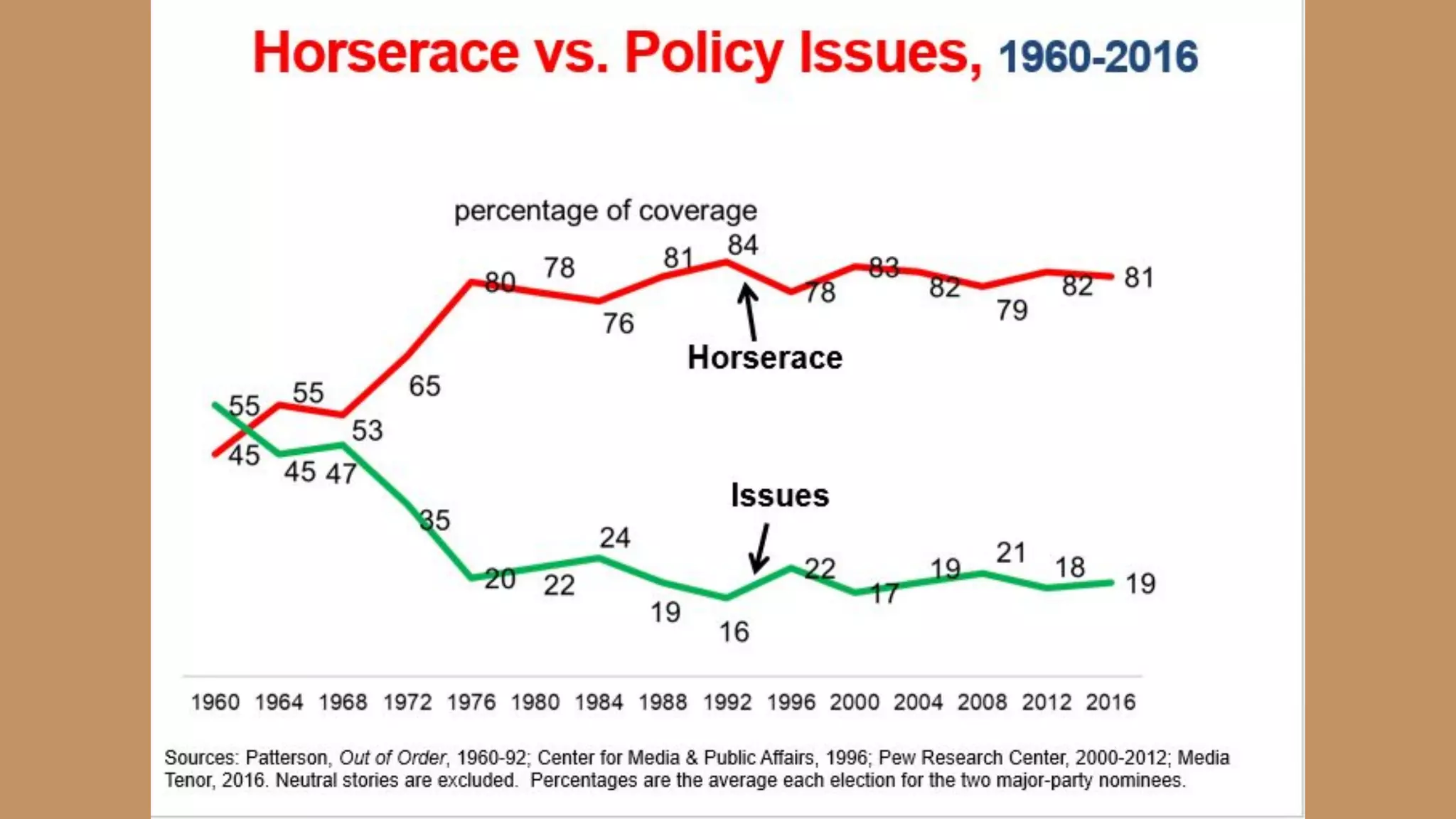
Horse race
reporting
What is it?
(Image by Clarence Alford from Pixabay)
Horse race reporting:
● Focuses on who’s winning/losing.
● Frames elections as a competitive sport.
● Discusses strengths/weaknesses in context of position in the race.
● Uses racing analogies.
● Relies heavily on opinion polls.
● Often compares campaign contributions.
● Emphasizes candidates’ strategies and tactics.
● Tends to over-cover some types of candidates, under-cover others.
It hurts:
● Candidates trailing in polls.
● Third-party candidates.
● Voters.
● News outlets.
It helps:
● Frontrunners.
● Underdogs on the rise.
Who does it affect?
Research: Horse race reporting is linked to …
● Voter distrust in politicians.
● Voter distrust in the news media.
● A less informed electorate.
● Inaccurate reporting of polls.
(Image by Gianni Crestani from Pixabay)
Covering the 2020 election when
you don’t have much money, staff
or time
Naomi Schalit,
Senior editor, Politics & Society
The Conversation US
Join the conversation with #ONA19Campaign
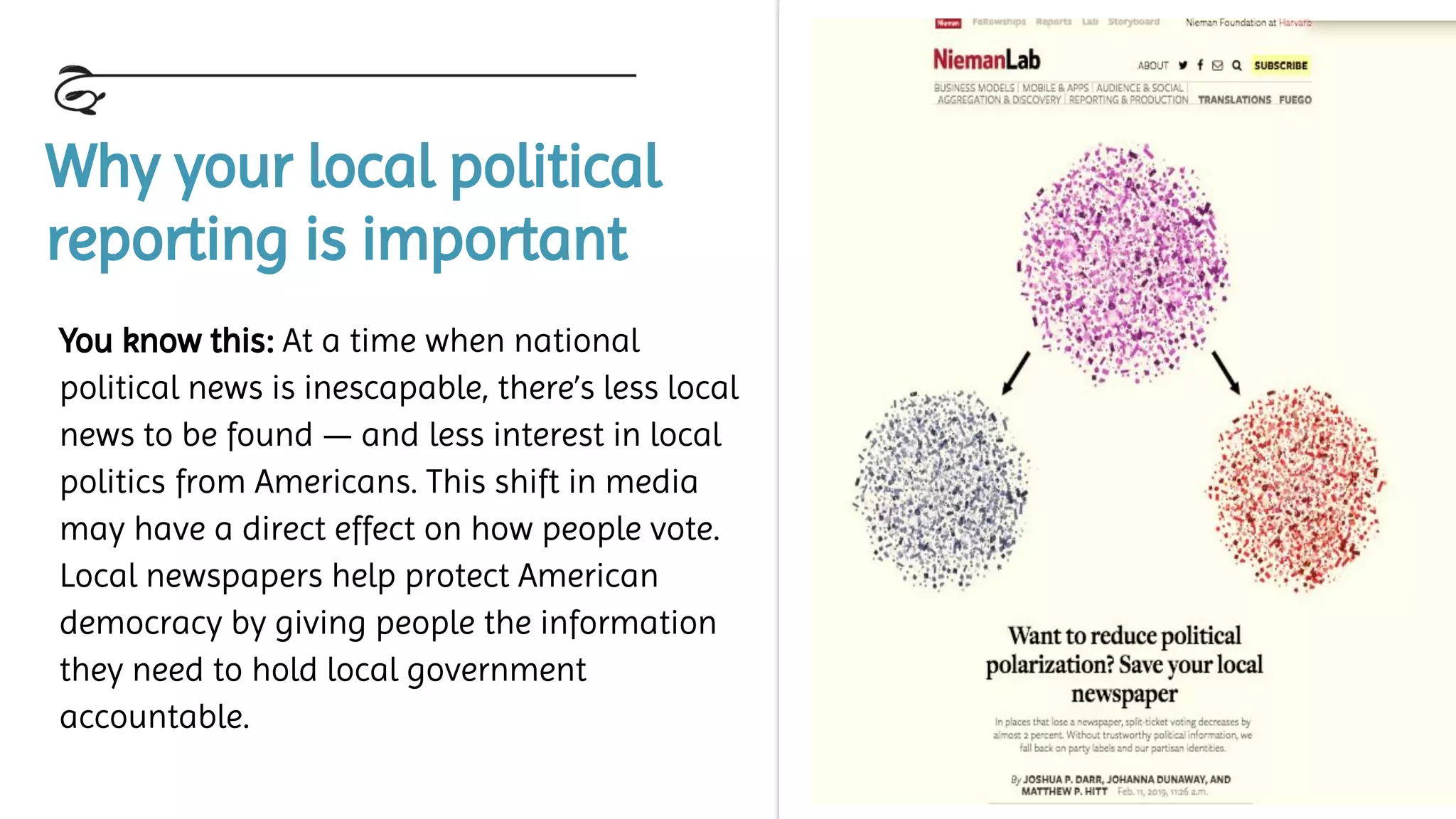
Why your local political
reporting is important
You know this: At a time when national
political news is inescapable, there’s less local
news to be found — and less interest in local
politics from Americans. This shift in media
may have a direct effect on how people vote.
Local newspapers help protect American
democracy by giving people the information
they need to hold local government
accountable.
No local politics? You get polarization
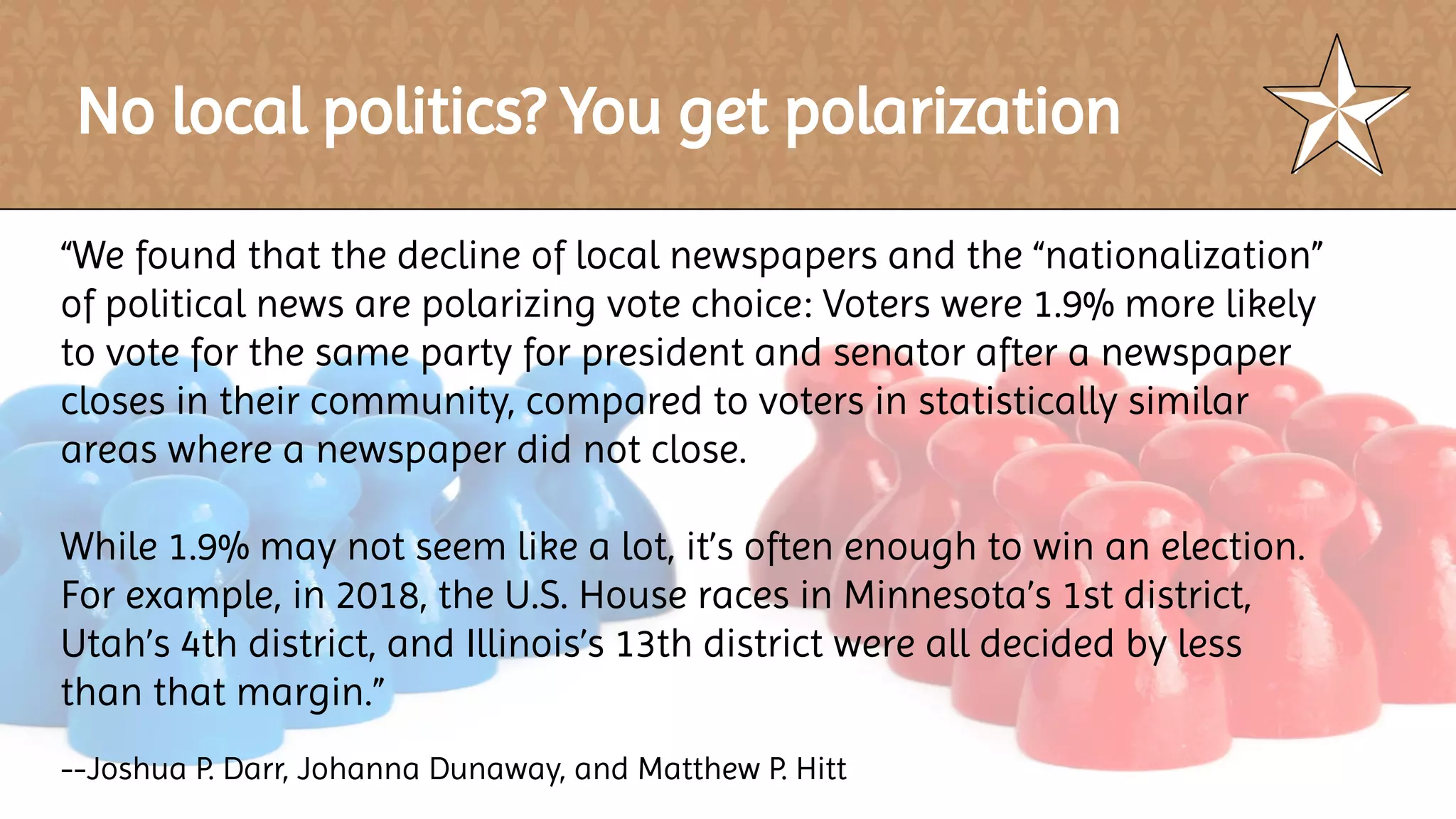
“We found that the decline of local newspapers and the “nationalization”
of political news are polarizing vote choice: Voters were 1.9% more likely
to vote for the same party for president and senator after a newspaper
closes in their community, compared to voters in statistically similar
areas where a newspaper did not close.
While 1.9% may not seem like a lot, it’s often enough to win an election.
For example, in 2018, the U.S. House races in Minnesota’s 1st district,
Utah’s 4th district, and Illinois’s 13th district were all decided by less
than that margin.”
--Joshua P. Darr, Johanna Dunaway, and Matthew P. Hitt
Now that democracy is
riding on your shoulders….
What is to be
done?
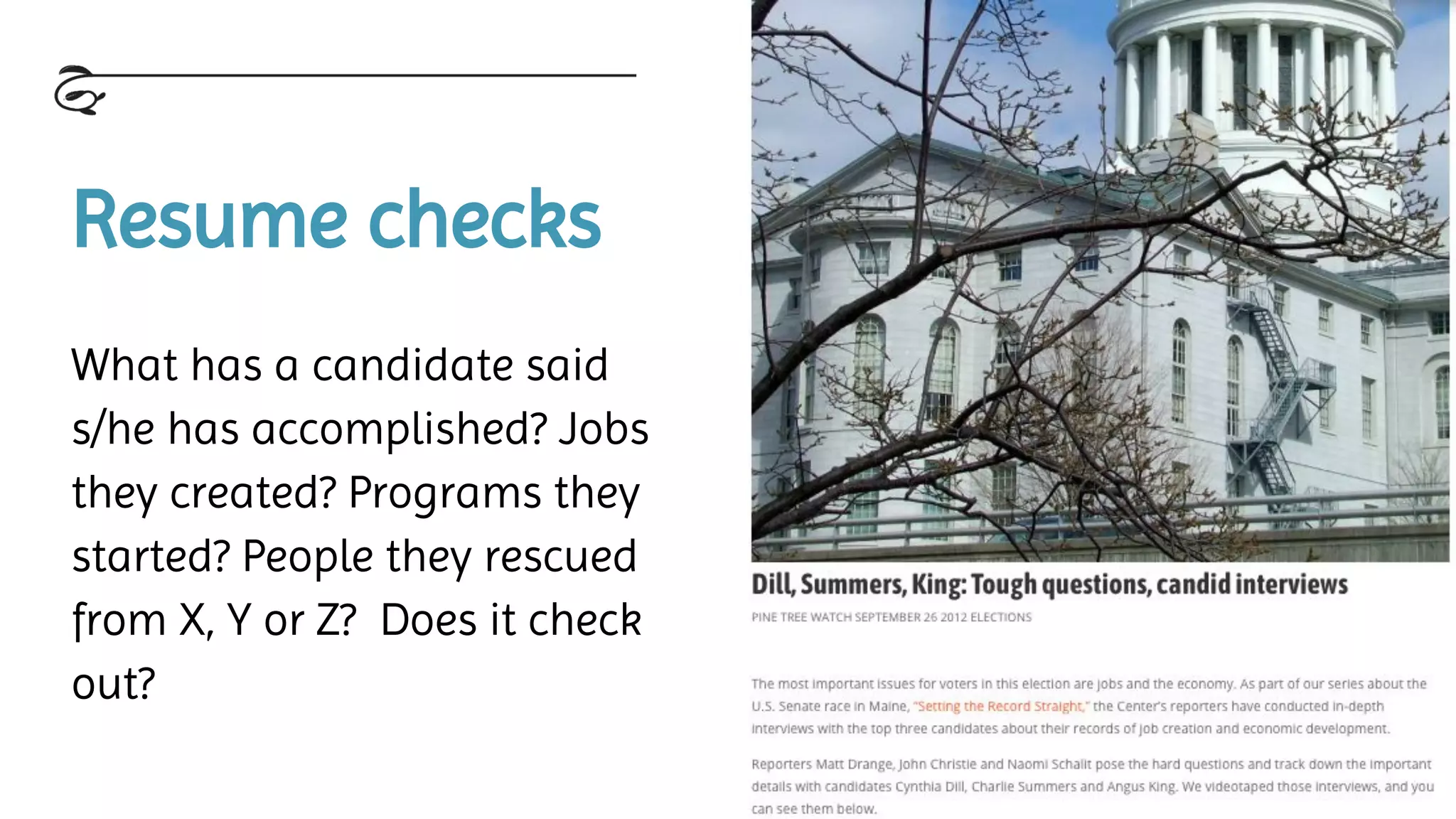
Resume checks
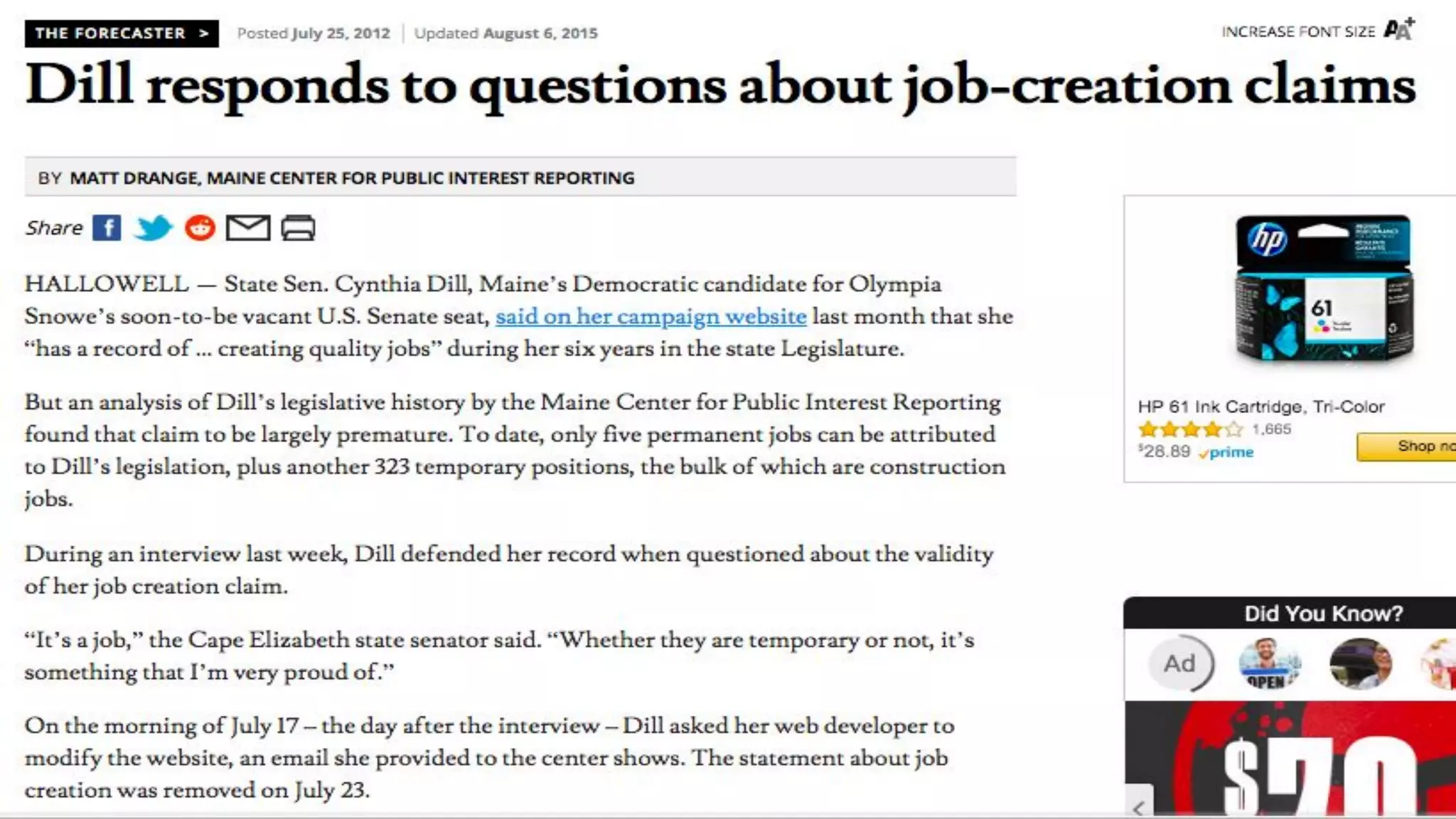
What has a candidate said
s/he has accomplished? Jobs
they created? Programs they
started? People they rescued
from X, Y or Z? Does it check
out?
Hey look! It’s Irving Washington!
THIS IS
IMPORTANT
MAKE SURE TO SCREEN-SHOT THE CANDIDATES’
WEBPAGE/FACEBOOK PAGE/ADS WHERE THEY MAKE
THE CLAIMS THAT YOU MAY WELL DEBUNK
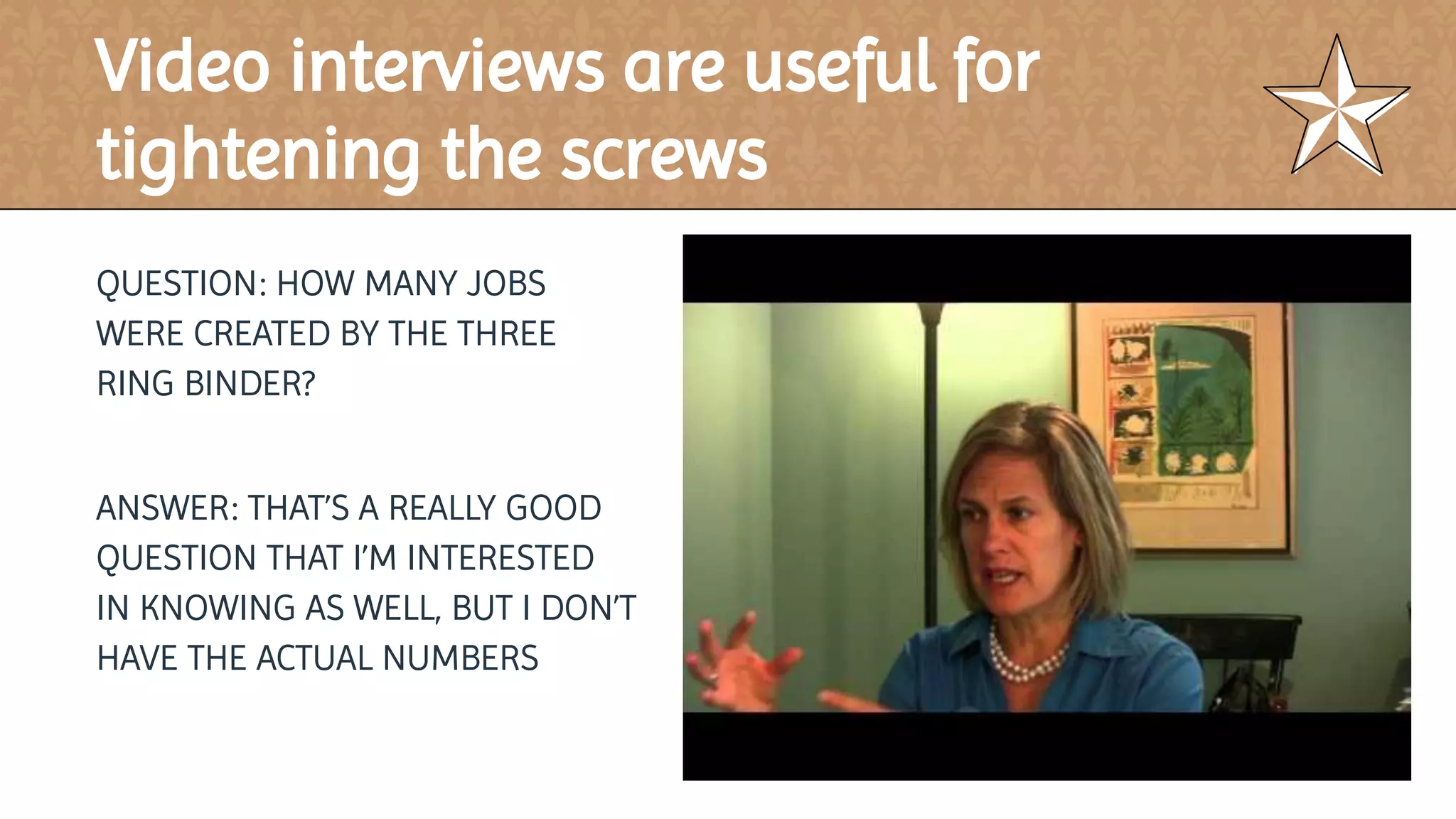
Or you may get this
QUESTION: HOW MANY JOBS
WERE CREATED BY THE THREE
RING BINDER?
ANSWER: THAT’S A REALLY GOOD
QUESTION THAT I’M INTERESTED
IN KNOWING AS WELL, BUT I DON’T
HAVE THE ACTUAL NUMBERS
Video interviews are useful for
tightening the screws
The money
horse race
Don’t get stuck doing PAC, SuperPAC, Dark Money “latest filing”
stories that just give the numbers. Readers need
context and they need to know what really matters.
The volume of campaign spending is not the
main problem with our campaign finance
system.
The real challenge for our democracy is
where so much of this money comes from.
Richard Briffault, Professor of Legislation, Columbia
University, in The Conversation, Nov. 2, 2018
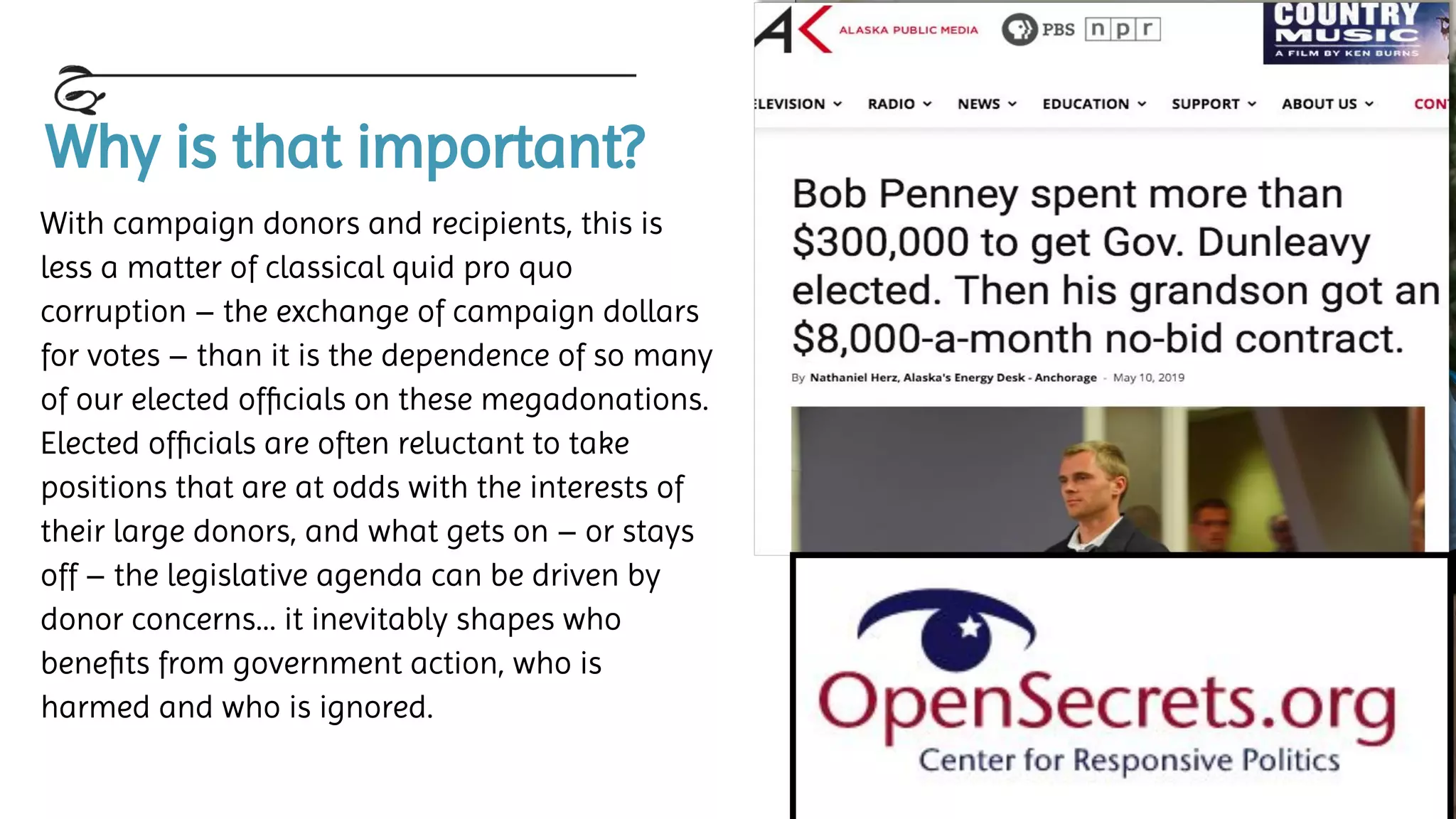
Why is that important?
With campaign donors and recipients, this is
less a matter of classical quid pro quo
corruption – the exchange of campaign dollars
for votes – than it is the dependence of so many
of our elected officials on these megadonations.
Elected officials are often reluctant to take
positions that are at odds with the interests of
their large donors, and what gets on – or stays
off – the legislative agenda can be driven by
donor concerns… it inevitably shapes who
benefits from government action, who is
harmed and who is ignored.
1. Voting systems – how do
they work in your
county/state and are they
secure? Who is overseeing
the systems?
2. Who are the voters?
3. Interrogate conventional
wisdom – your own and
others
Other kinds of stories
Don’t stop on
election day
“Eight months into his term as California
governor, Gavin Newsom has set aside
$1 billion to address the state's homelessness
crisis, formed a task force to get at its root
cause and pushed for speeding up the
construction of new shelters.
But he's yet to hire a cabinet-level
homelessness secretary, something he vowed
to do during his campaign. And it's not clear
whether he'll ever follow through.”
--PolitiFact California, Chris Nichols
John Adams
Join the conversation with #ONA19Campaign
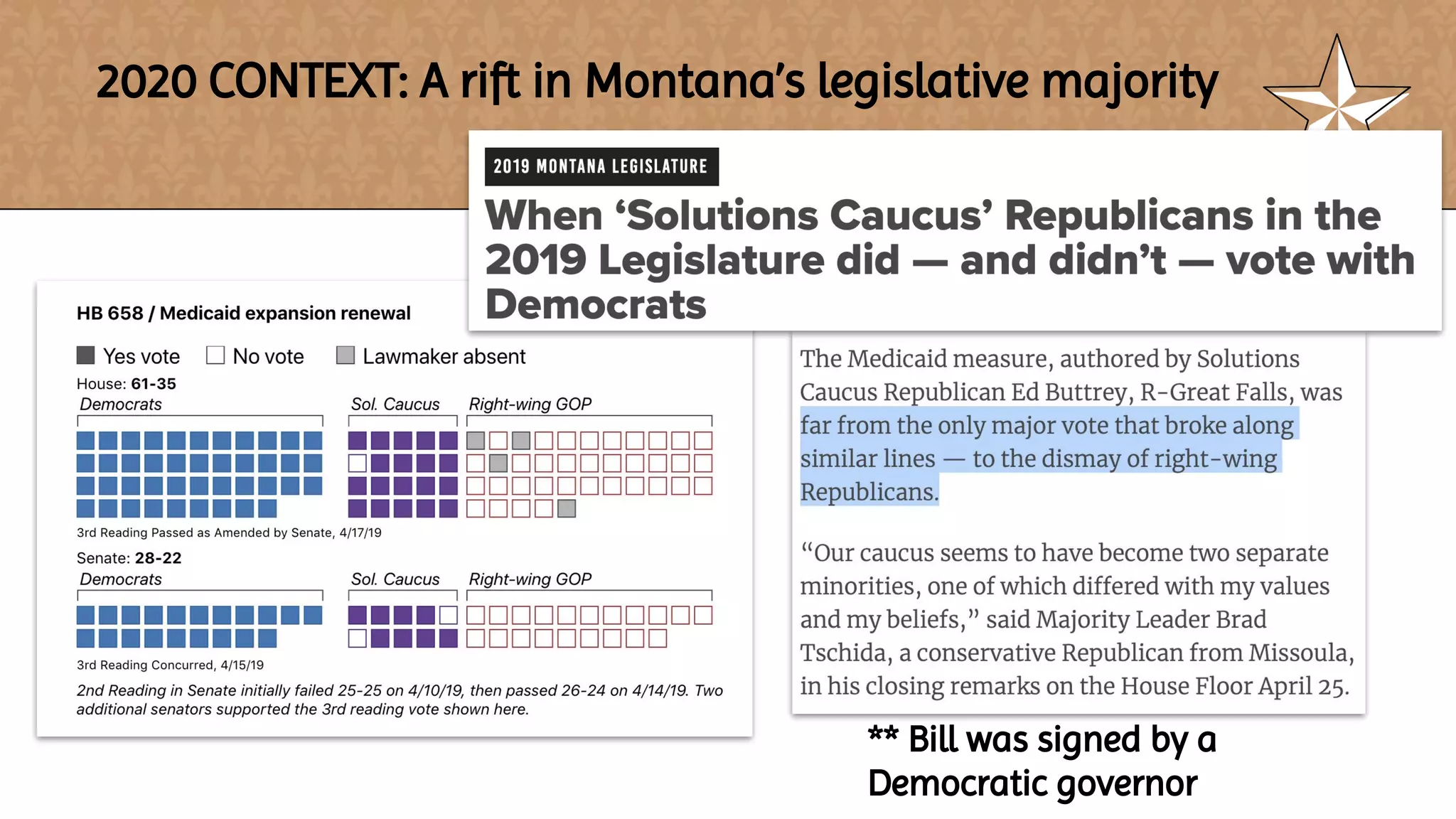
** Bill was signed by a
Democratic governor
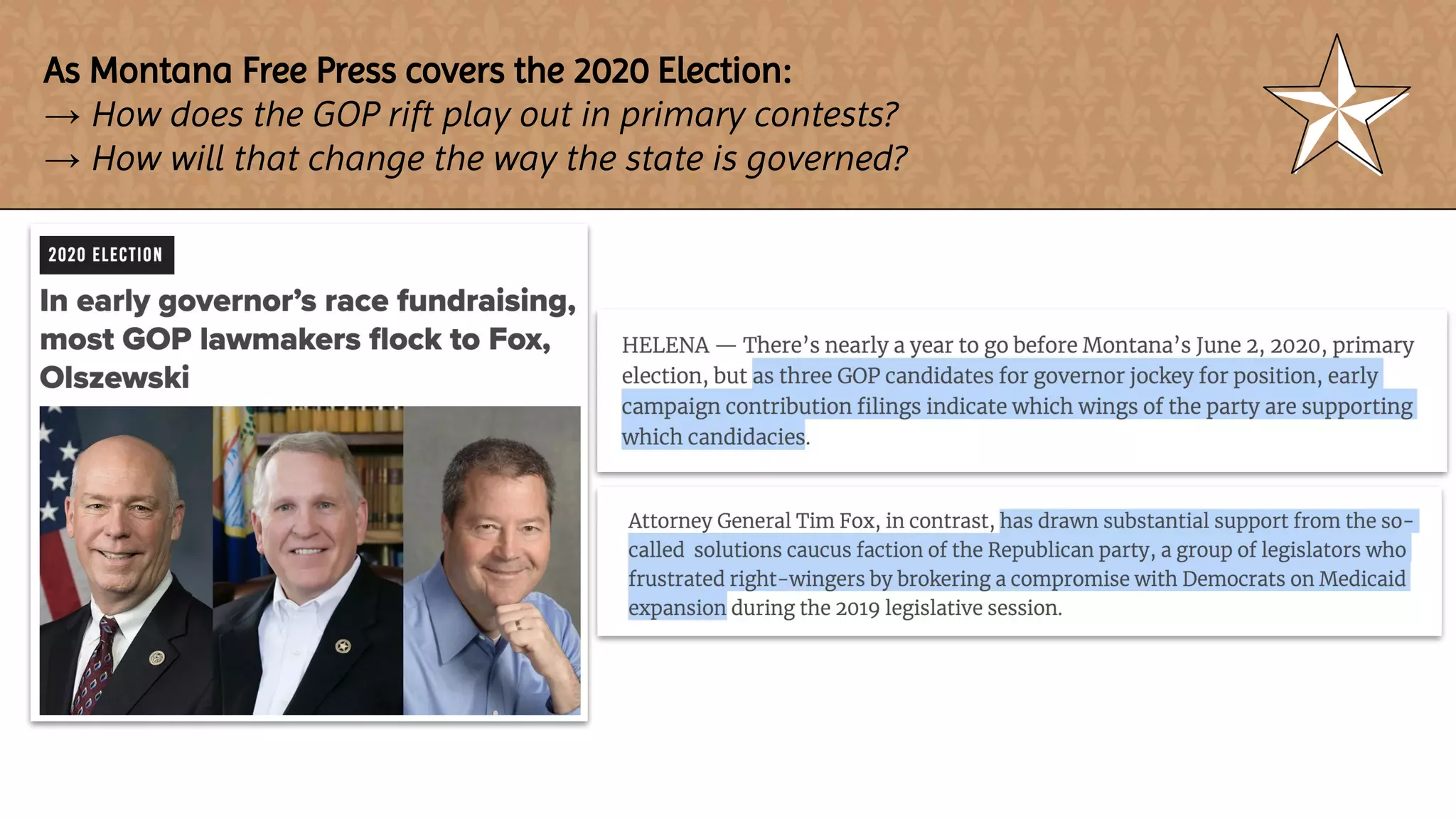
2020 CONTEXT: A rift in Montana’s legislative majority
As Montana Free Press covers the 2020 Election:
→ How does the GOP rift play out in primary contests?
→ How will that change the way the state is governed?
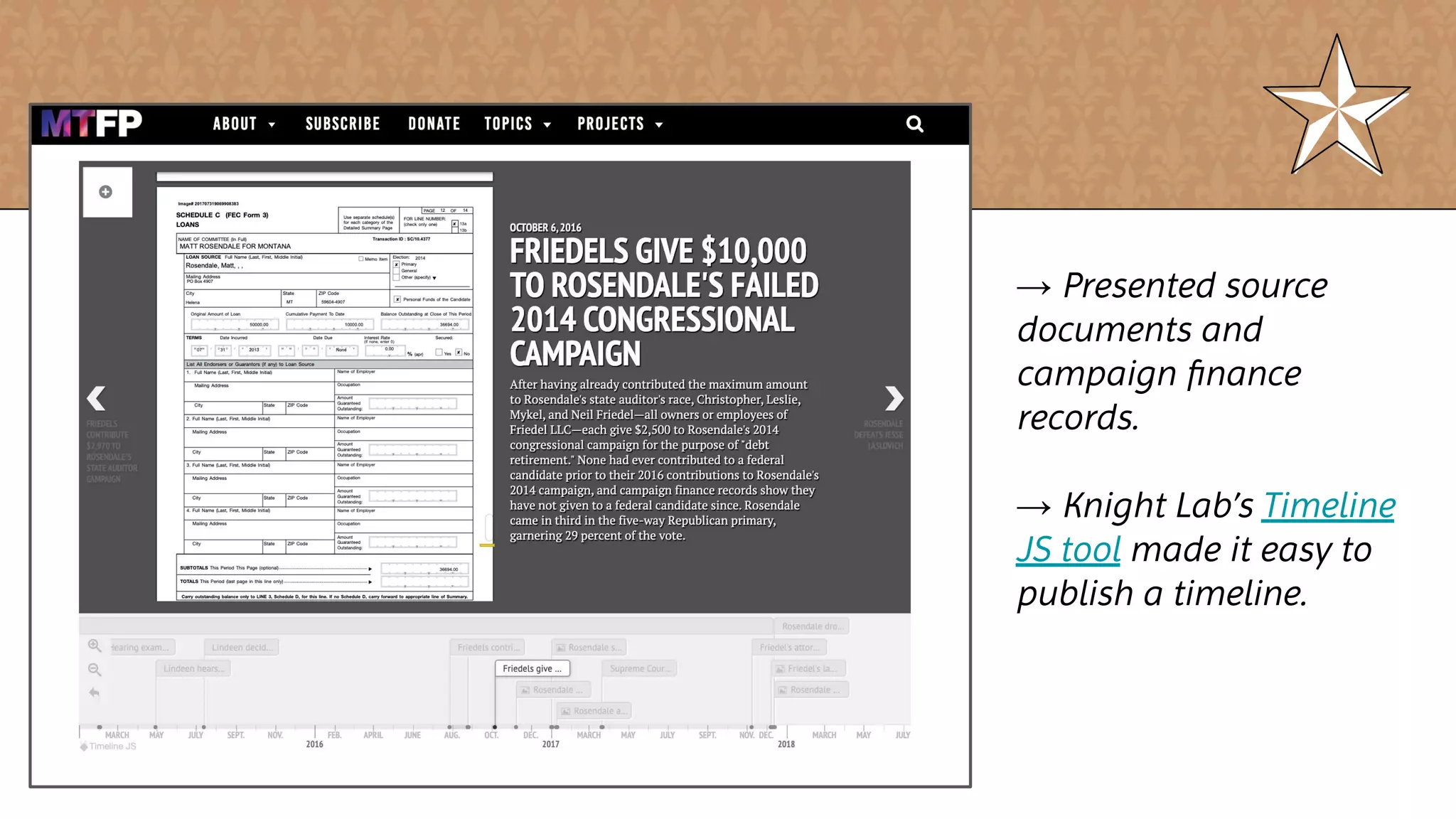
Examine incumbents’ past campaign finance reports
→ Were contributors rewarded for their generosity?
- In 2016, family members who owned a
company facing sanctions by the state
auditor gave nearly $13,000 to an
auditor candidate’s campaigns
(including a former U.S. House
campaign).
- Family did not have a history of political
giving.
- After years of protracted legal battles,
new state auditor drops the sanctions
after meeting with donors.
→ Presented source
documents and
campaign finance
records.
→ Knight Lab’s Timeline
JS tool made it easy to
publish a timeline.
Follow the money
→ Reporting on who is spending in elections is NOT horse race reporting.
→ People need to know who is seeking to influence politicians/voters.
FollowtheMoney.org
State-level campaign finance
data and tools
OpenSecrets.org
Federal campaign finance
data, tools, resources
FEC.gov
Raw federal campaign
finance data
Some Useful Tools
Dark Money Illuminated
Issue One’s searchable
database of dark money groups
FCC Political Ads
Track TV ad buys. Monitor
with Klaxon
Knight Lab
Easy-to-use open-source
storytelling toolkit
Time to talk
● How are you and your news organization trying to
move beyond the horse race?
Online resources: bit.ly/ONA19Campaign
Join the conversation at #ONA19Campaign
Thank you!
Be sure to visit the many ONA19 exhibitors in the third floor Exhibit Hall.
Naomi
SCHALIT
Joel
ABRAMS
Denise
ORDWAY
John
ADAMS

2020 Campaign Coverage: Beyond the Horse Race – ONA19

  • 1.
    2020 Campaign Coverage: Beyondthe Horse Race Sept. 13, 2019 Join the conversation with #ONA19Campaign
  • 2.
    Naomi SCHALIT Joel ABRAMS Beyond the HorseRace Denise ORDWAY John ADAMS
  • 3.
  • 5.
    Managing Editor of Journalist’sResource Former reporter for 15 years for Orlando Sentinel, Philadelphia Inquirer, and other outlets 2013 Pulitzer finalist Denise Ordway
  • 6.
    Senior Politics editor,The Conversation US Former reporter for San Jose Mercury News, Maine Public Radio, and other outlets Co-founder of Maine Center for Public Interest Reporting Naomi Schalit
  • 7.
    Founder, executive director and editor-in-chiefof the Montana Free Press Former reporter for Great Falls Tribune and USA Today John Adams
  • 8.
  • 9.
    Horse race reporting What isit? (Image by Clarence Alford from Pixabay)
  • 10.
    Horse race reporting: ●Focuses on who’s winning/losing. ● Frames elections as a competitive sport. ● Discusses strengths/weaknesses in context of position in the race. ● Uses racing analogies. ● Relies heavily on opinion polls. ● Often compares campaign contributions. ● Emphasizes candidates’ strategies and tactics. ● Tends to over-cover some types of candidates, under-cover others.
  • 11.
    It hurts: ● Candidatestrailing in polls. ● Third-party candidates. ● Voters. ● News outlets. It helps: ● Frontrunners. ● Underdogs on the rise. Who does it affect?
  • 12.
    Research: Horse racereporting is linked to … ● Voter distrust in politicians. ● Voter distrust in the news media. ● A less informed electorate. ● Inaccurate reporting of polls. (Image by Gianni Crestani from Pixabay)
  • 15.
    Covering the 2020election when you don’t have much money, staff or time Naomi Schalit, Senior editor, Politics & Society The Conversation US Join the conversation with #ONA19Campaign
  • 16.
    Why your localpolitical reporting is important You know this: At a time when national political news is inescapable, there’s less local news to be found — and less interest in local politics from Americans. This shift in media may have a direct effect on how people vote. Local newspapers help protect American democracy by giving people the information they need to hold local government accountable.
  • 17.
    No local politics?You get polarization “We found that the decline of local newspapers and the “nationalization” of political news are polarizing vote choice: Voters were 1.9% more likely to vote for the same party for president and senator after a newspaper closes in their community, compared to voters in statistically similar areas where a newspaper did not close. While 1.9% may not seem like a lot, it’s often enough to win an election. For example, in 2018, the U.S. House races in Minnesota’s 1st district, Utah’s 4th district, and Illinois’s 13th district were all decided by less than that margin.” --Joshua P. Darr, Johanna Dunaway, and Matthew P. Hitt
  • 18.
    Now that democracyis riding on your shoulders…. What is to be done?
  • 19.
    Resume checks What hasa candidate said s/he has accomplished? Jobs they created? Programs they started? People they rescued from X, Y or Z? Does it check out?
  • 20.
    Hey look! It’sIrving Washington!
  • 21.
    THIS IS IMPORTANT MAKE SURETO SCREEN-SHOT THE CANDIDATES’ WEBPAGE/FACEBOOK PAGE/ADS WHERE THEY MAKE THE CLAIMS THAT YOU MAY WELL DEBUNK
  • 22.
    Or you mayget this
  • 24.
    QUESTION: HOW MANYJOBS WERE CREATED BY THE THREE RING BINDER? ANSWER: THAT’S A REALLY GOOD QUESTION THAT I’M INTERESTED IN KNOWING AS WELL, BUT I DON’T HAVE THE ACTUAL NUMBERS Video interviews are useful for tightening the screws
  • 25.
    The money horse race Don’tget stuck doing PAC, SuperPAC, Dark Money “latest filing” stories that just give the numbers. Readers need context and they need to know what really matters.
  • 26.
    The volume ofcampaign spending is not the main problem with our campaign finance system. The real challenge for our democracy is where so much of this money comes from. Richard Briffault, Professor of Legislation, Columbia University, in The Conversation, Nov. 2, 2018
  • 27.
    Why is thatimportant? With campaign donors and recipients, this is less a matter of classical quid pro quo corruption – the exchange of campaign dollars for votes – than it is the dependence of so many of our elected officials on these megadonations. Elected officials are often reluctant to take positions that are at odds with the interests of their large donors, and what gets on – or stays off – the legislative agenda can be driven by donor concerns… it inevitably shapes who benefits from government action, who is harmed and who is ignored.
  • 28.
    1. Voting systems– how do they work in your county/state and are they secure? Who is overseeing the systems? 2. Who are the voters? 3. Interrogate conventional wisdom – your own and others Other kinds of stories
  • 29.
    Don’t stop on electionday “Eight months into his term as California governor, Gavin Newsom has set aside $1 billion to address the state's homelessness crisis, formed a task force to get at its root cause and pushed for speeding up the construction of new shelters. But he's yet to hire a cabinet-level homelessness secretary, something he vowed to do during his campaign. And it's not clear whether he'll ever follow through.” --PolitiFact California, Chris Nichols
  • 30.
    John Adams Join theconversation with #ONA19Campaign
  • 31.
    ** Bill wassigned by a Democratic governor 2020 CONTEXT: A rift in Montana’s legislative majority
  • 32.
    As Montana FreePress covers the 2020 Election: → How does the GOP rift play out in primary contests? → How will that change the way the state is governed?
  • 33.
    Examine incumbents’ pastcampaign finance reports → Were contributors rewarded for their generosity? - In 2016, family members who owned a company facing sanctions by the state auditor gave nearly $13,000 to an auditor candidate’s campaigns (including a former U.S. House campaign). - Family did not have a history of political giving. - After years of protracted legal battles, new state auditor drops the sanctions after meeting with donors.
  • 34.
    → Presented source documentsand campaign finance records. → Knight Lab’s Timeline JS tool made it easy to publish a timeline.
  • 35.
    Follow the money →Reporting on who is spending in elections is NOT horse race reporting. → People need to know who is seeking to influence politicians/voters. FollowtheMoney.org State-level campaign finance data and tools OpenSecrets.org Federal campaign finance data, tools, resources FEC.gov Raw federal campaign finance data Some Useful Tools Dark Money Illuminated Issue One’s searchable database of dark money groups FCC Political Ads Track TV ad buys. Monitor with Klaxon Knight Lab Easy-to-use open-source storytelling toolkit
  • 37.
    Time to talk ●How are you and your news organization trying to move beyond the horse race? Online resources: bit.ly/ONA19Campaign Join the conversation at #ONA19Campaign
  • 38.
    Thank you! Be sureto visit the many ONA19 exhibitors in the third floor Exhibit Hall. Naomi SCHALIT Joel ABRAMS Denise ORDWAY John ADAMS