1
1. Introduction
Throughout the years we have witnessed a marriage of informatics and telecommunications to
create telematics. We have witnessed telematics accomplish everything from improving health
care quality to reducing the environmental impact of vehicles. It has revolutionized many
aspects of our world.
Telematics is all about being able to get information on vehicles. Everything from fuel
performance to driving speed can be tracked with telematics. The beginning of telematics could
be said to have started with a tachograph over 60 years ago
Without GPS there would not be the telematics we know today. GPS is a system that was
designed for navigation and positioning. It was developed by the US defence department which
knew of the importance of exact data on the positions of its assets. It was developed to fulfil
the pressing need to have increased communication and exact data on the battlefield. It used
the satellite network in cohesion with ground communication
Dozens of GPS satellites now orbit the earth and enable GPS receivers to find their exact
location on the planet. GPS changed from a military application to a civilian one and the US
government provided free basic GPS signals to anyone in the world. It pushed for the adoption
of GPS around the world and made agreements with Japan and the EU.
The big difference between telematics and GPS is that telematics picks up where GPS left off.
It uses GPS technology to offer many different services to fleet owners such as navigation
services. GPS just provides data about your location where as telematics analyzes and uses
information along with communicating with parties outside of your vehicle. This enables a
huge range of services to be offered through telematics.
1.1 History of telematics
A lot of the development in Telematics began back in the 1984 European Parliamentary
resolution to promote road safety .Studies throughout the 1980’s kept tabs on informatics and
the development of telecommunications to find new applications for road safety. Through these
studies a program known as DRIVE was started to conduct research.This community based
research program focused on finding ways of using telematics for road safety, greater levels of
efficiency, and reducing environmental impact.
The DRIVE program was concluded in 1992 while in 1990 another program began for
telematics in general. In 1993 a European treaty was signed for telematics at the EU. The treaty
enabled more research and development along with increasing telematics firms
competitiveness on a global scale.
2
In 1993 the EU decided to increase its global competitiveness through stronger logistics
networks and transportation. The digital revolution that was beginning and leaders believed
that through telematics they could ride at the wave to economic success. Information and
technology was seen as a key factor to being more competitive.
Telematics research was heavily promoted in the government as a way to improve traffic
management and harmonizing traffic through the European Union. Pilot projects were set up
to ensure the technical capability of the telematics technology to be used for this new vision.
Here is an overview of some key technological innovations that have occurred in telematics
during the last decade:
1998 – The first hands free vehicle gateways were introduced
2000 – The first GSM & GPS systems were brought to market
2002 – Bluetooth hand free voice gateways with advanced voice integration features
2003 – Integrated GSM phone with Bluetooth
2007 – Multimedia handset integration is introduced
2009 – Fully integrated mobile navigation using a vehicle GSM system
2010 – 3G multimedia vehicle entertainment system
2011– Telematics and Infotainment systems introduced based on Linux
1.2 Telematics in Fleet Management
Telematics could help your business at very high extent. It has helped lots of fleets save on
fuel, maintenance and compliance costs while improving efficiency and productivity. It also
provide reliable navigation for your drivers. Telematics can mean a lot of different things but
as it applies to fleets it involves using data or information collected from a network or group
of connected vehicles. Essentially, telematics can transform your fleet from a bunch of
disparate, separate vehicles into a cohesive, organized fleet working together toward common
goals.
The existence of this network of connected vehicles with GPS receivers means fleet managers
no longer have to run their business largely in the dark they know where all vehicles are and
what they're doing. A few benefits gained by fleets using telematics include:
 Fuel economy increased by 18%
 Economical driving improved by 15%
 Harsh braking incidents decreased 77%
3
 Engine idle time down 64%
 Driving hours (windshield time) decreased 24%
GPS fleet data makes managers more aware of what's happening, what's costing them and how
they can work more efficiently. Operating a fleet without telematics is a bit like trying to drive
the speed limit without having a speedometer; without a clear gauge, you never know how fast
you're going in relation to the posted speed limit.
1.3 Future of telematics
Several new innovations in telematics are causing exciting new advertising applications for in
vehicle entertainment that will ultimately lead to lower costs for the consumer. Navigation will
become increasingly lower cost, with greater communication occurring between vehicles on
the road, and a trend towards ecofriendly.
Navigation systems are becoming increasingly popular as more drivers are realizing the
benefits it offers, and new features are being added every year. The services available through
telematics devices will separate more and more into two different categories:
Free Premium
This is going to increase the number of options available to consumers, especially as android
based telematics systems become more widely distributed.
Increased Personalization
You will be able to personalize and customize your telematics systems at an increasingly
popular level. Soon you will see telematics systems merging together, with your ability to have
a telematics black box and an android based entertainment system together in one unit.
Vehicle providers are also offering more possibilities for application development. The
previous model was based on manufacturers developing applications and then providing them
to the user. Now vehicle manufacturers are listening to the consumer more and focusing on
following software industry leaders like Apple and Google.
Greater Interactivity
New touch based systems are more sensitive than ever and offer greater opportunities for user
input. From voice control to new options like heat sensitive screens, and camera tracking of
user motions. You may one day be able to control half your vehicle by waving your finger in
the air, as new technology makes it easier than ever for greater control.
Community
You will observe more community and greater connectivity between in vehicle users, as the
speeds and services of Telematics becomes proliferated. This means that you may be able to
connect with other drivers on the road, social network, and even develop virtual carpooling to
help save on gas.
4
Greater Openness
You will see the telematics systems moving from closed manufacturer software to open
software with universal standards. Instead of manufacturers trying to each develop their own
proprietary systems, Telematics will become increasingly standardized and cross compatible
between vehicle models and manufacturers.
This will lead to more applications and services being available to Telematics customers as a
whole, in addition to greater flexibility when you change vehicle models.
Easier To Use
Ease of use ranks as the most important feature for vehicle users, so developers are trying to
make the systems increasingly user friendly for drivers. This includes better voice recognition
and control technology, more features, applications designed for drivers, and a simpler
interface that is more intuitive.
In a word, we can see telematics becoming more like Apple products.
1.4 Objective of the summer internship
The primary objective of the summer project
● Would be to have an extensive exposure to a hands-on experience in Market research
understanding the needs of the client, draft proposed solution and convert sales.
Apart from this, my secondary objective
● To gain knowledge by conducting a secondary and primary research about Telematics
Industry. This will certainly assist in improving my analytical skills.
● The organization have 150+ clients, thus, I would like to gain knowledge regarding
the business development process, how the organization engage and what is their
approach in bringing companies aboard.
● The delivery method to client via sending tailored solution proposals, creativity in
representation and what all constraints and hiccups that can occur while delivery of
project and how to overcome them will also be my key takeaways from this summer
project.
● To work and learn more about Sales channel and Branding strategies will be one of
the biggest takeaways from this project
5
1.5 Company Analysis
1.5.1 Company Detail
Locanix provides innovative SaaS solutions using GPS location information ranging from
corporate fleet management to consumer vehicle solutions, with a focus on safety, security and
operational efficiency.
Over the years GPS tracking technology has matured and a lot more innovation is possible as
a result. Locanix was created to harness the power of GPS tracking and create innovative
solutions that enable safety, security and operational efficiency. We try to go beyond the
boundaries of traditional GPS tracking solutions in our quest to add more value and solve
business problems for our clients.
While many solutions exist in this industry, Locanix sets itself apart from the competition by
providing enterprises not only the technology platform but also the ability to drive business
value with these solutions in complex and dynamic environments.
Every organization is different right from the roots. With software, a lot of innovation can be
done and we have been working hard to understand the fabric of the transportation business
across different sectors and come up with targeted solutions. Within transportation there are
many sectors like secure/high value goods, mining, cold chain etc. and one size does not fit all.
Most GPS vendors are viewing this as a single fleet management solution which tends to work
short term but does not drive value to the extent these systems can. And a lot of this depends
on the flexibility of the software platform else you cannot create solutions fast and effectively
enough. Innovation is key and we think we are way ahead of the competition.
Locanix solutions are designed to handle very large scale supply chains. Our supply chain
management solutions are not just about tracking vehicles. It’s about managing your complete
supply chain from our technology interface. Locanix solutions will escalate your entire supply
chain to the next level though business reporting, data analytics and actionable intelligence.
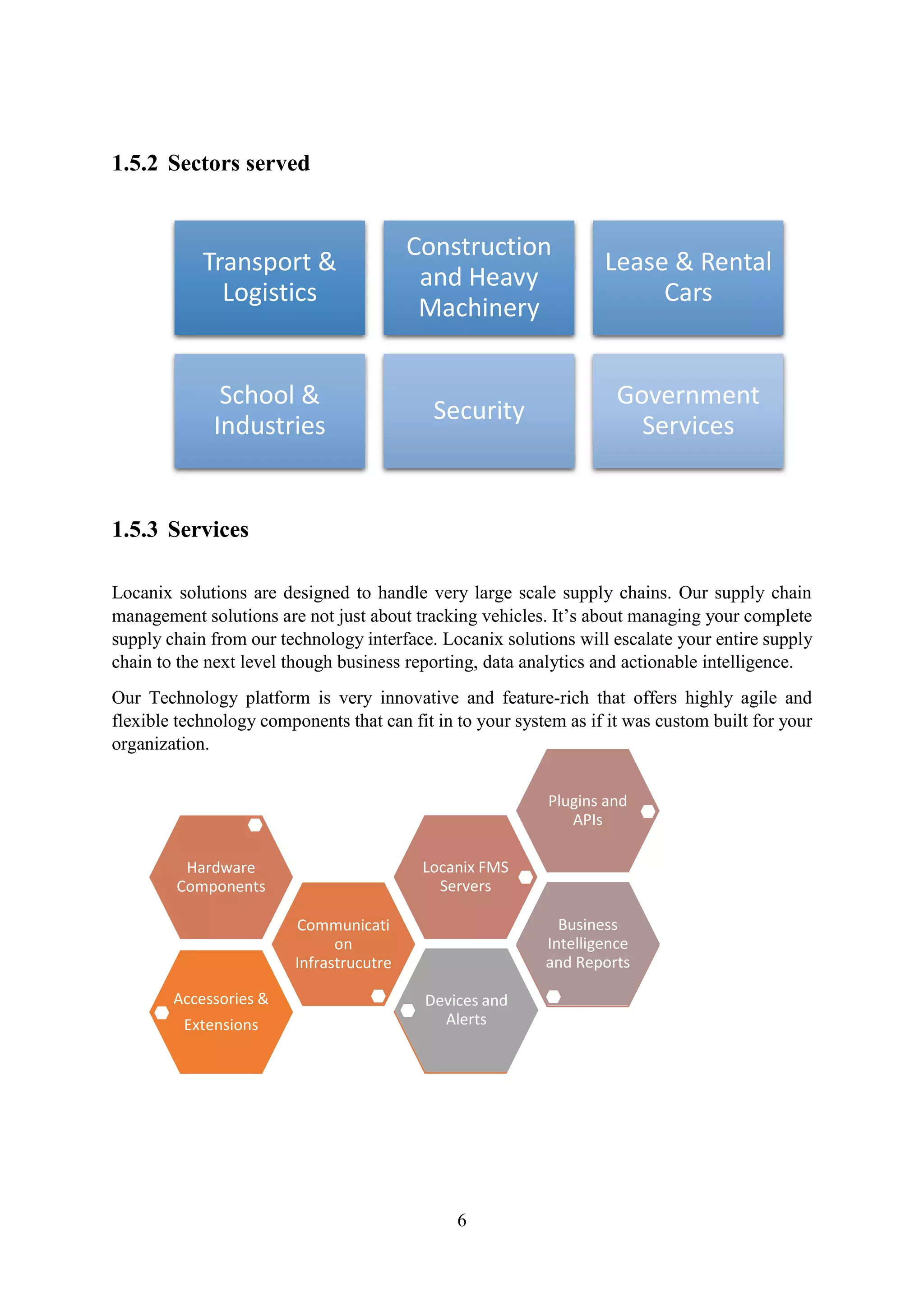
Our Technology platform is very innovative and feature-rich that offers highly agile and
flexible technology components that can fit in to your system as if it was custom built for your
organization.
6
Accessories &
Extensions
Communicati
on
Infrastrucutre
Hardware
Components
Locanix FMS
Servers
Plugins and
APIs
Business
Intelligence
and Reports
Devices and
Alerts
1.5.2 Sectors served
1.5.3 Services
Locanix solutions are designed to handle very large scale supply chains. Our supply chain
management solutions are not just about tracking vehicles. It’s about managing your complete
supply chain from our technology interface. Locanix solutions will escalate your entire supply
chain to the next level though business reporting, data analytics and actionable intelligence.
Our Technology platform is very innovative and feature-rich that offers highly agile and
flexible technology components that can fit in to your system as if it was custom built for your
organization.
Transport &
Logistics
Construction
and Heavy
Machinery
Lease & Rental
Cars
School &
Industries
Security
Government
Services
7
2 Project Handled
While the work performed during this period was particularly glamorous and equally thrilling,
true is that this internship period exposed me to experiences which have significantly altered
the perception of Sales, Market Research & Business Development in field of Telematics
2.1 Roles and Responsibilities
The internship period started from 18st
of April, 2016 and last up to 18st
June, 2016. Locanix
have been working hard to understand the fabric of the transportation business across different
sectors and come up with targeted solutions. Within transportation there are many sectors like
secure/high value goods, mining, cold chain etc. and one size does not fit all. Most GPS vendors
are viewing this as a single fleet management solution which tends to work short term but does
not drive value to the extent these systems can. And a lot of this depends on the flexibility of
the software platform else you cannot create solutions fast and effectively enough. Innovation
is key and we think we are way ahead of the competition. I assisted the team in the market
research , Sales & Business Devlopment work.
2.2 Assignments
When I joined the company I first worked on the project of Market research which included
both primary and secondary research. I was briefed and started to work in coordination with
the team and my guide. Every day, I was allotted work accordingly. I used to get proper
feedback from my team members and guide regarding the work done gradually my role was
shifted towards sales and business development.
2.2.1 Market Research
2.2.1.1 PEST Analysis
Political
GPS devices are rendered useless without a satellite system to support them. Global Navigation
Satellite System (GNSS) is the standard generic term for satellite navigation systems that
provide autonomous geo-spatial positioning with global coverage. Cu GPS devices are
rendered useless without a satellite system to support them. Global Navigation Satellite System
(GNSS) is the standard generic term for satellite navigation systems that provide autonomous
geo-spatial positioning with global coverage. Currently, the U.S. has the only operational
GNSS in the world referred to as the NAVSTAR Global Positioning System (GPS). The EU is
currently working on the Galileo project, expected to launch in 2013. Russia’s GLONASS and
China’s Beidou are similar projects underway, but neither will deploy until after 2013.
8
The European Union (EU) began to develop GNSS in order to have an independent system
they can rely upon in times of war or political disagreement. Presently, the U.S. and/or Russia
could disable EU’s access to GPS through encryption. The U.S. was successful in its request
that the EU leverage a different frequency for Galileo GPS, thereby ensuring any jamming of
their GNSS system would not affect the US system.
The worldwide market for global positioning system (GPS) navigation and location based
services has been growing exponentially and is expected to exponentially, with a high
compound annual growth rate. Although still at a nascent stage in India, the GPS navigation
market holds tremendous potential for growth, driven by its increasing acceptance among the
younger generation as well as the exponential growth in popularity of smartphones.
Based on the statistics and sales forecasts available, Indian telematics industry is heading
towards a considerable peak. This trend is being driven by the continually changing macro and
micro economic, political and business factors. The current climate has set the backdrop for
the stark rise in technology, and in turn, the various firms looking to take advantage, and seize
a share of this market.
This trend is further enhanced by the fact that India’s infrastructure investment plans of more
than US$ 1 trillion in investment over the next several years according to industry analysts
TRN Ltd, including planned construction of an additional 15,000 km of highway by 2017 will
drive demand growth for tracking and fleet management throughout India. This new
infrastructure will require 400,000 new buses by 2017, and similar growth is expected across
vertical market segments including logistics, distribution, mining, construction, and employee
transportation.
According to a new report from TRN Ltd, entitled “Indian Vehicle Tracking and Fleet
Management Market, 2013-17
• Indian Vehicle Tracking Market is set to double in size by 2017
• Growth in many key vertical markets is unaffected by current economic downturn
• Grass roots activism is driving the political agenda for public transport security
• Vehicle tracking and fleet management market growth is set to accelerate after the 2014
elections
As per the source, this report investigates opportunities in the vehicle tracking and fleet
management sector in light of economic and policy development in India in late 2012 and the
first half of 2013. Implications of recent changes to laws governing foreign investment in
retail, tax reform, the policy response to the Delhi bus rape, and the spring 2013 budget are
all covered in the new edition, and are used to inform scenarios and forecasts to 2017.
According to the report, a key conclusion is that the long term opportunity for vehicle
tracking and fleet management in Asia’s third largest economy is too large to ignore with
long term sustainable growth guaranteed even under the least favourable market scenario. In
the run up to the 2014 national elections, investors, fleet managers and operators remain
cautious and this is acting to dampen short term demand. There are however numerous cases
of successful and innovative tracking solutions being deployed throughout the country. The
9
new TRN report shows that in the current tough economic climate there are important
opportunities in many of the 12 vertical market sectors which are analysed in depth.
Economic
Vehicle telematics is the integrated use of mobile communication, vehicle monitoring
systems and location technology. It is one of the fastest-growing sectors in India for the past
few years.
The demand for telematics is primarily driven by factors such as an increase in the number of
accidents, rising vehicle thefts, security issues while travelling and the demand for navigation
services. The Indian telematics market, which is on a growth path, offers high potential for
the automobile.
The integration of machine-to-machine (M2M) telematics applications can convert a normal
vehicle into an intelligent version with special features such as an emergency warning, GPS
navigation, integrated hands-free cell phones, wireless safety communications, automatic
driving assistance systems support, mitigating road accidents, tracking, remote management,
Bluetooth and other related features.
The growth of telematics in the auto sector has been witnessed in developing and developed
countries, primarily in four types of service areas -- safety, information, navigation and
remote diagnostics. Vehicle maintenance, the preventive route to car safety, is already being
greatly enhanced. Remote diagnosis of the vehicle, data logging and the need for technical
and mechanical maintenance work can be tracked in real time with the help of telematics.
Telematics also enables anti-theft features, tracking the location of the car and an automated
interface with law enforcement agencies, reducing the response time, which eventually leads
to reduction in vehicular theft. The automobile industry globally is integrating more
telematics to monitor performance and detect flaws in vehicles and simultaneously meet the
demands of users for wireless connectivity.
According to IHS iSuppli Corporation, the BRIC region has the fastest-growing auto
industry, in comparison to western countries, and the percentage of vehicles embedded with
telematics technology is expected to reach 46% globally by the end of 2018.
It’s not only Asia that has tremendous potential. According to ABI Research’s consumer
survey report, telematics penetration in cars is expected to increase from 11.4% in 2012 to
60.1% in 2017.
While penetration in the US and Western Europe will exceed 80% by 2017, developing
regions such as Latin America and Eastern Europe will also see strong increase in telematics
penetration in new vehicles, mainly driven by mandates in Brazil and Russia.
The real time monitoring, analysis and broadcasting of data through the telematics platform
has the potential to fundamentally change and redefine the relationship between insurers and
customers. As well as improving overall engagement levels with consumers, the technology
allows insurers to cater for a pro-active asset protection model.
10
Through telematics, the ability to employ differential charging provides a more open and fair
process, with not only the decision and the premium communicated to the policy holder but
also the various factors that made up the premium calculation. That is quite a departure from
the traditional insurance models that assess risk and determine premiums based on group
behavior and other proxy variables.
With more than 160 insurance telematics trials and launches currently under way in 34
countries, it is estimated that over nine million telematics-based insurance policies are in effect
currently around the world. Asia, initially somewhat laggard, is catching up. In India
specifically, the telematics market is projected to reach $301.23 million by 2021.
In May 2015, Bangkok Insurance (BKI) in Thailand became one of the early adopters,
launching an insurance telematics program to manage risks from young drivers and commercial
fleets. The BKI program is currently targeting around 10,000 customers in the first phase. In
China, several Insurers have been preparing the market by providing telematics capabilities to
their policy holders as part of their value-added programs similarly, for most of Asia, the
growth potential is obvious when you consider the uptick in car sales. McKinsey, estimates
that new-car sales in China will overtake those of either Europe or North America by 2020.
Significantly, KPMG reports predict a healthy longer term “prognosis for the Indian
automotive industry” but rapid growth isn’t the case for every nation in Asia. Information group
Nielsen also says south-east Asian sales will drive much of the world’s demand for vehicles,
in turn increasing the demand for telematics.
Traditional car-insurance policies will be harder to find as capital is attracted to the better return
on investment ordered by telematics-based insurers. The Connected Car Opportunity A recent
report from Research and Markets concluded that the connected car market in India is expected
to grow at a CAGR of 60.4%, which is a remarkable figure. Similarly, the Economic Times
recently reported that internet-enabled cars now present a $30-billion market for a range of
sectors in India and that, by 2020, the market is set to increase nearly six fold. Throughout
India, the automotive industry is witnessing a new wave of technological revolution, which is
boosting the idea of connected cars. The aftermarket services segment has accounted for the
largest market share and is anticipated to lead in the forecast period. However, higher growth
is exhibited in pre-embedded segment as automobile companies such as Honda India launch
their ‘Connected Cars’ initiatives.
The provision of internet accessibility in cars is inevitable, as consumers now expect such real-
time services. This includes services from GPS and traffic navigation, to fuel analytics, weather
forecasting and safety features. The connected car market in India represents a ground-breaking
union of players from across a broad range of industries, including vehicle manufactures,
telecommunications, tech providers and insurers. Looking ahead a little, more services are
likely to be ordered via telematics as cars get connected and become an integral part of the
growing “internet of things” landscape. These ‘after market services’ can include proactive
roadside assistance, vehicle health status, security and connected navigation.
These services are all considered added benefits for the consumer, increasing the OEM’s
engagement with the driver and ultimately improving customer satisfaction rates.
11
Social & Environment
Telematics is a branch of IT that deals with transmission of computerized information over
long distances. In the case of UPS’s telematics their project focuses on the social,
environmental and financial aspects that are otherwise known as the triple bottom line. Some
of the social benefits include safer driving habits, self-correction encouraged by telematics
reports and truck reliability. In terms of environmental friendliness telematics help find
opportunities to reduce mileage, consumption of fuel and replacement parts. Financial
advantages of the telematics systems also result from the social and environmental advantages.
For example, reduced fuel consumption and route efficiency have greatly cut costs in that
department. They have also reaped the benefits from keeping their energy consumption and
costs consistent. Their decision to move from scheduled maintenance to maintenance that was
based on the condition of the vehicles has also had a great financial impact.
Technology
The general notion of tracking subjects has resulted in the advent of Global Positioning System
(GPS) as a major breakthrough that the world had witnessed. Though the technology has been
adopted a lot earlier in the developed countries, India is fast catching up the trend. GPS has
surfaced as a ubiquitous concept that looks at bringing the entire world into close proximity by
connecting far-off subjects. Though still considered to be at an initializing phase in India, GPS
holds magnanimous potential in years to come owing to its heightened acceptance among the
younger generation.
The report begins with the introduction of concept of GPS along with a brief description of the
types of tracking. It then goes on to describe the basic framework of the functioning of GPS
through its work model. The different components that get synergized to form the GPS
ecosystem are described in the following section. It is followed by market overview which can
be segregated into the global and the Indian scenario respectively. The global market overview
is elaborated with a general introduction as well as a market size by shipment and values. The
global market is slated to increase at the rate of 25-30% and a prediction is stated till 2016. An
overview of the Indian GPS market comes next wherein along with the understanding of the
sector, the market size as well as a market structure is also presented.
This is immediately followed by the differentiation of the GPS market into two primary heads.
The focus then shifts towards the Geographic Information System (GIS) wherein a take on the
concept of GIS along with the Indian market overview is rendered. The GIS market overview
comes with the market size figures and the segments where it operates. The following sections
speak about the product categories and the benefits associated with GPS in the country. The
report then progresses towards implementation of GPS as a mobile phone technology and also
deliberates on the modified version of technology that aims at ameliorating the usage for
consumers. Among the plethora of propositions that mobile phones’ manufacturers offer to
perk up their sales, GPS have surfaced as the most talked about application in them. The
discussion then moves towards GPS being implemented in Small and Medium Businesses
(SMBs).
12
Brief descriptions of the drivers that help the sector to prosper include growth in logistics
vertical, growth in radio cabs, increasing penetration of high end phones, demand from the
BPO sector, increasing sale of luxury cars and entry of mapping portals. As logistics call forth
goods being in transit, players often tend to be in the face of certain nuances in the likes of
pilferage, fuel tampering, issues in fleet management and others. GPS entails tracking of the
vehicle as well as fuel consumption that ultimately goes on to solve all the intricate issues in
logistics management. As logistics players become cautious in their operations and herald the
usage of GPS, growth in the same translates into growth for the GPS sector.
Another high usage of GPS is in radio cabs. With safety and security concerns looming large
over the country, radio cabs’ operators are installing GPS in their cabs both for their easy
functioning as well as for commuters’ safety. Another significant driver in this regard is the
usage of GPS available as an added feature in mobile phones which again poses as potent
enough to drive growth for the sector. In lines with radio cabs, BPO sector has also introduced
cars with GPS installed in them as concern over safety and security especially women and
inadvertently as the sector grows, GPS is sure to derive growth from the same. Luxury car
makers are looking at introducing GPS in their cars to position it a niche above the rest which
presents with it a glaring opportunity for the GPS providers to capitalize on.
Another stimulant for this sector is the entry of mapping portals that provide navigation aids
required for tracking as well. While these factors can be termed as growth drivers there are
certain factors that act as impediments to the sector including customer retention, fragmented
logistics sector, lack of awareness and consumer perception and operational issues.
The next section speaks about the Government participation in the sector which caters to
providing brief deliberations on the Wireless Planning and Coordination Wing and related
licenses.
The major trends identified in the sector include GPS providers cement bond with automobile
manufacturers, GPS providers look at partnering with stores, mobile phone players rendering
free services, emergence of new applications in the sector, GPS introduced for bikes,
entertainment options offered with GPS devices, India to have its own GPS and GPS installed
in public transport systems. The section ends with a Porter’s Five Forces analysis of the sector.
The competition section offers a competitive landscape of the players by providing their
financials and key financial ratios. It also provides basic information regarding the
organizations. Key financial parameters constitute the financial performances of the players
which are followed by business highlights.
The report concludes with a section on strategic recommendations which comprises an analysis
of the growth strategies of the event management market in India. The ideation of in-built car
navigation system is on the anvil and is slated to take a major shape in near future which can
be translated into tremendous growth opportunity for GPS providers.
13
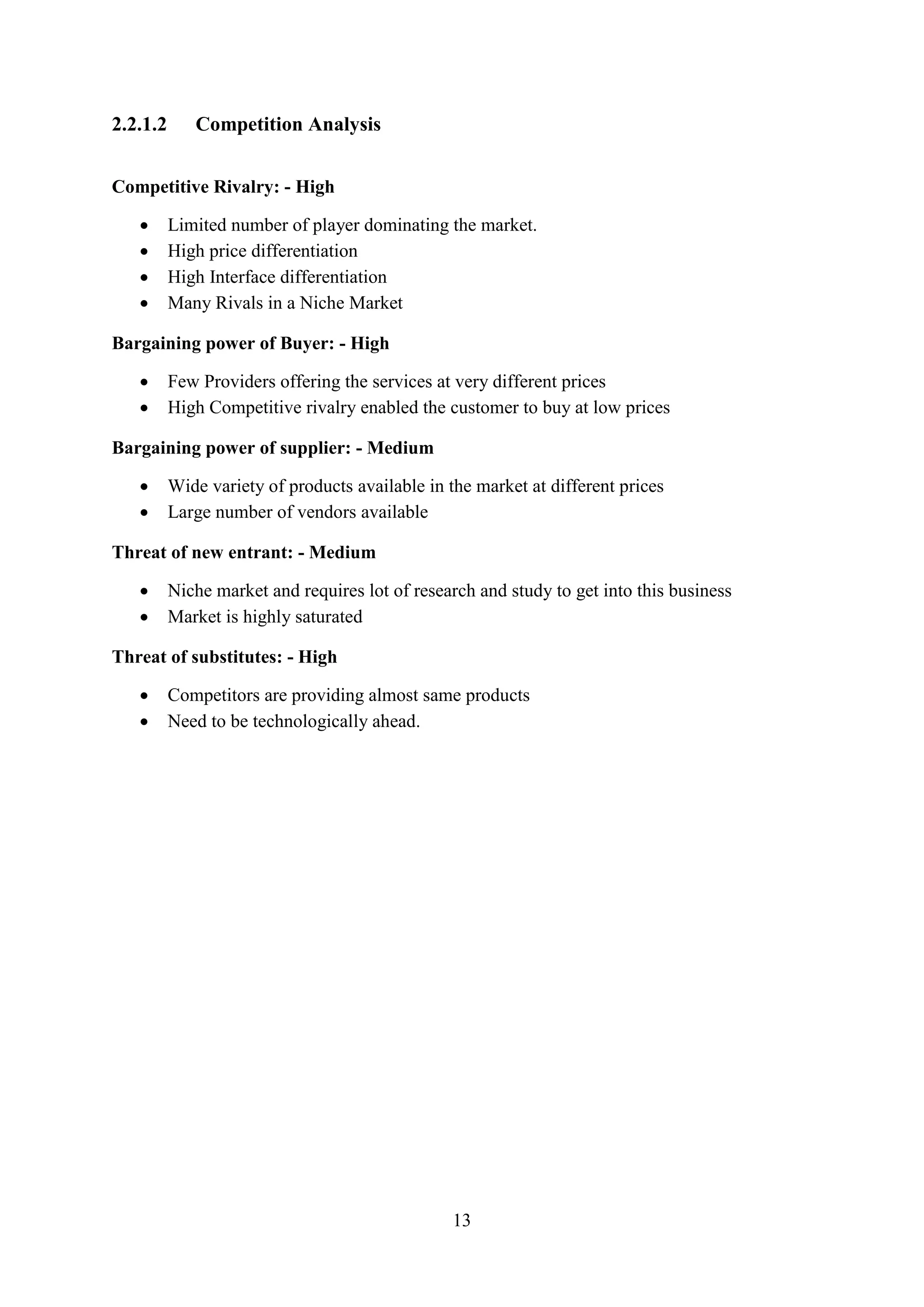
2.2.1.2 Competition Analysis
Competitive Rivalry: - High
 Limited number of player dominating the market.
 High price differentiation
 High Interface differentiation
 Many Rivals in a Niche Market
Bargaining power of Buyer: - High
 Few Providers offering the services at very different prices
 High Competitive rivalry enabled the customer to buy at low prices
Bargaining power of supplier: - Medium
 Wide variety of products available in the market at different prices
 Large number of vendors available
Threat of new entrant: - Medium
 Niche market and requires lot of research and study to get into this business
 Market is highly saturated
Threat of substitutes: - High
 Competitors are providing almost same products
 Need to be technologically ahead.
14
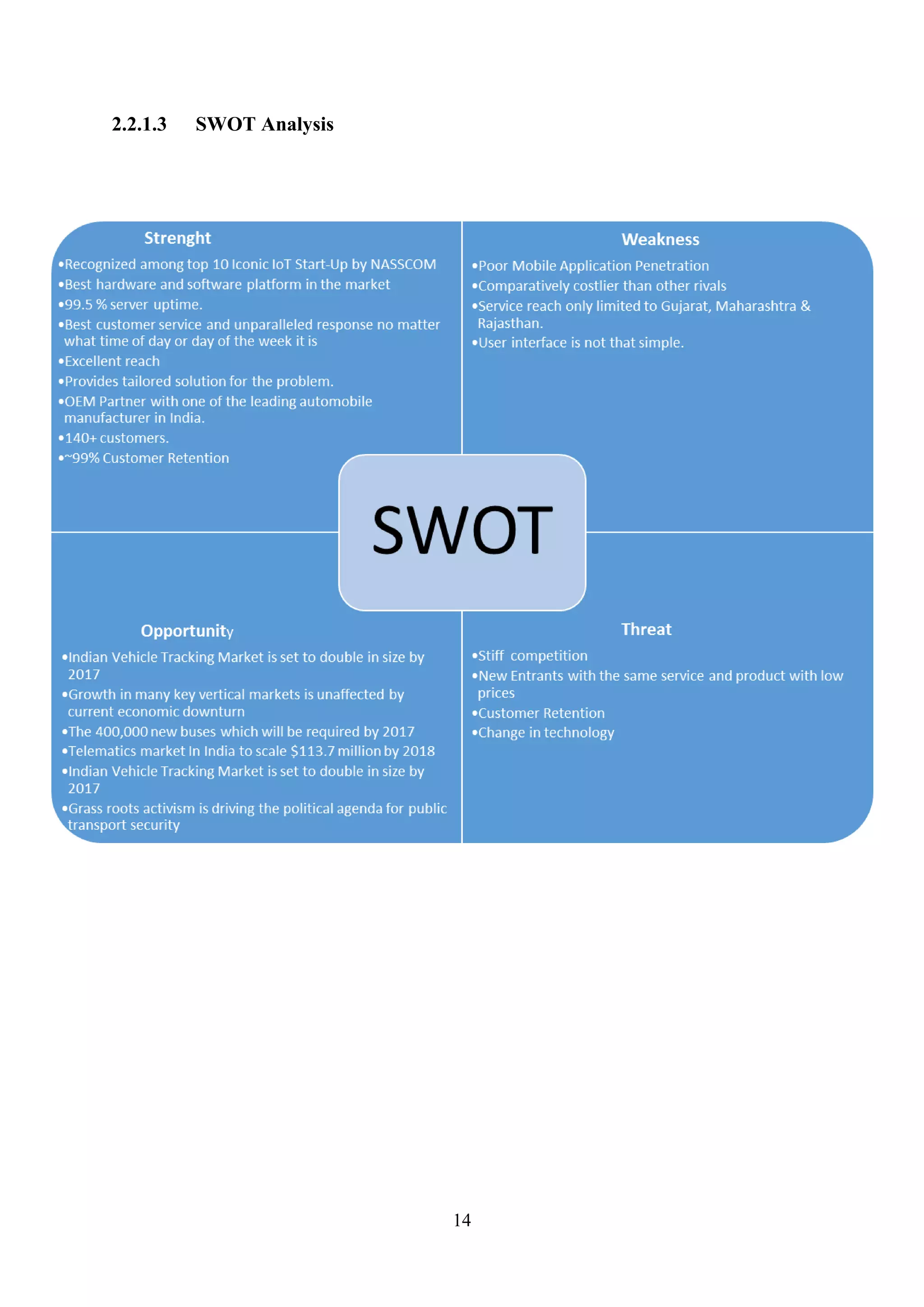
2.2.1.3 SWOT Analysis
15
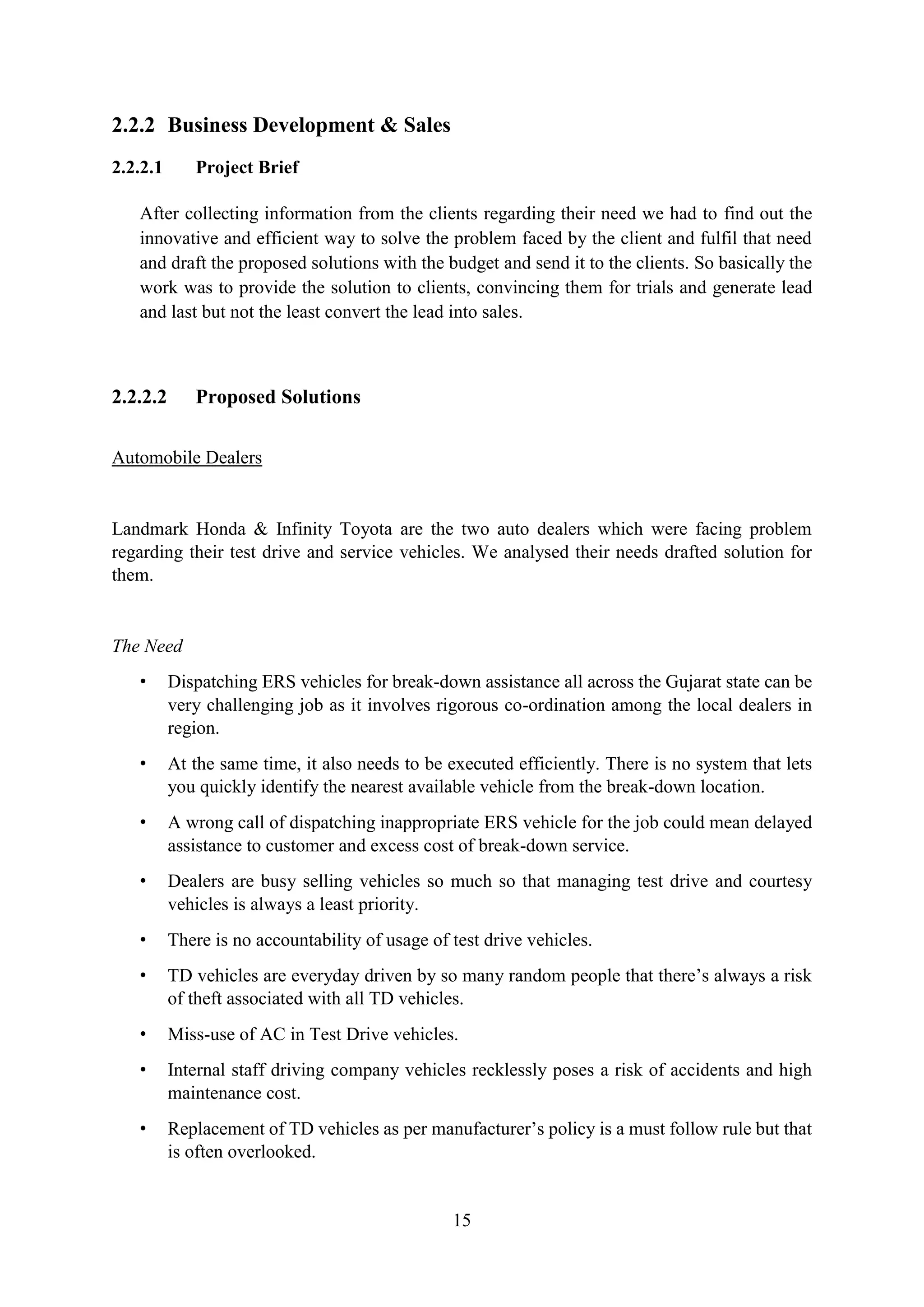
2.2.2 Business Development & Sales
2.2.2.1 Project Brief
After collecting information from the clients regarding their need we had to find out the
innovative and efficient way to solve the problem faced by the client and fulfil that need
and draft the proposed solutions with the budget and send it to the clients. So basically the
work was to provide the solution to clients, convincing them for trials and generate lead
and last but not the least convert the lead into sales.
2.2.2.2 Proposed Solutions
Automobile Dealers
Landmark Honda & Infinity Toyota are the two auto dealers which were facing problem
regarding their test drive and service vehicles. We analysed their needs drafted solution for
them.
The Need
• Dispatching ERS vehicles for break-down assistance all across the Gujarat state can be
very challenging job as it involves rigorous co-ordination among the local dealers in
region.
• At the same time, it also needs to be executed efficiently. There is no system that lets
you quickly identify the nearest available vehicle from the break-down location.
• A wrong call of dispatching inappropriate ERS vehicle for the job could mean delayed
assistance to customer and excess cost of break-down service.
• Dealers are busy selling vehicles so much so that managing test drive and courtesy
vehicles is always a least priority.
• There is no accountability of usage of test drive vehicles.
• TD vehicles are everyday driven by so many random people that there’s always a risk
of theft associated with all TD vehicles.
• Miss-use of AC in Test Drive vehicles.
• Internal staff driving company vehicles recklessly poses a risk of accidents and high
maintenance cost.
• Replacement of TD vehicles as per manufacturer’s policy is a must follow rule but that
is often overlooked.
16
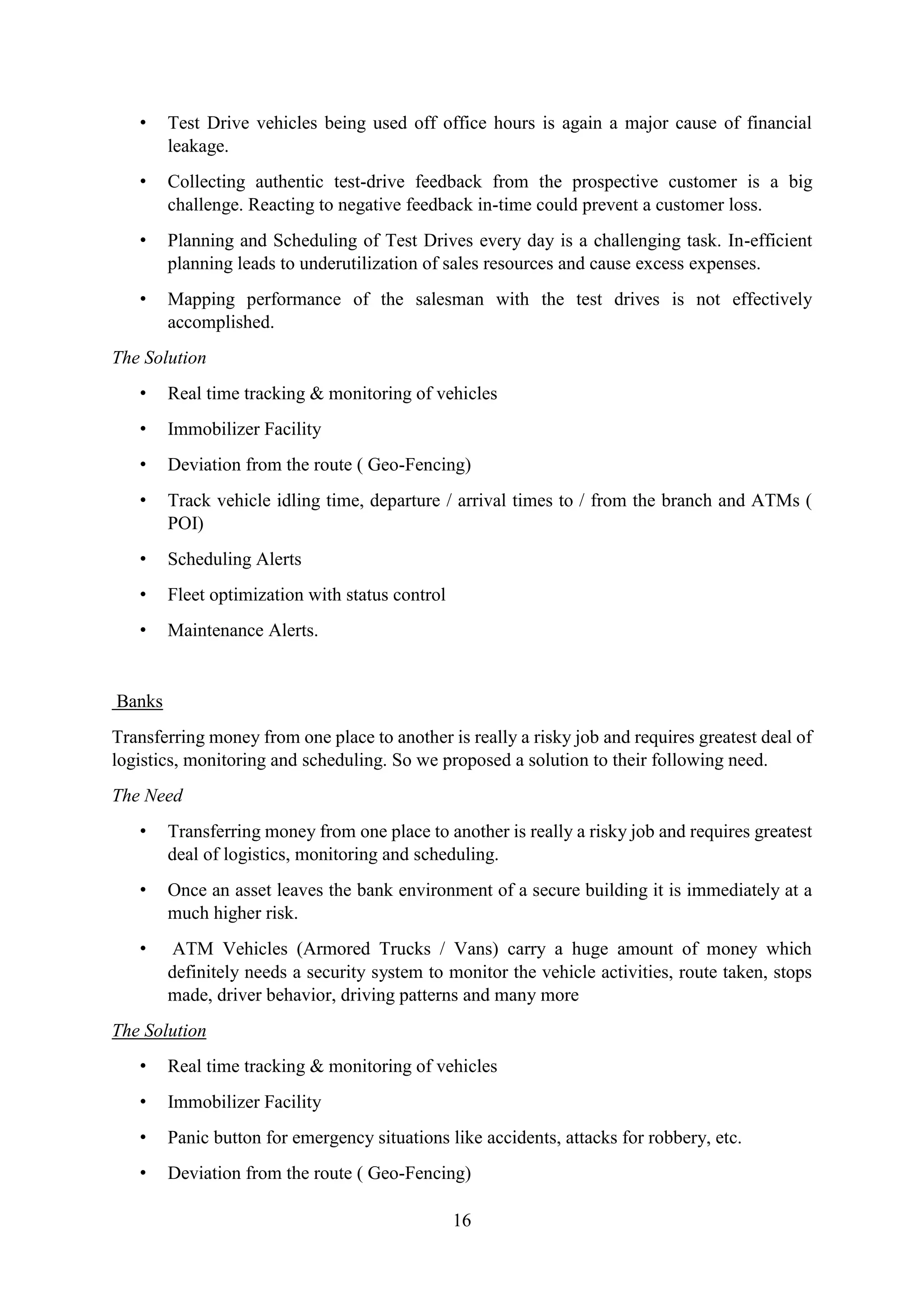
• Test Drive vehicles being used off office hours is again a major cause of financial
leakage.
• Collecting authentic test-drive feedback from the prospective customer is a big
challenge. Reacting to negative feedback in-time could prevent a customer loss.
• Planning and Scheduling of Test Drives every day is a challenging task. In-efficient
planning leads to underutilization of sales resources and cause excess expenses.
• Mapping performance of the salesman with the test drives is not effectively
accomplished.
The Solution
• Real time tracking & monitoring of vehicles
• Immobilizer Facility
• Deviation from the route ( Geo-Fencing)
• Track vehicle idling time, departure / arrival times to / from the branch and ATMs (
POI)
• Scheduling Alerts
• Fleet optimization with status control
• Maintenance Alerts.
Banks
Transferring money from one place to another is really a risky job and requires greatest deal of
logistics, monitoring and scheduling. So we proposed a solution to their following need.
The Need
• Transferring money from one place to another is really a risky job and requires greatest
deal of logistics, monitoring and scheduling.
• Once an asset leaves the bank environment of a secure building it is immediately at a
much higher risk.
• ATM Vehicles (Armored Trucks / Vans) carry a huge amount of money which
definitely needs a security system to monitor the vehicle activities, route taken, stops
made, driver behavior, driving patterns and many more
The Solution
• Real time tracking & monitoring of vehicles
• Immobilizer Facility
• Panic button for emergency situations like accidents, attacks for robbery, etc.
• Deviation from the route ( Geo-Fencing)
17
• Track vehicle idling time, departure / arrival times to / from the branch and ATMs (
POI)
• Scheduling Alerts
• Fleet optimization with status control
• Better route management and vehicle assignment to reduce the cash distribution time
Dairy
These two dairy were facing issues regarding timings of milk delivery and also regarding theft
of milk. Following is their need
The need
• The biggest issue with transportation of milk is theft and most of the time the milk is
being stolen by deviating from the main route.
• Maintenance of such vehicles are necessary because breakdown of a vehicle carrying
milk can be economically painful
• Constant tracking of vehicle is required by both Sender and Receiver.
• Over-speeding of such container truck has to be maintained for safety.
The Solution
1. Daily Activity Report
2. Distance Summary Report
3. Track History View
4. Route Trip Report
5. Over-speeding Report
6. Trip Deviation Report
7. Message Alerts
8. Email Alerts
Travel Agencies
The need
• To know where all your buses are at particular moment
• For information like vehicles reaching on time
• Providing facility to customers to track and know whereabouts of their vehicles
• Maintenance Alerts
• Driver Scorecards
18
• Duration of a trip made by Vehicle
• Fuel Consumption Report
• Effective Utilization
The Solution
 24 x7 Real Time Tracking
 Live Tracking facility for customers
 Geo-Fencing
 Vehicle History Review
 Smart Search
 Impact Detection
 Vehicle immobilizer system
 Proximity Alerts
 Auto Maintenance System
 User Friendly Reports
 Over Speeding Reports
 Management Dashboard
 Exceptional Reports
2.2.3 Customer Support and Relations
After the installation of device it was our duty to give 24X7 support to our client. Moreover it
was necessary for us to give them service in form of experience. So we continuously updated
the client regarding the project. It helps us to be on the right track and gives satisfaction to the
client. The company has a policy of sending an interim report to the client, on which a feedback
is obtained, considering which further work is done. After submitting final report to the client,
a call is scheduled to address to any queries they might have, any other technical/ non- technical
details they might want for specific interesting products identified by them.
19
2.2.4 Sales Channel with Brand Dimension
We need to know how and where customers want to buy our products or services, and the best
way of getting customers to hear about them.
The more appropriate sales channels we use, the more customers we can reach. But each
channel adds costs. If you add a new channel only to find it attracts sales away from an existing
channel without bringing in extra sales, you'll be increasing your costs for little or no benefit.
So it was important to find a sales channel which attracts the niche market like ours with
incurring little amount of cost. Also we needed a Branding as people tend to do business with
companies they are familiar with. If your branding is consistent and easy to recognize, it can
help people feel more at ease purchasing your products or services. It is important to remember
that your brand represents you. You are the brand, your staff is the brand, and your marketing
materials are the brand. What do they say about you, and what do they say about what you’re
going to deliver (promise) to the customer?
The best branding is built on a strong idea such that company can hold on to, can commit to,
and can deliver upon. Our brand needed to permeate the entire organization. When organization
is clear on the brand and can deliver on the promise of the brand, we see tremendous fruit while
building brand loyalty among customer base
So we came up with following idea.
The VAN:-
 The Van wrapped in Locanix Attire will be carrying a sales person and a technical
guy.
 The objective is to build the brand awareness among the target audience.
 Moto of this Van is “ On the Road for the Road”
 The Van will be moving around the entry and the exit of the city premises where
most of the transport and logistical offices a located
 In order to generate curiosity among people we’ll have a screen at the back of the
Van which will show real time location of the vehicle on the map as show in the fig
below.
20
2.2.5 Adhoc Projects
 Designing of content for the brochure of the company
 I assisted the organization to carry out an internal and external survey to identify
features and Interface for the mobile application
 Designed a Logo for the company
 Designed newsletter and mailed it on weekly basis to the clients
 Performed location analysis for sales office.
3 Case Studies
3.1 Shrinath Travel Agency
Shrinath Travel Agency is a renowned name in the Travel industry since 1975. Shrinath
Travel Agency handling tourists from Gujarat, Rajasthan, Delhi and Maharashtra, Madhya
Pradesh, Uttar Pradesh ,Uttarakhand. Shrinath Travel organize tours all over India and serving
best quality service in 2X1, 2X2, sleeping luxurious, A/C & Non A/C. Coaches
The main motive of Shrinath Travel Agency is to present a safe journey to people, with comfort,
ease and pamper them with little luxuries. Shrinath Travel Agency offers cheap and
comfortable transport to the customers.
Shrinath had a fleet of over 114 vehicles these included AC vehicles & cargo Vehicles. With
over a hundred vehicles, the cost of operation was significant and Shrinath needed to find a
way to optimize usage and plug any leakages in terms of misuse. At the same time safety
passenger and cargo was a concern and the company wanted to proactively manage safety.
Solution
Locanix provided a GPS based Transportation IoT solution to Shrinath that not only allowed
them to track all their vehicles in real time but also we provided them with Master report which
gave the facility to map the expected arrivals and departure of Buses with actual arrivals and
departure timings. In addition to that, the vehicles were equipped with an immobilizer. This
allowed remote disabling of the vehicles in case there was a theft situation or a vehicle was
driven outside a particular area. Geo fencing alerts, speeding and driver behavior reports
allowed for driving safety measures and optimizing operations.
Ac misuse was one of the biggest headache for them so we also provided them with the Ac
misuse and reports and alerts. Locanix worked hand in hand with Shrinath travels to address
all the issues and came up with a seamlessly integrated solution for Shrinath travels.
21
Business Value
 Keeping track of arrival and departure of Bus ( Planned vs Actual)
 Reduce the AC misuse
 Reduce fuel consumption and optimize vehicle utilization
 Increase vehicle safety
 Drive additional revenue streams
 Manage fleet efficiently
 Control vehicle misuse
 Drive down maintenance costs
3.2 Mahindra
Mahindra Truck and Bus Division is a wholly owned subsidiary and part of the US $ 16.9
billion Mahindra Group that provides an entire line of integrated trucking solutions. Mahindra
Truck and Bus Division have sold 15,000+ HCV Truck, whereas in the LCV segment the
company has sold more than 1.25 lakhs vehicles. In 2014, Mahindra featured on the Forbes
Global 2000, a comprehensive listing of the world’s largest, most powerful public companies,
as measured by revenue, profit, assets and market value.
The Need:
Mahindra wanted to improve fuel efficiency and resolve one of the most common issue of their
customers – fuel theft. They wanted such a solution which can help their customers to keep
track of real time location of vehicle and fuel level data. A single page report which can answer
to different questions like daily/weekly/monthly fuel consumption, fuel efficiency, kilometers
travelled and vehicle utilization.
Mahindra Truck and Bus Division has partnered with Locanix as an official OEM partner for
Vehicle Tracking and Fuel Monitoring Solutions.
The Solution:
Locanix provided a GPS based Transportation IoT solution to Mahindra that allowed them to
track all their vehicles in real time along with its fuel level details. In addition to tracking, the
vehicles were equipped with Fuel Level Sensor providing accuracy of 99%. We delivered a
fuel level detailed report which consist Fuel Refills, fuel level at start of the day, fuel level at
end of the day, fuel consumed in 24 hours, kilometers travelled and fuel efficiency of a vehicle.
In case of fuel theft, customer will be notified through email notification and on screen alerts.
Vehicle utilization report helped them to get higher level view of number of vehicles which are
not being utilized at its best.
22
The Business Value:
 Reduce fuel consumption and optimize vehicle utilization
 Increase Fuel Efficiency
 Drive additional revenue streams
 Manage fleet efficiently
 Drive down maintenance costs
4 Recommendations
 The Van Concept: - This concept of the Van wrapped in Locanix Attire will be
carrying a sales person and a technical guy on Highways where all our target
audience is located was designed by me .The objective was to build the brand
awareness among the target audience and its moto was “On the Road for the Road”.
This concept was accepted by the management and they started working on it by
renting a Van.
 Shop in Shop: - To expand our business we needed sales office at location where
our customers were located but it would have cost us a lot if we would have gone
for renting the whole shop. So an idea for shop in shop struck in my mind as I
studied that concept in my curriculum and we started looking for the shops which
was half occupied so that the rent can be reduced immensely.
 Rental Plans: - Doing my market research I met many fleet owners and when I told
them about product they took interest in it but when it came to the ownership cost
they were hesitant as the cost was too high for a large fleet size. I conveyed this
problem to the management and after discussion management came up with the
Rental Plans.
 Newsletter: - Though the support staff and customer success officer of the company
was taking good care clients but it was necessary for company to let their clients
know about what’s happening in the field of telematics. So I came up with the idea
of sending Newsletter Biweekly to our clients so that they can know what’s
happening and also it creates a good impression of company on clients
.
23
5 Bibliography
 Locanix Interim Report and Database
 Primary Research Data
 Official Websites of the companies mentioned in the report
 Telematics Report
 IOT Article
 News Article
 Sales Channel with Branding Dimension Pictures
 http://gpsworld.com/new-report-considers-gnss-market-outlook-2015-2020
 http://www.automotive-fleet.com/article/story/2011/02/the-evolution-of-telematics.aspx
 http://telematicswire.net

SummerProject@Locanix

  • 1.
    1 1. Introduction Throughout theyears we have witnessed a marriage of informatics and telecommunications to create telematics. We have witnessed telematics accomplish everything from improving health care quality to reducing the environmental impact of vehicles. It has revolutionized many aspects of our world. Telematics is all about being able to get information on vehicles. Everything from fuel performance to driving speed can be tracked with telematics. The beginning of telematics could be said to have started with a tachograph over 60 years ago Without GPS there would not be the telematics we know today. GPS is a system that was designed for navigation and positioning. It was developed by the US defence department which knew of the importance of exact data on the positions of its assets. It was developed to fulfil the pressing need to have increased communication and exact data on the battlefield. It used the satellite network in cohesion with ground communication Dozens of GPS satellites now orbit the earth and enable GPS receivers to find their exact location on the planet. GPS changed from a military application to a civilian one and the US government provided free basic GPS signals to anyone in the world. It pushed for the adoption of GPS around the world and made agreements with Japan and the EU. The big difference between telematics and GPS is that telematics picks up where GPS left off. It uses GPS technology to offer many different services to fleet owners such as navigation services. GPS just provides data about your location where as telematics analyzes and uses information along with communicating with parties outside of your vehicle. This enables a huge range of services to be offered through telematics. 1.1 History of telematics A lot of the development in Telematics began back in the 1984 European Parliamentary resolution to promote road safety .Studies throughout the 1980’s kept tabs on informatics and the development of telecommunications to find new applications for road safety. Through these studies a program known as DRIVE was started to conduct research.This community based research program focused on finding ways of using telematics for road safety, greater levels of efficiency, and reducing environmental impact. The DRIVE program was concluded in 1992 while in 1990 another program began for telematics in general. In 1993 a European treaty was signed for telematics at the EU. The treaty enabled more research and development along with increasing telematics firms competitiveness on a global scale.
  • 2.
    2 In 1993 theEU decided to increase its global competitiveness through stronger logistics networks and transportation. The digital revolution that was beginning and leaders believed that through telematics they could ride at the wave to economic success. Information and technology was seen as a key factor to being more competitive. Telematics research was heavily promoted in the government as a way to improve traffic management and harmonizing traffic through the European Union. Pilot projects were set up to ensure the technical capability of the telematics technology to be used for this new vision. Here is an overview of some key technological innovations that have occurred in telematics during the last decade: 1998 – The first hands free vehicle gateways were introduced 2000 – The first GSM & GPS systems were brought to market 2002 – Bluetooth hand free voice gateways with advanced voice integration features 2003 – Integrated GSM phone with Bluetooth 2007 – Multimedia handset integration is introduced 2009 – Fully integrated mobile navigation using a vehicle GSM system 2010 – 3G multimedia vehicle entertainment system 2011– Telematics and Infotainment systems introduced based on Linux 1.2 Telematics in Fleet Management Telematics could help your business at very high extent. It has helped lots of fleets save on fuel, maintenance and compliance costs while improving efficiency and productivity. It also provide reliable navigation for your drivers. Telematics can mean a lot of different things but as it applies to fleets it involves using data or information collected from a network or group of connected vehicles. Essentially, telematics can transform your fleet from a bunch of disparate, separate vehicles into a cohesive, organized fleet working together toward common goals. The existence of this network of connected vehicles with GPS receivers means fleet managers no longer have to run their business largely in the dark they know where all vehicles are and what they're doing. A few benefits gained by fleets using telematics include:  Fuel economy increased by 18%  Economical driving improved by 15%  Harsh braking incidents decreased 77%
  • 3.
    3  Engine idletime down 64%  Driving hours (windshield time) decreased 24% GPS fleet data makes managers more aware of what's happening, what's costing them and how they can work more efficiently. Operating a fleet without telematics is a bit like trying to drive the speed limit without having a speedometer; without a clear gauge, you never know how fast you're going in relation to the posted speed limit. 1.3 Future of telematics Several new innovations in telematics are causing exciting new advertising applications for in vehicle entertainment that will ultimately lead to lower costs for the consumer. Navigation will become increasingly lower cost, with greater communication occurring between vehicles on the road, and a trend towards ecofriendly. Navigation systems are becoming increasingly popular as more drivers are realizing the benefits it offers, and new features are being added every year. The services available through telematics devices will separate more and more into two different categories: Free Premium This is going to increase the number of options available to consumers, especially as android based telematics systems become more widely distributed. Increased Personalization You will be able to personalize and customize your telematics systems at an increasingly popular level. Soon you will see telematics systems merging together, with your ability to have a telematics black box and an android based entertainment system together in one unit. Vehicle providers are also offering more possibilities for application development. The previous model was based on manufacturers developing applications and then providing them to the user. Now vehicle manufacturers are listening to the consumer more and focusing on following software industry leaders like Apple and Google. Greater Interactivity New touch based systems are more sensitive than ever and offer greater opportunities for user input. From voice control to new options like heat sensitive screens, and camera tracking of user motions. You may one day be able to control half your vehicle by waving your finger in the air, as new technology makes it easier than ever for greater control. Community You will observe more community and greater connectivity between in vehicle users, as the speeds and services of Telematics becomes proliferated. This means that you may be able to connect with other drivers on the road, social network, and even develop virtual carpooling to help save on gas.
  • 4.
    4 Greater Openness You willsee the telematics systems moving from closed manufacturer software to open software with universal standards. Instead of manufacturers trying to each develop their own proprietary systems, Telematics will become increasingly standardized and cross compatible between vehicle models and manufacturers. This will lead to more applications and services being available to Telematics customers as a whole, in addition to greater flexibility when you change vehicle models. Easier To Use Ease of use ranks as the most important feature for vehicle users, so developers are trying to make the systems increasingly user friendly for drivers. This includes better voice recognition and control technology, more features, applications designed for drivers, and a simpler interface that is more intuitive. In a word, we can see telematics becoming more like Apple products. 1.4 Objective of the summer internship The primary objective of the summer project ● Would be to have an extensive exposure to a hands-on experience in Market research understanding the needs of the client, draft proposed solution and convert sales. Apart from this, my secondary objective ● To gain knowledge by conducting a secondary and primary research about Telematics Industry. This will certainly assist in improving my analytical skills. ● The organization have 150+ clients, thus, I would like to gain knowledge regarding the business development process, how the organization engage and what is their approach in bringing companies aboard. ● The delivery method to client via sending tailored solution proposals, creativity in representation and what all constraints and hiccups that can occur while delivery of project and how to overcome them will also be my key takeaways from this summer project. ● To work and learn more about Sales channel and Branding strategies will be one of the biggest takeaways from this project
  • 5.
    5 1.5 Company Analysis 1.5.1Company Detail Locanix provides innovative SaaS solutions using GPS location information ranging from corporate fleet management to consumer vehicle solutions, with a focus on safety, security and operational efficiency. Over the years GPS tracking technology has matured and a lot more innovation is possible as a result. Locanix was created to harness the power of GPS tracking and create innovative solutions that enable safety, security and operational efficiency. We try to go beyond the boundaries of traditional GPS tracking solutions in our quest to add more value and solve business problems for our clients. While many solutions exist in this industry, Locanix sets itself apart from the competition by providing enterprises not only the technology platform but also the ability to drive business value with these solutions in complex and dynamic environments. Every organization is different right from the roots. With software, a lot of innovation can be done and we have been working hard to understand the fabric of the transportation business across different sectors and come up with targeted solutions. Within transportation there are many sectors like secure/high value goods, mining, cold chain etc. and one size does not fit all. Most GPS vendors are viewing this as a single fleet management solution which tends to work short term but does not drive value to the extent these systems can. And a lot of this depends on the flexibility of the software platform else you cannot create solutions fast and effectively enough. Innovation is key and we think we are way ahead of the competition. Locanix solutions are designed to handle very large scale supply chains. Our supply chain management solutions are not just about tracking vehicles. It’s about managing your complete supply chain from our technology interface. Locanix solutions will escalate your entire supply chain to the next level though business reporting, data analytics and actionable intelligence. Our Technology platform is very innovative and feature-rich that offers highly agile and flexible technology components that can fit in to your system as if it was custom built for your organization.
  • 6.
    6 Accessories & Extensions Communicati on Infrastrucutre Hardware Components Locanix FMS Servers Pluginsand APIs Business Intelligence and Reports Devices and Alerts 1.5.2 Sectors served 1.5.3 Services Locanix solutions are designed to handle very large scale supply chains. Our supply chain management solutions are not just about tracking vehicles. It’s about managing your complete supply chain from our technology interface. Locanix solutions will escalate your entire supply chain to the next level though business reporting, data analytics and actionable intelligence. Our Technology platform is very innovative and feature-rich that offers highly agile and flexible technology components that can fit in to your system as if it was custom built for your organization. Transport & Logistics Construction and Heavy Machinery Lease & Rental Cars School & Industries Security Government Services
  • 7.
    7 2 Project Handled Whilethe work performed during this period was particularly glamorous and equally thrilling, true is that this internship period exposed me to experiences which have significantly altered the perception of Sales, Market Research & Business Development in field of Telematics 2.1 Roles and Responsibilities The internship period started from 18st of April, 2016 and last up to 18st June, 2016. Locanix have been working hard to understand the fabric of the transportation business across different sectors and come up with targeted solutions. Within transportation there are many sectors like secure/high value goods, mining, cold chain etc. and one size does not fit all. Most GPS vendors are viewing this as a single fleet management solution which tends to work short term but does not drive value to the extent these systems can. And a lot of this depends on the flexibility of the software platform else you cannot create solutions fast and effectively enough. Innovation is key and we think we are way ahead of the competition. I assisted the team in the market research , Sales & Business Devlopment work. 2.2 Assignments When I joined the company I first worked on the project of Market research which included both primary and secondary research. I was briefed and started to work in coordination with the team and my guide. Every day, I was allotted work accordingly. I used to get proper feedback from my team members and guide regarding the work done gradually my role was shifted towards sales and business development. 2.2.1 Market Research 2.2.1.1 PEST Analysis Political GPS devices are rendered useless without a satellite system to support them. Global Navigation Satellite System (GNSS) is the standard generic term for satellite navigation systems that provide autonomous geo-spatial positioning with global coverage. Cu GPS devices are rendered useless without a satellite system to support them. Global Navigation Satellite System (GNSS) is the standard generic term for satellite navigation systems that provide autonomous geo-spatial positioning with global coverage. Currently, the U.S. has the only operational GNSS in the world referred to as the NAVSTAR Global Positioning System (GPS). The EU is currently working on the Galileo project, expected to launch in 2013. Russia’s GLONASS and China’s Beidou are similar projects underway, but neither will deploy until after 2013.
  • 8.
    8 The European Union(EU) began to develop GNSS in order to have an independent system they can rely upon in times of war or political disagreement. Presently, the U.S. and/or Russia could disable EU’s access to GPS through encryption. The U.S. was successful in its request that the EU leverage a different frequency for Galileo GPS, thereby ensuring any jamming of their GNSS system would not affect the US system. The worldwide market for global positioning system (GPS) navigation and location based services has been growing exponentially and is expected to exponentially, with a high compound annual growth rate. Although still at a nascent stage in India, the GPS navigation market holds tremendous potential for growth, driven by its increasing acceptance among the younger generation as well as the exponential growth in popularity of smartphones. Based on the statistics and sales forecasts available, Indian telematics industry is heading towards a considerable peak. This trend is being driven by the continually changing macro and micro economic, political and business factors. The current climate has set the backdrop for the stark rise in technology, and in turn, the various firms looking to take advantage, and seize a share of this market. This trend is further enhanced by the fact that India’s infrastructure investment plans of more than US$ 1 trillion in investment over the next several years according to industry analysts TRN Ltd, including planned construction of an additional 15,000 km of highway by 2017 will drive demand growth for tracking and fleet management throughout India. This new infrastructure will require 400,000 new buses by 2017, and similar growth is expected across vertical market segments including logistics, distribution, mining, construction, and employee transportation. According to a new report from TRN Ltd, entitled “Indian Vehicle Tracking and Fleet Management Market, 2013-17 • Indian Vehicle Tracking Market is set to double in size by 2017 • Growth in many key vertical markets is unaffected by current economic downturn • Grass roots activism is driving the political agenda for public transport security • Vehicle tracking and fleet management market growth is set to accelerate after the 2014 elections As per the source, this report investigates opportunities in the vehicle tracking and fleet management sector in light of economic and policy development in India in late 2012 and the first half of 2013. Implications of recent changes to laws governing foreign investment in retail, tax reform, the policy response to the Delhi bus rape, and the spring 2013 budget are all covered in the new edition, and are used to inform scenarios and forecasts to 2017. According to the report, a key conclusion is that the long term opportunity for vehicle tracking and fleet management in Asia’s third largest economy is too large to ignore with long term sustainable growth guaranteed even under the least favourable market scenario. In the run up to the 2014 national elections, investors, fleet managers and operators remain cautious and this is acting to dampen short term demand. There are however numerous cases of successful and innovative tracking solutions being deployed throughout the country. The
  • 9.
    9 new TRN reportshows that in the current tough economic climate there are important opportunities in many of the 12 vertical market sectors which are analysed in depth. Economic Vehicle telematics is the integrated use of mobile communication, vehicle monitoring systems and location technology. It is one of the fastest-growing sectors in India for the past few years. The demand for telematics is primarily driven by factors such as an increase in the number of accidents, rising vehicle thefts, security issues while travelling and the demand for navigation services. The Indian telematics market, which is on a growth path, offers high potential for the automobile. The integration of machine-to-machine (M2M) telematics applications can convert a normal vehicle into an intelligent version with special features such as an emergency warning, GPS navigation, integrated hands-free cell phones, wireless safety communications, automatic driving assistance systems support, mitigating road accidents, tracking, remote management, Bluetooth and other related features. The growth of telematics in the auto sector has been witnessed in developing and developed countries, primarily in four types of service areas -- safety, information, navigation and remote diagnostics. Vehicle maintenance, the preventive route to car safety, is already being greatly enhanced. Remote diagnosis of the vehicle, data logging and the need for technical and mechanical maintenance work can be tracked in real time with the help of telematics. Telematics also enables anti-theft features, tracking the location of the car and an automated interface with law enforcement agencies, reducing the response time, which eventually leads to reduction in vehicular theft. The automobile industry globally is integrating more telematics to monitor performance and detect flaws in vehicles and simultaneously meet the demands of users for wireless connectivity. According to IHS iSuppli Corporation, the BRIC region has the fastest-growing auto industry, in comparison to western countries, and the percentage of vehicles embedded with telematics technology is expected to reach 46% globally by the end of 2018. It’s not only Asia that has tremendous potential. According to ABI Research’s consumer survey report, telematics penetration in cars is expected to increase from 11.4% in 2012 to 60.1% in 2017. While penetration in the US and Western Europe will exceed 80% by 2017, developing regions such as Latin America and Eastern Europe will also see strong increase in telematics penetration in new vehicles, mainly driven by mandates in Brazil and Russia. The real time monitoring, analysis and broadcasting of data through the telematics platform has the potential to fundamentally change and redefine the relationship between insurers and customers. As well as improving overall engagement levels with consumers, the technology allows insurers to cater for a pro-active asset protection model.
  • 10.
    10 Through telematics, theability to employ differential charging provides a more open and fair process, with not only the decision and the premium communicated to the policy holder but also the various factors that made up the premium calculation. That is quite a departure from the traditional insurance models that assess risk and determine premiums based on group behavior and other proxy variables. With more than 160 insurance telematics trials and launches currently under way in 34 countries, it is estimated that over nine million telematics-based insurance policies are in effect currently around the world. Asia, initially somewhat laggard, is catching up. In India specifically, the telematics market is projected to reach $301.23 million by 2021. In May 2015, Bangkok Insurance (BKI) in Thailand became one of the early adopters, launching an insurance telematics program to manage risks from young drivers and commercial fleets. The BKI program is currently targeting around 10,000 customers in the first phase. In China, several Insurers have been preparing the market by providing telematics capabilities to their policy holders as part of their value-added programs similarly, for most of Asia, the growth potential is obvious when you consider the uptick in car sales. McKinsey, estimates that new-car sales in China will overtake those of either Europe or North America by 2020. Significantly, KPMG reports predict a healthy longer term “prognosis for the Indian automotive industry” but rapid growth isn’t the case for every nation in Asia. Information group Nielsen also says south-east Asian sales will drive much of the world’s demand for vehicles, in turn increasing the demand for telematics. Traditional car-insurance policies will be harder to find as capital is attracted to the better return on investment ordered by telematics-based insurers. The Connected Car Opportunity A recent report from Research and Markets concluded that the connected car market in India is expected to grow at a CAGR of 60.4%, which is a remarkable figure. Similarly, the Economic Times recently reported that internet-enabled cars now present a $30-billion market for a range of sectors in India and that, by 2020, the market is set to increase nearly six fold. Throughout India, the automotive industry is witnessing a new wave of technological revolution, which is boosting the idea of connected cars. The aftermarket services segment has accounted for the largest market share and is anticipated to lead in the forecast period. However, higher growth is exhibited in pre-embedded segment as automobile companies such as Honda India launch their ‘Connected Cars’ initiatives. The provision of internet accessibility in cars is inevitable, as consumers now expect such real- time services. This includes services from GPS and traffic navigation, to fuel analytics, weather forecasting and safety features. The connected car market in India represents a ground-breaking union of players from across a broad range of industries, including vehicle manufactures, telecommunications, tech providers and insurers. Looking ahead a little, more services are likely to be ordered via telematics as cars get connected and become an integral part of the growing “internet of things” landscape. These ‘after market services’ can include proactive roadside assistance, vehicle health status, security and connected navigation. These services are all considered added benefits for the consumer, increasing the OEM’s engagement with the driver and ultimately improving customer satisfaction rates.
  • 11.
    11 Social & Environment Telematicsis a branch of IT that deals with transmission of computerized information over long distances. In the case of UPS’s telematics their project focuses on the social, environmental and financial aspects that are otherwise known as the triple bottom line. Some of the social benefits include safer driving habits, self-correction encouraged by telematics reports and truck reliability. In terms of environmental friendliness telematics help find opportunities to reduce mileage, consumption of fuel and replacement parts. Financial advantages of the telematics systems also result from the social and environmental advantages. For example, reduced fuel consumption and route efficiency have greatly cut costs in that department. They have also reaped the benefits from keeping their energy consumption and costs consistent. Their decision to move from scheduled maintenance to maintenance that was based on the condition of the vehicles has also had a great financial impact. Technology The general notion of tracking subjects has resulted in the advent of Global Positioning System (GPS) as a major breakthrough that the world had witnessed. Though the technology has been adopted a lot earlier in the developed countries, India is fast catching up the trend. GPS has surfaced as a ubiquitous concept that looks at bringing the entire world into close proximity by connecting far-off subjects. Though still considered to be at an initializing phase in India, GPS holds magnanimous potential in years to come owing to its heightened acceptance among the younger generation. The report begins with the introduction of concept of GPS along with a brief description of the types of tracking. It then goes on to describe the basic framework of the functioning of GPS through its work model. The different components that get synergized to form the GPS ecosystem are described in the following section. It is followed by market overview which can be segregated into the global and the Indian scenario respectively. The global market overview is elaborated with a general introduction as well as a market size by shipment and values. The global market is slated to increase at the rate of 25-30% and a prediction is stated till 2016. An overview of the Indian GPS market comes next wherein along with the understanding of the sector, the market size as well as a market structure is also presented. This is immediately followed by the differentiation of the GPS market into two primary heads. The focus then shifts towards the Geographic Information System (GIS) wherein a take on the concept of GIS along with the Indian market overview is rendered. The GIS market overview comes with the market size figures and the segments where it operates. The following sections speak about the product categories and the benefits associated with GPS in the country. The report then progresses towards implementation of GPS as a mobile phone technology and also deliberates on the modified version of technology that aims at ameliorating the usage for consumers. Among the plethora of propositions that mobile phones’ manufacturers offer to perk up their sales, GPS have surfaced as the most talked about application in them. The discussion then moves towards GPS being implemented in Small and Medium Businesses (SMBs).
  • 12.
    12 Brief descriptions ofthe drivers that help the sector to prosper include growth in logistics vertical, growth in radio cabs, increasing penetration of high end phones, demand from the BPO sector, increasing sale of luxury cars and entry of mapping portals. As logistics call forth goods being in transit, players often tend to be in the face of certain nuances in the likes of pilferage, fuel tampering, issues in fleet management and others. GPS entails tracking of the vehicle as well as fuel consumption that ultimately goes on to solve all the intricate issues in logistics management. As logistics players become cautious in their operations and herald the usage of GPS, growth in the same translates into growth for the GPS sector. Another high usage of GPS is in radio cabs. With safety and security concerns looming large over the country, radio cabs’ operators are installing GPS in their cabs both for their easy functioning as well as for commuters’ safety. Another significant driver in this regard is the usage of GPS available as an added feature in mobile phones which again poses as potent enough to drive growth for the sector. In lines with radio cabs, BPO sector has also introduced cars with GPS installed in them as concern over safety and security especially women and inadvertently as the sector grows, GPS is sure to derive growth from the same. Luxury car makers are looking at introducing GPS in their cars to position it a niche above the rest which presents with it a glaring opportunity for the GPS providers to capitalize on. Another stimulant for this sector is the entry of mapping portals that provide navigation aids required for tracking as well. While these factors can be termed as growth drivers there are certain factors that act as impediments to the sector including customer retention, fragmented logistics sector, lack of awareness and consumer perception and operational issues. The next section speaks about the Government participation in the sector which caters to providing brief deliberations on the Wireless Planning and Coordination Wing and related licenses. The major trends identified in the sector include GPS providers cement bond with automobile manufacturers, GPS providers look at partnering with stores, mobile phone players rendering free services, emergence of new applications in the sector, GPS introduced for bikes, entertainment options offered with GPS devices, India to have its own GPS and GPS installed in public transport systems. The section ends with a Porter’s Five Forces analysis of the sector. The competition section offers a competitive landscape of the players by providing their financials and key financial ratios. It also provides basic information regarding the organizations. Key financial parameters constitute the financial performances of the players which are followed by business highlights. The report concludes with a section on strategic recommendations which comprises an analysis of the growth strategies of the event management market in India. The ideation of in-built car navigation system is on the anvil and is slated to take a major shape in near future which can be translated into tremendous growth opportunity for GPS providers.
  • 13.
    13 2.2.1.2 Competition Analysis CompetitiveRivalry: - High  Limited number of player dominating the market.  High price differentiation  High Interface differentiation  Many Rivals in a Niche Market Bargaining power of Buyer: - High  Few Providers offering the services at very different prices  High Competitive rivalry enabled the customer to buy at low prices Bargaining power of supplier: - Medium  Wide variety of products available in the market at different prices  Large number of vendors available Threat of new entrant: - Medium  Niche market and requires lot of research and study to get into this business  Market is highly saturated Threat of substitutes: - High  Competitors are providing almost same products  Need to be technologically ahead.
  • 14.
  • 15.
    15 2.2.2 Business Development& Sales 2.2.2.1 Project Brief After collecting information from the clients regarding their need we had to find out the innovative and efficient way to solve the problem faced by the client and fulfil that need and draft the proposed solutions with the budget and send it to the clients. So basically the work was to provide the solution to clients, convincing them for trials and generate lead and last but not the least convert the lead into sales. 2.2.2.2 Proposed Solutions Automobile Dealers Landmark Honda & Infinity Toyota are the two auto dealers which were facing problem regarding their test drive and service vehicles. We analysed their needs drafted solution for them. The Need • Dispatching ERS vehicles for break-down assistance all across the Gujarat state can be very challenging job as it involves rigorous co-ordination among the local dealers in region. • At the same time, it also needs to be executed efficiently. There is no system that lets you quickly identify the nearest available vehicle from the break-down location. • A wrong call of dispatching inappropriate ERS vehicle for the job could mean delayed assistance to customer and excess cost of break-down service. • Dealers are busy selling vehicles so much so that managing test drive and courtesy vehicles is always a least priority. • There is no accountability of usage of test drive vehicles. • TD vehicles are everyday driven by so many random people that there’s always a risk of theft associated with all TD vehicles. • Miss-use of AC in Test Drive vehicles. • Internal staff driving company vehicles recklessly poses a risk of accidents and high maintenance cost. • Replacement of TD vehicles as per manufacturer’s policy is a must follow rule but that is often overlooked.
  • 16.
    16 • Test Drivevehicles being used off office hours is again a major cause of financial leakage. • Collecting authentic test-drive feedback from the prospective customer is a big challenge. Reacting to negative feedback in-time could prevent a customer loss. • Planning and Scheduling of Test Drives every day is a challenging task. In-efficient planning leads to underutilization of sales resources and cause excess expenses. • Mapping performance of the salesman with the test drives is not effectively accomplished. The Solution • Real time tracking & monitoring of vehicles • Immobilizer Facility • Deviation from the route ( Geo-Fencing) • Track vehicle idling time, departure / arrival times to / from the branch and ATMs ( POI) • Scheduling Alerts • Fleet optimization with status control • Maintenance Alerts. Banks Transferring money from one place to another is really a risky job and requires greatest deal of logistics, monitoring and scheduling. So we proposed a solution to their following need. The Need • Transferring money from one place to another is really a risky job and requires greatest deal of logistics, monitoring and scheduling. • Once an asset leaves the bank environment of a secure building it is immediately at a much higher risk. • ATM Vehicles (Armored Trucks / Vans) carry a huge amount of money which definitely needs a security system to monitor the vehicle activities, route taken, stops made, driver behavior, driving patterns and many more The Solution • Real time tracking & monitoring of vehicles • Immobilizer Facility • Panic button for emergency situations like accidents, attacks for robbery, etc. • Deviation from the route ( Geo-Fencing)
  • 17.
    17 • Track vehicleidling time, departure / arrival times to / from the branch and ATMs ( POI) • Scheduling Alerts • Fleet optimization with status control • Better route management and vehicle assignment to reduce the cash distribution time Dairy These two dairy were facing issues regarding timings of milk delivery and also regarding theft of milk. Following is their need The need • The biggest issue with transportation of milk is theft and most of the time the milk is being stolen by deviating from the main route. • Maintenance of such vehicles are necessary because breakdown of a vehicle carrying milk can be economically painful • Constant tracking of vehicle is required by both Sender and Receiver. • Over-speeding of such container truck has to be maintained for safety. The Solution 1. Daily Activity Report 2. Distance Summary Report 3. Track History View 4. Route Trip Report 5. Over-speeding Report 6. Trip Deviation Report 7. Message Alerts 8. Email Alerts Travel Agencies The need • To know where all your buses are at particular moment • For information like vehicles reaching on time • Providing facility to customers to track and know whereabouts of their vehicles • Maintenance Alerts • Driver Scorecards
  • 18.
    18 • Duration ofa trip made by Vehicle • Fuel Consumption Report • Effective Utilization The Solution  24 x7 Real Time Tracking  Live Tracking facility for customers  Geo-Fencing  Vehicle History Review  Smart Search  Impact Detection  Vehicle immobilizer system  Proximity Alerts  Auto Maintenance System  User Friendly Reports  Over Speeding Reports  Management Dashboard  Exceptional Reports 2.2.3 Customer Support and Relations After the installation of device it was our duty to give 24X7 support to our client. Moreover it was necessary for us to give them service in form of experience. So we continuously updated the client regarding the project. It helps us to be on the right track and gives satisfaction to the client. The company has a policy of sending an interim report to the client, on which a feedback is obtained, considering which further work is done. After submitting final report to the client, a call is scheduled to address to any queries they might have, any other technical/ non- technical details they might want for specific interesting products identified by them.
  • 19.
    19 2.2.4 Sales Channelwith Brand Dimension We need to know how and where customers want to buy our products or services, and the best way of getting customers to hear about them. The more appropriate sales channels we use, the more customers we can reach. But each channel adds costs. If you add a new channel only to find it attracts sales away from an existing channel without bringing in extra sales, you'll be increasing your costs for little or no benefit. So it was important to find a sales channel which attracts the niche market like ours with incurring little amount of cost. Also we needed a Branding as people tend to do business with companies they are familiar with. If your branding is consistent and easy to recognize, it can help people feel more at ease purchasing your products or services. It is important to remember that your brand represents you. You are the brand, your staff is the brand, and your marketing materials are the brand. What do they say about you, and what do they say about what you’re going to deliver (promise) to the customer? The best branding is built on a strong idea such that company can hold on to, can commit to, and can deliver upon. Our brand needed to permeate the entire organization. When organization is clear on the brand and can deliver on the promise of the brand, we see tremendous fruit while building brand loyalty among customer base So we came up with following idea. The VAN:-  The Van wrapped in Locanix Attire will be carrying a sales person and a technical guy.  The objective is to build the brand awareness among the target audience.  Moto of this Van is “ On the Road for the Road”  The Van will be moving around the entry and the exit of the city premises where most of the transport and logistical offices a located  In order to generate curiosity among people we’ll have a screen at the back of the Van which will show real time location of the vehicle on the map as show in the fig below.
  • 20.
    20 2.2.5 Adhoc Projects Designing of content for the brochure of the company  I assisted the organization to carry out an internal and external survey to identify features and Interface for the mobile application  Designed a Logo for the company  Designed newsletter and mailed it on weekly basis to the clients  Performed location analysis for sales office. 3 Case Studies 3.1 Shrinath Travel Agency Shrinath Travel Agency is a renowned name in the Travel industry since 1975. Shrinath Travel Agency handling tourists from Gujarat, Rajasthan, Delhi and Maharashtra, Madhya Pradesh, Uttar Pradesh ,Uttarakhand. Shrinath Travel organize tours all over India and serving best quality service in 2X1, 2X2, sleeping luxurious, A/C & Non A/C. Coaches The main motive of Shrinath Travel Agency is to present a safe journey to people, with comfort, ease and pamper them with little luxuries. Shrinath Travel Agency offers cheap and comfortable transport to the customers. Shrinath had a fleet of over 114 vehicles these included AC vehicles & cargo Vehicles. With over a hundred vehicles, the cost of operation was significant and Shrinath needed to find a way to optimize usage and plug any leakages in terms of misuse. At the same time safety passenger and cargo was a concern and the company wanted to proactively manage safety. Solution Locanix provided a GPS based Transportation IoT solution to Shrinath that not only allowed them to track all their vehicles in real time but also we provided them with Master report which gave the facility to map the expected arrivals and departure of Buses with actual arrivals and departure timings. In addition to that, the vehicles were equipped with an immobilizer. This allowed remote disabling of the vehicles in case there was a theft situation or a vehicle was driven outside a particular area. Geo fencing alerts, speeding and driver behavior reports allowed for driving safety measures and optimizing operations. Ac misuse was one of the biggest headache for them so we also provided them with the Ac misuse and reports and alerts. Locanix worked hand in hand with Shrinath travels to address all the issues and came up with a seamlessly integrated solution for Shrinath travels.
  • 21.
    21 Business Value  Keepingtrack of arrival and departure of Bus ( Planned vs Actual)  Reduce the AC misuse  Reduce fuel consumption and optimize vehicle utilization  Increase vehicle safety  Drive additional revenue streams  Manage fleet efficiently  Control vehicle misuse  Drive down maintenance costs 3.2 Mahindra Mahindra Truck and Bus Division is a wholly owned subsidiary and part of the US $ 16.9 billion Mahindra Group that provides an entire line of integrated trucking solutions. Mahindra Truck and Bus Division have sold 15,000+ HCV Truck, whereas in the LCV segment the company has sold more than 1.25 lakhs vehicles. In 2014, Mahindra featured on the Forbes Global 2000, a comprehensive listing of the world’s largest, most powerful public companies, as measured by revenue, profit, assets and market value. The Need: Mahindra wanted to improve fuel efficiency and resolve one of the most common issue of their customers – fuel theft. They wanted such a solution which can help their customers to keep track of real time location of vehicle and fuel level data. A single page report which can answer to different questions like daily/weekly/monthly fuel consumption, fuel efficiency, kilometers travelled and vehicle utilization. Mahindra Truck and Bus Division has partnered with Locanix as an official OEM partner for Vehicle Tracking and Fuel Monitoring Solutions. The Solution: Locanix provided a GPS based Transportation IoT solution to Mahindra that allowed them to track all their vehicles in real time along with its fuel level details. In addition to tracking, the vehicles were equipped with Fuel Level Sensor providing accuracy of 99%. We delivered a fuel level detailed report which consist Fuel Refills, fuel level at start of the day, fuel level at end of the day, fuel consumed in 24 hours, kilometers travelled and fuel efficiency of a vehicle. In case of fuel theft, customer will be notified through email notification and on screen alerts. Vehicle utilization report helped them to get higher level view of number of vehicles which are not being utilized at its best.
  • 22.
    22 The Business Value: Reduce fuel consumption and optimize vehicle utilization  Increase Fuel Efficiency  Drive additional revenue streams  Manage fleet efficiently  Drive down maintenance costs 4 Recommendations  The Van Concept: - This concept of the Van wrapped in Locanix Attire will be carrying a sales person and a technical guy on Highways where all our target audience is located was designed by me .The objective was to build the brand awareness among the target audience and its moto was “On the Road for the Road”. This concept was accepted by the management and they started working on it by renting a Van.  Shop in Shop: - To expand our business we needed sales office at location where our customers were located but it would have cost us a lot if we would have gone for renting the whole shop. So an idea for shop in shop struck in my mind as I studied that concept in my curriculum and we started looking for the shops which was half occupied so that the rent can be reduced immensely.  Rental Plans: - Doing my market research I met many fleet owners and when I told them about product they took interest in it but when it came to the ownership cost they were hesitant as the cost was too high for a large fleet size. I conveyed this problem to the management and after discussion management came up with the Rental Plans.  Newsletter: - Though the support staff and customer success officer of the company was taking good care clients but it was necessary for company to let their clients know about what’s happening in the field of telematics. So I came up with the idea of sending Newsletter Biweekly to our clients so that they can know what’s happening and also it creates a good impression of company on clients .
  • 23.
    23 5 Bibliography  LocanixInterim Report and Database  Primary Research Data  Official Websites of the companies mentioned in the report  Telematics Report  IOT Article  News Article  Sales Channel with Branding Dimension Pictures  http://gpsworld.com/new-report-considers-gnss-market-outlook-2015-2020  http://www.automotive-fleet.com/article/story/2011/02/the-evolution-of-telematics.aspx  http://telematicswire.net