















Summer Training presentation on
Gujarat Ambuja Exports ltd.
Submitted to
Department of mech. Engineering
Alwar institute of engineering and technology, Alwar
Acknowledgement
 First of all , I would like to thank Gujarat Ambuja expo. Ltd. , Mr. k. k. Rai ,
HR officer (who organized my training schedule ) & DGM’S and AGM’S of
various department who provided important information about their
respective shops.
 I also thanks the workers , who were always read to clarify our doubt .
 I wish to express my deep gratitude to all the concerned person with whose
cooperation and coordination I have successfully completed the training in
the organization
About GAEL
 Established in 1983
 GAEL is principally involved in agro-processing & trading and has focused on exports ,
competing in the global market.
 GAEL start with just a textile processing unit in 1983 , the year 1993-1994 was crucial
period for the company , with major project being taken up like the most modern cotton
yarn spinning project and maize-based starch project( Uttaranchal division),Soya
processing unit .
 GAEL is focus on international trade has setup a wholly-owned subsidiary at Singapore and
has recently promoted a vanaspati and oil refinery project in Srilanka.
 In its19th year of operation , GAEL is poised to scale newer heights and is fully geared to
achieve the magical Rs.1800 corers operational turn over.
Department
 Starch production plant
 Chiller
 Cooling tower
 ETP
 Gas engine
 Steam generation (boiler)
Starch production plant
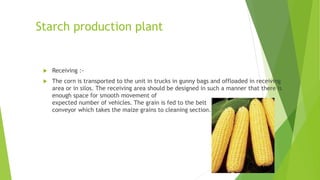
 Receiving :-
 The corn is transported to the unit in trucks in gunny bags and offloaded in receiving
area or in silos. The receiving area should be designed in such a manner that there is
enough space for smooth movement of
expected number of vehicles. The grain is fed to the belt
conveyor which takes the maize grains to cleaning section.
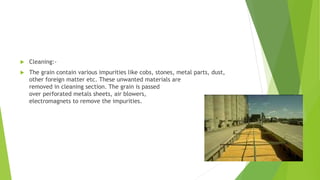
 Cleaning:-
 The grain contain various impurities like cobs, stones, metal parts, dust,
other foreign matter etc. These unwanted materials are
removed in cleaning section. The grain is passed
over perforated metals sheets, air blowers,
electromagnets to remove the impurities.
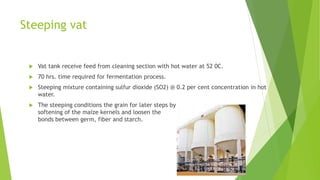
Steeping vat
 Vat tank receive feed from cleaning section with hot water at 52 0C.
 70 hrs. time required for fermentation process.
 Steeping mixture containing sulfur dioxide (SO2) @ 0.2 per cent concentration in hot
water.
 The steeping conditions the grain for later steps by
softening of the maize kernels and loosen the
bonds between germ, fiber and starch.
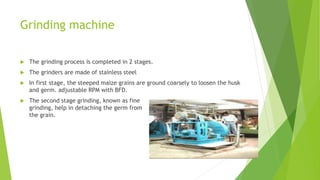
Grinding machine
 The grinding process is completed in 2 stages.
 The grinders are made of stainless steel
 In first stage, the steeped maize grains are ground coarsely to loosen the husk
and germ. adjustable RPM with BFD.
 The second stage grinding, known as fine
grinding, help in detaching the germ from
the grain.
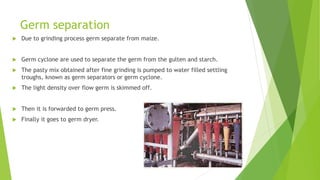
Germ separation
 Due to grinding process germ separate from maize.
 Germ cyclone are used to separate the germ from the gulten and starch.
 The pasty mix obtained after fine grinding is pumped to water filled settling
troughs, known as germ separators or germ cyclone.
 The light density over flow germ is skimmed off.
 Then it is forwarded to germ press.
 Finally it goes to germ dryer.
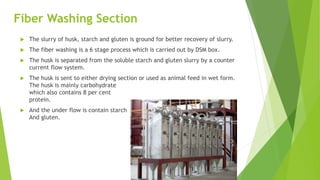
Fiber Washing Section
 The slurry of husk, starch and gluten is ground for better recovery of slurry.
 The fiber washing is a 6 stage process which is carried out by DSM box.
 The husk is separated from the soluble starch and gluten slurry by a counter
current flow system.
 The husk is sent to either drying section or used as animal feed in wet form.
The husk is mainly carbohydrate
which also contains 8 per cent
protein.
 And the under flow is contain starch
And gluten.
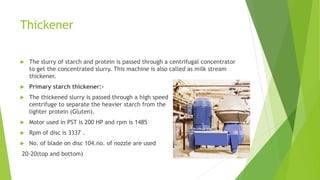
Thickener
 The slurry of starch and protein is passed through a centrifugal concentrator
to get the concentrated slurry. This machine is also called as milk stream
thickener.
 Primary starch thickener:-
 The thickened slurry is passed through a high speed
centrifuge to separate the heavier starch from the
lighter protein (Gluten).
 Motor used in PST is 200 HP and rpm is 1485
 Rpm of disc is 3337 .
 No. of blade on disc 104.no. of nozzle are used
20-20(top and bottom)
Hydro clone system
 The starch slurry received from the primary separation is passed through a multi
stage hydro clone system.
 This is used to separate the starch , gluten from slurry.
 A nozzle system is used no. of nozzle provide in a disc called battery.
 Slurry forced through it then over flow is gluten and starch found in under flow.
 Centrifugal pump are used
 No. of battery used=12
 No. of pump are used=11
 From one end feed is provide then in just
apposite direction water also feed by
centrifugal pump
Gluten thickener
 The protein slurry is passed through a centrifuge to get concentrated slurry of
gluten.
 The gluten contains 65 per cent protein and is a good source of protein for
the animals.
 Motor=300 HP and rpm=1490
 No. of nozzle used =30-30 (top & bottom)
 Rpm of disc = 2700(BFD)
Drying Process & Dryer
 Drying process done by dryer.
 Two types of dryer mainly used=
 1.spin flash dryer(commonly use)
 2.spray dryer
 The concentrated starch slurry is then dried by hot air application (175 0C)
to 11-12 per cent moisture content level.
 The main product of slurry, is starch and four major coproducts for the feed
industry namely the steep water, fiber, germ and gluten.
 Component=
 Induce draf fan
 Force draf fan
 Heater(by steam)
 Rotary valve
 Cyclone
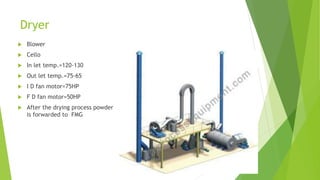
Dryer
 Blower
 Cello
 In let temp.=120-130
 Out let temp.=75-65
 I D fan motor=75HP
 F D fan motor=50HP
 After the drying process powder
is forwarded to FMG
Dextrose monohydrate, anhydrate and
liquid glucose
 The starch is raw material for various ancillary industries like dextrose
monohydrate , dextrose anhydrate.
 An another product also produce called liquid glucose
 DMH:-
 Cooling tank(for cooling purpose by cooling tower water)
 Crystallizer(for crystal formation)
 Centrifuge( separate product from the water )
 Spin flash dryer
 Packing section
 DAH:-
 Carbon treatment
 Filter press
 Ion exchange
 Filter press
 Crystallizer
 Centrifuge
 Spin flash dryer
 LIQUID GLUCOSE:-
 1.Jet cooker
 2.dextiniser
 3. Process tank
 4.Filter press
 5. Ion exchange
 6.EVAPORATOR=a. Falling film b. Rising film
Boiler
 Steam boiler or simple boiler is a basically a closed vessel in which water is heated
until the water is converted into steam at required pressure .
 TYPE:-
 1.fire tube boiler 2. water tube boiler
 MOUNTING:-
 1.NRV
 2.gauge glass
 3.main stop valve
 4.flow down
 5.drum:- a .Steam drum b. Mud drum
 6.main hole
 7.safety valve
Boiler
 ACCESERISE:-
 1. I D fan SPECIFICATION:-
 2 . F D fan 1. Capacity=30TPH
 3. P A fan 2 .Boiler type =water tube type
 4. Economizer 3. Pressure=17kg/cm₂
 5. Air pre heater
 6. Scrubber
 7. Cyclone
 8. Chimney
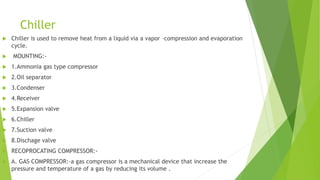
Chiller
 Chiller is used to remove heat from a liquid via a vapor –compression and evaporation
cycle.
 MOUNTING:-
 1.Ammonia gas type compressor
 2.Oil separator
 3.Condenser
 4.Receiver
 5.Expansion valve
 6.Chiller
 7.Suction valve
 8.Dischage valve
 RECOPROCATING COMPRESSOR:-
 A. GAS COMPRESSOR:-a gas compressor is a mechanical device that increase the
pressure and temperature of a gas by reducing its volume .
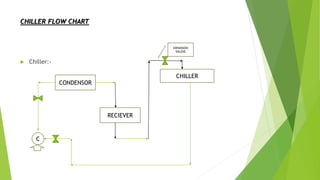
CHILLER FLOW CHART
 Chiller:-
CHILLER
RECIEVER
CONDENSOR
C
EXPANSION
VALEVE
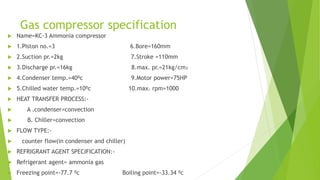
Gas compressor specification
 Name=KC-3 Ammonia compressor
 1.Piston no.=3 6.Bore=160mm
 2.Suction pr.=2kg 7.Stroke =110mm
 3.Discharge pr.=16kg 8.max. pr.=21kg/cm₂
 4.Condenser temp.=40⁰c 9.Motor power=75HP
 5.Chilled water temp.=10⁰c 10.max. rpm=1000
 HEAT TRANSFER PROCESS:-
 A .condenser=convection
 B. Chiller=convection
 FLOW TYPE:-
 counter flow(in condenser and chiller)
 REFRIGRANT AGENT SPECIFICATION:-
 Refrigerant agent= ammonia gas
 Freezing point=-77.7 ⁰c Boiling point=-33.34 ⁰c
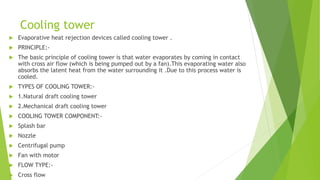
Cooling tower
 Evaporative heat rejection devices called cooling tower .
 PRINCIPLE:-
 The basic principle of cooling tower is that water evaporates by coming in contact
with cross air flow (which is being pumped out by a fan).This evaporating water also
absorbs the latent heat from the water surrounding it .Due to this process water is
cooled.
 TYPES OF COOLING TOWER:-
 1.Natural draft cooling tower
 2.Mechanical draft cooling tower
 COOLING TOWER COMPONENT:-
 Splash bar
 Nozzle
 Centrifugal pump
 Fan with motor
 FLOW TYPE:-
 Cross flow
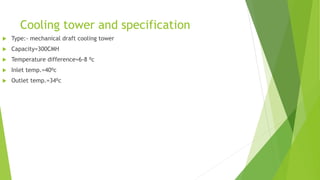
Cooling tower and specification
 Type:- mechanical draft cooling tower
 Capacity=300CMH
 Temperature difference=6-8 ⁰c
 Inlet temp.=40⁰c
 Outlet temp.=34⁰c
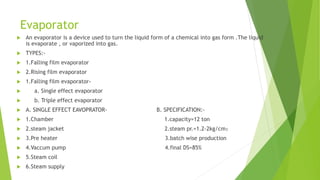
Evaporator
 An evaporator is a device used to turn the liquid form of a chemical into gas form .The liquid
is evaporate , or vaporized into gas.
 TYPES:-
 1.Falling film evaporator
 2.Rising film evaporator
 1.Falling film evaporator-
 a. Single effect evaporator
 b. Triple effect evaporator
 A. SINGLE EFFECT EAVOPRATOR- B. SPECIFICATION:-
 1.Chamber 1.capacity=12 ton
 2.steam jacket 2.steam pr.=1.2-2kg/cm₂
 3.Pre heater 3.batch wise production
 4.Vaccum pump 4.final DS=85%
 5.Steam coil
 6.Steam supply
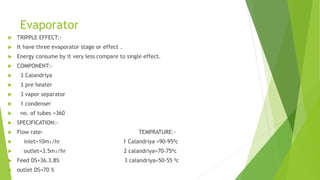
Evaporator
 TRIPPLE EFFECT:-
 It have three evaporator stage or effect .
 Energy consume by it very less compare to single effect.
 COMPONENT:-
 3 Calandriya
 3 pre heater
 3 vapor separator
 1 condenser
 no. of tubes =360
 SPECIFICATION:-
 Flow rate- TEMPRATURE:-
 inlet=10m₃/hr 1 Calandriya =90-95⁰c
 outlet=3.5m₃/hr 2 calandriya=70-75⁰c
 Feed DS=36.3.8% 3 calandriya=50-55 ⁰c
 outlet DS=70 %
.
THANK YOU
Summer training presentation on gujarat ambuja exports ltd

Summer training presentation on gujarat ambuja exports ltd

  • 1.
    Summer Training presentationon Gujarat Ambuja Exports ltd. Submitted to Department of mech. Engineering Alwar institute of engineering and technology, Alwar
  • 2.
    Acknowledgement  First ofall , I would like to thank Gujarat Ambuja expo. Ltd. , Mr. k. k. Rai , HR officer (who organized my training schedule ) & DGM’S and AGM’S of various department who provided important information about their respective shops.  I also thanks the workers , who were always read to clarify our doubt .  I wish to express my deep gratitude to all the concerned person with whose cooperation and coordination I have successfully completed the training in the organization
  • 3.
    About GAEL  Establishedin 1983  GAEL is principally involved in agro-processing & trading and has focused on exports , competing in the global market.  GAEL start with just a textile processing unit in 1983 , the year 1993-1994 was crucial period for the company , with major project being taken up like the most modern cotton yarn spinning project and maize-based starch project( Uttaranchal division),Soya processing unit .  GAEL is focus on international trade has setup a wholly-owned subsidiary at Singapore and has recently promoted a vanaspati and oil refinery project in Srilanka.  In its19th year of operation , GAEL is poised to scale newer heights and is fully geared to achieve the magical Rs.1800 corers operational turn over.
  • 4.
    Department  Starch productionplant  Chiller  Cooling tower  ETP  Gas engine  Steam generation (boiler)
  • 5.
    Starch production plant Receiving :-  The corn is transported to the unit in trucks in gunny bags and offloaded in receiving area or in silos. The receiving area should be designed in such a manner that there is enough space for smooth movement of expected number of vehicles. The grain is fed to the belt conveyor which takes the maize grains to cleaning section.
  • 6.
     Cleaning:-  Thegrain contain various impurities like cobs, stones, metal parts, dust, other foreign matter etc. These unwanted materials are removed in cleaning section. The grain is passed over perforated metals sheets, air blowers, electromagnets to remove the impurities.
  • 7.
    Steeping vat  Vattank receive feed from cleaning section with hot water at 52 0C.  70 hrs. time required for fermentation process.  Steeping mixture containing sulfur dioxide (SO2) @ 0.2 per cent concentration in hot water.  The steeping conditions the grain for later steps by softening of the maize kernels and loosen the bonds between germ, fiber and starch.
  • 8.
    Grinding machine  Thegrinding process is completed in 2 stages.  The grinders are made of stainless steel  In first stage, the steeped maize grains are ground coarsely to loosen the husk and germ. adjustable RPM with BFD.  The second stage grinding, known as fine grinding, help in detaching the germ from the grain.
  • 9.
    Germ separation  Dueto grinding process germ separate from maize.  Germ cyclone are used to separate the germ from the gulten and starch.  The pasty mix obtained after fine grinding is pumped to water filled settling troughs, known as germ separators or germ cyclone.  The light density over flow germ is skimmed off.  Then it is forwarded to germ press.  Finally it goes to germ dryer.
  • 10.
    Fiber Washing Section The slurry of husk, starch and gluten is ground for better recovery of slurry.  The fiber washing is a 6 stage process which is carried out by DSM box.  The husk is separated from the soluble starch and gluten slurry by a counter current flow system.  The husk is sent to either drying section or used as animal feed in wet form. The husk is mainly carbohydrate which also contains 8 per cent protein.  And the under flow is contain starch And gluten.
  • 11.
    Thickener  The slurryof starch and protein is passed through a centrifugal concentrator to get the concentrated slurry. This machine is also called as milk stream thickener.  Primary starch thickener:-  The thickened slurry is passed through a high speed centrifuge to separate the heavier starch from the lighter protein (Gluten).  Motor used in PST is 200 HP and rpm is 1485  Rpm of disc is 3337 .  No. of blade on disc 104.no. of nozzle are used 20-20(top and bottom)
  • 12.
    Hydro clone system The starch slurry received from the primary separation is passed through a multi stage hydro clone system.  This is used to separate the starch , gluten from slurry.  A nozzle system is used no. of nozzle provide in a disc called battery.  Slurry forced through it then over flow is gluten and starch found in under flow.  Centrifugal pump are used  No. of battery used=12  No. of pump are used=11  From one end feed is provide then in just apposite direction water also feed by centrifugal pump
  • 13.
    Gluten thickener  Theprotein slurry is passed through a centrifuge to get concentrated slurry of gluten.  The gluten contains 65 per cent protein and is a good source of protein for the animals.  Motor=300 HP and rpm=1490  No. of nozzle used =30-30 (top & bottom)  Rpm of disc = 2700(BFD)
  • 14.
    Drying Process &Dryer  Drying process done by dryer.  Two types of dryer mainly used=  1.spin flash dryer(commonly use)  2.spray dryer  The concentrated starch slurry is then dried by hot air application (175 0C) to 11-12 per cent moisture content level.  The main product of slurry, is starch and four major coproducts for the feed industry namely the steep water, fiber, germ and gluten.  Component=  Induce draf fan  Force draf fan  Heater(by steam)  Rotary valve  Cyclone
  • 15.
    Dryer  Blower  Cello In let temp.=120-130  Out let temp.=75-65  I D fan motor=75HP  F D fan motor=50HP  After the drying process powder is forwarded to FMG
  • 16.
    Dextrose monohydrate, anhydrateand liquid glucose  The starch is raw material for various ancillary industries like dextrose monohydrate , dextrose anhydrate.  An another product also produce called liquid glucose  DMH:-  Cooling tank(for cooling purpose by cooling tower water)  Crystallizer(for crystal formation)  Centrifuge( separate product from the water )  Spin flash dryer  Packing section  DAH:-  Carbon treatment  Filter press  Ion exchange
  • 17.
     Filter press Crystallizer  Centrifuge  Spin flash dryer  LIQUID GLUCOSE:-  1.Jet cooker  2.dextiniser  3. Process tank  4.Filter press  5. Ion exchange  6.EVAPORATOR=a. Falling film b. Rising film
  • 18.
    Boiler  Steam boileror simple boiler is a basically a closed vessel in which water is heated until the water is converted into steam at required pressure .  TYPE:-  1.fire tube boiler 2. water tube boiler  MOUNTING:-  1.NRV  2.gauge glass  3.main stop valve  4.flow down  5.drum:- a .Steam drum b. Mud drum  6.main hole  7.safety valve
  • 19.
    Boiler  ACCESERISE:-  1.I D fan SPECIFICATION:-  2 . F D fan 1. Capacity=30TPH  3. P A fan 2 .Boiler type =water tube type  4. Economizer 3. Pressure=17kg/cm₂  5. Air pre heater  6. Scrubber  7. Cyclone  8. Chimney
  • 20.
    Chiller  Chiller isused to remove heat from a liquid via a vapor –compression and evaporation cycle.  MOUNTING:-  1.Ammonia gas type compressor  2.Oil separator  3.Condenser  4.Receiver  5.Expansion valve  6.Chiller  7.Suction valve  8.Dischage valve  RECOPROCATING COMPRESSOR:-  A. GAS COMPRESSOR:-a gas compressor is a mechanical device that increase the pressure and temperature of a gas by reducing its volume .
  • 21.
    CHILLER FLOW CHART Chiller:- CHILLER RECIEVER CONDENSOR C EXPANSION VALEVE
  • 22.
    Gas compressor specification Name=KC-3 Ammonia compressor  1.Piston no.=3 6.Bore=160mm  2.Suction pr.=2kg 7.Stroke =110mm  3.Discharge pr.=16kg 8.max. pr.=21kg/cm₂  4.Condenser temp.=40⁰c 9.Motor power=75HP  5.Chilled water temp.=10⁰c 10.max. rpm=1000  HEAT TRANSFER PROCESS:-  A .condenser=convection  B. Chiller=convection  FLOW TYPE:-  counter flow(in condenser and chiller)  REFRIGRANT AGENT SPECIFICATION:-  Refrigerant agent= ammonia gas  Freezing point=-77.7 ⁰c Boiling point=-33.34 ⁰c
  • 23.
    Cooling tower  Evaporativeheat rejection devices called cooling tower .  PRINCIPLE:-  The basic principle of cooling tower is that water evaporates by coming in contact with cross air flow (which is being pumped out by a fan).This evaporating water also absorbs the latent heat from the water surrounding it .Due to this process water is cooled.  TYPES OF COOLING TOWER:-  1.Natural draft cooling tower  2.Mechanical draft cooling tower  COOLING TOWER COMPONENT:-  Splash bar  Nozzle  Centrifugal pump  Fan with motor  FLOW TYPE:-  Cross flow
  • 24.
    Cooling tower andspecification  Type:- mechanical draft cooling tower  Capacity=300CMH  Temperature difference=6-8 ⁰c  Inlet temp.=40⁰c  Outlet temp.=34⁰c
  • 25.
    Evaporator  An evaporatoris a device used to turn the liquid form of a chemical into gas form .The liquid is evaporate , or vaporized into gas.  TYPES:-  1.Falling film evaporator  2.Rising film evaporator  1.Falling film evaporator-  a. Single effect evaporator  b. Triple effect evaporator  A. SINGLE EFFECT EAVOPRATOR- B. SPECIFICATION:-  1.Chamber 1.capacity=12 ton  2.steam jacket 2.steam pr.=1.2-2kg/cm₂  3.Pre heater 3.batch wise production  4.Vaccum pump 4.final DS=85%  5.Steam coil  6.Steam supply
  • 26.
    Evaporator  TRIPPLE EFFECT:- It have three evaporator stage or effect .  Energy consume by it very less compare to single effect.  COMPONENT:-  3 Calandriya  3 pre heater  3 vapor separator  1 condenser  no. of tubes =360  SPECIFICATION:-  Flow rate- TEMPRATURE:-  inlet=10m₃/hr 1 Calandriya =90-95⁰c  outlet=3.5m₃/hr 2 calandriya=70-75⁰c  Feed DS=36.3.8% 3 calandriya=50-55 ⁰c  outlet DS=70 %
  • 27.