OPERATIONS
MANAGEMENT
Module Wrap-up
Instructor: Debjit Roy
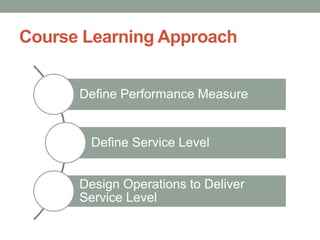
Course Learning Approach
Define Performance Measure
Define Service Level
Design Operations to Deliver
Service Level
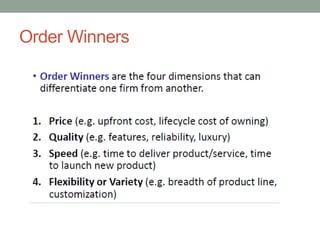
Order Winners
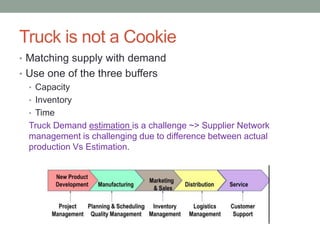
Truck is not a Cookie
• Matching supply with demand
• Use one of the three buffers
• Capacity
• Inventory
• Time
Truck Demand estimation is a challenge ~> Supplier Network
management is challenging due to difference between actual
production Vs Estimation.
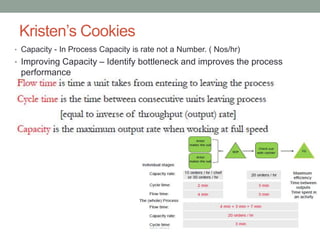
Kristen’s Cookies
• Capacity - In Process Capacity is rate not a Number. ( Nos/hr)
• Improving Capacity – Identify bottleneck and improves the process
performance
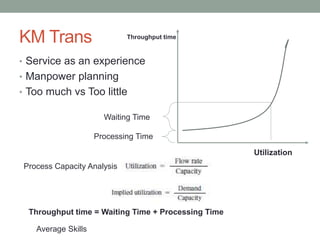
KM Trans
• Service as an experience
• Manpower planning
• Too much vs Too little
Processing Time
Waiting Time
Utilization
Throughput time
Process Capacity Analysis
Throughput time = Waiting Time + Processing Time
Average Skills
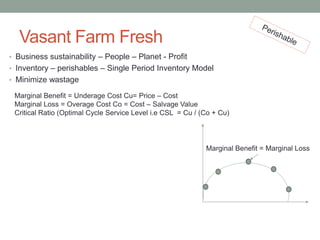
Vasant Farm Fresh
• Business sustainability – People – Planet - Profit
• Inventory – perishables – Single Period Inventory Model
• Minimize wastage
Marginal Benefit = Marginal Loss
Marginal Benefit = Underage Cost Cu= Price – Cost
Marginal Loss = Overage Cost Co = Cost – Salvage Value
Critical Ratio (Optimal Cycle Service Level i.e CSL = Cu / (Co + Cu)
Halloran
• How multiple companies co-exist?
• Virtual centralization
• Risk pooling with centralized inventory
• Role of GST?
• Operational strategy
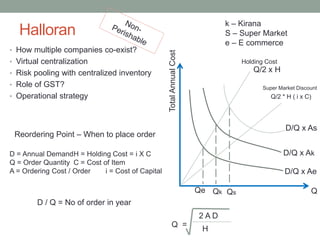
Reordering Point – When to place order
D = Annual DemandH = Holding Cost = i X C
Q = Order Quantity C = Cost of Item
A = Ordering Cost / Order i = Cost of Capital
D / Q = No of order in year
Total
Annual
Cost
Q/2 x H
Q/2 * H ( i x C)
Holding Cost
Super Market Discount
D/Q x As
D/Q x Ak
D/Q x Ae
Q
Qe Qk Qs
k – Kirana
S – Super Market
e – E commerce
Q =
2 A D
H
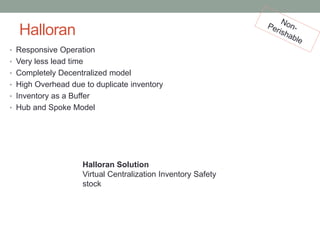
Halloran
• Responsive Operation
• Very less lead time
• Completely Decentralized model
• High Overhead due to duplicate inventory
• Inventory as a Buffer
• Hub and Spoke Model
Halloran Solution
Virtual Centralization Inventory Safety
stock
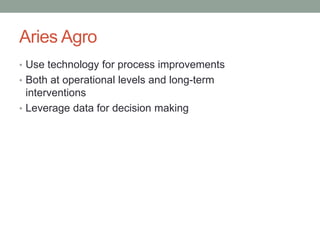
Aries Agro
• Use technology for process improvements
• Both at operational levels and long-term
interventions
• Leverage data for decision making
Aminia
• Business sustainability
• Menu restructuring to improve profitability
• How to sustain and manage competition?
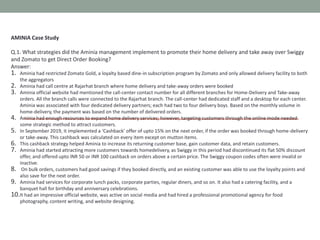
AMINIA Case Study
Q.1. What strategies did the Aminia management implement to promote their home delivery and take away over Swiggy
and Zomato to get Direct Order Booking?
Answer:
1. Aminia had restricted Zomato Gold, a loyalty based dine-in subscription program by Zomato and only allowed delivery facility to both
the aggregators
2. Aminia had call centre at Rajarhat branch where home delivery and take-away orders were booked
3. Aminia official website had mentioned the call-center contact number for all different branches for Home-Delivery and Take-away
orders. All the branch calls were connected to the Rajarhat branch. The call-center had dedicated staff and a desktop for each center.
Aminia was associated with four dedicated delivery partners; each had two to four delivery boys. Based on the monthly volume in
home-delivery, the payment was based on the number of delivered orders.
4. Aminia had enough resources to expand home delivery services; however, targeting customers through the online mode needed
some strategic method to attract customers.
5. In September 2019, it implemented a ‘Cashback’ offer of upto 15% on the next order, if the order was booked through home-delivery
or take-away. This cashback was calculated on every item except on mutton items.
6. This cashback strategy helped Aminia to increase its returning customer base, gain customer data, and retain customers.
7. Aminia had started attracting more customers towards homedelivery, as Swiggy in this period had discontinued its flat 50% discount
offer, and offered upto INR 50 or INR 100 cashback on orders above a certain price. The Swiggy coupon codes often were invalid or
inactive.
8. On bulk orders, customers had good savings if they booked directly, and an existing customer was able to use the loyalty points and
also save for the next order.
9. Aminia had services for corporate lunch packs, corporate parties, regular diners, and so on. It also had a catering facility, and a
banquet hall for birthday and anniversary celebrations.
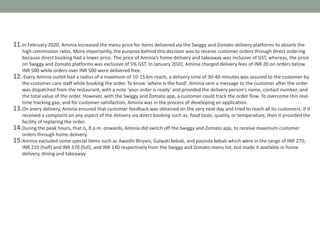
10.It had an impressive official website, was active on social media and had hired a professional promotional agency for food
photography, content writing, and website designing.
11.In February 2020, Aminia increased the menu price for items delivered via the Swiggy and Zomato delivery platforms to absorb the
high commission rates. More importantly, the purpose behind this decision was to receive customer orders through direct ordering
because direct booking had a lower price. The price of Aminia’s home delivery and takeaway was inclusive of GST, whereas, the price
on Swiggy and Zomato platforms was exclusive of 5% GST. In January 2020, Aminia charged delivery fees of INR 20 on orders below
INR 500 while orders over INR 500 were delivered free.
12. Every Aminia outlet had a radius of a maximum of 10-15 km reach, a delivery time of 30-40 minutes was assured to the customer by
the customer care staff while booking the order. To know ‘where is the food’, Aminia sent a message to the customer after the order
was dispatched from the restaurant, with a note ‘your order is ready’ and provided the delivery person’s name, contact number, and
the total value of the order. However, with the Swiggy and Zomato app, a customer could track the order flow. To overcome this real-
time tracking gap, and for customer satisfaction, Aminia was in the process of developing an application.
13.On every delivery, Aminia ensured that customer feedback was obtained on the very next day and tried to reach all its customers. If it
received a complaint on any aspect of the delivery via direct booking such as, food taste, quality, or temperature, then it provided the
facility of replacing the order.
14.During the peak hours, that is, 8 p.m. onwards, Aminia did switch off the Swiggy and Zomato app, to receive maximum customer
orders through home delivery.
15.Aminia excluded some special items such as Awadhi Biryani, Galwati kebab, and pasinda kebab which were in the range of INR 270,
INR 210 (half) and INR 370 (full), and INR 140 respectively from the Swiggy and Zomato menu list, but made it available in home
delivery, dining and takeaway
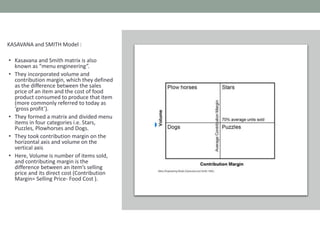
KASAVANA and SMITH Model :
• Kasavana and Smith matrix is also
known as “menu engineering”.
• They incorporated volume and
contribution margin, which they defined
as the difference between the sales
price of an item and the cost of food
product consumed to produce that item
(more commonly referred to today as
‘gross profit’).
• They formed a matrix and divided menu
items in four categories i.e. Stars,
Puzzles, Plowhorses and Dogs.
• They took contribution margin on the
horizontal axis and volume on the
vertical axis
• Here, Volume is number of items sold,
and contributing margin is the
difference between an item’s selling
price and its direct cost (Contribution
Margin= Selling Price- Food Cost ).
Trade-offs
a common “operations” dilemma
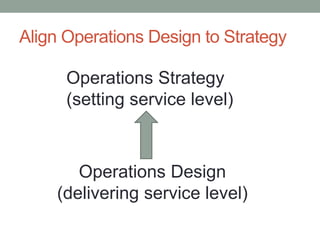
Align Operations Design to Strategy
Operations Design
(delivering service level)
Operations Strategy
(setting service level)
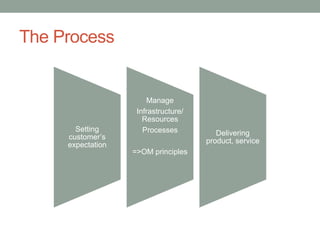
The Process
Setting
customer’s
expectation
Manage
Infrastructure/
Resources
Processes
=>OM principles
Delivering
product, service
18
Thank you for being wonderful participants!
May the “operations” inyou live for ever!
Wish you success!
Short-term: SMP
Long-term: Professional and Personal

Summary of OSM Case Study.pptx

  • 1.
  • 2.
    Course Learning Approach DefinePerformance Measure Define Service Level Design Operations to Deliver Service Level
  • 3.
  • 4.
    Truck is nota Cookie • Matching supply with demand • Use one of the three buffers • Capacity • Inventory • Time Truck Demand estimation is a challenge ~> Supplier Network management is challenging due to difference between actual production Vs Estimation.
  • 5.
    Kristen’s Cookies • Capacity- In Process Capacity is rate not a Number. ( Nos/hr) • Improving Capacity – Identify bottleneck and improves the process performance
  • 6.
    KM Trans • Serviceas an experience • Manpower planning • Too much vs Too little Processing Time Waiting Time Utilization Throughput time Process Capacity Analysis Throughput time = Waiting Time + Processing Time Average Skills
  • 7.
    Vasant Farm Fresh •Business sustainability – People – Planet - Profit • Inventory – perishables – Single Period Inventory Model • Minimize wastage Marginal Benefit = Marginal Loss Marginal Benefit = Underage Cost Cu= Price – Cost Marginal Loss = Overage Cost Co = Cost – Salvage Value Critical Ratio (Optimal Cycle Service Level i.e CSL = Cu / (Co + Cu)
  • 8.
    Halloran • How multiplecompanies co-exist? • Virtual centralization • Risk pooling with centralized inventory • Role of GST? • Operational strategy Reordering Point – When to place order D = Annual DemandH = Holding Cost = i X C Q = Order Quantity C = Cost of Item A = Ordering Cost / Order i = Cost of Capital D / Q = No of order in year Total Annual Cost Q/2 x H Q/2 * H ( i x C) Holding Cost Super Market Discount D/Q x As D/Q x Ak D/Q x Ae Q Qe Qk Qs k – Kirana S – Super Market e – E commerce Q = 2 A D H
  • 9.
    Halloran • Responsive Operation •Very less lead time • Completely Decentralized model • High Overhead due to duplicate inventory • Inventory as a Buffer • Hub and Spoke Model Halloran Solution Virtual Centralization Inventory Safety stock
  • 10.
    Aries Agro • Usetechnology for process improvements • Both at operational levels and long-term interventions • Leverage data for decision making
  • 11.
    Aminia • Business sustainability •Menu restructuring to improve profitability • How to sustain and manage competition?
  • 12.
    AMINIA Case Study Q.1.What strategies did the Aminia management implement to promote their home delivery and take away over Swiggy and Zomato to get Direct Order Booking? Answer: 1. Aminia had restricted Zomato Gold, a loyalty based dine-in subscription program by Zomato and only allowed delivery facility to both the aggregators 2. Aminia had call centre at Rajarhat branch where home delivery and take-away orders were booked 3. Aminia official website had mentioned the call-center contact number for all different branches for Home-Delivery and Take-away orders. All the branch calls were connected to the Rajarhat branch. The call-center had dedicated staff and a desktop for each center. Aminia was associated with four dedicated delivery partners; each had two to four delivery boys. Based on the monthly volume in home-delivery, the payment was based on the number of delivered orders. 4. Aminia had enough resources to expand home delivery services; however, targeting customers through the online mode needed some strategic method to attract customers. 5. In September 2019, it implemented a ‘Cashback’ offer of upto 15% on the next order, if the order was booked through home-delivery or take-away. This cashback was calculated on every item except on mutton items. 6. This cashback strategy helped Aminia to increase its returning customer base, gain customer data, and retain customers. 7. Aminia had started attracting more customers towards homedelivery, as Swiggy in this period had discontinued its flat 50% discount offer, and offered upto INR 50 or INR 100 cashback on orders above a certain price. The Swiggy coupon codes often were invalid or inactive. 8. On bulk orders, customers had good savings if they booked directly, and an existing customer was able to use the loyalty points and also save for the next order. 9. Aminia had services for corporate lunch packs, corporate parties, regular diners, and so on. It also had a catering facility, and a banquet hall for birthday and anniversary celebrations. 10.It had an impressive official website, was active on social media and had hired a professional promotional agency for food photography, content writing, and website designing.
  • 13.
    11.In February 2020,Aminia increased the menu price for items delivered via the Swiggy and Zomato delivery platforms to absorb the high commission rates. More importantly, the purpose behind this decision was to receive customer orders through direct ordering because direct booking had a lower price. The price of Aminia’s home delivery and takeaway was inclusive of GST, whereas, the price on Swiggy and Zomato platforms was exclusive of 5% GST. In January 2020, Aminia charged delivery fees of INR 20 on orders below INR 500 while orders over INR 500 were delivered free. 12. Every Aminia outlet had a radius of a maximum of 10-15 km reach, a delivery time of 30-40 minutes was assured to the customer by the customer care staff while booking the order. To know ‘where is the food’, Aminia sent a message to the customer after the order was dispatched from the restaurant, with a note ‘your order is ready’ and provided the delivery person’s name, contact number, and the total value of the order. However, with the Swiggy and Zomato app, a customer could track the order flow. To overcome this real- time tracking gap, and for customer satisfaction, Aminia was in the process of developing an application. 13.On every delivery, Aminia ensured that customer feedback was obtained on the very next day and tried to reach all its customers. If it received a complaint on any aspect of the delivery via direct booking such as, food taste, quality, or temperature, then it provided the facility of replacing the order. 14.During the peak hours, that is, 8 p.m. onwards, Aminia did switch off the Swiggy and Zomato app, to receive maximum customer orders through home delivery. 15.Aminia excluded some special items such as Awadhi Biryani, Galwati kebab, and pasinda kebab which were in the range of INR 270, INR 210 (half) and INR 370 (full), and INR 140 respectively from the Swiggy and Zomato menu list, but made it available in home delivery, dining and takeaway
  • 14.
    KASAVANA and SMITHModel : • Kasavana and Smith matrix is also known as “menu engineering”. • They incorporated volume and contribution margin, which they defined as the difference between the sales price of an item and the cost of food product consumed to produce that item (more commonly referred to today as ‘gross profit’). • They formed a matrix and divided menu items in four categories i.e. Stars, Puzzles, Plowhorses and Dogs. • They took contribution margin on the horizontal axis and volume on the vertical axis • Here, Volume is number of items sold, and contributing margin is the difference between an item’s selling price and its direct cost (Contribution Margin= Selling Price- Food Cost ).
  • 15.
  • 16.
    Align Operations Designto Strategy Operations Design (delivering service level) Operations Strategy (setting service level)
  • 17.
  • 18.
    18 Thank you forbeing wonderful participants! May the “operations” inyou live for ever! Wish you success! Short-term: SMP Long-term: Professional and Personal