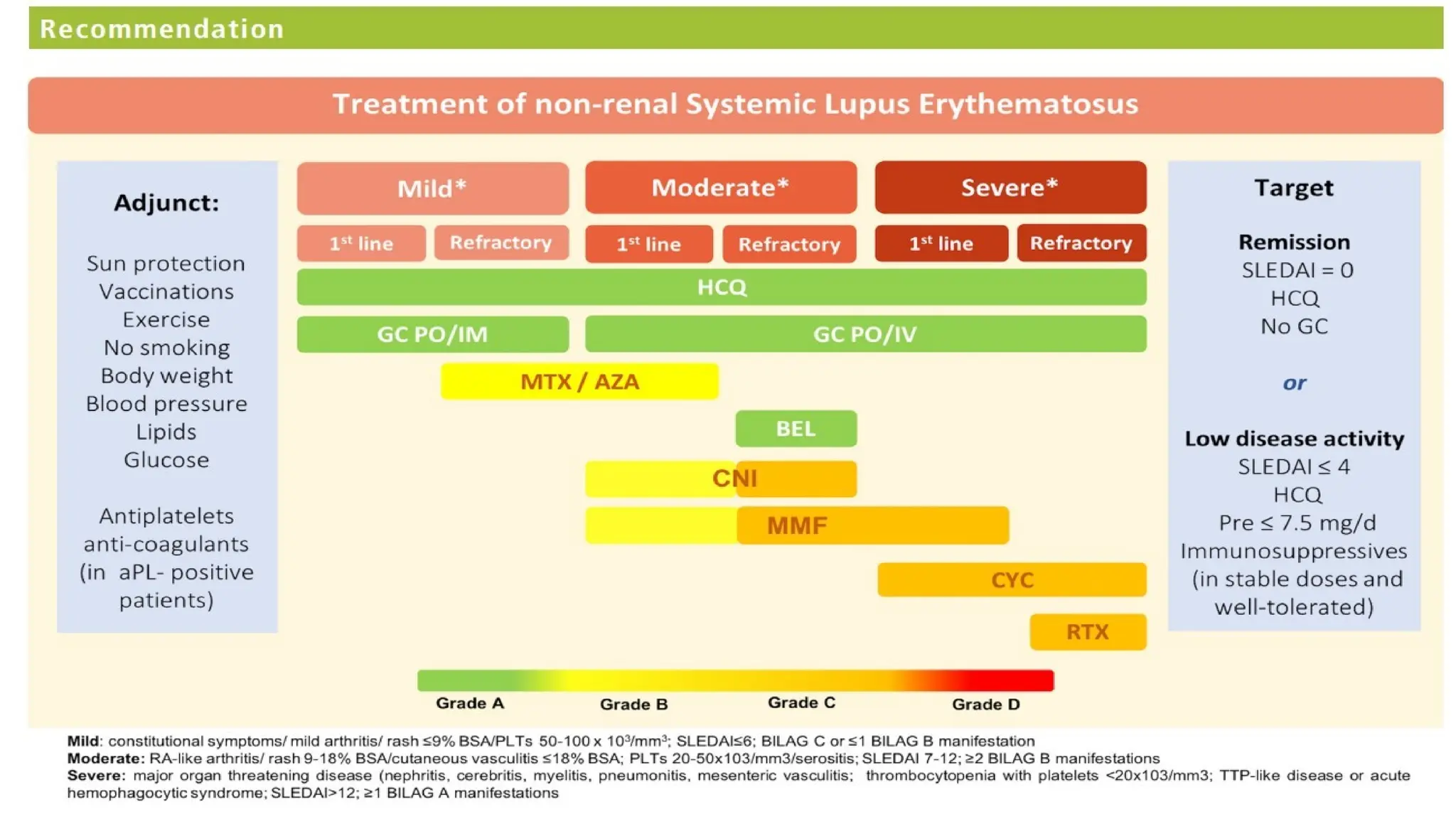
EULAR 2019 UPDATE FOR
SLE MANAGEMENT
DR MOHAMMAD SUHAIL
1. Guidelines
a) Goals
b) Treatment
i. HCQ
ii. GC
iii. Immunomodulators
iv. Biologics
c) Specific organ involvement
2. Summary of changes compared to 2008
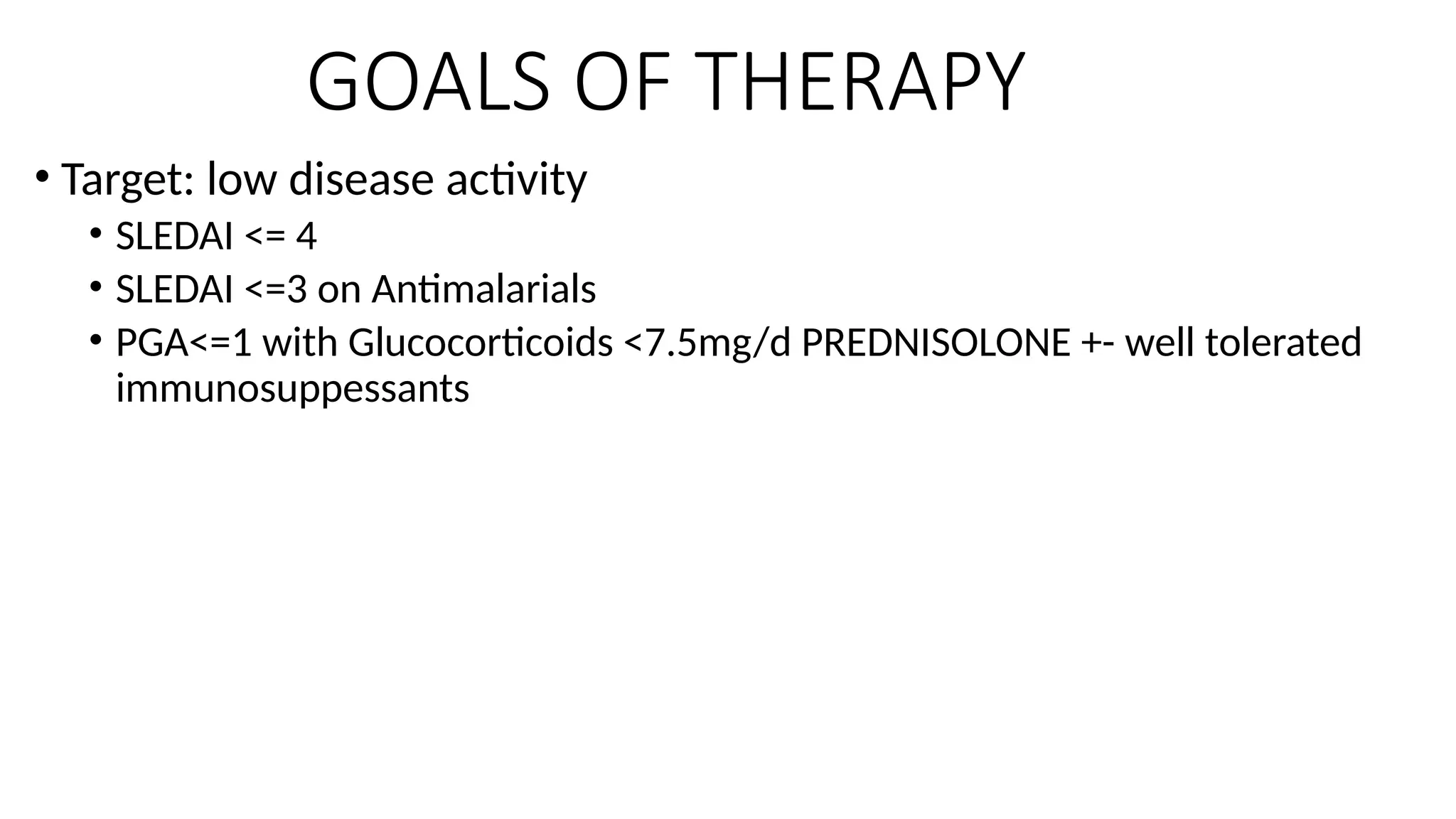
GOALS OF THERAPY
• Target: low disease activity
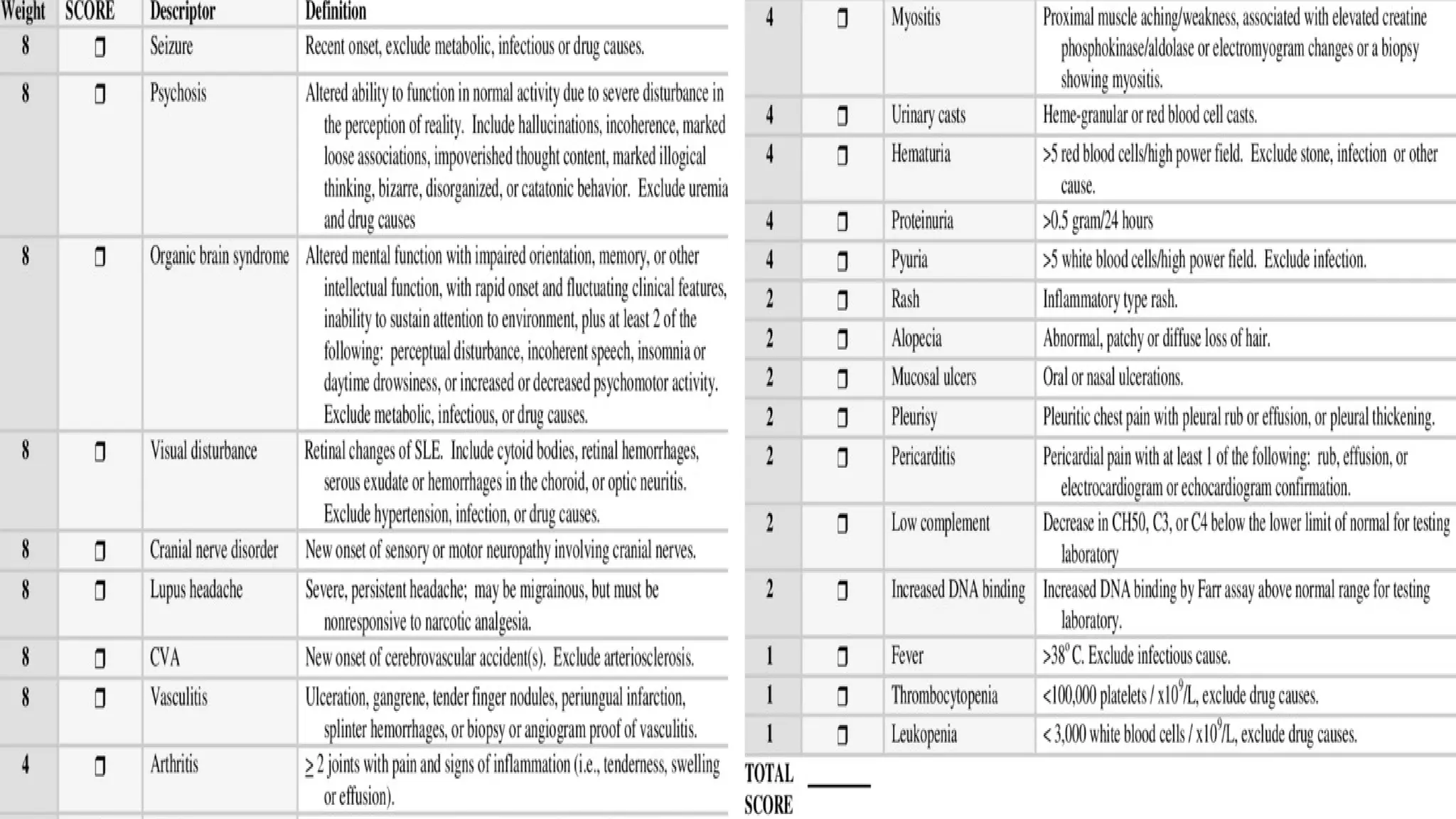
• SLEDAI <= 4
• SLEDAI <=3 on Antimalarials
• PGA<=1 with Glucocorticoids <7.5mg/d PREDNISOLONE +- well tolerated
immunosuppessants
GOALS OF THERAPY
• Target: Remission or at least low disease activity
• SLEDAI <= 4
• SLEDAI <=3 on Antimalarials
• PGA<=1 with Glucocorticoids <7.5mg/d PREDNISOLONE +- well tolerated
immunosuppessants
• In Lupus nephritis:
• >50% reduction in proteinuria and S.Cr within 10% from baseline in 12
months
• (Complete renal remission: Proteinuria <500mg/d, S.Cr witin 10% baseline)
• Prevention of flares
• Measurable increase in disease activity that leads to change of treatment
TREATMENT
HCQ
• Recommended to ALL patients with SLE (if not contraindicated)
• Dose: <5mg/kg/d BW in 2 divided doses
• Ophthalmology screening:
• At initiation
• After first 5 years
• Yearly thereafter
• QUINACRINE may be considered in HCQ-induced retinal toxicity
GLUCOCORTICOIDS (GC)
• Rapid symptom relief
• Dose <7.5mg/d PREDNISONE EQUIVALENT
• 2 strategies to reduce maintenance dose:
• Pulse GC (250-1000mg/d MP x 3-5 days)
• Early initiation of Immunosuppressant (IS)
IMMUNOSUPPRESSANTS (IS)
• Facilitates rapid GC tapering, lower maintenance GC
• METHOTREXATE (MTX): Strongest supporting data.
• Azathioprine (AZA): Published evidence less than MTX but compatible with
pregnancy
• Mycophenolate Mophetil (Mmf): Shown in recent RCT to be more efficacious
than AZA in controlling flares and achieving remission (But not
neuropsychiatric involvement). Teratogenic; needs to be stopped 6 weeks
before planning pregnancy.
• Cyclophosphamide (CYC): considered in organ-threatening disease (Renal,
neuropsychiatric,cardiopulmonary involvement). Gonadotoxic. Low dose
GnRh, cryopreservation.
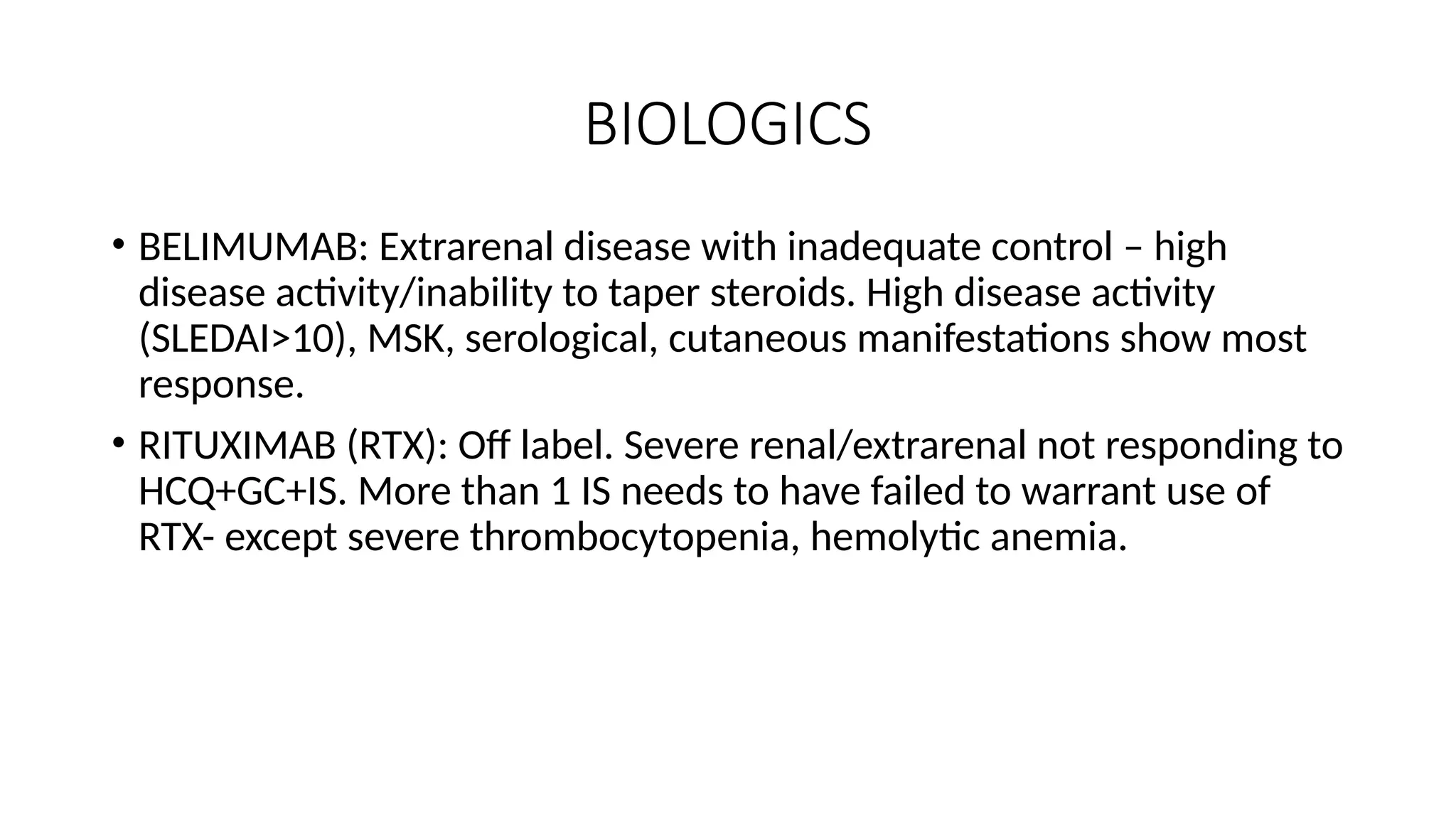
BIOLOGICS
• BELIMUMAB: Extrarenal disease with inadequate control – high
disease activity/inability to taper steroids. High disease activity
(SLEDAI>10), MSK, serological, cutaneous manifestations show most
response.
• RITUXIMAB (RTX): Off label. Severe renal/extrarenal not responding to
HCQ+GC+IS. More than 1 IS needs to have failed to warrant use of
RTX- except severe thrombocytopenia, hemolytic anemia.
SYSTEMIC DISEASE: SKIN (CLE)
• First line: Topic GC+HCQ +/-systemic GC
• MTX
• BELIMUMAB
• RTX
• Others: DAPSONE, THALIDOMIDE, EC-
Mycophenolic acid
• SKIN PROTECTION- broad spectrum
sunscreen, smoking cessation
• Refractory: skin biopsy
NEUROPSYCHIATRIC LE (NPSLE)
• Effort to link manifestations to SLE – Neuroimaging, etc.
• Underlying pathophysiology
• Inflammatory- GC, IS
• Ischemic/thromboembolic- Anticoagulants. *aPL
• CVA with SLE – 1st
line SLE management + stroke treatment
as in general population
• Symptomatic psychiatric treatment
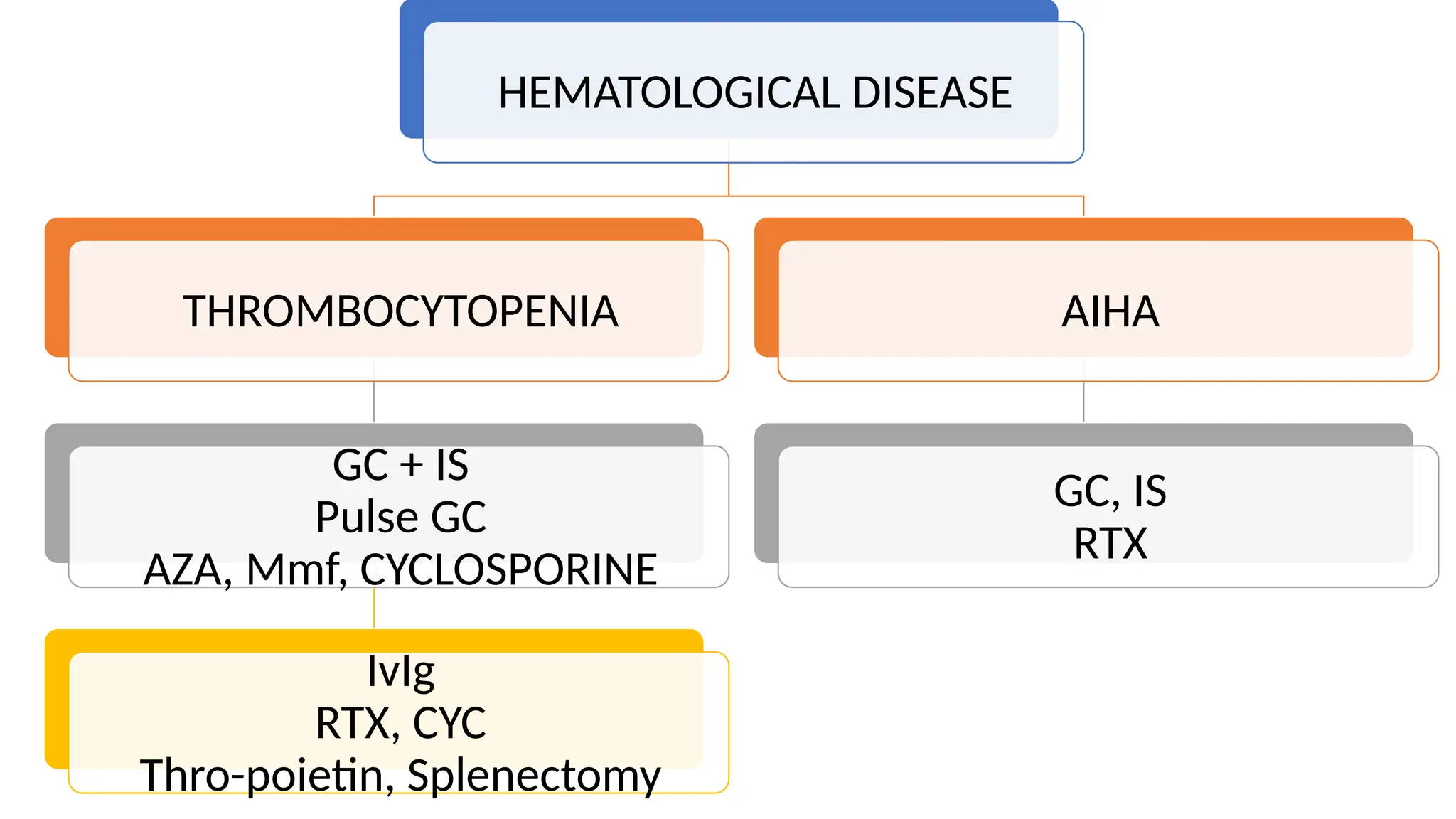
HEMATOLOGICAL DISEASE
THROMBOCYTOPENIA
GC + IS
Pulse GC
AZA, Mmf, CYCLOSPORINE
IvIg
RTX, CYC
Thro-poietin, Splenectomy
AIHA
GC, IS
RTX
LUPUS NEPHRITIS (LN)
• INDUCTION PHASE:
• MMF +/- CYCLOPHOSPHAMIDE
• MMF+CYC if high risk of progression to ESRD (reduced GFR, HPE – interstitial
fibrosis, Tubular atrophy, fibrous crescents/fibrinoid necrosis)
• MAINTENANCE:
• MMF > AZA
• REFRACTORY/RELAPSING CASES:
• RTX
• Calcineurin inhibitors (CNI)-TACROLIMUS, etc.
• F/U
• Upr <1g/d at 6m, <0.8g/d at 12 months = good prognosis. Hematuria not
considered
SUMMARY OF CHANGES
• Use of Scores to guide drug therapy.
• More HCQ, less steroids. HCQ recommended to all patients.
Upper limit set to maintenance steroid dose/day
• Early initiation of IS, recommendation of GnRH with CYC
• BELIMUMAB in extrarenal disease.
• Use of proteinuria and not hematuria in F/U of LN
THANK YOU

summary of EULAR 2019 guidelines SLE Mx.pptx

  • 1.
    EULAR 2019 UPDATEFOR SLE MANAGEMENT DR MOHAMMAD SUHAIL
  • 2.
    1. Guidelines a) Goals b)Treatment i. HCQ ii. GC iii. Immunomodulators iv. Biologics c) Specific organ involvement 2. Summary of changes compared to 2008
  • 3.
    GOALS OF THERAPY •Target: low disease activity • SLEDAI <= 4 • SLEDAI <=3 on Antimalarials • PGA<=1 with Glucocorticoids <7.5mg/d PREDNISOLONE +- well tolerated immunosuppessants
  • 7.
    GOALS OF THERAPY •Target: Remission or at least low disease activity • SLEDAI <= 4 • SLEDAI <=3 on Antimalarials • PGA<=1 with Glucocorticoids <7.5mg/d PREDNISOLONE +- well tolerated immunosuppessants • In Lupus nephritis: • >50% reduction in proteinuria and S.Cr within 10% from baseline in 12 months • (Complete renal remission: Proteinuria <500mg/d, S.Cr witin 10% baseline) • Prevention of flares • Measurable increase in disease activity that leads to change of treatment
  • 8.
  • 9.
    HCQ • Recommended toALL patients with SLE (if not contraindicated) • Dose: <5mg/kg/d BW in 2 divided doses • Ophthalmology screening: • At initiation • After first 5 years • Yearly thereafter • QUINACRINE may be considered in HCQ-induced retinal toxicity
  • 10.
    GLUCOCORTICOIDS (GC) • Rapidsymptom relief • Dose <7.5mg/d PREDNISONE EQUIVALENT • 2 strategies to reduce maintenance dose: • Pulse GC (250-1000mg/d MP x 3-5 days) • Early initiation of Immunosuppressant (IS)
  • 12.
    IMMUNOSUPPRESSANTS (IS) • Facilitatesrapid GC tapering, lower maintenance GC • METHOTREXATE (MTX): Strongest supporting data. • Azathioprine (AZA): Published evidence less than MTX but compatible with pregnancy • Mycophenolate Mophetil (Mmf): Shown in recent RCT to be more efficacious than AZA in controlling flares and achieving remission (But not neuropsychiatric involvement). Teratogenic; needs to be stopped 6 weeks before planning pregnancy. • Cyclophosphamide (CYC): considered in organ-threatening disease (Renal, neuropsychiatric,cardiopulmonary involvement). Gonadotoxic. Low dose GnRh, cryopreservation.
  • 13.
    BIOLOGICS • BELIMUMAB: Extrarenaldisease with inadequate control – high disease activity/inability to taper steroids. High disease activity (SLEDAI>10), MSK, serological, cutaneous manifestations show most response. • RITUXIMAB (RTX): Off label. Severe renal/extrarenal not responding to HCQ+GC+IS. More than 1 IS needs to have failed to warrant use of RTX- except severe thrombocytopenia, hemolytic anemia.
  • 15.
    SYSTEMIC DISEASE: SKIN(CLE) • First line: Topic GC+HCQ +/-systemic GC • MTX • BELIMUMAB • RTX • Others: DAPSONE, THALIDOMIDE, EC- Mycophenolic acid • SKIN PROTECTION- broad spectrum sunscreen, smoking cessation • Refractory: skin biopsy
  • 16.
    NEUROPSYCHIATRIC LE (NPSLE) •Effort to link manifestations to SLE – Neuroimaging, etc. • Underlying pathophysiology • Inflammatory- GC, IS • Ischemic/thromboembolic- Anticoagulants. *aPL • CVA with SLE – 1st line SLE management + stroke treatment as in general population • Symptomatic psychiatric treatment
  • 17.
    HEMATOLOGICAL DISEASE THROMBOCYTOPENIA GC +IS Pulse GC AZA, Mmf, CYCLOSPORINE IvIg RTX, CYC Thro-poietin, Splenectomy AIHA GC, IS RTX
  • 18.
    LUPUS NEPHRITIS (LN) •INDUCTION PHASE: • MMF +/- CYCLOPHOSPHAMIDE • MMF+CYC if high risk of progression to ESRD (reduced GFR, HPE – interstitial fibrosis, Tubular atrophy, fibrous crescents/fibrinoid necrosis) • MAINTENANCE: • MMF > AZA • REFRACTORY/RELAPSING CASES: • RTX • Calcineurin inhibitors (CNI)-TACROLIMUS, etc. • F/U • Upr <1g/d at 6m, <0.8g/d at 12 months = good prognosis. Hematuria not considered
  • 19.
    SUMMARY OF CHANGES •Use of Scores to guide drug therapy. • More HCQ, less steroids. HCQ recommended to all patients. Upper limit set to maintenance steroid dose/day • Early initiation of IS, recommendation of GnRH with CYC • BELIMUMAB in extrarenal disease. • Use of proteinuria and not hematuria in F/U of LN
  • 20.

Editor's Notes

  • #3 Complete remission is unlikelySLEDAI 0 with no GC or HCQ
  • #7 Complete remission is unlikely;
  • #12 MTX Dose 10-25mg/week with folic acid supplementation. Adverse effects: GI intolerance, mucositis, hair loss, hepatotoxicity, myelotoxicity. AZA dose: 1.5-2mg/kg/d in 2 doses initially; may be lowered in maintenance. MMF: mild/mod/maintenance: 1-2g/day in 2 doses. Induction/severe: 3g/day in 2 doses CYC:
  • #13 IgG1-Lambda Mab that blocks binding soluble human B-lymph stimulator (BLyS) to R on B-Lymph- reduces B-lymph survival. BELI: IV: 10 mg/Kg on weeks 0, 2, 4, then every 4 weeks ; SC: 200 mg weekly LUNAR trial showed that in LN, B-Lymph depletion with RTX improve chances for complete response at 78 weeks. RTX : 1000 mg on days 1 and 15 - re-administration every 6 months or “on-demand”
  • #16 Distinction between the 2 may not be easy; both may be present together – both treatment can be given together
  • #17 Cyclosporine dose: 1-3 mg/Kg/day or 100-400 mg/day in 2 doses
  • #18 High risk: Juveline onset, Males, anti-C1q Ab positive MMF: 3g/d 2 doses. CYC: 500mg IV alt weeks till 10 weeks (Euro-lupus; LN); 0.75-1g/BSA m2/month x 6 months (NIH; organ or life threatening)