Sum ar i zat i on
m
A Key Skill in Reading
Comprehension
Summary is the
foundational
skill of reading.
It is the heart of
comprehension and the
very essence of what
you should be able to
do when reading.
Summarizing and Paraphrasing
are not the same thing.

Summarizing

Paraphrasing

 A shortened version
of the original text

 Restating ideas in
different words

 The essential and
key points

 Putting things in
one’s own words
FEATURES
• Short

 A summary should be shorter than the
original (a paragraph or a page).

• Main Ideas

 Stating the main idea is often the most
difficult part, unless the author comes
right out and states it in the reading.

• Reflect Structure

 Consider the structure (problem/solution,
compare/contrast, cause/effect, etc.) of
the original and follow suit.

• Important Details

 Include the important details that support
the main points.
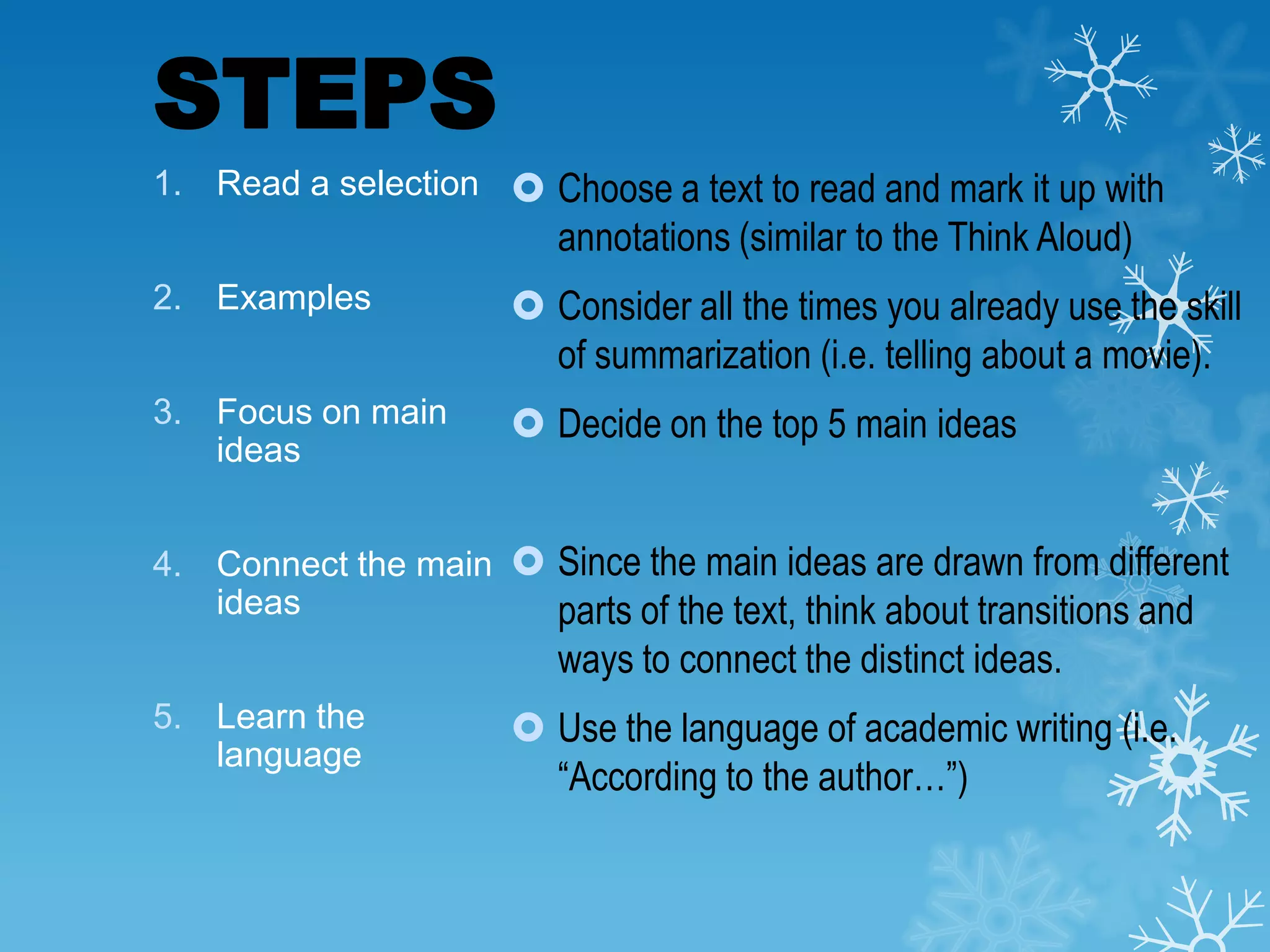
STEPS
1. Read a selection  Choose a text to read and mark it up with

annotations (similar to the Think Aloud)
2. Examples

 Consider all the times you already use the skill
of summarization (i.e. telling about a movie).

3. Focus on main
ideas

 Decide on the top 5 main ideas

4. Connect the main  Since the main ideas are drawn from different
ideas
parts of the text, think about transitions and

ways to connect the distinct ideas.
5. Learn the
language

 Use the language of academic writing (i.e.
“According to the author…”)

Summarization

  • 1.
    Sum ar izat i on m A Key Skill in Reading Comprehension
  • 2.
    Summary is the foundational skillof reading. It is the heart of comprehension and the very essence of what you should be able to do when reading.
  • 3.
    Summarizing and Paraphrasing arenot the same thing. Summarizing Paraphrasing  A shortened version of the original text  Restating ideas in different words  The essential and key points  Putting things in one’s own words
  • 4.
    FEATURES • Short  Asummary should be shorter than the original (a paragraph or a page). • Main Ideas  Stating the main idea is often the most difficult part, unless the author comes right out and states it in the reading. • Reflect Structure  Consider the structure (problem/solution, compare/contrast, cause/effect, etc.) of the original and follow suit. • Important Details  Include the important details that support the main points.
  • 5.
    STEPS 1. Read aselection  Choose a text to read and mark it up with annotations (similar to the Think Aloud) 2. Examples  Consider all the times you already use the skill of summarization (i.e. telling about a movie). 3. Focus on main ideas  Decide on the top 5 main ideas 4. Connect the main  Since the main ideas are drawn from different ideas parts of the text, think about transitions and ways to connect the distinct ideas. 5. Learn the language  Use the language of academic writing (i.e. “According to the author…”)