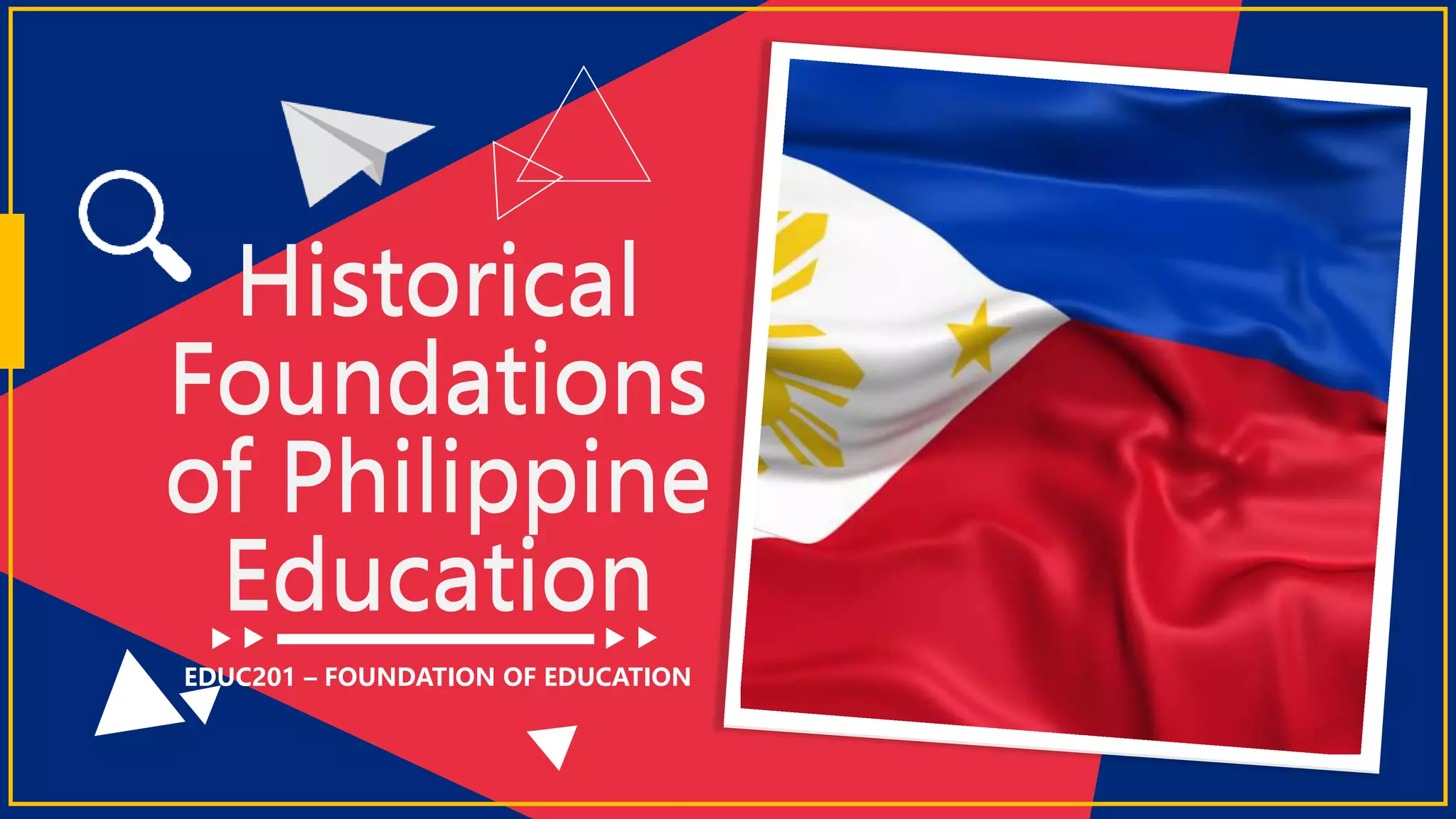
Historical
Foundations
of Philippine
Education
EDUC201 – FOUNDATION OF EDUCATION
Historical
Foundations
of Philippine
Education
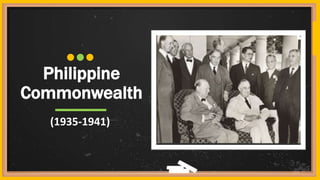
Philippine
Commonwealth
(1935-1941)
THE COMMONWEALTH PERIOD
Objectives:
•trace the timeline in the history of Philippine education during
the commonwealth period
•identify the goal and method applied in the commonwealth
period in Philippine education
•determine the educational reforms implemented in the
commonwealth period
THE COMMONWEALTH PERIOD
What is Commonwealth Period?
• The Philippine Commonwealth was the name of the
Philippines when it was still controlled by the U.S.
• Manuel Quezon was the first Filipino to head an elected
government in the Philippines.
THE COMMONWEALTH PERIOD
Goals of Education in the Commonwealth Period:
• All schools should develop moral character, civic conscience, personal
discipline, and vocational efficiency.
• Emphasize duties on citizenship
• Educate adults
*Methods used: Memorization, Recitation, Socialized Recitation
THE COMMONWEALTH PERIOD
Ways of Promoting Education
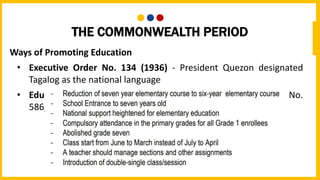
• Executive Order No. 134 (1936) - President Quezon designated
Tagalog as the national language
• Education Act of 1940 - also known as the Commonwealth Act No.
586, approved on August 7, 1940 by the Philippine Assembly.
THE COMMONWEALTH PERIOD
Ways of Promoting Education
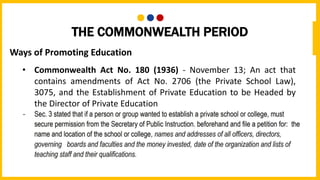
• Commonwealth Act No. 180 (1936) - November 13; An act that
contains amendments of Act No. 2706 (the Private School Law),
3075, and the Establishment of Private Education to be Headed by
the Director of Private Education
THE COMMONWEALTH PERIOD
Ways of Promoting Education
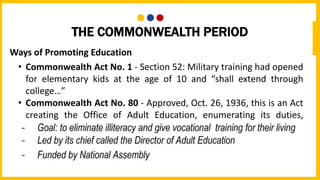
• Commonwealth Act No. 1 - Section 52: Military training had opened
for elementary kids at the age of 10 and “shall extend through
college…”
• Commonwealth Act No. 80 - Approved, Oct. 26, 1936, this is an Act
creating the Office of Adult Education, enumerating its duties,
defining its objectives, and providing funds for its operation under
the Department of Public Instruction
THE COMMONWEALTH PERIOD
Ways of Promoting Education
• Commonwealth Act No. 589 - August 19, 1940 by the National
Assembly; An Act Establishing a School Ritual in all Public and
Private Elementary and Secondary Schools
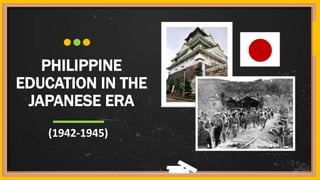
PHILIPPINE
EDUCATION IN THE
JAPANESE ERA
(1942-1945)
Six basic principles of Japanese Education
• Realization of the new order and promote friendly relations
between Japan and the Philippines to the farthest extent
• Foster a new Filipino culture base
• Endeavor to elevate the morals of people, giving up the
emphasis of materialism
• Diffusion of the Japanese language in the Philippines
• Promotion of vocational course
• To inspire people with the spirit to love neighbors
Goal: To spread the New Asian Order
Focus: Principles of the new order
Characteristics:
• Course of Study: Prescribed, Uniform, and
Centralized
• Propaganda tool: repressively anti-
American and anti-British, military-backed
existence of an educational system
Methods used: Rote memorization, use of threat,
and punishment
JAPANESE ERA
Ways of Promoting Education
• Military Order No. 2 - Embodies the Japanese educational
policies
• Ministry of Education - OCTOBER 14, 1943 – the Japanese
created the Ministry of Education
• Department of Instruction - FEBRUARY 27, 1945 – the
Department of Instruction was made part of the Department of
Public Instruction
• Executive Order No. 94 - Bureau of Public and Private Schools
 Use of Tagalog, Philippine History, and
Character Education were the focus.
 Love for work and dignity for labor were
emphasized; stop depending on the US and
Great Britain
 Spread of elementary and vocational
education
 NIPPONGO was used as the medium of
communication
The Content/Curriculum
AFTER WORLD WAR II
In 1947, by the virtue of Executive Order No. 94, the
Department of Instruction was changed to "Department of
Education." During this period, the regulation and
supervision of public and private schools belonged to
the Bureau of Public and Private Schools.
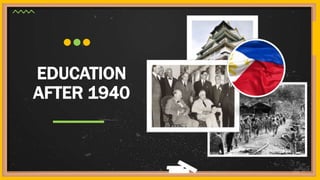
EDUCATION
AFTER 1940
The objective of Philippine Education was to
establish an “integrated, nationalistic, and
democracy-inspired educational system”
including the ff.
1.Inculcate moral and spiritual values
inspired by an abiding faith in God
2.To develop an enlightened, patriotic,
useful, and upright citizenry in a
democratic society
3.Conservation of the national resources
4.Perpetuation of our desirable values
5.Promote the science, arts, and letters
Great experiments in the community school and the use of vernacular in
the first two grades of the primary schools as the medium of instruction
were some of them.
An experiment worth mentioning that led to a change in the Philippine
Educational Philosophy was that of school and community collaboration
pioneered by Jose V. Aguilar.
Schools are increasingly using instructional materials that are Philippine-
oriented.
 Memorandum No. 30, 1966 sets the order of priority in the purchase of
books for use in the schools were as follows:
• Books which are contributions to Phil. Literature
• Books on character education and other library materials Library
equipment and permanent features
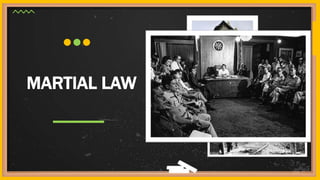
MARTIAL LAW
• The Department of Education became the Department of
Education and Culture in 1972, the Ministry of Education and
Culture in 1978, and with the Education Act of 1982, the
Ministry of Education, Culture, and Sports.
• A bilingual education scheme was established in 1974,
requiring Filipino and English to be used in schools.
• Science and math subjects as well as English language and
literature classes were taught in English while the rest were
taught in Filipino.
MARTIAL LAW
FROM 1986 TO THE PRESENT
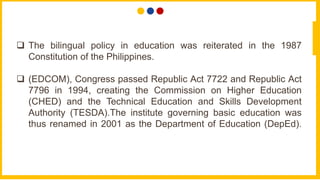
 The bilingual policy in education was reiterated in the 1987
Constitution of the Philippines.
 (EDCOM), Congress passed Republic Act 7722 and Republic Act
7796 in 1994, creating the Commission on Higher Education
(CHED) and the Technical Education and Skills Development
Authority (TESDA).The institute governing basic education was
thus renamed in 2001 as the Department of Education (DepEd).
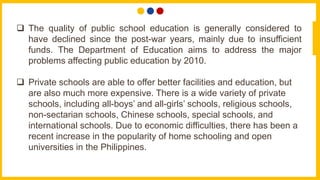
 The quality of public school education is generally considered to
have declined since the post-war years, mainly due to insufficient
funds. The Department of Education aims to address the major
problems affecting public education by 2010.
 Private schools are able to offer better facilities and education, but
are also much more expensive. There is a wide variety of private
schools, including all-boys’ and all-girls’ schools, religious schools,
non-sectarian schools, Chinese schools, special schools, and
international schools. Due to economic difficulties, there has been a
recent increase in the popularity of home schooling and open
universities in the Philippines.
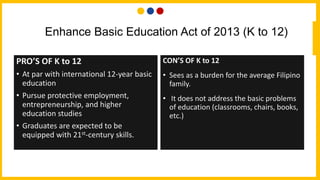
Enhance Basic Education Act of 2013 (K to 12)
PRO’S OF K to 12
• At par with international 12-year basic
education
• Pursue protective employment,
entrepreneurship, and higher
education studies
• Graduates are expected to be
equipped with 21st-century skills.
CON’S OF K to 12
• Sees as a burden for the average Filipino
family.
• It does not address the basic problems
of education (classrooms, chairs, books,
etc.)
Bases of K to 12 implementation
•Mastery of basic competencies is
insufficient due to a congested
curriculum.
•Philippines is the only remaining
country in Asia with a 10-year basic
education program.
The K to 12 Curriculum
• Learn-centered, inclusive, and developmentally
appropriate
• Relevant responsive and Research-based.
• Culture sensitive
• Contextualized and global
• Use of pedagogical approaches that are
constructivist, inquiry-based, reflective
collaborative, and integrative.
• Adhere to the principle of MOTHER TONGUE-
BASED MULTILINGUAL EDUCATION (MTB-MLE)
MOTHER TONGUE-BASED
MULTILINGUAL EDUCATION (MTB-
MLE)
It starts from where the learners are and from what they already
knew proceeding from the known to the unknown; instructional
materials and capable teachers to implement the MTB-MLE
curriculum shall be available.
• Use of spiral progression approach to ensure mastery of
knowledge and skills in every level
• Flexible enough to enable and allow schools to localize,
indigenize, and enhance the same based on their respective
educational and social context.
CURRICULUM
TRACKS
The students after ongoing Senior High
School can choose among four tracks:
• Academic
• Technical-Vocational-Livelihood
• Sports track
• Arts and Design track
This Presentation is Prepared by
NEIL PITA DECLARO
(8779) Foundation of Education | Historical Development of Philippine Education | Mary Joie Padron
– YouTube
Historical_Foundations_of_Philippine_Education.docx (1).pdf
(8779) History of Philippine Educational System – YouTube
Historical Development of Philippine Education ppt - Google Search
manayan-commonwealthandjapaneseperiodhandout-180515132832 (1).pdf
References:

1.1 Philippines Educational History.pptx

  • 1.
    Historical Foundations of Philippine Education EDUC201 –FOUNDATION OF EDUCATION Historical Foundations of Philippine Education
  • 2.
  • 3.
    THE COMMONWEALTH PERIOD Objectives: •tracethe timeline in the history of Philippine education during the commonwealth period •identify the goal and method applied in the commonwealth period in Philippine education •determine the educational reforms implemented in the commonwealth period
  • 4.
    THE COMMONWEALTH PERIOD Whatis Commonwealth Period? • The Philippine Commonwealth was the name of the Philippines when it was still controlled by the U.S. • Manuel Quezon was the first Filipino to head an elected government in the Philippines.
  • 5.
    THE COMMONWEALTH PERIOD Goalsof Education in the Commonwealth Period: • All schools should develop moral character, civic conscience, personal discipline, and vocational efficiency. • Emphasize duties on citizenship • Educate adults *Methods used: Memorization, Recitation, Socialized Recitation
  • 6.
    THE COMMONWEALTH PERIOD Waysof Promoting Education • Executive Order No. 134 (1936) - President Quezon designated Tagalog as the national language • Education Act of 1940 - also known as the Commonwealth Act No. 586, approved on August 7, 1940 by the Philippine Assembly.
  • 7.
    THE COMMONWEALTH PERIOD Waysof Promoting Education • Commonwealth Act No. 180 (1936) - November 13; An act that contains amendments of Act No. 2706 (the Private School Law), 3075, and the Establishment of Private Education to be Headed by the Director of Private Education
  • 8.
    THE COMMONWEALTH PERIOD Waysof Promoting Education • Commonwealth Act No. 1 - Section 52: Military training had opened for elementary kids at the age of 10 and “shall extend through college…” • Commonwealth Act No. 80 - Approved, Oct. 26, 1936, this is an Act creating the Office of Adult Education, enumerating its duties, defining its objectives, and providing funds for its operation under the Department of Public Instruction
  • 9.
    THE COMMONWEALTH PERIOD Waysof Promoting Education • Commonwealth Act No. 589 - August 19, 1940 by the National Assembly; An Act Establishing a School Ritual in all Public and Private Elementary and Secondary Schools
  • 10.
  • 11.
    Six basic principlesof Japanese Education • Realization of the new order and promote friendly relations between Japan and the Philippines to the farthest extent • Foster a new Filipino culture base • Endeavor to elevate the morals of people, giving up the emphasis of materialism • Diffusion of the Japanese language in the Philippines • Promotion of vocational course • To inspire people with the spirit to love neighbors
  • 12.
    Goal: To spreadthe New Asian Order Focus: Principles of the new order Characteristics: • Course of Study: Prescribed, Uniform, and Centralized • Propaganda tool: repressively anti- American and anti-British, military-backed existence of an educational system Methods used: Rote memorization, use of threat, and punishment JAPANESE ERA
  • 13.
    Ways of PromotingEducation • Military Order No. 2 - Embodies the Japanese educational policies • Ministry of Education - OCTOBER 14, 1943 – the Japanese created the Ministry of Education • Department of Instruction - FEBRUARY 27, 1945 – the Department of Instruction was made part of the Department of Public Instruction • Executive Order No. 94 - Bureau of Public and Private Schools
  • 14.
     Use ofTagalog, Philippine History, and Character Education were the focus.  Love for work and dignity for labor were emphasized; stop depending on the US and Great Britain  Spread of elementary and vocational education  NIPPONGO was used as the medium of communication The Content/Curriculum
  • 15.
    AFTER WORLD WARII In 1947, by the virtue of Executive Order No. 94, the Department of Instruction was changed to "Department of Education." During this period, the regulation and supervision of public and private schools belonged to the Bureau of Public and Private Schools.
  • 16.
  • 17.
    The objective ofPhilippine Education was to establish an “integrated, nationalistic, and democracy-inspired educational system” including the ff. 1.Inculcate moral and spiritual values inspired by an abiding faith in God 2.To develop an enlightened, patriotic, useful, and upright citizenry in a democratic society 3.Conservation of the national resources 4.Perpetuation of our desirable values 5.Promote the science, arts, and letters
  • 18.
    Great experiments inthe community school and the use of vernacular in the first two grades of the primary schools as the medium of instruction were some of them. An experiment worth mentioning that led to a change in the Philippine Educational Philosophy was that of school and community collaboration pioneered by Jose V. Aguilar. Schools are increasingly using instructional materials that are Philippine- oriented.  Memorandum No. 30, 1966 sets the order of priority in the purchase of books for use in the schools were as follows: • Books which are contributions to Phil. Literature • Books on character education and other library materials Library equipment and permanent features
  • 19.
  • 20.
    • The Departmentof Education became the Department of Education and Culture in 1972, the Ministry of Education and Culture in 1978, and with the Education Act of 1982, the Ministry of Education, Culture, and Sports. • A bilingual education scheme was established in 1974, requiring Filipino and English to be used in schools. • Science and math subjects as well as English language and literature classes were taught in English while the rest were taught in Filipino. MARTIAL LAW
  • 21.
    FROM 1986 TOTHE PRESENT
  • 22.
     The bilingualpolicy in education was reiterated in the 1987 Constitution of the Philippines.  (EDCOM), Congress passed Republic Act 7722 and Republic Act 7796 in 1994, creating the Commission on Higher Education (CHED) and the Technical Education and Skills Development Authority (TESDA).The institute governing basic education was thus renamed in 2001 as the Department of Education (DepEd).
  • 23.
     The qualityof public school education is generally considered to have declined since the post-war years, mainly due to insufficient funds. The Department of Education aims to address the major problems affecting public education by 2010.  Private schools are able to offer better facilities and education, but are also much more expensive. There is a wide variety of private schools, including all-boys’ and all-girls’ schools, religious schools, non-sectarian schools, Chinese schools, special schools, and international schools. Due to economic difficulties, there has been a recent increase in the popularity of home schooling and open universities in the Philippines.
  • 24.
    Enhance Basic EducationAct of 2013 (K to 12) PRO’S OF K to 12 • At par with international 12-year basic education • Pursue protective employment, entrepreneurship, and higher education studies • Graduates are expected to be equipped with 21st-century skills. CON’S OF K to 12 • Sees as a burden for the average Filipino family. • It does not address the basic problems of education (classrooms, chairs, books, etc.)
  • 25.
    Bases of Kto 12 implementation •Mastery of basic competencies is insufficient due to a congested curriculum. •Philippines is the only remaining country in Asia with a 10-year basic education program.
  • 26.
    The K to12 Curriculum • Learn-centered, inclusive, and developmentally appropriate • Relevant responsive and Research-based. • Culture sensitive • Contextualized and global • Use of pedagogical approaches that are constructivist, inquiry-based, reflective collaborative, and integrative. • Adhere to the principle of MOTHER TONGUE- BASED MULTILINGUAL EDUCATION (MTB-MLE)
  • 27.
    MOTHER TONGUE-BASED MULTILINGUAL EDUCATION(MTB- MLE) It starts from where the learners are and from what they already knew proceeding from the known to the unknown; instructional materials and capable teachers to implement the MTB-MLE curriculum shall be available. • Use of spiral progression approach to ensure mastery of knowledge and skills in every level • Flexible enough to enable and allow schools to localize, indigenize, and enhance the same based on their respective educational and social context.
  • 28.
    CURRICULUM TRACKS The students afterongoing Senior High School can choose among four tracks: • Academic • Technical-Vocational-Livelihood • Sports track • Arts and Design track
  • 29.
    This Presentation isPrepared by NEIL PITA DECLARO
  • 30.
    (8779) Foundation ofEducation | Historical Development of Philippine Education | Mary Joie Padron – YouTube Historical_Foundations_of_Philippine_Education.docx (1).pdf (8779) History of Philippine Educational System – YouTube Historical Development of Philippine Education ppt - Google Search manayan-commonwealthandjapaneseperiodhandout-180515132832 (1).pdf References:

Editor's Notes

  • #12 Republic Act No. 1079 - LawPhil https://lawphil.net › repacts › ra1954 › ra_1079_1954 1079. An Act Providing that Civil Service Eligibility Shall be Permanent.  What is RA No 1265? 1265. An Act Making Flag Ceremony Compulsory in All Educational Institutions. Be it enacted by the Senate and House of Representatives of the Philippine Congress Assembled: Section 1.
  • #14 ONE bullet- The Commission of Education, Health, and Public Welfare was established by the Philippine Executive Commission. - Schools were REOPENED in June 1942 with 300, 000 students Second Bullet -1978 – By virtue of P.D. No. 1397, it became the Ministry of Education and Culture -1982- Education Act of 1982 created the Ministry of Education, Culture and Sports -1987 – it became the Department of Education, Culture and Sports by virtue of Executive Order no. 117 Third Bullet - 1947 – By virtue of Executive Order No. 94, the Department of Instruction was changed to the Department of Education - 1972 – it became the Department of Education and Culture by virtue of Proclamation 1081. Fourth Bullet- Regulation and supervision public and private schools implemented
  • #19 He is also a recipient in the government service category of the said award which he shared with Chintaman Deshmukh in 1959. He is also recognized as the Father of the Community School Movement in the Philippines, pioneering reforms to ensure that community life is integrated in the education system.
  • #21 He is also a recipient in the government service category of the said award which he shared with Chintaman Deshmukh in 1959. He is also recognized as the Father of the Community School Movement in the Philippines, pioneering reforms to ensure that community life is integrated in the education system.
  • #23  The Congressional Commission on Education (EDCOM) report provided the impetus for Congress to pass RA 7722 and RA 7796 in 1994 creating the Commission on Higher Education (CHED) and the Technical Education and Skills Development Authority (TESDA), respectively.
  • #24 He is also a recipient in the government service category of the said award which he shared with Chintaman Deshmukh in 1959. He is also recognized as the Father of the Community School Movement in the Philippines, pioneering reforms to ensure that community life is integrated in the education system.
  • #25 He is also a recipient in the government service category of the said award which he shared with Chintaman Deshmukh in 1959. He is also recognized as the Father of the Community School Movement in the Philippines, pioneering reforms to ensure that community life is integrated in the education system.
  • #27 Contextualized and global you make teaching meaningful by putting your lesson in a context. Constructivist being constructivist means you believe that students learn by building upon their prior knowledge. What is the best pedagogical approach? One of the most powerful pedagogical approaches in the classroom is when the teacher becomes a mentor or coach who helps students achieve the learning goal. Using this strategy, the students can also work together and think, pair, share—using collective skills and expertise to accomplish learning tasks
  • #28 He is also a recipient in the government service category of the said award which he shared with Chintaman Deshmukh in 1959. He is also recognized as the Father of the Community School Movement in the Philippines, pioneering reforms to ensure that community life is integrated in the education system.