


Social Business


Expanding Your Social Business in a
         Global Market
Jesús Hoyos
 Managing Partner
  @jesus_hoyos
www.jesushoyos.com


               6/17/2012   ©2012 SugarCRM Inc. All rights reserved.   2
About Jesús Hoyos

 Google Me: Jesus Hoyos, CRM

 LinkedIn: http://www.linkedin.com/in/jesushoyos

 Twitter: @jesus_hoyos

 Email: jesus.hoyos@solvisconsulting.com

 More: http://about.me/jesushoyos


Tweet: #SCON12
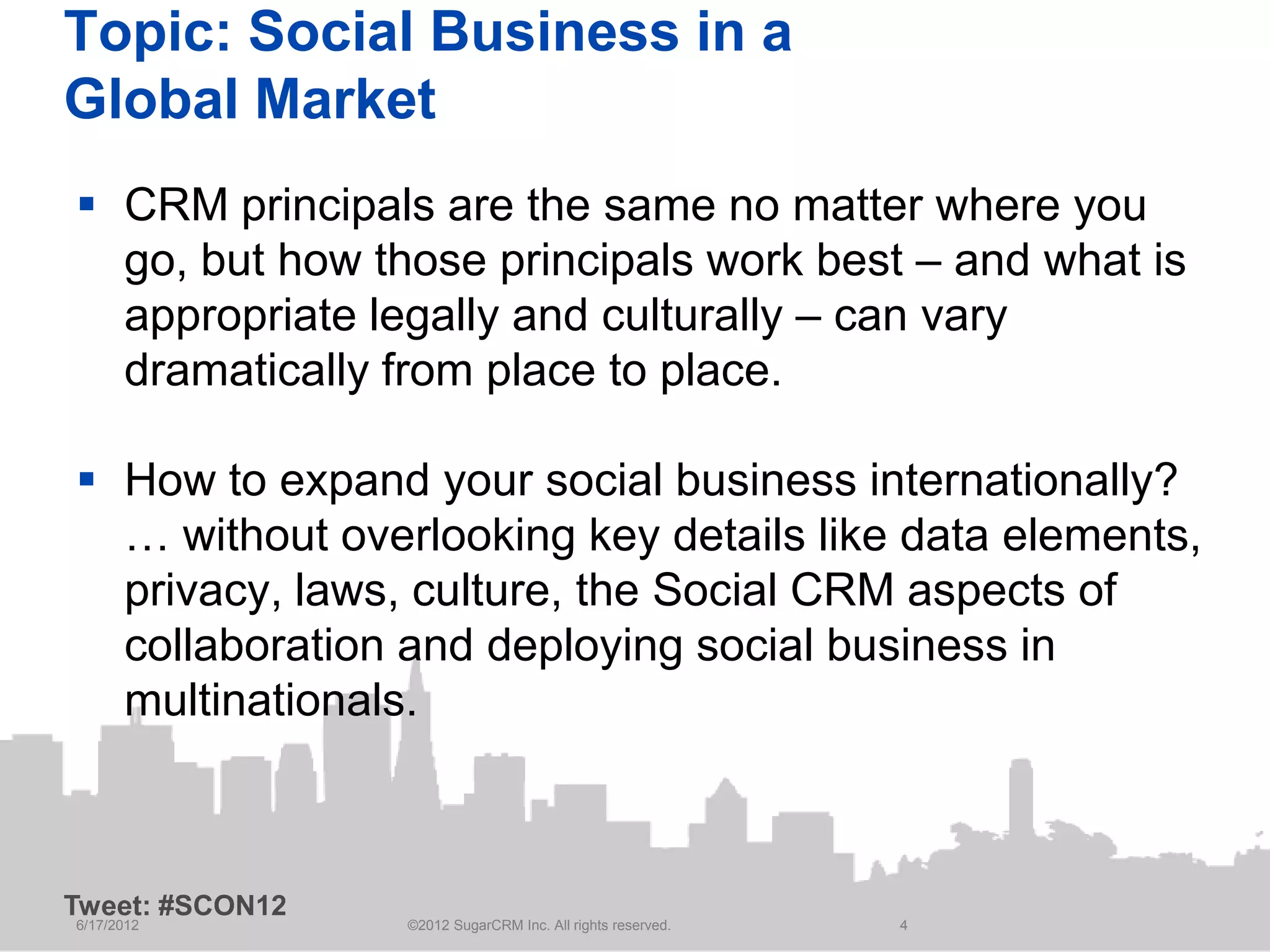
Topic: Social Business in a
Global Market
 CRM principals are the same no matter where you
  go, but how those principals work best – and what is
  appropriate legally and culturally – can vary
  dramatically from place to place.

 How to expand your social business internationally?
  … without overlooking key details like data elements,
  privacy, laws, culture, the Social CRM aspects of
  collaboration and deploying social business in
  multinationals.


Tweet: #SCON12
6/17/2012        ©2012 SugarCRM Inc. All rights reserved.   4
Key Trends

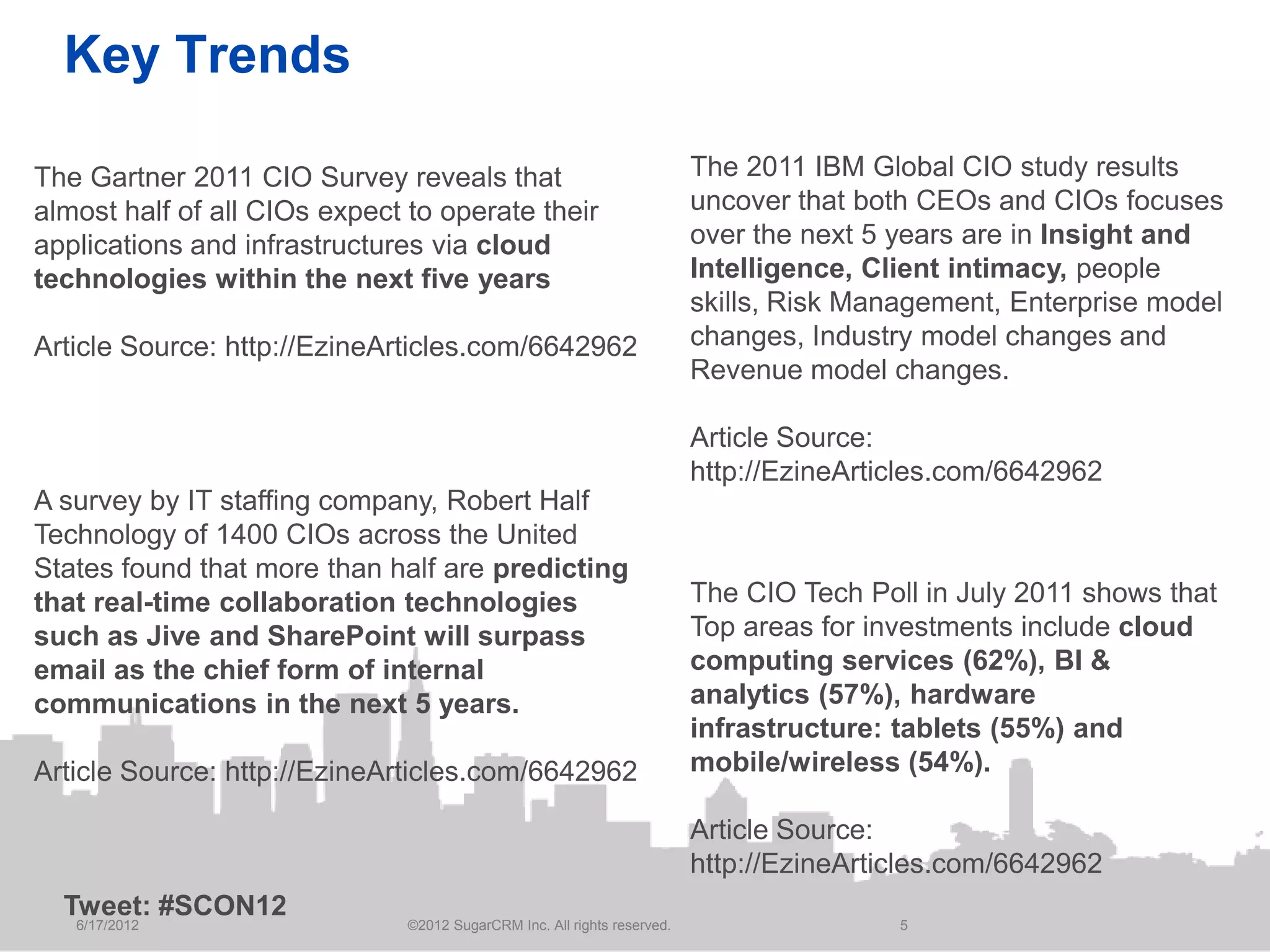
The Gartner 2011 CIO Survey reveals that                                  The 2011 IBM Global CIO study results
almost half of all CIOs expect to operate their                           uncover that both CEOs and CIOs focuses
applications and infrastructures via cloud                                over the next 5 years are in Insight and
technologies within the next five years                                   Intelligence, Client intimacy, people
                                                                          skills, Risk Management, Enterprise model
Article Source: http://EzineArticles.com/6642962                          changes, Industry model changes and
                                                                          Revenue model changes.

                                                                          Article Source:
                                                                          http://EzineArticles.com/6642962
A survey by IT staffing company, Robert Half
Technology of 1400 CIOs across the United
States found that more than half are predicting
that real-time collaboration technologies                                 The CIO Tech Poll in July 2011 shows that
such as Jive and SharePoint will surpass                                  Top areas for investments include cloud
email as the chief form of internal                                       computing services (62%), BI &
communications in the next 5 years.                                       analytics (57%), hardware
                                                                          infrastructure: tablets (55%) and
Article Source: http://EzineArticles.com/6642962                          mobile/wireless (54%).

                                                                          Article Source:
                                                                          http://EzineArticles.com/6642962
  Tweet: #SCON12
   6/17/2012                   ©2012 SugarCRM Inc. All rights reserved.                   5
Key Areas
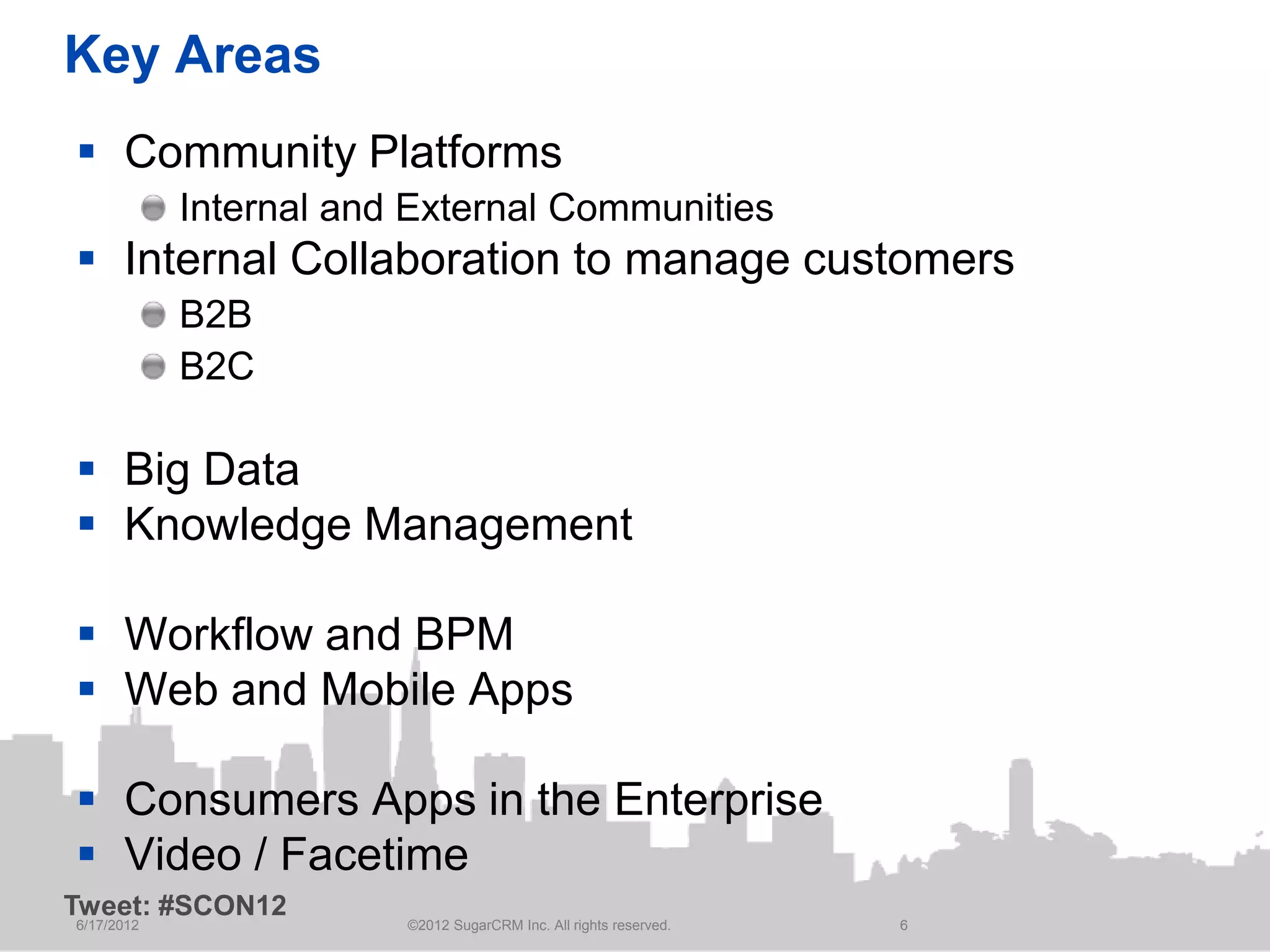
 Community Platforms
            Internal and External Communities
 Internal Collaboration to manage customers
            B2B
            B2C

 Big Data
 Knowledge Management

 Workflow and BPM
 Web and Mobile Apps

 Consumers Apps in the Enterprise
 Video / Facetime
Tweet: #SCON12
6/17/2012               ©2012 SugarCRM Inc. All rights reserved.   6
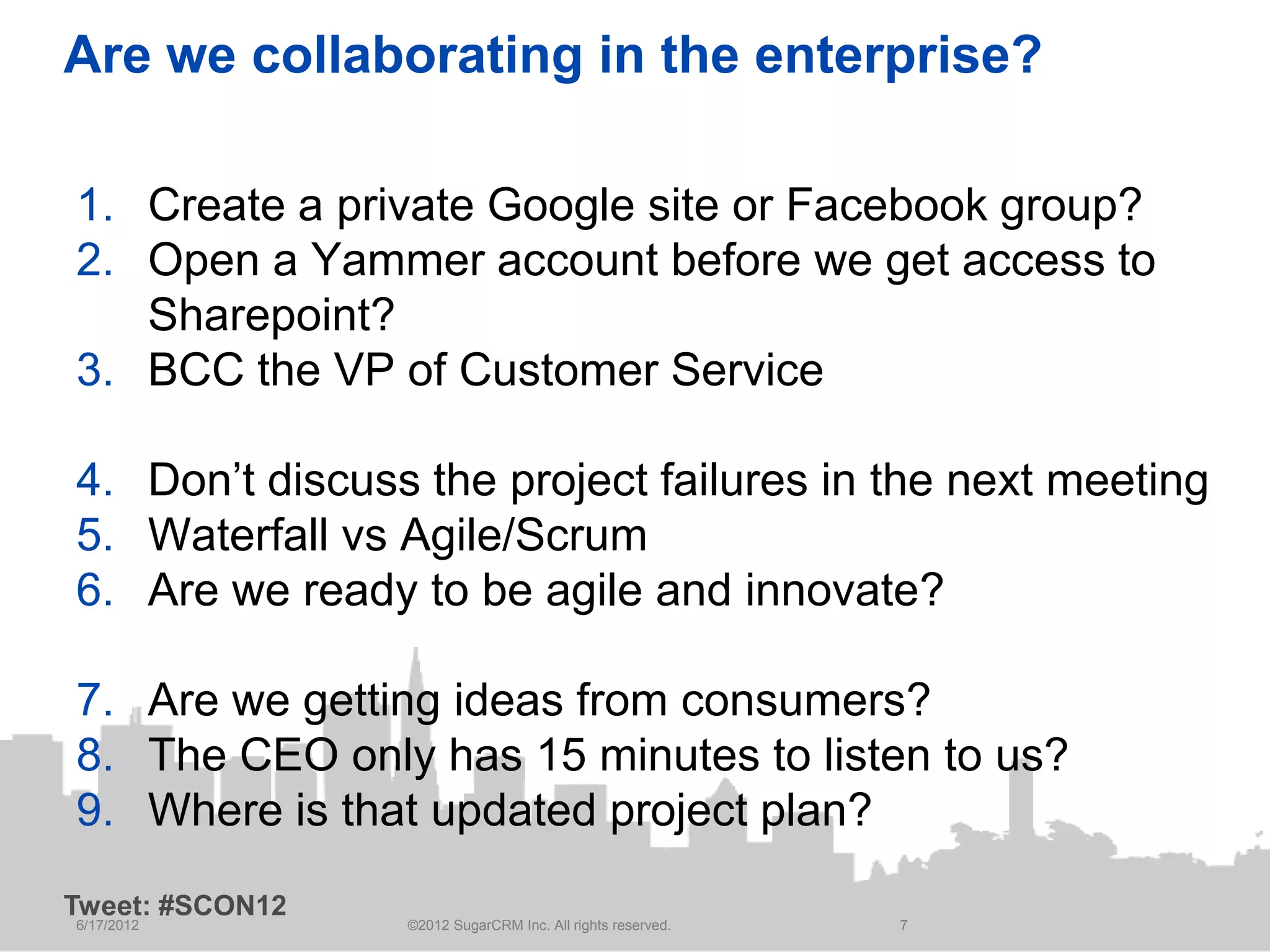
Are we collaborating in the enterprise?

1. Create a private Google site or Facebook group?
2. Open a Yammer account before we get access to
   Sharepoint?
3. BCC the VP of Customer Service

4. Don’t discuss the project failures in the next meeting
5. Waterfall vs Agile/Scrum
6. Are we ready to be agile and innovate?

7. Are we getting ideas from consumers?
8. The CEO only has 15 minutes to listen to us?
9. Where is that updated project plan?
Tweet: #SCON12
6/17/2012        ©2012 SugarCRM Inc. All rights reserved.   7
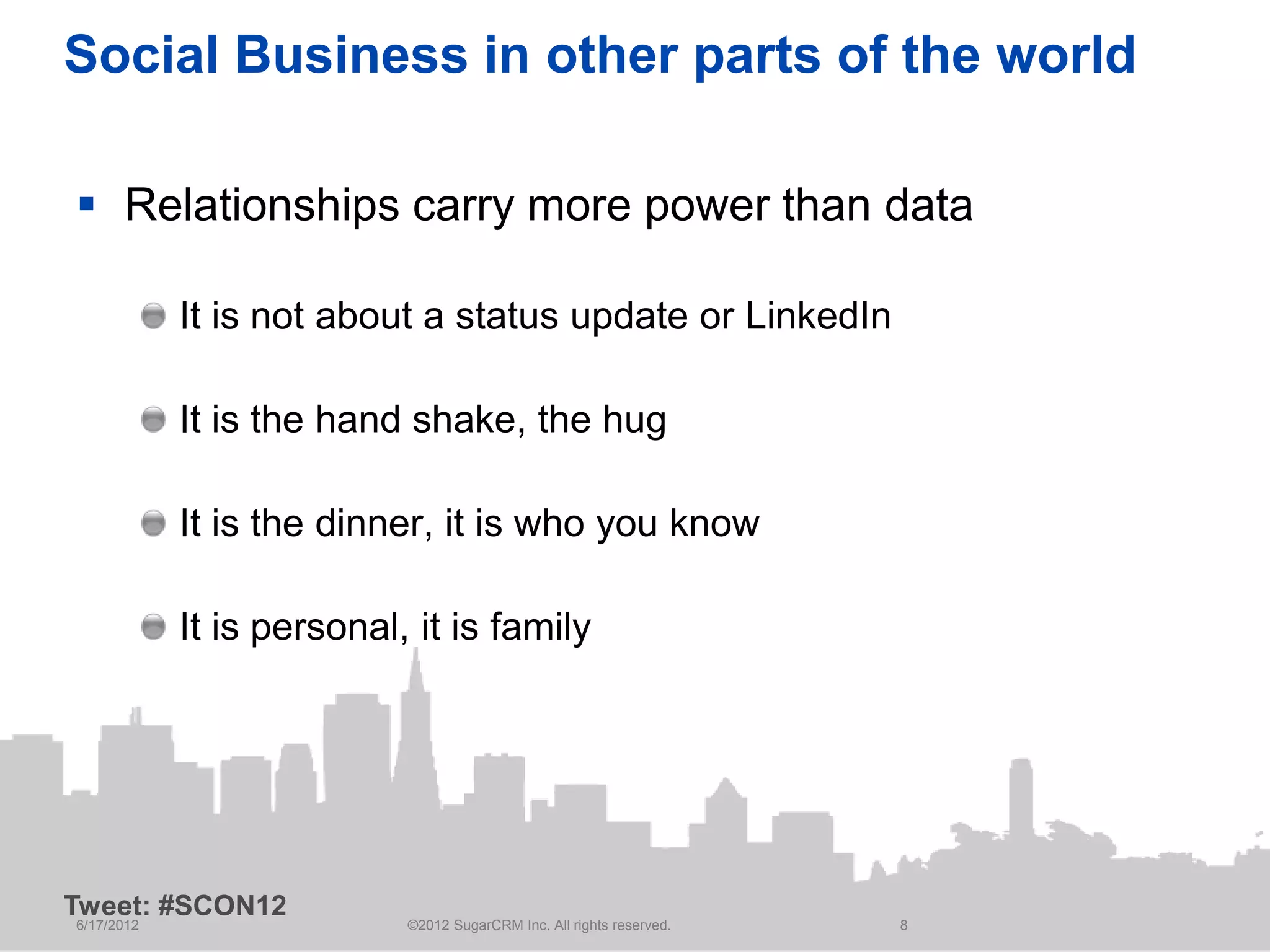
Social Business in other parts of the world

 Relationships carry more power than data

            It is not about a status update or LinkedIn

            It is the hand shake, the hug

            It is the dinner, it is who you know

            It is personal, it is family


Tweet: #SCON12
6/17/2012                  ©2012 SugarCRM Inc. All rights reserved.   8
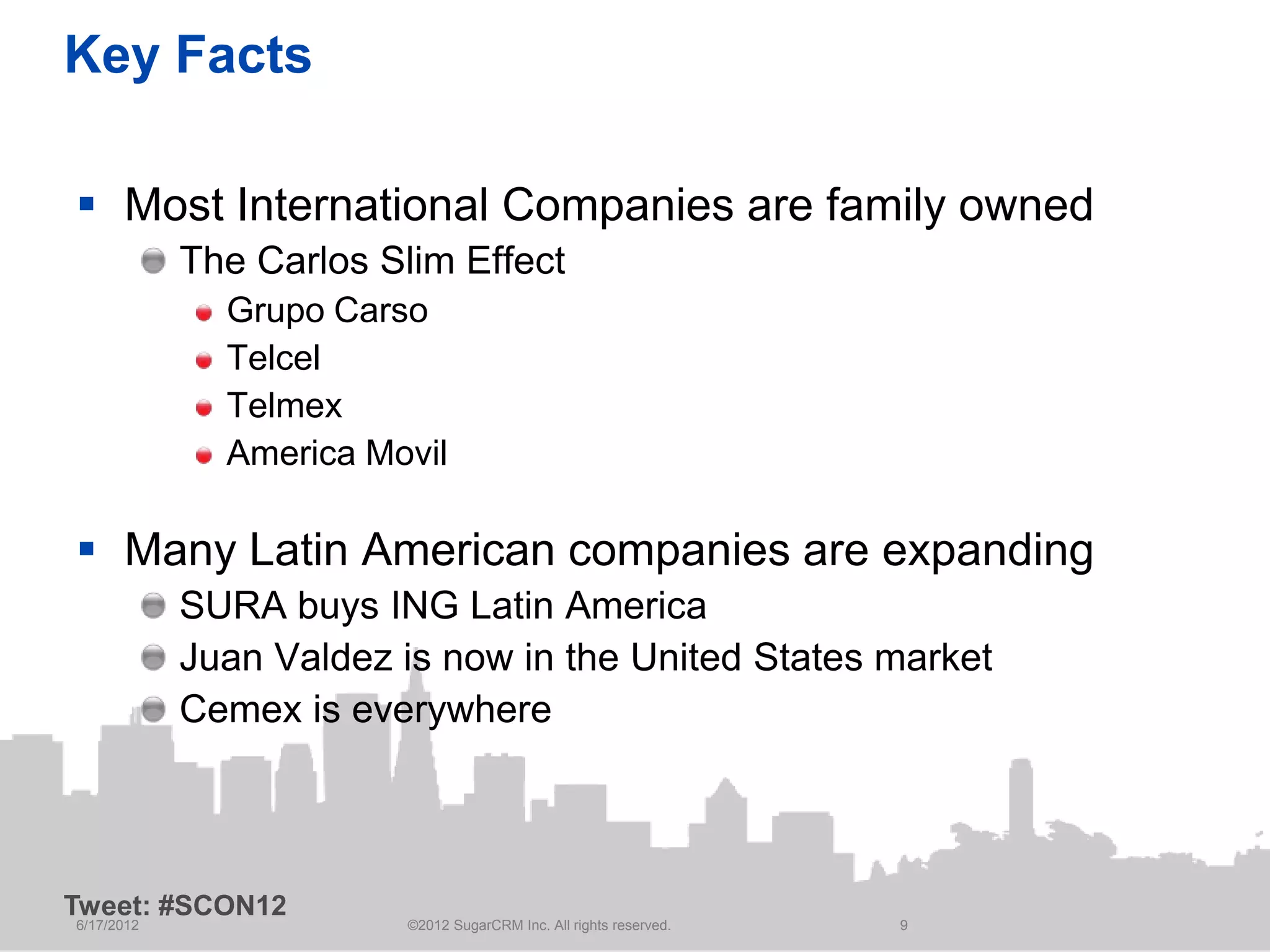
Key Facts

 Most International Companies are family owned
            The Carlos Slim Effect
              Grupo Carso
              Telcel
              Telmex
              America Movil

 Many Latin American companies are expanding
            SURA buys ING Latin America
            Juan Valdez is now in the United States market
            Cemex is everywhere


Tweet: #SCON12
6/17/2012                ©2012 SugarCRM Inc. All rights reserved.   9
Key Areas to Consider


                6/17/2012   ©2012 SugarCRM Inc. All rights reserved.   10
Geography

 Consider cities, countries and regional differences
  (business units are not countries)

 Geopolitical risks - part of your change management

 Design your Social Business program and software
  globally but deploy it locally
       projects can fail when one business unit is collaboration-centric and the
       another one is focused 100% in cutting costs
       allow different social business technologies to be used – locally or
       globally


Tweet: #SCON12
                       ©2012 SugarCRM Inc. All rights reserved.
Processes and Functionality

 Make sure you have standard processes that can be
  adjusted to the realities of each country and region

 Make sure that the functionality deployed can be changed
  quickly. You do not want the local business unit to wait six
  months for new functionality.


Tweet: #SCON12
6/17/2012         ©2012 SugarCRM Inc. All rights reserved.   12
Best Practices ARE not Best Practices

 Many best practices in U.S. are not really best practices in
  Latin America or in any of the BRICS’ countries.

 Best practices some time are bad practices when
  deployed in many countries or regions.

 Make sure you monitor all processes and functionality to
  make sure if they all make sense as best practices.


Tweet: #SCON12
6/17/2012         ©2012 SugarCRM Inc. All rights reserved.   13
SaaS & OnPremise

 Validate the differences between SaaS and OnPremise for
  your deployment on each country.

 If you decide to use a SaaS solution, be aware that we are
  in the era of the One-Click Deployment - validate GAP in
  knowledge and execution.

 Legal and Privacy aspects can affect a deployment in each
  country.

 Talk to Legal.


Tweet: #SCON12
6/17/2012          ©2012 SugarCRM Inc. All rights reserved.   14
Change Management

 Do not push your CRM projects to the countries. HQ and
  the local business units need to buy-in the project and a
  good change management process needs to be in place.

 Use local Project Managers.

 Training and more training.

 Have a realistic budget that goes beyond technology.


Tweet: #SCON12
6/17/2012        ©2012 SugarCRM Inc. All rights reserved.   15
Users

 I think you heard this one before – “Start with the early
  adopters or power-users”.

 I will recommend the contrary, start with the employees
  that will give you problems with change management or
  adopting the CRM strategy…. You need to start early with
  the late adopters.


Tweet: #SCON12
6/17/2012        ©2012 SugarCRM Inc. All rights reserved.   16
Use tools and methodolgy that enables
collaboration

 Agile/Scrum
 Wikis

 Project Management
          KnowledgeBase
 GotoMeeting, Webex
 Mindjet – share ideas
 eLearning Tools

 Involve HR in the local countries
 Make your IT gives you access to the Internet

Tweet: #SCON12
8/14/10               Managing Int'l CRM Projects   17
Some ideas before deploying a Globals
      Social Business strategy


                        6/17/2012   ©2012 SugarCRM Inc. All rights reserved.   18
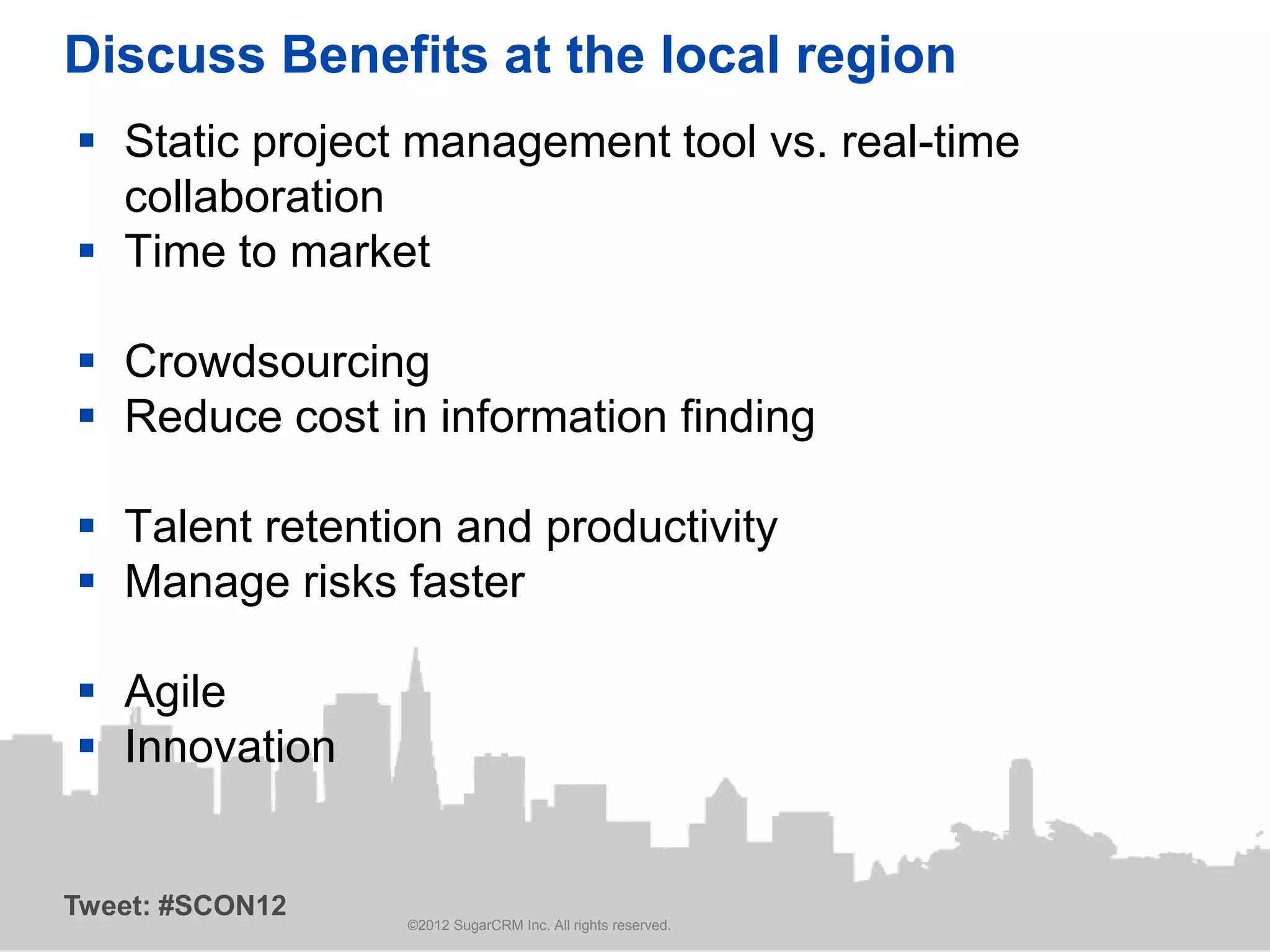
Discuss Benefits at the local region
 Static project management tool vs. real-time
  collaboration
 Time to market

 Crowdsourcing
 Reduce cost in information finding

 Talent retention and productivity
 Manage risks faster

 Agile
 Innovation


Tweet: #SCON12
                 ©2012 SugarCRM Inc. All rights reserved.
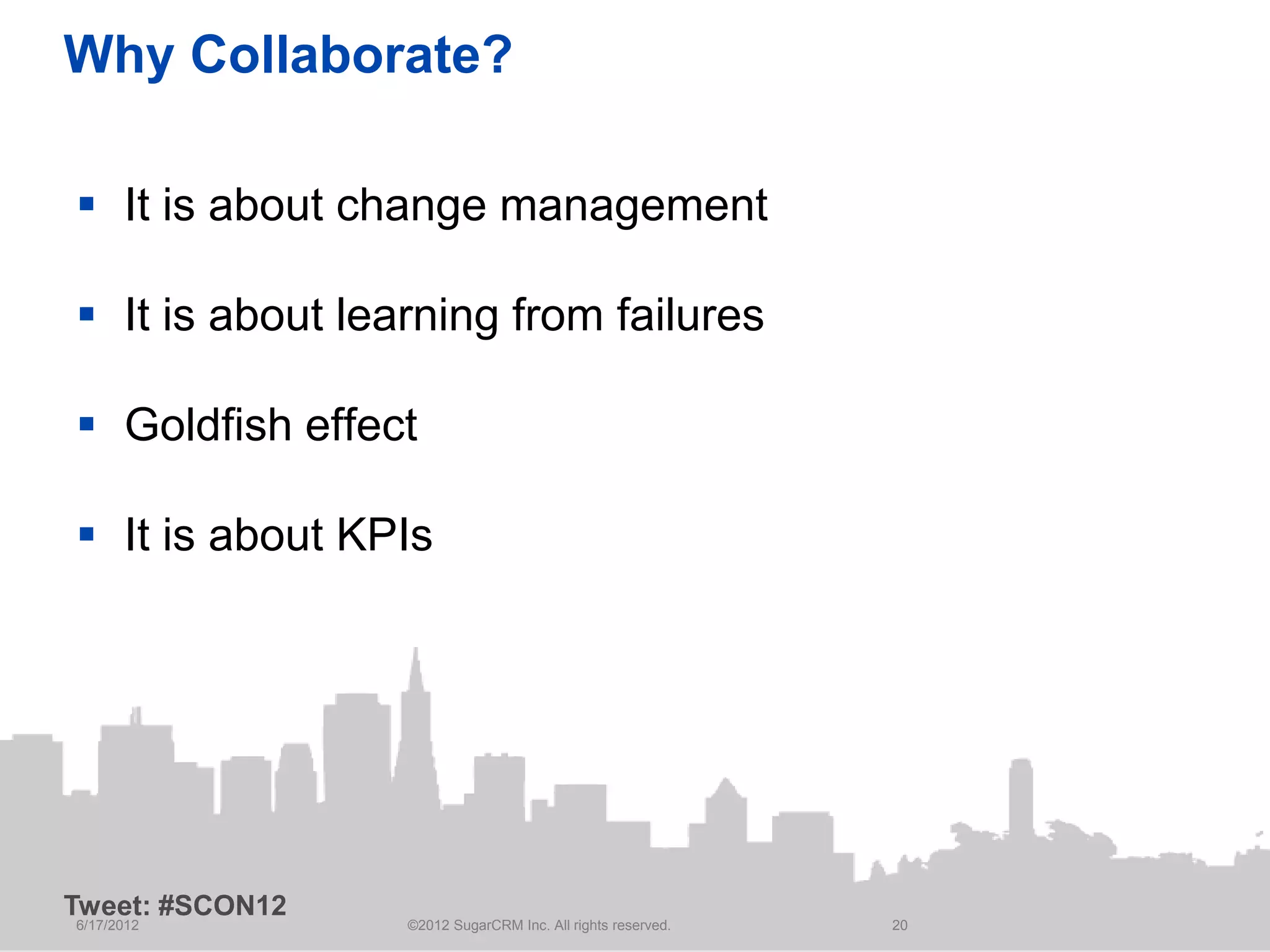
Why Collaborate?

 It is about change management

 It is about learning from failures

 Goldfish effect

 It is about KPIs


Tweet: #SCON12
6/17/2012        ©2012 SugarCRM Inc. All rights reserved.   20
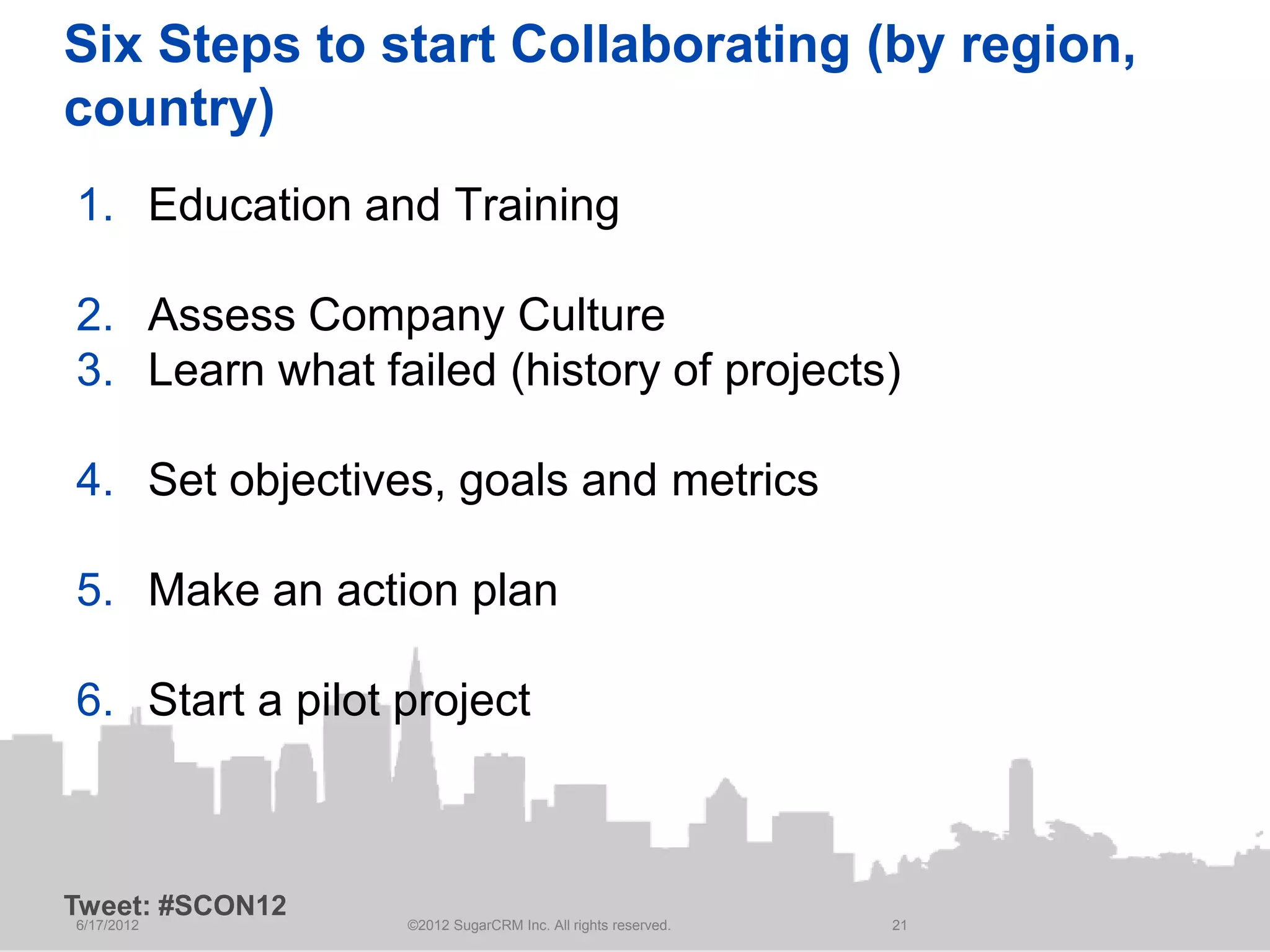
Six Steps to start Collaborating (by region,
country)
1. Education and Training

2. Assess Company Culture
3. Learn what failed (history of projects)

4. Set objectives, goals and metrics

5. Make an action plan

6. Start a pilot project


Tweet: #SCON12
6/17/2012        ©2012 SugarCRM Inc. All rights reserved.   21
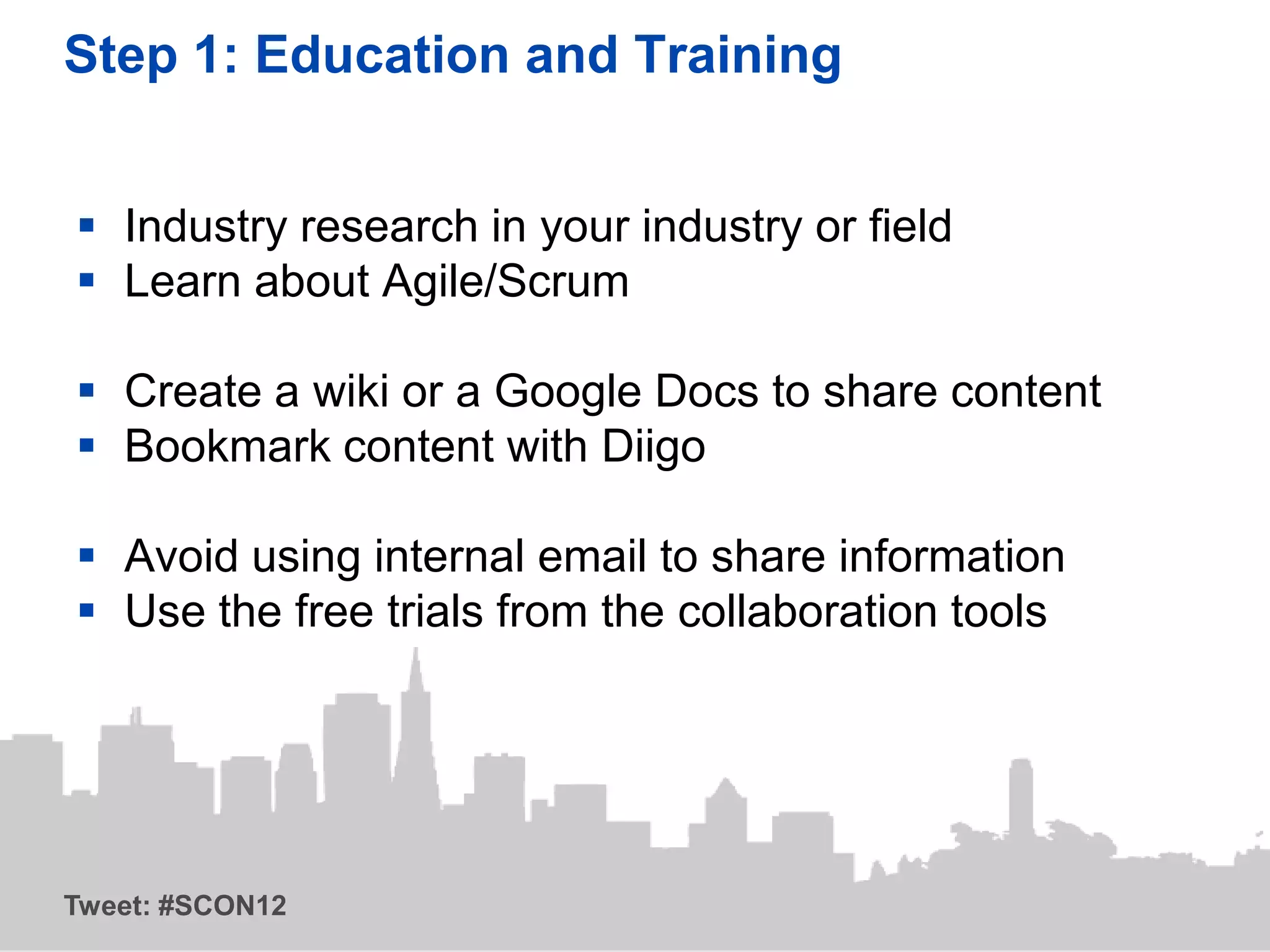
Step 1: Education and Training


 Industry research in your industry or field
 Learn about Agile/Scrum

 Create a wiki or a Google Docs to share content
 Bookmark content with Diigo

 Avoid using internal email to share information
 Use the free trials from the collaboration tools


Tweet: #SCON12
Step 2: Assess Company Culture
 Personalities – advocate vs. detractors
 Are we digital yet?

 Capable to collaborate
 Internal needs and requirements

 Are we PMI Certified?
 Can we innovate?

 Share case studies in your industry
 Can HR help with change management?
 Can we avoid the Netflix effect?


Tweet: #SCON12
Step 3: Learn what failed (history of projects)

 Past success stories
 Past failures

 Document what happened
 Learn from lessons

 Setup new metrics to learn
 Be ready to fail again but be sure to improve fast
 Be agile


Tweet: #SCON12
Step 4: Set objectives, goals and metrics

 Based on the first 3 steps setup goals, objectives
  and metrics
 Gather a list of requirements and process to start
  collaborating and innovating
 Link requirements to real company problems and
  solutions


Tweet: #SCON12
Step 5: Set up an action plan

   Project Charter – use a collaboration tool for this
   Look for executive buy in
   Look for staff buy in
   It is not just that they accept the project but they are
    part of it – there needs to be commitment


Tweet: #SCON12
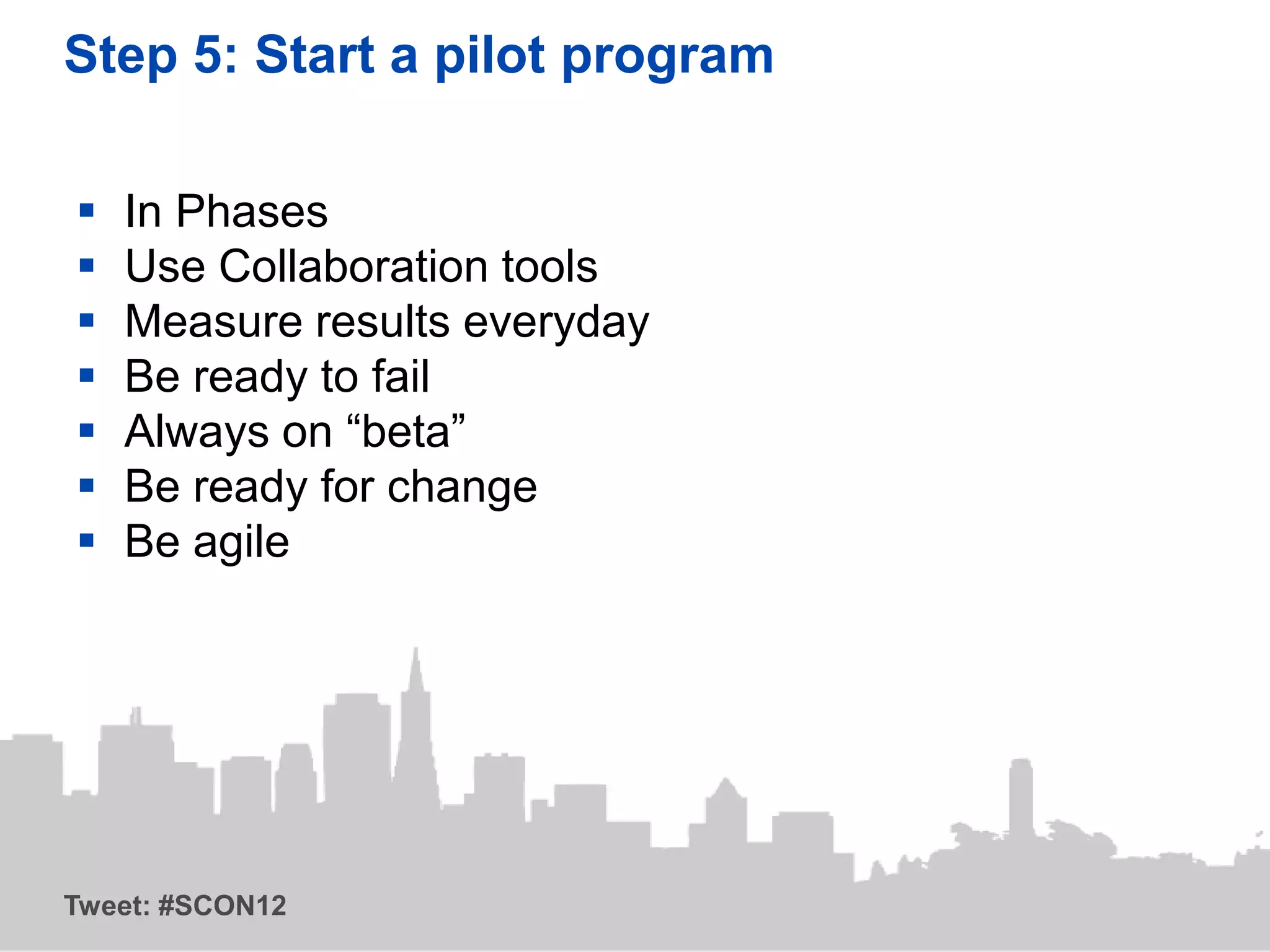
Step 5: Start a pilot program

   In Phases
   Use Collaboration tools
   Measure results everyday
   Be ready to fail
   Always on “beta”
   Be ready for change
   Be agile


Tweet: #SCON12
Q&A


      6/17/2012   ©2012 SugarCRM Inc. All rights reserved.   28
Thanks!

                    Jesús Hoyos

            jesus.hoyos@solvisconsulting.com

                     @jesus_hoyos


Tweet: #SCON12
                                    6/17/2012   ©2012 SugarCRM Inc. All rights reserved.   29
Submit Session Feedback
        Select the SugarCon Mobile App:
        1) Tap on this session
        2) Tap on survey
        3) Submit your feedback

*Prizes for attendees who submit session feedback using the Mobile App


                                               6/17/2012   ©2012 SugarCRM Inc. All rights reserved.   30
#SCON12


          6/17/2012   ©2012 SugarCRM Inc. All rights reserved.   31

SugarCon 2012 Presentation

  • 1.
    Social Business Expanding YourSocial Business in a Global Market
  • 2.
    Jesús Hoyos ManagingPartner @jesus_hoyos www.jesushoyos.com 6/17/2012 ©2012 SugarCRM Inc. All rights reserved. 2
  • 3.
    About Jesús Hoyos Google Me: Jesus Hoyos, CRM  LinkedIn: http://www.linkedin.com/in/jesushoyos  Twitter: @jesus_hoyos  Email: jesus.hoyos@solvisconsulting.com  More: http://about.me/jesushoyos Tweet: #SCON12
  • 4.
    Topic: Social Businessin a Global Market  CRM principals are the same no matter where you go, but how those principals work best – and what is appropriate legally and culturally – can vary dramatically from place to place.  How to expand your social business internationally? … without overlooking key details like data elements, privacy, laws, culture, the Social CRM aspects of collaboration and deploying social business in multinationals. Tweet: #SCON12 6/17/2012 ©2012 SugarCRM Inc. All rights reserved. 4
  • 5.
    Key Trends The Gartner2011 CIO Survey reveals that The 2011 IBM Global CIO study results almost half of all CIOs expect to operate their uncover that both CEOs and CIOs focuses applications and infrastructures via cloud over the next 5 years are in Insight and technologies within the next five years Intelligence, Client intimacy, people skills, Risk Management, Enterprise model Article Source: http://EzineArticles.com/6642962 changes, Industry model changes and Revenue model changes. Article Source: http://EzineArticles.com/6642962 A survey by IT staffing company, Robert Half Technology of 1400 CIOs across the United States found that more than half are predicting that real-time collaboration technologies The CIO Tech Poll in July 2011 shows that such as Jive and SharePoint will surpass Top areas for investments include cloud email as the chief form of internal computing services (62%), BI & communications in the next 5 years. analytics (57%), hardware infrastructure: tablets (55%) and Article Source: http://EzineArticles.com/6642962 mobile/wireless (54%). Article Source: http://EzineArticles.com/6642962 Tweet: #SCON12 6/17/2012 ©2012 SugarCRM Inc. All rights reserved. 5
  • 6.
    Key Areas  CommunityPlatforms Internal and External Communities  Internal Collaboration to manage customers B2B B2C  Big Data  Knowledge Management  Workflow and BPM  Web and Mobile Apps  Consumers Apps in the Enterprise  Video / Facetime Tweet: #SCON12 6/17/2012 ©2012 SugarCRM Inc. All rights reserved. 6
  • 7.
    Are we collaboratingin the enterprise? 1. Create a private Google site or Facebook group? 2. Open a Yammer account before we get access to Sharepoint? 3. BCC the VP of Customer Service 4. Don’t discuss the project failures in the next meeting 5. Waterfall vs Agile/Scrum 6. Are we ready to be agile and innovate? 7. Are we getting ideas from consumers? 8. The CEO only has 15 minutes to listen to us? 9. Where is that updated project plan? Tweet: #SCON12 6/17/2012 ©2012 SugarCRM Inc. All rights reserved. 7
  • 8.
    Social Business inother parts of the world  Relationships carry more power than data It is not about a status update or LinkedIn It is the hand shake, the hug It is the dinner, it is who you know It is personal, it is family Tweet: #SCON12 6/17/2012 ©2012 SugarCRM Inc. All rights reserved. 8
  • 9.
    Key Facts  MostInternational Companies are family owned The Carlos Slim Effect Grupo Carso Telcel Telmex America Movil  Many Latin American companies are expanding SURA buys ING Latin America Juan Valdez is now in the United States market Cemex is everywhere Tweet: #SCON12 6/17/2012 ©2012 SugarCRM Inc. All rights reserved. 9
  • 10.
    Key Areas toConsider 6/17/2012 ©2012 SugarCRM Inc. All rights reserved. 10
  • 11.
    Geography  Consider cities,countries and regional differences (business units are not countries)  Geopolitical risks - part of your change management  Design your Social Business program and software globally but deploy it locally projects can fail when one business unit is collaboration-centric and the another one is focused 100% in cutting costs allow different social business technologies to be used – locally or globally Tweet: #SCON12 ©2012 SugarCRM Inc. All rights reserved.
  • 12.
    Processes and Functionality Make sure you have standard processes that can be adjusted to the realities of each country and region  Make sure that the functionality deployed can be changed quickly. You do not want the local business unit to wait six months for new functionality. Tweet: #SCON12 6/17/2012 ©2012 SugarCRM Inc. All rights reserved. 12
  • 13.
    Best Practices AREnot Best Practices  Many best practices in U.S. are not really best practices in Latin America or in any of the BRICS’ countries.  Best practices some time are bad practices when deployed in many countries or regions.  Make sure you monitor all processes and functionality to make sure if they all make sense as best practices. Tweet: #SCON12 6/17/2012 ©2012 SugarCRM Inc. All rights reserved. 13
  • 14.
    SaaS & OnPremise Validate the differences between SaaS and OnPremise for your deployment on each country.  If you decide to use a SaaS solution, be aware that we are in the era of the One-Click Deployment - validate GAP in knowledge and execution.  Legal and Privacy aspects can affect a deployment in each country.  Talk to Legal. Tweet: #SCON12 6/17/2012 ©2012 SugarCRM Inc. All rights reserved. 14
  • 15.
    Change Management  Donot push your CRM projects to the countries. HQ and the local business units need to buy-in the project and a good change management process needs to be in place.  Use local Project Managers.  Training and more training.  Have a realistic budget that goes beyond technology. Tweet: #SCON12 6/17/2012 ©2012 SugarCRM Inc. All rights reserved. 15
  • 16.
    Users  I thinkyou heard this one before – “Start with the early adopters or power-users”.  I will recommend the contrary, start with the employees that will give you problems with change management or adopting the CRM strategy…. You need to start early with the late adopters. Tweet: #SCON12 6/17/2012 ©2012 SugarCRM Inc. All rights reserved. 16
  • 17.
    Use tools andmethodolgy that enables collaboration  Agile/Scrum  Wikis  Project Management KnowledgeBase  GotoMeeting, Webex  Mindjet – share ideas  eLearning Tools  Involve HR in the local countries  Make your IT gives you access to the Internet Tweet: #SCON12 8/14/10 Managing Int'l CRM Projects 17
  • 18.
    Some ideas beforedeploying a Globals Social Business strategy 6/17/2012 ©2012 SugarCRM Inc. All rights reserved. 18
  • 19.
    Discuss Benefits atthe local region  Static project management tool vs. real-time collaboration  Time to market  Crowdsourcing  Reduce cost in information finding  Talent retention and productivity  Manage risks faster  Agile  Innovation Tweet: #SCON12 ©2012 SugarCRM Inc. All rights reserved.
  • 20.
    Why Collaborate?  Itis about change management  It is about learning from failures  Goldfish effect  It is about KPIs Tweet: #SCON12 6/17/2012 ©2012 SugarCRM Inc. All rights reserved. 20
  • 21.
    Six Steps tostart Collaborating (by region, country) 1. Education and Training 2. Assess Company Culture 3. Learn what failed (history of projects) 4. Set objectives, goals and metrics 5. Make an action plan 6. Start a pilot project Tweet: #SCON12 6/17/2012 ©2012 SugarCRM Inc. All rights reserved. 21
  • 22.
    Step 1: Educationand Training  Industry research in your industry or field  Learn about Agile/Scrum  Create a wiki or a Google Docs to share content  Bookmark content with Diigo  Avoid using internal email to share information  Use the free trials from the collaboration tools Tweet: #SCON12
  • 23.
    Step 2: AssessCompany Culture  Personalities – advocate vs. detractors  Are we digital yet?  Capable to collaborate  Internal needs and requirements  Are we PMI Certified?  Can we innovate?  Share case studies in your industry  Can HR help with change management?  Can we avoid the Netflix effect? Tweet: #SCON12
  • 24.
    Step 3: Learnwhat failed (history of projects)  Past success stories  Past failures  Document what happened  Learn from lessons  Setup new metrics to learn  Be ready to fail again but be sure to improve fast  Be agile Tweet: #SCON12
  • 25.
    Step 4: Setobjectives, goals and metrics  Based on the first 3 steps setup goals, objectives and metrics  Gather a list of requirements and process to start collaborating and innovating  Link requirements to real company problems and solutions Tweet: #SCON12
  • 26.
    Step 5: Setup an action plan  Project Charter – use a collaboration tool for this  Look for executive buy in  Look for staff buy in  It is not just that they accept the project but they are part of it – there needs to be commitment Tweet: #SCON12
  • 27.
    Step 5: Starta pilot program  In Phases  Use Collaboration tools  Measure results everyday  Be ready to fail  Always on “beta”  Be ready for change  Be agile Tweet: #SCON12
  • 28.
    Q&A 6/17/2012 ©2012 SugarCRM Inc. All rights reserved. 28
  • 29.
    Thanks! Jesús Hoyos jesus.hoyos@solvisconsulting.com @jesus_hoyos Tweet: #SCON12 6/17/2012 ©2012 SugarCRM Inc. All rights reserved. 29
  • 30.
    Submit Session Feedback Select the SugarCon Mobile App: 1) Tap on this session 2) Tap on survey 3) Submit your feedback *Prizes for attendees who submit session feedback using the Mobile App 6/17/2012 ©2012 SugarCRM Inc. All rights reserved. 30
  • 31.
    #SCON12 6/17/2012 ©2012 SugarCRM Inc. All rights reserved. 31