


CRM 2020. Bluepaper.
Collaborate. Sell. Grow.
Vendo, ergo sum.
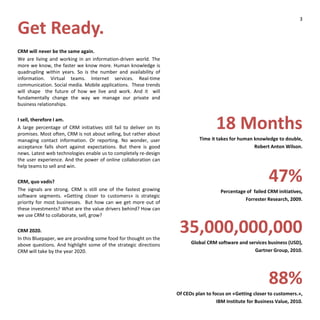
Get Ready.
CRM will never be the same again.
We are living and working in an information-driven world. The
more we know, the faster we know more. Human knowledge is
quadrupling within years. So is the number and availability of
information. Virtual teams. Internet services. Real-time
communication. Social media. Mobile applications. These trends
will shape the future of how we live and work. And it will
fundamentally change the way we manage our private and
business relationships.
I sell, therefore I am.
A large percentage of CRM initiatives still fail to deliver on its
promises. Most often, CRM is not about selling, but rather about
managing contact information. Or reporting. No wonder, user
acceptance falls short against expectations. But there is good
news. Latest web technologies enable us to completely re-design
the user experience. And the power of online collaboration can
help teams to sell and win.
CRM, quo vadis?
The signals are strong. CRM is still one of the fastest growing
software segments. «Getting closer to customers» is strategic
priority for most businesses. But how can we get more out of
these investments? What are the value drivers behind? How can
we use CRM to collaborate, sell, grow?
CRM 2020.
In this Bluepaper, we are providing some food for thought on the
above questions. And highlight some of the strategic directions
CRM will take by the year 2020.
18 Months
Time it takes for human knowledge to double,
Robert Anton Wilson.
47%
Percentage of failed CRM initiatives,
Forrester Research, 2009.
35,000,000,000
Global CRM software and services business (USD),
Gartner Group, 2010.
88%
Of CEOs plan to focus on «Getting closer to customers.»,
IBM Institute for Business Value, 2010.
3
4
75%
Of Companies expect to use more collaboration
tools within the next year,
Avanade, 2010.
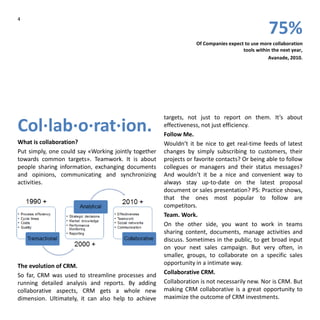
Col·lab·o·rat·ion.
What is collaboration?
Put simply, one could say «Working jointly together
towards common targets». Teamwork. It is about
people sharing information, exchanging documents
and opinions, communicating and synchronizing
activities.
The evolution of CRM.
So far, CRM was used to streamline processes and
running detailed analysis and reports. By adding
collaborative aspects, CRM gets a whole new
dimension. Ultimately, it can also help to achieve
targets, not just to report on them. It’s about
effectiveness, not just efficiency.
Follow Me.
Wouldn’t it be nice to get real-time feeds of latest
changes by simply subscribing to customers, their
projects or favorite contacts? Or being able to follow
collegues or managers and their status messages?
And wouldn’t it be a nice and convenient way to
always stay up-to-date on the latest proposal
document or sales presentation? PS: Practice shows,
that the ones most popular to follow are
competitors.
Team. Work.
On the other side, you want to work in teams
sharing content, documents, manage activities and
discuss. Sometimes in the public, to get broad input
on your next sales campaign. But very often, in
smaller, groups, to collaborate on a specific sales
opportunity in a intimate way.
Collaborative CRM.
Collaboration is not necessarily new. Nor is CRM. But
making CRM collaborative is a great opportunity to
maximize the outcome of CRM investments.
Mobility.
The Internet gets mobile.
Smartphone penetration is exploding. According to
Morgan Stanley, it will surpass computer sales by
2012. So is the availability of Wi-Fi and fast data
connections. Mobile applications are additionally
driving user adoption. As a result, the way of
consuming information and communicating are
fundamentally changing.
Mobile Salesforce.
What does it mean for CRM? The work we do on the
desktop is still very different from the work we do on
the mobile. Running detailed analysis and creating
targeted sales campaigns will most probably always
be something for the office. But receiving mobile
notifications, viewing dashboards and retrieving
specific opportunity and/or customer information
does directly help the users.
What’s in for me?
Mobility drives real-time collaboration. Information
can not just travel faster, but it can be processed more
interactively. Quality goes up. Response and
resolution times go down. Secondly, you can also
create CRM services around GPS locations to improve
targeting, optimize field services and meet up.
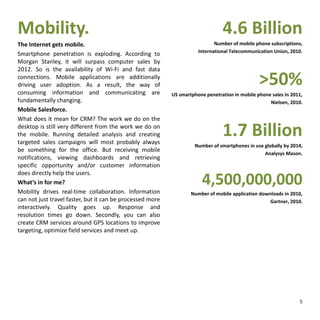
4.6 Billion
Number of mobile phone subscriptions,
International Telecommunication Union, 2010.
>50%
US smartphone penetration in mobile phone sales in 2011,
Nielsen, 2010.
1.7 Billion
Number of smartphones in use globally by 2014,
Analysys Mason.
4,500,000,000
Number of mobile application downloads in 2010,
Gartner, 2010.
5
User-Centric
Design.
Once upon a time …
A salesperson should sell, not updating CRM
systems. Unless, of course, she can sell more. If the
tools and processes make her more successful, she
will use it. Without management directive. Without
extra incentive.
It’s all about the User.
User acceptance is critical for the success of any
CRM initiative. Good tools are designed with and for
the different users, not just the sales manager. They
are simple and effective. If the user needs a day of
training to work with the system, rethink.
CRM 2.0.
In the last decade, drill-down reports and
dashboards have found their way into business
applications. In the next decade we will see tables
and forms being complemented or replaced by
process charts, activity timelines, network graphs
and maps. We will see animated menus, rich
content, interactive widgets, traffic lights and
graphical visualization.
Substantial Changes.
Your CRM will have the experience and performance
of a nice, interactive website. Powered by latest web
technologies. It will be touch-enabled to be used in
workshops. It will be interactive to facilitate
teamwork. It will be visual to stimulate and use
both sides of the brain. It will combine great
functionality, usability and design in an integrated
user experience. It will be used.
6
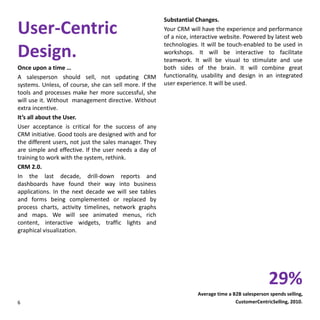
29%
Average time a B2B salesperson spends selling,
CustomerCentricSelling, 2010.
Cloud Computing.
CRM-as-a-Service.
When buying CRM, do you want to buy servers,
software code or rather business functionality? In
fact, cloud computing provides the option to buy CRM
as a service. Including server & network
infrastructure, database platform and the whole
application. Either over the Internet or within a
private network.
On Demand.
Forget about unused CRM licenses. Forget about
unused server or storage capacity. Remove fix costs.
Start paying only what you use and when you want to
use it. While in certain cases, we have seen lifetime
costs going up, in general, the «on demand» flexibility
should yield signficant savings.
Risks.
CRM security is business-critical. Could you provide
better security internally than a specialised service
provider could? Fraunhofer Institute just found, that a
majority of companies would improve security
through cloud services. And, operating in a private
cloud, it should be as easy to integrate or customize
than from an internal server. Control concerns remain,
but they can be overcome, it seems.
Opportunities.
Costs savings are nice. But does it help to sell more? A
CIO of a large enterprise put it this way: We don’t do
it for cost reasons, but to focus our resources solely
on the strategic aspects of CRM. Improving processes,
collaborating with partners and increasing business
impact. On top, we can enjoy some faster time to
market of innovative services.
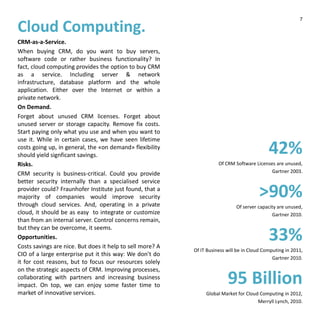
42%
Of CRM Software Licenses are unused,
Gartner 2003.
>90%
Of server capacity are unused,
Gartner 2010.
33%
Of IT Business will be in Cloud Computing in 2011,
Gartner 2010.
95 Billion
Global Market for Cloud Computing in 2012,
Merryll Lynch, 2010.
7
Social CRM.
Fans and friends.
Maintaining relationships was never as simple as
today. Facebook, LinkedIn, Twitter, Xing and
multiple other services help you to stay in touch, get
latest news, fotos, documents and personal updates
in a nice way. The numbers are skyrocketing. But
how can we leverage it for business life?
Hype and reality.
Everybody wants to do something with social media.
But only a minority of companies have found
strategic ways of leveraging the interactivity, speed
and directness of social communication channels.
Here, social CRM can help.
Listen & Learn.
You can learn a lot by monitoring user-generated
content around your products and services. Or your
competitors. You can learn even more by asking and
crowdsourcing ideas. And you can feel the direct
impact and reaction on your engagements and
promotions.
Social Sales.
Turn a twitter complaint into a support ticket.
Capture a sales lead on linked-in. Target key
influencers directly from your CRM. Identify sales
bridges to key decision-makers. Collaborate. Engage.
Integrating social networks into your sales
processes, will enable to leverage some of the social
opportunities. And there is more to come…
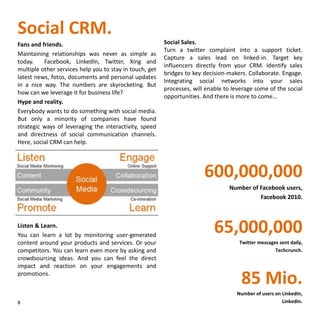
600,000,000
Number of Facebook users,
Facebook 2010.
65,000,000
Twitter messages sent daily,
Techcrunch.
85 Mio.
Number of users on LinkedIn,
LinkedIn.8
Conclusion.
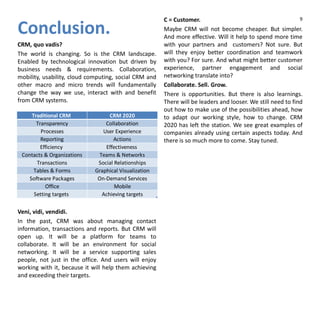
CRM, quo vadis?
The world is changing. So is the CRM landscape.
Enabled by technological innovation but driven by
business needs & requirements. Collaboration,
mobility, usability, cloud computing, social CRM and
other macro and micro trends will fundamentally
change the way we use, interact with and benefit
from CRM systems.
Veni, vidi, vendidi.
In the past, CRM was about managing contact
information, transactions and reports. But CRM will
open up. It will be a platform for teams to
collaborate. It will be an environment for social
networking. It will be a service supporting sales
people, not just in the office. And users will enjoy
working with it, because it will help them achieving
and exceeding their targets.
C = Customer.
Maybe CRM will not become cheaper. But simpler.
And more effective. Will it help to spend more time
with your partners and customers? Not sure. But
will they enjoy better coordination and teamwork
with you? For sure. And what might better customer
experience, partner engagement and social
networking translate into?
Collaborate. Sell. Grow.
There is opportunities. But there is also learnings.
There will be leaders and looser. We still need to find
out how to make use of the possibilities ahead, how
to adapt our working style, how to change. CRM
2020 has left the station. We see great examples of
companies already using certain aspects today. And
there is so much more to come. Stay tuned.
Traditional CRM CRM 2020
Transparency Collaboration
Processes User Experience
Reporting Actions
Efficiency Effectiveness
Contacts & Organizations Teams & Networks
Transactions Social Relationships
Tables & Forms Graphical Visualization
Software Packages On-Demand Services
Office Mobile
Setting targets Achieving targets
9
© Copyright 2010
Blueconomics Business Solutions
GmbH,
Zürich/Switzerland
All Rights Reserved.
BBS2010CH1000E
CRM 2020. Collaborate. Sell. Grow.

CRM 2020. Collaborate. Sell. Grow.

  • 1.
  • 2.
  • 3.
    Get Ready. CRM willnever be the same again. We are living and working in an information-driven world. The more we know, the faster we know more. Human knowledge is quadrupling within years. So is the number and availability of information. Virtual teams. Internet services. Real-time communication. Social media. Mobile applications. These trends will shape the future of how we live and work. And it will fundamentally change the way we manage our private and business relationships. I sell, therefore I am. A large percentage of CRM initiatives still fail to deliver on its promises. Most often, CRM is not about selling, but rather about managing contact information. Or reporting. No wonder, user acceptance falls short against expectations. But there is good news. Latest web technologies enable us to completely re-design the user experience. And the power of online collaboration can help teams to sell and win. CRM, quo vadis? The signals are strong. CRM is still one of the fastest growing software segments. «Getting closer to customers» is strategic priority for most businesses. But how can we get more out of these investments? What are the value drivers behind? How can we use CRM to collaborate, sell, grow? CRM 2020. In this Bluepaper, we are providing some food for thought on the above questions. And highlight some of the strategic directions CRM will take by the year 2020. 18 Months Time it takes for human knowledge to double, Robert Anton Wilson. 47% Percentage of failed CRM initiatives, Forrester Research, 2009. 35,000,000,000 Global CRM software and services business (USD), Gartner Group, 2010. 88% Of CEOs plan to focus on «Getting closer to customers.», IBM Institute for Business Value, 2010. 3
  • 4.
    4 75% Of Companies expectto use more collaboration tools within the next year, Avanade, 2010. Col·lab·o·rat·ion. What is collaboration? Put simply, one could say «Working jointly together towards common targets». Teamwork. It is about people sharing information, exchanging documents and opinions, communicating and synchronizing activities. The evolution of CRM. So far, CRM was used to streamline processes and running detailed analysis and reports. By adding collaborative aspects, CRM gets a whole new dimension. Ultimately, it can also help to achieve targets, not just to report on them. It’s about effectiveness, not just efficiency. Follow Me. Wouldn’t it be nice to get real-time feeds of latest changes by simply subscribing to customers, their projects or favorite contacts? Or being able to follow collegues or managers and their status messages? And wouldn’t it be a nice and convenient way to always stay up-to-date on the latest proposal document or sales presentation? PS: Practice shows, that the ones most popular to follow are competitors. Team. Work. On the other side, you want to work in teams sharing content, documents, manage activities and discuss. Sometimes in the public, to get broad input on your next sales campaign. But very often, in smaller, groups, to collaborate on a specific sales opportunity in a intimate way. Collaborative CRM. Collaboration is not necessarily new. Nor is CRM. But making CRM collaborative is a great opportunity to maximize the outcome of CRM investments.
  • 5.
    Mobility. The Internet getsmobile. Smartphone penetration is exploding. According to Morgan Stanley, it will surpass computer sales by 2012. So is the availability of Wi-Fi and fast data connections. Mobile applications are additionally driving user adoption. As a result, the way of consuming information and communicating are fundamentally changing. Mobile Salesforce. What does it mean for CRM? The work we do on the desktop is still very different from the work we do on the mobile. Running detailed analysis and creating targeted sales campaigns will most probably always be something for the office. But receiving mobile notifications, viewing dashboards and retrieving specific opportunity and/or customer information does directly help the users. What’s in for me? Mobility drives real-time collaboration. Information can not just travel faster, but it can be processed more interactively. Quality goes up. Response and resolution times go down. Secondly, you can also create CRM services around GPS locations to improve targeting, optimize field services and meet up. 4.6 Billion Number of mobile phone subscriptions, International Telecommunication Union, 2010. >50% US smartphone penetration in mobile phone sales in 2011, Nielsen, 2010. 1.7 Billion Number of smartphones in use globally by 2014, Analysys Mason. 4,500,000,000 Number of mobile application downloads in 2010, Gartner, 2010. 5
  • 6.
    User-Centric Design. Once upon atime … A salesperson should sell, not updating CRM systems. Unless, of course, she can sell more. If the tools and processes make her more successful, she will use it. Without management directive. Without extra incentive. It’s all about the User. User acceptance is critical for the success of any CRM initiative. Good tools are designed with and for the different users, not just the sales manager. They are simple and effective. If the user needs a day of training to work with the system, rethink. CRM 2.0. In the last decade, drill-down reports and dashboards have found their way into business applications. In the next decade we will see tables and forms being complemented or replaced by process charts, activity timelines, network graphs and maps. We will see animated menus, rich content, interactive widgets, traffic lights and graphical visualization. Substantial Changes. Your CRM will have the experience and performance of a nice, interactive website. Powered by latest web technologies. It will be touch-enabled to be used in workshops. It will be interactive to facilitate teamwork. It will be visual to stimulate and use both sides of the brain. It will combine great functionality, usability and design in an integrated user experience. It will be used. 6 29% Average time a B2B salesperson spends selling, CustomerCentricSelling, 2010.
  • 7.
    Cloud Computing. CRM-as-a-Service. When buyingCRM, do you want to buy servers, software code or rather business functionality? In fact, cloud computing provides the option to buy CRM as a service. Including server & network infrastructure, database platform and the whole application. Either over the Internet or within a private network. On Demand. Forget about unused CRM licenses. Forget about unused server or storage capacity. Remove fix costs. Start paying only what you use and when you want to use it. While in certain cases, we have seen lifetime costs going up, in general, the «on demand» flexibility should yield signficant savings. Risks. CRM security is business-critical. Could you provide better security internally than a specialised service provider could? Fraunhofer Institute just found, that a majority of companies would improve security through cloud services. And, operating in a private cloud, it should be as easy to integrate or customize than from an internal server. Control concerns remain, but they can be overcome, it seems. Opportunities. Costs savings are nice. But does it help to sell more? A CIO of a large enterprise put it this way: We don’t do it for cost reasons, but to focus our resources solely on the strategic aspects of CRM. Improving processes, collaborating with partners and increasing business impact. On top, we can enjoy some faster time to market of innovative services. 42% Of CRM Software Licenses are unused, Gartner 2003. >90% Of server capacity are unused, Gartner 2010. 33% Of IT Business will be in Cloud Computing in 2011, Gartner 2010. 95 Billion Global Market for Cloud Computing in 2012, Merryll Lynch, 2010. 7
  • 8.
    Social CRM. Fans andfriends. Maintaining relationships was never as simple as today. Facebook, LinkedIn, Twitter, Xing and multiple other services help you to stay in touch, get latest news, fotos, documents and personal updates in a nice way. The numbers are skyrocketing. But how can we leverage it for business life? Hype and reality. Everybody wants to do something with social media. But only a minority of companies have found strategic ways of leveraging the interactivity, speed and directness of social communication channels. Here, social CRM can help. Listen & Learn. You can learn a lot by monitoring user-generated content around your products and services. Or your competitors. You can learn even more by asking and crowdsourcing ideas. And you can feel the direct impact and reaction on your engagements and promotions. Social Sales. Turn a twitter complaint into a support ticket. Capture a sales lead on linked-in. Target key influencers directly from your CRM. Identify sales bridges to key decision-makers. Collaborate. Engage. Integrating social networks into your sales processes, will enable to leverage some of the social opportunities. And there is more to come… 600,000,000 Number of Facebook users, Facebook 2010. 65,000,000 Twitter messages sent daily, Techcrunch. 85 Mio. Number of users on LinkedIn, LinkedIn.8
  • 9.
    Conclusion. CRM, quo vadis? Theworld is changing. So is the CRM landscape. Enabled by technological innovation but driven by business needs & requirements. Collaboration, mobility, usability, cloud computing, social CRM and other macro and micro trends will fundamentally change the way we use, interact with and benefit from CRM systems. Veni, vidi, vendidi. In the past, CRM was about managing contact information, transactions and reports. But CRM will open up. It will be a platform for teams to collaborate. It will be an environment for social networking. It will be a service supporting sales people, not just in the office. And users will enjoy working with it, because it will help them achieving and exceeding their targets. C = Customer. Maybe CRM will not become cheaper. But simpler. And more effective. Will it help to spend more time with your partners and customers? Not sure. But will they enjoy better coordination and teamwork with you? For sure. And what might better customer experience, partner engagement and social networking translate into? Collaborate. Sell. Grow. There is opportunities. But there is also learnings. There will be leaders and looser. We still need to find out how to make use of the possibilities ahead, how to adapt our working style, how to change. CRM 2020 has left the station. We see great examples of companies already using certain aspects today. And there is so much more to come. Stay tuned. Traditional CRM CRM 2020 Transparency Collaboration Processes User Experience Reporting Actions Efficiency Effectiveness Contacts & Organizations Teams & Networks Transactions Social Relationships Tables & Forms Graphical Visualization Software Packages On-Demand Services Office Mobile Setting targets Achieving targets 9
  • 11.
    © Copyright 2010 BlueconomicsBusiness Solutions GmbH, Zürich/Switzerland All Rights Reserved. BBS2010CH1000E