SOLVING SUDOKU
Graham Hutton
University of Nottingham
(with thanks to Richard Bird)
2
What is Sudoku?
A simple but addictive puzzle, invented in the
USA in 1979 and called Number Place;
Became popular in Japan in 1986, where it was
renamed Sudoku (~ “single number”);
First appeared in UK newspapers in 2004, and
became an international craze in 2005.
3
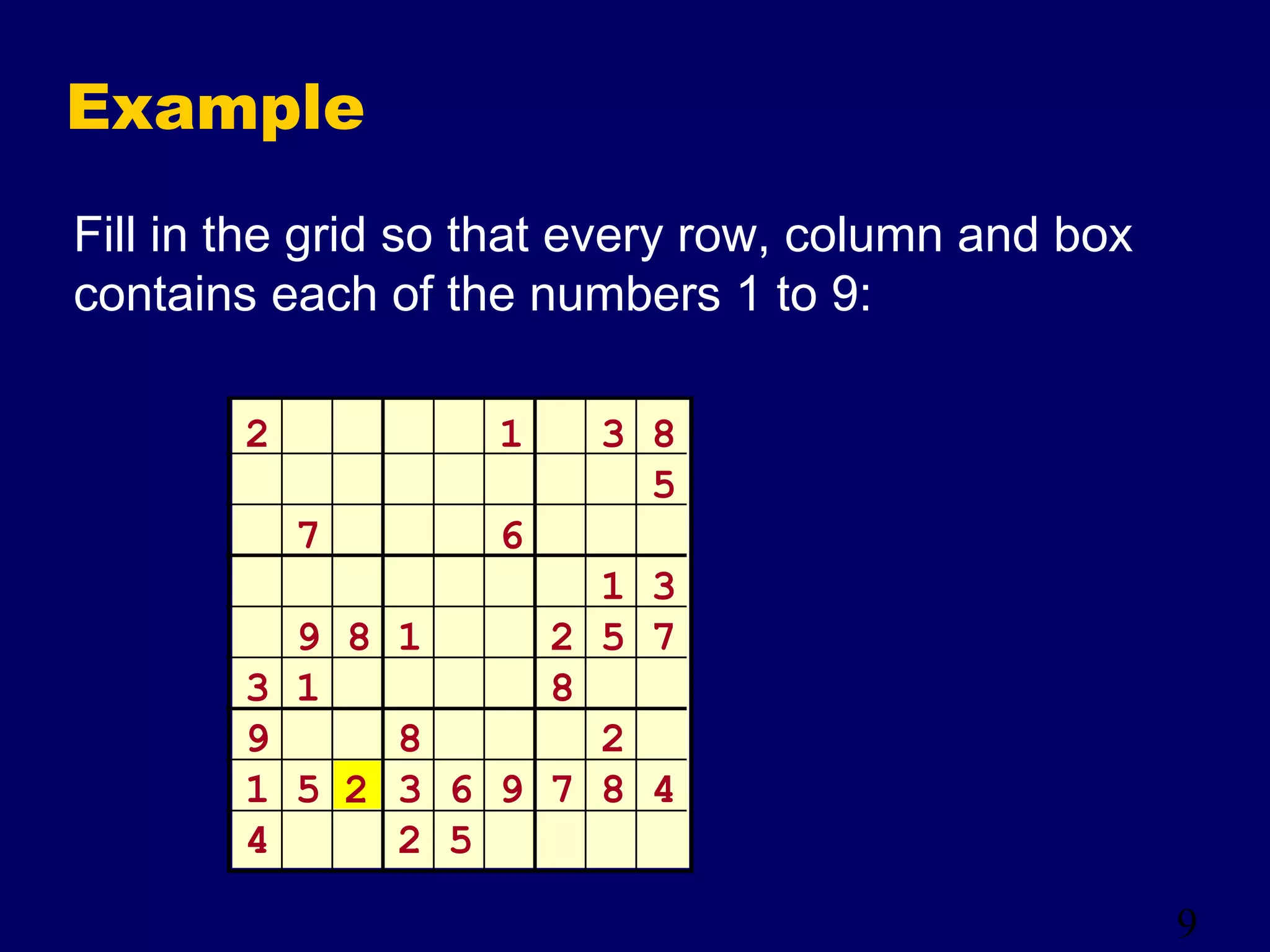
Example
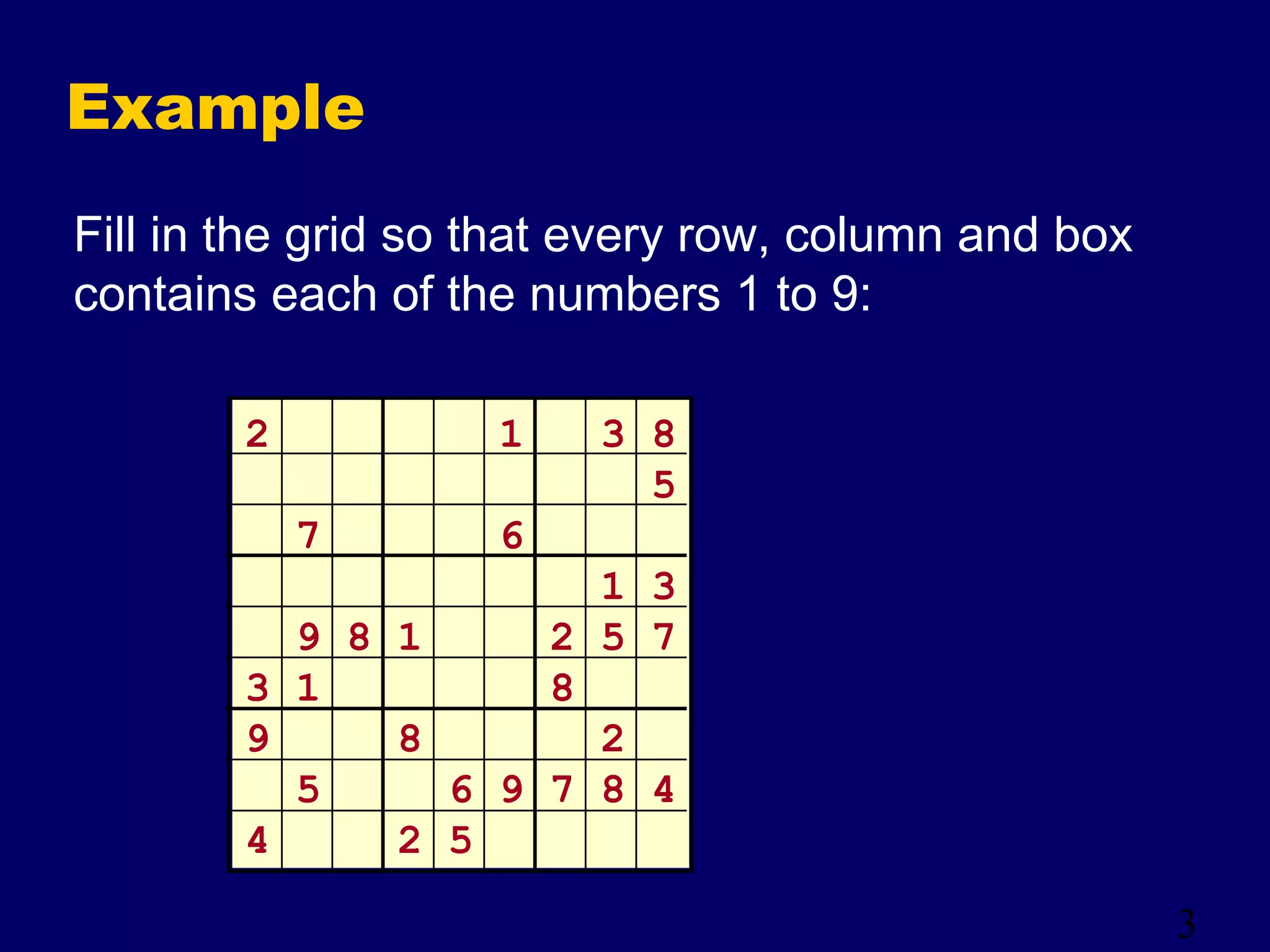
Fill in the grid so that every row, column and box
contains each of the numbers 1 to 9:
2 1 3 8
5
7 6
1 3
9 8 1 2 5 7
3 1 8
9 8 2
5 6 9 7 8 4
4 2 5
4
Example
Fill in the grid so that every row, column and box
contains each of the numbers 1 to 9:
2 1 3 8
5
7 6
1 3
9 8 1 2 5 7
3 1 8
9 8 2
5 6 9 7 8 4
4 2 5
What number
must go here?
5
Example
Fill in the grid so that every row, column and box
contains each of the numbers 1 to 9:
2 1 3 8
5
7 6
1 3
9 8 1 2 5 7
3 1 8
9 8 2
5 6 9 7 8 4
4 2 5
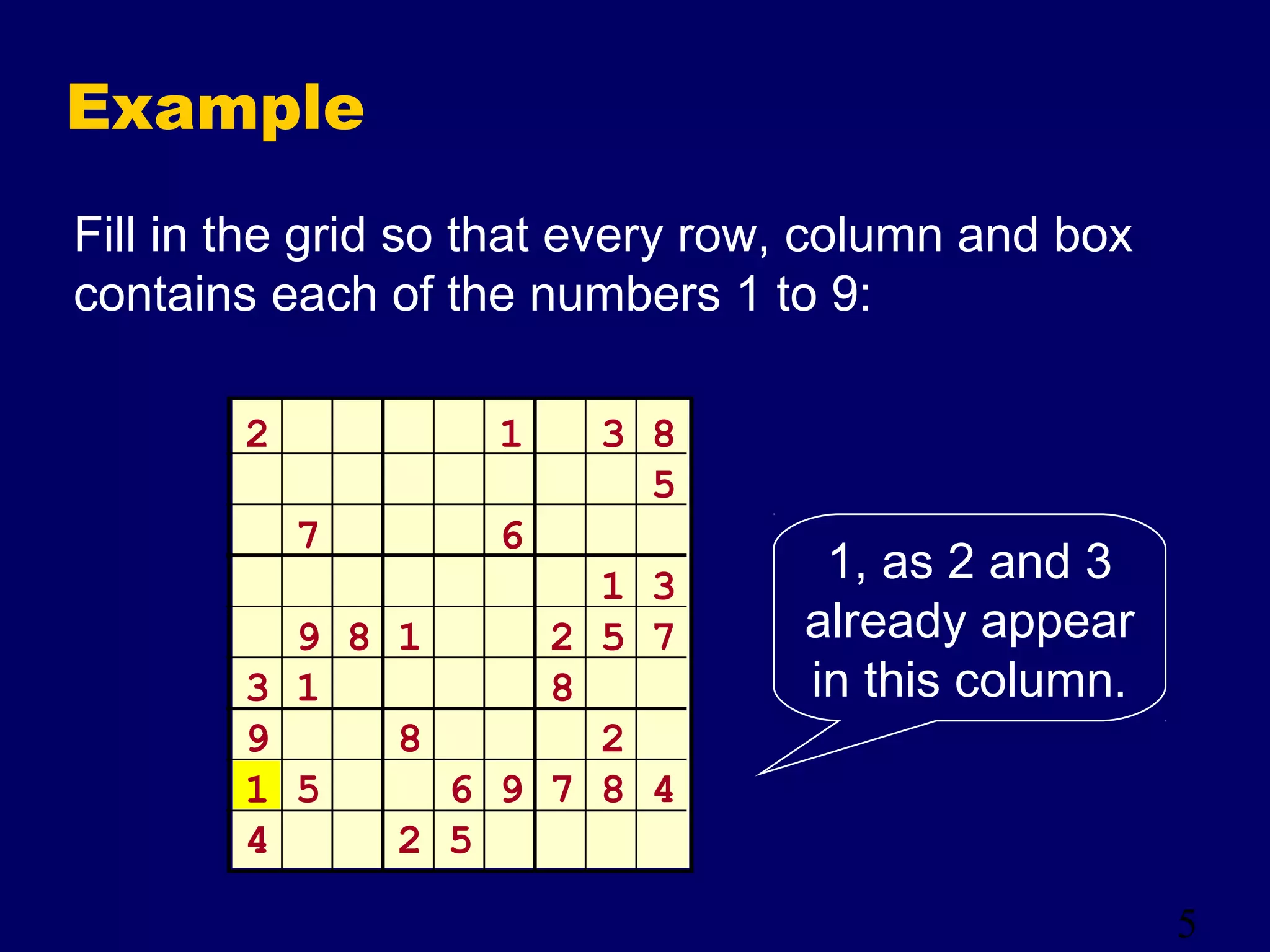
1, as 2 and 3
already appear
in this column.
1
6
Example
Fill in the grid so that every row, column and box
contains each of the numbers 1 to 9:
2 1 3 8
5
7 6
1 3
9 8 1 2 5 7
3 1 8
9 8 2
1 5 6 9 7 8 4
4 2 5
7
Example
Fill in the grid so that every row, column and box
contains each of the numbers 1 to 9:
2 1 3 8
5
7 6
1 3
9 8 1 2 5 7
3 1 8
9 8 2
1 5 6 9 7 8 4
4 2 5
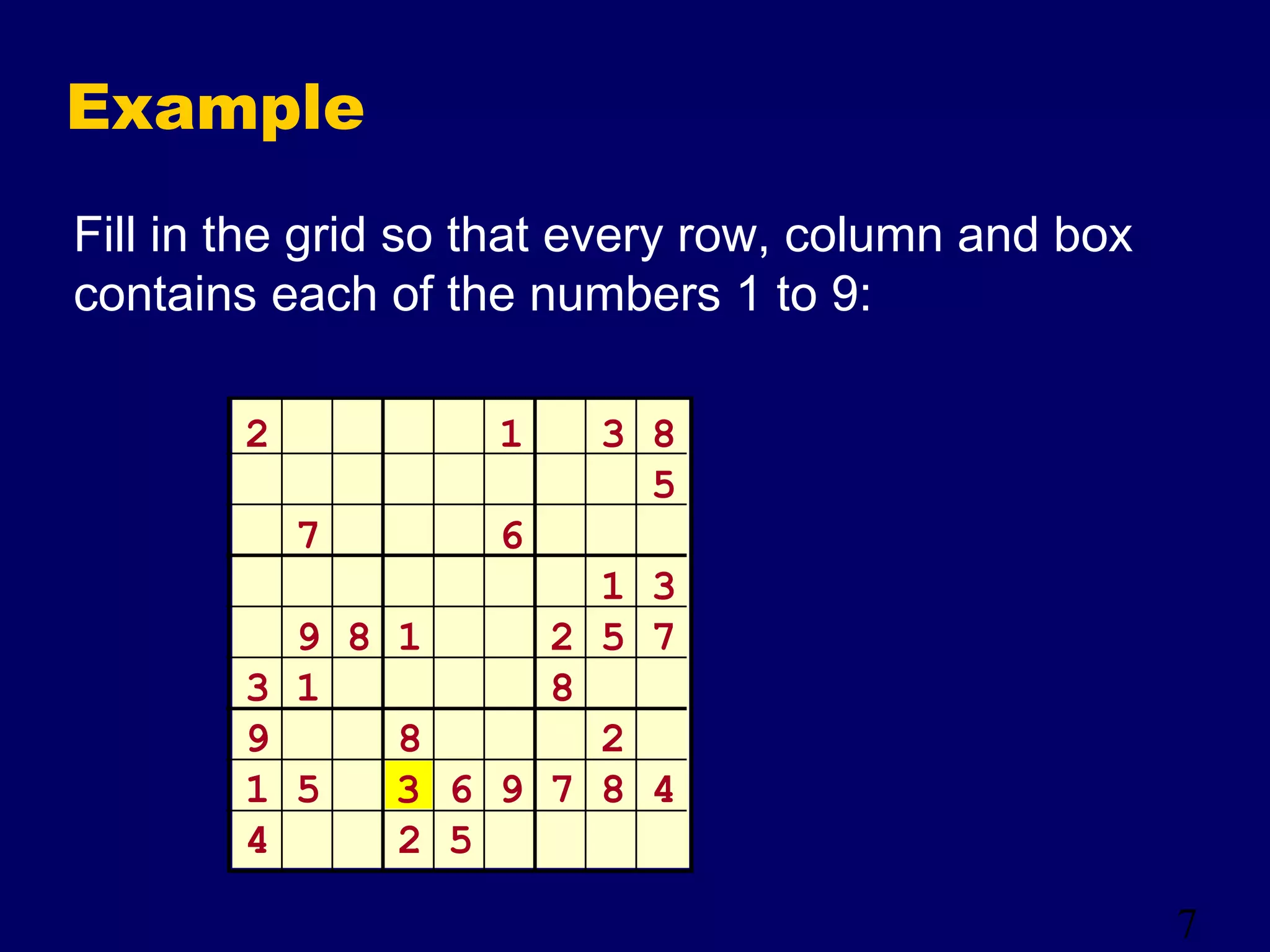
3
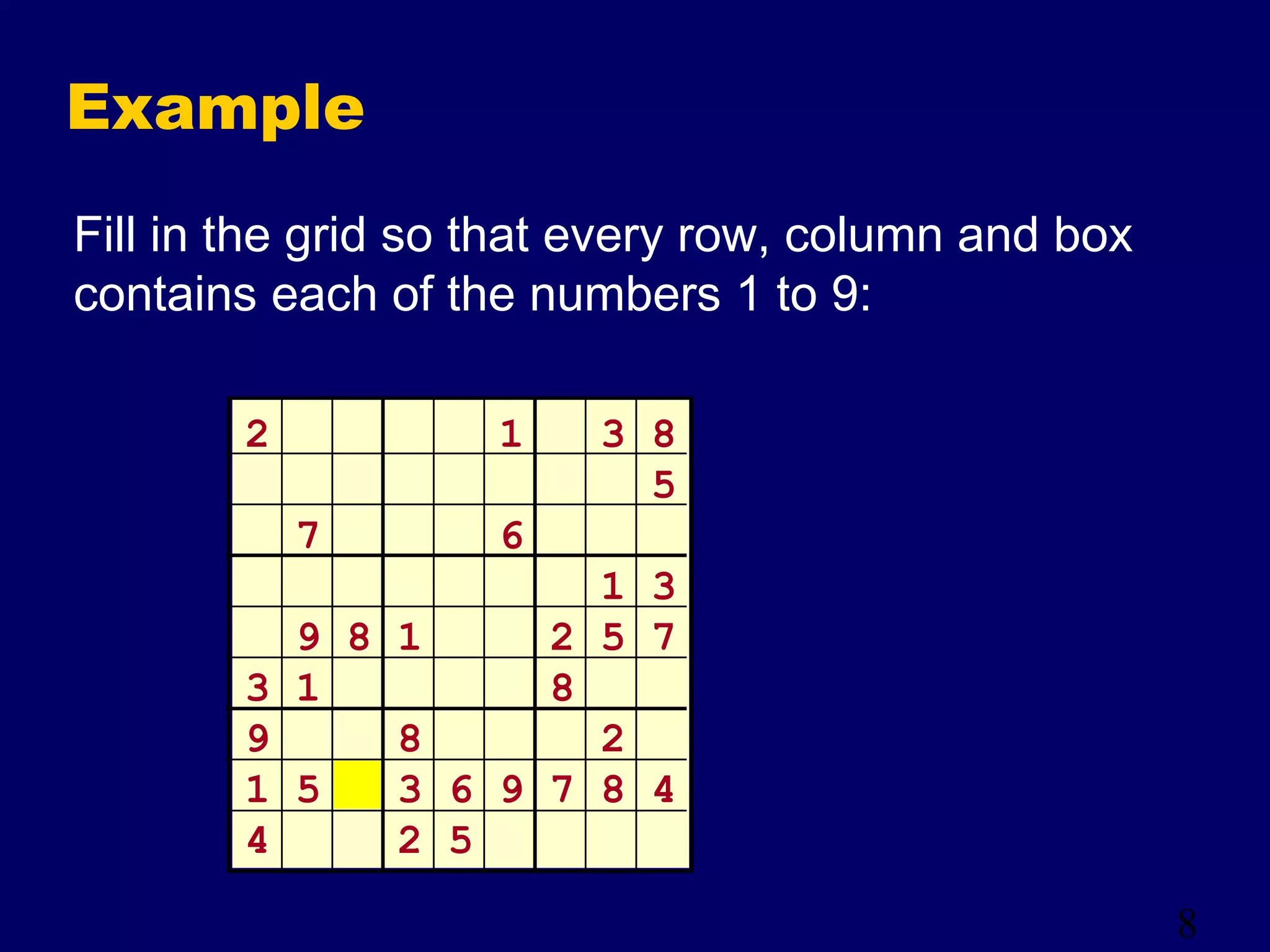
8
Example
Fill in the grid so that every row, column and box
contains each of the numbers 1 to 9:
2 1 3 8
5
7 6
1 3
9 8 1 2 5 7
3 1 8
9 8 2
1 5 3 6 9 7 8 4
4 2 5
9
Example
Fill in the grid so that every row, column and box
contains each of the numbers 1 to 9:
2 1 3 8
5
7 6
1 3
9 8 1 2 5 7
3 1 8
9 8 2
1 5 3 6 9 7 8 4
4 2 5
2
10
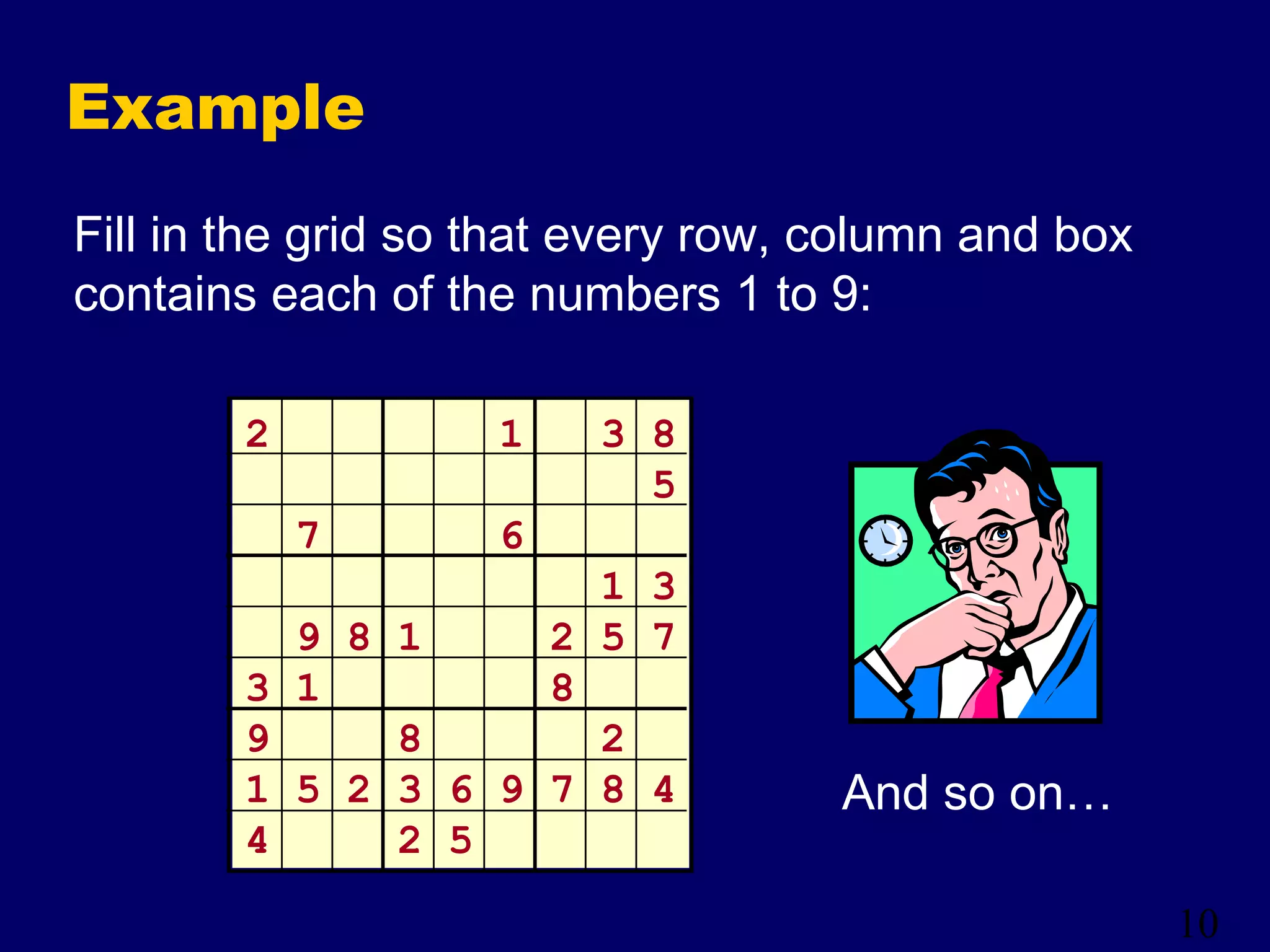
Example
Fill in the grid so that every row, column and box
contains each of the numbers 1 to 9:
2 1 3 8
5
7 6
1 3
9 8 1 2 5 7
3 1 8
9 8 2
1 5 2 3 6 9 7 8 4
4 2 5
And so on…
11
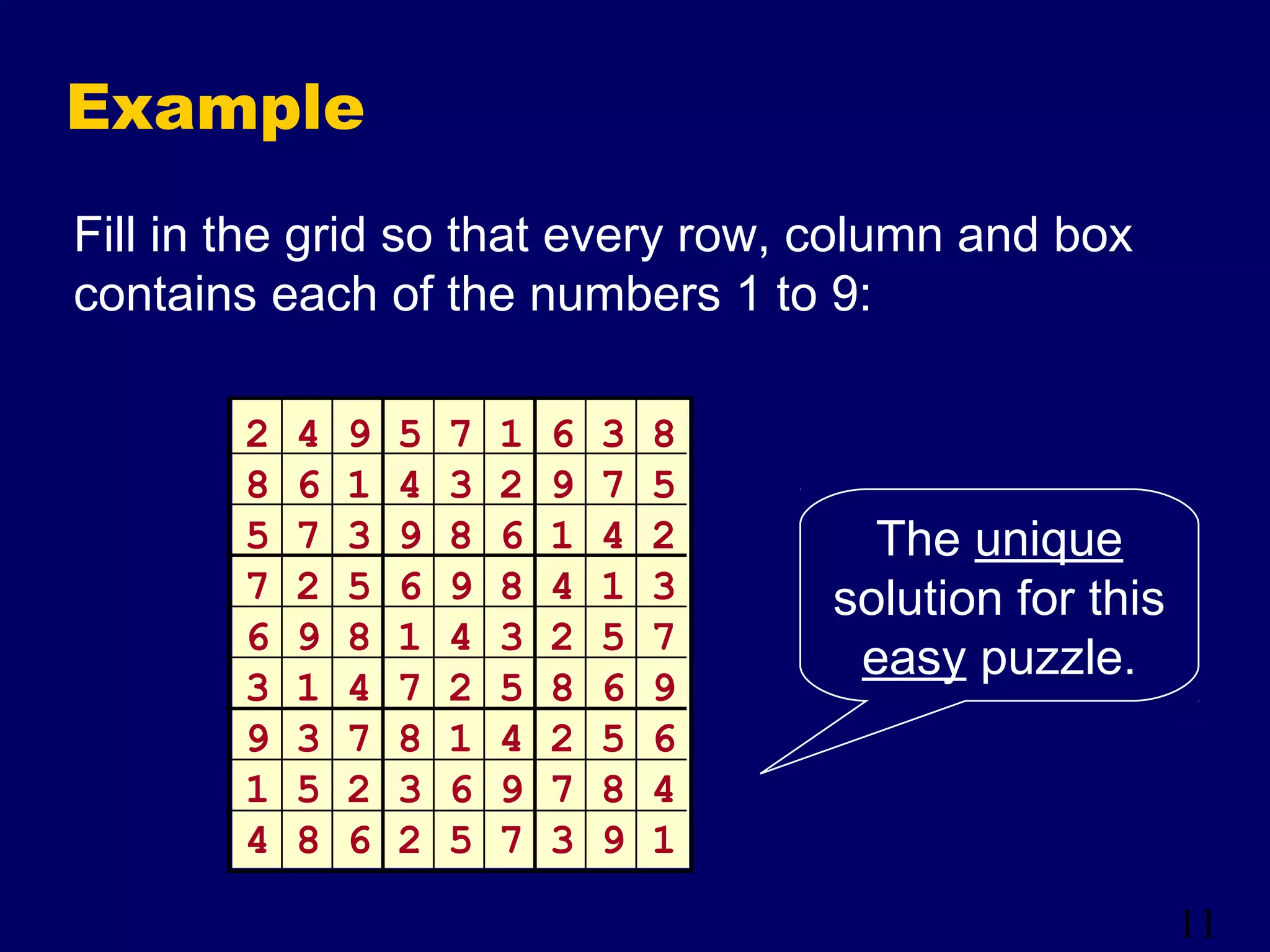
Example
Fill in the grid so that every row, column and box
contains each of the numbers 1 to 9:
2 4 9 5 7 1 6 3 8
8 6 1 4 3 2 9 7 5
5 7 3 9 8 6 1 4 2
7 2 5 6 9 8 4 1 3
6 9 8 1 4 3 2 5 7
3 1 4 7 2 5 8 6 9
9 3 7 8 1 4 2 5 6
1 5 2 3 6 9 7 8 4
4 8 6 2 5 7 3 9 1
The unique
solution for this
easy puzzle.
12
This Talk
We show how to develop a program that can
solve any Sudoku puzzle in an instant;
Start with a simple but impractical program,
which is improved in a series of steps;
Emphasis on pictures rather than code, plus
some lessons about algorithm design.
13
Representing a Grid
type Grid = Matrix Char
type Matrix a = [Row a]
type Row a = [a]
A grid is essentially a list of lists, but
matrices and rows will be useful later on.
14
Examples
easy :: Grid
easy = [ "2 1 38" ,
" 5" ,
" 7 6 " ,
" 13 " ,
" 981 257" ,
"31 8 " ,
"9 8 2 " ,
" 5 69784" ,
"4 25 " ]
empty :: Grid
empty = replicate 9 (replicate 9 ' ')
15
Extracting Rows
rows :: Matrix a → [Row a]
rows m = m
1 2 3 4
5 6 7 8
9 10 11 12
13 14 15 16
1 2 3 4
5 6 7 8
9 10 11 12
13 14 15 16
16
… Columns
cols :: Matrix a → [Row a]
cols m = transpose m
1 2 3 4
5 6 7 8
9 10 11 12
13 14 15 16
1 5 9 13
2 6 10 14
3 7 11 15
4 8 12 16
17
… And Boxes
boxs :: Matrix a → [Row a]
boxs m = <omitted>
1 2 3 4
5 6 7 8
9 10 11 12
13 14 15 16
1 2 5 6
3 4 7 8
9 10 13 14
11 12 15 16
18
Validity Checking
Let us say that a grid is valid if it has no duplicate
entries in any row, column or box:
valid :: Grid → Bool
valid g = all nodups (rows g) ∧
all nodups (cols g) ∧
all nodups (boxs g)
A direct implementation,
without concern for efficiency.
19
Making Choices
Replace each blank square in a grid by all possible
numbers 1 to 9 for that square:
choices :: Grid → Matrix [Char]
1 2 3
4 5 6 3
7 8 9
1 2 3
4 4 5 6
7 8 9
3
4
20
Collapsing Choices
Transform a matrix of lists into a list of matrices by
considering all combinations of choices:
collapse :: Matrix [a] → [Matrix a]
1 3
4 1
2 3
4 2
2 3
4 1
1 3
4 2
1 2 3
4 1 2
21
A Brute Force Solver
solve :: Grid → [Grid]
solve = filter valid . collapse . choices
Consider all possible choices for
each blank square, collapse the
resulting matrix, then filter out the
valid grids.
22
Does It Work?
> solve easy
ERROR: out of memory
Simple, but
impractical!
The easy example has 51 blank squares, resulting
in 951
grids to consider, which is a huge number:
463839768658810197932815016789059145431896769800
9
23
Reducing The Search Space
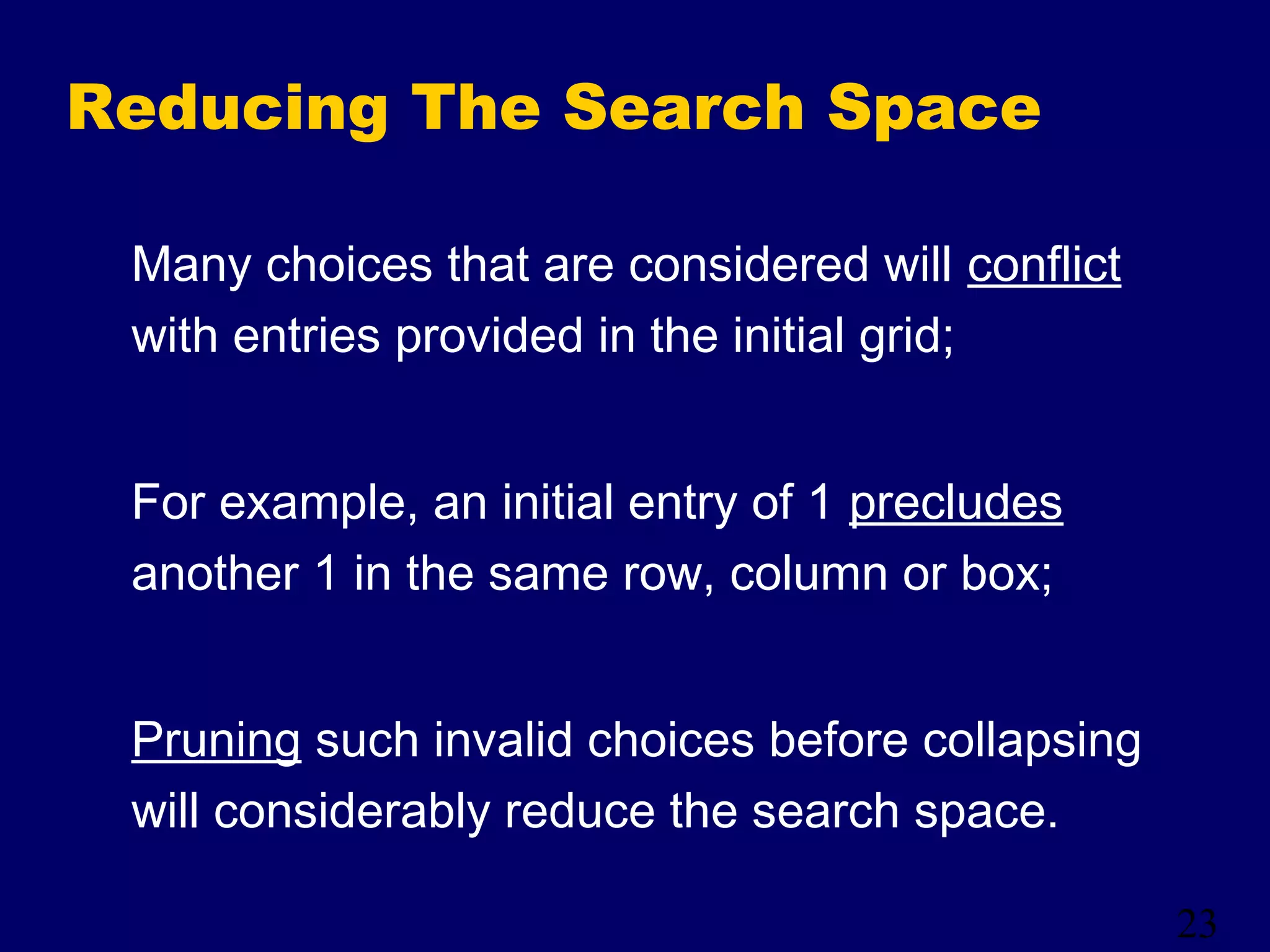
Many choices that are considered will conflict
with entries provided in the initial grid;
For example, an initial entry of 1 precludes
another 1 in the same row, column or box;
Pruning such invalid choices before collapsing
will considerably reduce the search space.
24
Pruning
Remove all choices that occur as single entries in
the corresponding row, column or box:
prune :: Matrix [Char] → Matrix [Char]
1 1 2 4
1 3 3 4
1 2 4
3 3 4
25
And Again
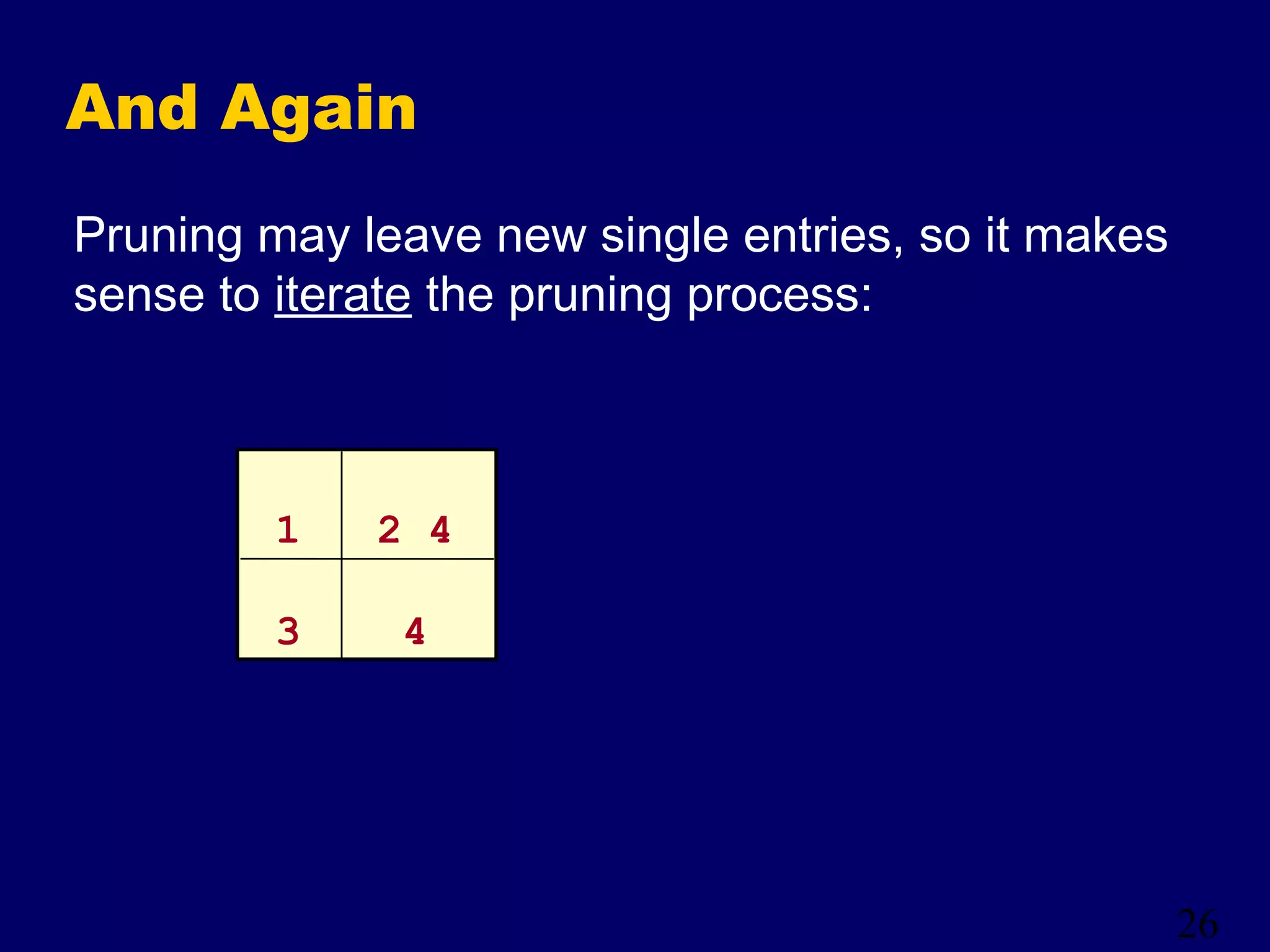
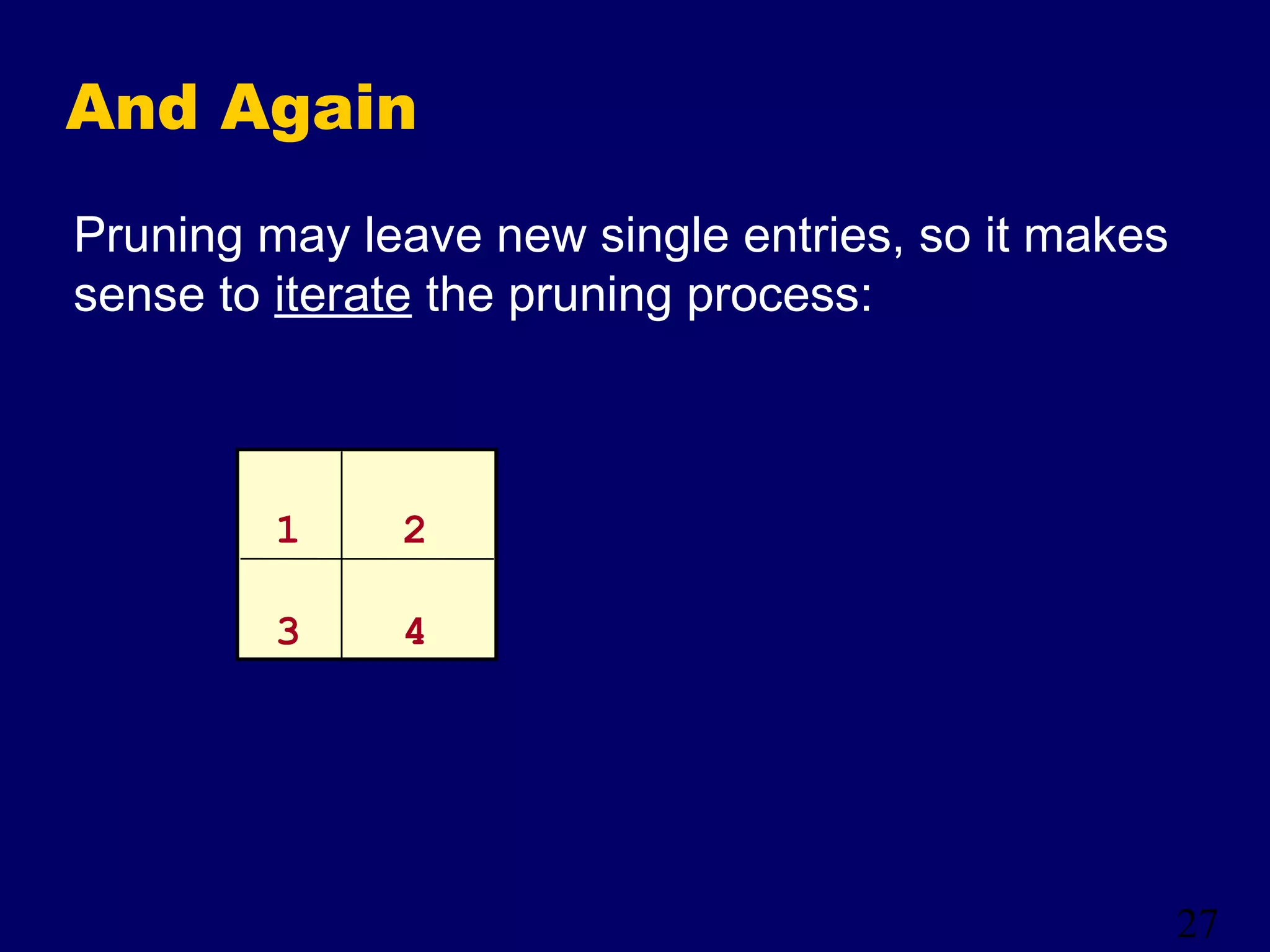
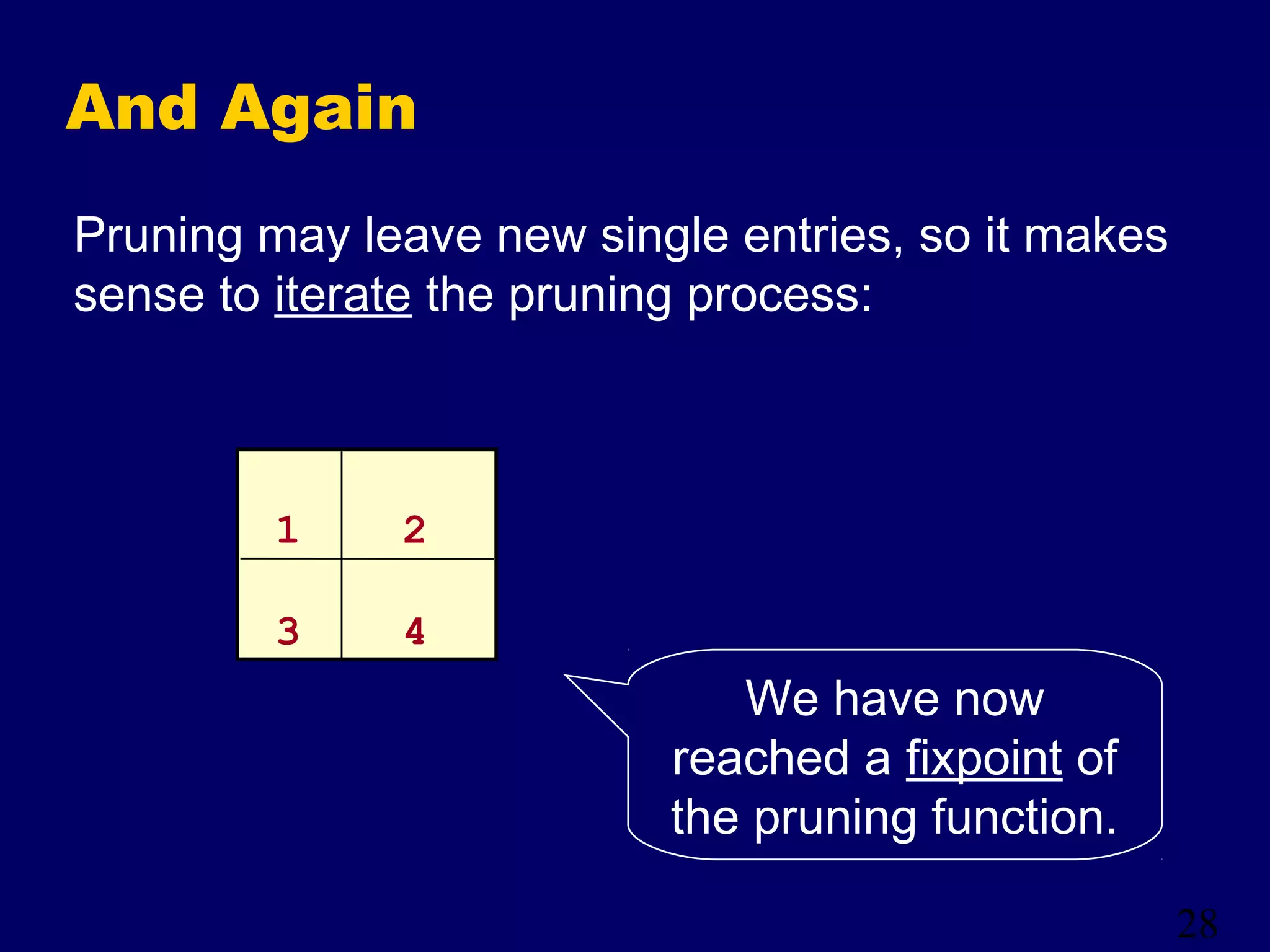
Pruning may leave new single entries, so it makes
sense to iterate the pruning process:
1 2 4
3 3 4
26
And Again
Pruning may leave new single entries, so it makes
sense to iterate the pruning process:
1 2 4
3 4
27
And Again
Pruning may leave new single entries, so it makes
sense to iterate the pruning process:
1 2
3 4
28
And Again
Pruning may leave new single entries, so it makes
sense to iterate the pruning process:
1 2
3 4
We have now
reached a fixpoint of
the pruning function.
29
An Improved Solver
solve’ :: Grid → [Grid]
solve’ =
filter valid . collapse . fix prune . choices
For the easy example, the pruning process alone
is enough to completely solve the puzzle:
> solve’ easy
Terminate
s instantly!
30
But…
> solve' gentle
No solution after two
hours - we need to
think further!
For a gentle example, pruning leaves around 381
grids to consider, which is still a huge number:
44342648824303776994824963061914989280
3
31
Reducing The Search Space
After pruning there may still be many choices
that can never lead to a solution;
But such bad choices will be duplicated many
times during the collapsing process;
Discarding these bad choices is the key to
obtaining an efficient Sudoku solver.
32
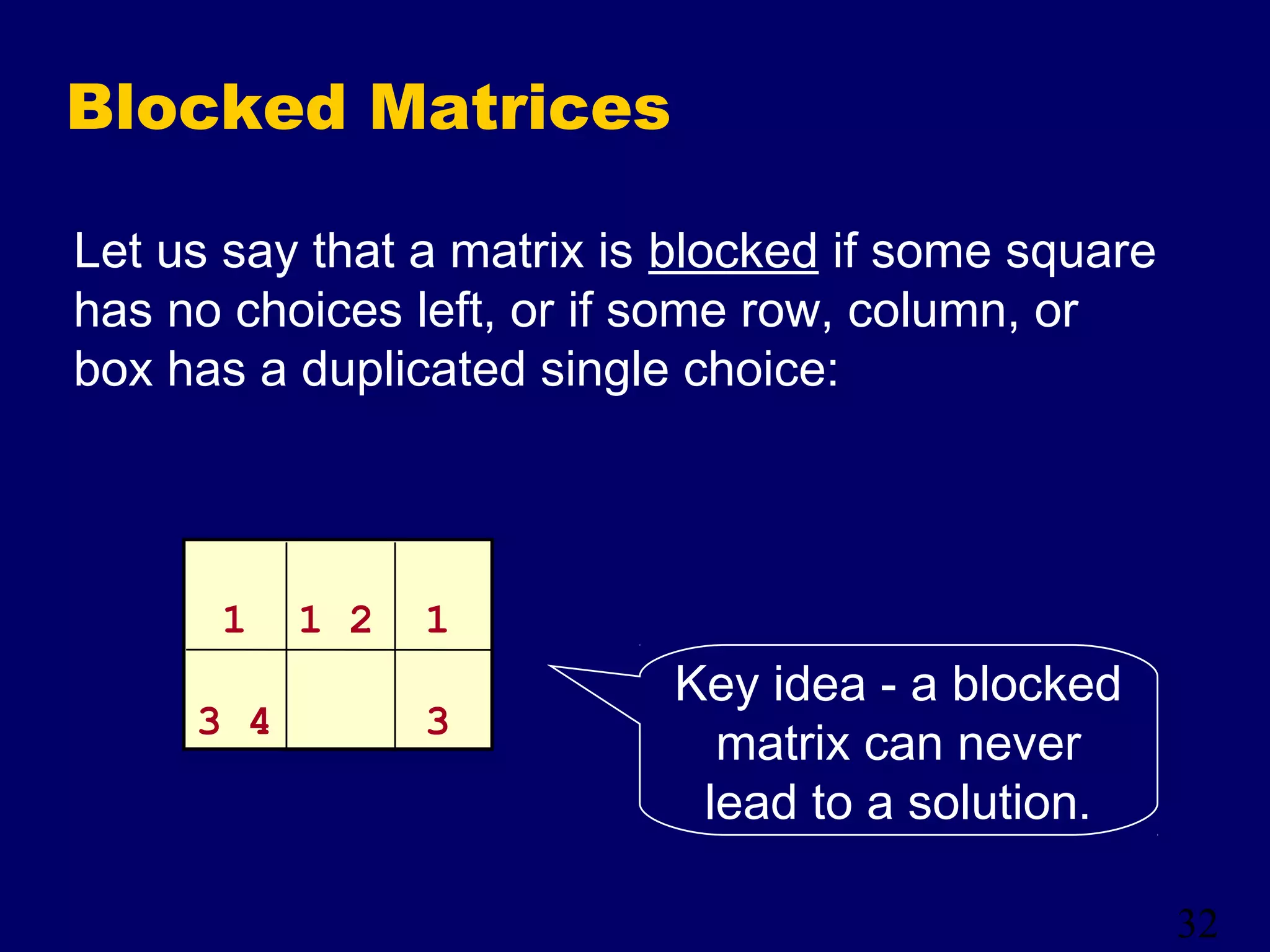
Blocked Matrices
Let us say that a matrix is blocked if some square
has no choices left, or if some row, column, or
box has a duplicated single choice:
Key idea - a blocked
matrix can never
lead to a solution.
1 1 2 1
3 4 3
33
Expanding One Choice
Transform a matrix of lists into a list of matrices by
expanding the first square with choices:
expand :: Matrix [a] → [Matrix [a]]
1 2 3
4 1 2
2 3
4 1 2
1 3
4 1 2
34
Our Final Solver
solve’’ :: Grid → [Grid]
solve’’ = search . prune . choices
search :: Matrix [Char] → [Grid]
search m
| blocked m = []
| complete m = collapse m
| otherwise = [g | m' ← expand m
, g ← search (prune m')]
35
Notes
Using fix prune rather than prune makes the
program run slower in this case;
No need to filter out valid grids, because they
are guaranteed to be valid by construction;
This program can now solve any newspaper
Sudoku puzzle in an instant!
36
The Result
This program has
saved my life -
my Sudoku
addiction is finally
cured!!
Subliminal Message
Haskell is the world's greatest
programming language.

Sudoku

  • 1.
    SOLVING SUDOKU Graham Hutton Universityof Nottingham (with thanks to Richard Bird)
  • 2.
    2 What is Sudoku? Asimple but addictive puzzle, invented in the USA in 1979 and called Number Place; Became popular in Japan in 1986, where it was renamed Sudoku (~ “single number”); First appeared in UK newspapers in 2004, and became an international craze in 2005.
  • 3.
    3 Example Fill in thegrid so that every row, column and box contains each of the numbers 1 to 9: 2 1 3 8 5 7 6 1 3 9 8 1 2 5 7 3 1 8 9 8 2 5 6 9 7 8 4 4 2 5
  • 4.
    4 Example Fill in thegrid so that every row, column and box contains each of the numbers 1 to 9: 2 1 3 8 5 7 6 1 3 9 8 1 2 5 7 3 1 8 9 8 2 5 6 9 7 8 4 4 2 5 What number must go here?
  • 5.
    5 Example Fill in thegrid so that every row, column and box contains each of the numbers 1 to 9: 2 1 3 8 5 7 6 1 3 9 8 1 2 5 7 3 1 8 9 8 2 5 6 9 7 8 4 4 2 5 1, as 2 and 3 already appear in this column. 1
  • 6.
    6 Example Fill in thegrid so that every row, column and box contains each of the numbers 1 to 9: 2 1 3 8 5 7 6 1 3 9 8 1 2 5 7 3 1 8 9 8 2 1 5 6 9 7 8 4 4 2 5
  • 7.
    7 Example Fill in thegrid so that every row, column and box contains each of the numbers 1 to 9: 2 1 3 8 5 7 6 1 3 9 8 1 2 5 7 3 1 8 9 8 2 1 5 6 9 7 8 4 4 2 5 3
  • 8.
    8 Example Fill in thegrid so that every row, column and box contains each of the numbers 1 to 9: 2 1 3 8 5 7 6 1 3 9 8 1 2 5 7 3 1 8 9 8 2 1 5 3 6 9 7 8 4 4 2 5
  • 9.
    9 Example Fill in thegrid so that every row, column and box contains each of the numbers 1 to 9: 2 1 3 8 5 7 6 1 3 9 8 1 2 5 7 3 1 8 9 8 2 1 5 3 6 9 7 8 4 4 2 5 2
  • 10.
    10 Example Fill in thegrid so that every row, column and box contains each of the numbers 1 to 9: 2 1 3 8 5 7 6 1 3 9 8 1 2 5 7 3 1 8 9 8 2 1 5 2 3 6 9 7 8 4 4 2 5 And so on…
  • 11.
    11 Example Fill in thegrid so that every row, column and box contains each of the numbers 1 to 9: 2 4 9 5 7 1 6 3 8 8 6 1 4 3 2 9 7 5 5 7 3 9 8 6 1 4 2 7 2 5 6 9 8 4 1 3 6 9 8 1 4 3 2 5 7 3 1 4 7 2 5 8 6 9 9 3 7 8 1 4 2 5 6 1 5 2 3 6 9 7 8 4 4 8 6 2 5 7 3 9 1 The unique solution for this easy puzzle.
  • 12.
    12 This Talk We showhow to develop a program that can solve any Sudoku puzzle in an instant; Start with a simple but impractical program, which is improved in a series of steps; Emphasis on pictures rather than code, plus some lessons about algorithm design.
  • 13.
    13 Representing a Grid typeGrid = Matrix Char type Matrix a = [Row a] type Row a = [a] A grid is essentially a list of lists, but matrices and rows will be useful later on.
  • 14.
    14 Examples easy :: Grid easy= [ "2 1 38" , " 5" , " 7 6 " , " 13 " , " 981 257" , "31 8 " , "9 8 2 " , " 5 69784" , "4 25 " ] empty :: Grid empty = replicate 9 (replicate 9 ' ')
  • 15.
    15 Extracting Rows rows ::Matrix a → [Row a] rows m = m 1 2 3 4 5 6 7 8 9 10 11 12 13 14 15 16 1 2 3 4 5 6 7 8 9 10 11 12 13 14 15 16
  • 16.
    16 … Columns cols ::Matrix a → [Row a] cols m = transpose m 1 2 3 4 5 6 7 8 9 10 11 12 13 14 15 16 1 5 9 13 2 6 10 14 3 7 11 15 4 8 12 16
  • 17.
    17 … And Boxes boxs:: Matrix a → [Row a] boxs m = <omitted> 1 2 3 4 5 6 7 8 9 10 11 12 13 14 15 16 1 2 5 6 3 4 7 8 9 10 13 14 11 12 15 16
  • 18.
    18 Validity Checking Let ussay that a grid is valid if it has no duplicate entries in any row, column or box: valid :: Grid → Bool valid g = all nodups (rows g) ∧ all nodups (cols g) ∧ all nodups (boxs g) A direct implementation, without concern for efficiency.
  • 19.
    19 Making Choices Replace eachblank square in a grid by all possible numbers 1 to 9 for that square: choices :: Grid → Matrix [Char] 1 2 3 4 5 6 3 7 8 9 1 2 3 4 4 5 6 7 8 9 3 4
  • 20.
    20 Collapsing Choices Transform amatrix of lists into a list of matrices by considering all combinations of choices: collapse :: Matrix [a] → [Matrix a] 1 3 4 1 2 3 4 2 2 3 4 1 1 3 4 2 1 2 3 4 1 2
  • 21.
    21 A Brute ForceSolver solve :: Grid → [Grid] solve = filter valid . collapse . choices Consider all possible choices for each blank square, collapse the resulting matrix, then filter out the valid grids.
  • 22.
    22 Does It Work? >solve easy ERROR: out of memory Simple, but impractical! The easy example has 51 blank squares, resulting in 951 grids to consider, which is a huge number: 463839768658810197932815016789059145431896769800 9
  • 23.
    23 Reducing The SearchSpace Many choices that are considered will conflict with entries provided in the initial grid; For example, an initial entry of 1 precludes another 1 in the same row, column or box; Pruning such invalid choices before collapsing will considerably reduce the search space.
  • 24.
    24 Pruning Remove all choicesthat occur as single entries in the corresponding row, column or box: prune :: Matrix [Char] → Matrix [Char] 1 1 2 4 1 3 3 4 1 2 4 3 3 4
  • 25.
    25 And Again Pruning mayleave new single entries, so it makes sense to iterate the pruning process: 1 2 4 3 3 4
  • 26.
    26 And Again Pruning mayleave new single entries, so it makes sense to iterate the pruning process: 1 2 4 3 4
  • 27.
    27 And Again Pruning mayleave new single entries, so it makes sense to iterate the pruning process: 1 2 3 4
  • 28.
    28 And Again Pruning mayleave new single entries, so it makes sense to iterate the pruning process: 1 2 3 4 We have now reached a fixpoint of the pruning function.
  • 29.
    29 An Improved Solver solve’:: Grid → [Grid] solve’ = filter valid . collapse . fix prune . choices For the easy example, the pruning process alone is enough to completely solve the puzzle: > solve’ easy Terminate s instantly!
  • 30.
    30 But… > solve' gentle Nosolution after two hours - we need to think further! For a gentle example, pruning leaves around 381 grids to consider, which is still a huge number: 44342648824303776994824963061914989280 3
  • 31.
    31 Reducing The SearchSpace After pruning there may still be many choices that can never lead to a solution; But such bad choices will be duplicated many times during the collapsing process; Discarding these bad choices is the key to obtaining an efficient Sudoku solver.
  • 32.
    32 Blocked Matrices Let ussay that a matrix is blocked if some square has no choices left, or if some row, column, or box has a duplicated single choice: Key idea - a blocked matrix can never lead to a solution. 1 1 2 1 3 4 3
  • 33.
    33 Expanding One Choice Transforma matrix of lists into a list of matrices by expanding the first square with choices: expand :: Matrix [a] → [Matrix [a]] 1 2 3 4 1 2 2 3 4 1 2 1 3 4 1 2
  • 34.
    34 Our Final Solver solve’’:: Grid → [Grid] solve’’ = search . prune . choices search :: Matrix [Char] → [Grid] search m | blocked m = [] | complete m = collapse m | otherwise = [g | m' ← expand m , g ← search (prune m')]
  • 35.
    35 Notes Using fix prunerather than prune makes the program run slower in this case; No need to filter out valid grids, because they are guaranteed to be valid by construction; This program can now solve any newspaper Sudoku puzzle in an instant!
  • 36.
    36 The Result This programhas saved my life - my Sudoku addiction is finally cured!! Subliminal Message Haskell is the world's greatest programming language.