



Planning for success
by Toronto Training and HR
June 2013
CONTENTS
3-4 Introduction to Toronto Training and HR Inc.
5-6 Definitions
7-9 Workforce planning
10-11 Key themes in succession planning
12-14 Steps to adopt
15-16 What stage is your organization at?
17-19 Performance and potential
20-21 Four critical dialogues
22-25 Strategies for succession planning
26-27 Drill
28-29 Best practice in succession planning
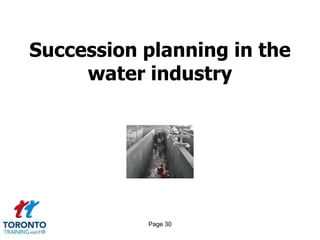
30-32 Succession planning in the water industry
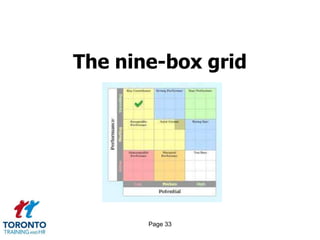
33-34 The nine-box grid
35-38 Common mistakes
39-40 Seven sins of succession planning
41-45 Criticisms of succession planning
46-47 Technology
48 Case studies
49-50 Conclusion and questions
Page 2
Page 3
Introduction
Page 4
Introduction to Toronto Training
and HR
Toronto Training and HR is a specialist training and
human resources consultancy headed by Timothy Holden
10 years in banking
10 years in training and human resources
Freelance practitioner since 2006
The core services provided by Toronto Training and HR
are:
Training event design
Training event delivery
Reducing costs, saving time plus improving
employee engagement and morale
Services for job seekers
Page 5
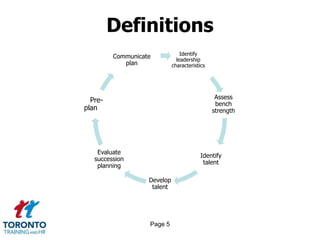
Definitions
Identify
leadership
characteristics
Assess
bench
strength
Identify
talent
Develop
talent
Evaluate
succession
planning
Pre-
plan
Communicate
plan
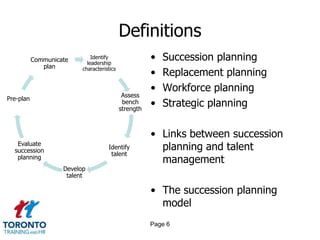
Definitions
• Succession planning
• Replacement planning
• Workforce planning
• Strategic planning
• Links between succession
planning and talent
management
• The succession planning
model
Page 6
Identify
leadership
characteristics
Assess
bench
strength
Identify
talent
Develop
talent
Evaluate
succession
planning
Pre-plan
Communicate
plan
Page 7
Workforce planning
Workforce planning 1 of 2
• Why is it necessary?
• How does it address recruiting
needs?
Page 8
Workforce planning 2 of 2
THE FIVE STEP MODEL
• Set the strategic direction
• Analyze the workforce
• Develop the action plan
• Implement the action plan
• Monitor, evaluate and revise
Page 9
Page 10
Key themes in succession
planning
Key themes in succession planning
• Open or closed process?
• Job modelling
• Broad or narrow audience?
• Making room for succession
• An annual or a continuous
activity?
• Integrating succession
planning and development
• Diversity
• Burnout
• Who owns the talent?
Page 11
Page 12
Steps to adopt
Steps to adopt 1 of 2
• Establish strategic alignment
• Identify succession targets and
analyze the talent pool
• Develop the succession
management plan
• Implement the succession
management plan
• Evaluate succession strategies
Page 13
Steps to adopt 2 of 2
RECIPE FOR SUCCESS
• Ongoing senior leader
commitment
• Ongoing employee
commitment to development
• Ongoing alignment of program
goals to strategic plan
• Ongoing communication and
change management
Page 14
Page 15
What stage is your
organization at?
What stage is your organization at?
• Crisis mode
• Replacement planning
• Succession planning
• Talent management
Page 16
Page 17
Performance and potential
Performance and potential 1 of 2
• Performance dimensions
• Standards for judging
performance
• Types of potential and
standards for judging potential
• “High” professionals
Page 18
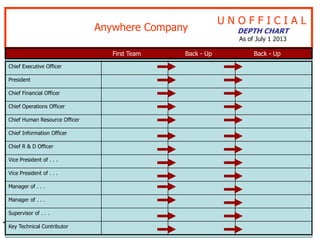
U N O F F I C I A L
DEPTH CHART
As of July 1 2013
Chief Executive Officer
President
Chief Financial Officer
Chief Operations Officer
Chief Human Resource Officer
Chief Information Officer
Chief R & D Officer
Vice President of . . .
Manager of . . .
Manager of . . .
Supervisor of . . .
Key Technical Contributor
First Team Back - Up Back - Up
Anywhere Company
Page 20
Four critical dialogues
• The internal dialogue
• The employee’s dialogue with
their stakeholders
• Dialogue between the
organization and employees
generally
• Dialogue between employees’
social networks and those of
the organization
Page 21
Page 22
Strategies for succession
planning
Strategies for succession planning
1 of 3
• Identify leadership skill sets
required for the future-not the
past or present
• Cultivate leaders from far-flung
corners of the organization
• Seek significant diversity when
comprising a leadership team
• Develop comprehensive
learning systems
• Create “stretch” work
experiences
Page 23
Strategies for succession planning
2 of 3
LEADERSHIP
• Extensive use of recruitment and
retention flexibilities for non-
supervisory, mission-critical
occupations in order to
identify/hire/retain high-potential
candidates who are in the talent
pipeline for leadership positions
Page 24
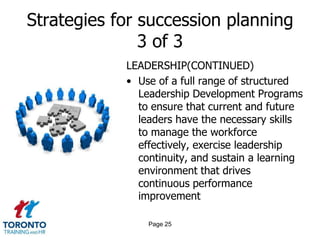
Strategies for succession planning
3 of 3
LEADERSHIP(CONTINUED)
• Use of a full range of structured
Leadership Development Programs
to ensure that current and future
leaders have the necessary skills
to manage the workforce
effectively, exercise leadership
continuity, and sustain a learning
environment that drives
continuous performance
improvement
Page 25
Page 26
Drill
Drill
Page 27
Page 28
Best practice in succession
planning
Best practice in succession planning
• Deploy a succession
management process
• Identify future leaders and
successors
• Develop future leaders and
typical activities
• Measure results
• Keep it simple
• Align succession with the
organization’s overall strategy
• Support the process
Page 29
Page 30
Succession planning in the
water industry
Succession planning in the water
industry 1 of 2
• Problem
• Purpose
• Barriers to meeting needs
• Issues
• Education and succession
planning
• Certification
• Training
• Leadership
• Compensation
Page 31
Succession planning in the water
industry 2 of 2
• Outreach
• Recruitment and retention
• Recommendations
Page 32
Page 33
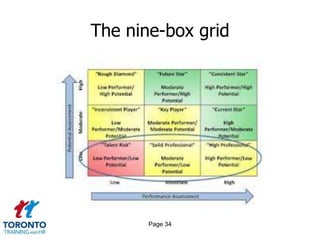
The nine-box grid
The nine-box grid
Page 34
Page 35
Common mistakes
Common mistakes 1 of 3
• Only allowing planners to
select successors from the
chain of command under a
position
• Heralding super-flat
organizations as a nirvana of
efficiency
Page 36
Common mistakes 2 of 3
• Allowing performance review
scores to be weighted as high
as 80% of criteria for
placement as successor
• Only doing succession planning
for the top three layers of an
organization
• Producing future workforce
strategies without reviewing
the data of historic workforce
trends and external market
conditions
Page 37
Common mistakes 3 of 3
• Avoiding line managers and
business unit leaders when it
comes to making employee
policies, because they “don’t
understand HR”
• Accepting that hard-to-use
software is better because it’s
more complex and will do more
for you…or that cheaper
software is merely simpler and
will give you a faster, yet
lesser return
Page 38
Page 39
Seven sins of succession
planning
Seven sins of succession planning
• I’ll be here forever
• What mattered then…
• Assume the plan is the plan
• Assume you need the whole
plan figured out
• Believing everyone wants to
rise through the ranks
• Developing only your high
potential people
• Thinking you need a formal
position
Page 40
Page 41
Criticisms of succession
planning
Criticisms of succession planning
1 of 4
• Overly reliant on line
manager’s perceptions of their
direct report’s performance
• Embedded in inflexible
competency frameworks
• Expect the individual to adapt
to the job description
• Assume the job is relatively
stable but jobs evolve rapidly
• Inadequate definitions of talent
• Do not take enough account of
gender differences
Page 42
Criticisms of succession planning
2 of 4
• Ignore work-life balance as a
factor in people’s decision to go
for more senior positions
• Fail to ensure employees gain
experience of both functional
specialists and generalist roles at
an early stage
• Assume employees will stay for
the long-term despite evidence
to the contrary
• Impose a uniform talent
development process
Page 43
Criticisms of succession planning
3 of 4
• Place people in boxes
• Focus succession on specific
roles with a small number of
candidates rather than
developing large clusters of jobs
which may be filled from a larger
pool
• Do not take sufficient notice of
the difference in attitudes
between different generations
Page 44
Criticisms of succession planning
4 of 4
• Fail to appreciate how people
make the transition from one
level of the organization to
another
• Takes inadequate account of how
“adult” people are
• Fail to take a sufficiently systemic
perspective
Page 45
Page 46
Technology
Technology
Page 47
Page 48
Case studies
Page 49
Conclusion and questions
Page 50
Conclusion and questions
Summary
Videos
Questions

Succession planning June 2013

  • 1.
    Planning for success byToronto Training and HR June 2013
  • 2.
    CONTENTS 3-4 Introduction toToronto Training and HR Inc. 5-6 Definitions 7-9 Workforce planning 10-11 Key themes in succession planning 12-14 Steps to adopt 15-16 What stage is your organization at? 17-19 Performance and potential 20-21 Four critical dialogues 22-25 Strategies for succession planning 26-27 Drill 28-29 Best practice in succession planning 30-32 Succession planning in the water industry 33-34 The nine-box grid 35-38 Common mistakes 39-40 Seven sins of succession planning 41-45 Criticisms of succession planning 46-47 Technology 48 Case studies 49-50 Conclusion and questions Page 2
  • 3.
  • 4.
    Page 4 Introduction toToronto Training and HR Toronto Training and HR is a specialist training and human resources consultancy headed by Timothy Holden 10 years in banking 10 years in training and human resources Freelance practitioner since 2006 The core services provided by Toronto Training and HR are: Training event design Training event delivery Reducing costs, saving time plus improving employee engagement and morale Services for job seekers
  • 5.
  • 6.
    Definitions • Succession planning •Replacement planning • Workforce planning • Strategic planning • Links between succession planning and talent management • The succession planning model Page 6 Identify leadership characteristics Assess bench strength Identify talent Develop talent Evaluate succession planning Pre-plan Communicate plan
  • 7.
  • 8.
    Workforce planning 1of 2 • Why is it necessary? • How does it address recruiting needs? Page 8
  • 9.
    Workforce planning 2of 2 THE FIVE STEP MODEL • Set the strategic direction • Analyze the workforce • Develop the action plan • Implement the action plan • Monitor, evaluate and revise Page 9
  • 10.
    Page 10 Key themesin succession planning
  • 11.
    Key themes insuccession planning • Open or closed process? • Job modelling • Broad or narrow audience? • Making room for succession • An annual or a continuous activity? • Integrating succession planning and development • Diversity • Burnout • Who owns the talent? Page 11
  • 12.
  • 13.
    Steps to adopt1 of 2 • Establish strategic alignment • Identify succession targets and analyze the talent pool • Develop the succession management plan • Implement the succession management plan • Evaluate succession strategies Page 13
  • 14.
    Steps to adopt2 of 2 RECIPE FOR SUCCESS • Ongoing senior leader commitment • Ongoing employee commitment to development • Ongoing alignment of program goals to strategic plan • Ongoing communication and change management Page 14
  • 15.
    Page 15 What stageis your organization at?
  • 16.
    What stage isyour organization at? • Crisis mode • Replacement planning • Succession planning • Talent management Page 16
  • 17.
  • 18.
    Performance and potential1 of 2 • Performance dimensions • Standards for judging performance • Types of potential and standards for judging potential • “High” professionals Page 18
  • 19.
    U N OF F I C I A L DEPTH CHART As of July 1 2013 Chief Executive Officer President Chief Financial Officer Chief Operations Officer Chief Human Resource Officer Chief Information Officer Chief R & D Officer Vice President of . . . Vice President of . . . Manager of . . . Manager of . . . Supervisor of . . . Key Technical Contributor First Team Back - Up Back - Up Anywhere Company
  • 20.
  • 21.
    Four critical dialogues •The internal dialogue • The employee’s dialogue with their stakeholders • Dialogue between the organization and employees generally • Dialogue between employees’ social networks and those of the organization Page 21
  • 22.
    Page 22 Strategies forsuccession planning
  • 23.
    Strategies for successionplanning 1 of 3 • Identify leadership skill sets required for the future-not the past or present • Cultivate leaders from far-flung corners of the organization • Seek significant diversity when comprising a leadership team • Develop comprehensive learning systems • Create “stretch” work experiences Page 23
  • 24.
    Strategies for successionplanning 2 of 3 LEADERSHIP • Extensive use of recruitment and retention flexibilities for non- supervisory, mission-critical occupations in order to identify/hire/retain high-potential candidates who are in the talent pipeline for leadership positions Page 24
  • 25.
    Strategies for successionplanning 3 of 3 LEADERSHIP(CONTINUED) • Use of a full range of structured Leadership Development Programs to ensure that current and future leaders have the necessary skills to manage the workforce effectively, exercise leadership continuity, and sustain a learning environment that drives continuous performance improvement Page 25
  • 26.
  • 27.
  • 28.
    Page 28 Best practicein succession planning
  • 29.
    Best practice insuccession planning • Deploy a succession management process • Identify future leaders and successors • Develop future leaders and typical activities • Measure results • Keep it simple • Align succession with the organization’s overall strategy • Support the process Page 29
  • 30.
    Page 30 Succession planningin the water industry
  • 31.
    Succession planning inthe water industry 1 of 2 • Problem • Purpose • Barriers to meeting needs • Issues • Education and succession planning • Certification • Training • Leadership • Compensation Page 31
  • 32.
    Succession planning inthe water industry 2 of 2 • Outreach • Recruitment and retention • Recommendations Page 32
  • 33.
  • 34.
  • 35.
  • 36.
    Common mistakes 1of 3 • Only allowing planners to select successors from the chain of command under a position • Heralding super-flat organizations as a nirvana of efficiency Page 36
  • 37.
    Common mistakes 2of 3 • Allowing performance review scores to be weighted as high as 80% of criteria for placement as successor • Only doing succession planning for the top three layers of an organization • Producing future workforce strategies without reviewing the data of historic workforce trends and external market conditions Page 37
  • 38.
    Common mistakes 3of 3 • Avoiding line managers and business unit leaders when it comes to making employee policies, because they “don’t understand HR” • Accepting that hard-to-use software is better because it’s more complex and will do more for you…or that cheaper software is merely simpler and will give you a faster, yet lesser return Page 38
  • 39.
    Page 39 Seven sinsof succession planning
  • 40.
    Seven sins ofsuccession planning • I’ll be here forever • What mattered then… • Assume the plan is the plan • Assume you need the whole plan figured out • Believing everyone wants to rise through the ranks • Developing only your high potential people • Thinking you need a formal position Page 40
  • 41.
    Page 41 Criticisms ofsuccession planning
  • 42.
    Criticisms of successionplanning 1 of 4 • Overly reliant on line manager’s perceptions of their direct report’s performance • Embedded in inflexible competency frameworks • Expect the individual to adapt to the job description • Assume the job is relatively stable but jobs evolve rapidly • Inadequate definitions of talent • Do not take enough account of gender differences Page 42
  • 43.
    Criticisms of successionplanning 2 of 4 • Ignore work-life balance as a factor in people’s decision to go for more senior positions • Fail to ensure employees gain experience of both functional specialists and generalist roles at an early stage • Assume employees will stay for the long-term despite evidence to the contrary • Impose a uniform talent development process Page 43
  • 44.
    Criticisms of successionplanning 3 of 4 • Place people in boxes • Focus succession on specific roles with a small number of candidates rather than developing large clusters of jobs which may be filled from a larger pool • Do not take sufficient notice of the difference in attitudes between different generations Page 44
  • 45.
    Criticisms of successionplanning 4 of 4 • Fail to appreciate how people make the transition from one level of the organization to another • Takes inadequate account of how “adult” people are • Fail to take a sufficiently systemic perspective Page 45
  • 46.
  • 47.
  • 48.
  • 49.
  • 50.
    Page 50 Conclusion andquestions Summary Videos Questions