Building a Successful Practice
Making & Keeping it Profitable

Presented by:
Chuck Crafton
© 2001
Slide 1
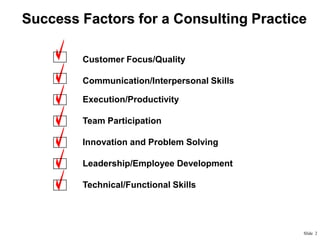
Success Factors for a Consulting Practice
Customer Focus/Quality
Communication/Interpersonal Skills
Execution/Productivity
Team Participation
Innovation and Problem Solving

Leadership/Employee Development
Technical/Functional Skills

Slide 2
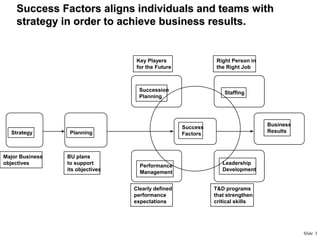
Success Factors aligns individuals and teams with
strategy in order to achieve business results.

Key Players
for the Future

Right Person in
the Right Job

Succession
Planning

Strategy

Major Business
objectives

Business
Results

Success
Factors

Planning

BU plans
to support
its objectives

Staffing

Performance
Management
Clearly defined
performance
expectations

Leadership
Development

T&D programs
that strengthen
critical skills

Slide 3
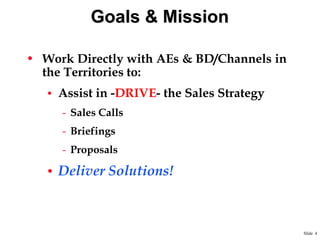
Goals & Mission
• Work Directly with AEs & BD/Channels in
the Territories to:
• Assist in -DRIVE- the Sales Strategy

- Sales Calls

- Briefings
- Proposals

• Deliver Solutions!

Slide 4
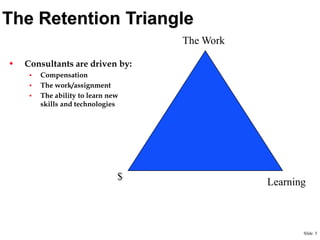
The Retention Triangle
The Work
•

Consultants are driven by:
•
•
•

Compensation
The work/assignment
The ability to learn new
skills and technologies

$

Learning

Slide 5
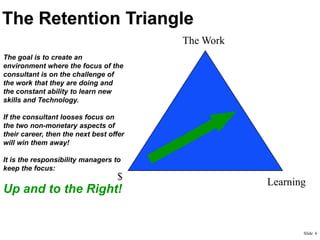
The Retention Triangle
The Work
The goal is to create an
environment where the focus of the
consultant is on the challenge of
the work that they are doing and
the constant ability to learn new
skills and Technology.
If the consultant looses focus on
the two non-monetary aspects of
their career, then the next best offer
will win them away!
It is the responsibility managers to
keep the focus:

$

Up and to the Right!

Learning

Slide 6
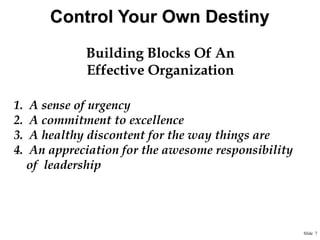
Control Your Own Destiny
Building Blocks Of An
Effective Organization
1.
2.
3.
4.

A sense of urgency
A commitment to excellence
A healthy discontent for the way things are
An appreciation for the awesome responsibility
of leadership

Slide 7
If you were going to be accused
of being a Project Manager,
would there be enough
evidence to convict you?

Slide 8
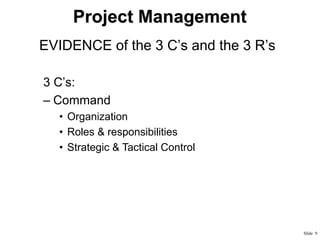
Project Management
• EVIDENCE of the 3 C’s and the 3 R’s
3 C’s:
– Command
• Organization
• Roles & responsibilities
• Strategic & Tactical Control

Slide 9
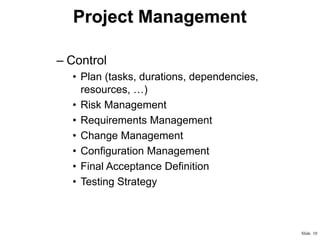
Project Management
– Control
• Plan (tasks, durations, dependencies,
resources, …)
• Risk Management
• Requirements Management
• Change Management
• Configuration Management
• Final Acceptance Definition
• Testing Strategy

Slide 10
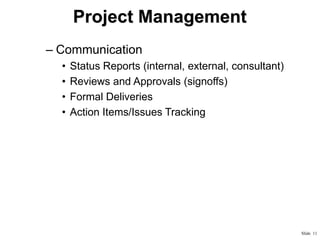
Project Management
– Communication
•
•
•
•

Status Reports (internal, external, consultant)
Reviews and Approvals (signoffs)
Formal Deliveries
Action Items/Issues Tracking

Slide 11
Project Management
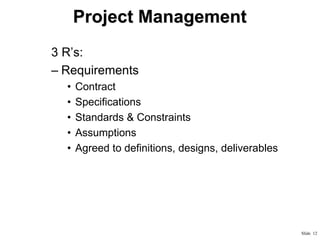
3 R’s:
– Requirements
•
•
•
•
•

Contract
Specifications
Standards & Constraints
Assumptions
Agreed to definitions, designs, deliverables

Slide 12
Project Management
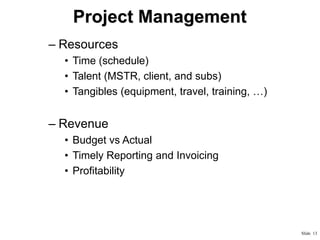
– Resources
• Time (schedule)
• Talent (MSTR, client, and subs)
• Tangibles (equipment, travel, training, …)

– Revenue
• Budget vs Actual
• Timely Reporting and Invoicing
• Profitability

Slide 13
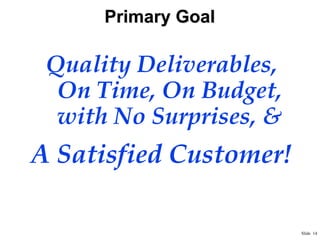
Primary Goal

Quality Deliverables,
On Time, On Budget,
with No Surprises, &

A Satisfied Customer!
Slide 14
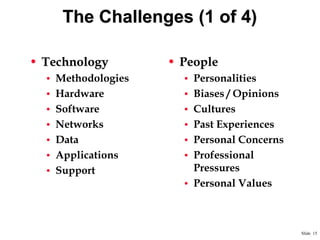
The Challenges (1 of 4)
• Technology

• People

• Methodologies

• Personalities

• Hardware

• Biases / Opinions

• Software

• Cultures

• Networks

• Past Experiences

• Data

• Personal Concerns

• Applications

• Professional

• Support

Pressures
• Personal Values

Slide 15
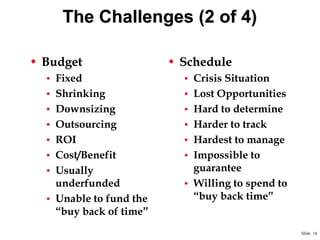
The Challenges (2 of 4)
• Budget

• Schedule

• Fixed

• Crisis Situation

• Shrinking

• Lost Opportunities

• Downsizing

• Hard to determine

• Outsourcing

• Harder to track

• ROI

• Hardest to manage

• Cost/Benefit

• Impossible to

• Usually

guarantee
• Willing to spend to
“buy back time”

underfunded
• Unable to fund the
“buy back of time”

Slide 16
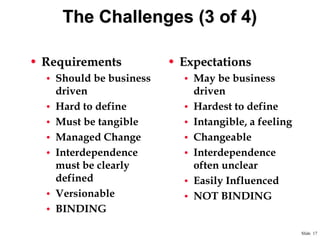
The Challenges (3 of 4)
• Requirements
• Should be business
•
•
•
•

•
•

driven
Hard to define
Must be tangible
Managed Change
Interdependence
must be clearly
defined
Versionable
BINDING

• Expectations
• May be business
•
•
•
•
•
•

driven
Hardest to define
Intangible, a feeling
Changeable
Interdependence
often unclear
Easily Influenced
NOT BINDING

Slide 17
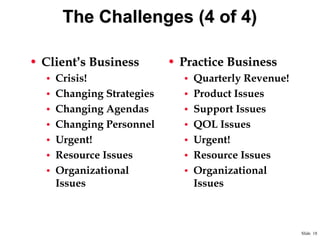
The Challenges (4 of 4)
• Client‟s Business

• Practice Business

• Crisis!

• Quarterly Revenue!

• Changing Strategies

• Product Issues

• Changing Agendas

• Support Issues

• Changing Personnel

• QOL Issues

• Urgent!

• Urgent!

• Resource Issues

• Resource Issues

• Organizational

• Organizational

Issues

Issues

Slide 18
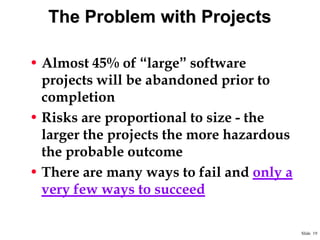
The Problem with Projects
• Almost 45% of “large” software
projects will be abandoned prior to
completion
• Risks are proportional to size - the
larger the projects the more hazardous
the probable outcome
• There are many ways to fail and only a
very few ways to succeed
Slide 19
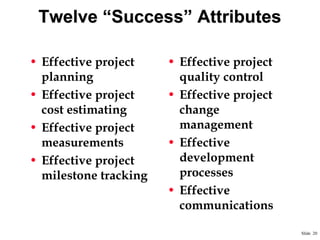
Twelve “Success” Attributes
• Effective project
planning
• Effective project
cost estimating
• Effective project
measurements
• Effective project
milestone tracking

• Effective project
quality control
• Effective project
change
management
• Effective
development
processes
• Effective
communications
Slide 20
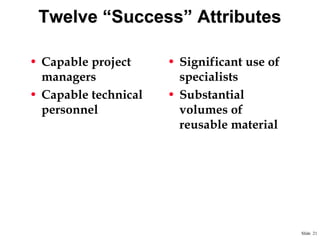
Twelve “Success” Attributes
• Capable project
managers
• Capable technical
personnel

• Significant use of
specialists
• Substantial
volumes of
reusable material

Slide 21
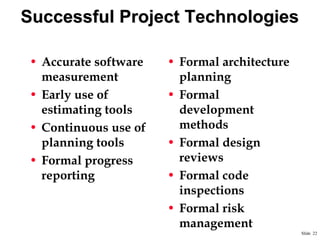
Successful Project Technologies
• Accurate software
measurement
• Early use of
estimating tools
• Continuous use of
planning tools
• Formal progress
reporting

• Formal architecture
planning
• Formal
development
methods
• Formal design
reviews
• Formal code
inspections
• Formal risk
management
Slide 22
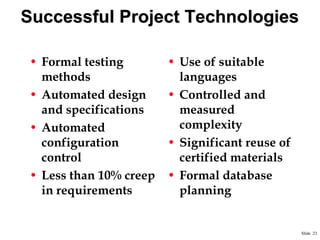
Successful Project Technologies
• Formal testing
methods
• Automated design
and specifications
• Automated
configuration
control
• Less than 10% creep
in requirements

• Use of suitable
languages
• Controlled and
measured
complexity
• Significant reuse of
certified materials
• Formal database
planning

Slide 23
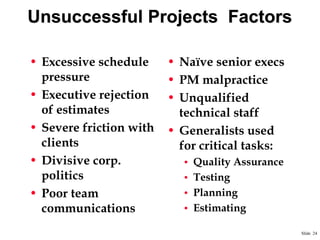
Unsuccessful Projects Factors
• Excessive schedule
pressure
• Executive rejection
of estimates
• Severe friction with
clients
• Divisive corp.
politics
• Poor team
communications

• Naïve senior execs
• PM malpractice
• Unqualified
technical staff
• Generalists used
for critical tasks:
• Quality Assurance
• Testing
• Planning
• Estimating
Slide 24
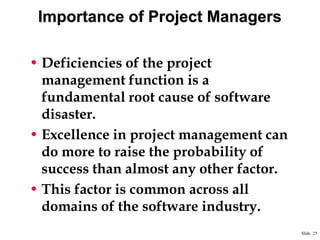
Importance of Project Managers
• Deficiencies of the project
management function is a
fundamental root cause of software
disaster.
• Excellence in project management can
do more to raise the probability of
success than almost any other factor.
• This factor is common across all
domains of the software industry.
Slide 25
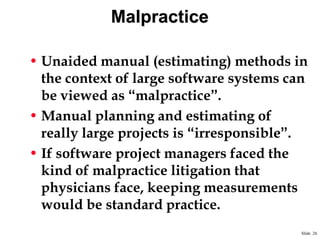
Malpractice
• Unaided manual (estimating) methods in
the context of large software systems can
be viewed as “malpractice”.
• Manual planning and estimating of
really large projects is “irresponsible”.
• If software project managers faced the
kind of malpractice litigation that
physicians face, keeping measurements
would be standard practice.
Slide 26
Who are our Customers?
• The Consultants
• The Customer
• The „Sales Folks‟
• Your Manager

Slide 27
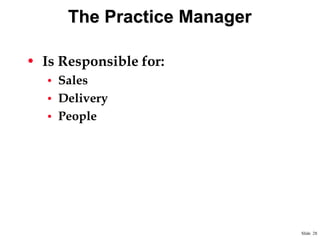
The Practice Manager
• Is Responsible for:
• Sales
• Delivery
• People

Slide 28
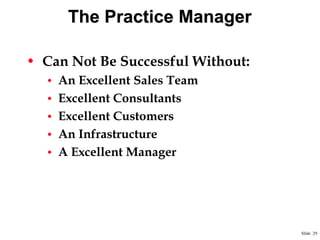
The Practice Manager
• Can Not Be Successful Without:
• An Excellent Sales Team
• Excellent Consultants
• Excellent Customers

• An Infrastructure
• A Excellent Manager

Slide 29
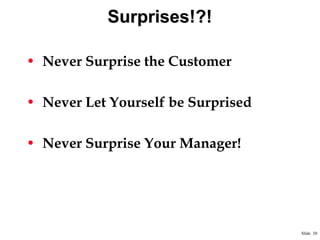
Surprises!?!
• Never Surprise the Customer
• Never Let Yourself be Surprised
• Never Surprise Your Manager!

Slide 30
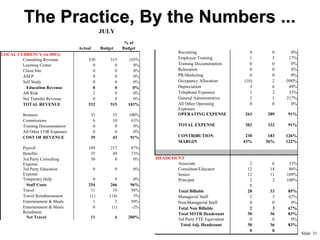
The Practice, By the Numbers ...
JULY
Actual
LOCAL CURRENCY (in 000's)
Consulting Revenue
Learning Center
Client Site
ASEP
Self Study
Education Revenue
AR Risk
Net Transfer Revenue
TOTAL REVENUE
Bonuses
Commissions
Training Documentation
All Other COR Expenses
COST OF REVENUE
Payroll
Benefits
3rd Party Consulting
Expense
3rd Party Education
Expense
Temporary Help
Staff Costs
Travel
Travel Reimbursement
Entertainment & Meals
Reimburse
Net Travel

% of
Budget

Budget

530
0
0
0
0
0
2
0
532

515
0
0
0
0
0
0
0
515

103%
0%
0%
0%
0%
0%
0%
0%
103%

33
6
0
0
39

33
10
0
0
43

100%
63%
0%
0%
91%

189
35
30

217
49
0

87%
73%
0%

0

0

0%

0
254
11
(1)
1
0

0
266
19
(14)
2
(1)

0%
96%
58%
5%
50%
-2%

11

6

200%

Recruiting
Employee Training
Training Documentation
Relocation
PR/Marketing
Occupancy Allocation
Depreciation
Telephone Expenses
General Administrative
All Other Operating
Expenses
OPERATING EXPENSE

0
1
0
0
0
(10)
3
1
2
0

0
5
0
0
0
2
6
2
1
0

0%
17%
0%
0%
0%
-500%
49%
33%
217%
0%

263

289

91%

TOTAL EXPENSE

302

332

91%

CONTRIBUTION
MARGIN

230
43%

183
36%

126%
122%

2
12
12
2
0
28
2
0
2
30
0
30
0

6
14
11
2

33%
86%
109%
100%

33
3
0
3
36
0
36
0

85%
67%
0%
67%
83%
0%
83%

HEADCOUNT
Associate
Consultant/Educator
Senior
Principal
Total Billable
Managerial Staff
Non-Managerial Staff
Total Non Billable
Total MSTR Headcount
3rd Party FTE Equivalent
Total Adj. Headcount

Slide 31
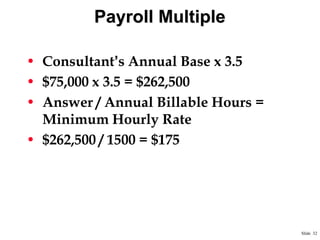
Payroll Multiple
• Consultant‟s Annual Base x 3.5
• $75,000 x 3.5 = $262,500
• Answer / Annual Billable Hours =
Minimum Hourly Rate
• $262,500 / 1500 = $175

Slide 32
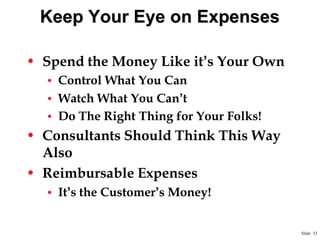
Keep Your Eye on Expenses
• Spend the Money Like it‟s Your Own
• Control What You Can
• Watch What You Can‟t
• Do The Right Thing for Your Folks!

• Consultants Should Think This Way
Also
• Reimbursable Expenses
• It‟s the Customer‟s Money!

Slide 33
Things!?!
• Do Things Right!

• Do The Right Things!

Slide 35
Know Your Customer
Or
MBWA

Slide 36
Execution
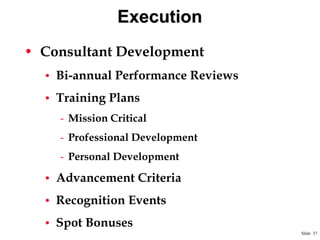
• Consultant Development
• Bi-annual Performance Reviews
• Training Plans

- Mission Critical
- Professional Development
- Personal Development
• Advancement Criteria
• Recognition Events
• Spot Bonuses
Slide 37
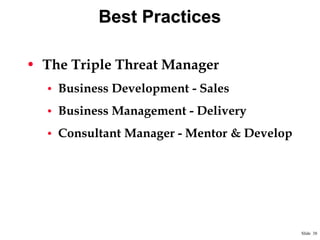
Best Practices
• The Triple Threat Manager
• Business Development - Sales
• Business Management - Delivery
• Consultant Manager - Mentor & Develop

Slide 38
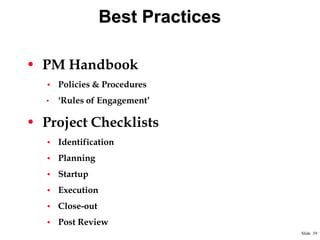
Best Practices
• PM Handbook
• Policies & Procedures
•

„Rules of Engagement‟

• Project Checklists
• Identification
• Planning
• Startup

• Execution
• Close-out
• Post Review
Slide 39
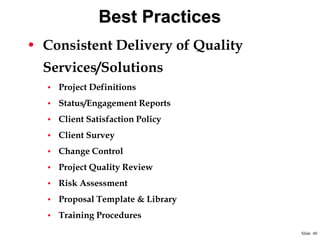
Best Practices
• Consistent Delivery of Quality
Services/Solutions
• Project Definitions
• Status/Engagement Reports
• Client Satisfaction Policy
• Client Survey
• Change Control
• Project Quality Review
• Risk Assessment

• Proposal Template & Library
• Training Procedures
Slide 40
Excellence
Excellence is ultimately....
persevering when others think the task
is too difficult,
risking more than others think is
healthy,
caring more than many think is prudent,
and
expecting more than others think is
possible.
Slide 41

Successful Professional Services Practice

  • 1.
    Building a SuccessfulPractice Making & Keeping it Profitable Presented by: Chuck Crafton © 2001 Slide 1
  • 2.
    Success Factors fora Consulting Practice Customer Focus/Quality Communication/Interpersonal Skills Execution/Productivity Team Participation Innovation and Problem Solving Leadership/Employee Development Technical/Functional Skills Slide 2
  • 3.
    Success Factors alignsindividuals and teams with strategy in order to achieve business results. Key Players for the Future Right Person in the Right Job Succession Planning Strategy Major Business objectives Business Results Success Factors Planning BU plans to support its objectives Staffing Performance Management Clearly defined performance expectations Leadership Development T&D programs that strengthen critical skills Slide 3
  • 4.
    Goals & Mission •Work Directly with AEs & BD/Channels in the Territories to: • Assist in -DRIVE- the Sales Strategy - Sales Calls - Briefings - Proposals • Deliver Solutions! Slide 4
  • 5.
    The Retention Triangle TheWork • Consultants are driven by: • • • Compensation The work/assignment The ability to learn new skills and technologies $ Learning Slide 5
  • 6.
    The Retention Triangle TheWork The goal is to create an environment where the focus of the consultant is on the challenge of the work that they are doing and the constant ability to learn new skills and Technology. If the consultant looses focus on the two non-monetary aspects of their career, then the next best offer will win them away! It is the responsibility managers to keep the focus: $ Up and to the Right! Learning Slide 6
  • 7.
    Control Your OwnDestiny Building Blocks Of An Effective Organization 1. 2. 3. 4. A sense of urgency A commitment to excellence A healthy discontent for the way things are An appreciation for the awesome responsibility of leadership Slide 7
  • 8.
    If you weregoing to be accused of being a Project Manager, would there be enough evidence to convict you? Slide 8
  • 9.
    Project Management • EVIDENCEof the 3 C’s and the 3 R’s 3 C’s: – Command • Organization • Roles & responsibilities • Strategic & Tactical Control Slide 9
  • 10.
    Project Management – Control •Plan (tasks, durations, dependencies, resources, …) • Risk Management • Requirements Management • Change Management • Configuration Management • Final Acceptance Definition • Testing Strategy Slide 10
  • 11.
    Project Management – Communication • • • • StatusReports (internal, external, consultant) Reviews and Approvals (signoffs) Formal Deliveries Action Items/Issues Tracking Slide 11
  • 12.
    Project Management 3 R’s: –Requirements • • • • • Contract Specifications Standards & Constraints Assumptions Agreed to definitions, designs, deliverables Slide 12
  • 13.
    Project Management – Resources •Time (schedule) • Talent (MSTR, client, and subs) • Tangibles (equipment, travel, training, …) – Revenue • Budget vs Actual • Timely Reporting and Invoicing • Profitability Slide 13
  • 14.
    Primary Goal Quality Deliverables, OnTime, On Budget, with No Surprises, & A Satisfied Customer! Slide 14
  • 15.
    The Challenges (1of 4) • Technology • People • Methodologies • Personalities • Hardware • Biases / Opinions • Software • Cultures • Networks • Past Experiences • Data • Personal Concerns • Applications • Professional • Support Pressures • Personal Values Slide 15
  • 16.
    The Challenges (2of 4) • Budget • Schedule • Fixed • Crisis Situation • Shrinking • Lost Opportunities • Downsizing • Hard to determine • Outsourcing • Harder to track • ROI • Hardest to manage • Cost/Benefit • Impossible to • Usually guarantee • Willing to spend to “buy back time” underfunded • Unable to fund the “buy back of time” Slide 16
  • 17.
    The Challenges (3of 4) • Requirements • Should be business • • • • • • driven Hard to define Must be tangible Managed Change Interdependence must be clearly defined Versionable BINDING • Expectations • May be business • • • • • • driven Hardest to define Intangible, a feeling Changeable Interdependence often unclear Easily Influenced NOT BINDING Slide 17
  • 18.
    The Challenges (4of 4) • Client‟s Business • Practice Business • Crisis! • Quarterly Revenue! • Changing Strategies • Product Issues • Changing Agendas • Support Issues • Changing Personnel • QOL Issues • Urgent! • Urgent! • Resource Issues • Resource Issues • Organizational • Organizational Issues Issues Slide 18
  • 19.
    The Problem withProjects • Almost 45% of “large” software projects will be abandoned prior to completion • Risks are proportional to size - the larger the projects the more hazardous the probable outcome • There are many ways to fail and only a very few ways to succeed Slide 19
  • 20.
    Twelve “Success” Attributes •Effective project planning • Effective project cost estimating • Effective project measurements • Effective project milestone tracking • Effective project quality control • Effective project change management • Effective development processes • Effective communications Slide 20
  • 21.
    Twelve “Success” Attributes •Capable project managers • Capable technical personnel • Significant use of specialists • Substantial volumes of reusable material Slide 21
  • 22.
    Successful Project Technologies •Accurate software measurement • Early use of estimating tools • Continuous use of planning tools • Formal progress reporting • Formal architecture planning • Formal development methods • Formal design reviews • Formal code inspections • Formal risk management Slide 22
  • 23.
    Successful Project Technologies •Formal testing methods • Automated design and specifications • Automated configuration control • Less than 10% creep in requirements • Use of suitable languages • Controlled and measured complexity • Significant reuse of certified materials • Formal database planning Slide 23
  • 24.
    Unsuccessful Projects Factors •Excessive schedule pressure • Executive rejection of estimates • Severe friction with clients • Divisive corp. politics • Poor team communications • Naïve senior execs • PM malpractice • Unqualified technical staff • Generalists used for critical tasks: • Quality Assurance • Testing • Planning • Estimating Slide 24
  • 25.
    Importance of ProjectManagers • Deficiencies of the project management function is a fundamental root cause of software disaster. • Excellence in project management can do more to raise the probability of success than almost any other factor. • This factor is common across all domains of the software industry. Slide 25
  • 26.
    Malpractice • Unaided manual(estimating) methods in the context of large software systems can be viewed as “malpractice”. • Manual planning and estimating of really large projects is “irresponsible”. • If software project managers faced the kind of malpractice litigation that physicians face, keeping measurements would be standard practice. Slide 26
  • 27.
    Who are ourCustomers? • The Consultants • The Customer • The „Sales Folks‟ • Your Manager Slide 27
  • 28.
    The Practice Manager •Is Responsible for: • Sales • Delivery • People Slide 28
  • 29.
    The Practice Manager •Can Not Be Successful Without: • An Excellent Sales Team • Excellent Consultants • Excellent Customers • An Infrastructure • A Excellent Manager Slide 29
  • 30.
    Surprises!?! • Never Surprisethe Customer • Never Let Yourself be Surprised • Never Surprise Your Manager! Slide 30
  • 31.
    The Practice, Bythe Numbers ... JULY Actual LOCAL CURRENCY (in 000's) Consulting Revenue Learning Center Client Site ASEP Self Study Education Revenue AR Risk Net Transfer Revenue TOTAL REVENUE Bonuses Commissions Training Documentation All Other COR Expenses COST OF REVENUE Payroll Benefits 3rd Party Consulting Expense 3rd Party Education Expense Temporary Help Staff Costs Travel Travel Reimbursement Entertainment & Meals Entertainment & Meals Reimburse Net Travel % of Budget Budget 530 0 0 0 0 0 2 0 532 515 0 0 0 0 0 0 0 515 103% 0% 0% 0% 0% 0% 0% 0% 103% 33 6 0 0 39 33 10 0 0 43 100% 63% 0% 0% 91% 189 35 30 217 49 0 87% 73% 0% 0 0 0% 0 254 11 (1) 1 0 0 266 19 (14) 2 (1) 0% 96% 58% 5% 50% -2% 11 6 200% Recruiting Employee Training Training Documentation Relocation PR/Marketing Occupancy Allocation Depreciation Telephone Expenses General Administrative All Other Operating Expenses OPERATING EXPENSE 0 1 0 0 0 (10) 3 1 2 0 0 5 0 0 0 2 6 2 1 0 0% 17% 0% 0% 0% -500% 49% 33% 217% 0% 263 289 91% TOTAL EXPENSE 302 332 91% CONTRIBUTION MARGIN 230 43% 183 36% 126% 122% 2 12 12 2 0 28 2 0 2 30 0 30 0 6 14 11 2 33% 86% 109% 100% 33 3 0 3 36 0 36 0 85% 67% 0% 67% 83% 0% 83% HEADCOUNT Associate Consultant/Educator Senior Principal Total Billable Managerial Staff Non-Managerial Staff Total Non Billable Total MSTR Headcount 3rd Party FTE Equivalent Total Adj. Headcount Slide 31
  • 32.
    Payroll Multiple • Consultant‟sAnnual Base x 3.5 • $75,000 x 3.5 = $262,500 • Answer / Annual Billable Hours = Minimum Hourly Rate • $262,500 / 1500 = $175 Slide 32
  • 33.
    Keep Your Eyeon Expenses • Spend the Money Like it‟s Your Own • Control What You Can • Watch What You Can‟t • Do The Right Thing for Your Folks! • Consultants Should Think This Way Also • Reimbursable Expenses • It‟s the Customer‟s Money! Slide 33
  • 34.
    Things!?! • Do ThingsRight! • Do The Right Things! Slide 35
  • 35.
  • 36.
    Execution • Consultant Development •Bi-annual Performance Reviews • Training Plans - Mission Critical - Professional Development - Personal Development • Advancement Criteria • Recognition Events • Spot Bonuses Slide 37
  • 37.
    Best Practices • TheTriple Threat Manager • Business Development - Sales • Business Management - Delivery • Consultant Manager - Mentor & Develop Slide 38
  • 38.
    Best Practices • PMHandbook • Policies & Procedures • „Rules of Engagement‟ • Project Checklists • Identification • Planning • Startup • Execution • Close-out • Post Review Slide 39
  • 39.
    Best Practices • ConsistentDelivery of Quality Services/Solutions • Project Definitions • Status/Engagement Reports • Client Satisfaction Policy • Client Survey • Change Control • Project Quality Review • Risk Assessment • Proposal Template & Library • Training Procedures Slide 40
  • 40.
    Excellence Excellence is ultimately.... perseveringwhen others think the task is too difficult, risking more than others think is healthy, caring more than many think is prudent, and expecting more than others think is possible. Slide 41