SUPPLY CHAIN
MANAGEMENT
GUIDE
Compiled by: Ioannis Dermitzakis
1. Introduction
INTRODUCTION
The series of slides is a basic introduction into Supply
Chain Management and it should be used as such, to
introduce to the staff of your organisation to the
concepts, theories, working and advantages of having
a fully functioning integrated Supply Chain.
Successful introduction, training and acceptance of
supply chain concepts throughout the whole
organisation has been achieved in large and small
organisation including SABIC in the middle east.
KEY CONCEPTS SUPPLY CHAIN
SUPPLY CHAIN IS:
the sequence of suppliers that contribute to the
creation and delivery of a good or service to end
customers.
Logistics is:
the management of the storage and flow of goods,
services and information throughout your
organisation.
Supply Chain Management is:
organizing the cost effective flow and storage of
materials, in-process inventory, finished goods and
related information from point of origin to point of
consumption to satisfy customer requirements.
A Business Philosophy
A way of doing business with your
customers and suppliers.
KEY CONCEPTS: A PHILOSOPHY
PRINCIPAL ISSUES: SUPPLY CHAIN (1)
Supply Chain
The supply chain of a company consists of
different departments, ranging from
procurement of materials to customer
service.
The supply chain includes activities
associated with inventory (materials)
acquisition, storing, use in production,
transit, and delivery to customers.
PRINCIPAL ISSUES: SUPPLY CHAIN (2)
The activities are planned, executed, and
monitored under the guidelines set by
the company’s chosen customer service
levels and in line with the company’s
other operating goals.
PRINCIPAL ISSUES: ELEMENTS OF LOGISTICS
Elements of Logistics:
 materials management:
sourcing and receiving of raw materials or
unfinished products for subsequent use
 material flow system:
the ability to locate and schedule material
through to end production and disposition
 physical distribution:
the delivery of finished goods to customers
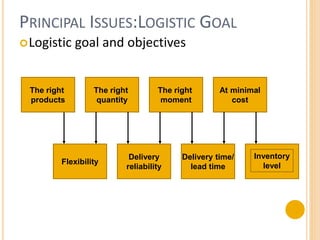
PRINCIPAL ISSUES:LOGISTIC GOAL
Logistic goal and objectives
The right
products
The right
quantity
The right
moment
At minimal
cost
Flexibility
Delivery
reliability
Delivery time/
lead time
Inventory
level
PRINCIPAL ISSUES: LOGISTIC STEPS
Logistic steps:
 accepting a customer order
receive and enter
credit clearance / authorize
delivery commitment
 supplier ordering
 forecasting demand
 scheduling manufacturing
 inventory management
 delivery to customer.
PRINCIPAL ISSUES . EVOLUTION
Quality products
Lowest possible cost
Order fulfillment
Integration of supply chains
Customer service
Preferred partners
Communication
Supply chain communities
Common goals, objectives
PRINCIPAL ISSUES: THE GOAL
Supply Chain Management Goal
To evolve a company’s supply chain into
an optimally efficient, customer-satisfying
process, where the effectiveness of the
whole supply chain is more important
than the effectiveness of each individual
department.
PRINCIPAL ISSUES: FOCUS
Supply Chain Management focuses on
business processes:
 product design
 planning
 order management
 stock management
instead of functions:
 sales
 purchasing
 production
PRINCIPAL ISSUES: DRIVERS OF CHANGE (1)
Drivers of change:
 outsourcing trend
 actual customer demand: speed,
flexibility and competitive pricing
 new software: ERP, sophisticated
application software
 new technologies
Electronic Data Interchange (EDI)
internet, intranet, extranet
wireless communications
teleconferencing and telecommuting
bar coding.
PRINCIPAL ISSUES: DRIVERS OF CHANGE (2)
PRINCIPAL ISSUES: ACTIVITIES
Supply chain management activities:
 Forecasting demand
 Selecting suppliers
 Ordering material
 Managing inventory
 Scheduling production
 Shipping and delivery
 Organizing information exchange
ANALYSIS: DIAGRAM
Understand the
customer
Understand the
product
Understand the
process
Understand the
information flow
ANALYSIS :UNDERSTAND THE CUSTOMER (1)
Know and understand the customers:
 Your existing customers, i.e.,
demographics
existing and potential number
income levels?
 Who are your potential customers?
 How might these customers be grouped?
 For which percentage of sales is each group
responsible?
ANALYSIS: UNDERSTAND THE CUSTOMER (2)
 What is the effect of various methods of
communications (i.e., telephone, fax, e-
mail, internet telephone systems) in
your relation with your customers?
 What do your customers want from
you?
 How well do your competitors meet
customers needs?
ANALYSIS: UNDERSTAND THE PRODUCTS
Understand the products:
 How many?
 Where are they?
 Which percentage of sales?
 What is the product life cycle?
 What is the product mix?
ANALYSIS: UNDERSTAND THE PROCESS
Understand the production process:
 process flow
linear flow
job shop - batch flow
assembly line
continuous flow
project flow
 order fulfillment strategy
make-to-order
make-to-stock.
ANALYSIS: UNDERSTAND THE INFORMATION FLOW
Understand the information flow:
 What information is required for
effective decision-making at each stage
in the supply chain?
 What data has to flow between each
part of the supply chain?
PERFORMANCE INDICATORS (1)
A total view must be taken in assessing
performance.
Performance measurements need to be focused
on what factors add to total performance, total
value or total cost.
The principle performance indicator is customer
service. Optimum service levels are necessary
from each supplier to each customer throughout
the supply chain.
PERFORMANCE INDICATORS (2)
Suppliers Inputs
Adding
value
Outputs Customers Results
Effectiveness
Efficiency
Productivity
Profitability
Customer Service + Quality
Customer
Service
PERFORMANCE INDICATORS (3)
Effectiveness:
 accomplishment of the right things, on
time, within the requirements specified.
Efficiency:
 resources expected to be consumed
divided by resources actually
consumed.
PERFORMANCE INDICATORS (4)
Productivity:
 measures of output divided by
measures of input for a given period of
time.
Profitability:
 relationship between revenues and
costs.
CONCLUSION
Intro to SCM
Process of SCM
KPI’s of SCM

Supply_Chain_Management_An_introduction.ppt

  • 1.
  • 2.
  • 3.
    INTRODUCTION The series ofslides is a basic introduction into Supply Chain Management and it should be used as such, to introduce to the staff of your organisation to the concepts, theories, working and advantages of having a fully functioning integrated Supply Chain. Successful introduction, training and acceptance of supply chain concepts throughout the whole organisation has been achieved in large and small organisation including SABIC in the middle east.
  • 4.
    KEY CONCEPTS SUPPLYCHAIN SUPPLY CHAIN IS: the sequence of suppliers that contribute to the creation and delivery of a good or service to end customers. Logistics is: the management of the storage and flow of goods, services and information throughout your organisation. Supply Chain Management is: organizing the cost effective flow and storage of materials, in-process inventory, finished goods and related information from point of origin to point of consumption to satisfy customer requirements.
  • 5.
    A Business Philosophy Away of doing business with your customers and suppliers. KEY CONCEPTS: A PHILOSOPHY
  • 6.
    PRINCIPAL ISSUES: SUPPLYCHAIN (1) Supply Chain The supply chain of a company consists of different departments, ranging from procurement of materials to customer service. The supply chain includes activities associated with inventory (materials) acquisition, storing, use in production, transit, and delivery to customers.
  • 7.
    PRINCIPAL ISSUES: SUPPLYCHAIN (2) The activities are planned, executed, and monitored under the guidelines set by the company’s chosen customer service levels and in line with the company’s other operating goals.
  • 8.
    PRINCIPAL ISSUES: ELEMENTSOF LOGISTICS Elements of Logistics:  materials management: sourcing and receiving of raw materials or unfinished products for subsequent use  material flow system: the ability to locate and schedule material through to end production and disposition  physical distribution: the delivery of finished goods to customers
  • 9.
    PRINCIPAL ISSUES:LOGISTIC GOAL Logisticgoal and objectives The right products The right quantity The right moment At minimal cost Flexibility Delivery reliability Delivery time/ lead time Inventory level
  • 10.
    PRINCIPAL ISSUES: LOGISTICSTEPS Logistic steps:  accepting a customer order receive and enter credit clearance / authorize delivery commitment  supplier ordering  forecasting demand  scheduling manufacturing  inventory management  delivery to customer.
  • 11.
    PRINCIPAL ISSUES .EVOLUTION Quality products Lowest possible cost Order fulfillment Integration of supply chains Customer service Preferred partners Communication Supply chain communities Common goals, objectives
  • 12.
    PRINCIPAL ISSUES: THEGOAL Supply Chain Management Goal To evolve a company’s supply chain into an optimally efficient, customer-satisfying process, where the effectiveness of the whole supply chain is more important than the effectiveness of each individual department.
  • 13.
    PRINCIPAL ISSUES: FOCUS SupplyChain Management focuses on business processes:  product design  planning  order management  stock management instead of functions:  sales  purchasing  production
  • 14.
    PRINCIPAL ISSUES: DRIVERSOF CHANGE (1) Drivers of change:  outsourcing trend  actual customer demand: speed, flexibility and competitive pricing  new software: ERP, sophisticated application software
  • 15.
     new technologies ElectronicData Interchange (EDI) internet, intranet, extranet wireless communications teleconferencing and telecommuting bar coding. PRINCIPAL ISSUES: DRIVERS OF CHANGE (2)
  • 16.
    PRINCIPAL ISSUES: ACTIVITIES Supplychain management activities:  Forecasting demand  Selecting suppliers  Ordering material  Managing inventory  Scheduling production  Shipping and delivery  Organizing information exchange
  • 17.
    ANALYSIS: DIAGRAM Understand the customer Understandthe product Understand the process Understand the information flow
  • 18.
    ANALYSIS :UNDERSTAND THECUSTOMER (1) Know and understand the customers:  Your existing customers, i.e., demographics existing and potential number income levels?  Who are your potential customers?  How might these customers be grouped?  For which percentage of sales is each group responsible?
  • 19.
    ANALYSIS: UNDERSTAND THECUSTOMER (2)  What is the effect of various methods of communications (i.e., telephone, fax, e- mail, internet telephone systems) in your relation with your customers?  What do your customers want from you?  How well do your competitors meet customers needs?
  • 20.
    ANALYSIS: UNDERSTAND THEPRODUCTS Understand the products:  How many?  Where are they?  Which percentage of sales?  What is the product life cycle?  What is the product mix?
  • 21.
    ANALYSIS: UNDERSTAND THEPROCESS Understand the production process:  process flow linear flow job shop - batch flow assembly line continuous flow project flow  order fulfillment strategy make-to-order make-to-stock.
  • 22.
    ANALYSIS: UNDERSTAND THEINFORMATION FLOW Understand the information flow:  What information is required for effective decision-making at each stage in the supply chain?  What data has to flow between each part of the supply chain?
  • 23.
    PERFORMANCE INDICATORS (1) Atotal view must be taken in assessing performance. Performance measurements need to be focused on what factors add to total performance, total value or total cost. The principle performance indicator is customer service. Optimum service levels are necessary from each supplier to each customer throughout the supply chain.
  • 24.
    PERFORMANCE INDICATORS (2) SuppliersInputs Adding value Outputs Customers Results Effectiveness Efficiency Productivity Profitability Customer Service + Quality Customer Service
  • 25.
    PERFORMANCE INDICATORS (3) Effectiveness: accomplishment of the right things, on time, within the requirements specified. Efficiency:  resources expected to be consumed divided by resources actually consumed.
  • 26.
    PERFORMANCE INDICATORS (4) Productivity: measures of output divided by measures of input for a given period of time. Profitability:  relationship between revenues and costs.
  • 27.
    CONCLUSION Intro to SCM Processof SCM KPI’s of SCM