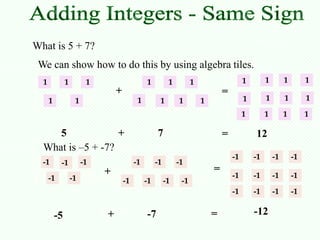
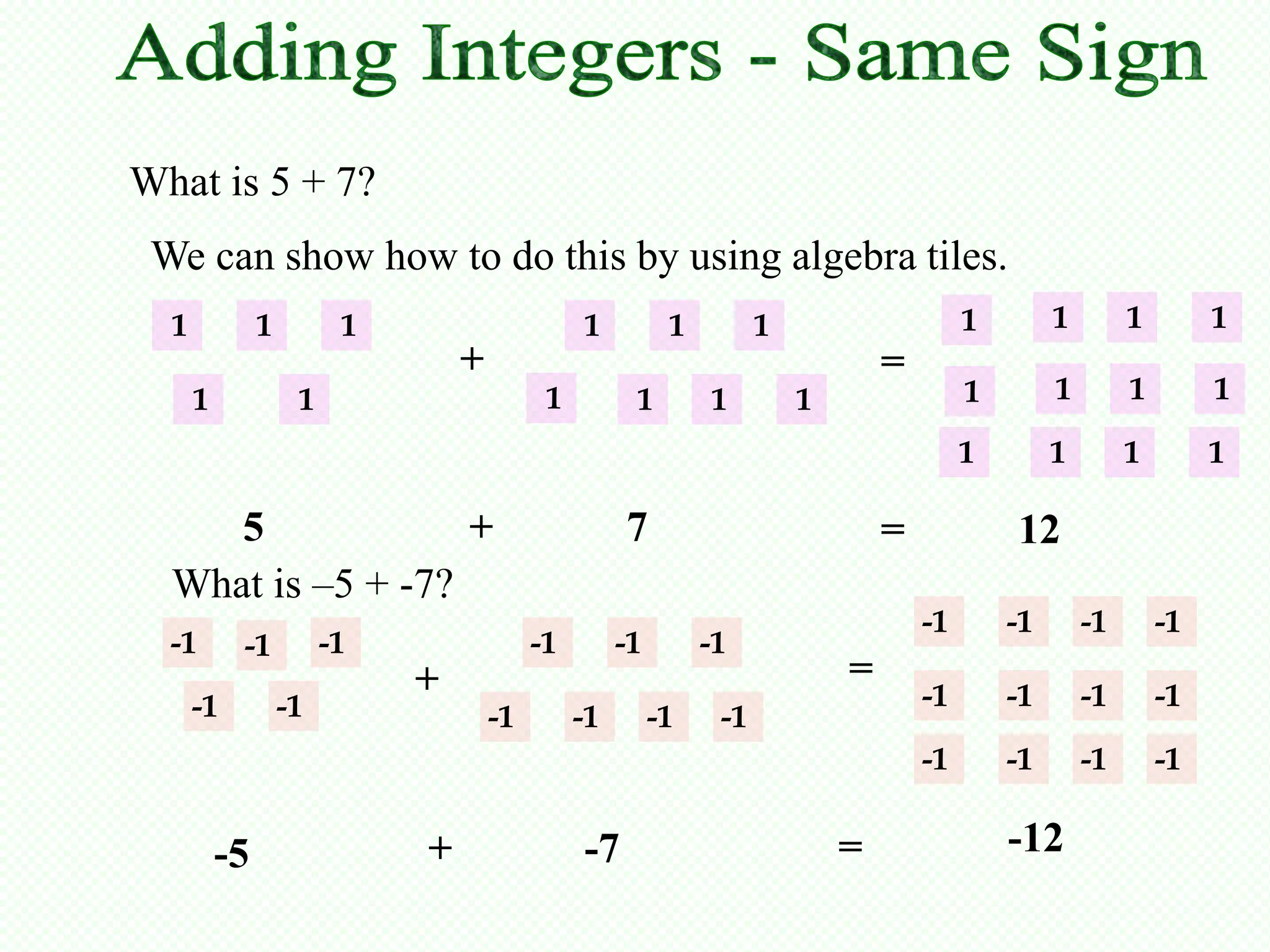
What is 5 + 7?
 We can show how to do this by using algebra tiles.
  1            1         1                     1          1         1                    1        1        1        1
                                 +                                              =
      1             1                      1         1        1         1                1        1        1        1

                                                                                         1        1        1        1

     5             +                                7                           =            12
  What is –5 + -7?
                                                                                    -1       -1       -1       -1
  -1       -1           -1                -1        -1        -1
                             +                                              =
      -1           -1                                                               -1       -1       -1       -1
                                     -1        -1        -1    -1
                                                                                    -1       -1       -1       -1


          -5                 +                 -7                           =                -12
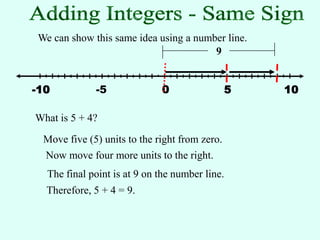
We can show this same idea using a number line.
                                       9


-10          -5              0                 5   10

What is 5 + 4?

 Move five (5) units to the right from zero.
 Now move four more units to the right.
  The final point is at 9 on the number line.
  Therefore, 5 + 4 = 9.
-9


-10           -5               0              5   10

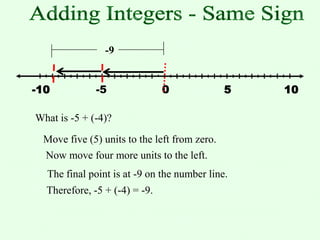
What is -5 + (-4)?

 Move five (5) units to the left from zero.
 Now move four more units to the left.
  The final point is at -9 on the number line.
  Therefore, -5 + (-4) = -9.
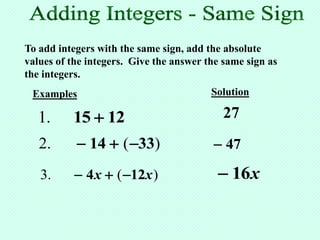
To add integers with the same sign, add the absolute
values of the integers. Give the answer the same sign as
the integers.
 Examples                                Solution

  1.      15  12                           27
   2.       14  ( 33)                  47

   3.      4 x  ( 12x )                 16x
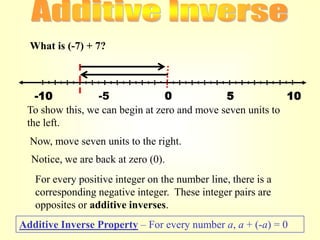
What is (-7) + 7?


   -10           -5              0            5             10
 To show this, we can begin at zero and move seven units to
 the left.
  Now, move seven units to the right.
  Notice, we are back at zero (0).
   For every positive integer on the number line, there is a
   corresponding negative integer. These integer pairs are
   opposites or additive inverses.
Additive Inverse Property – For every number a, a + (-a) = 0
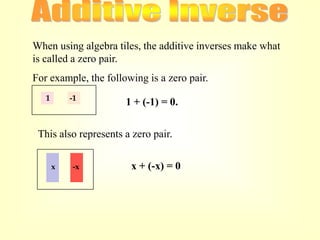
When using algebra tiles, the additive inverses make what
is called a zero pair.
For example, the following is a zero pair.
   1       -1
                      1 + (-1) = 0.


 This also represents a zero pair.

       x   -x          x + (-x) = 0
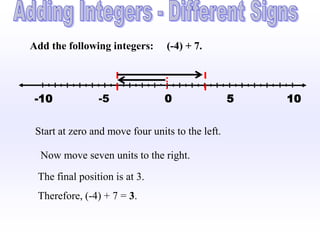
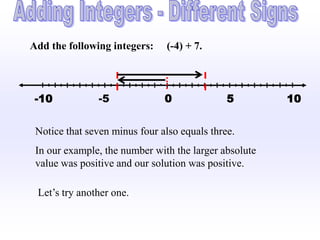
Add the following integers:      (-4) + 7.


 -10            -5               0                5   10


 Start at zero and move four units to the left.

  Now move seven units to the right.

 The final position is at 3.
 Therefore, (-4) + 7 = 3.
Add the following integers:     (-4) + 7.


 -10           -5              0              5        10


 Notice that seven minus four also equals three.
 In our example, the number with the larger absolute
 value was positive and our solution was positive.

 Let’s try another one.
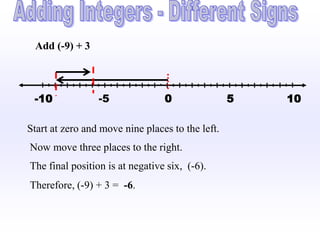
Add (-9) + 3


 -10             -5              0                5   10

Start at zero and move nine places to the left.
Now move three places to the right.
The final position is at negative six, (-6).
Therefore, (-9) + 3 = -6.
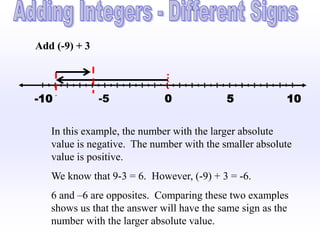
Add (-9) + 3


-10            -5            0             5             10


   In this example, the number with the larger absolute
   value is negative. The number with the smaller absolute
   value is positive.
   We know that 9-3 = 6. However, (-9) + 3 = -6.
   6 and –6 are opposites. Comparing these two examples
   shows us that the answer will have the same sign as the
   number with the larger absolute value.
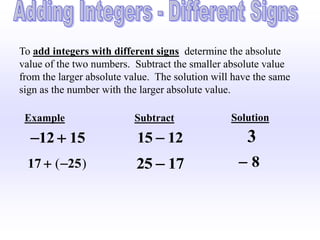
To add integers with different signs determine the absolute
value of the two numbers. Subtract the smaller absolute value
from the larger absolute value. The solution will have the same
sign as the number with the larger absolute value.

 Example                  Subtract               Solution

  12  15                 15  12                   3
 17  ( 25 )              25  17                8

Adding Integers

  • 1.
    What is 5+ 7? We can show how to do this by using algebra tiles. 1 1 1 1 1 1 1 1 1 1 + = 1 1 1 1 1 1 1 1 1 1 1 1 1 1 5 + 7 = 12 What is –5 + -7? -1 -1 -1 -1 -1 -1 -1 -1 -1 -1 + = -1 -1 -1 -1 -1 -1 -1 -1 -1 -1 -1 -1 -1 -1 -5 + -7 = -12
  • 2.
    We can showthis same idea using a number line. 9 -10 -5 0 5 10 What is 5 + 4? Move five (5) units to the right from zero. Now move four more units to the right. The final point is at 9 on the number line. Therefore, 5 + 4 = 9.
  • 3.
    -9 -10 -5 0 5 10 What is -5 + (-4)? Move five (5) units to the left from zero. Now move four more units to the left. The final point is at -9 on the number line. Therefore, -5 + (-4) = -9.
  • 4.
    To add integerswith the same sign, add the absolute values of the integers. Give the answer the same sign as the integers. Examples Solution 1. 15  12 27 2.  14  ( 33)  47 3.  4 x  ( 12x )  16x
  • 5.
    What is (-7)+ 7? -10 -5 0 5 10 To show this, we can begin at zero and move seven units to the left. Now, move seven units to the right. Notice, we are back at zero (0). For every positive integer on the number line, there is a corresponding negative integer. These integer pairs are opposites or additive inverses. Additive Inverse Property – For every number a, a + (-a) = 0
  • 6.
    When using algebratiles, the additive inverses make what is called a zero pair. For example, the following is a zero pair. 1 -1 1 + (-1) = 0. This also represents a zero pair. x -x x + (-x) = 0
  • 7.
    Add the followingintegers: (-4) + 7. -10 -5 0 5 10 Start at zero and move four units to the left. Now move seven units to the right. The final position is at 3. Therefore, (-4) + 7 = 3.
  • 8.
    Add the followingintegers: (-4) + 7. -10 -5 0 5 10 Notice that seven minus four also equals three. In our example, the number with the larger absolute value was positive and our solution was positive. Let’s try another one.
  • 9.
    Add (-9) +3 -10 -5 0 5 10 Start at zero and move nine places to the left. Now move three places to the right. The final position is at negative six, (-6). Therefore, (-9) + 3 = -6.
  • 10.
    Add (-9) +3 -10 -5 0 5 10 In this example, the number with the larger absolute value is negative. The number with the smaller absolute value is positive. We know that 9-3 = 6. However, (-9) + 3 = -6. 6 and –6 are opposites. Comparing these two examples shows us that the answer will have the same sign as the number with the larger absolute value.
  • 11.
    To add integerswith different signs determine the absolute value of the two numbers. Subtract the smaller absolute value from the larger absolute value. The solution will have the same sign as the number with the larger absolute value. Example Subtract Solution 12  15 15  12 3 17  ( 25 ) 25  17 8