Community Health Assessment
Jackson
County
Josephine
County
2013
George Adams
Don Bruland
Larry Gershowitz
Diane Hoover
Sandi Larsen
Laura McKeane
Meadow Martell
Rich Rohde
Ed Smith-Burns
Caryn Wheeler
Cynthia Ackerman
Shannon Cronin
Bevin Hansell
Heidi Hill
Jennifer Lind
Maggie Rollins
Belle Shepherd
Kari Swoboda
Acknowledgements
Primary Consultant, Technical Writer
Vanessa A Becker, M.P.H., Principal. V Consulting & Associates Inc.
www.vconsults.com
A special thanks to:
Introduction
The purpose of the Community Health Assessment (CHA) is to provide a macro view of community
health issues in Josephine and Jackson Counties. It completes this by cataloging and reviewing
applicable data related to the health of the community at a county level. The process of the CHA is
as important and vital to the community as the document that is produced. The document assists
Coordinated Care Organizations in planning and prioritizing efforts that ultimately improve health
outcomes, the health of individuals and communities and reduce health care costs. The process
serves to engage community members in identifying trends and opportunities to improve the
health of their community. The primary audience of the process and the resulting CHA document is
the CCO Community Advisory Council (CAC) membership.
Three Coordinated Care Organizations (CCOs) came together in January of 2013 to collaborate on a
single, collective community health assessment over two counties in Southwestern Oregon. Pooling
resources, reducing duplication of effort and meeting funding mandates motivated the three
organizations to secure a contract with a consultant to lead and facilitate a community health
assessment. The Josephine and Jackson Community Health Assessment was completed to meet the
needs for AllCare Health Plan, PrimaryHealth and Jackson Care Connect.
The Mobilizing for Action through Planning and Partnerships (MAPP) model was the basis of
the Community Health Assessment process. The MAPP process is a national best practice and
recognized by the Oregon Health Authority (OHA) as a process for community health assessment.
Due to the resources and time required for a thorough MAPP process, the collaborative agreed
upon a modified MAPP model with a time line of January 2013-December 2013.
Data used in the community health assessment included secondary data sets, those data sets that
were collected by another organization or group. These included needs assessments, census and
other demographic data, epidemiology data on incidence, prevalence and percentages of health
status at local, county, state and national population groups. Primary data, collected by those
leading the Jackson and Josephine County Community Health Assessment, was also collected via
key informant interviews and several focus groups across both counties.
	
The CHA document begins by outlining the process that was completed in 2013, then proceeds to
list notable demographic trends in each county, identify individual and community health status
issues and ends with a summary of community perceptions of health. Suggestions for next steps for
the Community Health Improvement Plan (CHIP) are found at the end of each county section.
Although the full document separates both counties into their own reports, health status data,
demographic trends and focus group data were similar across both counties. Focus group and key
informant data were also fairly consistent with the demographic and epidemiological picture of
the counties, with few distinct differences.
The Community Health Assessment is not meant to be a static document or an all-inclusive
document. It is designed to complement other community efforts, plans and assessments and will
be added to and changed over the next several years as community health and perceptions of
health change. The CHA is not intended to be a rigorous research study, a catalog of service gaps,
nor is it designed to extensively evaluate the efficacy and validity of existing community data.
Instead, it is intended to provide a macro view of available community data and help to identity
community trends to assist with planning.
“I appreciate that all three CCOs are working together on this—it’s hopeful. I’m super
glad they are listening. —Focus Group Participant
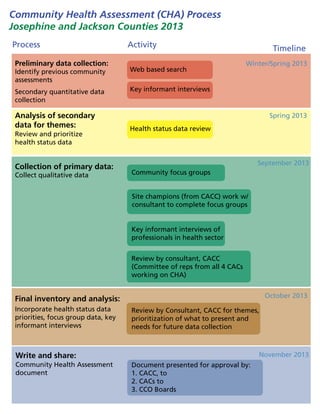
Community Health Assessment (CHA) Process
Josephine and Jackson Counties 2013
Preliminary data collection:
Identify previous community
assessments
Secondary quantitative data
collection
Process Activity
Web based search
Key informant interviews
Analysis of secondary
data for themes:
Review and prioritize
health status data
Health status data review
Review by consultant, CACC
(Committee of reps from all 4 CACs
working on CHA)
Collection of primary data:
Collect qualitative data Community focus groups
Site champions (from CACC) work w/
consultant to complete focus groups
Key informant interviews of
professionals in health sector
Final inventory and analysis:
Incorporate health status data
priorities, focus group data, key
informant interviews
Review by Consultant, CACC for themes,
prioritization of what to present and
needs for future data collection
Write and share:
Community Health Assessment
document
Document presented for approval by:
1. CACC, to
2. CACs to
3. CCO Boards
Timeline
Spring 2013
September 2013
October 2013
November 2013
Winter/Spring 2013
Process
The Jackson and Josephine county Community Health Assessment synthesizes several months of
collecting, cataloging and reviewing data related to the health of residents living in Jackson and
Josephine county. The process represents collaboration with three Coordinated Care Organizations
(CCOs) and spans two counties in Southwestern Oregon. It is the first step in an ongoing process of
community health assessment, planning and improvement.
The purpose of the Community Health Assessment (CHA) is to provide a macro view of community
health issues in the county. This is accomplished by cataloging and reviewing applicable community
health status data and gathering additional data from the community about their health priorities and
perceptions. The process serves to engage community members in identifying trends and opportunities
to improve the health of their community. The resulting CHA document assists organizations in
planning and prioritizing efforts that ultimately lead to the triple aim of improving health outcomes,
improving individual and community health, and reducing costs.
Community Health Assessments are required for Coordinated Care Organizations. Three CCOs came
together in January of 2013 and decided to collaborate on a single, collective community health
assessment. The Josephine and Jackson County Community Health Assessment was designed to
meet the needs for AllCare Health Plan, PrimaryHealth and Jackson Care Connect Coordinated Care
Organizations and their four Community Advisory Councils (CACs).
Framework and Process
A desire to pool resources, reduce duplication of effort and meet mandates motivated the
collaborative orgainzations to secure a contract with a consultant to lead and facilitate the
community health assessment. A contract was secured with V Consulting & Associates to lead
the process and provide technical writing.
The Mobilizing for Action through Planning and Partnerships (MAPP) model
was then chosen
as the basis of the Community Health Assessment process.
The MAPP process is a national best
practice and recognized by the
Oregon Health Authority (OHA) as a process for community
health assessment. MAPP enables enhanced understanding of the complex influences on
community health, through thoughtful and deliberate data collection and analysis. Due to
the resources and time required for a thorough MAPP process, the collaborative group agreed
upon a modified MAPP model with a time line of January 2013-December 2013.
The work of the CHA was completed by the consultant and a workgroup of
representatives
from all four CACs. The workgroup was titled the Community Advisory Council CHA
Committee (CACC). CACC members provided leadership to the process, assisted with primary
data collection and focus groups, and were advocates for the process
to their CCO Board of
Directors and the larger community. Engagement of the CAC members (via the CACC) was vital
to the process, providing an opportunity for the CAC to meet Oregon Administrative Rules
(OAR) requirements for overseeing the Community Health Assessment, increase individual
knowledge about community health and health care transformation.
The CACC reviewed and edited the first preliminary draft of the CHA document. The four
CAC’s were then given an opportunity to review the document and then recommend the
document be accepted and submitted to the Oregon Health Authority by the CCO Board of
Directors by their January 1, 2014 deadline.
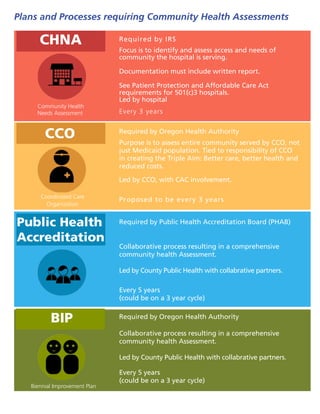
CHNA Required by IRS
Focus is to identify and assess access and needs of
community the hospital is serving.
Documentation must include written report.
See Patient Protection and Affordable Care Act
requirements for 501(c)3 hospitals.
Led by hospital
Every 3 years
CCO Required by Oregon Health Authority
Purpose is to assess entire community served by CCO, not
just Medicaid population. Tied to responsibility of CCO
in creating the Triple Aim: Better care, better health and
reduced costs.
Led by CCO, with CAC involvement.
Proposed to be every 3 years
Public Health
Accreditation
Required by Public Health Accreditation Board (PHAB)
Collaborative process resulting in a comprehensive
community health Assessment.
Led by County Public Health with collabrative partners.
Every 5 years
(could be on a 3 year cycle)
BIP Required by Oregon Health Authority
Collaborative process resulting in a comprehensive
community health Assessment.
Led by County Public Health with collabrative partners.
Every 5 years
(could be on a 3 year cycle)
Plans and Processes requiring Community Health Assessments
Community Health
Needs Assessment
Biennial Improvement Plan
Coordinated Care
Organization
Data Assumptions and Priorities
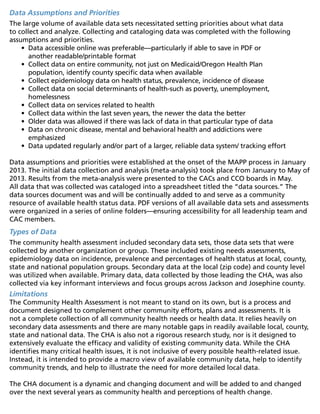
The large volume of available data sets necessitated setting priorities about what data
to collect and analyze. Collecting and cataloging data was completed with the following
assumptions and priorities.
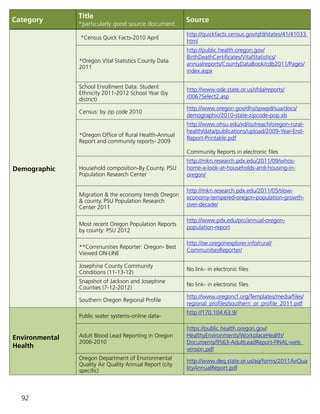
•	 Data accessible online was preferable—particularly if able to save in PDF or
another readable/printable format
•	 Collect data on entire community, not just on Medicaid/Oregon Health Plan
population, identify county specific data when available
•	 Collect epidemiology data on health status, prevalence, incidence of disease
•	 Collect data on social determinants of health-such as poverty, unemployment,
homelessness
•	 Collect data on services related to health
•	 Collect data within the last seven years, the newer the data the better
•	 Older data was allowed if there was lack of data in that particular type of data
•	 Data on chronic disease, mental and behavioral health and addictions were
emphasized
•	 Data updated regularly and/or part of a larger, reliable data system/ tracking effort
Data assumptions and priorities were established at the onset of the MAPP process in January
2013. The initial data collection and analysis (meta-analysis) took place from January to May of
2013. Results from the meta-analysis were presented to the CACs and CCO boards in May.
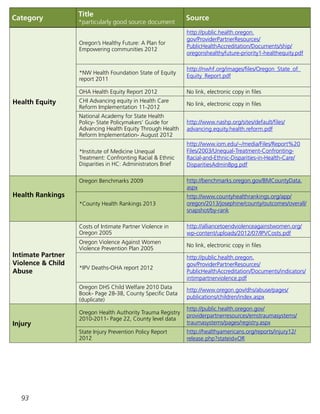
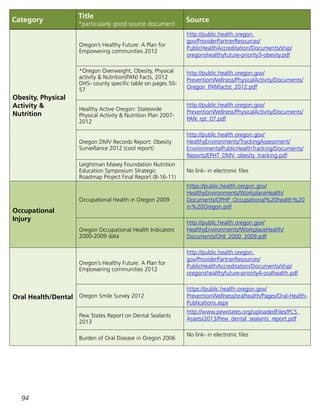
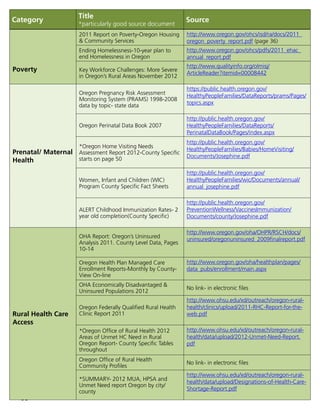
All data that was collected was cataloged into a spreadsheet titled the “data sources.” The
data sources document was and will be continually added to and serve as a community
resource of available health status data. PDF versions of all available data sets and assessments
were organized in a series of online folders—ensuring accessibility for all leadership team and
CAC members.
Types of Data
The community health assessment included secondary data sets, those data sets that were
collected by another organization or group. These included existing needs assessments,
epidemiology data on incidence, prevalence and percentages of health status at local, county,
state and national population groups. Secondary data at the local (zip code) and county level
was utilized when available. Primary data, data collected by those leading the CHA, was also
collected via key informant interviews and focus groups across Jackson and Josephine county.
Limitations
The Community Health Assessment is not meant to stand on its own, but is a process and
document designed to complement other community efforts, plans and assessments. It is
not a complete collection of all community health needs or health data. It relies heavily on
secondary data assessments and there are many notable gaps in readily available local, county,
state and national data. The CHA is also not a rigorous research study, nor is it designed to
extensively evaluate the efficacy and validity of existing community data. While the CHA
identifies many critical health issues, it is not inclusive of every possible health-related issue.
Instead, it is intended to provide a macro view of available community data, help to identify
community trends, and help to illustrate the need for more detailed local data.
The CHA document is a dynamic and changing document and will be added to and changed
over the next several years as community health and perceptions of health change.
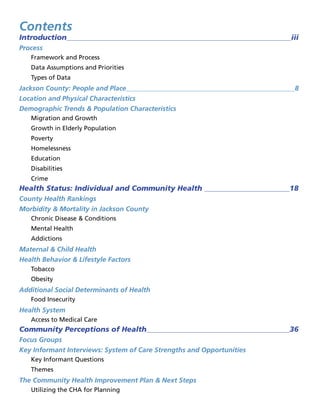
Contents
Introduction iii
Process
Framework and Process
Data Assumptions and Priorities
Types of Data
Jackson County: People and Place 8
Location and Physical Characteristics
Demographic Trends  Population Characteristics
Migration and Growth
Growth in Elderly Population
Poverty
Homelessness
Education
Disabilities
Crime
Health Status: Individual and Community Health  18
County Health Rankings
Morbidity  Mortality in Jackson County
Chronic Disease  Conditions
Mental Health
Addictions
Maternal  Child Health
Health Behavior  Lifestyle Factors
Tobacco
Obesity
Additional Social Determinants of Health
Food Insecurity
Health System
Access to Medical Care
Community Perceptions of Health 36
Focus Groups
Key Informant Interviews: System of Care Strengths and Opportunities
Key Informant Questions
Themes
The Community Health Improvement Plan  Next Steps
Utilizing the CHA for Planning
Josephine County People and Place 54
Location and Physical Characteristics
Demographic Trends and Population Characteristics
Migration and Growth
Growth in Elderly Population
Poverty
Homelessness
Education
Disabilities
Race and Ethnicity
Crime
Health Status: Individual and Community Health  62
County Health Rankings
Morbidity  Mortality in Josephine County
Chronic Disease  Conditions
Mental Health
Addictions
Maternal  Child Health
Health Behavior  Lifestyle Factors
Obesity
Physical Activity  Nutrition
Additional Social Determinants of Health
Food Insecurity
Health System
Access to Medical Care
Community Perceptions of Health 79
Focus Groups
Key Informant Interviews: System of Care Strengths and Opportunities
Key Informant Questions
Themes
The Community Health Improvement Plan  Next Steps
Utilizing the CHA for Planning
Appendix 95
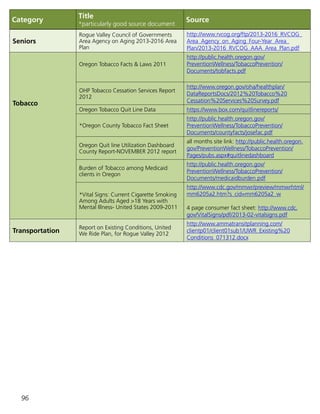
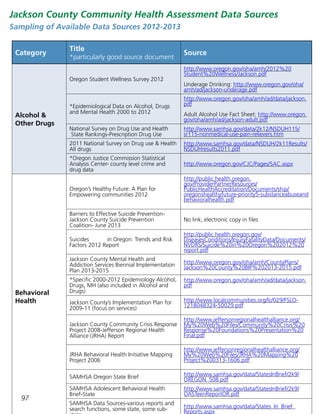
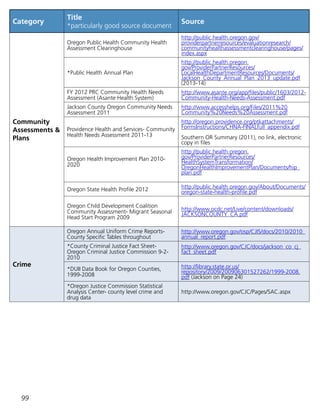
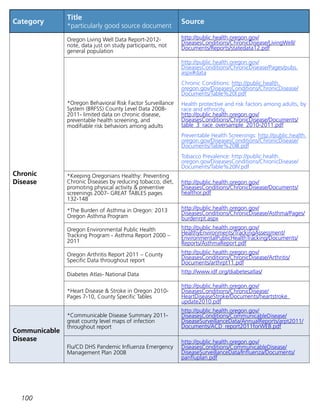
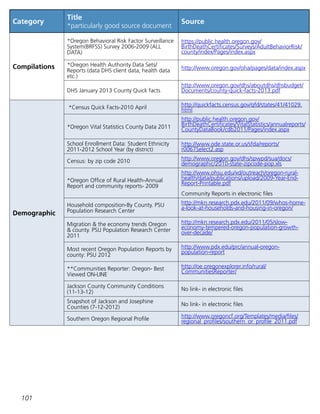
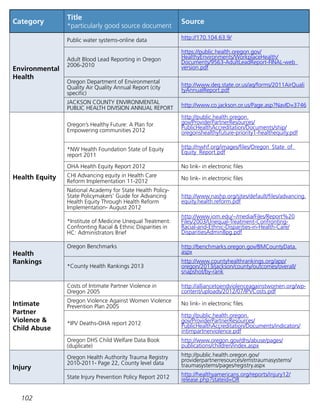
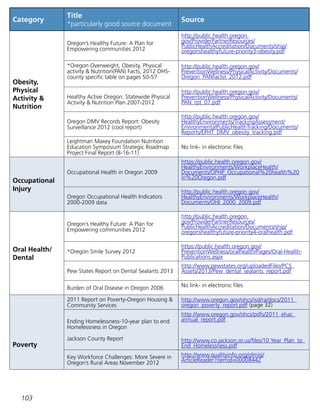
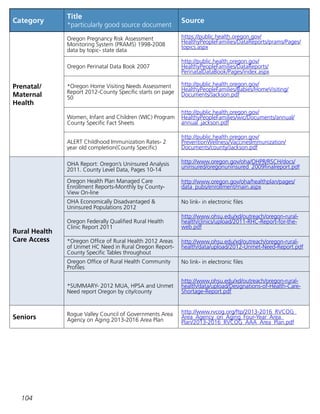
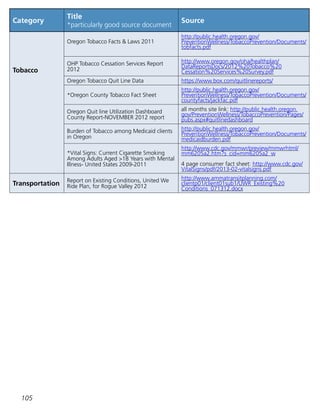
Josephine County Community Health Assessment Data Sources
Sampling of Available Data Sources 2012-2013
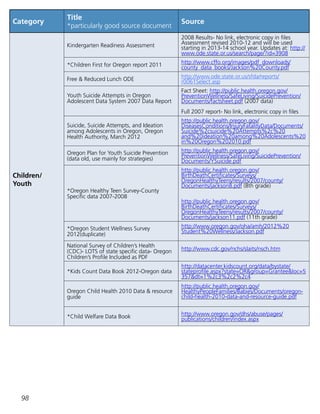
Jackson County Community Health Assessment Data Sources
Sampling of Available Data Sources 2012-2013
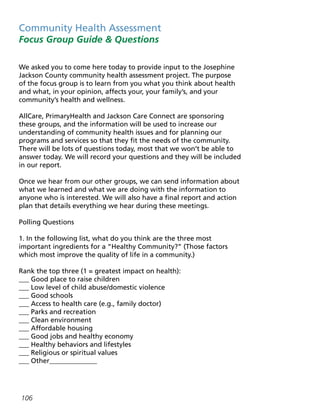
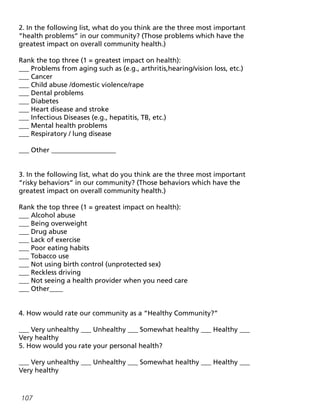
Focus Group Guide  Questions
Draft
Community Health Assessment
Jackson County
2013
1 - Jackson final version
Jackson County: People and Place
Location and Physical Characteristics
Jackson County is a county located in Southwestern
Oregon along the border with California. It is
considered one of the more rugged parts of the state
with multiple climates and geography within its 2,081
square miles. The terrain and geography is diverse
including large broad valleys, deep river valleys and
sparsely populated mountainous areas. There are
hundreds of hills, valleys and waterways including the
Rogue River and Bear Creek.
Interstate 5 (I-5) runs through the county and the only urban areas lie along the I-5 corridor,
in the broader valley areas of Medford and Ashland. The total population in Jackson County is
206,412 (2012). The population centers in Jackson County include Medford, Ashland, Phoenix,
Central Point and Talent. These centers account for 60% of the total county population, with
the remaining 40% of the county population living in many thinly populated rural areas.
There are 11 incorporated cities in Jackson County and 34 unincorporated communities. The
largest incorporated city is the county seat of Medford.
Demographic Trends  Population Characteristics
Migration and Growth
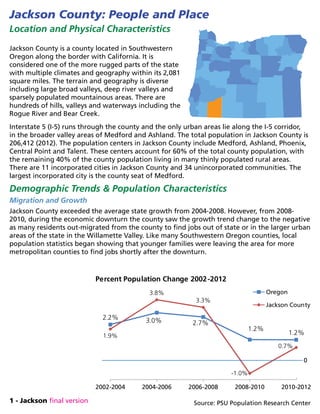
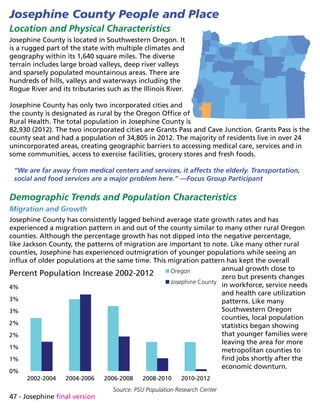
Jackson County exceeded the average state growth from 2004-2008. However, from 2008-
2010, during the economic downturn the county saw the growth trend change to the negative
as many residents out-migrated from the county to find jobs out of state or in the larger urban
areas of the state in the Willamette Valley. Like many Southwestern Oregon counties, local
population statistics began showing that younger families were leaving the area for more
metropolitan counties to find jobs shortly after the downturn.
2002-2004 2004-2006 2006-2008 2008-2010 2010-2012
2.2% 3.0% 2.7%
1.2%
1.2%1.9%
3.8%
3.3%
-1.0%
0.7%
Percent Population Change 2002-2012
Oregon
Jackson County
Source: PSU Population Research Center
0
2 - Jackson final version
At the same time, the county
continued to see a steady influx of
seniors to the county, largely from out
of state. Both the exodus of younger
and often higher socioeconomic level
populations and the influx of older
demographic groups in the county
ultimately influences the health status
and burden for care on the community.
The percentage of 60 and over is
expected to continue to rise within the
county, while percentages of younger
ages continues to diminish.
Growth in Elderly Population
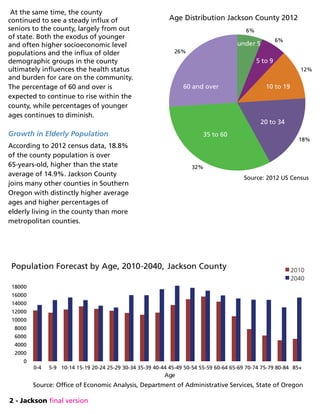
According to 2012 census data, 18.8%
of the county population is over
65-years-old, higher than the state
average of 14.9%. Jackson County
joins many other counties in Southern
Oregon with distinctly higher average
ages and higher percentages of
elderly living in the county than more
metropolitan counties.
6%
6%
12%
18%
32%
26%
Age Distribution Jackson County 2012
under 5
5 to 9
10 to 19
20 to 34
35 to 60
60 and over
Source: 2012 US Census
Population Forecast by Age, 2010-2040, Jackson County
0-4 5-9 10-14 15-19 20-24 25-29 30-34 35-39 40-44 45-49 50-54 55-59 60-64 65-69 70-74 75-79 80-84 85+
0
2000
4000
6000
8000
10000
12000
14000
16000
18000
Age
2010
2040
Source: Office of Economic Analysis, Department of Administrative Services, State of Oregon
3 - Jackson final version
Poverty
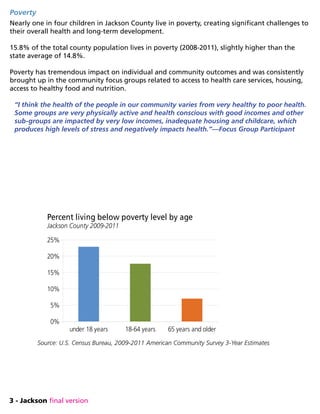
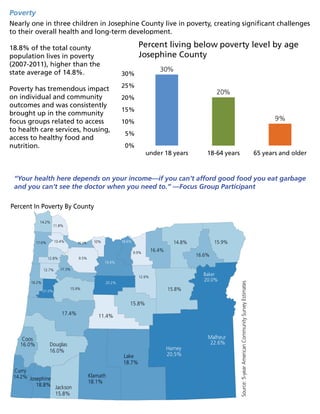
Nearly one in four children in Jackson County live in poverty, creating significant challenges to
their overall health and long-term development.
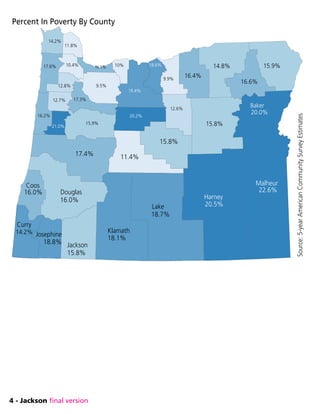
15.8% of the total county population lives in poverty (2008-2011), slightly higher than the
state average of 14.8%.
Poverty has tremendous impact on individual and community outcomes and was consistently
brought up in the community focus groups related to access to health care services, housing,
access to healthy food and nutrition.
“I think the health of the people in our community varies from very healthy to poor health.
Some groups are very physically active and health conscious with good incomes and other
sub-groups are impacted by very low incomes, inadequate housing and childcare, which
produces high levels of stress and negatively impacts health.”—Focus Group Participant
under 18 years 18-64 years 65 years and older
0%
5%
10%
15%
20%
25%
Percent living below poverty level by age
Jackson County 2009-2011
Source: U.S. Census Bureau, 2009-2011 American Community Survey 3-Year Estimates
4 - Jackson final version
Josephine
18.8%
Curry
14.2%
Jackson
15.8%
Coos
16.0%
Klamath
18.1%
Lake
18.7%
Douglas
16.0% Harney
20.5%
17.4% 11.4%
Malheur
22.6%
15.8%
21.0%
15.9%
20.2%
15.8%
16.2%
12.6%
12.7%
Baker
20.0%
17.3%
12.8% 9.5%
19.4%
10%16.5% 18.6%10.4%17.6%
9.9%
16.6%
16.4%
15.9%14.8%
11.8%
14.2%
Source:5-yearAmericanCommunitySurveyEstimates
Percent In Poverty By County
5 - Jackson final version
Homelessness
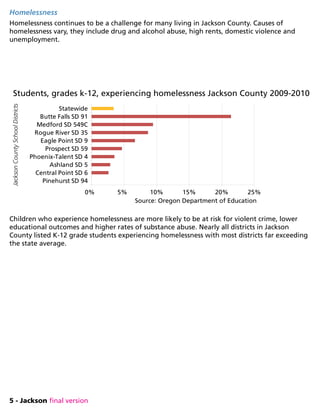
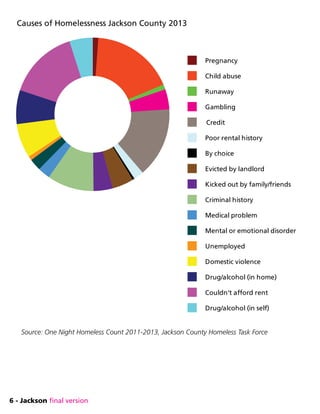
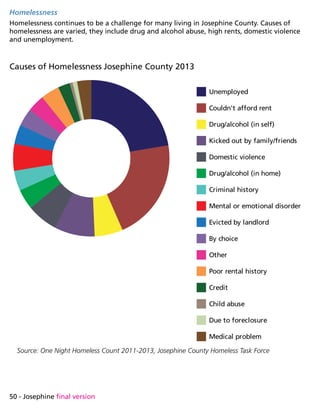
Homelessness continues to be a challenge for many living in Jackson County. Causes of
homelessness vary, they include drug and alcohol abuse, high rents, domestic violence and
unemployment.
Children who experience homelessness are more likely to be at risk for violent crime, lower
educational outcomes and higher rates of substance abuse. Nearly all districts in Jackson
County listed K-12 grade students experiencing homelessness with most districts far exceeding
the state average.
Source: Oregon Department of Education
Pinehurst SD 94
Central Point SD 6
Ashland SD 5
Phoenix-Talent SD 4
Prospect SD 59
Eagle Point SD 9
Rogue River SD 35
Medford SD 549C
Butte Falls SD 91
Statewide
0% 5% 10% 15% 20% 25%
Students, grades k-12, experiencing homelessness Jackson County 2009-2010
JacksonCountySchoolDistricts
6 - Jackson final version
Causes of Homelessness Jackson County 2013
Pregnancy
Child abuse
Runaway
Gambling
Credit
Poor rental history
By choice
Evicted by landlord
Kicked out by family/friends
Criminal history
Medical problem
Mental or emotional disorder
Unemployed
Domestic violence
Drug/alcohol (in home)
Couldn't afford rent
Drug/alcohol (in self)
Source: One Night Homeless Count 2011-2013, Jackson County Homeless Task Force
7 - Jackson final version
Disabilities
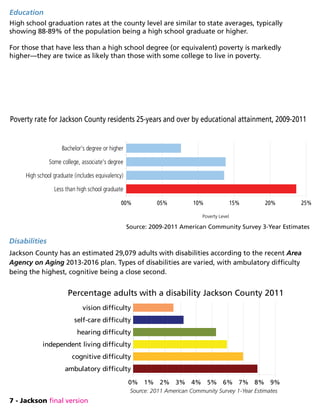
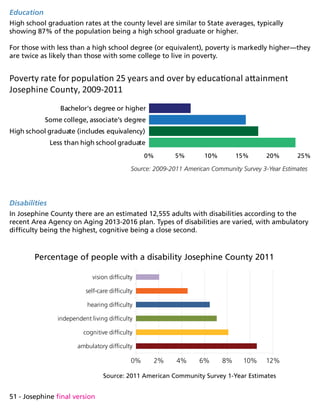
Jackson County has an estimated 29,079 adults with disabilities according to the recent Area
Agency on Aging 2013-2016 plan. Types of disabilities are varied, with ambulatory difficulty
being the highest, cognitive being a close second.
Education
High school graduation rates at the county level are similar to state averages, typically
showing 88-89% of the population being a high school graduate or higher.
For those that have less than a high school degree (or equivalent) poverty is markedly
higher—they are twice as likely than those with some college to live in poverty.
Source: 2009-2011 American Community Survey 3-Year Estimates
Less than high school graduate
High school graduate (includes equivalency)
Some college, associate's degree
Bachelor's degree or higher
00% 05% 10% 15% 20% 25%
Poverty rate for Jackson County residents 25-years and over by educational attainment, 2009-2011
Poverty Level
Source: 2011 American Community Survey 1-Year Estimates
ambulatory difficulty
cognitive difficulty
independent living difficulty
hearing difficulty
self-care difficulty
vision difficulty
0% 1% 2% 3% 4% 5% 6% 7% 8% 9%
Percentage adults with a disability Jackson County 2011
8 - Jackson final version
Race  Ethnicity
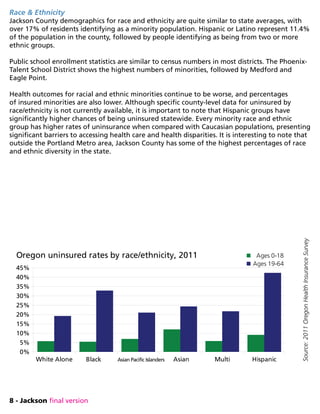
Jackson County demographics for race and ethnicity are quite similar to state averages, with
over 17% of residents identifying as a minority population. Hispanic or Latino represent 11.4%
of the population in the county, followed by people identifying as being from two or more
ethnic groups.
Public school enrollment statistics are similar to census numbers in most districts. The Phoenix-
Talent School District shows the highest numbers of minorities, followed by Medford and
Eagle Point.
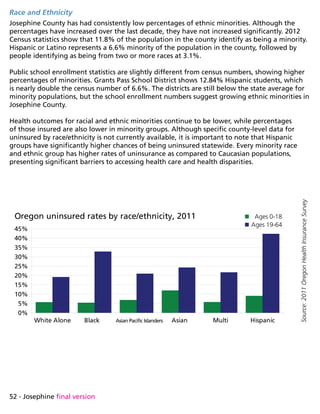
Health outcomes for racial and ethnic minorities continue to be worse, and percentages
of insured minorities are also lower. Although specific county-level data for uninsured by
race/ethnicity is not currently available, it is important to note that Hispanic groups have
significantly higher chances of being uninsured statewide. Every minority race and ethnic
group has higher rates of uninsurance when compared with Caucasian populations, presenting
significant barriers to accessing health care and health disparities. It is interesting to note that
outside the Portland Metro area, Jackson County has some of the highest percentages of race
and ethnic diversity in the state.
White Alone Black Asian Pacific Islanders Asian Multi Hispanic
0%
5%
10%
15%
20%
25%
30%
35%
40%
45%
Oregon uninsured rates by race/ethnicity, 2011 Ages 0-18
Ages 19-64
Source:2011OregonHealthInsuranceSurvey
9 - Jackson final version
Employment
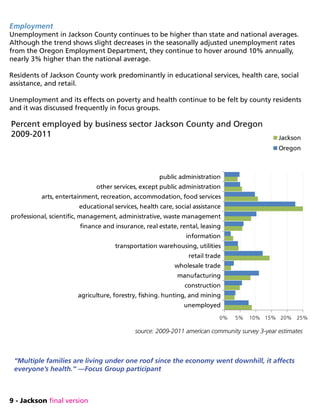
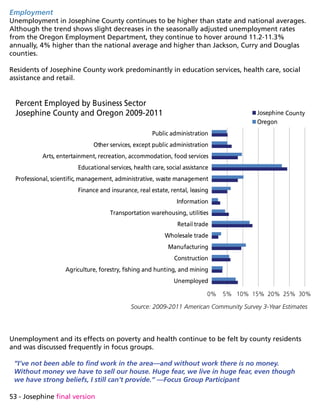
Unemployment in Jackson County continues to be higher than state and national averages.
Although the trend shows slight decreases in the seasonally adjusted unemployment rates
from the Oregon Employment Department, they continue to hover around 10% annually,
nearly 3% higher than the national average.
Residents of Jackson County work predominantly in educational services, health care, social
assistance, and retail.
Unemployment and its effects on poverty and health continue to be felt by county residents
and it was discussed frequently in focus groups.
“Multiple families are living under one roof since the economy went downhill, it affects
everyone’s health.” —Focus Group participant
unemployed
agriculture, forestry, fishing. hunting, and mining
construction
manufacturing
wholesale trade
retail trade
transportation warehousing, utilities
information
finance and insurance, real estate, rental, leasing
professional, scientific, management, administrative, waste management
educational services, health care, social assistance
arts, entertainment, recreation, accommodation, food services
other services, except public administration
public administration
Percent employed by business sector Jackson County and Oregon
2009-2011 Jackson
Oregon
source: 2009-2011 american community survey 3-year estimates
10 - Jackson final version
Jan-06 Aug-06 Mar-07 Oct-07 May-08 Dec-08 Jul-09 Feb-10 Sep-10 Apr-11 Nov-11 Jun-12
0
20
40
60
80
100
120
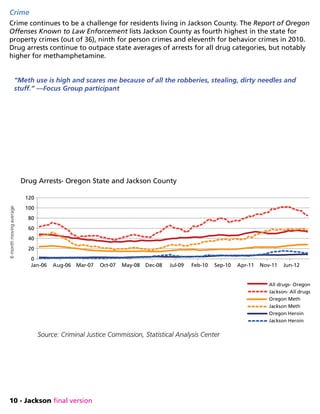
Drug Arrests- Oregon State and Jackson County
All drugs- Oregon
Jackson- All drugs
Oregon Meth
Jackson Meth
Oregon Heroin
Jackson Heroin
6monthmovingaverageCrime
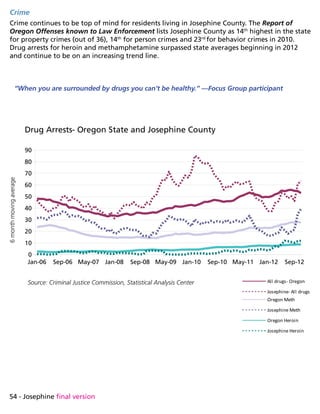
Crime continues to be a challenge for residents living in Jackson County. The Report of Oregon
Offenses Known to Law Enforcement lists Jackson County as fourth highest in the state for
property crimes (out of 36), ninth for person crimes and eleventh for behavior crimes in 2010.
Drug arrests continue to outpace state averages of arrests for all drug categories, but notably
higher for methamphetamine.
“Meth use is high and scares me because of all the robberies, stealing, dirty needles and
stuff.” —Focus Group participant
Source: Criminal Justice Commission, Statistical Analysis Center
11 - Jackson final version
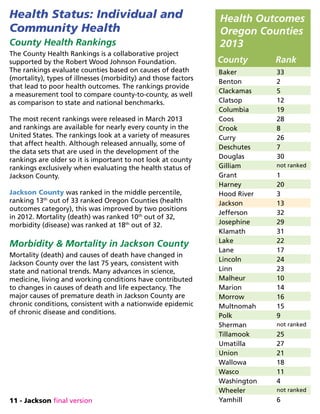
Health Status: Individual and
Community Health
County Health Rankings
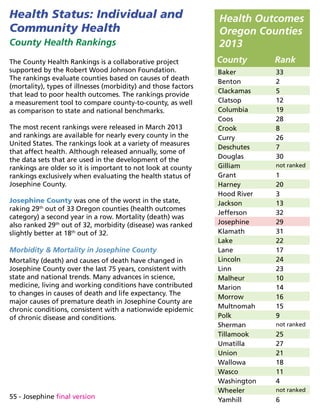
The County Health Rankings is a collaborative project
supported by the Robert Wood Johnson Foundation.
The rankings evaluate counties based on causes of death
(mortality), types of illnesses (morbidity) and those factors
that lead to poor health outcomes. The rankings provide
a measurement tool to compare county-to-county, as well
as comparison to state and national benchmarks.
The most recent rankings were released in March 2013
and rankings are available for nearly every county in the
United States. The rankings look at a variety of measures
that affect health. Although released annually, some of
the data sets that are used in the development of the
rankings are older so it is important to not look at county
rankings exclusively when evaluating the health status of
Jackson County.
Jackson County was ranked in the middle percentile,
ranking 13th
out of 33 ranked Oregon Counties (health
outcomes category), this was improved by two positions
in 2012. Mortality (death) was ranked 10th
out of 32,
morbidity (disease) was ranked at 18th
out of 32.
Morbidity  Mortality in Jackson County
Mortality (death) and causes of death have changed in
Jackson County over the last 75 years, consistent with
state and national trends. Many advances in science,
medicine, living and working conditions have contributed
to changes in causes of death and life expectancy. The
major causes of premature death in Jackson County are
chronic conditions, consistent with a nationwide epidemic
of chronic disease and conditions.
Health Outcomes
Oregon Counties
2013
County Rank
Baker 33
Benton 2
Clackamas 5
Clatsop 12
Columbia 19
Coos 28
Crook 8
Curry 26
Deschutes 7
Douglas 30
Gilliam not ranked
Grant 1
Harney 20
Hood River 3
Jackson 13
Jefferson 32
Josephine 29
Klamath 31
Lake 22
Lane 17
Lincoln 24
Linn 23
Malheur 10
Marion 14
Morrow 16
Multnomah 15
Polk 9
Sherman not ranked
Tillamook 25
Umatilla 27
Union 21
Wallowa 18
Wasco 11
Washington 4
Wheeler not ranked
Yamhill 6
12 - Jackson final version
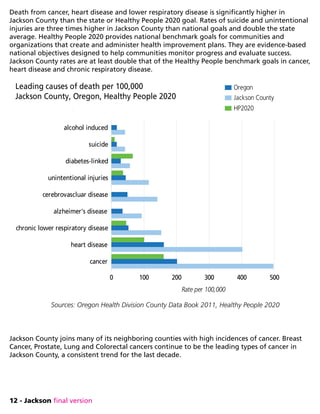
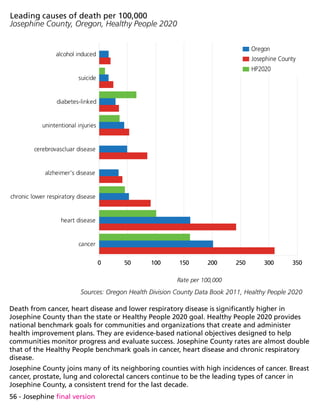
Death from cancer, heart disease and lower respiratory disease is significantly higher in
Jackson County than the state or Healthy People 2020 goal. Rates of suicide and unintentional
injuries are three times higher in Jackson County than national goals and double the state
average. Healthy People 2020 provides national benchmark goals for communities and
organizations that create and administer health improvement plans. They are evidence-based
national objectives designed to help communities monitor progress and evaluate success.
Jackson County rates are at least double that of the Healthy People benchmark goals in cancer,
heart disease and chronic respiratory disease.
Jackson County joins many of its neighboring counties with high incidences of cancer. Breast
Cancer, Prostate, Lung and Colorectal cancers continue to be the leading types of cancer in
Jackson County, a consistent trend for the last decade.
Sources: Oregon Health Division County Data Book 2011, Healthy People 2020
cancer
heart disease
chronic lower respiratory disease
alzheimer's disease
cerebrovascluar disease
unintentional injuries
diabetes-linked
suicide
alcohol induced
0 100 200 300 400 500
Jackson County
Oregon
HP2020
Rate per 100,000
Leading causes of death per 100,000
Jackson County, Oregon, Healthy People 2020
13 - Jackson final version
Chronic Disease  Conditions
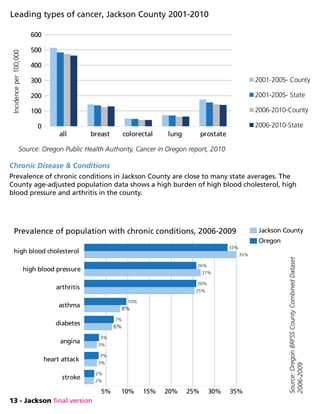
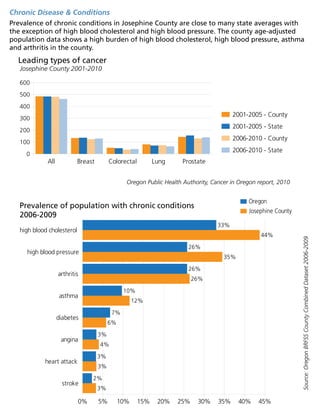
Prevalence of chronic conditions in Jackson County are close to many state averages. The
County age-adjusted population data shows a high burden of high blood cholesterol, high
blood pressure and arthritis in the county.
Source:OregonBRFSSCountyCombinedDataset
2006-2009
stroke
heart attack
angina
diabetes
asthma
arthritis
high blood pressure
high blood cholesterol
5% 10% 15% 20% 25% 30% 35%
2%
3%
3%
6%
8%
25%
27%
35%
2%
3%
3%
7%
10%
26%
26%
33%
Prevalence of population with chronic conditions, 2006-2009 Jackson County
Oregon
Source: Oregon Public Health Authority, Cancer in Oregon report, 2010
all breast colorectal lung prostate
0
100
200
300
400
500
600
Leading types of cancer, Jackson County 2001-2010
2001-2005- County
2001-2005- State
2006-2010-County
2006-2010-State
Incidenceper100,000
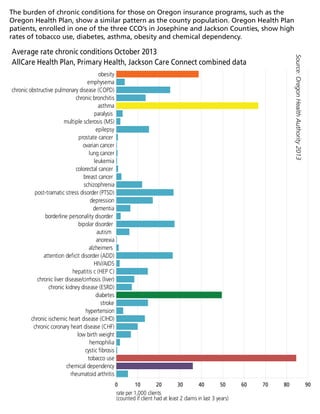
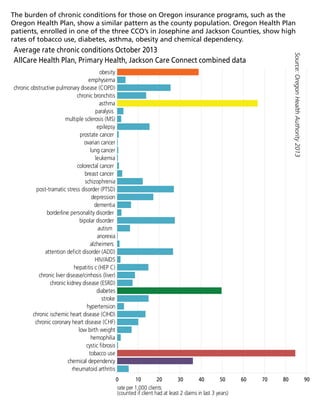
The burden of chronic conditions for those on Oregon insurance programs, such as the
Oregon Health Plan, show a similar pattern as the county population. Oregon Health Plan
patients, enrolled in one of the three CCO’s in Josephine and Jackson Counties, show high
rates of tobacco use, diabetes, asthma, obesity and chemical dependency.
rheumatoid arthritis
chemical dependency
tobacco use
cystic fibrosis
hemophilia
low birth weight
chronic coronary heart disease (CHF)
chronic ischemic heart disease (CIHD)
hypertension
stroke
diabetes
chronic kidney disease (ESRD)
chronic liver disease/cirrhosis (liver)
hepatitis c (HEP C)
HIV/AIDS
attention deficit disorder (ADD)
alzheimers
anorexia
autism
bipolar disorder
borderline personality disorder
dementia
depression
post-tramatic stress disorder (PTSD)
schizophrenia
breast cancer
colorectal cancer
leukemia
lung cancer
ovarian cancer
prostate cancer
epilepsy
multiple sclerosis (MS)
paralysis
asthma
chronic bronchitis
chronic obstructive pulmonary disease (COPD)
emphysema
obesity
0 10 20 30 40 50 60 70 80 90
Average rate chronic conditions October 2013
AllCare Health Plan, Primary Health, Jackson Care Connect combined data
rate per 1,000 clients
(counted if client had at least 2 claims in last 3 years)
Source:OregonHealthAuthority2013
15 - Jackson final version
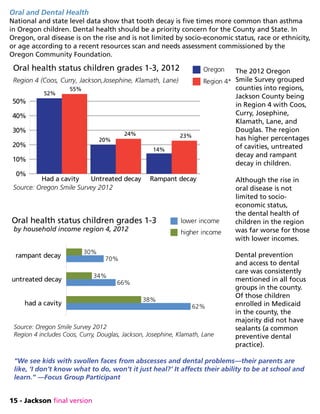
Oral and Dental Health
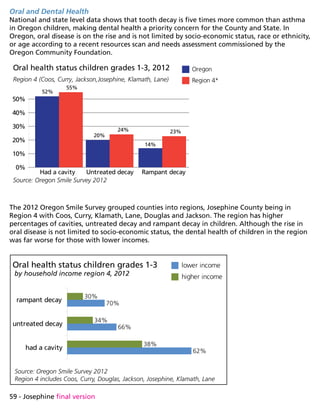
National and state level data show that tooth decay is five times more common than asthma
in Oregon children. Dental health should be a priority concern for the County and State. In
Oregon, oral disease is on the rise and is not limited by socio-economic status, race or ethnicity,
or age according to a recent resources scan and needs assessment commissioned by the
Oregon Community Foundation.
The 2012 Oregon
Smile Survey grouped
counties into regions,
Jackson County being
in Region 4 with Coos,
Curry, Josephine,
Klamath, Lane, and
Douglas. The region
has higher percentages
of cavities, untreated
decay and rampant
decay in children.
Although the rise in
oral disease is not
limited to socio-
economic status,
the dental health of
children in the region
was far worse for those
with lower incomes.
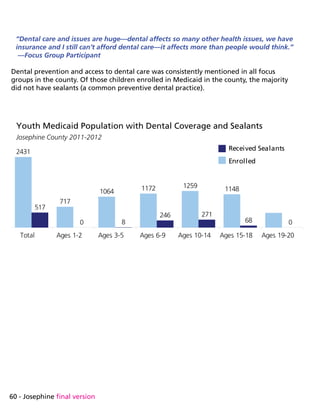
Dental prevention
and access to dental
care was consistently
mentioned in all focus
groups in the county.
Of those children
enrolled in Medicaid
in the county, the
majority did not have
sealants (a common
preventive dental
practice).
“We see kids with swollen faces from abscesses and dental problems—their parents are
like, ‘I don’t know what to do, won’t it just heal?’ It affects their ability to be at school and
learn.” —Focus Group Participant
Source: Oregon Smile Survey 2012
Region 4 includes Coos, Curry, Douglas, Jackson, Josephine, Klamath, Lane
had a cavity
untreated decay
rampant decay
62%
66%
70%
38%
34%
30%
Oral health status children grades 1-3
by household income region 4, 2012
lower income
higher income
Oral health status children grades 1-3, 2012
16 - Jackson final version
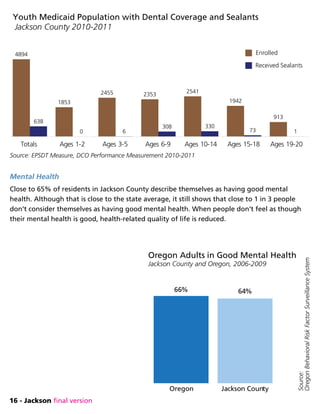
Mental Health
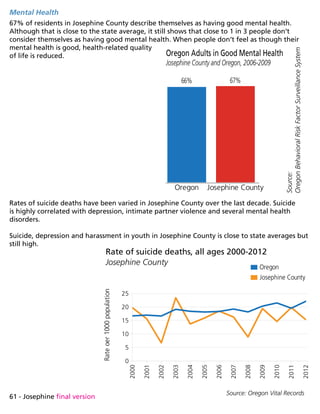
Close to 65% of residents in Jackson County describe themselves as having good mental
health. Although that is close to the state average, it still shows that close to 1 in 3 people
don’t consider themselves as having good mental health. When people don’t feel as though
their mental health is good, health-related quality of life is reduced.
Oregon Jackson County
66% 64%
Oregon Adults in Good Mental Health
Jackson County and Oregon, 2006-2009
Source:
OregonBehavioralRiskFactorSurveillanceSystem
Source: EPSDT Measure, DCO Performance Measurement 2010-2011
Totals Ages 1-2 Ages 3-5 Ages 6-9 Ages 10-14 Ages 15-18 Ages 19-20
4894
1853
2455 2353
2541
1942
913
638
0 6
308 330
73 1
Youth Medicaid Population with Dental Coverage and Sealants
Jackson County 2010-2011
Enrolled
Received Sealants
17 - Jackson final version
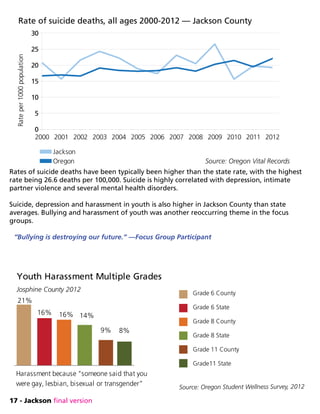
Rates of suicide deaths have been typically been higher than the state rate, with the highest
rate being 26.6 deaths per 100,000. Suicide is highly correlated with depression, intimate
partner violence and several mental health disorders.
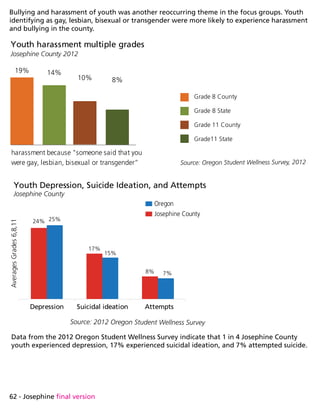
Suicide, depression and harassment in youth is also higher in Jackson County than state
averages. Bullying and harassment of youth was another reoccurring theme in the focus
groups.
“Bullying is destroying our future.” —Focus Group Participant
Source: Oregon Student Wellness Survey, 2012
21%
16% 16% 14%
9% 8%
Youth Harassment Multiple Grades
Josphine County 2012
Grade 6 County
Grade 6 State
Grade 8 County
Grade 8 State
Grade 11 County
Grade11 State
Harassment because someone said that you
were gay, lesbian, bisexual or transgender”
Source: Oregon Vital Records
2000 2001 2002 2003 2004 2005 2006 2007 2008 2009 2010 2011 2012
0
5
10
15
20
25
30
Rate of suicide deaths, all ages 2000-2012 — Jackson County
Jackson
Oregon
Rateper1000population
18 - Jackson final version
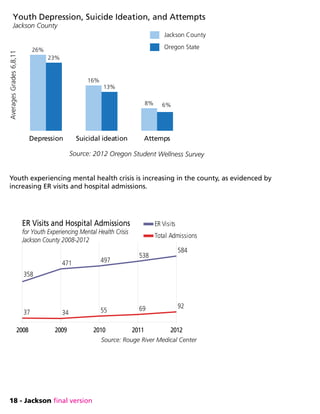
Youth experiencing mental health crisis is increasing in the county, as evidenced by
increasing ER visits and hospital admissions.
Source: 2012 Oregon Student Wellness Survey
Depression Suicidal ideation Attemps
26%
16%
8%
23%
13%
6%
Youth Depression, Suicide Ideation, and Attempts
Jackson County
Jackson County
Oregon State
AveragesGrades6,8,11
Source: Rouge River Medical Center
2008 2009 2010 2011 2012
358
471 497
538
584
37 34 55 69 92
ER Visits and Hospital Admissions
for Youth Experiencing Mental Health Crisis
Jackson County 2008-2012
ER Visits
Total Admissions
19 - Jackson final version
Addictions
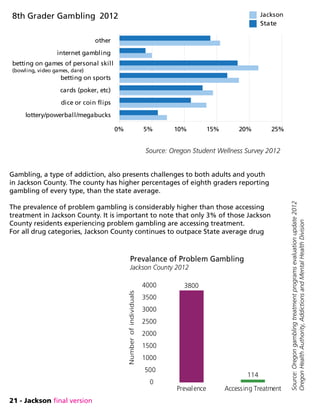
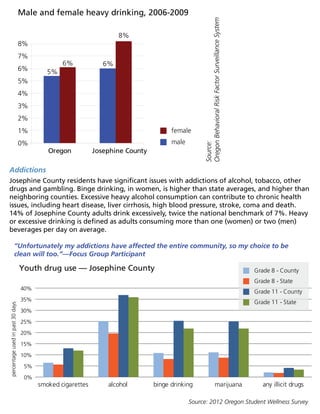
Jackson County residents have significant issues with addictions to alcohol, tobacco, other
drugs and gambling. Binge drinking, in both genders is higher than state averages, and higher
than neighboring counties. Excessive heavy alcohol consumption can contribute to chronic
health issues, including heart disease, cirrhosis of the liver, high blood pressure, stroke, coma
and death. 15% of
Jackson County adults
drink excessively,
twice the national
benchmark of 7%.
Heavy or excessive
drinking is defined as
adults consuming more
than one (women) or
two (men) beverages
per day on average.
Source: Jackson County Suicide Prevention Coalition, 2013
Jackson County National National Need
0
5
10
15
20
25
30
10
16.5
25.9
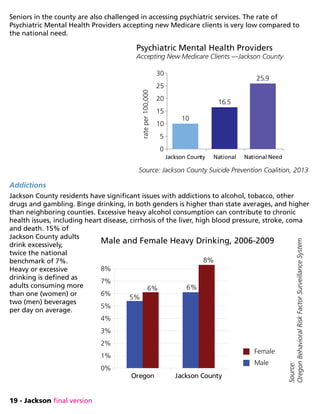
Psychiatric Mental Health Providers
Accepting New Medicare Clients —Jackson County
rateper100,000
Source:
OregonBehavioralRiskFactorSurveillanceSystem
Oregon Jackson County
0%
1%
2%
3%
4%
5%
6%
7%
8%
Male and Female Heavy Drinking, 2006-2009
Male
Female
5%
6% 6%
8%
Seniors in the county are also challenged in accessing psychiatric services. The rate of
Psychiatric Mental Health Providers accepting new Medicare clients is very low compared to
the national need.
20 - Jackson final version
The rate of DUII (driving under the influence of intoxicants) is a data set reviewed when
evaluating impact of addictions on a community. For well over a decade, rates of DUII has
been higher in Jackson County than the state average.
Drug and alcohol use is not a problem exclusively in adults. Jackson County shows youth
reporting higher rates of cigarette, alcohol, binge drinking, marijuana and illicit drug use than
state averages, for grade school through high school.
“Kids come back from lunch [at my school] visibly high—having smoked their parents’
stash at lunch. Everybody knows who the smokers are here, but there isn’t much that we
can do about it.” —Focus Group Participant
Source: 2012 Oregon Student Wellness Survey
smoked cigarettes alcohol binge drinking marijuana any illicit drugs
0
5
10
15
20
25
30
35
40
45
50
Youth Drug Use — Jackson County 2012
percentageusedinpast30days
grade 6- county
grade 6- state
grade 8- county
grade 8- state
grade 11- county
grade 11-state
Source: DUII Data Book for Oregon Counties, 1999-2008
1999 2000 2001 2002 2003 2004 2005 2006 2007 2008
0
2
4
6
8
10
DUII Offenses 1999-2008 Jackson County
Oregon State
Rateper1000
21 - Jackson final version
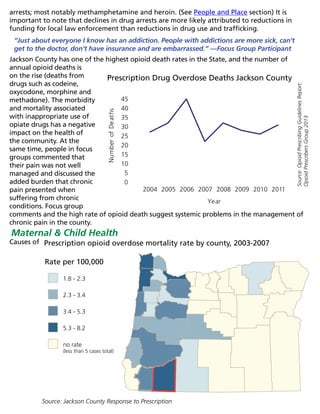
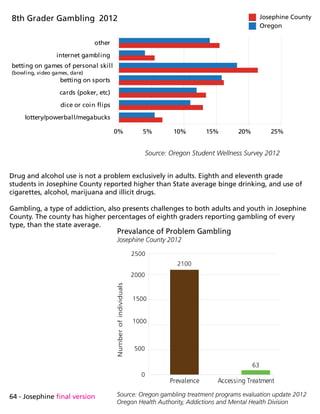
Gambling, a type of addiction, also presents challenges to both adults and youth
in Jackson County. The county has higher percentages of eighth graders reporting
gambling of every type, than the state average.
The prevalence of problem gambling is considerably higher than those accessing
treatment in Jackson County. It is important to note that only 3% of those Jackson
County residents experiencing problem gambling are accessing treatment.
For all drug categories, Jackson County continues to outpace State average drug
Source:Oregongamblingtreatmentprogramsevaluationupdate2012
OregonHealthAuthority,AddictionsandMentalHealthDivision
Prevalence Accessing Treatment
0
500
1000
1500
2000
2500
3000
3500
4000 3800
114
Prevalance of Problem Gambling
Jackson County 2012
Numberofindividuals
lottery/powerball/megabucks
dice or coin flips
cards (poker, etc)
betting on sports
betting on games of personal skill
(bowling, video games, dare)
internet gambling
other
0% 5% 10% 15% 20% 25%
8th Grader Gambling 2012 Jackson
State
Source: Oregon Student Wellness Survey 2012
arrests; most notably methamphetamine and heroin. (See People and Place section) It is
important to note that declines in drug arrests are more likely attributed to reductions in
funding for local law enforcement than reductions in drug use and trafficking.
“Just about everyone I know has an addiction. People with addictions are more sick, can’t
get to the doctor, don’t have insurance and are embarrassed.” —Focus Group Participant
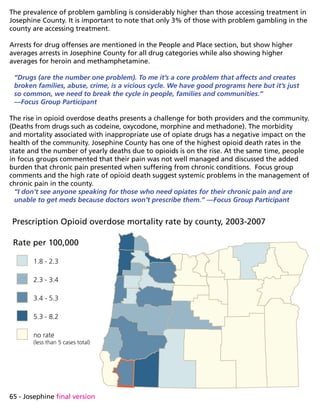
Jackson County has one of the highest opioid death rates in the State, and the number of
annual opioid deaths is
on the rise (deaths from
drugs such as codeine,
oxycodone, morphine and
methadone). The morbidity
and mortality associated
with inappropriate use of
opiate drugs has a negative
impact on the health of
the community. At the
same time, people in focus
groups commented that
their pain was not well
managed and discussed the
added burden that chronic
pain presented when
suffering from chronic
conditions. Focus group
comments and the high rate of opioid death suggest systemic problems in the management of
chronic pain in the county.
Maternal  Child Health
Causes of
Source:OpioidPrescribingGuidelinesReport:
OpioidPrescribersGroup2013
Year
Prescription Drug Overdose Deaths Jackson County
NumberofDeaths
2004 2005 2006 2007 2008 2009 2010 2011
0
5
10
15
20
25
30
35
40
45
Prescription opioid overdose mortality rate by county, 2003-2007
Rate per 100,000
1.8 - 2.3
2.3 - 3.4
3.4 - 5.3
5.3 - 8.2
no rate
(less than 5 cases total)
Source: Jackson County Response to Prescription
23 - Jackson final version
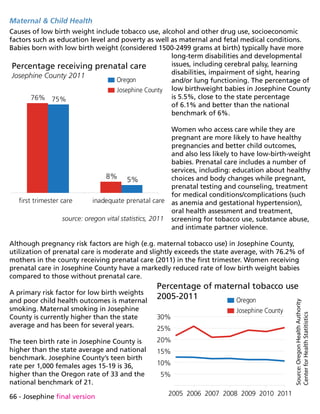
low birth weight include tobacco use, alcohol and other drug use, socioeconomic factors such
as education level and poverty as well as maternal and fetal medical conditions. Babies born
with low birth weight (considered 1500-2499 grams at birth) typically have more long-term
disabilities and developmental issues, including cerebral palsy, learning disabilities, impairment
of sight, hearing and/or lung functioning. The percentage of low birthweight babies in
Jackson County is 6%, close to the state percentage of 6.1% and just meeting the national
benchmark of 6%.
Women who access care while
they are pregnant are more likely
to have healthy pregnancies and
better child outcomes and less likely
to have low birth weight babies.
Prenatal care includes a myriad
of services, including: education
about healthy choices and body
changes while pregnant, prenatal
testing and counseling, treating
medical conditions/complications
(such as anemia and gestational
hypertension), oral health assessment
and treatment, screening for intimate
partner violence and tobacco use and
substance abuse.
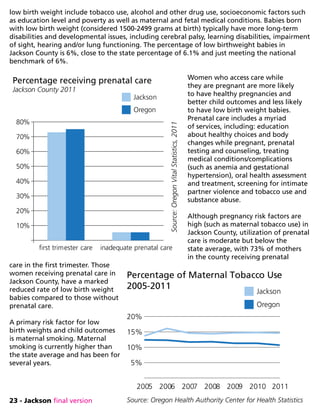
Although pregnancy risk factors are
high (such as maternal tobacco use) in
Jackson County, utilization of prenatal
care is moderate but below the
state average, with 73% of mothers
in the county receiving prenatal
care in the first trimester. Those
women receiving prenatal care in
Jackson County, have a marked
reduced rate of low birth weight
babies compared to those without
prenatal care.
A primary risk factor for low
birth weights and child outcomes
is maternal smoking. Maternal
smoking is currently higher than
the state average and has been for
several years.
first trimester care inadequate prenatal care
10%
20%
30%
40%
50%
60%
70%
80%
Percentage receiving prenatal care
Jackson County 2011
Jackson
Oregon
Source:OregonVitalStatistics,2011
Source: Oregon Health Authority Center for Health Statistics
2005 2006 2007 2008 2009 2010 2011
5%
10%
15%
20%
Percentage of Maternal Tobacco Use
2005-2011
Jackson
Oregon
24 - Jackson final version
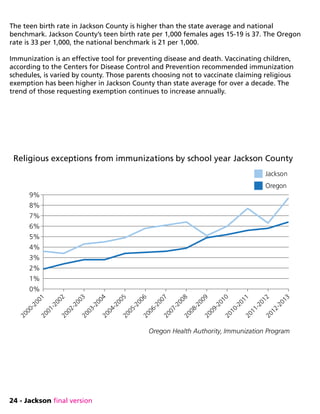
The teen birth rate in Jackson County is higher than the state average and national
benchmark. Jackson County’s teen birth rate per 1,000 females ages 15-19 is 37. The Oregon
rate is 33 per 1,000, the national benchmark is 21 per 1,000.
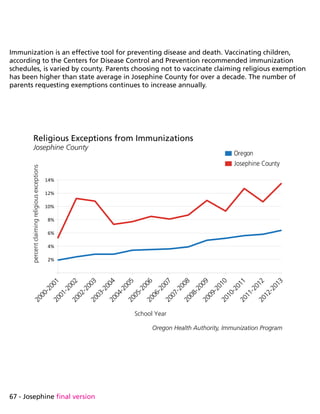
Immunization is an effective tool for preventing disease and death. Vaccinating children,
according to the Centers for Disease Control and Prevention recommended immunization
schedules, is varied by county. Those parents choosing not to vaccinate claiming religious
exemption has been higher in Jackson County than state average for over a decade. The
trend of those requesting exemption continues to increase annually.
Oregon Health Authority, Immunization Program
Jackson
Oregon
0%
1%
2%
3%
4%
5%
6%
7%
8%
9%
Religious exceptions from immunizations by school year Jackson County
25 - Jackson final version
Health Behavior  Lifestyle Factors
Modifiable behaviors related to health status such as tobacco use, inadequate physical activity
and nutrition have significant influence on the health of individuals and communities. The
leading cause of preventable death in Jackson County, as it is in Oregon, is tobacco use. A close
second is obesity.
Tobacco
Tobacco usage has remained high in Jackson County for many years. Roughly 1 in 5 adults in
the county smoke cigarettes, considerably higher than the state average of 17.1%. Of grave
concern are the 15% of birth mothers, in 2009, who reported smoking while pregnant.
According to the 2013 County Tobacco Fact Sheet, Jackson County spent an estimated $83.8
million on medical care related to tobacco use.
2012 Oregon Student Wellness Survey data indicates that 7.3% of 8th graders, and 16.5%
of 11th graders in Jackson County used cigarettes. One-third of these kids have started an
addiction that will eventually kill them. Eighty percent of adult smokers in Oregon started
before the age of 18.
Obesity
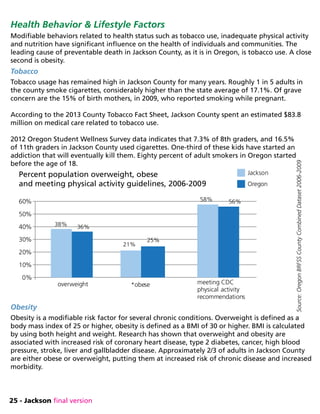
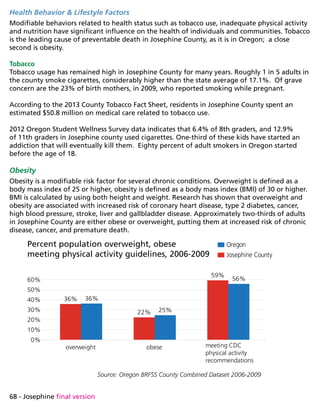
Obesity is a modifiable risk factor for several chronic conditions. Overweight is defined as a
body mass index of 25 or higher, obesity is defined as a BMI of 30 or higher. BMI is calculated
by using both height and weight. Research has shown that overweight and obesity are
associated with increased risk of coronary heart disease, type 2 diabetes, cancer, high blood
pressure, stroke, liver and gallbladder disease. Approximately 2/3 of adults in Jackson County
are either obese or overweight, putting them at increased risk of chronic disease and increased
morbidity.
overweight *obese meeting CDC
physical activity
recommendations
0%
10%
20%
30%
40%
50%
60%
38%
21%
58%
36%
25%
56%
Percent population overweight, obese
and meeting physical activity guidelines, 2006-2009
Jackson
Oregon
Source:OregonBRFSSCountyCombinedDataset2006-2009
26 - Jackson final version
Physical Activity  Nutrition
Regular physical activity and a healthy diet reduce the risk for chronic disease and obesity.
The percentage of adults consuming at least five servings of fruits and vegetables a day
in Jackson County from 2006-2009 was 33.2%, exceeding the state average of 27%. The
proportion of fast food establishments in the county, at 44%, is almost twice the national
benchmark.
“Access to resources to live a healthy lifestyle is hard. Food access here is bad, small stores
in small communities have mostly processed foods, they can’t afford to bring in fresh
out of town produce. That’s made worse by the fact that those with SNAP use their food
stamps for processed food, the money goes farther with processed food.”
— Focus Group Participant
Additional Social Determinants of Health
Food Insecurity
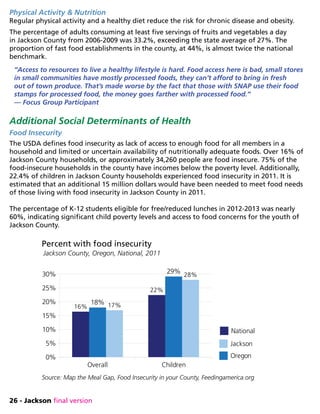
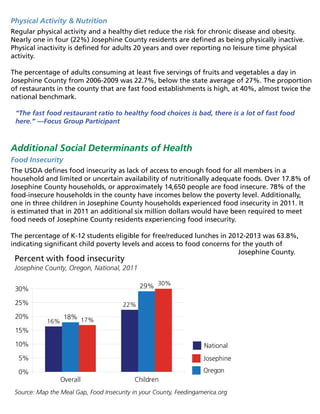
The USDA defines food insecurity as lack of access to enough food for all members in a
household and limited or uncertain availability of nutritionally adequate foods. Over 16% of
Jackson County households, or approximately 34,260 people are food insecure. 75% of the
food-insecure households in the county have incomes below the poverty level. Additionally,
22.4% of children in Jackson County households experienced food insecurity in 2011. It is
estimated that an additional 15 million dollars would have been needed to meet food needs
of those living with food insecurity in Jackson County in 2011.
The percentage of K-12 students eligible for free/reduced lunches in 2012-2013 was nearly
60%, indicating significant child poverty levels and access to food concerns for the youth of
Jackson County.
Source: Map the Meal Gap, Food Insecurity in your County, Feedingamerica.org
Overall Children
0%
5%
10%
15%
20%
25%
30%
16%
22%
18%
29%
17%
28%
Percent with food insecurity
Jackson County, Oregon, National, 2011
Jackson
Oregon
National
27 - Jackson final version
Health System
Access to Medical Care
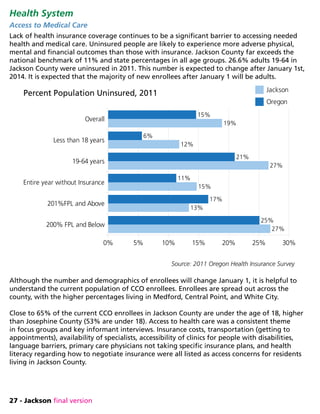
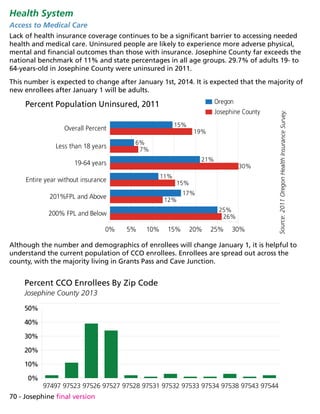
Lack of health insurance coverage continues to be a significant barrier to accessing needed
health and medical care. Uninsured people are likely to experience more adverse physical,
mental and financial outcomes than those with insurance. Jackson County far exceeds the
national benchmark of 11% and state percentages in all age groups. 26.6% adults 19-64 in
Jackson County were uninsured in 2011. This number is expected to change after January 1st,
2014. It is expected that the majority of new enrollees after January 1 will be adults.
Although the number and demographics of enrollees will change January 1, it is helpful to
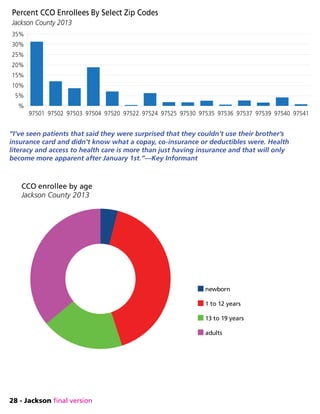
understand the current population of CCO enrollees. Enrollees are spread out across the
county, with the higher percentages living in Medford, Central Point, and White City.
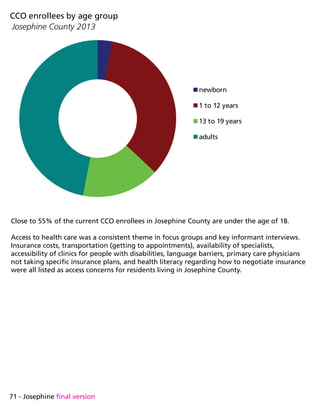
Close to 65% of the current CCO enrollees in Jackson County are under the age of 18, higher
than Josephine County (53% are under 18). Access to health care was a consistent theme
in focus groups and key informant interviews. Insurance costs, transportation (getting to
appointments), availability of specialists, accessibility of clinics for people with disabilities,
language barriers, primary care physicians not taking specific insurance plans, and health
literacy regarding how to negotiate insurance were all listed as access concerns for residents
living in Jackson County.
Source: 2011 Oregon Health Insurance Survey
200% FPL and Below
201%FPL and Above
Entire year without Insurance
19-64 years
Less than 18 years
Overall
0% 5% 10% 15% 20% 25% 30%
27%
13%
15%
27%
12%
19%
25%
17%
11%
21%
6%
15%
Percent Population Uninsured, 2011 Jackson
Oregon
28 - Jackson final version
“I’ve seen patients that said they were surprised that they couldn’t use their brother’s
insurance card and didn’t know what a copay, co-insurance or deductibles were. Health
literacy and access to health care is more than just having insurance and that will only
become more apparent after January 1st.”—Key Informant
CCO enrollee by age
Jackson County 2013
newborn
1 to 12 years
13 to 19 years
adults
97501 97502 97503 97504 97520 97522 97524 97525 97530 97535 97536 97537 97539 97540 97541
%
5%
10%
15%
20%
25%
30%
35%
Percent CCO Enrollees By Select Zip Codes
Jackson County 2013
29 - Jackson final version
Community Perceptions of Health
Focus Groups
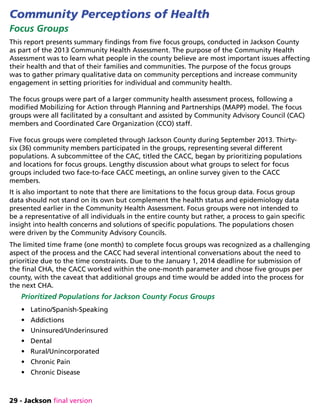
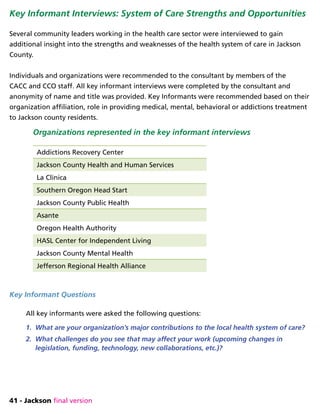
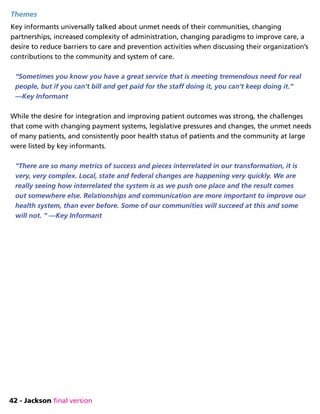
This report presents summary findings from five focus groups, conducted in Jackson County
as part of the 2013 Community Health Assessment. The purpose of the Community Health
Assessment was to learn what people in the county believe are most important issues affecting
their health and that of their families and communities. The purpose of the focus groups
was to gather primary qualitative data on community perceptions and increase community
engagement in setting priorities for individual and community health.
The focus groups were part of a larger community health assessment process, following a
modified Mobilizing for Action through Planning and Partnerships (MAPP) model. The focus
groups were all facilitated by a consultant and assisted by Community Advisory Council (CAC)
members and Coordinated Care Organization (CCO) staff.
Five focus groups were completed through Jackson County during September 2013. Thirty-
six (36) community members participated in the groups, representing several different
populations. A subcommittee of the CAC, titled the CACC, began by prioritizing populations
and locations for focus groups. Lengthy discussion about what groups to select for focus
groups included two face-to-face CACC meetings, an online survey given to the CACC
members.
It is also important to note that there are limitations to the focus group data. Focus group
data should not stand on its own but complement the health status and epidemiology data
presented earlier in the Community Health Assessment. Focus groups were not intended to
be a representative of all individuals in the entire county but rather, a process to gain specific
insight into health concerns and solutions of specific populations. The populations chosen
were driven by the Community Advisory Councils.
The limited time frame (one month) to complete focus groups was recognized as a challenging
aspect of the process and the CACC had several intentional conversations about the need to
prioritize due to the time constraints. Due to the January 1, 2014 deadline for submission of
the final CHA, the CACC worked within the one-month parameter and chose five groups per
county, with the caveat that additional groups and time would be added into the process for
the next CHA.
Prioritized Populations for Jackson County Focus Groups
•	 Latino/Spanish-Speaking
•	 Addictions
•	 Uninsured/Underinsured
•	 Dental
•	 Rural/Unincorporated
•	 Chronic Pain
•	 Chronic Disease
30 - Jackson final version
The CACC also discussed and guided the selection of data and questions to gather at the
focus groups. The focus group guide, including the specific questions asked, is attached in the
Appendices. A “site champion” was chosen from the CACC for each focus group. The role of
the site champion was to lead recruitment, coordination of focus group location, selection of
incentives for participants and introduction of the consultant to the participants at the group.
Data was gathered during the groups via open-ended questions and instant feedback polling
questions. The instant feedback polling questions utilized Turning Technology “clickers,”
capturing instant demographic data and polling on health priorities and perceptions. The use
of multiple feedback collection methodologies ensured 100% participation of focus group
attendees.
Light refreshments and $10 gift cards were provided to focus group participants as incentives.
The focus groups were completed within two hours, and averaged 6 participants per group.
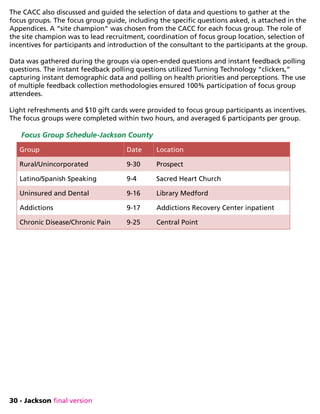
Focus Group Schedule-Jackson County
Group Date Location
Rural/Unincorporated 9-30 Prospect
Latino/Spanish Speaking 9-4 Sacred Heart Church
Uninsured and Dental 9-16 Library Medford
Addictions 9-17 Addictions Recovery Center inpatient
Chronic Disease/Chronic Pain 9-25 Central Point
31 - Jackson final version
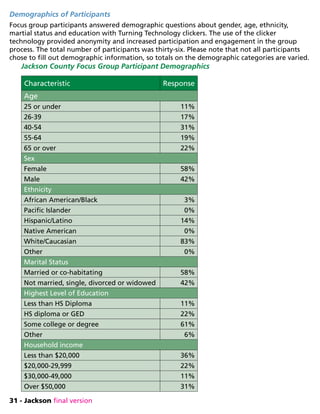
Demographics of Participants
Focus group participants answered demographic questions about gender, age, ethnicity,
martial status and education with Turning Technology clickers. The use of the clicker
technology provided anonymity and increased participation and engagement in the group
process. The total number of participants was thirty-six. Please note that not all participants
chose to fill out demographic information, so totals on the demographic categories are varied.
Jackson County Focus Group Participant Demographics
Characteristic Response
Age
25 or under 11%
26-39 17%
40-54 31%
55-64 19%
65 or over 22%
Sex
Female 58%
Male 42%
Ethnicity
African American/Black 3%
Pacific Islander 0%
Hispanic/Latino 14%
Native American 0%
White/Caucasian 83%
Other 0%
Marital Status
Married or co-habitating 58%
Not married, single, divorced or widowed 42%
Highest Level of Education
Less than HS Diploma 11%
HS diploma or GED 22%
Some college or degree 61%
Other 6%
Household income
Less than $20,000 36%
$20,000-29,999 22%
$30,000-49,000 11%
Over $50,000 31%
32 - Jackson final version
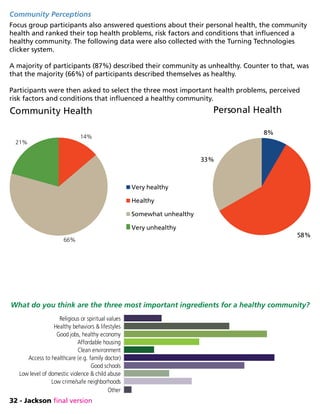
Community Perceptions
Focus group participants also answered questions about their personal health, the community
health and ranked their top health problems, risk factors and conditions that influenced a
healthy community. The following data were also collected with the Turning Technologies
clicker system.
A majority of participants (87%) described their community as unhealthy. Counter to that, was
that the majority (66%) of participants described themselves as healthy.
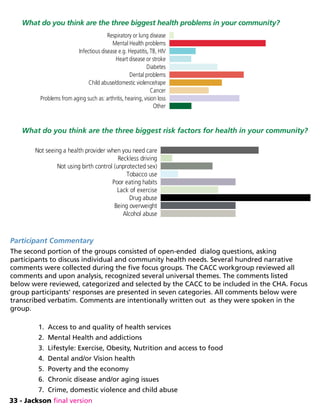
Participants were then asked to select the three most important health problems, perceived
risk factors and conditions that influenced a healthy community.
14%
66%
21%
Community Health
Very healthy
Healthy
Somewhat unhealthy
Very unhealthy
8%
58%
33%
Personal Health
What do you think are the three most important ingredients for a healthy community?
Low crime/safe neighborhoods
Low level of domestic violence  child abuse
Good schools
Access to healthcare (e.g. family doctor)
Clean environment
Affordable housing
Good jobs, healthy economy
Healthy behaviors  lifestyles
Religious or spiritual values
Other
33 - Jackson final version
What do you think are the three biggest health problems in your community?
What do you think are the three biggest risk factors for health in your community?
Participant Commentary
The second portion of the groups consisted of open-ended dialog questions, asking
participants to discuss individual and community health needs. Several hundred narrative
comments were collected during the five focus groups. The CACC workgroup reviewed all
comments and upon analysis, recognized several universal themes. The comments listed
below were reviewed, categorized and selected by the CACC to be included in the CHA. Focus
group participants’ responses are presented in seven categories. All comments below were
transcribed verbatim. Comments are intentionally written out as they were spoken in the
group.
1.	 Access to and quality of health services
2.	 Mental Health and addictions
3.	 Lifestyle: Exercise, Obesity, Nutrition and access to food
4.	 Dental and/or Vision health
5.	 Poverty and the economy
6.	 Chronic disease and/or aging issues
7.	 Crime, domestic violence and child abuse
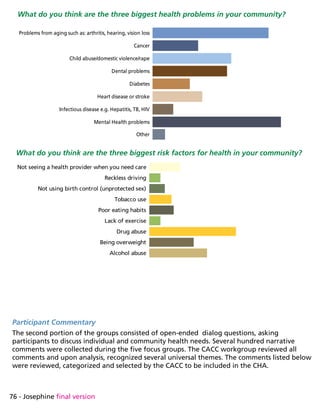
Problems from aging such as: arthritis, hearing, vision loss
Cancer
Child abuse/domestic violence/rape
Dental problems
Diabetes
Heart disease or stroke
Infectious disease e.g. Hepatitis, TB, HIV
Mental Health problems
Respiratory or lung disease
Other
Alcohol abuse
Being overweight
Drug abuse
Lack of exercise
Poor eating habits
Tobacco use
Not using birth control (unprotected sex)
Reckless driving
Not seeing a health provider when you need care
34 - Jackson final version
Access to and Quality of Health Services
Focus group participants consistently brought up barriers to accessing health and medical
services. Insurance (or lack of), paying for health care services, physically getting to a health
care provider (transportation), language barriers, having providers available and the
relationship with providers were all common themes in every focus group.
“Insurance needs to be more cost effective for us—I don’t want it for free, but it needs to be more
affordable so that we don’t have to choose between feeding my kids or getting medical care.”
“Some clinics don’t want to treat all issues at the same time, they only treat one issue at a time—
they ask for multiple appointments—but that requires more paying,deductibles, or copays.
“For years, I’ve been trying to get on OHP but I am over income—so I have to save for emergencies
and just deal with my pain.”
“[My biggest concern is] access to healthcare, being able to go to the doctor when you need to,
not always going to emergency room.”
“Availability of healthcare—up to a week ago I had no health insurance—I skipped a few doctor
appointments which made my chronic conditions worse and cost [more] in the long run.”
“Availability—getting into the doctor or specialists took me six months. You could be dead by
then. Even when you have insurance getting in is not always easy.”
“Continuity of care—not all docs on the same page, they all treat differently—not coordinated at
all.”
“Negative: Cost of healthcare, even with insurance, is a barrier. Positive: Availability of quality
healthcare in our community.”
“Most of the time, we just get over the counter medications or share each others prescription
medications and then it gets worse. We can’t afford to get the labs/tests to determine what is
wrong too, so it just gets worse.”
“Access isn’t just about insurance—we need more services, access on many different levels. More
of all services are needed, addictions, prenatal, all services are needed.”
“Transportation—even those that have chronic diseases—must have insurance but getting to the
provider is super difficult.”
35 - Jackson final version
“A woman at the gas station told me she was happy to see a clinic start in Butte Falls—and that
it will save peoples’ lives on the road. Older people were driving and either waiting too long or
getting in an accident—she told me, in tears, about several that she knew [that] died after leaving
the gas station to get to Medford.”
“Somebody might want to get to a workshop but they have no transportation, transportation is a
huge need.”
Mental Health and Addictions
Challenges with mental illness and addictions weighed heavily on all groups. The effects of
both on the individual and community were prevalent in many conversations about what
concerned participants and what solutions they wanted to improve their health and the health
of their community.
“Mental health problems, people don’t think they can be healthy so they turn into negative
thinking. If you are healthy mentally you are less prone to do drugs.”
“The biggest factor is lack of a continuum of mental health supports and services. Services seem to
be focused on meeting crisis needs rather than prevention and community support due to lack of
funding.”
“Mental illness and substance abuse are huge and costly. Also, the criminalization of mentally ill
and addicted individuals is an ineffective and costly approach to dealing with these issues.”
“Just about everyone I know has had an addiction. People with addictions are more sick, can’t get
to the doctor, don’t have health insurance and are embarrassed.”
“We need clean needles. I see needles laying around all over the place, in the street, on the
sidewalk, its disgusting and I was a user.”
“I am diabetic and used to supply all of Hawthorne Park with hypodermic needles, I got over 200 a
month and didn’t need them all. I’m here now (inpatient treatment) so I don’t know who is giving
out clean needles.”
“People are scared now—because of more homeless people are in the woods and the drug culture
they bring.”
“Substance abuse is another serious issue in our community across all economic levels. Also a lack
of adequate mental health services is a big problem.”
36 - Jackson final version
“We need less probation-focused treatment.”
“Pot, heroin, pills and prescription pills. People have gotten pretty creative. Like snorting Excedrin
migraine in their nose (in my high school).”
“Two years ago we had a huge problem with inhalants—kids were doing them at football
games—whipits with whip cream inhalants. My nephews were killed last year from doing whipits
and getting in a car accident.”
“Kids come back from lunch (at my school) visibly high—having smoked their parents’ stash at
lunch. Everybody knows who the smokers are here, but there isn’t much we can do about it.”
“Lack of resources [is a problem] they are out there but they are always broken. Bus passes, food
banks, etcetera are broke. It’s hard to get to resources. Not a lot of help for women with no
children. Jackson County Mental Health only has 12 visits a year—that’s not enough, it’s like you
just start getting into your problems and have to stop.”
“Homelessness, limited help for young single people. Hard if you don’t have parents to help you.”
“Out of fifteen of my preschoolers—four were raised by grandparents last year. They aren’t always
healthy [the grandparents]—and their health affects the kids and the grandparents. Plus, its
stressful to raise your grandkids.”
“Bullying is destroying our future, education systems are atrocious, our country is at the bottom of
education scales, (writing, math, science and reading) and it affects our health.”
Lifestyle: Exercise, Obesity, Nutrition and Access to Food
The need for lifestyle changes, including diet and exercise were clearly recognized in all
groups. Participants were quick to recognize their own challenges with lifestyle change while
also making suggestions for solutions such as community gardens, walking groups or farmers
markets.
“Habits are hard to break and start from our family going way back. I do what my parents did, and
food and life has changed, so should our habits.”
“Unhealthy food seems to be more convenient.”
“Access to resources to live a healthy lifestyle is hard. Food access here is bad—small stores
in small communities have mostly processed foods, they can’t afford to bring in fresh out of
town produce. That’s made worse with the fact that those with SNAP use their food stamps for
37 - Jackson final version
processed food-the money goes farther with processed food.”
“It costs $20 gas to get to Eagle Point [out of rural town] to a grocery store with good produce,
there is no public transit except “‘the thumb .’” (hitchhiking)
“Part of the problem is the lack of real education around nutrition and disease prevention.”
“With no grocery store with produce here, sometimes I call the local café and ask them for a head
of lettuce when I need it.”
“As a family—lack of consistent exercise for entire family affects our health—life is busy, exercise
becomes last on the list of priorities.”
“Kids don’t play outside—they sit in front of video games.”
Dental and Vision Health
Access to dental care and the negative effects of not having both preventive and crisis dental
care was a consistent theme among all groups and demographics. Vision health was also
mentioned in approximately 60% of the groups, related those living in poverty and not being
able to acquire glasses or contacts.
“[There are] lots of dental issues here—all they do is pull your teeth. When you don’t have teeth
you lose self esteem.”
“Dental appointments are still 2-3 weeks out even when in pain, what if I have a bad infection?
People can die without help.”
“We see kids with swollen face from abscesses and dental problems—their parents are like, “I
don’t know what to do, won’t it just heal?” It affects their ability to be at school and learn even
when they are there.”
“Vision services—glasses are expensive and if you can’t see you probably can’t work—half the
people that we serve at the food bank can’t see the line to sign for their food box.”
“Lack of affordable dental care—if you don’t have teeth, you can’t eat—it’s expensive to get
care—fillings, root canals which can lead to other chronic conditions. If it costs you $170-200 to
get your teeth cleaned, you probably won’t do it if you can already barely make it.”
“Homeless people don’t have the freedom to eat well, they eat whatever they can get, which is
usually not healthy food. Canned chili should not be a staple of anyone’s diet.”
38 - Jackson final version
“The homeless can’t get glasses because of [not having] ID for the Lions Club. ‘Free’ glasses—they
aren’t free.”
Poverty and the Economy
Poverty and the economy influences individual, family and community health. All groups
consistently discussed their influence on health, having lengthy conversations about how
improving the economy, jobs and not living in poverty would help improve health.
“No, [we are not healthy] because of homelessness. It’s embarrassing to go to doctor’s office and
they ask for address and I don’t have one.”
“I am very concerned at the growing numbers of families needing emergency food who are
food insecure, and the lack of affordable housing which is the number one need reported by the
families in my program.”
“We are not healthy enough. We have too much poverty, uninsured, lack of public health
programs, no affordable housing, too many homeless and jobless.”
“Multiple families are living under one roof since the economy went downhill-it affects everyone’s
health.”
“Childcare—hard to get benefits for it if you work and it’s expensive.”
“I think the health of the people in our community varies from very healthy to poor health. Some
groups are every physically active and health conscious with good incomes and other sub-groups
are impacted by very low incomes, inadequate housing and childcare, which produces high levels
of stress and negatively impacts health.”
Chronic Disease and Aging Issues
61% of focus group participants noted that they were currently living with a chronic
condition. Several participants also discussed challenges of managing chronic pain, particularly
in light of many programs to reduce opioid use in the county.
“I have MS and my husband has diabetes—I bring home preschool kids’colds from work and it
affects our health. In small towns you see small epidemics of flu, it goes through the entire town
and shuts us down. We can’t function with the flu like big cities do.”
“As our population ages—they have more chronic conditions and can’t get the right medical and
support services.”
39 - Jackson final version
“Caregiver fatigue—there is not a lot of money for caregivers so family often does it, they get tired
and they have their own health issues like depression, stress, etc.”
“The disabled— the entire group that just fell off Medicare that now won’t get care—hospice care
is narrowing and becoming highly medical focused.”
Crime, Domestic Violence and Child Abuse
Crime and concern about community and individual safety rated as a high concern in nearly all
focus groups. Concern about child abuse and domestic violence and their connection to health
were noted in all groups.
“Public safety. Cutting Sheriff’s Department. Criminals know public safety is last priority.”
“Need more counseling services and support to help families and dependents with trauma.”
Community Engagement in Solutions
All focus groups ended with a question about solutions to the challenges, problems and needs
identified in the prior questions. Specifically, the facilitator asked “what do you think we (as a
community) can do to enhance the health of our community?” The focus was directed at what
solutions participants wanted to be engaged in to address the problems discussed earlier.
All groups, regardless of demographic or location expressed a strong sense of concern about
their community and how they could contribute to improving problems. Several solutions and
positive comments were stated in every group, some of those comments are as follows:
Suggestions
“Embrace that we are all in this together—find things that help more than myself, but my larger
community too.”
“We have a community kitchen, but my problem is awareness and getting them there. I made
apple sauce one time and a lady said ‘oh, you can make apple sauce?’ People want to know how
to improve their life, they just don’t know how.”
“[We need] education for professionals on addictions, being addicted is a disease, we aren’t all bad
people.”
“Make sure I get prenatal care and take care of my baby now so she’s not a drain on the
community later.”
40 - Jackson final version
“I will stay clean, be a productive citizen in the community, volunteer work to help others with
addictions.”
“We need more opportunities to keep young people [get] active in good ways instead of getting
into trouble.”
“[We need] more things at schools to give youth direction. Now that I’m clean and sober, I realize I
wasted 44 years in my life-now I want to help and develop myself with education.”
“The meth commercial where they chase the addict like we are a horrible pople, that makes us
more separate. Instead, maybe the commercial should be a hand reaching out to help us with
problems. Reach out to the addict, don’t chase us.”
“Education is key. sometimes it’s about breaking cycles and learning new ways. Education can be
many different levels.”
“I appreciate that all three CCOs are working together for this, it’s hopeful. I am really glad that
they are listening.”
“Develop creative affordable ways to provide community service supports to those suffering from
mental illness to reduce isolation, support recovery, and prevent re-hospitalization.”
“Build and initiate pubic health programs that have community buy-in. Involve public in CCO
process.”
41 - Jackson final version
Key Informant Interviews: System of Care Strengths and Opportunities
Several community leaders working in the health care sector were interviewed to gain
additional insight into the strengths and weaknesses of the health system of care in Jackson
County.
Individuals and organizations were recommended to the consultant by members of the
CACC and CCO staff. All key informant interviews were completed by the consultant and
anonymity of name and title was provided. Key Informants were recommended based on their
organization affiliation, role in providing medical, mental, behavioral or addictions treatment
to Jackson county residents.
Organizations represented in the key informant interviews
Addictions Recovery Center
Jackson County Health and Human Services
La Clinica
Southern Oregon Head Start
Jackson County Public Health
Asante
Oregon Health Authority
HASL Center for Independent Living
Jackson County Mental Health
Jefferson Regional Health Alliance
Key Informant Questions
All key informants were asked the following questions:
1.	 What are your organization’s major contributions to the local health system of care?
2.	 What challenges do you see that may affect your work (upcoming changes in
legislation, funding, technology, new collaborations, etc.)?
42 - Jackson final version
Themes
Key informants universally talked about unmet needs of their communities, changing
partnerships, increased complexity of administration, changing paradigms to improve care, a
desire to reduce barriers to care and prevention activities when discussing their organization’s
contributions to the community and system of care.
“Sometimes you know you have a great service that is meeting tremendous need for real
people, but if you can’t bill and get paid for the staff doing it, you can’t keep doing it.”
—Key Informant
While the desire for integration and improving patient outcomes was strong, the challenges
that come with changing payment systems, legislative pressures and changes, the unmet needs
of many patients, and consistently poor health status of patients and the community at large
were listed by key informants.
“There are so many metrics of success and pieces interrelated in our transformation, it is
very, very complex. Local, state and federal changes are happening very quickly. We are
really seeing how interrelated the system is as we push one place and the result comes
out somewhere else. Relationships and communication are more important to improve our
health system, than ever before. Some of our communities will succeed at this and some
will not. ” —Key Informant
43 - Jackson final version
The Community Health Improvement Plan  Next Steps
Utilizing the CHA for Planning
The Jackson County Community Health Assessment (CHA) draws attention to numerous
opportunities for health improvement at the individual and community level. While
the CHA identifies many critical health issues, it is not inclusive of every possible health-
related issue. Instead, it was intended to provide a macro view of available community
data and help to identify community trends. The CHA was successful in that purpose as
well as engaging new community members in prioritizing what health status issues were
important and where additional focus and data was needed.
The CHA was the first step in an ongoing process of community health assessment,
planning and improvement. The natural progression of the community planning process
is to prioritize health status issues and implement strategies to improve them. The
prioritization process and document is titled the Community Health Improvement Plan
(CHIP).
“Pick the top three health problems in my community?! How can I only pick three, they
are all important!” –Focus Group Participant
Prioritizing future efforts to address individual and community health is imperative.
Individuals, organizations and communities in Jackson County do not have unlimited
resources to change all health status problems at once. Prioritizing efforts that are most
likely to succeed and have the biggest positive impact on individual and community
health must happen first. Strategies that are most likely to improve health outcomes,
improve health of individuals and reduce health care costs ties the CHIP to the CCO Triple
Aim. The prioritization conversation will not be one time process but will be dynamic.
The next step of the CCO community health process will entail community discussion
about the community health assessment findings followed by establishing short term,
intermediate and long-term strategies to address prioritized individual and community
health problems. The prioritization process should be based on the quantitative
and qualitative data presented in the community health assessment document and
complemented with additional community input.
44 - Jackson final version
Top 3 Health Problems: Focus Groups
Jackson County 2013
1. Mental Health Problems
2. Dental Problems
3. Problems from Aging
Top 3 Ingredients for A Healthy Community
Jackson County 2013
1. Access to health care
2. Good jobs and a healthy economy
3. Good schools
Top 3 Risk Factors/Behaviors Related to a Healthy Community
Jackson County 2013
1. Drug Abuse
2. Not seeing a health care provider when you needed to (access)
3. Alcohol abuse, overweight, poor eating habits
Strategies for addressing health problems, behaviors related to health or ingredients
for building a health community should be based on best practice/standards, potential
community impact, cost and feasibility. Additionally, strategies for health improvement
should be linked to indicators that are already being tracked in the community, to
better enable the evaluation of progress and success of the chosen strategies. This will
aid in reducing duplication of effort and provide a mechanism for more consistent and
continuous measurement of progress. CCO metrics and local, state and national public
health indicators are suggested possible indicators.
45 - Jackson final version
Identifying additional data needs and working with local, state and federal organizations
to meet those needs will also need to be considered in the CHIP. County specific data on
health status by race and ethnicity is an example of a continuing data need. Dental access
and outcomes is another area of data needs, among many others. Having adequate data
to understand problems in the community is imperative in planning appropriate strategies
and solutions. Advocating for access to county level data that is helpful for CCO and CAC
planning will need to be a continuing strategy in the CHIP.
Engagement of the CAC will continue to be instrumental in the process, as will listening to
community member priorities and concerns. The work of improving the health of people
in Jackson County will happen with collaborative and adaptable efforts as we move
forward through health care transformation and integration.
Josephine County
Community Health Assessment
2013
47 - Josephine final version
Source: PSU Population Research Center
2002-2004 2004-2006 2006-2008 2008-2010 2010-2012
0%
1%
1%
2%
2%
3%
3%
4%
Percent Population Increase 2002-2012 Oregon
Josephine County
Josephine County People and Place
Location and Physical Characteristics
Josephine County is located in Southwestern Oregon. It
is a rugged part of the state with multiple climates and
geography within its 1,640 square miles. The diverse
terrain includes large broad valleys, deep river valleys
and sparsely populated mountainous areas. There are
hundreds of hills, valleys and waterways including the
Rogue River and its tributaries such as the Illinois River.
Josephine County has only two incorporated cities and
the county is designated as rural by the Oregon Office of
Rural Health. The total population in Josephine County is
82,930 (2012). The two incorporated cities are Grants Pass and Cave Junction. Grants Pass is the
county seat and had a population of 34,805 in 2012. The majority of residents live in over 24
unincorporated areas, creating geographic barriers to accessing medical care, services and in
some communities, access to exercise facilities, grocery stores and fresh foods.
“We are far away from medical centers and services, it affects the elderly. Transportation,
social and food services are a major problem here.” —Focus Group Participant
Demographic Trends and Population Characteristics
Migration and Growth
Josephine County has consistently lagged behind average state growth rates and has
experienced a migration pattern in and out of the county similar to many other rural Oregon
counties. Although the percentage growth has not dipped into the negative percentage,
like Jackson County, the patterns of migration are important to note. Like many other rural
counties, Josephine has experienced outmigration of younger populations while seeing an
influx of older populations at the same time. This migration pattern has kept the overall
annual growth close to
zero but presents changes
in workforce, service needs
and health care utilization
patterns. Like many
Southwestern Oregon
counties, local population
statistics began showing
that younger families were
leaving the area for more
metropolitan counties to
find jobs shortly after the
economic downturn.
At the same time, the county continued to see a steady influx of seniors to the county, largely
from out of state.
Both the exodus of younger and often higher socioeconomic level populations and the influx
of older demographic groups in the county ultimately influences the health status and burden
for care on the community. The percentage of 60 and over is expected to continue to rise
within the county, while percentages of younger ages continues to diminish.
Growth in Elderly Population
According to 2012 census data, 23.6% of the county population is over 65 years old. That is nearly
double the state average of 14.9% and still higher than Jackson County at 18.8%.
Josephine County joins many other
counties in Southern Oregon with
distinctly higher average ages and higher
percentages of elderly living in the
county than more metropolitan counties.
The more isolated rural communities in
Josephine County have higher percentages
of residents over age 60 than Grants Pass,
the county seat.
“People here are old, they don’t have
anyone to help them anymore, they get
isolated [out here] and the group of them
is getting bigger.”
—Focus Group Participant
Age Distribution Josephine County 2012
source: 2012 US Census
5%
6%
11%
15%
33%
30%
60 and over
under 5
years 5 to
9 years
10 to 19 years
20 to 34 years
35 to 60 years
0-45 -9 10-
14
15-
19
20-
24
25-
29
30-
34
35-
39
40-
44
45-
49
50-
54
55-
59
60-
64
65-
69
70-
74
75-
79
80-
84
85+
0
1,000
2,000
3,000
4,000
5,000
6,000
7,000
8,000
Population Forecast by Age, 2010-2040
Josephine County
2010
2040
Source: Office of Economic Analysis, Department of Administrative Services, State of Oregon
49 - Josephine final version
Poverty
Nearly one in three children in Josephine County live in poverty, creating significant challenges
to their overall health and long-term development.
18.8% of the total county
population lives in poverty
(2007-2011), higher than the
state average of 14.8%.
Poverty has tremendous impact
on individual and community
outcomes and was consistently
brought up in the community
focus groups related to access
to health care services, housing,
access to healthy food and
nutrition.
“Your health here depends on your income—if you can’t afford good food you eat garbage
and you can’t see the doctor when you need to.” —Focus Group Participant
under 18 years 18-64 years 65 years and older
0%
5%
10%
15%
20%
25%
30%
30%
20%
9%
Percent living below poverty level by age
Josephine County
Josephine
18.8%
Curry
14.2%
Jackson
15.8%
Coos
16.0%
Klamath
18.1%
Lake
18.7%
Douglas
16.0% Harney
20.5%
17.4% 11.4%
Malheur
22.6%
15.8%
21.0%
15.9%
20.2%
15.8%
16.2%
12.6%
12.7%
Baker
20.0%
17.3%
12.8% 9.5%
19.4%
10%16.5% 18.6%10.4%17.6%
9.9%
16.6%
16.4%
15.9%14.8%
11.8%
14.2%
Source:5-yearAmericanCommunitySurveyEstimates
Percent In Poverty By County
50 - Josephine final version
Homelessness
Homelessness continues to be a challenge for many living in Josephine County. Causes of
homelessness are varied, they include drug and alcohol abuse, high rents, domestic violence
and unemployment.
Causes of Homelessness Josephine County 2013
Unemployed
Couldn't afford rent
Drug/alcohol (in self)
Kicked out by family/friends
Domestic violence
Drug/alcohol (in home)
Criminal history
Mental or emotional disorder
Evicted by landlord
By choice
Other
Poor rental history
Credit
Child abuse
Due to foreclosure
Medical problem
Source: One Night Homeless Count 2011-2013, Josephine County Homeless Task Force
51 - Josephine final version
Education
High school graduation rates at the county level are similar to State averages, typically
showing 87% of the population being a high school graduate or higher.
For those with less than a high school degree (or equivalent), poverty is markedly higher—they
are twice as likely than those with some college to live in poverty.
Disabilities
In Josephine County there are an estimated 12,555 adults with disabilities according to the
recent Area Agency on Aging 2013-2016 plan. Types of disabilities are varied, with ambulatory
difficulty being the highest, cognitive being a close second.
Source: 2009-2011 American Community Survey 3-Year Estimates
Less than high school graduate
High school graduate (includes equivalency)
Some college, associate's degree
Bachelor's degree or higher
Source: 2011 American Community Survey 1-Year Estimates
ambulatory difficulty
cognitive difficulty
independent living difficulty
hearing difficulty
self-care difficulty
vision difficulty
Percentage of people with a disability Josephine County 2011
52 - Josephine final version
Race and Ethnicity
Josephine County has had consistently low percentages of ethnic minorities. Although the
percentages have increased over the last decade, they have not increased significantly. 2012
Census statistics show that 11.8% of the population in the county identify as being a minority.
Hispanic or Latino represents a 6.6% minority of the population in the county, followed by
people identifying as being from two or more races at 3.1%.
Public school enrollment statistics are slightly different from census numbers, showing higher
percentages of minorities. Grants Pass School District shows 12.84% Hispanic students, which
is nearly double the census number of 6.6%. The districts are still below the state average for
minority populations, but the school enrollment numbers suggest growing ethnic minorities in
Josephine County.
Health outcomes for racial and ethnic minorities continue to be lower, while percentages
of those insured are also lower in minority groups. Although specific county-level data for
uninsured by race/ethnicity is not currently available, it is important to note that Hispanic
groups have significantly higher chances of being uninsured statewide. Every minority race
and ethnic group has higher rates of uninsurance as compared to Caucasian populations,
presenting significant barriers to accessing health care and health disparities.
White Alone Black Asian Pacific Islanders Asian Multi Hispanic
0%
5%
10%
15%
20%
25%
30%
35%
40%
45%
Oregon uninsured rates by race/ethnicity, 2011 Ages 0-18
Ages 19-64
Source:2011OregonHealthInsuranceSurvey
53 - Josephine final version
Employment
Unemployment in Josephine County continues to be higher than state and national averages.
Although the trend shows slight decreases in the seasonally adjusted unemployment rates
from the Oregon Employment Department, they continue to hover around 11.2-11.3%
annually, 4% higher than the national average and higher than Jackson, Curry and Douglas
counties.
Residents of Josephine County work predominantly in education services, health care, social
assistance and retail.
Unemployment and its effects on poverty and health continue to be felt by county residents
and was discussed frequently in focus groups.
“I’ve not been able to find work in the area—and without work there is no money.
Without money we have to sell our house. Huge fear, we live in huge fear, even though
we have strong beliefs, I still can’t provide.” —Focus Group Participant
Unemployed
Agriculture, forestry, fishing and hunting, and mining
Construction
Manufacturing
Wholesale trade
Retail trade
Transportation warehousing, utilities
Information
Finance and insurance, real estate, rental, leasing
Professional, scientific, management, administrative, waste management
Educational services, health care, social assistance
Arts, entertainment, recreation, accommodation, food services
Other services, except public administration
Public administration
Percent Employed by Business Sector
Josephine County and Oregon 2009-2011 Josephine County
Oregon
Source: 2009-2011 American Community Survey 3-Year Estimates
54 - Josephine final version
Source: Criminal Justice Commission, Statistical Analysis Center
Jan-06 Sep-06 May-07 Jan-08 Sep-08 May-09 Jan-10 Sep-10 May-11 Jan-12 Sep-12
0
10
20
30
40
50
60
70
80
90
Drug Arrests- Oregon State and Josephine County
All drugs- Oregon
Josephine- All drugs
Oregon Meth
Josephine Meth
Oregon Heroin
Josephine Heroin
6monthmovingaverageCrime
Crime continues to be top of mind for residents living in Josephine County. The Report of
Oregon Offenses known to Law Enforcement lists Josephine County as 14th
highest in the state
for property crimes (out of 36), 14th
for person crimes and 23rd
for behavior crimes in 2010.
Drug arrests for heroin and methamphetamine surpassed state averages beginning in 2012
and continue to be on an increasing trend line.
“When you are surrounded by drugs you can’t be healthy.” —Focus Group participant
55 - Josephine final version
Health Status: Individual and
Community Health
County Health Rankings
The County Health Rankings is a collaborative project
supported by the Robert Wood Johnson Foundation.
The rankings evaluate counties based on causes of death
(mortality), types of illnesses (morbidity) and those factors
that lead to poor health outcomes. The rankings provide
a measurement tool to compare county-to-county, as well
as comparison to state and national benchmarks.
The most recent rankings were released in March 2013
and rankings are available for nearly every county in the
United States. The rankings look at a variety of measures
that affect health. Although released annually, some of
the data sets that are used in the development of the
rankings are older so it is important to not look at county
rankings exclusively when evaluating the health status of
Josephine County.
Josephine County was one of the worst in the state,
raking 29th
out of 33 Oregon counties (health outcomes
category) a second year in a row. Mortality (death) was
also ranked 29th
out of 32, morbidity (disease) was ranked
slightly better at 18th
out of 32.
Morbidity  Mortality in Josephine County
Mortality (death) and causes of death have changed in
Josephine County over the last 75 years, consistent with
state and national trends. Many advances in science,
medicine, living and working conditions have contributed
to changes in causes of death and life expectancy. The
major causes of premature death in Josephine County are
chronic conditions, consistent with a nationwide epidemic
of chronic disease and conditions.
Health Outcomes
Oregon Counties
2013
County Rank
Baker 33
Benton 2
Clackamas 5
Clatsop 12
Columbia 19
Coos 28
Crook 8
Curry 26
Deschutes 7
Douglas 30
Gilliam not ranked
Grant 1
Harney 20
Hood River 3
Jackson 13
Jefferson 32
Josephine 29
Klamath 31
Lake 22
Lane 17
Lincoln 24
Linn 23
Malheur 10
Marion 14
Morrow 16
Multnomah 15
Polk 9
Sherman not ranked
Tillamook 25
Umatilla 27
Union 21
Wallowa 18
Wasco 11
Washington 4
Wheeler not ranked
Yamhill 6
56 - Josephine final version
Death from cancer, heart disease and lower respiratory disease is significantly higher in
Josephine County than the state or Healthy People 2020 goal. Healthy People 2020 provides
national benchmark goals for communities and organizations that create and administer
health improvement plans. They are evidence-based national objectives designed to help
communities monitor progress and evaluate success. Josephine County rates are almost double
that of the Healthy People benchmark goals in cancer, heart disease and chronic respiratory
disease.
Josephine County joins many of its neighboring counties with high incidences of cancer. Breast
cancer, prostate, lung and colorectal cancers continue to be the leading types of cancer in
Josephine County, a consistent trend for the last decade.
cancer
heart disease
chronic lower respiratory disease
alzheimer's disease
cerebrovascluar disease
unintentional injuries
diabetes-linked
suicide
alcohol induced
0 50 100 150 200 250 300 350
Leading causes of death per 100,000
Josephine County, Oregon, Healthy People 2020
Rate per 100,000
Josephine County
Oregon
HP2020
Sources: Oregon Health Division County Data Book 2011, Healthy People 2020
Chronic Disease  Conditions
Prevalence of chronic conditions in Josephine County are close to many state averages with
the exception of high blood cholesterol and high blood pressure. The county age-adjusted
population data shows a high burden of high blood cholesterol, high blood pressure, asthma
and arthritis in the county.
Oregon Public Health Authority, Cancer in Oregon report, 2010
All Breast Colorectal Lung Prostate
0
100
200
300
400
500
600
Leading types of cancer
Josephine County 2001-2010
2001-2005 - County
2001-2005 - State
2006-2010 - County
2006-2010 - State
Josephine County
Oregon
Source:OregonBRFSSCountyCombinedDataset2006-2009
stroke
heart attack
angina
diabetes
asthma
arthritis
high blood pressure
high blood cholesterol
0% 5% 10% 15% 20% 25% 30% 35% 40% 45%
3%
3%
4%
6%
12%
26%
35%
44%
2%
3%
3%
7%
10%
26%
26%
33%
Prevalence of population with chronic conditions
2006-2009
The burden of chronic conditions for those on Oregon insurance programs, such as the
Oregon Health Plan, show a similar pattern as the county population. Oregon Health Plan
patients, enrolled in one of the three CCO’s in Josephine and Jackson Counties, show high
rates of tobacco use, diabetes, asthma, obesity and chemical dependency.
rheumatoid arthritis
chemical dependency
tobacco use
cystic fibrosis
hemophilia
low birth weight
chronic coronary heart disease (CHF)
chronic ischemic heart disease (CIHD)
hypertension
stroke
diabetes
chronic kidney disease (ESRD)
chronic liver disease/cirrhosis (liver)
hepatitis c (HEP C)
HIV/AIDS
attention deficit disorder (ADD)
alzheimers
anorexia
autism
bipolar disorder
borderline personality disorder
dementia
depression
post-tramatic stress disorder (PTSD)
schizophrenia
breast cancer
colorectal cancer
leukemia
lung cancer
ovarian cancer
prostate cancer
epilepsy
multiple sclerosis (MS)
paralysis
asthma
chronic bronchitis
chronic obstructive pulmonary disease (COPD)
emphysema
obesity
0 10 20 30 40 50 60 70 80 90
Average rate chronic conditions October 2013
AllCare Health Plan, Primary Health, Jackson Care Connect combined data
rate per 1,000 clients
(counted if client had at least 2 claims in last 3 years)
Source:OregonHealthAuthority2013
59 - Josephine final version
Oral and Dental Health
National and state level data shows that tooth decay is five times more common than asthma
in Oregon children, making dental health a priority concern for the County and State. In
Oregon, oral disease is on the rise and is not limited by socio-economic status, race or ethnicity,
or age according to a recent resources scan and needs assessment commissioned by the
Oregon Community Foundation.
The 2012 Oregon Smile Survey grouped counties into regions, Josephine County being in
Region 4 with Coos, Curry, Klamath, Lane, Douglas and Jackson. The region has higher
percentages of cavities, untreated decay and rampant decay in children. Although the rise in
oral disease is not limited to socio-economic status, the dental health of children in the region
was far worse for those with lower incomes.
Oral health status children grades 1-3, 2012
Source: Oregon Smile Survey 2012
Region 4 includes Coos, Curry, Douglas, Jackson, Josephine, Klamath, Lane
had a cavity
untreated decay
rampant decay
62%
66%
70%
38%
34%
30%
Oral health status children grades 1-3
by household income region 4, 2012
lower income
higher income
60 - Josephine final version
Total Ages 1-2 Ages 3-5 Ages 6-9 Ages 10-14 Ages 15-18 Ages 19-20
2431
717
1064 1172 1259 1148
517
0 8
246 271
68 0
Youth Medicaid Population with Dental Coverage and Sealants
Josephine County 2011-2012
Enrolled
Received Sealants
“Dental care and issues are huge—dental affects so many other health issues, we have
insurance and I still can’t afford dental care—it affects more than people would think.”
—Focus Group Participant
Dental prevention and access to dental care was consistently mentioned in all focus
groups in the county. Of those children enrolled in Medicaid in the county, the majority
did not have sealants (a common preventive dental practice).
61 - Josephine final version
Rates of suicide deaths have been varied in Josephine County over the last decade. Suicide
is highly correlated with depression, intimate partner violence and several mental health
disorders.
Suicide, depression and harassment in youth in Josephine County is close to state averages but
still high.
Source: Oregon Vital Records
2000
2001
2002
2003
2004
2005
2006
2007
2008
2009
2010
2011
2012
0
5
10
15
20
25
Rate of suicide deaths, all ages 2000-2012
Josephine County
Rateoer1000population
Josephine County
Oregon
Source:
OregonBehavioralRiskFactorSurveillanceSystem
Oregon Josephine County
66% 67%
Oregon Adults in Good Mental Health
Josephine County and Oregon, 2006-2009
Mental Health
67% of residents in Josephine County describe themselves as having good mental health.
Although that is close to the state average, it still shows that close to 1 in 3 people don’t
consider themselves as having good mental health. When people don’t feel as though their
mental health is good, health-related quality
of life is reduced.
62 - Josephine final version
Bullying and harassment of youth was another reoccurring theme in the focus groups. Youth
identifying as gay, lesbian, bisexual or transgender were more likely to experience harassment
and bullying in the county.
Source: 2012 Oregon Student Wellness Survey
Depression Suicidal ideation Attempts
24%
17%
8%
25%
15%
7%
Youth Depression, Suicide Ideation, and Attempts
Josephine County
AveragesGrades6,8,11
Josephine County
Oregon
Source: Oregon Student Wellness Survey, 2012
Grade 8 County
Grade 8 State
Grade 11 County
Grade11 State
19% 14%
10% 8%
Youth harassment multiple grades
Josephine County 2012
harassment because someone said that you
were gay, lesbian, bisexual or transgender”
Data from the 2012 Oregon Student Wellness Survey indicate that 1 in 4 Josephine County
youth experienced depression, 17% experienced suicidal ideation, and 7% attempted suicide.
Addictions
Josephine County residents have significant issues with addictions of alcohol, tobacco, other
drugs and gambling. Binge drinking, in women, is higher than state averages, and higher than
neighboring counties. Excessive heavy alcohol consumption can contribute to chronic health
issues, including heart disease, liver cirrhosis, high blood pressure, stroke, coma and death.
14% of Josephine County adults drink excessively, twice the national benchmark of 7%. Heavy
or excessive drinking is defined as adults consuming more than one (women) or two (men)
beverages per day on average.
“Unfortunately my addictions have affected the entire community, so my choice to be
clean will too.”—Focus Group Participant
Source:
OregonBehavioralRiskFactorSurveillanceSystem
Oregon Josephine County
0%
1%
2%
3%
4%
5%
6%
7%
8%
Male and female heavy drinking, 2006-2009
male
female
5%
6% 6%
8%
Source: 2012 Oregon Student Wellness Survey
smoked cigarettes alcohol binge drinking marijuana any illicit drugs
0%
5%
10%
15%
20%
25%
30%
35%
40%
Youth drug use — Josephine County Grade 8 - County
Grade 8 - State
Grade 11 - County
Grade 11 - State
percentageusedinpast30days
64 - Josephine final version
Drug and alcohol use is not a problem exclusively in adults. Eighth and eleventh grade
students in Josephine County reported higher than State average binge drinking, and use of
cigarettes, alcohol, marijuana and illicit drugs.
Gambling, a type of addiction, also presents challenges to both adults and youth in Josephine
County. The county has higher percentages of eighth graders reporting gambling of every
type, than the state average.
lottery/powerball/megabucks
dice or coin flips
cards (poker, etc)
betting on sports
betting on games of personal skill
(bowling, video games, dare)
internet gambling
other
0% 5% 10% 15% 20% 25%
8th Grader Gambling 2012 Josephine County
Oregon
Source: Oregon Student Wellness Survey 2012
Source: Oregon gambling treatment programs evaluation update 2012
Oregon Health Authority, Addictions and Mental Health Division
Prevalence Accessing Treatment
Prevalance of Problem Gambling
Josephine County 2012
Numberofindividuals
0
500
1000
1500
2000
2500
2100
63
65 - Josephine final version
The prevalence of problem gambling is considerably higher than those accessing treatment in
Josephine County. It is important to note that only 3% of those with problem gambling in the
county are accessing treatment.
Arrests for drug offenses are mentioned in the People and Place section, but show higher
averages arrests in Josephine County for all drug categories while also showing higher
averages for heroin and methamphetamine.
“Drugs (are the number one problem). To me it’s a core problem that affects and creates
broken families, abuse, crime, is a vicious cycle. We have good programs here but it’s just
so common, we need to break the cycle in people, families and communities.”
—Focus Group Participant
The rise in opioid overdose deaths presents a challenge for both providers and the community.
(Deaths from drugs such as codeine, oxycodone, morphine and methadone). The morbidity
and mortality associated with inappropriate use of opiate drugs has a negative impact on the
health of the community. Josephine County has one of the highest opioid death rates in the
state and the number of yearly deaths due to opioids is on the rise. At the same time, people
in focus groups commented that their pain was not well managed and discussed the added
burden that chronic pain presented when suffering from chronic conditions. Focus group
comments and the high rate of opioid death suggest systemic problems in the management of
chronic pain in the county.
“I don’t see anyone speaking for those who need opiates for their chronic pain and are
unable to get meds because doctors won’t prescribe them.” —Focus Group Participant
Prescription Opioid overdose mortality rate by county, 2003-2007
Rate per 100,000
1.8 - 2.3
2.3 - 3.4
3.4 - 5.3
5.3 - 8.2
no rate
(less than 5 cases total)
66 - Josephine final version
Maternal  Child Health
Causes of low birth weight include tobacco use, alcohol and other drug use, socioeconomic
factors such as education level and poverty as well as maternal and fetal medical conditions.
Babies born with low birth weight (considered 1500-2499 grams at birth) typically have more
long-term disabilities and developmental
issues, including cerebral palsy, learning
disabilities, impairment of sight, hearing
and/or lung functioning. The percentage of
low birthweight babies in Josephine County
is 5.5%, close to the state percentage
of 6.1% and better than the national
benchmark of 6%.
Women who access care while they are
pregnant are more likely to have healthy
pregnancies and better child outcomes,
and also less likely to have low-birth-weight
babies. Prenatal care includes a number of
services, including: education about healthy
choices and body changes while pregnant,
prenatal testing and counseling, treatment
for medical conditions/complications (such
as anemia and gestational hypertension),
oral health assessment and treatment,
screening for tobacco use, substance abuse,
and intimate partner violence.
Although pregnancy risk factors are high (e.g. maternal tobacco use) in Josephine County,
utilization of prenatal care is moderate and slightly exceeds the state average, with 76.2% of
mothers in the county receiving prenatal care (2011) in the first trimester. Women receiving
prenatal care in Josephine County have a markedly reduced rate of low birth weight babies
compared to those without prenatal care.
A primary risk factor for low birth weights
and poor child health outcomes is maternal
smoking. Maternal smoking in Josephine
County is currently higher than the state
average and has been for several years.
The teen birth rate in Josephine County is
higher than the state average and national
benchmark. Josephine County’s teen birth
rate per 1,000 females ages 15-19 is 36,
higher than the Oregon rate of 33 and the
national benchmark of 21.
source: oregon vital statistics, 2011
first trimester care inadequate prenatal care
76%
8%
75%
5%
Percentage receiving prenatal care
Josephine County 2011
Josephine County
Oregon
5%
10%
15%
20%
25%
30%
Percentage of maternal tobacco use
2005-2011
2005 2006 2007 2008 2009 2010 2011
Josephine County
Oregon Source:OregonHealthAuthority
CenterforHealthStatitistics
67 - Josephine final version
Immunization is an effective tool for preventing disease and death. Vaccinating children,
according to the Centers for Disease Control and Prevention recommended immunization
schedules, is varied by county. Parents choosing not to vaccinate claiming religious exemption
has been higher than state average in Josephine County for over a decade. The number of
parents requesting exemptions continues to increase annually.
Oregon Health Authority, Immunization Program
2%
4%
6%
8%
10%
12%
14%
Religious Exceptions from Immunizations
Josephine County
School Year
percentclaimingreligiousexceptions
Josephine County
Oregon
68 - Josephine final version
Health Behavior  Lifestyle Factors
Modifiable behaviors related to health status such as tobacco use, inadequate physical activity
and nutrition have significant influence on the health of individuals and communities. Tobacco
is the leading cause of preventable death in Josephine County, as it is in Oregon; a close
second is obesity.
Tobacco
Tobacco usage has remained high in Josephine County for many years. Roughly 1 in 5 adults in
the county smoke cigarettes, considerably higher than the state average of 17.1%. Of grave
concern are the 23% of birth mothers, in 2009, who reported smoking while pregnant.
According to the 2013 County Tobacco Fact Sheet, residents in Josephine County spent an
estimated $50.8 million on medical care related to tobacco use.
2012 Oregon Student Wellness Survey data indicates that 6.4% of 8th graders, and 12.9%
of 11th graders in Josephine county used cigarettes. One-third of these kids have started an
addiction that will eventually kill them. Eighty percent of adult smokers in Oregon started
before the age of 18.
Obesity
Obesity is a modifiable risk factor for several chronic conditions. Overweight is defined as a
body mass index of 25 or higher, obesity is defined as a body mass index (BMI) of 30 or higher.
BMI is calculated by using both height and weight. Research has shown that overweight and
obesity are associated with increased risk of coronary heart disease, type 2 diabetes, cancer,
high blood pressure, stroke, liver and gallbladder disease. Approximately two-thirds of adults
in Josephine County are either obese or overweight, putting them at increased risk of chronic
disease, cancer, and premature death.
Source: Oregon BRFSS County Combined Dataset 2006-2009
Josephine County
Oregon
overweight obese
0%
10%
20%
30%
40%
50%
60%
36%
22%
59%
36%
25%
56%
Percent population overweight, obese
meeting physical activity guidelines, 2006-2009
meeting CDC
physical activity
recommendations
69 - Josephine final version
Physical Activity  Nutrition
Regular physical activity and a healthy diet reduce the risk for chronic disease and obesity.
Nearly one in four (22%) Josephine County residents are defined as being physically inactive.
Physical inactivity is defined for adults 20 years and over reporting no leisure time physical
activity.
The percentage of adults consuming at least five servings of fruits and vegetables a day in
Josephine County from 2006-2009 was 22.7%, below the state average of 27%. The proportion
of restaurants in the county that are fast food establishments is high, at 40%, almost twice the
national benchmark.
“The fast food restaurant ratio to healthy food choices is bad, there is a lot of fast food
here.” —Focus Group Participant
Additional Social Determinants of Health
Food Insecurity
The USDA defines food insecurity as lack of access to enough food for all members in a
household and limited or uncertain availability of nutritionally adequate foods. Over 17.8% of
Josephine County households, or approximately 14,650 people are food insecure. 78% of the
food-insecure households in the county have incomes below the poverty level. Additionally,
one in three children in Josephine County households experienced food insecurity in 2011. It
is estimated that in 2011 an additional six million dollars would have been required to meet
food needs of Josephine County residents experiencing food insecurity.
The percentage of K-12 students eligible for free/reduced lunches in 2012-2013 was 63.8%,
indicating significant child poverty levels and access to food concerns for the youth of
Josephine County.
Source: Map the Meal Gap, Food Insecurity in your County, Feedingamerica.org
Overall Children
0%
5%
10%
15%
20%
25%
30%
16%
22%
18%
29%
17%
30%
Percent with food insecurity
Josephine County, Oregon, National, 2011
Josephine
Oregon
National
70 - Josephine final version
Health System
Access to Medical Care
Lack of health insurance coverage continues to be a significant barrier to accessing needed
health and medical care. Uninsured people are likely to experience more adverse physical,
mental and financial outcomes than those with insurance. Josephine County far exceeds the
national benchmark of 11% and state percentages in all age groups. 29.7% of adults 19- to
64-years-old in Josephine County were uninsured in 2011.
This number is expected to change after January 1st, 2014. It is expected that the majority of
new enrollees after January 1 will be adults.
Although the number and demographics of enrollees will change January 1, it is helpful to
understand the current population of CCO enrollees. Enrollees are spread out across the
county, with the majority living in Grants Pass and Cave Junction.
97497 97523 97526 97527 97528 97531 97532 97533 97534 97538 97543 97544
0%
10%
20%
30%
40%
50%
Percent CCO Enrollees By Zip Code
Josephine County 2013
200% FPL and Below
201%FPL and Above
Entire year without insurance
19-64 years
Less than 18 years
Overall Percent
0% 5% 10% 15% 20% 25% 30%
26%
12%
15%
30%
7%
19%
25%
17%
11%
21%
6%
15%
Percent Population Uninsured, 2011
Josephine County
Oregon
Source:2011OregonHealthInsuranceSurvey.
71 - Josephine final version
Close to 55% of the current CCO enrollees in Josephine County are under the age of 18.
Access to health care was a consistent theme in focus groups and key informant interviews.
Insurance costs, transportation (getting to appointments), availability of specialists,
accessibility of clinics for people with disabilities, language barriers, primary care physicians
not taking specific insurance plans, and health literacy regarding how to negotiate insurance
were all listed as access concerns for residents living in Josephine County.
CCO enrollees by age group
Josephine County 2013
newborn
1 to 12 years
13 to 19 years
adults
72 - Josephine final version
Community Perceptions of Health
Focus Groups
This report presents summary findings from five focus groups, conducted in Josephine County
as part of the 2013 Community Health Assessment (CHA). The purpose of the CHA was to learn
what people in the county believe are most important issues affecting their health and that
of their families and communities. The purpose of the focus groups was to gather primary
qualitative data on community perceptions and increase community engagement in setting
priorities for individual and community health.
The focus groups were part of a larger community health assessment process, following a
modified Mobilizing for Action through Planning and Partnerships (MAPP) model. The focus
groups were all facilitated by a consultant and assisted by Community Advisory Council (CAC)
members and Coordinated Care Organization (CCO) staff.
Five focus groups were conducted throughout Josephine County during September 2013.
Forty-eight (48) community members participated in the groups, representing several different
populations. A subcommittee of the CAC, titled the CACC, began by prioritizing populations
and locations for focus groups. Lengthy discussion about what groups to select for focus
groups included two face-to-face CACC meetings, and an online survey given to the CACC
members.
The limited time frame (one month) to complete focus groups was recognized as a challenging
aspect of the process and the CACC had several intentional conversations about the need to
prioritize due to the time constraints. Due to the January 1, 2014 deadline for submission of
the final CHA, the CACC worked within the one-month parameter and chose five groups per
county, with the caveat that additional groups and time would be added into the process for
the next CHA.
It is also important to note that there are limitations to the focus group data. The focus group
data should not stand on its own but complement the health status and epidemiology data
presented earlier in the Community Health Assessment. The focus groups were not intended
to be a representative of all individuals in the entire county but rather, a process to gain
specific insight into health concerns and solutions of specific populations. The populations
chosen were driven by the CACs.
Prioritized Populations for Josephine County Focus Groups
CACC Priorities for 2013 CHA
•	 Rural/Unincorporated
•	 Seniors
•	 Uninsured/Underinsured
•	 Dental
•	 Addictions
•	 Chronic Pain
•	 Chronic Disease
73 - Josephine final version
The CACC also discussed and guided the selection of data and questions to gather at the
focus groups. The focus group guide, including the specific questions asked, is attached in the
Appendices. A “site champion” was chosen from the CACC for each focus group. The role of
the site champion was to lead recruitment of focus group participants, coordinate a location,
select incentives for participants, and introduce the consultant to the focus group.
Data was gathered during the groups via open-ended questions and instant feedback
polling questions. The instant feedback polling questions utilized Turning Technology
“clickers,”capturing instant demographic data and polling on health priorities and
perceptions. The use of multiple feedback collection methodologies ensured 100%
participation of focus group attendees.
Focus groups were all facilitated by the same consultant and assisted by the Community
Advisory Council (CAC) members and Coordinated Care Organization (CCO) staff. Light
refreshments and $10 gift cards were provided to focus group participants as incentives.
The focus groups were completed within two hours and averaged 6 participants per group.
Focus Group Schedule-Josephine County
Group Date Location
Rural/Unincorporated 9-26 Cave Junction
Seniors 9-04 Seniors Dining Site Grants Pass
Uninsured and Dental 9-25 Grants Pass
Addictions 9-16 OnTrack Inpatient
Chronic Disease/Chronic Pain 9-09 Grants Pass
74 - Josephine final version
Demographic of Participants
Focus group participants answered questions about gender, age, ethnicity, martial status
and education with Turning Technology clickers. The use of the clicker technology provided
anonymity and increased participation and engagement in the group process. The total
number of participants was fourty-eight. Please note that not all participants chose to fill out
demographic information, so totals on the demographic categories are varied.
Josephine County Focus Group Participant Demographics
Characteristic Response
Age
25 or under 6%
26-39 15%
40-54 23%
55-64 15%
65 or over 42%
Sex
Female 61%
Male 39%
Ethnicity
African American/Black 6%
Pacific Islander 2%
Hispanic/Latino 4%
Native American 0%
White/Caucasian 85%
Other 0%
Marital Status
Married or co-habitating 70%
Not married, single, divorced or widowed 30%
Highest Level of Education
Less than HS Diploma 7%
HS diploma or GED 39%
Some College or degree 50%
Other 4%
Household income
Less than $20,000 30%
$20,000-29,999 22%
$30,000-49,000 13%
Over $50,000 13%
I don’t know 17%
75 - Josephine final version
Community Perceptions
Focus group participants answered questions about their personal health and their
community’s health. Additionally, participants were asked to rank health problems, risk factors
and conditions that influenced a healthy community. The following data were also collected
with the Turning Technologies clicker system.
A majority of participants (76%) described their community as unhealthy. Counter to that, the
majority (60%) of participants described themselves as healthy.
2%
21%
70%
6%
Community Health
Very healthy
Healthy
Somewhat unhealthy
Very unhealthy
15%
40%
45%
Personal Health
What do you think are the three most important ingredients for a healthy community?
Low crime/safe neighborhoods
Low level of domestic violence  child abuse
Good schools
Access to healthcare (e.g. family doctor)
Clean environment
Affordable housing
Good jobs  healthy economy
Healthy behaviors  lifestyles
Religious or spiritual values
Other
76 - Josephine final version
What do you think are the three biggest health problems in your community?
What do you think are the three biggest risk factors for health in your community?
Participant Commentary
The second portion of the groups consisted of open-ended dialog questions, asking
participants to discuss individual and community health needs. Several hundred narrative
comments were collected during the five focus groups. The CACC workgroup reviewed all
comments and upon analysis, recognized several universal themes. The comments listed below
were reviewed, categorized and selected by the CACC to be included in the CHA.
Problems from aging such as: arthritis, hearing, vision loss
Cancer
Child abuse/domestic violence/rape
Dental problems
Diabetes
Heart disease or stroke
Infectious disease e.g. Hepatitis, TB, HIV
Mental Health problems
Other
Alcohol abuse
Being overweight
Drug abuse
Lack of exercise
Poor eating habits
Tobacco use
Not using birth control (unprotected sex)
Reckless driving
Not seeing a health provider when you need care
77 - Josephine final version
Focus group participants’ responses are presented in seven categories. All comments below
were transcribed verbatim. Comments are intentionally written out as they were spoken in the
group.
1.	 Access to and quality of health services
2.	 Mental health and addictions
3.	 Lifestyle: exercise, obesity, nutrition and access to food
4.	 Dental and/or vision health
5.	 Poverty and the economy
6.	 Chronic disease and/or aging issues
7.	 Crime, domestic violence and child abuse
Access to and Quality of Health Services
Participants in groups consistently brought up barriers to accessing health and medical
services. Insurance (or lack of), paying for health care services, physically getting to a health
care provider (transportation), language barriers, having providers available and the
relationship with providers were common themes in every focus group.
“We only have major medical, so dental and eye visits have been pushed to “as needed” as
opposed to “routine.” And for our major medical benefits, the deductibles on our plan has made
it tough for both my husband and to get care in the same year. We’ve had to choose who’s health
issues are more threatening and that person goes to the doctor and uses the money budgeted for
co-insurance.”
“I had to go off meds and withdrawls were crazy because I couldn’t pay for the doctors
appointment to get it refilled.”
“We are far away here from medical center and services, it affects the elderly. Transportation,
social, and food services are a major problem.”
“Healthcare shouldn’t just be ‘see the doctor and get a prescription and go home.’ We need
holistic approaches. We need lifestyle changes. Alcohol and drug abuse have to be included.”
“A lot of healthcare plans won’t pay for a Naturopath; it’s the only place my wife will go.”
“[I have] depression from not having money for care—problems get added to the pile and my
depression gets worse—its easy to get hopeless.”
“Providers won’t talk to me—only want to know one issue or complaint. I do know my body.”
“A lot of physicians that won’t take Medicare patients, it’s a small town. Where are we going to
go?”
78 - Josephine final version
“Providers and doctors don’t always give you credit for your intuition about your health, they don’t
want to listen, they only want one…complaint per visit.”
“Transportation is a challenge—getting to where we need to go is almost impossible sometimes.”
Mental Health and Addictions
Challenges with mental illness and addictions weighed heavily on all groups. The effects of
both on the individual and community were prevalent in many conversations about what
concerned participants and what solutions they wanted to improve their health and the health
of their community.
“When you are surrounded by drugs you can’t be healthy.”
“I see a lot of mental health problems with homeless people—I’ve seen a lot of homeless and it’s a
notable increase.”
“Mental health is a disaster area—my adopted daughter has been in 15 facilities in 5 years and she
has very little hope for her future, it’s sad even when your parents cannot advocate for you.”
“Mental disabilities, lack of staffing and services and they wander the street. Not taking meds and/
or can’t afford it. There is nowhere for them to go or they can’t get transportation to get there.”
“Meth and Heroin are our biggest drug problems, [they] cause broken families, effect safety,
education.”
“My addiction caused me to go into heart attack—that caused issues for family on top of my
addiction problem.”
“My alcoholism is from a lack of treatment of my depression—it wasn’t being treated and alcohol
is what I turned to.”
“Drugs [are our number one problem]. To me it’s a core problem that affects and creates broken
families, abuse, crime, is a vicious cycle. We have good programs here but it’s just so common, we
need to break the cycle in people, families and communities”
“Inadequate or negligent prescribing of drugs with dangerous side effects, like anti-depressants,
methadone can be worse than the disease.”
“Unfortunately my addictions have affected the entire community so my choice to be clean will
too.”
79 - Josephine final version
Lifestyle: Exercise, Obesity, Nutrition and Access to Food
The need for lifestyle changes, including diet and exercise were clearly recognized in all
groups. Participants were quick to recognize their own challenges with lifestyle change while
also making suggestions for solutions such as community gardens, walking groups or farmers
markets.
“Obesity is a big problem of all ages here.”
“I feel the biggest health concern is obesity. I know for a small county the meth issue and now
heroin is huge but as a whole I think people are morbidly obese which brings on a whole other
onset of health problems.”
“The fast food restaurant ratio to healthy food choices is bad, there is a lot of fast food here.”
“Drastic increase in Diabetes—starting in grade school, not just caused by diet and exercise, but
sugary carbonated drinks too.”
“Carbonated, sugary drinks are too available and too many.”
Dental and Vision Health
Access to dental care and the negative effects of not having both preventive and crisis dental
care was a consistent theme among all groups and demographics. Vision health was also
mentioned in 40% of the groups, related those living in poverty and not being able to acquire
glasses or contacts. Only 45% of focus group participants noted that they had received dental
services when they needed them in the last 12 months.
“Dental care and issues are huge—dental affects so many other health issues—we have insurance
and still can’t afford dental care, it affects more than people would think.”
“Not having quality dental has affected mine and my wife’s health—they either pull teeth or do
nothing at all.”
“My bulimia has messed up my teeth, when I had dental insurance it wasn’t so much a issue as it is
now.”
80 - Josephine final version
Poverty and the Economy
Poverty and the economy influence individual, family, and community health. All focus group
participants consistently discussed their influence on health. Participants were largely of the
opinion that improving the economy, jobs and not living in poverty would help improve
health.
“Economy and drug abuse effects everyone, in one way or another.”
“Those that can afford to be healthy, are. Unfortunately, we have too many poor and unemployed
living on junk food. Too much obesity for young people.”
“Not being able to find work in the area—and without work there is no money. Without money
we have to sell our house. Huge fear, we live in huge fear, even though we have strong beliefs I
still can’t provide”
“We are grateful for programs like OHP, UCAN, food stamps. OHP paying for my other meds is
huge help. But I’d like to be able to stand on my own two feet someday soon, I am tired.”
“Unemployment rate are going up. People are idle and don’t have insurance. Poverty scale is
different for healthcare than other benefits—I’m not quite poor enough for help but I still need
help.”
“We need more jobs, and better health education, and better law enforcement to get rid of the
drugs.”
“High unemployment results in higher non or underinsured, increased alcohol use and abuse,
increased domestic tensions, and increased crime.”
Chronic Disease and Aging Issues
51% of focus group participants noted that they were currently living with a chronic
condition. Several participants also discussed challenges of managing chronic pain, particularly
in light of many programs to reduce opioid use in the county.
“A lot of us are past retirement and with that comes a lot of health problems. I hate to go to the
doctor and hear that I should expect it because I’m old and just get used to it—its discrimination
and its not right.”
“I don’t see anyone speaking for those who need opiates for their chronic pain. I’m unable to get
meds because doctors won’t prescribe them to me because they are afraid of getting in trouble.
But I’m still in pain.”
81 - Josephine final version
“Chronic pain effects both me and my wife—doing what we can do to manage pain to do
everyday tasks like mowing the lawn. Long-term we try to stay cheerful, but at times we get sad
and hopeless—is this as good as it gets? That’s a big drag that affects all aspects of life. We used
to go dancing, but not anymore, we are lucky to just get through the day.”
“We have insurance but it doesn’t cover medication for my chronic pain-when something breaks in
the house, it stays broken. I have to save money to pay for my medication to help with my pain.”
“People here are old, they don’t have anyone to help them anymore, they get isolated (out here)
and the group of them is getting bigger.”
Crime, Domestic Violence and Child Abuse
Crime and concern about community and individual safety rated as a high concern in nearly all
focus groups. Concern about child abuse and domestic violence and their connection to health
were noted in all groups.
“I normally feel safe here, but the police protection is horrible.”
“I called 911 and it took 20 minutes for them to respond, I don’t feel safe.”
“My community [of domestic violence workers and clients] are very unhealthy—a lot of drug use,
alcohol, sexual assault—a lot of violence unreported that our community doesn’t see.”
“Domestic violence was in my household and has affected me and my kids with PTSD and
depression—I wonder how it will affect my kids long term.”
“[We need to] increase public awareness of the impact of stress and trauma on children and our
future.”
82 - Josephine final version
Community Engagement in Solutions
All focus groups ended with a question about solutions to the challenges, problems and needs
identified in the prior questions. Specifically, the facilitator asked “what do you think we (as a
community) can do to enhance the health of our community?” The focus was directed at what
solutions participants wanted to be engaged in to address the problems discussed earlier.
All groups, regardless of demographic or location expressed a strong sense of concern about
their community and how they could contribute to improving problems. Several solutions and
positive comments were stated in every group, some of those comments are as follows:
Suggestions
“We need to build opportunities for multi-generations to share skills like gardening, sewing,
community gardens-would help to teach and provide food and skills.”
“Church and social groups—support them. We need to do these skills again and not rely on others
to do them for us.”
“Change attitudes that we hold helping and doing something, improving something every day.
This has to start young. Striving for self-sufficiency starts young.”
“[We need] community gardens—teach to grow and preserve.”
“[We should] educate children about importance of healthy food and exercise. change life styles.
Could we do a community walk your child to school day? Like the nationalwalktoschool.org in
October.”
“[We must] recognize that community health is a systems issue and that every cog in the wheel
(law enforcement, school systems, health care, housing affordability) all impact the health of a
community. People in this community just want to hunker down and ignore our problems, blame
the government for their woes and not accept personal responsibility as citizens for positive
change.
83 - Josephine final version
Key Informant Interviews: System of Care Strengths and Opportunities
Several community leaders working in the health care sector were interviewed to gain
additional insight into the strengths and weaknesses of the health system of care in Josephine
County.
Individuals and organizations were recommended to the consultant by members of the
CACC and CCO staff. All key informant interviews were completed by the consultant and
anonymity of name and title was provided. Key Informants were recommended based on their
organization affiliation, role in providing medical, mental, behavioral or addictions treatment
to Josephine county residents.
Organizations represented in the key informant interviews
Southern Oregon Head Start
OnTrack Addiction Recovery Programs and Services
Three Rivers Community Hospital
Asante
Oregon Health Authority
Rogue Medicine
Options of Southern Oregon
Siskiyou Health Center
Josephine Public Health
Josephine County Board of Commissioners
HASL Center for Independent Living
84 - Josephine final version
Key Informant Questions
All key informants were asked the following questions:
1.	 What are your organization’s major contributions to the local health system of care?
2.	 What challenges do you see that may affect your work (upcoming changes in
legislation, funding, technology, new collaborations, etc.)?
Themes
Key informants universally talked about unmet needs of their communities, changing
partnerships, increased complexity of administration, changing paradigms to improve
care, a desire to reduce barriers to care and prevention activities when discussing their
organization’s contributions to the community and system of care.
“Finding and keeping high quality staff is very difficult here. Our pay is less than bigger
areas and our problems more challenging. Many providers are getting ready to retire, who
is going to move here to lead us into the future? We are tired.”—Key Informant
While the desire for integration and improving patient outcomes was strong, the challenges
that come with changing payment systems, legislative pressures and changes, the unmet needs
of many patients, and consistently poor health status of patients and the community at large
were listed by key informants.
85 - Josephine final version
The Community Health Improvement Plan  Next Steps
Utilizing the CHA for Planning
The Josephine County Community Health Assessment (CHA) draws attention to numerous
opportunities for health improvement at the individual and community level. While the CHA
identifies many critical health issues, it is not inclusive of every possible health-related issue.
Instead, it was intended to provide a macro view of available community data and help to
identify community trends. The CHA was successful in that purpose, as well as engaging new
community members in prioritizing what health status issues were important, and where
additional focus and data was needed.
The CHA was the first step in an ongoing process of community health assessment, planning
and improvement. The natural progression of the community planning process is to prioritize
health status issues and implement strategies to improve them. The prioritization process and
document is titled the Community Health Improvement Plan (CHIP).
“Pick the top three health problems in my community?! How can I only pick three, they are
all important!” –Focus Group Participant
Prioritizing future efforts to address individual and community health is imperative. Individuals,
organizations and communities in Josephine County do not have unlimited resources to change
all health status problems at once. Prioritizing efforts that are most likely to succeed and have
the biggest positive impact on individual and community health must happen first. Strategies
that are most likely to improve health outcomes, improve health of individuals and reduce
health care costs ties the CHIP to the CCO Triple Aim. The prioritization conversation will not be
one time process but will be dynamic.
The next step of the CCO community health process will entail community discussion about
the community health assessment findings followed by establishing short term, intermediate
and long-term strategies to address prioritized individual and community health problems. The
prioritization process should be based on the quantitative and qualitative data presented in
the community health assessment document and complemented with additional community
input.
86 - Josephine final version
Top 3 Health Problems: Focus Groups
Josephine County 2013
1. Mental Health Problems
2. Problems from Aging
3. Domestic violence and child abuse
Top 3 Ingredients for A Healthy Community
Josephine County 2013
1. Low Crime and safe communities
2. Access to health care
3. Good jobs and economy
Top 3 Risk Factors/Behaviors Related to a
Healthy Community Josephine County 2013
1. Drug Abuse
2. Alcohol abuse
3. Being overweight
Strategies for addressing health problems, behaviors related to health or ingredients
for building a health community should be based on best practice/standards, potential
community impact, cost and feasibility. Additionally, strategies for health improvement
should be linked to indicators that are already being tracked in the community, to
better enable the evaluation of progress and success of the chosen strategies. This will
aid in reducing duplication of effort and provide a mechanism for more consistent and
continuous measurement of progress. CCO metrics and local, state and national public
health indicators are suggested possible indicators.
Identifying additional data needs and working with local, state and federal organizations
to meet those needs will also need to be considered in the CHIP. County specific data on
health status by race and ethnicity is an example of a continuing data need. Dental access
and outcomes is another area of data needs, among many others. Having adequate data
to understand problems in the community is imperative in planning appropriate strategies
and solutions. Advocating for access to county level data that is helpful for CCO and CAC
planning will need to be a continuing strategy in the CHIP.
Engagement of the CAC will continue to be instrumental in the process, as will listening to
community member priorities and concerns. The work of improving the health of people in
Josephine County will happen with collaborative and adaptable efforts as we move forward
through health care transformation and integration.
Appendix
87
Category
Title
*particularly good source document
Source
Alcohol  Other
Drugs
Oregon Student Wellness Survey 2012
http://www.oregon.gov/oha/amh/2012%20
Student%20Wellness/Josephine.pdf
*Epidemiological Data on Alcohol, Drugs
and Mental Health 2000 to 2012
http://www.oregon.gov/oha/amh/ad/data/
josephine.pdf
Adult Alcohol Use Fact Sheet: http://www.
oregon.gov/oha/amh/ad/josephine-adult.pdf
National Survey on Drug Use and Health
State Rankings-Prescription Drug Use
http://www.samhsa.gov/data/2k12/NSDUH115/
sr115-nonmedical-use-pain-relievers.htm
2011 National Survey on Drug use 
Health All drugs
http://www.samhsa.gov/data/
NSDUH/2k11Results/NSDUHresults2011.pdf
*Oregon Justice Commission Statistical
Analysis Center- county level crime and
drug data
http://www.oregon.gov/CJC/Pages/SAC.aspx
(best viewed on-line)
Behavioral Health
Oregon’s Healthy Future: A Plan for
Empowering communities 2012
http://public.health.oregon.
gov/ProviderPartnerResources/
PublicHealthAccreditation/Documents/ship/
oregonshealthyfuture-priority5-substanceabusea
ndbehavioralhealth.pdf
Suicides in Oregon: Trends and Risk
Factors 2012 Report
http://public.health.oregon.gov/
DiseasesConditions/InjuryFatalityData/
Documents/NVDRS/Suicide%20in%20
Oregon%202012%20report.pdf
*Specific 2000-2012 Epidemiology
Alcohol, Drugs, MH (also included in
Alcohol  Drugs)
http://www.oregon.gov/oha/amh/ad/data/
josephine.pdf
SAMHSA Oregon State Brief
http://www.samhsa.gov/data/StatesInBrief/2k9/
OREGON_508.pdf
SAMHSA Adolescent Behavioral Health
Brief-State
http://www.samhsa.gov/data/StatesInBrief/2k9/
OASTeenReportOR.pdf
SAMHSA Data Sources-various reports
and search functions, some state, some
sub-state
http://www.samhsa.gov/data/States_In_Brief_
Reports.aspx
Josephine County Community Health Assessment Data Sources
Sampling of Available Data Sources 2012-2013
88
Category
Title
*particularly good source document
Source
Children/
Youth
Kindergarten Readiness
2008 Results- No link, electronic copy in files
Assessment revised 2010-12 and will be used
starting in 2013-14 school year. Updates
at: http://www.ode.state.or.us/search/
page/?id=3908
*Children First for Oregon report 2011
http://www.cffo.org/images/pdf_downloads/
county_data_books/Josephine%20County.pdf
Free  Reduced Lunch ODE
http://www.ode.state.or.us/sfda/reports/
r0061Select.asp
Youth Suicide Attempts in Oregon
Adolescent Data System 2007 Data
Report
Fact Sheet: http://public.health.oregon.gov/
PreventionWellness/SafeLiving/SuicidePrevention/
Documents/factsheet.pdf (2007 data)
Full 2007 report- No link, electronic copy in files
Suicide, Suicide Attempts, and Ideation
among Adolescents in Oregon, Oregon
Health Authority, March 2012
http://public.health.oregon.gov/
DiseasesConditions/InjuryFatalityData/
Documents/Suicide%2csuicide%20
Attempts%2c%20and%20ideation%20
among%20Adolescents%20in%20Oregon%20
2010.pdf
*Oregon Student Wellness Survey
2012(duplicate)
http://www.oregon.gov/oha/amh/2012%20
Student%20Wellness/Josephine.pdf
National Survey of Children’s Health
(CDC)- LOTS of state specific data-
Oregon Children’s Profile Included as PDF
http://www.cdc.gov/nchs/slaits/nsch.htm
*Kids Count Data Book 2012-Oregon
data
http://datacenter.kidscount.org/data/bystate/
stateprofile.aspx?state=ORgroup=Granteeloc
=5359dt=1%2c3%2c2%2c4
Oregon Child Health 2010 Data 
resource guide
http://public.health.oregon.gov/
HealthyPeopleFamilies/Babies/Documents/
oregon-child-health-2010-data-and-resource-
guide.pdf
*Child Welfare Data Book
http://www.oregon.gov/dhs/abuse/pages/
publications/children/index.aspx
89
Category
Title
*particularly good source document
Source
Community
Assessments 
Plans
Oregon Public Health Community Health
Assessment Clearinghouse
http://public.health.oregon.gov/
providerpartnerresources/evaluationresearch/
communityhealthassessmentclearinghouse/
pages/index.aspx
*Public Health Annual Plan
http://public.health.oregon.
gov/ProviderPartnerResources/
LocalHealthDepartmentResources/Documents/
Annual%20Plans/AnnualPlan2012-2013/
Josephine_County_2012_Annual_Plan.pdf
(2012-13)
FY 2012 PRC Community Health Needs
Assessment (Asante Health System)
http://www.asante.org/app/files/
public/1603/2012-Community-Health-Needs-
Assessment.pdf
Providence Health and Services-
Summary of the Community Needs
Assessment and Community Benefit Plan
(3-1-2011)
http://oregon.providence.org/ptkattachments/
FormsInstructions/CHNA-FINALfull_appendix.pdf
Southern OR Summary (2011), no link, electronic
copy in files
Oregon Health Improvement Plan 2010-
2020
http://public.health.oregon.
gov/ProviderPartnerResources/
HealthSystemTransformation/
OregonHealthImprovementPlan/Documents/
hip_plan.pdf
Oregon State Health Profile 2012
http://public.health.oregon.gov/About/
Documents/oregon-state-health-profile.pdf
Crime
Oregon Annual Uniform Crime Reports-
County Specific Tables throughout
http://www.oregon.gov/osp/CJIS/
docs/2010/2010_annual_report.pdf
*County Criminal Justice Fact Sheet-
Oregon Criminal Justice Commission
9-2-2010
http://www.oregon.gov/CJC/docs/josephine_co_
cj_fact_sheet.pdf
*DUII Data Book for Oregon Counties,
1999-2008
http://library.state.or.us/
repository/2009/200906301527262/1999-2008.
pdf (Josephine 26)
*Oregon Justice Commission Statistical
Analysis Center- county level crime and
drug data
http://www.oregon.gov/CJC/Pages/SAC.aspx
90
Category
Title
*particularly good source document
Source
Chronic Disease
Oregon Living Well Data Report-2012-
note, data just on study participants, not
general population
http://public.health.oregon.gov/
DiseasesConditions/ChronicDisease/LivingWell/
Documents/Reports/statedata12.pdf
*Oregon Behavioral Risk Factor
Surveillance System (BRFSS) County Level
Data 2008-2011- limited data on chronic
disease, preventable health screening,
and modifiable risk behaviors among
adults
http://public.health.oregon.gov/
DiseasesConditions/ChronicDisease/Pages/pubs.
aspx#data
Chronic Conditions: http://public.health.
oregon.gov/DiseasesConditions/ChronicDisease/
Documents/Table%20I.pdf
Health protective and risk factors among adults,
by race and ethnicity,
http://public.health.oregon.gov/
DiseasesConditions/ChronicDisease/Documents/
table_3_race_oversample_2010-2011.pdf
Preventable Health Screenings: http://public.
health.oregon.gov/DiseasesConditions/
ChronicDisease/Documents/Table%20III.pdf
Tobacco Prevalence: http://public.health.
oregon.gov/DiseasesConditions/ChronicDisease/
Documents/Table%20IV.pdf
*Keeping Oregonians Healthy:
Preventing Chronic Diseases by reducing
tobacco, diet, promoting physical activity
 preventive screenings 2007- GREAT
TABLES pages 132-148
http://public.health.oregon.gov/
DiseasesConditions/ChronicDisease/Documents/
healthor.pdf
*Asthma-Oregon Asthma Surveillance
Data 2010- county specific maps
throughout
No link, electronic copy in files
*The Burden of Asthma in Oregon: 2013
Oregon Asthma Program
http://public.health.oregon.gov/
DiseasesConditions/ChronicDisease/Asthma/
Pages/burdenrpt.aspx
Oregon Environmental Public Health
Tracking Program - Asthma Report 2000
– 2011
http://public.health.oregon.gov/
HealthyEnvironments/TrackingAssessment/
EnvironmentalPublicHealthTracking/Documents/
Reports/AsthmaReport.pdf
Oregon Arthritis Report 2011 – County
Specific Data throughout report
http://public.health.oregon.gov/
DiseasesConditions/ChronicDisease/Arthritis/
Documents/arthrpt11.pdf
Diabetes Atlas- National Data
http://www.idf.org/diabetesatlas/
*Heart Disease  Stroke in Oregon 2010-
Pages 7-10, County Specific Tables
http://public.health.oregon.gov/
DiseasesConditions/ChronicDisease/
HeartDiseaseStroke/Documents/heartstroke_
update2010.pdf
91
Category
Title
*particularly good source document
Source
Communicable
Disease
*Communicable Disease Summary 2011-
great county level maps of infection
throughout report
http://public.health.oregon.gov/
DiseasesConditions/CommunicableDisease/
DiseaseSurveillanceData/AnnualReports/
arpt2011/Documents/ACD_report2011forWEB.
pdf
Flu/CD DHS Pandemic Influenza
Emergency Management Plan 2008
http://public.health.oregon.gov/
DiseasesConditions/CommunicableDisease/
DiseaseSurveillanceData/Influenza/Documents/
panfluplan.pdf
Compilations
*Oregon Behavioral Risk Factor
Surveillance System(BRFSS) Survey 2006-
2009 (ALL DATA)
https://public.health.oregon.gov/
BirthDeathCertificates/Surveys/AdultBehaviorRisk/
county/index/Pages/index.aspx
*Oregon Health Authority Data Sets/
Reports (data DHS client data, health
data etc.)
http://www.oregon.gov/oha/pages/data/index.
aspx
DHS January 2013 County Quick facts
http://www.oregon.gov/dhs/aboutdhs/
dhsbudget/Documents/county-quick-facts-2013.
pdf
92
Category
Title
*particularly good source document
Source
Demographic
*Census Quick Facts-2010 April
http://quickfacts.census.gov/qfd/states/41/41033.
html
*Oregon Vital Statistics County Data
2011
http://public.health.oregon.gov/
BirthDeathCertificates/VitalStatistics/
annualreports/CountyDataBook/cdb2011/Pages/
index.aspx
School Enrollment Data: Student
Ethnicity 2011-2012 School Year (by
district)
http://www.ode.state.or.us/sfda/reports/
r0067Select2.asp
Census: by zip code 2010
http://www.oregon.gov/dhs/spwpd/sua/docs/
demographic/2010-state-zipcode-pop.xls
*Oregon Office of Rural Health-Annual
Report and community reports- 2009
http://www.ohsu.edu/xd/outreach/oregon-rural-
health/data/publications/upload/2009-Year-End-
Report-Printable.pdf
Community Reports in electronic files
Household composition-By County. PSU
Population Research Center
http://mkn.research.pdx.edu/2011/09/whos-
home-a-look-at-households-and-housing-in-
oregon/
Migration  the economy trends Oregon
 county. PSU Population Research
Center 2011
http://mkn.research.pdx.edu/2011/05/slow-
economy-tempered-oregon-population-growth-
over-decade/
Most recent Oregon Population Reports
by county: PSU 2012
http://www.pdx.edu/prc/annual-oregon-
population-report
**Communities Reporter: Oregon- Best
Viewed ON-LINE
http://oe.oregonexplorer.info/rural/
CommunitiesReporter/
Josephine County Community
Conditions (11-13-12)
No link- in electronic files
Snapshot of Jackson and Josephine
Counties (7-12-2012)
No link- in electronic files
Southern Oregon Regional Profile
http://www.oregoncf.org/Templates/media/files/
regional_profiles/southern_or_profile_2011.pdf
Environmental
Health
Public water systems-online data-
http://170.104.63.9/
Adult Blood Lead Reporting in Oregon
2006-2010
https://public.health.oregon.gov/
HealthyEnvironments/WorkplaceHealth/
Documents/9563-AdultLeadReport-FINAL-web_
version.pdf
Oregon Department of Environmental
Quality Air Quality Annual Report (city
specific)
http://www.deq.state.or.us/aq/forms/2011AirQua
lityAnnualReport.pdf
93
Category
Title
*particularly good source document
Source
Health Equity
Oregon’s Healthy Future: A Plan for
Empowering communities 2012
http://public.health.oregon.
gov/ProviderPartnerResources/
PublicHealthAccreditation/Documents/ship/
oregonshealthyfuture-priority1-healthequity.pdf
*NW Health Foundation State of Equity
report 2011
http://nwhf.org/images/files/Oregon_State_of_
Equity_Report.pdf
OHA Health Equity Report 2012 No link, electronic copy in files
CHI Advancing equity in Health Care
Reform Implementation 11-2012
No link, electronic copy in files
National Academy for State Health
Policy- State Policymakers’ Guide for
Advancing Health Equity Through Health
Reform Implementation- August 2012
http://www.nashp.org/sites/default/files/
advancing.equity.health.reform.pdf
*Institute of Medicine Unequal
Treatment: Confronting Racial  Ethnic
Disparities in HC: Administrators Brief
http://www.iom.edu/~/media/Files/Report%20
Files/2003/Unequal-Treatment-Confronting-
Racial-and-Ethnic-Disparities-in-Health-Care/
DisparitiesAdmin8pg.pdf
Health Rankings
Oregon Benchmarks 2009 http://benchmarks.oregon.gov/BMCountyData.
aspx
*County Health Rankings 2013
http://www.countyhealthrankings.org/app/
oregon/2013/josephine/county/outcomes/overall/
snapshot/by-rank
Intimate Partner
Violence  Child
Abuse
Costs of Intimate Partner Violence in
Oregon 2005
http://alliancetoendviolenceagainstwomen.org/
wp-content/uploads/2012/07/IPVCosts.pdf
Oregon Violence Against Women
Violence Prevention Plan 2005
No link, electronic copy in files
*IPV Deaths-OHA report 2012
http://public.health.oregon.
gov/ProviderPartnerResources/
PublicHealthAccreditation/Documents/indicators/
intimpartnerviolence.pdf
Oregon DHS Child Welfare 2010 Data
Book- Page 28-38, County Specific Data
(duplicate)
http://www.oregon.gov/dhs/abuse/pages/
publications/children/index.aspx
Injury
Oregon Health Authority Trauma Registry
2010-2011- Page 22, County level data
http://public.health.oregon.gov/
providerpartnerresources/emstraumasystems/
traumasystems/pages/registry.aspx
State Injury Prevention Policy Report
2012
http://healthyamericans.org/reports/injury12/
release.php?stateid=OR
94
Category
Title
*particularly good source document
Source
Obesity, Physical
Activity 
Nutrition
Oregon’s Healthy Future: A Plan for
Empowering communities 2012
http://public.health.oregon.
gov/ProviderPartnerResources/
PublicHealthAccreditation/Documents/ship/
oregonshealthyfuture-priority3-obesity.pdf
*Oregon Overweight, Obesity, Physical
activity  Nutrition(PAN) Facts, 2012
DHS- county specific table on pages 50-
57
http://public.health.oregon.gov/
PreventionWellness/PhysicalActivity/Documents/
Oregon_PANfactst_2012.pdf
Healthy Active Oregon: Statewide
Physical Activity  Nutrition Plan 2007-
2012
http://public.health.oregon.gov/
PreventionWellness/PhysicalActivity/Documents/
PAN_rpt_07.pdf
Oregon DMV Records Report: Obesity
Surveillance 2012 (cool report)
http://public.health.oregon.gov/
HealthyEnvironments/TrackingAssessment/
EnvironmentalPublicHealthTracking/Documents/
Reports/EPHT_DMV_obesity_tracking.pdf
Leightman Maxey Foundation Nutrition
Education Symposium Strategic
Roadmap Project Final Report (8-16-11)
No link- in electronic files
Occupational
Injury
Occupational Health in Oregon 2009
https://public.health.oregon.gov/
HealthyEnvironments/WorkplaceHealth/
Documents/OPHP_Occupational%20health%20
in%20Oregon.pdf
Oregon Occupational Health Indicators
2000-2009 data
http://public.health.oregon.gov/
HealthyEnvironments/WorkplaceHealth/
Documents/OHI_2000_2009.pdf
Oral Health/Dental
Oregon’s Healthy Future: A Plan for
Empowering communities 2012
http://public.health.oregon.
gov/ProviderPartnerResources/
PublicHealthAccreditation/Documents/ship/
oregonshealthyfuture-priority4-oralhealth.pdf
Oregon Smile Survey 2012
https://public.health.oregon.gov/
PreventionWellness/oralhealth/Pages/Oral-Health-
Publications.aspx
Pew States Report on Dental Sealants
2013
http://www.pewstates.org/uploadedFiles/PCS_
Assets/2013/Pew_dental_sealants_report.pdf
Burden of Oral Disease in Oregon 2006
No link- in electronic files
95
Category
Title
*particularly good source document
Source
Poverty
2011 Report on Poverty-Oregon Housing
 Community Services
http://www.oregon.gov/ohcs/isd/ra/docs/2011_
oregon_poverty_report.pdf (page 36)
Ending Homelessness-10-year plan to
end Homelessness in Oregon
http://www.oregon.gov/ohcs/pdfs/2011_ehac_
annual_report.pdf
Key Workforce Challenges: More Severe
in Oregon’s Rural Areas November 2012
http://www.qualityinfo.org/olmisj/
ArticleReader?itemid=00008442
Prenatal/ Maternal
Health
Oregon Pregnancy Risk Assessment
Monitoring System (PRAMS) 1998-2008
data by topic- state data
https://public.health.oregon.gov/
HealthyPeopleFamilies/DataReports/prams/Pages/
topics.aspx
Oregon Perinatal Data Book 2007
http://public.health.oregon.gov/
HealthyPeopleFamilies/DataReports/
PerinatalDataBook/Pages/index.aspx
*Oregon Home Visiting Needs
Assessment Report 2012-County Specific
starts on page 50
http://public.health.oregon.gov/
HealthyPeopleFamilies/Babies/HomeVisiting/
Documents/Josephine.pdf
Women, Infant and Children (WIC)
Program County Specific Fact Sheets
http://public.health.oregon.gov/
HealthyPeopleFamilies/wic/Documents/annual/
annual_josephine.pdf
ALERT Childhood Immunization Rates- 2
year old completion(County Specific)
http://public.health.oregon.gov/
PreventionWellness/VaccinesImmunization/
Documents/county/Josephine.pdf
Rural Health Care
Access
OHA Report: Oregon’s Uninsured
Analysis 2011. County Level Data, Pages
10-14
http://www.oregon.gov/oha/OHPR/RSCH/docs/
uninsured/oregonuninsured_2009finalreport.pdf
Oregon Health Plan Managed Care
Enrollment Reports-Monthly by County-
View On-line
http://www.oregon.gov/oha/healthplan/pages/
data_pubs/enrollment/main.aspx
OHA Economically Disadvantaged 
Uninsured Populations 2012
No link- in electronic files
Oregon Federally Qualified Rural Health
Clinic Report 2011
http://www.ohsu.edu/xd/outreach/oregon-rural-
health/clinics/upload/2011-RHC-Report-for-the-
web.pdf
*Oregon Office of Rural Health 2012
Areas of Unmet HC Need in Rural
Oregon Report- County Specific Tables
throughout
http://www.ohsu.edu/xd/outreach/oregon-rural-
health/data/upload/2012-Unmet-Need-Report.
pdf
Oregon Office of Rural Health
Community Profiles
No link- in electronic files
*SUMMARY- 2012 MUA, HPSA and
Unmet Need report Oregon by city/
county
http://www.ohsu.edu/xd/outreach/oregon-rural-
health/data/upload/Designations-of-Health-Care-
Shortage-Report.pdf
96
Category
Title
*particularly good source document
Source
Seniors
Rogue Valley Council of Governments
Area Agency on Aging 2013-2016 Area
Plan
http://www.rvcog.org/ftp/2013-2016_RVCOG_
Area_Agency_on_Aging_Four-Year_Area_
Plan/2013-2016_RVCOG_AAA_Area_Plan.pdf
Tobacco
Oregon Tobacco Facts  Laws 2011
http://public.health.oregon.gov/
PreventionWellness/TobaccoPrevention/
Documents/tobfacts.pdf
OHP Tobacco Cessation Services Report
2012
http://www.oregon.gov/oha/healthplan/
DataReportsDocs/2012%20Tobacco%20
Cessation%20Services%20Survey.pdf
Oregon Tobacco Quit Line Data https://www.box.com/quitlinereports/
*Oregon County Tobacco Fact Sheet
http://public.health.oregon.gov/
PreventionWellness/TobaccoPrevention/
Documents/countyfacts/josefac.pdf
Oregon Quit line Utilization Dashboard
County Report-NOVEMBER 2012 report
all months site link: http://public.health.oregon.
gov/PreventionWellness/TobaccoPrevention/
Pages/pubs.aspx#quitlinedashboard
Burden of Tobacco among Medicaid
clients in Oregon
http://public.health.oregon.gov/
PreventionWellness/TobaccoPrevention/
Documents/medicaidburden.pdf
*Vital Signs: Current Cigarette Smoking
Among Adults Aged 18 Years with
Mental Illness- United States 2009-2011
http://www.cdc.gov/mmwr/preview/mmwrhtml/
mm6205a2.htm?s_cid=mm6205a2_w
4 page consumer fact sheet: http://www.cdc.
gov/VitalSigns/pdf/2013-02-vitalsigns.pdf
Transportation
Report on Existing Conditions, United
We Ride Plan, for Rogue Valley 2012
http://www.ammatransitplanning.com/
clientp01/client01sub1/UWR_Existing%20
Conditions_071312.docx
97
Jackson County Community Health Assessment Data Sources
Sampling of Available Data Sources 2012-2013
Category
Title
*particularly good source document
Source
Alcohol 
Other Drugs
Oregon Student Wellness Survey 2012
http://www.oregon.gov/oha/amh/2012%20
Student%20Wellness/Jackson.pdf
Underage Drinking: http://www.oregon.gov/oha/
amh/ad/jackson-underage.pdf
*Epidemiological Data on Alcohol, Drugs
and Mental Health 2000 to 2012
http://www.oregon.gov/oha/amh/ad/data/jackson.
pdf
Adult Alcohol Use Fact Sheet: http://www.oregon.
gov/oha/amh/ad/jackson-adult.pdf
National Survey on Drug Use and Health
State Rankings-Prescription Drug Use
http://www.samhsa.gov/data/2k12/NSDUH115/
sr115-nonmedical-use-pain-relievers.htm
2011 National Survey on Drug use  Health
All drugs
http://www.samhsa.gov/data/NSDUH/2k11Results/
NSDUHresults2011.pdf
*Oregon Justice Commission Statistical
Analysis Center- county level crime and
drug data
http://www.oregon.gov/CJC/Pages/SAC.aspx
Behavioral
Health
Oregon’s Healthy Future: A Plan for
Empowering communities 2012
http://public.health.oregon.
gov/ProviderPartnerResources/
PublicHealthAccreditation/Documents/ship/
oregonshealthyfuture-priority5-substanceabuseand
behavioralhealth.pdf
Barriers to Effective Suicide Prevention-
Jackson County Suicide Prevention
Coalition- June 2013
No link, electronic copy in files
Suicides	 in Oregon: Trends and Risk
Factors 2012 Report
http://public.health.oregon.gov/
DiseasesConditions/InjuryFatalityData/Documents/
NVDRS/Suicide%20in%20Oregon%202012%20
report.pdf
Jackson County Mental Health and
Addiction Services Biennial Implementation
Plan 2013-2015
http://www.oregon.gov/oha/amh/CountyPlans/
Jackson%20County%20BIP%202013-2015.pdf
*Specific 2000-2012 Epidemiology Alcohol,
Drugs, MH (also included in Alcohol and
Drugs)
http://www.oregon.gov/oha/amh/ad/data/jackson.
pdf
Jackson County’s Implementation Plan for
2009-11 (focus on services)
http://www.localcommunities.org/lc/029/FSLO-
1218048324-50029.pdf
Jackson County Community Crisis Response
Project 2008-Jefferson Regional Health
Alliance (JRHA) Report
http://www.jeffersonregionalhealthalliance.org/
My%20Web%20Files/Community%20Crisis%20
Response%20Foundations%20Presentation%20
Final.pdf
JRHA Behavioral Health Initiative Mapping
Project 2006
http://www.jeffersonregionalhealthalliance.org/
My%20Web%20Files/JRHA%20Mapping%20
Project%200313-1606.pdf
SAMHSA Oregon State Brief http://www.samhsa.gov/data/StatesInBrief/2k9/
OREGON_508.pdf
SAMHSA Adolescent Behavioral Health
Brief-State
http://www.samhsa.gov/data/StatesInBrief/2k9/
OASTeenReportOR.pdf
SAMHSA Data Sources-various reports and
search functions, some state, some sub- http://www.samhsa.gov/data/States_In_Brief_
Reports.aspx
98
Category
Title
*particularly good source document
Source
Children/
Youth
Kindergarten Readiness Assessment
2008 Results- No link, electronic copy in files
Assessment revised 2010-12 and will be used
starting in 2013-14 school year. Updates at: http://
www.ode.state.or.us/search/page/?id=3908
*Children First for Oregon report 2011 http://www.cffo.org/images/pdf_downloads/
county_data_books/Jackson%20County.pdf
Free  Reduced Lunch ODE http://www.ode.state.or.us/sfda/reports/
r0061Select.asp
Youth Suicide Attempts in Oregon
Adolescent Data System 2007 Data Report
Fact Sheet: http://public.health.oregon.gov/
PreventionWellness/SafeLiving/SuicidePrevention/
Documents/factsheet.pdf (2007 data)
Full 2007 report- No link, electronic copy in files
Suicide, Suicide Attempts, and Ideation
among Adolescents in Oregon, Oregon
Health Authority, March 2012
http://public.health.oregon.gov/
DiseasesConditions/InjuryFatalityData/Documents/
Suicide%2csuicide%20Attempts%2c%20
and%20ideation%20among%20Adolescents%20
in%20Oregon%202010.pdf
Oregon Plan for Youth Suicide Prevention
(data old, use mainly for strategies)
http://public.health.oregon.gov/
PreventionWellness/SafeLiving/SuicidePrevention/
Documents/YSuicide.pdf
*Oregon Healthy Teen Survey-County
Specific data 2007-2008
http://public.health.oregon.gov/
BirthDeathCertificates/Surveys/
OregonHealthyTeens/results/2007/county/
Documents/jackson8.pdf (8th grade)
http://public.health.oregon.gov/
BirthDeathCertificates/Surveys/
OregonHealthyTeens/results/2007/county/
Documents/jackson11.pdf (11th grade)
*Oregon Student Wellness Survey
2012(duplicate)
http://www.oregon.gov/oha/amh/2012%20
Student%20Wellness/Jackson.pdf
National Survey of Children’s Health
(CDC)- LOTS of state specific data- Oregon
Children’s Profile Included as PDF
http://www.cdc.gov/nchs/slaits/nsch.htm
*Kids Count Data Book 2012-Oregon data
http://datacenter.kidscount.org/data/bystate/
stateprofile.aspx?state=ORgroup=Granteeloc=5
357dt=1%2c3%2c2%2c4
Oregon Child Health 2010 Data  resource
guide
http://public.health.oregon.gov/
HealthyPeopleFamilies/Babies/Documents/oregon-
child-health-2010-data-and-resource-guide.pdf
*Child Welfare Data Book http://www.oregon.gov/dhs/abuse/pages/
publications/children/index.aspx
99
Category
Title
*particularly good source document
Source
Community
Assessments 
Plans
Oregon Public Health Community Health
Assessment Clearinghouse
http://public.health.oregon.gov/
providerpartnerresources/evaluationresearch/
communityhealthassessmentclearinghouse/pages/
index.aspx
*Public Health Annual Plan
http://public.health.oregon.
gov/ProviderPartnerResources/
LocalHealthDepartmentResources/Documents/
Jackson_County_Annual_Plan_2013_update.pdf
(2013-14)
FY 2012 PRC Community Health Needs
Assessment (Asante Health System)
http://www.asante.org/app/files/public/1603/2012-
Community-Health-Needs-Assessment.pdf
Jackson County Oregon Community Needs
Assessment 2011
http://www.accesshelps.org/Files/2011%20
Community%20Needs%20Assessment.pdf
Providence Health and Services- Community
Health Needs Assessment 2011-13
http://oregon.providence.org/ptkattachments/
FormsInstructions/CHNA-FINALfull_appendix.pdf
Southern OR Summary (2011), no link, electronic
copy in files
Oregon Health Improvement Plan 2010-
2020
http://public.health.oregon.
gov/ProviderPartnerResources/
HealthSystemTransformation/
OregonHealthImprovementPlan/Documents/hip_
plan.pdf
Oregon State Health Profile 2012 http://public.health.oregon.gov/About/Documents/
oregon-state-health-profile.pdf
Oregon Child Development Coalition
Community Assessment- Migrant Seasonal
Head Start Program 2009
http://www.ocdc.net/Live/content/downloads/
JACKSONCOUNTY_CA.pdf
Crime
Oregon Annual Uniform Crime Reports-
County Specific Tables throughout
http://www.oregon.gov/osp/CJIS/docs/2010/2010_
annual_report.pdf
*County Criminal Justice Fact Sheet-
Oregon Criminal Justice Commission 9-2-
2010
http://www.oregon.gov/CJC/docs/jackson_co_cj_
fact_sheet.pdf
*DUII Data Book for Oregon Counties,
1999-2008
http://library.state.or.us/
repository/2009/200906301527262/1999-2008.
pdf (Jackson on Page 24)
*Oregon Justice Commission Statistical
Analysis Center- county level crime and
drug data
http://www.oregon.gov/CJC/Pages/SAC.aspx
100
Category
Title
*particularly good source document
Source
Chronic
Disease
Oregon Living Well Data Report-2012-
note, data just on study participants, not
general population
http://public.health.oregon.gov/
DiseasesConditions/ChronicDisease/LivingWell/
Documents/Reports/statedata12.pdf
*Oregon Behavioral Risk Factor Surveillance
System (BRFSS) County Level Data 2008-
2011- limited data on chronic disease,
preventable health screening, and
modifiable risk behaviors among adults
http://public.health.oregon.gov/
DiseasesConditions/ChronicDisease/Pages/pubs.
aspx#data
Chronic Conditions: http://public.health.
oregon.gov/DiseasesConditions/ChronicDisease/
Documents/Table%20I.pdf
Health protective and risk factors among adults, by
race and ethnicity,
http://public.health.oregon.gov/
DiseasesConditions/ChronicDisease/Documents/
table_3_race_oversample_2010-2011.pdf
Preventable Health Screenings: http://public.health.
oregon.gov/DiseasesConditions/ChronicDisease/
Documents/Table%20III.pdf
Tobacco Prevalence: http://public.health.
oregon.gov/DiseasesConditions/ChronicDisease/
Documents/Table%20IV.pdf
*Keeping Oregonians Healthy: Preventing
Chronic Diseases by reducing tobacco, diet,
promoting physical activity  preventive
screenings 2007- GREAT TABLES pages
132-148
http://public.health.oregon.gov/
DiseasesConditions/ChronicDisease/Documents/
healthor.pdf
*The Burden of Asthma in Oregon: 2013
Oregon Asthma Program
http://public.health.oregon.gov/
DiseasesConditions/ChronicDisease/Asthma/Pages/
burdenrpt.aspx
Oregon Environmental Public Health
Tracking Program - Asthma Report 2000 –
2011
http://public.health.oregon.gov/
HealthyEnvironments/TrackingAssessment/
EnvironmentalPublicHealthTracking/Documents/
Reports/AsthmaReport.pdf
Oregon Arthritis Report 2011 – County
Specific Data throughout report
http://public.health.oregon.gov/
DiseasesConditions/ChronicDisease/Arthritis/
Documents/arthrpt11.pdf
Diabetes Atlas- National Data http://www.idf.org/diabetesatlas/
*Heart Disease  Stroke in Oregon 2010-
Pages 7-10, County Specific Tables
http://public.health.oregon.gov/
DiseasesConditions/ChronicDisease/
HeartDiseaseStroke/Documents/heartstroke_
update2010.pdf
Communicable
Disease
*Communicable Disease Summary 2011-
great county level maps of infection
throughout report
http://public.health.oregon.gov/
DiseasesConditions/CommunicableDisease/
DiseaseSurveillanceData/AnnualReports/arpt2011/
Documents/ACD_report2011forWEB.pdf
Flu/CD DHS Pandemic Influenza Emergency
Management Plan 2008
http://public.health.oregon.gov/
DiseasesConditions/CommunicableDisease/
DiseaseSurveillanceData/Influenza/Documents/
panfluplan.pdf
101
Category
Title
*particularly good source document
Source
Compilations
*Oregon Behavioral Risk Factor Surveillance
System(BRFSS) Survey 2006-2009 (ALL
DATA)
https://public.health.oregon.gov/
BirthDeathCertificates/Surveys/AdultBehaviorRisk/
county/index/Pages/index.aspx
*Oregon Health Authority Data Sets/
Reports (data DHS client data, health data
etc.)
http://www.oregon.gov/oha/pages/data/index.aspx
DHS January 2013 County Quick facts
http://www.oregon.gov/dhs/aboutdhs/dhsbudget/
Documents/county-quick-facts-2013.pdf
Demographic
*Census Quick Facts-2010 April http://quickfacts.census.gov/qfd/states/41/41029.
html
*Oregon Vital Statistics County Data 2011
http://public.health.oregon.gov/
BirthDeathCertificates/VitalStatistics/annualreports/
CountyDataBook/cdb2011/Pages/index.aspx
School Enrollment Data: Student Ethnicity
2011-2012 School Year (by district)
http://www.ode.state.or.us/sfda/reports/
r0067Select2.asp
Census: by zip code 2010 http://www.oregon.gov/dhs/spwpd/sua/docs/
demographic/2010-state-zipcode-pop.xls
*Oregon Office of Rural Health-Annual
Report and community reports- 2009
http://www.ohsu.edu/xd/outreach/oregon-rural-
health/data/publications/upload/2009-Year-End-
Report-Printable.pdf
Community Reports in electronic files
Household composition-By County. PSU
Population Research Center
http://mkn.research.pdx.edu/2011/09/whos-home-
a-look-at-households-and-housing-in-oregon/
Migration  the economy trends Oregon
 county. PSU Population Research Center
2011
http://mkn.research.pdx.edu/2011/05/slow-
economy-tempered-oregon-population-growth-
over-decade/
Most recent Oregon Population Reports by
county: PSU 2012
http://www.pdx.edu/prc/annual-oregon-
population-report
**Communities Reporter: Oregon- Best
Viewed ON-LINE
http://oe.oregonexplorer.info/rural/
CommunitiesReporter/
Jackson County Community Conditions
(11-13-12)
No link- in electronic files
Snapshot of Jackson and Josephine
Counties (7-12-2012)
No link- in electronic files
Southern Oregon Regional Profile http://www.oregoncf.org/Templates/media/files/
regional_profiles/southern_or_profile_2011.pdf
102
Category
Title
*particularly good source document
Source
Environmental
Health
Public water systems-online data http://170.104.63.9/
Adult Blood Lead Reporting in Oregon
2006-2010
https://public.health.oregon.gov/
HealthyEnvironments/WorkplaceHealth/
Documents/9563-AdultLeadReport-FINAL-web_
version.pdf
Oregon Department of Environmental
Quality Air Quality Annual Report (city
specific)
http://www.deq.state.or.us/aq/forms/2011AirQuali
tyAnnualReport.pdf
JACKSON COUNTY ENVIRONMENTAL
PUBLIC HEALTH DIVISION ANNUAL REPORT
http://www.co.jackson.or.us/Page.asp?NavID=3746
Health Equity
Oregon’s Healthy Future: A Plan for
Empowering communities 2012
http://public.health.oregon.
gov/ProviderPartnerResources/
PublicHealthAccreditation/Documents/ship/
oregonshealthyfuture-priority1-healthequity.pdf
*NW Health Foundation State of Equity
report 2011
http://nwhf.org/images/files/Oregon_State_of_
Equity_Report.pdf
OHA Health Equity Report 2012 No link- in electronic files
CHI Advancing equity in Health Care
Reform Implementation 11-2012
No link- in electronic files
National Academy for State Health Policy-
State Policymakers’ Guide for Advancing
Health Equity Through Health Reform
Implementation- August 2012
http://www.nashp.org/sites/default/files/advancing.
equity.health.reform.pdf
*Institute of Medicine Unequal Treatment:
Confronting Racial  Ethnic Disparities in
HC: Administrators Brief
http://www.iom.edu/~/media/Files/Report%20
Files/2003/Unequal-Treatment-Confronting-
Racial-and-Ethnic-Disparities-in-Health-Care/
DisparitiesAdmin8pg.pdf
Health
Rankings
Oregon Benchmarks http://benchmarks.oregon.gov/BMCountyData.
aspx
*County Health Rankings 2013
http://www.countyhealthrankings.org/app/
oregon/2013/jackson/county/outcomes/overall/
snapshot/by-rank
Intimate
Partner
Violence 
Child Abuse
Costs of Intimate Partner Violence in
Oregon 2005
http://alliancetoendviolenceagainstwomen.org/wp-
content/uploads/2012/07/IPVCosts.pdf
Oregon Violence Against Women Violence
Prevention Plan 2005
No link- in electronic files
*IPV Deaths-OHA report 2012
http://public.health.oregon.
gov/ProviderPartnerResources/
PublicHealthAccreditation/Documents/indicators/
intimpartnerviolence.pdf
Oregon DHS Child Welfare Data Book
(duplicate)
http://www.oregon.gov/dhs/abuse/pages/
publications/children/index.aspx
Injury
Oregon Health Authority Trauma Registry
2010-2011- Page 22, County level data
http://public.health.oregon.gov/
providerpartnerresources/emstraumasystems/
traumasystems/pages/registry.aspx
State Injury Prevention Policy Report 2012 http://healthyamericans.org/reports/injury12/
release.php?stateid=OR
103
Category
Title
*particularly good source document
Source
Obesity,
Physical
Activity 
Nutrition
Oregon’s Healthy Future: A Plan for
Empowering communities 2012
http://public.health.oregon.
gov/ProviderPartnerResources/
PublicHealthAccreditation/Documents/ship/
oregonshealthyfuture-priority3-obesity.pdf
*Oregon Overweight, Obesity, Physical
activity  Nutrition(PAN) Facts, 2012 DHS-
county specific table on pages 50-57
http://public.health.oregon.gov/
PreventionWellness/PhysicalActivity/Documents/
Oregon_PANfactst_2012.pdf
Healthy Active Oregon: Statewide Physical
Activity  Nutrition Plan 2007-2012
http://public.health.oregon.gov/
PreventionWellness/PhysicalActivity/Documents/
PAN_rpt_07.pdf
Oregon DMV Records Report: Obesity
Surveillance 2012 (cool report)
http://public.health.oregon.gov/
HealthyEnvironments/TrackingAssessment/
EnvironmentalPublicHealthTracking/Documents/
Reports/EPHT_DMV_obesity_tracking.pdf
Leightman Maxey Foundation Nutrition
Education Symposium Strategic Roadmap
Project Final Report (8-16-11)
No link- in electronic files
Occupational
Injury
Occupational Health in Oregon 2009
https://public.health.oregon.gov/
HealthyEnvironments/WorkplaceHealth/
Documents/OPHP_Occupational%20health%20
in%20Oregon.pdf
Oregon Occupational Health Indicators
2000-2009 data
http://public.health.oregon.gov/
HealthyEnvironments/WorkplaceHealth/
Documents/OHI_2000_2009.pdf
Oral Health/
Dental
Oregon’s Healthy Future: A Plan for
Empowering communities 2012
http://public.health.oregon.
gov/ProviderPartnerResources/
PublicHealthAccreditation/Documents/ship/
oregonshealthyfuture-priority4-oralhealth.pdf
*Oregon Smile Survey 2012
https://public.health.oregon.gov/
PreventionWellness/oralhealth/Pages/Oral-Health-
Publications.aspx
Pew States Report on Dental Sealants 2013
http://www.pewstates.org/uploadedFiles/PCS_
Assets/2013/Pew_dental_sealants_report.pdf
Burden of Oral Disease in Oregon 2006 No link- in electronic files
Poverty
2011 Report on Poverty-Oregon Housing 
Community Services
http://www.oregon.gov/ohcs/isd/ra/docs/2011_
oregon_poverty_report.pdf (page 32)
Ending Homelessness-10-year plan to end
Homelessness in Oregon
Jackson County Report
http://www.oregon.gov/ohcs/pdfs/2011_ehac_
annual_report.pdf
http://www.co.jackson.or.us/files/10 Year_Plan_to_
End_Homelessness.pdf
Key Workforce Challenges: More Severe in
Oregon’s Rural Areas November 2012
http://www.qualityinfo.org/olmisj/
ArticleReader?itemid=00008442
104
Category
Title
*particularly good source document
Source
Prenatal/
Maternal
Health
Oregon Pregnancy Risk Assessment
Monitoring System (PRAMS) 1998-2008
data by topic- state data
https://public.health.oregon.gov/
HealthyPeopleFamilies/DataReports/prams/Pages/
topics.aspx
Oregon Perinatal Data Book 2007
http://public.health.oregon.gov/
HealthyPeopleFamilies/DataReports/
PerinatalDataBook/Pages/index.aspx
*Oregon Home Visiting Needs Assessment
Report 2012-County Specific starts on page
50
http://public.health.oregon.gov/
HealthyPeopleFamilies/Babies/HomeVisiting/
Documents/Jackson.pdf
Women, Infant and Children (WIC) Program
County Specific Fact Sheets
http://public.health.oregon.gov/
HealthyPeopleFamilies/wic/Documents/annual/
annual_jackson.pdf
ALERT Childhood Immunization Rates- 2
year old completion(County Specific)
http://public.health.oregon.gov/
PreventionWellness/VaccinesImmunization/
Documents/county/Jackson.pdf
Rural Health
Care Access
OHA Report: Oregon’s Uninsured Analysis
2011. County Level Data, Pages 10-14
http://www.oregon.gov/oha/OHPR/RSCH/docs/
uninsured/oregonuninsured_2009finalreport.pdf
Oregon Health Plan Managed Care
Enrollment Reports-Monthly by County-
View On-line
http://www.oregon.gov/oha/healthplan/pages/
data_pubs/enrollment/main.aspx
OHA Economically Disadvantaged 
Uninsured Populations 2012
No link- in electronic files
Oregon Federally Qualified Rural Health
Clinic Report 2011
http://www.ohsu.edu/xd/outreach/oregon-rural-
health/clinics/upload/2011-RHC-Report-for-the-
web.pdf
*Oregon Office of Rural Health 2012 Areas
of Unmet HC Need in Rural Oregon Report-
County Specific Tables throughout
http://www.ohsu.edu/xd/outreach/oregon-rural-
health/data/upload/2012-Unmet-Need-Report.pdf
Oregon Office of Rural Health Community
Profiles
No link- in electronic files
*SUMMARY- 2012 MUA, HPSA and Unmet
Need report Oregon by city/county
http://www.ohsu.edu/xd/outreach/oregon-rural-
health/data/upload/Designations-of-Health-Care-
Shortage-Report.pdf
Seniors Rogue Valley Council of Governments Area
Agency on Aging 2013-2016 Area Plan
http://www.rvcog.org/ftp/2013-2016_RVCOG_
Area_Agency_on_Aging_Four-Year_Area_
Plan/2013-2016_RVCOG_AAA_Area_Plan.pdf
105
Category
Title
*particularly good source document
Source
Tobacco
Oregon Tobacco Facts  Laws 2011
http://public.health.oregon.gov/
PreventionWellness/TobaccoPrevention/Documents/
tobfacts.pdf
OHP Tobacco Cessation Services Report
2012
http://www.oregon.gov/oha/healthplan/
DataReportsDocs/2012%20Tobacco%20
Cessation%20Services%20Survey.pdf
Oregon Tobacco Quit Line Data https://www.box.com/quitlinereports/
*Oregon County Tobacco Fact Sheet
http://public.health.oregon.gov/
PreventionWellness/TobaccoPrevention/Documents/
countyfacts/jackfac.pdf
Oregon Quit line Utilization Dashboard
County Report-NOVEMBER 2012 report
all months site link: http://public.health.oregon.
gov/PreventionWellness/TobaccoPrevention/Pages/
pubs.aspx#quitlinedashboard
Burden of Tobacco among Medicaid clients
in Oregon
http://public.health.oregon.gov/
PreventionWellness/TobaccoPrevention/Documents/
medicaidburden.pdf
*Vital Signs: Current Cigarette Smoking
Among Adults Aged 18 Years with Mental
Illness- United States 2009-2011
http://www.cdc.gov/mmwr/preview/mmwrhtml/
mm6205a2.htm?s_cid=mm6205a2_w
4 page consumer fact sheet: http://www.cdc.gov/
VitalSigns/pdf/2013-02-vitalsigns.pdf
Transportation Report on Existing Conditions, United We
Ride Plan, for Rogue Valley 2012
http://www.ammatransitplanning.com/
clientp01/client01sub1/UWR_Existing%20
Conditions_071312.docx
Community Health Assessment
Focus Group Guide  Questions
We asked you to come here today to provide input to the Josephine
Jackson County community health assessment project. The purpose
of the focus group is to learn from you what you think about health
and what, in your opinion, affects your, your family’s, and your
community’s health and wellness.
AllCare, PrimaryHealth and Jackson Care Connect are sponsoring
these groups, and the information will be used to increase our
understanding of community health issues and for planning our
programs and services so that they fit the needs of the community.
There will be lots of questions today, most that we won’t be able to
answer today. We will record your questions and they will be included
in our report.
Once we hear from our other groups, we can send information about
what we learned and what we are doing with the information to
anyone who is interested. We will also have a final report and action
plan that details everything we hear during these meetings.
Polling Questions
1. In the following list, what do you think are the three most
important ingredients for a “Healthy Community?” (Those factors
which most improve the quality of life in a community.)
Rank the top three (1 = greatest impact on health):
___ Good place to raise children
___ Low level of child abuse/domestic violence
___ Good schools
___ Access to health care (e.g., family doctor)
___ Parks and recreation
___ Clean environment
___ Affordable housing
___ Good jobs and healthy economy
___ Healthy behaviors and lifestyles
___ Religious or spiritual values
___ Other______________
106
107
2. In the following list, what do you think are the three most important
“health problems” in our community? (Those problems which have the
greatest impact on overall community health.)
Rank the top three (1 = greatest impact on health):
___ Problems from aging such as (e.g., arthritis,hearing/vision loss, etc.)
___ Cancer
___ Child abuse /domestic violence/rape
___ Dental problems
___ Diabetes
___ Heart disease and stroke
___ Infectious Diseases (e.g., hepatitis, TB, etc.)
___ Mental health problems
___ Respiratory / lung disease
___ Other ___________________
3. In the following list, what do you think are the three most important
“risky behaviors” in our community? (Those behaviors which have the
greatest impact on overall community health.)
Rank the top three (1 = greatest impact on health):
___ Alcohol abuse
___ Being overweight
___ Drug abuse
___ Lack of exercise
___ Poor eating habits
___ Tobacco use
___ Not using birth control (unprotected sex)
___ Reckless driving
___ Not seeing a health provider when you need care
___ Other____
4. How would rate our community as a “Healthy Community?”
___ Very unhealthy ___ Unhealthy ___ Somewhat healthy ___ Healthy ___
Very healthy
5. How would you rate your personal health?
___ Very unhealthy ___ Unhealthy ___ Somewhat healthy ___ Healthy ___
Very healthy
108
6.. How do you pay for most of your health care?
___ Pay cash (no insurance)
___ Health insurance (e.g., private
insurance, Blue Shield, HMO)
___ Medicaid (OHP)
___ Medicare
___ Veterans’ Administration
___ Indian Health Services
___ Other ____________________
7. Have you had a dental exam/teeth cleaning in the last 12
months?
_____Yes
_____ No
8. I currently live with a chronic disease like Diabetes, Asthma,
Heart Disease, Arthritis, COPD or other chronic condition.
___ Yes
___No
9. I have received health care services when I needed them in
the last 12 months.
Strongly agree
Agree
Somewhat agree
Neutral
Somewhat disagree
Disagree
Strongly disagree
10. What county do you live in?
Josephine
Jackson
11. What is your age?
109
25 or under		 26-39		 40-54		 55-64		 65 or over
12. What is your sex?
Female
Male
13. Which ethnic group do you most identify with?
African American/Black
Asian/Pacific Islander
Hispanic/Latino
Native American
White/Caucasian
Biracial/more than one
Other
14. What is your marital status?
Married or living with somebody
Not married, dating, single, widowed or divorced
15. What is the highest level of education you have completed?
Less than high school diploma
High school diploma or GED
College degree or certificate
Advanced Degree (masters or more)
Other
16. What is your approximate annual household income?
Less than $20,000
$20,000 to $29,999
$30,000 to $49,000
$50,000-$75,000
Over $75,000
I don’t know
110
Discussion Questions:
Do you think people in your community are healthy? Why? Why not?
What affects the health of you  your family the most?
Tell me about your biggest health concern in your community?
What do you think we (as a community) can do to enhance health?

Substance Abuse Jackson, Michigan

  • 1.
  • 2.
    George Adams Don Bruland LarryGershowitz Diane Hoover Sandi Larsen Laura McKeane Meadow Martell Rich Rohde Ed Smith-Burns Caryn Wheeler Cynthia Ackerman Shannon Cronin Bevin Hansell Heidi Hill Jennifer Lind Maggie Rollins Belle Shepherd Kari Swoboda Acknowledgements Primary Consultant, Technical Writer Vanessa A Becker, M.P.H., Principal. V Consulting & Associates Inc. www.vconsults.com A special thanks to:
  • 3.
    Introduction The purpose ofthe Community Health Assessment (CHA) is to provide a macro view of community health issues in Josephine and Jackson Counties. It completes this by cataloging and reviewing applicable data related to the health of the community at a county level. The process of the CHA is as important and vital to the community as the document that is produced. The document assists Coordinated Care Organizations in planning and prioritizing efforts that ultimately improve health outcomes, the health of individuals and communities and reduce health care costs. The process serves to engage community members in identifying trends and opportunities to improve the health of their community. The primary audience of the process and the resulting CHA document is the CCO Community Advisory Council (CAC) membership. Three Coordinated Care Organizations (CCOs) came together in January of 2013 to collaborate on a single, collective community health assessment over two counties in Southwestern Oregon. Pooling resources, reducing duplication of effort and meeting funding mandates motivated the three organizations to secure a contract with a consultant to lead and facilitate a community health assessment. The Josephine and Jackson Community Health Assessment was completed to meet the needs for AllCare Health Plan, PrimaryHealth and Jackson Care Connect. The Mobilizing for Action through Planning and Partnerships (MAPP) model was the basis of the Community Health Assessment process. The MAPP process is a national best practice and recognized by the Oregon Health Authority (OHA) as a process for community health assessment. Due to the resources and time required for a thorough MAPP process, the collaborative agreed upon a modified MAPP model with a time line of January 2013-December 2013. Data used in the community health assessment included secondary data sets, those data sets that were collected by another organization or group. These included needs assessments, census and other demographic data, epidemiology data on incidence, prevalence and percentages of health status at local, county, state and national population groups. Primary data, collected by those leading the Jackson and Josephine County Community Health Assessment, was also collected via key informant interviews and several focus groups across both counties. The CHA document begins by outlining the process that was completed in 2013, then proceeds to list notable demographic trends in each county, identify individual and community health status issues and ends with a summary of community perceptions of health. Suggestions for next steps for the Community Health Improvement Plan (CHIP) are found at the end of each county section. Although the full document separates both counties into their own reports, health status data, demographic trends and focus group data were similar across both counties. Focus group and key informant data were also fairly consistent with the demographic and epidemiological picture of the counties, with few distinct differences. The Community Health Assessment is not meant to be a static document or an all-inclusive document. It is designed to complement other community efforts, plans and assessments and will be added to and changed over the next several years as community health and perceptions of health change. The CHA is not intended to be a rigorous research study, a catalog of service gaps, nor is it designed to extensively evaluate the efficacy and validity of existing community data. Instead, it is intended to provide a macro view of available community data and help to identity community trends to assist with planning. “I appreciate that all three CCOs are working together on this—it’s hopeful. I’m super glad they are listening. —Focus Group Participant
  • 4.
    Community Health Assessment(CHA) Process Josephine and Jackson Counties 2013 Preliminary data collection: Identify previous community assessments Secondary quantitative data collection Process Activity Web based search Key informant interviews Analysis of secondary data for themes: Review and prioritize health status data Health status data review Review by consultant, CACC (Committee of reps from all 4 CACs working on CHA) Collection of primary data: Collect qualitative data Community focus groups Site champions (from CACC) work w/ consultant to complete focus groups Key informant interviews of professionals in health sector Final inventory and analysis: Incorporate health status data priorities, focus group data, key informant interviews Review by Consultant, CACC for themes, prioritization of what to present and needs for future data collection Write and share: Community Health Assessment document Document presented for approval by: 1. CACC, to 2. CACs to 3. CCO Boards Timeline Spring 2013 September 2013 October 2013 November 2013 Winter/Spring 2013
  • 5.
    Process The Jackson andJosephine county Community Health Assessment synthesizes several months of collecting, cataloging and reviewing data related to the health of residents living in Jackson and Josephine county. The process represents collaboration with three Coordinated Care Organizations (CCOs) and spans two counties in Southwestern Oregon. It is the first step in an ongoing process of community health assessment, planning and improvement. The purpose of the Community Health Assessment (CHA) is to provide a macro view of community health issues in the county. This is accomplished by cataloging and reviewing applicable community health status data and gathering additional data from the community about their health priorities and perceptions. The process serves to engage community members in identifying trends and opportunities to improve the health of their community. The resulting CHA document assists organizations in planning and prioritizing efforts that ultimately lead to the triple aim of improving health outcomes, improving individual and community health, and reducing costs. Community Health Assessments are required for Coordinated Care Organizations. Three CCOs came together in January of 2013 and decided to collaborate on a single, collective community health assessment. The Josephine and Jackson County Community Health Assessment was designed to meet the needs for AllCare Health Plan, PrimaryHealth and Jackson Care Connect Coordinated Care Organizations and their four Community Advisory Councils (CACs). Framework and Process A desire to pool resources, reduce duplication of effort and meet mandates motivated the collaborative orgainzations to secure a contract with a consultant to lead and facilitate the community health assessment. A contract was secured with V Consulting & Associates to lead the process and provide technical writing. The Mobilizing for Action through Planning and Partnerships (MAPP) model
was then chosen as the basis of the Community Health Assessment process.
The MAPP process is a national best practice and recognized by the
Oregon Health Authority (OHA) as a process for community health assessment. MAPP enables enhanced understanding of the complex influences on community health, through thoughtful and deliberate data collection and analysis. Due to the resources and time required for a thorough MAPP process, the collaborative group agreed upon a modified MAPP model with a time line of January 2013-December 2013. The work of the CHA was completed by the consultant and a workgroup of
representatives from all four CACs. The workgroup was titled the Community Advisory Council CHA Committee (CACC). CACC members provided leadership to the process, assisted with primary data collection and focus groups, and were advocates for the process
to their CCO Board of Directors and the larger community. Engagement of the CAC members (via the CACC) was vital to the process, providing an opportunity for the CAC to meet Oregon Administrative Rules (OAR) requirements for overseeing the Community Health Assessment, increase individual knowledge about community health and health care transformation. The CACC reviewed and edited the first preliminary draft of the CHA document. The four CAC’s were then given an opportunity to review the document and then recommend the document be accepted and submitted to the Oregon Health Authority by the CCO Board of Directors by their January 1, 2014 deadline.
  • 6.
    CHNA Required byIRS Focus is to identify and assess access and needs of community the hospital is serving. Documentation must include written report. See Patient Protection and Affordable Care Act requirements for 501(c)3 hospitals. Led by hospital Every 3 years CCO Required by Oregon Health Authority Purpose is to assess entire community served by CCO, not just Medicaid population. Tied to responsibility of CCO in creating the Triple Aim: Better care, better health and reduced costs. Led by CCO, with CAC involvement. Proposed to be every 3 years Public Health Accreditation Required by Public Health Accreditation Board (PHAB) Collaborative process resulting in a comprehensive community health Assessment. Led by County Public Health with collabrative partners. Every 5 years (could be on a 3 year cycle) BIP Required by Oregon Health Authority Collaborative process resulting in a comprehensive community health Assessment. Led by County Public Health with collabrative partners. Every 5 years (could be on a 3 year cycle) Plans and Processes requiring Community Health Assessments Community Health Needs Assessment Biennial Improvement Plan Coordinated Care Organization
  • 7.
    Data Assumptions andPriorities The large volume of available data sets necessitated setting priorities about what data to collect and analyze. Collecting and cataloging data was completed with the following assumptions and priorities. • Data accessible online was preferable—particularly if able to save in PDF or another readable/printable format • Collect data on entire community, not just on Medicaid/Oregon Health Plan population, identify county specific data when available • Collect epidemiology data on health status, prevalence, incidence of disease • Collect data on social determinants of health-such as poverty, unemployment, homelessness • Collect data on services related to health • Collect data within the last seven years, the newer the data the better • Older data was allowed if there was lack of data in that particular type of data • Data on chronic disease, mental and behavioral health and addictions were emphasized • Data updated regularly and/or part of a larger, reliable data system/ tracking effort Data assumptions and priorities were established at the onset of the MAPP process in January 2013. The initial data collection and analysis (meta-analysis) took place from January to May of 2013. Results from the meta-analysis were presented to the CACs and CCO boards in May. All data that was collected was cataloged into a spreadsheet titled the “data sources.” The data sources document was and will be continually added to and serve as a community resource of available health status data. PDF versions of all available data sets and assessments were organized in a series of online folders—ensuring accessibility for all leadership team and CAC members. Types of Data The community health assessment included secondary data sets, those data sets that were collected by another organization or group. These included existing needs assessments, epidemiology data on incidence, prevalence and percentages of health status at local, county, state and national population groups. Secondary data at the local (zip code) and county level was utilized when available. Primary data, data collected by those leading the CHA, was also collected via key informant interviews and focus groups across Jackson and Josephine county. Limitations The Community Health Assessment is not meant to stand on its own, but is a process and document designed to complement other community efforts, plans and assessments. It is not a complete collection of all community health needs or health data. It relies heavily on secondary data assessments and there are many notable gaps in readily available local, county, state and national data. The CHA is also not a rigorous research study, nor is it designed to extensively evaluate the efficacy and validity of existing community data. While the CHA identifies many critical health issues, it is not inclusive of every possible health-related issue. Instead, it is intended to provide a macro view of available community data, help to identify community trends, and help to illustrate the need for more detailed local data. The CHA document is a dynamic and changing document and will be added to and changed over the next several years as community health and perceptions of health change.
  • 8.
    Contents Introduction iii Process Framework andProcess Data Assumptions and Priorities Types of Data Jackson County: People and Place 8 Location and Physical Characteristics Demographic Trends Population Characteristics Migration and Growth Growth in Elderly Population Poverty Homelessness Education Disabilities Crime Health Status: Individual and Community Health 18 County Health Rankings Morbidity Mortality in Jackson County Chronic Disease Conditions Mental Health Addictions Maternal Child Health Health Behavior Lifestyle Factors Tobacco Obesity Additional Social Determinants of Health Food Insecurity Health System Access to Medical Care Community Perceptions of Health 36 Focus Groups Key Informant Interviews: System of Care Strengths and Opportunities Key Informant Questions Themes The Community Health Improvement Plan Next Steps Utilizing the CHA for Planning
  • 9.
    Josephine County Peopleand Place 54 Location and Physical Characteristics Demographic Trends and Population Characteristics Migration and Growth Growth in Elderly Population Poverty Homelessness Education Disabilities Race and Ethnicity Crime Health Status: Individual and Community Health 62 County Health Rankings Morbidity Mortality in Josephine County Chronic Disease Conditions Mental Health Addictions Maternal Child Health Health Behavior Lifestyle Factors Obesity Physical Activity Nutrition Additional Social Determinants of Health Food Insecurity Health System Access to Medical Care Community Perceptions of Health 79 Focus Groups Key Informant Interviews: System of Care Strengths and Opportunities Key Informant Questions Themes The Community Health Improvement Plan Next Steps Utilizing the CHA for Planning Appendix 95 Josephine County Community Health Assessment Data Sources Sampling of Available Data Sources 2012-2013 Jackson County Community Health Assessment Data Sources Sampling of Available Data Sources 2012-2013 Focus Group Guide Questions
  • 10.
  • 11.
    1 - Jacksonfinal version Jackson County: People and Place Location and Physical Characteristics Jackson County is a county located in Southwestern Oregon along the border with California. It is considered one of the more rugged parts of the state with multiple climates and geography within its 2,081 square miles. The terrain and geography is diverse including large broad valleys, deep river valleys and sparsely populated mountainous areas. There are hundreds of hills, valleys and waterways including the Rogue River and Bear Creek. Interstate 5 (I-5) runs through the county and the only urban areas lie along the I-5 corridor, in the broader valley areas of Medford and Ashland. The total population in Jackson County is 206,412 (2012). The population centers in Jackson County include Medford, Ashland, Phoenix, Central Point and Talent. These centers account for 60% of the total county population, with the remaining 40% of the county population living in many thinly populated rural areas. There are 11 incorporated cities in Jackson County and 34 unincorporated communities. The largest incorporated city is the county seat of Medford. Demographic Trends Population Characteristics Migration and Growth Jackson County exceeded the average state growth from 2004-2008. However, from 2008- 2010, during the economic downturn the county saw the growth trend change to the negative as many residents out-migrated from the county to find jobs out of state or in the larger urban areas of the state in the Willamette Valley. Like many Southwestern Oregon counties, local population statistics began showing that younger families were leaving the area for more metropolitan counties to find jobs shortly after the downturn. 2002-2004 2004-2006 2006-2008 2008-2010 2010-2012 2.2% 3.0% 2.7% 1.2% 1.2%1.9% 3.8% 3.3% -1.0% 0.7% Percent Population Change 2002-2012 Oregon Jackson County Source: PSU Population Research Center 0
  • 12.
    2 - Jacksonfinal version At the same time, the county continued to see a steady influx of seniors to the county, largely from out of state. Both the exodus of younger and often higher socioeconomic level populations and the influx of older demographic groups in the county ultimately influences the health status and burden for care on the community. The percentage of 60 and over is expected to continue to rise within the county, while percentages of younger ages continues to diminish. Growth in Elderly Population According to 2012 census data, 18.8% of the county population is over 65-years-old, higher than the state average of 14.9%. Jackson County joins many other counties in Southern Oregon with distinctly higher average ages and higher percentages of elderly living in the county than more metropolitan counties. 6% 6% 12% 18% 32% 26% Age Distribution Jackson County 2012 under 5 5 to 9 10 to 19 20 to 34 35 to 60 60 and over Source: 2012 US Census Population Forecast by Age, 2010-2040, Jackson County 0-4 5-9 10-14 15-19 20-24 25-29 30-34 35-39 40-44 45-49 50-54 55-59 60-64 65-69 70-74 75-79 80-84 85+ 0 2000 4000 6000 8000 10000 12000 14000 16000 18000 Age 2010 2040 Source: Office of Economic Analysis, Department of Administrative Services, State of Oregon
  • 13.
    3 - Jacksonfinal version Poverty Nearly one in four children in Jackson County live in poverty, creating significant challenges to their overall health and long-term development. 15.8% of the total county population lives in poverty (2008-2011), slightly higher than the state average of 14.8%. Poverty has tremendous impact on individual and community outcomes and was consistently brought up in the community focus groups related to access to health care services, housing, access to healthy food and nutrition. “I think the health of the people in our community varies from very healthy to poor health. Some groups are very physically active and health conscious with good incomes and other sub-groups are impacted by very low incomes, inadequate housing and childcare, which produces high levels of stress and negatively impacts health.”—Focus Group Participant under 18 years 18-64 years 65 years and older 0% 5% 10% 15% 20% 25% Percent living below poverty level by age Jackson County 2009-2011 Source: U.S. Census Bureau, 2009-2011 American Community Survey 3-Year Estimates
  • 14.
    4 - Jacksonfinal version Josephine 18.8% Curry 14.2% Jackson 15.8% Coos 16.0% Klamath 18.1% Lake 18.7% Douglas 16.0% Harney 20.5% 17.4% 11.4% Malheur 22.6% 15.8% 21.0% 15.9% 20.2% 15.8% 16.2% 12.6% 12.7% Baker 20.0% 17.3% 12.8% 9.5% 19.4% 10%16.5% 18.6%10.4%17.6% 9.9% 16.6% 16.4% 15.9%14.8% 11.8% 14.2% Source:5-yearAmericanCommunitySurveyEstimates Percent In Poverty By County
  • 15.
    5 - Jacksonfinal version Homelessness Homelessness continues to be a challenge for many living in Jackson County. Causes of homelessness vary, they include drug and alcohol abuse, high rents, domestic violence and unemployment. Children who experience homelessness are more likely to be at risk for violent crime, lower educational outcomes and higher rates of substance abuse. Nearly all districts in Jackson County listed K-12 grade students experiencing homelessness with most districts far exceeding the state average. Source: Oregon Department of Education Pinehurst SD 94 Central Point SD 6 Ashland SD 5 Phoenix-Talent SD 4 Prospect SD 59 Eagle Point SD 9 Rogue River SD 35 Medford SD 549C Butte Falls SD 91 Statewide 0% 5% 10% 15% 20% 25% Students, grades k-12, experiencing homelessness Jackson County 2009-2010 JacksonCountySchoolDistricts
  • 16.
    6 - Jacksonfinal version Causes of Homelessness Jackson County 2013 Pregnancy Child abuse Runaway Gambling Credit Poor rental history By choice Evicted by landlord Kicked out by family/friends Criminal history Medical problem Mental or emotional disorder Unemployed Domestic violence Drug/alcohol (in home) Couldn't afford rent Drug/alcohol (in self) Source: One Night Homeless Count 2011-2013, Jackson County Homeless Task Force
  • 17.
    7 - Jacksonfinal version Disabilities Jackson County has an estimated 29,079 adults with disabilities according to the recent Area Agency on Aging 2013-2016 plan. Types of disabilities are varied, with ambulatory difficulty being the highest, cognitive being a close second. Education High school graduation rates at the county level are similar to state averages, typically showing 88-89% of the population being a high school graduate or higher. For those that have less than a high school degree (or equivalent) poverty is markedly higher—they are twice as likely than those with some college to live in poverty. Source: 2009-2011 American Community Survey 3-Year Estimates Less than high school graduate High school graduate (includes equivalency) Some college, associate's degree Bachelor's degree or higher 00% 05% 10% 15% 20% 25% Poverty rate for Jackson County residents 25-years and over by educational attainment, 2009-2011 Poverty Level Source: 2011 American Community Survey 1-Year Estimates ambulatory difficulty cognitive difficulty independent living difficulty hearing difficulty self-care difficulty vision difficulty 0% 1% 2% 3% 4% 5% 6% 7% 8% 9% Percentage adults with a disability Jackson County 2011
  • 18.
    8 - Jacksonfinal version Race Ethnicity Jackson County demographics for race and ethnicity are quite similar to state averages, with over 17% of residents identifying as a minority population. Hispanic or Latino represent 11.4% of the population in the county, followed by people identifying as being from two or more ethnic groups. Public school enrollment statistics are similar to census numbers in most districts. The Phoenix- Talent School District shows the highest numbers of minorities, followed by Medford and Eagle Point. Health outcomes for racial and ethnic minorities continue to be worse, and percentages of insured minorities are also lower. Although specific county-level data for uninsured by race/ethnicity is not currently available, it is important to note that Hispanic groups have significantly higher chances of being uninsured statewide. Every minority race and ethnic group has higher rates of uninsurance when compared with Caucasian populations, presenting significant barriers to accessing health care and health disparities. It is interesting to note that outside the Portland Metro area, Jackson County has some of the highest percentages of race and ethnic diversity in the state. White Alone Black Asian Pacific Islanders Asian Multi Hispanic 0% 5% 10% 15% 20% 25% 30% 35% 40% 45% Oregon uninsured rates by race/ethnicity, 2011 Ages 0-18 Ages 19-64 Source:2011OregonHealthInsuranceSurvey
  • 19.
    9 - Jacksonfinal version Employment Unemployment in Jackson County continues to be higher than state and national averages. Although the trend shows slight decreases in the seasonally adjusted unemployment rates from the Oregon Employment Department, they continue to hover around 10% annually, nearly 3% higher than the national average. Residents of Jackson County work predominantly in educational services, health care, social assistance, and retail. Unemployment and its effects on poverty and health continue to be felt by county residents and it was discussed frequently in focus groups. “Multiple families are living under one roof since the economy went downhill, it affects everyone’s health.” —Focus Group participant unemployed agriculture, forestry, fishing. hunting, and mining construction manufacturing wholesale trade retail trade transportation warehousing, utilities information finance and insurance, real estate, rental, leasing professional, scientific, management, administrative, waste management educational services, health care, social assistance arts, entertainment, recreation, accommodation, food services other services, except public administration public administration Percent employed by business sector Jackson County and Oregon 2009-2011 Jackson Oregon source: 2009-2011 american community survey 3-year estimates
  • 20.
    10 - Jacksonfinal version Jan-06 Aug-06 Mar-07 Oct-07 May-08 Dec-08 Jul-09 Feb-10 Sep-10 Apr-11 Nov-11 Jun-12 0 20 40 60 80 100 120 Drug Arrests- Oregon State and Jackson County All drugs- Oregon Jackson- All drugs Oregon Meth Jackson Meth Oregon Heroin Jackson Heroin 6monthmovingaverageCrime Crime continues to be a challenge for residents living in Jackson County. The Report of Oregon Offenses Known to Law Enforcement lists Jackson County as fourth highest in the state for property crimes (out of 36), ninth for person crimes and eleventh for behavior crimes in 2010. Drug arrests continue to outpace state averages of arrests for all drug categories, but notably higher for methamphetamine. “Meth use is high and scares me because of all the robberies, stealing, dirty needles and stuff.” —Focus Group participant Source: Criminal Justice Commission, Statistical Analysis Center
  • 21.
    11 - Jacksonfinal version Health Status: Individual and Community Health County Health Rankings The County Health Rankings is a collaborative project supported by the Robert Wood Johnson Foundation. The rankings evaluate counties based on causes of death (mortality), types of illnesses (morbidity) and those factors that lead to poor health outcomes. The rankings provide a measurement tool to compare county-to-county, as well as comparison to state and national benchmarks. The most recent rankings were released in March 2013 and rankings are available for nearly every county in the United States. The rankings look at a variety of measures that affect health. Although released annually, some of the data sets that are used in the development of the rankings are older so it is important to not look at county rankings exclusively when evaluating the health status of Jackson County. Jackson County was ranked in the middle percentile, ranking 13th out of 33 ranked Oregon Counties (health outcomes category), this was improved by two positions in 2012. Mortality (death) was ranked 10th out of 32, morbidity (disease) was ranked at 18th out of 32. Morbidity Mortality in Jackson County Mortality (death) and causes of death have changed in Jackson County over the last 75 years, consistent with state and national trends. Many advances in science, medicine, living and working conditions have contributed to changes in causes of death and life expectancy. The major causes of premature death in Jackson County are chronic conditions, consistent with a nationwide epidemic of chronic disease and conditions. Health Outcomes Oregon Counties 2013 County Rank Baker 33 Benton 2 Clackamas 5 Clatsop 12 Columbia 19 Coos 28 Crook 8 Curry 26 Deschutes 7 Douglas 30 Gilliam not ranked Grant 1 Harney 20 Hood River 3 Jackson 13 Jefferson 32 Josephine 29 Klamath 31 Lake 22 Lane 17 Lincoln 24 Linn 23 Malheur 10 Marion 14 Morrow 16 Multnomah 15 Polk 9 Sherman not ranked Tillamook 25 Umatilla 27 Union 21 Wallowa 18 Wasco 11 Washington 4 Wheeler not ranked Yamhill 6
  • 22.
    12 - Jacksonfinal version Death from cancer, heart disease and lower respiratory disease is significantly higher in Jackson County than the state or Healthy People 2020 goal. Rates of suicide and unintentional injuries are three times higher in Jackson County than national goals and double the state average. Healthy People 2020 provides national benchmark goals for communities and organizations that create and administer health improvement plans. They are evidence-based national objectives designed to help communities monitor progress and evaluate success. Jackson County rates are at least double that of the Healthy People benchmark goals in cancer, heart disease and chronic respiratory disease. Jackson County joins many of its neighboring counties with high incidences of cancer. Breast Cancer, Prostate, Lung and Colorectal cancers continue to be the leading types of cancer in Jackson County, a consistent trend for the last decade. Sources: Oregon Health Division County Data Book 2011, Healthy People 2020 cancer heart disease chronic lower respiratory disease alzheimer's disease cerebrovascluar disease unintentional injuries diabetes-linked suicide alcohol induced 0 100 200 300 400 500 Jackson County Oregon HP2020 Rate per 100,000 Leading causes of death per 100,000 Jackson County, Oregon, Healthy People 2020
  • 23.
    13 - Jacksonfinal version Chronic Disease Conditions Prevalence of chronic conditions in Jackson County are close to many state averages. The County age-adjusted population data shows a high burden of high blood cholesterol, high blood pressure and arthritis in the county. Source:OregonBRFSSCountyCombinedDataset 2006-2009 stroke heart attack angina diabetes asthma arthritis high blood pressure high blood cholesterol 5% 10% 15% 20% 25% 30% 35% 2% 3% 3% 6% 8% 25% 27% 35% 2% 3% 3% 7% 10% 26% 26% 33% Prevalence of population with chronic conditions, 2006-2009 Jackson County Oregon Source: Oregon Public Health Authority, Cancer in Oregon report, 2010 all breast colorectal lung prostate 0 100 200 300 400 500 600 Leading types of cancer, Jackson County 2001-2010 2001-2005- County 2001-2005- State 2006-2010-County 2006-2010-State Incidenceper100,000
  • 24.
    The burden ofchronic conditions for those on Oregon insurance programs, such as the Oregon Health Plan, show a similar pattern as the county population. Oregon Health Plan patients, enrolled in one of the three CCO’s in Josephine and Jackson Counties, show high rates of tobacco use, diabetes, asthma, obesity and chemical dependency. rheumatoid arthritis chemical dependency tobacco use cystic fibrosis hemophilia low birth weight chronic coronary heart disease (CHF) chronic ischemic heart disease (CIHD) hypertension stroke diabetes chronic kidney disease (ESRD) chronic liver disease/cirrhosis (liver) hepatitis c (HEP C) HIV/AIDS attention deficit disorder (ADD) alzheimers anorexia autism bipolar disorder borderline personality disorder dementia depression post-tramatic stress disorder (PTSD) schizophrenia breast cancer colorectal cancer leukemia lung cancer ovarian cancer prostate cancer epilepsy multiple sclerosis (MS) paralysis asthma chronic bronchitis chronic obstructive pulmonary disease (COPD) emphysema obesity 0 10 20 30 40 50 60 70 80 90 Average rate chronic conditions October 2013 AllCare Health Plan, Primary Health, Jackson Care Connect combined data rate per 1,000 clients (counted if client had at least 2 claims in last 3 years) Source:OregonHealthAuthority2013
  • 25.
    15 - Jacksonfinal version Oral and Dental Health National and state level data show that tooth decay is five times more common than asthma in Oregon children. Dental health should be a priority concern for the County and State. In Oregon, oral disease is on the rise and is not limited by socio-economic status, race or ethnicity, or age according to a recent resources scan and needs assessment commissioned by the Oregon Community Foundation. The 2012 Oregon Smile Survey grouped counties into regions, Jackson County being in Region 4 with Coos, Curry, Josephine, Klamath, Lane, and Douglas. The region has higher percentages of cavities, untreated decay and rampant decay in children. Although the rise in oral disease is not limited to socio- economic status, the dental health of children in the region was far worse for those with lower incomes. Dental prevention and access to dental care was consistently mentioned in all focus groups in the county. Of those children enrolled in Medicaid in the county, the majority did not have sealants (a common preventive dental practice). “We see kids with swollen faces from abscesses and dental problems—their parents are like, ‘I don’t know what to do, won’t it just heal?’ It affects their ability to be at school and learn.” —Focus Group Participant Source: Oregon Smile Survey 2012 Region 4 includes Coos, Curry, Douglas, Jackson, Josephine, Klamath, Lane had a cavity untreated decay rampant decay 62% 66% 70% 38% 34% 30% Oral health status children grades 1-3 by household income region 4, 2012 lower income higher income Oral health status children grades 1-3, 2012
  • 26.
    16 - Jacksonfinal version Mental Health Close to 65% of residents in Jackson County describe themselves as having good mental health. Although that is close to the state average, it still shows that close to 1 in 3 people don’t consider themselves as having good mental health. When people don’t feel as though their mental health is good, health-related quality of life is reduced. Oregon Jackson County 66% 64% Oregon Adults in Good Mental Health Jackson County and Oregon, 2006-2009 Source: OregonBehavioralRiskFactorSurveillanceSystem Source: EPSDT Measure, DCO Performance Measurement 2010-2011 Totals Ages 1-2 Ages 3-5 Ages 6-9 Ages 10-14 Ages 15-18 Ages 19-20 4894 1853 2455 2353 2541 1942 913 638 0 6 308 330 73 1 Youth Medicaid Population with Dental Coverage and Sealants Jackson County 2010-2011 Enrolled Received Sealants
  • 27.
    17 - Jacksonfinal version Rates of suicide deaths have been typically been higher than the state rate, with the highest rate being 26.6 deaths per 100,000. Suicide is highly correlated with depression, intimate partner violence and several mental health disorders. Suicide, depression and harassment in youth is also higher in Jackson County than state averages. Bullying and harassment of youth was another reoccurring theme in the focus groups. “Bullying is destroying our future.” —Focus Group Participant Source: Oregon Student Wellness Survey, 2012 21% 16% 16% 14% 9% 8% Youth Harassment Multiple Grades Josphine County 2012 Grade 6 County Grade 6 State Grade 8 County Grade 8 State Grade 11 County Grade11 State Harassment because someone said that you were gay, lesbian, bisexual or transgender” Source: Oregon Vital Records 2000 2001 2002 2003 2004 2005 2006 2007 2008 2009 2010 2011 2012 0 5 10 15 20 25 30 Rate of suicide deaths, all ages 2000-2012 — Jackson County Jackson Oregon Rateper1000population
  • 28.
    18 - Jacksonfinal version Youth experiencing mental health crisis is increasing in the county, as evidenced by increasing ER visits and hospital admissions. Source: 2012 Oregon Student Wellness Survey Depression Suicidal ideation Attemps 26% 16% 8% 23% 13% 6% Youth Depression, Suicide Ideation, and Attempts Jackson County Jackson County Oregon State AveragesGrades6,8,11 Source: Rouge River Medical Center 2008 2009 2010 2011 2012 358 471 497 538 584 37 34 55 69 92 ER Visits and Hospital Admissions for Youth Experiencing Mental Health Crisis Jackson County 2008-2012 ER Visits Total Admissions
  • 29.
    19 - Jacksonfinal version Addictions Jackson County residents have significant issues with addictions to alcohol, tobacco, other drugs and gambling. Binge drinking, in both genders is higher than state averages, and higher than neighboring counties. Excessive heavy alcohol consumption can contribute to chronic health issues, including heart disease, cirrhosis of the liver, high blood pressure, stroke, coma and death. 15% of Jackson County adults drink excessively, twice the national benchmark of 7%. Heavy or excessive drinking is defined as adults consuming more than one (women) or two (men) beverages per day on average. Source: Jackson County Suicide Prevention Coalition, 2013 Jackson County National National Need 0 5 10 15 20 25 30 10 16.5 25.9 Psychiatric Mental Health Providers Accepting New Medicare Clients —Jackson County rateper100,000 Source: OregonBehavioralRiskFactorSurveillanceSystem Oregon Jackson County 0% 1% 2% 3% 4% 5% 6% 7% 8% Male and Female Heavy Drinking, 2006-2009 Male Female 5% 6% 6% 8% Seniors in the county are also challenged in accessing psychiatric services. The rate of Psychiatric Mental Health Providers accepting new Medicare clients is very low compared to the national need.
  • 30.
    20 - Jacksonfinal version The rate of DUII (driving under the influence of intoxicants) is a data set reviewed when evaluating impact of addictions on a community. For well over a decade, rates of DUII has been higher in Jackson County than the state average. Drug and alcohol use is not a problem exclusively in adults. Jackson County shows youth reporting higher rates of cigarette, alcohol, binge drinking, marijuana and illicit drug use than state averages, for grade school through high school. “Kids come back from lunch [at my school] visibly high—having smoked their parents’ stash at lunch. Everybody knows who the smokers are here, but there isn’t much that we can do about it.” —Focus Group Participant Source: 2012 Oregon Student Wellness Survey smoked cigarettes alcohol binge drinking marijuana any illicit drugs 0 5 10 15 20 25 30 35 40 45 50 Youth Drug Use — Jackson County 2012 percentageusedinpast30days grade 6- county grade 6- state grade 8- county grade 8- state grade 11- county grade 11-state Source: DUII Data Book for Oregon Counties, 1999-2008 1999 2000 2001 2002 2003 2004 2005 2006 2007 2008 0 2 4 6 8 10 DUII Offenses 1999-2008 Jackson County Oregon State Rateper1000
  • 31.
    21 - Jacksonfinal version Gambling, a type of addiction, also presents challenges to both adults and youth in Jackson County. The county has higher percentages of eighth graders reporting gambling of every type, than the state average. The prevalence of problem gambling is considerably higher than those accessing treatment in Jackson County. It is important to note that only 3% of those Jackson County residents experiencing problem gambling are accessing treatment. For all drug categories, Jackson County continues to outpace State average drug Source:Oregongamblingtreatmentprogramsevaluationupdate2012 OregonHealthAuthority,AddictionsandMentalHealthDivision Prevalence Accessing Treatment 0 500 1000 1500 2000 2500 3000 3500 4000 3800 114 Prevalance of Problem Gambling Jackson County 2012 Numberofindividuals lottery/powerball/megabucks dice or coin flips cards (poker, etc) betting on sports betting on games of personal skill (bowling, video games, dare) internet gambling other 0% 5% 10% 15% 20% 25% 8th Grader Gambling 2012 Jackson State Source: Oregon Student Wellness Survey 2012
  • 32.
    arrests; most notablymethamphetamine and heroin. (See People and Place section) It is important to note that declines in drug arrests are more likely attributed to reductions in funding for local law enforcement than reductions in drug use and trafficking. “Just about everyone I know has an addiction. People with addictions are more sick, can’t get to the doctor, don’t have insurance and are embarrassed.” —Focus Group Participant Jackson County has one of the highest opioid death rates in the State, and the number of annual opioid deaths is on the rise (deaths from drugs such as codeine, oxycodone, morphine and methadone). The morbidity and mortality associated with inappropriate use of opiate drugs has a negative impact on the health of the community. At the same time, people in focus groups commented that their pain was not well managed and discussed the added burden that chronic pain presented when suffering from chronic conditions. Focus group comments and the high rate of opioid death suggest systemic problems in the management of chronic pain in the county. Maternal Child Health Causes of Source:OpioidPrescribingGuidelinesReport: OpioidPrescribersGroup2013 Year Prescription Drug Overdose Deaths Jackson County NumberofDeaths 2004 2005 2006 2007 2008 2009 2010 2011 0 5 10 15 20 25 30 35 40 45 Prescription opioid overdose mortality rate by county, 2003-2007 Rate per 100,000 1.8 - 2.3 2.3 - 3.4 3.4 - 5.3 5.3 - 8.2 no rate (less than 5 cases total) Source: Jackson County Response to Prescription
  • 33.
    23 - Jacksonfinal version low birth weight include tobacco use, alcohol and other drug use, socioeconomic factors such as education level and poverty as well as maternal and fetal medical conditions. Babies born with low birth weight (considered 1500-2499 grams at birth) typically have more long-term disabilities and developmental issues, including cerebral palsy, learning disabilities, impairment of sight, hearing and/or lung functioning. The percentage of low birthweight babies in Jackson County is 6%, close to the state percentage of 6.1% and just meeting the national benchmark of 6%. Women who access care while they are pregnant are more likely to have healthy pregnancies and better child outcomes and less likely to have low birth weight babies. Prenatal care includes a myriad of services, including: education about healthy choices and body changes while pregnant, prenatal testing and counseling, treating medical conditions/complications (such as anemia and gestational hypertension), oral health assessment and treatment, screening for intimate partner violence and tobacco use and substance abuse. Although pregnancy risk factors are high (such as maternal tobacco use) in Jackson County, utilization of prenatal care is moderate but below the state average, with 73% of mothers in the county receiving prenatal care in the first trimester. Those women receiving prenatal care in Jackson County, have a marked reduced rate of low birth weight babies compared to those without prenatal care. A primary risk factor for low birth weights and child outcomes is maternal smoking. Maternal smoking is currently higher than the state average and has been for several years. first trimester care inadequate prenatal care 10% 20% 30% 40% 50% 60% 70% 80% Percentage receiving prenatal care Jackson County 2011 Jackson Oregon Source:OregonVitalStatistics,2011 Source: Oregon Health Authority Center for Health Statistics 2005 2006 2007 2008 2009 2010 2011 5% 10% 15% 20% Percentage of Maternal Tobacco Use 2005-2011 Jackson Oregon
  • 34.
    24 - Jacksonfinal version The teen birth rate in Jackson County is higher than the state average and national benchmark. Jackson County’s teen birth rate per 1,000 females ages 15-19 is 37. The Oregon rate is 33 per 1,000, the national benchmark is 21 per 1,000. Immunization is an effective tool for preventing disease and death. Vaccinating children, according to the Centers for Disease Control and Prevention recommended immunization schedules, is varied by county. Those parents choosing not to vaccinate claiming religious exemption has been higher in Jackson County than state average for over a decade. The trend of those requesting exemption continues to increase annually. Oregon Health Authority, Immunization Program Jackson Oregon 0% 1% 2% 3% 4% 5% 6% 7% 8% 9% Religious exceptions from immunizations by school year Jackson County
  • 35.
    25 - Jacksonfinal version Health Behavior Lifestyle Factors Modifiable behaviors related to health status such as tobacco use, inadequate physical activity and nutrition have significant influence on the health of individuals and communities. The leading cause of preventable death in Jackson County, as it is in Oregon, is tobacco use. A close second is obesity. Tobacco Tobacco usage has remained high in Jackson County for many years. Roughly 1 in 5 adults in the county smoke cigarettes, considerably higher than the state average of 17.1%. Of grave concern are the 15% of birth mothers, in 2009, who reported smoking while pregnant. According to the 2013 County Tobacco Fact Sheet, Jackson County spent an estimated $83.8 million on medical care related to tobacco use. 2012 Oregon Student Wellness Survey data indicates that 7.3% of 8th graders, and 16.5% of 11th graders in Jackson County used cigarettes. One-third of these kids have started an addiction that will eventually kill them. Eighty percent of adult smokers in Oregon started before the age of 18. Obesity Obesity is a modifiable risk factor for several chronic conditions. Overweight is defined as a body mass index of 25 or higher, obesity is defined as a BMI of 30 or higher. BMI is calculated by using both height and weight. Research has shown that overweight and obesity are associated with increased risk of coronary heart disease, type 2 diabetes, cancer, high blood pressure, stroke, liver and gallbladder disease. Approximately 2/3 of adults in Jackson County are either obese or overweight, putting them at increased risk of chronic disease and increased morbidity. overweight *obese meeting CDC physical activity recommendations 0% 10% 20% 30% 40% 50% 60% 38% 21% 58% 36% 25% 56% Percent population overweight, obese and meeting physical activity guidelines, 2006-2009 Jackson Oregon Source:OregonBRFSSCountyCombinedDataset2006-2009
  • 36.
    26 - Jacksonfinal version Physical Activity Nutrition Regular physical activity and a healthy diet reduce the risk for chronic disease and obesity. The percentage of adults consuming at least five servings of fruits and vegetables a day in Jackson County from 2006-2009 was 33.2%, exceeding the state average of 27%. The proportion of fast food establishments in the county, at 44%, is almost twice the national benchmark. “Access to resources to live a healthy lifestyle is hard. Food access here is bad, small stores in small communities have mostly processed foods, they can’t afford to bring in fresh out of town produce. That’s made worse by the fact that those with SNAP use their food stamps for processed food, the money goes farther with processed food.” — Focus Group Participant Additional Social Determinants of Health Food Insecurity The USDA defines food insecurity as lack of access to enough food for all members in a household and limited or uncertain availability of nutritionally adequate foods. Over 16% of Jackson County households, or approximately 34,260 people are food insecure. 75% of the food-insecure households in the county have incomes below the poverty level. Additionally, 22.4% of children in Jackson County households experienced food insecurity in 2011. It is estimated that an additional 15 million dollars would have been needed to meet food needs of those living with food insecurity in Jackson County in 2011. The percentage of K-12 students eligible for free/reduced lunches in 2012-2013 was nearly 60%, indicating significant child poverty levels and access to food concerns for the youth of Jackson County. Source: Map the Meal Gap, Food Insecurity in your County, Feedingamerica.org Overall Children 0% 5% 10% 15% 20% 25% 30% 16% 22% 18% 29% 17% 28% Percent with food insecurity Jackson County, Oregon, National, 2011 Jackson Oregon National
  • 37.
    27 - Jacksonfinal version Health System Access to Medical Care Lack of health insurance coverage continues to be a significant barrier to accessing needed health and medical care. Uninsured people are likely to experience more adverse physical, mental and financial outcomes than those with insurance. Jackson County far exceeds the national benchmark of 11% and state percentages in all age groups. 26.6% adults 19-64 in Jackson County were uninsured in 2011. This number is expected to change after January 1st, 2014. It is expected that the majority of new enrollees after January 1 will be adults. Although the number and demographics of enrollees will change January 1, it is helpful to understand the current population of CCO enrollees. Enrollees are spread out across the county, with the higher percentages living in Medford, Central Point, and White City. Close to 65% of the current CCO enrollees in Jackson County are under the age of 18, higher than Josephine County (53% are under 18). Access to health care was a consistent theme in focus groups and key informant interviews. Insurance costs, transportation (getting to appointments), availability of specialists, accessibility of clinics for people with disabilities, language barriers, primary care physicians not taking specific insurance plans, and health literacy regarding how to negotiate insurance were all listed as access concerns for residents living in Jackson County. Source: 2011 Oregon Health Insurance Survey 200% FPL and Below 201%FPL and Above Entire year without Insurance 19-64 years Less than 18 years Overall 0% 5% 10% 15% 20% 25% 30% 27% 13% 15% 27% 12% 19% 25% 17% 11% 21% 6% 15% Percent Population Uninsured, 2011 Jackson Oregon
  • 38.
    28 - Jacksonfinal version “I’ve seen patients that said they were surprised that they couldn’t use their brother’s insurance card and didn’t know what a copay, co-insurance or deductibles were. Health literacy and access to health care is more than just having insurance and that will only become more apparent after January 1st.”—Key Informant CCO enrollee by age Jackson County 2013 newborn 1 to 12 years 13 to 19 years adults 97501 97502 97503 97504 97520 97522 97524 97525 97530 97535 97536 97537 97539 97540 97541 % 5% 10% 15% 20% 25% 30% 35% Percent CCO Enrollees By Select Zip Codes Jackson County 2013
  • 39.
    29 - Jacksonfinal version Community Perceptions of Health Focus Groups This report presents summary findings from five focus groups, conducted in Jackson County as part of the 2013 Community Health Assessment. The purpose of the Community Health Assessment was to learn what people in the county believe are most important issues affecting their health and that of their families and communities. The purpose of the focus groups was to gather primary qualitative data on community perceptions and increase community engagement in setting priorities for individual and community health. The focus groups were part of a larger community health assessment process, following a modified Mobilizing for Action through Planning and Partnerships (MAPP) model. The focus groups were all facilitated by a consultant and assisted by Community Advisory Council (CAC) members and Coordinated Care Organization (CCO) staff. Five focus groups were completed through Jackson County during September 2013. Thirty- six (36) community members participated in the groups, representing several different populations. A subcommittee of the CAC, titled the CACC, began by prioritizing populations and locations for focus groups. Lengthy discussion about what groups to select for focus groups included two face-to-face CACC meetings, an online survey given to the CACC members. It is also important to note that there are limitations to the focus group data. Focus group data should not stand on its own but complement the health status and epidemiology data presented earlier in the Community Health Assessment. Focus groups were not intended to be a representative of all individuals in the entire county but rather, a process to gain specific insight into health concerns and solutions of specific populations. The populations chosen were driven by the Community Advisory Councils. The limited time frame (one month) to complete focus groups was recognized as a challenging aspect of the process and the CACC had several intentional conversations about the need to prioritize due to the time constraints. Due to the January 1, 2014 deadline for submission of the final CHA, the CACC worked within the one-month parameter and chose five groups per county, with the caveat that additional groups and time would be added into the process for the next CHA. Prioritized Populations for Jackson County Focus Groups • Latino/Spanish-Speaking • Addictions • Uninsured/Underinsured • Dental • Rural/Unincorporated • Chronic Pain • Chronic Disease
  • 40.
    30 - Jacksonfinal version The CACC also discussed and guided the selection of data and questions to gather at the focus groups. The focus group guide, including the specific questions asked, is attached in the Appendices. A “site champion” was chosen from the CACC for each focus group. The role of the site champion was to lead recruitment, coordination of focus group location, selection of incentives for participants and introduction of the consultant to the participants at the group. Data was gathered during the groups via open-ended questions and instant feedback polling questions. The instant feedback polling questions utilized Turning Technology “clickers,” capturing instant demographic data and polling on health priorities and perceptions. The use of multiple feedback collection methodologies ensured 100% participation of focus group attendees. Light refreshments and $10 gift cards were provided to focus group participants as incentives. The focus groups were completed within two hours, and averaged 6 participants per group. Focus Group Schedule-Jackson County Group Date Location Rural/Unincorporated 9-30 Prospect Latino/Spanish Speaking 9-4 Sacred Heart Church Uninsured and Dental 9-16 Library Medford Addictions 9-17 Addictions Recovery Center inpatient Chronic Disease/Chronic Pain 9-25 Central Point
  • 41.
    31 - Jacksonfinal version Demographics of Participants Focus group participants answered demographic questions about gender, age, ethnicity, martial status and education with Turning Technology clickers. The use of the clicker technology provided anonymity and increased participation and engagement in the group process. The total number of participants was thirty-six. Please note that not all participants chose to fill out demographic information, so totals on the demographic categories are varied. Jackson County Focus Group Participant Demographics Characteristic Response Age 25 or under 11% 26-39 17% 40-54 31% 55-64 19% 65 or over 22% Sex Female 58% Male 42% Ethnicity African American/Black 3% Pacific Islander 0% Hispanic/Latino 14% Native American 0% White/Caucasian 83% Other 0% Marital Status Married or co-habitating 58% Not married, single, divorced or widowed 42% Highest Level of Education Less than HS Diploma 11% HS diploma or GED 22% Some college or degree 61% Other 6% Household income Less than $20,000 36% $20,000-29,999 22% $30,000-49,000 11% Over $50,000 31%
  • 42.
    32 - Jacksonfinal version Community Perceptions Focus group participants also answered questions about their personal health, the community health and ranked their top health problems, risk factors and conditions that influenced a healthy community. The following data were also collected with the Turning Technologies clicker system. A majority of participants (87%) described their community as unhealthy. Counter to that, was that the majority (66%) of participants described themselves as healthy. Participants were then asked to select the three most important health problems, perceived risk factors and conditions that influenced a healthy community. 14% 66% 21% Community Health Very healthy Healthy Somewhat unhealthy Very unhealthy 8% 58% 33% Personal Health What do you think are the three most important ingredients for a healthy community? Low crime/safe neighborhoods Low level of domestic violence child abuse Good schools Access to healthcare (e.g. family doctor) Clean environment Affordable housing Good jobs, healthy economy Healthy behaviors lifestyles Religious or spiritual values Other
  • 43.
    33 - Jacksonfinal version What do you think are the three biggest health problems in your community? What do you think are the three biggest risk factors for health in your community? Participant Commentary The second portion of the groups consisted of open-ended dialog questions, asking participants to discuss individual and community health needs. Several hundred narrative comments were collected during the five focus groups. The CACC workgroup reviewed all comments and upon analysis, recognized several universal themes. The comments listed below were reviewed, categorized and selected by the CACC to be included in the CHA. Focus group participants’ responses are presented in seven categories. All comments below were transcribed verbatim. Comments are intentionally written out as they were spoken in the group. 1. Access to and quality of health services 2. Mental Health and addictions 3. Lifestyle: Exercise, Obesity, Nutrition and access to food 4. Dental and/or Vision health 5. Poverty and the economy 6. Chronic disease and/or aging issues 7. Crime, domestic violence and child abuse Problems from aging such as: arthritis, hearing, vision loss Cancer Child abuse/domestic violence/rape Dental problems Diabetes Heart disease or stroke Infectious disease e.g. Hepatitis, TB, HIV Mental Health problems Respiratory or lung disease Other Alcohol abuse Being overweight Drug abuse Lack of exercise Poor eating habits Tobacco use Not using birth control (unprotected sex) Reckless driving Not seeing a health provider when you need care
  • 44.
    34 - Jacksonfinal version Access to and Quality of Health Services Focus group participants consistently brought up barriers to accessing health and medical services. Insurance (or lack of), paying for health care services, physically getting to a health care provider (transportation), language barriers, having providers available and the relationship with providers were all common themes in every focus group. “Insurance needs to be more cost effective for us—I don’t want it for free, but it needs to be more affordable so that we don’t have to choose between feeding my kids or getting medical care.” “Some clinics don’t want to treat all issues at the same time, they only treat one issue at a time— they ask for multiple appointments—but that requires more paying,deductibles, or copays. “For years, I’ve been trying to get on OHP but I am over income—so I have to save for emergencies and just deal with my pain.” “[My biggest concern is] access to healthcare, being able to go to the doctor when you need to, not always going to emergency room.” “Availability of healthcare—up to a week ago I had no health insurance—I skipped a few doctor appointments which made my chronic conditions worse and cost [more] in the long run.” “Availability—getting into the doctor or specialists took me six months. You could be dead by then. Even when you have insurance getting in is not always easy.” “Continuity of care—not all docs on the same page, they all treat differently—not coordinated at all.” “Negative: Cost of healthcare, even with insurance, is a barrier. Positive: Availability of quality healthcare in our community.” “Most of the time, we just get over the counter medications or share each others prescription medications and then it gets worse. We can’t afford to get the labs/tests to determine what is wrong too, so it just gets worse.” “Access isn’t just about insurance—we need more services, access on many different levels. More of all services are needed, addictions, prenatal, all services are needed.” “Transportation—even those that have chronic diseases—must have insurance but getting to the provider is super difficult.”
  • 45.
    35 - Jacksonfinal version “A woman at the gas station told me she was happy to see a clinic start in Butte Falls—and that it will save peoples’ lives on the road. Older people were driving and either waiting too long or getting in an accident—she told me, in tears, about several that she knew [that] died after leaving the gas station to get to Medford.” “Somebody might want to get to a workshop but they have no transportation, transportation is a huge need.” Mental Health and Addictions Challenges with mental illness and addictions weighed heavily on all groups. The effects of both on the individual and community were prevalent in many conversations about what concerned participants and what solutions they wanted to improve their health and the health of their community. “Mental health problems, people don’t think they can be healthy so they turn into negative thinking. If you are healthy mentally you are less prone to do drugs.” “The biggest factor is lack of a continuum of mental health supports and services. Services seem to be focused on meeting crisis needs rather than prevention and community support due to lack of funding.” “Mental illness and substance abuse are huge and costly. Also, the criminalization of mentally ill and addicted individuals is an ineffective and costly approach to dealing with these issues.” “Just about everyone I know has had an addiction. People with addictions are more sick, can’t get to the doctor, don’t have health insurance and are embarrassed.” “We need clean needles. I see needles laying around all over the place, in the street, on the sidewalk, its disgusting and I was a user.” “I am diabetic and used to supply all of Hawthorne Park with hypodermic needles, I got over 200 a month and didn’t need them all. I’m here now (inpatient treatment) so I don’t know who is giving out clean needles.” “People are scared now—because of more homeless people are in the woods and the drug culture they bring.” “Substance abuse is another serious issue in our community across all economic levels. Also a lack of adequate mental health services is a big problem.”
  • 46.
    36 - Jacksonfinal version “We need less probation-focused treatment.” “Pot, heroin, pills and prescription pills. People have gotten pretty creative. Like snorting Excedrin migraine in their nose (in my high school).” “Two years ago we had a huge problem with inhalants—kids were doing them at football games—whipits with whip cream inhalants. My nephews were killed last year from doing whipits and getting in a car accident.” “Kids come back from lunch (at my school) visibly high—having smoked their parents’ stash at lunch. Everybody knows who the smokers are here, but there isn’t much we can do about it.” “Lack of resources [is a problem] they are out there but they are always broken. Bus passes, food banks, etcetera are broke. It’s hard to get to resources. Not a lot of help for women with no children. Jackson County Mental Health only has 12 visits a year—that’s not enough, it’s like you just start getting into your problems and have to stop.” “Homelessness, limited help for young single people. Hard if you don’t have parents to help you.” “Out of fifteen of my preschoolers—four were raised by grandparents last year. They aren’t always healthy [the grandparents]—and their health affects the kids and the grandparents. Plus, its stressful to raise your grandkids.” “Bullying is destroying our future, education systems are atrocious, our country is at the bottom of education scales, (writing, math, science and reading) and it affects our health.” Lifestyle: Exercise, Obesity, Nutrition and Access to Food The need for lifestyle changes, including diet and exercise were clearly recognized in all groups. Participants were quick to recognize their own challenges with lifestyle change while also making suggestions for solutions such as community gardens, walking groups or farmers markets. “Habits are hard to break and start from our family going way back. I do what my parents did, and food and life has changed, so should our habits.” “Unhealthy food seems to be more convenient.” “Access to resources to live a healthy lifestyle is hard. Food access here is bad—small stores in small communities have mostly processed foods, they can’t afford to bring in fresh out of town produce. That’s made worse with the fact that those with SNAP use their food stamps for
  • 47.
    37 - Jacksonfinal version processed food-the money goes farther with processed food.” “It costs $20 gas to get to Eagle Point [out of rural town] to a grocery store with good produce, there is no public transit except “‘the thumb .’” (hitchhiking) “Part of the problem is the lack of real education around nutrition and disease prevention.” “With no grocery store with produce here, sometimes I call the local café and ask them for a head of lettuce when I need it.” “As a family—lack of consistent exercise for entire family affects our health—life is busy, exercise becomes last on the list of priorities.” “Kids don’t play outside—they sit in front of video games.” Dental and Vision Health Access to dental care and the negative effects of not having both preventive and crisis dental care was a consistent theme among all groups and demographics. Vision health was also mentioned in approximately 60% of the groups, related those living in poverty and not being able to acquire glasses or contacts. “[There are] lots of dental issues here—all they do is pull your teeth. When you don’t have teeth you lose self esteem.” “Dental appointments are still 2-3 weeks out even when in pain, what if I have a bad infection? People can die without help.” “We see kids with swollen face from abscesses and dental problems—their parents are like, “I don’t know what to do, won’t it just heal?” It affects their ability to be at school and learn even when they are there.” “Vision services—glasses are expensive and if you can’t see you probably can’t work—half the people that we serve at the food bank can’t see the line to sign for their food box.” “Lack of affordable dental care—if you don’t have teeth, you can’t eat—it’s expensive to get care—fillings, root canals which can lead to other chronic conditions. If it costs you $170-200 to get your teeth cleaned, you probably won’t do it if you can already barely make it.” “Homeless people don’t have the freedom to eat well, they eat whatever they can get, which is usually not healthy food. Canned chili should not be a staple of anyone’s diet.”
  • 48.
    38 - Jacksonfinal version “The homeless can’t get glasses because of [not having] ID for the Lions Club. ‘Free’ glasses—they aren’t free.” Poverty and the Economy Poverty and the economy influences individual, family and community health. All groups consistently discussed their influence on health, having lengthy conversations about how improving the economy, jobs and not living in poverty would help improve health. “No, [we are not healthy] because of homelessness. It’s embarrassing to go to doctor’s office and they ask for address and I don’t have one.” “I am very concerned at the growing numbers of families needing emergency food who are food insecure, and the lack of affordable housing which is the number one need reported by the families in my program.” “We are not healthy enough. We have too much poverty, uninsured, lack of public health programs, no affordable housing, too many homeless and jobless.” “Multiple families are living under one roof since the economy went downhill-it affects everyone’s health.” “Childcare—hard to get benefits for it if you work and it’s expensive.” “I think the health of the people in our community varies from very healthy to poor health. Some groups are every physically active and health conscious with good incomes and other sub-groups are impacted by very low incomes, inadequate housing and childcare, which produces high levels of stress and negatively impacts health.” Chronic Disease and Aging Issues 61% of focus group participants noted that they were currently living with a chronic condition. Several participants also discussed challenges of managing chronic pain, particularly in light of many programs to reduce opioid use in the county. “I have MS and my husband has diabetes—I bring home preschool kids’colds from work and it affects our health. In small towns you see small epidemics of flu, it goes through the entire town and shuts us down. We can’t function with the flu like big cities do.” “As our population ages—they have more chronic conditions and can’t get the right medical and support services.”
  • 49.
    39 - Jacksonfinal version “Caregiver fatigue—there is not a lot of money for caregivers so family often does it, they get tired and they have their own health issues like depression, stress, etc.” “The disabled— the entire group that just fell off Medicare that now won’t get care—hospice care is narrowing and becoming highly medical focused.” Crime, Domestic Violence and Child Abuse Crime and concern about community and individual safety rated as a high concern in nearly all focus groups. Concern about child abuse and domestic violence and their connection to health were noted in all groups. “Public safety. Cutting Sheriff’s Department. Criminals know public safety is last priority.” “Need more counseling services and support to help families and dependents with trauma.” Community Engagement in Solutions All focus groups ended with a question about solutions to the challenges, problems and needs identified in the prior questions. Specifically, the facilitator asked “what do you think we (as a community) can do to enhance the health of our community?” The focus was directed at what solutions participants wanted to be engaged in to address the problems discussed earlier. All groups, regardless of demographic or location expressed a strong sense of concern about their community and how they could contribute to improving problems. Several solutions and positive comments were stated in every group, some of those comments are as follows: Suggestions “Embrace that we are all in this together—find things that help more than myself, but my larger community too.” “We have a community kitchen, but my problem is awareness and getting them there. I made apple sauce one time and a lady said ‘oh, you can make apple sauce?’ People want to know how to improve their life, they just don’t know how.” “[We need] education for professionals on addictions, being addicted is a disease, we aren’t all bad people.” “Make sure I get prenatal care and take care of my baby now so she’s not a drain on the community later.”
  • 50.
    40 - Jacksonfinal version “I will stay clean, be a productive citizen in the community, volunteer work to help others with addictions.” “We need more opportunities to keep young people [get] active in good ways instead of getting into trouble.” “[We need] more things at schools to give youth direction. Now that I’m clean and sober, I realize I wasted 44 years in my life-now I want to help and develop myself with education.” “The meth commercial where they chase the addict like we are a horrible pople, that makes us more separate. Instead, maybe the commercial should be a hand reaching out to help us with problems. Reach out to the addict, don’t chase us.” “Education is key. sometimes it’s about breaking cycles and learning new ways. Education can be many different levels.” “I appreciate that all three CCOs are working together for this, it’s hopeful. I am really glad that they are listening.” “Develop creative affordable ways to provide community service supports to those suffering from mental illness to reduce isolation, support recovery, and prevent re-hospitalization.” “Build and initiate pubic health programs that have community buy-in. Involve public in CCO process.”
  • 51.
    41 - Jacksonfinal version Key Informant Interviews: System of Care Strengths and Opportunities Several community leaders working in the health care sector were interviewed to gain additional insight into the strengths and weaknesses of the health system of care in Jackson County. Individuals and organizations were recommended to the consultant by members of the CACC and CCO staff. All key informant interviews were completed by the consultant and anonymity of name and title was provided. Key Informants were recommended based on their organization affiliation, role in providing medical, mental, behavioral or addictions treatment to Jackson county residents. Organizations represented in the key informant interviews Addictions Recovery Center Jackson County Health and Human Services La Clinica Southern Oregon Head Start Jackson County Public Health Asante Oregon Health Authority HASL Center for Independent Living Jackson County Mental Health Jefferson Regional Health Alliance Key Informant Questions All key informants were asked the following questions: 1. What are your organization’s major contributions to the local health system of care? 2. What challenges do you see that may affect your work (upcoming changes in legislation, funding, technology, new collaborations, etc.)?
  • 52.
    42 - Jacksonfinal version Themes Key informants universally talked about unmet needs of their communities, changing partnerships, increased complexity of administration, changing paradigms to improve care, a desire to reduce barriers to care and prevention activities when discussing their organization’s contributions to the community and system of care. “Sometimes you know you have a great service that is meeting tremendous need for real people, but if you can’t bill and get paid for the staff doing it, you can’t keep doing it.” —Key Informant While the desire for integration and improving patient outcomes was strong, the challenges that come with changing payment systems, legislative pressures and changes, the unmet needs of many patients, and consistently poor health status of patients and the community at large were listed by key informants. “There are so many metrics of success and pieces interrelated in our transformation, it is very, very complex. Local, state and federal changes are happening very quickly. We are really seeing how interrelated the system is as we push one place and the result comes out somewhere else. Relationships and communication are more important to improve our health system, than ever before. Some of our communities will succeed at this and some will not. ” —Key Informant
  • 53.
    43 - Jacksonfinal version The Community Health Improvement Plan Next Steps Utilizing the CHA for Planning The Jackson County Community Health Assessment (CHA) draws attention to numerous opportunities for health improvement at the individual and community level. While the CHA identifies many critical health issues, it is not inclusive of every possible health- related issue. Instead, it was intended to provide a macro view of available community data and help to identify community trends. The CHA was successful in that purpose as well as engaging new community members in prioritizing what health status issues were important and where additional focus and data was needed. The CHA was the first step in an ongoing process of community health assessment, planning and improvement. The natural progression of the community planning process is to prioritize health status issues and implement strategies to improve them. The prioritization process and document is titled the Community Health Improvement Plan (CHIP). “Pick the top three health problems in my community?! How can I only pick three, they are all important!” –Focus Group Participant Prioritizing future efforts to address individual and community health is imperative. Individuals, organizations and communities in Jackson County do not have unlimited resources to change all health status problems at once. Prioritizing efforts that are most likely to succeed and have the biggest positive impact on individual and community health must happen first. Strategies that are most likely to improve health outcomes, improve health of individuals and reduce health care costs ties the CHIP to the CCO Triple Aim. The prioritization conversation will not be one time process but will be dynamic. The next step of the CCO community health process will entail community discussion about the community health assessment findings followed by establishing short term, intermediate and long-term strategies to address prioritized individual and community health problems. The prioritization process should be based on the quantitative and qualitative data presented in the community health assessment document and complemented with additional community input.
  • 54.
    44 - Jacksonfinal version Top 3 Health Problems: Focus Groups Jackson County 2013 1. Mental Health Problems 2. Dental Problems 3. Problems from Aging Top 3 Ingredients for A Healthy Community Jackson County 2013 1. Access to health care 2. Good jobs and a healthy economy 3. Good schools Top 3 Risk Factors/Behaviors Related to a Healthy Community Jackson County 2013 1. Drug Abuse 2. Not seeing a health care provider when you needed to (access) 3. Alcohol abuse, overweight, poor eating habits Strategies for addressing health problems, behaviors related to health or ingredients for building a health community should be based on best practice/standards, potential community impact, cost and feasibility. Additionally, strategies for health improvement should be linked to indicators that are already being tracked in the community, to better enable the evaluation of progress and success of the chosen strategies. This will aid in reducing duplication of effort and provide a mechanism for more consistent and continuous measurement of progress. CCO metrics and local, state and national public health indicators are suggested possible indicators.
  • 55.
    45 - Jacksonfinal version Identifying additional data needs and working with local, state and federal organizations to meet those needs will also need to be considered in the CHIP. County specific data on health status by race and ethnicity is an example of a continuing data need. Dental access and outcomes is another area of data needs, among many others. Having adequate data to understand problems in the community is imperative in planning appropriate strategies and solutions. Advocating for access to county level data that is helpful for CCO and CAC planning will need to be a continuing strategy in the CHIP. Engagement of the CAC will continue to be instrumental in the process, as will listening to community member priorities and concerns. The work of improving the health of people in Jackson County will happen with collaborative and adaptable efforts as we move forward through health care transformation and integration.
  • 56.
  • 57.
    47 - Josephinefinal version Source: PSU Population Research Center 2002-2004 2004-2006 2006-2008 2008-2010 2010-2012 0% 1% 1% 2% 2% 3% 3% 4% Percent Population Increase 2002-2012 Oregon Josephine County Josephine County People and Place Location and Physical Characteristics Josephine County is located in Southwestern Oregon. It is a rugged part of the state with multiple climates and geography within its 1,640 square miles. The diverse terrain includes large broad valleys, deep river valleys and sparsely populated mountainous areas. There are hundreds of hills, valleys and waterways including the Rogue River and its tributaries such as the Illinois River. Josephine County has only two incorporated cities and the county is designated as rural by the Oregon Office of Rural Health. The total population in Josephine County is 82,930 (2012). The two incorporated cities are Grants Pass and Cave Junction. Grants Pass is the county seat and had a population of 34,805 in 2012. The majority of residents live in over 24 unincorporated areas, creating geographic barriers to accessing medical care, services and in some communities, access to exercise facilities, grocery stores and fresh foods. “We are far away from medical centers and services, it affects the elderly. Transportation, social and food services are a major problem here.” —Focus Group Participant Demographic Trends and Population Characteristics Migration and Growth Josephine County has consistently lagged behind average state growth rates and has experienced a migration pattern in and out of the county similar to many other rural Oregon counties. Although the percentage growth has not dipped into the negative percentage, like Jackson County, the patterns of migration are important to note. Like many other rural counties, Josephine has experienced outmigration of younger populations while seeing an influx of older populations at the same time. This migration pattern has kept the overall annual growth close to zero but presents changes in workforce, service needs and health care utilization patterns. Like many Southwestern Oregon counties, local population statistics began showing that younger families were leaving the area for more metropolitan counties to find jobs shortly after the economic downturn.
  • 58.
    At the sametime, the county continued to see a steady influx of seniors to the county, largely from out of state. Both the exodus of younger and often higher socioeconomic level populations and the influx of older demographic groups in the county ultimately influences the health status and burden for care on the community. The percentage of 60 and over is expected to continue to rise within the county, while percentages of younger ages continues to diminish. Growth in Elderly Population According to 2012 census data, 23.6% of the county population is over 65 years old. That is nearly double the state average of 14.9% and still higher than Jackson County at 18.8%. Josephine County joins many other counties in Southern Oregon with distinctly higher average ages and higher percentages of elderly living in the county than more metropolitan counties. The more isolated rural communities in Josephine County have higher percentages of residents over age 60 than Grants Pass, the county seat. “People here are old, they don’t have anyone to help them anymore, they get isolated [out here] and the group of them is getting bigger.” —Focus Group Participant Age Distribution Josephine County 2012 source: 2012 US Census 5% 6% 11% 15% 33% 30% 60 and over under 5 years 5 to 9 years 10 to 19 years 20 to 34 years 35 to 60 years 0-45 -9 10- 14 15- 19 20- 24 25- 29 30- 34 35- 39 40- 44 45- 49 50- 54 55- 59 60- 64 65- 69 70- 74 75- 79 80- 84 85+ 0 1,000 2,000 3,000 4,000 5,000 6,000 7,000 8,000 Population Forecast by Age, 2010-2040 Josephine County 2010 2040 Source: Office of Economic Analysis, Department of Administrative Services, State of Oregon
  • 59.
    49 - Josephinefinal version Poverty Nearly one in three children in Josephine County live in poverty, creating significant challenges to their overall health and long-term development. 18.8% of the total county population lives in poverty (2007-2011), higher than the state average of 14.8%. Poverty has tremendous impact on individual and community outcomes and was consistently brought up in the community focus groups related to access to health care services, housing, access to healthy food and nutrition. “Your health here depends on your income—if you can’t afford good food you eat garbage and you can’t see the doctor when you need to.” —Focus Group Participant under 18 years 18-64 years 65 years and older 0% 5% 10% 15% 20% 25% 30% 30% 20% 9% Percent living below poverty level by age Josephine County Josephine 18.8% Curry 14.2% Jackson 15.8% Coos 16.0% Klamath 18.1% Lake 18.7% Douglas 16.0% Harney 20.5% 17.4% 11.4% Malheur 22.6% 15.8% 21.0% 15.9% 20.2% 15.8% 16.2% 12.6% 12.7% Baker 20.0% 17.3% 12.8% 9.5% 19.4% 10%16.5% 18.6%10.4%17.6% 9.9% 16.6% 16.4% 15.9%14.8% 11.8% 14.2% Source:5-yearAmericanCommunitySurveyEstimates Percent In Poverty By County
  • 60.
    50 - Josephinefinal version Homelessness Homelessness continues to be a challenge for many living in Josephine County. Causes of homelessness are varied, they include drug and alcohol abuse, high rents, domestic violence and unemployment. Causes of Homelessness Josephine County 2013 Unemployed Couldn't afford rent Drug/alcohol (in self) Kicked out by family/friends Domestic violence Drug/alcohol (in home) Criminal history Mental or emotional disorder Evicted by landlord By choice Other Poor rental history Credit Child abuse Due to foreclosure Medical problem Source: One Night Homeless Count 2011-2013, Josephine County Homeless Task Force
  • 61.
    51 - Josephinefinal version Education High school graduation rates at the county level are similar to State averages, typically showing 87% of the population being a high school graduate or higher. For those with less than a high school degree (or equivalent), poverty is markedly higher—they are twice as likely than those with some college to live in poverty. Disabilities In Josephine County there are an estimated 12,555 adults with disabilities according to the recent Area Agency on Aging 2013-2016 plan. Types of disabilities are varied, with ambulatory difficulty being the highest, cognitive being a close second. Source: 2009-2011 American Community Survey 3-Year Estimates Less than high school graduate High school graduate (includes equivalency) Some college, associate's degree Bachelor's degree or higher Source: 2011 American Community Survey 1-Year Estimates ambulatory difficulty cognitive difficulty independent living difficulty hearing difficulty self-care difficulty vision difficulty Percentage of people with a disability Josephine County 2011
  • 62.
    52 - Josephinefinal version Race and Ethnicity Josephine County has had consistently low percentages of ethnic minorities. Although the percentages have increased over the last decade, they have not increased significantly. 2012 Census statistics show that 11.8% of the population in the county identify as being a minority. Hispanic or Latino represents a 6.6% minority of the population in the county, followed by people identifying as being from two or more races at 3.1%. Public school enrollment statistics are slightly different from census numbers, showing higher percentages of minorities. Grants Pass School District shows 12.84% Hispanic students, which is nearly double the census number of 6.6%. The districts are still below the state average for minority populations, but the school enrollment numbers suggest growing ethnic minorities in Josephine County. Health outcomes for racial and ethnic minorities continue to be lower, while percentages of those insured are also lower in minority groups. Although specific county-level data for uninsured by race/ethnicity is not currently available, it is important to note that Hispanic groups have significantly higher chances of being uninsured statewide. Every minority race and ethnic group has higher rates of uninsurance as compared to Caucasian populations, presenting significant barriers to accessing health care and health disparities. White Alone Black Asian Pacific Islanders Asian Multi Hispanic 0% 5% 10% 15% 20% 25% 30% 35% 40% 45% Oregon uninsured rates by race/ethnicity, 2011 Ages 0-18 Ages 19-64 Source:2011OregonHealthInsuranceSurvey
  • 63.
    53 - Josephinefinal version Employment Unemployment in Josephine County continues to be higher than state and national averages. Although the trend shows slight decreases in the seasonally adjusted unemployment rates from the Oregon Employment Department, they continue to hover around 11.2-11.3% annually, 4% higher than the national average and higher than Jackson, Curry and Douglas counties. Residents of Josephine County work predominantly in education services, health care, social assistance and retail. Unemployment and its effects on poverty and health continue to be felt by county residents and was discussed frequently in focus groups. “I’ve not been able to find work in the area—and without work there is no money. Without money we have to sell our house. Huge fear, we live in huge fear, even though we have strong beliefs, I still can’t provide.” —Focus Group Participant Unemployed Agriculture, forestry, fishing and hunting, and mining Construction Manufacturing Wholesale trade Retail trade Transportation warehousing, utilities Information Finance and insurance, real estate, rental, leasing Professional, scientific, management, administrative, waste management Educational services, health care, social assistance Arts, entertainment, recreation, accommodation, food services Other services, except public administration Public administration Percent Employed by Business Sector Josephine County and Oregon 2009-2011 Josephine County Oregon Source: 2009-2011 American Community Survey 3-Year Estimates
  • 64.
    54 - Josephinefinal version Source: Criminal Justice Commission, Statistical Analysis Center Jan-06 Sep-06 May-07 Jan-08 Sep-08 May-09 Jan-10 Sep-10 May-11 Jan-12 Sep-12 0 10 20 30 40 50 60 70 80 90 Drug Arrests- Oregon State and Josephine County All drugs- Oregon Josephine- All drugs Oregon Meth Josephine Meth Oregon Heroin Josephine Heroin 6monthmovingaverageCrime Crime continues to be top of mind for residents living in Josephine County. The Report of Oregon Offenses known to Law Enforcement lists Josephine County as 14th highest in the state for property crimes (out of 36), 14th for person crimes and 23rd for behavior crimes in 2010. Drug arrests for heroin and methamphetamine surpassed state averages beginning in 2012 and continue to be on an increasing trend line. “When you are surrounded by drugs you can’t be healthy.” —Focus Group participant
  • 65.
    55 - Josephinefinal version Health Status: Individual and Community Health County Health Rankings The County Health Rankings is a collaborative project supported by the Robert Wood Johnson Foundation. The rankings evaluate counties based on causes of death (mortality), types of illnesses (morbidity) and those factors that lead to poor health outcomes. The rankings provide a measurement tool to compare county-to-county, as well as comparison to state and national benchmarks. The most recent rankings were released in March 2013 and rankings are available for nearly every county in the United States. The rankings look at a variety of measures that affect health. Although released annually, some of the data sets that are used in the development of the rankings are older so it is important to not look at county rankings exclusively when evaluating the health status of Josephine County. Josephine County was one of the worst in the state, raking 29th out of 33 Oregon counties (health outcomes category) a second year in a row. Mortality (death) was also ranked 29th out of 32, morbidity (disease) was ranked slightly better at 18th out of 32. Morbidity Mortality in Josephine County Mortality (death) and causes of death have changed in Josephine County over the last 75 years, consistent with state and national trends. Many advances in science, medicine, living and working conditions have contributed to changes in causes of death and life expectancy. The major causes of premature death in Josephine County are chronic conditions, consistent with a nationwide epidemic of chronic disease and conditions. Health Outcomes Oregon Counties 2013 County Rank Baker 33 Benton 2 Clackamas 5 Clatsop 12 Columbia 19 Coos 28 Crook 8 Curry 26 Deschutes 7 Douglas 30 Gilliam not ranked Grant 1 Harney 20 Hood River 3 Jackson 13 Jefferson 32 Josephine 29 Klamath 31 Lake 22 Lane 17 Lincoln 24 Linn 23 Malheur 10 Marion 14 Morrow 16 Multnomah 15 Polk 9 Sherman not ranked Tillamook 25 Umatilla 27 Union 21 Wallowa 18 Wasco 11 Washington 4 Wheeler not ranked Yamhill 6
  • 66.
    56 - Josephinefinal version Death from cancer, heart disease and lower respiratory disease is significantly higher in Josephine County than the state or Healthy People 2020 goal. Healthy People 2020 provides national benchmark goals for communities and organizations that create and administer health improvement plans. They are evidence-based national objectives designed to help communities monitor progress and evaluate success. Josephine County rates are almost double that of the Healthy People benchmark goals in cancer, heart disease and chronic respiratory disease. Josephine County joins many of its neighboring counties with high incidences of cancer. Breast cancer, prostate, lung and colorectal cancers continue to be the leading types of cancer in Josephine County, a consistent trend for the last decade. cancer heart disease chronic lower respiratory disease alzheimer's disease cerebrovascluar disease unintentional injuries diabetes-linked suicide alcohol induced 0 50 100 150 200 250 300 350 Leading causes of death per 100,000 Josephine County, Oregon, Healthy People 2020 Rate per 100,000 Josephine County Oregon HP2020 Sources: Oregon Health Division County Data Book 2011, Healthy People 2020
  • 67.
    Chronic Disease Conditions Prevalence of chronic conditions in Josephine County are close to many state averages with the exception of high blood cholesterol and high blood pressure. The county age-adjusted population data shows a high burden of high blood cholesterol, high blood pressure, asthma and arthritis in the county. Oregon Public Health Authority, Cancer in Oregon report, 2010 All Breast Colorectal Lung Prostate 0 100 200 300 400 500 600 Leading types of cancer Josephine County 2001-2010 2001-2005 - County 2001-2005 - State 2006-2010 - County 2006-2010 - State Josephine County Oregon Source:OregonBRFSSCountyCombinedDataset2006-2009 stroke heart attack angina diabetes asthma arthritis high blood pressure high blood cholesterol 0% 5% 10% 15% 20% 25% 30% 35% 40% 45% 3% 3% 4% 6% 12% 26% 35% 44% 2% 3% 3% 7% 10% 26% 26% 33% Prevalence of population with chronic conditions 2006-2009
  • 68.
    The burden ofchronic conditions for those on Oregon insurance programs, such as the Oregon Health Plan, show a similar pattern as the county population. Oregon Health Plan patients, enrolled in one of the three CCO’s in Josephine and Jackson Counties, show high rates of tobacco use, diabetes, asthma, obesity and chemical dependency. rheumatoid arthritis chemical dependency tobacco use cystic fibrosis hemophilia low birth weight chronic coronary heart disease (CHF) chronic ischemic heart disease (CIHD) hypertension stroke diabetes chronic kidney disease (ESRD) chronic liver disease/cirrhosis (liver) hepatitis c (HEP C) HIV/AIDS attention deficit disorder (ADD) alzheimers anorexia autism bipolar disorder borderline personality disorder dementia depression post-tramatic stress disorder (PTSD) schizophrenia breast cancer colorectal cancer leukemia lung cancer ovarian cancer prostate cancer epilepsy multiple sclerosis (MS) paralysis asthma chronic bronchitis chronic obstructive pulmonary disease (COPD) emphysema obesity 0 10 20 30 40 50 60 70 80 90 Average rate chronic conditions October 2013 AllCare Health Plan, Primary Health, Jackson Care Connect combined data rate per 1,000 clients (counted if client had at least 2 claims in last 3 years) Source:OregonHealthAuthority2013
  • 69.
    59 - Josephinefinal version Oral and Dental Health National and state level data shows that tooth decay is five times more common than asthma in Oregon children, making dental health a priority concern for the County and State. In Oregon, oral disease is on the rise and is not limited by socio-economic status, race or ethnicity, or age according to a recent resources scan and needs assessment commissioned by the Oregon Community Foundation. The 2012 Oregon Smile Survey grouped counties into regions, Josephine County being in Region 4 with Coos, Curry, Klamath, Lane, Douglas and Jackson. The region has higher percentages of cavities, untreated decay and rampant decay in children. Although the rise in oral disease is not limited to socio-economic status, the dental health of children in the region was far worse for those with lower incomes. Oral health status children grades 1-3, 2012 Source: Oregon Smile Survey 2012 Region 4 includes Coos, Curry, Douglas, Jackson, Josephine, Klamath, Lane had a cavity untreated decay rampant decay 62% 66% 70% 38% 34% 30% Oral health status children grades 1-3 by household income region 4, 2012 lower income higher income
  • 70.
    60 - Josephinefinal version Total Ages 1-2 Ages 3-5 Ages 6-9 Ages 10-14 Ages 15-18 Ages 19-20 2431 717 1064 1172 1259 1148 517 0 8 246 271 68 0 Youth Medicaid Population with Dental Coverage and Sealants Josephine County 2011-2012 Enrolled Received Sealants “Dental care and issues are huge—dental affects so many other health issues, we have insurance and I still can’t afford dental care—it affects more than people would think.” —Focus Group Participant Dental prevention and access to dental care was consistently mentioned in all focus groups in the county. Of those children enrolled in Medicaid in the county, the majority did not have sealants (a common preventive dental practice).
  • 71.
    61 - Josephinefinal version Rates of suicide deaths have been varied in Josephine County over the last decade. Suicide is highly correlated with depression, intimate partner violence and several mental health disorders. Suicide, depression and harassment in youth in Josephine County is close to state averages but still high. Source: Oregon Vital Records 2000 2001 2002 2003 2004 2005 2006 2007 2008 2009 2010 2011 2012 0 5 10 15 20 25 Rate of suicide deaths, all ages 2000-2012 Josephine County Rateoer1000population Josephine County Oregon Source: OregonBehavioralRiskFactorSurveillanceSystem Oregon Josephine County 66% 67% Oregon Adults in Good Mental Health Josephine County and Oregon, 2006-2009 Mental Health 67% of residents in Josephine County describe themselves as having good mental health. Although that is close to the state average, it still shows that close to 1 in 3 people don’t consider themselves as having good mental health. When people don’t feel as though their mental health is good, health-related quality of life is reduced.
  • 72.
    62 - Josephinefinal version Bullying and harassment of youth was another reoccurring theme in the focus groups. Youth identifying as gay, lesbian, bisexual or transgender were more likely to experience harassment and bullying in the county. Source: 2012 Oregon Student Wellness Survey Depression Suicidal ideation Attempts 24% 17% 8% 25% 15% 7% Youth Depression, Suicide Ideation, and Attempts Josephine County AveragesGrades6,8,11 Josephine County Oregon Source: Oregon Student Wellness Survey, 2012 Grade 8 County Grade 8 State Grade 11 County Grade11 State 19% 14% 10% 8% Youth harassment multiple grades Josephine County 2012 harassment because someone said that you were gay, lesbian, bisexual or transgender” Data from the 2012 Oregon Student Wellness Survey indicate that 1 in 4 Josephine County youth experienced depression, 17% experienced suicidal ideation, and 7% attempted suicide.
  • 73.
    Addictions Josephine County residentshave significant issues with addictions of alcohol, tobacco, other drugs and gambling. Binge drinking, in women, is higher than state averages, and higher than neighboring counties. Excessive heavy alcohol consumption can contribute to chronic health issues, including heart disease, liver cirrhosis, high blood pressure, stroke, coma and death. 14% of Josephine County adults drink excessively, twice the national benchmark of 7%. Heavy or excessive drinking is defined as adults consuming more than one (women) or two (men) beverages per day on average. “Unfortunately my addictions have affected the entire community, so my choice to be clean will too.”—Focus Group Participant Source: OregonBehavioralRiskFactorSurveillanceSystem Oregon Josephine County 0% 1% 2% 3% 4% 5% 6% 7% 8% Male and female heavy drinking, 2006-2009 male female 5% 6% 6% 8% Source: 2012 Oregon Student Wellness Survey smoked cigarettes alcohol binge drinking marijuana any illicit drugs 0% 5% 10% 15% 20% 25% 30% 35% 40% Youth drug use — Josephine County Grade 8 - County Grade 8 - State Grade 11 - County Grade 11 - State percentageusedinpast30days
  • 74.
    64 - Josephinefinal version Drug and alcohol use is not a problem exclusively in adults. Eighth and eleventh grade students in Josephine County reported higher than State average binge drinking, and use of cigarettes, alcohol, marijuana and illicit drugs. Gambling, a type of addiction, also presents challenges to both adults and youth in Josephine County. The county has higher percentages of eighth graders reporting gambling of every type, than the state average. lottery/powerball/megabucks dice or coin flips cards (poker, etc) betting on sports betting on games of personal skill (bowling, video games, dare) internet gambling other 0% 5% 10% 15% 20% 25% 8th Grader Gambling 2012 Josephine County Oregon Source: Oregon Student Wellness Survey 2012 Source: Oregon gambling treatment programs evaluation update 2012 Oregon Health Authority, Addictions and Mental Health Division Prevalence Accessing Treatment Prevalance of Problem Gambling Josephine County 2012 Numberofindividuals 0 500 1000 1500 2000 2500 2100 63
  • 75.
    65 - Josephinefinal version The prevalence of problem gambling is considerably higher than those accessing treatment in Josephine County. It is important to note that only 3% of those with problem gambling in the county are accessing treatment. Arrests for drug offenses are mentioned in the People and Place section, but show higher averages arrests in Josephine County for all drug categories while also showing higher averages for heroin and methamphetamine. “Drugs (are the number one problem). To me it’s a core problem that affects and creates broken families, abuse, crime, is a vicious cycle. We have good programs here but it’s just so common, we need to break the cycle in people, families and communities.” —Focus Group Participant The rise in opioid overdose deaths presents a challenge for both providers and the community. (Deaths from drugs such as codeine, oxycodone, morphine and methadone). The morbidity and mortality associated with inappropriate use of opiate drugs has a negative impact on the health of the community. Josephine County has one of the highest opioid death rates in the state and the number of yearly deaths due to opioids is on the rise. At the same time, people in focus groups commented that their pain was not well managed and discussed the added burden that chronic pain presented when suffering from chronic conditions. Focus group comments and the high rate of opioid death suggest systemic problems in the management of chronic pain in the county. “I don’t see anyone speaking for those who need opiates for their chronic pain and are unable to get meds because doctors won’t prescribe them.” —Focus Group Participant Prescription Opioid overdose mortality rate by county, 2003-2007 Rate per 100,000 1.8 - 2.3 2.3 - 3.4 3.4 - 5.3 5.3 - 8.2 no rate (less than 5 cases total)
  • 76.
    66 - Josephinefinal version Maternal Child Health Causes of low birth weight include tobacco use, alcohol and other drug use, socioeconomic factors such as education level and poverty as well as maternal and fetal medical conditions. Babies born with low birth weight (considered 1500-2499 grams at birth) typically have more long-term disabilities and developmental issues, including cerebral palsy, learning disabilities, impairment of sight, hearing and/or lung functioning. The percentage of low birthweight babies in Josephine County is 5.5%, close to the state percentage of 6.1% and better than the national benchmark of 6%. Women who access care while they are pregnant are more likely to have healthy pregnancies and better child outcomes, and also less likely to have low-birth-weight babies. Prenatal care includes a number of services, including: education about healthy choices and body changes while pregnant, prenatal testing and counseling, treatment for medical conditions/complications (such as anemia and gestational hypertension), oral health assessment and treatment, screening for tobacco use, substance abuse, and intimate partner violence. Although pregnancy risk factors are high (e.g. maternal tobacco use) in Josephine County, utilization of prenatal care is moderate and slightly exceeds the state average, with 76.2% of mothers in the county receiving prenatal care (2011) in the first trimester. Women receiving prenatal care in Josephine County have a markedly reduced rate of low birth weight babies compared to those without prenatal care. A primary risk factor for low birth weights and poor child health outcomes is maternal smoking. Maternal smoking in Josephine County is currently higher than the state average and has been for several years. The teen birth rate in Josephine County is higher than the state average and national benchmark. Josephine County’s teen birth rate per 1,000 females ages 15-19 is 36, higher than the Oregon rate of 33 and the national benchmark of 21. source: oregon vital statistics, 2011 first trimester care inadequate prenatal care 76% 8% 75% 5% Percentage receiving prenatal care Josephine County 2011 Josephine County Oregon 5% 10% 15% 20% 25% 30% Percentage of maternal tobacco use 2005-2011 2005 2006 2007 2008 2009 2010 2011 Josephine County Oregon Source:OregonHealthAuthority CenterforHealthStatitistics
  • 77.
    67 - Josephinefinal version Immunization is an effective tool for preventing disease and death. Vaccinating children, according to the Centers for Disease Control and Prevention recommended immunization schedules, is varied by county. Parents choosing not to vaccinate claiming religious exemption has been higher than state average in Josephine County for over a decade. The number of parents requesting exemptions continues to increase annually. Oregon Health Authority, Immunization Program 2% 4% 6% 8% 10% 12% 14% Religious Exceptions from Immunizations Josephine County School Year percentclaimingreligiousexceptions Josephine County Oregon
  • 78.
    68 - Josephinefinal version Health Behavior Lifestyle Factors Modifiable behaviors related to health status such as tobacco use, inadequate physical activity and nutrition have significant influence on the health of individuals and communities. Tobacco is the leading cause of preventable death in Josephine County, as it is in Oregon; a close second is obesity. Tobacco Tobacco usage has remained high in Josephine County for many years. Roughly 1 in 5 adults in the county smoke cigarettes, considerably higher than the state average of 17.1%. Of grave concern are the 23% of birth mothers, in 2009, who reported smoking while pregnant. According to the 2013 County Tobacco Fact Sheet, residents in Josephine County spent an estimated $50.8 million on medical care related to tobacco use. 2012 Oregon Student Wellness Survey data indicates that 6.4% of 8th graders, and 12.9% of 11th graders in Josephine county used cigarettes. One-third of these kids have started an addiction that will eventually kill them. Eighty percent of adult smokers in Oregon started before the age of 18. Obesity Obesity is a modifiable risk factor for several chronic conditions. Overweight is defined as a body mass index of 25 or higher, obesity is defined as a body mass index (BMI) of 30 or higher. BMI is calculated by using both height and weight. Research has shown that overweight and obesity are associated with increased risk of coronary heart disease, type 2 diabetes, cancer, high blood pressure, stroke, liver and gallbladder disease. Approximately two-thirds of adults in Josephine County are either obese or overweight, putting them at increased risk of chronic disease, cancer, and premature death. Source: Oregon BRFSS County Combined Dataset 2006-2009 Josephine County Oregon overweight obese 0% 10% 20% 30% 40% 50% 60% 36% 22% 59% 36% 25% 56% Percent population overweight, obese meeting physical activity guidelines, 2006-2009 meeting CDC physical activity recommendations
  • 79.
    69 - Josephinefinal version Physical Activity Nutrition Regular physical activity and a healthy diet reduce the risk for chronic disease and obesity. Nearly one in four (22%) Josephine County residents are defined as being physically inactive. Physical inactivity is defined for adults 20 years and over reporting no leisure time physical activity. The percentage of adults consuming at least five servings of fruits and vegetables a day in Josephine County from 2006-2009 was 22.7%, below the state average of 27%. The proportion of restaurants in the county that are fast food establishments is high, at 40%, almost twice the national benchmark. “The fast food restaurant ratio to healthy food choices is bad, there is a lot of fast food here.” —Focus Group Participant Additional Social Determinants of Health Food Insecurity The USDA defines food insecurity as lack of access to enough food for all members in a household and limited or uncertain availability of nutritionally adequate foods. Over 17.8% of Josephine County households, or approximately 14,650 people are food insecure. 78% of the food-insecure households in the county have incomes below the poverty level. Additionally, one in three children in Josephine County households experienced food insecurity in 2011. It is estimated that in 2011 an additional six million dollars would have been required to meet food needs of Josephine County residents experiencing food insecurity. The percentage of K-12 students eligible for free/reduced lunches in 2012-2013 was 63.8%, indicating significant child poverty levels and access to food concerns for the youth of Josephine County. Source: Map the Meal Gap, Food Insecurity in your County, Feedingamerica.org Overall Children 0% 5% 10% 15% 20% 25% 30% 16% 22% 18% 29% 17% 30% Percent with food insecurity Josephine County, Oregon, National, 2011 Josephine Oregon National
  • 80.
    70 - Josephinefinal version Health System Access to Medical Care Lack of health insurance coverage continues to be a significant barrier to accessing needed health and medical care. Uninsured people are likely to experience more adverse physical, mental and financial outcomes than those with insurance. Josephine County far exceeds the national benchmark of 11% and state percentages in all age groups. 29.7% of adults 19- to 64-years-old in Josephine County were uninsured in 2011. This number is expected to change after January 1st, 2014. It is expected that the majority of new enrollees after January 1 will be adults. Although the number and demographics of enrollees will change January 1, it is helpful to understand the current population of CCO enrollees. Enrollees are spread out across the county, with the majority living in Grants Pass and Cave Junction. 97497 97523 97526 97527 97528 97531 97532 97533 97534 97538 97543 97544 0% 10% 20% 30% 40% 50% Percent CCO Enrollees By Zip Code Josephine County 2013 200% FPL and Below 201%FPL and Above Entire year without insurance 19-64 years Less than 18 years Overall Percent 0% 5% 10% 15% 20% 25% 30% 26% 12% 15% 30% 7% 19% 25% 17% 11% 21% 6% 15% Percent Population Uninsured, 2011 Josephine County Oregon Source:2011OregonHealthInsuranceSurvey.
  • 81.
    71 - Josephinefinal version Close to 55% of the current CCO enrollees in Josephine County are under the age of 18. Access to health care was a consistent theme in focus groups and key informant interviews. Insurance costs, transportation (getting to appointments), availability of specialists, accessibility of clinics for people with disabilities, language barriers, primary care physicians not taking specific insurance plans, and health literacy regarding how to negotiate insurance were all listed as access concerns for residents living in Josephine County. CCO enrollees by age group Josephine County 2013 newborn 1 to 12 years 13 to 19 years adults
  • 82.
    72 - Josephinefinal version Community Perceptions of Health Focus Groups This report presents summary findings from five focus groups, conducted in Josephine County as part of the 2013 Community Health Assessment (CHA). The purpose of the CHA was to learn what people in the county believe are most important issues affecting their health and that of their families and communities. The purpose of the focus groups was to gather primary qualitative data on community perceptions and increase community engagement in setting priorities for individual and community health. The focus groups were part of a larger community health assessment process, following a modified Mobilizing for Action through Planning and Partnerships (MAPP) model. The focus groups were all facilitated by a consultant and assisted by Community Advisory Council (CAC) members and Coordinated Care Organization (CCO) staff. Five focus groups were conducted throughout Josephine County during September 2013. Forty-eight (48) community members participated in the groups, representing several different populations. A subcommittee of the CAC, titled the CACC, began by prioritizing populations and locations for focus groups. Lengthy discussion about what groups to select for focus groups included two face-to-face CACC meetings, and an online survey given to the CACC members. The limited time frame (one month) to complete focus groups was recognized as a challenging aspect of the process and the CACC had several intentional conversations about the need to prioritize due to the time constraints. Due to the January 1, 2014 deadline for submission of the final CHA, the CACC worked within the one-month parameter and chose five groups per county, with the caveat that additional groups and time would be added into the process for the next CHA. It is also important to note that there are limitations to the focus group data. The focus group data should not stand on its own but complement the health status and epidemiology data presented earlier in the Community Health Assessment. The focus groups were not intended to be a representative of all individuals in the entire county but rather, a process to gain specific insight into health concerns and solutions of specific populations. The populations chosen were driven by the CACs. Prioritized Populations for Josephine County Focus Groups CACC Priorities for 2013 CHA • Rural/Unincorporated • Seniors • Uninsured/Underinsured • Dental • Addictions • Chronic Pain • Chronic Disease
  • 83.
    73 - Josephinefinal version The CACC also discussed and guided the selection of data and questions to gather at the focus groups. The focus group guide, including the specific questions asked, is attached in the Appendices. A “site champion” was chosen from the CACC for each focus group. The role of the site champion was to lead recruitment of focus group participants, coordinate a location, select incentives for participants, and introduce the consultant to the focus group. Data was gathered during the groups via open-ended questions and instant feedback polling questions. The instant feedback polling questions utilized Turning Technology “clickers,”capturing instant demographic data and polling on health priorities and perceptions. The use of multiple feedback collection methodologies ensured 100% participation of focus group attendees. Focus groups were all facilitated by the same consultant and assisted by the Community Advisory Council (CAC) members and Coordinated Care Organization (CCO) staff. Light refreshments and $10 gift cards were provided to focus group participants as incentives. The focus groups were completed within two hours and averaged 6 participants per group. Focus Group Schedule-Josephine County Group Date Location Rural/Unincorporated 9-26 Cave Junction Seniors 9-04 Seniors Dining Site Grants Pass Uninsured and Dental 9-25 Grants Pass Addictions 9-16 OnTrack Inpatient Chronic Disease/Chronic Pain 9-09 Grants Pass
  • 84.
    74 - Josephinefinal version Demographic of Participants Focus group participants answered questions about gender, age, ethnicity, martial status and education with Turning Technology clickers. The use of the clicker technology provided anonymity and increased participation and engagement in the group process. The total number of participants was fourty-eight. Please note that not all participants chose to fill out demographic information, so totals on the demographic categories are varied. Josephine County Focus Group Participant Demographics Characteristic Response Age 25 or under 6% 26-39 15% 40-54 23% 55-64 15% 65 or over 42% Sex Female 61% Male 39% Ethnicity African American/Black 6% Pacific Islander 2% Hispanic/Latino 4% Native American 0% White/Caucasian 85% Other 0% Marital Status Married or co-habitating 70% Not married, single, divorced or widowed 30% Highest Level of Education Less than HS Diploma 7% HS diploma or GED 39% Some College or degree 50% Other 4% Household income Less than $20,000 30% $20,000-29,999 22% $30,000-49,000 13% Over $50,000 13% I don’t know 17%
  • 85.
    75 - Josephinefinal version Community Perceptions Focus group participants answered questions about their personal health and their community’s health. Additionally, participants were asked to rank health problems, risk factors and conditions that influenced a healthy community. The following data were also collected with the Turning Technologies clicker system. A majority of participants (76%) described their community as unhealthy. Counter to that, the majority (60%) of participants described themselves as healthy. 2% 21% 70% 6% Community Health Very healthy Healthy Somewhat unhealthy Very unhealthy 15% 40% 45% Personal Health What do you think are the three most important ingredients for a healthy community? Low crime/safe neighborhoods Low level of domestic violence child abuse Good schools Access to healthcare (e.g. family doctor) Clean environment Affordable housing Good jobs healthy economy Healthy behaviors lifestyles Religious or spiritual values Other
  • 86.
    76 - Josephinefinal version What do you think are the three biggest health problems in your community? What do you think are the three biggest risk factors for health in your community? Participant Commentary The second portion of the groups consisted of open-ended dialog questions, asking participants to discuss individual and community health needs. Several hundred narrative comments were collected during the five focus groups. The CACC workgroup reviewed all comments and upon analysis, recognized several universal themes. The comments listed below were reviewed, categorized and selected by the CACC to be included in the CHA. Problems from aging such as: arthritis, hearing, vision loss Cancer Child abuse/domestic violence/rape Dental problems Diabetes Heart disease or stroke Infectious disease e.g. Hepatitis, TB, HIV Mental Health problems Other Alcohol abuse Being overweight Drug abuse Lack of exercise Poor eating habits Tobacco use Not using birth control (unprotected sex) Reckless driving Not seeing a health provider when you need care
  • 87.
    77 - Josephinefinal version Focus group participants’ responses are presented in seven categories. All comments below were transcribed verbatim. Comments are intentionally written out as they were spoken in the group. 1. Access to and quality of health services 2. Mental health and addictions 3. Lifestyle: exercise, obesity, nutrition and access to food 4. Dental and/or vision health 5. Poverty and the economy 6. Chronic disease and/or aging issues 7. Crime, domestic violence and child abuse Access to and Quality of Health Services Participants in groups consistently brought up barriers to accessing health and medical services. Insurance (or lack of), paying for health care services, physically getting to a health care provider (transportation), language barriers, having providers available and the relationship with providers were common themes in every focus group. “We only have major medical, so dental and eye visits have been pushed to “as needed” as opposed to “routine.” And for our major medical benefits, the deductibles on our plan has made it tough for both my husband and to get care in the same year. We’ve had to choose who’s health issues are more threatening and that person goes to the doctor and uses the money budgeted for co-insurance.” “I had to go off meds and withdrawls were crazy because I couldn’t pay for the doctors appointment to get it refilled.” “We are far away here from medical center and services, it affects the elderly. Transportation, social, and food services are a major problem.” “Healthcare shouldn’t just be ‘see the doctor and get a prescription and go home.’ We need holistic approaches. We need lifestyle changes. Alcohol and drug abuse have to be included.” “A lot of healthcare plans won’t pay for a Naturopath; it’s the only place my wife will go.” “[I have] depression from not having money for care—problems get added to the pile and my depression gets worse—its easy to get hopeless.” “Providers won’t talk to me—only want to know one issue or complaint. I do know my body.” “A lot of physicians that won’t take Medicare patients, it’s a small town. Where are we going to go?”
  • 88.
    78 - Josephinefinal version “Providers and doctors don’t always give you credit for your intuition about your health, they don’t want to listen, they only want one…complaint per visit.” “Transportation is a challenge—getting to where we need to go is almost impossible sometimes.” Mental Health and Addictions Challenges with mental illness and addictions weighed heavily on all groups. The effects of both on the individual and community were prevalent in many conversations about what concerned participants and what solutions they wanted to improve their health and the health of their community. “When you are surrounded by drugs you can’t be healthy.” “I see a lot of mental health problems with homeless people—I’ve seen a lot of homeless and it’s a notable increase.” “Mental health is a disaster area—my adopted daughter has been in 15 facilities in 5 years and she has very little hope for her future, it’s sad even when your parents cannot advocate for you.” “Mental disabilities, lack of staffing and services and they wander the street. Not taking meds and/ or can’t afford it. There is nowhere for them to go or they can’t get transportation to get there.” “Meth and Heroin are our biggest drug problems, [they] cause broken families, effect safety, education.” “My addiction caused me to go into heart attack—that caused issues for family on top of my addiction problem.” “My alcoholism is from a lack of treatment of my depression—it wasn’t being treated and alcohol is what I turned to.” “Drugs [are our number one problem]. To me it’s a core problem that affects and creates broken families, abuse, crime, is a vicious cycle. We have good programs here but it’s just so common, we need to break the cycle in people, families and communities” “Inadequate or negligent prescribing of drugs with dangerous side effects, like anti-depressants, methadone can be worse than the disease.” “Unfortunately my addictions have affected the entire community so my choice to be clean will too.”
  • 89.
    79 - Josephinefinal version Lifestyle: Exercise, Obesity, Nutrition and Access to Food The need for lifestyle changes, including diet and exercise were clearly recognized in all groups. Participants were quick to recognize their own challenges with lifestyle change while also making suggestions for solutions such as community gardens, walking groups or farmers markets. “Obesity is a big problem of all ages here.” “I feel the biggest health concern is obesity. I know for a small county the meth issue and now heroin is huge but as a whole I think people are morbidly obese which brings on a whole other onset of health problems.” “The fast food restaurant ratio to healthy food choices is bad, there is a lot of fast food here.” “Drastic increase in Diabetes—starting in grade school, not just caused by diet and exercise, but sugary carbonated drinks too.” “Carbonated, sugary drinks are too available and too many.” Dental and Vision Health Access to dental care and the negative effects of not having both preventive and crisis dental care was a consistent theme among all groups and demographics. Vision health was also mentioned in 40% of the groups, related those living in poverty and not being able to acquire glasses or contacts. Only 45% of focus group participants noted that they had received dental services when they needed them in the last 12 months. “Dental care and issues are huge—dental affects so many other health issues—we have insurance and still can’t afford dental care, it affects more than people would think.” “Not having quality dental has affected mine and my wife’s health—they either pull teeth or do nothing at all.” “My bulimia has messed up my teeth, when I had dental insurance it wasn’t so much a issue as it is now.”
  • 90.
    80 - Josephinefinal version Poverty and the Economy Poverty and the economy influence individual, family, and community health. All focus group participants consistently discussed their influence on health. Participants were largely of the opinion that improving the economy, jobs and not living in poverty would help improve health. “Economy and drug abuse effects everyone, in one way or another.” “Those that can afford to be healthy, are. Unfortunately, we have too many poor and unemployed living on junk food. Too much obesity for young people.” “Not being able to find work in the area—and without work there is no money. Without money we have to sell our house. Huge fear, we live in huge fear, even though we have strong beliefs I still can’t provide” “We are grateful for programs like OHP, UCAN, food stamps. OHP paying for my other meds is huge help. But I’d like to be able to stand on my own two feet someday soon, I am tired.” “Unemployment rate are going up. People are idle and don’t have insurance. Poverty scale is different for healthcare than other benefits—I’m not quite poor enough for help but I still need help.” “We need more jobs, and better health education, and better law enforcement to get rid of the drugs.” “High unemployment results in higher non or underinsured, increased alcohol use and abuse, increased domestic tensions, and increased crime.” Chronic Disease and Aging Issues 51% of focus group participants noted that they were currently living with a chronic condition. Several participants also discussed challenges of managing chronic pain, particularly in light of many programs to reduce opioid use in the county. “A lot of us are past retirement and with that comes a lot of health problems. I hate to go to the doctor and hear that I should expect it because I’m old and just get used to it—its discrimination and its not right.” “I don’t see anyone speaking for those who need opiates for their chronic pain. I’m unable to get meds because doctors won’t prescribe them to me because they are afraid of getting in trouble. But I’m still in pain.”
  • 91.
    81 - Josephinefinal version “Chronic pain effects both me and my wife—doing what we can do to manage pain to do everyday tasks like mowing the lawn. Long-term we try to stay cheerful, but at times we get sad and hopeless—is this as good as it gets? That’s a big drag that affects all aspects of life. We used to go dancing, but not anymore, we are lucky to just get through the day.” “We have insurance but it doesn’t cover medication for my chronic pain-when something breaks in the house, it stays broken. I have to save money to pay for my medication to help with my pain.” “People here are old, they don’t have anyone to help them anymore, they get isolated (out here) and the group of them is getting bigger.” Crime, Domestic Violence and Child Abuse Crime and concern about community and individual safety rated as a high concern in nearly all focus groups. Concern about child abuse and domestic violence and their connection to health were noted in all groups. “I normally feel safe here, but the police protection is horrible.” “I called 911 and it took 20 minutes for them to respond, I don’t feel safe.” “My community [of domestic violence workers and clients] are very unhealthy—a lot of drug use, alcohol, sexual assault—a lot of violence unreported that our community doesn’t see.” “Domestic violence was in my household and has affected me and my kids with PTSD and depression—I wonder how it will affect my kids long term.” “[We need to] increase public awareness of the impact of stress and trauma on children and our future.”
  • 92.
    82 - Josephinefinal version Community Engagement in Solutions All focus groups ended with a question about solutions to the challenges, problems and needs identified in the prior questions. Specifically, the facilitator asked “what do you think we (as a community) can do to enhance the health of our community?” The focus was directed at what solutions participants wanted to be engaged in to address the problems discussed earlier. All groups, regardless of demographic or location expressed a strong sense of concern about their community and how they could contribute to improving problems. Several solutions and positive comments were stated in every group, some of those comments are as follows: Suggestions “We need to build opportunities for multi-generations to share skills like gardening, sewing, community gardens-would help to teach and provide food and skills.” “Church and social groups—support them. We need to do these skills again and not rely on others to do them for us.” “Change attitudes that we hold helping and doing something, improving something every day. This has to start young. Striving for self-sufficiency starts young.” “[We need] community gardens—teach to grow and preserve.” “[We should] educate children about importance of healthy food and exercise. change life styles. Could we do a community walk your child to school day? Like the nationalwalktoschool.org in October.” “[We must] recognize that community health is a systems issue and that every cog in the wheel (law enforcement, school systems, health care, housing affordability) all impact the health of a community. People in this community just want to hunker down and ignore our problems, blame the government for their woes and not accept personal responsibility as citizens for positive change.
  • 93.
    83 - Josephinefinal version Key Informant Interviews: System of Care Strengths and Opportunities Several community leaders working in the health care sector were interviewed to gain additional insight into the strengths and weaknesses of the health system of care in Josephine County. Individuals and organizations were recommended to the consultant by members of the CACC and CCO staff. All key informant interviews were completed by the consultant and anonymity of name and title was provided. Key Informants were recommended based on their organization affiliation, role in providing medical, mental, behavioral or addictions treatment to Josephine county residents. Organizations represented in the key informant interviews Southern Oregon Head Start OnTrack Addiction Recovery Programs and Services Three Rivers Community Hospital Asante Oregon Health Authority Rogue Medicine Options of Southern Oregon Siskiyou Health Center Josephine Public Health Josephine County Board of Commissioners HASL Center for Independent Living
  • 94.
    84 - Josephinefinal version Key Informant Questions All key informants were asked the following questions: 1. What are your organization’s major contributions to the local health system of care? 2. What challenges do you see that may affect your work (upcoming changes in legislation, funding, technology, new collaborations, etc.)? Themes Key informants universally talked about unmet needs of their communities, changing partnerships, increased complexity of administration, changing paradigms to improve care, a desire to reduce barriers to care and prevention activities when discussing their organization’s contributions to the community and system of care. “Finding and keeping high quality staff is very difficult here. Our pay is less than bigger areas and our problems more challenging. Many providers are getting ready to retire, who is going to move here to lead us into the future? We are tired.”—Key Informant While the desire for integration and improving patient outcomes was strong, the challenges that come with changing payment systems, legislative pressures and changes, the unmet needs of many patients, and consistently poor health status of patients and the community at large were listed by key informants.
  • 95.
    85 - Josephinefinal version The Community Health Improvement Plan Next Steps Utilizing the CHA for Planning The Josephine County Community Health Assessment (CHA) draws attention to numerous opportunities for health improvement at the individual and community level. While the CHA identifies many critical health issues, it is not inclusive of every possible health-related issue. Instead, it was intended to provide a macro view of available community data and help to identify community trends. The CHA was successful in that purpose, as well as engaging new community members in prioritizing what health status issues were important, and where additional focus and data was needed. The CHA was the first step in an ongoing process of community health assessment, planning and improvement. The natural progression of the community planning process is to prioritize health status issues and implement strategies to improve them. The prioritization process and document is titled the Community Health Improvement Plan (CHIP). “Pick the top three health problems in my community?! How can I only pick three, they are all important!” –Focus Group Participant Prioritizing future efforts to address individual and community health is imperative. Individuals, organizations and communities in Josephine County do not have unlimited resources to change all health status problems at once. Prioritizing efforts that are most likely to succeed and have the biggest positive impact on individual and community health must happen first. Strategies that are most likely to improve health outcomes, improve health of individuals and reduce health care costs ties the CHIP to the CCO Triple Aim. The prioritization conversation will not be one time process but will be dynamic. The next step of the CCO community health process will entail community discussion about the community health assessment findings followed by establishing short term, intermediate and long-term strategies to address prioritized individual and community health problems. The prioritization process should be based on the quantitative and qualitative data presented in the community health assessment document and complemented with additional community input.
  • 96.
    86 - Josephinefinal version Top 3 Health Problems: Focus Groups Josephine County 2013 1. Mental Health Problems 2. Problems from Aging 3. Domestic violence and child abuse Top 3 Ingredients for A Healthy Community Josephine County 2013 1. Low Crime and safe communities 2. Access to health care 3. Good jobs and economy Top 3 Risk Factors/Behaviors Related to a Healthy Community Josephine County 2013 1. Drug Abuse 2. Alcohol abuse 3. Being overweight Strategies for addressing health problems, behaviors related to health or ingredients for building a health community should be based on best practice/standards, potential community impact, cost and feasibility. Additionally, strategies for health improvement should be linked to indicators that are already being tracked in the community, to better enable the evaluation of progress and success of the chosen strategies. This will aid in reducing duplication of effort and provide a mechanism for more consistent and continuous measurement of progress. CCO metrics and local, state and national public health indicators are suggested possible indicators. Identifying additional data needs and working with local, state and federal organizations to meet those needs will also need to be considered in the CHIP. County specific data on health status by race and ethnicity is an example of a continuing data need. Dental access and outcomes is another area of data needs, among many others. Having adequate data to understand problems in the community is imperative in planning appropriate strategies and solutions. Advocating for access to county level data that is helpful for CCO and CAC planning will need to be a continuing strategy in the CHIP. Engagement of the CAC will continue to be instrumental in the process, as will listening to community member priorities and concerns. The work of improving the health of people in Josephine County will happen with collaborative and adaptable efforts as we move forward through health care transformation and integration.
  • 97.
    Appendix 87 Category Title *particularly good sourcedocument Source Alcohol Other Drugs Oregon Student Wellness Survey 2012 http://www.oregon.gov/oha/amh/2012%20 Student%20Wellness/Josephine.pdf *Epidemiological Data on Alcohol, Drugs and Mental Health 2000 to 2012 http://www.oregon.gov/oha/amh/ad/data/ josephine.pdf Adult Alcohol Use Fact Sheet: http://www. oregon.gov/oha/amh/ad/josephine-adult.pdf National Survey on Drug Use and Health State Rankings-Prescription Drug Use http://www.samhsa.gov/data/2k12/NSDUH115/ sr115-nonmedical-use-pain-relievers.htm 2011 National Survey on Drug use Health All drugs http://www.samhsa.gov/data/ NSDUH/2k11Results/NSDUHresults2011.pdf *Oregon Justice Commission Statistical Analysis Center- county level crime and drug data http://www.oregon.gov/CJC/Pages/SAC.aspx (best viewed on-line) Behavioral Health Oregon’s Healthy Future: A Plan for Empowering communities 2012 http://public.health.oregon. gov/ProviderPartnerResources/ PublicHealthAccreditation/Documents/ship/ oregonshealthyfuture-priority5-substanceabusea ndbehavioralhealth.pdf Suicides in Oregon: Trends and Risk Factors 2012 Report http://public.health.oregon.gov/ DiseasesConditions/InjuryFatalityData/ Documents/NVDRS/Suicide%20in%20 Oregon%202012%20report.pdf *Specific 2000-2012 Epidemiology Alcohol, Drugs, MH (also included in Alcohol Drugs) http://www.oregon.gov/oha/amh/ad/data/ josephine.pdf SAMHSA Oregon State Brief http://www.samhsa.gov/data/StatesInBrief/2k9/ OREGON_508.pdf SAMHSA Adolescent Behavioral Health Brief-State http://www.samhsa.gov/data/StatesInBrief/2k9/ OASTeenReportOR.pdf SAMHSA Data Sources-various reports and search functions, some state, some sub-state http://www.samhsa.gov/data/States_In_Brief_ Reports.aspx Josephine County Community Health Assessment Data Sources Sampling of Available Data Sources 2012-2013
  • 98.
    88 Category Title *particularly good sourcedocument Source Children/ Youth Kindergarten Readiness 2008 Results- No link, electronic copy in files Assessment revised 2010-12 and will be used starting in 2013-14 school year. Updates at: http://www.ode.state.or.us/search/ page/?id=3908 *Children First for Oregon report 2011 http://www.cffo.org/images/pdf_downloads/ county_data_books/Josephine%20County.pdf Free Reduced Lunch ODE http://www.ode.state.or.us/sfda/reports/ r0061Select.asp Youth Suicide Attempts in Oregon Adolescent Data System 2007 Data Report Fact Sheet: http://public.health.oregon.gov/ PreventionWellness/SafeLiving/SuicidePrevention/ Documents/factsheet.pdf (2007 data) Full 2007 report- No link, electronic copy in files Suicide, Suicide Attempts, and Ideation among Adolescents in Oregon, Oregon Health Authority, March 2012 http://public.health.oregon.gov/ DiseasesConditions/InjuryFatalityData/ Documents/Suicide%2csuicide%20 Attempts%2c%20and%20ideation%20 among%20Adolescents%20in%20Oregon%20 2010.pdf *Oregon Student Wellness Survey 2012(duplicate) http://www.oregon.gov/oha/amh/2012%20 Student%20Wellness/Josephine.pdf National Survey of Children’s Health (CDC)- LOTS of state specific data- Oregon Children’s Profile Included as PDF http://www.cdc.gov/nchs/slaits/nsch.htm *Kids Count Data Book 2012-Oregon data http://datacenter.kidscount.org/data/bystate/ stateprofile.aspx?state=ORgroup=Granteeloc =5359dt=1%2c3%2c2%2c4 Oregon Child Health 2010 Data resource guide http://public.health.oregon.gov/ HealthyPeopleFamilies/Babies/Documents/ oregon-child-health-2010-data-and-resource- guide.pdf *Child Welfare Data Book http://www.oregon.gov/dhs/abuse/pages/ publications/children/index.aspx
  • 99.
    89 Category Title *particularly good sourcedocument Source Community Assessments Plans Oregon Public Health Community Health Assessment Clearinghouse http://public.health.oregon.gov/ providerpartnerresources/evaluationresearch/ communityhealthassessmentclearinghouse/ pages/index.aspx *Public Health Annual Plan http://public.health.oregon. gov/ProviderPartnerResources/ LocalHealthDepartmentResources/Documents/ Annual%20Plans/AnnualPlan2012-2013/ Josephine_County_2012_Annual_Plan.pdf (2012-13) FY 2012 PRC Community Health Needs Assessment (Asante Health System) http://www.asante.org/app/files/ public/1603/2012-Community-Health-Needs- Assessment.pdf Providence Health and Services- Summary of the Community Needs Assessment and Community Benefit Plan (3-1-2011) http://oregon.providence.org/ptkattachments/ FormsInstructions/CHNA-FINALfull_appendix.pdf Southern OR Summary (2011), no link, electronic copy in files Oregon Health Improvement Plan 2010- 2020 http://public.health.oregon. gov/ProviderPartnerResources/ HealthSystemTransformation/ OregonHealthImprovementPlan/Documents/ hip_plan.pdf Oregon State Health Profile 2012 http://public.health.oregon.gov/About/ Documents/oregon-state-health-profile.pdf Crime Oregon Annual Uniform Crime Reports- County Specific Tables throughout http://www.oregon.gov/osp/CJIS/ docs/2010/2010_annual_report.pdf *County Criminal Justice Fact Sheet- Oregon Criminal Justice Commission 9-2-2010 http://www.oregon.gov/CJC/docs/josephine_co_ cj_fact_sheet.pdf *DUII Data Book for Oregon Counties, 1999-2008 http://library.state.or.us/ repository/2009/200906301527262/1999-2008. pdf (Josephine 26) *Oregon Justice Commission Statistical Analysis Center- county level crime and drug data http://www.oregon.gov/CJC/Pages/SAC.aspx
  • 100.
    90 Category Title *particularly good sourcedocument Source Chronic Disease Oregon Living Well Data Report-2012- note, data just on study participants, not general population http://public.health.oregon.gov/ DiseasesConditions/ChronicDisease/LivingWell/ Documents/Reports/statedata12.pdf *Oregon Behavioral Risk Factor Surveillance System (BRFSS) County Level Data 2008-2011- limited data on chronic disease, preventable health screening, and modifiable risk behaviors among adults http://public.health.oregon.gov/ DiseasesConditions/ChronicDisease/Pages/pubs. aspx#data Chronic Conditions: http://public.health. oregon.gov/DiseasesConditions/ChronicDisease/ Documents/Table%20I.pdf Health protective and risk factors among adults, by race and ethnicity, http://public.health.oregon.gov/ DiseasesConditions/ChronicDisease/Documents/ table_3_race_oversample_2010-2011.pdf Preventable Health Screenings: http://public. health.oregon.gov/DiseasesConditions/ ChronicDisease/Documents/Table%20III.pdf Tobacco Prevalence: http://public.health. oregon.gov/DiseasesConditions/ChronicDisease/ Documents/Table%20IV.pdf *Keeping Oregonians Healthy: Preventing Chronic Diseases by reducing tobacco, diet, promoting physical activity preventive screenings 2007- GREAT TABLES pages 132-148 http://public.health.oregon.gov/ DiseasesConditions/ChronicDisease/Documents/ healthor.pdf *Asthma-Oregon Asthma Surveillance Data 2010- county specific maps throughout No link, electronic copy in files *The Burden of Asthma in Oregon: 2013 Oregon Asthma Program http://public.health.oregon.gov/ DiseasesConditions/ChronicDisease/Asthma/ Pages/burdenrpt.aspx Oregon Environmental Public Health Tracking Program - Asthma Report 2000 – 2011 http://public.health.oregon.gov/ HealthyEnvironments/TrackingAssessment/ EnvironmentalPublicHealthTracking/Documents/ Reports/AsthmaReport.pdf Oregon Arthritis Report 2011 – County Specific Data throughout report http://public.health.oregon.gov/ DiseasesConditions/ChronicDisease/Arthritis/ Documents/arthrpt11.pdf Diabetes Atlas- National Data http://www.idf.org/diabetesatlas/ *Heart Disease Stroke in Oregon 2010- Pages 7-10, County Specific Tables http://public.health.oregon.gov/ DiseasesConditions/ChronicDisease/ HeartDiseaseStroke/Documents/heartstroke_ update2010.pdf
  • 101.
    91 Category Title *particularly good sourcedocument Source Communicable Disease *Communicable Disease Summary 2011- great county level maps of infection throughout report http://public.health.oregon.gov/ DiseasesConditions/CommunicableDisease/ DiseaseSurveillanceData/AnnualReports/ arpt2011/Documents/ACD_report2011forWEB. pdf Flu/CD DHS Pandemic Influenza Emergency Management Plan 2008 http://public.health.oregon.gov/ DiseasesConditions/CommunicableDisease/ DiseaseSurveillanceData/Influenza/Documents/ panfluplan.pdf Compilations *Oregon Behavioral Risk Factor Surveillance System(BRFSS) Survey 2006- 2009 (ALL DATA) https://public.health.oregon.gov/ BirthDeathCertificates/Surveys/AdultBehaviorRisk/ county/index/Pages/index.aspx *Oregon Health Authority Data Sets/ Reports (data DHS client data, health data etc.) http://www.oregon.gov/oha/pages/data/index. aspx DHS January 2013 County Quick facts http://www.oregon.gov/dhs/aboutdhs/ dhsbudget/Documents/county-quick-facts-2013. pdf
  • 102.
    92 Category Title *particularly good sourcedocument Source Demographic *Census Quick Facts-2010 April http://quickfacts.census.gov/qfd/states/41/41033. html *Oregon Vital Statistics County Data 2011 http://public.health.oregon.gov/ BirthDeathCertificates/VitalStatistics/ annualreports/CountyDataBook/cdb2011/Pages/ index.aspx School Enrollment Data: Student Ethnicity 2011-2012 School Year (by district) http://www.ode.state.or.us/sfda/reports/ r0067Select2.asp Census: by zip code 2010 http://www.oregon.gov/dhs/spwpd/sua/docs/ demographic/2010-state-zipcode-pop.xls *Oregon Office of Rural Health-Annual Report and community reports- 2009 http://www.ohsu.edu/xd/outreach/oregon-rural- health/data/publications/upload/2009-Year-End- Report-Printable.pdf Community Reports in electronic files Household composition-By County. PSU Population Research Center http://mkn.research.pdx.edu/2011/09/whos- home-a-look-at-households-and-housing-in- oregon/ Migration the economy trends Oregon county. PSU Population Research Center 2011 http://mkn.research.pdx.edu/2011/05/slow- economy-tempered-oregon-population-growth- over-decade/ Most recent Oregon Population Reports by county: PSU 2012 http://www.pdx.edu/prc/annual-oregon- population-report **Communities Reporter: Oregon- Best Viewed ON-LINE http://oe.oregonexplorer.info/rural/ CommunitiesReporter/ Josephine County Community Conditions (11-13-12) No link- in electronic files Snapshot of Jackson and Josephine Counties (7-12-2012) No link- in electronic files Southern Oregon Regional Profile http://www.oregoncf.org/Templates/media/files/ regional_profiles/southern_or_profile_2011.pdf Environmental Health Public water systems-online data- http://170.104.63.9/ Adult Blood Lead Reporting in Oregon 2006-2010 https://public.health.oregon.gov/ HealthyEnvironments/WorkplaceHealth/ Documents/9563-AdultLeadReport-FINAL-web_ version.pdf Oregon Department of Environmental Quality Air Quality Annual Report (city specific) http://www.deq.state.or.us/aq/forms/2011AirQua lityAnnualReport.pdf
  • 103.
    93 Category Title *particularly good sourcedocument Source Health Equity Oregon’s Healthy Future: A Plan for Empowering communities 2012 http://public.health.oregon. gov/ProviderPartnerResources/ PublicHealthAccreditation/Documents/ship/ oregonshealthyfuture-priority1-healthequity.pdf *NW Health Foundation State of Equity report 2011 http://nwhf.org/images/files/Oregon_State_of_ Equity_Report.pdf OHA Health Equity Report 2012 No link, electronic copy in files CHI Advancing equity in Health Care Reform Implementation 11-2012 No link, electronic copy in files National Academy for State Health Policy- State Policymakers’ Guide for Advancing Health Equity Through Health Reform Implementation- August 2012 http://www.nashp.org/sites/default/files/ advancing.equity.health.reform.pdf *Institute of Medicine Unequal Treatment: Confronting Racial Ethnic Disparities in HC: Administrators Brief http://www.iom.edu/~/media/Files/Report%20 Files/2003/Unequal-Treatment-Confronting- Racial-and-Ethnic-Disparities-in-Health-Care/ DisparitiesAdmin8pg.pdf Health Rankings Oregon Benchmarks 2009 http://benchmarks.oregon.gov/BMCountyData. aspx *County Health Rankings 2013 http://www.countyhealthrankings.org/app/ oregon/2013/josephine/county/outcomes/overall/ snapshot/by-rank Intimate Partner Violence Child Abuse Costs of Intimate Partner Violence in Oregon 2005 http://alliancetoendviolenceagainstwomen.org/ wp-content/uploads/2012/07/IPVCosts.pdf Oregon Violence Against Women Violence Prevention Plan 2005 No link, electronic copy in files *IPV Deaths-OHA report 2012 http://public.health.oregon. gov/ProviderPartnerResources/ PublicHealthAccreditation/Documents/indicators/ intimpartnerviolence.pdf Oregon DHS Child Welfare 2010 Data Book- Page 28-38, County Specific Data (duplicate) http://www.oregon.gov/dhs/abuse/pages/ publications/children/index.aspx Injury Oregon Health Authority Trauma Registry 2010-2011- Page 22, County level data http://public.health.oregon.gov/ providerpartnerresources/emstraumasystems/ traumasystems/pages/registry.aspx State Injury Prevention Policy Report 2012 http://healthyamericans.org/reports/injury12/ release.php?stateid=OR
  • 104.
    94 Category Title *particularly good sourcedocument Source Obesity, Physical Activity Nutrition Oregon’s Healthy Future: A Plan for Empowering communities 2012 http://public.health.oregon. gov/ProviderPartnerResources/ PublicHealthAccreditation/Documents/ship/ oregonshealthyfuture-priority3-obesity.pdf *Oregon Overweight, Obesity, Physical activity Nutrition(PAN) Facts, 2012 DHS- county specific table on pages 50- 57 http://public.health.oregon.gov/ PreventionWellness/PhysicalActivity/Documents/ Oregon_PANfactst_2012.pdf Healthy Active Oregon: Statewide Physical Activity Nutrition Plan 2007- 2012 http://public.health.oregon.gov/ PreventionWellness/PhysicalActivity/Documents/ PAN_rpt_07.pdf Oregon DMV Records Report: Obesity Surveillance 2012 (cool report) http://public.health.oregon.gov/ HealthyEnvironments/TrackingAssessment/ EnvironmentalPublicHealthTracking/Documents/ Reports/EPHT_DMV_obesity_tracking.pdf Leightman Maxey Foundation Nutrition Education Symposium Strategic Roadmap Project Final Report (8-16-11) No link- in electronic files Occupational Injury Occupational Health in Oregon 2009 https://public.health.oregon.gov/ HealthyEnvironments/WorkplaceHealth/ Documents/OPHP_Occupational%20health%20 in%20Oregon.pdf Oregon Occupational Health Indicators 2000-2009 data http://public.health.oregon.gov/ HealthyEnvironments/WorkplaceHealth/ Documents/OHI_2000_2009.pdf Oral Health/Dental Oregon’s Healthy Future: A Plan for Empowering communities 2012 http://public.health.oregon. gov/ProviderPartnerResources/ PublicHealthAccreditation/Documents/ship/ oregonshealthyfuture-priority4-oralhealth.pdf Oregon Smile Survey 2012 https://public.health.oregon.gov/ PreventionWellness/oralhealth/Pages/Oral-Health- Publications.aspx Pew States Report on Dental Sealants 2013 http://www.pewstates.org/uploadedFiles/PCS_ Assets/2013/Pew_dental_sealants_report.pdf Burden of Oral Disease in Oregon 2006 No link- in electronic files
  • 105.
    95 Category Title *particularly good sourcedocument Source Poverty 2011 Report on Poverty-Oregon Housing Community Services http://www.oregon.gov/ohcs/isd/ra/docs/2011_ oregon_poverty_report.pdf (page 36) Ending Homelessness-10-year plan to end Homelessness in Oregon http://www.oregon.gov/ohcs/pdfs/2011_ehac_ annual_report.pdf Key Workforce Challenges: More Severe in Oregon’s Rural Areas November 2012 http://www.qualityinfo.org/olmisj/ ArticleReader?itemid=00008442 Prenatal/ Maternal Health Oregon Pregnancy Risk Assessment Monitoring System (PRAMS) 1998-2008 data by topic- state data https://public.health.oregon.gov/ HealthyPeopleFamilies/DataReports/prams/Pages/ topics.aspx Oregon Perinatal Data Book 2007 http://public.health.oregon.gov/ HealthyPeopleFamilies/DataReports/ PerinatalDataBook/Pages/index.aspx *Oregon Home Visiting Needs Assessment Report 2012-County Specific starts on page 50 http://public.health.oregon.gov/ HealthyPeopleFamilies/Babies/HomeVisiting/ Documents/Josephine.pdf Women, Infant and Children (WIC) Program County Specific Fact Sheets http://public.health.oregon.gov/ HealthyPeopleFamilies/wic/Documents/annual/ annual_josephine.pdf ALERT Childhood Immunization Rates- 2 year old completion(County Specific) http://public.health.oregon.gov/ PreventionWellness/VaccinesImmunization/ Documents/county/Josephine.pdf Rural Health Care Access OHA Report: Oregon’s Uninsured Analysis 2011. County Level Data, Pages 10-14 http://www.oregon.gov/oha/OHPR/RSCH/docs/ uninsured/oregonuninsured_2009finalreport.pdf Oregon Health Plan Managed Care Enrollment Reports-Monthly by County- View On-line http://www.oregon.gov/oha/healthplan/pages/ data_pubs/enrollment/main.aspx OHA Economically Disadvantaged Uninsured Populations 2012 No link- in electronic files Oregon Federally Qualified Rural Health Clinic Report 2011 http://www.ohsu.edu/xd/outreach/oregon-rural- health/clinics/upload/2011-RHC-Report-for-the- web.pdf *Oregon Office of Rural Health 2012 Areas of Unmet HC Need in Rural Oregon Report- County Specific Tables throughout http://www.ohsu.edu/xd/outreach/oregon-rural- health/data/upload/2012-Unmet-Need-Report. pdf Oregon Office of Rural Health Community Profiles No link- in electronic files *SUMMARY- 2012 MUA, HPSA and Unmet Need report Oregon by city/ county http://www.ohsu.edu/xd/outreach/oregon-rural- health/data/upload/Designations-of-Health-Care- Shortage-Report.pdf
  • 106.
    96 Category Title *particularly good sourcedocument Source Seniors Rogue Valley Council of Governments Area Agency on Aging 2013-2016 Area Plan http://www.rvcog.org/ftp/2013-2016_RVCOG_ Area_Agency_on_Aging_Four-Year_Area_ Plan/2013-2016_RVCOG_AAA_Area_Plan.pdf Tobacco Oregon Tobacco Facts Laws 2011 http://public.health.oregon.gov/ PreventionWellness/TobaccoPrevention/ Documents/tobfacts.pdf OHP Tobacco Cessation Services Report 2012 http://www.oregon.gov/oha/healthplan/ DataReportsDocs/2012%20Tobacco%20 Cessation%20Services%20Survey.pdf Oregon Tobacco Quit Line Data https://www.box.com/quitlinereports/ *Oregon County Tobacco Fact Sheet http://public.health.oregon.gov/ PreventionWellness/TobaccoPrevention/ Documents/countyfacts/josefac.pdf Oregon Quit line Utilization Dashboard County Report-NOVEMBER 2012 report all months site link: http://public.health.oregon. gov/PreventionWellness/TobaccoPrevention/ Pages/pubs.aspx#quitlinedashboard Burden of Tobacco among Medicaid clients in Oregon http://public.health.oregon.gov/ PreventionWellness/TobaccoPrevention/ Documents/medicaidburden.pdf *Vital Signs: Current Cigarette Smoking Among Adults Aged 18 Years with Mental Illness- United States 2009-2011 http://www.cdc.gov/mmwr/preview/mmwrhtml/ mm6205a2.htm?s_cid=mm6205a2_w 4 page consumer fact sheet: http://www.cdc. gov/VitalSigns/pdf/2013-02-vitalsigns.pdf Transportation Report on Existing Conditions, United We Ride Plan, for Rogue Valley 2012 http://www.ammatransitplanning.com/ clientp01/client01sub1/UWR_Existing%20 Conditions_071312.docx
  • 107.
    97 Jackson County CommunityHealth Assessment Data Sources Sampling of Available Data Sources 2012-2013 Category Title *particularly good source document Source Alcohol Other Drugs Oregon Student Wellness Survey 2012 http://www.oregon.gov/oha/amh/2012%20 Student%20Wellness/Jackson.pdf Underage Drinking: http://www.oregon.gov/oha/ amh/ad/jackson-underage.pdf *Epidemiological Data on Alcohol, Drugs and Mental Health 2000 to 2012 http://www.oregon.gov/oha/amh/ad/data/jackson. pdf Adult Alcohol Use Fact Sheet: http://www.oregon. gov/oha/amh/ad/jackson-adult.pdf National Survey on Drug Use and Health State Rankings-Prescription Drug Use http://www.samhsa.gov/data/2k12/NSDUH115/ sr115-nonmedical-use-pain-relievers.htm 2011 National Survey on Drug use Health All drugs http://www.samhsa.gov/data/NSDUH/2k11Results/ NSDUHresults2011.pdf *Oregon Justice Commission Statistical Analysis Center- county level crime and drug data http://www.oregon.gov/CJC/Pages/SAC.aspx Behavioral Health Oregon’s Healthy Future: A Plan for Empowering communities 2012 http://public.health.oregon. gov/ProviderPartnerResources/ PublicHealthAccreditation/Documents/ship/ oregonshealthyfuture-priority5-substanceabuseand behavioralhealth.pdf Barriers to Effective Suicide Prevention- Jackson County Suicide Prevention Coalition- June 2013 No link, electronic copy in files Suicides in Oregon: Trends and Risk Factors 2012 Report http://public.health.oregon.gov/ DiseasesConditions/InjuryFatalityData/Documents/ NVDRS/Suicide%20in%20Oregon%202012%20 report.pdf Jackson County Mental Health and Addiction Services Biennial Implementation Plan 2013-2015 http://www.oregon.gov/oha/amh/CountyPlans/ Jackson%20County%20BIP%202013-2015.pdf *Specific 2000-2012 Epidemiology Alcohol, Drugs, MH (also included in Alcohol and Drugs) http://www.oregon.gov/oha/amh/ad/data/jackson. pdf Jackson County’s Implementation Plan for 2009-11 (focus on services) http://www.localcommunities.org/lc/029/FSLO- 1218048324-50029.pdf Jackson County Community Crisis Response Project 2008-Jefferson Regional Health Alliance (JRHA) Report http://www.jeffersonregionalhealthalliance.org/ My%20Web%20Files/Community%20Crisis%20 Response%20Foundations%20Presentation%20 Final.pdf JRHA Behavioral Health Initiative Mapping Project 2006 http://www.jeffersonregionalhealthalliance.org/ My%20Web%20Files/JRHA%20Mapping%20 Project%200313-1606.pdf SAMHSA Oregon State Brief http://www.samhsa.gov/data/StatesInBrief/2k9/ OREGON_508.pdf SAMHSA Adolescent Behavioral Health Brief-State http://www.samhsa.gov/data/StatesInBrief/2k9/ OASTeenReportOR.pdf SAMHSA Data Sources-various reports and search functions, some state, some sub- http://www.samhsa.gov/data/States_In_Brief_ Reports.aspx
  • 108.
    98 Category Title *particularly good sourcedocument Source Children/ Youth Kindergarten Readiness Assessment 2008 Results- No link, electronic copy in files Assessment revised 2010-12 and will be used starting in 2013-14 school year. Updates at: http:// www.ode.state.or.us/search/page/?id=3908 *Children First for Oregon report 2011 http://www.cffo.org/images/pdf_downloads/ county_data_books/Jackson%20County.pdf Free Reduced Lunch ODE http://www.ode.state.or.us/sfda/reports/ r0061Select.asp Youth Suicide Attempts in Oregon Adolescent Data System 2007 Data Report Fact Sheet: http://public.health.oregon.gov/ PreventionWellness/SafeLiving/SuicidePrevention/ Documents/factsheet.pdf (2007 data) Full 2007 report- No link, electronic copy in files Suicide, Suicide Attempts, and Ideation among Adolescents in Oregon, Oregon Health Authority, March 2012 http://public.health.oregon.gov/ DiseasesConditions/InjuryFatalityData/Documents/ Suicide%2csuicide%20Attempts%2c%20 and%20ideation%20among%20Adolescents%20 in%20Oregon%202010.pdf Oregon Plan for Youth Suicide Prevention (data old, use mainly for strategies) http://public.health.oregon.gov/ PreventionWellness/SafeLiving/SuicidePrevention/ Documents/YSuicide.pdf *Oregon Healthy Teen Survey-County Specific data 2007-2008 http://public.health.oregon.gov/ BirthDeathCertificates/Surveys/ OregonHealthyTeens/results/2007/county/ Documents/jackson8.pdf (8th grade) http://public.health.oregon.gov/ BirthDeathCertificates/Surveys/ OregonHealthyTeens/results/2007/county/ Documents/jackson11.pdf (11th grade) *Oregon Student Wellness Survey 2012(duplicate) http://www.oregon.gov/oha/amh/2012%20 Student%20Wellness/Jackson.pdf National Survey of Children’s Health (CDC)- LOTS of state specific data- Oregon Children’s Profile Included as PDF http://www.cdc.gov/nchs/slaits/nsch.htm *Kids Count Data Book 2012-Oregon data http://datacenter.kidscount.org/data/bystate/ stateprofile.aspx?state=ORgroup=Granteeloc=5 357dt=1%2c3%2c2%2c4 Oregon Child Health 2010 Data resource guide http://public.health.oregon.gov/ HealthyPeopleFamilies/Babies/Documents/oregon- child-health-2010-data-and-resource-guide.pdf *Child Welfare Data Book http://www.oregon.gov/dhs/abuse/pages/ publications/children/index.aspx
  • 109.
    99 Category Title *particularly good sourcedocument Source Community Assessments Plans Oregon Public Health Community Health Assessment Clearinghouse http://public.health.oregon.gov/ providerpartnerresources/evaluationresearch/ communityhealthassessmentclearinghouse/pages/ index.aspx *Public Health Annual Plan http://public.health.oregon. gov/ProviderPartnerResources/ LocalHealthDepartmentResources/Documents/ Jackson_County_Annual_Plan_2013_update.pdf (2013-14) FY 2012 PRC Community Health Needs Assessment (Asante Health System) http://www.asante.org/app/files/public/1603/2012- Community-Health-Needs-Assessment.pdf Jackson County Oregon Community Needs Assessment 2011 http://www.accesshelps.org/Files/2011%20 Community%20Needs%20Assessment.pdf Providence Health and Services- Community Health Needs Assessment 2011-13 http://oregon.providence.org/ptkattachments/ FormsInstructions/CHNA-FINALfull_appendix.pdf Southern OR Summary (2011), no link, electronic copy in files Oregon Health Improvement Plan 2010- 2020 http://public.health.oregon. gov/ProviderPartnerResources/ HealthSystemTransformation/ OregonHealthImprovementPlan/Documents/hip_ plan.pdf Oregon State Health Profile 2012 http://public.health.oregon.gov/About/Documents/ oregon-state-health-profile.pdf Oregon Child Development Coalition Community Assessment- Migrant Seasonal Head Start Program 2009 http://www.ocdc.net/Live/content/downloads/ JACKSONCOUNTY_CA.pdf Crime Oregon Annual Uniform Crime Reports- County Specific Tables throughout http://www.oregon.gov/osp/CJIS/docs/2010/2010_ annual_report.pdf *County Criminal Justice Fact Sheet- Oregon Criminal Justice Commission 9-2- 2010 http://www.oregon.gov/CJC/docs/jackson_co_cj_ fact_sheet.pdf *DUII Data Book for Oregon Counties, 1999-2008 http://library.state.or.us/ repository/2009/200906301527262/1999-2008. pdf (Jackson on Page 24) *Oregon Justice Commission Statistical Analysis Center- county level crime and drug data http://www.oregon.gov/CJC/Pages/SAC.aspx
  • 110.
    100 Category Title *particularly good sourcedocument Source Chronic Disease Oregon Living Well Data Report-2012- note, data just on study participants, not general population http://public.health.oregon.gov/ DiseasesConditions/ChronicDisease/LivingWell/ Documents/Reports/statedata12.pdf *Oregon Behavioral Risk Factor Surveillance System (BRFSS) County Level Data 2008- 2011- limited data on chronic disease, preventable health screening, and modifiable risk behaviors among adults http://public.health.oregon.gov/ DiseasesConditions/ChronicDisease/Pages/pubs. aspx#data Chronic Conditions: http://public.health. oregon.gov/DiseasesConditions/ChronicDisease/ Documents/Table%20I.pdf Health protective and risk factors among adults, by race and ethnicity, http://public.health.oregon.gov/ DiseasesConditions/ChronicDisease/Documents/ table_3_race_oversample_2010-2011.pdf Preventable Health Screenings: http://public.health. oregon.gov/DiseasesConditions/ChronicDisease/ Documents/Table%20III.pdf Tobacco Prevalence: http://public.health. oregon.gov/DiseasesConditions/ChronicDisease/ Documents/Table%20IV.pdf *Keeping Oregonians Healthy: Preventing Chronic Diseases by reducing tobacco, diet, promoting physical activity preventive screenings 2007- GREAT TABLES pages 132-148 http://public.health.oregon.gov/ DiseasesConditions/ChronicDisease/Documents/ healthor.pdf *The Burden of Asthma in Oregon: 2013 Oregon Asthma Program http://public.health.oregon.gov/ DiseasesConditions/ChronicDisease/Asthma/Pages/ burdenrpt.aspx Oregon Environmental Public Health Tracking Program - Asthma Report 2000 – 2011 http://public.health.oregon.gov/ HealthyEnvironments/TrackingAssessment/ EnvironmentalPublicHealthTracking/Documents/ Reports/AsthmaReport.pdf Oregon Arthritis Report 2011 – County Specific Data throughout report http://public.health.oregon.gov/ DiseasesConditions/ChronicDisease/Arthritis/ Documents/arthrpt11.pdf Diabetes Atlas- National Data http://www.idf.org/diabetesatlas/ *Heart Disease Stroke in Oregon 2010- Pages 7-10, County Specific Tables http://public.health.oregon.gov/ DiseasesConditions/ChronicDisease/ HeartDiseaseStroke/Documents/heartstroke_ update2010.pdf Communicable Disease *Communicable Disease Summary 2011- great county level maps of infection throughout report http://public.health.oregon.gov/ DiseasesConditions/CommunicableDisease/ DiseaseSurveillanceData/AnnualReports/arpt2011/ Documents/ACD_report2011forWEB.pdf Flu/CD DHS Pandemic Influenza Emergency Management Plan 2008 http://public.health.oregon.gov/ DiseasesConditions/CommunicableDisease/ DiseaseSurveillanceData/Influenza/Documents/ panfluplan.pdf
  • 111.
    101 Category Title *particularly good sourcedocument Source Compilations *Oregon Behavioral Risk Factor Surveillance System(BRFSS) Survey 2006-2009 (ALL DATA) https://public.health.oregon.gov/ BirthDeathCertificates/Surveys/AdultBehaviorRisk/ county/index/Pages/index.aspx *Oregon Health Authority Data Sets/ Reports (data DHS client data, health data etc.) http://www.oregon.gov/oha/pages/data/index.aspx DHS January 2013 County Quick facts http://www.oregon.gov/dhs/aboutdhs/dhsbudget/ Documents/county-quick-facts-2013.pdf Demographic *Census Quick Facts-2010 April http://quickfacts.census.gov/qfd/states/41/41029. html *Oregon Vital Statistics County Data 2011 http://public.health.oregon.gov/ BirthDeathCertificates/VitalStatistics/annualreports/ CountyDataBook/cdb2011/Pages/index.aspx School Enrollment Data: Student Ethnicity 2011-2012 School Year (by district) http://www.ode.state.or.us/sfda/reports/ r0067Select2.asp Census: by zip code 2010 http://www.oregon.gov/dhs/spwpd/sua/docs/ demographic/2010-state-zipcode-pop.xls *Oregon Office of Rural Health-Annual Report and community reports- 2009 http://www.ohsu.edu/xd/outreach/oregon-rural- health/data/publications/upload/2009-Year-End- Report-Printable.pdf Community Reports in electronic files Household composition-By County. PSU Population Research Center http://mkn.research.pdx.edu/2011/09/whos-home- a-look-at-households-and-housing-in-oregon/ Migration the economy trends Oregon county. PSU Population Research Center 2011 http://mkn.research.pdx.edu/2011/05/slow- economy-tempered-oregon-population-growth- over-decade/ Most recent Oregon Population Reports by county: PSU 2012 http://www.pdx.edu/prc/annual-oregon- population-report **Communities Reporter: Oregon- Best Viewed ON-LINE http://oe.oregonexplorer.info/rural/ CommunitiesReporter/ Jackson County Community Conditions (11-13-12) No link- in electronic files Snapshot of Jackson and Josephine Counties (7-12-2012) No link- in electronic files Southern Oregon Regional Profile http://www.oregoncf.org/Templates/media/files/ regional_profiles/southern_or_profile_2011.pdf
  • 112.
    102 Category Title *particularly good sourcedocument Source Environmental Health Public water systems-online data http://170.104.63.9/ Adult Blood Lead Reporting in Oregon 2006-2010 https://public.health.oregon.gov/ HealthyEnvironments/WorkplaceHealth/ Documents/9563-AdultLeadReport-FINAL-web_ version.pdf Oregon Department of Environmental Quality Air Quality Annual Report (city specific) http://www.deq.state.or.us/aq/forms/2011AirQuali tyAnnualReport.pdf JACKSON COUNTY ENVIRONMENTAL PUBLIC HEALTH DIVISION ANNUAL REPORT http://www.co.jackson.or.us/Page.asp?NavID=3746 Health Equity Oregon’s Healthy Future: A Plan for Empowering communities 2012 http://public.health.oregon. gov/ProviderPartnerResources/ PublicHealthAccreditation/Documents/ship/ oregonshealthyfuture-priority1-healthequity.pdf *NW Health Foundation State of Equity report 2011 http://nwhf.org/images/files/Oregon_State_of_ Equity_Report.pdf OHA Health Equity Report 2012 No link- in electronic files CHI Advancing equity in Health Care Reform Implementation 11-2012 No link- in electronic files National Academy for State Health Policy- State Policymakers’ Guide for Advancing Health Equity Through Health Reform Implementation- August 2012 http://www.nashp.org/sites/default/files/advancing. equity.health.reform.pdf *Institute of Medicine Unequal Treatment: Confronting Racial Ethnic Disparities in HC: Administrators Brief http://www.iom.edu/~/media/Files/Report%20 Files/2003/Unequal-Treatment-Confronting- Racial-and-Ethnic-Disparities-in-Health-Care/ DisparitiesAdmin8pg.pdf Health Rankings Oregon Benchmarks http://benchmarks.oregon.gov/BMCountyData. aspx *County Health Rankings 2013 http://www.countyhealthrankings.org/app/ oregon/2013/jackson/county/outcomes/overall/ snapshot/by-rank Intimate Partner Violence Child Abuse Costs of Intimate Partner Violence in Oregon 2005 http://alliancetoendviolenceagainstwomen.org/wp- content/uploads/2012/07/IPVCosts.pdf Oregon Violence Against Women Violence Prevention Plan 2005 No link- in electronic files *IPV Deaths-OHA report 2012 http://public.health.oregon. gov/ProviderPartnerResources/ PublicHealthAccreditation/Documents/indicators/ intimpartnerviolence.pdf Oregon DHS Child Welfare Data Book (duplicate) http://www.oregon.gov/dhs/abuse/pages/ publications/children/index.aspx Injury Oregon Health Authority Trauma Registry 2010-2011- Page 22, County level data http://public.health.oregon.gov/ providerpartnerresources/emstraumasystems/ traumasystems/pages/registry.aspx State Injury Prevention Policy Report 2012 http://healthyamericans.org/reports/injury12/ release.php?stateid=OR
  • 113.
    103 Category Title *particularly good sourcedocument Source Obesity, Physical Activity Nutrition Oregon’s Healthy Future: A Plan for Empowering communities 2012 http://public.health.oregon. gov/ProviderPartnerResources/ PublicHealthAccreditation/Documents/ship/ oregonshealthyfuture-priority3-obesity.pdf *Oregon Overweight, Obesity, Physical activity Nutrition(PAN) Facts, 2012 DHS- county specific table on pages 50-57 http://public.health.oregon.gov/ PreventionWellness/PhysicalActivity/Documents/ Oregon_PANfactst_2012.pdf Healthy Active Oregon: Statewide Physical Activity Nutrition Plan 2007-2012 http://public.health.oregon.gov/ PreventionWellness/PhysicalActivity/Documents/ PAN_rpt_07.pdf Oregon DMV Records Report: Obesity Surveillance 2012 (cool report) http://public.health.oregon.gov/ HealthyEnvironments/TrackingAssessment/ EnvironmentalPublicHealthTracking/Documents/ Reports/EPHT_DMV_obesity_tracking.pdf Leightman Maxey Foundation Nutrition Education Symposium Strategic Roadmap Project Final Report (8-16-11) No link- in electronic files Occupational Injury Occupational Health in Oregon 2009 https://public.health.oregon.gov/ HealthyEnvironments/WorkplaceHealth/ Documents/OPHP_Occupational%20health%20 in%20Oregon.pdf Oregon Occupational Health Indicators 2000-2009 data http://public.health.oregon.gov/ HealthyEnvironments/WorkplaceHealth/ Documents/OHI_2000_2009.pdf Oral Health/ Dental Oregon’s Healthy Future: A Plan for Empowering communities 2012 http://public.health.oregon. gov/ProviderPartnerResources/ PublicHealthAccreditation/Documents/ship/ oregonshealthyfuture-priority4-oralhealth.pdf *Oregon Smile Survey 2012 https://public.health.oregon.gov/ PreventionWellness/oralhealth/Pages/Oral-Health- Publications.aspx Pew States Report on Dental Sealants 2013 http://www.pewstates.org/uploadedFiles/PCS_ Assets/2013/Pew_dental_sealants_report.pdf Burden of Oral Disease in Oregon 2006 No link- in electronic files Poverty 2011 Report on Poverty-Oregon Housing Community Services http://www.oregon.gov/ohcs/isd/ra/docs/2011_ oregon_poverty_report.pdf (page 32) Ending Homelessness-10-year plan to end Homelessness in Oregon Jackson County Report http://www.oregon.gov/ohcs/pdfs/2011_ehac_ annual_report.pdf http://www.co.jackson.or.us/files/10 Year_Plan_to_ End_Homelessness.pdf Key Workforce Challenges: More Severe in Oregon’s Rural Areas November 2012 http://www.qualityinfo.org/olmisj/ ArticleReader?itemid=00008442
  • 114.
    104 Category Title *particularly good sourcedocument Source Prenatal/ Maternal Health Oregon Pregnancy Risk Assessment Monitoring System (PRAMS) 1998-2008 data by topic- state data https://public.health.oregon.gov/ HealthyPeopleFamilies/DataReports/prams/Pages/ topics.aspx Oregon Perinatal Data Book 2007 http://public.health.oregon.gov/ HealthyPeopleFamilies/DataReports/ PerinatalDataBook/Pages/index.aspx *Oregon Home Visiting Needs Assessment Report 2012-County Specific starts on page 50 http://public.health.oregon.gov/ HealthyPeopleFamilies/Babies/HomeVisiting/ Documents/Jackson.pdf Women, Infant and Children (WIC) Program County Specific Fact Sheets http://public.health.oregon.gov/ HealthyPeopleFamilies/wic/Documents/annual/ annual_jackson.pdf ALERT Childhood Immunization Rates- 2 year old completion(County Specific) http://public.health.oregon.gov/ PreventionWellness/VaccinesImmunization/ Documents/county/Jackson.pdf Rural Health Care Access OHA Report: Oregon’s Uninsured Analysis 2011. County Level Data, Pages 10-14 http://www.oregon.gov/oha/OHPR/RSCH/docs/ uninsured/oregonuninsured_2009finalreport.pdf Oregon Health Plan Managed Care Enrollment Reports-Monthly by County- View On-line http://www.oregon.gov/oha/healthplan/pages/ data_pubs/enrollment/main.aspx OHA Economically Disadvantaged Uninsured Populations 2012 No link- in electronic files Oregon Federally Qualified Rural Health Clinic Report 2011 http://www.ohsu.edu/xd/outreach/oregon-rural- health/clinics/upload/2011-RHC-Report-for-the- web.pdf *Oregon Office of Rural Health 2012 Areas of Unmet HC Need in Rural Oregon Report- County Specific Tables throughout http://www.ohsu.edu/xd/outreach/oregon-rural- health/data/upload/2012-Unmet-Need-Report.pdf Oregon Office of Rural Health Community Profiles No link- in electronic files *SUMMARY- 2012 MUA, HPSA and Unmet Need report Oregon by city/county http://www.ohsu.edu/xd/outreach/oregon-rural- health/data/upload/Designations-of-Health-Care- Shortage-Report.pdf Seniors Rogue Valley Council of Governments Area Agency on Aging 2013-2016 Area Plan http://www.rvcog.org/ftp/2013-2016_RVCOG_ Area_Agency_on_Aging_Four-Year_Area_ Plan/2013-2016_RVCOG_AAA_Area_Plan.pdf
  • 115.
    105 Category Title *particularly good sourcedocument Source Tobacco Oregon Tobacco Facts Laws 2011 http://public.health.oregon.gov/ PreventionWellness/TobaccoPrevention/Documents/ tobfacts.pdf OHP Tobacco Cessation Services Report 2012 http://www.oregon.gov/oha/healthplan/ DataReportsDocs/2012%20Tobacco%20 Cessation%20Services%20Survey.pdf Oregon Tobacco Quit Line Data https://www.box.com/quitlinereports/ *Oregon County Tobacco Fact Sheet http://public.health.oregon.gov/ PreventionWellness/TobaccoPrevention/Documents/ countyfacts/jackfac.pdf Oregon Quit line Utilization Dashboard County Report-NOVEMBER 2012 report all months site link: http://public.health.oregon. gov/PreventionWellness/TobaccoPrevention/Pages/ pubs.aspx#quitlinedashboard Burden of Tobacco among Medicaid clients in Oregon http://public.health.oregon.gov/ PreventionWellness/TobaccoPrevention/Documents/ medicaidburden.pdf *Vital Signs: Current Cigarette Smoking Among Adults Aged 18 Years with Mental Illness- United States 2009-2011 http://www.cdc.gov/mmwr/preview/mmwrhtml/ mm6205a2.htm?s_cid=mm6205a2_w 4 page consumer fact sheet: http://www.cdc.gov/ VitalSigns/pdf/2013-02-vitalsigns.pdf Transportation Report on Existing Conditions, United We Ride Plan, for Rogue Valley 2012 http://www.ammatransitplanning.com/ clientp01/client01sub1/UWR_Existing%20 Conditions_071312.docx
  • 116.
    Community Health Assessment FocusGroup Guide Questions We asked you to come here today to provide input to the Josephine Jackson County community health assessment project. The purpose of the focus group is to learn from you what you think about health and what, in your opinion, affects your, your family’s, and your community’s health and wellness. AllCare, PrimaryHealth and Jackson Care Connect are sponsoring these groups, and the information will be used to increase our understanding of community health issues and for planning our programs and services so that they fit the needs of the community. There will be lots of questions today, most that we won’t be able to answer today. We will record your questions and they will be included in our report. Once we hear from our other groups, we can send information about what we learned and what we are doing with the information to anyone who is interested. We will also have a final report and action plan that details everything we hear during these meetings. Polling Questions 1. In the following list, what do you think are the three most important ingredients for a “Healthy Community?” (Those factors which most improve the quality of life in a community.) Rank the top three (1 = greatest impact on health): ___ Good place to raise children ___ Low level of child abuse/domestic violence ___ Good schools ___ Access to health care (e.g., family doctor) ___ Parks and recreation ___ Clean environment ___ Affordable housing ___ Good jobs and healthy economy ___ Healthy behaviors and lifestyles ___ Religious or spiritual values ___ Other______________ 106
  • 117.
    107 2. In thefollowing list, what do you think are the three most important “health problems” in our community? (Those problems which have the greatest impact on overall community health.) Rank the top three (1 = greatest impact on health): ___ Problems from aging such as (e.g., arthritis,hearing/vision loss, etc.) ___ Cancer ___ Child abuse /domestic violence/rape ___ Dental problems ___ Diabetes ___ Heart disease and stroke ___ Infectious Diseases (e.g., hepatitis, TB, etc.) ___ Mental health problems ___ Respiratory / lung disease ___ Other ___________________ 3. In the following list, what do you think are the three most important “risky behaviors” in our community? (Those behaviors which have the greatest impact on overall community health.) Rank the top three (1 = greatest impact on health): ___ Alcohol abuse ___ Being overweight ___ Drug abuse ___ Lack of exercise ___ Poor eating habits ___ Tobacco use ___ Not using birth control (unprotected sex) ___ Reckless driving ___ Not seeing a health provider when you need care ___ Other____ 4. How would rate our community as a “Healthy Community?” ___ Very unhealthy ___ Unhealthy ___ Somewhat healthy ___ Healthy ___ Very healthy 5. How would you rate your personal health? ___ Very unhealthy ___ Unhealthy ___ Somewhat healthy ___ Healthy ___ Very healthy
  • 118.
    108 6.. How doyou pay for most of your health care? ___ Pay cash (no insurance) ___ Health insurance (e.g., private insurance, Blue Shield, HMO) ___ Medicaid (OHP) ___ Medicare ___ Veterans’ Administration ___ Indian Health Services ___ Other ____________________ 7. Have you had a dental exam/teeth cleaning in the last 12 months? _____Yes _____ No 8. I currently live with a chronic disease like Diabetes, Asthma, Heart Disease, Arthritis, COPD or other chronic condition. ___ Yes ___No 9. I have received health care services when I needed them in the last 12 months. Strongly agree Agree Somewhat agree Neutral Somewhat disagree Disagree Strongly disagree 10. What county do you live in? Josephine Jackson 11. What is your age?
  • 119.
    109 25 or under 26-39 40-54 55-64 65 or over 12. What is your sex? Female Male 13. Which ethnic group do you most identify with? African American/Black Asian/Pacific Islander Hispanic/Latino Native American White/Caucasian Biracial/more than one Other 14. What is your marital status? Married or living with somebody Not married, dating, single, widowed or divorced 15. What is the highest level of education you have completed? Less than high school diploma High school diploma or GED College degree or certificate Advanced Degree (masters or more) Other 16. What is your approximate annual household income? Less than $20,000 $20,000 to $29,999 $30,000 to $49,000 $50,000-$75,000 Over $75,000 I don’t know
  • 120.
    110 Discussion Questions: Do youthink people in your community are healthy? Why? Why not? What affects the health of you your family the most? Tell me about your biggest health concern in your community? What do you think we (as a community) can do to enhance health?