Engaging communities 
for health improvement 
A scoping study for the 
Health Foundation 
Produced as a scoping paper by the Health Foundation in 2009. 
Angela Coulter, PhD 
Identify Innovate Demonstrate Encourage
2 Engaging communities for health improvement A scoping study for the Health Foundation 3 
Executive summary 5 
Introduction 6 
Terminology and scope; Policy context; 6 
Community engagement in health 
Review methods 11 
Objective 1: Determining local needs and aspirations 12 
Consulting local people; Example: Liverpool’s Big Health Debate; 
Community audit; Example: Connected Care in Hartlepool 
Objective 2: Promoting health and reducing inequalities 16 
Social capital and co-production; Health promotion in minority groups; 
Example: Apnee Sehat; Narrowing the gap; Example: Health Action Zones; 
Measuring impact; Example: Healthy Communities Collaborative 
Objective 3: Improving service design and the quality of care 22 
Commissioners reaching out; Example: NHS Tower Hamlets; 
New models of service provision; Example: Bromley by Bow Centre 
Objective 4: Strengthening local accountability 25 
Scrutinising services; Example: Partnership between LINks and OSCs; 
Deciding on spending priorities; Example: Oxfordshire PCT Priorities Forum 
Engagement methods 31 
Working with communities; Engaging service users; Tools and techniques; 
Principles for effective involvement 
What makes a good project? 38 
Clarity of purpose ; Clearly defined community profile,; 
Identified leadership; Specified goals; Engagement plan; 
Building on previous experience; Recruitment strategy; 
Participation methods; Payment policy; Timetable; Capacity and resources; 
Training; Cultural awareness; Consensus-building; Communications; 
Monitoring and outcomes assessment; Evaluation and dissemination 
Appendix: List of sources 41 
National organisations; Local organisations; Organisations with a specific focus on 
ethnic minority communities; Universities 
References 45 
Contents
4 Engaging communities for health improvement A scoping study for the Health Foundation 5 
The report fed into our design for the 2010/11 
round of Closing the Gap, which focuses on 
transforming the dynamic between those 
who use services and those who provide them. 
We have published it as it may have wider use for 
people working in this area. 
It is argued that there are at least four roles for 
community engagement in healthcare: 
• to determine local needs and aspirations 
• to promote health and reduce health inequalities 
• to improve service design and the quality of care 
• to strengthen local accountability. 
The report reviews relevant policy, conceptual 
and methodological issues, summarising the 
evidence base and giving examples of relevant 
initiatives. 
Executive summary 
This publication was produced as a background 
scoping study for the Health Foundation. It was to 
help us to decide what we might do to strengthen 
community engagement in health. 
Good community engagement projects share 
the following characteristics: 
• clarity of purpose 
• a clearly defined community profile 
• identified leadership 
• specified goals 
• a plan for engagement 
• learning from previous experience 
• a thought-through recruitment strategy 
• carefully selected methods for encouraging 
participation 
• attention to issues of payment 
• a realistic timetable 
• attention to capacity and resources 
• training for community members and 
professional staff 
• cultural awareness 
• focus on consensus building 
• a communications strategy 
• a plan for monitoring process and outcomes 
• independent evaluation and dissemination 
of the results.
6 Engaging communities for health improvement A scoping study for the Health Foundation 7 
Various terms are used to describe the 
phenomenon of involving groups of people 
in tackling issues of relevance to their local 
communities. These include community 
development, community mobilisation, 
community empowerment, community 
involvement and community engagement. 
Differing views on which of these terms is most 
acceptable exist. For the purposes of this report 
I have decided to follow the lead set by some key 
players – the Improvement Foundation, Turning 
Point and the National Institute for Health and 
Clinical Excellence (NICE) – all of whom use the 
term community engagement. 
The Shorter Oxford English Dictionary (OED)2 
gives a number of definitions for ‘community’: ‘an 
organized political, municipal, or social body’; 
‘a body of people living in the same locality’; ‘a 
body of people having religion, profession etc 
in common’; and ‘a sense of common identity’. 
The term encompasses not just geographical 
communities, but also people sharing a common 
identity by reason of their faith, ethnic origin, 
occupation, organisational affiliation, health status, 
disability and so on. 
The OED is not quite so helpful in relation to 
‘engagement’ because the term has numerous 
meanings, including some quite contradictory 
ones, for example, ‘bind by a promise of marriage’; 
‘enter into combat’; ‘provide occupation for’; and 
‘come into contact with or fit into a corresponding 
part so as to prevent or transmit movement’. The 
most relevant definitions for our purposes are 
‘attract and hold fast a person’s attention’; ‘enter 
upon or occupy oneself in an activity, interest, etc’. 
Thus the act of engagement can be transitive and 
intransitive, active or passive, done by or done to. 
In respect of healthcare, NHS organisations might 
Introduction 
The Health Foundation is considering making 
funds available to support demonstration projects 
that use community engagement strategies to 
improve health and healthcare. This scoping study 
aims to help clarify what the Foundation could 
usefully do in this field. It has the 
following objectives: 
• to outline potential gains from community 
engagement in health and healthcare 
• to describe current approaches to community 
engagement in the UK 
• to outline what is known about the effectiveness 
of community engagement 
• to identify people working in the field and other 
relevant experts 
• to suggest a role for the Foundation in helping to 
build and strengthen community engagement. 
A companion paper by Blomfield and Cayton 
outlines the theoretical background to the topic.1 
The purpose of this report is to complement 
their paper by focusing on practical examples 
and extracting general learning points to 
inform the Foundation’s planning and future work. 
want to attract the attention of local communities, 
and members of local communities may decide to 
get actively involved with them. So engagement 
seems a satisfactory term because it can be used to 
describe the motivations and actions of all parties. 
There are divided views on the appropriate focus 
for community engagement. Some people advocate 
an exclusive focus on working with groups of 
disadvantaged people in specific locations, such 
as a housing estate. This builds on a long tradition 
of community development work espousing a 
holistic or social model to empower communities. 
Community members are encouraged to set 
the agenda to tackle the issues that they deem 
most important. Of course, these issues may not 
necessarily involve health or healthcare directly, 
but helping people to take action to improve their 
lives may strengthen community cohesion or social 
capital which may in turn have an impact on health. 
Healthcare provider organisations, on the other 
hand, tend to see their responsibilities to engage 
with their local communities somewhat differently. 
Their concern is to respond to the healthcare 
needs of people living in their catchment area and 
to improve their services by learning from the 
experience of service users, so they cast a wider 
geographical net. Their main contacts tend to be 
with representatives of organised community groups 
or individual service users, with a specific focus on 
their health and social care needs and experiences. 
This report encompasses both these perspectives. 
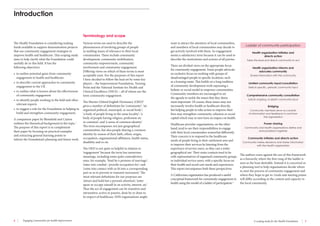
A Californian organisation has produced a useful 
conceptual framework for community engagement in 
health using the model of a ladder of participation.3 
Ladder of community participation 
Health organisation initiates and 
directs action 
Takes the lead and directs community to act 
Health organisation informs and 
educates community 
Shares information with the community 
Limited community input/consultation 
Selects specific, periodic community input 
Comprehensive community consultation 
Solicits ongoing, in-depth community input 
Bridging 
Community members serve as conduits 
of information and feedback to and from 
the organisation 
Power-sharing 
Community and health organisations define and 
solve problems together 
Community initiates and directs action 
Community makes decisions and shares information 
with the health organisation 
The authors warn against the use of this framework 
as a hierarchy where the first rung of the ladder is 
seen as the least desirable. Instead it is conceived as 
a planning tool to help organisations decide where 
to start the process of community engagement and 
where they hope to get to. Goals and starting points 
will differ according to the context and capacity in 
the local community. 
Terminology and scope
8 Engaging communities for health improvement A scoping study for the Health Foundation 9 
The UK policy pendulum tends to oscillate 
between initiatives designed to strengthen 
command from the centre and those that aim to 
encourage local initiatives. At present it appears to 
be swinging in the direction of local community 
engagement. This is evident in recent policy 
documents from each of the four UK jurisdictions 
– England,4 Scotland,5 Wales6 and Northern 
Ireland.7 
Recent White Papers and other policy documents 
have emphasised the need to strengthen local 
communities by empowering people to 
influence the decisions that affect them. For 
example, the 2008 White Paper, Communities 
in control: real people, real power, included the 
following statement: 
We want to shift power, influence and 
responsibility away from existing centres of 
power into the hands of communities and 
individual citizens. This is because we believe 
that they can take difficult decisions and solve 
complex problems for themselves. The state’s role 
should be to set national priorities and minimum 
standards, while providing support and a fair 
distribution of resources.8 
Historically, UK healthcare policy has stressed 
the national, universal nature of the NHS, but this 
is undergoing some modification as the impact 
of devolution opens up differences in emphasis 
between the four UK nations. Within England 
there is now an attempt to encourage greater 
devolution and localism while maintaining 
universal entitlements and a strong steer from the 
centre. This sentiment was encapsulated in Lord 
Darzi’s NHS Next Stage Review: 
The proposals will allow NHS services 
everywhere to reflect the needs of their local 
communities ... The NHS should be universal, 
but that does not mean that it should be uniform. 
Clear minimum standards and entitlements will 
exist, but not a one size fits all model.4 
Public and patient involvement is seen as central 
to this easing of central command and control. 
The NHS Constitution includes the following 
commitment to citizens: 
You have the right to be involved, directly 
or through representatives, in the planning 
of healthcare services, the development and 
consideration of proposals for changes in the way 
those services are provided, and in decisions to be 
made affecting the operation of those services.9 
The main responsibility for consulting and 
engaging with local communities about their health 
and healthcare needs is laid firmly on the shoulders 
of primary care trust (PCT) commissioners. The 
NHS operating framework for 2008/9 says: 
Commissioners have a responsibility to ensure 
that their local communities have the opportunity 
to be fully engaged in the decisions they take, and 
to take greater efforts to communicate what they 
are doing and why to their populations.10 
In recent years the Labour government introduced 
a number of specific initiatives and policy 
instruments designed to focus attention on 
community engagement: 
• PCTs, NHS trusts, strategic health authorities 
(SHAs) and local authorities have a statutory 
duty to involve patients and the public by 
consulting and informing them11 
• World Class Commissioning emphasises PCTs’ 
responsibilities to provide local leadership for 
the NHS, to work with community partners and 
engage with public.12 
A great deal is expected of commissioners – both 
PCTs and practice-based commissioners – in respect 
of engagement with their local communities.12 They 
are expected to make careful assessments of local 
needs, use their commissioning power to ensure that 
local services provide high-quality care and that they 
are responsive, and they must conduct their business 
in a transparent manner being held accountable to 
local communities for their decisions. 
NHS commissioners must work with local 
authorities, voluntary organisations and other 
agencies in local strategic partnerships to develop 
Local Area Agreements on how to improve the 
health and wellbeing of local communities.13 
• NHS foundation trusts are expected to engage with 
their local communities and recruit local people as 
members who can elect trust governors.14 
• All local authorities must now have a Health 
Overview and Scrutiny Committee who must be 
consulted when major changes are planned.15 
• Since September 2008 each local authority has 
been required to establish a Local Involvement 
Network (LINk) to represent the views of local 
people on health and social care.16 
The goal is to ensure that the NHS is more locally 
accountable and shaped by the people who use 
it. NHS organisations are expected to forge new 
relationships, both internally and externally, in the 
hope that user involvement will move from the 
margins to the mainstream of every organisation 
that is responsible for planning, commissioning 
and providing health services.17 
Doing the job properly involves keeping in touch 
with the views of all local residents, not just the 
small minority who turn out for public meetings 
or volunteer to sit on committees. In particular 
commissioners must reach out to minority or 
disadvantaged groups whose views are seldom 
heard and often ignored. This is no easy task. 
A recent survey found that many PCTs were 
struggling to engage patients and the public in 
commissioning.18 Many said they lacked the skills, 
experience and confidence to do this effectively. If 
they are to prioritise this as they must, PCT staff 
will need help in the form of budgets, leadership, 
techniques and technology. 
The Labour government’s goals appeared to be 
in tune with public sentiment, at least in theory. 
The vast majority of people – 90% in one survey19 
– think local people should have a say in how 
the NHS is run, and they expect to be consulted. 
However, only 22% say they’d like to be actively 
involved in planning or delivering services,20 
and in practice only 1–2% do get actively involved 
when invited to do so.21 So engaging with 
local communities is more difficult than it may 
at first appear. 
Policy context Community engagement in health
10 Engaging communities for health improvement A scoping study for the Health Foundation 11 
I have also followed up leads in reports and 
journal articles, but in the short time available it 
was not possible to carry out a systematic review 
of the extensive academic literature. A list of the 
organisations whose websites were identified by 
this means is included in the appendix. 
Scrutinising websites to identify practical examples 
and tease out the learning from them has not 
been an easy task and I am acutely conscious of 
having only scratched the surface. There are, of 
course, many thousands of community initiatives 
up and down the country. Many of these have not 
published their experiences and many do not even 
have websites. Those engaging specifically with 
health and healthcare issues are the subset that I 
have tried to find, but it is very possible that many 
good examples have been missed. I hope readers 
of the report will draw my attention to major 
omissions so these can be rectified. 
The report includes brief descriptions of a few 
projects selected to illustrate the variety of 
approaches. Many of the other projects listed in the 
appendix could have served equally well as case 
studies, but a description of each would have made 
the report too long and unwieldy. Instead I have 
tried to incorporate themes from their experience 
in the general learning points outlined in the 
conclusions. 
There are at least four reasons why community 
engagement in health and social care is seen as 
worthwhile: 
• to determine local needs and aspirations 
• to promote health and reduce inequalities 
• to improve service design and the quality of care 
• to strengthen local accountability. 
The following sections elaborate on these four 
objectives, briefly summarising the evidence 
base and giving examples of relevant initiatives. 
The report concludes with a consideration of 
the characteristics of a successful community 
engagement project. 
The scoping study draws on an extensive web search using 
terms such as ‘community engagement’, ‘community 
development’, ‘community mobilisation’, ‘community 
involvement’, ‘community empowerment’, ‘patient and 
public involvement’ ‘health’, ‘healthcare’ and ‘commissioning’ 
(see below for a discussion of the terminology). 
Review methods
12 Engaging communities for health improvement A scoping study for the Health Foundation 13 
Health needs assessment has been defined as ‘a 
systematic method for reviewing the health issues 
facing a population, leading to agreed priorities 
and resource allocation that will improve health 
and reduce inequalities’.22 It is the first step in a 
commissioning cycle that includes assessing needs, 
reviewing services and identifying gaps, analysing 
health risks, deciding on priorities, determining 
strategic options, implementing contracts, 
developing providers and managing provider 
performance. 
There is nothing new about needs assessment – 
public health departments have been producing 
statistical analyses and epidemiological profiles 
for many years and these have informed 
commissioning plans and local health 
improvement strategies. Nowadays, however, there 
is an expectation that the statistical analyses and 
options appraisals will be accompanied by, and 
take account of, extensive consultation with local 
people. Commissioners are expected to ensure 
that their local strategies are built on an in-depth 
understanding of the needs and aspirations of all 
sections of the local community. 
There is evidence that World Class Commissioning 
has helped to drive change in the organisational 
culture of PCTs and boost the status of patient 
and public engagement, but most PCTs are not 
yet in a position to demonstrate whether and how 
engagement with local communities has influenced 
their decisions.18 Furthermore, there is as yet no 
evidence that this form of engagement leads to 
improvements in health outcomes. 
The best local consultations are carefully planned 
and involve a number of different methods to ensure 
that the diversity of perspectives is understood 
and that all sections of the community have an 
opportunity to give their views. Feeding back the 
results once the consultation process is complete is 
equally important and should be programmed in 
from the start, with attention paid to how these will 
be disseminated to interested parties. 
In the process of developing its 
outside-of-hospitals strategy, 
Liverpool PCT organised a three-stage 
community consultation, 
beginning in July 2006. The first 
phase of engagement took the 
form of an online questionnaire 
and ballot-box paper 
questionnaire, accessible from 
the Big Health Debate website, 
surveys in general practitioner 
(GP) surgeries and a 24-hour 
freephone line, which elicited 
10,000 responses. 
The PCT made visits to more than 
40 community groups and then 
organised a one-day deliberative 
event for 150 participants (100 
members of the public and 50 
healthcare professionals and 
representatives from community 
groups). This Big Health 
Debate Live! was held on 30 
October 2006. This introduced 
participants to the case for change 
and provided an initial response 
to the concepts involved. 
A further survey of more than 
600 regular users of primary 
care services provided additional 
information supplemented by 
a multidisciplinary workshop 
for health and social care staff 
and three road shows for health 
professionals. 
The views of people from 
specific priority groups were 
sought by means of 13 specially 
organised discussion groups. 
These included people from 
the Chinese, Sikh, Somali and 
Yemeni communities, homeless 
men, Irish travellers, people with 
sensory disabilities and mental 
health service users. 
The conclusions of the consultation, 
which had involved a total of 11,000 
people, were incorporated into the 
PCT’s health strategy. An update 
event was organised in October 
2007 to revisit the strategy and 
inform people about the actions 
that had ensued. 
example Liverpool’s Big Health Debate 
OBJECTIVE 1: 
Determining local 
needs and aspirations 
Consulting local people
14 Engaging communities for health improvement A scoping study for the Health Foundation 15 
Some projects are now going beyond traditional 
methods of professionally-led consultation to 
involve local community members in leading 
the process. Turning Point, which has been 
working on engagement in social care for 
some years, is promoting a new concept called 
Connected Care. The idea originated from 
research carried out by Turning Point and the 
Institute for Public Policy Research (IPPR) in 
2004. Connected Care is Turning Point’s vision 
for integrating health, housing and social care 
in the most deprived communities, with the 
community playing a central role in the design 
and delivery of those services. 
The aim of Connected Care is to provide a 
framework to help commissioners that: 
• prioritises integrated services that meet the 
needs of individuals 
• enables local people to design and deliver their 
own services 
• provides better access to services for everyone in 
the community 
• engages those who cannot or will not use services 
• achieves greater diversity of provision and draws 
upon the strengths of the third sector 
• fosters the development of a skilled, innovative 
and professionally coordinated health and social 
care workforce. 
The Connected Care programme is promoting 
community audits in which local people are 
recruited to find out what other local people 
think about their health needs and aspirations. 
The idea is to support local people in developing 
their own needs assessment or community profile. 
The community audit is not just an information 
gathering tool, but also the first stage in engaging 
the community. 
The first national Connected 
Care pilot took place in Owton 
Ward in Hartlepool. The ward 
is ranked as one of the most 
deprived nationally, with most 
residents living in social housing. 
However, it has a well-developed 
community and voluntary 
sector with strong residents’ 
associations and organisations 
that are delivering a number of 
services locally. 
The first stage of the project 
involved a community audit 
to determine the needs and 
aspirations of local residents 
and their perceptions of current 
services. Auditors were recruited 
from the local community and 
trained to carry out the audit. They 
were supported by Turning Point, 
Hartlepool PCT and by academics 
from the University of Central 
Lancashire (UCLan). The process 
was evaluated by researchers from 
Durham University. 
A local community organisation 
was selected to recruit, 
coordinate and host the team 
of nine community auditors 
recruited from the local 
community. The training 
package, which was delivered 
by UCLan, covered research 
methods, interview techniques, 
facilitating focus groups and 
recording and analysing data. The 
workshops were accredited giving 
the community auditors the 
opportunity to gain a university 
qualification. 
The audit involved an initial 
survey, followed by one-to-one 
interviews, focus groups and a 
‘Have your say’ event. In total, 
251 people participated in the 
process. A detailed report of the 
audit was published in January 
2006. This included the main 
findings presented thematically 
under five headings: information, 
choice, access to services, 
continuity and coordination 
between services, workforce and 
quality provision. 
Durham University’s evaluation 
pointed to a number of important 
issues and learning: 
• recruitment of community 
members proved quite difficult; 
it was undertaken by the 
host organisation and drew 
largely on existing community 
association staff and volunteers 
• payment of volunteers can be 
a tricky issue and a flexible 
approach was adopted 
• team-working and individual’s 
needs and capacity required 
careful handling 
• qualitative research methods 
were found to work best 
• a supplementary 
professionally-led process was 
undertaken to provide the 
perspectives of harder to reach 
groups and to deliver the report 
within the desired timescale 
• the audit team was involved 
in data gathering but not 
substantially involved in the 
process of analysis and report 
writing 
• the host organisation and 
audit team were central 
to the organisation of the 
launch event and presentation 
of findings which helped 
to reinforce community 
ownership 
• the existence of a range 
of champions, including 
policy makers, professionals, 
community organisations and 
their members, was important 
• training should focus not only 
on research design and methods 
but also on the concept of 
Connected Care itself so that 
everyone involved understands 
the bigger picture.23 
example Connected Care in Hartlepool 
Community audit
16 Engaging communities for health improvement A scoping study for the Health Foundation 17 
Apnee Sehat (our health) is a 
social enterprise pathfinder 
project that is tailoring lifestyle 
programmes to meet the needs of 
Britain’s South Asian community. 
The project began in 2005 in 
South Warwickshire with the 
support of South Warwickshire 
hospitals and the PCT, the 
National Diabetes Support 
Team and the DH Equality 
Director, Surinder Sharma, in 
response to a community request 
for lifestyle support. 
The project, which has involved 
a multidisciplinary effort by a 
number of organisations across 
traditional boundaries, has 
achieved national recognition 
for its innovative approach in 
supporting preventive healthcare 
for this target ‘high risk’, ‘hard to 
reach’ group. 
Based in Coventry, Apnee Sehat 
currently works with communities 
in Royal Leamington Spa, 
Warwickshire and Coventry to 
raise awareness and screen for 
vascular disease risk so as to reduce 
the danger of strokes, heart attacks 
and diabetes. They encourage 
lifestyle changes through the 
provision of education, self-care 
and screening programmes. They 
educate the community about risk 
factors pertinent to their genetic 
predisposition and lifestyle choices, 
and they deliver services, including 
community specialist clinics, 
that are culturally sensitive, easily 
understandable and transferable. 
Most of the national and local organisations with a 
specific focus on community engagement in health 
list improving health and reducing inequalities 
among their goals. This is also a high priority for the 
government. The Department of Health (DH) has 
set out a strategy for improving public health which 
includes action to achieve the following goals: 
• tackling inequalities in health 
• reducing the numbers of people who smoke 
• tackling obesity 
• improving sexual health 
• improving mental health and wellbeing 
• reducing harm and encouraging sensible drinking 
• helping children and young people to lead 
healthy lives 
• promoting health and active life among older 
people.24 
Community engagement is seen as an essential 
component of this strategy, as well as the 
provision of individual advice, education, mass 
marketing and secondary prevention activities, 
such as screening. 
The theoretical underpinning for collective 
approaches to health promotion is connected to 
ideas about building community cohesion or social 
capital. Social capital is a way of describing the norms, 
networks and interactions (sense of belonging) that 
facilitate collective action. Many commentators 
consider it essential for economic development and 
for fostering inclusion and social cohesion. Many 
believe it holds the key to understanding and tackling 
social inequalities in health.25 
There is also a belief that co-production (involving 
lay people directly in working alongside 
professionals to create and deliver services) will have 
more effect on people’s health and wellbeing than 
merely informing, advising or consulting them.26 
The theories are appealing, but testing them is 
extremely difficult. Few studies have compared 
the effectiveness of community-based approaches 
against other methods of health promotion, for 
example national legislation, mass communication 
or direct provision of lifestyle advice. 
OBJECTIVE 2: 
Promoting health and 
reducing inequalities 
Some of the most successful projects have 
emerged from communities that have a 
clear identity and focused goals rooted in an 
understanding of specific health needs. Many of 
these involve minority ethnic groups. 
example Apnee Sehat 
Social capital and co-production Health promotion in minority groups
18 Engaging communities for health improvement A scoping study for the Health Foundation 19 
There is evidence from independent studies that 
carefully targeted health promotion programmes 
and social marketing can reduce health risks in 
certain groups, but there is very little evidence 
on the extent to which they reduce health 
inequalities between groups.27-59 Approaches that 
help communities to work as equal partners, or 
delegate some power to them, may lead to more 
positive health outcomes, but the evidence, as 
yet, is not strong.26 The Healthy Communities 
Collaborative (see p 21) certainly looks promising, 
but independent evaluation is required. 
This whole area was recently reviewed by 
NICE. The resulting guidance lists the following 
recommendations for effective community 
engagement to promote health: 
• coordinate implementation of relevant 
initiatives 
• commit to long-term investment 
• foster openness to organisational and 
cultural change 
• be willing to share power, as appropriate, 
between statutory and community 
organisations 
• develop trust and respect among all those 
involved 
• support appropriate training and development 
for those working with the community – 
including members of that community 
• introduce formal mechanisms which endorse 
partnership working 
• support effective implementation of area-based 
initiatives 
• recruit community members to act as agents 
of change 
• organise community workshops and events 
• employ experienced consultants 
• develop and implement an evaluation 
framework.26 
One of the most extensive and 
ambitious attempts to develop 
community engagement initiatives 
across the country was the Health 
Action Zone (HAZ) programme 
launched by the government in 
1997. Twenty-six HAZs were set 
up as seven-year pilot projects. 
They were meant not only to 
improve health outcomes and 
reduce health inequalities, but 
also to act as trailblazers for new 
ways of working at a local level.60 
The outcome of all this effort 
was mixed. Many of the HAZs 
succeeded in focusing local 
attention on health improvement 
and inequalities, but there was 
disappointingly little evidence of an 
impact on reducing the health gap 
between social groups. 
The national HAZ evaluation 
pointed to a number of factors that 
had affected their progress: 
• changes in national policy 
• changes in HAZ priorities and 
uncertainties about their future 
• variable understanding of the 
problem of health inequalities 
• changes in local organisational 
boundaries and lack of co-terminosity 
of agencies 
• the nature of local labour 
markets leading to high staff 
turnover in some areas and 
inflexibility in others 
• the key role played by specific 
individuals in promoting or 
inhibiting the work.60 
One of the perennial problems 
in policy development is that 
previous initiatives – even major 
ones such as the HAZ programme 
– tend to get forgotten when a 
new one appears. But much can 
be learnt from the experience of 
programmes such as this, and it 
is especially helpful that it was 
independently evaluated. Any 
organisation wanting to engage 
local people in health improvement 
activities would do well to study the 
HAZ experience. 
example Health Action Zones 
Narrowing the gap
20 Engaging communities for health improvement A scoping study for the Health Foundation 21 
Many community engagement approaches to 
health promotion appear promising but they lack 
adequate evaluation. This is a serious problem 
because all strategies to tackle health inequalities 
need to be based on rigorous evidence if the 
government’s goals are to be achieved. 
Sir Michael Marmot’s recently published review 
of progress in tackling health inequalities over 
10 years since the publication of the Acheson 
Inquiry provides a great deal of evidence of a 
persistent gap between rich and poor in relation to 
a plethora of health indicators.61 The report takes 
an epidemiological approach and has very little to 
say about community engagement. It is strange, 
in view of the general enthusiasm for community 
approaches, that they have been overlooked in 
this major review but this may be a reflection 
of the lack of published evidence on effectiveness 
and impact. 
The Improvement Foundation’s 
Healthy Communities 
Collaborative (HCC) has made 
strenuous efforts to measure the 
impact of its work. HCC aims to 
combine quality improvement 
and community development in 
the hope that this will both build 
social capital and reduce health 
inequalities. The programme has 
grown from an initial three sites 
in 2002 and now includes more 
than 50 projects involving a wide 
range of partners. 
The HCC uses the collaborative 
model led by local people. They 
are supported and enabled to 
improve their communities 
through partnerships with 
statutory and voluntary 
organisations. The focus of 
the work is to make positive 
changes in health and wellbeing. 
To achieve this, all participants 
are taught how to use tools to 
effect change. Outcomes include 
improvement in a specific 
topic area and benefits to the 
community itself, which ignites 
the desire to affect other topics. 
Key features of the HCC are 
as follows: 
• An expert reference group 
develops ‘change principles’ 
that when followed will 
secure the greatest gain 
in the chosen topic. 
• Learning workshops are held 
during which the teams learn of 
best practice on the topic and 
are supported to understand 
this in a local context. 
• Action periods take place 
where they meet regularly 
and use the Plan-Do-Study- 
Act (PDSA) learning cycles 
to test ideas for change and 
improvement. Teams are 
encouraged to test ideas on a 
small scale and continue taking 
small sequential steps. 
• Improvement tracking, with 
data collected monthly, occurs. 
Putting these key features 
together in a framework 
makes it easy for teams to get 
started, achieve results rapidly 
and demonstrate success. 
They aim to bring about a 
creative environment in which 
testing ideas and measuring 
improvement become the norm. 
HCC has achieved some notable 
successes.62 An early focus of the 
programme was on reducing falls 
in older people. In three sites, 
covering a population of 150,000, 
there has been a 32% reduction 
in falls (730 fewer falls over two 
years). The HCC estimate that 
this amounts to a reduction 
in hospital costs of £1.2m, in 
ambulance costs of £120,000 and 
in the costs of residential social 
care by £2.75m. 
There was also evidence of an 
improvement in social capital 
within the communities involved 
in the reducing falls programme, 
resulting in: 
• 12% increase in people’s 
perception of whether their 
area was a good place to live 
• 12% increase in people’s 
perception of whether 
individuals show concern for 
each other 
• 22% increase in the number of 
people who knew where to get 
advice about falls 
• 48% increase among 
participants in the proportion 
who thought they could change 
and improve things in their 
communities. 
Current projects include 
community-based programmes 
to improve diet and nutrition and 
reduce obesity; to improve early 
identification and assessment 
of people at increased risk of 
cardiovascular disease; and to 
raise awareness and promote 
earlier identification of cancer. 
example Healthy Communities Collaborative 
Measuring impact
22 Engaging communities for health improvement A scoping study for the Health Foundation 23 
Many community engagement projects have 
service improvement and redesign as a central 
focus. Since almost everyone uses the health 
service on a fairly regular basis, most discussions 
about health needs inevitably come round to 
people’s concerns about the quality of local 
service provision and gaps in the availability of 
particular services. 
Engaging local people and service users in quality 
improvement requires considerable effort on 
the part of NHS organisations. In general, most 
people do not come forward to talk about their 
experiences or give their views without a great deal 
of encouragement. 
There is some evidence that most members of 
the public do not know how they could get 
involved in shaping local services if they wanted 
to. In the Healthcare Commission’s 2005 survey 
of users of local health services in 100 PCTs, only 
3,597 out of 34,494 respondents (10%) said they 
knew how to get involved in making decisions 
about local health services (for example, by 
attending meetings or joining a local patients 
group); 17% said they were not sure and the 
overwhelming majority (73%) said they did not 
know how to get involved.63 
This highlights the need to improve 
communications and to focus efforts on actively 
encouraging people to get involved. It is possible 
that a more concerted push on the part of 
healthcare organisations will lead to an increase in 
the numbers of people who volunteer, but staff will 
need to be very clear about what role they expect 
them to play and how they will welcome and 
support service users wanting to participate. 
Some successful projects have stemmed from 
commissioners’ desire to understand and reflect 
the diverse needs of their local communities. 
In certain cases these have been reflected in 
commissioning plans, leading to changes in the 
pattern of service provision. Once again, however, 
we lack the evidence that these changes have led to 
improved outcomes. 
The PCT in Tower Hamlets 
has led the way in responding 
to the needs of its community. 
NHS Tower Hamlets has 
particular challenges when it 
comes to engaging with its local 
population: nearly half of the 
population is from non-white 
ethnic communities, one third 
originates from Bangladesh 
and there are also significant 
Vietnamese, Chinese and 
Jewish communities; at least 78 
different languages are spoken. 
They have made great efforts to 
engage with local community 
members and in 2009 the PCT 
was rated first in London and 
second nationally for its work on 
improving health services. 
When reviewing services 
for people with diabetes it 
recognised that it needed to 
reach out to the Bangladeshi 
population because diabetes is 
more prevalent among South 
Asians than in the population as 
a whole. The PCT has employed 
two multilingual link workers 
as lay diabetes educators. They 
run education classes in Bengali 
within the diabetes centre, 
GP practices and community 
settings, greatly enhancing the 
service provided. 
They also opened a second retinal 
screening service at Spitalfields 
Health Centre, chosen because 
it was more convenient than the 
existing centre for many of the 
Bangladeshi population. The 
opening of this new service was 
accompanied by an intensive 
publicity campaign within the 
Bangladeshi community using 
contacts in local mosques, 
community centres, voluntary 
organisations and shops, as well 
as poster campaigns. 
example NHS Tower Hamlets 
OBJECTIVE 3: 
Improving service design 
and the quality of care 
Commissioners reaching out
24 Engaging communities for health improvement A scoping study for the Health Foundation 25 
Another important development in Tower Hamlets 
has produced an entirely new model of service 
provision. The Bromley by Bow Centre is frequently 
cited as one of the most innovative examples of a 
community-based facility with a new type of health 
centre at its core. 
The Bromley by Bow Centre is an 
innovative community organisation 
in East London. Working in one of 
the most deprived wards in the UK, 
it supports families, young people 
and adults of all ages to learn new 
skills, improve their health and 
wellbeing, find employment and 
develop the confidence to achieve 
their goals and transform their lives. 
The centre was established in 
1984 when Reverend Andrew 
Mawson became the Minister 
of the local United Reformed 
Church. He found a dwindling, 
elderly congregation and 
recognised that if the church 
was to survive it needed to 
adopt a different approach. He 
persuaded his congregation to 
open the building up to the local 
community. Local artists became 
involved and agreed to teach 
their skills in return for rent-free 
workshops, the church started a 
nursery and was used for various 
events, from Eid and May Day 
celebrations to the Chinese New 
Year and a harvest supper. As 
a result, the building became a 
focal point and meeting place 
for the entire community, laying 
the foundations for the centre’s 
subsequent development. 
As it grew beyond the church, 
the Bromley by Bow Centre 
developed as a secular 
organisation in its own right 
and became a registered charity 
in 1994. It then expanded 
rapidly, with the biggest change 
happening in 1997 with the 
opening of the health centre. The 
entire site kept evolving, with 
new buildings added to existing 
ones and the park restored as an 
asset for the entire community. 
Today, the Bromley by Bow 
Centre is an organisation with 
a turnover of more than £3m a 
year and in excess of 100 staff. 
It is the third largest provider of 
adult education in the Borough 
of Tower Hamlets and has 
launched numerous spin-off 
businesses. They centre works 
with 2,000 people each week, 
including families, young 
people, vulnerable adults and 
the elderly. 
A GP partnership lies at the heart 
of the centre providing a vital 
service to the local community. 
Together they have developed the 
healthy living centre model which 
has become a national exemplar 
for an entrepreneurial approach 
to integrated healthcare. The GPs 
rent the Healthy Living Centre 
premises from the centre and 
deliver primary healthcare to over 
5,000 patients in this community 
and a further 7,000 patients from 
the XX Place practice in Stepney. 
The practice is fully integrated 
with centre activities at every 
level, from senior management to 
project delivery. The model hinges 
on a common approach to service 
delivery which focuses on the 
widest possible network of support 
and intervention for patients. 
example Bromley by Bow Centre 
Public accountability for commissioning decisions 
is very important because PCTs now control 
the major part of the NHS budget and they are 
required to consult, involve and inform local 
people in respect of their commissioning decisions. 
There are three main domains of public services for 
which public accountability is felt to be essential: 
• financial accountability – value for money 
• accountability for performance – quality of services 
• political and democratic accountability – 
responsiveness to service users.64 
The traditional model of public accountability 
was upwards to parliament or Whitehall, but 
nowadays this is clearly insufficient. Allowing 
the electorate the chance to express their views 
at the ballot box once every four or five years 
is not enough to ensure that public services 
respond adequately to people’s needs and desires, 
so the DH is trying to strengthen healthcare 
commissioning and increase its responsiveness 
by requiring commissioners to consult with, and 
report back to, local communities. 
Recognition that the centrally funded and directed 
NHS suffers from a democratic deficit has led 
to calls for new forms of local participation. The 
renewed emphasis on community engagement 
is part of this shift in thinking. Mechanisms 
such as Local Strategic Partnerships, Local 
Area Agreements and Comprehensive Area 
Assessments, coupled with the legal duty to 
engage with and consult local people, have been 
introduced in an attempt to ensure that services 
retain public support and respond to local 
perceptions of needs and priorities. 
Commissioners are supposed to be held to account 
for the quality of services delivered to local residents. 
Quality metrics and other performance indicators are 
to be published in the form of quality accounts and 
PCTs must also publish prospectuses setting out what 
they have done to address any problems identified. 
The whole system is overseen by a complex mix of 
organisations, including SHAs, the Care Quality 
Commission, Monitor, the Audit Commission and 
professional regulators such as the General Medical 
Council, the Nursing and Midwifery Council and the 
Health Professions Council. 
OBJECTIVE 4: 
Strengthening local accountability 
New models of service provision
26 Engaging communities for health improvement A scoping study for the Health Foundation 27 
With this proliferation of top-down supervisory 
bodies it is no wonder that PCTs struggle to look 
outwards to their local communities. The structure 
of regulation seems designed to foster conformity 
with centrally-derived rules and targets rather 
than flexibility and responsiveness to diverse 
local populations. The establishment of Local 
Involvement Networks (LINks) and Overview 
and Scrutiny Committees (OSCs) is meant to 
encourage them to do this but these bodies are 
relatively immature and still finding their feet. 
The Centre for Public Scrutiny argues that effective 
scrutiny should: 
• provide a ‘critical friend’ challenge to executive 
policy makers and decision makers 
• enable and voice the concerns of the public 
• be carried out by independent-minded people 
• drive improvements in public services.64 
This is an area that LINks and OSCs can work 
together to ensure community scrutiny and 
accountability. 
The NHS Centre for Involvement 
(NCI) has published a document 
outlining the potential for 
collaboration between LINks and 
OSCs as a way of strengthening 
local accountability.65 Both 
organisations are expected to 
play the ‘critical friend’ role 
and both have a legal right to 
ask for information about the 
performance of health and social 
care organisations and to expect 
a response to any criticisms or 
recommendations, so working 
together should make sense. 
The NCI argues that since LINks 
and OSCs have limited resources 
to support their work, they 
should collaborate to identify 
local priorities and explore issues 
in more detail before making 
recommendations to health and 
social care organisations. There 
are signs that this collaboration 
is already beginning to develop 
in some areas. For example, in 
Bristol, Cumbria, East Sussex, 
Gateshead, Hull, Isles of Scilly, 
London Borough of Merton, 
Newcastle, Northamptonshire, 
Nottingham, Sandwell, Somerset 
and Stockport, LINks and 
OSCs have agreed protocols 
for joint working involving a 
variety of options for developing 
partnerships. The organisations 
have different powers and remits 
and different types of members 
and support arrangements, so 
they are likely to have different 
viewpoints on some local issues 
and in some cases priorities may 
conflict. In many cases, however, 
joint working ought to provide 
the basis for stronger local 
accountability. 
The NCI warns that progress 
to date has been patchy; some 
areas have developed close 
and effective partnerships, but 
in others progress has been 
slow. They have developed the 
following checklist to guide good 
practice in this area: 
• understand the responsibilities, 
roles and structure of OSCs 
and LINks in the area 
• work with local health and 
social care organisations to 
keep up to date with what 
they are doing and what their 
priorities are 
• OSCs and LINks should 
communicate regularly, both 
formally and informally 
• agree ‘rules of engagement’ 
or protocols and review them 
regularly 
• encourage support staff to 
communicate with each other 
on a regular basis 
• agree joint planning meetings 
or events to identify local 
priorities 
• be realistic about setting 
priorities, identifying those that 
can be addressed or influenced 
and those that cannot 
• focus on outcomes not just 
processes 
• build in time within work 
programmes to address 
issues that may arise 
throughout the year 
• agree at times to differ – the 
roles are complementary not 
competitive. 
example Partnership between LINks and OSCs 
Scrutinising services
28 Engaging communities for health improvement A scoping study for the Health Foundation 29 
Taking decisions about the quality, availability, 
design and funding of local services can lead 
commissioners into controversial waters, especially 
when this involves denying services to particular 
groups or individuals. Judicial reviews, and the 
threat of them, are becoming increasingly frequent. 
PCTs and other commissioning bodies must 
develop coherent principles to guide their decision 
making. These will have most legitimacy when 
they are developed with the active involvement 
of local people and the rationale for decisions is 
communicated effectively. This form of community 
engagement, sometimes referred to as deliberative 
democracy, is relatively underdeveloped as yet, but 
it is likely to come to the fore as we enter a period 
of funding squeeze over the next couple of years. 
There are several theories on what ought to be 
done when tackling sensitive issues such as priority 
setting or rationing of healthcare. One of the most 
useful, ‘accountability for reasonableness’, suggests 
that decision makers should pay attention to four 
conditions or principles to maximise the chance of 
achieving local buy-in: 
• Publicity – the public has access to both the 
decisions and the rationales for priority setting. 
• Reasonableness – the rationales should be 
acceptable by ‘fair-minded’ people as a way 
of providing value for money while meeting 
health needs for a defined population under 
resource constraints. 
• Appeals – there must be ways to challenge 
decisions and resolve disputes, and these must 
offer an opportunity to revise decisions, for 
example in the light of new evidence. 
• Enforcement – action to ensure the first three 
conditions are met through either voluntary or 
mandatory regulation.66 
Various techniques can be used to secure 
active engagement of local people in priority 
setting, including citizen’s panels, citizen’s juries, 
neighbourhood committees and deliberative 
forums. There is some evidence that these can 
lead to improved knowledge and understanding 
among those directly involved and the results of 
their deliberations can be influential, but they are 
often costly and time consuming to organise.26,67-69 
Whether the benefits justify the costs requires 
further research, but their usefulness depends in 
large part on what local policy-making bodies do 
with the resulting recommendations. 
PCTs are under a statutory duty 
to promote the health of the local 
community. They are also under 
a duty not to exceed their annual 
financial allocation. These legal 
requirements mean that, from 
time to time, difficult choices 
have to be made. The Oxfordshire 
PCT Priorities Forum makes 
recommendations about which 
drugs and treatments should be 
low and which should be high 
priority. It provides an advisory 
service to the Oxfordshire PCT’s 
clinical executive team to help 
them make difficult decisions 
on prioritisation. The forum 
includes lay members of the local 
community as well as clinicians 
and managers. 
The forum is supported by 
the South Central Priorities 
Support Unit which provides 
an independent service to 
all PCTs in the region. They 
undertake literature searches and 
produce evidence-based reviews, 
which are then submitted to 
an individual PCT’s priorities 
committees. 
The South Central Priority Setting 
Unit and the Oxfordshire Priorities 
Forum have developed an ethical 
framework to guide their decision 
making. This gives priority to 
evidence of clinical and cost 
effectiveness, equity, healthcare 
need and capacity to benefit, and 
patient choice. The framework was 
discussed with local people, agreed 
by the PCT’s board and published 
on their website. 
Oxfordshire PCT uses the 
ethical framework together with 
the evidence-based reviews to 
aid their deliberations when 
considering whether to fund 
referrals for treatments that 
are exceptions to previously 
agreed policy and not covered by 
contracts or NICE guidance. This 
does not eliminate public protests 
when individuals are denied 
treatment that they believe will 
be beneficial, but it does enable 
the PCT to demonstrate that 
its procedures conform to the 
requirements of accountability 
for reasonableness. 
example Oxfordshire PCT Priorities Forum 
Deciding on spending priorities
30 Engaging communities for health improvement A scoping study for the Health Foundation 31 
There is no shortage of techniques and case 
studies but, in general, we lack a critical literature 
and sufficiently rigorous evaluations to provide 
definitive guidance on which techniques are most 
appropriate in each and every circumstance. 
Nevertheless, there is much to be learnt from the 
experience of those who have tried it and several 
specialist organisations, including Involve and the 
NCI, have produced helpful guidance. 
Working with communities 
Good involvement practice is described as being 
continuous, inclusive, well-informed, fit for 
purpose, transparent, influential, reciprocal and 
proportionate.17 However, this is much easier said 
than done. Local authorities have had longer and 
broader experience of doing it than healthcare 
organisations. Drawing on this experience, 
Involve’s guidance suggests that effective 
engagement with local communities means 
paying attention to the following: 
• understanding the local community 
• tapping into existing networks 
• learning from informal relationships 
• targeting under-represented groups 
• allowing people responsible for strategy and 
delivery to work together 
• taking an action-focused approach 
• maintaining a long-term perspective 
• understanding that the method is only part of 
the story – purpose + context + people + method 
= outcome 
• setting clear objectives 
• bringing people together around issues that 
connect them 
• adapting to local circumstances and context 
• listening and learning 
• having good communications and visible results 
• supporting participants to take part 
(information, logistics, incentives) 
• ensuring diversity of voices 
• capturing and sharing learning to improve practice.70 
Engagement 
methods 
A wide range of methods has been advocated for 
securing community engagement – from informing 
and consulting through to full community control.
32 Engaging communities for health improvement A scoping study for the Health Foundation 33 
The Involve guidelines are useful for organisations, 
such as local authorities, with a broad remit 
that can allow local communities to determine 
priorities, but commissioners and providers of 
healthcare often have a more specific requirement 
for community engagement with a clear focus on 
service improvement. Some healthcare provider 
organisations have made efforts to involve users 
of their services in their quality improvement 
efforts and their experience is instructive. 
Evaluative studies have suggested that effective 
user involvement in this context requires: 
• adequate resources 
• a facilitative organisational culture 
• good quality information 
• professional champions 
• staff training (by users) 
• user training (by staff) 
• payment and/or employment of users 
(sometimes) 
• representative structures 
• recognition and understanding of power 
differentials 
• acknowledgement of, and sensitivity to, 
likelihood of mental distress 
• high-quality, meaningful and measurable 
involvement processes.26,71-73 
This can be quite challenging and few healthcare 
professionals have received relevant training. In 
addition many of those with responsibility for 
patient and public involvement feel unsupported.74 
And it is not as if there’s a great clamour on the 
part of service users to get directly involved. Many 
organisations struggle to get people to join patient 
groups or attend meetings. 
A key issue is the extent to which active sustained 
involvement is essential, and what it is realistic 
to expect people to do. Most service users who 
actively participate in planning and service 
development value the experience, but only a 
tiny minority get involved in this way.26,67,68 These 
people undoubtedly have a valuable contribution 
to make, but they cannot be expected to represent 
the diversity of views in the larger population of 
service users. For example, it may be unrealistic to 
expect busy people to give up much time to work 
with staff to improve customer service and care 
delivery or be consulted about complex service 
developments that do not affect them directly. 
These people may, however, be willing to give their 
views and they are likely to welcome information 
and feedback on what organisations are doing to 
improve services. The views of active participants 
need to be balanced by information gathered from 
people who are unable or unwilling to get directly 
involved but are nevertheless willing to give their 
views in surveys, focus groups or by other means. 
A wide range of tools and techniques have been 
developed to assist in working with groups 
of people. Some of the most commonly used 
participatory methods are listed below. 
For a more detailed description of each method, its 
strengths and weaknesses and when it should be 
used, see www.peopleandparticipation.net. 
Techniques for use 
with large groups 
Techniques for use 
with smaller groups 
Online techniques for 
use with those who 
have internet access 
21st-century town meeting Appreciative inquiry Blogs 
Area forums Citizen advisory groups ePanels 
Citizen’s summit Citizen’s panels Online consultations 
Community development Citizen’s jury Online forum 
Consensus conference Café consultation Twitter 
Deliberative polling 
Customer journey 
mapping 
Webcasting 
Fun days/festivals Deliberative workshops Web chat 
Future search Delphi survey Wiki 
Open space events Focus groups 
Opinion polls Mystery shopping 
Surveys Participatory appraisal 
Participatory strategic 
planning 
Planning for real 
User panels 
Engaging service users Tools and techniques 
Participatory methods
34 Engaging communities for health improvement A scoping study for the Health Foundation 35 
The NCI at the University of Warwick works with 
NHS organisations to help them develop patient 
and public involvement programmes. Their 
organisational development programme provides 
strategic and practical help to trusts and gathers 
case studies and learning for wider dissemination. 
The NCI has developed the following set of 
principles for effective patient and public 
involvement. 
Be clear about what involvement means. People 
in all parts of the organisation need to: 
• have a shared understanding of what is meant by 
involvement and its purpose 
• be clear about the difference between working 
for and working with patients and the public 
• be clear about the different possible purposes of 
collective involvement 
• make sure there are adequate resources including 
money, time and people (skilled staff, engaged 
and informed patients and the public). 
Focus on improvement. Involvement is a means 
of improving services, not a problem to be 
solved. Organisations must: 
• engage with patients and the public and 
demonstrate change as a result of that 
engagement 
• embed a systematic approach to involvement 
that links corporate decision making to the 
community 
• ensure commitment and leadership from the 
board, its chair, trust chief executive, directors 
and clinical leads 
• support staff and equip them with the 
necessary skills. 
Be clear about why you are involving patients 
and the public: 
• by being clear about the objectives of the work, 
its rationale, relevance and connection to 
organisational priorities 
• by being honest about what can change, what is 
not negotiable, and the reasons why 
• by finding out and using what is already known 
about people’s views and experiences. 
Identify and understand your stakeholders: 
• by defining who needs to be involved and who 
needs to be informed 
• by considering who is likely to be affected by the 
implications of the matter in hand 
• by ensuring that your involvement activity is 
relevant to your stakeholders’ interests 
• by making sure all stakeholders are 
appropriately involved. 
Involve people: 
• by finding out how people prefer to be involved 
• by creating opportunities for people to be 
involved 
• by making sure your methods suit the purpose 
of the involvement exercise 
• by making a concerted effort and bespoke 
arrangements in order to reach out to people 
whose voices are seldom heard 
• by sharing information and knowledge, so that 
people can easily understand the issues 
• by making it clear to people what you are 
doing and why, including what you can and 
cannot change 
• by clearly letting people know that their views 
will feed into decision making processes 
• by providing feedback to people about what you 
have learned from them and what action(s) you 
intend to take as a result of their involvement 
• by ensuring that patients and the public have the 
support they need to get involved. 
Principles for effective involvement
36 Engaging communities for health improvement A scoping study for the Health Foundation 37 
Clarity of purpose 
Those proposing to engage with local communities 
should be clear about why they are doing it. 
Reasons might include the following: to determine 
local needs and aspirations; to promote health 
and reduce inequalities; to improve service 
design and the quality of care; to strengthen local 
accountability. 
Clearly defined community profile 
The most effective projects start with a clear idea 
of the nature and make-up of the community 
they want to engage and key stakeholders within 
it. It should be possible to specify who the target 
community is and why their engagement is 
considered important. Known characteristics of 
the community should be described including, if 
appropriate, the names of host organisations or 
community partners. Apnee Sehat (p 17) is a good 
example of a project that works with a specific 
group (members of the Sikh community) and has 
clear focused health improvement goals (reducing 
the risk of strokes, heart attacks and diabetes). 
Identified leadership 
It should be clear from the outset who is 
responsible for leading the project. This person/ 
people may be located in a healthcare organisation, 
voluntary organisation or in a community group; 
in many cases all three will be required. Most of the 
successful projects stress the crucial role played by 
effective champions. For example, the evaluation of 
the community audit organised by Connected Care 
in Hartlepool (p 15) stressed the crucial role played 
by various champions, including the PCT, local 
community associations, and a national voluntary 
organisation – Turning Point. 
Specified goals 
Project proposers should be able to specify the 
goals of the project at the outset and what they 
hope and expect to achieve. Ideally the goals should 
be SMART, ie specific, measurable, agreed upon, 
realistic and time based. Careful consideration 
should be given at the outset to how flexible or 
fixed you want the goals to be. For example, can the 
project accommodate community-defined goals if 
community members decide that issues other than 
health are a higher priority? It may be possible to 
combine the general aim of community mobilisation 
and empowerment with a more specific focus on 
particular health topics. The Bromley by Bow Centre 
(p 24) is an example of a project that successfully 
combines both. 
What makes a good project? 
This section draws together the learning from the 
various projects and reports reviewed during the course 
of this scoping study to describe the characteristics of an 
effective community engagement project.
38 Engaging communities for health improvement A scoping study for the Health Foundation 39 
A project plan should set out how community 
members will be approached and what will 
be done to ensure that all relevant people are 
informed, consulted and invited to participate. 
Ideally the plan should be developed with the 
active involvement of community representatives. 
Liverpool PCT’s Big Health Debate (p 13) 
managed to engage large numbers of people in its 
consultation and planning process. 
Building on previous experience 
There is a great deal of knowledge about 
community engagement, much of it stemming 
from outside the health sector. It makes sense 
to study the experience of other projects before 
plunging in. The many national, local and 
academic organisations that specialise in this field 
(see appendix) are useful information sources. The 
HAZs (p 19) are a useful source of learning and 
the results of the national evaluation have been 
published. 
Recruitment strategy 
If people from the community are to be employed 
in the project, either on a paid basis or as 
volunteers, a recruitment strategy should be 
specified. Connected Care in Hartlepool (p 15) 
found this was more difficult and took longer than 
had been anticipated. 
Techniques for promoting and securing local 
participation should be carefully selected and 
clearly specified. Involve’s People and Participation 
website (p 33) is a useful source of information and 
guidance on tried and tested techniques. 
Payment policy 
Consideration should be given to the issue of 
financial incentives, including the possibility 
of paying community members for time spent 
working on the project, fees and expenses. This 
has proved a sensitive topic in some community 
engagement projects. Connected Care in 
Hartlepool (p 15) solved it by adopting a flexible 
approach to meet specific individual needs. 
Timetable 
Project proposals should include a realistic 
timeline. In practice many community engagement 
projects underestimate the amount of time it 
takes to achieve their goals. Tackling entrenched 
problems, such as health inequalities, is likely to 
require a long-term commitment. 
Capacity and resources 
Expecting community members to devote a great 
deal of time may be unrealistic. An assessment 
should be made of the likely extent of voluntary 
contributions and what skills people can bring to the 
project, in addition to a clearly worked out budget 
for professional staff time and resources. Sometimes 
working in partnership with other organisations will 
make sense, as in the arrangements worked out by 
LINks and OSCs (p 27). 
Community members and professional staff may 
need training to help them perform identified 
tasks. This needs to be timetabled and budgeted 
for. Voluntary organisations and university 
departments may be able to help as in the case 
of Connected Care in Hartlepool (p 15), where 
UCLan provided the training. 
Cultural awareness 
If the target community includes people from 
minority groups, it is especially important to be 
aware of cultural differences and to seek guidance 
from members of those communities. NHS Tower 
Hamlets (p 23) was able to develop new facilities to 
meet the identified and previously unmet needs of 
particular minority groups. 
Consensus-building 
It is crucial that all involved share a common 
understanding of the goals of the project, its 
rationale and planned direction of travel. Plenty 
of time should be set aside for consensus building. 
Involving local people in the development of a 
clear ethical framework to guide decision making 
has been helpful to Oxfordshire PCT (p 29) 
when making its allocation and exceptional 
treatment decisions. 
Clear communication and transparency are 
important elements in any community engagement 
programme. It may be appropriate to seek help 
from communications professionals in developing 
a strategy and implementing it. Liverpool’s Big 
Health Debate (p 13) went to great lengths to 
increase understanding of the consultation process 
and its outcomes. 
Monitoring and outcomes assessment 
If the project has set itself SMART goals, including 
measurable outcomes, it should be relatively easy to 
monitor progress. Process and outcome indicators 
should be carefully selected to ensure that they are 
feasible, specific and reliable. Monitoring process 
and outcomes is important for keeping on track 
and informing funding bodies and, in particular, 
for maintaining the commitment of those involved. 
The Healthy Communities Collaborative (p 21) is 
a model in this respect since regular monitoring 
of progress towards their health and community 
empowerment goals is a feature of all their projects. 
Evaluation and dissemination 
All those involved in community engagement 
should have an interest in developing the 
knowledge base, so independent evaluation 
should be built into projects wherever possible. 
Many of the best projects have involved 
academic organisations in formative and 
summative evaluations. Completed evaluations 
should be published with a clear plan for 
disseminating the learning. 
Engagement plan Participation methods Training Communications
40 Engaging communities for health improvement A scoping study for the Health Foundation 41 
Association of Public Health 
Observatories (APHO) 
www.apho.org.uk 
Centre for Public Scrutiny 
www.cfps.org.uk 
Charities Evaluation Service 
www.ces-vol.org.uk 
Community Development Exchange (CDX) 
www.cdx.org.uk 
Community Development Foundation (CDF) 
www.cdf.org.uk 
Community Empowerment Division, Dept 
of Communities and Local Government 
www.togetherwecan.direct.gov.uk 
Community Health Exchange (CHEX) 
www.scdc.org.uk 
Federation for Community 
Development Learning 
www.fcdl.org.uk 
Health Link 
www.health-link.org.uk 
Healthy Communities Collaborative, 
Improvement Foundation 
www.improvementfoundation.org 
Improvement and Development Agency 
for Local Government (IDeA) 
www.idea.gov.uk 
Involve 
www.involve.co.uk 
National Council for Voluntary 
Organisations (NCVO) 
www.ncvo-vol.org.uk 
NHS Centre for Involvement 
www.nhscentreforinvolvement.nhs.uk 
National Institute for Health and 
Clinical Excellence (NICE) 
www.nice.org.uk 
National Social Marketing Centre 
www.nsms.org.uk 
National Support Team for Health Inequalities 
www.dh.gov.uk/en/Publichealth/ 
Healthinequalities/index.htm 
New Economics Foundation (NEF) 
www.neweconomics.org 
Pacesetters Programme 
www.dh.gov.uk/en/Managingyourorganisation/ 
Equalityandhumanrights/ 
Pacesettersprogramme/index.htm 
Patient and Public Involvement 
Specialist Library 
www.library.nhs.uk/ppi/ 
Picker Institute Europe 
www.pickereurope.org 
Turning Point 
www.turning-point.co.uk 
Appendix: List of sources 
National organisations
42 Engaging communities for health improvement A scoping study for the Health Foundation 43 
Bradford and Airedale PCT 
www.bradfordairedale-pct.nhs.uk 
Bromley by Bow Centre 
www.bbbc.org.uk 
Community Health Action Partnership (CHAP) 
www.chalk-ndc.info/doing/ndc-health/chap.htm 
East Midlands Community Dialogue Project 
www.communitydialogue.typepad.com 
Grimsby Open Door 
www.guardian.co.uk/society/2007/aug/15/ 
guardiansocietysupplement.health 
Heart of Birmingham PCT 
www.hobtpct.nhs.uk 
Herefordshire PCT 
www.herefordshire.nhs.uk 
Liverpool PCT 
www.liverpoolpct.nhs.uk 
Murray Hall Community Trust 
www.murrayhall.co.uk 
St Matthew’s Project, Leicester 
www2.le.ac.uk/departments/health-sciences/ 
extranet/research-groups/Nuffield/project_profiles/ 
eqh.html 
NHS Tower Hamlets 
www.towerhamlets.nhs.uk 
Apnee Sehat 
www.apneesehat.net 
Black and Ethnic Minority Community Care 
Forum 
www.bemccf.org.uk 
Communities in Action Enterprises 
www.communitiesinaction.org 
Community Health Involvement and 
Empowerment Forum (CHIEF) 
www.chiefcic.com 
Delivering Race Equality in Mental Health 
www.nmhdu.org.uk/our-work/promoting-equalities- 
in-mental-health/ 
Social Action for Health 
www.safh.org.uk/safh_php/index.php 
Department of Social Policy and 
Social Work, Oxford University 
www.ox.ac.uk 
International School for Communities, Rights 
and Inclusion, University of Central Lancashire 
www.uclan.ac.uk 
Personal Social Services Research Unit, 
London School of Economics 
www.lse.ac.uk 
School for Health, Bath University 
www.bath.ac.uk 
School of Applied Social Sciences, 
Durham University 
www.dur.ac.uk/sass/ 
School of Health and Medicine, 
Lancaster University 
www.lancs.ac.uk 
School of Population, Community and 
Behavioural Sciences, Liverpool University 
www.liv.ac.uk 
Social Policy Research Unit, York University 
www.york.ac.uk 
Local organisations 
Organisations with a specific focus 
on ethnic minority communities Universities
44 Engaging communities for health improvement A scoping study for the Health Foundation 45 
1 Blomfield M, Cayton H. Community engagement 
report for the Health Foundation. London: Health 
Foundation, 2010. 
2 Shorter Oxford English dictionary. Oxford: Oxford 
University Press, 2007. 
3 Morgan MA, Lifshay J. Community engagement in public 
health. Martinez, CA: Contra Costa Health Services, 2006. 
4 Secretary of State for Health. High quality care for all: 
NHS Next Stage Review final report. London: Department 
of Health, 2008. 
5 NHS Scotland. Better Health, Better Care Action Plan. 
Edinburgh: The Scottish Government, 2007. 
6 Welsh Assembly Government. Designed for life: creating 
world class health and social care for Wales in the 21st 
century. Cardiff: Health and Social Care Department, 
Welsh Assembly Government, 2005. 
7 Department of Health SSaPS. A healthier future: a twenty 
year vision for health and wellbeing in Northern Ireland 
2005–2025. Belfast: DHSSPS Northern Ireland, 2005. 
8 Secretary of State for Communities and Local 
Government. Communities in control: real people, 
real power. Cm 7427. London: TSO, 2008. 
9 Department of Health. The NHS Constitution. 
London: Department of Health, 2009. 
10 Department of Health. The NHS in England: 
the operating framework for 2008/9. 
London: Department of Health, 2009. 
11 Department of Health. Duty to involve patients 
strengthened: briefing on section 242 of NHS Act 2006. 
London: Department of Health, 2007. 
12 Department of Health. World class commissioning 
competencies. London: Department of Health, 2007. 
13 Department of Health. Guidance on Joint Strategic Needs 
Assessment. London: Department of Health, 2007. 
14 Department of Health. A short guide to NHS Foundation 
Trusts. London: Department of Health, 2007. Available 
from: www.dh.gov.uk/en/Publicationsandstatistics/ 
Publications/PublicationsPolicyAndGuidance/ 
Browsable/DH_4128728. 
15 Centre for Public Scrutiny NPCRaDC. Tackling the 
democratic deficit in health: an introduction to the power 
of local authority scrutiny. London: Centre for Public 
Scrutiny, 2005. 
16 Department of Health. Stronger voice, better care: 
Local Involvement Networks (LINks) explained. 
London: Department of Health, 2008. 
17 Department of Health. Real involvement: working 
with people to improve health services. London: 
Department of Health, 2008. 
18 Picker Institute Europe. Patient and public engagement – 
the early impact of World Class Commissioning. 
Oxford: Picker Institute, 2009. 
19 Developing Patient Partnerships. Effective practice-based 
commissioning. London: Developing Patient 
Partnerships, 2006. 
20 Audit Commission. Corporate governance: improvement 
and trust in local public services. London: Audit 
Commission, 2003. 
21 Skidmore P, Bound K, Lownsbrough H. Community 
participation: who benefits? York: Joseph Rowntree 
Foundation, 2006. 
22 National Institute for Health and Clinical Excellence. 
Health needs assessment – a practical guide. London: 
NICE, 2009. 
23 Callaghan G, Duggan S. Report on the evaluation of the 
Connected Care Audit. Durham: School of Applied Social 
Sciences, Durham University, 2008. 
24 Department of Health. Choosing health: making healthy 
choices easier. London: Department of Health, 2008. 
25 Health Development Agency. Social capital for health: 
issues of definition, measurement and links to health. 
London: Health Development Agency, 2004. 
26 National Institute for Health and Clinical Excellence. 
Community engagement to improve health. London: 
NICE, 2008. 
27 Nicholson SO. The effect of cardiovascular health 
promotion on health behaviors in elementary 
school children: an integrative review. J Pediatr Nurs 
2000;15(6):343–355. 
References 
w
46 Engaging communities for health improvement A scoping study for the Health Foundation 47 
28 Eakin EG, Bull SS, Glasgow RE, Mason M. Reaching 
those most in need: a review of diabetes self-management 
interventions in disadvantaged populations. Diabetes 
Metab Res Rev 2002;18(1):26–35. 
29 Sarkisian CA, Brown AF, Norris KC, Wintz RL, 
Mangione CM. A systematic review of diabetes self-care 
interventions for older, African American, or Latino 
adults. Diabetes Educ 2003;29(3):467–479. 
30 DeWalt DA, Berkman ND, Sheridan S, Lohr KN, Pignone 
MP. Literacy and health outcomes: a systematic review of 
the literature. J Gen Intern Med 2004;19(12):1228–1239. 
31 France EK, Glasgow RE, Marcus AC. Smoking cessation 
interventions among hospitalized patients: what have we 
learned? Prev Med 2001;32(4):376–388. 
32 Pelletier KR. A review and analysis of the clinical- and 
cost-effectiveness studies of comprehensive health 
promotion and disease management programs at 
the worksite: 1998-2000 update. Am J Health Promot 
2001;16(2):107–116. 
33 Ammerman A, Lindquist C, Hersey J, Jackman AM, 
Gavin NI, Garces C et al. Efficacy of interventions to 
modify dietary behavior related to cancer risk. Evid Rep 
Technol Assess (Summ ) 2000;(25):1–4. 
34 Ammerman AS, Lindquist CH, Lohr KN, Hersey J. The 
efficacy of behavioral interventions to modify dietary fat 
and fruit and vegetable intake: a review of the evidence. 
Prev Med 2002;35(1):25–41. 
35 Coren E, Barlow J, Stewart-Brown S. The effectiveness 
of individual and group-based parenting programmes 
in improving outcomes for teenage mothers and their 
children: a systematic review. J Adolesc 2003;26(1):79–103. 
36 Elwy AR, Hart GJ, Hawkes S, Petticrew M. Effectiveness 
of interventions to prevent sexually transmitted infections 
and human immunodeficiency virus in heterosexual men: 
a systematic review. Arch Intern Med 2002;162(16): 
1818–1830. 
37 Black ME, Yamada J, Mann V. A systematic literature 
review of the effectiveness of community-based strategies 
to increase cervical cancer screening. Can J Public Health 
2002;93(5):386–393. 
38 Thompson RL, Summerbell CD, Hooper L, Higgins JP, 
Little PS, Talbot D et al. Dietary advice given by a dietitian 
versus other health professional or self-help resources 
to reduce blood cholesterol. Cochrane Database Syst Rev 
2003;(3):CD001366. 
39 Kosters JP, Gotzsche PC. Regular self-examination or 
clinical examination for early detection of breast cancer. 
Cochrane Database Syst Rev 2003;(2):CD003373. 
40 Beswick AD, Rees K, Griebsch I, Taylor FC, Burke M, 
West RR et al. Provision, uptake and cost of cardiac 
rehabilitation programmes: improving services to 
under-represented groups. Health Technol Assess 2004; 
8(41):iii-x, 1. 
41 Beswick AD, Rees K, West RR, Taylor FC, Burke M, 
Griebsch I et al. Improving uptake and adherence in 
cardiac rehabilitation: literature review. J Adv Nurs 
2005;49(5):538–555. 
42 Lancaster T, Stead LF. Self-help interventions for 
smoking cessation. Cochrane Database Syst Rev 
2002;(3):CD001118. 
43 Ranney L, Melvin C, Lux L, McClain E, Lohr KN. 
Systematic review: smoking cessation intervention 
strategies for adults and adults in special populations. Ann 
Intern Med 2006;145(11):845–856. 
44 Stead LF, Perera R, Lancaster T. A systematic review 
of interventions for smokers who contact quitlines. 
Tob Control 2007;16(Suppl 1):i3-i8. 
45 Stead LF, Perera R, Lancaster T. Telephone counselling 
for smoking cessation. Cochrane Database Syst Rev 2006; 
3:CD002850. 
46 Boulware LE, Marinopoulos S, Phillips KA, Hwang CW, 
Maynor K, Merenstein D et al. Systematic review: the 
value of the periodic health evaluation. Ann Intern Med 
2007;146(4):289–300. 
47 Boulware LE, Barnes GJ, Wilson RF, Phillips K, Maynor 
K, Hwang C et al. Value of the periodic health evaluation. 
Evid Rep Technol Assess 2006;(136):1–134. 
48 Walters ST, Wright JA, Shegog R. A review of computer 
and Internet-based interventions for smoking behavior. 
Addict Behav 2006;31(2):264–277. 
49 Sorensen JB, Skovgaard T, Puggaard L. Exercise on 
prescription in general practice: a systematic review. 
Scand J Prim Health Care 2006;24(2):69–74. 
50 Beach MC, Gary TL, Price EG, Robinson K, Gozu A, 
Palacio A et al. Improving health care quality for racial/ 
ethnic minorities: a systematic review of the best evidence 
regarding provider and organization interventions. BMC 
Public Health 2006;6:104. 
51 National Institute for Health Clinical Excellence. Four 
commonly used methods to increase physical activity. 
London: NICE, 2006. 
52 Bravata DM, Smith-Spangler C, Sundaram V, Gienger 
AL, Lin N, Lewis R et al. Using pedometers to increase 
physical activity and improve health: a systematic review. 
JAMA 2007;298(19):2296–2304. 
53 Bosch-Capblanch X, Abba K, Prictor M, Garner P. 
Contracts between patients and healthcare practitioners 
for improving patients’ adherence to treatment, 
prevention and health promotion activities. Cochrane 
Database Syst Rev 2007;(2):CD004808. 
54 Naughton F, Prevost AT, Sutton S. Self-help smoking 
cessation interventions in pregnancy: a systematic review 
and meta-analysis. Addiction 2008;103(4):566–579. 
55 National Institute for Health Clinical Excellence. 
Interventions in schools to prevent or reduce alcohol use 
among young people.London: NICE, 2008. 
56 National Institute for Health Clinical Excellence. 
Promoting or creating built or natural environments 
that encourage and support physical activity. 
London: NICE, 2008. 
57 National Institute for Health Clinical Excellence. 
Workplace health promotion: how to encourage employees 
to be physically active. London: NICE, 2008. 
58 National Institute for Health Clinical Excellence. 
One-to-one interventions to reduce the transmission of 
sexually transmitted infections (STIs) including HIV, and 
to reduce the rate of under 18 conceptions, especially among 
vulnerable and at risk groups. London: NICE, 2007. 
59 National Institute for Health Clinical Excellence. 
Promoting children’s social and emotional wellbeing 
in primary education. London: NICE, 2008. 
60 Health Development Agency. Lessons from health action 
zones. London: Health Development Agency, 2004. 
61 Marmot M. Tackling health inequalities: 10 years on. 
London: Department of Health; 2009. 
62 Slater B, Knowles J, Lyon D. Improvement science meets 
community development: approaching health inequalities 
through community engagement. J Integrated Care 
2008;16(6):26–36. 
63 Healthcare Commission. Survey of primary care trust 
patients. London: Commission for Healthcare Audit 
and Inspection, 2005. 
64 Centre for Public Scrutiny. The anatomy of accountability: 
how the National Health Service answers to the people. 
London: Centre for Public Scrutiny, 2007. 
65 NHS Centre for Involvement. Local Involvement Networks 
and Overview and Scrutiny Committees working together. 
Warwick: NHS Centre for Involvement, 2009. 
66 Daniels N, Sabin J. The ethics of accountability in 
managed care reform. Health Affairs 1998;17(5):50–64. 
67 Crawford MJ, Rutter D, Manley C, Weaver T, Bhui K, 
Fulop N et al. Systematic review of involving patients 
in the planning and development of health care. BMJ 
2002;325(7375):1263. 
68 Simces Z. Exploring the link between public involvement / 
citizen engagement and quality health care. Ottawa: 
Health Human Resources Strategies Division, Health 
Canada, 2003. 
69 Chisholm A, Briggs K, Askham J. Not NICE: Can PCTs 
engage patients and the public in commissioning new health 
technologies? Oxford: Picker Institute Europe, 2009. 
70 Creasy S, Gavelin K, Potter D. Everybody needs good 
neighbours? London: Involve, 2008. 
71 Rose D, Fleischmann P, Tonkiss F, Campbell P, Wykes 
T. User and carer involvement in change management in 
a mental health context: review of the literature. London: 
National Co-ordinating Centre for NHS Service Delivery 
and Organisation R&D, 2003. 
72 Doel M, Carroll C, Chambers E, Cooke I, Hollows A, 
Laurie L et al. Participation: finding out what difference it 
makes. London: Social Care Institute for Excellence, 2007. 
73 Nilsen ES, Myrhaug HT, Johansen M, Oliver S, Oxman 
AD. Methods of consumer involvement in developing 
healthcare policy and research, clinical practice guidelines 
and patient information material. Cochrane Database Syst 
Rev 2006;3:CD004563. 
74 Chisholm A, Redding DCPCA. Patient and public 
involvement in PCT commissioning: a survey of primary 
care trusts. Oxford: Picker Institute, 2007.
48 Engaging communities for health improvement 
The Health Foundation 
90 Long Acre 
London WC2E 9RA 
T 020 7257 8000 
F 020 7257 8001 
E info@health.org.uk 
Registered charity number 286967 
Registered company number 1714937 
www.health.org.uk 
© 2010 The Health Foundation 
The Health Foundation is an 
independent charity working to 
continuously improve the quality 
of healthcare in the UK. 
We want the UK to have a healthcare system 
of the highest possible quality – safe, effective, 
person-centred, timely, efficient and equitable. 
We believe that in order to achieve this, 
health services need to continually improve 
the way they work.

Engaging communities for health improvement

  • 1.
    Engaging communities forhealth improvement A scoping study for the Health Foundation Produced as a scoping paper by the Health Foundation in 2009. Angela Coulter, PhD Identify Innovate Demonstrate Encourage
  • 2.
    2 Engaging communitiesfor health improvement A scoping study for the Health Foundation 3 Executive summary 5 Introduction 6 Terminology and scope; Policy context; 6 Community engagement in health Review methods 11 Objective 1: Determining local needs and aspirations 12 Consulting local people; Example: Liverpool’s Big Health Debate; Community audit; Example: Connected Care in Hartlepool Objective 2: Promoting health and reducing inequalities 16 Social capital and co-production; Health promotion in minority groups; Example: Apnee Sehat; Narrowing the gap; Example: Health Action Zones; Measuring impact; Example: Healthy Communities Collaborative Objective 3: Improving service design and the quality of care 22 Commissioners reaching out; Example: NHS Tower Hamlets; New models of service provision; Example: Bromley by Bow Centre Objective 4: Strengthening local accountability 25 Scrutinising services; Example: Partnership between LINks and OSCs; Deciding on spending priorities; Example: Oxfordshire PCT Priorities Forum Engagement methods 31 Working with communities; Engaging service users; Tools and techniques; Principles for effective involvement What makes a good project? 38 Clarity of purpose ; Clearly defined community profile,; Identified leadership; Specified goals; Engagement plan; Building on previous experience; Recruitment strategy; Participation methods; Payment policy; Timetable; Capacity and resources; Training; Cultural awareness; Consensus-building; Communications; Monitoring and outcomes assessment; Evaluation and dissemination Appendix: List of sources 41 National organisations; Local organisations; Organisations with a specific focus on ethnic minority communities; Universities References 45 Contents
  • 3.
    4 Engaging communitiesfor health improvement A scoping study for the Health Foundation 5 The report fed into our design for the 2010/11 round of Closing the Gap, which focuses on transforming the dynamic between those who use services and those who provide them. We have published it as it may have wider use for people working in this area. It is argued that there are at least four roles for community engagement in healthcare: • to determine local needs and aspirations • to promote health and reduce health inequalities • to improve service design and the quality of care • to strengthen local accountability. The report reviews relevant policy, conceptual and methodological issues, summarising the evidence base and giving examples of relevant initiatives. Executive summary This publication was produced as a background scoping study for the Health Foundation. It was to help us to decide what we might do to strengthen community engagement in health. Good community engagement projects share the following characteristics: • clarity of purpose • a clearly defined community profile • identified leadership • specified goals • a plan for engagement • learning from previous experience • a thought-through recruitment strategy • carefully selected methods for encouraging participation • attention to issues of payment • a realistic timetable • attention to capacity and resources • training for community members and professional staff • cultural awareness • focus on consensus building • a communications strategy • a plan for monitoring process and outcomes • independent evaluation and dissemination of the results.
  • 4.
    6 Engaging communitiesfor health improvement A scoping study for the Health Foundation 7 Various terms are used to describe the phenomenon of involving groups of people in tackling issues of relevance to their local communities. These include community development, community mobilisation, community empowerment, community involvement and community engagement. Differing views on which of these terms is most acceptable exist. For the purposes of this report I have decided to follow the lead set by some key players – the Improvement Foundation, Turning Point and the National Institute for Health and Clinical Excellence (NICE) – all of whom use the term community engagement. The Shorter Oxford English Dictionary (OED)2 gives a number of definitions for ‘community’: ‘an organized political, municipal, or social body’; ‘a body of people living in the same locality’; ‘a body of people having religion, profession etc in common’; and ‘a sense of common identity’. The term encompasses not just geographical communities, but also people sharing a common identity by reason of their faith, ethnic origin, occupation, organisational affiliation, health status, disability and so on. The OED is not quite so helpful in relation to ‘engagement’ because the term has numerous meanings, including some quite contradictory ones, for example, ‘bind by a promise of marriage’; ‘enter into combat’; ‘provide occupation for’; and ‘come into contact with or fit into a corresponding part so as to prevent or transmit movement’. The most relevant definitions for our purposes are ‘attract and hold fast a person’s attention’; ‘enter upon or occupy oneself in an activity, interest, etc’. Thus the act of engagement can be transitive and intransitive, active or passive, done by or done to. In respect of healthcare, NHS organisations might Introduction The Health Foundation is considering making funds available to support demonstration projects that use community engagement strategies to improve health and healthcare. This scoping study aims to help clarify what the Foundation could usefully do in this field. It has the following objectives: • to outline potential gains from community engagement in health and healthcare • to describe current approaches to community engagement in the UK • to outline what is known about the effectiveness of community engagement • to identify people working in the field and other relevant experts • to suggest a role for the Foundation in helping to build and strengthen community engagement. A companion paper by Blomfield and Cayton outlines the theoretical background to the topic.1 The purpose of this report is to complement their paper by focusing on practical examples and extracting general learning points to inform the Foundation’s planning and future work. want to attract the attention of local communities, and members of local communities may decide to get actively involved with them. So engagement seems a satisfactory term because it can be used to describe the motivations and actions of all parties. There are divided views on the appropriate focus for community engagement. Some people advocate an exclusive focus on working with groups of disadvantaged people in specific locations, such as a housing estate. This builds on a long tradition of community development work espousing a holistic or social model to empower communities. Community members are encouraged to set the agenda to tackle the issues that they deem most important. Of course, these issues may not necessarily involve health or healthcare directly, but helping people to take action to improve their lives may strengthen community cohesion or social capital which may in turn have an impact on health. Healthcare provider organisations, on the other hand, tend to see their responsibilities to engage with their local communities somewhat differently. Their concern is to respond to the healthcare needs of people living in their catchment area and to improve their services by learning from the experience of service users, so they cast a wider geographical net. Their main contacts tend to be with representatives of organised community groups or individual service users, with a specific focus on their health and social care needs and experiences. This report encompasses both these perspectives. A Californian organisation has produced a useful conceptual framework for community engagement in health using the model of a ladder of participation.3 Ladder of community participation Health organisation initiates and directs action Takes the lead and directs community to act Health organisation informs and educates community Shares information with the community Limited community input/consultation Selects specific, periodic community input Comprehensive community consultation Solicits ongoing, in-depth community input Bridging Community members serve as conduits of information and feedback to and from the organisation Power-sharing Community and health organisations define and solve problems together Community initiates and directs action Community makes decisions and shares information with the health organisation The authors warn against the use of this framework as a hierarchy where the first rung of the ladder is seen as the least desirable. Instead it is conceived as a planning tool to help organisations decide where to start the process of community engagement and where they hope to get to. Goals and starting points will differ according to the context and capacity in the local community. Terminology and scope
  • 5.
    8 Engaging communitiesfor health improvement A scoping study for the Health Foundation 9 The UK policy pendulum tends to oscillate between initiatives designed to strengthen command from the centre and those that aim to encourage local initiatives. At present it appears to be swinging in the direction of local community engagement. This is evident in recent policy documents from each of the four UK jurisdictions – England,4 Scotland,5 Wales6 and Northern Ireland.7 Recent White Papers and other policy documents have emphasised the need to strengthen local communities by empowering people to influence the decisions that affect them. For example, the 2008 White Paper, Communities in control: real people, real power, included the following statement: We want to shift power, influence and responsibility away from existing centres of power into the hands of communities and individual citizens. This is because we believe that they can take difficult decisions and solve complex problems for themselves. The state’s role should be to set national priorities and minimum standards, while providing support and a fair distribution of resources.8 Historically, UK healthcare policy has stressed the national, universal nature of the NHS, but this is undergoing some modification as the impact of devolution opens up differences in emphasis between the four UK nations. Within England there is now an attempt to encourage greater devolution and localism while maintaining universal entitlements and a strong steer from the centre. This sentiment was encapsulated in Lord Darzi’s NHS Next Stage Review: The proposals will allow NHS services everywhere to reflect the needs of their local communities ... The NHS should be universal, but that does not mean that it should be uniform. Clear minimum standards and entitlements will exist, but not a one size fits all model.4 Public and patient involvement is seen as central to this easing of central command and control. The NHS Constitution includes the following commitment to citizens: You have the right to be involved, directly or through representatives, in the planning of healthcare services, the development and consideration of proposals for changes in the way those services are provided, and in decisions to be made affecting the operation of those services.9 The main responsibility for consulting and engaging with local communities about their health and healthcare needs is laid firmly on the shoulders of primary care trust (PCT) commissioners. The NHS operating framework for 2008/9 says: Commissioners have a responsibility to ensure that their local communities have the opportunity to be fully engaged in the decisions they take, and to take greater efforts to communicate what they are doing and why to their populations.10 In recent years the Labour government introduced a number of specific initiatives and policy instruments designed to focus attention on community engagement: • PCTs, NHS trusts, strategic health authorities (SHAs) and local authorities have a statutory duty to involve patients and the public by consulting and informing them11 • World Class Commissioning emphasises PCTs’ responsibilities to provide local leadership for the NHS, to work with community partners and engage with public.12 A great deal is expected of commissioners – both PCTs and practice-based commissioners – in respect of engagement with their local communities.12 They are expected to make careful assessments of local needs, use their commissioning power to ensure that local services provide high-quality care and that they are responsive, and they must conduct their business in a transparent manner being held accountable to local communities for their decisions. NHS commissioners must work with local authorities, voluntary organisations and other agencies in local strategic partnerships to develop Local Area Agreements on how to improve the health and wellbeing of local communities.13 • NHS foundation trusts are expected to engage with their local communities and recruit local people as members who can elect trust governors.14 • All local authorities must now have a Health Overview and Scrutiny Committee who must be consulted when major changes are planned.15 • Since September 2008 each local authority has been required to establish a Local Involvement Network (LINk) to represent the views of local people on health and social care.16 The goal is to ensure that the NHS is more locally accountable and shaped by the people who use it. NHS organisations are expected to forge new relationships, both internally and externally, in the hope that user involvement will move from the margins to the mainstream of every organisation that is responsible for planning, commissioning and providing health services.17 Doing the job properly involves keeping in touch with the views of all local residents, not just the small minority who turn out for public meetings or volunteer to sit on committees. In particular commissioners must reach out to minority or disadvantaged groups whose views are seldom heard and often ignored. This is no easy task. A recent survey found that many PCTs were struggling to engage patients and the public in commissioning.18 Many said they lacked the skills, experience and confidence to do this effectively. If they are to prioritise this as they must, PCT staff will need help in the form of budgets, leadership, techniques and technology. The Labour government’s goals appeared to be in tune with public sentiment, at least in theory. The vast majority of people – 90% in one survey19 – think local people should have a say in how the NHS is run, and they expect to be consulted. However, only 22% say they’d like to be actively involved in planning or delivering services,20 and in practice only 1–2% do get actively involved when invited to do so.21 So engaging with local communities is more difficult than it may at first appear. Policy context Community engagement in health
  • 6.
    10 Engaging communitiesfor health improvement A scoping study for the Health Foundation 11 I have also followed up leads in reports and journal articles, but in the short time available it was not possible to carry out a systematic review of the extensive academic literature. A list of the organisations whose websites were identified by this means is included in the appendix. Scrutinising websites to identify practical examples and tease out the learning from them has not been an easy task and I am acutely conscious of having only scratched the surface. There are, of course, many thousands of community initiatives up and down the country. Many of these have not published their experiences and many do not even have websites. Those engaging specifically with health and healthcare issues are the subset that I have tried to find, but it is very possible that many good examples have been missed. I hope readers of the report will draw my attention to major omissions so these can be rectified. The report includes brief descriptions of a few projects selected to illustrate the variety of approaches. Many of the other projects listed in the appendix could have served equally well as case studies, but a description of each would have made the report too long and unwieldy. Instead I have tried to incorporate themes from their experience in the general learning points outlined in the conclusions. There are at least four reasons why community engagement in health and social care is seen as worthwhile: • to determine local needs and aspirations • to promote health and reduce inequalities • to improve service design and the quality of care • to strengthen local accountability. The following sections elaborate on these four objectives, briefly summarising the evidence base and giving examples of relevant initiatives. The report concludes with a consideration of the characteristics of a successful community engagement project. The scoping study draws on an extensive web search using terms such as ‘community engagement’, ‘community development’, ‘community mobilisation’, ‘community involvement’, ‘community empowerment’, ‘patient and public involvement’ ‘health’, ‘healthcare’ and ‘commissioning’ (see below for a discussion of the terminology). Review methods
  • 7.
    12 Engaging communitiesfor health improvement A scoping study for the Health Foundation 13 Health needs assessment has been defined as ‘a systematic method for reviewing the health issues facing a population, leading to agreed priorities and resource allocation that will improve health and reduce inequalities’.22 It is the first step in a commissioning cycle that includes assessing needs, reviewing services and identifying gaps, analysing health risks, deciding on priorities, determining strategic options, implementing contracts, developing providers and managing provider performance. There is nothing new about needs assessment – public health departments have been producing statistical analyses and epidemiological profiles for many years and these have informed commissioning plans and local health improvement strategies. Nowadays, however, there is an expectation that the statistical analyses and options appraisals will be accompanied by, and take account of, extensive consultation with local people. Commissioners are expected to ensure that their local strategies are built on an in-depth understanding of the needs and aspirations of all sections of the local community. There is evidence that World Class Commissioning has helped to drive change in the organisational culture of PCTs and boost the status of patient and public engagement, but most PCTs are not yet in a position to demonstrate whether and how engagement with local communities has influenced their decisions.18 Furthermore, there is as yet no evidence that this form of engagement leads to improvements in health outcomes. The best local consultations are carefully planned and involve a number of different methods to ensure that the diversity of perspectives is understood and that all sections of the community have an opportunity to give their views. Feeding back the results once the consultation process is complete is equally important and should be programmed in from the start, with attention paid to how these will be disseminated to interested parties. In the process of developing its outside-of-hospitals strategy, Liverpool PCT organised a three-stage community consultation, beginning in July 2006. The first phase of engagement took the form of an online questionnaire and ballot-box paper questionnaire, accessible from the Big Health Debate website, surveys in general practitioner (GP) surgeries and a 24-hour freephone line, which elicited 10,000 responses. The PCT made visits to more than 40 community groups and then organised a one-day deliberative event for 150 participants (100 members of the public and 50 healthcare professionals and representatives from community groups). This Big Health Debate Live! was held on 30 October 2006. This introduced participants to the case for change and provided an initial response to the concepts involved. A further survey of more than 600 regular users of primary care services provided additional information supplemented by a multidisciplinary workshop for health and social care staff and three road shows for health professionals. The views of people from specific priority groups were sought by means of 13 specially organised discussion groups. These included people from the Chinese, Sikh, Somali and Yemeni communities, homeless men, Irish travellers, people with sensory disabilities and mental health service users. The conclusions of the consultation, which had involved a total of 11,000 people, were incorporated into the PCT’s health strategy. An update event was organised in October 2007 to revisit the strategy and inform people about the actions that had ensued. example Liverpool’s Big Health Debate OBJECTIVE 1: Determining local needs and aspirations Consulting local people
  • 8.
    14 Engaging communitiesfor health improvement A scoping study for the Health Foundation 15 Some projects are now going beyond traditional methods of professionally-led consultation to involve local community members in leading the process. Turning Point, which has been working on engagement in social care for some years, is promoting a new concept called Connected Care. The idea originated from research carried out by Turning Point and the Institute for Public Policy Research (IPPR) in 2004. Connected Care is Turning Point’s vision for integrating health, housing and social care in the most deprived communities, with the community playing a central role in the design and delivery of those services. The aim of Connected Care is to provide a framework to help commissioners that: • prioritises integrated services that meet the needs of individuals • enables local people to design and deliver their own services • provides better access to services for everyone in the community • engages those who cannot or will not use services • achieves greater diversity of provision and draws upon the strengths of the third sector • fosters the development of a skilled, innovative and professionally coordinated health and social care workforce. The Connected Care programme is promoting community audits in which local people are recruited to find out what other local people think about their health needs and aspirations. The idea is to support local people in developing their own needs assessment or community profile. The community audit is not just an information gathering tool, but also the first stage in engaging the community. The first national Connected Care pilot took place in Owton Ward in Hartlepool. The ward is ranked as one of the most deprived nationally, with most residents living in social housing. However, it has a well-developed community and voluntary sector with strong residents’ associations and organisations that are delivering a number of services locally. The first stage of the project involved a community audit to determine the needs and aspirations of local residents and their perceptions of current services. Auditors were recruited from the local community and trained to carry out the audit. They were supported by Turning Point, Hartlepool PCT and by academics from the University of Central Lancashire (UCLan). The process was evaluated by researchers from Durham University. A local community organisation was selected to recruit, coordinate and host the team of nine community auditors recruited from the local community. The training package, which was delivered by UCLan, covered research methods, interview techniques, facilitating focus groups and recording and analysing data. The workshops were accredited giving the community auditors the opportunity to gain a university qualification. The audit involved an initial survey, followed by one-to-one interviews, focus groups and a ‘Have your say’ event. In total, 251 people participated in the process. A detailed report of the audit was published in January 2006. This included the main findings presented thematically under five headings: information, choice, access to services, continuity and coordination between services, workforce and quality provision. Durham University’s evaluation pointed to a number of important issues and learning: • recruitment of community members proved quite difficult; it was undertaken by the host organisation and drew largely on existing community association staff and volunteers • payment of volunteers can be a tricky issue and a flexible approach was adopted • team-working and individual’s needs and capacity required careful handling • qualitative research methods were found to work best • a supplementary professionally-led process was undertaken to provide the perspectives of harder to reach groups and to deliver the report within the desired timescale • the audit team was involved in data gathering but not substantially involved in the process of analysis and report writing • the host organisation and audit team were central to the organisation of the launch event and presentation of findings which helped to reinforce community ownership • the existence of a range of champions, including policy makers, professionals, community organisations and their members, was important • training should focus not only on research design and methods but also on the concept of Connected Care itself so that everyone involved understands the bigger picture.23 example Connected Care in Hartlepool Community audit
  • 9.
    16 Engaging communitiesfor health improvement A scoping study for the Health Foundation 17 Apnee Sehat (our health) is a social enterprise pathfinder project that is tailoring lifestyle programmes to meet the needs of Britain’s South Asian community. The project began in 2005 in South Warwickshire with the support of South Warwickshire hospitals and the PCT, the National Diabetes Support Team and the DH Equality Director, Surinder Sharma, in response to a community request for lifestyle support. The project, which has involved a multidisciplinary effort by a number of organisations across traditional boundaries, has achieved national recognition for its innovative approach in supporting preventive healthcare for this target ‘high risk’, ‘hard to reach’ group. Based in Coventry, Apnee Sehat currently works with communities in Royal Leamington Spa, Warwickshire and Coventry to raise awareness and screen for vascular disease risk so as to reduce the danger of strokes, heart attacks and diabetes. They encourage lifestyle changes through the provision of education, self-care and screening programmes. They educate the community about risk factors pertinent to their genetic predisposition and lifestyle choices, and they deliver services, including community specialist clinics, that are culturally sensitive, easily understandable and transferable. Most of the national and local organisations with a specific focus on community engagement in health list improving health and reducing inequalities among their goals. This is also a high priority for the government. The Department of Health (DH) has set out a strategy for improving public health which includes action to achieve the following goals: • tackling inequalities in health • reducing the numbers of people who smoke • tackling obesity • improving sexual health • improving mental health and wellbeing • reducing harm and encouraging sensible drinking • helping children and young people to lead healthy lives • promoting health and active life among older people.24 Community engagement is seen as an essential component of this strategy, as well as the provision of individual advice, education, mass marketing and secondary prevention activities, such as screening. The theoretical underpinning for collective approaches to health promotion is connected to ideas about building community cohesion or social capital. Social capital is a way of describing the norms, networks and interactions (sense of belonging) that facilitate collective action. Many commentators consider it essential for economic development and for fostering inclusion and social cohesion. Many believe it holds the key to understanding and tackling social inequalities in health.25 There is also a belief that co-production (involving lay people directly in working alongside professionals to create and deliver services) will have more effect on people’s health and wellbeing than merely informing, advising or consulting them.26 The theories are appealing, but testing them is extremely difficult. Few studies have compared the effectiveness of community-based approaches against other methods of health promotion, for example national legislation, mass communication or direct provision of lifestyle advice. OBJECTIVE 2: Promoting health and reducing inequalities Some of the most successful projects have emerged from communities that have a clear identity and focused goals rooted in an understanding of specific health needs. Many of these involve minority ethnic groups. example Apnee Sehat Social capital and co-production Health promotion in minority groups
  • 10.
    18 Engaging communitiesfor health improvement A scoping study for the Health Foundation 19 There is evidence from independent studies that carefully targeted health promotion programmes and social marketing can reduce health risks in certain groups, but there is very little evidence on the extent to which they reduce health inequalities between groups.27-59 Approaches that help communities to work as equal partners, or delegate some power to them, may lead to more positive health outcomes, but the evidence, as yet, is not strong.26 The Healthy Communities Collaborative (see p 21) certainly looks promising, but independent evaluation is required. This whole area was recently reviewed by NICE. The resulting guidance lists the following recommendations for effective community engagement to promote health: • coordinate implementation of relevant initiatives • commit to long-term investment • foster openness to organisational and cultural change • be willing to share power, as appropriate, between statutory and community organisations • develop trust and respect among all those involved • support appropriate training and development for those working with the community – including members of that community • introduce formal mechanisms which endorse partnership working • support effective implementation of area-based initiatives • recruit community members to act as agents of change • organise community workshops and events • employ experienced consultants • develop and implement an evaluation framework.26 One of the most extensive and ambitious attempts to develop community engagement initiatives across the country was the Health Action Zone (HAZ) programme launched by the government in 1997. Twenty-six HAZs were set up as seven-year pilot projects. They were meant not only to improve health outcomes and reduce health inequalities, but also to act as trailblazers for new ways of working at a local level.60 The outcome of all this effort was mixed. Many of the HAZs succeeded in focusing local attention on health improvement and inequalities, but there was disappointingly little evidence of an impact on reducing the health gap between social groups. The national HAZ evaluation pointed to a number of factors that had affected their progress: • changes in national policy • changes in HAZ priorities and uncertainties about their future • variable understanding of the problem of health inequalities • changes in local organisational boundaries and lack of co-terminosity of agencies • the nature of local labour markets leading to high staff turnover in some areas and inflexibility in others • the key role played by specific individuals in promoting or inhibiting the work.60 One of the perennial problems in policy development is that previous initiatives – even major ones such as the HAZ programme – tend to get forgotten when a new one appears. But much can be learnt from the experience of programmes such as this, and it is especially helpful that it was independently evaluated. Any organisation wanting to engage local people in health improvement activities would do well to study the HAZ experience. example Health Action Zones Narrowing the gap
  • 11.
    20 Engaging communitiesfor health improvement A scoping study for the Health Foundation 21 Many community engagement approaches to health promotion appear promising but they lack adequate evaluation. This is a serious problem because all strategies to tackle health inequalities need to be based on rigorous evidence if the government’s goals are to be achieved. Sir Michael Marmot’s recently published review of progress in tackling health inequalities over 10 years since the publication of the Acheson Inquiry provides a great deal of evidence of a persistent gap between rich and poor in relation to a plethora of health indicators.61 The report takes an epidemiological approach and has very little to say about community engagement. It is strange, in view of the general enthusiasm for community approaches, that they have been overlooked in this major review but this may be a reflection of the lack of published evidence on effectiveness and impact. The Improvement Foundation’s Healthy Communities Collaborative (HCC) has made strenuous efforts to measure the impact of its work. HCC aims to combine quality improvement and community development in the hope that this will both build social capital and reduce health inequalities. The programme has grown from an initial three sites in 2002 and now includes more than 50 projects involving a wide range of partners. The HCC uses the collaborative model led by local people. They are supported and enabled to improve their communities through partnerships with statutory and voluntary organisations. The focus of the work is to make positive changes in health and wellbeing. To achieve this, all participants are taught how to use tools to effect change. Outcomes include improvement in a specific topic area and benefits to the community itself, which ignites the desire to affect other topics. Key features of the HCC are as follows: • An expert reference group develops ‘change principles’ that when followed will secure the greatest gain in the chosen topic. • Learning workshops are held during which the teams learn of best practice on the topic and are supported to understand this in a local context. • Action periods take place where they meet regularly and use the Plan-Do-Study- Act (PDSA) learning cycles to test ideas for change and improvement. Teams are encouraged to test ideas on a small scale and continue taking small sequential steps. • Improvement tracking, with data collected monthly, occurs. Putting these key features together in a framework makes it easy for teams to get started, achieve results rapidly and demonstrate success. They aim to bring about a creative environment in which testing ideas and measuring improvement become the norm. HCC has achieved some notable successes.62 An early focus of the programme was on reducing falls in older people. In three sites, covering a population of 150,000, there has been a 32% reduction in falls (730 fewer falls over two years). The HCC estimate that this amounts to a reduction in hospital costs of £1.2m, in ambulance costs of £120,000 and in the costs of residential social care by £2.75m. There was also evidence of an improvement in social capital within the communities involved in the reducing falls programme, resulting in: • 12% increase in people’s perception of whether their area was a good place to live • 12% increase in people’s perception of whether individuals show concern for each other • 22% increase in the number of people who knew where to get advice about falls • 48% increase among participants in the proportion who thought they could change and improve things in their communities. Current projects include community-based programmes to improve diet and nutrition and reduce obesity; to improve early identification and assessment of people at increased risk of cardiovascular disease; and to raise awareness and promote earlier identification of cancer. example Healthy Communities Collaborative Measuring impact
  • 12.
    22 Engaging communitiesfor health improvement A scoping study for the Health Foundation 23 Many community engagement projects have service improvement and redesign as a central focus. Since almost everyone uses the health service on a fairly regular basis, most discussions about health needs inevitably come round to people’s concerns about the quality of local service provision and gaps in the availability of particular services. Engaging local people and service users in quality improvement requires considerable effort on the part of NHS organisations. In general, most people do not come forward to talk about their experiences or give their views without a great deal of encouragement. There is some evidence that most members of the public do not know how they could get involved in shaping local services if they wanted to. In the Healthcare Commission’s 2005 survey of users of local health services in 100 PCTs, only 3,597 out of 34,494 respondents (10%) said they knew how to get involved in making decisions about local health services (for example, by attending meetings or joining a local patients group); 17% said they were not sure and the overwhelming majority (73%) said they did not know how to get involved.63 This highlights the need to improve communications and to focus efforts on actively encouraging people to get involved. It is possible that a more concerted push on the part of healthcare organisations will lead to an increase in the numbers of people who volunteer, but staff will need to be very clear about what role they expect them to play and how they will welcome and support service users wanting to participate. Some successful projects have stemmed from commissioners’ desire to understand and reflect the diverse needs of their local communities. In certain cases these have been reflected in commissioning plans, leading to changes in the pattern of service provision. Once again, however, we lack the evidence that these changes have led to improved outcomes. The PCT in Tower Hamlets has led the way in responding to the needs of its community. NHS Tower Hamlets has particular challenges when it comes to engaging with its local population: nearly half of the population is from non-white ethnic communities, one third originates from Bangladesh and there are also significant Vietnamese, Chinese and Jewish communities; at least 78 different languages are spoken. They have made great efforts to engage with local community members and in 2009 the PCT was rated first in London and second nationally for its work on improving health services. When reviewing services for people with diabetes it recognised that it needed to reach out to the Bangladeshi population because diabetes is more prevalent among South Asians than in the population as a whole. The PCT has employed two multilingual link workers as lay diabetes educators. They run education classes in Bengali within the diabetes centre, GP practices and community settings, greatly enhancing the service provided. They also opened a second retinal screening service at Spitalfields Health Centre, chosen because it was more convenient than the existing centre for many of the Bangladeshi population. The opening of this new service was accompanied by an intensive publicity campaign within the Bangladeshi community using contacts in local mosques, community centres, voluntary organisations and shops, as well as poster campaigns. example NHS Tower Hamlets OBJECTIVE 3: Improving service design and the quality of care Commissioners reaching out
  • 13.
    24 Engaging communitiesfor health improvement A scoping study for the Health Foundation 25 Another important development in Tower Hamlets has produced an entirely new model of service provision. The Bromley by Bow Centre is frequently cited as one of the most innovative examples of a community-based facility with a new type of health centre at its core. The Bromley by Bow Centre is an innovative community organisation in East London. Working in one of the most deprived wards in the UK, it supports families, young people and adults of all ages to learn new skills, improve their health and wellbeing, find employment and develop the confidence to achieve their goals and transform their lives. The centre was established in 1984 when Reverend Andrew Mawson became the Minister of the local United Reformed Church. He found a dwindling, elderly congregation and recognised that if the church was to survive it needed to adopt a different approach. He persuaded his congregation to open the building up to the local community. Local artists became involved and agreed to teach their skills in return for rent-free workshops, the church started a nursery and was used for various events, from Eid and May Day celebrations to the Chinese New Year and a harvest supper. As a result, the building became a focal point and meeting place for the entire community, laying the foundations for the centre’s subsequent development. As it grew beyond the church, the Bromley by Bow Centre developed as a secular organisation in its own right and became a registered charity in 1994. It then expanded rapidly, with the biggest change happening in 1997 with the opening of the health centre. The entire site kept evolving, with new buildings added to existing ones and the park restored as an asset for the entire community. Today, the Bromley by Bow Centre is an organisation with a turnover of more than £3m a year and in excess of 100 staff. It is the third largest provider of adult education in the Borough of Tower Hamlets and has launched numerous spin-off businesses. They centre works with 2,000 people each week, including families, young people, vulnerable adults and the elderly. A GP partnership lies at the heart of the centre providing a vital service to the local community. Together they have developed the healthy living centre model which has become a national exemplar for an entrepreneurial approach to integrated healthcare. The GPs rent the Healthy Living Centre premises from the centre and deliver primary healthcare to over 5,000 patients in this community and a further 7,000 patients from the XX Place practice in Stepney. The practice is fully integrated with centre activities at every level, from senior management to project delivery. The model hinges on a common approach to service delivery which focuses on the widest possible network of support and intervention for patients. example Bromley by Bow Centre Public accountability for commissioning decisions is very important because PCTs now control the major part of the NHS budget and they are required to consult, involve and inform local people in respect of their commissioning decisions. There are three main domains of public services for which public accountability is felt to be essential: • financial accountability – value for money • accountability for performance – quality of services • political and democratic accountability – responsiveness to service users.64 The traditional model of public accountability was upwards to parliament or Whitehall, but nowadays this is clearly insufficient. Allowing the electorate the chance to express their views at the ballot box once every four or five years is not enough to ensure that public services respond adequately to people’s needs and desires, so the DH is trying to strengthen healthcare commissioning and increase its responsiveness by requiring commissioners to consult with, and report back to, local communities. Recognition that the centrally funded and directed NHS suffers from a democratic deficit has led to calls for new forms of local participation. The renewed emphasis on community engagement is part of this shift in thinking. Mechanisms such as Local Strategic Partnerships, Local Area Agreements and Comprehensive Area Assessments, coupled with the legal duty to engage with and consult local people, have been introduced in an attempt to ensure that services retain public support and respond to local perceptions of needs and priorities. Commissioners are supposed to be held to account for the quality of services delivered to local residents. Quality metrics and other performance indicators are to be published in the form of quality accounts and PCTs must also publish prospectuses setting out what they have done to address any problems identified. The whole system is overseen by a complex mix of organisations, including SHAs, the Care Quality Commission, Monitor, the Audit Commission and professional regulators such as the General Medical Council, the Nursing and Midwifery Council and the Health Professions Council. OBJECTIVE 4: Strengthening local accountability New models of service provision
  • 14.
    26 Engaging communitiesfor health improvement A scoping study for the Health Foundation 27 With this proliferation of top-down supervisory bodies it is no wonder that PCTs struggle to look outwards to their local communities. The structure of regulation seems designed to foster conformity with centrally-derived rules and targets rather than flexibility and responsiveness to diverse local populations. The establishment of Local Involvement Networks (LINks) and Overview and Scrutiny Committees (OSCs) is meant to encourage them to do this but these bodies are relatively immature and still finding their feet. The Centre for Public Scrutiny argues that effective scrutiny should: • provide a ‘critical friend’ challenge to executive policy makers and decision makers • enable and voice the concerns of the public • be carried out by independent-minded people • drive improvements in public services.64 This is an area that LINks and OSCs can work together to ensure community scrutiny and accountability. The NHS Centre for Involvement (NCI) has published a document outlining the potential for collaboration between LINks and OSCs as a way of strengthening local accountability.65 Both organisations are expected to play the ‘critical friend’ role and both have a legal right to ask for information about the performance of health and social care organisations and to expect a response to any criticisms or recommendations, so working together should make sense. The NCI argues that since LINks and OSCs have limited resources to support their work, they should collaborate to identify local priorities and explore issues in more detail before making recommendations to health and social care organisations. There are signs that this collaboration is already beginning to develop in some areas. For example, in Bristol, Cumbria, East Sussex, Gateshead, Hull, Isles of Scilly, London Borough of Merton, Newcastle, Northamptonshire, Nottingham, Sandwell, Somerset and Stockport, LINks and OSCs have agreed protocols for joint working involving a variety of options for developing partnerships. The organisations have different powers and remits and different types of members and support arrangements, so they are likely to have different viewpoints on some local issues and in some cases priorities may conflict. In many cases, however, joint working ought to provide the basis for stronger local accountability. The NCI warns that progress to date has been patchy; some areas have developed close and effective partnerships, but in others progress has been slow. They have developed the following checklist to guide good practice in this area: • understand the responsibilities, roles and structure of OSCs and LINks in the area • work with local health and social care organisations to keep up to date with what they are doing and what their priorities are • OSCs and LINks should communicate regularly, both formally and informally • agree ‘rules of engagement’ or protocols and review them regularly • encourage support staff to communicate with each other on a regular basis • agree joint planning meetings or events to identify local priorities • be realistic about setting priorities, identifying those that can be addressed or influenced and those that cannot • focus on outcomes not just processes • build in time within work programmes to address issues that may arise throughout the year • agree at times to differ – the roles are complementary not competitive. example Partnership between LINks and OSCs Scrutinising services
  • 15.
    28 Engaging communitiesfor health improvement A scoping study for the Health Foundation 29 Taking decisions about the quality, availability, design and funding of local services can lead commissioners into controversial waters, especially when this involves denying services to particular groups or individuals. Judicial reviews, and the threat of them, are becoming increasingly frequent. PCTs and other commissioning bodies must develop coherent principles to guide their decision making. These will have most legitimacy when they are developed with the active involvement of local people and the rationale for decisions is communicated effectively. This form of community engagement, sometimes referred to as deliberative democracy, is relatively underdeveloped as yet, but it is likely to come to the fore as we enter a period of funding squeeze over the next couple of years. There are several theories on what ought to be done when tackling sensitive issues such as priority setting or rationing of healthcare. One of the most useful, ‘accountability for reasonableness’, suggests that decision makers should pay attention to four conditions or principles to maximise the chance of achieving local buy-in: • Publicity – the public has access to both the decisions and the rationales for priority setting. • Reasonableness – the rationales should be acceptable by ‘fair-minded’ people as a way of providing value for money while meeting health needs for a defined population under resource constraints. • Appeals – there must be ways to challenge decisions and resolve disputes, and these must offer an opportunity to revise decisions, for example in the light of new evidence. • Enforcement – action to ensure the first three conditions are met through either voluntary or mandatory regulation.66 Various techniques can be used to secure active engagement of local people in priority setting, including citizen’s panels, citizen’s juries, neighbourhood committees and deliberative forums. There is some evidence that these can lead to improved knowledge and understanding among those directly involved and the results of their deliberations can be influential, but they are often costly and time consuming to organise.26,67-69 Whether the benefits justify the costs requires further research, but their usefulness depends in large part on what local policy-making bodies do with the resulting recommendations. PCTs are under a statutory duty to promote the health of the local community. They are also under a duty not to exceed their annual financial allocation. These legal requirements mean that, from time to time, difficult choices have to be made. The Oxfordshire PCT Priorities Forum makes recommendations about which drugs and treatments should be low and which should be high priority. It provides an advisory service to the Oxfordshire PCT’s clinical executive team to help them make difficult decisions on prioritisation. The forum includes lay members of the local community as well as clinicians and managers. The forum is supported by the South Central Priorities Support Unit which provides an independent service to all PCTs in the region. They undertake literature searches and produce evidence-based reviews, which are then submitted to an individual PCT’s priorities committees. The South Central Priority Setting Unit and the Oxfordshire Priorities Forum have developed an ethical framework to guide their decision making. This gives priority to evidence of clinical and cost effectiveness, equity, healthcare need and capacity to benefit, and patient choice. The framework was discussed with local people, agreed by the PCT’s board and published on their website. Oxfordshire PCT uses the ethical framework together with the evidence-based reviews to aid their deliberations when considering whether to fund referrals for treatments that are exceptions to previously agreed policy and not covered by contracts or NICE guidance. This does not eliminate public protests when individuals are denied treatment that they believe will be beneficial, but it does enable the PCT to demonstrate that its procedures conform to the requirements of accountability for reasonableness. example Oxfordshire PCT Priorities Forum Deciding on spending priorities
  • 16.
    30 Engaging communitiesfor health improvement A scoping study for the Health Foundation 31 There is no shortage of techniques and case studies but, in general, we lack a critical literature and sufficiently rigorous evaluations to provide definitive guidance on which techniques are most appropriate in each and every circumstance. Nevertheless, there is much to be learnt from the experience of those who have tried it and several specialist organisations, including Involve and the NCI, have produced helpful guidance. Working with communities Good involvement practice is described as being continuous, inclusive, well-informed, fit for purpose, transparent, influential, reciprocal and proportionate.17 However, this is much easier said than done. Local authorities have had longer and broader experience of doing it than healthcare organisations. Drawing on this experience, Involve’s guidance suggests that effective engagement with local communities means paying attention to the following: • understanding the local community • tapping into existing networks • learning from informal relationships • targeting under-represented groups • allowing people responsible for strategy and delivery to work together • taking an action-focused approach • maintaining a long-term perspective • understanding that the method is only part of the story – purpose + context + people + method = outcome • setting clear objectives • bringing people together around issues that connect them • adapting to local circumstances and context • listening and learning • having good communications and visible results • supporting participants to take part (information, logistics, incentives) • ensuring diversity of voices • capturing and sharing learning to improve practice.70 Engagement methods A wide range of methods has been advocated for securing community engagement – from informing and consulting through to full community control.
  • 17.
    32 Engaging communitiesfor health improvement A scoping study for the Health Foundation 33 The Involve guidelines are useful for organisations, such as local authorities, with a broad remit that can allow local communities to determine priorities, but commissioners and providers of healthcare often have a more specific requirement for community engagement with a clear focus on service improvement. Some healthcare provider organisations have made efforts to involve users of their services in their quality improvement efforts and their experience is instructive. Evaluative studies have suggested that effective user involvement in this context requires: • adequate resources • a facilitative organisational culture • good quality information • professional champions • staff training (by users) • user training (by staff) • payment and/or employment of users (sometimes) • representative structures • recognition and understanding of power differentials • acknowledgement of, and sensitivity to, likelihood of mental distress • high-quality, meaningful and measurable involvement processes.26,71-73 This can be quite challenging and few healthcare professionals have received relevant training. In addition many of those with responsibility for patient and public involvement feel unsupported.74 And it is not as if there’s a great clamour on the part of service users to get directly involved. Many organisations struggle to get people to join patient groups or attend meetings. A key issue is the extent to which active sustained involvement is essential, and what it is realistic to expect people to do. Most service users who actively participate in planning and service development value the experience, but only a tiny minority get involved in this way.26,67,68 These people undoubtedly have a valuable contribution to make, but they cannot be expected to represent the diversity of views in the larger population of service users. For example, it may be unrealistic to expect busy people to give up much time to work with staff to improve customer service and care delivery or be consulted about complex service developments that do not affect them directly. These people may, however, be willing to give their views and they are likely to welcome information and feedback on what organisations are doing to improve services. The views of active participants need to be balanced by information gathered from people who are unable or unwilling to get directly involved but are nevertheless willing to give their views in surveys, focus groups or by other means. A wide range of tools and techniques have been developed to assist in working with groups of people. Some of the most commonly used participatory methods are listed below. For a more detailed description of each method, its strengths and weaknesses and when it should be used, see www.peopleandparticipation.net. Techniques for use with large groups Techniques for use with smaller groups Online techniques for use with those who have internet access 21st-century town meeting Appreciative inquiry Blogs Area forums Citizen advisory groups ePanels Citizen’s summit Citizen’s panels Online consultations Community development Citizen’s jury Online forum Consensus conference Café consultation Twitter Deliberative polling Customer journey mapping Webcasting Fun days/festivals Deliberative workshops Web chat Future search Delphi survey Wiki Open space events Focus groups Opinion polls Mystery shopping Surveys Participatory appraisal Participatory strategic planning Planning for real User panels Engaging service users Tools and techniques Participatory methods
  • 18.
    34 Engaging communitiesfor health improvement A scoping study for the Health Foundation 35 The NCI at the University of Warwick works with NHS organisations to help them develop patient and public involvement programmes. Their organisational development programme provides strategic and practical help to trusts and gathers case studies and learning for wider dissemination. The NCI has developed the following set of principles for effective patient and public involvement. Be clear about what involvement means. People in all parts of the organisation need to: • have a shared understanding of what is meant by involvement and its purpose • be clear about the difference between working for and working with patients and the public • be clear about the different possible purposes of collective involvement • make sure there are adequate resources including money, time and people (skilled staff, engaged and informed patients and the public). Focus on improvement. Involvement is a means of improving services, not a problem to be solved. Organisations must: • engage with patients and the public and demonstrate change as a result of that engagement • embed a systematic approach to involvement that links corporate decision making to the community • ensure commitment and leadership from the board, its chair, trust chief executive, directors and clinical leads • support staff and equip them with the necessary skills. Be clear about why you are involving patients and the public: • by being clear about the objectives of the work, its rationale, relevance and connection to organisational priorities • by being honest about what can change, what is not negotiable, and the reasons why • by finding out and using what is already known about people’s views and experiences. Identify and understand your stakeholders: • by defining who needs to be involved and who needs to be informed • by considering who is likely to be affected by the implications of the matter in hand • by ensuring that your involvement activity is relevant to your stakeholders’ interests • by making sure all stakeholders are appropriately involved. Involve people: • by finding out how people prefer to be involved • by creating opportunities for people to be involved • by making sure your methods suit the purpose of the involvement exercise • by making a concerted effort and bespoke arrangements in order to reach out to people whose voices are seldom heard • by sharing information and knowledge, so that people can easily understand the issues • by making it clear to people what you are doing and why, including what you can and cannot change • by clearly letting people know that their views will feed into decision making processes • by providing feedback to people about what you have learned from them and what action(s) you intend to take as a result of their involvement • by ensuring that patients and the public have the support they need to get involved. Principles for effective involvement
  • 19.
    36 Engaging communitiesfor health improvement A scoping study for the Health Foundation 37 Clarity of purpose Those proposing to engage with local communities should be clear about why they are doing it. Reasons might include the following: to determine local needs and aspirations; to promote health and reduce inequalities; to improve service design and the quality of care; to strengthen local accountability. Clearly defined community profile The most effective projects start with a clear idea of the nature and make-up of the community they want to engage and key stakeholders within it. It should be possible to specify who the target community is and why their engagement is considered important. Known characteristics of the community should be described including, if appropriate, the names of host organisations or community partners. Apnee Sehat (p 17) is a good example of a project that works with a specific group (members of the Sikh community) and has clear focused health improvement goals (reducing the risk of strokes, heart attacks and diabetes). Identified leadership It should be clear from the outset who is responsible for leading the project. This person/ people may be located in a healthcare organisation, voluntary organisation or in a community group; in many cases all three will be required. Most of the successful projects stress the crucial role played by effective champions. For example, the evaluation of the community audit organised by Connected Care in Hartlepool (p 15) stressed the crucial role played by various champions, including the PCT, local community associations, and a national voluntary organisation – Turning Point. Specified goals Project proposers should be able to specify the goals of the project at the outset and what they hope and expect to achieve. Ideally the goals should be SMART, ie specific, measurable, agreed upon, realistic and time based. Careful consideration should be given at the outset to how flexible or fixed you want the goals to be. For example, can the project accommodate community-defined goals if community members decide that issues other than health are a higher priority? It may be possible to combine the general aim of community mobilisation and empowerment with a more specific focus on particular health topics. The Bromley by Bow Centre (p 24) is an example of a project that successfully combines both. What makes a good project? This section draws together the learning from the various projects and reports reviewed during the course of this scoping study to describe the characteristics of an effective community engagement project.
  • 20.
    38 Engaging communitiesfor health improvement A scoping study for the Health Foundation 39 A project plan should set out how community members will be approached and what will be done to ensure that all relevant people are informed, consulted and invited to participate. Ideally the plan should be developed with the active involvement of community representatives. Liverpool PCT’s Big Health Debate (p 13) managed to engage large numbers of people in its consultation and planning process. Building on previous experience There is a great deal of knowledge about community engagement, much of it stemming from outside the health sector. It makes sense to study the experience of other projects before plunging in. The many national, local and academic organisations that specialise in this field (see appendix) are useful information sources. The HAZs (p 19) are a useful source of learning and the results of the national evaluation have been published. Recruitment strategy If people from the community are to be employed in the project, either on a paid basis or as volunteers, a recruitment strategy should be specified. Connected Care in Hartlepool (p 15) found this was more difficult and took longer than had been anticipated. Techniques for promoting and securing local participation should be carefully selected and clearly specified. Involve’s People and Participation website (p 33) is a useful source of information and guidance on tried and tested techniques. Payment policy Consideration should be given to the issue of financial incentives, including the possibility of paying community members for time spent working on the project, fees and expenses. This has proved a sensitive topic in some community engagement projects. Connected Care in Hartlepool (p 15) solved it by adopting a flexible approach to meet specific individual needs. Timetable Project proposals should include a realistic timeline. In practice many community engagement projects underestimate the amount of time it takes to achieve their goals. Tackling entrenched problems, such as health inequalities, is likely to require a long-term commitment. Capacity and resources Expecting community members to devote a great deal of time may be unrealistic. An assessment should be made of the likely extent of voluntary contributions and what skills people can bring to the project, in addition to a clearly worked out budget for professional staff time and resources. Sometimes working in partnership with other organisations will make sense, as in the arrangements worked out by LINks and OSCs (p 27). Community members and professional staff may need training to help them perform identified tasks. This needs to be timetabled and budgeted for. Voluntary organisations and university departments may be able to help as in the case of Connected Care in Hartlepool (p 15), where UCLan provided the training. Cultural awareness If the target community includes people from minority groups, it is especially important to be aware of cultural differences and to seek guidance from members of those communities. NHS Tower Hamlets (p 23) was able to develop new facilities to meet the identified and previously unmet needs of particular minority groups. Consensus-building It is crucial that all involved share a common understanding of the goals of the project, its rationale and planned direction of travel. Plenty of time should be set aside for consensus building. Involving local people in the development of a clear ethical framework to guide decision making has been helpful to Oxfordshire PCT (p 29) when making its allocation and exceptional treatment decisions. Clear communication and transparency are important elements in any community engagement programme. It may be appropriate to seek help from communications professionals in developing a strategy and implementing it. Liverpool’s Big Health Debate (p 13) went to great lengths to increase understanding of the consultation process and its outcomes. Monitoring and outcomes assessment If the project has set itself SMART goals, including measurable outcomes, it should be relatively easy to monitor progress. Process and outcome indicators should be carefully selected to ensure that they are feasible, specific and reliable. Monitoring process and outcomes is important for keeping on track and informing funding bodies and, in particular, for maintaining the commitment of those involved. The Healthy Communities Collaborative (p 21) is a model in this respect since regular monitoring of progress towards their health and community empowerment goals is a feature of all their projects. Evaluation and dissemination All those involved in community engagement should have an interest in developing the knowledge base, so independent evaluation should be built into projects wherever possible. Many of the best projects have involved academic organisations in formative and summative evaluations. Completed evaluations should be published with a clear plan for disseminating the learning. Engagement plan Participation methods Training Communications
  • 21.
    40 Engaging communitiesfor health improvement A scoping study for the Health Foundation 41 Association of Public Health Observatories (APHO) www.apho.org.uk Centre for Public Scrutiny www.cfps.org.uk Charities Evaluation Service www.ces-vol.org.uk Community Development Exchange (CDX) www.cdx.org.uk Community Development Foundation (CDF) www.cdf.org.uk Community Empowerment Division, Dept of Communities and Local Government www.togetherwecan.direct.gov.uk Community Health Exchange (CHEX) www.scdc.org.uk Federation for Community Development Learning www.fcdl.org.uk Health Link www.health-link.org.uk Healthy Communities Collaborative, Improvement Foundation www.improvementfoundation.org Improvement and Development Agency for Local Government (IDeA) www.idea.gov.uk Involve www.involve.co.uk National Council for Voluntary Organisations (NCVO) www.ncvo-vol.org.uk NHS Centre for Involvement www.nhscentreforinvolvement.nhs.uk National Institute for Health and Clinical Excellence (NICE) www.nice.org.uk National Social Marketing Centre www.nsms.org.uk National Support Team for Health Inequalities www.dh.gov.uk/en/Publichealth/ Healthinequalities/index.htm New Economics Foundation (NEF) www.neweconomics.org Pacesetters Programme www.dh.gov.uk/en/Managingyourorganisation/ Equalityandhumanrights/ Pacesettersprogramme/index.htm Patient and Public Involvement Specialist Library www.library.nhs.uk/ppi/ Picker Institute Europe www.pickereurope.org Turning Point www.turning-point.co.uk Appendix: List of sources National organisations
  • 22.
    42 Engaging communitiesfor health improvement A scoping study for the Health Foundation 43 Bradford and Airedale PCT www.bradfordairedale-pct.nhs.uk Bromley by Bow Centre www.bbbc.org.uk Community Health Action Partnership (CHAP) www.chalk-ndc.info/doing/ndc-health/chap.htm East Midlands Community Dialogue Project www.communitydialogue.typepad.com Grimsby Open Door www.guardian.co.uk/society/2007/aug/15/ guardiansocietysupplement.health Heart of Birmingham PCT www.hobtpct.nhs.uk Herefordshire PCT www.herefordshire.nhs.uk Liverpool PCT www.liverpoolpct.nhs.uk Murray Hall Community Trust www.murrayhall.co.uk St Matthew’s Project, Leicester www2.le.ac.uk/departments/health-sciences/ extranet/research-groups/Nuffield/project_profiles/ eqh.html NHS Tower Hamlets www.towerhamlets.nhs.uk Apnee Sehat www.apneesehat.net Black and Ethnic Minority Community Care Forum www.bemccf.org.uk Communities in Action Enterprises www.communitiesinaction.org Community Health Involvement and Empowerment Forum (CHIEF) www.chiefcic.com Delivering Race Equality in Mental Health www.nmhdu.org.uk/our-work/promoting-equalities- in-mental-health/ Social Action for Health www.safh.org.uk/safh_php/index.php Department of Social Policy and Social Work, Oxford University www.ox.ac.uk International School for Communities, Rights and Inclusion, University of Central Lancashire www.uclan.ac.uk Personal Social Services Research Unit, London School of Economics www.lse.ac.uk School for Health, Bath University www.bath.ac.uk School of Applied Social Sciences, Durham University www.dur.ac.uk/sass/ School of Health and Medicine, Lancaster University www.lancs.ac.uk School of Population, Community and Behavioural Sciences, Liverpool University www.liv.ac.uk Social Policy Research Unit, York University www.york.ac.uk Local organisations Organisations with a specific focus on ethnic minority communities Universities
  • 23.
    44 Engaging communitiesfor health improvement A scoping study for the Health Foundation 45 1 Blomfield M, Cayton H. Community engagement report for the Health Foundation. London: Health Foundation, 2010. 2 Shorter Oxford English dictionary. Oxford: Oxford University Press, 2007. 3 Morgan MA, Lifshay J. Community engagement in public health. Martinez, CA: Contra Costa Health Services, 2006. 4 Secretary of State for Health. High quality care for all: NHS Next Stage Review final report. London: Department of Health, 2008. 5 NHS Scotland. Better Health, Better Care Action Plan. Edinburgh: The Scottish Government, 2007. 6 Welsh Assembly Government. Designed for life: creating world class health and social care for Wales in the 21st century. Cardiff: Health and Social Care Department, Welsh Assembly Government, 2005. 7 Department of Health SSaPS. A healthier future: a twenty year vision for health and wellbeing in Northern Ireland 2005–2025. Belfast: DHSSPS Northern Ireland, 2005. 8 Secretary of State for Communities and Local Government. Communities in control: real people, real power. Cm 7427. London: TSO, 2008. 9 Department of Health. The NHS Constitution. London: Department of Health, 2009. 10 Department of Health. The NHS in England: the operating framework for 2008/9. London: Department of Health, 2009. 11 Department of Health. Duty to involve patients strengthened: briefing on section 242 of NHS Act 2006. London: Department of Health, 2007. 12 Department of Health. World class commissioning competencies. London: Department of Health, 2007. 13 Department of Health. Guidance on Joint Strategic Needs Assessment. London: Department of Health, 2007. 14 Department of Health. A short guide to NHS Foundation Trusts. London: Department of Health, 2007. Available from: www.dh.gov.uk/en/Publicationsandstatistics/ Publications/PublicationsPolicyAndGuidance/ Browsable/DH_4128728. 15 Centre for Public Scrutiny NPCRaDC. Tackling the democratic deficit in health: an introduction to the power of local authority scrutiny. London: Centre for Public Scrutiny, 2005. 16 Department of Health. Stronger voice, better care: Local Involvement Networks (LINks) explained. London: Department of Health, 2008. 17 Department of Health. Real involvement: working with people to improve health services. London: Department of Health, 2008. 18 Picker Institute Europe. Patient and public engagement – the early impact of World Class Commissioning. Oxford: Picker Institute, 2009. 19 Developing Patient Partnerships. Effective practice-based commissioning. London: Developing Patient Partnerships, 2006. 20 Audit Commission. Corporate governance: improvement and trust in local public services. London: Audit Commission, 2003. 21 Skidmore P, Bound K, Lownsbrough H. Community participation: who benefits? York: Joseph Rowntree Foundation, 2006. 22 National Institute for Health and Clinical Excellence. Health needs assessment – a practical guide. London: NICE, 2009. 23 Callaghan G, Duggan S. Report on the evaluation of the Connected Care Audit. Durham: School of Applied Social Sciences, Durham University, 2008. 24 Department of Health. Choosing health: making healthy choices easier. London: Department of Health, 2008. 25 Health Development Agency. Social capital for health: issues of definition, measurement and links to health. London: Health Development Agency, 2004. 26 National Institute for Health and Clinical Excellence. Community engagement to improve health. London: NICE, 2008. 27 Nicholson SO. The effect of cardiovascular health promotion on health behaviors in elementary school children: an integrative review. J Pediatr Nurs 2000;15(6):343–355. References w
  • 24.
    46 Engaging communitiesfor health improvement A scoping study for the Health Foundation 47 28 Eakin EG, Bull SS, Glasgow RE, Mason M. Reaching those most in need: a review of diabetes self-management interventions in disadvantaged populations. Diabetes Metab Res Rev 2002;18(1):26–35. 29 Sarkisian CA, Brown AF, Norris KC, Wintz RL, Mangione CM. A systematic review of diabetes self-care interventions for older, African American, or Latino adults. Diabetes Educ 2003;29(3):467–479. 30 DeWalt DA, Berkman ND, Sheridan S, Lohr KN, Pignone MP. Literacy and health outcomes: a systematic review of the literature. J Gen Intern Med 2004;19(12):1228–1239. 31 France EK, Glasgow RE, Marcus AC. Smoking cessation interventions among hospitalized patients: what have we learned? Prev Med 2001;32(4):376–388. 32 Pelletier KR. A review and analysis of the clinical- and cost-effectiveness studies of comprehensive health promotion and disease management programs at the worksite: 1998-2000 update. Am J Health Promot 2001;16(2):107–116. 33 Ammerman A, Lindquist C, Hersey J, Jackman AM, Gavin NI, Garces C et al. Efficacy of interventions to modify dietary behavior related to cancer risk. Evid Rep Technol Assess (Summ ) 2000;(25):1–4. 34 Ammerman AS, Lindquist CH, Lohr KN, Hersey J. The efficacy of behavioral interventions to modify dietary fat and fruit and vegetable intake: a review of the evidence. Prev Med 2002;35(1):25–41. 35 Coren E, Barlow J, Stewart-Brown S. The effectiveness of individual and group-based parenting programmes in improving outcomes for teenage mothers and their children: a systematic review. J Adolesc 2003;26(1):79–103. 36 Elwy AR, Hart GJ, Hawkes S, Petticrew M. Effectiveness of interventions to prevent sexually transmitted infections and human immunodeficiency virus in heterosexual men: a systematic review. Arch Intern Med 2002;162(16): 1818–1830. 37 Black ME, Yamada J, Mann V. A systematic literature review of the effectiveness of community-based strategies to increase cervical cancer screening. Can J Public Health 2002;93(5):386–393. 38 Thompson RL, Summerbell CD, Hooper L, Higgins JP, Little PS, Talbot D et al. Dietary advice given by a dietitian versus other health professional or self-help resources to reduce blood cholesterol. Cochrane Database Syst Rev 2003;(3):CD001366. 39 Kosters JP, Gotzsche PC. Regular self-examination or clinical examination for early detection of breast cancer. Cochrane Database Syst Rev 2003;(2):CD003373. 40 Beswick AD, Rees K, Griebsch I, Taylor FC, Burke M, West RR et al. Provision, uptake and cost of cardiac rehabilitation programmes: improving services to under-represented groups. Health Technol Assess 2004; 8(41):iii-x, 1. 41 Beswick AD, Rees K, West RR, Taylor FC, Burke M, Griebsch I et al. Improving uptake and adherence in cardiac rehabilitation: literature review. J Adv Nurs 2005;49(5):538–555. 42 Lancaster T, Stead LF. Self-help interventions for smoking cessation. Cochrane Database Syst Rev 2002;(3):CD001118. 43 Ranney L, Melvin C, Lux L, McClain E, Lohr KN. Systematic review: smoking cessation intervention strategies for adults and adults in special populations. Ann Intern Med 2006;145(11):845–856. 44 Stead LF, Perera R, Lancaster T. A systematic review of interventions for smokers who contact quitlines. Tob Control 2007;16(Suppl 1):i3-i8. 45 Stead LF, Perera R, Lancaster T. Telephone counselling for smoking cessation. Cochrane Database Syst Rev 2006; 3:CD002850. 46 Boulware LE, Marinopoulos S, Phillips KA, Hwang CW, Maynor K, Merenstein D et al. Systematic review: the value of the periodic health evaluation. Ann Intern Med 2007;146(4):289–300. 47 Boulware LE, Barnes GJ, Wilson RF, Phillips K, Maynor K, Hwang C et al. Value of the periodic health evaluation. Evid Rep Technol Assess 2006;(136):1–134. 48 Walters ST, Wright JA, Shegog R. A review of computer and Internet-based interventions for smoking behavior. Addict Behav 2006;31(2):264–277. 49 Sorensen JB, Skovgaard T, Puggaard L. Exercise on prescription in general practice: a systematic review. Scand J Prim Health Care 2006;24(2):69–74. 50 Beach MC, Gary TL, Price EG, Robinson K, Gozu A, Palacio A et al. Improving health care quality for racial/ ethnic minorities: a systematic review of the best evidence regarding provider and organization interventions. BMC Public Health 2006;6:104. 51 National Institute for Health Clinical Excellence. Four commonly used methods to increase physical activity. London: NICE, 2006. 52 Bravata DM, Smith-Spangler C, Sundaram V, Gienger AL, Lin N, Lewis R et al. Using pedometers to increase physical activity and improve health: a systematic review. JAMA 2007;298(19):2296–2304. 53 Bosch-Capblanch X, Abba K, Prictor M, Garner P. Contracts between patients and healthcare practitioners for improving patients’ adherence to treatment, prevention and health promotion activities. Cochrane Database Syst Rev 2007;(2):CD004808. 54 Naughton F, Prevost AT, Sutton S. Self-help smoking cessation interventions in pregnancy: a systematic review and meta-analysis. Addiction 2008;103(4):566–579. 55 National Institute for Health Clinical Excellence. Interventions in schools to prevent or reduce alcohol use among young people.London: NICE, 2008. 56 National Institute for Health Clinical Excellence. Promoting or creating built or natural environments that encourage and support physical activity. London: NICE, 2008. 57 National Institute for Health Clinical Excellence. Workplace health promotion: how to encourage employees to be physically active. London: NICE, 2008. 58 National Institute for Health Clinical Excellence. One-to-one interventions to reduce the transmission of sexually transmitted infections (STIs) including HIV, and to reduce the rate of under 18 conceptions, especially among vulnerable and at risk groups. London: NICE, 2007. 59 National Institute for Health Clinical Excellence. Promoting children’s social and emotional wellbeing in primary education. London: NICE, 2008. 60 Health Development Agency. Lessons from health action zones. London: Health Development Agency, 2004. 61 Marmot M. Tackling health inequalities: 10 years on. London: Department of Health; 2009. 62 Slater B, Knowles J, Lyon D. Improvement science meets community development: approaching health inequalities through community engagement. J Integrated Care 2008;16(6):26–36. 63 Healthcare Commission. Survey of primary care trust patients. London: Commission for Healthcare Audit and Inspection, 2005. 64 Centre for Public Scrutiny. The anatomy of accountability: how the National Health Service answers to the people. London: Centre for Public Scrutiny, 2007. 65 NHS Centre for Involvement. Local Involvement Networks and Overview and Scrutiny Committees working together. Warwick: NHS Centre for Involvement, 2009. 66 Daniels N, Sabin J. The ethics of accountability in managed care reform. Health Affairs 1998;17(5):50–64. 67 Crawford MJ, Rutter D, Manley C, Weaver T, Bhui K, Fulop N et al. Systematic review of involving patients in the planning and development of health care. BMJ 2002;325(7375):1263. 68 Simces Z. Exploring the link between public involvement / citizen engagement and quality health care. Ottawa: Health Human Resources Strategies Division, Health Canada, 2003. 69 Chisholm A, Briggs K, Askham J. Not NICE: Can PCTs engage patients and the public in commissioning new health technologies? Oxford: Picker Institute Europe, 2009. 70 Creasy S, Gavelin K, Potter D. Everybody needs good neighbours? London: Involve, 2008. 71 Rose D, Fleischmann P, Tonkiss F, Campbell P, Wykes T. User and carer involvement in change management in a mental health context: review of the literature. London: National Co-ordinating Centre for NHS Service Delivery and Organisation R&D, 2003. 72 Doel M, Carroll C, Chambers E, Cooke I, Hollows A, Laurie L et al. Participation: finding out what difference it makes. London: Social Care Institute for Excellence, 2007. 73 Nilsen ES, Myrhaug HT, Johansen M, Oliver S, Oxman AD. Methods of consumer involvement in developing healthcare policy and research, clinical practice guidelines and patient information material. Cochrane Database Syst Rev 2006;3:CD004563. 74 Chisholm A, Redding DCPCA. Patient and public involvement in PCT commissioning: a survey of primary care trusts. Oxford: Picker Institute, 2007.
  • 25.
    48 Engaging communitiesfor health improvement The Health Foundation 90 Long Acre London WC2E 9RA T 020 7257 8000 F 020 7257 8001 E info@health.org.uk Registered charity number 286967 Registered company number 1714937 www.health.org.uk © 2010 The Health Foundation The Health Foundation is an independent charity working to continuously improve the quality of healthcare in the UK. We want the UK to have a healthcare system of the highest possible quality – safe, effective, person-centred, timely, efficient and equitable. We believe that in order to achieve this, health services need to continually improve the way they work.