Seminar
          ON
     SMART SENSOR


              Submitted by :
          SUBIR KUMAR GHOSH
              Roll No. IN-14/04
    Electrical & Instrumentation Deptt.
              B.E 7th Semester

JORHAT ENGINEERING COLLEGE, JORHAT
        PIN: 785 007 (ASSAM)
CONTENTS
   Introduction
   Definition
   Usefulness of silicon technology in Smart Sensor
   Importance and Adoption of Smart Sensor
   General Architecture of Smart Sensor
   Block Level Design Consideration for Smart Sensor
   Summary of Different Smart Sensor
   Conclusions
   References
INTRODUCTION
   Main aim of Integrating the electronics and the Sensor is to
    make and intelligent sensor.

   Smart Sensor have the ability to take decision.

   Complete system is called a system on Chip.

   Smart Sensor consist of Transduction Element, Signal Conditioning
    Electronic and controller/processor.
DEFINITION

   Smart Sensors are sensors with Integrated Electronics that
    can perform the following functions :

    a) Logic Function

    b) Two way communication

    c) Make Decisions
Useful ness of Silicon Technology in Smart Sensor

   A smart sensor is made with same technology as
    Integrated circuits

   A transduction element either includes thin metal
    films, Zinc Oxide and Polymeric films
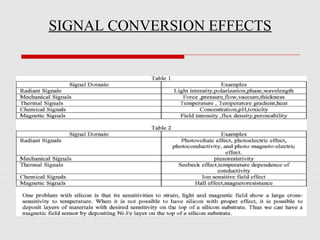
SIGNAL CONVERSION EFFECTS
MECHANICAL SIGNAL DOMAIN
   Silicon Can be used for measuring force &
    pressure because of piezo-resistance effect

   By heating a silicon structure having two
    temperature devices and is brought to air flow
    then resulting the temperature difference is
    proportional to square root of flow velocity
THERMAL SIGNAL DOMAIN
   Electron devices in Silicon show temperature
    dependence this property of Silicon can be used for the
    measurement of Temperature
   We can measure temperature because seeback in Silicon
    is very large
              Magnetic Signal Domain
•   It can be used for the Construction of Hall Plates &
    Transistor Structure that are sensitive to magnetic field
              CHEMICAL Signal Domain
* It can be used as humidity sensor or gas sensor
IMPORTANCE & ADOPTION OF SMART SENSOR
   The presence of controller in smart sensor has led to corrections for different undesirable
    sensor characteristics which include span variation , non –linearity, cross-sensitivity.

                        REDUCE COST OF BULK CABLES & CONNECTORS
   By using smart sensor the cost of bulb cables and connectors is reduced
                                       REMOTE DIAGNOSTICS
   It is possible to have digital communication via a standard bus & a built in self-test.
                                 ENHANCEMENT OF APPLICATION
   Self Calibration – It means adjusting some parameters of sensor during fabrication this can be
    either gain or offset or both.
   Computation : Computation is also allows one to obtain the average, variance and standard
    deviation for the set of measurements.
   Communication : Communication is the means of exchanging or conveying information.
   Multi sensing : Some smart sensor has to measure more than one physical or chemical
    variable simultaneously
                                        SYSTEM RELIABILITY
   System reliability is significantly improved due to the utilization of smart sensor
                                 BETTER SIGNAL TO NOISE RATIO
   The electrical output of most sensors is very weak and it is transmitted through long wires lot
    of noise get coupled by using smart sensor this problem is avoided
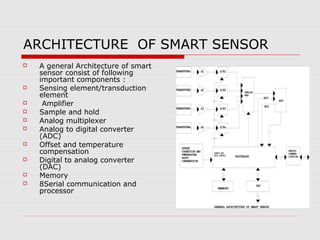
ARCHITECTURE OF SMART SENSOR
   A general Architecture of smart
    sensor consist of following
    important components :
   Sensing element/transduction
    element
    Amplifier
   Sample and hold
   Analog multiplexer
   Analog to digital converter
    (ADC)
   Offset and temperature
    compensation
   Digital to analog converter
    (DAC)
   Memory
   8Serial communication and
    processor
FUNCTIONS WITHIN ELECTRONICS
   Many a times it is required to alter the sensor excitation
    over the operating range of a SENSOR.
    an example of this is SILICON Wheatstone bridge,
    where the drive voltage is increased with increasing
    temperature
                         ANALOG INPUT
•   Multiplexing of inputs can be done to avoid duplication
    of circuits in multiplexing inputs of same type and range
    are switched to a common front end.
                      DATA CONVERSION
* In case of Smart sensor most of the signal processing in
    digital form this is possible we have an ADC along with
    an Anti-aliasing filter.
SUMMARY OF DIFFERENT SMART SENSOR
                            Optical Sensor
•    It is used for measuring exposure in cameras, optical angle
     encoders
                           ACCELEROMETER
* It consists of sensing element and electronics on SILICON
                     INTREGATED MULTI SENSOR
•    This chip was fabricated using conventional Silicon planer
     processing, Silicon Micro machining and thin deposition
     technique.
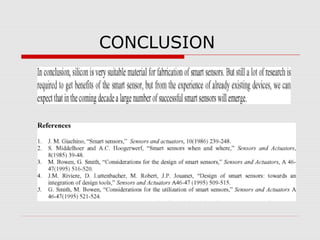
CONCLUSION

Subir presentation

  • 1.
    Seminar ON SMART SENSOR Submitted by : SUBIR KUMAR GHOSH Roll No. IN-14/04 Electrical & Instrumentation Deptt. B.E 7th Semester JORHAT ENGINEERING COLLEGE, JORHAT PIN: 785 007 (ASSAM)
  • 2.
    CONTENTS  Introduction  Definition  Usefulness of silicon technology in Smart Sensor  Importance and Adoption of Smart Sensor  General Architecture of Smart Sensor  Block Level Design Consideration for Smart Sensor  Summary of Different Smart Sensor  Conclusions  References
  • 3.
    INTRODUCTION  Main aim of Integrating the electronics and the Sensor is to make and intelligent sensor.  Smart Sensor have the ability to take decision.  Complete system is called a system on Chip.  Smart Sensor consist of Transduction Element, Signal Conditioning Electronic and controller/processor.
  • 4.
    DEFINITION  Smart Sensors are sensors with Integrated Electronics that can perform the following functions : a) Logic Function b) Two way communication c) Make Decisions
  • 5.
    Useful ness ofSilicon Technology in Smart Sensor  A smart sensor is made with same technology as Integrated circuits  A transduction element either includes thin metal films, Zinc Oxide and Polymeric films
  • 6.
  • 7.
    MECHANICAL SIGNAL DOMAIN  Silicon Can be used for measuring force & pressure because of piezo-resistance effect  By heating a silicon structure having two temperature devices and is brought to air flow then resulting the temperature difference is proportional to square root of flow velocity
  • 8.
    THERMAL SIGNAL DOMAIN  Electron devices in Silicon show temperature dependence this property of Silicon can be used for the measurement of Temperature  We can measure temperature because seeback in Silicon is very large Magnetic Signal Domain • It can be used for the Construction of Hall Plates & Transistor Structure that are sensitive to magnetic field CHEMICAL Signal Domain * It can be used as humidity sensor or gas sensor
  • 9.
    IMPORTANCE & ADOPTIONOF SMART SENSOR  The presence of controller in smart sensor has led to corrections for different undesirable sensor characteristics which include span variation , non –linearity, cross-sensitivity. REDUCE COST OF BULK CABLES & CONNECTORS  By using smart sensor the cost of bulb cables and connectors is reduced REMOTE DIAGNOSTICS  It is possible to have digital communication via a standard bus & a built in self-test. ENHANCEMENT OF APPLICATION  Self Calibration – It means adjusting some parameters of sensor during fabrication this can be either gain or offset or both.  Computation : Computation is also allows one to obtain the average, variance and standard deviation for the set of measurements.  Communication : Communication is the means of exchanging or conveying information.  Multi sensing : Some smart sensor has to measure more than one physical or chemical variable simultaneously SYSTEM RELIABILITY  System reliability is significantly improved due to the utilization of smart sensor BETTER SIGNAL TO NOISE RATIO  The electrical output of most sensors is very weak and it is transmitted through long wires lot of noise get coupled by using smart sensor this problem is avoided
  • 10.
    ARCHITECTURE OF SMARTSENSOR  A general Architecture of smart sensor consist of following important components :  Sensing element/transduction element  Amplifier  Sample and hold  Analog multiplexer  Analog to digital converter (ADC)  Offset and temperature compensation  Digital to analog converter (DAC)  Memory  8Serial communication and processor
  • 11.
    FUNCTIONS WITHIN ELECTRONICS  Many a times it is required to alter the sensor excitation over the operating range of a SENSOR. an example of this is SILICON Wheatstone bridge, where the drive voltage is increased with increasing temperature ANALOG INPUT • Multiplexing of inputs can be done to avoid duplication of circuits in multiplexing inputs of same type and range are switched to a common front end. DATA CONVERSION * In case of Smart sensor most of the signal processing in digital form this is possible we have an ADC along with an Anti-aliasing filter.
  • 12.
    SUMMARY OF DIFFERENTSMART SENSOR Optical Sensor • It is used for measuring exposure in cameras, optical angle encoders ACCELEROMETER * It consists of sensing element and electronics on SILICON INTREGATED MULTI SENSOR • This chip was fabricated using conventional Silicon planer processing, Silicon Micro machining and thin deposition technique.
  • 13.