EducationUSA can help you every step along the way.
5 Steps to U.S. Study
1.Research Your Options
2.Finance Your Studies
3.Complete Your Application
4.Apply for Your Student Visa
5.Prepare for Your Departure
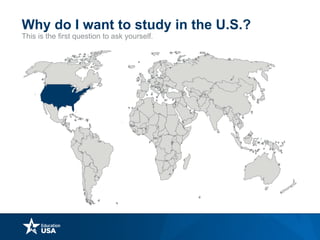
This is the first question to ask yourself.
Why do I want to study in the U.S.?
Why Study in the U.S. of all places?
Flexibility
Critical-thinking
State-of-the-art
Facilities
International
Experience and
Networking
4,900+ Choices
Quality
English language
practice
Value
Student-centered
approach
Working closely with
professors
Diversity
Benefits of a Life in Engineering or
Architecture
 Job satisfaction
 Variety of career opportunities
 Challenging work
 Intellectual development
 Potential to benefit society
 Financial security
 Technological & scientific discovery
 Creative thinking
 And much more…..
Starting your Search
• 1000+ engineering
programs
• 400+ architecture
programs
• Best universities overall
may not be best for your
field
• Accreditation, not rankings!
– ABET: engineering
accreditation, globally
recognized
– NAAB: architecture
accreditation, required for
professional registration
• Admission rates?
A word about ACCREDITATION
1) University Accreditation – www.chea.org
2) Professional Accreditation
National Architectural Accrediting Board (NAAB) – www.naab.org
Accreditation Board for Engineering & Technology (ABET) – www.abet.org
Since most state registration boards in the United States require any
applicant for licensure to have graduated from a NAAB or ABET
accredited program, obtaining such a degree is an essential aspect of
preparing for the professional practice of engineering and architecture.
Studying Engineering
in the U.S.
Is Engineering Right for You?
Do you possess:
• Strong analytical aptitude/logical thinking?
• Attention to detail?
• Creativity?
• Interest in staying up-to-date on newest developments?
• Good mathematical/problem solving skills?
• Ability to work as part of a team?
• Excellent technical knowledge?
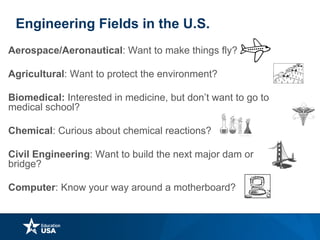
Engineering Fields in the U.S.
• Aerospace/Aeronautical: Want to make things fly?
• Agricultural: Want to protect the environment?
• Biomedical: Interested in medicine, but don’t want to go to
medical school?
• Chemical: Curious about chemical reactions?
• Civil Engineering: Want to build the next major dam or
bridge?
• Computer: Know your way around a motherboard?
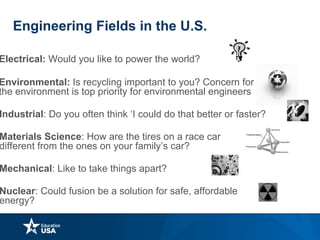
Engineering Fields in the U.S.
Electrical: Would you like to power the world?
Environmental: Is recycling important to you? Concern for
the environment is top priority for environmental engineers
Industrial: Do you often think ‘I could do that better or faster?
Materials Science: How are the tires on a race car
different from the ones on your family’s car?
Mechanical: Like to take things apart?
Nuclear: Could fusion be a solution for safe, affordable
energy??
Choosing an Engineering Program
• Know professional organizations for your
field; do they have a guide to best schools?
• Faculty
• Well-regarded in field?
• Read publications or know their work
• Accreditation
• Academic unit size
• Facilities/ support
• Career programs
• Postgraduate plans
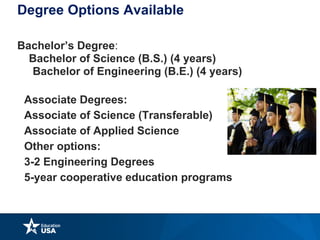
Degree Options Available
Bachelor’s Degree:
Bachelor of Science (B.S.) (4 years)
Bachelor of Engineering (B.E.) (4 years)
Associate Degrees:
Associate of Science (Transferable)
Associate of Applied Science
Other options:
3-2 Engineering Degrees
5-year cooperative education programs
Undergraduate
Admissions
• SAT/ACT scores
– Optional, recommended,
or required?
• English proficiency
– Is there conditional
admission?
– Know minimum scores
required
• Grades: 2.75-3.0
– Average minimums for
admission to major
• Architecture
– 4-year bachelor’s
degrees
– 5-year master’s degrees
• Math preparation for
engineering
– Calculus I recommended
– SAT/ACT scores can
help
Undergraduate Scholarships
• Two kinds
– Need-based
– Merit-based
• Need-based
– Awarded for financial need
• Merit-based
– Awarded for grades,
scores, quality of work
– University-wide or through
departments
• Can get more than 1
• Who’s eligible?
– Requirements differ
– New freshmen?
– Or just enrolled
students?
• Deadlines
– November 1st or
February 1st are
common
– Departments may have
different deadlines
• Look outside the university!
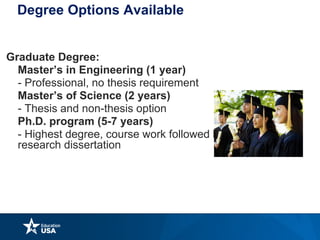
Degree Options Available
Graduate Degree:
Master’s in Engineering (1 year)
- Professional, no thesis requirement
Master’s of Science (2 years)
- Thesis and non-thesis option
Ph.D. program (5-7 years)
- Highest degree, course work followed by original
research dissertation
Graduate Admissions
• Done through
department
• Most programs take
students only for fall
• Deadlines are early!
– 1st week of January or
earlier
• GRE: general test
– Some require it,
others don’t
– May be no minimums
• English proficiency
– TOEFL or IELTS
• Minimum scores can
be different for each
department
– Conditional admission?
• Transcripts
– 3.0 minimum GPA
– Especially in your major
• Architecture
– Portfolio: examples of
academic or
professional work
• Prerequisite courses or
degrees?
• Reference letters
– 3, from professors or
supervisors
• Personal statement
– What do you want to
study?
– Why do you want to study
it?
– Why is ____ University
the best place for you?
• Resume/CV
Graduate Admissions
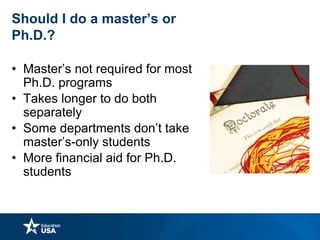
Should I do a master’s or
Ph.D.?
• Master’s not required for most
Ph.D. programs
• Takes longer to do both
separately
• Some departments don’t take
master’s-only students
• More financial aid for Ph.D.
students
Graduate Funding
• Teaching
assistantships
– Funded by
departments
– Teach or assist
professor in course
• Research
assistantships
– Usually funded by
research grants
• Fellowships
– Support in return for
teaching or research
duties
– Very competitive
• Scholarships
– Usually for excellent
academic work
– Some for Ph.D.
students only
• Travel grants
– For conferences
Online Resources for Engineering
The Accreditation Board for Engineering and Technology
(ABET) www.abet.org
American Society for Engineering Education www.asee.org
Society of Women Engineers www.swe.org
The National Council of Examiners for Engineers and Surveying
(NCEES) www.ncees.org
National Society of Professional Engineers Education
www.nspe.org/students/home.asp
Studying Architecture
in the USA
Common Specializations
• Architectural Engineering
• Architectural History
• Historic Preservation/Conservation
• Interior Architecture
• Industrial Design
• Landscape Architecture
• Urban Design
EducationUSA.state.gov
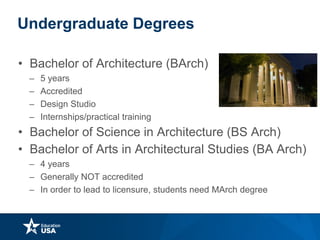
Undergraduate Degrees
• Bachelor of Architecture (BArch)
– 5 years
– Accredited
– Design Studio
– Internships/practical training
• Bachelor of Science in Architecture (BS Arch)
• Bachelor of Arts in Architectural Studies (BA Arch)
– 4 years
– Generally NOT accredited
– In order to lead to licensure, students need MArch degree
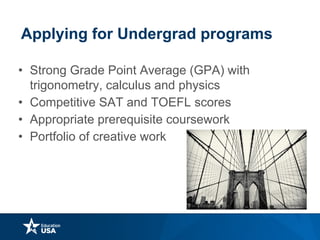
Applying for Undergrad programs
• Strong Grade Point Average (GPA) with
trigonometry, calculus and physics
• Competitive SAT and TOEFL scores
• Appropriate prerequisite coursework
• Portfolio of creative work works
Master Degrees
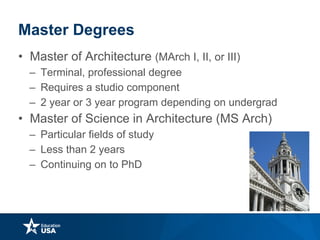
• Master of Architecture (MArch I, II, or III)
– Terminal, professional degree
– Requires a studio component
– 2 year or 3 year program depending on undergrad
• Master of Science in Architecture (MS Arch)
– Particular fields of study
– Less than 2 years
– Continuing on to PhD
Doctorate Degrees
Doctor of Philosophy (Ph.D.)
– Teaching or Research
• Doctorate in Architecture (DArch)
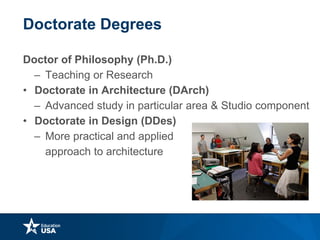
– Advanced study in particular area & Studio component
• Doctorate in Design (DDes)
– More practical and applied
approach to architecture
Applying to Grad Programs
• Graduated from undergraduate degree program in
Architecture or related field
• Strong portfolio
– Includes complete projects related to proposed study or
specialization
• Good GRE score
• TOEFL or IELTS
Highlighted Specializations
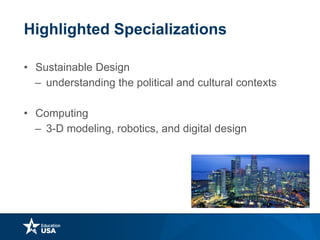
• Sustainable Design
– understanding the political and cultural contexts
• Computing
– 3-D modeling, robotics, and digital design
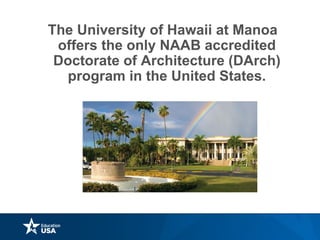
The University of Hawaii at Manoa
offers the only NAAB accredited
Doctorate of Architecture (DArch)
program in the United States.
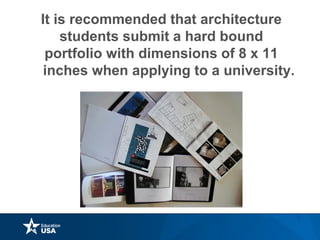
It is recommended that architecture
students submit a hard bound
portfolio with dimensions of 8 x 11
inches when applying to a university.
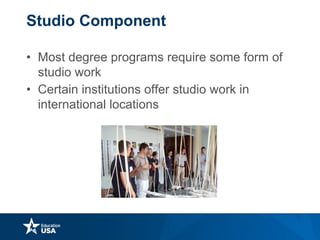
Studio Component
• Most degree programs require some form of
studio work
• Certain institutions offer studio work in
international locations
Online Architecture Resources
• National Association of Architecture Accrediting Board:
www.naab.org
• American Institute of Architecture: www.aia.org
• American Institute of Architecture Students: www.aias.org
• Occupational Outlook Handbook www.bls.gov/oco
• AMIDEAST amideast.org/usstudy/fields-study
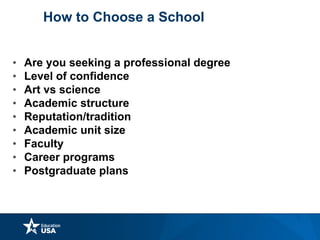
How to Choose a School
• Are you seeking a professional degree
• Level of confidence
• Art vs science
• Academic structure
• Reputation/tradition
• Academic unit size
• Faculty
• Career programs
• Postgraduate plans
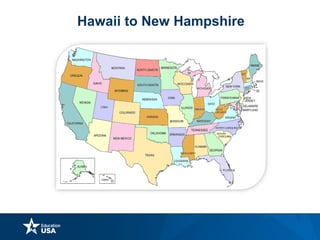
Hawaii to New Hampshire
Big Cities and Small Towns
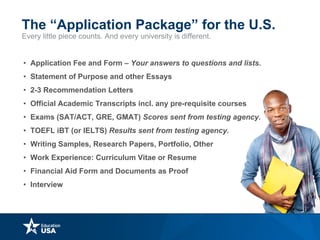
Every little piece counts. And every university is different.
The “Application Package” for the U.S.
• Application Fee and Form – Your answers to questions and lists.
• Statement of Purpose and other Essays
• 2-3 Recommendation Letters
• Official Academic Transcripts incl. any pre-requisite courses
• Exams (SAT/ACT, GRE, GMAT) Scores sent from testing agency.
• TOEFL iBT (or IELTS) Results sent from testing agency.
• Writing Samples, Research Papers, Portfolio, Other
• Work Experience: Curriculum Vitae or Resume
• Financial Aid Form and Documents as Proof
• Interview
Our Facebook Community
EducationUSA Egypt
www.youtube.com/EducationUSA
Thank you and Good Luck!
EducationUSAcairo@amideast.org
EducationUSA‐Alexandria@amideast.org
19263
Q&A
Ask your questions about
Study in the USA.

Studying Engineering and Architecture in the U.S. 2019

  • 2.
    EducationUSA can helpyou every step along the way. 5 Steps to U.S. Study 1.Research Your Options 2.Finance Your Studies 3.Complete Your Application 4.Apply for Your Student Visa 5.Prepare for Your Departure
  • 3.
    This is thefirst question to ask yourself. Why do I want to study in the U.S.?
  • 4.
    Why Study inthe U.S. of all places? Flexibility Critical-thinking State-of-the-art Facilities International Experience and Networking 4,900+ Choices Quality English language practice Value Student-centered approach Working closely with professors Diversity
  • 5.
    Benefits of aLife in Engineering or Architecture  Job satisfaction  Variety of career opportunities  Challenging work  Intellectual development  Potential to benefit society  Financial security  Technological & scientific discovery  Creative thinking  And much more…..
  • 6.
    Starting your Search •1000+ engineering programs • 400+ architecture programs • Best universities overall may not be best for your field • Accreditation, not rankings! – ABET: engineering accreditation, globally recognized – NAAB: architecture accreditation, required for professional registration • Admission rates?
  • 7.
    A word aboutACCREDITATION 1) University Accreditation – www.chea.org 2) Professional Accreditation National Architectural Accrediting Board (NAAB) – www.naab.org Accreditation Board for Engineering & Technology (ABET) – www.abet.org Since most state registration boards in the United States require any applicant for licensure to have graduated from a NAAB or ABET accredited program, obtaining such a degree is an essential aspect of preparing for the professional practice of engineering and architecture.
  • 8.
  • 9.
    Is Engineering Rightfor You? Do you possess: • Strong analytical aptitude/logical thinking? • Attention to detail? • Creativity? • Interest in staying up-to-date on newest developments? • Good mathematical/problem solving skills? • Ability to work as part of a team? • Excellent technical knowledge?
  • 10.
    Engineering Fields inthe U.S. • Aerospace/Aeronautical: Want to make things fly? • Agricultural: Want to protect the environment? • Biomedical: Interested in medicine, but don’t want to go to medical school? • Chemical: Curious about chemical reactions? • Civil Engineering: Want to build the next major dam or bridge? • Computer: Know your way around a motherboard?
  • 11.
    Engineering Fields inthe U.S. Electrical: Would you like to power the world? Environmental: Is recycling important to you? Concern for the environment is top priority for environmental engineers Industrial: Do you often think ‘I could do that better or faster? Materials Science: How are the tires on a race car different from the ones on your family’s car? Mechanical: Like to take things apart? Nuclear: Could fusion be a solution for safe, affordable energy??
  • 12.
    Choosing an EngineeringProgram • Know professional organizations for your field; do they have a guide to best schools? • Faculty • Well-regarded in field? • Read publications or know their work • Accreditation • Academic unit size • Facilities/ support • Career programs • Postgraduate plans
  • 13.
    Degree Options Available Bachelor’sDegree: Bachelor of Science (B.S.) (4 years) Bachelor of Engineering (B.E.) (4 years) Associate Degrees: Associate of Science (Transferable) Associate of Applied Science Other options: 3-2 Engineering Degrees 5-year cooperative education programs
  • 14.
    Undergraduate Admissions • SAT/ACT scores –Optional, recommended, or required? • English proficiency – Is there conditional admission? – Know minimum scores required • Grades: 2.75-3.0 – Average minimums for admission to major • Architecture – 4-year bachelor’s degrees – 5-year master’s degrees • Math preparation for engineering – Calculus I recommended – SAT/ACT scores can help
  • 15.
    Undergraduate Scholarships • Twokinds – Need-based – Merit-based • Need-based – Awarded for financial need • Merit-based – Awarded for grades, scores, quality of work – University-wide or through departments • Can get more than 1 • Who’s eligible? – Requirements differ – New freshmen? – Or just enrolled students? • Deadlines – November 1st or February 1st are common – Departments may have different deadlines • Look outside the university!
  • 16.
    Degree Options Available GraduateDegree: Master’s in Engineering (1 year) - Professional, no thesis requirement Master’s of Science (2 years) - Thesis and non-thesis option Ph.D. program (5-7 years) - Highest degree, course work followed by original research dissertation
  • 17.
    Graduate Admissions • Donethrough department • Most programs take students only for fall • Deadlines are early! – 1st week of January or earlier • GRE: general test – Some require it, others don’t – May be no minimums • English proficiency – TOEFL or IELTS • Minimum scores can be different for each department – Conditional admission? • Transcripts – 3.0 minimum GPA – Especially in your major
  • 18.
    • Architecture – Portfolio:examples of academic or professional work • Prerequisite courses or degrees? • Reference letters – 3, from professors or supervisors • Personal statement – What do you want to study? – Why do you want to study it? – Why is ____ University the best place for you? • Resume/CV Graduate Admissions
  • 19.
    Should I doa master’s or Ph.D.? • Master’s not required for most Ph.D. programs • Takes longer to do both separately • Some departments don’t take master’s-only students • More financial aid for Ph.D. students
  • 20.
    Graduate Funding • Teaching assistantships –Funded by departments – Teach or assist professor in course • Research assistantships – Usually funded by research grants • Fellowships – Support in return for teaching or research duties – Very competitive • Scholarships – Usually for excellent academic work – Some for Ph.D. students only • Travel grants – For conferences
  • 21.
    Online Resources forEngineering The Accreditation Board for Engineering and Technology (ABET) www.abet.org American Society for Engineering Education www.asee.org Society of Women Engineers www.swe.org The National Council of Examiners for Engineers and Surveying (NCEES) www.ncees.org National Society of Professional Engineers Education www.nspe.org/students/home.asp
  • 22.
  • 23.
    Common Specializations • ArchitecturalEngineering • Architectural History • Historic Preservation/Conservation • Interior Architecture • Industrial Design • Landscape Architecture • Urban Design EducationUSA.state.gov
  • 24.
    Undergraduate Degrees • Bachelorof Architecture (BArch) – 5 years – Accredited – Design Studio – Internships/practical training • Bachelor of Science in Architecture (BS Arch) • Bachelor of Arts in Architectural Studies (BA Arch) – 4 years – Generally NOT accredited – In order to lead to licensure, students need MArch degree
  • 25.
    Applying for Undergradprograms • Strong Grade Point Average (GPA) with trigonometry, calculus and physics • Competitive SAT and TOEFL scores • Appropriate prerequisite coursework • Portfolio of creative work works
  • 26.
    Master Degrees • Masterof Architecture (MArch I, II, or III) – Terminal, professional degree – Requires a studio component – 2 year or 3 year program depending on undergrad • Master of Science in Architecture (MS Arch) – Particular fields of study – Less than 2 years – Continuing on to PhD
  • 27.
    Doctorate Degrees Doctor ofPhilosophy (Ph.D.) – Teaching or Research • Doctorate in Architecture (DArch) – Advanced study in particular area & Studio component • Doctorate in Design (DDes) – More practical and applied approach to architecture
  • 28.
    Applying to GradPrograms • Graduated from undergraduate degree program in Architecture or related field • Strong portfolio – Includes complete projects related to proposed study or specialization • Good GRE score • TOEFL or IELTS
  • 29.
    Highlighted Specializations • SustainableDesign – understanding the political and cultural contexts • Computing – 3-D modeling, robotics, and digital design
  • 30.
    The University ofHawaii at Manoa offers the only NAAB accredited Doctorate of Architecture (DArch) program in the United States.
  • 31.
    It is recommendedthat architecture students submit a hard bound portfolio with dimensions of 8 x 11 inches when applying to a university.
  • 32.
    Studio Component • Mostdegree programs require some form of studio work • Certain institutions offer studio work in international locations
  • 33.
    Online Architecture Resources •National Association of Architecture Accrediting Board: www.naab.org • American Institute of Architecture: www.aia.org • American Institute of Architecture Students: www.aias.org • Occupational Outlook Handbook www.bls.gov/oco • AMIDEAST amideast.org/usstudy/fields-study
  • 34.
    How to Choosea School • Are you seeking a professional degree • Level of confidence • Art vs science • Academic structure • Reputation/tradition • Academic unit size • Faculty • Career programs • Postgraduate plans
  • 35.
    Hawaii to NewHampshire
  • 36.
    Big Cities andSmall Towns
  • 37.
    Every little piececounts. And every university is different. The “Application Package” for the U.S. • Application Fee and Form – Your answers to questions and lists. • Statement of Purpose and other Essays • 2-3 Recommendation Letters • Official Academic Transcripts incl. any pre-requisite courses • Exams (SAT/ACT, GRE, GMAT) Scores sent from testing agency. • TOEFL iBT (or IELTS) Results sent from testing agency. • Writing Samples, Research Papers, Portfolio, Other • Work Experience: Curriculum Vitae or Resume • Financial Aid Form and Documents as Proof • Interview
  • 38.
  • 39.
    www.youtube.com/EducationUSA Thank you andGood Luck! EducationUSAcairo@amideast.org EducationUSA‐Alexandria@amideast.org 19263
  • 40.
    Q&A Ask your questionsabout Study in the USA.