


EducationUSA can help you every step along the way.
5 Steps to U.S. Study
1.Research Your Options
2.Finance Your Studies
3.Complete Your Application
4.Apply for Your Student Visa
5.Prepare for Your Departure
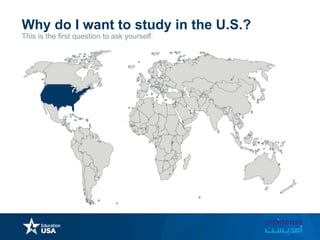
This is the first question to ask yourself.
Why do I want to study in the U.S.?
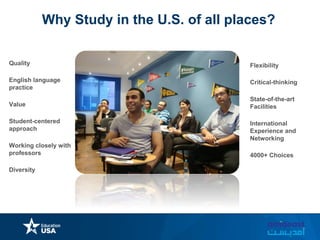
Why Study in the U.S. of all places?
Flexibility
Critical-thinking
State-of-the-art
Facilities
International
Experience and
Networking
4000+ Choices
Quality
English language
practice
Value
Student-centered
approach
Working closely with
professors
Diversity
Finance Your Studies
Study in the U.S. while attaining your degree from Egypt.
Non-Degree Seeking Options in the U.S.
• Exchange Programs through the U.S. Embassy University Students:
E.g. (GlobalUGRAD/SUSI) Secondary Students: E.g. (Tech
Girls/Between the Lines) https://eg.usembassy.gov/education-
culture/exchange-opportunities/allexchanges/
• KL-Yes for high school students (AFS)
• Humphrey Fellowship (Professionals) through Fulbright
• Junior Faculty Development through Fulbright
• PhD Research grants (including Fulbright)
• FLTA for English Teachers(Fulbright)
• TCLP (AMIDEAST) for Arabic and English teachers at Governmental
Schools
• Medical Residencies, Observerships, etc. (EAMTAR)
• Certificate Programs/Summer Programs through Community colleges
or US Universities. (Self fund)
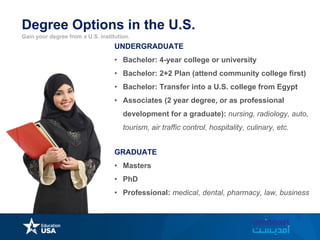
Gain your degree from a U.S. institution.
Degree Options in the U.S.
UNDERGRADUATE
• Bachelor: 4-year college or university
• Bachelor: 2+2 Plan (attend community college first)
• Bachelor: Transfer into a U.S. college from Egypt
• Associates (2 year degree, or as professional
development for a graduate): nursing, radiology, auto,
tourism, air traffic control, hospitality, culinary, etc.
GRADUATE
• Masters
• PhD
• Professional: medical, dental, pharmacy, law, business
Find out what the total costs for each school on your list.
Calculate the Total Costs
• Tuition (by credit hour)
• College/University Fees
• Books, Supplies, Class Fees
• Health Insurance (mandatory)
• Personal Expenses (according to the university)
• Room & Board (off-campus and on-campus options)
• Local Transportation
• International Transportation (Will you come home for breaks?)
• SEVIS and Student Visa Application
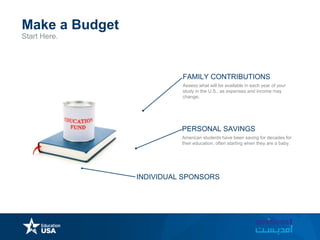
Start Here.
Make a Budget
INDIVIDUAL SPONSORS
American students have been saving for decades for
their education, often starting when they are a baby.
PERSONAL SAVINGS
Assess what will be available in each year of your
study in the U.S., as expenses and income may
change.
FAMILY CONTRIBUTIONS
A Little Research Goes a Long Way
Many Ways to Afford a U.S. Education
Please note that U.S.
colleges and universities
use two different definitions
of Financial Aid.
1.Fellowships, Scholarships, Graduate Assistantships,
Need-based Financial Aid, and more. 2. Affordable tuition, cost of living, discounts and waivers,
shorter or intensive programs.
Some schools offer affordable costs
without financial assistance
Best Buys – highest quality at lowest
prices (such as state universities)
What financial aid is available?
Find out what the college offers and which programs you are eligible for.
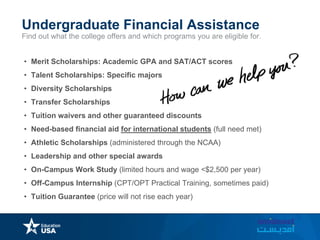
Undergraduate Financial Assistance
• Merit Scholarships: Academic GPA and SAT/ACT scores
• Talent Scholarships: Specific majors
• Diversity Scholarships
• Transfer Scholarships
• Tuition waivers and other guaranteed discounts
• Need-based financial aid for international students (full need met)
• Athletic Scholarships (administered through the NCAA)
• Leadership and other special awards
• On-Campus Work Study (limited hours and wage <$2,500 per year)
• Off-Campus Internship (CPT/OPT Practical Training, sometimes paid)
• Tuition Guarantee (price will not rise each year)
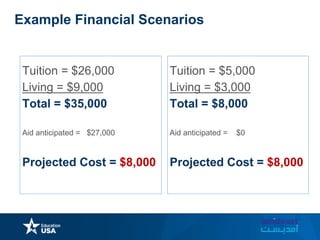
Example Financial Scenarios
Tuition = $26,000
Living = $9,000
Total = $35,000
Aid anticipated = $27,000
Projected Cost = $8,000
Tuition = $5,000
Living = $3,000
Total = $8,000
Aid anticipated = $0
Projected Cost = $8,000
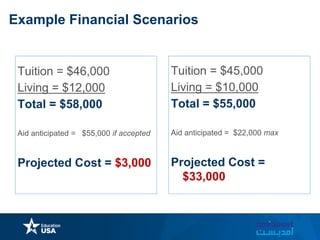
Example Financial Scenarios
Tuition = $46,000
Living = $12,000
Total = $58,000
Aid anticipated = $55,000 if accepted
Projected Cost = $3,000
Tuition = $45,000
Living = $10,000
Total = $55,000
Aid anticipated = $22,000 max
Projected Cost =
$33,000
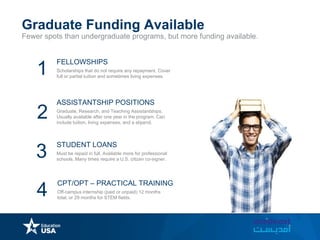
Fewer spots than undergraduate programs, but more funding available.
Graduate Funding Available
Scholarships that do not require any repayment. Cover
full or partial tuition and sometimes living expenses.
FELLOWSHIPS
Graduate, Research, and Teaching Assistantships.
Usually available after one year in the program. Can
include tuition, living expenses, and a stipend.
ASSISTANTSHIP POSITIONS
Must be repaid in full. Available more for professional
schools. Many times require a U.S. citizen co-signer.
STUDENT LOANS
1
3
Off-campus internship (paid or unpaid) 12 months
total, or 29 months for STEM fields.
CPT/OPT – PRACTICAL TRAINING
4
2
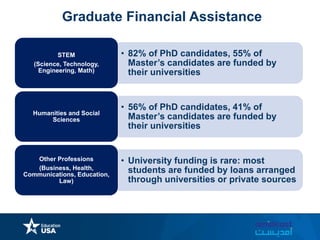
• 82% of PhD candidates, 55% of
Master’s candidates are funded by
their universities
STEM
(Science, Technology,
Engineering, Math)
• 56% of PhD candidates, 41% of
Master’s candidates are funded by
their universities
Humanities and Social
Sciences
• University funding is rare: most
students are funded by loans arranged
through universities or private sources
Other Professions
(Business, Health,
Communications, Education,
Law)
Graduate Financial Assistance
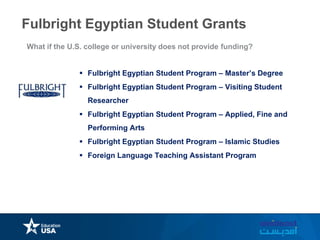
 Fulbright Egyptian Student Program – Master’s Degree
 Fulbright Egyptian Student Program – Visiting Student
Researcher
 Fulbright Egyptian Student Program – Applied, Fine and
Performing Arts
 Fulbright Egyptian Student Program – Islamic Studies
 Foreign Language Teaching Assistant Program
What if the U.S. college or university does not provide funding?
Fulbright Egyptian Student Grants
MBA Fellowship at Stanford
Fellowship Eligibility
 You must be a citizen of an African country
 You must have completed, or be in the final year of completing, your university
studies.
Evaluation Criteria
 Commitment to developing Africa
 Demonstrated financial need is preferred
 Merit, determined by the three criteria used to consider candidates: intellectual
vitality, demonstrated leadership potential, and personal qualities and
contributions that will add to the class.
 Link: https://www.gsb.stanford.edu/programs/mba/financial-aid/types-
aid/stanford-africa-mba-fellowship
AFRICAN WOMEN'S PUBLIC SERVICE
FELLOWSHIP
 Global EMPA Degree, funded by Opera Winfery Foundation
 Citizen and resident in an African country at the time of
application.
 Strong academic record.
 Demonstrated commitment to public service.
 A NYU Wagner education would significantly enhance your
ability to have a deep and lasting impact on public service
issues in your home country and region.
What if the U.S. college or university does not provide funding?
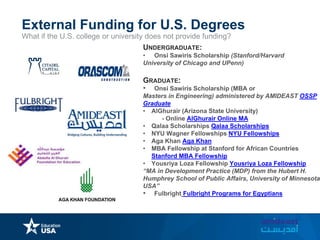
External Funding for U.S. Degrees
UNDERGRADUATE:
• Onsi Sawiris Scholarship (Stanford/Harvard
University of Chicago and UPenn)
GRADUATE:
• Onsi Sawiris Scholarship (MBA or
Masters in Engineering) administered by AMIDEAST OSSP
Graduate
• AlGhurair (Arizona State University)
- Online AlGhurair Online MA
• Qalaa Scholarships Qalaa Scholarships
• NYU Wagner Fellowships NYU Fellowships
• Aga Khan Aga Khan
• MBA Fellowship at Stanford for African Countries
Stanford MBA Fellowship
• Yousriya Loza Fellowship Yousriya Loza Fellowship
“MA in Development Practice (MDP) from the Hubert H.
Humphrey School of Public Affairs, University of Minnesota,
USA”
• Fulbright Fulbright Programs for Egyptians
Research your options fully. Everything you need to know is available online.
Undergraduate: Questions to Ask
• Do you fit the personality of the college?
• Do they have the programs and services
you want and need?
• Are your academics and within the range of
their top students?
• Are they looking for more diversity?
• How many applicants do they accept?
• Do they need to see financial evidence of 1
year of funding before they can accept you?
Research your options fully. Everything you need to know is available online.
Graduate: Things to Consider
• More like applying for a job.
• Is the professor/department doing exactly
what you have experience with?
• How many positions do they have available?
• Two Models: Few, fully-funded students VS
Many, partially-funded students
• Are they looking for work/life experience?
• Fewer spots than undergraduate programs,
but more funding available
• Professional Schools offer little/no funding;
Could you consider an academic degree
instead of a professional track?
Every little piece counts. And every university is different.
The “Application Package” for the U.S.
• Application Fee and Form – Your answers to questions and lists.
• Statement of Purpose and other Essays
• 2-3 Recommendation Letters
• Official Academic Records/Transcripts
• Exams (SAT/ACT, GRE, GMAT) Scores sent from testing agency.
• TOEFL iBT (or IELTS) Results sent from testing agency.
• Writing Samples, Research Papers, Portfolio, Other
• Curriculum Vitae or Resume
• Financial Aid Form and Documents as Proof
• Interview
• School Form: details of your high school. For Common App only.
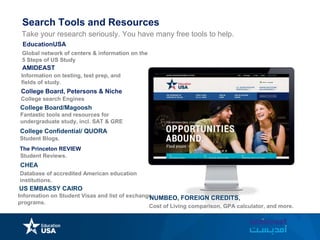
Take your research seriously. You have many free tools to help.
Global network of centers & information on the
5 Steps of US Study
EducationUSA
AMIDEAST
Information on testing, test prep, and
fields of study.
College Board, Petersons & Niche
College Board/Magoosh
Fantastic tools and resources for
undergraduate study, incl. SAT & GRE
College search Engines
College Confidential/ QUORA
Student Blogs.
The Princeton REVIEW
Student Reviews.
CHEA
Database of accredited American education
institutions.
Search Tools and Resources
US EMBASSY CAIRO
Information on Student Visas and list of exchange
programs.
NUMBEO, FOREIGN CREDITS,
Cost of Living comparison, GPA calculator, and more.
Our Facebook Community
EducationUSA Egypt
Our Slideshare Account
EducationUSAEgypt
https://www.instagram.com/educationusaegypt/?hl=en
Thank you and Good Luck!
Cairo@educationusa.org
Alexandria@educationusa.org
19263
https://www.clubhouse.com/club/educationusa-egypt
https://www.youtube.com/channel/UCB8dXSCJ6hGMui6GV_M_C9Q
Q&A
Ask your questions about
Study in the USA.

Step 2: Finance Your Studies-2021

  • 2.
    EducationUSA can helpyou every step along the way. 5 Steps to U.S. Study 1.Research Your Options 2.Finance Your Studies 3.Complete Your Application 4.Apply for Your Student Visa 5.Prepare for Your Departure
  • 3.
    This is thefirst question to ask yourself. Why do I want to study in the U.S.?
  • 4.
    Why Study inthe U.S. of all places? Flexibility Critical-thinking State-of-the-art Facilities International Experience and Networking 4000+ Choices Quality English language practice Value Student-centered approach Working closely with professors Diversity
  • 5.
  • 6.
    Study in theU.S. while attaining your degree from Egypt. Non-Degree Seeking Options in the U.S. • Exchange Programs through the U.S. Embassy University Students: E.g. (GlobalUGRAD/SUSI) Secondary Students: E.g. (Tech Girls/Between the Lines) https://eg.usembassy.gov/education- culture/exchange-opportunities/allexchanges/ • KL-Yes for high school students (AFS) • Humphrey Fellowship (Professionals) through Fulbright • Junior Faculty Development through Fulbright • PhD Research grants (including Fulbright) • FLTA for English Teachers(Fulbright) • TCLP (AMIDEAST) for Arabic and English teachers at Governmental Schools • Medical Residencies, Observerships, etc. (EAMTAR) • Certificate Programs/Summer Programs through Community colleges or US Universities. (Self fund)
  • 7.
    Gain your degreefrom a U.S. institution. Degree Options in the U.S. UNDERGRADUATE • Bachelor: 4-year college or university • Bachelor: 2+2 Plan (attend community college first) • Bachelor: Transfer into a U.S. college from Egypt • Associates (2 year degree, or as professional development for a graduate): nursing, radiology, auto, tourism, air traffic control, hospitality, culinary, etc. GRADUATE • Masters • PhD • Professional: medical, dental, pharmacy, law, business
  • 8.
    Find out whatthe total costs for each school on your list. Calculate the Total Costs • Tuition (by credit hour) • College/University Fees • Books, Supplies, Class Fees • Health Insurance (mandatory) • Personal Expenses (according to the university) • Room & Board (off-campus and on-campus options) • Local Transportation • International Transportation (Will you come home for breaks?) • SEVIS and Student Visa Application
  • 9.
    Start Here. Make aBudget INDIVIDUAL SPONSORS American students have been saving for decades for their education, often starting when they are a baby. PERSONAL SAVINGS Assess what will be available in each year of your study in the U.S., as expenses and income may change. FAMILY CONTRIBUTIONS
  • 10.
    A Little ResearchGoes a Long Way Many Ways to Afford a U.S. Education Please note that U.S. colleges and universities use two different definitions of Financial Aid. 1.Fellowships, Scholarships, Graduate Assistantships, Need-based Financial Aid, and more. 2. Affordable tuition, cost of living, discounts and waivers, shorter or intensive programs. Some schools offer affordable costs without financial assistance Best Buys – highest quality at lowest prices (such as state universities) What financial aid is available?
  • 11.
    Find out whatthe college offers and which programs you are eligible for. Undergraduate Financial Assistance • Merit Scholarships: Academic GPA and SAT/ACT scores • Talent Scholarships: Specific majors • Diversity Scholarships • Transfer Scholarships • Tuition waivers and other guaranteed discounts • Need-based financial aid for international students (full need met) • Athletic Scholarships (administered through the NCAA) • Leadership and other special awards • On-Campus Work Study (limited hours and wage <$2,500 per year) • Off-Campus Internship (CPT/OPT Practical Training, sometimes paid) • Tuition Guarantee (price will not rise each year)
  • 12.
    Example Financial Scenarios Tuition= $26,000 Living = $9,000 Total = $35,000 Aid anticipated = $27,000 Projected Cost = $8,000 Tuition = $5,000 Living = $3,000 Total = $8,000 Aid anticipated = $0 Projected Cost = $8,000
  • 13.
    Example Financial Scenarios Tuition= $46,000 Living = $12,000 Total = $58,000 Aid anticipated = $55,000 if accepted Projected Cost = $3,000 Tuition = $45,000 Living = $10,000 Total = $55,000 Aid anticipated = $22,000 max Projected Cost = $33,000
  • 14.
    Fewer spots thanundergraduate programs, but more funding available. Graduate Funding Available Scholarships that do not require any repayment. Cover full or partial tuition and sometimes living expenses. FELLOWSHIPS Graduate, Research, and Teaching Assistantships. Usually available after one year in the program. Can include tuition, living expenses, and a stipend. ASSISTANTSHIP POSITIONS Must be repaid in full. Available more for professional schools. Many times require a U.S. citizen co-signer. STUDENT LOANS 1 3 Off-campus internship (paid or unpaid) 12 months total, or 29 months for STEM fields. CPT/OPT – PRACTICAL TRAINING 4 2
  • 15.
    • 82% ofPhD candidates, 55% of Master’s candidates are funded by their universities STEM (Science, Technology, Engineering, Math) • 56% of PhD candidates, 41% of Master’s candidates are funded by their universities Humanities and Social Sciences • University funding is rare: most students are funded by loans arranged through universities or private sources Other Professions (Business, Health, Communications, Education, Law) Graduate Financial Assistance
  • 16.
     Fulbright EgyptianStudent Program – Master’s Degree  Fulbright Egyptian Student Program – Visiting Student Researcher  Fulbright Egyptian Student Program – Applied, Fine and Performing Arts  Fulbright Egyptian Student Program – Islamic Studies  Foreign Language Teaching Assistant Program What if the U.S. college or university does not provide funding? Fulbright Egyptian Student Grants
  • 17.
    MBA Fellowship atStanford Fellowship Eligibility  You must be a citizen of an African country  You must have completed, or be in the final year of completing, your university studies. Evaluation Criteria  Commitment to developing Africa  Demonstrated financial need is preferred  Merit, determined by the three criteria used to consider candidates: intellectual vitality, demonstrated leadership potential, and personal qualities and contributions that will add to the class.  Link: https://www.gsb.stanford.edu/programs/mba/financial-aid/types- aid/stanford-africa-mba-fellowship
  • 18.
    AFRICAN WOMEN'S PUBLICSERVICE FELLOWSHIP  Global EMPA Degree, funded by Opera Winfery Foundation  Citizen and resident in an African country at the time of application.  Strong academic record.  Demonstrated commitment to public service.  A NYU Wagner education would significantly enhance your ability to have a deep and lasting impact on public service issues in your home country and region.
  • 19.
    What if theU.S. college or university does not provide funding? External Funding for U.S. Degrees UNDERGRADUATE: • Onsi Sawiris Scholarship (Stanford/Harvard University of Chicago and UPenn) GRADUATE: • Onsi Sawiris Scholarship (MBA or Masters in Engineering) administered by AMIDEAST OSSP Graduate • AlGhurair (Arizona State University) - Online AlGhurair Online MA • Qalaa Scholarships Qalaa Scholarships • NYU Wagner Fellowships NYU Fellowships • Aga Khan Aga Khan • MBA Fellowship at Stanford for African Countries Stanford MBA Fellowship • Yousriya Loza Fellowship Yousriya Loza Fellowship “MA in Development Practice (MDP) from the Hubert H. Humphrey School of Public Affairs, University of Minnesota, USA” • Fulbright Fulbright Programs for Egyptians
  • 20.
    Research your optionsfully. Everything you need to know is available online. Undergraduate: Questions to Ask • Do you fit the personality of the college? • Do they have the programs and services you want and need? • Are your academics and within the range of their top students? • Are they looking for more diversity? • How many applicants do they accept? • Do they need to see financial evidence of 1 year of funding before they can accept you?
  • 21.
    Research your optionsfully. Everything you need to know is available online. Graduate: Things to Consider • More like applying for a job. • Is the professor/department doing exactly what you have experience with? • How many positions do they have available? • Two Models: Few, fully-funded students VS Many, partially-funded students • Are they looking for work/life experience? • Fewer spots than undergraduate programs, but more funding available • Professional Schools offer little/no funding; Could you consider an academic degree instead of a professional track?
  • 22.
    Every little piececounts. And every university is different. The “Application Package” for the U.S. • Application Fee and Form – Your answers to questions and lists. • Statement of Purpose and other Essays • 2-3 Recommendation Letters • Official Academic Records/Transcripts • Exams (SAT/ACT, GRE, GMAT) Scores sent from testing agency. • TOEFL iBT (or IELTS) Results sent from testing agency. • Writing Samples, Research Papers, Portfolio, Other • Curriculum Vitae or Resume • Financial Aid Form and Documents as Proof • Interview • School Form: details of your high school. For Common App only.
  • 23.
    Take your researchseriously. You have many free tools to help. Global network of centers & information on the 5 Steps of US Study EducationUSA AMIDEAST Information on testing, test prep, and fields of study. College Board, Petersons & Niche College Board/Magoosh Fantastic tools and resources for undergraduate study, incl. SAT & GRE College search Engines College Confidential/ QUORA Student Blogs. The Princeton REVIEW Student Reviews. CHEA Database of accredited American education institutions. Search Tools and Resources US EMBASSY CAIRO Information on Student Visas and list of exchange programs. NUMBEO, FOREIGN CREDITS, Cost of Living comparison, GPA calculator, and more.
  • 24.
  • 25.
  • 26.
    https://www.instagram.com/educationusaegypt/?hl=en Thank you andGood Luck! Cairo@educationusa.org Alexandria@educationusa.org 19263 https://www.clubhouse.com/club/educationusa-egypt https://www.youtube.com/channel/UCB8dXSCJ6hGMui6GV_M_C9Q
  • 27.
    Q&A Ask your questionsabout Study in the USA.

Editor's Notes

  • #7  EAMTAR was created by a group of Egyptian physicians in the US as an online portal for Egyptian medical students and graduates to help those interested in coming to the United States for residency, fellowship or research. Since starting this organization in 2010 we were joined by a large number of Egyptian physicians all across the US who wanted to provide their help and support. Also hundreds and now thousands of Egyptian students and graduates have joined our Facebook groups and website. Our aim is to empower Egyptian physicians with excellent postgraduate training and research experience to advance medical education back home in Egypt. We have been dealing with Egyptian students via our social media networks and website for the past 3 years, but decided to reach even further into our medical schools back home and work on the ground with medical students that are not familiar with social media and virtual environments.
  • #12 https://www.edmit.me/blog/need-blind-vs-need-aware-colleges
  • #16 It is also important to note that funding at U.S. colleges and universities varies by field. • In the STEM fields (science, technology, engineering, math) 82% of PhD candidates and 55% of master's candidates are awarded funding through their U.S. universities; • In the humanities and social sciences 56% of PhD candidates and 41% of master's candidates are awarded university funding; • In other professions, such as business (MBA), health, law, and communications funding is rare and most students are funded by loans, made available through universities or private sources.
  • #17 https://fulbright-egypt.org/programs-for-egyptians/
  • #21 Liberal Arts Colleges Focus on the undergraduate students Great option for those wanting to apply to graduate schools later Small classes: where the professors know you so well, they will call if you miss class. Students in the liberal arts generally concentrate their studies in a particular field of study, while receiving exposure to a wide range of academic subjects, from the sciences to humanities subjects. To be well-rounded and employable More generous with scholarships   Research Universities  Access to the latest research and top professors More research and internship opportunities Usually larger classes and campuses Ask how many large classes you can expect to take, Requires independent learning because you are one of many More opportunities for graduate students   Regional Public Universities Many are mid-size which is comfortable for a lot of students Tuition and costs lower than the private colleges, but students who live in the area pay the lowest rate.  Many have agreements that tuition will not raise over time. The whole university might not have a prestigious reputation but the program/department you are interested in might be of the highest quality. Lots of resources and activities offered.   Community College Lowest tuition Small classes Not as much required for application and acceptance English Language programs and other services   Womens Colleges Female role models All services and facilities tailored for women Proven results of successful women   Technical Institutes / Arts and Design Focused curriculum Competitive and Rigorous   HBCUs A pride of the nation Culturally-aware education Supportive environment for minorities Many times progressive, liberal education   Work Colleges Pay for your education through manual labor Only a handful of schools Working a farm, ranch, office, etc.   Professional Schools Training and certification for a certain profession Little to no funding available Highly, highly competitive