??What isWhat isWhat is
engineering
engineering
engineering
engineering?
engineering??
engineering?
engineering?
engineering
Engineer
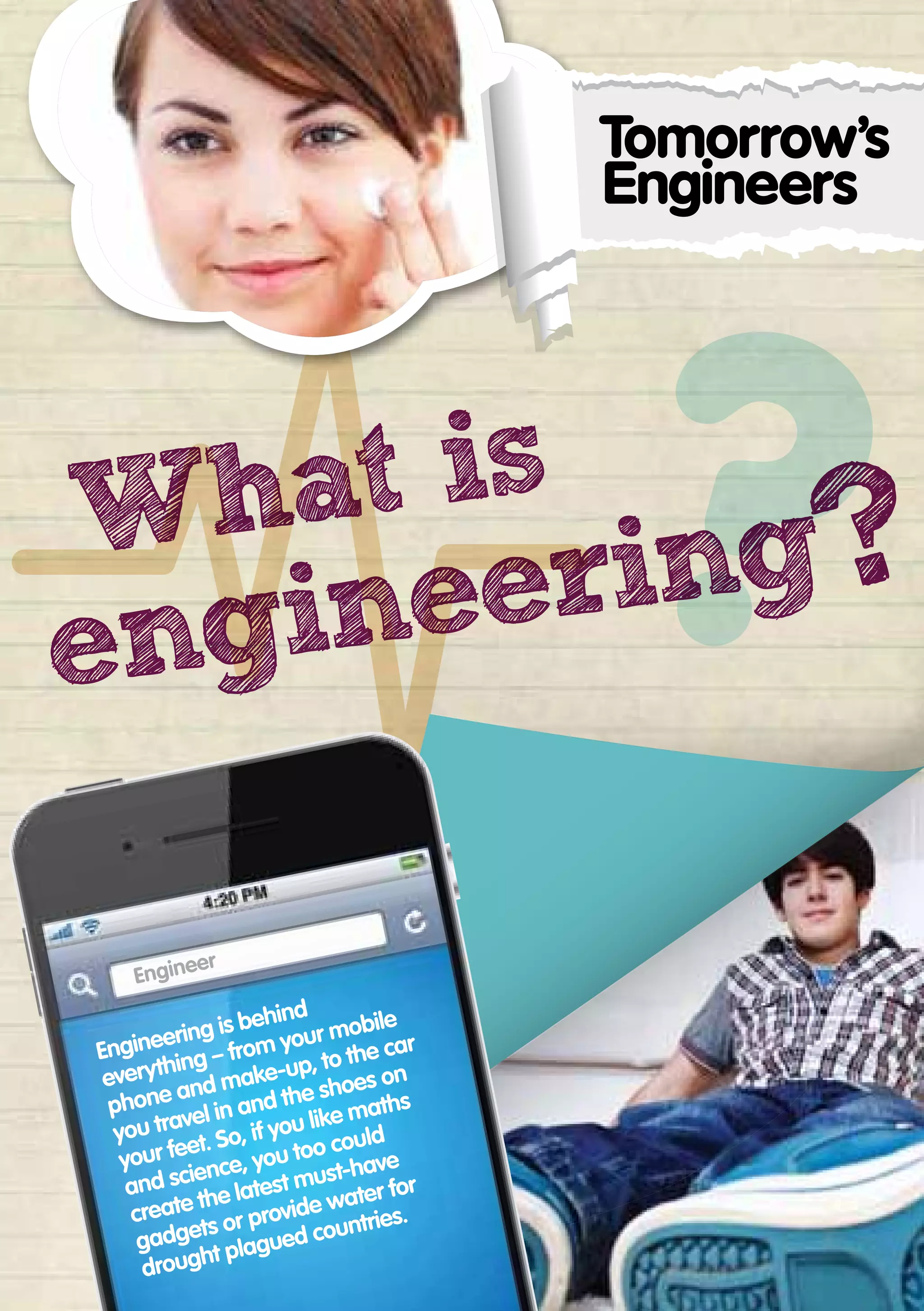
Engineering is behind
everything – from your mobile
phone and make-up, to the car
you travel in and the shoes on
your feet. So, if you like maths
and science, you too could
create the latest must-have
gadgets or provide water for
drought plagued countries.
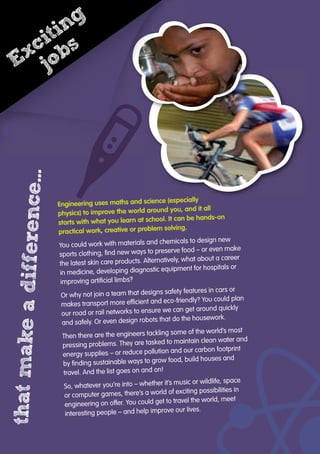
Engineering uses maths and science (especially
physics) to improve the world around you, and it all
starts with what you learn at school. It can be hands-on
practical work, creative or problem solving.
You could work with materials and chemicals to design new
sports clothing, find new ways to preserve food – or even make
the latest skin care products. Alternatively, what about a career
in medicine, developing diagnostic equipment for hospitals or
improving artificial limbs?
Or why not join a team that designs safety features in cars or
makes transport more efficient and eco-friendly? You could plan
our road or rail networks to ensure we can get around quickly
and safely. Or even design robots that do the housework.
Then there are the engineers tackling some of the world’s most
pressing problems. They are tasked to maintain clean water and
energy supplies – or reduce pollution and our carbon footprint
by finding sustainable ways to grow food, build houses and
travel. And the list goes on and on!
So, whatever you’re into – whether it’s music or wildlife, space
or computer games, there’s a world of exciting possibilities in
engineering on offer. You could get to travel the world, meet
interesting people – and help improve our lives.
thatmakeadifference…
Engineering uses maths and science (especially
Exciting
jobs
How do
Studying science (especially physics),
maths, design and technology and computing
at school will get you off to a great start.
They all provide you with some of the skills
engineers use and a great engineering basis
for apprenticeships, college, university or work.
What’s more, an interest in design andWhat’s more, an interest in design andWhat’s more, an interest in design andWhat’s more, an interest in design andWhat’s more, an interest in design andWhat’s more, an interest in design andWhat’s more, an interest in design and
computers is always a bonus!computers is always a bonus!computers is always a bonus!computers is always a bonus!computers is always a bonus!computers is always a bonus!computers is always a bonus!
Then – simply choose the best route for you…
How do
Studying science (especially physics),
maths, design and technology and computing
at school will get you off to a great start.
They all provide you with some of the skills
engineers use and a great engineering basis
for apprenticeships, college, university or work.
What’s more, an interest in design andWhat’s more, an interest in design andWhat’s more, an interest in design andWhat’s more, an interest in design and
computers is always a bonus!computers is always a bonus!computers is always a bonus!computers is always a bonus!
Step
1
money while
you study!
money while
you study!
money while
Ibecomebecome
Study at your local college or training
provider and qualify for further study
or employment.
As well as studying A levels (or equivalent)
other popular engineering qualifications
include BTECs at levels 2 and 3 or HNC
and HND at levels 4 and 5 – foundation
degrees are also available. Find out more
about courses and entry requirements
from your local college website or at
www.hotcourses.com
CollegeCollegeCollegeCollege
money whilemoney while
you study!
money while
you study!
money while
becomebecome an
Intermediate, Advanced and Higher
Apprenticeships (England and Northern Ireland)or Modern Apprenticeships (Scotland and Wales)combine study with employment and provide coreskills plus qualifications such as N/SVQ3and technical certificates.
You will generally need a minimum of five GCSEs(or equivalent), including English, mathematicsand science or technology subjects, often at A* toC level due to competition for places. At the end ofan apprenticeship many decide to take full timeemployment, however it is also possible to go froman apprenticeship on to university. Find out more atwww.apprenticeships.org.uk
ApprenticeshipsApprenticeships
degrees are also available. Find out more
Earn
money while
Earn
money whilemoney while
Intermediate, Advanced and Higher
Apprenticeships (England and Northern Ireland)or Modern Apprenticeships (Scotland and Wales)combine study with employment and provide coreskills plus qualifications such as N/SVQ3and technical certificates.
You will generally need a minimum of five GCSEs(or equivalent), including English, mathematicsand science or technology subjects, often at A* toC level due to competition for places. At the end ofan apprenticeship many decide to take full timeemployment, however it is also possible to go from
Apprenticeships
Step
2
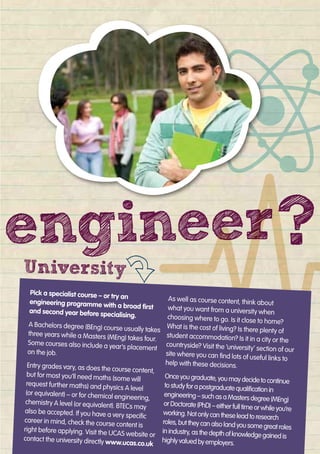
Pick a specialist course – or try an
engineering programme with a broad first
and second year before specialising.
A Bachelors degree (BEng) course usually takes
three years while a Masters (MEng) takes four.
Some courses also include a year’s placement
on the job.
Entry grades vary, as does the course content,
but for most you’ll need maths (some will
request further maths) and physics A level
(or equivalent) – or for chemical engineering,
chemistry A level (or equivalent). BTECs may
also be accepted. If you have a very specific
career in mind, check the course content is
right before applying. Visit the UCAS website or
contact the university directly www.ucas.co.uk
As well as course content, think about
what you want from a university when
choosing where to go. Is it close to home?
What is the cost of living? Is there plenty of
student accommodation? Is it in a city or the
countryside? Visit the ‘university’ section of our
site where you can find lots of useful links to
help with these decisions.
Onceyougraduate,youmaydecidetocontinue
tostudyforapostgraduatequalificationin
engineering–suchasaMastersdegree(MEng)
orDoctorate(PhD)–eitherfulltimeorwhileyou’re
working.Notonlycantheseleadtoresearch
roles,buttheycanalsolandyousomegreatroles
inindustry,asthedepthofknowledgegainedis
highlyvaluedbyemployers.
University
engineerengineerengineerengineer??engineerengineer
Whichever route you take into engineering
– with the appropriate working experience
– you can apply to become professionally
registered with a professional engineering
institution. Your registration options are
Engineering Technician (EngTech), ICT
Technician (ICT Tech), Incorporated Engineer
(IEng) or Chartered Engineer (CEng). Once
registered, you can use these letters after
your name so employers and customers
can see that you’ve achieved a high
standard of engineering professionalism.
Beyond Study
Beyond Study
Work Experience
and Grants...
Work Experience
If you’re interested in becoming an engineer, why not find some work
experience during the school/college holidays? Some universities are now
requesting work experience as part of the application process for their
engineering courses. So be one step ahead!
Work experience placements can be difficult to find, so start searching as
soon as you can to ensure you are not disappointed. Visit the ‘work experience’
section on our website for organisations to help you set up placements.
And don’t forget to include details of your work experience on your CV and
apprenticeship, university or college application forms. Be clear about what you did,
explain what you learnt and demonstrate how this will help you with your career.
Finally, there are organisations that offer sponsorships, grants and study
bursaries to support you with your studies and research projects – we have a
list in the ‘grants’ section on our website.
www.tomorrowsengineers.org.uk
There are some degree courses
which will give you a head start on the
road to professional registration.
Check the Engineering Council’s site to
see if your chosen course is one of them
www.engc.org.uk/education--skills/
accreditation/accredited-course-search
You will also find a full list of professional
institutions and benefits of membership in
their ‘institutions’ section www.engc.org.uk
Whichever route you take into engineering
– with the appropriate working experience
– you can apply to become professionally
registered with a professional engineering
institution. Your registration options are
Technician (ICT Tech), Incorporated Engineer
(IEng) or Chartered Engineer (CEng). Once
registered, you can use these letters after
your name so employers and customers
standard of engineering professionalism.
There are some degree courses
which will give you a head start on the
road to professional registration.
Check the Engineering Council’s site to
see if your chosen course is one of them
Step
3
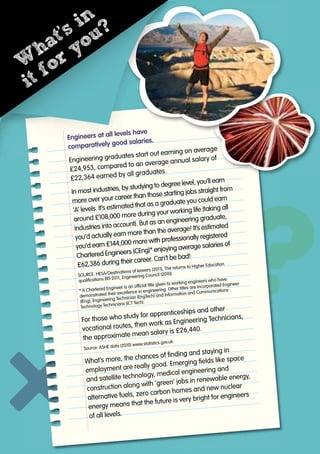
Engineers at all levels have
comparatively good salaries.
Engineering graduates start out earning on average
£24,953, compared to an average annual salary of
£22,364 earned by all graduates.
In most industries, by studying to degree level, you’ll earn
more over your career than those starting jobs straight from
‘A’ levels. It’s estimated that as a graduate you could earn
around £108,000 more during your working life (taking all
industries into account). But as an engineering graduate,
you’d actually earn more than the average! It’s estimated
you’d earn £144,000 more with professionally registered
Chartered Engineers (CEng)* enjoying average salaries of
£62,386 during their career. Can’t be bad!
SOURCE: HESA/Destinations of leavers (2011), The returns to Higher Education
qualifications BIS 2011, Engineering Council (2010)
* A Chartered Engineer is an official title given to working engineers who have
demonstrated their excellence in engineering. Other titles are Incorporated Engineer
(IEng), Engineering Technician (EngTech) and Information and Communications
Technology Technicians (ICT Tech).
For those who study for apprenticeships and other
vocational routes, then work as Engineering Technicians,
the approximate mean salary is £26,440.
Source: ASHE data (2010) www.statistics.gov.uk
What’s more, the chances of finding and staying in
employment are really good. Emerging fields like space
and satellite technology, medical engineering and
construction along with ‘green’ jobs in renewable energy,
alternative fuels, zero carbon homes and new nuclear
energy means that the future is very bright for engineers
of all levels.
Engineering graduates start out earning on average
£24,953, compared to an average annual salary of
Engineers at all levels have
comparatively good salaries.
Engineering graduates start out earning on average
£24,953, compared to an average annual salary of
Engineers at all levels have
W
hat’s in
it for you?
Check out our website
for more information about
engineering careers...
www.tomorrowsengineers.org.uk
Or email us atcareers@engineeringuk.com
www.tomorrowsengineers.org.uk
@
www.tomorrowsengineers.org.uk
@FIND YOUR
ROUTE INTO
ENGINEERING

What is engineering_leaflet

  • 1.
    ??What isWhat isWhatis engineering engineering engineering engineering? engineering?? engineering? engineering? engineering Engineer Engineering is behind everything – from your mobile phone and make-up, to the car you travel in and the shoes on your feet. So, if you like maths and science, you too could create the latest must-have gadgets or provide water for drought plagued countries.
  • 2.
    Engineering uses mathsand science (especially physics) to improve the world around you, and it all starts with what you learn at school. It can be hands-on practical work, creative or problem solving. You could work with materials and chemicals to design new sports clothing, find new ways to preserve food – or even make the latest skin care products. Alternatively, what about a career in medicine, developing diagnostic equipment for hospitals or improving artificial limbs? Or why not join a team that designs safety features in cars or makes transport more efficient and eco-friendly? You could plan our road or rail networks to ensure we can get around quickly and safely. Or even design robots that do the housework. Then there are the engineers tackling some of the world’s most pressing problems. They are tasked to maintain clean water and energy supplies – or reduce pollution and our carbon footprint by finding sustainable ways to grow food, build houses and travel. And the list goes on and on! So, whatever you’re into – whether it’s music or wildlife, space or computer games, there’s a world of exciting possibilities in engineering on offer. You could get to travel the world, meet interesting people – and help improve our lives. thatmakeadifference… Engineering uses maths and science (especially Exciting jobs
  • 3.
    How do Studying science(especially physics), Studying science (especially physics), Studying science (especially physics), Studying science (especially physics), Studying science (especially physics), maths, design and technology and computing maths, design and technology and computing maths, design and technology and computing maths, design and technology and computing maths, design and technology and computing at school will get you off to a great start. at school will get you off to a great start. at school will get you off to a great start. at school will get you off to a great start. at school will get you off to a great start. at school will get you off to a great start. They all provide you with some of the skills They all provide you with some of the skills They all provide you with some of the skills They all provide you with some of the skills They all provide you with some of the skills They all provide you with some of the skills They all provide you with some of the skills engineers use and a great engineering basis engineers use and a great engineering basis engineers use and a great engineering basis engineers use and a great engineering basis engineers use and a great engineering basis engineers use and a great engineering basis engineers use and a great engineering basis engineers use and a great engineering basis engineers use and a great engineering basis for apprenticeships, college, university or work. for apprenticeships, college, university or work. for apprenticeships, college, university or work. for apprenticeships, college, university or work. for apprenticeships, college, university or work. for apprenticeships, college, university or work. for apprenticeships, college, university or work. for apprenticeships, college, university or work. for apprenticeships, college, university or work. for apprenticeships, college, university or work. What’s more, an interest in design andWhat’s more, an interest in design andWhat’s more, an interest in design andWhat’s more, an interest in design andWhat’s more, an interest in design andWhat’s more, an interest in design andWhat’s more, an interest in design and computers is always a bonus!computers is always a bonus!computers is always a bonus!computers is always a bonus!computers is always a bonus!computers is always a bonus!computers is always a bonus! Then – simply choose the best route for you… How do Studying science (especially physics), Studying science (especially physics), Studying science (especially physics), Studying science (especially physics), Studying science (especially physics), maths, design and technology and computing maths, design and technology and computing maths, design and technology and computing maths, design and technology and computing maths, design and technology and computing maths, design and technology and computing at school will get you off to a great start. at school will get you off to a great start. at school will get you off to a great start. at school will get you off to a great start. at school will get you off to a great start. at school will get you off to a great start. They all provide you with some of the skills They all provide you with some of the skills They all provide you with some of the skills They all provide you with some of the skills engineers use and a great engineering basis engineers use and a great engineering basis engineers use and a great engineering basis engineers use and a great engineering basis engineers use and a great engineering basis for apprenticeships, college, university or work. for apprenticeships, college, university or work. for apprenticeships, college, university or work. for apprenticeships, college, university or work. What’s more, an interest in design andWhat’s more, an interest in design andWhat’s more, an interest in design andWhat’s more, an interest in design and computers is always a bonus!computers is always a bonus!computers is always a bonus!computers is always a bonus! Step 1
  • 4.
    money while you study! moneywhile you study! money while Ibecomebecome Study at your local college or training provider and qualify for further study or employment. As well as studying A levels (or equivalent) other popular engineering qualifications include BTECs at levels 2 and 3 or HNC and HND at levels 4 and 5 – foundation degrees are also available. Find out more about courses and entry requirements from your local college website or at www.hotcourses.com CollegeCollegeCollegeCollege money whilemoney while you study! money while you study! money while becomebecome an Intermediate, Advanced and Higher Apprenticeships (England and Northern Ireland)or Modern Apprenticeships (Scotland and Wales)combine study with employment and provide coreskills plus qualifications such as N/SVQ3and technical certificates. You will generally need a minimum of five GCSEs(or equivalent), including English, mathematicsand science or technology subjects, often at A* toC level due to competition for places. At the end ofan apprenticeship many decide to take full timeemployment, however it is also possible to go froman apprenticeship on to university. Find out more atwww.apprenticeships.org.uk ApprenticeshipsApprenticeships degrees are also available. Find out more Earn money while Earn money whilemoney while Intermediate, Advanced and Higher Apprenticeships (England and Northern Ireland)or Modern Apprenticeships (Scotland and Wales)combine study with employment and provide coreskills plus qualifications such as N/SVQ3and technical certificates. You will generally need a minimum of five GCSEs(or equivalent), including English, mathematicsand science or technology subjects, often at A* toC level due to competition for places. At the end ofan apprenticeship many decide to take full timeemployment, however it is also possible to go from Apprenticeships Step 2
  • 5.
    Pick a specialistcourse – or try an engineering programme with a broad first and second year before specialising. A Bachelors degree (BEng) course usually takes three years while a Masters (MEng) takes four. Some courses also include a year’s placement on the job. Entry grades vary, as does the course content, but for most you’ll need maths (some will request further maths) and physics A level (or equivalent) – or for chemical engineering, chemistry A level (or equivalent). BTECs may also be accepted. If you have a very specific career in mind, check the course content is right before applying. Visit the UCAS website or contact the university directly www.ucas.co.uk As well as course content, think about what you want from a university when choosing where to go. Is it close to home? What is the cost of living? Is there plenty of student accommodation? Is it in a city or the countryside? Visit the ‘university’ section of our site where you can find lots of useful links to help with these decisions. Onceyougraduate,youmaydecidetocontinue tostudyforapostgraduatequalificationin engineering–suchasaMastersdegree(MEng) orDoctorate(PhD)–eitherfulltimeorwhileyou’re working.Notonlycantheseleadtoresearch roles,buttheycanalsolandyousomegreatroles inindustry,asthedepthofknowledgegainedis highlyvaluedbyemployers. University engineerengineerengineerengineer??engineerengineer
  • 6.
    Whichever route youtake into engineering – with the appropriate working experience – you can apply to become professionally registered with a professional engineering institution. Your registration options are Engineering Technician (EngTech), ICT Technician (ICT Tech), Incorporated Engineer (IEng) or Chartered Engineer (CEng). Once registered, you can use these letters after your name so employers and customers can see that you’ve achieved a high standard of engineering professionalism. Beyond Study Beyond Study Work Experience and Grants... Work Experience If you’re interested in becoming an engineer, why not find some work experience during the school/college holidays? Some universities are now requesting work experience as part of the application process for their engineering courses. So be one step ahead! Work experience placements can be difficult to find, so start searching as soon as you can to ensure you are not disappointed. Visit the ‘work experience’ section on our website for organisations to help you set up placements. And don’t forget to include details of your work experience on your CV and apprenticeship, university or college application forms. Be clear about what you did, explain what you learnt and demonstrate how this will help you with your career. Finally, there are organisations that offer sponsorships, grants and study bursaries to support you with your studies and research projects – we have a list in the ‘grants’ section on our website. www.tomorrowsengineers.org.uk There are some degree courses which will give you a head start on the road to professional registration. Check the Engineering Council’s site to see if your chosen course is one of them www.engc.org.uk/education--skills/ accreditation/accredited-course-search You will also find a full list of professional institutions and benefits of membership in their ‘institutions’ section www.engc.org.uk Whichever route you take into engineering – with the appropriate working experience – you can apply to become professionally registered with a professional engineering institution. Your registration options are Technician (ICT Tech), Incorporated Engineer (IEng) or Chartered Engineer (CEng). Once registered, you can use these letters after your name so employers and customers standard of engineering professionalism. There are some degree courses which will give you a head start on the road to professional registration. Check the Engineering Council’s site to see if your chosen course is one of them Step 3
  • 7.
    Engineers at alllevels have comparatively good salaries. Engineering graduates start out earning on average £24,953, compared to an average annual salary of £22,364 earned by all graduates. In most industries, by studying to degree level, you’ll earn more over your career than those starting jobs straight from ‘A’ levels. It’s estimated that as a graduate you could earn around £108,000 more during your working life (taking all industries into account). But as an engineering graduate, you’d actually earn more than the average! It’s estimated you’d earn £144,000 more with professionally registered Chartered Engineers (CEng)* enjoying average salaries of £62,386 during their career. Can’t be bad! SOURCE: HESA/Destinations of leavers (2011), The returns to Higher Education qualifications BIS 2011, Engineering Council (2010) * A Chartered Engineer is an official title given to working engineers who have demonstrated their excellence in engineering. Other titles are Incorporated Engineer (IEng), Engineering Technician (EngTech) and Information and Communications Technology Technicians (ICT Tech). For those who study for apprenticeships and other vocational routes, then work as Engineering Technicians, the approximate mean salary is £26,440. Source: ASHE data (2010) www.statistics.gov.uk What’s more, the chances of finding and staying in employment are really good. Emerging fields like space and satellite technology, medical engineering and construction along with ‘green’ jobs in renewable energy, alternative fuels, zero carbon homes and new nuclear energy means that the future is very bright for engineers of all levels. Engineering graduates start out earning on average Engineering graduates start out earning on average £24,953, compared to an average annual salary of £24,953, compared to an average annual salary of Engineers at all levels have comparatively good salaries. comparatively good salaries. Engineering graduates start out earning on average Engineering graduates start out earning on average £24,953, compared to an average annual salary of Engineers at all levels have W hat’s in it for you?
  • 8.
    Check out ourwebsite for more information about engineering careers... www.tomorrowsengineers.org.uk Or email us atcareers@engineeringuk.com www.tomorrowsengineers.org.uk @ www.tomorrowsengineers.org.uk www.tomorrowsengineers.org.uk www.tomorrowsengineers.org.uk @FIND YOUR ROUTE INTO ENGINEERING