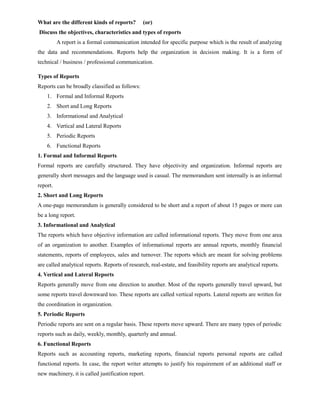
What are the different kinds of reports? (or)
Discuss the objectives, characteristics and types of reports
A report is a formal communication intended for specific purpose which is the result of analyzing
the data and recommendations. Reports help the organization in decision making. It is a form of
technical / business / professional communication.
Types of Reports
Reports can be broadly classified as follows:
1. Formal and Informal Reports
2. Short and Long Reports
3. Informational and Analytical
4. Vertical and Lateral Reports
5. Periodic Reports
6. Functional Reports
1. Formal and Informal Reports
Formal reports are carefully structured. They have objectivity and organization. Informal reports are
generally short messages and the language used is casual. The memorandum sent internally is an informal
report.
2. Short and Long Reports
A one-page memorandum is generally considered to be short and a report of about 15 pages or more can
be a long report.
3. Informational and Analytical
The reports which have objective information are called informational reports. They move from one area
of an organization to another. Examples of informational reports are annual reports, monthly financial
statements, reports of employees, sales and turnover. The reports which are meant for solving problems
are called analytical reports. Reports of research, real-estate, and feasibility reports are analytical reports.
4. Vertical and Lateral Reports
Reports generally move from one direction to another. Most of the reports generally travel upward, but
some reports travel downward too. These reports are called vertical reports. Lateral reports are written for
the coordination in organization.
5. Periodic Reports
Periodic reports are sent on a regular basis. These reports move upward. There are many types of periodic
reports such as daily, weekly, monthly, quarterly and annual.
6. Functional Reports
Reports such as accounting reports, marketing reports, financial reports personal reports are called
functional reports. In case, the report writer attempts to justify his requirement of an additional staff or
new machinery, it is called justification report.
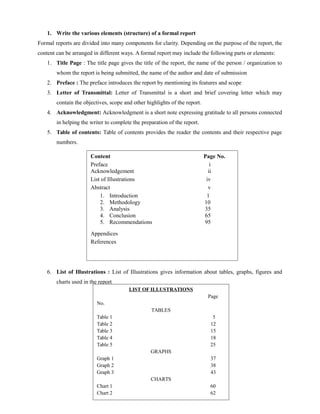
1. Write the various elements (structure) of a formal report
Formal reports are divided into many components for clarity. Depending on the purpose of the report, the
content can be arranged in different ways. A formal report may include the following parts or elements:
1. Title Page : The title page gives the title of the report, the name of the person / organization to
whom the report is being submitted, the name of the author and date of submission
2. Preface : The preface introduces the report by mentioning its features and scope
3. Letter of Transmittal: Letter of Transmittal is a short and brief covering letter which may
contain the objectives, scope and other highlights of the report.
4. Acknowledgment: Acknowledgment is a short note expressing gratitude to all persons connected
in helping the writer to complete the preparation of the report.
5. Table of contents: Table of contents provides the reader the contents and their respective page
numbers.
6. List of Illustrations : List of Illustrations gives information about tables, graphs, figures and
charts used in the report
LIST OF ILLUSTRATIONS
Page
No.
TABLES
Table 1 5
Table 2 12
Table 3 15
Table 4 18
Table 5 25
GRAPHS
Graph 1 37
Graph 2 38
Graph 3 43
CHARTS
Chart 1 60
Chart 2 62
Content Page No.
Preface i
Acknowledgement ii
List of Illustrations iv
Abstract v
1. Introduction 1
2. Methodology 10
3. Analysis 35
4. Conclusion 65
5. Recommendations 95
Appendices
References
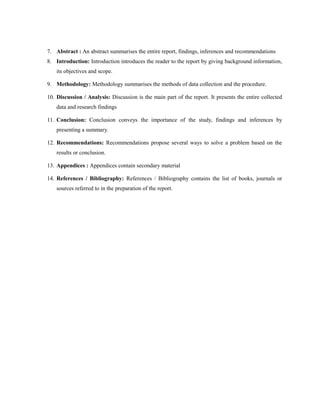
7. Abstract : An abstract summarises the entire report, findings, inferences and recommendations
8. Introduction: Introduction introduces the reader to the report by giving background information,
its objectives and scope.
9. Methodology: Methodology summarises the methods of data collection and the procedure.
10. Discussion / Analysis: Discussion is the main part of the report. It presents the entire collected
data and research findings
11. Conclusion: Conclusion conveys the importance of the study, findings and inferences by
presenting a summary.
12. Recommendations: Recommendations propose several ways to solve a problem based on the
results or conclusion.
13. Appendices : Appendices contain secondary material
14. References / Bibliography: References / Bibliography contains the list of books, journals or
sources referred to in the preparation of the report.
A REPORT ON ___________________________
SUBMITTED TO
The Principal
ABC College of Engineering
Chennai
SUBMITTED BY
XXXXXX
Staff Secretary
ABC College of Engineering, Chennai
DATE
05.05.2013

249123739-Report-Writing-Structureee.pdf

  • 1.
    What are thedifferent kinds of reports? (or) Discuss the objectives, characteristics and types of reports A report is a formal communication intended for specific purpose which is the result of analyzing the data and recommendations. Reports help the organization in decision making. It is a form of technical / business / professional communication. Types of Reports Reports can be broadly classified as follows: 1. Formal and Informal Reports 2. Short and Long Reports 3. Informational and Analytical 4. Vertical and Lateral Reports 5. Periodic Reports 6. Functional Reports 1. Formal and Informal Reports Formal reports are carefully structured. They have objectivity and organization. Informal reports are generally short messages and the language used is casual. The memorandum sent internally is an informal report. 2. Short and Long Reports A one-page memorandum is generally considered to be short and a report of about 15 pages or more can be a long report. 3. Informational and Analytical The reports which have objective information are called informational reports. They move from one area of an organization to another. Examples of informational reports are annual reports, monthly financial statements, reports of employees, sales and turnover. The reports which are meant for solving problems are called analytical reports. Reports of research, real-estate, and feasibility reports are analytical reports. 4. Vertical and Lateral Reports Reports generally move from one direction to another. Most of the reports generally travel upward, but some reports travel downward too. These reports are called vertical reports. Lateral reports are written for the coordination in organization. 5. Periodic Reports Periodic reports are sent on a regular basis. These reports move upward. There are many types of periodic reports such as daily, weekly, monthly, quarterly and annual. 6. Functional Reports Reports such as accounting reports, marketing reports, financial reports personal reports are called functional reports. In case, the report writer attempts to justify his requirement of an additional staff or new machinery, it is called justification report.
  • 2.
    1. Write thevarious elements (structure) of a formal report Formal reports are divided into many components for clarity. Depending on the purpose of the report, the content can be arranged in different ways. A formal report may include the following parts or elements: 1. Title Page : The title page gives the title of the report, the name of the person / organization to whom the report is being submitted, the name of the author and date of submission 2. Preface : The preface introduces the report by mentioning its features and scope 3. Letter of Transmittal: Letter of Transmittal is a short and brief covering letter which may contain the objectives, scope and other highlights of the report. 4. Acknowledgment: Acknowledgment is a short note expressing gratitude to all persons connected in helping the writer to complete the preparation of the report. 5. Table of contents: Table of contents provides the reader the contents and their respective page numbers. 6. List of Illustrations : List of Illustrations gives information about tables, graphs, figures and charts used in the report LIST OF ILLUSTRATIONS Page No. TABLES Table 1 5 Table 2 12 Table 3 15 Table 4 18 Table 5 25 GRAPHS Graph 1 37 Graph 2 38 Graph 3 43 CHARTS Chart 1 60 Chart 2 62 Content Page No. Preface i Acknowledgement ii List of Illustrations iv Abstract v 1. Introduction 1 2. Methodology 10 3. Analysis 35 4. Conclusion 65 5. Recommendations 95 Appendices References
  • 3.
    7. Abstract :An abstract summarises the entire report, findings, inferences and recommendations 8. Introduction: Introduction introduces the reader to the report by giving background information, its objectives and scope. 9. Methodology: Methodology summarises the methods of data collection and the procedure. 10. Discussion / Analysis: Discussion is the main part of the report. It presents the entire collected data and research findings 11. Conclusion: Conclusion conveys the importance of the study, findings and inferences by presenting a summary. 12. Recommendations: Recommendations propose several ways to solve a problem based on the results or conclusion. 13. Appendices : Appendices contain secondary material 14. References / Bibliography: References / Bibliography contains the list of books, journals or sources referred to in the preparation of the report.
  • 4.
    A REPORT ON___________________________ SUBMITTED TO The Principal ABC College of Engineering Chennai SUBMITTED BY XXXXXX Staff Secretary ABC College of Engineering, Chennai DATE
  • 5.