FIRE AND LIFE SAFETY
Study Case
Viata Viriezky
2106662941
INTRODUCTION
Fire outbreaks happened on
buildings create huge negative impacts
such as property loss and deaths, fire can
occur in almost any kind of building
(Buchanan & Abu, 2017). One of the
places that has the risk of fire is the
hospital. Even though hospitals have a
low risk of fire, if a fire occurs, it will have
a very broad impact (Nayka et al, 2012). A
hospital is a building that is used 24 hours
a day without stopping as a basis for
medical treatment, mental illness,
obstetrics, or surgical treatment and for
people who need health (Sanjaya et al,
2015). According to National Fire
Protection Association (NFPA), U.S. fire
departments responded to an estimated
average of 5,750 structure fires in health
care properties per year in 2011– 2015
which caused annual averages of two
civilian deaths, 157 civilian injuries, and
$50.4 million in direct property damage
(NFPA, 2017).
As the place for people who have
illness search for medical treatment,
hospitals need to create a sense of
security in their environment, especially
in situations of fire disaster and other
emergencies, the hospital must be able
to save lives and can provide health
services for the community (Arrazy et al,
2014). Thus, learning about fire and life
safety through study case is conducted
to understand fire and life safety system
in hospital to reduce probability of death,
injury, property loss and environmental
damage of fire occurred in hospitals.
BACKGROUND FIRE AND LIFE SAFETY
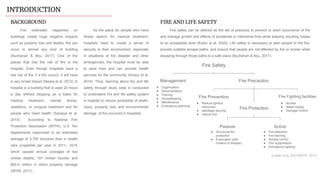
Fire safety can be defined as the set of practices to prevent or avert occurrence of fire
and manage growth and effects of accidental or intentional fires while keeping resulting losses
to an acceptable level (Kodur et al, 2020). Life safety is necessary to alert people to the fire,
provide suitable escape paths, and ensure that people are not affected by fire or smoke while
escaping through those paths to a safe place (Buchanan & Abu, 2017).
Fire Safety
Management Fire Precaution
Fire Prevention
Fire Protection
Fire Fighting facilities
Passive Active
● Organization
● Documentation
● Training
● Housekeeping
● Maintenance
● Emergency planning
● Reduce ignition
resources
● sabotage security
● reduce fuel
● Structural fire
protection
● Evacuation path
(means of escape)
● Fire detection
● Fire warning
● Smoke control
● Fire suppression
● Emergency lighting
● Access
● Water supply
● Damage control
(Lestari et al, 2021)(NFPA, 2017)
Indonesia regulations
According to UU No. 66 2016 concerning Occupational
Safety and Health in Hospitals, each manajerial of hospitals
need to follow K3RS (Risk Management and Facilities
Environment), which means to ensure and protect the safety and
health of hospital human resources, patients, patient companions,
visitors, and the hospital environment through efforts to prevent
work accidents and occupational diseases in hospitals, which include
fire safety and emergency.
Fire safety and emergency based on PU Department in
building fire safety Pd-T-11-2005-C, some indicators
inspected are;
1. Site requirements
2. Means of rescue
3. Passive Fire Protection system
4. Active fire protection system
(Republic Indonesia Ministry of Health, 2012)
CASE STUDY 1
TNI-AL Dr. Mintohardjo Hospital
BUILDING PROFILE
Location : Jl. Bendungan Hilir, Pejompongan, Jakarta
Area : 42.586 sqm
Year built : 1957
Function : Public hospital
(https://www.rsalmintohardjo.com/)
https://static.republika.co.id/
https://img.beritasatu.com/
According to Permenkes RI Nomor 986/Menkes/Per/11/1992,
TNI AL-Dr. Mintohardjo Hospital is a hospital class B,
established in provincial capital that accommodates referral
services from home hospitals
(http://bppsdmk.kemkes.go.id/)
Mintoharjo Hospital experienced a fire incident on March 14,
2016, at 1 p.m which caused deaths of four victims
https://www.bbc.com/indonesia/)Lestari, 2017
FIRE OCCURRED
Mintoharjo Hospital fires and explosions occurred in a high-pressure air
room (RUBT) or hyperbaric chamber (https://www.bbc.com/indonesia/).
Hyperbaric Chamber, also known as High
Pressure Air Room (RUBT), is a
treatment method that uses 100%
oxygen at a pressure greater than
atmospheric pressure (LAKESLA Naval
Health Service, 2019).
https://ichef.bbci.co.uk/
● Therapy in the capsule room was carried out at around 11.30 WIB with a
pressure of 2.4 atmospheres.
● around 13.00 WIB, the pressure is lowered to 1 atmosphere
● 13.10 WIB seen fire sparks in the capsule
● The operator immediately opened the fire system after seeing the spark.
However, the fire inside the capsule quickly grew bigger, and the pressure
inside rose rapidly, as a result, the safety valve opened and caused an
explosion
● The fire started to go out but the victim who was undergoing therapy could not
be saved
● 14.00 WIB the victim was evacuated. The officers and guards in the
high-pressure air room (RUBT) were also evacuated to receive intensive care
due to smoke
The chronology of fires (Armando et al, 2017)
IMPACT
The incident caused material losses and four people died, victims
are;
1. Former Head of the National Police Public Relations Division, Inspector
General of Police (Purn) Abubakar Nataprawira
2. Member of DPD RI and Chairman of PGRI, Sulistiyo
3. A patient, Edi Suwandi
4. A doctor, Dimas
INSPECTION
In general, RSAL Mintohardjo has arranged several Outline Plans
(RGB) for Fire Prevention and Mitigation Exercises by RSAL
Mintohardjo. However, the education and training regarding fire
prevention weren’t balanced with the availability of good fire
protection and prevention facilities. In accordance with the existing
RGB, the available fire extinguisher inventory included only three
tools; Hydrant and light fire extinguisher
In fact, hospitals did not install other tools such as smoke
detectors, fire alarms, and sprinklers as fire pre-caution or early
detection tools when there are signs of fire. Even if there are, not all
rooms are reached by these tools (Armando et al, 2017)(.
(https://nasional.kompas.com/)(https://www.liputan6.com/)
CASE STUDY 2
DR. M. DJAMIL HOSPITAL, PADANG
BUILDING PROFILE
Location : Jl. Perintis Kemerdekaan Padang, West Sumatera
Area : 8.576 Ha
Year built : 1953
Function : Public Center hospital
(https://rsdjamil.co.id/)
RSUP Dr. M. Djamil Padang is a Class A Education Hospital
which was declared to have passed the Plenary Accreditation
on December 31, 2018 and International Accreditation on
April 9, 2019 by the International Hospital Accreditation
Commission (KARS).
According to KepMen PU No.02/KPTS/1985, Hospital type A
vertical building which its main structural components must
withstand fire for at least 3 hours (http://bppsdmk.kemkes.go.id/)
(https://rsdjamil.co.id/) (http://bppsdmk.kemkes.go.id/)
(https://rsdjamil.co.id/)
https://tbindonesia.or.id/ https://akcdn.detik.net.id/
FIRE & LIFE SAFETY SYSTEM Overview
ON SITE EQUIPMENT
(Hesna et al, 2009)
https://www.google.com/maps/
(Hesna et al, 2009)
FIRE PROTECTION SYSTEM
Passive
Structure Fire Protection
The hospital’s primary structure material is concrete, concrete can offer up to four
hours resistance (Rashwan et al, 2014).
Compartmentation
The hospital has already installed compartment to limit the fire that occurs, so that it
can provide protection for occupants who are in other rooms in the building. It also limits
the spread of fire and makes it easier for firefighters to carry out their duties (Hesna et al,
2009)(NFPA, 2018).
Openings Protection
The openings in the building are generally protected against the spread of fire.
While vertical openings are provided with a fire stop from the bottom to the top floor and
each floor is provided with a fireproof cover (Ramli, 2010)(NFPA, 2017).
FIRE PROTECTION SYSTEM
Active
Research on DR.M.Djamil Hospital active fire protection has been
conducted by Hesna et al (2009) which results;
EVACUATION
Evacuation Path
The distance from the inside of the building to the
outside is relatively short and it doesn't take long for
residents to leave the room. Usually, exit access for
building occupants is through the main doors that go
straight out of the room. In addition, there is also ramp for
patients evacuate using wheeled chair (Hesna, et al,
2009)
(Hesna, et al, 2009)
The average form of exit construction in each building is in the form of long
corridors that are usually traversed by patients and hospital visitors. The corridor is
made of reinforced concrete to withstand fire until four hours. Thus, it can provide
evacuation time for building occupants in the event of a fire (Hesna, et al, 2009)(Ramli,
2010)(NFPA, 2017).
According to Hesna et al (2009). M. Jamil Hospital Padang
has a Building Safety System Reliability Value of more than 80
which is 82.17 (Good) with the physical condition of the fire
safety components assessed both based on the standard
number, size, equipment completeness, as well as from the
function of the equipment on the components of site fittings,
rescue facilities, active protection and passive protection of
buildings.
Overall Fire & Life Safety System
An earthquake of 5.2 magnitude in
Padang occurred in November 18th, 2020,
at 1.13 p.m and was felt by users of RSUP
Dr. M. Djamil, some patients were
evacuated safely and some patients
independently evacuated.
https://news.detik.com/
CONCLUSION
The occurrence of fires and disasters in hospitals can be fatal,
considering that hospital users need medical assistance, besides that
in hospitals there are special medical equipment that involves
mechanical and electrical. Safe evacuation path such as ramp and fire
resistance evacuation path needs to be so that patients escape
safely, failure in fire fighting systems such as sprinklers and hydrant
can ignition growth uncontrolled and results in fatalities. Thus, it is
crucial for hospital buildings to follow and meet the requirements of
fire and safety systems according to standards to prevent fatal
accidents, which are complete safety at the site, means of rescue,
passive and active fire protection system equipments installation.
Recommendation
There are some of the recommendations for hospital fire and safety
systems, which are;
1. Hospital buildings are recommended to apply every fire protection
system, both active and passive according to standards and not trade-off
fire extinguishing systems
2. Implement safe evacuation routes with fire resistant structures and
provide ramps
3. Active fire protection systems should be maintained and tested regularly
so that they can function properly when a fire or disaster occurs
REFERENCES
Arrazy, Syafiran, Sunarsih, Elvi, Rahmiwati, Anita. 2014. Penerapan Sistem Manajemen Keselamatan Kebakaran Di Rumah Sakit Dr. Sobirin Kabupaten Musi Rawas Tahun 2013. Vol. 5. pp 103-111. Ikatan Kesehatan Masyarakat Indonesia Komisariat FKM Unsri.
Armando, D. Y., et al. 2017. Fire and Explosion Case Studies: Kebakaran di Rumah Sakit TNI-AL Dr. Mintohardjo Pada Tahun 2016. FKM UI: Depok.
Buchanan A., Abu A. 2017. STRUCTURAL DESIGN FOR FIRE SAFETY: Second Edition. United Kingdom.
Direktorat Bina Upaya Kesehatan, Kementerian Kesehatan Republik Indonesia. 2012. Pedoman Teknis Prasarana Rumah Sakit Sistem Proteksi Kebakaran Aktif. Direktorat Bina Pelayanan Penunjang Medik dan Sarana Kesehatan.
Departemen Pekerjaan Umum. Pedoman Pemeriksaan Keselamatan Kebakaran Bangunan Geding Pd T-11-2005-C.
Hesna, Yervi, Hidayat, B., Suwanda, S. 2009. Evaluasi Penerapan Sistem Keselamatan Kebakaran Pada Bangunan Gedung Rumah Sakit Dr. M. Djamil Padang. Jurnal Rekayasa Sipil Vol 5 No.2. pp 65-76.
Lestari, et al. 2021.Keselamatan Kebakaran (Fire Safety). Fakultas Kesehatan Masyarakat Universitas Indonesia: Depok.
Kementerian Kesehatan Republik Indonesia. Diklat Manajemen Resiko Fasilitas dan Lingkungan (K3RS). https://sariasihgroup.com/ediklat/.
Kodur, Vankatesh, Kumar, P., Rafi, M. M. 2019. Fire hazard in buildings: review, assessment and strategies for improving fire safety. Fire hazard in Buildings. DOI 10.1108/PRR-12-2018-0033.
National Fire Protection Association. 2017. U.S. Structure Fires in Health Care Properties. https://www.nfpa.org.
Nayka, Esa Prakasa, Mulyono. 2012. Penilaian Risiko dan Upaya Tanggap Darurat Kebakaran di BRSU Tabanan Bali, Fakultan Kesehatan Masyarakat Universitas Airlangga. Surabaya.
S. Ramli. 2010. Petunjuk Praktis Manajemen Kebakaran (Fire Management). Dian Rakyat: Jakarta.
Sanjaya, Mirza, Ulfa, M. 2015. Evaluasi Sarana dan Prasarana Rumah Sakit dalam Menghadapi Bencana Kebakaran (Studi Kasus di RS Pku Muhammadiyah Yogyakarta Unit II. Jurnal Medicoeticolegal dan Manajemen Rumah Sakit, 4(2), pp. 1–6.
UU No. 66 2016 concerning Occupational Safety and Health in Hospitals.
Peraturan Menteri Pekerjaan Umum, Nomor 26/PRT/M/2008, tentang Persyaratan teknis sistem proteksi kebakaran pada bangunan gedung dan lingkungan.
SNI 03-3986-2000 Tata Cara Perencanaan Dan Pemasangan Instalasi Alarm Kebakaran Otomatis Untuk Pencegahan Bahaya Kebakaran Pada Bangunan Gedung.
SNI 03-3989-2000 Tata Cara Perencanaan Dan Pemasangan Sistem Sprinkler Otomatis Untuk Pencegahan Bahaya Kebakaran Pada Bangunan Gedung.
SNI 03-1745-2000 Tata Cara Perencanaan Dan Pemasangan Sistem Pipa Tegak Dan Slang Untuk Pencegahan Bahaya Kebakaran Pada Bangunan Gedung.
SNI 03-1735-2000 Tata Cara Perencanaan Akses Bangunan Dan Akses Lingkungan Untuk Pencegahan Bahaya Kebakaran pada Bangunan Gedung.
SNI 03-7012-2004 tentang Tata Cara Perencanaan Dan Pemasangan Sistem Manajemen Asap Di Dalam Mal, Atrium Dan Ruangan Bervolume Besar.
SNI 03-3987-1995 Tata Cara Perencanaan Dan Pemasangan Alat Pemadam Api Ringan Untuk Pencegahan Bahaya Kebakaran Pada Bangunan Rumah Dan Gedung.
https://www.rsalmintohardjo.com/ Diakses 12/02/2022
http://bppsdmk.kemkes.go.id/ Diakses 12/02/2022
https://www.bbc.com/indonesia/ Diakses 12/02/2022
https://static.republika.co.id/ Diakses 12/02/2022
https://img.beritasatu.com/ Diakses 13/02/2022
https://nasional.kompas.com/ Diakses 13/02/2022
https://www.liputan6.com/ Diakses 13/02/2022
https://rsdjamil.co.id/ Diakses 12/02/2022

Study Case Fire & Life Safety.pdf

  • 1.
    FIRE AND LIFESAFETY Study Case Viata Viriezky 2106662941
  • 2.
    INTRODUCTION Fire outbreaks happenedon buildings create huge negative impacts such as property loss and deaths, fire can occur in almost any kind of building (Buchanan & Abu, 2017). One of the places that has the risk of fire is the hospital. Even though hospitals have a low risk of fire, if a fire occurs, it will have a very broad impact (Nayka et al, 2012). A hospital is a building that is used 24 hours a day without stopping as a basis for medical treatment, mental illness, obstetrics, or surgical treatment and for people who need health (Sanjaya et al, 2015). According to National Fire Protection Association (NFPA), U.S. fire departments responded to an estimated average of 5,750 structure fires in health care properties per year in 2011– 2015 which caused annual averages of two civilian deaths, 157 civilian injuries, and $50.4 million in direct property damage (NFPA, 2017). As the place for people who have illness search for medical treatment, hospitals need to create a sense of security in their environment, especially in situations of fire disaster and other emergencies, the hospital must be able to save lives and can provide health services for the community (Arrazy et al, 2014). Thus, learning about fire and life safety through study case is conducted to understand fire and life safety system in hospital to reduce probability of death, injury, property loss and environmental damage of fire occurred in hospitals. BACKGROUND FIRE AND LIFE SAFETY Fire safety can be defined as the set of practices to prevent or avert occurrence of fire and manage growth and effects of accidental or intentional fires while keeping resulting losses to an acceptable level (Kodur et al, 2020). Life safety is necessary to alert people to the fire, provide suitable escape paths, and ensure that people are not affected by fire or smoke while escaping through those paths to a safe place (Buchanan & Abu, 2017). Fire Safety Management Fire Precaution Fire Prevention Fire Protection Fire Fighting facilities Passive Active ● Organization ● Documentation ● Training ● Housekeeping ● Maintenance ● Emergency planning ● Reduce ignition resources ● sabotage security ● reduce fuel ● Structural fire protection ● Evacuation path (means of escape) ● Fire detection ● Fire warning ● Smoke control ● Fire suppression ● Emergency lighting ● Access ● Water supply ● Damage control (Lestari et al, 2021)(NFPA, 2017)
  • 3.
    Indonesia regulations According toUU No. 66 2016 concerning Occupational Safety and Health in Hospitals, each manajerial of hospitals need to follow K3RS (Risk Management and Facilities Environment), which means to ensure and protect the safety and health of hospital human resources, patients, patient companions, visitors, and the hospital environment through efforts to prevent work accidents and occupational diseases in hospitals, which include fire safety and emergency. Fire safety and emergency based on PU Department in building fire safety Pd-T-11-2005-C, some indicators inspected are; 1. Site requirements 2. Means of rescue 3. Passive Fire Protection system 4. Active fire protection system (Republic Indonesia Ministry of Health, 2012)
  • 4.
    CASE STUDY 1 TNI-ALDr. Mintohardjo Hospital BUILDING PROFILE Location : Jl. Bendungan Hilir, Pejompongan, Jakarta Area : 42.586 sqm Year built : 1957 Function : Public hospital (https://www.rsalmintohardjo.com/) https://static.republika.co.id/ https://img.beritasatu.com/ According to Permenkes RI Nomor 986/Menkes/Per/11/1992, TNI AL-Dr. Mintohardjo Hospital is a hospital class B, established in provincial capital that accommodates referral services from home hospitals (http://bppsdmk.kemkes.go.id/) Mintoharjo Hospital experienced a fire incident on March 14, 2016, at 1 p.m which caused deaths of four victims https://www.bbc.com/indonesia/)Lestari, 2017
  • 5.
    FIRE OCCURRED Mintoharjo Hospitalfires and explosions occurred in a high-pressure air room (RUBT) or hyperbaric chamber (https://www.bbc.com/indonesia/). Hyperbaric Chamber, also known as High Pressure Air Room (RUBT), is a treatment method that uses 100% oxygen at a pressure greater than atmospheric pressure (LAKESLA Naval Health Service, 2019). https://ichef.bbci.co.uk/ ● Therapy in the capsule room was carried out at around 11.30 WIB with a pressure of 2.4 atmospheres. ● around 13.00 WIB, the pressure is lowered to 1 atmosphere ● 13.10 WIB seen fire sparks in the capsule ● The operator immediately opened the fire system after seeing the spark. However, the fire inside the capsule quickly grew bigger, and the pressure inside rose rapidly, as a result, the safety valve opened and caused an explosion ● The fire started to go out but the victim who was undergoing therapy could not be saved ● 14.00 WIB the victim was evacuated. The officers and guards in the high-pressure air room (RUBT) were also evacuated to receive intensive care due to smoke The chronology of fires (Armando et al, 2017) IMPACT The incident caused material losses and four people died, victims are; 1. Former Head of the National Police Public Relations Division, Inspector General of Police (Purn) Abubakar Nataprawira 2. Member of DPD RI and Chairman of PGRI, Sulistiyo 3. A patient, Edi Suwandi 4. A doctor, Dimas INSPECTION In general, RSAL Mintohardjo has arranged several Outline Plans (RGB) for Fire Prevention and Mitigation Exercises by RSAL Mintohardjo. However, the education and training regarding fire prevention weren’t balanced with the availability of good fire protection and prevention facilities. In accordance with the existing RGB, the available fire extinguisher inventory included only three tools; Hydrant and light fire extinguisher In fact, hospitals did not install other tools such as smoke detectors, fire alarms, and sprinklers as fire pre-caution or early detection tools when there are signs of fire. Even if there are, not all rooms are reached by these tools (Armando et al, 2017)(. (https://nasional.kompas.com/)(https://www.liputan6.com/)
  • 6.
    CASE STUDY 2 DR.M. DJAMIL HOSPITAL, PADANG BUILDING PROFILE Location : Jl. Perintis Kemerdekaan Padang, West Sumatera Area : 8.576 Ha Year built : 1953 Function : Public Center hospital (https://rsdjamil.co.id/) RSUP Dr. M. Djamil Padang is a Class A Education Hospital which was declared to have passed the Plenary Accreditation on December 31, 2018 and International Accreditation on April 9, 2019 by the International Hospital Accreditation Commission (KARS). According to KepMen PU No.02/KPTS/1985, Hospital type A vertical building which its main structural components must withstand fire for at least 3 hours (http://bppsdmk.kemkes.go.id/) (https://rsdjamil.co.id/) (http://bppsdmk.kemkes.go.id/) (https://rsdjamil.co.id/) https://tbindonesia.or.id/ https://akcdn.detik.net.id/
  • 7.
    FIRE & LIFESAFETY SYSTEM Overview ON SITE EQUIPMENT (Hesna et al, 2009) https://www.google.com/maps/ (Hesna et al, 2009) FIRE PROTECTION SYSTEM Passive Structure Fire Protection The hospital’s primary structure material is concrete, concrete can offer up to four hours resistance (Rashwan et al, 2014). Compartmentation The hospital has already installed compartment to limit the fire that occurs, so that it can provide protection for occupants who are in other rooms in the building. It also limits the spread of fire and makes it easier for firefighters to carry out their duties (Hesna et al, 2009)(NFPA, 2018). Openings Protection The openings in the building are generally protected against the spread of fire. While vertical openings are provided with a fire stop from the bottom to the top floor and each floor is provided with a fireproof cover (Ramli, 2010)(NFPA, 2017). FIRE PROTECTION SYSTEM Active Research on DR.M.Djamil Hospital active fire protection has been conducted by Hesna et al (2009) which results;
  • 8.
    EVACUATION Evacuation Path The distancefrom the inside of the building to the outside is relatively short and it doesn't take long for residents to leave the room. Usually, exit access for building occupants is through the main doors that go straight out of the room. In addition, there is also ramp for patients evacuate using wheeled chair (Hesna, et al, 2009) (Hesna, et al, 2009) The average form of exit construction in each building is in the form of long corridors that are usually traversed by patients and hospital visitors. The corridor is made of reinforced concrete to withstand fire until four hours. Thus, it can provide evacuation time for building occupants in the event of a fire (Hesna, et al, 2009)(Ramli, 2010)(NFPA, 2017). According to Hesna et al (2009). M. Jamil Hospital Padang has a Building Safety System Reliability Value of more than 80 which is 82.17 (Good) with the physical condition of the fire safety components assessed both based on the standard number, size, equipment completeness, as well as from the function of the equipment on the components of site fittings, rescue facilities, active protection and passive protection of buildings. Overall Fire & Life Safety System An earthquake of 5.2 magnitude in Padang occurred in November 18th, 2020, at 1.13 p.m and was felt by users of RSUP Dr. M. Djamil, some patients were evacuated safely and some patients independently evacuated. https://news.detik.com/
  • 9.
    CONCLUSION The occurrence offires and disasters in hospitals can be fatal, considering that hospital users need medical assistance, besides that in hospitals there are special medical equipment that involves mechanical and electrical. Safe evacuation path such as ramp and fire resistance evacuation path needs to be so that patients escape safely, failure in fire fighting systems such as sprinklers and hydrant can ignition growth uncontrolled and results in fatalities. Thus, it is crucial for hospital buildings to follow and meet the requirements of fire and safety systems according to standards to prevent fatal accidents, which are complete safety at the site, means of rescue, passive and active fire protection system equipments installation. Recommendation There are some of the recommendations for hospital fire and safety systems, which are; 1. Hospital buildings are recommended to apply every fire protection system, both active and passive according to standards and not trade-off fire extinguishing systems 2. Implement safe evacuation routes with fire resistant structures and provide ramps 3. Active fire protection systems should be maintained and tested regularly so that they can function properly when a fire or disaster occurs
  • 10.
    REFERENCES Arrazy, Syafiran, Sunarsih,Elvi, Rahmiwati, Anita. 2014. Penerapan Sistem Manajemen Keselamatan Kebakaran Di Rumah Sakit Dr. Sobirin Kabupaten Musi Rawas Tahun 2013. Vol. 5. pp 103-111. Ikatan Kesehatan Masyarakat Indonesia Komisariat FKM Unsri. Armando, D. Y., et al. 2017. Fire and Explosion Case Studies: Kebakaran di Rumah Sakit TNI-AL Dr. Mintohardjo Pada Tahun 2016. FKM UI: Depok. Buchanan A., Abu A. 2017. STRUCTURAL DESIGN FOR FIRE SAFETY: Second Edition. United Kingdom. Direktorat Bina Upaya Kesehatan, Kementerian Kesehatan Republik Indonesia. 2012. Pedoman Teknis Prasarana Rumah Sakit Sistem Proteksi Kebakaran Aktif. Direktorat Bina Pelayanan Penunjang Medik dan Sarana Kesehatan. Departemen Pekerjaan Umum. Pedoman Pemeriksaan Keselamatan Kebakaran Bangunan Geding Pd T-11-2005-C. Hesna, Yervi, Hidayat, B., Suwanda, S. 2009. Evaluasi Penerapan Sistem Keselamatan Kebakaran Pada Bangunan Gedung Rumah Sakit Dr. M. Djamil Padang. Jurnal Rekayasa Sipil Vol 5 No.2. pp 65-76. Lestari, et al. 2021.Keselamatan Kebakaran (Fire Safety). Fakultas Kesehatan Masyarakat Universitas Indonesia: Depok. Kementerian Kesehatan Republik Indonesia. Diklat Manajemen Resiko Fasilitas dan Lingkungan (K3RS). https://sariasihgroup.com/ediklat/. Kodur, Vankatesh, Kumar, P., Rafi, M. M. 2019. Fire hazard in buildings: review, assessment and strategies for improving fire safety. Fire hazard in Buildings. DOI 10.1108/PRR-12-2018-0033. National Fire Protection Association. 2017. U.S. Structure Fires in Health Care Properties. https://www.nfpa.org. Nayka, Esa Prakasa, Mulyono. 2012. Penilaian Risiko dan Upaya Tanggap Darurat Kebakaran di BRSU Tabanan Bali, Fakultan Kesehatan Masyarakat Universitas Airlangga. Surabaya. S. Ramli. 2010. Petunjuk Praktis Manajemen Kebakaran (Fire Management). Dian Rakyat: Jakarta. Sanjaya, Mirza, Ulfa, M. 2015. Evaluasi Sarana dan Prasarana Rumah Sakit dalam Menghadapi Bencana Kebakaran (Studi Kasus di RS Pku Muhammadiyah Yogyakarta Unit II. Jurnal Medicoeticolegal dan Manajemen Rumah Sakit, 4(2), pp. 1–6. UU No. 66 2016 concerning Occupational Safety and Health in Hospitals. Peraturan Menteri Pekerjaan Umum, Nomor 26/PRT/M/2008, tentang Persyaratan teknis sistem proteksi kebakaran pada bangunan gedung dan lingkungan. SNI 03-3986-2000 Tata Cara Perencanaan Dan Pemasangan Instalasi Alarm Kebakaran Otomatis Untuk Pencegahan Bahaya Kebakaran Pada Bangunan Gedung. SNI 03-3989-2000 Tata Cara Perencanaan Dan Pemasangan Sistem Sprinkler Otomatis Untuk Pencegahan Bahaya Kebakaran Pada Bangunan Gedung. SNI 03-1745-2000 Tata Cara Perencanaan Dan Pemasangan Sistem Pipa Tegak Dan Slang Untuk Pencegahan Bahaya Kebakaran Pada Bangunan Gedung. SNI 03-1735-2000 Tata Cara Perencanaan Akses Bangunan Dan Akses Lingkungan Untuk Pencegahan Bahaya Kebakaran pada Bangunan Gedung. SNI 03-7012-2004 tentang Tata Cara Perencanaan Dan Pemasangan Sistem Manajemen Asap Di Dalam Mal, Atrium Dan Ruangan Bervolume Besar. SNI 03-3987-1995 Tata Cara Perencanaan Dan Pemasangan Alat Pemadam Api Ringan Untuk Pencegahan Bahaya Kebakaran Pada Bangunan Rumah Dan Gedung. https://www.rsalmintohardjo.com/ Diakses 12/02/2022 http://bppsdmk.kemkes.go.id/ Diakses 12/02/2022 https://www.bbc.com/indonesia/ Diakses 12/02/2022 https://static.republika.co.id/ Diakses 12/02/2022 https://img.beritasatu.com/ Diakses 13/02/2022 https://nasional.kompas.com/ Diakses 13/02/2022 https://www.liputan6.com/ Diakses 13/02/2022 https://rsdjamil.co.id/ Diakses 12/02/2022