English as a second foreign language: in FdL : enhancing learner oppportunities through learning
Rana CHALLAH        Faculté des Langues


                        STUDENTS AT WORK

                                   Rana CHALLAH
                              Faculté des Langues (FdL)
English as a second foreign language: in FdL : enhancing learner oppportunities through learning
Rana CHALLAH Faculté des Langues


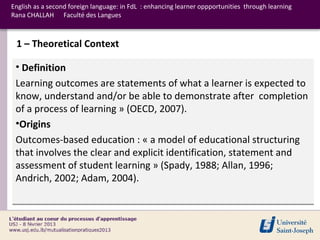
 1 – Theoretical Context

 • Definition
 Learning outcomes are statements of what a learner is expected to
 know, understand and/or be able to demonstrate after completion
 of a process of learning » (OECD, 2007).
 •Origins
 Outcomes-based education : « a model of educational structuring
 that involves the clear and explicit identification, statement and
 assessment of student learning » (Spady, 1988; Allan, 1996;
 Andrich, 2002; Adam, 2004).
English as a second foreign language: in FdL : enhancing learner oppportunities through learning
Rana CHALLAH Faculté des Langues


    • 1. Context
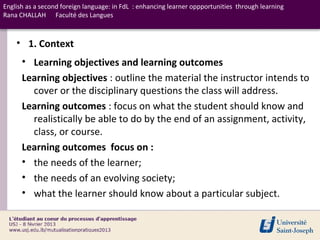
      • Learning objectives and learning outcomes
      Learning objectives : outline the material the instructor intends to
        cover or the disciplinary questions the class will address.
      Learning outcomes : focus on what the student should know and
        realistically be able to do by the end of an assignment, activity,
        class, or course.
      Learning outcomes focus on :
      • the needs of the learner;
      • the needs of an evolving society;
      • what the learner should know about a particular subject.
English as a second foreign language: in FdL : enhancing learner oppportunities through learning
Rana CHALLAH Faculté des Langues


    • 1. Context

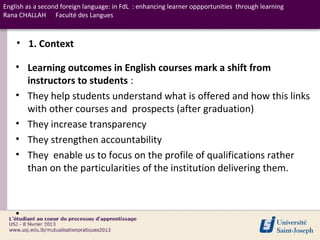
    • Learning outcomes in English courses mark a shift from
      instructors to students :
    • They help students understand what is offered and how this links
      with other courses and prospects (after graduation)
    • They increase transparency
    • They strengthen accountability
    • They enable us to focus on the profile of qualifications rather
      than on the particularities of the institution delivering them.


    •
English as a second foreign language: in FdL : enhancing learner oppportunities through learning
Rana CHALLAH     Faculté des Langues


    • 1. Context

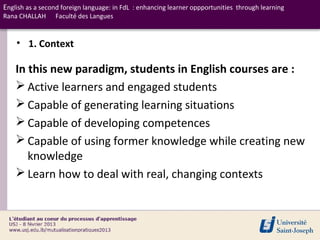
    In this new paradigm, students in English courses are :
     Active learners and engaged students
     Capable of generating learning situations
     Capable of developing competences
     Capable of using former knowledge while creating new
       knowledge
     Learn how to deal with real, changing contexts
English as a second foreign language: in FdL : enhancing learner oppportunities through learning
Rana CHALLAH Faculté des Langues


   • 1. Context
    The shift to learning outcomes helps us prepare specific course
    plans. In this paradigm, there is a transition to action verbs:

       Action verbs                                Unclear verbs
       • list, describe,                           • Become aware of
       • write, plan,                              • understand
       • select, discuss,                          • become familiar with
       • explain, compare…                         • appreciate
English as a second foreign language: in FdL : enhancing learner oppportunities through learning
Rana CHALLAH Faculté des Langues


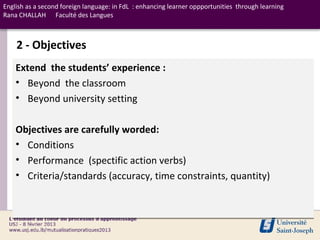
    2 - Objectives
    Extend the students’ experience :
    • Beyond the classroom
    • Beyond university setting

    Objectives are carefully worded:
    • Conditions
    • Performance (spectific action verbs)
    • Criteria/standards (accuracy, time constraints, quantity)
English as a second foreign language: in FdL : enhancing learner oppportunities through learning
Rana CHALLAH Faculté des Langues


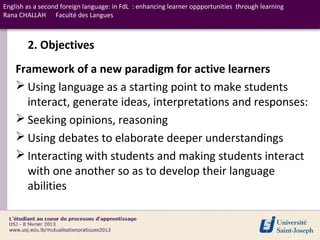
        2. Objectives
    Framework of a new paradigm for active learners
     Using language as a starting point to make students
      interact, generate ideas, interpretations and responses:
     Seeking opinions, reasoning
     Using debates to elaborate deeper understandings
     Interacting with students and making students interact
      with one another so as to develop their language
      abilities
English as a second foreign language: in FdL : enhancing learner oppportunities through learning
Rana CHALLAH Faculté des Langues


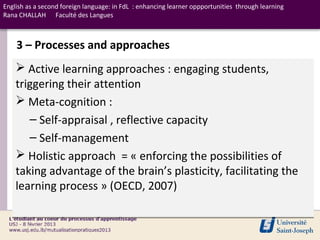
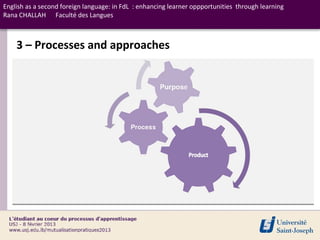
    3 – Processes and approaches
     Active learning approaches : engaging students,
    triggering their attention
     Meta-cognition :
       – Self-appraisal , reflective capacity
       – Self-management
     Holistic approach = « enforcing the possibilities of
    taking advantage of the brain’s plasticity, facilitating the
    learning process » (OECD, 2007)
English as a second foreign language: in FdL : enhancing learner oppportunities through learning
Rana CHALLAH Faculté des Langues


    3 – Processes and approaches
English as a second foreign language: in FdL : enhancing learner oppportunities through
learning
Rana CHALLAH       Faculté des Langues
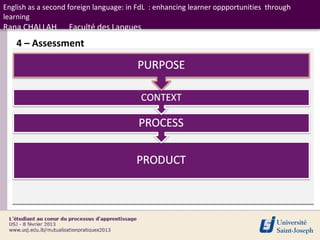
    4 – Assessment
English as a second foreign language: in FdL : enhancing learner oppportunities through
learning
Rana CHALLAH       Faculté des Langues
    5 – Links to Learning Outcomes

   Learning outcomes focus on what the student should know and realistically be
   able to do by the end of an assignment, activity, class, or course.
   Learning outcomes focus on :
    the needs of the learner = students become more involved
    the needs of an evolving society = updated
    what the learner should know about a particular subject : research, real
   life situations
   Learning outcomes in English courses mark a shift from instructors to students:
    They inscrease transparency and strengthen accountability = guidance
   They enable us to focus on the profile of qualifications rather than on the
   particularities of the institution delivering them = personalised
English as a second foreign language: in FdL : enhancing learner oppportunities through
learning
Rana CHALLAH       Faculté des Langues
    6 – Comments

   • Need to have a common framework for all USJ
   faculties.

   • Help the students understand the importance of
   this paradigm.
English as a second foreign language: in FdL : enhancing learner oppportunities through
learning
Rana CHALLAH       Faculté des Langues
    • For Further Information

   E-mail : rana.challah@usj.edu.lb

        OCED. (2007). Assessing Higher Education : Learning
         Outcomes.

        CEDEFOP. (2011). Using Learning Outcomes : European
          Qualifications Framework. Series N°4.

Students at work rana challah fdl

  • 1.
    English as asecond foreign language: in FdL : enhancing learner oppportunities through learning Rana CHALLAH Faculté des Langues STUDENTS AT WORK Rana CHALLAH Faculté des Langues (FdL)
  • 2.
    English as asecond foreign language: in FdL : enhancing learner oppportunities through learning Rana CHALLAH Faculté des Langues 1 – Theoretical Context • Definition Learning outcomes are statements of what a learner is expected to know, understand and/or be able to demonstrate after completion of a process of learning » (OECD, 2007). •Origins Outcomes-based education : « a model of educational structuring that involves the clear and explicit identification, statement and assessment of student learning » (Spady, 1988; Allan, 1996; Andrich, 2002; Adam, 2004).
  • 3.
    English as asecond foreign language: in FdL : enhancing learner oppportunities through learning Rana CHALLAH Faculté des Langues • 1. Context • Learning objectives and learning outcomes Learning objectives : outline the material the instructor intends to cover or the disciplinary questions the class will address. Learning outcomes : focus on what the student should know and realistically be able to do by the end of an assignment, activity, class, or course. Learning outcomes focus on : • the needs of the learner; • the needs of an evolving society; • what the learner should know about a particular subject.
  • 4.
    English as asecond foreign language: in FdL : enhancing learner oppportunities through learning Rana CHALLAH Faculté des Langues • 1. Context • Learning outcomes in English courses mark a shift from instructors to students : • They help students understand what is offered and how this links with other courses and prospects (after graduation) • They increase transparency • They strengthen accountability • They enable us to focus on the profile of qualifications rather than on the particularities of the institution delivering them. •
  • 5.
    English as asecond foreign language: in FdL : enhancing learner oppportunities through learning Rana CHALLAH Faculté des Langues • 1. Context In this new paradigm, students in English courses are :  Active learners and engaged students  Capable of generating learning situations  Capable of developing competences  Capable of using former knowledge while creating new knowledge  Learn how to deal with real, changing contexts
  • 6.
    English as asecond foreign language: in FdL : enhancing learner oppportunities through learning Rana CHALLAH Faculté des Langues • 1. Context The shift to learning outcomes helps us prepare specific course plans. In this paradigm, there is a transition to action verbs: Action verbs Unclear verbs • list, describe, • Become aware of • write, plan, • understand • select, discuss, • become familiar with • explain, compare… • appreciate
  • 7.
    English as asecond foreign language: in FdL : enhancing learner oppportunities through learning Rana CHALLAH Faculté des Langues 2 - Objectives Extend the students’ experience : • Beyond the classroom • Beyond university setting Objectives are carefully worded: • Conditions • Performance (spectific action verbs) • Criteria/standards (accuracy, time constraints, quantity)
  • 8.
    English as asecond foreign language: in FdL : enhancing learner oppportunities through learning Rana CHALLAH Faculté des Langues 2. Objectives Framework of a new paradigm for active learners  Using language as a starting point to make students interact, generate ideas, interpretations and responses:  Seeking opinions, reasoning  Using debates to elaborate deeper understandings  Interacting with students and making students interact with one another so as to develop their language abilities
  • 9.
    English as asecond foreign language: in FdL : enhancing learner oppportunities through learning Rana CHALLAH Faculté des Langues 3 – Processes and approaches  Active learning approaches : engaging students, triggering their attention  Meta-cognition : – Self-appraisal , reflective capacity – Self-management  Holistic approach = « enforcing the possibilities of taking advantage of the brain’s plasticity, facilitating the learning process » (OECD, 2007)
  • 10.
    English as asecond foreign language: in FdL : enhancing learner oppportunities through learning Rana CHALLAH Faculté des Langues 3 – Processes and approaches
  • 11.
    English as asecond foreign language: in FdL : enhancing learner oppportunities through learning Rana CHALLAH Faculté des Langues 4 – Assessment
  • 12.
    English as asecond foreign language: in FdL : enhancing learner oppportunities through learning Rana CHALLAH Faculté des Langues 5 – Links to Learning Outcomes Learning outcomes focus on what the student should know and realistically be able to do by the end of an assignment, activity, class, or course. Learning outcomes focus on :  the needs of the learner = students become more involved  the needs of an evolving society = updated  what the learner should know about a particular subject : research, real life situations Learning outcomes in English courses mark a shift from instructors to students:  They inscrease transparency and strengthen accountability = guidance They enable us to focus on the profile of qualifications rather than on the particularities of the institution delivering them = personalised
  • 13.
    English as asecond foreign language: in FdL : enhancing learner oppportunities through learning Rana CHALLAH Faculté des Langues 6 – Comments • Need to have a common framework for all USJ faculties. • Help the students understand the importance of this paradigm.
  • 14.
    English as asecond foreign language: in FdL : enhancing learner oppportunities through learning Rana CHALLAH Faculté des Langues • For Further Information E-mail : rana.challah@usj.edu.lb OCED. (2007). Assessing Higher Education : Learning Outcomes. CEDEFOP. (2011). Using Learning Outcomes : European Qualifications Framework. Series N°4.