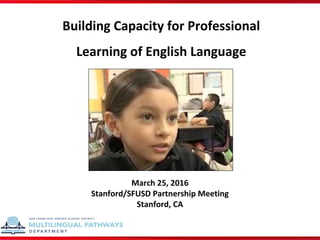
March 25, 2016
Stanford/SFUSD Partnership Meeting
Stanford, CA
Building Capacity for Professional
Learning of English Language
Welcome and Introductions
Angie Estonina, SFUSD C&I Multilingual Pathways Department
Neil Hasser, Doctoral Student
Lisa Kwong, SFUSD C&I Multilingual Pathways Department
Jeff Zwiers, Stanford University, Senior Researcher
Understanding Language/SCALEStanford/SFUSD Partnership
That’s Me!
If the statement applies to you, stand up and shout out “That’s Me!”
Speak another/other language(s) other than English.
My role: district or site administrator, teacher support, classroom
teacher, paraeducators, other support staff
Years in education: Brand New, 1-5 years, 5-15 years, 15 -25, 25+
I work with English Learners.
I am/was an English Learner myself.
I want to help improve language instruction for English Learners.
Understanding Language/SCALEStanford/SFUSD Partnership
3 Minute Greeting
Understanding Language/SCALEStanford/SFUSD Partnership
1. Everyone stand up and connect with as many colleagues as
you can within the time given.
2. Share: name, role, and your understanding of Designated and
Integrated ELD.
3. Observe how your idea changes with each partner exchange.
Stronger! Clearer!
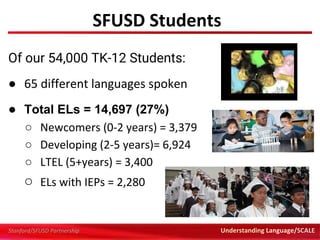
SFUSD Students
Understanding Language/SCALEStanford/SFUSD Partnership
Of our 54,000 TK-12 Students:
● 65 different languages spoken
● Total ELs = 14,697 (27%)
○ Newcomers (0-2 years) = 3,379
○ Developing (2-5 years)= 6,924
○ LTEL (5+years) = 3,400
○ ELs with IEPs = 2,280
New Standards: Overhauling the Teaching of ELD
LESS MORE
Individual
memorization of word
meanings and using
language for points
Using language to
collaborate,
understand,
communicate, & build
whole ideas
Understanding Language/SCALEStanford/SFUSD Partnership
Designated & Integrated ELD
Designated Integrated
Language
development is the
main goal of lessons;
rich and engaging
content supports the
development of
language. Students
are grouped by
proficiency level.
Content
development is the
main goal of
lessons, with
language being a
close—and
vital—secondary
focus.
Authentic and
engaged
communication is
the best way to
learn and
remember
language and
content.
Understanding Language/SCALEStanford/SFUSD Partnership
Five Essential Practices
How to go from…
Compliance Commitment
Capacity
Building
Challenges Create Opportunity for SFUSD
• Current State: ELD ambiguity and atrophy
• Number of K-5 & K-8 schools served by MPD: 72
Understanding Language/SCALEStanford/SFUSD Partnership
Capacity & Scale Up. How?
Guiding Research Question
What aspects of teacher
knowledge and practice changed,
if at all, as a result of a
multidimensional model of
professional development
focused on designated and
integrated ELD?
Understanding Language/SCALEStanford/SFUSD Partnership
What is a MOOC?
- MOOC stands for Massive Online
Open Course that’s free
- offers access to high quality
university lectures
- unlimited enrollment from
around the world
- a hybrid model of online learning
and face-to-face interactions
Understanding Language
Online Sessions (every 3-4 weeks)
1. Communication-Focused
Listening & Watching
2. Communication-Focused
Speaking
3. Communication-Focused
Reading & Viewing
4. Communication-Focused Writing
5. Communication-Focused Conversing
Understanding LanguageDesignated ELD MOOC
Each session included:
Understanding LanguageDesignated ELD MOOC
1. Webcast
2. Videos
3. Readings
4. Assignments
Scope of Project?
WHAT WHO
● Hybrid professional learning
model with:
○ 5 online modules
○ 4 face-to-face meetings
● FALL: Designated ELD: 3 Key
Features for
Communication
● SPRING: Integrated ELD:
Content Conversations
● Classroom teachers
● Site support teachers and
coaches
● Cross department central
office content specialists
● Site based and central
office administrators
Understanding Language/SCALEStanford/SFUSD Partnership
Communication Features
for Designing Activities
FEATURE 1 – Useful & Engaging Purpose: In the activity,
students use language to do something meaningful and
engaging (beyond just to answer questions or get points); the
activity prepares students to use language for academic
purposes.
FEATURE 2 - Information Gap: In the activity, students
get or give information that they want, need, and don’t
have.
FEATURE 3 - Attention to Language in service of
communication: In the activity, there is extra teaching
and assessment focused on improving how language is
used. This includes structuring interactions, modeling,
practicing, giving feedback, and/or scaffolding.
Understanding Language/SCALEStanford/SFUSD Partnership
Communicativeness Design & Observation
Tool (CDOT) – Video Analysis
Understanding Language
Activity: Using the CDOT tool, can you
identify the 3 features in the following
Designated ELD lesson?
Lesson Revision
Understanding Language
Activity: Work in triads to help revise a
traditional ELD lesson to incorporate the 3 key
features.
Stanford Team
Understanding Language/SCALEStanford/SFUSD Partnership
Research Questions
Understanding Language/SCALEStanford/SFUSD Partnership
Research Methods
• Analysis of MOOC assignments
• Pre- & Post- Surveys
• Classroom observations
• Teacher interviews
• Live Session Surveys
Understanding Language/SCALEStanford/SFUSD Partnership
DATA ANALYSIS: Classroom Observations
• Enga
Understanding Language/SCALEStanford/SFUSD Partnership
DATA ANALYSIS: Interviews
Understanding Language/SCALEStanford/SFUSD Partnership
Results– Just Starting Analysis
Understanding Language/SCALEStanford/SFUSD Partnership
DATA ANALYSIS: Classroom Observations
Engaging/Purpose:
• High interest topics + info. Gap correlated
with student engagement
• Structured S:S talk w/ focus on articulating
opinions correlated w/ higher engagement
• Integrating deeper, underlying purpose into
activity more challenging for many
Understanding Language/SCALEStanford/SFUSD Partnership
DATA ANALYSIS: Classroom Observations
• Info. Gap– 2 basic types observed:
• Students need info. held by
teacher
• Student pairs each had info.
needed by a partner–
• The above seemed more successful
than 1st
one
Understanding Language/SCALEStanford/SFUSD Partnership
DATA ANALYSIS: Classroom Observations
• Attention to language:
• Many valued creating more time/space
for S:S structured interactions & less
teacher talk
• Instances of more student use of
language correlated with multifaceted
strategies from T.
Understanding Language/SCALEStanford/SFUSD Partnership
DATA ANALYSIS: 30- Min. Interviews
• Engaging/ purpose:
• Deeper underlying purpose a challenge
• More time built in for S:S conversation, the
more engaged students seemed
• Info. Gap: New concept– appreciated its
inclusion in structuring activities
• Attention to language:
• Many found more teacher modeling correlated
with more students using language
• Harder to get students to USE scaffolds in S:S talk
Understanding Language/SCALEStanford/SFUSD Partnership
Now What?
• Continue symbiotic benefits of collaboration
between educators and researchers
• Morph live sessions into PLCs that focus on MOOC
topics
• Offer MOOC’s as an option for high quality
professional development
• Bring colleagues across curricula together
Understanding Language/SCALEStanford/SFUSD Partnership
Understanding LanguageDesignated ELD MOOC
Final Word from Jeff Zwiers
Many students are in dire need of
authentic practice in using language to
communicate. Their brains are wired to
use language to engage, learn, describe,
and build ideas with others. We owe it to
them to make the most of the precious
minutes we have with them
in class. Good luck!
Understanding LanguageDesignated ELD MOOC

16-3-25.CABE.STANFORD.SFUSD.pptx

  • 1.
    March 25, 2016 Stanford/SFUSDPartnership Meeting Stanford, CA Building Capacity for Professional Learning of English Language
  • 2.
    Welcome and Introductions AngieEstonina, SFUSD C&I Multilingual Pathways Department Neil Hasser, Doctoral Student Lisa Kwong, SFUSD C&I Multilingual Pathways Department Jeff Zwiers, Stanford University, Senior Researcher Understanding Language/SCALEStanford/SFUSD Partnership
  • 3.
    That’s Me! If thestatement applies to you, stand up and shout out “That’s Me!” Speak another/other language(s) other than English. My role: district or site administrator, teacher support, classroom teacher, paraeducators, other support staff Years in education: Brand New, 1-5 years, 5-15 years, 15 -25, 25+ I work with English Learners. I am/was an English Learner myself. I want to help improve language instruction for English Learners. Understanding Language/SCALEStanford/SFUSD Partnership
  • 4.
    3 Minute Greeting UnderstandingLanguage/SCALEStanford/SFUSD Partnership 1. Everyone stand up and connect with as many colleagues as you can within the time given. 2. Share: name, role, and your understanding of Designated and Integrated ELD. 3. Observe how your idea changes with each partner exchange. Stronger! Clearer!
  • 5.
    SFUSD Students Understanding Language/SCALEStanford/SFUSDPartnership Of our 54,000 TK-12 Students: ● 65 different languages spoken ● Total ELs = 14,697 (27%) ○ Newcomers (0-2 years) = 3,379 ○ Developing (2-5 years)= 6,924 ○ LTEL (5+years) = 3,400 ○ ELs with IEPs = 2,280
  • 6.
    New Standards: Overhaulingthe Teaching of ELD LESS MORE Individual memorization of word meanings and using language for points Using language to collaborate, understand, communicate, & build whole ideas Understanding Language/SCALEStanford/SFUSD Partnership
  • 7.
    Designated & IntegratedELD Designated Integrated Language development is the main goal of lessons; rich and engaging content supports the development of language. Students are grouped by proficiency level. Content development is the main goal of lessons, with language being a close—and vital—secondary focus. Authentic and engaged communication is the best way to learn and remember language and content. Understanding Language/SCALEStanford/SFUSD Partnership
  • 8.
  • 9.
    How to gofrom… Compliance Commitment Capacity Building
  • 10.
    Challenges Create Opportunityfor SFUSD • Current State: ELD ambiguity and atrophy • Number of K-5 & K-8 schools served by MPD: 72 Understanding Language/SCALEStanford/SFUSD Partnership
  • 11.
  • 12.
    Guiding Research Question Whataspects of teacher knowledge and practice changed, if at all, as a result of a multidimensional model of professional development focused on designated and integrated ELD? Understanding Language/SCALEStanford/SFUSD Partnership
  • 13.
    What is aMOOC? - MOOC stands for Massive Online Open Course that’s free - offers access to high quality university lectures - unlimited enrollment from around the world - a hybrid model of online learning and face-to-face interactions Understanding Language
  • 14.
    Online Sessions (every3-4 weeks) 1. Communication-Focused Listening & Watching 2. Communication-Focused Speaking 3. Communication-Focused Reading & Viewing 4. Communication-Focused Writing 5. Communication-Focused Conversing Understanding LanguageDesignated ELD MOOC
  • 15.
    Each session included: UnderstandingLanguageDesignated ELD MOOC 1. Webcast 2. Videos 3. Readings 4. Assignments
  • 16.
    Scope of Project? WHATWHO ● Hybrid professional learning model with: ○ 5 online modules ○ 4 face-to-face meetings ● FALL: Designated ELD: 3 Key Features for Communication ● SPRING: Integrated ELD: Content Conversations ● Classroom teachers ● Site support teachers and coaches ● Cross department central office content specialists ● Site based and central office administrators Understanding Language/SCALEStanford/SFUSD Partnership
  • 17.
  • 18.
    Communication Features for DesigningActivities FEATURE 1 – Useful & Engaging Purpose: In the activity, students use language to do something meaningful and engaging (beyond just to answer questions or get points); the activity prepares students to use language for academic purposes. FEATURE 2 - Information Gap: In the activity, students get or give information that they want, need, and don’t have. FEATURE 3 - Attention to Language in service of communication: In the activity, there is extra teaching and assessment focused on improving how language is used. This includes structuring interactions, modeling, practicing, giving feedback, and/or scaffolding. Understanding Language/SCALEStanford/SFUSD Partnership
  • 19.
    Communicativeness Design &Observation Tool (CDOT) – Video Analysis Understanding Language Activity: Using the CDOT tool, can you identify the 3 features in the following Designated ELD lesson?
  • 20.
    Lesson Revision Understanding Language Activity:Work in triads to help revise a traditional ELD lesson to incorporate the 3 key features.
  • 21.
  • 22.
  • 23.
    Research Methods • Analysisof MOOC assignments • Pre- & Post- Surveys • Classroom observations • Teacher interviews • Live Session Surveys Understanding Language/SCALEStanford/SFUSD Partnership
  • 24.
    DATA ANALYSIS: ClassroomObservations • Enga Understanding Language/SCALEStanford/SFUSD Partnership
  • 25.
    DATA ANALYSIS: Interviews UnderstandingLanguage/SCALEStanford/SFUSD Partnership
  • 26.
    Results– Just StartingAnalysis Understanding Language/SCALEStanford/SFUSD Partnership
  • 27.
    DATA ANALYSIS: ClassroomObservations Engaging/Purpose: • High interest topics + info. Gap correlated with student engagement • Structured S:S talk w/ focus on articulating opinions correlated w/ higher engagement • Integrating deeper, underlying purpose into activity more challenging for many Understanding Language/SCALEStanford/SFUSD Partnership
  • 28.
    DATA ANALYSIS: ClassroomObservations • Info. Gap– 2 basic types observed: • Students need info. held by teacher • Student pairs each had info. needed by a partner– • The above seemed more successful than 1st one Understanding Language/SCALEStanford/SFUSD Partnership
  • 29.
    DATA ANALYSIS: ClassroomObservations • Attention to language: • Many valued creating more time/space for S:S structured interactions & less teacher talk • Instances of more student use of language correlated with multifaceted strategies from T. Understanding Language/SCALEStanford/SFUSD Partnership
  • 30.
    DATA ANALYSIS: 30-Min. Interviews • Engaging/ purpose: • Deeper underlying purpose a challenge • More time built in for S:S conversation, the more engaged students seemed • Info. Gap: New concept– appreciated its inclusion in structuring activities • Attention to language: • Many found more teacher modeling correlated with more students using language • Harder to get students to USE scaffolds in S:S talk Understanding Language/SCALEStanford/SFUSD Partnership
  • 31.
    Now What? • Continuesymbiotic benefits of collaboration between educators and researchers • Morph live sessions into PLCs that focus on MOOC topics • Offer MOOC’s as an option for high quality professional development • Bring colleagues across curricula together Understanding Language/SCALEStanford/SFUSD Partnership
  • 32.
    Understanding LanguageDesignated ELDMOOC Final Word from Jeff Zwiers Many students are in dire need of authentic practice in using language to communicate. Their brains are wired to use language to engage, learn, describe, and build ideas with others. We owe it to them to make the most of the precious minutes we have with them in class. Good luck!
  • 33.