PHYSICAL THERAPIST
STUDENT EVALUATION:
CLINICAL EXPERIENCE
AND
CLINICAL INSTRUCTION
June 10, 2003
(updated 12/27/10)
1
American Physical Therapy Association
Department of Physical Therapy Education
1111 North Fairfax Street
Alexandria, Virginia 22314
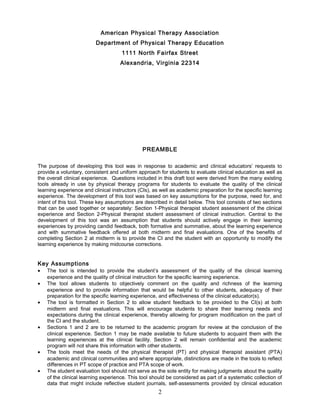
PREAMBLE
The purpose of developing this tool was in response to academic and clinical educators’ requests to
provide a voluntary, consistent and uniform approach for students to evaluate clinical education as well as
the overall clinical experience. Questions included in this draft tool were derived from the many existing
tools already in use by physical therapy programs for students to evaluate the quality of the clinical
learning experience and clinical instructors (CIs), as well as academic preparation for the specific learning
experience. The development of this tool was based on key assumptions for the purpose, need for, and
intent of this tool. These key assumptions are described in detail below. This tool consists of two sections
that can be used together or separately: Section 1-Physical therapist student assessment of the clinical
experience and Section 2-Physical therapist student assessment of clinical instruction. Central to the
development of this tool was an assumption that students should actively engage in their learning
experiences by providing candid feedback, both formative and summative, about the learning experience
and with summative feedback offered at both midterm and final evaluations. One of the benefits of
completing Section 2 at midterm is to provide the CI and the student with an opportunity to modify the
learning experience by making midcourse corrections.
Key Assumptions
• The tool is intended to provide the student’s assessment of the quality of the clinical learning
experience and the quality of clinical instruction for the specific learning experience.
• The tool allows students to objectively comment on the quality and richness of the learning
experience and to provide information that would be helpful to other students, adequacy of their
preparation for the specific learning experience, and effectiveness of the clinical educator(s).
• The tool is formatted in Section 2 to allow student feedback to be provided to the CI(s) at both
midterm and final evaluations. This will encourage students to share their learning needs and
expectations during the clinical experience, thereby allowing for program modification on the part of
the CI and the student.
• Sections 1 and 2 are to be returned to the academic program for review at the conclusion of the
clinical experience. Section 1 may be made available to future students to acquaint them with the
learning experiences at the clinical facility. Section 2 will remain confidential and the academic
program will not share this information with other students.
• The tools meet the needs of the physical therapist (PT) and physical therapist assistant (PTA)
academic and clinical communities and where appropriate, distinctions are made in the tools to reflect
differences in PT scope of practice and PTA scope of work.
• The student evaluation tool should not serve as the sole entity for making judgments about the quality
of the clinical learning experience. This tool should be considered as part of a systematic collection of
data that might include reflective student journals, self-assessments provided by clinical education
2
sites, Center Coordinators of Clinical Education (CCCEs), and CIs based on the Guidelines for
Clinical Education, ongoing communications and site visits, student performance evaluations, student
planning worksheets, Clinical Site Information Form (CSIF), program outcomes, and other sources of
information.
Acknowledgement
We would like to acknowledge the collaborative effort between the Clinical Education Special Interest
Group (SIG) of the Education Section and APTA’s Education Department in completing this project. We
are especially indebted to those individuals from the Clinical Education SIG who willingly volunteered their
time to develop and refine these tools. Comments and feedback provided by academic and clinical
faculty, clinical educators, and students on several draft versions of this document were instrumental in
developing, shaping, and refining the tools. Our gratitude goes out to all of those individuals and groups
who willingly gave their time and expertise to work toward a common voluntary PT and PTA Student
Evaluation Tool of the Clinical Experience and Clinical Instruction.
Ad Hoc Group Members: Jackie Crossen-Sills, PT, MS, Nancy Erikson, PT, MS, GCS, Peggy Gleeson,
PT, PhD, Deborah Ingram, PT, EdD, Corrie Odom, PT, DPT, ATC, and Karen O’Loughlin, PT, MA
©2003 American Physical Therapy Association. All rights reserved. Duplication of this
form in its entirety is permitted; however, any revision, addition, or deletion is prohibited.
3
GENERAL INFORMATION AND SIGNATURES
General Information
Student Name      
Academic Institution      
Name of Clinical Education Site      
Address       City       State      
Clinical Experience Number       Clinical Experience Dates     
Signatures
I have reviewed information contained in this physical therapist student evaluation of the clinical education
experience and of clinical instruction. I recognize that the information below is being collected to facilitate
accreditation requirements. I understand that my personal information will not be available to students in
the academic program files.
           
Student Name (Provide signature) Date
           
Primary Clinical Instructor Name (Print name) Date
     
Primary Clinical Instructor Name (Provide signature)
Entry-level PT degree earned     
Highest degree earned       Degree area      
Years experience as a CI      
Years experience as a clinician     
Areas of expertise      
Clinical Certification, specify area      
APTA Credentialed CI Yes No
Other CI Credential       State Yes No
Professional organization memberships APTA Other      
           
Additional Clinical Instructor Name (Print name) Date
     
Additional Clinical Instructor Name (Provide signature)
Entry-level PT degree earned     
Highest degree earned       Degree area      
Years experience as a CI      
Years experience as a clinician      
Areas of expertise      
Clinical Certification, specify area      
APTA Credentialed CI Yes No
Other CI Credential       State Yes No
Professional organization memberships APTA Other
4
SECTION 1: PT STUDENT ASSESSMENT OF THE CLINICAL
EXPERIENCE
Information found in Section 1 may be available to program faculty and students to familiarize them with
the learning experiences at this clinical facility.
1. Name of Clinical Education Site      
Address       City       State      
2. Clinical Experience Number      
3. Specify the number of weeks for each applicable clinical experience/rotation.
      Acute Care/Inpatient Hospital Facility       Private Practice
      Ambulatory Care/Outpatient       Rehabilitation/Sub-acute Rehabilitation
      ECF/Nursing Home/SNF       School/Preschool Program
      Federal/State/County Health       Wellness/Prevention/Fitness Program
      Industrial/Occupational Health Facility       Other      
Orientation
4. Did you receive information from the clinical facility prior to your arrival? Yes No
5. Did the on-site orientation provide you with an awareness of the Yes No
information and resources that you would need for the experience?
6. What else could have been provided during the orientation?      
Patient/Client Management and the Practice Environment
For questions 7, 8, and 9, use the following 4-point rating scale:
1= Never 2 = Rarely 3 = Occasionally 4 = Often
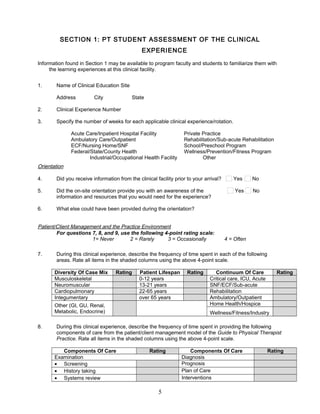
7. During this clinical experience, describe the frequency of time spent in each of the following
areas. Rate all items in the shaded columns using the above 4-point scale.
Diversity Of Case Mix Rating Patient Lifespan Rating Continuum Of Care Rating
Musculoskeletal 0-12 years Critical care, ICU, Acute
Neuromuscular 13-21 years SNF/ECF/Sub-acute
Cardiopulmonary 22-65 years Rehabilitation
Integumentary over 65 years Ambulatory/Outpatient
Other (GI, GU, Renal,
Metabolic, Endocrine)
Home Health/Hospice
Wellness/Fitness/Industry
8. During this clinical experience, describe the frequency of time spent in providing the following
components of care from the patient/client management model of the Guide to Physical Therapist
Practice. Rate all items in the shaded columns using the above 4-point scale.
Components Of Care Rating Components Of Care Rating
Examination Diagnosis
• Screening Prognosis
• History taking Plan of Care
• Systems review Interventions
5
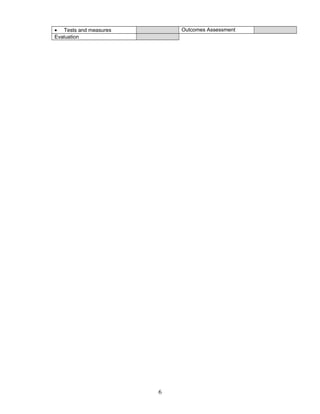
• Tests and measures Outcomes Assessment
Evaluation
6
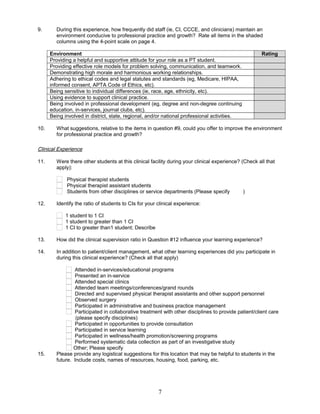
9. During this experience, how frequently did staff (ie, CI, CCCE, and clinicians) maintain an
environment conducive to professional practice and growth? Rate all items in the shaded
columns using the 4-point scale on page 4.
Environment Rating
Providing a helpful and supportive attitude for your role as a PT student.
Providing effective role models for problem solving, communication, and teamwork.
Demonstrating high morale and harmonious working relationships.
Adhering to ethical codes and legal statutes and standards (eg, Medicare, HIPAA,
informed consent, APTA Code of Ethics, etc).
Being sensitive to individual differences (ie, race, age, ethnicity, etc).
Using evidence to support clinical practice.
Being involved in professional development (eg, degree and non-degree continuing
education, in-services, journal clubs, etc).
Being involved in district, state, regional, and/or national professional activities.
10. What suggestions, relative to the items in question #9, could you offer to improve the environment
for professional practice and growth?      
Clinical Experience
11. Were there other students at this clinical facility during your clinical experience? (Check all that
apply):
Physical therapist students
Physical therapist assistant students
Students from other disciplines or service departments (Please specify     )
12. Identify the ratio of students to CIs for your clinical experience:
1 student to 1 CI
1 student to greater than 1 CI
1 CI to greater than1 student; Describe      
13. How did the clinical supervision ratio in Question #12 influence your learning experience?      
14. In addition to patient/client management, what other learning experiences did you participate in
during this clinical experience? (Check all that apply)
Attended in-services/educational programs
Presented an in-service
Attended special clinics
Attended team meetings/conferences/grand rounds
Directed and supervised physical therapist assistants and other support personnel
Observed surgery
Participated in administrative and business practice management
Participated in collaborative treatment with other disciplines to provide patient/client care
(please specify disciplines)     
Participated in opportunities to provide consultation
Participated in service learning
Participated in wellness/health promotion/screening programs
Performed systematic data collection as part of an investigative study
Other; Please specify      
15. Please provide any logistical suggestions for this location that may be helpful to students in the
future. Include costs, names of resources, housing, food, parking, etc.      
7
Overall Summary Appraisal
16. Overall, how would you assess this clinical experience? (Check only one)
Excellent clinical learning experience; would not hesitate to recommend this clinical education
site to another student.
Time well spent; would recommend this clinical education site to another student.
Some good learning experiences; student program needs further development.
Student clinical education program is not adequately developed at this time.
17. What specific qualities or skills do you believe a physical therapist student should have to function
successfully at this clinical education site?      
18. If, during this clinical education experience, you were exposed to content not included in your
previous physical therapist academic preparation, describe those subject areas not addressed.
     
19. What suggestions would you offer to future physical therapist students to improve this clinical
education experience?      
20. What do you believe were the strengths of your physical therapist academic preparation and/or
coursework for this clinical experience?      
21. What curricular suggestions do you have that would have prepared you better for this clinical
experience?      
8
SECTION 2: PT STUDENT ASSESSMENT OF CLINICAL INSTRUCTION
Information found in this section is to be shared between the student and the clinical instructor(s) at
midterm and final evaluations. Additional copies of Section 2 should be made when there are multiple CIs
supervising the student. Information contained in Section 2 is confidential and will not be shared by the
academic program with other students.
Assessment of Clinical Instruction
22. Using the scale (1 - 5) below, rate how clinical instruction was provided during this clinical
experience at both midterm and final evaluations (shaded columns).
1=Strongly Disagree 2=Disagree 3=Neutral 4=Agree 5=Strongly Agree
Provision of Clinical Instruction Midterm Final
The clinical instructor (CI) was familiar with the academic program’s
objectives and expectations for this experience.
The clinical education site had written objectives for this learning
experience.
The clinical education site’s objectives for this learning experience were
clearly communicated.
There was an opportunity for student input into the objectives for this
learning experience.
The CI provided constructive feedback on student performance.
The CI provided timely feedback on student performance.
The CI demonstrated skill in active listening.
The CI provided clear and concise communication.
The CI communicated in an open and non-threatening manner.
The CI taught in an interactive manner that encouraged problem solving.
There was a clear understanding to whom you were directly responsible
and accountable.
The supervising CI was accessible when needed.
The CI clearly explained your student responsibilities.
The CI provided responsibilities that were within your scope of
knowledge and skills.
The CI facilitated patient-therapist and therapist-student relationships.
Time was available with the CI to discuss patient/client management.
The CI served as a positive role model in physical therapy practice.
The CI skillfully used the clinical environment for planned and unplanned
learning experiences.
The CI integrated knowledge of various learning styles into student
clinical teaching.
The CI made the formal evaluation process constructive.
The CI encouraged the student to self-assess.
23. Was your CI’(s) evaluation of your level of performance in agreement with your self-assessment?
Midterm Evaluation Yes No Final Evaluation Yes No
9
24. If there were inconsistencies, how were they discussed and managed?
Midterm Evaluation      
Final Evaluation      
25. What did your CI(s) do well to contribute to your learning?
Midterm Comments      
Final Comments      
26. What, if anything, could your CI(s) and/or other staff have done differently to contribute to your
learning?
Midterm Comments      
Final Comments      
Thank you for sharing and discussing candid feedback with your CI(s) so that any
necessary midcourse corrections can be made to modify and further enhance your
learning experience.
10

Student pt evaluationform

  • 1.
    PHYSICAL THERAPIST STUDENT EVALUATION: CLINICALEXPERIENCE AND CLINICAL INSTRUCTION June 10, 2003 (updated 12/27/10) 1
  • 2.
    American Physical TherapyAssociation Department of Physical Therapy Education 1111 North Fairfax Street Alexandria, Virginia 22314 PREAMBLE The purpose of developing this tool was in response to academic and clinical educators’ requests to provide a voluntary, consistent and uniform approach for students to evaluate clinical education as well as the overall clinical experience. Questions included in this draft tool were derived from the many existing tools already in use by physical therapy programs for students to evaluate the quality of the clinical learning experience and clinical instructors (CIs), as well as academic preparation for the specific learning experience. The development of this tool was based on key assumptions for the purpose, need for, and intent of this tool. These key assumptions are described in detail below. This tool consists of two sections that can be used together or separately: Section 1-Physical therapist student assessment of the clinical experience and Section 2-Physical therapist student assessment of clinical instruction. Central to the development of this tool was an assumption that students should actively engage in their learning experiences by providing candid feedback, both formative and summative, about the learning experience and with summative feedback offered at both midterm and final evaluations. One of the benefits of completing Section 2 at midterm is to provide the CI and the student with an opportunity to modify the learning experience by making midcourse corrections. Key Assumptions • The tool is intended to provide the student’s assessment of the quality of the clinical learning experience and the quality of clinical instruction for the specific learning experience. • The tool allows students to objectively comment on the quality and richness of the learning experience and to provide information that would be helpful to other students, adequacy of their preparation for the specific learning experience, and effectiveness of the clinical educator(s). • The tool is formatted in Section 2 to allow student feedback to be provided to the CI(s) at both midterm and final evaluations. This will encourage students to share their learning needs and expectations during the clinical experience, thereby allowing for program modification on the part of the CI and the student. • Sections 1 and 2 are to be returned to the academic program for review at the conclusion of the clinical experience. Section 1 may be made available to future students to acquaint them with the learning experiences at the clinical facility. Section 2 will remain confidential and the academic program will not share this information with other students. • The tools meet the needs of the physical therapist (PT) and physical therapist assistant (PTA) academic and clinical communities and where appropriate, distinctions are made in the tools to reflect differences in PT scope of practice and PTA scope of work. • The student evaluation tool should not serve as the sole entity for making judgments about the quality of the clinical learning experience. This tool should be considered as part of a systematic collection of data that might include reflective student journals, self-assessments provided by clinical education 2
  • 3.
    sites, Center Coordinatorsof Clinical Education (CCCEs), and CIs based on the Guidelines for Clinical Education, ongoing communications and site visits, student performance evaluations, student planning worksheets, Clinical Site Information Form (CSIF), program outcomes, and other sources of information. Acknowledgement We would like to acknowledge the collaborative effort between the Clinical Education Special Interest Group (SIG) of the Education Section and APTA’s Education Department in completing this project. We are especially indebted to those individuals from the Clinical Education SIG who willingly volunteered their time to develop and refine these tools. Comments and feedback provided by academic and clinical faculty, clinical educators, and students on several draft versions of this document were instrumental in developing, shaping, and refining the tools. Our gratitude goes out to all of those individuals and groups who willingly gave their time and expertise to work toward a common voluntary PT and PTA Student Evaluation Tool of the Clinical Experience and Clinical Instruction. Ad Hoc Group Members: Jackie Crossen-Sills, PT, MS, Nancy Erikson, PT, MS, GCS, Peggy Gleeson, PT, PhD, Deborah Ingram, PT, EdD, Corrie Odom, PT, DPT, ATC, and Karen O’Loughlin, PT, MA ©2003 American Physical Therapy Association. All rights reserved. Duplication of this form in its entirety is permitted; however, any revision, addition, or deletion is prohibited. 3
  • 4.
    GENERAL INFORMATION ANDSIGNATURES General Information Student Name       Academic Institution       Name of Clinical Education Site       Address       City       State       Clinical Experience Number       Clinical Experience Dates      Signatures I have reviewed information contained in this physical therapist student evaluation of the clinical education experience and of clinical instruction. I recognize that the information below is being collected to facilitate accreditation requirements. I understand that my personal information will not be available to students in the academic program files.             Student Name (Provide signature) Date             Primary Clinical Instructor Name (Print name) Date       Primary Clinical Instructor Name (Provide signature) Entry-level PT degree earned      Highest degree earned       Degree area       Years experience as a CI       Years experience as a clinician      Areas of expertise       Clinical Certification, specify area       APTA Credentialed CI Yes No Other CI Credential       State Yes No Professional organization memberships APTA Other                   Additional Clinical Instructor Name (Print name) Date       Additional Clinical Instructor Name (Provide signature) Entry-level PT degree earned      Highest degree earned       Degree area       Years experience as a CI       Years experience as a clinician       Areas of expertise       Clinical Certification, specify area       APTA Credentialed CI Yes No Other CI Credential       State Yes No Professional organization memberships APTA Other 4
  • 5.
    SECTION 1: PTSTUDENT ASSESSMENT OF THE CLINICAL EXPERIENCE Information found in Section 1 may be available to program faculty and students to familiarize them with the learning experiences at this clinical facility. 1. Name of Clinical Education Site       Address       City       State       2. Clinical Experience Number       3. Specify the number of weeks for each applicable clinical experience/rotation.       Acute Care/Inpatient Hospital Facility       Private Practice       Ambulatory Care/Outpatient       Rehabilitation/Sub-acute Rehabilitation       ECF/Nursing Home/SNF       School/Preschool Program       Federal/State/County Health       Wellness/Prevention/Fitness Program       Industrial/Occupational Health Facility       Other       Orientation 4. Did you receive information from the clinical facility prior to your arrival? Yes No 5. Did the on-site orientation provide you with an awareness of the Yes No information and resources that you would need for the experience? 6. What else could have been provided during the orientation?       Patient/Client Management and the Practice Environment For questions 7, 8, and 9, use the following 4-point rating scale: 1= Never 2 = Rarely 3 = Occasionally 4 = Often 7. During this clinical experience, describe the frequency of time spent in each of the following areas. Rate all items in the shaded columns using the above 4-point scale. Diversity Of Case Mix Rating Patient Lifespan Rating Continuum Of Care Rating Musculoskeletal 0-12 years Critical care, ICU, Acute Neuromuscular 13-21 years SNF/ECF/Sub-acute Cardiopulmonary 22-65 years Rehabilitation Integumentary over 65 years Ambulatory/Outpatient Other (GI, GU, Renal, Metabolic, Endocrine) Home Health/Hospice Wellness/Fitness/Industry 8. During this clinical experience, describe the frequency of time spent in providing the following components of care from the patient/client management model of the Guide to Physical Therapist Practice. Rate all items in the shaded columns using the above 4-point scale. Components Of Care Rating Components Of Care Rating Examination Diagnosis • Screening Prognosis • History taking Plan of Care • Systems review Interventions 5
  • 6.
    • Tests andmeasures Outcomes Assessment Evaluation 6
  • 7.
    9. During thisexperience, how frequently did staff (ie, CI, CCCE, and clinicians) maintain an environment conducive to professional practice and growth? Rate all items in the shaded columns using the 4-point scale on page 4. Environment Rating Providing a helpful and supportive attitude for your role as a PT student. Providing effective role models for problem solving, communication, and teamwork. Demonstrating high morale and harmonious working relationships. Adhering to ethical codes and legal statutes and standards (eg, Medicare, HIPAA, informed consent, APTA Code of Ethics, etc). Being sensitive to individual differences (ie, race, age, ethnicity, etc). Using evidence to support clinical practice. Being involved in professional development (eg, degree and non-degree continuing education, in-services, journal clubs, etc). Being involved in district, state, regional, and/or national professional activities. 10. What suggestions, relative to the items in question #9, could you offer to improve the environment for professional practice and growth?       Clinical Experience 11. Were there other students at this clinical facility during your clinical experience? (Check all that apply): Physical therapist students Physical therapist assistant students Students from other disciplines or service departments (Please specify     ) 12. Identify the ratio of students to CIs for your clinical experience: 1 student to 1 CI 1 student to greater than 1 CI 1 CI to greater than1 student; Describe       13. How did the clinical supervision ratio in Question #12 influence your learning experience?       14. In addition to patient/client management, what other learning experiences did you participate in during this clinical experience? (Check all that apply) Attended in-services/educational programs Presented an in-service Attended special clinics Attended team meetings/conferences/grand rounds Directed and supervised physical therapist assistants and other support personnel Observed surgery Participated in administrative and business practice management Participated in collaborative treatment with other disciplines to provide patient/client care (please specify disciplines)      Participated in opportunities to provide consultation Participated in service learning Participated in wellness/health promotion/screening programs Performed systematic data collection as part of an investigative study Other; Please specify       15. Please provide any logistical suggestions for this location that may be helpful to students in the future. Include costs, names of resources, housing, food, parking, etc.       7
  • 8.
    Overall Summary Appraisal 16.Overall, how would you assess this clinical experience? (Check only one) Excellent clinical learning experience; would not hesitate to recommend this clinical education site to another student. Time well spent; would recommend this clinical education site to another student. Some good learning experiences; student program needs further development. Student clinical education program is not adequately developed at this time. 17. What specific qualities or skills do you believe a physical therapist student should have to function successfully at this clinical education site?       18. If, during this clinical education experience, you were exposed to content not included in your previous physical therapist academic preparation, describe those subject areas not addressed.       19. What suggestions would you offer to future physical therapist students to improve this clinical education experience?       20. What do you believe were the strengths of your physical therapist academic preparation and/or coursework for this clinical experience?       21. What curricular suggestions do you have that would have prepared you better for this clinical experience?       8
  • 9.
    SECTION 2: PTSTUDENT ASSESSMENT OF CLINICAL INSTRUCTION Information found in this section is to be shared between the student and the clinical instructor(s) at midterm and final evaluations. Additional copies of Section 2 should be made when there are multiple CIs supervising the student. Information contained in Section 2 is confidential and will not be shared by the academic program with other students. Assessment of Clinical Instruction 22. Using the scale (1 - 5) below, rate how clinical instruction was provided during this clinical experience at both midterm and final evaluations (shaded columns). 1=Strongly Disagree 2=Disagree 3=Neutral 4=Agree 5=Strongly Agree Provision of Clinical Instruction Midterm Final The clinical instructor (CI) was familiar with the academic program’s objectives and expectations for this experience. The clinical education site had written objectives for this learning experience. The clinical education site’s objectives for this learning experience were clearly communicated. There was an opportunity for student input into the objectives for this learning experience. The CI provided constructive feedback on student performance. The CI provided timely feedback on student performance. The CI demonstrated skill in active listening. The CI provided clear and concise communication. The CI communicated in an open and non-threatening manner. The CI taught in an interactive manner that encouraged problem solving. There was a clear understanding to whom you were directly responsible and accountable. The supervising CI was accessible when needed. The CI clearly explained your student responsibilities. The CI provided responsibilities that were within your scope of knowledge and skills. The CI facilitated patient-therapist and therapist-student relationships. Time was available with the CI to discuss patient/client management. The CI served as a positive role model in physical therapy practice. The CI skillfully used the clinical environment for planned and unplanned learning experiences. The CI integrated knowledge of various learning styles into student clinical teaching. The CI made the formal evaluation process constructive. The CI encouraged the student to self-assess. 23. Was your CI’(s) evaluation of your level of performance in agreement with your self-assessment? Midterm Evaluation Yes No Final Evaluation Yes No 9
  • 10.
    24. If therewere inconsistencies, how were they discussed and managed? Midterm Evaluation       Final Evaluation       25. What did your CI(s) do well to contribute to your learning? Midterm Comments       Final Comments       26. What, if anything, could your CI(s) and/or other staff have done differently to contribute to your learning? Midterm Comments       Final Comments       Thank you for sharing and discussing candid feedback with your CI(s) so that any necessary midcourse corrections can be made to modify and further enhance your learning experience. 10