UPDATE IN CLINICAL EDUCATION: Pharmacy Students and Experiential learning
As members of a profession, we are entrusted with a responsibility to continuously renew our ranks by educating our future clinical colleagues.  Despite the many challenges, we have a professional duty to teach young practitioners.
 
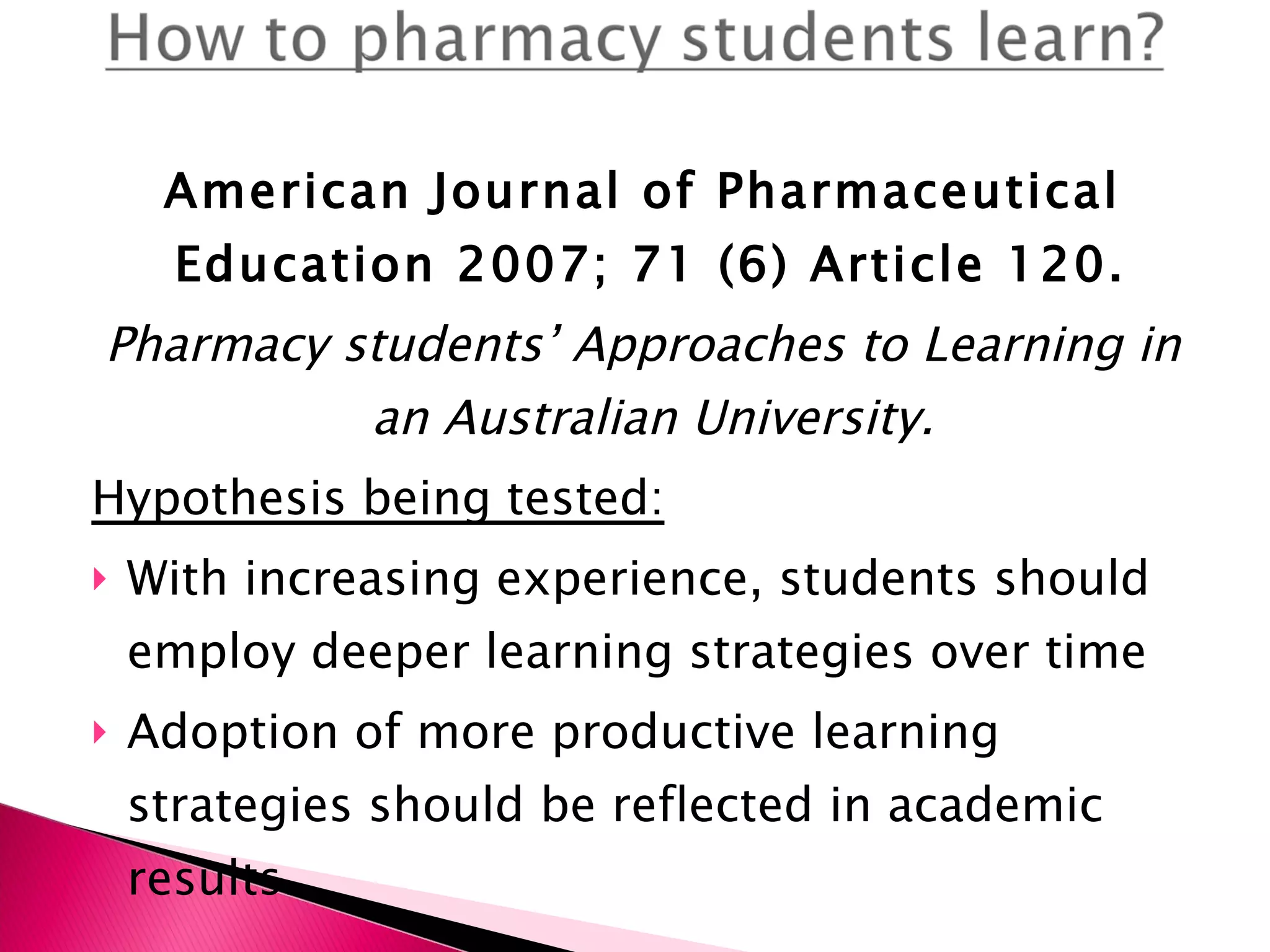
American Journal of Pharmaceutical Education 2007; 71 (6) Article 120.  Pharmacy students’ Approaches to Learning in an Australian University.   Hypothesis being tested: With increasing experience, students should employ deeper learning strategies over time Adoption of more productive learning strategies should be reflected in academic results.
Meaning directed learning  (Deep processing strategies & self regulation: Learning is the  construction  of knowledge) Reproduction directed learning  (Surface learning & reliance on regulation: Learning is  intake  of knowledge) Undirected learning  (Poor self regulation, dependence on external sources for help) Application directed learning  ( Strong vocational orientation & belief that learning is the  use  of knowledge)
Measure & Evaluate the approaches to learning that students adopt Examine the relationship between student approach to learning and academic performance outcomes Examine differences in students approach to learning between year groups and within the same year group over time Evaluate the influence of gender & subject on students’ approach to learning
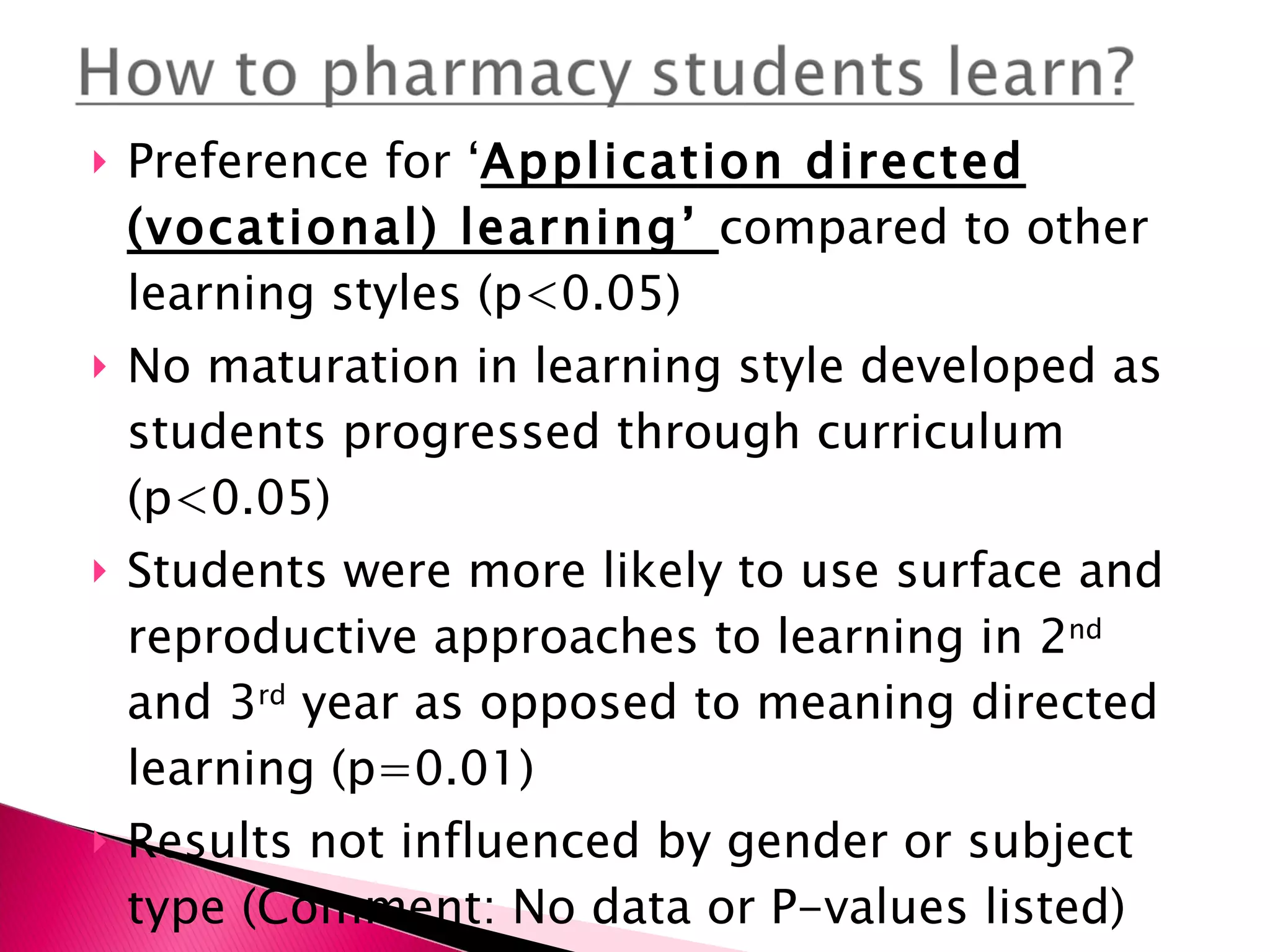
Preference for ‘ Application directed (vocational) learning’  compared to other learning styles (p<0.05) No maturation in learning style developed as students progressed through curriculum (p<0.05) Students were more likely to use surface and reproductive approaches to learning in 2 nd  and 3 rd  year as opposed to meaning directed learning (p=0.01) Results not influenced by gender or subject type (Comment: No data or P-values listed) Academic results not influenced by learning style (p=0.01)
Learning style and personality – KOLB’s Model Learning style and Profession – Approaches to learning Model Learning Style, Personality & Choice of Profession – no proven correlation for pharmacy
Adult Learning Should Be…  Active , where adult learners need to be actively involved in their learning in order for them to develop their learning needs.  In context , where adults are motivated to obtain the necessary knowledge and skills to solve specific problems.  Reflective ,  where adults learn from prior experience and generalize these experiences to new situations.  Practical ,  where adults learn by doing. Multiple exposures (short duration) & with a diverse range of preceptors and institutions
 
Difference between Undergraduate and post graduate pharmacy students How many hours are considered essential for the development of practical skills Status quo for preceptor:student:patient ratios in pharmacy placements
University Perspective Supply Vs Demand Vs Competition Quality training sites and preceptors were quoted as major issues affecting accreditation of university courses Placements Vs Academic Research Workplace / Industry perspective Preceptor availability (52%) Workload concern (9.2%) Other: Reimbursement, student issues, amalgamation Supply Vs Demand (46%) Student perspective Ability to engage in learning
Account for; adult learning principles, curriculum and student engagement Assist students to Understand their selected occupation Develop the capacity to practice effectively  Access to authentic work activities (novel & routine) Observation & listening Access to experienced practitioners Opportunities to reinforce and refine practical skills Understand Limitations
Engaging registered pharmacists to act as preceptors / educators / facilitators Maximise positive contributions from practice settings Prepare students to be  ‘agentic’  learners: This requires students to participate &  negotiate in learning and become proactive and self directed adult learners as part of their professional preparation (Billet 2009)
Action Learning Project to improve satisfaction from all stakeholders for the pharmacy student experiential placements program Phase 1:  Operational Changes Phase 2 : Clinical education needs analysis & training Phase 3:  Implementation
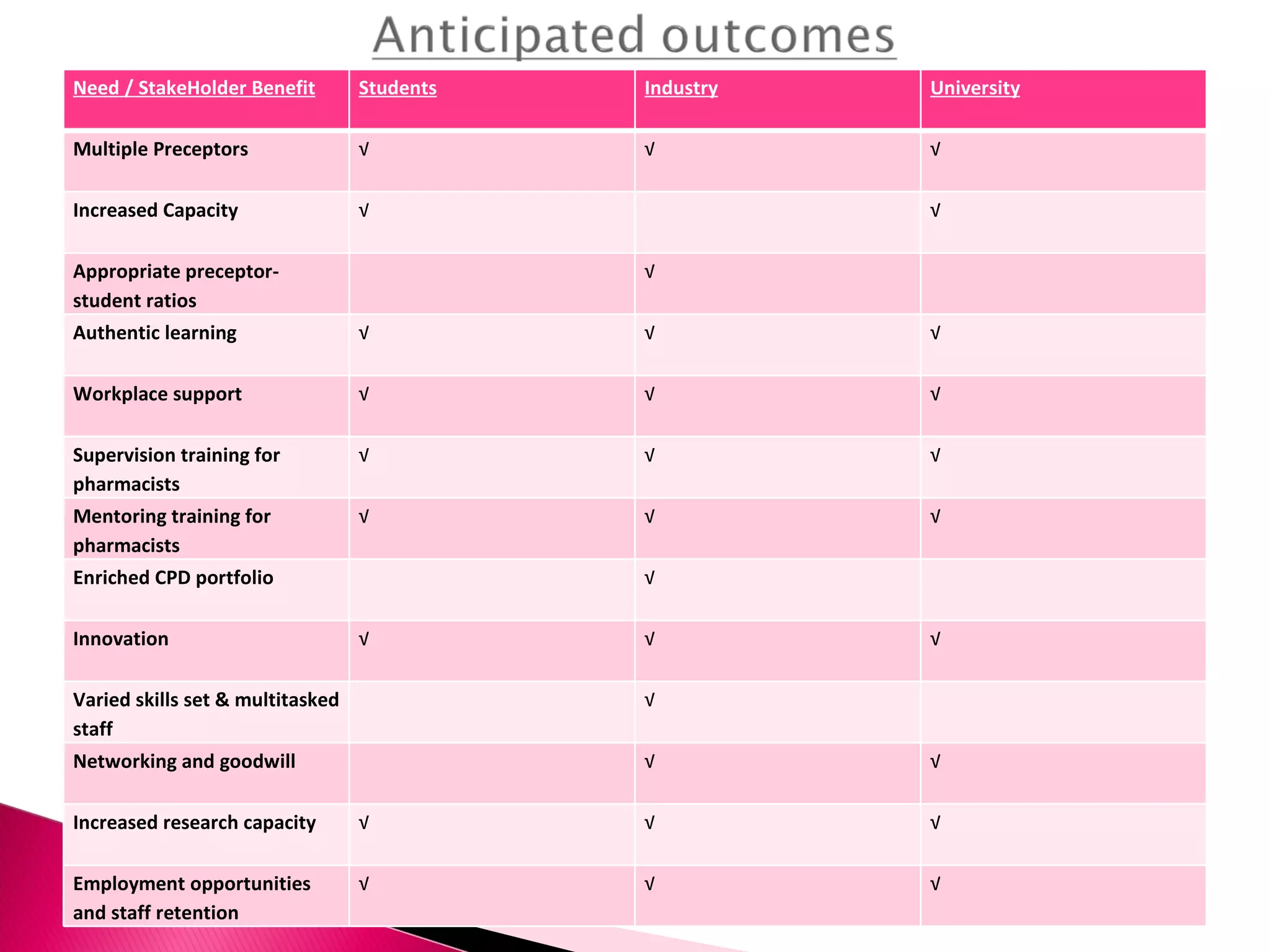
Need / StakeHolder Benefit Students Industry University Multiple Preceptors √ √ √ Increased Capacity √ √ Appropriate preceptor-student ratios √ Authentic learning √ √ √ Workplace support √ √ √ Supervision training for pharmacists √ √ √ Mentoring training for pharmacists  √ √ √ Enriched CPD portfolio √ Innovation √ √ √ Varied skills set & multitasked staff √ Networking and goodwill √ √ Increased research capacity √ √ √ Employment opportunities and staff retention √ √ √
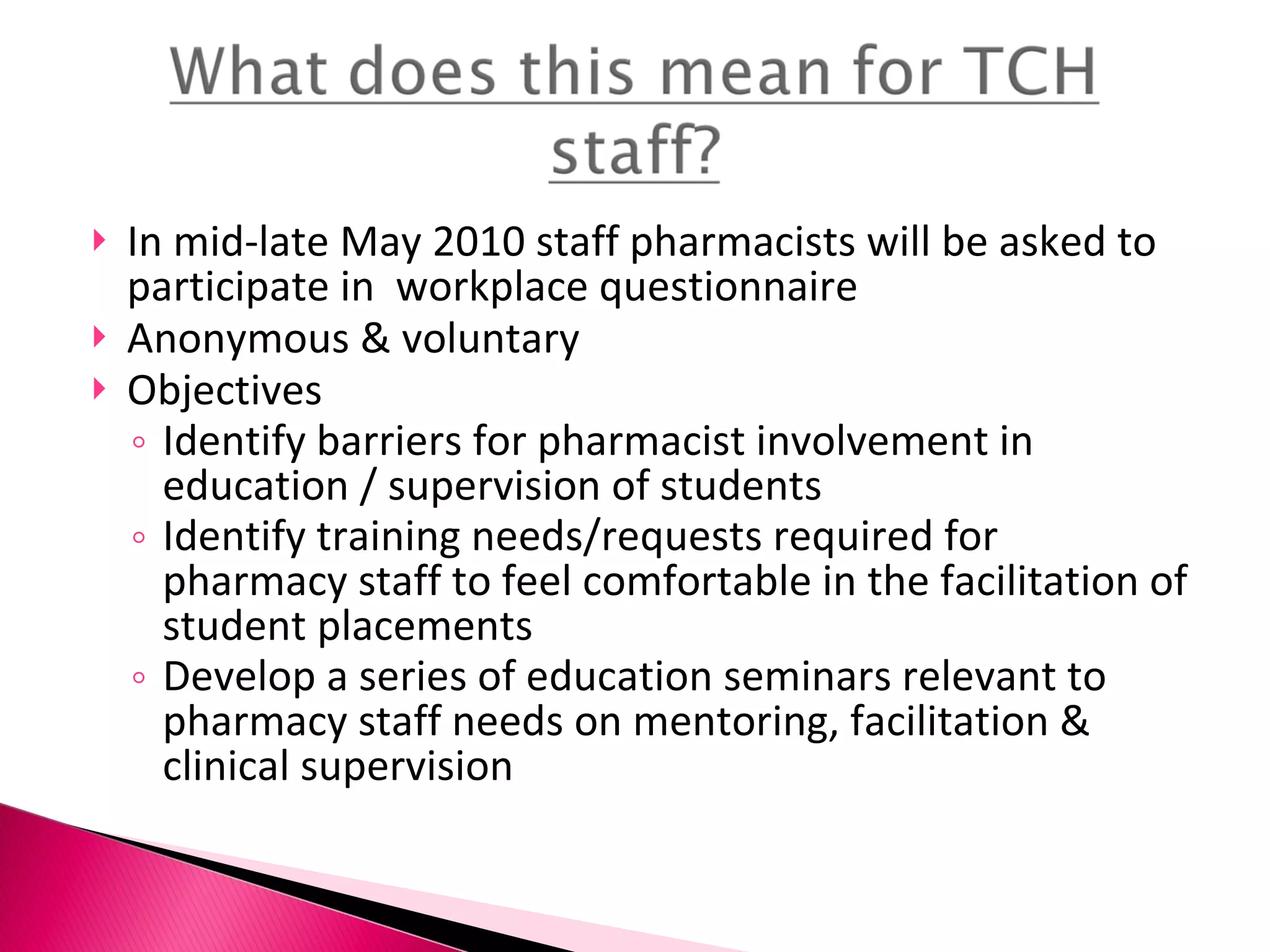
In mid-late May 2010 staff pharmacists will be asked to participate in  workplace questionnaire Anonymous & voluntary Objectives Identify barriers for pharmacist involvement in education / supervision of students Identify training needs/requests required for pharmacy staff to feel comfortable in the facilitation of student placements Develop a series of education seminars relevant to pharmacy staff needs on mentoring, facilitation & clinical supervision
Kolb’s experiential Learning Model (Accessed 2.4.10;http://leadershipchamps.files.wordpress.com/2008/04/kolbs-experiential-model.jpg American Journal of Pharmaceutical Education 2007; 71 (6) Article 120.  Pharmacy students’ Approaches to Learning in an Australian University.  Lorraine Smith, PhD, Bandana Saini, PhD, Ines Krass, PhD, Timothy Chen, PhD, Sinthia Bosnic-Anticevich, PhD & Erica Sainsbury, MSc. Faculty of pharmacy, University of Sydney, Australia Owens, Susanne & Stupans,I. 2008.  “Experiential Placements in Pharmacy: ‘Quality Indicators for Best Practice Approaches to Experiential Placements in Pharmacy Programs’”.  The Carrick Institute for Learning and Teaching in Higher Education. Australia.
Implications of Advanced Pharmacy Practice Experience Placements: Cecilia M. Plaza, PharmD, MS, and JoLaine Reierson Draugalis, PhD.  American Journal of Pharmaceutical Education  2005; 69 (3) Article 45. Assessing Pharmacy Students’ Learning styles & personality types; A 10 year analysis. Avis, Shuck & Phillips 1999. American Journal of Pharmaceutical Education. Vol 63. pp.27-33

Update in clinical education

  • 1.
    UPDATE IN CLINICALEDUCATION: Pharmacy Students and Experiential learning
  • 2.
    As members ofa profession, we are entrusted with a responsibility to continuously renew our ranks by educating our future clinical colleagues. Despite the many challenges, we have a professional duty to teach young practitioners.
  • 3.
  • 4.
    American Journal ofPharmaceutical Education 2007; 71 (6) Article 120. Pharmacy students’ Approaches to Learning in an Australian University. Hypothesis being tested: With increasing experience, students should employ deeper learning strategies over time Adoption of more productive learning strategies should be reflected in academic results.
  • 5.
    Meaning directed learning (Deep processing strategies & self regulation: Learning is the construction of knowledge) Reproduction directed learning (Surface learning & reliance on regulation: Learning is intake of knowledge) Undirected learning (Poor self regulation, dependence on external sources for help) Application directed learning ( Strong vocational orientation & belief that learning is the use of knowledge)
  • 6.
    Measure & Evaluatethe approaches to learning that students adopt Examine the relationship between student approach to learning and academic performance outcomes Examine differences in students approach to learning between year groups and within the same year group over time Evaluate the influence of gender & subject on students’ approach to learning
  • 7.
    Preference for ‘Application directed (vocational) learning’ compared to other learning styles (p<0.05) No maturation in learning style developed as students progressed through curriculum (p<0.05) Students were more likely to use surface and reproductive approaches to learning in 2 nd and 3 rd year as opposed to meaning directed learning (p=0.01) Results not influenced by gender or subject type (Comment: No data or P-values listed) Academic results not influenced by learning style (p=0.01)
  • 8.
    Learning style andpersonality – KOLB’s Model Learning style and Profession – Approaches to learning Model Learning Style, Personality & Choice of Profession – no proven correlation for pharmacy
  • 9.
    Adult Learning ShouldBe… Active , where adult learners need to be actively involved in their learning in order for them to develop their learning needs. In context , where adults are motivated to obtain the necessary knowledge and skills to solve specific problems. Reflective , where adults learn from prior experience and generalize these experiences to new situations. Practical , where adults learn by doing. Multiple exposures (short duration) & with a diverse range of preceptors and institutions
  • 10.
  • 11.
    Difference between Undergraduateand post graduate pharmacy students How many hours are considered essential for the development of practical skills Status quo for preceptor:student:patient ratios in pharmacy placements
  • 12.
    University Perspective SupplyVs Demand Vs Competition Quality training sites and preceptors were quoted as major issues affecting accreditation of university courses Placements Vs Academic Research Workplace / Industry perspective Preceptor availability (52%) Workload concern (9.2%) Other: Reimbursement, student issues, amalgamation Supply Vs Demand (46%) Student perspective Ability to engage in learning
  • 13.
    Account for; adultlearning principles, curriculum and student engagement Assist students to Understand their selected occupation Develop the capacity to practice effectively Access to authentic work activities (novel & routine) Observation & listening Access to experienced practitioners Opportunities to reinforce and refine practical skills Understand Limitations
  • 14.
    Engaging registered pharmaciststo act as preceptors / educators / facilitators Maximise positive contributions from practice settings Prepare students to be ‘agentic’ learners: This requires students to participate & negotiate in learning and become proactive and self directed adult learners as part of their professional preparation (Billet 2009)
  • 15.
    Action Learning Projectto improve satisfaction from all stakeholders for the pharmacy student experiential placements program Phase 1: Operational Changes Phase 2 : Clinical education needs analysis & training Phase 3: Implementation
  • 16.
    Need / StakeHolderBenefit Students Industry University Multiple Preceptors √ √ √ Increased Capacity √ √ Appropriate preceptor-student ratios √ Authentic learning √ √ √ Workplace support √ √ √ Supervision training for pharmacists √ √ √ Mentoring training for pharmacists √ √ √ Enriched CPD portfolio √ Innovation √ √ √ Varied skills set & multitasked staff √ Networking and goodwill √ √ Increased research capacity √ √ √ Employment opportunities and staff retention √ √ √
  • 17.
    In mid-late May2010 staff pharmacists will be asked to participate in workplace questionnaire Anonymous & voluntary Objectives Identify barriers for pharmacist involvement in education / supervision of students Identify training needs/requests required for pharmacy staff to feel comfortable in the facilitation of student placements Develop a series of education seminars relevant to pharmacy staff needs on mentoring, facilitation & clinical supervision
  • 18.
    Kolb’s experiential LearningModel (Accessed 2.4.10;http://leadershipchamps.files.wordpress.com/2008/04/kolbs-experiential-model.jpg American Journal of Pharmaceutical Education 2007; 71 (6) Article 120. Pharmacy students’ Approaches to Learning in an Australian University. Lorraine Smith, PhD, Bandana Saini, PhD, Ines Krass, PhD, Timothy Chen, PhD, Sinthia Bosnic-Anticevich, PhD & Erica Sainsbury, MSc. Faculty of pharmacy, University of Sydney, Australia Owens, Susanne & Stupans,I. 2008. “Experiential Placements in Pharmacy: ‘Quality Indicators for Best Practice Approaches to Experiential Placements in Pharmacy Programs’”. The Carrick Institute for Learning and Teaching in Higher Education. Australia.
  • 19.
    Implications of AdvancedPharmacy Practice Experience Placements: Cecilia M. Plaza, PharmD, MS, and JoLaine Reierson Draugalis, PhD. American Journal of Pharmaceutical Education 2005; 69 (3) Article 45. Assessing Pharmacy Students’ Learning styles & personality types; A 10 year analysis. Avis, Shuck & Phillips 1999. American Journal of Pharmaceutical Education. Vol 63. pp.27-33

Editor's Notes

  • #3 Common Responses to this are: Why me? What can I teach? How do I teach it?   How can I learn to teach it?
  • #10 (Demoins University) (Pharmacy Guild of Australia)