Neural Network for
Detecting APT
Lateral Movement
Shusei Tomonaga
JPCERT/CC
PacSec 2017
Copyright ©2017 JPCERT/CC All rights reserved.
Self-introduction
 Analysis Center at JPCERT/CC
 Malware analysis, Forensics investigation.
 Written up posts on malware analysis and technical
findings on this blog and Github.
̶ http://blog.jpcert.or.jp/
̶ https://github.com/JPCERTCC/aa-tools
※ Iʼm a malware analyst, not a data scientist.
1
Shusei Tomonaga
Copyright ©2017 JPCERT/CC All rights reserved.
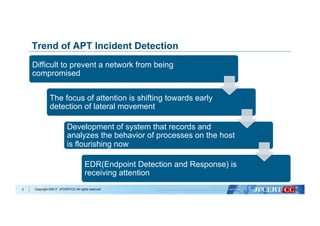
Difficult to prevent a network from being
compromised
The focus of attention is shifting towards early
detection of lateral movement
Development of system that records and
analyzes the behavior of processes on the host
is flourishing now
EDR(Endpoint Detection and Response) is
receiving attention
2
Trend of APT Incident Detection
Copyright ©2017 JPCERT/CC All rights reserved.3
Goals of This Presentation
Proposal of a method of
detecting lateral movement
Copyright ©2017 JPCERT/CC All rights reserved.
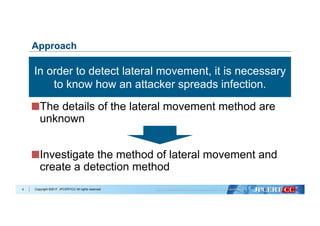
Approach
 The details of the lateral movement method are
unknown
 Investigate the method of lateral movement and
create a detection method
4
In order to detect lateral movement, it is necessary
to know how an attacker spreads infection.
Copyright ©2017 JPCERT/CC All rights reserved.
This Presentation Topics
5
1
Research of
Lateral Movement
2 Pattern of Lateral Movement
3
Detecting Lateral Movement
using Machine Learning
4 Detection System
Copyright ©2017 JPCERT/CC All rights reserved.6
1
Research of
Lateral Movement
2 Pattern of Lateral Movement
3
Detecting Lateral Movement
using Machine Learning
4 Detection System
Copyright ©2017 JPCERT/CC All rights reserved.
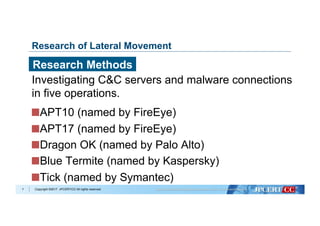
Research of Lateral Movement
Investigating C&C servers and malware connections
in five operations.
 APT10 (named by FireEye)
 APT17 (named by FireEye)
 Dragon OK (named by Palo Alto)
 Blue Termite (named by Kaspersky)
 Tick (named by Symantec)
7
Research Methods
Copyright ©2017 JPCERT/CC All rights reserved.
Research of Lateral Movement
 Investigate how to spread infection from the
commands executed by the attacker.
8
Research Methods
Copyright ©2017 JPCERT/CC All rights reserved.
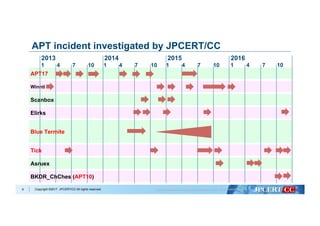
APT incident investigated by JPCERT/CC
BKDR_ChChes (APT10)
Asruex
Elirks
Tick
Blue Termite
Scanbox
Winnti
APT17
2013	 2014	 2015	
1	 4	 7	 10	 1	 4	 7	 10	 1	 4	 7	 10	
2016	
1	 4	 7	 10	
9
Copyright ©2017 JPCERT/CC All rights reserved.
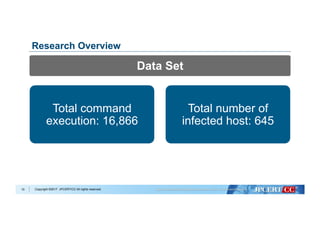
Data Set
Total command
execution: 16,866
Total number of
infected host: 645
10
Research Overview
Copyright ©2017 JPCERT/CC All rights reserved.
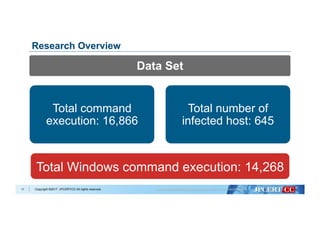
Data Set
Total command
execution: 16,866
Total number of
infected host: 645
11
Research Overview
Total Windows command execution: 14,268
Copyright ©2017 JPCERT/CC All rights reserved.
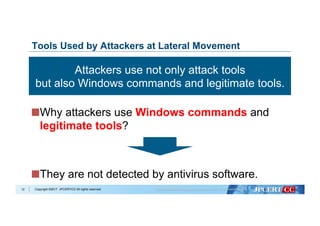
Tools Used by Attackers at Lateral Movement
 Why attackers use Windows commands and
legitimate tools?
 They are not detected by antivirus software.
12
Attackers use not only attack tools
but also Windows commands and legitimate tools.
Copyright ©2017 JPCERT/CC All rights reserved.13
1
Research of
Lateral Movement
2 Pattern of Lateral Movement
3
Detecting Lateral Movement
using Machine Learning
4 Detection System
Copyright ©2017 JPCERT/CC All rights reserved.14
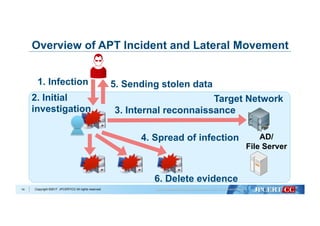
AD/
File Server
Target Network
1. Infection
2. Initial
investigation 3. Internal reconnaissance
4. Spread of infection
5. Sending stolen data
Overview of APT Incident and Lateral Movement
6. Delete evidence
Copyright ©2017 JPCERT/CC All rights reserved.
Lateral Movement: Initial Investigation
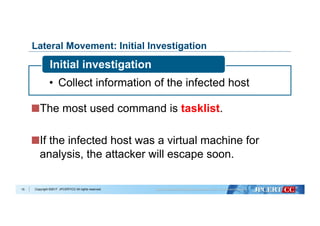
 The most used command is tasklist.
 If the infected host was a virtual machine for
analysis, the attacker will escape soon.
15
•  Collect information of the infected host
Initial investigation
Copyright ©2017 JPCERT/CC All rights reserved.
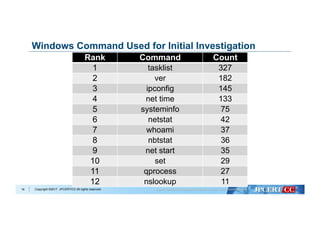
Windows Command Used for Initial Investigation
Rank Command Count
1 tasklist 327
2 ver 182
3 ipconfig 145
4 net time 133
5 systeminfo 75
6 netstat 42
7 whoami 37
8 nbtstat 36
9 net start 35
10 set 29
11 qprocess 27
12 nslookup 11
16
Copyright ©2017 JPCERT/CC All rights reserved.
Lateral Movement: Internal Reconnaissance
•  Look for information saved in the compromised
machine and information on the network
Internal Reconnaissance
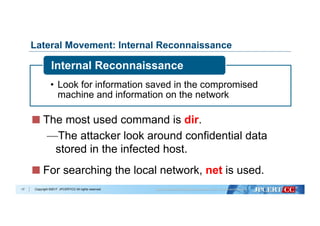
17
  The most used command is dir.
— The attacker look around confidential data
stored in the infected host.
  For searching the local network, net is used.
Copyright ©2017 JPCERT/CC All rights reserved.
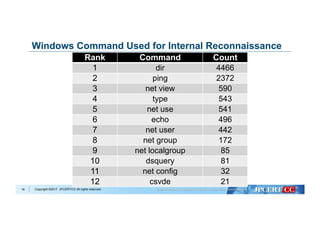
Windows Command Used for Internal Reconnaissance
Rank Command Count
1 dir 4466
2 ping 2372
3 net view 590
4 type 543
5 net use 541
6 echo 496
7 net user 442
8 net group 172
9 net localgroup 85
10 dsquery 81
11 net config 32
12 csvde 21
18
Copyright ©2017 JPCERT/CC All rights reserved.
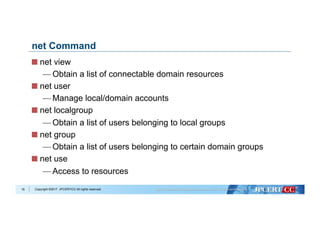
net Command
  net view
— Obtain a list of connectable domain resources
  net user
— Manage local/domain accounts
  net localgroup
— Obtain a list of users belonging to local groups
  net group
— Obtain a list of users belonging to certain domain groups
  net use
— Access to resources
19
Copyright ©2017 JPCERT/CC All rights reserved.
Lateral Movement: Spread of Infection
•  Infect the machine with other malware or
try to access other hosts
Spread of infection
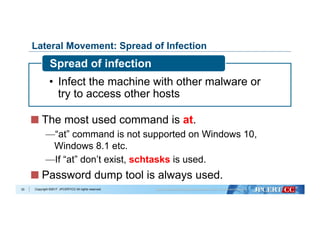
20
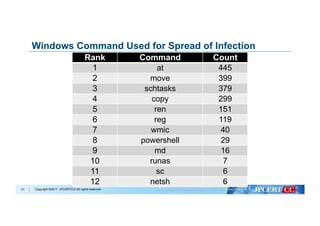
  The most used command is at.
— “at” command is not supported on Windows 10,
Windows 8.1 etc.
— If “at” don’t exist, schtasks is used.
  Password dump tool is always used.
Copyright ©2017 JPCERT/CC All rights reserved.
Windows Command Used for Spread of Infection
21
Rank Command Count
1 at 445
2 move 399
3 schtasks 379
4 copy 299
5 ren 151
6 reg 119
7 wmic 40
8 powershell 29
9 md 16
10 runas 7
11 sc 6
12 netsh 6
Copyright ©2017 JPCERT/CC All rights reserved.
Remote Command Execute Used Windows Command
22
at command
> at [IP Address] 12:00 cmd /c "C:windowstemp
mal.exe"
schtasks command
> schtasks /create /tn [Task Name] /tr C:1.bat /sc
onstart /ru System /s [IP Address]
Copyright ©2017 JPCERT/CC All rights reserved.
Remote Command Execute Used Windows Command
23
wmic command
> wmic /node:[IP Address] /user:”[User Name]” /
password:”[PASSWORD]” process call create
“cmd /c c:WindowsSystem32net.exe user”
Copyright ©2017 JPCERT/CC All rights reserved.
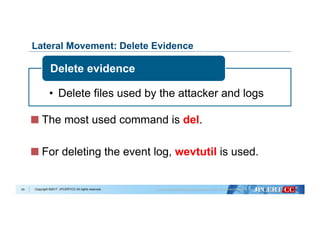
Lateral Movement: Delete Evidence
•  Delete files used by the attacker and logs
Delete evidence
24
  The most used command is del.
  For deleting the event log, wevtutil is used.
Copyright ©2017 JPCERT/CC All rights reserved.
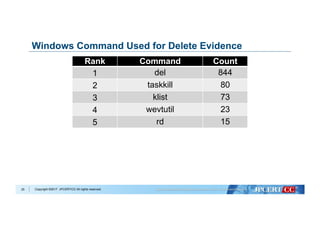
Windows Command Used for Delete Evidence
Rank Command Count
1 del 844
2 taskkill 80
3 klist 73
4 wevtutil 23
5 rd 15
25
Copyright ©2017 JPCERT/CC All rights reserved.
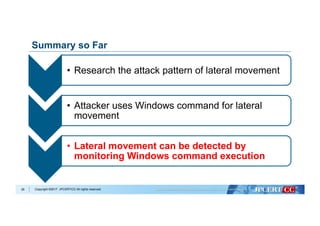
•  Research the attack pattern of lateral movement
•  Attacker uses Windows command for lateral
movement
•  Lateral movement can be detected by
monitoring Windows command execution
26
Summary so Far
Copyright ©2017 JPCERT/CC All rights reserved.
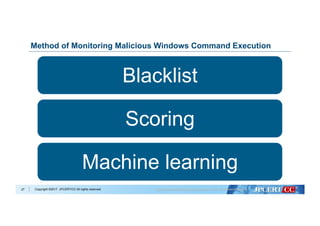
Blacklist
Scoring
Machine learning
27
Method of Monitoring Malicious Windows Command Execution
Copyright ©2017 JPCERT/CC All rights reserved.28
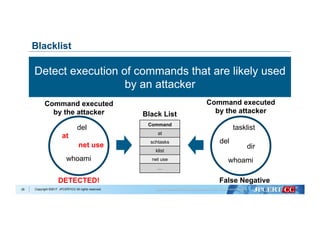
Blacklist
Detect execution of commands that are likely used
by an attacker
Command executed
by the attacker
at
whoami
del
net use
Command
at
schtasks
klist
net use
…
Black List
whoami
tasklist
del
dir
Command executed
by the attacker
False NegativeDETECTED!
Copyright ©2017 JPCERT/CC All rights reserved.
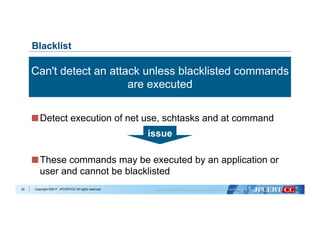
 Detect execution of net use, schtasks and at command
 These commands may be executed by an application or
user and cannot be blacklisted
29
Blacklist
Can't detect an attack unless blacklisted commands
are executed
issue
Copyright ©2017 JPCERT/CC All rights reserved.30
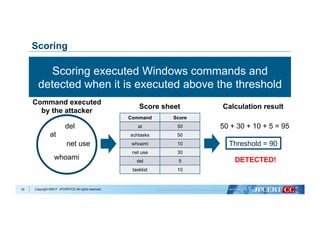
Scoring
Scoring executed Windows commands and
detected when it is executed above the threshold
Command Score
at 50
schtasks 50
whoami 10
net use 30
del 5
tasklist 10
Score sheet
at
whoami
del
net use
Calculation result
50 + 30 + 10 + 5 = 95
Threshold = 90
DETECTED!
Command executed
by the attacker
Copyright ©2017 JPCERT/CC All rights reserved.31
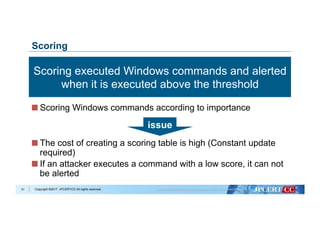
Scoring
 Scoring Windows commands according to importance
 The cost of creating a scoring table is high (Constant update
required)
 If an attacker executes a command with a low score, it can not
be alerted
issue
Scoring executed Windows commands and alerted
when it is executed above the threshold
Copyright ©2017 JPCERT/CC All rights reserved.
 
    
32
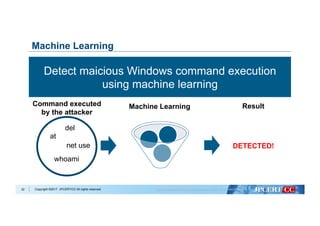
Machine Learning
Detect maicious Windows command execution
using machine learning
Machine Learning
at
whoami
del
net use
Result
DETECTED!
Command executed
by the attacker
Copyright ©2017 JPCERT/CC All rights reserved.33
Machine Learning
Detect anomaly Windows command
using machine learning
After this slide, I present the observation
results of this method
Copyright ©2017 JPCERT/CC All rights reserved.34
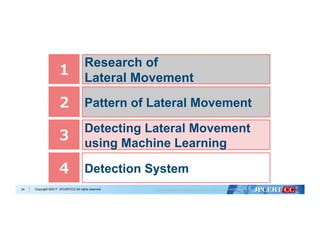
1
Research of
Lateral Movement
2 Pattern of Lateral Movement
3
Detecting Lateral Movement
using Machine Learning
4 Detection System
Copyright ©2017 JPCERT/CC All rights reserved.
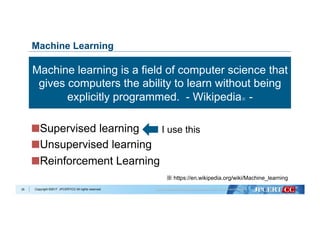
 Supervised learning
 Unsupervised learning
 Reinforcement Learning
35
Machine Learning
Machine learning is a field of computer science that
gives computers the ability to learn without being
explicitly programmed. - Wikipedia※ -
※ https://en.wikipedia.org/wiki/Machine_learning
I use this
Copyright ©2017 JPCERT/CC All rights reserved.
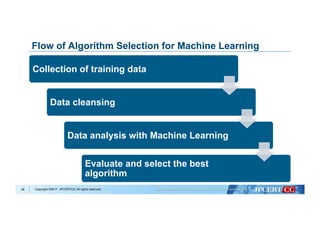
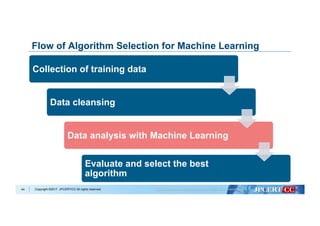
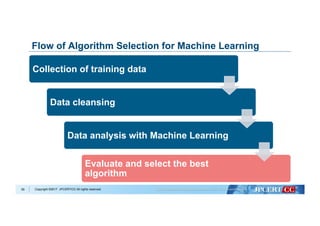
Collection of training data
Data cleansing
Data analysis with Machine Learning
Evaluate and select the best
algorithm
36
Flow of Algorithm Selection for Machine Learning
Copyright ©2017 JPCERT/CC All rights reserved.
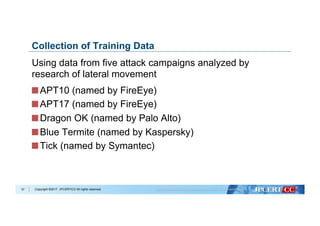
Using data from five attack campaigns analyzed by
research of lateral movement
 APT10 (named by FireEye)
 APT17 (named by FireEye)
 Dragon OK (named by Palo Alto)
 Blue Termite (named by Kaspersky)
 Tick (named by Symantec)
37
Collection of Training Data
Copyright ©2017 JPCERT/CC All rights reserved.
Collection of training data
Data cleansing
Data analysis with Machine Learning
Evaluate and select the best
algorithm
38
Flow of Algorithm Selection for Machine Learning
Copyright ©2017 JPCERT/CC All rights reserved.39
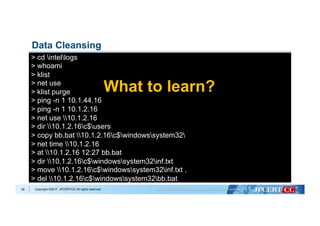
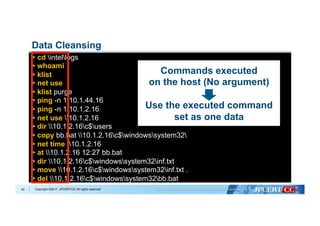
Data Cleansing
> cd intellogs
> whoami
> klist
> net use
> klist purge
> ping -n 1 10.1.44.16
> ping -n 1 10.1.2.16
> net use 10.1.2.16
> dir 10.1.2.16c$users
> copy bb.bat 10.1.2.16c$windowssystem32
> net time 10.1.2.16
> at 10.1.2.16 12:27 bb.bat
> dir 10.1.2.16c$windowssystem32inf.txt
> move 10.1.2.16c$windowssystem32inf.txt .
> del 10.1.2.16c$windowssystem32bb.bat
What to learn?
Copyright ©2017 JPCERT/CC All rights reserved.40
Data Cleansing
> cd intellogs
> whoami
> klist
> net use
> klist purge
> ping -n 1 10.1.44.16
> ping -n 1 10.1.2.16
> net use 10.1.2.16
> dir 10.1.2.16c$users
> copy bb.bat 10.1.2.16c$windowssystem32
> net time 10.1.2.16
> at 10.1.2.16 12:27 bb.bat
> dir 10.1.2.16c$windowssystem32inf.txt
> move 10.1.2.16c$windowssystem32inf.txt .
> del 10.1.2.16c$windowssystem32bb.bat
Commands executed
on the host (No argument)
Use the executed command
set as one data
Copyright ©2017 JPCERT/CC All rights reserved.41
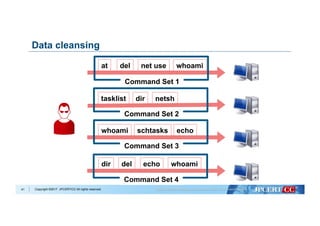
Data cleansing
at whoamidel net use
tasklist dir netsh
whoami schtasks echo
dir del echo whoami
Command Set 1
Command Set 2
Command Set 3
Command Set 4
Copyright ©2017 JPCERT/CC All rights reserved.
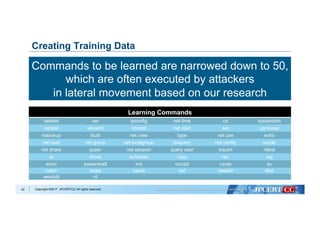
Creating Training Data
Learning Commands
tasklist ver ipconfig net time cd systeminfo
netstat whoami nbtstat net start set qprocess
nslookup fsutil net view type net use echo
net user net group net localgroup dsquery net config csvde
net share quser net session query user tracert nltest
at move schtasks copy ren reg
wmic powershell md cscript runas sc
netsh wusa icacls del taskkill klist
wevtutil rd
42
Commands to be learned are narrowed down to 50,
which are often executed by attackers
in lateral movement based on our research
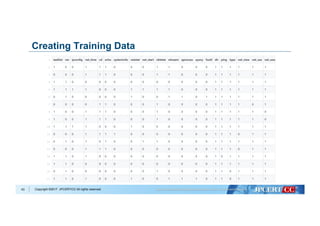
Copyright ©2017 JPCERT/CC All rights reserved.43
Creating Training Data
Copyright ©2017 JPCERT/CC All rights reserved.
Collection of training data
Data cleansing
Data analysis with Machine Learning
Evaluate and select the best
algorithm
44
Flow of Algorithm Selection for Machine Learning
Copyright ©2017 JPCERT/CC All rights reserved.
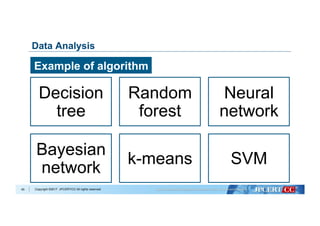
Decision
tree
Random
forest
Neural
network
Bayesian
network
k-means SVM
45
Data Analysis
Example of algorithm
Copyright ©2017 JPCERT/CC All rights reserved.46
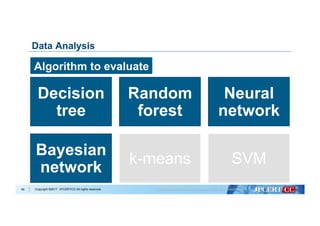
Data Analysis
Algorithm to evaluate
Decision
tree
Random
forest
Neural
network
Bayesian
network
k-means SVM
Copyright ©2017 JPCERT/CC All rights reserved.
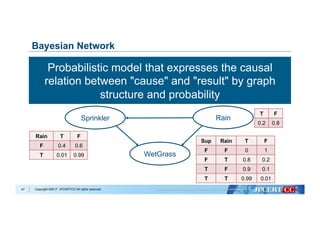
T F
0.2 0.8
47
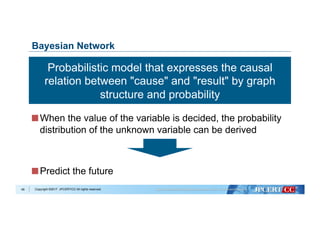
Bayesian Network
Probabilistic model that expresses the causal
relation between "cause" and "result" by graph
structure and probability
Rain
WetGrass
Sprinkler
Rain T F
F 0.4 0.6
T 0.01 0.99
Sup Rain T F
F F 0 1
F T 0.8 0.2
T F 0.9 0.1
T T 0.99 0.01
Copyright ©2017 JPCERT/CC All rights reserved.48
Bayesian Network
 When the value of the variable is decided, the probability
distribution of the unknown variable can be derived
 Predict the future
Probabilistic model that expresses the causal
relation between "cause" and "result" by graph
structure and probability
Copyright ©2017 JPCERT/CC All rights reserved.
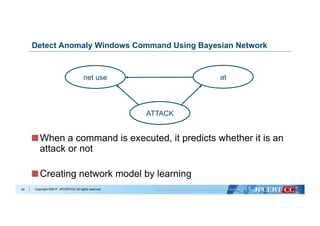
 When a command is executed, it predicts whether it is an
attack or not
 Creating network model by learning
49
Detect Anomaly Windows Command Using Bayesian Network
at
ATTACK
net use
Copyright ©2017 JPCERT/CC All rights reserved.50
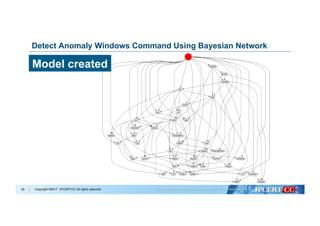
Detect Anomaly Windows Command Using Bayesian Network
Model created
Copyright ©2017 JPCERT/CC All rights reserved.51
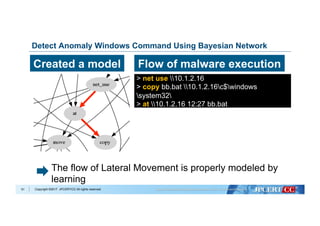
Detect Anomaly Windows Command Using Bayesian Network
Created a model
> net use 10.1.2.16
> copy bb.bat 10.1.2.16c$windows
system32
> at 10.1.2.16 12:27 bb.bat
Flow of malware execution
The flow of Lateral Movement is properly modeled by
learning
Copyright ©2017 JPCERT/CC All rights reserved.52
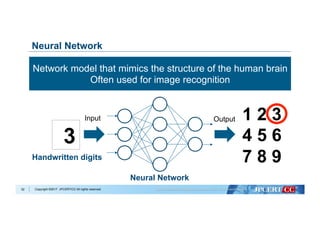
Neural Network
Network model that mimics the structure of the human brain
Often used for image recognition
3
Input Output 1 2 3
4 5 6
7 8 9Handwritten digits
Neural Network
Copyright ©2017 JPCERT/CC All rights reserved.53
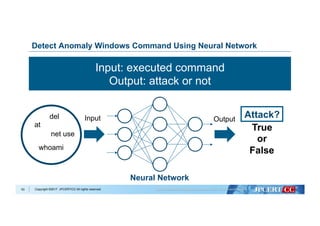
Detect Anomaly Windows Command Using Neural Network
Input: executed command
Output: attack or not
Input Output
Neural Network
at
whoami
del
net use
True
or
False
Attack?
Copyright ©2017 JPCERT/CC All rights reserved.
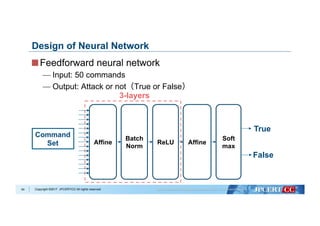
Design of Neural Network
 Feedforward neural network
— Input: 50 commands
— Output: Attack or not(True or False)
54
Affine
Batch
Norm
ReLU Affine
Soft
max
Command
Set
3-layers
True
False
Copyright ©2017 JPCERT/CC All rights reserved.55
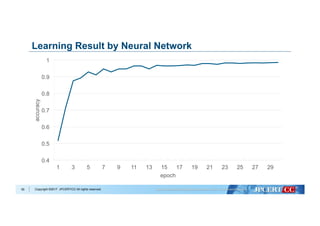
Learning Result by Neural Network
0.4
0.5
0.6
0.7
0.8
0.9
1
1 3 5 7 9 11 13 15 17 19 21 23 25 27 29
accuracy
epoch
Copyright ©2017 JPCERT/CC All rights reserved.
Problem
56
・ The model created by learning is a black box,
and it is unknown which criteria is used
・ The criteria changes for each learning result
Problem of neural network
Copyright ©2017 JPCERT/CC All rights reserved.
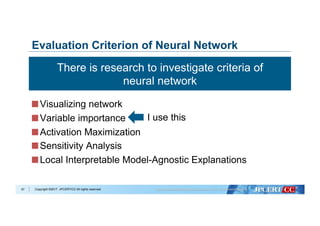
Evaluation Criterion of Neural Network
 Visualizing network
 Variable importance
 Activation Maximization
 Sensitivity Analysis
 Local Interpretable Model-Agnostic Explanations
57
There is research to investigate criteria of
neural network
I use this
Copyright ©2017 JPCERT/CC All rights reserved.58
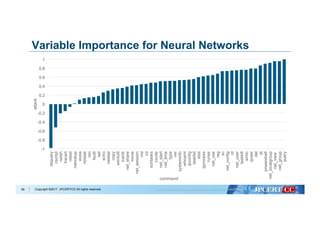
Variable Importance for Neural Networks
-1
-0.8
-0.6
-0.4
-0.2
0
0.2
0.4
0.6
0.8
1
dsquery
cscript
netsh
tracert
nltest
nslookup
wusa
nbtstat
ren
fsutil
set
echo
netstat
copy
wevtutil
icacls
net_share
move
net_session
md
cd
schtasks
csvde
net_start
net_time
type
ver
systeminfo
whoami
ipconfig
tasklist
klist
qprocess
runas
net_use
reg
sc
net_config
rd
net_user
taskkill
wmic
quser
del
at
powershell
net_localgroup
net_view
net_group
query
attack
command
Copyright ©2017 JPCERT/CC All rights reserved.
Collection of training data
Data cleansing
Data analysis with Machine Learning
Evaluate and select the best
algorithm
59
Flow of Algorithm Selection for Machine Learning
Copyright ©2017 JPCERT/CC All rights reserved.
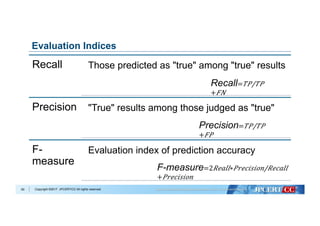
Evaluation Indices
Recall Those predicted as "true" among "true" results
Precision "True" results among those judged as "true"
F-
measure
Evaluation index of prediction accuracy
60
Recall=​ 𝑇 𝑃/𝑇𝑃
+ 𝐹𝑁 
Precision=​ 𝑇 𝑃/𝑇𝑃
+ 𝐹𝑃 
F-measure=​2 𝑅𝑒𝑎𝑙𝑙∗ 𝑃𝑟𝑒𝑐𝑖𝑠𝑖𝑜𝑛/𝑅𝑒𝑐𝑎𝑙𝑙
+ 𝑃𝑟𝑒𝑐𝑖𝑠𝑖𝑜𝑛 
Copyright ©2017 JPCERT/CC All rights reserved.
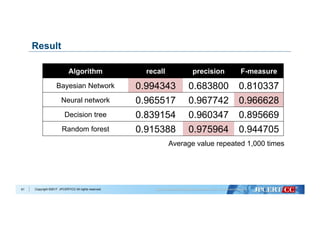
Result
Algorithm recall precision F-measure
Bayesian Network 0.994343 0.683800 0.810337
Neural network 0.965517 0.967742 0.966628
Decision tree 0.839154 0.960347 0.895669
Random forest 0.915388 0.975964 0.944705
61
Average value repeated 1,000 times
Copyright ©2017 JPCERT/CC All rights reserved.
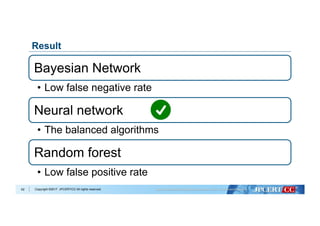
Bayesian Network
•  Low false negative rate
Neural network
•  The balanced algorithms
Random forest
•  Low false positive rate
62
Result
Copyright ©2017 JPCERT/CC All rights reserved.63
1
Research of
Lateral Movement
2 Pattern of Lateral Movement
3
Detecting Lateral Movement
using Machine Learning
4 Detection System
Copyright ©2017 JPCERT/CC All rights reserved.64
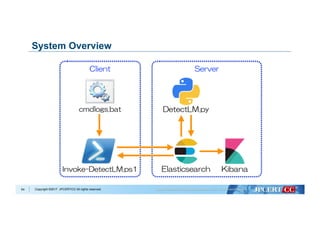
System Overview
Copyright ©2017 JPCERT/CC All rights reserved.
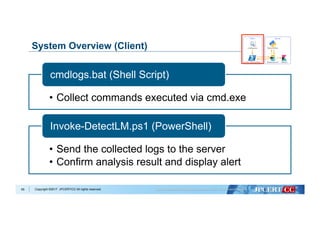
System Overview (Client)
65
•  Collect commands executed via cmd.exe
cmdlogs.bat (Shell Script)
•  Send the collected logs to the server
•  Confirm analysis result and display alert
Invoke-DetectLM.ps1 (PowerShell)
Copyright ©2017 JPCERT/CC All rights reserved.
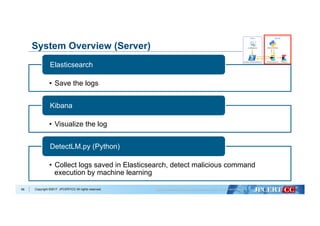
System Overview (Server)
66
•  Save the logs
Elasticsearch
•  Visualize the log
Kibana
•  Collect logs saved in Elasticsearch, detect malicious command
execution by machine learning
DetectLM.py (Python)
Copyright ©2017 JPCERT/CC All rights reserved.
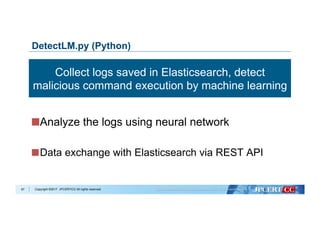
DetectLM.py (Python)
 Analyze the logs using neural network
 Data exchange with Elasticsearch via REST API
67
Collect logs saved in Elasticsearch, detect
malicious command execution by machine learning
Copyright ©2017 JPCERT/CC All rights reserved.68
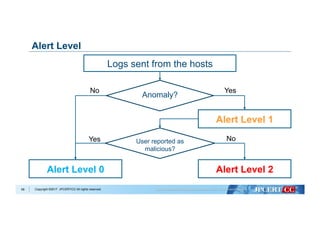
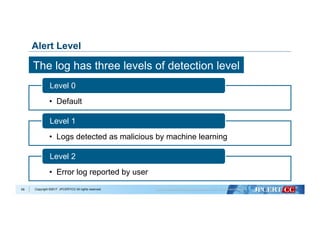
Alert Level
Logs sent from the hosts
Anomaly?
Alert Level 0
No
Alert Level 1
Yes
User reported as
malicious?
Alert Level 2
NoYes
Copyright ©2017 JPCERT/CC All rights reserved.
•  Default
Level 0
•  Logs detected as malicious by machine learning
Level 1
•  Error log reported by user
Level 2
69
Alert Level
The log has three levels of detection level
Copyright ©2017 JPCERT/CC All rights reserved.
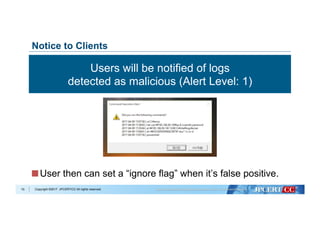
Notice to Clients
 User then can set a “ignore flag” when it’s false positive.
70
Users will be notified of logs
detected as malicious (Alert Level: 1)
Copyright ©2017 JPCERT/CC All rights reserved.
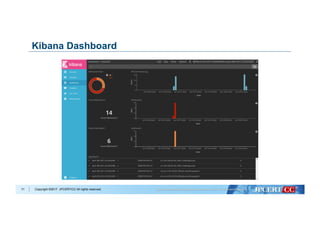
Kibana Dashboard
71
Copyright ©2017 JPCERT/CC All rights reserved.
Demo
72
Copyright ©2017 JPCERT/CC All rights reserved.
Future Work
Update algorithm
•  Current algorithm does not consider time series
data and frequency of execution
•  Some commands have to be executed in order
•  Take in (consider) time series of execution
73
Copyright ©2017 JPCERT/CC All rights reserved.
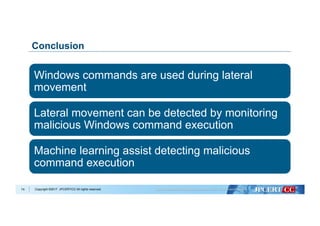
Conclusion
Windows commands are used during lateral
movement
Lateral movement can be detected by monitoring
malicious Windows command execution
Machine learning assist detecting malicious
command execution
74
Copyright ©2017 JPCERT/CC All rights reserved.75
Thank you
Q&A
https://github.com/JPCERTCC/DetectLM

Shusei tomonaga pac_sec_20171026

  • 1.
    Neural Network for DetectingAPT Lateral Movement Shusei Tomonaga JPCERT/CC PacSec 2017
  • 2.
    Copyright ©2017 JPCERT/CCAll rights reserved. Self-introduction  Analysis Center at JPCERT/CC  Malware analysis, Forensics investigation.  Written up posts on malware analysis and technical findings on this blog and Github. ̶ http://blog.jpcert.or.jp/ ̶ https://github.com/JPCERTCC/aa-tools ※ Iʼm a malware analyst, not a data scientist. 1 Shusei Tomonaga
  • 3.
    Copyright ©2017 JPCERT/CCAll rights reserved. Difficult to prevent a network from being compromised The focus of attention is shifting towards early detection of lateral movement Development of system that records and analyzes the behavior of processes on the host is flourishing now EDR(Endpoint Detection and Response) is receiving attention 2 Trend of APT Incident Detection
  • 4.
    Copyright ©2017 JPCERT/CCAll rights reserved.3 Goals of This Presentation Proposal of a method of detecting lateral movement
  • 5.
    Copyright ©2017 JPCERT/CCAll rights reserved. Approach  The details of the lateral movement method are unknown  Investigate the method of lateral movement and create a detection method 4 In order to detect lateral movement, it is necessary to know how an attacker spreads infection.
  • 6.
    Copyright ©2017 JPCERT/CCAll rights reserved. This Presentation Topics 5 1 Research of Lateral Movement 2 Pattern of Lateral Movement 3 Detecting Lateral Movement using Machine Learning 4 Detection System
  • 7.
    Copyright ©2017 JPCERT/CCAll rights reserved.6 1 Research of Lateral Movement 2 Pattern of Lateral Movement 3 Detecting Lateral Movement using Machine Learning 4 Detection System
  • 8.
    Copyright ©2017 JPCERT/CCAll rights reserved. Research of Lateral Movement Investigating C&C servers and malware connections in five operations.  APT10 (named by FireEye)  APT17 (named by FireEye)  Dragon OK (named by Palo Alto)  Blue Termite (named by Kaspersky)  Tick (named by Symantec) 7 Research Methods
  • 9.
    Copyright ©2017 JPCERT/CCAll rights reserved. Research of Lateral Movement  Investigate how to spread infection from the commands executed by the attacker. 8 Research Methods
  • 10.
    Copyright ©2017 JPCERT/CCAll rights reserved. APT incident investigated by JPCERT/CC BKDR_ChChes (APT10) Asruex Elirks Tick Blue Termite Scanbox Winnti APT17 2013 2014 2015 1 4 7 10 1 4 7 10 1 4 7 10 2016 1 4 7 10 9
  • 11.
    Copyright ©2017 JPCERT/CCAll rights reserved. Data Set Total command execution: 16,866 Total number of infected host: 645 10 Research Overview
  • 12.
    Copyright ©2017 JPCERT/CCAll rights reserved. Data Set Total command execution: 16,866 Total number of infected host: 645 11 Research Overview Total Windows command execution: 14,268
  • 13.
    Copyright ©2017 JPCERT/CCAll rights reserved. Tools Used by Attackers at Lateral Movement  Why attackers use Windows commands and legitimate tools?  They are not detected by antivirus software. 12 Attackers use not only attack tools but also Windows commands and legitimate tools.
  • 14.
    Copyright ©2017 JPCERT/CCAll rights reserved.13 1 Research of Lateral Movement 2 Pattern of Lateral Movement 3 Detecting Lateral Movement using Machine Learning 4 Detection System
  • 15.
    Copyright ©2017 JPCERT/CCAll rights reserved.14 AD/ File Server Target Network 1. Infection 2. Initial investigation 3. Internal reconnaissance 4. Spread of infection 5. Sending stolen data Overview of APT Incident and Lateral Movement 6. Delete evidence
  • 16.
    Copyright ©2017 JPCERT/CCAll rights reserved. Lateral Movement: Initial Investigation  The most used command is tasklist.  If the infected host was a virtual machine for analysis, the attacker will escape soon. 15 •  Collect information of the infected host Initial investigation
  • 17.
    Copyright ©2017 JPCERT/CCAll rights reserved. Windows Command Used for Initial Investigation Rank Command Count 1 tasklist 327 2 ver 182 3 ipconfig 145 4 net time 133 5 systeminfo 75 6 netstat 42 7 whoami 37 8 nbtstat 36 9 net start 35 10 set 29 11 qprocess 27 12 nslookup 11 16
  • 18.
    Copyright ©2017 JPCERT/CCAll rights reserved. Lateral Movement: Internal Reconnaissance •  Look for information saved in the compromised machine and information on the network Internal Reconnaissance 17   The most used command is dir. — The attacker look around confidential data stored in the infected host.   For searching the local network, net is used.
  • 19.
    Copyright ©2017 JPCERT/CCAll rights reserved. Windows Command Used for Internal Reconnaissance Rank Command Count 1 dir 4466 2 ping 2372 3 net view 590 4 type 543 5 net use 541 6 echo 496 7 net user 442 8 net group 172 9 net localgroup 85 10 dsquery 81 11 net config 32 12 csvde 21 18
  • 20.
    Copyright ©2017 JPCERT/CCAll rights reserved. net Command   net view — Obtain a list of connectable domain resources   net user — Manage local/domain accounts   net localgroup — Obtain a list of users belonging to local groups   net group — Obtain a list of users belonging to certain domain groups   net use — Access to resources 19
  • 21.
    Copyright ©2017 JPCERT/CCAll rights reserved. Lateral Movement: Spread of Infection •  Infect the machine with other malware or try to access other hosts Spread of infection 20   The most used command is at. — “at” command is not supported on Windows 10, Windows 8.1 etc. — If “at” don’t exist, schtasks is used.   Password dump tool is always used.
  • 22.
    Copyright ©2017 JPCERT/CCAll rights reserved. Windows Command Used for Spread of Infection 21 Rank Command Count 1 at 445 2 move 399 3 schtasks 379 4 copy 299 5 ren 151 6 reg 119 7 wmic 40 8 powershell 29 9 md 16 10 runas 7 11 sc 6 12 netsh 6
  • 23.
    Copyright ©2017 JPCERT/CCAll rights reserved. Remote Command Execute Used Windows Command 22 at command > at [IP Address] 12:00 cmd /c "C:windowstemp mal.exe" schtasks command > schtasks /create /tn [Task Name] /tr C:1.bat /sc onstart /ru System /s [IP Address]
  • 24.
    Copyright ©2017 JPCERT/CCAll rights reserved. Remote Command Execute Used Windows Command 23 wmic command > wmic /node:[IP Address] /user:”[User Name]” / password:”[PASSWORD]” process call create “cmd /c c:WindowsSystem32net.exe user”
  • 25.
    Copyright ©2017 JPCERT/CCAll rights reserved. Lateral Movement: Delete Evidence •  Delete files used by the attacker and logs Delete evidence 24   The most used command is del.   For deleting the event log, wevtutil is used.
  • 26.
    Copyright ©2017 JPCERT/CCAll rights reserved. Windows Command Used for Delete Evidence Rank Command Count 1 del 844 2 taskkill 80 3 klist 73 4 wevtutil 23 5 rd 15 25
  • 27.
    Copyright ©2017 JPCERT/CCAll rights reserved. •  Research the attack pattern of lateral movement •  Attacker uses Windows command for lateral movement •  Lateral movement can be detected by monitoring Windows command execution 26 Summary so Far
  • 28.
    Copyright ©2017 JPCERT/CCAll rights reserved. Blacklist Scoring Machine learning 27 Method of Monitoring Malicious Windows Command Execution
  • 29.
    Copyright ©2017 JPCERT/CCAll rights reserved.28 Blacklist Detect execution of commands that are likely used by an attacker Command executed by the attacker at whoami del net use Command at schtasks klist net use … Black List whoami tasklist del dir Command executed by the attacker False NegativeDETECTED!
  • 30.
    Copyright ©2017 JPCERT/CCAll rights reserved.  Detect execution of net use, schtasks and at command  These commands may be executed by an application or user and cannot be blacklisted 29 Blacklist Can't detect an attack unless blacklisted commands are executed issue
  • 31.
    Copyright ©2017 JPCERT/CCAll rights reserved.30 Scoring Scoring executed Windows commands and detected when it is executed above the threshold Command Score at 50 schtasks 50 whoami 10 net use 30 del 5 tasklist 10 Score sheet at whoami del net use Calculation result 50 + 30 + 10 + 5 = 95 Threshold = 90 DETECTED! Command executed by the attacker
  • 32.
    Copyright ©2017 JPCERT/CCAll rights reserved.31 Scoring  Scoring Windows commands according to importance  The cost of creating a scoring table is high (Constant update required)  If an attacker executes a command with a low score, it can not be alerted issue Scoring executed Windows commands and alerted when it is executed above the threshold
  • 33.
    Copyright ©2017 JPCERT/CCAll rights reserved.        32 Machine Learning Detect maicious Windows command execution using machine learning Machine Learning at whoami del net use Result DETECTED! Command executed by the attacker
  • 34.
    Copyright ©2017 JPCERT/CCAll rights reserved.33 Machine Learning Detect anomaly Windows command using machine learning After this slide, I present the observation results of this method
  • 35.
    Copyright ©2017 JPCERT/CCAll rights reserved.34 1 Research of Lateral Movement 2 Pattern of Lateral Movement 3 Detecting Lateral Movement using Machine Learning 4 Detection System
  • 36.
    Copyright ©2017 JPCERT/CCAll rights reserved.  Supervised learning  Unsupervised learning  Reinforcement Learning 35 Machine Learning Machine learning is a field of computer science that gives computers the ability to learn without being explicitly programmed. - Wikipedia※ - ※ https://en.wikipedia.org/wiki/Machine_learning I use this
  • 37.
    Copyright ©2017 JPCERT/CCAll rights reserved. Collection of training data Data cleansing Data analysis with Machine Learning Evaluate and select the best algorithm 36 Flow of Algorithm Selection for Machine Learning
  • 38.
    Copyright ©2017 JPCERT/CCAll rights reserved. Using data from five attack campaigns analyzed by research of lateral movement  APT10 (named by FireEye)  APT17 (named by FireEye)  Dragon OK (named by Palo Alto)  Blue Termite (named by Kaspersky)  Tick (named by Symantec) 37 Collection of Training Data
  • 39.
    Copyright ©2017 JPCERT/CCAll rights reserved. Collection of training data Data cleansing Data analysis with Machine Learning Evaluate and select the best algorithm 38 Flow of Algorithm Selection for Machine Learning
  • 40.
    Copyright ©2017 JPCERT/CCAll rights reserved.39 Data Cleansing > cd intellogs > whoami > klist > net use > klist purge > ping -n 1 10.1.44.16 > ping -n 1 10.1.2.16 > net use 10.1.2.16 > dir 10.1.2.16c$users > copy bb.bat 10.1.2.16c$windowssystem32 > net time 10.1.2.16 > at 10.1.2.16 12:27 bb.bat > dir 10.1.2.16c$windowssystem32inf.txt > move 10.1.2.16c$windowssystem32inf.txt . > del 10.1.2.16c$windowssystem32bb.bat What to learn?
  • 41.
    Copyright ©2017 JPCERT/CCAll rights reserved.40 Data Cleansing > cd intellogs > whoami > klist > net use > klist purge > ping -n 1 10.1.44.16 > ping -n 1 10.1.2.16 > net use 10.1.2.16 > dir 10.1.2.16c$users > copy bb.bat 10.1.2.16c$windowssystem32 > net time 10.1.2.16 > at 10.1.2.16 12:27 bb.bat > dir 10.1.2.16c$windowssystem32inf.txt > move 10.1.2.16c$windowssystem32inf.txt . > del 10.1.2.16c$windowssystem32bb.bat Commands executed on the host (No argument) Use the executed command set as one data
  • 42.
    Copyright ©2017 JPCERT/CCAll rights reserved.41 Data cleansing at whoamidel net use tasklist dir netsh whoami schtasks echo dir del echo whoami Command Set 1 Command Set 2 Command Set 3 Command Set 4
  • 43.
    Copyright ©2017 JPCERT/CCAll rights reserved. Creating Training Data Learning Commands tasklist ver ipconfig net time cd systeminfo netstat whoami nbtstat net start set qprocess nslookup fsutil net view type net use echo net user net group net localgroup dsquery net config csvde net share quser net session query user tracert nltest at move schtasks copy ren reg wmic powershell md cscript runas sc netsh wusa icacls del taskkill klist wevtutil rd 42 Commands to be learned are narrowed down to 50, which are often executed by attackers in lateral movement based on our research
  • 44.
    Copyright ©2017 JPCERT/CCAll rights reserved.43 Creating Training Data
  • 45.
    Copyright ©2017 JPCERT/CCAll rights reserved. Collection of training data Data cleansing Data analysis with Machine Learning Evaluate and select the best algorithm 44 Flow of Algorithm Selection for Machine Learning
  • 46.
    Copyright ©2017 JPCERT/CCAll rights reserved. Decision tree Random forest Neural network Bayesian network k-means SVM 45 Data Analysis Example of algorithm
  • 47.
    Copyright ©2017 JPCERT/CCAll rights reserved.46 Data Analysis Algorithm to evaluate Decision tree Random forest Neural network Bayesian network k-means SVM
  • 48.
    Copyright ©2017 JPCERT/CCAll rights reserved. T F 0.2 0.8 47 Bayesian Network Probabilistic model that expresses the causal relation between "cause" and "result" by graph structure and probability Rain WetGrass Sprinkler Rain T F F 0.4 0.6 T 0.01 0.99 Sup Rain T F F F 0 1 F T 0.8 0.2 T F 0.9 0.1 T T 0.99 0.01
  • 49.
    Copyright ©2017 JPCERT/CCAll rights reserved.48 Bayesian Network  When the value of the variable is decided, the probability distribution of the unknown variable can be derived  Predict the future Probabilistic model that expresses the causal relation between "cause" and "result" by graph structure and probability
  • 50.
    Copyright ©2017 JPCERT/CCAll rights reserved.  When a command is executed, it predicts whether it is an attack or not  Creating network model by learning 49 Detect Anomaly Windows Command Using Bayesian Network at ATTACK net use
  • 51.
    Copyright ©2017 JPCERT/CCAll rights reserved.50 Detect Anomaly Windows Command Using Bayesian Network Model created
  • 52.
    Copyright ©2017 JPCERT/CCAll rights reserved.51 Detect Anomaly Windows Command Using Bayesian Network Created a model > net use 10.1.2.16 > copy bb.bat 10.1.2.16c$windows system32 > at 10.1.2.16 12:27 bb.bat Flow of malware execution The flow of Lateral Movement is properly modeled by learning
  • 53.
    Copyright ©2017 JPCERT/CCAll rights reserved.52 Neural Network Network model that mimics the structure of the human brain Often used for image recognition 3 Input Output 1 2 3 4 5 6 7 8 9Handwritten digits Neural Network
  • 54.
    Copyright ©2017 JPCERT/CCAll rights reserved.53 Detect Anomaly Windows Command Using Neural Network Input: executed command Output: attack or not Input Output Neural Network at whoami del net use True or False Attack?
  • 55.
    Copyright ©2017 JPCERT/CCAll rights reserved. Design of Neural Network  Feedforward neural network — Input: 50 commands — Output: Attack or not(True or False) 54 Affine Batch Norm ReLU Affine Soft max Command Set 3-layers True False
  • 56.
    Copyright ©2017 JPCERT/CCAll rights reserved.55 Learning Result by Neural Network 0.4 0.5 0.6 0.7 0.8 0.9 1 1 3 5 7 9 11 13 15 17 19 21 23 25 27 29 accuracy epoch
  • 57.
    Copyright ©2017 JPCERT/CCAll rights reserved. Problem 56 ・ The model created by learning is a black box, and it is unknown which criteria is used ・ The criteria changes for each learning result Problem of neural network
  • 58.
    Copyright ©2017 JPCERT/CCAll rights reserved. Evaluation Criterion of Neural Network  Visualizing network  Variable importance  Activation Maximization  Sensitivity Analysis  Local Interpretable Model-Agnostic Explanations 57 There is research to investigate criteria of neural network I use this
  • 59.
    Copyright ©2017 JPCERT/CCAll rights reserved.58 Variable Importance for Neural Networks -1 -0.8 -0.6 -0.4 -0.2 0 0.2 0.4 0.6 0.8 1 dsquery cscript netsh tracert nltest nslookup wusa nbtstat ren fsutil set echo netstat copy wevtutil icacls net_share move net_session md cd schtasks csvde net_start net_time type ver systeminfo whoami ipconfig tasklist klist qprocess runas net_use reg sc net_config rd net_user taskkill wmic quser del at powershell net_localgroup net_view net_group query attack command
  • 60.
    Copyright ©2017 JPCERT/CCAll rights reserved. Collection of training data Data cleansing Data analysis with Machine Learning Evaluate and select the best algorithm 59 Flow of Algorithm Selection for Machine Learning
  • 61.
    Copyright ©2017 JPCERT/CCAll rights reserved. Evaluation Indices Recall Those predicted as "true" among "true" results Precision "True" results among those judged as "true" F- measure Evaluation index of prediction accuracy 60 Recall=​ 𝑇 𝑃/𝑇𝑃 + 𝐹𝑁  Precision=​ 𝑇 𝑃/𝑇𝑃 + 𝐹𝑃  F-measure=​2 𝑅𝑒𝑎𝑙𝑙∗ 𝑃𝑟𝑒𝑐𝑖𝑠𝑖𝑜𝑛/𝑅𝑒𝑐𝑎𝑙𝑙 + 𝑃𝑟𝑒𝑐𝑖𝑠𝑖𝑜𝑛 
  • 62.
    Copyright ©2017 JPCERT/CCAll rights reserved. Result Algorithm recall precision F-measure Bayesian Network 0.994343 0.683800 0.810337 Neural network 0.965517 0.967742 0.966628 Decision tree 0.839154 0.960347 0.895669 Random forest 0.915388 0.975964 0.944705 61 Average value repeated 1,000 times
  • 63.
    Copyright ©2017 JPCERT/CCAll rights reserved. Bayesian Network •  Low false negative rate Neural network •  The balanced algorithms Random forest •  Low false positive rate 62 Result
  • 64.
    Copyright ©2017 JPCERT/CCAll rights reserved.63 1 Research of Lateral Movement 2 Pattern of Lateral Movement 3 Detecting Lateral Movement using Machine Learning 4 Detection System
  • 65.
    Copyright ©2017 JPCERT/CCAll rights reserved.64 System Overview
  • 66.
    Copyright ©2017 JPCERT/CCAll rights reserved. System Overview (Client) 65 •  Collect commands executed via cmd.exe cmdlogs.bat (Shell Script) •  Send the collected logs to the server •  Confirm analysis result and display alert Invoke-DetectLM.ps1 (PowerShell)
  • 67.
    Copyright ©2017 JPCERT/CCAll rights reserved. System Overview (Server) 66 •  Save the logs Elasticsearch •  Visualize the log Kibana •  Collect logs saved in Elasticsearch, detect malicious command execution by machine learning DetectLM.py (Python)
  • 68.
    Copyright ©2017 JPCERT/CCAll rights reserved. DetectLM.py (Python)  Analyze the logs using neural network  Data exchange with Elasticsearch via REST API 67 Collect logs saved in Elasticsearch, detect malicious command execution by machine learning
  • 69.
    Copyright ©2017 JPCERT/CCAll rights reserved.68 Alert Level Logs sent from the hosts Anomaly? Alert Level 0 No Alert Level 1 Yes User reported as malicious? Alert Level 2 NoYes
  • 70.
    Copyright ©2017 JPCERT/CCAll rights reserved. •  Default Level 0 •  Logs detected as malicious by machine learning Level 1 •  Error log reported by user Level 2 69 Alert Level The log has three levels of detection level
  • 71.
    Copyright ©2017 JPCERT/CCAll rights reserved. Notice to Clients  User then can set a “ignore flag” when it’s false positive. 70 Users will be notified of logs detected as malicious (Alert Level: 1)
  • 72.
    Copyright ©2017 JPCERT/CCAll rights reserved. Kibana Dashboard 71
  • 73.
    Copyright ©2017 JPCERT/CCAll rights reserved. Demo 72
  • 74.
    Copyright ©2017 JPCERT/CCAll rights reserved. Future Work Update algorithm •  Current algorithm does not consider time series data and frequency of execution •  Some commands have to be executed in order •  Take in (consider) time series of execution 73
  • 75.
    Copyright ©2017 JPCERT/CCAll rights reserved. Conclusion Windows commands are used during lateral movement Lateral movement can be detected by monitoring malicious Windows command execution Machine learning assist detecting malicious command execution 74
  • 76.
    Copyright ©2017 JPCERT/CCAll rights reserved.75 Thank you Q&A https://github.com/JPCERTCC/DetectLM