+
Stuart Hall – Encoding/Decoding
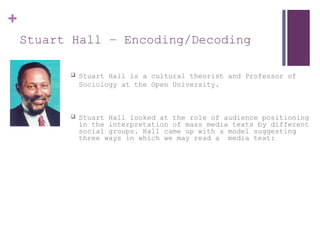
 Stuart Hall is a cultural theorist and Professor of
Sociology at the Open University.
 Stuart Hall looked at the role of audience positioning
in the interpretation of mass media texts by different
social groups. Hall came up with a model suggesting
three ways in which we may read a media text:
+
Encoding and decoding
 Dominant reading- reader fully accepts the
preferred reading (audience will read the text the
way the author intended them to) so that the code
seems natural and transparent.
 The negotiated reading – the reader partly believes
the code and broadly accepts the preferred reading,
but sometimes modifies it in a way which reflects
their own position, experiences and interests.
 The oppositional reading – the readers social
position places them in an oppositional relation to
the dominant code. They reject the reading.
+
Media Power
 Hall was concerned with media power, including how it
propagates particular social values, to create dominant
ideologies (in other words framing public debate surrounding
certain issues; e.g. the role of women in society, asylum and
immigration, the welfare system, the monarchy etc...)
 He believes that the mass media create and define issues of
public concern and interest through audience positioning.
 Polysemy- is the capacity for a text to have multiple
meanings. It is to do with how individuals interpret and decode
readings in different contexts and cultures.

Stuart Hall

  • 1.
    + Stuart Hall –Encoding/Decoding  Stuart Hall is a cultural theorist and Professor of Sociology at the Open University.  Stuart Hall looked at the role of audience positioning in the interpretation of mass media texts by different social groups. Hall came up with a model suggesting three ways in which we may read a media text:
  • 2.
    + Encoding and decoding Dominant reading- reader fully accepts the preferred reading (audience will read the text the way the author intended them to) so that the code seems natural and transparent.  The negotiated reading – the reader partly believes the code and broadly accepts the preferred reading, but sometimes modifies it in a way which reflects their own position, experiences and interests.  The oppositional reading – the readers social position places them in an oppositional relation to the dominant code. They reject the reading.
  • 3.
    + Media Power  Hallwas concerned with media power, including how it propagates particular social values, to create dominant ideologies (in other words framing public debate surrounding certain issues; e.g. the role of women in society, asylum and immigration, the welfare system, the monarchy etc...)  He believes that the mass media create and define issues of public concern and interest through audience positioning.  Polysemy- is the capacity for a text to have multiple meanings. It is to do with how individuals interpret and decode readings in different contexts and cultures.