Development of a Bioengineered, Decellularised
Xenograft for Mitral Valve Replacement
By
Stuart A. Deane, BA BAI.
A thesis submitted to the University of Dublin in partial fulfilment of the requirements for the
degree of
Masters in Bioengineering
Trinity College Dublin
August 2014
Supervisor
Dr Bruce Murphy
Stuart A. Deane Trinity College Dublin 2014
i
Declaration
I Declare that I am the sole author of this dissertation and that the work present in it,
unless otherwise referenced, is entirely my own. I also declare that the work has not been
submitted, in whole or in part, to any other university as an exercise for a degree or any other
qualification.
I agree that the library of Trinity College Dublin may lend or copy this dissertation upon
request.
__________________
Stuart Deane
August 2014
Stuart A. Deane Trinity College Dublin 2014
ii
Acknowledgments
I would like to dedicate this to my family for their unfaltering support throughout my
whole education. I would also like to acknowledge the guidance and patience of Gillian
Gunning, Bruce Murphy and Peter O’Reilly.
Stuart A. Deane Trinity College Dublin 2014
iii
Abstract
In this project we began the development of a bioengineered decellularised xenograft
for mitral valve replacement. By investigating the deficiencies of available mitral devices we
created a list of ideal criteria which the valve would possess. A number of steps were taken to
standardise the surgical procedure. Firstly an extensive literature review was carried out to
guide in designing additional constructs, discovering ideal features and establishing natural
geometry. All of the information was then processed to design a standardised bioengineered
construct to aid in surgical implantation and vitally developing an “off-the-shelf” “one-size-fits-
all” aspect to the design. This was carried out to make the surgical procedure less intricate and
time consuming. A decellularisation protocol was assessed for efficacy in terms of the changes
to mechanical properties. Using uniaxial tensile testing coupled with video extensometry
separately on mitral leaflet and chordae and comparing decellularised and fresh samples. The
decellularisation process was considered not to significantly change the properties of the valve
with slight degradation which was found to be none significant. Changes to microstructure
were evaluated using a picrosirius red stain for collagen and remaining nucleic material was
assessed with a hematoxylin and eosin stain. The picrosirius staining showed no visible
changes to microstructure and the HE staining showed no remaining visible nuclear material.
There were a number of limitations to this study, including small numbers in mechanical tests
and the necessary future testing vital to establishing this as a safe, saleable product which
have been briefly outlined. Overall the design presented establishes the bioengineered
decellularised xenograft as a feasible alternative to commercially available mitral valve
replacements overcoming many of the existing issues.
Stuart A. Deane Trinity College Dublin 2014
iv
Table of Contents
Declaration...............................................................................................................................................i
Acknowledgments...................................................................................................................................ii
Abstract..................................................................................................................................................iii
Table of Contents................................................................................................................................... iv
List of Figures ....................................................................................................................................... viii
List of Tables............................................................................................................................................x
1 Introduction ....................................................................................................................................1
2 Literature Review............................................................................................................................3
2.1 Anatomy and Physiology...............................................................................................3
2.1.1 The Cardiovascular system....................................................................................3
2.1.2 The Heart...............................................................................................................4
2.2 The Mitral Valve............................................................................................................4
2.2.1 Microscopic Organisation .....................................................................................5
2.3 What Goes Wrong?.......................................................................................................6
2.3.1 Indications.............................................................................................................6
2.3.2 Pathology of Indications........................................................................................7
2.3.3 Contraindications..................................................................................................7
2.4 Current Treatments.......................................................................................................8
2.4.1 Surgical Volume Analysis.......................................................................................8
2.4.2 Existing Devices...................................................................................................11
2.5 Surgical Technique ......................................................................................................15
2.5.1 Imaging................................................................................................................15
2.5.2 Operative Technique...........................................................................................15
2.5.3 Insertion of Papillary Muscle...............................................................................16
2.5.4 Leaflet implantation............................................................................................16
2.5.5 Annuloplasty .......................................................................................................17
Stuart A. Deane Trinity College Dublin 2014
v
2.6 Valve Geometry...........................................................................................................21
2.6.1 Shape...................................................................................................................21
2.6.2 Annular Dynamics ...............................................................................................22
2.6.3 Annular Area .......................................................................................................23
2.6.4 Dimensions..........................................................................................................24
2.6.5 Annulus Properties..............................................................................................25
2.6.6 Sizing & Mismatch...............................................................................................27
2.7 Material.......................................................................................................................28
2.8 Chordae & Papillary Muscle Placement......................................................................29
2.9 Xenograft Preparation.................................................................................................31
2.9.1 Excision................................................................................................................31
2.10 Decellularisation..........................................................................................................32
2.10.1 Techniques ..........................................................................................................32
2.10.2 Decellularisation Assessment..............................................................................36
2.11 Recellularisation..........................................................................................................38
2.11.1 Reseeding............................................................................................................38
2.11.2 Diffusion..............................................................................................................38
2.12 Sterilisation and Storage.............................................................................................39
2.12.1 Sterilisation .........................................................................................................39
2.12.2 Storage and Preservation....................................................................................39
3 Materials and Methods.................................................................................................................41
3.1 Mitral Valve Excision...................................................................................................41
3.2 Additional Construct Design........................................................................................43
3.3 Additional Construct Dimension Test .........................................................................44
3.4 Decellularisation Protocol...........................................................................................45
3.5 Histology......................................................................................................................46
3.6 Mechanical Testing .....................................................................................................50
3.6.1 Anterior Leaflet ...................................................................................................50
Stuart A. Deane Trinity College Dublin 2014
vi
3.6.2 Chordae...............................................................................................................52
3.6.3 Video Extensometry............................................................................................53
3.6.4 Data Analysis.......................................................................................................55
3.6.5 Sample Discarding...............................................................................................56
4 Results...........................................................................................................................................57
4.1 Additional Constructs..................................................................................................57
4.1.1 Annuloplasty .......................................................................................................57
4.1.2 Papillary Muscle Construct..................................................................................59
4.2 Histology......................................................................................................................61
4.2.1 Leaflet..................................................................................................................61
4.2.2 Chordae...............................................................................................................64
4.3 Mechanical Testing .....................................................................................................66
4.3.1 Leaflet..................................................................................................................66
4.3.2 Chordae...............................................................................................................68
5 Discussion......................................................................................................................................70
5.1 Additional Constructs..................................................................................................70
5.1.1 Papillary Muscle Construct..................................................................................71
5.1.2 Annuloplasty Construct.......................................................................................72
5.2 Decellularisation..........................................................................................................74
5.2.1 Mechanical testing..............................................................................................75
5.2.2 Microstructure ....................................................................................................78
5.2.3 Decellularisation..................................................................................................79
6 Conclusion.....................................................................................................................................81
Works Cited...........................................................................................................................................82
Appendix A – Effects of Deoxycholic acid Decellularisation on Porcine Mitral Valve Chordae............88
Abstract...............................................................................................................................88
Introduction ........................................................................................................................88
Methods..............................................................................................................................89
Stuart A. Deane Trinity College Dublin 2014
vii
Results.................................................................................................................................90
Discussion............................................................................................................................91
Conclusion...........................................................................................................................93
Works Cited.........................................................................................................................93
Appendix B - Ethical Issues....................................................................................................................94
Introduction ........................................................................................................................94
Experimental Stage .............................................................................................................94
Importance of the Study .....................................................................................................96
Implications for Society.......................................................................................................96
Future work.........................................................................................................................97
Conclusion...........................................................................................................................98
Works Cited.........................................................................................................................98
Appendix C - Business and Entrepreneurship.......................................................................................99
Introduction ........................................................................................................................99
Market Analysis...................................................................................................................99
Existing Products.................................................................................................................99
Patentability......................................................................................................................100
Regulatory Route ..............................................................................................................101
Further Research...............................................................................................................102
Further Funding.................................................................................................................102
Conclusion.........................................................................................................................102
Works Cited.......................................................................................................................103
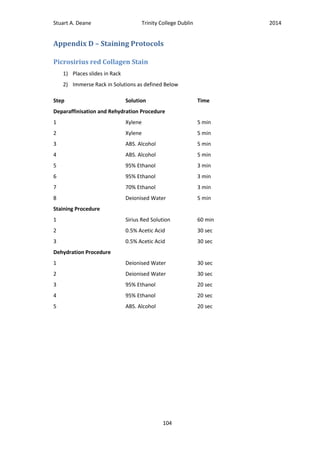
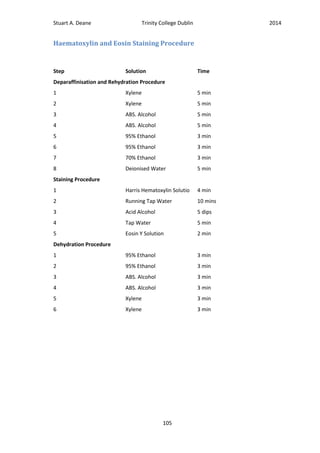
Appendix D – Staining Protocols.........................................................................................................104
Picrosirius red Collagen Stain................................................................................................104
Haematoxylin and Eosin Staining Procedure........................................................................105
Stuart A. Deane Trinity College Dublin 2014
viii
List of Figures
Figure 1 - The cardiovascular system (Young, 2006).....................................................................3
Figure 2 - The Internal Anatomy of the heart (Medical Nursing 2010) ........................................3
Figure 3 - Mitral Valve (Carpentier 2008) .....................................................................................4
Figure 4 - Prevalence of heart disease by age, Frequency in population based studies (Nkomo
2007) .............................................................................................................................................6
Figure 5 - First-time Mitral Valve Replacements (Blue Books Online)..........................................8
Figure 6 - Mortality (%) for outcomes of valve repair (A) and valve replacement (B) (blue books
online) ...........................................................................................................................................9
Figure 7 – All Valve replacement, volume and type from the Cleveland Clinic 2007-2011........10
Figure 8 - Percentage of Isolated Mitral valve replacements carried out with Mechanical or
Bioprosthetic valves (Gammie et al 2009)..................................................................................10
Figure 9 - CarboMedics Standard Prosthetic Heart Valve (CPHV™)............................................11
Figure 10 - St. Jude Medical™ masters series standard valve.....................................................11
Figure 11 - Carpentier-Edwards PERIMOUNT Pericardial Bioprosthesis ....................................11
Figure 12 - Papillary muscle Insertion (Acar 1996) .....................................................................16
Figure 13 - annuloplasty sutures placed Pre Annular fixation (Acar 1996) ................................17
Figure 14 - Suture placed Post annulus fixation (Kalangos 2011)...............................................17
Figure 15 - Proposed versus conventional surgical technique ...................................................18
Figure 16 - Suture techniques; A. Simple Suture B. Figure of Eight C. Everting Pledgeted
Mattress Suture D. Ventricular Pledgeted Mattress Suture (Khonsari 2008).............................19
Figure 17 - Surgical Knots (Penn Medicine 2013) .......................................................................19
Figure 18 - Annulus Geometry (De Simone 2006) ......................................................................21
Figure 19 - Reported Annular Dimension (adapted from Kaplan 1999).....................................23
Figure 20 - Valvular Anatomy (Carpentier 2008) ........................................................................25
Figure 21 - A display of the materials whose mechanical properties were found to be
acceptable using CES EduPack 2013 Software............................................................................28
Figure 22 - Medtronic Physiologic Mitral Valve (Franco, 1999)..................................................30
Figure 23 - Frozen Heart Defrosting............................................................................................41
Figure 24 - Left Ventricle, displaying Mitral Valve ......................................................................41
Figure 25 - Locating the fibrous transition region from the aortic root to the mitral annulus;
marked in Blue ............................................................................................................................42
Figure 26 - Template and Components of the Papillary Muscle Construct................................43
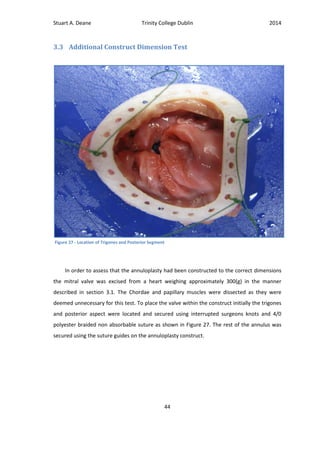
Figure 27 - Location of Trigones and Posterior Segment............................................................44
Stuart A. Deane Trinity College Dublin 2014
ix
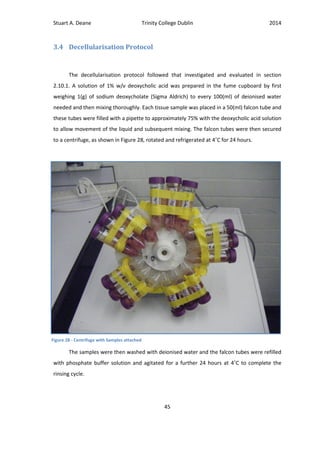
Figure 28 - Centrifuge with Samples attached............................................................................45
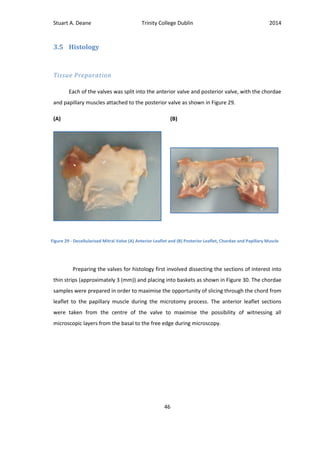
Figure 29 - Decellularised Mitral Valve (A) Anterior Leaflet and (B) Posterior Leaflet, Chordae
and Papillary Muscle...................................................................................................................46
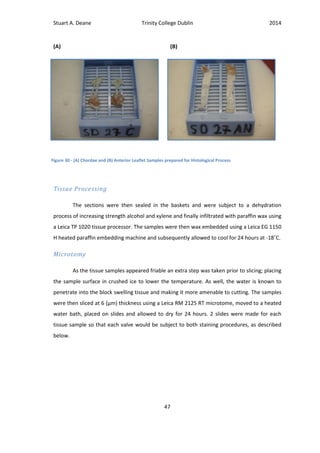
Figure 30 - (A) Chordae and (B) Anterior Leaflet Samples prepared for Histological Process....47
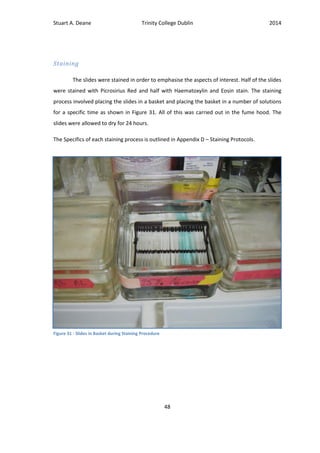
Figure 31 - Slides in Basket during Staining Procedure...............................................................48
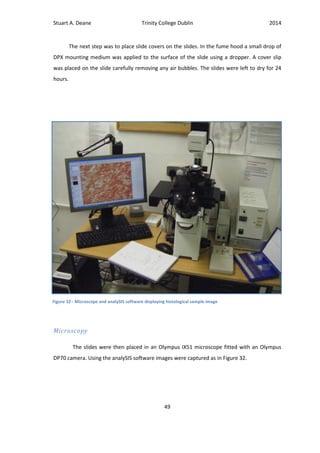
Figure 32 - Microscope and analySIS software displaying histological sample image................49
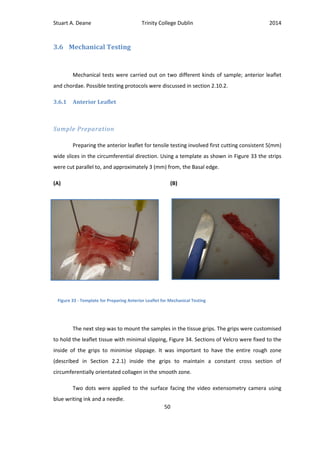
Figure 33 - Template for Preparing Anterior Leaflet for Mechanical Testing.............................50
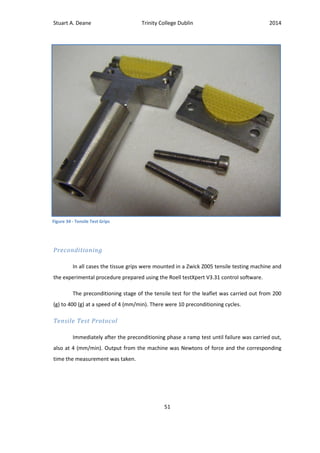
Figure 34 - Tensile Test Grips......................................................................................................51
Figure 35 - Tensile Grip Mount for Chordae Test (A) Dismantled and (B) with Leaflet secured 52
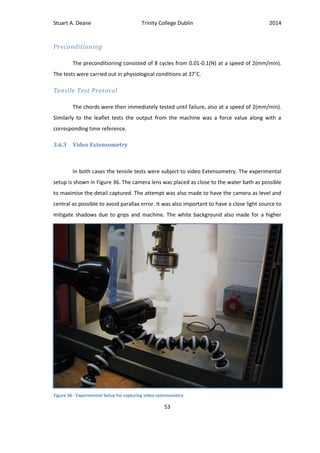
Figure 36 - Experimental Setup for capturing video extensometry............................................53
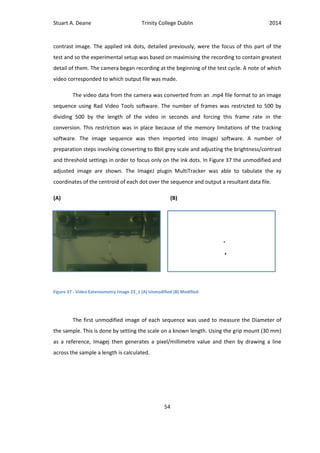
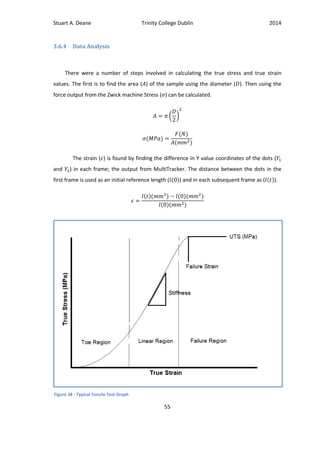
Figure 37 - Video Extensometry Image 23_1 (A) Unmodified (B) Modified ...............................54
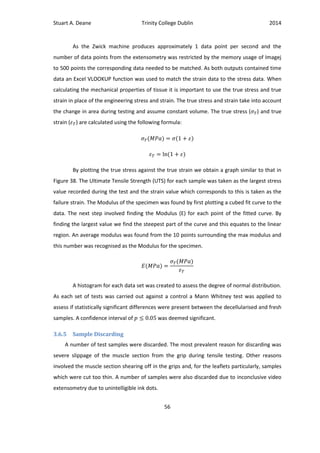
Figure 38 - Typical Tensile Test Graph ........................................................................................55
Figure 39 - Mitral Annulus technical Specifications....................................................................57
Figure 40 - Annuloplasty Additional Construct and Dacron Mesh..............................................58
Figure 41 - Fitted Mitral Valve in Annuloplasty Construct..........................................................58
Figure 42 - Papillary Muscle Construct, Rendering Creo Parametric..........................................59
Figure 43 - Papillary Muscle Construct Technical Drawing.........................................................59
Figure 44 - Papillary Construct Prototype, made actual size. Dimensions taken from technical
drawings......................................................................................................................................60
Figure 45 - Approximate Assembly orientation of Mitral Annulus and Papillary Constructs
rendering in Creo Parametric......................................................................................................60
Figure 46 - Hematoxylin and Eosin Staining of (Top) Fresh and (Bottom) decellularised Anterior
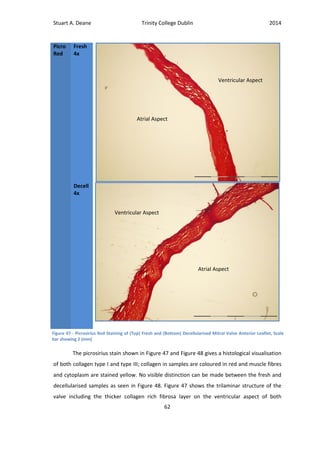
Mitral Valve Leaflet. Scale Bar showing 0.5 (mm) ......................................................................61
Figure 47 - Picrosirius Red Staining of (Top) Fresh and (Bottom) Decellularised Mitral Valve
Anterior Leaflet, Scale bar showing 2 (mm)................................................................................62
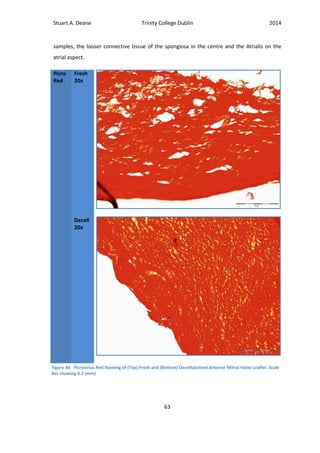
Figure 48 - Picrosirius Red Staining of (Top) Fresh and (Bottom) Decellularised Anterior Mitral
Valve Leaflet. Scale Bar showing 0.2 (mm) .................................................................................63
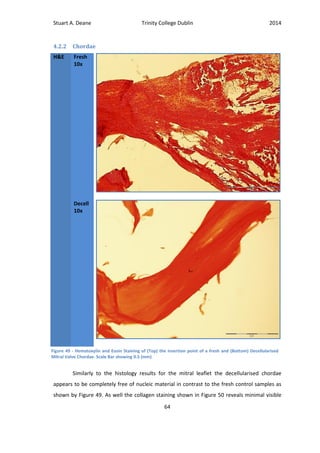
Figure 49 - Hematoxylin and Eosin Staining of (Top) the insertion point of a fresh and (Bottom)
Decellularised Mitral Valve Chordae. Scale Bar showing 0.5 (mm)............................................64
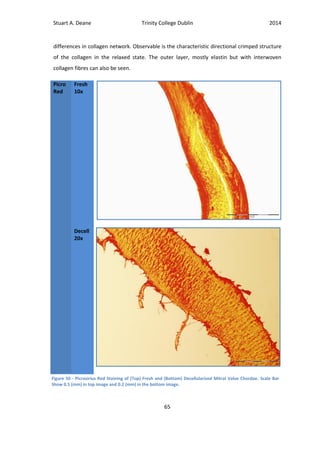
Figure 50 - Picrosirius Red Staining of (Top) Fresh and (Bottom) Decellularised Mitral Valve
Chordae. Scale Bar Show 0.5 (mm) in top image and 0.2 (mm) in the bottom image. ..............65
Figure 51 - Typical plot of True Stress vs. True Strain from leaflet testing. The cubic fitted line is
also displayed..............................................................................................................................67
Figure 52 - Histograms displaying lack of normality in Leaflet Tensile test data........................67
Stuart A. Deane Trinity College Dublin 2014
x
Figure 53 - typical true stress vs. true strain plot using video extensometry and Zwick force
data .............................................................................................................................................69
Figure 54 - Histogram showing lack of normality for chordae tensile test data.........................69
Figure 55 - Load Displacement Curve Illustrating the uncrimping of Collagen in relation to the
three regions...............................................................................................................................75
List of Tables
Table 1 - Reported Annular Dimensions .....................................................................................23
Table 2 - Showing comparison of various Inter-valley to Inter-peak sizes and an average........24
Table 3 - Measurements of Human and Porcine Hearts [62] .....................................................30
Table 4 - Decellularisation Processes..........................................................................................34
Table 5 - Results of uniaxial tensile tests carried out on Mitral Valve leaflet tissue displaying the
Modulus (MPa), UTS (MPa) and the % Strain at UTS..................................................................66
Table 6 - Results of Uniaxial Tensile test on both decellularised and fresh Mitral Chordae ......68
Stuart A. Deane Trinity College Dublin 2014
1
1 Introduction
In Britain approximately 1.87% of total cardiac surgeries are mitral valve replacements
(MVR). The total number of cardiac surgeries carried out in NHS hospitals in the year 2012 was
34,174 (639 MVR). Reports suggest, according to hospital discharges, that over 43,000 mitral
valve disorders were dealt with in The U.S, in 2003 [1]. If we were to extrapolate this based on
population increase alone this number rises to 48,562 mitral valve surgeries in the US in 2013.
According to Stanford school of medicine the national average is 43% replacement versus
repair [2]. This equates to almost 21,000 mitral replacements in the US every year. This is a
conservative estimate, not taking rising levels of obesity and an increasing elderly population
into account. Another report suggests that between 4.2-5.6 million adults in the U.S. had valve
disease in the year 2000 [3]. They discuss that 1 in 8 people older than 75 had a moderate to
severe valve disease and that of the 2.5% of the population affected as much as 1.8% had a
mitral valve disease.
When a mitral valve is defective there are two means of surgical intervention; repair
or replacement. At the moment the majority of surgeries carried out are repairs as this
represents a safer and more durable solution. Replacement is only selected when repair is not
amenable due to extensive damage. There are several options available when replacing a
valve; mechanical, bioprosthetic and allograft. The mechanical valves are associated with
much longer lifetimes and are therefore the preferred option when treating patients under
the age of 65 or who have a longer projected lifetime. There are two major drawbacks to
mechanical valves which are the necessity of long-term anticoagulation therapy and the forfeit
of natural hemodynamics. The bioprosthetic options are generally made of a fixed animal
tissue which is constructed on a plastic frame. These valves, in the mitral position, do not offer
the expected lifetimes of the mechanical valves for patients under 65 but do not require the
anticoagulation therapy [4]. For this reason they are the valve of choice for older patients or
those to whom anticoagulation therapy is not applicable.
The use of allografts in the clinical setting is very limited. A homograft when implanted
triggers an immunogenic response to donor tissue which requires anti-immunogenic drug
treatment. To combat this, techniques such as cryopreservation were employed to minimise
the immunogenic response. Formerly the majority of implants were cryopreserved until more
recent trials showed the lack of viability post-processing which lead to rapid calcification and
Stuart A. Deane Trinity College Dublin 2014
2
subsequent valve failure. The advantage of using a homograft is the reinstatement of natural
hemodynamics, as it is thought that mimicking the natural geometry of the heart reduces the
consequent stress (the mitral valve, in particular, experiencing high stress). Unfortunately the
surgical implantation procedure is complicated and extensive and the availability of suitable
donor valves is limited.
The process of decellularising develops a donor valve by removing the cells, and
retaining a scaffold with natural geometry. Ideally this scaffold retains the appropriate sites to
attract and support infiltrating host cells. This system will allow the possibility of growth,
repair and remodelling. This will increase the lifetime of the valve and allow implantation in
patients in the growing phase. The process also negates the need for immunogenic drug
treatment. The issues with current trials is the need to use fresh structures which means very
limited matching between patients and appropriate available valves.
From the previously mentioned existing procedures there are a number of factors
which would be incorporated into the ideal replacement mitral valve. These are:
 Easy surgical procedure
 Long lifetime
 No anticoagulation therapy
 Lack of Immune reaction
 Natural hemodynamics
 Viability
 Availability
We hypothesise that the design of a bioengineered decellularised xenograft for mitral
valve replacement can achieve these objectives optimising the process of creating an off-the-
shelf decellularised porcine xenogeneic mitral valve for surgical use. The initial step will
attempt to refine the surgical procedure by standardising the steps of implantation. The next
step will aspire to develop a protocol for decellularisation, sterilisation and storage which will
promote viability in vivo by minimising the stress of the pre-implantation processes on the
extra-cellular matrix. With the ability to store these valves and harvest them in large quantities
it is expected that a safer more standardised procedure will become obtainable. The
interrelated nature of steps means that this may be an iterative process where an optimum
technique can be achieved for the overall procedure.
Stuart A. Deane Trinity College Dublin 2014
3
2 Literature Review
2.1 Anatomy and Physiology
2.1.1 The Cardiovascular system
The heart is part of the
cardiovascular system in the body shown
in Figure 1 [5]. The cardiovascular system
is made up of the heart and the many
blood vessels running throughout the
body supplying nutrients and oxygen and
removing waste. It is essentially the
pump which maintains the flow of blood
through the system. The heart is split into
two sides the right receives blood from
the body and pumps it
to the lungs to
exchange carbon
dioxide for oxygen,
and the left receives
the oxygenated blood
from the lungs and
pumps it to the body.
The pumping pressure
is created by the
contraction and
relaxation of the
muscle wall.
Figure 1 - The cardiovascular system (Young, 2006)
Figure 2 - The Internal Anatomy of the heart (Medical Nursing 2010)
Stuart A. Deane Trinity College Dublin 2014
4
2.1.2 The Heart
The heart is approximately the size of a fist and is located in the thoracic cavity (chest
cavity) and has a mass of 250-350 (g) depending on the individual. Both sides of the heart are
split into two chambers; the atrium which receives the blood and the ventricle which pumps
the blood back out as shown in Figure 2 [6]. The ventricles take up most of the volume of the
heart, and the left in particular. As the muscle here is required to do more work it is much
thicker. In order to maintain blood flow in one direction the outlet of each chamber is
controlled by a valve. These valves work on the difference in pressure created by the relaxing
and tensing of the ventricular and atrial wall.
2.2 The Mitral Valve
The Mitral valve (also known as the
Bicuspid or the left Atrioventricular valve) is
located between the left atrium and ventricle.
This valve is under the most pressure, as it is
subject to the pressure caused by the contraction
of the left ventricle, and its failure will mean the
loss of nutrients and oxygen to the body. The
valve is made up of the annulus, the leaflets, the
chordae tendinae and the papillary muscles. The
Annulus is the area which surrounds the leaflets
and represents the edge of the valve as it is
positioned in the heart in the atrio-ventricular
junction (between the two chambers). There are
two leaflets (the anterior and posterior) and these are flaps of endocardium reinforced by a
connective tissue core that are attached to the inside of the annulus shown in Figure 3 [7].
The papillary muscles are embedded in the ventricular wall. The chordae are chords
of collagen which stretch from the valves to the papillary muscles. When the ventricle
contracts the pressure in the chamber causes the flaps to close and the chordae prevent the
valve from prolapsing (everting) into the atrium and thus prevent regurgitation. The papillary
muscles contract along with the ventricle wall tightening the chords [8]. Collectively, the
chordae and the papillary muscles are known as the sub-valvular apparatus. An indication of
Figure 3 - Mitral Valve (Carpentier 2008)
Stuart A. Deane Trinity College Dublin 2014
5
the size of the valve is given in the study by Acar of 82 homografts; the height of the anterior
leaflet was 25 ± 3 (mm). It was also noted that the distance from the apex of the anterior
papillary muscle to the annulus was 21 ±3 (mm). The distance from the annulus to the apex of
the posterior papillary muscle was 26 ± 4 (mm) [9].
2.2.1 Microscopic Organisation
The Structure of the valve leaflet can be split into several stratified layers. Each layer
begins at the basal edge and extends a distance into the valve providing different mechanical
properties. The main layers are the Spongiosa, Fibrosa and the Atrialis [10, 11]. The fibrosa is
made up of circumferentially orientated collagen fibrils to provide tensile stiffness, it is located
on the ventricular aspect of the valve [10]. The fibrosa is the thickest layer in the porcine
mitral valve and extends from the annulus into the valve where the collagen fibres propagate
into the chordae [11]. The Atrialis is found on the atrial aspect of the valve and extends from
the annulus approximately two thirds of the length of the valve. This layer consists
predominantly of radially orientated elastic fibres and also smooth muscle cells [11]. This layer
permits movement by tolerating extension and recoil [10]. The spongiosa is a layer of loose
connective tissue extending from the annulus to the free edge, where it makes up most of the
thickness [11]. It is comprised of proteoglycans interspersed with collagen and elastin. The
spongiosa provides compressibility, integrity and acts as an interface between the orthogonal
Atrialis and fibrosa [10]. The exterior of the valve is covered in continuous endocardial
endothelial layer which extends from the endocardial endothelial layers of the ventricle and
atrium. Cardiac muscle extends into the base of the valve which may lead to limited
vasculature. It is noted in Hinton et al (2011) that there is a particular balance of stiffness and
flexibility provided by the complex ECM which is essential for proper valve function [10].
There are five cell types found in the valves; valvular interstitial cells (VIC),
endocardial, cardiac muscle, endothelial and smooth muscle cells [11]. The most predominant
cell type is the VIC which is found in all layers. The distinct structure of the valve in
homeostasis is dependent on gene expression from the VIC that encodes fibrillar collagens,
proteoglycans and elastin [10] and thus it is highly likely that VIC have an important role in
valve remodelling. It is interesting to note that VIC have shown contractile properties which
may suggest that they maintain more than a passive support and could alter to aid
withstanding hemodynamic forces [11].
Stuart A. Deane Trinity College Dublin 2014
6
2.3 What Goes Wrong?
2.3.1 Indications
Total Mitral Valve replacement is indicative only when much less complex valve repair
reconstruction techniques are not amenable, due to it being considered a much more severe
surgical procedure. Replacement occurs when there is extensive damage to the valve leaflets
and valve apparatus [9]. The patient population changes from region to region as more
developed healthcare systems have increased ability for prophylaxis of disease reducing
rheumatic disease but in conjunction with that an increased life expectancy raises the
incidence of degenerative conditions [3, 12]. This is the opposite in developing countries
where rheumatic valve disease still presents a major health problem and affects a much
younger population. In a study by Chikwe et al the Aetiology of valve failure was shown for
patients recommended for both mitral repairs and replacements. Showing a significantly
higher level of rheumatic (3.5-27.4%) and endorcarditis (1.8-13.7%) recommended for
replacement, but still a higher percentage for Degenerative disorders (40%) [13]. A study by
Nkomo et al shows that incidence of valve disease is significantly associated with age in the
U.S. as shown in Figure 4.
Damage is traditionally caused by conditions such as severe rheumatic degeneration,
leaflet calcification, bacterial endocarditis (causing extensive tissue loss) and with the presence
Figure 4 - Prevalence of heart disease by age, Frequency in population based
studies (Nkomo 2007)
Stuart A. Deane Trinity College Dublin 2014
7
of complex lesions. Repair is avoided in these situations because of asymmetrical stenosis,
calcareous incrustations and valvular abscess formation [14] warranting valve replacement. In
one study by Acar et al the indications for operation were as follows: rheumatic mitral stenosis
(n = 26), acute infective endocarditis (n = 14), systemic lupus endocarditis (n = 2), and
marasmic endocarditis (n = 1).
2.3.2 Pathology of Indications
The pathologies of the various indicative diseases are important to consider as they
may change how a device performs when implanted. With Mitral Stenosis caused by
rheumatic carditis the valves are progressively thickened, scarred and calcified. These effects
cause fusion of the commissures and the chordae tendinae eventually reducing the effective
orifice area. This decrease will lead to a higher atrial pressure and can initiate atrial
enlargement. The pathophysiology for mitral regurgitation, caused by rheumatic heart disease
and acute infective endocarditis is similar. The left ventricle overloads as it must pump both
the stroke volume and the amount of blood regurgitated. This can cause ventricular dilation. It
has also been noted that the annular tissue can be friable (easily crumbled) due to these
conditions which can affect suturing. The Pathology associated with degenerative disease is
similar as mitral regurgitation is associated with LV enlargement and mitral stenosis is
associated with larger LA diameters [3].
2.3.3 Contraindications
According to Acar et al notable contraindications for traditional homograft are
unfavourable anatomy of the recipient papillary muscles due to the complex nature of the
surgical procedure, patients who are receiving a reoperation after a prosthetic valve (due to
issues with sizing) and young patients who are still growing (due to strong immune reactions)
[15]. It is hoped that by addressing each of these issues these contraindications can be
overcome.
Stuart A. Deane Trinity College Dublin 2014
8
2.4 Current Treatments
2.4.1 Surgical Volume Analysis
According to the online database resource provided by the Society for Cardiothoracic
Surgery in Great Britain & Ireland [16] the total number of cardiac surgeries carried out in the
year 2012 was 34,174 for all NHS hospitals. Of these procedures 2,118 were Isolated first time
mitral, either repair or replacement. The number of MV replacements was 638 (Figure 5), of
which 356 were isolated and 282 of which involved coronary artery bypass grafting (CABG).
Equating to approximately 1.87% of total Cardiac surgeries. Outcomes from these surgeries, in
terms of mortality, are shown adjacent to those for repair in Figure 6. The mortality for
replacement is marginally over twice that of repair (4.23-1.99%).
Figure 5 - First-time Mitral Valve Replacements (Blue Books Online)
Stuart A. Deane Trinity College Dublin 2014
9
In the United States (U.S.) a study carried out by Gammie et al over an 8 year period
(2000-2007) recorded 58,370 primary isolated MV surgeries (This excludes 127,261 patients
with concomitant CABG, aortic and other valve issues) from a total of 910 participating
hospitals. Of these 24,404 were replacements (41%) [17]. They concluded that the mortality
rate for replacement was consistently higher than for repair (3.8% vs. 1.4%), similar to that
found in Britain. These figures confirm that repair is presently a more desirable approach to
valve replacement.
In their study Gammie et al also recorded the type of valve replacement taking place
either mechanical or bioprosthetic; the results can be seen in Figure 8. The results indicate a
clear trend in the increasing popularity of the Bioprosthetic over the traditional mechanical
replacement valve. Their conclusions establish that improved reoperative mortality rates and
longer lifetimes without degeneration are the reasons behind this.
For more recent surgical trends we can look at data from the Cleveland Clinic, Ohio
US, which is the US leader in overall valve surgery and mitral valve surgery volume per
institution. In 2011 they carried out 1,286 primary mitral valve operations of which 416 (32%)
were replacements [18]. Their data, from 2007-2011, shows a dramatic shift towards the use
of bioprosthetics over mechanical valve replacements; as can be seen in Figure 7.
(A) (B)
Figure 6 - Mortality (%) for outcomes of valve repair (A) and valve replacement (B) (blue books online)
Stuart A. Deane Trinity College Dublin 2014
10
This shift in valve replacement type is attributed to advancement in fixation
technology in the tissue engineered bioprosthesis. In the past they were considered to
degenerate too quickly, particularly in younger patients, or patients with significant life
expectancy however recent studies have shown significant improvements in possible implant
lifetimes, with a low rate of valve related events at 18 years for patients over 65 [19]. The
Mechanical replacement is also less desirable due to the necessary long term anticoagulation
therapy.
Figure 8 - Percentage of Isolated Mitral valve replacements carried out with Mechanical or Bioprosthetic valves
(Gammie et al 2009).
Figure 7 – All Valve replacement, volume and type from the Cleveland Clinic 2007-2011
Stuart A. Deane Trinity College Dublin 2014
11
2.4.2 Existing Devices
There are many devices currently on the market for Mitral Valve replacement and
they fall under several headings; Mechanical, Bioprosthetic and Homograft. Due to the variety
available only the most prevalent will be investigated.
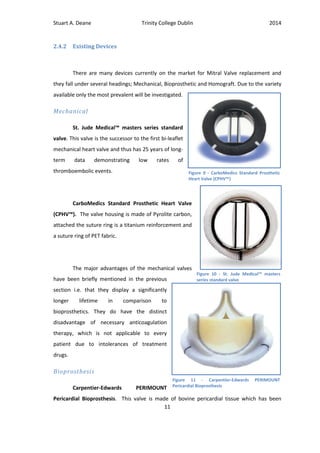
Mechanical
St. Jude Medical™ masters series standard
valve. This valve is the successor to the first bi-leaflet
mechanical heart valve and thus has 25 years of long-
term data demonstrating low rates of
thromboembolic events.
CarboMedics Standard Prosthetic Heart Valve
(CPHV™). The valve housing is made of Pyrolite carbon,
attached the suture ring is a titanium reinforcement and
a suture ring of PET fabric.
The major advantages of the mechanical valves
have been briefly mentioned in the previous
section i.e. that they display a significantly
longer lifetime in comparison to
bioprosthetics. They do have the distinct
disadvantage of necessary anticoagulation
therapy, which is not applicable to every
patient due to intolerances of treatment
drugs.
Bioprosthesis
Carpentier-Edwards PERIMOUNT
Pericardial Bioprosthesis. This valve is made of bovine pericardial tissue which has been
Figure 10 - St. Jude Medical™ masters
series standard valve
Figure 9 - CarboMedics Standard Prosthetic
Heart Valve (CPHV™)
Figure 11 - Carpentier-Edwards PERIMOUNT
Pericardial Bioprosthesis
Stuart A. Deane Trinity College Dublin 2014
12
fixated using a glutaraldehyde solution. The annulus is made up of a flexible silicon rubber
covered in a knitted PTFE mesh.
Although these more developed valves have been shown to improve lifetime and
reduce calcification they still do not compare to the longevity of the mechanical valves. A
study carried out by Hammermeister et al (2000) compared the outcome of 181 mitral valve
replacements to compare the 15 year results of mechanical versus bioprosthetic valves [20].
Their results (although using older generation valves) revealed that in the mitral position
mechanical valves had a lower primary failure than bioprosthetics but that these result were
offset by the higher bleeding rate associated with anticoagulation therapy. A more recent
study shows the 25 year results of the PERIMOUNT placed in the mitral position [4]. They have
concluded that the expected valve “durability” was 11.4, 16.6 and 19.4 years for age groups
<60, 60-70 and >70 respectively.
Homograft/Xenograft
The first clinical procedure using a tissue engineered heart valve was carried out by
Dohmen et al in 2000 [21]. They describe the use of a cryopreserved decellularised pulmonary
allograft replacing the right ventricular outflow during a ROSS operation. The valve was
cultured for four weeks in autologous vascular endothelial cells (AVEC) in order to assure
recellularisation and thus no valvular calcification. The single operation, at one year, was
successful. They conclude by noting that the ideal Extra-Cellular Matrix (ECM) for tissue
engineered heart valves may be porcine due to their relative abundance and cost. More
recently Ali et al (2004) published the results of a much larger study involving the implanting
of 104 mitral homografts and eight-year follow-up data [22]. The valves used were
cryopreserved and they noted that after this process the valves did not retain any
recellularisation viability. Similarly to the bioprosthetics the durability appears to be related to
the recipient’s age, they noted a higher rate of cardiac events in patients below 40. They
stated that a majority of the early valve failures were due to patient mismatch and the
technique could be refined by intraoperative sizing.
A commercially available decellularised porcine heart valve, the SYNERGRAFT™
(CRYOLIFE Inc.) was introduced as an alternative to conventional bioprosthetics. A consequent
study by Simon et al (2003) exposed rapid early failure in paediatric patients [23]. They
concluded that the ECM provoked a strong inflammatory response causing structural failure
Stuart A. Deane Trinity College Dublin 2014
13
and rapid degeneration. They hypothesised that this response may be due to pre-implant
calcific deposits and incomplete decellularisation. Implantation of the SYNERGRAFT™ was
subsequently stopped. Again more recently Cebotari et al (2011) have compared the use of
fresh decellularised allografts for pulmonary valve replacement to glutaraldehyde-fixed bovine
and cryopreserved homografts [24]. Their findings suggest that the decellularised valves
showed better viability in that they provided “adaptive growth”, although the patient did have
to be called into hospital with short notice (3 weeks) for implantation. They also mention that
in their ovine tests in the decellularised allograft there was little invasion by inflammatory
cells.
An influential article by Rieder et al (2005) investigated the immune response of
decellularised porcine tissue in comparison to human tissue [25]. They established that the
decellularised (processed) xenograft ECM were more pro-inflammatory than the human tissue
which had not been decellularised and that the decellularised human tissue performed best.
These findings suggest that in the development of a decellularised ECM scaffold developed
from a native valve structure Homografts rather than Xenografts represent a better chance of
success. Initially this appears to negate the study of future Xenograft valve scaffold but
Hopkins et al (2005) remarks that guidance document 1994 put forward by the FDA in relation
prosthetic valves and ISO 5840:1996 suggest that before such a valve can be considered for
human trial it must first be replicated in a large animal trial [26]. The results by Rieder et al
now appear to recommend that such an animal model would need to be carried out using a
valve from the same species in order to properly simulate the in vivo immunological conditions
and that these findings and protocols would then be transferred to a human model. Therefore
this suggests that the first step in developing a successful decellularised homograft mitral
valve is to develop a successful decellularised xenograft mitral valve. It is important to note
that these results were based on decellularisation and assessment protocols available in 2005.
It is expected that by using more recent techniques a more thoroughly decellularised
xenograft ECM can be achieved.
The major advantage of using Xenograft material over homograft material is the
unrestricted material quantity. In response to the issue that a suitable homograft may not be
available a number of “homograft banks” have been set up to harvest, sterilise and store
homografts for future use. A number of these can be found, for example the national heart
centre Singapore, the European Homograft Bank in Brussels and a small clinical unit based at
Stuart A. Deane Trinity College Dublin 2014
14
the John Radcliffe Hospital in Britain. A recent report by Walter et al (2012) called the
practicality of these institutions into question by detailing a limited availability of suitable
donors and a wide variety in decontamination and thawing techniques meaning graft quality is
difficult to compare [27].
Another possible technology which may be utilised in the future is the creation of
autologous tissue-engineered heart valves (TEHVS) using biodegradable synthetic materials
[28].A promising study which utilises in vivo reseeding appears the most positive [29]. Much
more research and further in vitro and clinical trials will be necessary to establish the
advisability of this technology.
As has been shown there are several benefits of the viable Xenograft over traditional
mechanical prosthesis, bioprosthesis and homograft. As well as use when repair is not
appropriate the avoidance of long-term anticoagulation therapy can result in a much more
satisfying patient experience as the risk of a thromboembolic event is lower [30, 31]. It is
hypothesised that another benefit of the decellularised xenograft over a traditional fixated
bioprosthetic would be that due to cellular ingrowth the body would sustain the valve over
longer periods of time increasing durability due to viability [24]. Another benefit over
traditional prosthesis is the preservation of both natural ventricular geometry and
hemodynamics which reduces stress on the heart. As the study by Vetter et al shows the
leaflet motion was comparable with recordings obtained from natural mitral valves [32]. It is
thought that due to the Mitral valves intricate sub valvular apparatus that retaining the
natural structure will better mimic the regular bileaflet motion.
Stuart A. Deane Trinity College Dublin 2014
15
2.5 Surgical Technique
2.5.1 Imaging
Preoperative trans-esophageal echocardiography is performed to carry out a detailed
examination of the mitral valve and sub-valvular apparatus and to guide surgical strategy [9].
One reason for this is to examine the functionality and extent of damage to assess the
necessity of valve replacement [14]. In traditional surgery the native valve must be measured
in order to match to the xenograft. Important dimensions to take note of are the valve annular
diameter, height of the anterior leaflet, chordal and papillary muscle length and shape
(morphology) of the chords and papillary muscles [14]. These dimensions could be used to
choose a replacement valve. With the use of an off-the-shelf product this sizing can be
achieved intra-operatively and more accurately. It is suggested that Intra-operative trans-
esophageal echocardiography is repeated to compare pre and post-replacement valvular
function [14]. In one study the morphologic characteristics of the papillary muscles and the
distribution of the chordae were noted for each homograft and recorded on a specifically
designed identification card due to their individuality in each patient [9].
As the morphology of the papillary muscle and chordae can be quite individual to each
patient the study by Acar found it necessary to subdivide the features into four groups based
on the existence of a division in the muscle and its location with respect to the commissure:
“Type I, Simple single muscle. Type II, divided muscle in the sagittal plane forming an individual
head supporting chordae of the posterior leaflet. Type III, divided muscle in a coronal plane
forming an individual head supporting the commissural area of the leaflet. Type IV, divided
muscle with multiple heads originating at different levels on the ventricular wall from the apex
to the base” [9]. The number of anterior papillary muscles in each classification is as follows:
type I, n = 47; type II, n = 12; type III, n = 14; and type IV, n = 9, and for the posterior papillary
muscles: type I, n = 43; type II, n = 22; type III, n = 7; and type IV, n = 10. This indicates more
type I and type II than III and IV. It is also noted that Acar found type IV to be unsuitable for
implantation and these were discarded.
2.5.2 Operative Technique
Valve replacement must be carried out using “open” heart surgery. Firstly the patient
is given a general anaesthetic. The surgeon will open the chest wall and cut through the
breastbone to expose the heart; in a small number of cases a small incision between the ribs is
sufficient. Once the surgeon gains access to the heart a heart and lung bypass machine is
Stuart A. Deane Trinity College Dublin 2014
16
attached to move blood away from the heart and take over the pumping action and function
of the lungs. To open the heart a small incision is made in the left atrium. Most people spend
4-7 days in hospital following surgery.
2.5.3 Insertion of Papillary Muscle
The first step of attaching the new valve is inserting
the papillary muscles. Suturing of the papillary muscles end
to end would result in a poor join and thus the development
of an entirely new technique was necessary. The Donor
muscle is placed between the host papillary muscle (which
has been left intact during excision of the valve) and the
ventricular wall. In the study by Kalangos the host papillary
muscle and the ventricular wall are sutured in a “sandwich
fashion” around the donor papillary muscles using 4/0
pledgeted teflon sutures [14]. The technique used by Acar et
al is very similar. They first placed a number of mattress
sutures at the base of the graft muscle, then a number of
interrupted sutures along the margins of the graft and finally
at the apex as shown in Figure 12 [9]. It is important that the sutures do not interfere with the
origin of the chordae to prevent causing erosion.
2.5.4 Leaflet implantation
Before leaflet implantation sutures for mitral annuloplasty were placed around the
perimeter of the native annulus. The leaflet tissue was then sutured using a 4/0 braided
polyester suture around the circumference [9, 14, 33]. Both Acar and Kalangos use a
continuous suture for this. Acar details the order in which each annular segment is attached;
(1) posteromedial commissure, (2) anterior leaflet, (3) anterolateral commissure, and (4)
posterior leaflet. It is also noted that particular care is taken in the placement of the
positioning of the commissures [9].
Figure 12 - Papillary muscle Insertion
(Acar 1996)
Stuart A. Deane Trinity College Dublin 2014
17
2.5.5 Annuloplasty
Annuloplasty fixation
Much of the basis of this
device lies in refining the surgical
procedure to make quicker and more
reproducible surgical techniques than
are currently available. The need for
this refinement is outlined as it
demonstrates a major issue which
halts progress in establishing valvular
replacement via xenograft as a
superior treatment [15]. With this in
mind this research suggests that that
the incorporation of an annuloplasty
ring onto the graft at pre-surgery
could significantly reduce time spent
choosing and fitting during surgery.
The use of an annuloplasty
has many benefits all of which are
outlined by Acar [33]. His reasons for the
addition are as follows “the semirigid
structure” of the annuloplasty will
absorb the majority of the stress
experienced by the continuous valvular
suture line generated by ventricular
contraction; this could be attributed to
the dilation which often accompanies
the indications for replacement. As well
as this the ring allows a greater surface of leaflet coaptation, thereby lowering the tension on
the subvalvular apparatus by conforming the native annulus to the natural geometry of the
xenograft [9, 33].
Figure 14 - Suture placed Post annulus fixation (Kalangos
2011)
Figure 13 - annuloplasty sutures placed Pre Annular fixation
(Acar 1996)
Stuart A. Deane Trinity College Dublin 2014
18
Current techniques to fixate the valve leaflets do not vary significantly from author to
author. In most cases the fixation of the mitral homograft annulus to the native annulus is
accomplished by suturing using a continuous suture. In two recent surgical guides a 4/0
polypropylene monofilament is used [14, 33] to accomplish this. It is interesting to note that a
pre-dated paper also involving Christophe Acar advises the use of continuous 5-0 Prolene
polypropylene suture [9]. It is unclear why the surgeon changes from 5/0 to 4/0 suture but it
does equate both techniques and the change occurs during a period when Acar is performing
multiple surgeries [22], therefore we can presume the change is based on experience. Also in
one of these studies the sutures to fixate the annuloplasty are placed along the perimeter of
the host annulus prior to leaflet fixation, Figure 13, whereas the newer guide has these
stitches placed after annulo-fixation, Figure 14. Both Studies use 2/0 braided polyester sutures
to secure the annuloplasty and both used an interrupted stitch. An additional
recommendation is the use of 2/0 Tevdek (Braided polyester) [34]. The results recorded in one
study conducted by Acar using this technique demonstrate encouraging results from 104
patients with freedom any cardiac event 76% at 7 years and patients free from cardiac death
and all death as 90.6% and 82% after 8 years [22]. The important detail to take from this is
that it is conventional that both the donor annulus and annuloplasty are sutured to the host
annulus as shown in Figure 15 A. It is suggested that the donor annulus be secured to the
Annuloplasty pre-operatively, which in turn could be secured to the host annulus trans-
operatively thereby reducing surgery by one step and refining the surgical procedure by
standardising this step. This difference in technique is shown, Figure 15 B. The major
difference is both the integration and sealing of the homograft is largely dependent on the
annuloplasty ring. This extra functionality must be considered in annuloplasty ring choice as a
custom design may be required.
Figure 15 - Proposed versus conventional surgical technique
Stuart A. Deane Trinity College Dublin 2014
19
Suturing Technique
Surgical suturing
techniques to secure the
annuloplasty are shown in
Figure 16 [34]. The
suturing techniques
suggested for mitral valve
surgery are dependent on
the condition of the
tissue. It is noted that the
annular tissue is often
edematous (abnormal
accumulation of fluid,
swelling) and friable
(crumbly) and in this case
it is more beneficial to use horizontal mattress with soft felt pledgets as shown [34].
The Sutures can be completed
using a simple box knot or a surgeons knot
as shown in Figure 17 [35]. The sutures
should be placed 3-4 (mm) apart along the
annulus. The suggestion is made that the
leaflet tissue be kept moist with
intermittent rinsing with room temperature
physiologic saline solution as the heat from
the operating room lights will dry out and
permanently damage the tissue. It is also
noted that consideration be given to the
left circumflex coronary artery which
courses through the atrioventricular groove
first outside the posterior mitral annulus.
The coronary sinus also transverses around
the annulus and is likely to be encountered
Figure 16 - Suture techniques; A. Simple Suture B. Figure of Eight C. Everting
Pledgeted Mattress Suture D. Ventricular Pledgeted Mattress Suture (Khonsari
2008)
Figure 17 - Surgical Knots (Penn Medicine 2013)
Stuart A. Deane Trinity College Dublin 2014
20
in the region of the posteromedial commissure. The artery to the atrioventricular node also
may run parallel to the annulus just above the posteromedial commissure.
The size of the annuloplasty ring is chosen based on the size of the donor valve, in
both cases corresponding to the surface area of the anterior mitral leaflet [14] and in one case
outlining the use of an obturator [9], therefore sizing inter-operatively is not an issue.
Testing
A question arises as to whether a test, to determine the mechanical stress which the
fixation sutures of the homograft with pre-implanted annuloplasty could withstand in
comparison to the current surgical technique, should be performed. At the time of writing the
author was not aware of any appropriate established tests in this area as the technique has
been refined over many years and was originally adopted from mitral valve repair [36]. There
are a number of studies which deal with the use of computational models to estimate forces
experienced [37]. It is important to note that homograft failure due to dehiscence of the
leaflet tissue is not common in the failure of homograft devices. The one case of Dehiscence
experienced in Acars study of 104 patients was attributed to an underestimated replacement
valve due to a dilated left ventricle [22] which caused the chordae to put more tensile stress
on the leaflet. In another study the case described was attributed to the omission of an
annuloplasty ring [38]. It is therefore not thought necessary to test for mechanical properties
of the junction.
Stuart A. Deane Trinity College Dublin 2014
21
2.6 Valve Geometry
The next consideration is the choice of annuloplasty ring as there is a range to choose
from. The traditional role of the annuloplasty is restoration of natural geometry. As mentioned
previously the ring must take on extra functionality in the proposed technique by taking the
role of integrating and sealing the homograft as the transferred annulus and native annulus
will no longer be directly sutured. The two major characteristics to take into account therefore
are shape (change in shape) and mechanical properties (material).
2.6.1 Shape
The shape of the mitral valve is complex and
changes with the stage of the cardiac cycle. A plan
view of the mitral valve will show a D shaped profile
[39]. In three dimensions the annulus is well known
to approximate a saddle shape [40]. A study to
record the regional annular distortion of the mitral
annulus using 3-dimensional echocardiography with
respect to mitral regurgitation, measured using 3-
dimensional colour Doppler obtained the
reconstruction shown, Figure 18 [41]. Their
acquisition was based on 2˚ increments until 90 heart
cycles were recorded. This reconstruction shows the
“saddle” shape associated with the mitral annulus.
More importantly their conclusion on the choice of annuloplasty states that it should be based
on individual case of the valvular apparatus, suggesting that intra-operative sizing would be
appropriate.
A study which used both numerical simulation and experimental data investigated the
mitral valve stress experienced [42]. The numerical simulation compared flat to “markedly”
saddle shaped phantom annulus and discovered that minimum peak leaflet stress occurred at
15-25% annular height to commissural height ratio. The experimental data used 3D
echocardiography to image sheep, baboon and human valve geometry and found that each
had a ratio of 10-15%. Their conclusion was that the shape confers a mechanical advantage by
adding curvature. A study using 3D echocardiographic analysis in humans measures a mean
Figure 18 - Annulus Geometry (De Simone
2006)
Stuart A. Deane Trinity College Dublin 2014
22
value of annular height (AH) to intercommisural width (inter-valley) ratio of 22.7±6.9% [43].
The measurements taken in another study show a change in height from approximately 5.8-
7.8(mm) in comparison to an IV of approximately 33-35(mm) [40]; This gives an IV:AH ratio of
approximately 20%.
2.6.2 Annular Dynamics
The measurement of annular area and dynamics is extremely intricate; this is outlined
by Timek et al [44]. In their review of studies to that point they discuss the difference in results
found whilst using different techniques and species. They conclude that techniques such as
radiopaque marker imaging and sonomicrometry, for mitral valve mapping, have the added
advantage of tagging specific sites to be measured in comparison to techniques like
echocardiography which is much more subjective. The results found for these techniques are
much more consistent. Unfortunately these techniques are also much more invasive.
The major dynamics of the annulus are due to a change in circumference and a change
in area, Kaplan et al reported this change was due to shortening of the annular perimeter and
supplemented by reduced interpeak distances [40]. This change in circumference has been
linked to the dynamics of the muscular portion of the annulus in sheep by Timek et al. As well,
in this study, the fibrous portion remains relatively static [45]. It is worth noting that these
tests were carried out at stable baseline conditions in heavily sedated subjects. More recently
the fibrous, or anterior, portion of the annulus has been shown to contract in a quantitatively
similar way as levels of inotropy increase [46]. Another interesting finding is that a moderate
folding at end systole has been measured in humans, their conclusion that a prosthetic ring
seeking to mimic natural function would have to be flexible [47].
Stuart A. Deane Trinity College Dublin 2014
23
2.6.3 Annular Area
The change in Annular area and circumference measurements do vary with each
study; shown in Table 1. Timek et al discusses how the Primary use of TTE (transthoracic
echocardiogram) could be the cause of this as the studies are unable to follow individual
anatomical landmarks. The use of TTE over more accurate methods is presumably due to its
less invasive qualities, especially with regard to human testing. They also compare the data
which was available at the time. The figure below shows some of these data sets, Figure 19. It
is noted that the data collected in Pai could have been the result of dilation from cardiac
disease. The study also suggests that the data in Flachskamp showing larger annular areas
could be due to the tracking of LV myocardium muscle. In some cases a replacement valve is
sized slightly larger (3mm) in order to
provide an excess of skin for coaptation
[9]. Taking this into account an estimate
of 7±1 (cm2
) average annular area has
been chosen; agreeing with Kaplan and
Ormiston [40, 48]. The measurement of
the percentage annular circumference
reduction is similarly multifaceted,
taking into account what conditions the
heart was measured under [46] and the
technique used. A general agreement
appears to be an approximately 20-25%
area reduction.
Table 1 - Reported Annular Dimensions
Area (cm2
) % Change Perimeter (cm) % Change Subject Study Condition Technique
11.8±2.5 23.8±5.1% Human [47] None 3D Echo.
13±13% Sheep [45] None Rad.
Opaq.
7.5±1.4 14.3% 10.7±8.8 6.8% Sheep [46] Atrial
Pacing
Sono.
6.9±.5 18.2%±1.5 Human [41] None 3D Echo.
7.1±1.3 26±3% 9.3±0.9 13±3% Human [48] None 2D Echo.
Figure 19 - Reported Annular Dimension (adapted from Kaplan
1999)
Stuart A. Deane Trinity College Dublin 2014
24
2.6.4 Dimensions
The inter-peak (IP) and inter-valley (IV) distances have been recorded with similar but
lesser discrepancies. One study [49] gives a reading of approximately 3.3-3.5(cm) and 3-
3.4(cm) for IV and IP respectively. This equates to an approximate IP:IV max ratio of 97% and
an approximate minimum ratio of 90%. Another study by Carlhall gives IP = 33±2(mm) and IV =
35±5(mm) [50]. The given values for IP:IV ratio was a maximum of 0.94±0.15 to a minimum
(during presystolic period) of 0.89±0.16. A much more recent study by Pouch et al gives values
that lie between the two sets mentioned [43]; the results are given as IP 28.5±3.7 and IV of
33±3.3 (mm) which results in a ratio of 87.3±9.3%. Interestingly they record the minimum and
maximum deviation of the IP and IV 21.1-36.1 and 23.4-41.6 respectively. This shows a wide
range of valve sizes but a relatively small variation in measured ratios as shown in Table 2.
Table 2 - Showing comparison of various Inter-valley to Inter-peak sizes and an average
Size Inter-valley
(mm)
Size Inter-Peak
(mm)
Ratio (%) Species Reference
33-35 30-34 90-97 Human Kaplan (1999) [49]
35±5 33±2 89-94 Human Carlhall (2004) [50]
33±3.3 28.5±3.7 87±9.3 Human Pouch (2014) [43]
Average 90.6
Stuart A. Deane Trinity College Dublin 2014
25
2.6.5 Annulus Properties
Structure
The properties of the annulus correlate with the position of the annulus and is closely
linked to the general anatomy, Figure 20 taken from Carpentier et al 2008 [7]. It is important
to note that the annulus is denoted as the “hinge line” of the valvular leaflets [39]. The mitral
valve makes up part of the cardiac skeleton which holds all of the heart valves in place and
separates the atria and ventricles.
The anterior leaflet is located distally from the aortic valve and the area between
them has been shown to be in fibrous continuity [39]. The straighter part of the “D Shape”
associated with the mitral valve is located here. The area of the annulus between the two
valves is known as the fibrous annulus and stretches from the right to the left fibrous trigone.
It is worth noting that the atrioventricular bundle passes through the right trigone. Angelini et
al. describe how thick and well organised fibrous structures that produce chord-like segments
of ring are always present at the site of the left and right fibrous trigones [51]. Although
originally the mitral annulus was thought to be a “well defined band of collagen”, more recent
studies have shown that the structural and mechanical properties change in different regions
and, as well, from heart to heart [51]. Also in that study Angelini et al. describe how a well-
defined region of fibrous tissue which encircles the left atrioventricular valve, supports the
mitral valves and separates the atrial and ventricular myocardium is “exceptional”.
Figure 20 - Valvular Anatomy (Carpentier 2008)
Stuart A. Deane Trinity College Dublin 2014
26
It has been noted that in the anterior segment the hingeline is distinguished by the
distal margin of atrial myocardium from the atrial aspect and is less distinct from the
ventricular aspect as the fibrous continuity is an extensive sheet [39]. They describe the
change in properties in terms of the collagen present, stating that some areas have an easily
identifiable curtain like appearance whereas in other segments only thin strands of fibres were
present. The segment surrounding the posterior valve is known as the muscular region, as it is
the junction between the atrial and ventricular myocardium with little or no fibrous continuity.
Commonly the majority of the contraction of the circumference of the annulus is thought to
happen in this region and it has been shown to be weaker and is more susceptible to annular
dilation [39]. Another noteworthy anatomical feature adjacent to the annulus is the Coronary
sinus shown in Figure 20. This vein drains blood from the heart muscle and delivers it to the
right atrium.
Mechanical Properties
The mechanical properties of the annulus have been measured both in-vitro and in-
vivo. Gunning et al. studied the tensile strength of each individual segment [52]. They
concluded that the anterior annulus was stiffer than the posterior segment by a factor of 27 at
2% strain and decreased to a factor of 13 at 6% strain. They also determine that the posterior
segment is stiffest at the right commissural segment, followed by the left commissural
segment and least stiff at the posterior. Values for the modulus vary throughout the annulus.
At 2% strain a minimum of 1.007(MPa) at the posterior segment to a maximum of 28.15(MPa)
at the Anterior Segment.
When choosing a desired modulus for the mitral annulus a stiffer ring will reduce the
stress on the suture line, whereas a lower modulus will reduce stress on the apparatus by
retaining natural geometry through movement. A Finite Element Analysis (FEA) study carried
out has compared the benefits of a flexible annuloplasty ring over a rigid one and found that
the flexible returned leaflet and chordal stresses to a more natural state [53]. A study carried
out by Rijk-Zwikker concluded that flexible rings interfered less with normal movements of the
mitral valve and caused less impairment in ventricular filling, and the unloaded stroke volume
was 16% higher [54]. In contrast a recent study using 3-dimensional echocardiography
concluded that the objective of an annuloplasty is to restore natural shape and discouraged
the use of flexible, partial and flat rings [55]. It is important to note that a majority of this
movement is caused by a constriction of the posterior segment; this cannot be replicated due
Stuart A. Deane Trinity College Dublin 2014
27
to the necessary complexity of such a design. Therefore a modulus which correlates to the
higher modulus anterior segment will be chosen.
2.6.6 Sizing & Mismatch
The issue of sizing the annuloplasty can be broken down into the inner and outer
diameter. The outer diameter can be constructed so that the surgeon can trim the edge to
leave an overlap suitable for suturing to the host annulus. The sizing of the inner diameter is
more complex. Because the annuloplasty will not be able to contract the maximum effective
orifice area will need to be close to the smallest (diastolic) size of the donor valve; to reduce
stress on the sub-valvular apparatus. The minimum EOA (effective orifice area) will be
determined by the host heart size and the effective orifice size necessary to retain normal
function. A valve which has been mismatched can be associated with recurrence of congestive
heart failure, postoperative pulmonary hypertension and independently affected late survival
[56]. In this study Patient-prosthesis mismatch was defined as an indexed EOA of 1.25
(cm2
/m2
) or less. The IEOA is found by dividing the EOA (cm2
) by the Body Surface area of the
individual. The diastolic EOA of the valve can be determined by reducing the relaxed area by a
percentage correlated to cardiac contraction. Approximate values taken from [40]. Figure 4 in
this study show an approximate percentage difference of 7.6%. This was calculated by taking
the Mid-Diastole value (largest 5.3cm2
) to approximate the valve size when extracted, because
this represents the least muscle action (ventricular relaxation). If we divide the Mid-Systolic
value (smallest 4.9cm2
) by this Mid-Diastolic Value. To avoid valve mismatch a donor valve
could be sized in vitro and then reduced by 7.6%, then this value can be given a range of
effective IEOA it can cover effectively.
Another technique to simplify the process is to take into account the area found
earlier 7±1 (cm2
). By manipulating a 3D model of the mitral valve as constructed with the
ratios found earlier we can see that an IV value of 34(mm) generates an EOA of 8.23(cm2
) and
26 generates an EOA of 4.81(cm2
). Therefore these can correspond to a maximum and
minimum outer diameter. Therefore restricting the inner diameter (i.e. the porcine valve) to
an EOA of 4(cm2
) can standardise the procedure by designing the outer edge so that it is easily
modifiable. The issue of mismatch raised above should not become an issue as this exceeds
most available bioprosthetic EOA.
Stuart A. Deane Trinity College Dublin 2014
28
2.7 Material
The material choice for the Annuloplasty is based on a number of different factors. As
mentioned the material must have a Youngs Modulus stiffer than the annulus properties in
order to counteract any dilation due to the several conditions indicative of mitral replacement.
The Youngs modulus should then exceed 0.02815 (GPa). Another important factor will be the
fatigue limit of the material as it will be loaded 103680 times per day (at an average of
72bpm). This equates to 37843200 in one year or approximately 7.6 cycles over 20
years. Clearly this is a large ask of any material and maximising the fatigue properties is
extremely important. Finally if the density of the material can be minimised then this would be
advantageous. Having taken these factors into consideration a graph cross referencing each
properties can be created using CES EduPack 2013 software as shown in Figure 21.
The graph shows that the properties of Polyester, ABS, Polyamides, Polyethylene and
PTFE fall within the specifications of Youngs modulus. There are a number of issues with PTFE,
firstly that it has a very high density [57] and secondly it has a lower Fatigue strength and, due
to the importance of this property, will be discounted.
Exploring the available devices which are supported by similar structures we can see
that the majority use a polyester sewing ring. A few such devices are the St. Jude Medical
Epic™ and the Labcor Stented Pericardial™. The Carpentier-Edwards Perimount uses an
annulus made of flexible silicon rubber. Although the idea of using a more flexible material like
Fatigue strength at 10^7 cycles (MPa)
0.1 1 10 100
Young'smodulus(GPa)
0
1
2
3
4
5
Acrylonitrile butadiene styrene (ABS)
PTFE
Polyethylene (PE)
Polyamides (Nylons, PA)
Polyester
Figure 21 - A display of the materials whose mechanical properties were found to be acceptable using CES
EduPack 2013 Software
Stuart A. Deane Trinity College Dublin 2014
29
a silicon rubber is more attractive because it could further replicate the dynamic nature of the
natural annulus. The expected Youngs modulus for this material however falls short of the
acceptable range (0.005-0.02 GPa). The opposite is true of ABS plastic in that it is not easily
deformed; therefore the plastic of choice is polyester.
In order to improve the healing response and biocompatibility of the sewing ring a
Dacron® mesh could be added which promotes ingrowth of tissue. This is also very popular
among available valve replacements. A study by Golden et al in 1990 Showed that the porosity
of the Polyester used could influence the integration of synthetic arterial grafts [58]. They
showed that at a pore size of 60 (µm) intermodal distance luminal endothelial coverage of the
luminal surface was most comprehensive. A final thought might be the addition of a
radiopaque metal wire or markers so that the annulus can be subject to post-operative
imaging.
2.8 Chordae & Papillary Muscle Placement
The placement of the papillary muscles presents a further issue. An article by Robert
Frater MD lists the variability in anatomy of papillary muscles and their chordal origins as the
major reason that use of harvested mitral valves is not more widespread [59]. At present the
implantation techniques mentioned previously (section 2.5.3) are very difficult and time
consuming. Ideally the implantation method would standardise the papillary muscle
placement by presenting an adjustable length and also allowing integration of the muscle to
myocardium.
The chordae can be split into a number of different categories. First-order chordae insert
on the free edge of the leaflet and Second-order chordae insert onto the ventricular aspect on
the transition from the rough to smooth zones [60]. Although the primary purpose of the
subvalvular apparatus is to maintain leaflet competence (i.e. prevent prolapse) and free edge
alignment [59] Rodrigeuz et al 2004 detail the importance of second-order chordae in
“valvular-ventricular interaction” [61]. Their studies have shown that transection of the
chordae can lead to contractile dysfunction affecting left ventricle systolic performance,
leading to wall thickening and changes to systolic temporal dynamics. This is a clear argument
for the retention of natural geometry.
Stuart A. Deane Trinity College Dublin 2014
30
Research by Degandt et al shows that the “stay” chordae in the posterior porcine valve
were shorter than in the anterior which is unlike the human valve [62]. This implies that even
morphologically similar chordae would need to be placed slightly differently. They do mention
that a limitation of their study is the small numbers and change in heart weight which means
inter-species length comparison is impractical. The range of Mitral annulus diameter is very
similar in both the porcine and human valves measured. There is a significant difference in the
distance measured between the anterior papillary muscle to the left trigone (T1 – M1) and the
posterior papillary muscle to the right trigone (T2 – M2) in the human and porcine valves as
shown in Table 3. This suggests that a porcine valve replacement chosen for its annular area
would not have similar papillary muscle placement sights. In order to design a device which
facilitated the integration of the sub-valvular apparatus researchers would need to know
whether placement of the host or donors natural orientation was more important.
Table 3 - Measurements of Human and Porcine Hearts [62]
Measurement Human Porcine
Mitral Annulus Diameter 29.54±2.54 28.1±3.54
T1 – M1 (mm) 14.98±4.25 25.2±2.06
T2 – M2 (mm) 18.21±4.80 28.6±3.05
Yankah et al detail that implantation
technique should mimic the natural orientation
of the donor valve as closely as possible in
placement of both the annulus and the papillary
muscles, although this refers to allografts not
xenografts [63]. This approach will be adopted as
rationally the misalignment of the donor valve
will lead to rapid degeneration due to irregular
forces applied to the valve and sub-valvular
apparatus. Having established this, a further step
to harvest a standard morphology would also
standardise the procedure. This would involve
utilising only valves with 2 primary papillary
muscle heads as described by Acar et al (1996)
Type I and detailed earlier in section 2.5.1.
Figure 22 - Medtronic Physiologic Mitral Valve
(Franco, 1999)
Stuart A. Deane Trinity College Dublin 2014
31
One device tested using an animal model used Dacron sewing tubes secured near the
native papillary muscle insertion points as shown in Figure 22 [64]. Using this technique the
donor papillary muscle tips were secured to the Left ventricular myocardium using a number
(2-3) mattress sutures at a distance adequately apical to prevent prolapse. The sewing tubes
were then secured with two mattress sutures to the myocardium. It is worth noting that the
valve in this example was fixated, which means remodelling was not an issue and thus contact
of the papillary muscle to the host myocardium to provide possible revascularisation was not
necessary.
2.9 Xenograft Preparation
2.9.1 Excision
Acar et al. detail how to extract the donor valve [9]:
1. The first step is to dissect off the ventricular myocardium inserted into the annulus
without damaging the leaflet tissue; special care is to be taken around the
commissural area.
2. The atrial myocardium attached to the annulus is then dissected off.
3. Next the connective tissue of the left and right fibrous trigone is trimmed (“frequently
the site of a fibrocalcerous nodule”).
4. The last step of annular excision is the removal of fatty tissue in the atrioventricular
junction.
5. The preparation of the papillary muscles begins with the noting of their morphological
features so as to maintain orientation at implantation.
6. Where a papillary muscle head was divided sutures are placed to maintain respective
positions of the heads.
7. Leaving approximately 15 (mm) of muscular tissue beyond the origin of the chordae
the papillary muscles are detached from the ventricular wall.
Stuart A. Deane Trinity College Dublin 2014
32
2.10 Decellularisation
The decellularisation process is perhaps the most significant stage in developing a
xenograft which can survive in vivo for extended periods. When a xenogeneic material is
implanted into a host it will cause an inflammatory response and induce an immunogenic
reaction in the form of hyperacute rejection or delayed acute vascular rejection [65]. There are
a number of strategies to counteract this including immunosuppression, encapsulation and
decellularisation. In this scenario we are attempting to create an implant which will replace
the host valve, recellularise and revascularise if possible therefore the concept of
encapsulation is not appropriate. The strategy of immunosuppression also means chronic
pharmacological treatment which is undesirable.
The ideal process of decellularisation involves the most efficient removal of cells from
the tissue of interest and the minimisation of disruption to the structural and functional
proteins of the extracellular matrix [66, 67]. The reason for retaining the ECM is that they
provide a source of cues to promote constructive remodelling with recellularisation [68].
Badylak et al 2014 define remodelling as the complete breakdown and replacement of the
implanted tissue by functional tissue [69]. There are many different processes available and
each tissue requires a variation of these to decellularise effectively. The various steps in
different protocols can be divided into physical, chemical and enzymatic.
2.10.1 Techniques
An overview of the various protocol portions are given in papers by Gilbert et al. [68]
and Badylak et al. [67]. Most often a process to rupture the cell membrane will be used at the
beginning of the process. These processes can include thermal shock, ultrasonics and
mechanical disruption. The term mechanical disruption can also be applied to simply removing
cell rich unwanted tissue before further steps to increase efficiency.
Agitation and perfusion are used to introduce the chemical and enzymatic solutions to
the tissue, depending on the characteristics of the tissue (i.e. if it is highly vascularised,
thick/thin). The use of vascular perfusion can greatly increase the efficacy of the process. In
this case the valve is known to have little vasculature which can be isolated, mainly due to
muscle insertion in the leaflet [11] and with some vasculature based in the strut chordae [70]
and this will make this technique ineffective. It is a combination of these various mechanical
Stuart A. Deane Trinity College Dublin 2014
33
and chemical processes carried out over varying times all affecting the composition,
mechanical strength and cytocompatability in different ways which makes it difficult to
ascertain which protocol to use.
Various chemicals have been shown to effectively decellularise tissue in different
situations. There are a number of categories of chemical solution: detergents, solvents, acidic
and alkaline solutions and ionic solutions. For more complicated tissue samples it is beneficial
to pass the tissue through a number of short washes, this is to increase the efficacy of each
chemical and also reduces the time that each chemical is in contact with the tissue. The ionic
solutions are used to rupture the cell membrane by osmotic shock instead of, or along with,
thermal shock etc. By rupturing the membrane the cell contents are released and are
subsequently much easier to transport from the tissue in subsequent steps. Detergents are
used to solubilize the membrane of the cell. There are a number of types, the most common
being the non-ionic triton x-100 and the ionic sodium dodecyl sulphate and sodium
deoxycholate. It is thought that the ionic detergents are harsher on the tissue and may cause
greater disruption to structural proteins. In the context of this project this destruction may
cause the tissue to lose its ability to give the cues necessary for constructive remodelling.
Enzymes are also used in the decellularisation process to disrupt cell adhesion. A popular
enzyme is trypsin and disrupts cell-matrix interaction. It is noted that trypsin can target
collagen and therefore can lead to a decrease in mechanical properties.
Stuart A. Deane Trinity College Dublin 2014
34
A paper which takes into account the
recellularisation properties specific to the
xenogeneic heart valve is Rieder et al. 2004
[71]. In their study they compared
decellularisation protocols with their
subsequent aptitude for recellularisation with
human endothelial cells. The results for SDS
treatment is initially promising with effective
decellularisation but they report massive cell
lysis during recellularisation, the results
indicate that residual SDS can be found even
after prolonged washout. Their protocol of
Trypsin/EDTA created a confluent endothelial
layer in recellularisation. They did note
detectable porcine cells however. A protocol
of Triton x-100 and sodium-deoxycholate
followed by a washing process of
DNAse/RNAse to remove residual nucleic acids
proved to be the most effective for both
decellularisation and recellularisation
processes.
A study which also compares various
decell methods on porcine valves is by Zhou et
al. 2010 [72]. In their results they find that the
sodium deoxycholate treatment (A) was the
only one of four protocols which left the
elastic and collagen fibres unaltered. “Group A
were treated with 1% sodium deoxycholate
(Sigma–Aldrich) in PBS (Phosphate buffer
solution) at 37 ˚C for 24 hours with an
additional 24 h washing in PBS at room
temperature was performed under continuous
Table 4 - Decellularisation Processes
Stuart A. Deane Trinity College Dublin 2014
35
shaking to remove cellular remnants”. Their conclusion being that only sodium deoxycholate
allowed comprehensive cell removal with satisfactory ECM conservation.
Another study by Honge et al. 2011 [73] describes the effectiveness of recellularising
and calcification of Deoxycholic acid (DOA) and Glutaraldehyde treated aortic pig valves in
vivo. They showed that the glutaraldehyde rendered the valves extremely susceptible to
calcification and to thrombosis development. The DOA treated valves, when explanted,
showed observable endothelial and fibroblast recellularisation.
There are numerous techniques to be considered as shown in Table 4. Based on the
results of the summarised studies treatment with SDS is incompatible with recellularisation
process. Protocols using DOA did show improved recellularisation and less ECM malalignment
overall. This research indicates that the two most effective protocols are Zhou (A) and Rieder
(3). It is difficult to differentiate the two as the results of Rieder mostly deal with
recellularisation and Zhou with structure, but they do differ in total decell time and Rieder is
longer by 48 hours. Also the protocol set out by Rieder is older by 6 years; therefore Zhou
protocol (A) is the chosen protocol.
Stuart A. Deane Trinity College Dublin 2014
36
2.10.2 Decellularisation Assessment
There will be various aspects to the assessment of the capacity for the component to
be implanted after the decellularisation process. As the process will not be ideal there will be
unwanted side effects including growth factor elimination, ECM disruption, residual chemicals
and non-complete nuclei removal. Another factor is the mechanical strength and how the
valve and sub-valvular apparatus will perform in vivo under loading. Assessing how the
changed mechanical loading and other in vivo effects affect the recellularisation will be an
iterative process.
To fixate the tissue samples for examination a number of methods are described;
fixation in glutaraldehyde [71], fixation in formaldehyde [72-74] and snap freezing in liquid
nitrogen at -80˚C [25]. After fixation all samples are embedded in wax in preparation for
analysis.
In order to be determined fully decellularised the components which have been
shown to cause an immune rejection must be removed. Many of the techniques used to assess
the efficacy of the process are based on measuring the denuclearisation of the tissue. The
techniques based on evidence of avoiding adverse cell and host responses in studies are a
measurement of less than 50 dsDNA per milligram ECM dry weight, less than 200 (bp) DNA
fragment length and a lack of visible nuclear material in tissue sections stained with 4’,6-
diamidino-2-phenylindole (DAPI) or H&E (hematoxylin and eosin) [69, 75]. It is noted however
that the intracellular and membrane components also include the antigens which have been
shown to invoke immune rejection.
The next issue to investigate is the structural integrity of the ECM. This can be done by
staining, using various chemicals which will fluoresce during histology. Many studies analyse
collagen and elastin structure; using polyclonal rabbit IgG, 1:20 Monosan (Collagen type I & III)
[25, 71], Monoclonal anti-elastin, elastin trichrome and Movat Pentachrome staining [72] and
picrosirius red. The assumption being that the arrangement of collagen and elastin affects the
remodelling process. There is debate over the relevance of the composition and structure of
tissue with respect to site appropriate reconstruction [76]. It is largely recognised that ECM
does exert an influence on modulation of site specific function [77] and that collagen fibre
composition, individual to each tissue type is a critical factor in regulating its biomechanical
properties [76].
Stuart A. Deane Trinity College Dublin 2014
37
Further assessment can be carried out by conducting tensile tests on the leaflet tissue.
This can be carried out using a tensile testing machine modified to hold the leaflet tissue to
give an indication of the degradation of the mechanical properties during decellularisation.
This is especially important as the valve will be required to function immediately on
implantation, in this state, until recellularisation has taken place. Ideally testing of each
component would provide a better understanding of possible changes as the microstructure
changes from annulus to leaflet to chordae. An example of such a test for the leaflet is found
in a trial by Iwai et al 2007 [78]. In their test 5x10 (mm) Samples were tested at 10 (mm/min).
Another study carried out by Arbeiter et al also uses 5 (mm) wide samples but does not specify
length [79]. In the study by Barber et al the speed used was 4 (mm/s) [80]. Importantly tests
are carried out at different speeds and as the valve components demonstrate viscoelastic
properties this can significantly affect the mechanical properties. It will be necessary to
maintain a constant speed across mechanical tests.
The preconditioning phase of mechanical testing of tissue has been well documented.
The role of preconditioning is to mitigate error due to tissue handling and to diminish the
difference in subsequent load cycles by realigning the microstructure to a natural state, Carew
et al describe this as establishing a repeatable reference state [81]. There are a number of
studies which describe protocols for this stage of testing. Liao et al use 10 contiguous cycles
[82] whereas others have used cycling until a repeatable loading curve is observed [80]. In
their experiments Barber et al cycle between 200-400 (g) (≈2-4 (N)).
Similar uniaxial tensile tests have been carried out on the chordae. In the study by
Casado et al a test speed of 1 (mm/min) was used and the test was carried out at 37˚C in
physiological conditions [83]. They also describe preconditioning as described by Ritchie et al
2004 which involves cycling at a speed of 40 (% strain/s) (approximately 4mm/s) from 0-2 (N).
Liao et al use a speed of 4 (mm/s) also under physiological conditions and precondition until a
loading curve is repeatable.
There is much scope for further work in examining residual chemicals and growth factor
elimination. Also ideally a separate experimental setup to determine whether the different
tissue types present, leaflet, chordae and papillary muscles respond better to different
protocols.
Stuart A. Deane Trinity College Dublin 2014
38
2.11 Recellularisation
There are two methods to repopulate the scaffold with native cells. The first is based
on pre-surgical cell seeding using a bioreactor. The second method is the reliance on post-
implant diffusion of nutrients from the blood [26].
2.11.1 Reseeding
Although research has been conducted in this area the major issue in relation to this
project is that the time necessary to harvest the appropriate cells, culture them and then
reseed them is considerable. In a review by Badylak et al 2011 they discuss times differing
from 7 days to more than a month, depending on cell type and tissue type [67]. Clearly this is
not a possibility for an off-the-shelf product.
2.11.2 Diffusion
The question as to whether full endothelialisation can be accomplished in vivo due to
diffusion appears to be a question of tissue thickness. This oxygen and diffusion limitation of
tissue thickness in whole organ recellularisation is discussed in a study by Baptista et al 2009
[84]. The utilisation of in vivo recellularisation has been studied in relation to heart valves.
Research carried out by Quinn et al (2011) implanted decellularised pulmonary allografts
(n=8)to compare performance against bioprosthetics (n=4) and cryopreserved allografts (n=6)
in juvenile sheep [85]. The valves were explanted after 20 weeks for histological examination.
Their results show that autologous recellularisation was seen in decellularised valves but that
cells migrated primarily into the leaflet base and were rarely found in the middle or tip.
Endothelialisation occurred unevenly on the surface of the leaflet.
Another trial has shown similar results when implanting decellularised porcine valves
in the pulmonary valve location in canines [78]. The results show the spontaneous
endothelialisation of the luminal surface. They also show with H&E staining that at 2 months
the leaflets and adventitia (the outermost connective tissue covering of any vessel) were well
recellularised. At 6 months the valves were seen to be showing smooth muscle cells. These
results show viability of an in vivo recellularisation process without the need for in vitro cell
seeding and without the requirement of an intact vascular system. It should be noted that
these are short term results. A possible source of errors using this method is also mentioned
such that there must be a balance between resorption of the old matrix and synthesis of the
new matrix to reduce the likelihood of mechanical degradation.
Stuart A. Deane Trinity College Dublin 2014
39
The mitral valve is found in the systemic circuit, not the pulmonary as in the examples
above. This means that the valve will be subject to higher pressures and thus larger shear
forces which may affect in vivo recellularisation.
2.12 Sterilisation and Storage
2.12.1 Sterilisation
The Issue of sterilising heart valves is not new. A study carried out by Gall et al (1995)
outlines the recommendations made by an institution with 25 years of experience (1969-1994)
[86]. They recommend the use of incubation at 37˚C for 6 hours in a mixture of antibiotics
including penicillin and streptomycin. They say that valves which are refrigerated at 4˚C after
this sterilisation can be stored for up to 72 days and that storage for longer requires
cryopreservation. Another interesting recommendation is that specimens of tissue collected at
“trimming” must be sent for culture. This will allow knowledge of sterilisation to be compared
with patient progress. A follow up to this established that valves which are not to be
implanted within 1 to 2 days should be cryopreserved in order to remain viable [87]. It is noted
that viability was measured pre-implantation using autoradiography to assess cell function.
The use of gamma irradiation for sterilisation of medical devices is well known. Research
by Hafeez et al 2005 shows that Gamma irradiation has a significant detrimental effect on the
mechanical properties of samples of bovine pericardium [88]. The research theorises that the
pre-treatment process before irradiation has an effect on the damage experienced. This was
determined because the results measured are different from the conclusion of other trials
conducted.
2.12.2 Storage and Preservation
The shortfalls in the viability of cryopreserved valves as discussed previously and
established by Ali et al 2004 [22] conclude that all valves after cryopreservation were found to
be unviable at explant. Their definition appears to be that acellular and unviable are
interchangeable. Further work discussed how these homografts work by utilising the foreign
body response to sheath the valve and creates a pliable layer which encapsulates the leaflet
Stuart A. Deane Trinity College Dublin 2014
40
[89]. This effectively cuts off the cells in the leaflet tissue causing apoptosis. The durability of
these valves is limited by calcification. A more experimental technique is ice-free
cryopreservation which has shown greater ECM preservation due to the lack of formation of
ice [90]. The results of this trial are promising but more research must be carried out to make
it a practical substitute.
An alternative to cryopreservation is freeze drying. The trial carried out by Curtil et al
detail a protocol for freeze drying of porcine pulmonary valve leaflets [91]. Their results show
how the process and rate of cooling affected the structure of the leaflets. Although they do
allow that their process is not ideal for preservation. They do succeed in creating a porous
scaffold which is appropriate for rapid penetration by fibroblasts, but they show that the
internal pores do not communicate with the surface. The research carried out by Hafeez et al
2005 reports that there is minimal effects on mechanical properties due to freeze drying.
Once again it is presumed that these processes, both sterilisation and storage will have
effects on each other, the recellularisation process and will be affected by the decellularisation
process in turn. The process to produce the ideal preserved decellularised xenograft will be
some combination of the preceding techniques and finding the ultimate protocol will be an
iterative process.
Stuart A. Deane Trinity College Dublin 2014
41
3 Materials and Methods
3.1 Mitral Valve Excision
The excision of the mitral valve was
involved many times in each of the following
sections. Each heart was acquired from Doyle
Bros. Butcher, Pearse Street, Dublin. As each
package was vacuum packed and frozen the
first step was to separate and defrost each
heart, Figure 23. It was also important to check
for damage which might render a mitral valve
unusable e.g. large lacerations. The excess
heart material was removed to improve visual
access, this involved the removal of the right
atrium and ventricle and the left atrium as
shown in Figure 24.
Figure 23 - Frozen Heart Defrosting
Figure 24 - Left Ventricle, displaying Mitral Valve
Stuart A. Deane Trinity College Dublin 2014
42
The next step was to locate the fibrous band between the aortic root and the mitral
valve leaflets (Figure 25) as this is accepted as a transition region to the mitral annulus.
By making an incision through this region and continuing posteriorly until reaching the
fibrous right trigone a hole appropriately sized allowed an incision along the posterior
ventricular wall. Cutting through to the apex of the heart in this way a lateral view of the
annulus is exposed and this allows for easier excision. In addition, with the left ventricle open
like this the excision of the papillary muscles is a simple matter. When the mitral valve is free
all excess ventricular tissue is removed.
Figure 25 - Locating the fibrous transition region from the aortic root to the mitral annulus; marked in Blue
Stuart A. Deane Trinity College Dublin 2014
43
3.2 Additional Construct Design
Drawing
Taking into account the various dimensions and ratios discovered during the literary
review in section 2.6 and based on the surgical procedure investigated in section 2.5 a number
of additional surgical constructs were designed. The design process began with a number of
rough sketches to finalise the necessary features and approximate dimensions. The designs
were then moved to a student version of Creo Parametric 2.0 3D modelling software to draft
technical drawings of the pieces. The technical drawings were used as an initial validation of
the design for manufacturing by technicians.
Prototyping
The Annuloplasty construct was then rapid prototyped by exporting an .igs file to the
rapid prototyper and fabricated using ABS (Acrylonitrile Butadiene Styrene) plastic. The Rapid
prototype machine was a Stratasys Dimension Elite FDM printer. This machine can print layers
accurate to 0.245(mm). The annuloplasty ring was then finished by suturing a layer of Dacron
mesh to the outside using interrupted surgeons knots and 4/0 polyester braided suture. Finally
the locations of the suturing guides were indicated with black marker.
The Papillary muscle construct was created from a Dacron mesh. The design for the
construct was drawn and cut from a template as shown in Figure 26. Each segment was then
held with a single surgeons knot using 4/0 polyester braided suture.
Figure 26 - Template and Components of the Papillary Muscle Construct
Stuart A. Deane Trinity College Dublin 2014
44
3.3 Additional Construct Dimension Test
In order to assess that the annuloplasty had been constructed to the correct dimensions
the mitral valve was excised from a heart weighing approximately 300(g) in the manner
described in section 3.1. The Chordae and papillary muscles were dissected as they were
deemed unnecessary for this test. To place the valve within the construct initially the trigones
and posterior aspect were located and secured using interrupted surgeons knots and 4/0
polyester braided non absorbable suture as shown in Figure 27. The rest of the annulus was
secured using the suture guides on the annuloplasty construct.
Figure 27 - Location of Trigones and Posterior Segment
Stuart A. Deane Trinity College Dublin 2014
45
3.4 Decellularisation Protocol
The decellularisation protocol followed that investigated and evaluated in section
2.10.1. A solution of 1% w/v deoxycholic acid was prepared in the fume cupboard by first
weighing 1(g) of sodium deoxycholate (Sigma Aldrich) to every 100(ml) of deionised water
needed and then mixing thoroughly. Each tissue sample was placed in a 50(ml) falcon tube and
these tubes were filled with a pipette to approximately 75% with the deoxycholic acid solution
to allow movement of the liquid and subsequent mixing. The falcon tubes were then secured
to a centrifuge, as shown in Figure 28, rotated and refrigerated at 4˚C for 24 hours.
The samples were then washed with deionised water and the falcon tubes were refilled
with phosphate buffer solution and agitated for a further 24 hours at 4˚C to complete the
rinsing cycle.
Figure 28 - Centrifuge with Samples attached
Stuart A. Deane Trinity College Dublin 2014
46
3.5 Histology
Tissue Preparation
Each of the valves was split into the anterior valve and posterior valve, with the chordae
and papillary muscles attached to the posterior valve as shown in Figure 29.
(A) (B)
Preparing the valves for histology first involved dissecting the sections of interest into
thin strips (approximately 3 (mm)) and placing into baskets as shown in Figure 30. The chordae
samples were prepared in order to maximise the opportunity of slicing through the chord from
leaflet to the papillary muscle during the microtomy process. The anterior leaflet sections
were taken from the centre of the valve to maximise the possibility of witnessing all
microscopic layers from the basal to the free edge during microscopy.
Figure 29 - Decellularised Mitral Valve (A) Anterior Leaflet and (B) Posterior Leaflet, Chordae and Papillary Muscle
Stuart A. Deane Trinity College Dublin 2014
47
(A) (B)
Tissue Processing
The sections were then sealed in the baskets and were subject to a dehydration
process of increasing strength alcohol and xylene and finally infiltrated with paraffin wax using
a Leica TP 1020 tissue processor. The samples were then wax embedded using a Leica EG 1150
H heated paraffin embedding machine and subsequently allowed to cool for 24 hours at -18˚C.
Microtomy
As the tissue samples appeared friable an extra step was taken prior to slicing; placing
the sample surface in crushed ice to lower the temperature. As well, the water is known to
penetrate into the block swelling tissue and making it more amenable to cutting. The samples
were then sliced at 6 (µm) thickness using a Leica RM 2125 RT microtome, moved to a heated
water bath, placed on slides and allowed to dry for 24 hours. 2 slides were made for each
tissue sample so that each valve would be subject to both staining procedures, as described
below.
Figure 30 - (A) Chordae and (B) Anterior Leaflet Samples prepared for Histological Process
Stuart A. Deane Trinity College Dublin 2014
48
Staining
The slides were stained in order to emphasise the aspects of interest. Half of the slides
were stained with Picrosirius Red and half with Haematoxylin and Eosin stain. The staining
process involved placing the slides in a basket and placing the basket in a number of solutions
for a specific time as shown in Figure 31. All of this was carried out in the fume hood. The
slides were allowed to dry for 24 hours.
The Specifics of each staining process is outlined in Appendix D – Staining Protocols.
Figure 31 - Slides in Basket during Staining Procedure
Stuart A. Deane Trinity College Dublin 2014
49
The next step was to place slide covers on the slides. In the fume hood a small drop of
DPX mounting medium was applied to the surface of the slide using a dropper. A cover slip
was placed on the slide carefully removing any air bubbles. The slides were left to dry for 24
hours.
Microscopy
The slides were then placed in an Olympus IX51 microscope fitted with an Olympus
DP70 camera. Using the analySIS software images were captured as in Figure 32.
Figure 32 - Microscope and analySIS software displaying histological sample image
Stuart A. Deane Trinity College Dublin 2014
50
3.6 Mechanical Testing
Mechanical tests were carried out on two different kinds of sample; anterior leaflet
and chordae. Possible testing protocols were discussed in section 2.10.2.
3.6.1 Anterior Leaflet
Sample Preparation
Preparing the anterior leaflet for tensile testing involved first cutting consistent 5(mm)
wide slices in the circumferential direction. Using a template as shown in Figure 33 the strips
were cut parallel to, and approximately 3 (mm) from, the Basal edge.
(A) (B)
The next step was to mount the samples in the tissue grips. The grips were customised
to hold the leaflet tissue with minimal slipping, Figure 34. Sections of Velcro were fixed to the
inside of the grips to minimise slippage. It was important to have the entire rough zone
(described in Section 2.2.1) inside the grips to maintain a constant cross section of
circumferentially orientated collagen in the smooth zone.
Two dots were applied to the surface facing the video extensometry camera using
blue writing ink and a needle.
Figure 33 - Template for Preparing Anterior Leaflet for Mechanical Testing
Stuart A. Deane Trinity College Dublin 2014
51
Preconditioning
In all cases the tissue grips were mounted in a Zwick Z005 tensile testing machine and
the experimental procedure prepared using the Roell testXpert V3.31 control software.
The preconditioning stage of the tensile test for the leaflet was carried out from 200
(g) to 400 (g) at a speed of 4 (mm/min). There were 10 preconditioning cycles.
Tensile Test Protocol
Immediately after the preconditioning phase a ramp test until failure was carried out,
also at 4 (mm/min). Output from the machine was Newtons of force and the corresponding
time the measurement was taken.
Figure 34 - Tensile Test Grips
Stuart A. Deane Trinity College Dublin 2014
52
3.6.2 Chordae
Sample Preparation
The chordae samples were chosen based on a number of criteria. As described by Lam
et al there are several classification of chordae [92]. As the structure of each chordae type
differs in both morphology and interaction with the valve leaflet the decision was made to use
the basal, or rough zone, chordae for consistency and because they are abundant. The
papillary muscle heads of the samples, as shown in Figure 29 (B), were split. Next the minor
branches of the chords were cut with approximately 1.5-2(mm) left on the main chord so as
not to cause a stress concentration. Finally the leaflet was cut so that adequate tissue could be
enclosed in the grip mount.
Again the grip mounts were custom made to hold the tissue with minimal slippage.
The grip holding the papillary muscle was equivalent to the anterior leaflet grip mounts. The
grip which held the leaflet was designed so as to remove the stress concentration presented
when the grip closed on the chord. This was achieved by wrapping the chord around a bar at a
distance from the grip as shown in Figure 35. Once again two ink dots were applied.
(A) (B)
Figure 35 - Tensile Grip Mount for Chordae Test (A) Dismantled and (B) with Leaflet secured
Stuart A. Deane Trinity College Dublin 2014
53
Preconditioning
The preconditioning consisted of 8 cycles from 0.01-0.1(N) at a speed of 2(mm/min).
The tests were carried out in physiological conditions at 37˚C.
Tensile Test Protocol
The chords were then immediately tested until failure, also at a speed of 2(mm/min).
Similarly to the leaflet tests the output from the machine was a force value along with a
corresponding time reference.
3.6.3 Video Extensometry
In both cases the tensile tests were subject to video Extensometry. The experimental
setup is shown in Figure 36. The camera lens was placed as close to the water bath as possible
to maximise the detail captured. The attempt was also made to have the camera as level and
central as possible to avoid parallax error. It was also important to have a close light source to
mitigate shadows due to grips and machine. The white background also made for a higher
Figure 36 - Experimental Setup for capturing video extensometry
Stuart A. Deane Trinity College Dublin 2014
54
contrast image. The applied ink dots, detailed previously, were the focus of this part of the
test and so the experimental setup was based on maximising the recording to contain greatest
detail of them. The camera began recording at the beginning of the test cycle. A note of which
video corresponded to which output file was made.
The video data from the camera was converted from an .mp4 file format to an image
sequence using Rad Video Tools software. The number of frames was restricted to 500 by
dividing 500 by the length of the video in seconds and forcing this frame rate in the
conversion. This restriction was in place because of the memory limitations of the tracking
software. The image sequence was then imported into ImageJ software. A number of
preparation steps involving converting to 8bit grey scale and adjusting the brightness/contrast
and threshold settings in order to focus only on the ink dots. In Figure 37 the unmodified and
adjusted image are shown. The ImageJ plugin MultiTracker was able to tabulate the xy
coordinates of the centroid of each dot over the sequence and output a resultant data file.
(A) (B)
The first unmodified image of each sequence was used to measure the Diameter of
the sample. This is done by setting the scale on a known length. Using the grip mount (30 mm)
as a reference, Imagej then generates a pixel/millimetre value and then by drawing a line
across the sample a length is calculated.
Figure 37 - Video Extensometry Image 23_1 (A) Unmodified (B) Modified
Stuart A. Deane Trinity College Dublin 2014
55
3.6.4 Data Analysis
There were a number of steps involved in calculating the true stress and true strain
values. The first is to find the area ( ) of the sample using the diameter ( ). Then using the
force output from the Zwick machine Stress ( ) can be calculated.
( )
The strain ( ) is found by finding the difference in Y value coordinates of the dots (
and ) in each frame; the output from MultiTracker. The distance between the dots in the
first frame is used as an initial reference length ( ) and in each subsequent frame as ( ).
Figure 38 - Typical Tensile Test Graph
Stuart A. Deane Trinity College Dublin 2014
56
As the Zwick machine produces approximately 1 data point per second and the
number of data points from the extensometry was restricted by the memory usage of Imagej
to 500 points the corresponding data needed to be matched. As both outputs contained time
data an Excel VLOOKUP function was used to match the strain data to the stress data. When
calculating the mechanical properties of tissue it is important to use the true stress and true
strain in place of the engineering stress and strain. The true stress and strain take into account
the change in area during testing and assume constant volume. The true stress ( ) and true
strain ( ) are calculated using the following formula:
By plotting the true stress against the true strain we obtain a graph similar to that in
Figure 38. The Ultimate Tensile Strength (UTS) for each sample was taken as the largest stress
value recorded during the test and the strain value which corresponds to this is taken as the
failure strain. The Modulus of the specimen was found by first plotting a cubed fit curve to the
data. The next step involved finding the Modulus (E) for each point of the fitted curve. By
finding the largest value we find the steepest part of the curve and this equates to the linear
region. An average modulus was found from the 10 points surrounding the max modulus and
this number was recognised as the Modulus for the specimen.
A histogram for each data set was created to assess the degree of normal distribution.
As each set of tests was carried out against a control a Mann Whitney test was applied to
assess if statistically significant differences were present between the decellularised and fresh
samples. A confidence interval of was deemed significant.
3.6.5 Sample Discarding
A number of test samples were discarded. The most prevalent reason for discarding was
severe slippage of the muscle section from the grip during tensile testing. Other reasons
involved the muscle section shearing off in the grips and, for the leaflets particularly, samples
which were cut too thin. A number of samples were also discarded due to inconclusive video
extensometry due to unintelligible ink dots.
Stuart A. Deane Trinity College Dublin 2014
57
4 Results
4.1 Additional Constructs
4.1.1 Annuloplasty
It was thought that the design of a modifiable “One-size-fits-all” annuloplasty would
further standardise the surgical procedure. With this in mind a constant inner orifice based on
the minimum expected intervalley (IV) ratio of a recipient valve could be exploited. This is
coupled with a modifiable outer edge based on the maximum expected mitral valve size. The
Major dimensions were taken from those found in the literary review. This means that the
range of intervalley dimensions expected are 30-36 (mm). Therefore the maximum outer IV is
45 in order to leave a 6 (mm) modifiable lip, 3 (mm) on either side, and a 7 (mm) overlap for
suturing to the donor annulus, 3.5(mm) on either side. This results in a constant EOA
(Estimated Orifice Area) of 6.4 (cm2
) which is larger than all available mechanical and
bioprosthetics [93]. As can be seen in the drawing a strengthening rib is positioned on the
inside overlap to add strength. The exact dimensions of this rib will need to be specified by in
vitro or finite element modelling. The guide holes along the inside are used to standardise the
Figure 39 - Mitral Annulus technical Specifications
Stuart A. Deane Trinity College Dublin 2014
58
addition of the donor annulus.
Fitting of the biocompatible Dacron Mesh to the Annuloplasty in vitro is shown in
Figure 40. As well as this the characteristic natural geometry imitation D and Saddle-shapes
are clearly visible.
Figure 40 - Annuloplasty Additional Construct and Dacron Mesh
Figure 41 - Fitted Mitral Valve in Annuloplasty Construct
Stuart A. Deane Trinity College Dublin 2014
59
4.1.2 Papillary Muscle Construct
Figure 42 - Papillary Muscle Construct, Rendering Creo Parametric
Figure 43 - Papillary Muscle Construct Technical Drawing
Stuart A. Deane Trinity College Dublin 2014
60
The Important aspects of the papillary muscle constructs are the easy suture tabs, the
conical shape and the overall simple design easily producible to individual chordae insertion
structures all of which can be seen in the Dacron Mesh prototype in Figure 44.
Figure 45 - Approximate Assembly orientation of Mitral Annulus and Papillary Constructs rendering in
Creo Parametric
Figure 44 - Papillary Construct Prototype, made actual size. Dimensions taken from technical drawings
Stuart A. Deane Trinity College Dublin 2014
61
4.2 Histology
4.2.1 Leaflet
H&E
Stain
Fresh
10x
Decell
10x
Figure 46 shows the HE staining of the mitral valve leaflet. The nucleic material
(including RNA and DNA) is stained a deep blue-purple colour and the ECM varying shades of
pink. Cell material is clearly visible in the fresh sample and it appears as though the cell
material in the decellularised specimen has been completely removed.
Figure 46 - Hematoxylin and Eosin Staining of (Top) Fresh and (Bottom) decellularised Anterior Mitral Valve
Leaflet. Scale Bar showing 0.5 (mm)
Stuart A. Deane Trinity College Dublin 2014
62
Picro
Red
Fresh
4x
Decell
4x
The picrosirius stain shown in Figure 47 and Figure 48 gives a histological visualisation
of both collagen type I and type III; collagen in samples are coloured in red and muscle fibres
and cytoplasm are stained yellow. No visible distinction can be made between the fresh and
decellularised samples as seen in Figure 48. Figure 47 shows the trilaminar structure of the
valve including the thicker collagen rich fibrosa layer on the ventricular aspect of both
Figure 47 - Picrosirius Red Staining of (Top) Fresh and (Bottom) Decellularised Mitral Valve Anterior Leaflet, Scale
bar showing 2 (mm)
Atrial Aspect
Ventricular Aspect
Atrial Aspect
Ventricular Aspect
Stuart A. Deane Trinity College Dublin 2014
63
samples, the looser connective tissue of the spongiosa in the centre and the Atrialis on the
atrial aspect.
Picro
Red
Fresh
20x
Decell
20x
Figure 48 - Picrosirius Red Staining of (Top) Fresh and (Bottom) Decellularised Anterior Mitral Valve Leaflet. Scale
Bar showing 0.2 (mm)
Stuart A. Deane Trinity College Dublin 2014
64
4.2.2 Chordae
H&E Fresh
10x
Decell
10x
Similarly to the histology results for the mitral leaflet the decellularised chordae
appears to be completely free of nucleic material in contrast to the fresh control samples as
shown by Figure 49. As well the collagen staining shown in Figure 50 reveals minimal visible
Figure 49 - Hematoxylin and Eosin Staining of (Top) the insertion point of a fresh and (Bottom) Decellularised
Mitral Valve Chordae. Scale Bar showing 0.5 (mm)
Stuart A. Deane Trinity College Dublin 2014
65
differences in collagen network. Observable is the characteristic directional crimped structure
of the collagen in the relaxed state. The outer layer, mostly elastin but with interwoven
collagen fibres can also be seen.
Picro
Red
Fresh
10x
Decell
20x
Figure 50 - Picrosirius Red Staining of (Top) Fresh and (Bottom) Decellularised Mitral Valve Chordae. Scale Bar
Show 0.5 (mm) in top image and 0.2 (mm) in the bottom image.
Stuart A. Deane Trinity College Dublin 2014
66
4.3 Mechanical Testing
4.3.1 Leaflet
The results displayed in Table 5 display the mechanical properties resulting from the
uniaxial tensile tests. In the “Modulus” column the Youngs Modulus of the leaflet calculated as
discussed in Section 3.6.4 along with the median value and standard deviation. They are
calculated individually for the Decellularised and the Fresh samples. Similarly the Ultimate
Tensile Stress (UTS) and the % Strain at UTS is displayed. As the input variable is nominal
(Decell/Fresh) and the output variable is Quantitative non-normal a Mann Whitney test for
statistical significance was carried out. Figure 51 shows a typical true stress vs. true strain plot
obtained by combining video extensometry data and Zwick force data. We can identify each
region; the toe region, the linear region and the failure region.
The results show that the fresh leaflets show a 16.0% higher modulus than the
decellularised leaflets which translates into a stiffer fresh valve; 39.9 (MPa) to 34.2 (MPa)
respectively. The Mann Whitney test carried out shows a which signifies
no statistical difference. The UTS of both the decellularised and fresh samples are very similar;
1.4 (MPa) and 1.7 (MPa) respectively. The Strain at UTS is higher for the decellularised sample
with values of 5.6% and 4.3% respectively.
Table 5 - Results of uniaxial tensile tests carried out on Mitral Valve leaflet tissue displaying the Modulus (MPa),
UTS (MPa) and the % Strain at UTS.
Stuart A. Deane Trinity College Dublin 2014
67
A B
Figure 51 - Typical plot of True Stress vs. True Strain from leaflet testing. The cubic fitted line is
also displayed
Figure 52 - Histograms displaying lack of normality in Leaflet Tensile test data
Stuart A. Deane Trinity College Dublin 2014
68
4.3.2 Chordae
The results displayed in Table 6 are formatted identically to those in Table 5. We can
see that the median Modulus of the fresh samples is 9.2% higher than the decellularised
samples with values of 433.7 (MPa) and 396.8 (MPa) respectively. The Mann Whitney test
carried out doesn’t show a significant statistical difference; . The median
UTS measured also exhibits a stiffer stronger value with a 4.2% larger value for the fresh
chords. The % Strain at UTS also shows the fresh samples to be slightly more extensible than
the decellularised with values of 10.7% and 8.5% respectively.
Figure 53 shows a typical true stress vs. true strain plot of the mechanical tests data
with the strain data acquired using video extensometry and the stress data acquired using the
Zwick force data. The fitted cubic equation is also shown. We can see the transition zone and
the linear region of the plot. Unlike the leaflet data the chordae display a very abrupt failure as
Table 6 - Results of Uniaxial Tensile test on both decellularised and fresh Mitral Chordae
Stuart A. Deane Trinity College Dublin 2014
69
the collagen network fails sharply. N=49_8 indicates that the chord was the 8th
chord to be
tested from valve n=49.
Figure 53 - typical true stress vs. true strain plot using video extensometry and Zwick force data
A B
y = 143.26x3 + 5650.5x2 - 97.161x
R² = 0.9862
0
10
20
30
40
50
60
70
80
0 0.02 0.04 0.06 0.08 0.1 0.12 0.14
Stress(MPa)
Strain
n=49_8
Figure 54 - Histogram showing lack of normality for chordae tensile test data
Stuart A. Deane Trinity College Dublin 2014
70
5 Discussion
The overall objective of this project was the development of a bioengineered
decellularised xenograft for mitral valve replacement. In the beginning some major ideal
characteristics which the device would require were outlined. These involved standardising
the surgical procedure to maintain the xenograft as a feasible option, retaining the natural
hemodynamics of the heart, maximising availability of the device, long implanted lifetimes,
lack of anticoagulation therapy, lack of immune reaction and importantly viability to repair and
regrow due to the natural remodelling process of the body.
5.1 Additional Constructs
The research into the current treatments for mitral valve replacement indicated that the
primary reason the homograft was not in more widespread use was the intricate and time
consuming surgical procedure [15]. With this in mind a thorough investigation into the
techniques used was undertaken; Section 2.5 Surgical Technique. From this a number of areas
were highlighted as being difficult, irregular and carried out based largely on surgeons
intuition. The first issue arose in the analysis of presurgical imaging techniques. The valve must
be chosen and prepared before surgery. The approximate sizing and degree of damage must
be determined using trans-esophageal echocardiography [9, 14]. As outlined in Section 2.6 the
imaging process is itself quite difficult due to the gradual change from myocardium to valve
leaflet. These images can often be uninformative and ambiguous. One study states that the
majority of early failures were caused by patient mismatch and could have been avoided by
using transoperative sizing [22]. It was thought that intraoperative sizing would be a more
definitive process and as it is already utilised for choice of annuloplasty would not increase the
number of surgical steps or instruments [14, 15]. The device therefore must be available
immediately during surgery; an off-the-shelf (OTS) product. The implications of this become
more evident in the design process later on.
Stuart A. Deane Trinity College Dublin 2014
71
5.1.1 Papillary Muscle Construct
There are three steps involved in the implantation of a homograft. The first is the
insertion of the papillary muscles. In order for the device to simplify the papillary insertion
procedure it must be an improvement on the existing technique detailed in Section 2.5.3 and
shown in Figure 12. Here we can see that approximately 9 separate sutures are placed in each
of the papillary muscle. The placement is also restricted to the natural geometry of the
patient, particularly relying on the native papillary muscle for fixation. Due to the variability of
individual chordae and papillary muscle an OTS device designed to support all must conform
to a standard size. The use of a xenograft will mean that chordae morphology will not match
exactly to the geometry of the natural valve [62]. The decision was made to harvest a standard
valve type and size utilising a regular papillary muscle arrangement (type 1 as described in
Section 2.5.1) and implanting the valve in the natural geometry of the donor valve, which is
known to reduce stress in the subvalvular apparatus [63]. The design presented (Figure 42) for
the papillary muscle construct addresses these subjects. The first benefit of the papillary
muscle construct will be found in placing of the papillary muscles as it is not restricted to using
the recipient papillary muscles. As the donor valve is to be kept in its natural geometry a
structure can be utilised to maintain the geometry throughout the surgical procedure,
reducing the risk of misplacement and subsequent abnormal stress on the chordae. As well as
this the placement allows for contact between the papillary muscle and ventricular wall, this
could allow nutrient and cell diffusion in the remodelling process. This construct can be
compared with the Medtronic physiologic valve shown in Figure 22. The Dacron sewing tubes
on this product do not allow for contact of the papillary muscle with native tissue. Although
the glutaraldehyde fixed valve in question would be unable to remodel. Secondly the three
“easy suture” tabs will reduce the time and intricacy of the securing process by reducing the
number of sutures necessary, but also by mitigating suture placement issues surrounding the
chordae insertion points, which can cause erosion [15]. It is thought that securing of the device
will be improved by utilising the cone shape of the papillary muscle as it spreads from the tip
to the wider base which is attached to the myocardium. Lastly because the device will interact
with the papillary muscle, it must be permeable to allow diffusion of nutrients and cells from
the blood to allow remodelling. As can be seen in Figure 44 the device is easily manufactured
from a Dacron® mesh.
Stuart A. Deane Trinity College Dublin 2014
72
5.1.2 Annuloplasty Construct
Conventionally the next two steps of the surgical procedure involved, firstly, securing
the donor valve annulus which is followed by an annuloplasty. With the use of an OTS valve it
is possible to combine these steps, thereby reducing the surgical procedure significantly. This
would not be possible using a traditional valve as preoperative sizing was used for the valve
but intraoperative sizing was used for the annuloplasty. As previously mentioned the decision
was made to utilise an OTS one-size-fits-all approach. What this means is that one valve must
fit all recipients, and therefore must be easily modifiable. It was found in Section 2.6 that the
components of the annulus geometry could be described as ratios of the intervalley distance.
For this reason this is the dimension used to describe the design. It was also discovered that a
regular valve range of 30-36(mm) intervalley distance could be expected. The design
presented satisfies this range by maintaining a constant inner IV distance of 30 (mm) and by
having a modifiable outer lip, exact dimensions detailed in Section 4.1.1. As shown this will
allow a constant EOA of 6.4 (cm2
). It is important to note that all commercially available
mechanical and bioprosthetic devices have a smaller EOA than this with the Hancock
Bioprosthetic largest at 3.15 (cm2
) [93]. The benefits to the device recipient patient would be a
reduction in lower atrial pressure which would reduce the likelihood of atrial enlargement.
Another major feature of the annuloplasty construct is the shape. Research revealed
that the natural annulus conforms both to a D-shape when viewed from above [39] and also a
saddle-shape [40, 41]. The annulus design as seen in Figure 39 utilises these features to
conform the valve to the natural geometry when implanted, reducing unnatural stress on the
subvalvular apparatus [42]. As well as this it was noted that the annulus undergoes a change in
shape throughout the cardiac process. This involves a contraction of the posterior segment
during systole and a folding during end systole [40, 45, 47]. These factors indicate that the
annulus should be able to deform correctly to reduce subvalvular apparatus stress [47]. With
this and a fatigue life of (cycles) a material choice of polyester was made. Polyester
emulates the mechanical properties of the annulus adequately and which would survive for
approximately 20 years in vivo. This choice is popular amongst commercially available
bioprosthetics, which have polyester sewing rings. Interestingly all major market leaders have
released unaccompanied annuloplastys with similar characteristic saddle and D-shapes.
Caprentier Edwards Physio II [94], St. Jude Medical™ Rigid Saddle Ring [95] and the Medtronic
Stuart A. Deane Trinity College Dublin 2014
73
Profile 3D® Annuloplasty Mitral Valve Ring [96] all utilise the natural shape of the valve and
suggest the reduction in chordal forces as the reason.
Other less crucial features which are evident in the design presented include the
surgical guides (holes) placed around the annulus to allow for a more uniform, standard,
placement procedure. As well as this, as can be seen in Figure 40, the annulus construct is
finished by covering in a Dacron mesh to aid in biocompatibility. A strengthening rib is also
visible which would distribute the loading more evenly.
There are a number of issues which due to time constraints could not be dealt with. As
much of the work on constructs was research based, there was little testing of the concept.
What is shown is that the design is possible and although much in vitro testing would be
necessary before animal/human trials each component can be quickly constructed and is
theoretically highly functional. There were also some thoughts for evolutions of the design, for
example, if the annuloplasty were to be made from a resorbable material the valves would be
much more suitable to paediatric patients as it could integrate fully and grow with the heart.
As well as this the scaffold which would be necessary to implant the valve whilst retaining the
donor geometry will need to be considered. This is outside the scope of this project.
From this it can be found that the surgical procedure involved in implanting a xenograft
mitral valve could be standardised. With the use of easily placed papillary muscle constructs
and a modifiable annuloplasty construct a “one-size-fits-all” “off-the-shelf” valve is possible
and achievable. What this means is several of the original criteria are accomplished. Having
already discussed the easy surgical procedure, but also because we can now feasibly use a
xenograft we have the advantage of availability. This is in contrast to homografts which have
limited supply of suitable donors [27]. The criteria of retaining the natural hemodynamics is
also accomplished as the donor valve will include the characteristic subvalvular apparatus. This
will be an advantage over all commercially available bioprosthetics and mechanical valves and
it is known that recorded leaflet motion is comparable to natural mitral valves [32]. Another of
the conditions, a lack of anticoagulation therapy, is also satisfied by this arrangement as the
materials used in the considered procedure will not cause thrombosis.
Stuart A. Deane Trinity College Dublin 2014
74
5.2 Decellularisation
The major criteria which have not yet been addressed are the expected long lifetimes,
lack of immune reaction and viability. We have mentioned that the use of a xenograft over a
homograft will mean a greater supply due to the lack of availability of the homograft. The
negative aspect of using untreated xenogeneic material is that implantation in human subjects
invariably results in hyperacute rejection [65]. This will mean that the valve will be subject to a
rejection process gradually breaking it down and leading to failure. In order to avoid this
outcome a decellularisation process must be completed. The ideal decell process is intended
to successfully remove the immunogenic nucleic material whilst preserving the ECM [66, 67]. A
successfully decellularised valve will not provoke an immune reaction when implanted. The
ECM is shown to provide cues attracting appropriate recellularisation which is essential in the
remodelling process [68, 76, 77]. Badylak et al describe remodelling as the complete
replacement of donor tissue with site specific native tissue [69]. In an ideal process after decell
the tissue will remain viable to recellularisation. This means that the implanted valve is
replaced and a new living valve is regrown in its place due to the natural remodelling of the
body. As discussed in Section 2.10.1 there are many different decell protocols and their use is
dependent on the tissue type and required end use of the material. The protocol used in this
project was described by Zhou et al uses mechanical agitation and an ionic detergent
Deoxycholic Acid (DOA) to solubilise the cell membrane followed by a PBS rinsing cycle to
remove the remnants [72]. This protocol was chosen as there were a number of studies
relating DOA to the decell of valves, in successfully retaining their important microstructure
[72] and also in effective recellularisation [71, 73]. A Valve which has been successfully
remodelled in this way could be expected to endure for long periods of time supported by the
natural processes of the body, leading to long lifetimes.
An important aspect of the decellularisation process is the assessment of its successful
completion. There are a number of criteria which must be considered including the mechanical
properties, the microstructure and the detection of remaining nucleic material. The
mechanical properties of the valve are important as in our OTS model the valve will be
required to function immediately on implantation. Because of this it is important to compare
the decellularised valve to native tissue to ensure the mechanical properties have not been
substantially changed.
Stuart A. Deane Trinity College Dublin 2014
75
5.2.1 Mechanical testing
To test the mechanical properties a uniaxial tensile test was carried out. There are many
test protocols dependent on tissue type and the properties required which are discussed in
Section 2.10.2.
Leaflet
The properties tested are displayed in Table 5. The median modulus of the fresh valves
was shown to be 16% higher than the decellularised valve with values of 39.9 (MPa) and 34.2
(MPa) respectively. As well as this the corresponding Ultimate Tensile Strength (UTS)
measured were 1.7 (MPa) and 1.4 (MPa); a difference of 21.4%.This indicates that the
decellularisation process is reducing the mechanical properties of the valves and that the fresh
valve is slightly stiffer and stronger. A review by Badylak et al recently considers that the
decellularisation of tissue using ionic detergents (such as DOA) can lead to collagen denaturing
and a reduction in growth factors and GAG content [69]. The denaturing of collagen involves
slowly breaking it down and fully denatured collagen is gelatin. This consequence of the decell
process is most likely the cause of the slightly lower mechanical properties recorded as the
modulus is recorded during the linear phase attributed to collagen. The typical load
displacement diagram shown in Figure 51 is representative of that found in literature. As
described by Tower et al the toe region is demonstrative of the collagen structure uncrimping
and aligning while the other components
bear the load [97]. The linear region then
demonstrates the aligned collagen
becoming the primary load bearing element.
Finally the failure region shows failure of the
collagen fibres. This is illustrated in Figure
55. When analysing the data a cubic curve
was fitted. This was chosen because of
failure pattern resulting from the three
regions and is believed to represent the data
most accurately.
A finite element model analysis of the mitral valve simulated under normal conditions
found that the stress in the belly of the anterior leaflet reached 0.4-0.6 (MPa) [98]. As well as
this Liao et al indicated that a load of 60 (N/m) (approximately 0.6 (MPa)) represented
Figure 55 - Load Displacement Curve Illustrating the
uncrimping of Collagen in relation to the three regions
Stuart A. Deane Trinity College Dublin 2014
76
maximum systolic pressure [82]. This indicates that the tested valves (reaching 1.4 and 1.7
(MPa)) are well within the safe region and are not in danger of failure. Overall it appears that
although the decell process is reducing the mechanical properties, the difference is not
significant. The mechanical properties recorded by Arbeiter for the aortic valve are a modulus
of 28±4 (MPa) and a UTS of 4±2.6 (MPa) [79]. These values fall reasonably close to those
measured here and the discrepancies could be explained by a difference in testing conditions.
As their testing procedure does not mention video extensometry this could mean possible
slippage decreasing the Youngs modulus. As well as this the elongation at breakage was
measured as 23±13 (%) whereas the value found in this study was 4.3% also indicating possible
slippage. Another factor may be that the fibrosa is relatively thicker in the mitral valve
increasing the collagen to elastin ratio. The failure strength recorded by Barber et al is 981
(N/m), this is .981 (N/mm) and converting to MPa by dividing by and average leaflet thickness
(≈.5 (mm)) we get 1.962 (MPa) which is similar to the result found in this study [80]. It is noted
that the average measured thickness of the valve may have been a limitation here as the value
measured by Grande-Allen et al is almost double at 2.15±1.14 (mm) [99]. Mitigating a
difference like this would certainly bring the measured closer to the UTS measured in this
study.
A Mann Whitney test carried out on the leaflet data shows that the statistical
difference in the data groups (decell and fresh) is insignificant as . A
Mann Whitney Test is a non-parametric test for unpaired data sets. The data was thought to
be non-parametric as the histograms seen in Figure 52 do not visually represent normally
distributed data. For this reason and the small data set the median of the data was used
instead of the mean as the mean could be greatly influenced by outliers with the median being
more robust and sensible. This small data set remains one of the limitations of the experiment.
The modulus was calculated in a way that was reproducible over all of the data
samples, as described in Section 3.6.4. At first a linear trendline was fitted to the linear region
and the slope of this line was thought to be representative of the modulus. This technique was
inconsistent as the linear region was identified only visually.
Chordae
The results for the chordae are similar to the leaflet results and can be found in Table
6. Once again the histograms in Figure 54 show a lack of normality in the distribution due to
Stuart A. Deane Trinity College Dublin 2014
77
small study numbers. For this reason the data is analysed in the same non-parametric way as
the leaflet data described above.
The modulus for the decellularised chordae was measured as 9.2 (%) lower than that
of the fresh valves with 396.8 (MPa) and 433.7 (MPa) respectively. Again a Mann Whitney test
concludes that the difference in the data sets is not significant; . As well
as this the UTS measured was measured for the decellularised chordae as 4.2 (%) lower than
the fresh chord with values of 47.2 (MPa) and 49.2 (MPa) respectively. The percentage strain
at failure measured also shows the fresh valve to be slightly stiffer with values of 8.5 (%) for
the fresh and 10.7 (%)for the decellularised chord. Overall it can be seen that the
decellularisation process has reduced the mechanical properties of the chordae, but not in a
significant manner. Again the likely cause for this is the denaturing of the collagen in the use of
ionic detergents reported by Badylak et al [69].
Physiological conditions experienced by the chordae are reported by Rim et al as
ranging from 0.3-1.1 (MPa), using their computational model [98]. Results measured by Siefert
for the strut chordae are given as 0.71±0.08 (MPa) largely agreeing with Rim. A study by Liao
et al suggests that the thicker chordae are less strong and more extensible than thinner
chordae due to the crimp period [100] and as the effects are measured on the basal chordae it
is expected that they will be under more pressure. Lomholt et al report that the primary
chordae are under 3 times the tension of secondary chordae [101], even so the UTS measured
are far outside of this range. Ritchie et al report the largest strain experienced during the
cardiac cycle as 4.29 (%) for the strut chordae. It is expected that the basal chords would be
less extensible and comparing this with the typical force/displacement curve in Figure 53 this
falls well within the toe region and thus the elastic region where the chord can return its
original shape without damage.
The reported modulus figures by Casado are 233 (MPa) with an average area of 0.35
(mm2
) [83] and Barber as 132 (MPa) with an average area of 0.8 (mm2
) [102]; both smaller
than what is measured in this study. Barbers area is 3.3 times that found in this study and
Casados is 1.45 times higher. The smallest area group for mitral chordae reported by Liao is
0.5-1 (mm2
) which is still twice the area recorded in this study of 0.24±0.05 (mm2
).
Interestingly if these differences are multiplied by the reported moduli it is found that Barbers
changes to 435.6 (MPa) (132×3.3) and Casado to 337.9 (MPa) (233×1.45), which are very
similar to the values reported here. A report by Sasaki and Odajima suggests that the modulus
Stuart A. Deane Trinity College Dublin 2014
78
of collagen is 430 (MPa) [103] and as the chordae are largely aligned collagen this figure also
agrees with this study. These figures suggest that differences in diameter measurement may
have led to measured modulus differences. Overall it can be concluded that the
decellularisation process has not affected the mechanical properties of the chordae in a
significant way.
As mentioned a limitation of the mechanical studies is the small sample number. Steps
to mitigate the non-parametric data have been taken to reverse the effects. Another test to be
considered in the future which may yield further interesting results would be tensile tests on
the decellularised annulus as it may behave differently to the leaflet and the chordae.
5.2.2 Microstructure
As previously discussed it is important to preserve the ECM of the valve as it has been
shown to provide cues for remodelling in vivo. On a macroscopic level the structure of the
leaflet tissue is seen to be largely intact in both the fresh and decellularised samples, as seen
in Figure 47. The leaflet structure is very similar to images found by Stephens et al [104] who
describe the fibrosa, spongiosa and atrialis layers as described in Section 2.2.1. The
Microscopic structure showing interaction of the collagen network is very similar to that
shown by Movat Pentachrome staining in a study by Baraki et al for a decellularised aortic
valve to be implanted in sheep for in vivo recellularisation [105]. The results for Barakis study
do show successful recellularisation and it can be inferred that the collagen network in this
study could be similarly attractive. From this it is assumed that the collagen network has not
been substantially affected by the decellularisation process. Interestingly apparent damage to
the both the decellularised leaflet (Figure 47) and the decellularised chordae (Figure 50) can
be seen. The leaflet appears to be damaged on the atrial aspect and the chordae on the outer
sheath. Both of these areas are elastin rich. Following on from this it would be important to
carry out a movat pentachrome stain to ascertain changes to the elastin structure as this is a
crucial feature of the atrialis on the atrial aspect and the chordal sheath. Due to time
restrictions it was not possible during this study.
In Figure 50 the picrosirius stains for the chordae can be seen. An interesting feature
noticeable more so in the image of the decellularised chordae are the wavy lines running
perpendicular to the length of the chordae. These lines represent the crimped collagen
Stuart A. Deane Trinity College Dublin 2014
79
structure which is characteristic of the chordae as described by Liao et al [100]. The crimped
structures are sliced in a flat plane leaving only horizontal lines visible. As well as this the outer
sheath made of collagen and elastin can be seen. Again there is little visible difference to the
collagen structure and the assumption is that the decellularisation process made no
substantial change to the collagen structure.
5.2.3 Decellularisation
The hematoxylin and eosin (HE) staining presented in Figure 46 and Figure 49 are
perhaps the most important assessment of how successful the decellularisation process has
been. The HE stain reveals remaining nuclear material and therefore can give a visual
representation of the possible immune response of a xenogeneic material when implanted
[69, 75]. A clear difference in both the leaflet and chordae images can. Cellular material
(stained in blue) is abundantly visible in the fresh samples and appears to be completely
removed in the decellularised samples, indicating that the decell process has been a success.
Although the chordae image is of the insertion point and not the mid-chordae as in the decell
image Ritchie et al reported that HE staining on fresh valves revealed fibroblasts distributed
throughout the inner and outer layers of the chordae [70]. From this a successful
decellularisation can still be declared based on Figure 49. Rieder et al show images of
successfully decellularised leaflet tissue and they are comparable to those shown here [25]. In
a study carried out by Driessen et al Tissue Engineered Heart Valves (TEHV) were constructed
and decellularised before implant. The HE images in that paper were deemed a successful
decellularisation despite (minimal) visual cellular material present, these valves were shown to
recellularise autologously in vivo when implanted. Decellularised aortic ovine valves implanted
for in vivo recellularisation presented by Baraki et al also gave similar results [105]. The
viability is the important aspect associated with a successful decellularisation. The in vivo
autologous recellularisation, as recorded in these studies [29, 105], is inextricably linked to
remodelling and regrowth. This natural regrowth will then lead to the necessary long lifetimes
as the valve is supported by the body.
Following from these results it would be important to carry out DNA assays to determine
residual DNA which would give a clearer understanding of remaining immunogenic material,
due to time constraints this could not be carried out during this study. As discussed in Section
2.10.2 the recommended amount is 50 dsDNA per milligram ECM dry weight [69]. A major
Stuart A. Deane Trinity College Dublin 2014
80
limitation to this study was found when the muscles were viewed after the HE stain, it is clear
that neither the papillary muscles nor the muscle from the ventricular annulus were
decellularised. Separate research is ongoing into this area as the thicker muscle tissue is much
more difficult to process. It would also be important to test for residual chemicals and the
possible elimination of growth factors as described by Badylak [69].
As described here, all of the original criteria have been acknowledged. An improved
system for surgical procedure to establish the xenograft as a feasible alternative to available
bioprosthetics and mechanical valves was developed leading to availability of donors. Next the
condition of natural hemodynamics was established successfully as the xenograft retains the
characteristic subvalvular apparatus. An additional feature of both of these was the lack of
immune reaction due to the materials used. The decellularisation process was also shown to
be successful due to a lack of immunogenic material and the minimal disruption the ECM
indicating viability leading to long lifetimes would be possible. The next step of this process
would be to test the recellularisation potential of the valve. It would then be necessary to
measure the balance between resorption and remodelling to ascertain whether the valve can
survive in vivo long enough to complete the remodelling process. Furthermore, although the
preservation and storage was briefly described in Section 2.12.2 a more thorough investigation
into the available techniques and their possible effects on the properties mentioned would be
necessary.
Stuart A. Deane Trinity College Dublin 2014
81
6 Conclusion
In this project we had originally set out to develop a bioengineered, decellularised
xenograft for mitral valve replacement. We began by investigating the commercially available
alternatives and discovered a number of shortcomings. The bioprosthetic valves which are
becoming more popular do not have the expected longevity exhibited by the mechanical
valves. The mechanical valves require long-term anticoagulation therapy and neither valve
type retain the natural hemodynamics important for left ventricular interaction. The
homograft, which is very limited in clinical use, is not regarded as a feasible option due to the
intricate and time consuming surgical procedure as well as a lack of suitable donors.
The bioengineered xenograft design was thought to overcome these issues. The xenograft
retains the characteristic geometry of the natural valve and also overcomes the availability
issues of the homograft and the anticoagulant problems of the mechanical valve. By providing
a more standardised surgical procedure with the design of the additional constructs and
development of the “off-the-shelf” “one-size-fits-all” aspect we have made the xenograft,
surgically, a practical substitute to the commercially available valves. As the xenogeneic
material will trigger an immune response a decellularisation procedure is necessary. The
decellularisation protocol used was assessed using uniaxial tensile testing and picrosirius red
and hematoxylin eosin staining. As discussed, the protocol was able to present the
extracellular matrix viable to recellularisation and possible remodelling with no significant
changes to mechanical properties or microstructure and no remaining visible nuclear material.
This means we have developed a valve which has the prospect to remodel, supported by the
natural actions of the heart leading to longer lifetimes.
Overall it is a combination of each of the segments, the xenograft, standardised
surgical procedure and the decellularisation process, that make the development of this valve
a viable alternative to commercially available heart valve replacements.
Stuart A. Deane Trinity College Dublin 2014
82
Works Cited
1. Members, W.G., et al., Heart Disease and Stroke Statistics—2006 Update: A Report
From the American Heart Association Statistics Committee and Stroke Statistics
Subcommittee. Circulation, 2006. 113(6): p. e85-e151.
2. Cardiothoracic Surgical Outcome reports. 2013 [cited 2014 28 March]; Available from:
http://ctsurgery.stanford.edu/patient_care/outcomes_shc.html.
3. Nkomo, V.T., et al., Burden of valvular heart diseases: a population-based study. The
Lancet. 368(9540): p. 1005-1011.
4. Bourguignon, T., et al., Very late outcomes for mitral valve replacement with the
Carpentier-Edwards pericardial bioprosthesis: 25-year follow-up of 450 implantations.
The Journal of Thoracic and Cardiovascular Surgery, (0).
5. Young, M. Cardiovascular fitness training. 2008; Available from: http://www.swim-
teach.com/cardiovascular-fitness.html.
6. Medical Nursing. 2010 10th March]; Available from:
http://nursingmedic.blogspot.ie/2010/11/anatomy-of-heart.html.
7. Carpentier, A., Carpentier's Reconstructive Valve Surgery; From valve Analysis to Valve
Reconstruction. 2008: Saunders.
8. Marieb, E.N.a. and K.a. Hoehn, Anatomy & physiology. Fifth edition, International
edition. ed.
9. Acar, C., et al., Homograft replacement of the mitral valve: graft selection, technique of
implantation, and results in forty-three patients. The Journal of Thoracic and
Cardiovascular Surgery, 1996. 111(2): p. 367-380.
10. Hinton, R.B. and K.E. Yutzey, Heart Valve Structure and Function in Development and
Disease. Annual Review of Physiology, 2011. 73(1): p. 29-46.
11. Mulholland, M.D.L. and M.D.C.M.F.A.I. Gotlieb, Cardiac Valve Interstitial Cells:
Regulator of Valve Structure and Function. Cardiovascular Pathology, 1997. 6(3): p.
167-174.
12. Vahanian, A., et al., Guidelines on the management of valvular heart disease: The Task
Force on the Management of Valvular Heart Disease of the European Society of
Cardiology. European Heart Journal, 2007. 28(2): p. 230-268.
13. Chikwe, J., et al., A propensity score-adjusted retrospective comparison of early and
mid-term results of mitral valve repair versus replacement in octogenarians. European
Heart Journal, 2011. 32(5): p. 618-626.
14. Kalangos, A., et al., Mitral valve replacement using a mitral homograft. Multimedia
Manual of Cardio-Thoracic Surgery, 2011. 2011(0916).
15. Acar, C. and M. Ali, Homologous transplantation of the mitral valve: a review. The
Journal of cardiovascular surgery, 2004. 45(5): p. 455-464.
16. Blue Books Online. 2013; Available from: http://bluebook.scts.org/.
17. Gammie, J.S., et al., Trends in Mitral Valve Surgery in the United States: Results From
The Society of Thoracic Surgeons Adult Cardiac Database. The Annals of Thoracic
Surgery, 2009. 87(5): p. 1431-1439.
18. Valve Surgery Outcomes. 2011 [cited 2014 march 8th]; Available from:
http://my.clevelandclinic.org/Documents/heart/Outcomes/2011/05-valve-
disease.pdf.
19. Aupart, M.R., et al., Perimount pericardial bioprosthesis for aortic calcified stenosis:
18-year experience with 1133 patients. The Journal of heart valve disease, 2006. 15(6):
p. 768-75; discussion 775-6.
Stuart A. Deane Trinity College Dublin 2014
83
20. Hammermeister, K., et al., Outcomes 15 years after valve replacement with a
mechanical versus a bioprosthetic valve: final report of the Veterans Affairs
randomized trial. Journal of the American College of Cardiology, 2000. 36(4): p. 1152-
1158.
21. Dohmen, P.M., et al., Ross operation with a tissue-engineered heart valve. The Annals
of Thoracic Surgery, 2002. 74(5): p. 1438-1442.
22. Ali, M., et al., Homograft replacement of the mitral valve: Eight-year results. The
Journal of Thoracic and Cardiovascular Surgery, 2004. 128(4): p. 529-534.
23. Simon, P., et al., Early failure of the tissue engineered porcine heart valve
SYNERGRAFT® in pediatric patients. European Journal of Cardio-Thoracic Surgery,
2003. 23(6): p. 1002-1006.
24. Cebotari, S., et al., Use of Fresh Decellularized Allografts for Pulmonary Valve
Replacement May Reduce the Reoperation Rate in Children and Young Adults: Early
Report. Circulation, 2011. 124(11 suppl 1): p. S115-S123.
25. Rieder, E., et al., Tissue Engineering of Heart Valves: Decellularized Porcine and Human
Valve Scaffolds Differ Importantly in Residual Potential to Attract Monocytic Cells.
Circulation, 2005. 111(21): p. 2792-2797.
26. Hopkins, R.A., Tissue Engineering of Heart Valves: Decellularized Valve Scaffolds.
Circulation, 2005. 111(21): p. 2712-2714.
27. Walter, E.M.D., The future of heart valve banking and of homogratfs: perspective form
the Deutsches Herzzentrum Berlin. HSR Proc Intensive Care Cardiovasc Anesth, 2012.
4(2): p. 97-108.
28. Weber, B., et al., Off-the-shelf human decellularized tissue-engineered heart valves in a
non-human primate model. Biomaterials, 2013. 34(30): p. 7269-7280.
29. Driessen-Mol, A., et al., Transcatheter Implantation of Homologous “Off-the-Shelf”
Tissue-Engineered Heart Valves With Self-Repair CapacityLong-Term Functionality and
Rapid In Vivo Remodeling in Sheep. Journal of the American College of Cardiology,
2014. 63(13): p. 1320-1329.
30. McGiffin, D.C., et al., Long-term results of the viable cryopreserved allograft aortic
valve: continuing evidence for superior valve durability. Journal of cardiac surgery,
1988. 3(3 Suppl): p. 289-296.
31. Gulbins, H., et al., Mitral valve surgery utilizing homografts: early results. The Journal
of heart valve disease, 2000. 9(2): p. 222-229.
32. Vetter, H.O., et al., Haemodynamic and Echocardiographic Characteristics of a
Stentless Allograft Mitral Prosthesis: An in Vitro Study. Vascular, 1996. 4(2): p. 237-
240.
33. Doty, D.B. and C. Acar, Mitral valve replacement with homograft. The Annals of
Thoracic Surgery, 1998. 66(6): p. 2127-2131.
34. Khonsari, S., C. Sintek, and A. Ardehali, Cardiac surgery : safeguards and pitfalls in
operative technique. 4th ed. ed. 2008, Philadelphia: Wolters Kluwer Health/Lippincott
Williams & Wilkins.
35. Penn. Training Programme: Medical Students. 2013; Available from:
http://www.uphs.upenn.edu/surgery/Education/medical_students/knot_tying.html.
36. Carpentier, A., Cardiac valve surgery--the "French correction". J Thorac Cardiovasc
Surg, 1983. 86(3): p. 323-37.
37. Chandran, K., Role of Computational Simulations in Heart Valve Dynamics and Design
of Valvular Prostheses. Cardiovascular Engineering and Technology, 2010. 1(1): p. 18-
38.
Stuart A. Deane Trinity College Dublin 2014
84
38. Plunkett, M.D., et al., Homograft replacement of mitral valve in children. The Annals of
Thoracic Surgery, 1998. 66(3): p. 849-852.
39. Ho, S.Y., Anatomy of the mitral valve. Heart, 2002. 88(suppl 4): p. iv5-iv10.
40. Kaplan, S.R., et al., Three-dimensional echocardiographic assessment of annular shape
changes in the normal and regurgitant mitral valve. American Heart Journal, 2000.
139(3): p. 378-387.
41. De Simone, R., et al., A clinical study of annular geometry and dynamics in patients
with ischemic mitral regurgitation: new insights into asymmetrical ring annuloplasty.
European Journal of Cardio-Thoracic Surgery, 2006. 29(3): p. 355-361.
42. Salgo, I.S., et al., Effect of Annular Shape on Leaflet Curvature in Reducing Mitral
Leaflet Stress. Circulation, 2002. 106(6): p. 711-717.
43. Pouch, A.M., et al., Statistical Assessment of Normal Mitral Annular Geometry Using
Automated Three-Dimensional Echocardiographic Analysis. The Annals of Thoracic
Surgery, 2014. 97(1): p. 71-77.
44. Timek, T.A. and D.C. Miller, Experimental and clinical assessment of mitral annular
area and dynamics: what are we actually measuring? The Annals of Thoracic Surgery,
2001. 72(3): p. 966-974.
45. Timek, T.A., et al., Aorto-mitral annular dynamics. The Annals of Thoracic Surgery,
2003. 76(6): p. 1944-1950.
46. Parish, L.M., et al., The Dynamic Anterior Mitral Annulus. The Annals of Thoracic
Surgery, 2004. 78(4): p. 1248-1255.
47. Flachskampf, F.A., et al., Analysis of Shape and Motion of the Mitral Annulus in
Subjects With and Without Cardiomyopathy by Echocardiographic 3-Dimensional
Reconstruction. Journal of the American Society of Echocardiography, 2000. 13(4): p.
277-287.
48. Ormiston, J.A., et al., Size and motion of the mitral valve annulus in man. I. A two-
dimensional echocardiographic method and findings in normal subjects. Circulation,
1981. 64(1): p. 113-20.
49. Kaplan, S., Three-dimensional echocardiographic assessment of annular shape changes
in the normal and regurgitant mitral valve. 1999.
50. Carlhäll, C., et al., Contribution of mitral annular excursion and shape dynamics to total
left ventricular volume change. American Journal of Physiology - Heart and Circulatory
Physiology, 2004. 287(4): p. H1836-H1841.
51. Angelini, A., et al., A histological study of the atrioventricular junction in hearts with
normal and prolapsed leaflets of the mitral valve. British Heart Journal, 1988. 59(6): p.
712-716.
52. gunning, g., Determination of the tensile mechanical properties of the segmented
mitral valve annulus. 2014.
53. Kunzelman, K.S., M.S. Reimink, and R.P. Cochran, Flexible versus rigid ring
annuloplasty for mitral valve annular dilatation: a finite element model. The Journal of
heart valve disease, 1998. 7(1): p. 108-116.
54. van Rijk-Zwikker, G.L., et al., Comparison of rigid and flexible rings for annuloplasty of
the porcine mitral valve. Circulation, 1990. 82(5 Suppl): p. IV58-64.
55. Jassar, A.S., et al., Regional Annular Geometry in Patients With Mitral Regurgitation:
Implications for Annuloplasty Ring Selection. The Annals of Thoracic Surgery, 2014.
97(1): p. 64-70.
56. Lam, B.-K., et al., The impact of patient–prosthesis mismatch on late outcomes after
mitral valve replacement. The Journal of Thoracic and Cardiovascular Surgery, 2007.
133(6): p. 1464-1473.e3.
Stuart A. Deane Trinity College Dublin 2014
85
57. Park, J.B. and R.S. Lakes, Biomaterials : an introduction. 3rd ed. ed. 2007, New York,
N.Y.: Springer.
58. Golden, M.A., et al., Healing of polytetrafluoroethylene arterial grafts is influenced by
graft porosity. Journal of Vascular Surgery, 1990. 11(6): p. 838-845.
59. Frater, R.W.M., Stentless mitral valves. The Journal of Thoracic and Cardiovascular
Surgery. 133(4): p. 861-864.
60. RANGANATHAN, N., et al., Morphology of the Human Mitral Valve: II. The Valve
Leaflets. Circulation, 1970. 41(3): p. 459-467.
61. Rodriguez, F., et al., Importance of Mitral Valve Second-Order Chordae for Left
Ventricular Geometry, Wall Thickening Mechanics, and Global Systolic Function.
Circulation, 2004. 110(11 suppl 1): p. II-115-II-122.
62. Degandt, A.A., et al., Mitral Valve Basal Chordae: Comparative Anatomy and
Terminology. The Annals of Thoracic Surgery, 2007. 84(4): p. 1250-1255.
63. Yankah, A.C., M. Yacoub, and R. Hetzer, Cardiac valve allografts : science and practice.
1997, Darmstradt: Steinkopff.
64. Franco, K.L. and E.D. Verrier, Advanced therapy in cardiac surgery. 1999, Hamilton ;
London: B.C. Decker.
65. Auchincloss, H.J., Xenogeneic Transplantation: A Review. Transplantation, 1988. 46(1):
p. 1-20.
66. Gilbert, T.W., T.L. Sellaro, and S.F. Badylak, Decellularization of tissues and organs.
Biomaterials, 2006. 27(19): p. 3675-3683.
67. Badylak, S.F., D. Taylor, and K. Uygun, Whole-Organ Tissue Engineering:
Decellularization and Recellularization of Three-Dimensional Matrix Scaffolds. Annual
Review of Biomedical Engineering, 2011. 13(1): p. 27-53.
68. Gilbert, T.W., Strategies for tissue and organ decellularization. Journal of Cellular
Biochemistry, 2012. 113(7): p. 2217-2222.
69. Badylak, S., Decellularized Allogeneic and Xenogeneic Tissue as a Bioscaffold for
Regenerative Medicine: Factors that Influence the Host Response. Annals of Biomedical
Engineering, 2014: p. 1-11.
70. Ritchie, J., J.N. Warnock, and A.P. Yoganathan, Structural Characterization of the
Chordae Tendineae in Native Porcine Mitral Valves. The Annals of Thoracic Surgery,
2005. 80(1): p. 189-197.
71. Rieder, E., et al., Decellularization protocols of porcine heart valves differ importantly
in efficiency of cell removal and susceptibility of the matrix to recellularization with
human vascular cells. The Journal of Thoracic and Cardiovascular Surgery, 2004.
127(2): p. 399-405.
72. Zhou, J., et al., Impact of heart valve decellularization on 3-D ultrastructure,
immunogenicity and thrombogenicity. Biomaterials, 2010. 31(9): p. 2549-2554.
73. Honge, J.L., et al., Recellularization of aortic valves in pigs. European Journal of Cardio-
Thoracic Surgery, 2011. 39(6): p. 829-834.
74. Honge, J.L., Degenerative processes in bioprosthetic mitral valves in juvenile pigs.
Cardiothoracic Surgery, 2011. 6(72).
75. Crapo, P.M., T.W. Gilbert, and S.F. Badylak, An overview of tissue and whole organ
decellularization processes. Biomaterials, 2011. 32(12): p. 3233-3243.
76. Badylak, S.F., D.O. Freytes, and T.W. Gilbert, Extracellular matrix as a biological
scaffold material: Structure and function. Acta Biomaterialia, 2009. 5(1): p. 1-13.
77. Bissell, M.J. and J. Aggeler, Dynamic reciprocity: how do extracellular matrix and
hormones direct gene expression? Progress in clinical and biological research, 1987.
249: p. 251-262.
Stuart A. Deane Trinity College Dublin 2014
86
78. Iwai, S., et al., Minimally immunogenic decellularized porcine valve provides in situ
recellularization as a stentless bioprosthetic valve. Journal of Artificial Organs, 2007.
10(1): p. 29-35.
79. Arbieter, D., Suitability of porcine pericardial tissue for heart valve engineering:
Biomechanical properties. Biomedical Technology, 2012. 51(1): p. 882-883.
80. Barber, J.E., et al., Mechanical properties of myxomatous mitral valves. The Journal of
Thoracic and Cardiovascular Surgery, 2001. 122(5): p. 955-962.
81. Carew, E.O., J.E. Barber, and I. Vesely, Role of Preconditioning and Recovery Time in
Repeated Testing of Aortic Valve Tissues: Validation Through Quasilinear Viscoelastic
Theory. Annals of Biomedical Engineering, 2000. 28(9): p. 1093-1100.
82. Liao, J., E.M. Joyce, and M.S. Sacks, Effects of decellularization on the mechanical and
structural properties of the porcine aortic valve leaflet. Biomaterials, 2008. 29(8): p.
1065-1074.
83. Casado, J.A., et al., Determination of the mechanical properties of normal and calcified
human mitral chordae tendineae. Journal of the Mechanical Behavior of Biomedical
Materials, 2012. 13(0): p. 1-13.
84. Baptista, P.M., et al., Whole organ decellularization - a tool for bioscaffold fabrication
and organ bioengineering. Conf Proc IEEE Eng Med Biol Soc, 2009. 2009: p. 6526-9.
85. Quinn, R.W., et al., Performance and Morphology of Decellularized Pulmonary Valves
Implanted in Juvenile Sheep. The Annals of Thoracic Surgery, 2011. 92(1): p. 131-137.
86. Gall, K., et al., Allograft heart valve sterilization: A six-year in-depth analysis of a
twenty-five–year experience with low-dose antibiotics. The Journal of Thoracic and
Cardiovascular Surgery, 1995. 110(3): p. 680-687.
87. Gall BapplSc, K.L., et al., Allograft Heart Valve Viability and Valve-Processing Variables.
The Annals of Thoracic Surgery, 1998. 65(4): p. 1032-1038.
88. Hafeez, Y.M., et al., Effect of freeze-drying and gamma irradiation on biomechanical
properties of bovine pericardium. Cell and Tissue Banking, 2005. 6(2): p. 85-89.
89. Hopkins, R., From cadaver harvested homograft valves to tissue-engineered valve
conduits. Progress in Pediatric Cardiology, 2006. 21(2): p. 137-152.
90. Brockbank, K.M., et al., Ice-free cryopreservation of heart valve allografts: better
extracellular matrix preservation in vivo and preclinical results. Cell and Tissue Banking,
2012. 13(4): p. 663-671.
91. Curtil, A., D.E. Pegg, and A. Wilson, Freeze Drying of Cardiac Valves in Preparation for
Cellular Repopulation. Cryobiology, 1997. 34(1): p. 13-22.
92. LAM, J.H.C., et al., Morphology of the Human Mitral Valve: I. Chordae Tendineae: A
New Classification. Circulation, 1970. 41(3): p. 449-458.
93. Normal measurements of mitral valve protheses. 28 June 2010 [cited 2014 5th June];
Available from:
http://www.echopedia.org/wiki/Normal_measurements_of_mitral_valve_protheses.
94. Edwards. Carpentier-Edwards Physio II Annuloplasty Ring. 2014 [cited 2014 19th
Aug.]; Available from: http://www.edwards.com/products/rings/pages/physioii.aspx.
95. Medical, S.J. St. Jude Medical Rigid Saddle Ring with EZ Suture Cuff. 2014 [cited 2014
19th Aug]; Available from: http://professional.sjm.com/products/sh/valve-
repair/rigid-semi-rigid-rings/st-jude-medical-rigid-saddle-ring-with-ez-suture-
cuff#tech-specs.
96. Medtronic. Profile 3D Annuloplasty Mitral Valve Ring. 2014 [cited 2014 19th Aug];
Available from: http://www.medtronic.com/mics/valve-profile-3d.html.
97. Tower, T., M. Neidert, and R. Tranquillo, Fiber Alignment Imaging During Mechanical
Testing of Soft Tissues. Annals of Biomedical Engineering, 2002. 30(10): p. 1221-1233.
Stuart A. Deane Trinity College Dublin 2014
87
98. Rim, Y., et al., Mitral Valve Repair Using ePTFE Sutures for Ruptured Mitral Chordae
Tendineae: A Computational Simulation Study. Annals of Biomedical Engineering,
2014. 42(1): p. 139-148.
99. Grande-Allen, K.J., et al., Mitral valve stiffening in end-stage heart failure: Evidence of
an organic contribution to functional mitral regurgitation. The Journal of Thoracic and
Cardiovascular Surgery, 2005. 130(3): p. 783-790.
100. Liao, J. and I. Vesely, A structural basis for the size-related mechanical properties of
mitral valve chordae tendineae. Journal of Biomechanics, 2003. 36(8): p. 1125-1133.
101. Lomholt, M., et al., Differential tension between secondary and primary mitral chordae
in an acute in-vivo porcine model. The Journal of heart valve disease, 2002. 11(3): p.
337-345.
102. Barber, J.E., et al., Myxomatous mitral valve chordae. I: Mechanical properties. J Heart
Valve Dis, 2001. 10(3): p. 320-4.
103. Sasaki, N. and S. Odajima, Stress-strain curve and young's modulus of a collagen
molecule as determined by the X-ray diffraction technique. Journal of Biomechanics,
1996. 29(5): p. 655-658.
104. Stephens, E.H., et al., The Effects of Mitral Regurgitation Alone Are Sufficient for
Leaflet Remodeling. Circulation, 2008. 118(14 suppl 1): p. S243-S249.
105. Baraki, H., et al., Orthotopic replacement of the aortic valve with decellularized
allograft in a sheep model. Biomaterials, 2009. 30(31): p. 6240-6246.
Stuart A. Deane Trinity College Dublin 2014
88
Appendix A – Effects of Deoxycholic acid
Decellularisation on Porcine Mitral Valve Chordae
Stuart A. Deane, Trinity College Dublin.
Abstract - This paper investigates the
effect of decellularisation using sodium
deoxycholate on the chordae of a porcine
mitral valve. Important aspects examined
are the resultant mechanical properties
and the changes to the Extra Cellular
Matrix as well as remaining nuclear
material. These factors could affect
performance if the chordae were to be
implanted as an unaccompanied device or
in conjunction with a replacement heart
valve. It was found that the
decellularisation process was a success and
as the mechanical properties did not
change significantly, the ECM appeared
unaltered and no visual signs of remaining
nuclear material were exhibited.
Introduction – The failure of the chordae
tendinae is a common complaint in all ages
but especially in the middle aged [1]. Their
failure leads to prolapsing of the valve
(MVP) and subsequently to the mitral
regurgitation associated with left
ventricular enlargement and heart failure.
There are a number of surgical procedures
for the treatment of MVP. The two major
categories are mitral valve
repair (MR) and replacement (MVR). MVR
is reserved for cases only where MR is not
applicable due to extensive damage to the
leaflet and subvalvular apparatus. Stanford
school of medicine report 57% as MR [2].
Reasoning for this is given as the mortality
rate associated with MVR is much higher;
4.23 and 1.99% respectively [3].
There are repair techniques for
mitral valve failure associated with failure
of the chordae in particular. These include
shortening the chordae or replacing them
with artificial PTFE chords [4]. It is thought
that a replacement chord which was
constructed from a decellularised porcine
chordae may have the ability to integrate
better with the native tissue, recellularise
and remodel.
MVR the chordae would be part of
an integrated decellularised mitral valve to
be implanted whole into patients. A
replacement like this would be expected to
integrate with the native geometry,
recellularise and remodel. The
investigation of properties of the chordae
is intrinsic to the success of such a valve.
Stuart A. Deane is a Student in the Bioengineering
Engineering Department Trinity College Dublin
Author Correspondence: deanest@tcd.ie
Stuart A. Deane Trinity College Dublin 2014
89
Methods - The investigation involved
attempting to successfully decellularise the
mitral chordae and assess the degree of
success.
Chordae Preparation –The hearts
were purchased from a butcher and were
received vacuum packed. The hearts were
defrosted weighed and dissected as
described by Acar et al [5].
Decellularisation – The protocol for
decellularisation was chosen based on a
similar process reported by Zhou et al [6].
A 1% w/v solution of deoxycholic acid was
prepared by measuring 1g of sodium
deoxycholate to every 100ml of deionised
water necessary. Each Sample was placed
in a 50ml falcon tube and filled 75% with a
pipette to allow movement of the fluid
during agitation. The falcon tubes were
then secured to a centrifuge and agitated
for 24hrs at 4˚C. After this a rinsing cycle
was carried out by washing the chordae in
deionised water filling the tubes 75% with
PBS and agitating for a further 24hrs also
at 4˚C.
Histology - The Chords were prepared
for histology by placing them in the baskets
in such a way as to maximise the
opportunity of slicing through them
longitudinally during the Microtomy
process. The sections were then sealed in
the baskets and subject to a dehydration
process in a Leica TP 1020 tissue processor.
The Samples were then wax embedded
and subsequently cooled at -18˚C for a
minimum of 24hrs. Samples were sliced at
6µm during Microtomy and placed on
slides. The slides were stained for
picrosirius red and H&E stains.
Mechanical testing – Uniaxial tensile
tests were carried out on the tissue
samples under physiological conditions at
37˚C. It was decided to use basal chordae
as they are abundant. The papillary muscle
heads were split and the chordae were
placed in the custom grips; designed to
allow minimal slippage during testing. The
grips were placed in a Zwick Z005 using
Roell testXpert V3.31 software. Two ink
dots were applied for video extensometry.
8 preconditioning cycles from 0.01-0.1N
were carried out at a speed of 2 mm/min.
A load to failure cycle was then carried out
at the same speed and this was used to
produce the load displacement curve.
Video Extensometry - For the video
extensometry the camera was placed as
close as possible whilst trying to minimise
shadow and increasing he contrast of the
background to the ink dots. An image
sequence of the test was then loaded into
imageJ and after a number of preparation
steps (e.g. adjusting brightness, contrast
and threshold) the MultiTracker plugin was
used to tabulate the coordinates of the
centroids of the dots.
Stuart A. Deane Trinity College Dublin 2014
90
Data Analysis – The force data from
the Zwick machine was matched to the
displacement data from the video
extensometry. The true stress and strain
were calculated and plotted to create the
True stress vs. True Strain diagram.
Results – The results from the HE staining
are shown in Figure 1. Nuclear material is
shown stained in blue and the ECM in
various shades of pink.
Figure 1 - Hematoxylin and Eosin Staining of (Top)
the insertion point of a fresh and (Bottom)
Decellularised Mitral Valve Chordae. Scale Bar
showing 0.5 (mm)
The results Picrosirius Red stain results are
shown in Figure 2. Collagen type I and type
III are coloured red and other muscle fibres
and cytoplasm are coloured yellow
Figure 2 - Picrosirius Red Staining of (Top) Fresh and
(Bottom) Decellularised Mitral Valve Chordae. Scale
Bar Show 0.5 (mm) in top image and 0.2 (mm) in
the bottom image.
The Results from the tensile tests are
shown in Table 1. We can see that the
median Modulus of the fresh samples is
9.2% higher than the decellularised
samples; 433.7 & 396.8MPa respectively.
The Mann Whitney test carried out doesn’t
show a significant statistical difference;
. The median UTS
measured also exhibits a stiffer stronger
value with a 4.2% larger value for the fresh
chords. The % Strain at UTS shows the
fresh samples to be slightly more
extensible than the decellularised; 10.7%
and 8.5% respectively.
Stuart A. Deane Trinity College Dublin 2014
91
Discussion – As the data recorded for the
mechanical tests was found to be non-
parametric a Mann Whitney statistical test
was chosen over a traditional t test.
Because of a small data set the median was
chosen to represent the data as the mean
could be influenced by outliers.
The Modulus for the decellularised
chordae was measured as 9.2% lower than
that of the fresh valves with 396.8MPa and
433.7MPa. A Mann Whitney test concludes
that the difference in the data sets is not
significant; . The UTS
was measured as 4.2% lower; 47.2 and
49.2MPa respectively. The % Strain
at failure measured also shows the fresh
valve to be slightly stiffer with values of
8.5% and 10.7%. We can see that the
decellularisation process has reduced the
mechanical properties of the chordae, but
not in any significant way. The rationale for
this is the collagen denaturing reported by
Badylak et al in the use of ionic detergents
[7].
The Physiological conditions
experienced by the chordae are reported
by Rim et al as ranging from 0.3-1.1MPa,
using their computational model [8].
Similarly Sieferts results for the strut
Table 1 – Results of the Uniaxial tensile test data on Mitral Chordae
Stuart A. Deane Trinity College Dublin 2014
92
chordae are given as 0.71±0.08MPa. A
study by Liao et al suggests that the thicker
chordae are less strong and more
extensible than thinner chordae [9] and as
we are measuring the effects on the basal
chordae we expect that they will be under
more pressure. Lomholt et al report that
the primary chordae are under 3 times the
tension [10], even so the UTS measured
are far outside of this range. Ritchie et al
report the largest strain experienced
during the cardiac cycle as 4.29% for the
strut chordae. We expect the basal chords
to be less extensible and comparing this
with our typical force/displacement curve
this falls well within the toe region and
thus the elastic region where the chord can
return its original shape without damage.
The reported modulus figures by
Casado are 233MPa with an average area
of .35mm2
[11] and Barber as 132MPa with
an average area of 0.8mm)[12] are smaller
than is measured in this study. Barbers
area is 3.3 times that found in this study
and Casados is 1.45 times. The smallest
area group for mitral chordae reported by
Liao is 0.5-1mm2
which is still twice the
area recorded in this study of
0.24±0.05mm2
. Interestingly if we multiply
these differences by the reported moduli
we find Barbers changes to 435.6MPa and
Casado to 337.9MPa, which are very
similar to the values reported here. A
report by sasaki and odajima suggests that
the modulus of collagen is 430MPa[13] and
as the chordae are largely aligned collagen
this figure also agrees with our study.
These figures suggest that differences in
diameter measurement may have led to
measured modulus differences. Overall we
can conclude that the decellularisation
process has not affected the mechanical
properties of the chordae in a significant
way.
An interesting feature noticeable
more in the image of the decellularised
chordae are the wavy lines running
perpendicular to the length of the chordae,
Figure 2. These lines represent the crimped
collagen structure which is characteristic of
the chordae as described by Liao et al [9].
The crimped structures are sliced in a flat
plane leaving only horizontal lines visible.
As well as this we can see the outer sheath
made of collagen and elastin. Again there
is little visible difference to the collagen
structure and the assumption is that the
decellularisation process made no
substantial change to the collagen
structure.
Cellular material (Stained in Blue)
is abundantly visible in the fresh samples
and appears to be completely removed in
the decellularised samples, indicating that
the decell process has been a success.
Although the chordae image is of the
insertion point and not the mid-chordae as
Stuart A. Deane Trinity College Dublin 2014
93
in the decell image Ritchie et al reported
that H&E staining on fresh valves revealed
fibroblasts distributed throughout the
inner and outer layers of the chordae [14]
and so we can still relate a successful
decellularisation based on Figure 1.
Conclusion – We can conclude that the
decellularisation process has been a
success and has not significantly affected
the mechanical or microstructural
properties of the chordae.
Works Cited
1. Devereux, R.B., et al., Mitral valve
prolapse. Circulation, 1976. 54(1):
p. 3-14.
2. Cardiothoracic Surgical Outcome
reports. 2013 [cited 2014 28
March]; Available from:
http://ctsurgery.stanford.edu/pati
ent_care/outcomes_shc.html.
3. Blue Books Online. 2013; Available
from: http://bluebook.scts.org/.
4. Mohty, D., et al., Very Long-Term
Survival and Durability of Mitral
Valve Repair for Mitral Valve
Prolapse. Circulation, 2001.
104(suppl 1): p. I-1-I-7.
5. Acar, C., et al., Homograft
replacement of the mitral valve:
graft selection, technique of
implantation, and results in forty-
three patients. The Journal of
Thoracic and Cardiovascular
Surgery, 1996. 111(2): p. 367-380.
6. Zhou, J., et al., Impact of heart
valve decellularization on 3-D
ultrastructure, immunogenicity and
thrombogenicity. Biomaterials,
2010. 31(9): p. 2549-2554.
7. Badylak, S., Decellularized
Allogeneic and Xenogeneic Tissue
as a Bioscaffold for Regenerative
Medicine: Factors that Influence
the Host Response. Annals of
Biomedical Engineering, 2014: p. 1-
11.
8. Rim, Y., et al., Mitral Valve Repair
Using ePTFE Sutures for Ruptured
Mitral Chordae Tendineae: A
Computational Simulation Study.
Annals of Biomedical Engineering,
2014. 42(1): p. 139-148.
9. Liao, J. and I. Vesely, A structural
basis for the size-related
mechanical properties of mitral
valve chordae tendineae. Journal
of Biomechanics, 2003. 36(8): p.
1125-1133.
10. Lomholt, M., et al., Differential
tension between secondary and
primary mitral chordae in an acute
in-vivo porcine model. The Journal
of heart valve disease, 2002. 11(3):
p. 337-345.
11. Casado, J.A., et al., Determination
of the mechanical properties of
normal and calcified human mitral
chordae tendineae. Journal of the
Mechanical Behavior of Biomedical
Materials, 2012. 13(0): p. 1-13.
12. Barber, J.E., et al., Myxomatous
mitral valve chordae. I: Mechanical
properties. J Heart Valve Dis, 2001.
10(3): p. 320-4.
13. Sasaki, N. and S. Odajima, Stress-
strain curve and young's modulus
of a collagen molecule as
determined by the X-ray diffraction
technique. Journal of
Biomechanics, 1996. 29(5): p. 655-
658.
14. Ritchie, J., J.N. Warnock, and A.P.
Yoganathan, Structural
Characterization of the Chordae
Tendineae in Native Porcine Mitral
Valves. The Annals of Thoracic
Surgery, 2005. 80(1): p. 189-197.
Stuart A. Deane Trinity College Dublin 2014
94
Appendix B - Ethical Issues
Introduction
This project is based around developing an effective treatment for
severe degenerative and progressive mitral valve failure. It is important to
look at both the short and long term effects of the research and the implications it may have
for society. In the short term how are tests being carried out and how is tissue being sourced
and resources allocated, in the long term is this treatment more effective than existing
treatments and if the device were to make it to market what would are the potential positive
and detrimental effects possible.
Experimental Stage
Safety Standards
All testing is being carried out under the strictest laboratory safety standards. The
most relevant dealing with personal safety is the European Directive 98/391/EEC whose basic
principle is risk prevention. There are many supplemental directives which support this
document covering chemical,biological, explosive ergonomic and general hazards Some of the
most appropriate being the IEC 61010 dedicated to equipment safety, BS EN 13150:2001 on
workbenches for laboratories, IEC 61010 on Equipment safety and EN IS726:2011 on Building
ventilation [1]. As all of the practical experiments necessary for this phase of testing are basic
and well established the set of standards outlined above give adequate safety coverage.
Tissue Sourcing
It is important to look at the issue surrounding the ethical sourcing of the animal tissue
for testing. At this early stage no live animal testing will take place. A number of studies are
being carried out on porcine heart sections sourced from a local butcher. Sourcing the tissue in
this manner ensures that the animals were killed in such a way as to avoid unnecessary
suffering in accordance with European Directive 93/119/EC. As well as this, sourcing tissue in
this way ensures that all reasonable steps to ensure tissue safety and hygiene meet the
highest standards reasonably available as regulated by the Food safety authority of Ireland [2].
Stuart A. Deane Trinity College Dublin 2014
95
Data Analysis and Study Limitations
An essential aspect of any research project is the accurate and unbiased reporting of
all data collected. It is a requirement of the educational institution and or publishing body that
all data is represented accurately and is the product of the individuals own work. Falsification
of results although forbidden can also have detrimental effects on the field of research as
future funding allocation may be wrongly based on them. As well as this a device based on
false results has the potential to cause massive direct damage to patients and clinicians when
brought to market. There are also ethical issues to be considered in the publication of results.
A summary of ethical issues in scientific publication is given by Anil K Jain [3]. In this article
they summarise the main points of Duplicate submission, falsification and Plagiarism.
In this experiment data obtained falls under several criteria. Results come primarily
from histological and mechanical tests. The issue with histological results is that they can be
open to interpretation. The images obtained are examined only by eye and this can lead to
individual opinions differing. This is avoided by examination from a number of researchers and
more experienced researchers to minimise the potential for bias. It is also important that
histological data is displayed in a clear format so as not to influence opinion. As well as this the
results from this study are compared to controls which are treated to similar conditions. It is
difficult to compare various studies as the origin, age, storage and testing conditions the tissue
is subject to can affect the outcome of tests. Measuring the difference against a control is a
more common defined method. The inaccuracy here can be compounded by a mistreatment
which is applied to both the control and test subject although by only measuring the
difference and strictly following standard test procedures this error can be minimised.
The design of the study is also significant in that it must be streamline in order not to
waste either time or funds allocated. As can be seen in the research proposal a timeline for
the study has been arranged. Adjacent to this a thorough review of literature to establish the
most effective test methods was conducted prior to testing.
Fund Allocation
The study is partly funded by the Higher Education Authority whose role is the
statutory planning and policy development body for higher education and research in Ireland.
This body has no conflict of interest which might bias the results published.
Stuart A. Deane Trinity College Dublin 2014
96
Importance of the Study
It is essential to assess the importance of the research and to understand whether
funds could be allocated in a more productive way. A mitral valve replacement is considered
only if a repair is not amenable. As shown in Figure 1 [4] the mortality rates for replacement
are much higher than that for repair. This suggests that patients who are recommended for
valve replacement have a much higher chance of morbidity and mortality.
With the number of people suffering from mitral valve disease increasing significantly
due to comorbidities such as obesity, research into this area will become more significant. As
shown in the introduction to my thesis the number of mitral valve replacements in the U.S.
alone could conservatively approximate 21,000 every year. These patients are receiving a less
satisfactory form of treatment and so research into an effective alternative is critical. It is
expected that the new technique will have the potential to exceed current techniques due to
the combination of a simplified surgical procedure, longer lifetime, viability and availability. As
well as this the individual parts of the research, additional constructs, decellularisation and
recellularisation viability are in themselves useful.
Implications for Society
More recently morbidity and disability in the elderly are declining and becoming
compressed into a shorter duration of time before death. One way of looking at this is that
new medical technology is recognised to lengthen the survival of those with disabling
conditions, through diagnostics and treatment, and on the other hand that declining mortality
from fatal diseases leads to a shift in the distribution of causes of disability from fatal to more
(A) (B)
Figure 1 - Mortality (%) for outcomes of valve repair (A) and valve replacement (B) (blue books online)
Stuart A. Deane Trinity College Dublin 2014
97
chronic illnesses associated with aging. These areas can then be attributed to the increasing
burden placed on developed societies to support their ever increasing elderly population. With
an increasing elderly population being treated for multiple illnesses and possibly retaining a
number of chronic illnesses, the cost increases will be large. “the nearly 23 million Americans
older than the age of 65 currently represent 11% of the population, yet they account for close
to 30% of the $160 billion spent annually on health care” [5]. And so it seems that although
the diagnosis and treatment of many serious conditions has improved due to medical devices,
statistically our elderly population is less healthy than ever, but somewhat paradoxically are
living longer. All of this puts a bigger strain on society to provide more services to retain
quality of life. Every person in the developed world has the right to adequate healthcare and
whether it is sustainable or not this will continue for some time to come.
The next issue to consider is who could afford to pay for the device if it were to go to
market. Ideally the device could be targeted at pediatrics as well as the elderly. Younger
patients have shown advanced calcification and rapid early failure of Cryopreserved implants
[6] and it is hoped that the developed device would better cater to their needs due to its
recellularisation viability. It has been shown that younger patients are more likely to present
with rheumatic heart disease in less developed countries whereas the increase in elderly
population means that most cases in fully developed countries will be due to degenerative
diseases [7]. It will be important to consider these presentations when conducting clinical
trials and to keep the cost of the device at a level where it can still be accessed by all in need
patients.
Future work
If the projected development of this research into a commercial product were to
advance this would necessitate animal testing and human clinical testing to validate efficacy
and safety of the product. The animal testing will have to be carried out under the European
Directive 2010/63/EU which covers the protection of animals used for scientific purposes [8].
As well as this researchers are required to consider the principles of three Rs, to Replace,
Reduce and refine the use of animals.
It is also suggested that commercialisation may affect the study and results as a
conflict of interest may occur. It will be crucial to implement a system which promotes
objectivity, honesty, respect for research participants and social responsibility. Presently no
financial gain is expected for either positive or negative results and so these ideals are not
affected.
Stuart A. Deane Trinity College Dublin 2014
98
Conclusion
We have discussed the major ethical issues likely to be encountered whilst
undertaking this research project. From the Issues of sourcing and working with tissue in a
laboratory setting to the considerations which must be taken into account if the device were
to be commercialised. These issues must be an integral part of the study design in order to
ensure ethical decency.
Works Cited
1. OSHA. Checklist for the prevention of accidents in laboraties. E-Facts; Available from:
http://www.osha.mddsz.gov.si/resources/files/pdf/E-Fact_20_-
_Checklist_for_the_prevention_of_accidents_in_laboratories.pdf.
2. FSAI. Requirments for SLaughterhouses. 13/3/2009; Available from:
https://www.fsai.ie/legislation/food_legislation/fresh_meat/requirements_for_slaugh
terhouses.html.
3. Jain, A.K., Ethical issues in scientific publication. Indian J Orthop, 2010. 44(3): p. 235-7.
4. Blue Books Online. 2013; Available from: http://bluebook.scts.org/.
5. Ouslander, J.G. and J.C. Beck, Defining the Health Problems of the Elderly. Annual
Review of Public Health, 1982. 3(1): p. 55-83.
6. Simon, P., et al., Early failure of the tissue engineered porcine heart valve
SYNERGRAFT® in pediatric patients. European Journal of Cardio-Thoracic Surgery,
2003. 23(6): p. 1002-1006.
7. Vahanian, A., et al., Guidelines on the management of valvular heart disease: The Task
Force on the Management of Valvular Heart Disease of the European Society of
Cardiology. European Heart Journal, 2007. 28(2): p. 230-268.
8. Commission, E. Animals used for scientific purposes. 2014 [cited 2014 18th May];
Available from:
http://ec.europa.eu/environment/chemicals/lab_animals/home_en.htm.
Stuart A. Deane Trinity College Dublin 2014
99
Appendix C - Business and Entrepreneurship
Introduction
It is important to investigate the possible impact of a technology in
the market place. In the medical device industry a product which does not
represent a significant profit margin will not be considered feasible as the
resources necessary to bring it to market are substantial. The heart valve
replacement market is forecast to increase and emerging technologies with serious market
potential will become takeover targets for larger companies. It is important to recognise which
pieces of the developed technologies are desirable and what can be protected in order to
maximise business potential. The steps necessary to accomplish market prospects include
preclinical testing to attract significant outside investment which can move the project
forward into IP and regulatory approval.
Market Analysis
The Global heart valve market represents a significant opportunity for emerging
technologies. There have been many market analysis’ carried out predicting growth of the
sector. Forecasts range from an expected Global market for heart valve devices of $1.5[1] to
$1.7[2] billion in the year 2015. In another analysis The US market alone is forecast to reach
$1.73 billion in 2015 [3]. The European market for heart valve repair and replacement
products is forecast to reach an estimated $1.37 Billion in the same year [4]. Although these
forecasts do vary significantly they all predict huge growth from 7-18.3% annually [2, 3].This
predicted growth will attract small manufacturers with specific technologies. The most
influential companies in the market are Edwards, St. Jude Medical and Medtronic, who control
approximately 70% of the overall market share [2] and the market dynamics suggest that
smaller manufacturers with market potential will become tempting takeover targets for the
larger corporations.
The primary reasons given for this growth are an increasing population raising rates of
congenital heart problems and a rapidly growing elderly population with age related valve
degeneration. As these trends are recognised to continue to increase, this market will
continue to grow.
Existing Products
There are a number of products available which represent direct competition to a
bioengineered decellularised xenograft for mitral valve replacement. These devices fall into
Stuart A. Deane Trinity College Dublin 2014
100
the following categories Mechanical, Bioprosthetic and homograft. The clinical use of
homografts is very limited due to difficult operative techniques and supply of appropriate
donor valves. Studies which report trends in valve replacement type show a growth in use of
bioprosthetics over the traditional mechanical valves [5]. Their conclusions establish that
improved reoperative mortality rates and longer lifetimes without degeneration are the
reasons behind this. For more recent surgical trends we can look at data from the Cleveland
Clinic, Ohio US, which is the US leader in overall valve surgery and mitral valve surgery volume
per institution. In 2011 they carried out 1,286 primary mitral valve operations of which 416
(32%) were replacements [6]. Their data, from 2007-2011, shows a dramatic shift towards the
use of bioprosthetics over mechanical valve replacements; as can be seen in Figure 1.
This shift in valve replacement type is attributed to advancement in fixation
technology in the tissue engineered bioprosthesis. In the past they were considered to
degenerate too quickly, particularly in younger patients, or patients with significant life
expectancy however recent studies have shown significant improvements in possible implant
lifetimes, with a low rate of valve related events at 18 years for patients over 65 [7]. The
Mechanical replacement is also less desirable due to the necessary long term anticoagulation
therapy.
Logically a valve technology which allowed implantation for longer periods without
degeneration, such as our device which has the potential for constructive remodelling, would
be desirable to companies such as those mentioned before and would therefore represent a
probable takeover target.
Patentability
In order for a technology to be patentable it must satisfy a number of criteria; Novelty,
Non-obviousness and usefulness. In this the device would be patentable as a combination of
Figure 1– All Valve replacement, volume and type from the Cleveland Clinic 2007-2011
Stuart A. Deane Trinity College Dublin 2014
101
the various aspects; Additional Surgical Constructs, Decellularised, Off-the-Shelf Capabilities
and remodelling viability. An initial search of competition (relevant prior art search) was
carried out using the following keywords, and combinations thereof, on the various databases
listed below.
Keywords – Decellularized, Additional Surgical constructs, Saddle shape, annuloplasty, Mitral
Valve, Valve Replacement, Xenograft, Off-the-Shelf, Remodelling viability.
Databases – U.S. Patent and Trademark Office Web Patent Database, Google Sch. Patent
Search, Free Patents online, The European Patent Register Online, PubMed.
Process patents which are only valid in the US cover techniques and processes which
can be applied to products or services. US Patent # 8,574,826 (Nov. 5th
2013) details a process
for decellularising soft-tissue engineered medical implants, and decellularized soft-tissue
medical implants produced. The claim described does cover the process used and therefore a
licensing agreement will be necessary. US Patent # 8,382,828 B2 which describes a D-shaped
mitral annuloplasty which is reasonably saddle shaped held by Edwards life science (Feb. 26th
2013) will cover the additional construct Annuloplasty and thus a licensing agreement would
be necessary here.
The combination of the several aspects, as a device, could be protected as could the
additional papillary constructs individually. Any intellectual property generated is the asset of
the university.
Regulatory Route
In order to create a technology which is an attractive acquisition prospect for larger
companies the device must have evidence that it is effective and safe. As the U.S. provides the
largest potential we will focus on the possible regulatory routes available there. The first step is
to classify the device. This device is immediately classifiable as a Class III device as it for use in
“supporting or sustaining human life”. As well as this the classification is compounded by the
fact that the technology in use, a far as in vivo reseeding and constructive remodelling is
relatively unknown, unproven and inapplicable to a 510k. With this in mind a premarket
approval will be necessary to obtain regulatory approval. What this will mean is a much more
expensive and extensive process involving the sponsor providing data from a pivotal study,
generally this includes a large multicentre randomised clinical trial. In order to be approved to
carry out this study IDE (investigational Device exemption) study must be carried out first. The
IDE is to demonstrate that the product is safe for human use by carrying out benchtop testing
Stuart A. Deane Trinity College Dublin 2014
102
to show the results of relevant non-clinical tests. The patient consent form must also be
reviewed. The most pertinent parts to a PMA application are the kinds of tests carried out on
the specific device and the results collected from this.
Further Research
In order to bring the project to a point where outside investment can be pursued
certain goals must be accomplished. The pre-clinical test will include testing of complex
components such as the potential of in vivo recellularisation to verify that it represents a
significantly effective alternative to fixation as has been previously used to ensure long
lifetimes. The first set of tests would be implantation in a pulsatile bioreactor with circulating
blood substitute which would simulate biological conditions as studies have shown that
biomechanics have a substantial effect on cell differentiation. Subsequent studies would
involve similar studies following sterilisation and storage of long periods which will
demonstrate effectiveness as an off-the-shelf product and thus liberating its full market
potential.
Further Funding
To fund the necessary further research, applications for support to the higher
education authority for a research grant which could fund a 3-4 year PhD would be a first step.
As well as this the Trinity research and innovation commission aims to transfer college IP to
industry. Ideally a potential supplemental source of funding could be industry itself. Presented
with the possibility to invest in a new, potentially valuable, technology large market leaders
could make an investment. This will probably mean that the technology will be licensed solely
to the company.
Conclusion
We can see that this product does represent significant market potential. This
potential will only be realised by bringing the product forward through a number of preclinical
test phases in order to attract outside investment as the product will require the extensive,
expensive premarket approval process to bring to market. The most likely route will be to
present the device as a desirable takeover technology for the market leaders in, what is a
quickly growing market.
Stuart A. Deane Trinity College Dublin 2014
103
Works Cited
1. Millenium. US Heart Valve Market to Reach $1.5 Billion by 2016. 2012 26th June, 2012
[cited 2014 17th June]; Available from: http://mrg.net/News-and-Events/Press-
Releases/Heart-Valve-Market-062612.aspx.
2. Transparency. Heart Valve Devices Market - Global Industry Size, Share, Trends,
Analysis and Forecasts 2012 - 2018. 2011 [cited 2014 17th June]; Available from:
http://www.transparencymarketresearch.com/heart-valve-devices-market.html.
3. Science, L. U.S. Markets for Heart Valve Repair and Replacement Products. 2010 [cited
2014 17th June]; Available from: https://www.lifescienceintelligence.com/market-
reports-page.php?id=A212.
4. Medtech. European Markets for Heart Valve Repair and Replacement Products. 2012
[cited 2014 17th June]; Available from:
http://www.medtechinsight.com/ReportA261.html.
5. Gammie, J.S., et al., Trends in Mitral Valve Surgery in the United States: Results From
The Society of Thoracic Surgeons Adult Cardiac Database. The Annals of Thoracic
Surgery, 2009. 87(5): p. 1431-1439.
6. Valve Surgery Outcomes. 2011 [cited 2014 march 8th]; Available from:
http://my.clevelandclinic.org/Documents/heart/Outcomes/2011/05-valve-
disease.pdf.
7. Aupart, M.R., et al., Perimount pericardial bioprosthesis for aortic calcified stenosis:
18-year experience with 1133 patients. The Journal of heart valve disease, 2006. 15(6):
p. 768-75; discussion 775-6.
Stuart A. Deane Trinity College Dublin 2014
104
Appendix D – Staining Protocols
Picrosirius red Collagen Stain
1) Places slides in Rack
2) Immerse Rack in Solutions as defined Below
Step Solution Time
Deparaffinisation and Rehydration Procedure
1 Xylene 5 min
2 Xylene 5 min
3 ABS. Alcohol 5 min
4 ABS. Alcohol 5 min
5 95% Ethanol 3 min
6 95% Ethanol 3 min
7 70% Ethanol 3 min
8 Deionised Water 5 min
Staining Procedure
1 Sirius Red Solution 60 min
2 0.5% Acetic Acid 30 sec
3 0.5% Acetic Acid 30 sec
Dehydration Procedure
1 Deionised Water 30 sec
2 Deionised Water 30 sec
3 95% Ethanol 20 sec
4 95% Ethanol 20 sec
5 ABS. Alcohol 20 sec
Stuart A. Deane Trinity College Dublin 2014
105
Haematoxylin and Eosin Staining Procedure
Step Solution Time
Deparaffinisation and Rehydration Procedure
1 Xylene 5 min
2 Xylene 5 min
3 ABS. Alcohol 5 min
4 ABS. Alcohol 5 min
5 95% Ethanol 3 min
6 95% Ethanol 3 min
7 70% Ethanol 3 min
8 Deionised Water 5 min
Staining Procedure
1 Harris Hematoxylin Solutio 4 min
2 Running Tap Water 10 mins
3 Acid Alcohol 5 dips
4 Tap Water 5 min
5 Eosin Y Solution 2 min
Dehydration Procedure
1 95% Ethanol 3 min
2 95% Ethanol 3 min
3 ABS. Alcohol 3 min
4 ABS. Alcohol 3 min
5 Xylene 3 min
6 Xylene 3 min

Stuart Deane - Thesis

  • 1.
    Development of aBioengineered, Decellularised Xenograft for Mitral Valve Replacement By Stuart A. Deane, BA BAI. A thesis submitted to the University of Dublin in partial fulfilment of the requirements for the degree of Masters in Bioengineering Trinity College Dublin August 2014 Supervisor Dr Bruce Murphy
  • 2.
    Stuart A. DeaneTrinity College Dublin 2014 i Declaration I Declare that I am the sole author of this dissertation and that the work present in it, unless otherwise referenced, is entirely my own. I also declare that the work has not been submitted, in whole or in part, to any other university as an exercise for a degree or any other qualification. I agree that the library of Trinity College Dublin may lend or copy this dissertation upon request. __________________ Stuart Deane August 2014
  • 3.
    Stuart A. DeaneTrinity College Dublin 2014 ii Acknowledgments I would like to dedicate this to my family for their unfaltering support throughout my whole education. I would also like to acknowledge the guidance and patience of Gillian Gunning, Bruce Murphy and Peter O’Reilly.
  • 4.
    Stuart A. DeaneTrinity College Dublin 2014 iii Abstract In this project we began the development of a bioengineered decellularised xenograft for mitral valve replacement. By investigating the deficiencies of available mitral devices we created a list of ideal criteria which the valve would possess. A number of steps were taken to standardise the surgical procedure. Firstly an extensive literature review was carried out to guide in designing additional constructs, discovering ideal features and establishing natural geometry. All of the information was then processed to design a standardised bioengineered construct to aid in surgical implantation and vitally developing an “off-the-shelf” “one-size-fits- all” aspect to the design. This was carried out to make the surgical procedure less intricate and time consuming. A decellularisation protocol was assessed for efficacy in terms of the changes to mechanical properties. Using uniaxial tensile testing coupled with video extensometry separately on mitral leaflet and chordae and comparing decellularised and fresh samples. The decellularisation process was considered not to significantly change the properties of the valve with slight degradation which was found to be none significant. Changes to microstructure were evaluated using a picrosirius red stain for collagen and remaining nucleic material was assessed with a hematoxylin and eosin stain. The picrosirius staining showed no visible changes to microstructure and the HE staining showed no remaining visible nuclear material. There were a number of limitations to this study, including small numbers in mechanical tests and the necessary future testing vital to establishing this as a safe, saleable product which have been briefly outlined. Overall the design presented establishes the bioengineered decellularised xenograft as a feasible alternative to commercially available mitral valve replacements overcoming many of the existing issues.
  • 5.
    Stuart A. DeaneTrinity College Dublin 2014 iv Table of Contents Declaration...............................................................................................................................................i Acknowledgments...................................................................................................................................ii Abstract..................................................................................................................................................iii Table of Contents................................................................................................................................... iv List of Figures ....................................................................................................................................... viii List of Tables............................................................................................................................................x 1 Introduction ....................................................................................................................................1 2 Literature Review............................................................................................................................3 2.1 Anatomy and Physiology...............................................................................................3 2.1.1 The Cardiovascular system....................................................................................3 2.1.2 The Heart...............................................................................................................4 2.2 The Mitral Valve............................................................................................................4 2.2.1 Microscopic Organisation .....................................................................................5 2.3 What Goes Wrong?.......................................................................................................6 2.3.1 Indications.............................................................................................................6 2.3.2 Pathology of Indications........................................................................................7 2.3.3 Contraindications..................................................................................................7 2.4 Current Treatments.......................................................................................................8 2.4.1 Surgical Volume Analysis.......................................................................................8 2.4.2 Existing Devices...................................................................................................11 2.5 Surgical Technique ......................................................................................................15 2.5.1 Imaging................................................................................................................15 2.5.2 Operative Technique...........................................................................................15 2.5.3 Insertion of Papillary Muscle...............................................................................16 2.5.4 Leaflet implantation............................................................................................16 2.5.5 Annuloplasty .......................................................................................................17
  • 6.
    Stuart A. DeaneTrinity College Dublin 2014 v 2.6 Valve Geometry...........................................................................................................21 2.6.1 Shape...................................................................................................................21 2.6.2 Annular Dynamics ...............................................................................................22 2.6.3 Annular Area .......................................................................................................23 2.6.4 Dimensions..........................................................................................................24 2.6.5 Annulus Properties..............................................................................................25 2.6.6 Sizing & Mismatch...............................................................................................27 2.7 Material.......................................................................................................................28 2.8 Chordae & Papillary Muscle Placement......................................................................29 2.9 Xenograft Preparation.................................................................................................31 2.9.1 Excision................................................................................................................31 2.10 Decellularisation..........................................................................................................32 2.10.1 Techniques ..........................................................................................................32 2.10.2 Decellularisation Assessment..............................................................................36 2.11 Recellularisation..........................................................................................................38 2.11.1 Reseeding............................................................................................................38 2.11.2 Diffusion..............................................................................................................38 2.12 Sterilisation and Storage.............................................................................................39 2.12.1 Sterilisation .........................................................................................................39 2.12.2 Storage and Preservation....................................................................................39 3 Materials and Methods.................................................................................................................41 3.1 Mitral Valve Excision...................................................................................................41 3.2 Additional Construct Design........................................................................................43 3.3 Additional Construct Dimension Test .........................................................................44 3.4 Decellularisation Protocol...........................................................................................45 3.5 Histology......................................................................................................................46 3.6 Mechanical Testing .....................................................................................................50 3.6.1 Anterior Leaflet ...................................................................................................50
  • 7.
    Stuart A. DeaneTrinity College Dublin 2014 vi 3.6.2 Chordae...............................................................................................................52 3.6.3 Video Extensometry............................................................................................53 3.6.4 Data Analysis.......................................................................................................55 3.6.5 Sample Discarding...............................................................................................56 4 Results...........................................................................................................................................57 4.1 Additional Constructs..................................................................................................57 4.1.1 Annuloplasty .......................................................................................................57 4.1.2 Papillary Muscle Construct..................................................................................59 4.2 Histology......................................................................................................................61 4.2.1 Leaflet..................................................................................................................61 4.2.2 Chordae...............................................................................................................64 4.3 Mechanical Testing .....................................................................................................66 4.3.1 Leaflet..................................................................................................................66 4.3.2 Chordae...............................................................................................................68 5 Discussion......................................................................................................................................70 5.1 Additional Constructs..................................................................................................70 5.1.1 Papillary Muscle Construct..................................................................................71 5.1.2 Annuloplasty Construct.......................................................................................72 5.2 Decellularisation..........................................................................................................74 5.2.1 Mechanical testing..............................................................................................75 5.2.2 Microstructure ....................................................................................................78 5.2.3 Decellularisation..................................................................................................79 6 Conclusion.....................................................................................................................................81 Works Cited...........................................................................................................................................82 Appendix A – Effects of Deoxycholic acid Decellularisation on Porcine Mitral Valve Chordae............88 Abstract...............................................................................................................................88 Introduction ........................................................................................................................88 Methods..............................................................................................................................89
  • 8.
    Stuart A. DeaneTrinity College Dublin 2014 vii Results.................................................................................................................................90 Discussion............................................................................................................................91 Conclusion...........................................................................................................................93 Works Cited.........................................................................................................................93 Appendix B - Ethical Issues....................................................................................................................94 Introduction ........................................................................................................................94 Experimental Stage .............................................................................................................94 Importance of the Study .....................................................................................................96 Implications for Society.......................................................................................................96 Future work.........................................................................................................................97 Conclusion...........................................................................................................................98 Works Cited.........................................................................................................................98 Appendix C - Business and Entrepreneurship.......................................................................................99 Introduction ........................................................................................................................99 Market Analysis...................................................................................................................99 Existing Products.................................................................................................................99 Patentability......................................................................................................................100 Regulatory Route ..............................................................................................................101 Further Research...............................................................................................................102 Further Funding.................................................................................................................102 Conclusion.........................................................................................................................102 Works Cited.......................................................................................................................103 Appendix D – Staining Protocols.........................................................................................................104 Picrosirius red Collagen Stain................................................................................................104 Haematoxylin and Eosin Staining Procedure........................................................................105
  • 9.
    Stuart A. DeaneTrinity College Dublin 2014 viii List of Figures Figure 1 - The cardiovascular system (Young, 2006).....................................................................3 Figure 2 - The Internal Anatomy of the heart (Medical Nursing 2010) ........................................3 Figure 3 - Mitral Valve (Carpentier 2008) .....................................................................................4 Figure 4 - Prevalence of heart disease by age, Frequency in population based studies (Nkomo 2007) .............................................................................................................................................6 Figure 5 - First-time Mitral Valve Replacements (Blue Books Online)..........................................8 Figure 6 - Mortality (%) for outcomes of valve repair (A) and valve replacement (B) (blue books online) ...........................................................................................................................................9 Figure 7 – All Valve replacement, volume and type from the Cleveland Clinic 2007-2011........10 Figure 8 - Percentage of Isolated Mitral valve replacements carried out with Mechanical or Bioprosthetic valves (Gammie et al 2009)..................................................................................10 Figure 9 - CarboMedics Standard Prosthetic Heart Valve (CPHV™)............................................11 Figure 10 - St. Jude Medical™ masters series standard valve.....................................................11 Figure 11 - Carpentier-Edwards PERIMOUNT Pericardial Bioprosthesis ....................................11 Figure 12 - Papillary muscle Insertion (Acar 1996) .....................................................................16 Figure 13 - annuloplasty sutures placed Pre Annular fixation (Acar 1996) ................................17 Figure 14 - Suture placed Post annulus fixation (Kalangos 2011)...............................................17 Figure 15 - Proposed versus conventional surgical technique ...................................................18 Figure 16 - Suture techniques; A. Simple Suture B. Figure of Eight C. Everting Pledgeted Mattress Suture D. Ventricular Pledgeted Mattress Suture (Khonsari 2008).............................19 Figure 17 - Surgical Knots (Penn Medicine 2013) .......................................................................19 Figure 18 - Annulus Geometry (De Simone 2006) ......................................................................21 Figure 19 - Reported Annular Dimension (adapted from Kaplan 1999).....................................23 Figure 20 - Valvular Anatomy (Carpentier 2008) ........................................................................25 Figure 21 - A display of the materials whose mechanical properties were found to be acceptable using CES EduPack 2013 Software............................................................................28 Figure 22 - Medtronic Physiologic Mitral Valve (Franco, 1999)..................................................30 Figure 23 - Frozen Heart Defrosting............................................................................................41 Figure 24 - Left Ventricle, displaying Mitral Valve ......................................................................41 Figure 25 - Locating the fibrous transition region from the aortic root to the mitral annulus; marked in Blue ............................................................................................................................42 Figure 26 - Template and Components of the Papillary Muscle Construct................................43 Figure 27 - Location of Trigones and Posterior Segment............................................................44
  • 10.
    Stuart A. DeaneTrinity College Dublin 2014 ix Figure 28 - Centrifuge with Samples attached............................................................................45 Figure 29 - Decellularised Mitral Valve (A) Anterior Leaflet and (B) Posterior Leaflet, Chordae and Papillary Muscle...................................................................................................................46 Figure 30 - (A) Chordae and (B) Anterior Leaflet Samples prepared for Histological Process....47 Figure 31 - Slides in Basket during Staining Procedure...............................................................48 Figure 32 - Microscope and analySIS software displaying histological sample image................49 Figure 33 - Template for Preparing Anterior Leaflet for Mechanical Testing.............................50 Figure 34 - Tensile Test Grips......................................................................................................51 Figure 35 - Tensile Grip Mount for Chordae Test (A) Dismantled and (B) with Leaflet secured 52 Figure 36 - Experimental Setup for capturing video extensometry............................................53 Figure 37 - Video Extensometry Image 23_1 (A) Unmodified (B) Modified ...............................54 Figure 38 - Typical Tensile Test Graph ........................................................................................55 Figure 39 - Mitral Annulus technical Specifications....................................................................57 Figure 40 - Annuloplasty Additional Construct and Dacron Mesh..............................................58 Figure 41 - Fitted Mitral Valve in Annuloplasty Construct..........................................................58 Figure 42 - Papillary Muscle Construct, Rendering Creo Parametric..........................................59 Figure 43 - Papillary Muscle Construct Technical Drawing.........................................................59 Figure 44 - Papillary Construct Prototype, made actual size. Dimensions taken from technical drawings......................................................................................................................................60 Figure 45 - Approximate Assembly orientation of Mitral Annulus and Papillary Constructs rendering in Creo Parametric......................................................................................................60 Figure 46 - Hematoxylin and Eosin Staining of (Top) Fresh and (Bottom) decellularised Anterior Mitral Valve Leaflet. Scale Bar showing 0.5 (mm) ......................................................................61 Figure 47 - Picrosirius Red Staining of (Top) Fresh and (Bottom) Decellularised Mitral Valve Anterior Leaflet, Scale bar showing 2 (mm)................................................................................62 Figure 48 - Picrosirius Red Staining of (Top) Fresh and (Bottom) Decellularised Anterior Mitral Valve Leaflet. Scale Bar showing 0.2 (mm) .................................................................................63 Figure 49 - Hematoxylin and Eosin Staining of (Top) the insertion point of a fresh and (Bottom) Decellularised Mitral Valve Chordae. Scale Bar showing 0.5 (mm)............................................64 Figure 50 - Picrosirius Red Staining of (Top) Fresh and (Bottom) Decellularised Mitral Valve Chordae. Scale Bar Show 0.5 (mm) in top image and 0.2 (mm) in the bottom image. ..............65 Figure 51 - Typical plot of True Stress vs. True Strain from leaflet testing. The cubic fitted line is also displayed..............................................................................................................................67 Figure 52 - Histograms displaying lack of normality in Leaflet Tensile test data........................67
  • 11.
    Stuart A. DeaneTrinity College Dublin 2014 x Figure 53 - typical true stress vs. true strain plot using video extensometry and Zwick force data .............................................................................................................................................69 Figure 54 - Histogram showing lack of normality for chordae tensile test data.........................69 Figure 55 - Load Displacement Curve Illustrating the uncrimping of Collagen in relation to the three regions...............................................................................................................................75 List of Tables Table 1 - Reported Annular Dimensions .....................................................................................23 Table 2 - Showing comparison of various Inter-valley to Inter-peak sizes and an average........24 Table 3 - Measurements of Human and Porcine Hearts [62] .....................................................30 Table 4 - Decellularisation Processes..........................................................................................34 Table 5 - Results of uniaxial tensile tests carried out on Mitral Valve leaflet tissue displaying the Modulus (MPa), UTS (MPa) and the % Strain at UTS..................................................................66 Table 6 - Results of Uniaxial Tensile test on both decellularised and fresh Mitral Chordae ......68
  • 12.
    Stuart A. DeaneTrinity College Dublin 2014 1 1 Introduction In Britain approximately 1.87% of total cardiac surgeries are mitral valve replacements (MVR). The total number of cardiac surgeries carried out in NHS hospitals in the year 2012 was 34,174 (639 MVR). Reports suggest, according to hospital discharges, that over 43,000 mitral valve disorders were dealt with in The U.S, in 2003 [1]. If we were to extrapolate this based on population increase alone this number rises to 48,562 mitral valve surgeries in the US in 2013. According to Stanford school of medicine the national average is 43% replacement versus repair [2]. This equates to almost 21,000 mitral replacements in the US every year. This is a conservative estimate, not taking rising levels of obesity and an increasing elderly population into account. Another report suggests that between 4.2-5.6 million adults in the U.S. had valve disease in the year 2000 [3]. They discuss that 1 in 8 people older than 75 had a moderate to severe valve disease and that of the 2.5% of the population affected as much as 1.8% had a mitral valve disease. When a mitral valve is defective there are two means of surgical intervention; repair or replacement. At the moment the majority of surgeries carried out are repairs as this represents a safer and more durable solution. Replacement is only selected when repair is not amenable due to extensive damage. There are several options available when replacing a valve; mechanical, bioprosthetic and allograft. The mechanical valves are associated with much longer lifetimes and are therefore the preferred option when treating patients under the age of 65 or who have a longer projected lifetime. There are two major drawbacks to mechanical valves which are the necessity of long-term anticoagulation therapy and the forfeit of natural hemodynamics. The bioprosthetic options are generally made of a fixed animal tissue which is constructed on a plastic frame. These valves, in the mitral position, do not offer the expected lifetimes of the mechanical valves for patients under 65 but do not require the anticoagulation therapy [4]. For this reason they are the valve of choice for older patients or those to whom anticoagulation therapy is not applicable. The use of allografts in the clinical setting is very limited. A homograft when implanted triggers an immunogenic response to donor tissue which requires anti-immunogenic drug treatment. To combat this, techniques such as cryopreservation were employed to minimise the immunogenic response. Formerly the majority of implants were cryopreserved until more recent trials showed the lack of viability post-processing which lead to rapid calcification and
  • 13.
    Stuart A. DeaneTrinity College Dublin 2014 2 subsequent valve failure. The advantage of using a homograft is the reinstatement of natural hemodynamics, as it is thought that mimicking the natural geometry of the heart reduces the consequent stress (the mitral valve, in particular, experiencing high stress). Unfortunately the surgical implantation procedure is complicated and extensive and the availability of suitable donor valves is limited. The process of decellularising develops a donor valve by removing the cells, and retaining a scaffold with natural geometry. Ideally this scaffold retains the appropriate sites to attract and support infiltrating host cells. This system will allow the possibility of growth, repair and remodelling. This will increase the lifetime of the valve and allow implantation in patients in the growing phase. The process also negates the need for immunogenic drug treatment. The issues with current trials is the need to use fresh structures which means very limited matching between patients and appropriate available valves. From the previously mentioned existing procedures there are a number of factors which would be incorporated into the ideal replacement mitral valve. These are:  Easy surgical procedure  Long lifetime  No anticoagulation therapy  Lack of Immune reaction  Natural hemodynamics  Viability  Availability We hypothesise that the design of a bioengineered decellularised xenograft for mitral valve replacement can achieve these objectives optimising the process of creating an off-the- shelf decellularised porcine xenogeneic mitral valve for surgical use. The initial step will attempt to refine the surgical procedure by standardising the steps of implantation. The next step will aspire to develop a protocol for decellularisation, sterilisation and storage which will promote viability in vivo by minimising the stress of the pre-implantation processes on the extra-cellular matrix. With the ability to store these valves and harvest them in large quantities it is expected that a safer more standardised procedure will become obtainable. The interrelated nature of steps means that this may be an iterative process where an optimum technique can be achieved for the overall procedure.
  • 14.
    Stuart A. DeaneTrinity College Dublin 2014 3 2 Literature Review 2.1 Anatomy and Physiology 2.1.1 The Cardiovascular system The heart is part of the cardiovascular system in the body shown in Figure 1 [5]. The cardiovascular system is made up of the heart and the many blood vessels running throughout the body supplying nutrients and oxygen and removing waste. It is essentially the pump which maintains the flow of blood through the system. The heart is split into two sides the right receives blood from the body and pumps it to the lungs to exchange carbon dioxide for oxygen, and the left receives the oxygenated blood from the lungs and pumps it to the body. The pumping pressure is created by the contraction and relaxation of the muscle wall. Figure 1 - The cardiovascular system (Young, 2006) Figure 2 - The Internal Anatomy of the heart (Medical Nursing 2010)
  • 15.
    Stuart A. DeaneTrinity College Dublin 2014 4 2.1.2 The Heart The heart is approximately the size of a fist and is located in the thoracic cavity (chest cavity) and has a mass of 250-350 (g) depending on the individual. Both sides of the heart are split into two chambers; the atrium which receives the blood and the ventricle which pumps the blood back out as shown in Figure 2 [6]. The ventricles take up most of the volume of the heart, and the left in particular. As the muscle here is required to do more work it is much thicker. In order to maintain blood flow in one direction the outlet of each chamber is controlled by a valve. These valves work on the difference in pressure created by the relaxing and tensing of the ventricular and atrial wall. 2.2 The Mitral Valve The Mitral valve (also known as the Bicuspid or the left Atrioventricular valve) is located between the left atrium and ventricle. This valve is under the most pressure, as it is subject to the pressure caused by the contraction of the left ventricle, and its failure will mean the loss of nutrients and oxygen to the body. The valve is made up of the annulus, the leaflets, the chordae tendinae and the papillary muscles. The Annulus is the area which surrounds the leaflets and represents the edge of the valve as it is positioned in the heart in the atrio-ventricular junction (between the two chambers). There are two leaflets (the anterior and posterior) and these are flaps of endocardium reinforced by a connective tissue core that are attached to the inside of the annulus shown in Figure 3 [7]. The papillary muscles are embedded in the ventricular wall. The chordae are chords of collagen which stretch from the valves to the papillary muscles. When the ventricle contracts the pressure in the chamber causes the flaps to close and the chordae prevent the valve from prolapsing (everting) into the atrium and thus prevent regurgitation. The papillary muscles contract along with the ventricle wall tightening the chords [8]. Collectively, the chordae and the papillary muscles are known as the sub-valvular apparatus. An indication of Figure 3 - Mitral Valve (Carpentier 2008)
  • 16.
    Stuart A. DeaneTrinity College Dublin 2014 5 the size of the valve is given in the study by Acar of 82 homografts; the height of the anterior leaflet was 25 ± 3 (mm). It was also noted that the distance from the apex of the anterior papillary muscle to the annulus was 21 ±3 (mm). The distance from the annulus to the apex of the posterior papillary muscle was 26 ± 4 (mm) [9]. 2.2.1 Microscopic Organisation The Structure of the valve leaflet can be split into several stratified layers. Each layer begins at the basal edge and extends a distance into the valve providing different mechanical properties. The main layers are the Spongiosa, Fibrosa and the Atrialis [10, 11]. The fibrosa is made up of circumferentially orientated collagen fibrils to provide tensile stiffness, it is located on the ventricular aspect of the valve [10]. The fibrosa is the thickest layer in the porcine mitral valve and extends from the annulus into the valve where the collagen fibres propagate into the chordae [11]. The Atrialis is found on the atrial aspect of the valve and extends from the annulus approximately two thirds of the length of the valve. This layer consists predominantly of radially orientated elastic fibres and also smooth muscle cells [11]. This layer permits movement by tolerating extension and recoil [10]. The spongiosa is a layer of loose connective tissue extending from the annulus to the free edge, where it makes up most of the thickness [11]. It is comprised of proteoglycans interspersed with collagen and elastin. The spongiosa provides compressibility, integrity and acts as an interface between the orthogonal Atrialis and fibrosa [10]. The exterior of the valve is covered in continuous endocardial endothelial layer which extends from the endocardial endothelial layers of the ventricle and atrium. Cardiac muscle extends into the base of the valve which may lead to limited vasculature. It is noted in Hinton et al (2011) that there is a particular balance of stiffness and flexibility provided by the complex ECM which is essential for proper valve function [10]. There are five cell types found in the valves; valvular interstitial cells (VIC), endocardial, cardiac muscle, endothelial and smooth muscle cells [11]. The most predominant cell type is the VIC which is found in all layers. The distinct structure of the valve in homeostasis is dependent on gene expression from the VIC that encodes fibrillar collagens, proteoglycans and elastin [10] and thus it is highly likely that VIC have an important role in valve remodelling. It is interesting to note that VIC have shown contractile properties which may suggest that they maintain more than a passive support and could alter to aid withstanding hemodynamic forces [11].
  • 17.
    Stuart A. DeaneTrinity College Dublin 2014 6 2.3 What Goes Wrong? 2.3.1 Indications Total Mitral Valve replacement is indicative only when much less complex valve repair reconstruction techniques are not amenable, due to it being considered a much more severe surgical procedure. Replacement occurs when there is extensive damage to the valve leaflets and valve apparatus [9]. The patient population changes from region to region as more developed healthcare systems have increased ability for prophylaxis of disease reducing rheumatic disease but in conjunction with that an increased life expectancy raises the incidence of degenerative conditions [3, 12]. This is the opposite in developing countries where rheumatic valve disease still presents a major health problem and affects a much younger population. In a study by Chikwe et al the Aetiology of valve failure was shown for patients recommended for both mitral repairs and replacements. Showing a significantly higher level of rheumatic (3.5-27.4%) and endorcarditis (1.8-13.7%) recommended for replacement, but still a higher percentage for Degenerative disorders (40%) [13]. A study by Nkomo et al shows that incidence of valve disease is significantly associated with age in the U.S. as shown in Figure 4. Damage is traditionally caused by conditions such as severe rheumatic degeneration, leaflet calcification, bacterial endocarditis (causing extensive tissue loss) and with the presence Figure 4 - Prevalence of heart disease by age, Frequency in population based studies (Nkomo 2007)
  • 18.
    Stuart A. DeaneTrinity College Dublin 2014 7 of complex lesions. Repair is avoided in these situations because of asymmetrical stenosis, calcareous incrustations and valvular abscess formation [14] warranting valve replacement. In one study by Acar et al the indications for operation were as follows: rheumatic mitral stenosis (n = 26), acute infective endocarditis (n = 14), systemic lupus endocarditis (n = 2), and marasmic endocarditis (n = 1). 2.3.2 Pathology of Indications The pathologies of the various indicative diseases are important to consider as they may change how a device performs when implanted. With Mitral Stenosis caused by rheumatic carditis the valves are progressively thickened, scarred and calcified. These effects cause fusion of the commissures and the chordae tendinae eventually reducing the effective orifice area. This decrease will lead to a higher atrial pressure and can initiate atrial enlargement. The pathophysiology for mitral regurgitation, caused by rheumatic heart disease and acute infective endocarditis is similar. The left ventricle overloads as it must pump both the stroke volume and the amount of blood regurgitated. This can cause ventricular dilation. It has also been noted that the annular tissue can be friable (easily crumbled) due to these conditions which can affect suturing. The Pathology associated with degenerative disease is similar as mitral regurgitation is associated with LV enlargement and mitral stenosis is associated with larger LA diameters [3]. 2.3.3 Contraindications According to Acar et al notable contraindications for traditional homograft are unfavourable anatomy of the recipient papillary muscles due to the complex nature of the surgical procedure, patients who are receiving a reoperation after a prosthetic valve (due to issues with sizing) and young patients who are still growing (due to strong immune reactions) [15]. It is hoped that by addressing each of these issues these contraindications can be overcome.
  • 19.
    Stuart A. DeaneTrinity College Dublin 2014 8 2.4 Current Treatments 2.4.1 Surgical Volume Analysis According to the online database resource provided by the Society for Cardiothoracic Surgery in Great Britain & Ireland [16] the total number of cardiac surgeries carried out in the year 2012 was 34,174 for all NHS hospitals. Of these procedures 2,118 were Isolated first time mitral, either repair or replacement. The number of MV replacements was 638 (Figure 5), of which 356 were isolated and 282 of which involved coronary artery bypass grafting (CABG). Equating to approximately 1.87% of total Cardiac surgeries. Outcomes from these surgeries, in terms of mortality, are shown adjacent to those for repair in Figure 6. The mortality for replacement is marginally over twice that of repair (4.23-1.99%). Figure 5 - First-time Mitral Valve Replacements (Blue Books Online)
  • 20.
    Stuart A. DeaneTrinity College Dublin 2014 9 In the United States (U.S.) a study carried out by Gammie et al over an 8 year period (2000-2007) recorded 58,370 primary isolated MV surgeries (This excludes 127,261 patients with concomitant CABG, aortic and other valve issues) from a total of 910 participating hospitals. Of these 24,404 were replacements (41%) [17]. They concluded that the mortality rate for replacement was consistently higher than for repair (3.8% vs. 1.4%), similar to that found in Britain. These figures confirm that repair is presently a more desirable approach to valve replacement. In their study Gammie et al also recorded the type of valve replacement taking place either mechanical or bioprosthetic; the results can be seen in Figure 8. The results indicate a clear trend in the increasing popularity of the Bioprosthetic over the traditional mechanical replacement valve. Their conclusions establish that improved reoperative mortality rates and longer lifetimes without degeneration are the reasons behind this. For more recent surgical trends we can look at data from the Cleveland Clinic, Ohio US, which is the US leader in overall valve surgery and mitral valve surgery volume per institution. In 2011 they carried out 1,286 primary mitral valve operations of which 416 (32%) were replacements [18]. Their data, from 2007-2011, shows a dramatic shift towards the use of bioprosthetics over mechanical valve replacements; as can be seen in Figure 7. (A) (B) Figure 6 - Mortality (%) for outcomes of valve repair (A) and valve replacement (B) (blue books online)
  • 21.
    Stuart A. DeaneTrinity College Dublin 2014 10 This shift in valve replacement type is attributed to advancement in fixation technology in the tissue engineered bioprosthesis. In the past they were considered to degenerate too quickly, particularly in younger patients, or patients with significant life expectancy however recent studies have shown significant improvements in possible implant lifetimes, with a low rate of valve related events at 18 years for patients over 65 [19]. The Mechanical replacement is also less desirable due to the necessary long term anticoagulation therapy. Figure 8 - Percentage of Isolated Mitral valve replacements carried out with Mechanical or Bioprosthetic valves (Gammie et al 2009). Figure 7 – All Valve replacement, volume and type from the Cleveland Clinic 2007-2011
  • 22.
    Stuart A. DeaneTrinity College Dublin 2014 11 2.4.2 Existing Devices There are many devices currently on the market for Mitral Valve replacement and they fall under several headings; Mechanical, Bioprosthetic and Homograft. Due to the variety available only the most prevalent will be investigated. Mechanical St. Jude Medical™ masters series standard valve. This valve is the successor to the first bi-leaflet mechanical heart valve and thus has 25 years of long- term data demonstrating low rates of thromboembolic events. CarboMedics Standard Prosthetic Heart Valve (CPHV™). The valve housing is made of Pyrolite carbon, attached the suture ring is a titanium reinforcement and a suture ring of PET fabric. The major advantages of the mechanical valves have been briefly mentioned in the previous section i.e. that they display a significantly longer lifetime in comparison to bioprosthetics. They do have the distinct disadvantage of necessary anticoagulation therapy, which is not applicable to every patient due to intolerances of treatment drugs. Bioprosthesis Carpentier-Edwards PERIMOUNT Pericardial Bioprosthesis. This valve is made of bovine pericardial tissue which has been Figure 10 - St. Jude Medical™ masters series standard valve Figure 9 - CarboMedics Standard Prosthetic Heart Valve (CPHV™) Figure 11 - Carpentier-Edwards PERIMOUNT Pericardial Bioprosthesis
  • 23.
    Stuart A. DeaneTrinity College Dublin 2014 12 fixated using a glutaraldehyde solution. The annulus is made up of a flexible silicon rubber covered in a knitted PTFE mesh. Although these more developed valves have been shown to improve lifetime and reduce calcification they still do not compare to the longevity of the mechanical valves. A study carried out by Hammermeister et al (2000) compared the outcome of 181 mitral valve replacements to compare the 15 year results of mechanical versus bioprosthetic valves [20]. Their results (although using older generation valves) revealed that in the mitral position mechanical valves had a lower primary failure than bioprosthetics but that these result were offset by the higher bleeding rate associated with anticoagulation therapy. A more recent study shows the 25 year results of the PERIMOUNT placed in the mitral position [4]. They have concluded that the expected valve “durability” was 11.4, 16.6 and 19.4 years for age groups <60, 60-70 and >70 respectively. Homograft/Xenograft The first clinical procedure using a tissue engineered heart valve was carried out by Dohmen et al in 2000 [21]. They describe the use of a cryopreserved decellularised pulmonary allograft replacing the right ventricular outflow during a ROSS operation. The valve was cultured for four weeks in autologous vascular endothelial cells (AVEC) in order to assure recellularisation and thus no valvular calcification. The single operation, at one year, was successful. They conclude by noting that the ideal Extra-Cellular Matrix (ECM) for tissue engineered heart valves may be porcine due to their relative abundance and cost. More recently Ali et al (2004) published the results of a much larger study involving the implanting of 104 mitral homografts and eight-year follow-up data [22]. The valves used were cryopreserved and they noted that after this process the valves did not retain any recellularisation viability. Similarly to the bioprosthetics the durability appears to be related to the recipient’s age, they noted a higher rate of cardiac events in patients below 40. They stated that a majority of the early valve failures were due to patient mismatch and the technique could be refined by intraoperative sizing. A commercially available decellularised porcine heart valve, the SYNERGRAFT™ (CRYOLIFE Inc.) was introduced as an alternative to conventional bioprosthetics. A consequent study by Simon et al (2003) exposed rapid early failure in paediatric patients [23]. They concluded that the ECM provoked a strong inflammatory response causing structural failure
  • 24.
    Stuart A. DeaneTrinity College Dublin 2014 13 and rapid degeneration. They hypothesised that this response may be due to pre-implant calcific deposits and incomplete decellularisation. Implantation of the SYNERGRAFT™ was subsequently stopped. Again more recently Cebotari et al (2011) have compared the use of fresh decellularised allografts for pulmonary valve replacement to glutaraldehyde-fixed bovine and cryopreserved homografts [24]. Their findings suggest that the decellularised valves showed better viability in that they provided “adaptive growth”, although the patient did have to be called into hospital with short notice (3 weeks) for implantation. They also mention that in their ovine tests in the decellularised allograft there was little invasion by inflammatory cells. An influential article by Rieder et al (2005) investigated the immune response of decellularised porcine tissue in comparison to human tissue [25]. They established that the decellularised (processed) xenograft ECM were more pro-inflammatory than the human tissue which had not been decellularised and that the decellularised human tissue performed best. These findings suggest that in the development of a decellularised ECM scaffold developed from a native valve structure Homografts rather than Xenografts represent a better chance of success. Initially this appears to negate the study of future Xenograft valve scaffold but Hopkins et al (2005) remarks that guidance document 1994 put forward by the FDA in relation prosthetic valves and ISO 5840:1996 suggest that before such a valve can be considered for human trial it must first be replicated in a large animal trial [26]. The results by Rieder et al now appear to recommend that such an animal model would need to be carried out using a valve from the same species in order to properly simulate the in vivo immunological conditions and that these findings and protocols would then be transferred to a human model. Therefore this suggests that the first step in developing a successful decellularised homograft mitral valve is to develop a successful decellularised xenograft mitral valve. It is important to note that these results were based on decellularisation and assessment protocols available in 2005. It is expected that by using more recent techniques a more thoroughly decellularised xenograft ECM can be achieved. The major advantage of using Xenograft material over homograft material is the unrestricted material quantity. In response to the issue that a suitable homograft may not be available a number of “homograft banks” have been set up to harvest, sterilise and store homografts for future use. A number of these can be found, for example the national heart centre Singapore, the European Homograft Bank in Brussels and a small clinical unit based at
  • 25.
    Stuart A. DeaneTrinity College Dublin 2014 14 the John Radcliffe Hospital in Britain. A recent report by Walter et al (2012) called the practicality of these institutions into question by detailing a limited availability of suitable donors and a wide variety in decontamination and thawing techniques meaning graft quality is difficult to compare [27]. Another possible technology which may be utilised in the future is the creation of autologous tissue-engineered heart valves (TEHVS) using biodegradable synthetic materials [28].A promising study which utilises in vivo reseeding appears the most positive [29]. Much more research and further in vitro and clinical trials will be necessary to establish the advisability of this technology. As has been shown there are several benefits of the viable Xenograft over traditional mechanical prosthesis, bioprosthesis and homograft. As well as use when repair is not appropriate the avoidance of long-term anticoagulation therapy can result in a much more satisfying patient experience as the risk of a thromboembolic event is lower [30, 31]. It is hypothesised that another benefit of the decellularised xenograft over a traditional fixated bioprosthetic would be that due to cellular ingrowth the body would sustain the valve over longer periods of time increasing durability due to viability [24]. Another benefit over traditional prosthesis is the preservation of both natural ventricular geometry and hemodynamics which reduces stress on the heart. As the study by Vetter et al shows the leaflet motion was comparable with recordings obtained from natural mitral valves [32]. It is thought that due to the Mitral valves intricate sub valvular apparatus that retaining the natural structure will better mimic the regular bileaflet motion.
  • 26.
    Stuart A. DeaneTrinity College Dublin 2014 15 2.5 Surgical Technique 2.5.1 Imaging Preoperative trans-esophageal echocardiography is performed to carry out a detailed examination of the mitral valve and sub-valvular apparatus and to guide surgical strategy [9]. One reason for this is to examine the functionality and extent of damage to assess the necessity of valve replacement [14]. In traditional surgery the native valve must be measured in order to match to the xenograft. Important dimensions to take note of are the valve annular diameter, height of the anterior leaflet, chordal and papillary muscle length and shape (morphology) of the chords and papillary muscles [14]. These dimensions could be used to choose a replacement valve. With the use of an off-the-shelf product this sizing can be achieved intra-operatively and more accurately. It is suggested that Intra-operative trans- esophageal echocardiography is repeated to compare pre and post-replacement valvular function [14]. In one study the morphologic characteristics of the papillary muscles and the distribution of the chordae were noted for each homograft and recorded on a specifically designed identification card due to their individuality in each patient [9]. As the morphology of the papillary muscle and chordae can be quite individual to each patient the study by Acar found it necessary to subdivide the features into four groups based on the existence of a division in the muscle and its location with respect to the commissure: “Type I, Simple single muscle. Type II, divided muscle in the sagittal plane forming an individual head supporting chordae of the posterior leaflet. Type III, divided muscle in a coronal plane forming an individual head supporting the commissural area of the leaflet. Type IV, divided muscle with multiple heads originating at different levels on the ventricular wall from the apex to the base” [9]. The number of anterior papillary muscles in each classification is as follows: type I, n = 47; type II, n = 12; type III, n = 14; and type IV, n = 9, and for the posterior papillary muscles: type I, n = 43; type II, n = 22; type III, n = 7; and type IV, n = 10. This indicates more type I and type II than III and IV. It is also noted that Acar found type IV to be unsuitable for implantation and these were discarded. 2.5.2 Operative Technique Valve replacement must be carried out using “open” heart surgery. Firstly the patient is given a general anaesthetic. The surgeon will open the chest wall and cut through the breastbone to expose the heart; in a small number of cases a small incision between the ribs is sufficient. Once the surgeon gains access to the heart a heart and lung bypass machine is
  • 27.
    Stuart A. DeaneTrinity College Dublin 2014 16 attached to move blood away from the heart and take over the pumping action and function of the lungs. To open the heart a small incision is made in the left atrium. Most people spend 4-7 days in hospital following surgery. 2.5.3 Insertion of Papillary Muscle The first step of attaching the new valve is inserting the papillary muscles. Suturing of the papillary muscles end to end would result in a poor join and thus the development of an entirely new technique was necessary. The Donor muscle is placed between the host papillary muscle (which has been left intact during excision of the valve) and the ventricular wall. In the study by Kalangos the host papillary muscle and the ventricular wall are sutured in a “sandwich fashion” around the donor papillary muscles using 4/0 pledgeted teflon sutures [14]. The technique used by Acar et al is very similar. They first placed a number of mattress sutures at the base of the graft muscle, then a number of interrupted sutures along the margins of the graft and finally at the apex as shown in Figure 12 [9]. It is important that the sutures do not interfere with the origin of the chordae to prevent causing erosion. 2.5.4 Leaflet implantation Before leaflet implantation sutures for mitral annuloplasty were placed around the perimeter of the native annulus. The leaflet tissue was then sutured using a 4/0 braided polyester suture around the circumference [9, 14, 33]. Both Acar and Kalangos use a continuous suture for this. Acar details the order in which each annular segment is attached; (1) posteromedial commissure, (2) anterior leaflet, (3) anterolateral commissure, and (4) posterior leaflet. It is also noted that particular care is taken in the placement of the positioning of the commissures [9]. Figure 12 - Papillary muscle Insertion (Acar 1996)
  • 28.
    Stuart A. DeaneTrinity College Dublin 2014 17 2.5.5 Annuloplasty Annuloplasty fixation Much of the basis of this device lies in refining the surgical procedure to make quicker and more reproducible surgical techniques than are currently available. The need for this refinement is outlined as it demonstrates a major issue which halts progress in establishing valvular replacement via xenograft as a superior treatment [15]. With this in mind this research suggests that that the incorporation of an annuloplasty ring onto the graft at pre-surgery could significantly reduce time spent choosing and fitting during surgery. The use of an annuloplasty has many benefits all of which are outlined by Acar [33]. His reasons for the addition are as follows “the semirigid structure” of the annuloplasty will absorb the majority of the stress experienced by the continuous valvular suture line generated by ventricular contraction; this could be attributed to the dilation which often accompanies the indications for replacement. As well as this the ring allows a greater surface of leaflet coaptation, thereby lowering the tension on the subvalvular apparatus by conforming the native annulus to the natural geometry of the xenograft [9, 33]. Figure 14 - Suture placed Post annulus fixation (Kalangos 2011) Figure 13 - annuloplasty sutures placed Pre Annular fixation (Acar 1996)
  • 29.
    Stuart A. DeaneTrinity College Dublin 2014 18 Current techniques to fixate the valve leaflets do not vary significantly from author to author. In most cases the fixation of the mitral homograft annulus to the native annulus is accomplished by suturing using a continuous suture. In two recent surgical guides a 4/0 polypropylene monofilament is used [14, 33] to accomplish this. It is interesting to note that a pre-dated paper also involving Christophe Acar advises the use of continuous 5-0 Prolene polypropylene suture [9]. It is unclear why the surgeon changes from 5/0 to 4/0 suture but it does equate both techniques and the change occurs during a period when Acar is performing multiple surgeries [22], therefore we can presume the change is based on experience. Also in one of these studies the sutures to fixate the annuloplasty are placed along the perimeter of the host annulus prior to leaflet fixation, Figure 13, whereas the newer guide has these stitches placed after annulo-fixation, Figure 14. Both Studies use 2/0 braided polyester sutures to secure the annuloplasty and both used an interrupted stitch. An additional recommendation is the use of 2/0 Tevdek (Braided polyester) [34]. The results recorded in one study conducted by Acar using this technique demonstrate encouraging results from 104 patients with freedom any cardiac event 76% at 7 years and patients free from cardiac death and all death as 90.6% and 82% after 8 years [22]. The important detail to take from this is that it is conventional that both the donor annulus and annuloplasty are sutured to the host annulus as shown in Figure 15 A. It is suggested that the donor annulus be secured to the Annuloplasty pre-operatively, which in turn could be secured to the host annulus trans- operatively thereby reducing surgery by one step and refining the surgical procedure by standardising this step. This difference in technique is shown, Figure 15 B. The major difference is both the integration and sealing of the homograft is largely dependent on the annuloplasty ring. This extra functionality must be considered in annuloplasty ring choice as a custom design may be required. Figure 15 - Proposed versus conventional surgical technique
  • 30.
    Stuart A. DeaneTrinity College Dublin 2014 19 Suturing Technique Surgical suturing techniques to secure the annuloplasty are shown in Figure 16 [34]. The suturing techniques suggested for mitral valve surgery are dependent on the condition of the tissue. It is noted that the annular tissue is often edematous (abnormal accumulation of fluid, swelling) and friable (crumbly) and in this case it is more beneficial to use horizontal mattress with soft felt pledgets as shown [34]. The Sutures can be completed using a simple box knot or a surgeons knot as shown in Figure 17 [35]. The sutures should be placed 3-4 (mm) apart along the annulus. The suggestion is made that the leaflet tissue be kept moist with intermittent rinsing with room temperature physiologic saline solution as the heat from the operating room lights will dry out and permanently damage the tissue. It is also noted that consideration be given to the left circumflex coronary artery which courses through the atrioventricular groove first outside the posterior mitral annulus. The coronary sinus also transverses around the annulus and is likely to be encountered Figure 16 - Suture techniques; A. Simple Suture B. Figure of Eight C. Everting Pledgeted Mattress Suture D. Ventricular Pledgeted Mattress Suture (Khonsari 2008) Figure 17 - Surgical Knots (Penn Medicine 2013)
  • 31.
    Stuart A. DeaneTrinity College Dublin 2014 20 in the region of the posteromedial commissure. The artery to the atrioventricular node also may run parallel to the annulus just above the posteromedial commissure. The size of the annuloplasty ring is chosen based on the size of the donor valve, in both cases corresponding to the surface area of the anterior mitral leaflet [14] and in one case outlining the use of an obturator [9], therefore sizing inter-operatively is not an issue. Testing A question arises as to whether a test, to determine the mechanical stress which the fixation sutures of the homograft with pre-implanted annuloplasty could withstand in comparison to the current surgical technique, should be performed. At the time of writing the author was not aware of any appropriate established tests in this area as the technique has been refined over many years and was originally adopted from mitral valve repair [36]. There are a number of studies which deal with the use of computational models to estimate forces experienced [37]. It is important to note that homograft failure due to dehiscence of the leaflet tissue is not common in the failure of homograft devices. The one case of Dehiscence experienced in Acars study of 104 patients was attributed to an underestimated replacement valve due to a dilated left ventricle [22] which caused the chordae to put more tensile stress on the leaflet. In another study the case described was attributed to the omission of an annuloplasty ring [38]. It is therefore not thought necessary to test for mechanical properties of the junction.
  • 32.
    Stuart A. DeaneTrinity College Dublin 2014 21 2.6 Valve Geometry The next consideration is the choice of annuloplasty ring as there is a range to choose from. The traditional role of the annuloplasty is restoration of natural geometry. As mentioned previously the ring must take on extra functionality in the proposed technique by taking the role of integrating and sealing the homograft as the transferred annulus and native annulus will no longer be directly sutured. The two major characteristics to take into account therefore are shape (change in shape) and mechanical properties (material). 2.6.1 Shape The shape of the mitral valve is complex and changes with the stage of the cardiac cycle. A plan view of the mitral valve will show a D shaped profile [39]. In three dimensions the annulus is well known to approximate a saddle shape [40]. A study to record the regional annular distortion of the mitral annulus using 3-dimensional echocardiography with respect to mitral regurgitation, measured using 3- dimensional colour Doppler obtained the reconstruction shown, Figure 18 [41]. Their acquisition was based on 2˚ increments until 90 heart cycles were recorded. This reconstruction shows the “saddle” shape associated with the mitral annulus. More importantly their conclusion on the choice of annuloplasty states that it should be based on individual case of the valvular apparatus, suggesting that intra-operative sizing would be appropriate. A study which used both numerical simulation and experimental data investigated the mitral valve stress experienced [42]. The numerical simulation compared flat to “markedly” saddle shaped phantom annulus and discovered that minimum peak leaflet stress occurred at 15-25% annular height to commissural height ratio. The experimental data used 3D echocardiography to image sheep, baboon and human valve geometry and found that each had a ratio of 10-15%. Their conclusion was that the shape confers a mechanical advantage by adding curvature. A study using 3D echocardiographic analysis in humans measures a mean Figure 18 - Annulus Geometry (De Simone 2006)
  • 33.
    Stuart A. DeaneTrinity College Dublin 2014 22 value of annular height (AH) to intercommisural width (inter-valley) ratio of 22.7±6.9% [43]. The measurements taken in another study show a change in height from approximately 5.8- 7.8(mm) in comparison to an IV of approximately 33-35(mm) [40]; This gives an IV:AH ratio of approximately 20%. 2.6.2 Annular Dynamics The measurement of annular area and dynamics is extremely intricate; this is outlined by Timek et al [44]. In their review of studies to that point they discuss the difference in results found whilst using different techniques and species. They conclude that techniques such as radiopaque marker imaging and sonomicrometry, for mitral valve mapping, have the added advantage of tagging specific sites to be measured in comparison to techniques like echocardiography which is much more subjective. The results found for these techniques are much more consistent. Unfortunately these techniques are also much more invasive. The major dynamics of the annulus are due to a change in circumference and a change in area, Kaplan et al reported this change was due to shortening of the annular perimeter and supplemented by reduced interpeak distances [40]. This change in circumference has been linked to the dynamics of the muscular portion of the annulus in sheep by Timek et al. As well, in this study, the fibrous portion remains relatively static [45]. It is worth noting that these tests were carried out at stable baseline conditions in heavily sedated subjects. More recently the fibrous, or anterior, portion of the annulus has been shown to contract in a quantitatively similar way as levels of inotropy increase [46]. Another interesting finding is that a moderate folding at end systole has been measured in humans, their conclusion that a prosthetic ring seeking to mimic natural function would have to be flexible [47].
  • 34.
    Stuart A. DeaneTrinity College Dublin 2014 23 2.6.3 Annular Area The change in Annular area and circumference measurements do vary with each study; shown in Table 1. Timek et al discusses how the Primary use of TTE (transthoracic echocardiogram) could be the cause of this as the studies are unable to follow individual anatomical landmarks. The use of TTE over more accurate methods is presumably due to its less invasive qualities, especially with regard to human testing. They also compare the data which was available at the time. The figure below shows some of these data sets, Figure 19. It is noted that the data collected in Pai could have been the result of dilation from cardiac disease. The study also suggests that the data in Flachskamp showing larger annular areas could be due to the tracking of LV myocardium muscle. In some cases a replacement valve is sized slightly larger (3mm) in order to provide an excess of skin for coaptation [9]. Taking this into account an estimate of 7±1 (cm2 ) average annular area has been chosen; agreeing with Kaplan and Ormiston [40, 48]. The measurement of the percentage annular circumference reduction is similarly multifaceted, taking into account what conditions the heart was measured under [46] and the technique used. A general agreement appears to be an approximately 20-25% area reduction. Table 1 - Reported Annular Dimensions Area (cm2 ) % Change Perimeter (cm) % Change Subject Study Condition Technique 11.8±2.5 23.8±5.1% Human [47] None 3D Echo. 13±13% Sheep [45] None Rad. Opaq. 7.5±1.4 14.3% 10.7±8.8 6.8% Sheep [46] Atrial Pacing Sono. 6.9±.5 18.2%±1.5 Human [41] None 3D Echo. 7.1±1.3 26±3% 9.3±0.9 13±3% Human [48] None 2D Echo. Figure 19 - Reported Annular Dimension (adapted from Kaplan 1999)
  • 35.
    Stuart A. DeaneTrinity College Dublin 2014 24 2.6.4 Dimensions The inter-peak (IP) and inter-valley (IV) distances have been recorded with similar but lesser discrepancies. One study [49] gives a reading of approximately 3.3-3.5(cm) and 3- 3.4(cm) for IV and IP respectively. This equates to an approximate IP:IV max ratio of 97% and an approximate minimum ratio of 90%. Another study by Carlhall gives IP = 33±2(mm) and IV = 35±5(mm) [50]. The given values for IP:IV ratio was a maximum of 0.94±0.15 to a minimum (during presystolic period) of 0.89±0.16. A much more recent study by Pouch et al gives values that lie between the two sets mentioned [43]; the results are given as IP 28.5±3.7 and IV of 33±3.3 (mm) which results in a ratio of 87.3±9.3%. Interestingly they record the minimum and maximum deviation of the IP and IV 21.1-36.1 and 23.4-41.6 respectively. This shows a wide range of valve sizes but a relatively small variation in measured ratios as shown in Table 2. Table 2 - Showing comparison of various Inter-valley to Inter-peak sizes and an average Size Inter-valley (mm) Size Inter-Peak (mm) Ratio (%) Species Reference 33-35 30-34 90-97 Human Kaplan (1999) [49] 35±5 33±2 89-94 Human Carlhall (2004) [50] 33±3.3 28.5±3.7 87±9.3 Human Pouch (2014) [43] Average 90.6
  • 36.
    Stuart A. DeaneTrinity College Dublin 2014 25 2.6.5 Annulus Properties Structure The properties of the annulus correlate with the position of the annulus and is closely linked to the general anatomy, Figure 20 taken from Carpentier et al 2008 [7]. It is important to note that the annulus is denoted as the “hinge line” of the valvular leaflets [39]. The mitral valve makes up part of the cardiac skeleton which holds all of the heart valves in place and separates the atria and ventricles. The anterior leaflet is located distally from the aortic valve and the area between them has been shown to be in fibrous continuity [39]. The straighter part of the “D Shape” associated with the mitral valve is located here. The area of the annulus between the two valves is known as the fibrous annulus and stretches from the right to the left fibrous trigone. It is worth noting that the atrioventricular bundle passes through the right trigone. Angelini et al. describe how thick and well organised fibrous structures that produce chord-like segments of ring are always present at the site of the left and right fibrous trigones [51]. Although originally the mitral annulus was thought to be a “well defined band of collagen”, more recent studies have shown that the structural and mechanical properties change in different regions and, as well, from heart to heart [51]. Also in that study Angelini et al. describe how a well- defined region of fibrous tissue which encircles the left atrioventricular valve, supports the mitral valves and separates the atrial and ventricular myocardium is “exceptional”. Figure 20 - Valvular Anatomy (Carpentier 2008)
  • 37.
    Stuart A. DeaneTrinity College Dublin 2014 26 It has been noted that in the anterior segment the hingeline is distinguished by the distal margin of atrial myocardium from the atrial aspect and is less distinct from the ventricular aspect as the fibrous continuity is an extensive sheet [39]. They describe the change in properties in terms of the collagen present, stating that some areas have an easily identifiable curtain like appearance whereas in other segments only thin strands of fibres were present. The segment surrounding the posterior valve is known as the muscular region, as it is the junction between the atrial and ventricular myocardium with little or no fibrous continuity. Commonly the majority of the contraction of the circumference of the annulus is thought to happen in this region and it has been shown to be weaker and is more susceptible to annular dilation [39]. Another noteworthy anatomical feature adjacent to the annulus is the Coronary sinus shown in Figure 20. This vein drains blood from the heart muscle and delivers it to the right atrium. Mechanical Properties The mechanical properties of the annulus have been measured both in-vitro and in- vivo. Gunning et al. studied the tensile strength of each individual segment [52]. They concluded that the anterior annulus was stiffer than the posterior segment by a factor of 27 at 2% strain and decreased to a factor of 13 at 6% strain. They also determine that the posterior segment is stiffest at the right commissural segment, followed by the left commissural segment and least stiff at the posterior. Values for the modulus vary throughout the annulus. At 2% strain a minimum of 1.007(MPa) at the posterior segment to a maximum of 28.15(MPa) at the Anterior Segment. When choosing a desired modulus for the mitral annulus a stiffer ring will reduce the stress on the suture line, whereas a lower modulus will reduce stress on the apparatus by retaining natural geometry through movement. A Finite Element Analysis (FEA) study carried out has compared the benefits of a flexible annuloplasty ring over a rigid one and found that the flexible returned leaflet and chordal stresses to a more natural state [53]. A study carried out by Rijk-Zwikker concluded that flexible rings interfered less with normal movements of the mitral valve and caused less impairment in ventricular filling, and the unloaded stroke volume was 16% higher [54]. In contrast a recent study using 3-dimensional echocardiography concluded that the objective of an annuloplasty is to restore natural shape and discouraged the use of flexible, partial and flat rings [55]. It is important to note that a majority of this movement is caused by a constriction of the posterior segment; this cannot be replicated due
  • 38.
    Stuart A. DeaneTrinity College Dublin 2014 27 to the necessary complexity of such a design. Therefore a modulus which correlates to the higher modulus anterior segment will be chosen. 2.6.6 Sizing & Mismatch The issue of sizing the annuloplasty can be broken down into the inner and outer diameter. The outer diameter can be constructed so that the surgeon can trim the edge to leave an overlap suitable for suturing to the host annulus. The sizing of the inner diameter is more complex. Because the annuloplasty will not be able to contract the maximum effective orifice area will need to be close to the smallest (diastolic) size of the donor valve; to reduce stress on the sub-valvular apparatus. The minimum EOA (effective orifice area) will be determined by the host heart size and the effective orifice size necessary to retain normal function. A valve which has been mismatched can be associated with recurrence of congestive heart failure, postoperative pulmonary hypertension and independently affected late survival [56]. In this study Patient-prosthesis mismatch was defined as an indexed EOA of 1.25 (cm2 /m2 ) or less. The IEOA is found by dividing the EOA (cm2 ) by the Body Surface area of the individual. The diastolic EOA of the valve can be determined by reducing the relaxed area by a percentage correlated to cardiac contraction. Approximate values taken from [40]. Figure 4 in this study show an approximate percentage difference of 7.6%. This was calculated by taking the Mid-Diastole value (largest 5.3cm2 ) to approximate the valve size when extracted, because this represents the least muscle action (ventricular relaxation). If we divide the Mid-Systolic value (smallest 4.9cm2 ) by this Mid-Diastolic Value. To avoid valve mismatch a donor valve could be sized in vitro and then reduced by 7.6%, then this value can be given a range of effective IEOA it can cover effectively. Another technique to simplify the process is to take into account the area found earlier 7±1 (cm2 ). By manipulating a 3D model of the mitral valve as constructed with the ratios found earlier we can see that an IV value of 34(mm) generates an EOA of 8.23(cm2 ) and 26 generates an EOA of 4.81(cm2 ). Therefore these can correspond to a maximum and minimum outer diameter. Therefore restricting the inner diameter (i.e. the porcine valve) to an EOA of 4(cm2 ) can standardise the procedure by designing the outer edge so that it is easily modifiable. The issue of mismatch raised above should not become an issue as this exceeds most available bioprosthetic EOA.
  • 39.
    Stuart A. DeaneTrinity College Dublin 2014 28 2.7 Material The material choice for the Annuloplasty is based on a number of different factors. As mentioned the material must have a Youngs Modulus stiffer than the annulus properties in order to counteract any dilation due to the several conditions indicative of mitral replacement. The Youngs modulus should then exceed 0.02815 (GPa). Another important factor will be the fatigue limit of the material as it will be loaded 103680 times per day (at an average of 72bpm). This equates to 37843200 in one year or approximately 7.6 cycles over 20 years. Clearly this is a large ask of any material and maximising the fatigue properties is extremely important. Finally if the density of the material can be minimised then this would be advantageous. Having taken these factors into consideration a graph cross referencing each properties can be created using CES EduPack 2013 software as shown in Figure 21. The graph shows that the properties of Polyester, ABS, Polyamides, Polyethylene and PTFE fall within the specifications of Youngs modulus. There are a number of issues with PTFE, firstly that it has a very high density [57] and secondly it has a lower Fatigue strength and, due to the importance of this property, will be discounted. Exploring the available devices which are supported by similar structures we can see that the majority use a polyester sewing ring. A few such devices are the St. Jude Medical Epic™ and the Labcor Stented Pericardial™. The Carpentier-Edwards Perimount uses an annulus made of flexible silicon rubber. Although the idea of using a more flexible material like Fatigue strength at 10^7 cycles (MPa) 0.1 1 10 100 Young'smodulus(GPa) 0 1 2 3 4 5 Acrylonitrile butadiene styrene (ABS) PTFE Polyethylene (PE) Polyamides (Nylons, PA) Polyester Figure 21 - A display of the materials whose mechanical properties were found to be acceptable using CES EduPack 2013 Software
  • 40.
    Stuart A. DeaneTrinity College Dublin 2014 29 a silicon rubber is more attractive because it could further replicate the dynamic nature of the natural annulus. The expected Youngs modulus for this material however falls short of the acceptable range (0.005-0.02 GPa). The opposite is true of ABS plastic in that it is not easily deformed; therefore the plastic of choice is polyester. In order to improve the healing response and biocompatibility of the sewing ring a Dacron® mesh could be added which promotes ingrowth of tissue. This is also very popular among available valve replacements. A study by Golden et al in 1990 Showed that the porosity of the Polyester used could influence the integration of synthetic arterial grafts [58]. They showed that at a pore size of 60 (µm) intermodal distance luminal endothelial coverage of the luminal surface was most comprehensive. A final thought might be the addition of a radiopaque metal wire or markers so that the annulus can be subject to post-operative imaging. 2.8 Chordae & Papillary Muscle Placement The placement of the papillary muscles presents a further issue. An article by Robert Frater MD lists the variability in anatomy of papillary muscles and their chordal origins as the major reason that use of harvested mitral valves is not more widespread [59]. At present the implantation techniques mentioned previously (section 2.5.3) are very difficult and time consuming. Ideally the implantation method would standardise the papillary muscle placement by presenting an adjustable length and also allowing integration of the muscle to myocardium. The chordae can be split into a number of different categories. First-order chordae insert on the free edge of the leaflet and Second-order chordae insert onto the ventricular aspect on the transition from the rough to smooth zones [60]. Although the primary purpose of the subvalvular apparatus is to maintain leaflet competence (i.e. prevent prolapse) and free edge alignment [59] Rodrigeuz et al 2004 detail the importance of second-order chordae in “valvular-ventricular interaction” [61]. Their studies have shown that transection of the chordae can lead to contractile dysfunction affecting left ventricle systolic performance, leading to wall thickening and changes to systolic temporal dynamics. This is a clear argument for the retention of natural geometry.
  • 41.
    Stuart A. DeaneTrinity College Dublin 2014 30 Research by Degandt et al shows that the “stay” chordae in the posterior porcine valve were shorter than in the anterior which is unlike the human valve [62]. This implies that even morphologically similar chordae would need to be placed slightly differently. They do mention that a limitation of their study is the small numbers and change in heart weight which means inter-species length comparison is impractical. The range of Mitral annulus diameter is very similar in both the porcine and human valves measured. There is a significant difference in the distance measured between the anterior papillary muscle to the left trigone (T1 – M1) and the posterior papillary muscle to the right trigone (T2 – M2) in the human and porcine valves as shown in Table 3. This suggests that a porcine valve replacement chosen for its annular area would not have similar papillary muscle placement sights. In order to design a device which facilitated the integration of the sub-valvular apparatus researchers would need to know whether placement of the host or donors natural orientation was more important. Table 3 - Measurements of Human and Porcine Hearts [62] Measurement Human Porcine Mitral Annulus Diameter 29.54±2.54 28.1±3.54 T1 – M1 (mm) 14.98±4.25 25.2±2.06 T2 – M2 (mm) 18.21±4.80 28.6±3.05 Yankah et al detail that implantation technique should mimic the natural orientation of the donor valve as closely as possible in placement of both the annulus and the papillary muscles, although this refers to allografts not xenografts [63]. This approach will be adopted as rationally the misalignment of the donor valve will lead to rapid degeneration due to irregular forces applied to the valve and sub-valvular apparatus. Having established this, a further step to harvest a standard morphology would also standardise the procedure. This would involve utilising only valves with 2 primary papillary muscle heads as described by Acar et al (1996) Type I and detailed earlier in section 2.5.1. Figure 22 - Medtronic Physiologic Mitral Valve (Franco, 1999)
  • 42.
    Stuart A. DeaneTrinity College Dublin 2014 31 One device tested using an animal model used Dacron sewing tubes secured near the native papillary muscle insertion points as shown in Figure 22 [64]. Using this technique the donor papillary muscle tips were secured to the Left ventricular myocardium using a number (2-3) mattress sutures at a distance adequately apical to prevent prolapse. The sewing tubes were then secured with two mattress sutures to the myocardium. It is worth noting that the valve in this example was fixated, which means remodelling was not an issue and thus contact of the papillary muscle to the host myocardium to provide possible revascularisation was not necessary. 2.9 Xenograft Preparation 2.9.1 Excision Acar et al. detail how to extract the donor valve [9]: 1. The first step is to dissect off the ventricular myocardium inserted into the annulus without damaging the leaflet tissue; special care is to be taken around the commissural area. 2. The atrial myocardium attached to the annulus is then dissected off. 3. Next the connective tissue of the left and right fibrous trigone is trimmed (“frequently the site of a fibrocalcerous nodule”). 4. The last step of annular excision is the removal of fatty tissue in the atrioventricular junction. 5. The preparation of the papillary muscles begins with the noting of their morphological features so as to maintain orientation at implantation. 6. Where a papillary muscle head was divided sutures are placed to maintain respective positions of the heads. 7. Leaving approximately 15 (mm) of muscular tissue beyond the origin of the chordae the papillary muscles are detached from the ventricular wall.
  • 43.
    Stuart A. DeaneTrinity College Dublin 2014 32 2.10 Decellularisation The decellularisation process is perhaps the most significant stage in developing a xenograft which can survive in vivo for extended periods. When a xenogeneic material is implanted into a host it will cause an inflammatory response and induce an immunogenic reaction in the form of hyperacute rejection or delayed acute vascular rejection [65]. There are a number of strategies to counteract this including immunosuppression, encapsulation and decellularisation. In this scenario we are attempting to create an implant which will replace the host valve, recellularise and revascularise if possible therefore the concept of encapsulation is not appropriate. The strategy of immunosuppression also means chronic pharmacological treatment which is undesirable. The ideal process of decellularisation involves the most efficient removal of cells from the tissue of interest and the minimisation of disruption to the structural and functional proteins of the extracellular matrix [66, 67]. The reason for retaining the ECM is that they provide a source of cues to promote constructive remodelling with recellularisation [68]. Badylak et al 2014 define remodelling as the complete breakdown and replacement of the implanted tissue by functional tissue [69]. There are many different processes available and each tissue requires a variation of these to decellularise effectively. The various steps in different protocols can be divided into physical, chemical and enzymatic. 2.10.1 Techniques An overview of the various protocol portions are given in papers by Gilbert et al. [68] and Badylak et al. [67]. Most often a process to rupture the cell membrane will be used at the beginning of the process. These processes can include thermal shock, ultrasonics and mechanical disruption. The term mechanical disruption can also be applied to simply removing cell rich unwanted tissue before further steps to increase efficiency. Agitation and perfusion are used to introduce the chemical and enzymatic solutions to the tissue, depending on the characteristics of the tissue (i.e. if it is highly vascularised, thick/thin). The use of vascular perfusion can greatly increase the efficacy of the process. In this case the valve is known to have little vasculature which can be isolated, mainly due to muscle insertion in the leaflet [11] and with some vasculature based in the strut chordae [70] and this will make this technique ineffective. It is a combination of these various mechanical
  • 44.
    Stuart A. DeaneTrinity College Dublin 2014 33 and chemical processes carried out over varying times all affecting the composition, mechanical strength and cytocompatability in different ways which makes it difficult to ascertain which protocol to use. Various chemicals have been shown to effectively decellularise tissue in different situations. There are a number of categories of chemical solution: detergents, solvents, acidic and alkaline solutions and ionic solutions. For more complicated tissue samples it is beneficial to pass the tissue through a number of short washes, this is to increase the efficacy of each chemical and also reduces the time that each chemical is in contact with the tissue. The ionic solutions are used to rupture the cell membrane by osmotic shock instead of, or along with, thermal shock etc. By rupturing the membrane the cell contents are released and are subsequently much easier to transport from the tissue in subsequent steps. Detergents are used to solubilize the membrane of the cell. There are a number of types, the most common being the non-ionic triton x-100 and the ionic sodium dodecyl sulphate and sodium deoxycholate. It is thought that the ionic detergents are harsher on the tissue and may cause greater disruption to structural proteins. In the context of this project this destruction may cause the tissue to lose its ability to give the cues necessary for constructive remodelling. Enzymes are also used in the decellularisation process to disrupt cell adhesion. A popular enzyme is trypsin and disrupts cell-matrix interaction. It is noted that trypsin can target collagen and therefore can lead to a decrease in mechanical properties.
  • 45.
    Stuart A. DeaneTrinity College Dublin 2014 34 A paper which takes into account the recellularisation properties specific to the xenogeneic heart valve is Rieder et al. 2004 [71]. In their study they compared decellularisation protocols with their subsequent aptitude for recellularisation with human endothelial cells. The results for SDS treatment is initially promising with effective decellularisation but they report massive cell lysis during recellularisation, the results indicate that residual SDS can be found even after prolonged washout. Their protocol of Trypsin/EDTA created a confluent endothelial layer in recellularisation. They did note detectable porcine cells however. A protocol of Triton x-100 and sodium-deoxycholate followed by a washing process of DNAse/RNAse to remove residual nucleic acids proved to be the most effective for both decellularisation and recellularisation processes. A study which also compares various decell methods on porcine valves is by Zhou et al. 2010 [72]. In their results they find that the sodium deoxycholate treatment (A) was the only one of four protocols which left the elastic and collagen fibres unaltered. “Group A were treated with 1% sodium deoxycholate (Sigma–Aldrich) in PBS (Phosphate buffer solution) at 37 ˚C for 24 hours with an additional 24 h washing in PBS at room temperature was performed under continuous Table 4 - Decellularisation Processes
  • 46.
    Stuart A. DeaneTrinity College Dublin 2014 35 shaking to remove cellular remnants”. Their conclusion being that only sodium deoxycholate allowed comprehensive cell removal with satisfactory ECM conservation. Another study by Honge et al. 2011 [73] describes the effectiveness of recellularising and calcification of Deoxycholic acid (DOA) and Glutaraldehyde treated aortic pig valves in vivo. They showed that the glutaraldehyde rendered the valves extremely susceptible to calcification and to thrombosis development. The DOA treated valves, when explanted, showed observable endothelial and fibroblast recellularisation. There are numerous techniques to be considered as shown in Table 4. Based on the results of the summarised studies treatment with SDS is incompatible with recellularisation process. Protocols using DOA did show improved recellularisation and less ECM malalignment overall. This research indicates that the two most effective protocols are Zhou (A) and Rieder (3). It is difficult to differentiate the two as the results of Rieder mostly deal with recellularisation and Zhou with structure, but they do differ in total decell time and Rieder is longer by 48 hours. Also the protocol set out by Rieder is older by 6 years; therefore Zhou protocol (A) is the chosen protocol.
  • 47.
    Stuart A. DeaneTrinity College Dublin 2014 36 2.10.2 Decellularisation Assessment There will be various aspects to the assessment of the capacity for the component to be implanted after the decellularisation process. As the process will not be ideal there will be unwanted side effects including growth factor elimination, ECM disruption, residual chemicals and non-complete nuclei removal. Another factor is the mechanical strength and how the valve and sub-valvular apparatus will perform in vivo under loading. Assessing how the changed mechanical loading and other in vivo effects affect the recellularisation will be an iterative process. To fixate the tissue samples for examination a number of methods are described; fixation in glutaraldehyde [71], fixation in formaldehyde [72-74] and snap freezing in liquid nitrogen at -80˚C [25]. After fixation all samples are embedded in wax in preparation for analysis. In order to be determined fully decellularised the components which have been shown to cause an immune rejection must be removed. Many of the techniques used to assess the efficacy of the process are based on measuring the denuclearisation of the tissue. The techniques based on evidence of avoiding adverse cell and host responses in studies are a measurement of less than 50 dsDNA per milligram ECM dry weight, less than 200 (bp) DNA fragment length and a lack of visible nuclear material in tissue sections stained with 4’,6- diamidino-2-phenylindole (DAPI) or H&E (hematoxylin and eosin) [69, 75]. It is noted however that the intracellular and membrane components also include the antigens which have been shown to invoke immune rejection. The next issue to investigate is the structural integrity of the ECM. This can be done by staining, using various chemicals which will fluoresce during histology. Many studies analyse collagen and elastin structure; using polyclonal rabbit IgG, 1:20 Monosan (Collagen type I & III) [25, 71], Monoclonal anti-elastin, elastin trichrome and Movat Pentachrome staining [72] and picrosirius red. The assumption being that the arrangement of collagen and elastin affects the remodelling process. There is debate over the relevance of the composition and structure of tissue with respect to site appropriate reconstruction [76]. It is largely recognised that ECM does exert an influence on modulation of site specific function [77] and that collagen fibre composition, individual to each tissue type is a critical factor in regulating its biomechanical properties [76].
  • 48.
    Stuart A. DeaneTrinity College Dublin 2014 37 Further assessment can be carried out by conducting tensile tests on the leaflet tissue. This can be carried out using a tensile testing machine modified to hold the leaflet tissue to give an indication of the degradation of the mechanical properties during decellularisation. This is especially important as the valve will be required to function immediately on implantation, in this state, until recellularisation has taken place. Ideally testing of each component would provide a better understanding of possible changes as the microstructure changes from annulus to leaflet to chordae. An example of such a test for the leaflet is found in a trial by Iwai et al 2007 [78]. In their test 5x10 (mm) Samples were tested at 10 (mm/min). Another study carried out by Arbeiter et al also uses 5 (mm) wide samples but does not specify length [79]. In the study by Barber et al the speed used was 4 (mm/s) [80]. Importantly tests are carried out at different speeds and as the valve components demonstrate viscoelastic properties this can significantly affect the mechanical properties. It will be necessary to maintain a constant speed across mechanical tests. The preconditioning phase of mechanical testing of tissue has been well documented. The role of preconditioning is to mitigate error due to tissue handling and to diminish the difference in subsequent load cycles by realigning the microstructure to a natural state, Carew et al describe this as establishing a repeatable reference state [81]. There are a number of studies which describe protocols for this stage of testing. Liao et al use 10 contiguous cycles [82] whereas others have used cycling until a repeatable loading curve is observed [80]. In their experiments Barber et al cycle between 200-400 (g) (≈2-4 (N)). Similar uniaxial tensile tests have been carried out on the chordae. In the study by Casado et al a test speed of 1 (mm/min) was used and the test was carried out at 37˚C in physiological conditions [83]. They also describe preconditioning as described by Ritchie et al 2004 which involves cycling at a speed of 40 (% strain/s) (approximately 4mm/s) from 0-2 (N). Liao et al use a speed of 4 (mm/s) also under physiological conditions and precondition until a loading curve is repeatable. There is much scope for further work in examining residual chemicals and growth factor elimination. Also ideally a separate experimental setup to determine whether the different tissue types present, leaflet, chordae and papillary muscles respond better to different protocols.
  • 49.
    Stuart A. DeaneTrinity College Dublin 2014 38 2.11 Recellularisation There are two methods to repopulate the scaffold with native cells. The first is based on pre-surgical cell seeding using a bioreactor. The second method is the reliance on post- implant diffusion of nutrients from the blood [26]. 2.11.1 Reseeding Although research has been conducted in this area the major issue in relation to this project is that the time necessary to harvest the appropriate cells, culture them and then reseed them is considerable. In a review by Badylak et al 2011 they discuss times differing from 7 days to more than a month, depending on cell type and tissue type [67]. Clearly this is not a possibility for an off-the-shelf product. 2.11.2 Diffusion The question as to whether full endothelialisation can be accomplished in vivo due to diffusion appears to be a question of tissue thickness. This oxygen and diffusion limitation of tissue thickness in whole organ recellularisation is discussed in a study by Baptista et al 2009 [84]. The utilisation of in vivo recellularisation has been studied in relation to heart valves. Research carried out by Quinn et al (2011) implanted decellularised pulmonary allografts (n=8)to compare performance against bioprosthetics (n=4) and cryopreserved allografts (n=6) in juvenile sheep [85]. The valves were explanted after 20 weeks for histological examination. Their results show that autologous recellularisation was seen in decellularised valves but that cells migrated primarily into the leaflet base and were rarely found in the middle or tip. Endothelialisation occurred unevenly on the surface of the leaflet. Another trial has shown similar results when implanting decellularised porcine valves in the pulmonary valve location in canines [78]. The results show the spontaneous endothelialisation of the luminal surface. They also show with H&E staining that at 2 months the leaflets and adventitia (the outermost connective tissue covering of any vessel) were well recellularised. At 6 months the valves were seen to be showing smooth muscle cells. These results show viability of an in vivo recellularisation process without the need for in vitro cell seeding and without the requirement of an intact vascular system. It should be noted that these are short term results. A possible source of errors using this method is also mentioned such that there must be a balance between resorption of the old matrix and synthesis of the new matrix to reduce the likelihood of mechanical degradation.
  • 50.
    Stuart A. DeaneTrinity College Dublin 2014 39 The mitral valve is found in the systemic circuit, not the pulmonary as in the examples above. This means that the valve will be subject to higher pressures and thus larger shear forces which may affect in vivo recellularisation. 2.12 Sterilisation and Storage 2.12.1 Sterilisation The Issue of sterilising heart valves is not new. A study carried out by Gall et al (1995) outlines the recommendations made by an institution with 25 years of experience (1969-1994) [86]. They recommend the use of incubation at 37˚C for 6 hours in a mixture of antibiotics including penicillin and streptomycin. They say that valves which are refrigerated at 4˚C after this sterilisation can be stored for up to 72 days and that storage for longer requires cryopreservation. Another interesting recommendation is that specimens of tissue collected at “trimming” must be sent for culture. This will allow knowledge of sterilisation to be compared with patient progress. A follow up to this established that valves which are not to be implanted within 1 to 2 days should be cryopreserved in order to remain viable [87]. It is noted that viability was measured pre-implantation using autoradiography to assess cell function. The use of gamma irradiation for sterilisation of medical devices is well known. Research by Hafeez et al 2005 shows that Gamma irradiation has a significant detrimental effect on the mechanical properties of samples of bovine pericardium [88]. The research theorises that the pre-treatment process before irradiation has an effect on the damage experienced. This was determined because the results measured are different from the conclusion of other trials conducted. 2.12.2 Storage and Preservation The shortfalls in the viability of cryopreserved valves as discussed previously and established by Ali et al 2004 [22] conclude that all valves after cryopreservation were found to be unviable at explant. Their definition appears to be that acellular and unviable are interchangeable. Further work discussed how these homografts work by utilising the foreign body response to sheath the valve and creates a pliable layer which encapsulates the leaflet
  • 51.
    Stuart A. DeaneTrinity College Dublin 2014 40 [89]. This effectively cuts off the cells in the leaflet tissue causing apoptosis. The durability of these valves is limited by calcification. A more experimental technique is ice-free cryopreservation which has shown greater ECM preservation due to the lack of formation of ice [90]. The results of this trial are promising but more research must be carried out to make it a practical substitute. An alternative to cryopreservation is freeze drying. The trial carried out by Curtil et al detail a protocol for freeze drying of porcine pulmonary valve leaflets [91]. Their results show how the process and rate of cooling affected the structure of the leaflets. Although they do allow that their process is not ideal for preservation. They do succeed in creating a porous scaffold which is appropriate for rapid penetration by fibroblasts, but they show that the internal pores do not communicate with the surface. The research carried out by Hafeez et al 2005 reports that there is minimal effects on mechanical properties due to freeze drying. Once again it is presumed that these processes, both sterilisation and storage will have effects on each other, the recellularisation process and will be affected by the decellularisation process in turn. The process to produce the ideal preserved decellularised xenograft will be some combination of the preceding techniques and finding the ultimate protocol will be an iterative process.
  • 52.
    Stuart A. DeaneTrinity College Dublin 2014 41 3 Materials and Methods 3.1 Mitral Valve Excision The excision of the mitral valve was involved many times in each of the following sections. Each heart was acquired from Doyle Bros. Butcher, Pearse Street, Dublin. As each package was vacuum packed and frozen the first step was to separate and defrost each heart, Figure 23. It was also important to check for damage which might render a mitral valve unusable e.g. large lacerations. The excess heart material was removed to improve visual access, this involved the removal of the right atrium and ventricle and the left atrium as shown in Figure 24. Figure 23 - Frozen Heart Defrosting Figure 24 - Left Ventricle, displaying Mitral Valve
  • 53.
    Stuart A. DeaneTrinity College Dublin 2014 42 The next step was to locate the fibrous band between the aortic root and the mitral valve leaflets (Figure 25) as this is accepted as a transition region to the mitral annulus. By making an incision through this region and continuing posteriorly until reaching the fibrous right trigone a hole appropriately sized allowed an incision along the posterior ventricular wall. Cutting through to the apex of the heart in this way a lateral view of the annulus is exposed and this allows for easier excision. In addition, with the left ventricle open like this the excision of the papillary muscles is a simple matter. When the mitral valve is free all excess ventricular tissue is removed. Figure 25 - Locating the fibrous transition region from the aortic root to the mitral annulus; marked in Blue
  • 54.
    Stuart A. DeaneTrinity College Dublin 2014 43 3.2 Additional Construct Design Drawing Taking into account the various dimensions and ratios discovered during the literary review in section 2.6 and based on the surgical procedure investigated in section 2.5 a number of additional surgical constructs were designed. The design process began with a number of rough sketches to finalise the necessary features and approximate dimensions. The designs were then moved to a student version of Creo Parametric 2.0 3D modelling software to draft technical drawings of the pieces. The technical drawings were used as an initial validation of the design for manufacturing by technicians. Prototyping The Annuloplasty construct was then rapid prototyped by exporting an .igs file to the rapid prototyper and fabricated using ABS (Acrylonitrile Butadiene Styrene) plastic. The Rapid prototype machine was a Stratasys Dimension Elite FDM printer. This machine can print layers accurate to 0.245(mm). The annuloplasty ring was then finished by suturing a layer of Dacron mesh to the outside using interrupted surgeons knots and 4/0 polyester braided suture. Finally the locations of the suturing guides were indicated with black marker. The Papillary muscle construct was created from a Dacron mesh. The design for the construct was drawn and cut from a template as shown in Figure 26. Each segment was then held with a single surgeons knot using 4/0 polyester braided suture. Figure 26 - Template and Components of the Papillary Muscle Construct
  • 55.
    Stuart A. DeaneTrinity College Dublin 2014 44 3.3 Additional Construct Dimension Test In order to assess that the annuloplasty had been constructed to the correct dimensions the mitral valve was excised from a heart weighing approximately 300(g) in the manner described in section 3.1. The Chordae and papillary muscles were dissected as they were deemed unnecessary for this test. To place the valve within the construct initially the trigones and posterior aspect were located and secured using interrupted surgeons knots and 4/0 polyester braided non absorbable suture as shown in Figure 27. The rest of the annulus was secured using the suture guides on the annuloplasty construct. Figure 27 - Location of Trigones and Posterior Segment
  • 56.
    Stuart A. DeaneTrinity College Dublin 2014 45 3.4 Decellularisation Protocol The decellularisation protocol followed that investigated and evaluated in section 2.10.1. A solution of 1% w/v deoxycholic acid was prepared in the fume cupboard by first weighing 1(g) of sodium deoxycholate (Sigma Aldrich) to every 100(ml) of deionised water needed and then mixing thoroughly. Each tissue sample was placed in a 50(ml) falcon tube and these tubes were filled with a pipette to approximately 75% with the deoxycholic acid solution to allow movement of the liquid and subsequent mixing. The falcon tubes were then secured to a centrifuge, as shown in Figure 28, rotated and refrigerated at 4˚C for 24 hours. The samples were then washed with deionised water and the falcon tubes were refilled with phosphate buffer solution and agitated for a further 24 hours at 4˚C to complete the rinsing cycle. Figure 28 - Centrifuge with Samples attached
  • 57.
    Stuart A. DeaneTrinity College Dublin 2014 46 3.5 Histology Tissue Preparation Each of the valves was split into the anterior valve and posterior valve, with the chordae and papillary muscles attached to the posterior valve as shown in Figure 29. (A) (B) Preparing the valves for histology first involved dissecting the sections of interest into thin strips (approximately 3 (mm)) and placing into baskets as shown in Figure 30. The chordae samples were prepared in order to maximise the opportunity of slicing through the chord from leaflet to the papillary muscle during the microtomy process. The anterior leaflet sections were taken from the centre of the valve to maximise the possibility of witnessing all microscopic layers from the basal to the free edge during microscopy. Figure 29 - Decellularised Mitral Valve (A) Anterior Leaflet and (B) Posterior Leaflet, Chordae and Papillary Muscle
  • 58.
    Stuart A. DeaneTrinity College Dublin 2014 47 (A) (B) Tissue Processing The sections were then sealed in the baskets and were subject to a dehydration process of increasing strength alcohol and xylene and finally infiltrated with paraffin wax using a Leica TP 1020 tissue processor. The samples were then wax embedded using a Leica EG 1150 H heated paraffin embedding machine and subsequently allowed to cool for 24 hours at -18˚C. Microtomy As the tissue samples appeared friable an extra step was taken prior to slicing; placing the sample surface in crushed ice to lower the temperature. As well, the water is known to penetrate into the block swelling tissue and making it more amenable to cutting. The samples were then sliced at 6 (µm) thickness using a Leica RM 2125 RT microtome, moved to a heated water bath, placed on slides and allowed to dry for 24 hours. 2 slides were made for each tissue sample so that each valve would be subject to both staining procedures, as described below. Figure 30 - (A) Chordae and (B) Anterior Leaflet Samples prepared for Histological Process
  • 59.
    Stuart A. DeaneTrinity College Dublin 2014 48 Staining The slides were stained in order to emphasise the aspects of interest. Half of the slides were stained with Picrosirius Red and half with Haematoxylin and Eosin stain. The staining process involved placing the slides in a basket and placing the basket in a number of solutions for a specific time as shown in Figure 31. All of this was carried out in the fume hood. The slides were allowed to dry for 24 hours. The Specifics of each staining process is outlined in Appendix D – Staining Protocols. Figure 31 - Slides in Basket during Staining Procedure
  • 60.
    Stuart A. DeaneTrinity College Dublin 2014 49 The next step was to place slide covers on the slides. In the fume hood a small drop of DPX mounting medium was applied to the surface of the slide using a dropper. A cover slip was placed on the slide carefully removing any air bubbles. The slides were left to dry for 24 hours. Microscopy The slides were then placed in an Olympus IX51 microscope fitted with an Olympus DP70 camera. Using the analySIS software images were captured as in Figure 32. Figure 32 - Microscope and analySIS software displaying histological sample image
  • 61.
    Stuart A. DeaneTrinity College Dublin 2014 50 3.6 Mechanical Testing Mechanical tests were carried out on two different kinds of sample; anterior leaflet and chordae. Possible testing protocols were discussed in section 2.10.2. 3.6.1 Anterior Leaflet Sample Preparation Preparing the anterior leaflet for tensile testing involved first cutting consistent 5(mm) wide slices in the circumferential direction. Using a template as shown in Figure 33 the strips were cut parallel to, and approximately 3 (mm) from, the Basal edge. (A) (B) The next step was to mount the samples in the tissue grips. The grips were customised to hold the leaflet tissue with minimal slipping, Figure 34. Sections of Velcro were fixed to the inside of the grips to minimise slippage. It was important to have the entire rough zone (described in Section 2.2.1) inside the grips to maintain a constant cross section of circumferentially orientated collagen in the smooth zone. Two dots were applied to the surface facing the video extensometry camera using blue writing ink and a needle. Figure 33 - Template for Preparing Anterior Leaflet for Mechanical Testing
  • 62.
    Stuart A. DeaneTrinity College Dublin 2014 51 Preconditioning In all cases the tissue grips were mounted in a Zwick Z005 tensile testing machine and the experimental procedure prepared using the Roell testXpert V3.31 control software. The preconditioning stage of the tensile test for the leaflet was carried out from 200 (g) to 400 (g) at a speed of 4 (mm/min). There were 10 preconditioning cycles. Tensile Test Protocol Immediately after the preconditioning phase a ramp test until failure was carried out, also at 4 (mm/min). Output from the machine was Newtons of force and the corresponding time the measurement was taken. Figure 34 - Tensile Test Grips
  • 63.
    Stuart A. DeaneTrinity College Dublin 2014 52 3.6.2 Chordae Sample Preparation The chordae samples were chosen based on a number of criteria. As described by Lam et al there are several classification of chordae [92]. As the structure of each chordae type differs in both morphology and interaction with the valve leaflet the decision was made to use the basal, or rough zone, chordae for consistency and because they are abundant. The papillary muscle heads of the samples, as shown in Figure 29 (B), were split. Next the minor branches of the chords were cut with approximately 1.5-2(mm) left on the main chord so as not to cause a stress concentration. Finally the leaflet was cut so that adequate tissue could be enclosed in the grip mount. Again the grip mounts were custom made to hold the tissue with minimal slippage. The grip holding the papillary muscle was equivalent to the anterior leaflet grip mounts. The grip which held the leaflet was designed so as to remove the stress concentration presented when the grip closed on the chord. This was achieved by wrapping the chord around a bar at a distance from the grip as shown in Figure 35. Once again two ink dots were applied. (A) (B) Figure 35 - Tensile Grip Mount for Chordae Test (A) Dismantled and (B) with Leaflet secured
  • 64.
    Stuart A. DeaneTrinity College Dublin 2014 53 Preconditioning The preconditioning consisted of 8 cycles from 0.01-0.1(N) at a speed of 2(mm/min). The tests were carried out in physiological conditions at 37˚C. Tensile Test Protocol The chords were then immediately tested until failure, also at a speed of 2(mm/min). Similarly to the leaflet tests the output from the machine was a force value along with a corresponding time reference. 3.6.3 Video Extensometry In both cases the tensile tests were subject to video Extensometry. The experimental setup is shown in Figure 36. The camera lens was placed as close to the water bath as possible to maximise the detail captured. The attempt was also made to have the camera as level and central as possible to avoid parallax error. It was also important to have a close light source to mitigate shadows due to grips and machine. The white background also made for a higher Figure 36 - Experimental Setup for capturing video extensometry
  • 65.
    Stuart A. DeaneTrinity College Dublin 2014 54 contrast image. The applied ink dots, detailed previously, were the focus of this part of the test and so the experimental setup was based on maximising the recording to contain greatest detail of them. The camera began recording at the beginning of the test cycle. A note of which video corresponded to which output file was made. The video data from the camera was converted from an .mp4 file format to an image sequence using Rad Video Tools software. The number of frames was restricted to 500 by dividing 500 by the length of the video in seconds and forcing this frame rate in the conversion. This restriction was in place because of the memory limitations of the tracking software. The image sequence was then imported into ImageJ software. A number of preparation steps involving converting to 8bit grey scale and adjusting the brightness/contrast and threshold settings in order to focus only on the ink dots. In Figure 37 the unmodified and adjusted image are shown. The ImageJ plugin MultiTracker was able to tabulate the xy coordinates of the centroid of each dot over the sequence and output a resultant data file. (A) (B) The first unmodified image of each sequence was used to measure the Diameter of the sample. This is done by setting the scale on a known length. Using the grip mount (30 mm) as a reference, Imagej then generates a pixel/millimetre value and then by drawing a line across the sample a length is calculated. Figure 37 - Video Extensometry Image 23_1 (A) Unmodified (B) Modified
  • 66.
    Stuart A. DeaneTrinity College Dublin 2014 55 3.6.4 Data Analysis There were a number of steps involved in calculating the true stress and true strain values. The first is to find the area ( ) of the sample using the diameter ( ). Then using the force output from the Zwick machine Stress ( ) can be calculated. ( ) The strain ( ) is found by finding the difference in Y value coordinates of the dots ( and ) in each frame; the output from MultiTracker. The distance between the dots in the first frame is used as an initial reference length ( ) and in each subsequent frame as ( ). Figure 38 - Typical Tensile Test Graph
  • 67.
    Stuart A. DeaneTrinity College Dublin 2014 56 As the Zwick machine produces approximately 1 data point per second and the number of data points from the extensometry was restricted by the memory usage of Imagej to 500 points the corresponding data needed to be matched. As both outputs contained time data an Excel VLOOKUP function was used to match the strain data to the stress data. When calculating the mechanical properties of tissue it is important to use the true stress and true strain in place of the engineering stress and strain. The true stress and strain take into account the change in area during testing and assume constant volume. The true stress ( ) and true strain ( ) are calculated using the following formula: By plotting the true stress against the true strain we obtain a graph similar to that in Figure 38. The Ultimate Tensile Strength (UTS) for each sample was taken as the largest stress value recorded during the test and the strain value which corresponds to this is taken as the failure strain. The Modulus of the specimen was found by first plotting a cubed fit curve to the data. The next step involved finding the Modulus (E) for each point of the fitted curve. By finding the largest value we find the steepest part of the curve and this equates to the linear region. An average modulus was found from the 10 points surrounding the max modulus and this number was recognised as the Modulus for the specimen. A histogram for each data set was created to assess the degree of normal distribution. As each set of tests was carried out against a control a Mann Whitney test was applied to assess if statistically significant differences were present between the decellularised and fresh samples. A confidence interval of was deemed significant. 3.6.5 Sample Discarding A number of test samples were discarded. The most prevalent reason for discarding was severe slippage of the muscle section from the grip during tensile testing. Other reasons involved the muscle section shearing off in the grips and, for the leaflets particularly, samples which were cut too thin. A number of samples were also discarded due to inconclusive video extensometry due to unintelligible ink dots.
  • 68.
    Stuart A. DeaneTrinity College Dublin 2014 57 4 Results 4.1 Additional Constructs 4.1.1 Annuloplasty It was thought that the design of a modifiable “One-size-fits-all” annuloplasty would further standardise the surgical procedure. With this in mind a constant inner orifice based on the minimum expected intervalley (IV) ratio of a recipient valve could be exploited. This is coupled with a modifiable outer edge based on the maximum expected mitral valve size. The Major dimensions were taken from those found in the literary review. This means that the range of intervalley dimensions expected are 30-36 (mm). Therefore the maximum outer IV is 45 in order to leave a 6 (mm) modifiable lip, 3 (mm) on either side, and a 7 (mm) overlap for suturing to the donor annulus, 3.5(mm) on either side. This results in a constant EOA (Estimated Orifice Area) of 6.4 (cm2 ) which is larger than all available mechanical and bioprosthetics [93]. As can be seen in the drawing a strengthening rib is positioned on the inside overlap to add strength. The exact dimensions of this rib will need to be specified by in vitro or finite element modelling. The guide holes along the inside are used to standardise the Figure 39 - Mitral Annulus technical Specifications
  • 69.
    Stuart A. DeaneTrinity College Dublin 2014 58 addition of the donor annulus. Fitting of the biocompatible Dacron Mesh to the Annuloplasty in vitro is shown in Figure 40. As well as this the characteristic natural geometry imitation D and Saddle-shapes are clearly visible. Figure 40 - Annuloplasty Additional Construct and Dacron Mesh Figure 41 - Fitted Mitral Valve in Annuloplasty Construct
  • 70.
    Stuart A. DeaneTrinity College Dublin 2014 59 4.1.2 Papillary Muscle Construct Figure 42 - Papillary Muscle Construct, Rendering Creo Parametric Figure 43 - Papillary Muscle Construct Technical Drawing
  • 71.
    Stuart A. DeaneTrinity College Dublin 2014 60 The Important aspects of the papillary muscle constructs are the easy suture tabs, the conical shape and the overall simple design easily producible to individual chordae insertion structures all of which can be seen in the Dacron Mesh prototype in Figure 44. Figure 45 - Approximate Assembly orientation of Mitral Annulus and Papillary Constructs rendering in Creo Parametric Figure 44 - Papillary Construct Prototype, made actual size. Dimensions taken from technical drawings
  • 72.
    Stuart A. DeaneTrinity College Dublin 2014 61 4.2 Histology 4.2.1 Leaflet H&E Stain Fresh 10x Decell 10x Figure 46 shows the HE staining of the mitral valve leaflet. The nucleic material (including RNA and DNA) is stained a deep blue-purple colour and the ECM varying shades of pink. Cell material is clearly visible in the fresh sample and it appears as though the cell material in the decellularised specimen has been completely removed. Figure 46 - Hematoxylin and Eosin Staining of (Top) Fresh and (Bottom) decellularised Anterior Mitral Valve Leaflet. Scale Bar showing 0.5 (mm)
  • 73.
    Stuart A. DeaneTrinity College Dublin 2014 62 Picro Red Fresh 4x Decell 4x The picrosirius stain shown in Figure 47 and Figure 48 gives a histological visualisation of both collagen type I and type III; collagen in samples are coloured in red and muscle fibres and cytoplasm are stained yellow. No visible distinction can be made between the fresh and decellularised samples as seen in Figure 48. Figure 47 shows the trilaminar structure of the valve including the thicker collagen rich fibrosa layer on the ventricular aspect of both Figure 47 - Picrosirius Red Staining of (Top) Fresh and (Bottom) Decellularised Mitral Valve Anterior Leaflet, Scale bar showing 2 (mm) Atrial Aspect Ventricular Aspect Atrial Aspect Ventricular Aspect
  • 74.
    Stuart A. DeaneTrinity College Dublin 2014 63 samples, the looser connective tissue of the spongiosa in the centre and the Atrialis on the atrial aspect. Picro Red Fresh 20x Decell 20x Figure 48 - Picrosirius Red Staining of (Top) Fresh and (Bottom) Decellularised Anterior Mitral Valve Leaflet. Scale Bar showing 0.2 (mm)
  • 75.
    Stuart A. DeaneTrinity College Dublin 2014 64 4.2.2 Chordae H&E Fresh 10x Decell 10x Similarly to the histology results for the mitral leaflet the decellularised chordae appears to be completely free of nucleic material in contrast to the fresh control samples as shown by Figure 49. As well the collagen staining shown in Figure 50 reveals minimal visible Figure 49 - Hematoxylin and Eosin Staining of (Top) the insertion point of a fresh and (Bottom) Decellularised Mitral Valve Chordae. Scale Bar showing 0.5 (mm)
  • 76.
    Stuart A. DeaneTrinity College Dublin 2014 65 differences in collagen network. Observable is the characteristic directional crimped structure of the collagen in the relaxed state. The outer layer, mostly elastin but with interwoven collagen fibres can also be seen. Picro Red Fresh 10x Decell 20x Figure 50 - Picrosirius Red Staining of (Top) Fresh and (Bottom) Decellularised Mitral Valve Chordae. Scale Bar Show 0.5 (mm) in top image and 0.2 (mm) in the bottom image.
  • 77.
    Stuart A. DeaneTrinity College Dublin 2014 66 4.3 Mechanical Testing 4.3.1 Leaflet The results displayed in Table 5 display the mechanical properties resulting from the uniaxial tensile tests. In the “Modulus” column the Youngs Modulus of the leaflet calculated as discussed in Section 3.6.4 along with the median value and standard deviation. They are calculated individually for the Decellularised and the Fresh samples. Similarly the Ultimate Tensile Stress (UTS) and the % Strain at UTS is displayed. As the input variable is nominal (Decell/Fresh) and the output variable is Quantitative non-normal a Mann Whitney test for statistical significance was carried out. Figure 51 shows a typical true stress vs. true strain plot obtained by combining video extensometry data and Zwick force data. We can identify each region; the toe region, the linear region and the failure region. The results show that the fresh leaflets show a 16.0% higher modulus than the decellularised leaflets which translates into a stiffer fresh valve; 39.9 (MPa) to 34.2 (MPa) respectively. The Mann Whitney test carried out shows a which signifies no statistical difference. The UTS of both the decellularised and fresh samples are very similar; 1.4 (MPa) and 1.7 (MPa) respectively. The Strain at UTS is higher for the decellularised sample with values of 5.6% and 4.3% respectively. Table 5 - Results of uniaxial tensile tests carried out on Mitral Valve leaflet tissue displaying the Modulus (MPa), UTS (MPa) and the % Strain at UTS.
  • 78.
    Stuart A. DeaneTrinity College Dublin 2014 67 A B Figure 51 - Typical plot of True Stress vs. True Strain from leaflet testing. The cubic fitted line is also displayed Figure 52 - Histograms displaying lack of normality in Leaflet Tensile test data
  • 79.
    Stuart A. DeaneTrinity College Dublin 2014 68 4.3.2 Chordae The results displayed in Table 6 are formatted identically to those in Table 5. We can see that the median Modulus of the fresh samples is 9.2% higher than the decellularised samples with values of 433.7 (MPa) and 396.8 (MPa) respectively. The Mann Whitney test carried out doesn’t show a significant statistical difference; . The median UTS measured also exhibits a stiffer stronger value with a 4.2% larger value for the fresh chords. The % Strain at UTS also shows the fresh samples to be slightly more extensible than the decellularised with values of 10.7% and 8.5% respectively. Figure 53 shows a typical true stress vs. true strain plot of the mechanical tests data with the strain data acquired using video extensometry and the stress data acquired using the Zwick force data. The fitted cubic equation is also shown. We can see the transition zone and the linear region of the plot. Unlike the leaflet data the chordae display a very abrupt failure as Table 6 - Results of Uniaxial Tensile test on both decellularised and fresh Mitral Chordae
  • 80.
    Stuart A. DeaneTrinity College Dublin 2014 69 the collagen network fails sharply. N=49_8 indicates that the chord was the 8th chord to be tested from valve n=49. Figure 53 - typical true stress vs. true strain plot using video extensometry and Zwick force data A B y = 143.26x3 + 5650.5x2 - 97.161x R² = 0.9862 0 10 20 30 40 50 60 70 80 0 0.02 0.04 0.06 0.08 0.1 0.12 0.14 Stress(MPa) Strain n=49_8 Figure 54 - Histogram showing lack of normality for chordae tensile test data
  • 81.
    Stuart A. DeaneTrinity College Dublin 2014 70 5 Discussion The overall objective of this project was the development of a bioengineered decellularised xenograft for mitral valve replacement. In the beginning some major ideal characteristics which the device would require were outlined. These involved standardising the surgical procedure to maintain the xenograft as a feasible option, retaining the natural hemodynamics of the heart, maximising availability of the device, long implanted lifetimes, lack of anticoagulation therapy, lack of immune reaction and importantly viability to repair and regrow due to the natural remodelling process of the body. 5.1 Additional Constructs The research into the current treatments for mitral valve replacement indicated that the primary reason the homograft was not in more widespread use was the intricate and time consuming surgical procedure [15]. With this in mind a thorough investigation into the techniques used was undertaken; Section 2.5 Surgical Technique. From this a number of areas were highlighted as being difficult, irregular and carried out based largely on surgeons intuition. The first issue arose in the analysis of presurgical imaging techniques. The valve must be chosen and prepared before surgery. The approximate sizing and degree of damage must be determined using trans-esophageal echocardiography [9, 14]. As outlined in Section 2.6 the imaging process is itself quite difficult due to the gradual change from myocardium to valve leaflet. These images can often be uninformative and ambiguous. One study states that the majority of early failures were caused by patient mismatch and could have been avoided by using transoperative sizing [22]. It was thought that intraoperative sizing would be a more definitive process and as it is already utilised for choice of annuloplasty would not increase the number of surgical steps or instruments [14, 15]. The device therefore must be available immediately during surgery; an off-the-shelf (OTS) product. The implications of this become more evident in the design process later on.
  • 82.
    Stuart A. DeaneTrinity College Dublin 2014 71 5.1.1 Papillary Muscle Construct There are three steps involved in the implantation of a homograft. The first is the insertion of the papillary muscles. In order for the device to simplify the papillary insertion procedure it must be an improvement on the existing technique detailed in Section 2.5.3 and shown in Figure 12. Here we can see that approximately 9 separate sutures are placed in each of the papillary muscle. The placement is also restricted to the natural geometry of the patient, particularly relying on the native papillary muscle for fixation. Due to the variability of individual chordae and papillary muscle an OTS device designed to support all must conform to a standard size. The use of a xenograft will mean that chordae morphology will not match exactly to the geometry of the natural valve [62]. The decision was made to harvest a standard valve type and size utilising a regular papillary muscle arrangement (type 1 as described in Section 2.5.1) and implanting the valve in the natural geometry of the donor valve, which is known to reduce stress in the subvalvular apparatus [63]. The design presented (Figure 42) for the papillary muscle construct addresses these subjects. The first benefit of the papillary muscle construct will be found in placing of the papillary muscles as it is not restricted to using the recipient papillary muscles. As the donor valve is to be kept in its natural geometry a structure can be utilised to maintain the geometry throughout the surgical procedure, reducing the risk of misplacement and subsequent abnormal stress on the chordae. As well as this the placement allows for contact between the papillary muscle and ventricular wall, this could allow nutrient and cell diffusion in the remodelling process. This construct can be compared with the Medtronic physiologic valve shown in Figure 22. The Dacron sewing tubes on this product do not allow for contact of the papillary muscle with native tissue. Although the glutaraldehyde fixed valve in question would be unable to remodel. Secondly the three “easy suture” tabs will reduce the time and intricacy of the securing process by reducing the number of sutures necessary, but also by mitigating suture placement issues surrounding the chordae insertion points, which can cause erosion [15]. It is thought that securing of the device will be improved by utilising the cone shape of the papillary muscle as it spreads from the tip to the wider base which is attached to the myocardium. Lastly because the device will interact with the papillary muscle, it must be permeable to allow diffusion of nutrients and cells from the blood to allow remodelling. As can be seen in Figure 44 the device is easily manufactured from a Dacron® mesh.
  • 83.
    Stuart A. DeaneTrinity College Dublin 2014 72 5.1.2 Annuloplasty Construct Conventionally the next two steps of the surgical procedure involved, firstly, securing the donor valve annulus which is followed by an annuloplasty. With the use of an OTS valve it is possible to combine these steps, thereby reducing the surgical procedure significantly. This would not be possible using a traditional valve as preoperative sizing was used for the valve but intraoperative sizing was used for the annuloplasty. As previously mentioned the decision was made to utilise an OTS one-size-fits-all approach. What this means is that one valve must fit all recipients, and therefore must be easily modifiable. It was found in Section 2.6 that the components of the annulus geometry could be described as ratios of the intervalley distance. For this reason this is the dimension used to describe the design. It was also discovered that a regular valve range of 30-36(mm) intervalley distance could be expected. The design presented satisfies this range by maintaining a constant inner IV distance of 30 (mm) and by having a modifiable outer lip, exact dimensions detailed in Section 4.1.1. As shown this will allow a constant EOA of 6.4 (cm2 ). It is important to note that all commercially available mechanical and bioprosthetic devices have a smaller EOA than this with the Hancock Bioprosthetic largest at 3.15 (cm2 ) [93]. The benefits to the device recipient patient would be a reduction in lower atrial pressure which would reduce the likelihood of atrial enlargement. Another major feature of the annuloplasty construct is the shape. Research revealed that the natural annulus conforms both to a D-shape when viewed from above [39] and also a saddle-shape [40, 41]. The annulus design as seen in Figure 39 utilises these features to conform the valve to the natural geometry when implanted, reducing unnatural stress on the subvalvular apparatus [42]. As well as this it was noted that the annulus undergoes a change in shape throughout the cardiac process. This involves a contraction of the posterior segment during systole and a folding during end systole [40, 45, 47]. These factors indicate that the annulus should be able to deform correctly to reduce subvalvular apparatus stress [47]. With this and a fatigue life of (cycles) a material choice of polyester was made. Polyester emulates the mechanical properties of the annulus adequately and which would survive for approximately 20 years in vivo. This choice is popular amongst commercially available bioprosthetics, which have polyester sewing rings. Interestingly all major market leaders have released unaccompanied annuloplastys with similar characteristic saddle and D-shapes. Caprentier Edwards Physio II [94], St. Jude Medical™ Rigid Saddle Ring [95] and the Medtronic
  • 84.
    Stuart A. DeaneTrinity College Dublin 2014 73 Profile 3D® Annuloplasty Mitral Valve Ring [96] all utilise the natural shape of the valve and suggest the reduction in chordal forces as the reason. Other less crucial features which are evident in the design presented include the surgical guides (holes) placed around the annulus to allow for a more uniform, standard, placement procedure. As well as this, as can be seen in Figure 40, the annulus construct is finished by covering in a Dacron mesh to aid in biocompatibility. A strengthening rib is also visible which would distribute the loading more evenly. There are a number of issues which due to time constraints could not be dealt with. As much of the work on constructs was research based, there was little testing of the concept. What is shown is that the design is possible and although much in vitro testing would be necessary before animal/human trials each component can be quickly constructed and is theoretically highly functional. There were also some thoughts for evolutions of the design, for example, if the annuloplasty were to be made from a resorbable material the valves would be much more suitable to paediatric patients as it could integrate fully and grow with the heart. As well as this the scaffold which would be necessary to implant the valve whilst retaining the donor geometry will need to be considered. This is outside the scope of this project. From this it can be found that the surgical procedure involved in implanting a xenograft mitral valve could be standardised. With the use of easily placed papillary muscle constructs and a modifiable annuloplasty construct a “one-size-fits-all” “off-the-shelf” valve is possible and achievable. What this means is several of the original criteria are accomplished. Having already discussed the easy surgical procedure, but also because we can now feasibly use a xenograft we have the advantage of availability. This is in contrast to homografts which have limited supply of suitable donors [27]. The criteria of retaining the natural hemodynamics is also accomplished as the donor valve will include the characteristic subvalvular apparatus. This will be an advantage over all commercially available bioprosthetics and mechanical valves and it is known that recorded leaflet motion is comparable to natural mitral valves [32]. Another of the conditions, a lack of anticoagulation therapy, is also satisfied by this arrangement as the materials used in the considered procedure will not cause thrombosis.
  • 85.
    Stuart A. DeaneTrinity College Dublin 2014 74 5.2 Decellularisation The major criteria which have not yet been addressed are the expected long lifetimes, lack of immune reaction and viability. We have mentioned that the use of a xenograft over a homograft will mean a greater supply due to the lack of availability of the homograft. The negative aspect of using untreated xenogeneic material is that implantation in human subjects invariably results in hyperacute rejection [65]. This will mean that the valve will be subject to a rejection process gradually breaking it down and leading to failure. In order to avoid this outcome a decellularisation process must be completed. The ideal decell process is intended to successfully remove the immunogenic nucleic material whilst preserving the ECM [66, 67]. A successfully decellularised valve will not provoke an immune reaction when implanted. The ECM is shown to provide cues attracting appropriate recellularisation which is essential in the remodelling process [68, 76, 77]. Badylak et al describe remodelling as the complete replacement of donor tissue with site specific native tissue [69]. In an ideal process after decell the tissue will remain viable to recellularisation. This means that the implanted valve is replaced and a new living valve is regrown in its place due to the natural remodelling of the body. As discussed in Section 2.10.1 there are many different decell protocols and their use is dependent on the tissue type and required end use of the material. The protocol used in this project was described by Zhou et al uses mechanical agitation and an ionic detergent Deoxycholic Acid (DOA) to solubilise the cell membrane followed by a PBS rinsing cycle to remove the remnants [72]. This protocol was chosen as there were a number of studies relating DOA to the decell of valves, in successfully retaining their important microstructure [72] and also in effective recellularisation [71, 73]. A Valve which has been successfully remodelled in this way could be expected to endure for long periods of time supported by the natural processes of the body, leading to long lifetimes. An important aspect of the decellularisation process is the assessment of its successful completion. There are a number of criteria which must be considered including the mechanical properties, the microstructure and the detection of remaining nucleic material. The mechanical properties of the valve are important as in our OTS model the valve will be required to function immediately on implantation. Because of this it is important to compare the decellularised valve to native tissue to ensure the mechanical properties have not been substantially changed.
  • 86.
    Stuart A. DeaneTrinity College Dublin 2014 75 5.2.1 Mechanical testing To test the mechanical properties a uniaxial tensile test was carried out. There are many test protocols dependent on tissue type and the properties required which are discussed in Section 2.10.2. Leaflet The properties tested are displayed in Table 5. The median modulus of the fresh valves was shown to be 16% higher than the decellularised valve with values of 39.9 (MPa) and 34.2 (MPa) respectively. As well as this the corresponding Ultimate Tensile Strength (UTS) measured were 1.7 (MPa) and 1.4 (MPa); a difference of 21.4%.This indicates that the decellularisation process is reducing the mechanical properties of the valves and that the fresh valve is slightly stiffer and stronger. A review by Badylak et al recently considers that the decellularisation of tissue using ionic detergents (such as DOA) can lead to collagen denaturing and a reduction in growth factors and GAG content [69]. The denaturing of collagen involves slowly breaking it down and fully denatured collagen is gelatin. This consequence of the decell process is most likely the cause of the slightly lower mechanical properties recorded as the modulus is recorded during the linear phase attributed to collagen. The typical load displacement diagram shown in Figure 51 is representative of that found in literature. As described by Tower et al the toe region is demonstrative of the collagen structure uncrimping and aligning while the other components bear the load [97]. The linear region then demonstrates the aligned collagen becoming the primary load bearing element. Finally the failure region shows failure of the collagen fibres. This is illustrated in Figure 55. When analysing the data a cubic curve was fitted. This was chosen because of failure pattern resulting from the three regions and is believed to represent the data most accurately. A finite element model analysis of the mitral valve simulated under normal conditions found that the stress in the belly of the anterior leaflet reached 0.4-0.6 (MPa) [98]. As well as this Liao et al indicated that a load of 60 (N/m) (approximately 0.6 (MPa)) represented Figure 55 - Load Displacement Curve Illustrating the uncrimping of Collagen in relation to the three regions
  • 87.
    Stuart A. DeaneTrinity College Dublin 2014 76 maximum systolic pressure [82]. This indicates that the tested valves (reaching 1.4 and 1.7 (MPa)) are well within the safe region and are not in danger of failure. Overall it appears that although the decell process is reducing the mechanical properties, the difference is not significant. The mechanical properties recorded by Arbeiter for the aortic valve are a modulus of 28±4 (MPa) and a UTS of 4±2.6 (MPa) [79]. These values fall reasonably close to those measured here and the discrepancies could be explained by a difference in testing conditions. As their testing procedure does not mention video extensometry this could mean possible slippage decreasing the Youngs modulus. As well as this the elongation at breakage was measured as 23±13 (%) whereas the value found in this study was 4.3% also indicating possible slippage. Another factor may be that the fibrosa is relatively thicker in the mitral valve increasing the collagen to elastin ratio. The failure strength recorded by Barber et al is 981 (N/m), this is .981 (N/mm) and converting to MPa by dividing by and average leaflet thickness (≈.5 (mm)) we get 1.962 (MPa) which is similar to the result found in this study [80]. It is noted that the average measured thickness of the valve may have been a limitation here as the value measured by Grande-Allen et al is almost double at 2.15±1.14 (mm) [99]. Mitigating a difference like this would certainly bring the measured closer to the UTS measured in this study. A Mann Whitney test carried out on the leaflet data shows that the statistical difference in the data groups (decell and fresh) is insignificant as . A Mann Whitney Test is a non-parametric test for unpaired data sets. The data was thought to be non-parametric as the histograms seen in Figure 52 do not visually represent normally distributed data. For this reason and the small data set the median of the data was used instead of the mean as the mean could be greatly influenced by outliers with the median being more robust and sensible. This small data set remains one of the limitations of the experiment. The modulus was calculated in a way that was reproducible over all of the data samples, as described in Section 3.6.4. At first a linear trendline was fitted to the linear region and the slope of this line was thought to be representative of the modulus. This technique was inconsistent as the linear region was identified only visually. Chordae The results for the chordae are similar to the leaflet results and can be found in Table 6. Once again the histograms in Figure 54 show a lack of normality in the distribution due to
  • 88.
    Stuart A. DeaneTrinity College Dublin 2014 77 small study numbers. For this reason the data is analysed in the same non-parametric way as the leaflet data described above. The modulus for the decellularised chordae was measured as 9.2 (%) lower than that of the fresh valves with 396.8 (MPa) and 433.7 (MPa) respectively. Again a Mann Whitney test concludes that the difference in the data sets is not significant; . As well as this the UTS measured was measured for the decellularised chordae as 4.2 (%) lower than the fresh chord with values of 47.2 (MPa) and 49.2 (MPa) respectively. The percentage strain at failure measured also shows the fresh valve to be slightly stiffer with values of 8.5 (%) for the fresh and 10.7 (%)for the decellularised chord. Overall it can be seen that the decellularisation process has reduced the mechanical properties of the chordae, but not in a significant manner. Again the likely cause for this is the denaturing of the collagen in the use of ionic detergents reported by Badylak et al [69]. Physiological conditions experienced by the chordae are reported by Rim et al as ranging from 0.3-1.1 (MPa), using their computational model [98]. Results measured by Siefert for the strut chordae are given as 0.71±0.08 (MPa) largely agreeing with Rim. A study by Liao et al suggests that the thicker chordae are less strong and more extensible than thinner chordae due to the crimp period [100] and as the effects are measured on the basal chordae it is expected that they will be under more pressure. Lomholt et al report that the primary chordae are under 3 times the tension of secondary chordae [101], even so the UTS measured are far outside of this range. Ritchie et al report the largest strain experienced during the cardiac cycle as 4.29 (%) for the strut chordae. It is expected that the basal chords would be less extensible and comparing this with the typical force/displacement curve in Figure 53 this falls well within the toe region and thus the elastic region where the chord can return its original shape without damage. The reported modulus figures by Casado are 233 (MPa) with an average area of 0.35 (mm2 ) [83] and Barber as 132 (MPa) with an average area of 0.8 (mm2 ) [102]; both smaller than what is measured in this study. Barbers area is 3.3 times that found in this study and Casados is 1.45 times higher. The smallest area group for mitral chordae reported by Liao is 0.5-1 (mm2 ) which is still twice the area recorded in this study of 0.24±0.05 (mm2 ). Interestingly if these differences are multiplied by the reported moduli it is found that Barbers changes to 435.6 (MPa) (132×3.3) and Casado to 337.9 (MPa) (233×1.45), which are very similar to the values reported here. A report by Sasaki and Odajima suggests that the modulus
  • 89.
    Stuart A. DeaneTrinity College Dublin 2014 78 of collagen is 430 (MPa) [103] and as the chordae are largely aligned collagen this figure also agrees with this study. These figures suggest that differences in diameter measurement may have led to measured modulus differences. Overall it can be concluded that the decellularisation process has not affected the mechanical properties of the chordae in a significant way. As mentioned a limitation of the mechanical studies is the small sample number. Steps to mitigate the non-parametric data have been taken to reverse the effects. Another test to be considered in the future which may yield further interesting results would be tensile tests on the decellularised annulus as it may behave differently to the leaflet and the chordae. 5.2.2 Microstructure As previously discussed it is important to preserve the ECM of the valve as it has been shown to provide cues for remodelling in vivo. On a macroscopic level the structure of the leaflet tissue is seen to be largely intact in both the fresh and decellularised samples, as seen in Figure 47. The leaflet structure is very similar to images found by Stephens et al [104] who describe the fibrosa, spongiosa and atrialis layers as described in Section 2.2.1. The Microscopic structure showing interaction of the collagen network is very similar to that shown by Movat Pentachrome staining in a study by Baraki et al for a decellularised aortic valve to be implanted in sheep for in vivo recellularisation [105]. The results for Barakis study do show successful recellularisation and it can be inferred that the collagen network in this study could be similarly attractive. From this it is assumed that the collagen network has not been substantially affected by the decellularisation process. Interestingly apparent damage to the both the decellularised leaflet (Figure 47) and the decellularised chordae (Figure 50) can be seen. The leaflet appears to be damaged on the atrial aspect and the chordae on the outer sheath. Both of these areas are elastin rich. Following on from this it would be important to carry out a movat pentachrome stain to ascertain changes to the elastin structure as this is a crucial feature of the atrialis on the atrial aspect and the chordal sheath. Due to time restrictions it was not possible during this study. In Figure 50 the picrosirius stains for the chordae can be seen. An interesting feature noticeable more so in the image of the decellularised chordae are the wavy lines running perpendicular to the length of the chordae. These lines represent the crimped collagen
  • 90.
    Stuart A. DeaneTrinity College Dublin 2014 79 structure which is characteristic of the chordae as described by Liao et al [100]. The crimped structures are sliced in a flat plane leaving only horizontal lines visible. As well as this the outer sheath made of collagen and elastin can be seen. Again there is little visible difference to the collagen structure and the assumption is that the decellularisation process made no substantial change to the collagen structure. 5.2.3 Decellularisation The hematoxylin and eosin (HE) staining presented in Figure 46 and Figure 49 are perhaps the most important assessment of how successful the decellularisation process has been. The HE stain reveals remaining nuclear material and therefore can give a visual representation of the possible immune response of a xenogeneic material when implanted [69, 75]. A clear difference in both the leaflet and chordae images can. Cellular material (stained in blue) is abundantly visible in the fresh samples and appears to be completely removed in the decellularised samples, indicating that the decell process has been a success. Although the chordae image is of the insertion point and not the mid-chordae as in the decell image Ritchie et al reported that HE staining on fresh valves revealed fibroblasts distributed throughout the inner and outer layers of the chordae [70]. From this a successful decellularisation can still be declared based on Figure 49. Rieder et al show images of successfully decellularised leaflet tissue and they are comparable to those shown here [25]. In a study carried out by Driessen et al Tissue Engineered Heart Valves (TEHV) were constructed and decellularised before implant. The HE images in that paper were deemed a successful decellularisation despite (minimal) visual cellular material present, these valves were shown to recellularise autologously in vivo when implanted. Decellularised aortic ovine valves implanted for in vivo recellularisation presented by Baraki et al also gave similar results [105]. The viability is the important aspect associated with a successful decellularisation. The in vivo autologous recellularisation, as recorded in these studies [29, 105], is inextricably linked to remodelling and regrowth. This natural regrowth will then lead to the necessary long lifetimes as the valve is supported by the body. Following from these results it would be important to carry out DNA assays to determine residual DNA which would give a clearer understanding of remaining immunogenic material, due to time constraints this could not be carried out during this study. As discussed in Section 2.10.2 the recommended amount is 50 dsDNA per milligram ECM dry weight [69]. A major
  • 91.
    Stuart A. DeaneTrinity College Dublin 2014 80 limitation to this study was found when the muscles were viewed after the HE stain, it is clear that neither the papillary muscles nor the muscle from the ventricular annulus were decellularised. Separate research is ongoing into this area as the thicker muscle tissue is much more difficult to process. It would also be important to test for residual chemicals and the possible elimination of growth factors as described by Badylak [69]. As described here, all of the original criteria have been acknowledged. An improved system for surgical procedure to establish the xenograft as a feasible alternative to available bioprosthetics and mechanical valves was developed leading to availability of donors. Next the condition of natural hemodynamics was established successfully as the xenograft retains the characteristic subvalvular apparatus. An additional feature of both of these was the lack of immune reaction due to the materials used. The decellularisation process was also shown to be successful due to a lack of immunogenic material and the minimal disruption the ECM indicating viability leading to long lifetimes would be possible. The next step of this process would be to test the recellularisation potential of the valve. It would then be necessary to measure the balance between resorption and remodelling to ascertain whether the valve can survive in vivo long enough to complete the remodelling process. Furthermore, although the preservation and storage was briefly described in Section 2.12.2 a more thorough investigation into the available techniques and their possible effects on the properties mentioned would be necessary.
  • 92.
    Stuart A. DeaneTrinity College Dublin 2014 81 6 Conclusion In this project we had originally set out to develop a bioengineered, decellularised xenograft for mitral valve replacement. We began by investigating the commercially available alternatives and discovered a number of shortcomings. The bioprosthetic valves which are becoming more popular do not have the expected longevity exhibited by the mechanical valves. The mechanical valves require long-term anticoagulation therapy and neither valve type retain the natural hemodynamics important for left ventricular interaction. The homograft, which is very limited in clinical use, is not regarded as a feasible option due to the intricate and time consuming surgical procedure as well as a lack of suitable donors. The bioengineered xenograft design was thought to overcome these issues. The xenograft retains the characteristic geometry of the natural valve and also overcomes the availability issues of the homograft and the anticoagulant problems of the mechanical valve. By providing a more standardised surgical procedure with the design of the additional constructs and development of the “off-the-shelf” “one-size-fits-all” aspect we have made the xenograft, surgically, a practical substitute to the commercially available valves. As the xenogeneic material will trigger an immune response a decellularisation procedure is necessary. The decellularisation protocol used was assessed using uniaxial tensile testing and picrosirius red and hematoxylin eosin staining. As discussed, the protocol was able to present the extracellular matrix viable to recellularisation and possible remodelling with no significant changes to mechanical properties or microstructure and no remaining visible nuclear material. This means we have developed a valve which has the prospect to remodel, supported by the natural actions of the heart leading to longer lifetimes. Overall it is a combination of each of the segments, the xenograft, standardised surgical procedure and the decellularisation process, that make the development of this valve a viable alternative to commercially available heart valve replacements.
  • 93.
    Stuart A. DeaneTrinity College Dublin 2014 82 Works Cited 1. Members, W.G., et al., Heart Disease and Stroke Statistics—2006 Update: A Report From the American Heart Association Statistics Committee and Stroke Statistics Subcommittee. Circulation, 2006. 113(6): p. e85-e151. 2. Cardiothoracic Surgical Outcome reports. 2013 [cited 2014 28 March]; Available from: http://ctsurgery.stanford.edu/patient_care/outcomes_shc.html. 3. Nkomo, V.T., et al., Burden of valvular heart diseases: a population-based study. The Lancet. 368(9540): p. 1005-1011. 4. Bourguignon, T., et al., Very late outcomes for mitral valve replacement with the Carpentier-Edwards pericardial bioprosthesis: 25-year follow-up of 450 implantations. The Journal of Thoracic and Cardiovascular Surgery, (0). 5. Young, M. Cardiovascular fitness training. 2008; Available from: http://www.swim- teach.com/cardiovascular-fitness.html. 6. Medical Nursing. 2010 10th March]; Available from: http://nursingmedic.blogspot.ie/2010/11/anatomy-of-heart.html. 7. Carpentier, A., Carpentier's Reconstructive Valve Surgery; From valve Analysis to Valve Reconstruction. 2008: Saunders. 8. Marieb, E.N.a. and K.a. Hoehn, Anatomy & physiology. Fifth edition, International edition. ed. 9. Acar, C., et al., Homograft replacement of the mitral valve: graft selection, technique of implantation, and results in forty-three patients. The Journal of Thoracic and Cardiovascular Surgery, 1996. 111(2): p. 367-380. 10. Hinton, R.B. and K.E. Yutzey, Heart Valve Structure and Function in Development and Disease. Annual Review of Physiology, 2011. 73(1): p. 29-46. 11. Mulholland, M.D.L. and M.D.C.M.F.A.I. Gotlieb, Cardiac Valve Interstitial Cells: Regulator of Valve Structure and Function. Cardiovascular Pathology, 1997. 6(3): p. 167-174. 12. Vahanian, A., et al., Guidelines on the management of valvular heart disease: The Task Force on the Management of Valvular Heart Disease of the European Society of Cardiology. European Heart Journal, 2007. 28(2): p. 230-268. 13. Chikwe, J., et al., A propensity score-adjusted retrospective comparison of early and mid-term results of mitral valve repair versus replacement in octogenarians. European Heart Journal, 2011. 32(5): p. 618-626. 14. Kalangos, A., et al., Mitral valve replacement using a mitral homograft. Multimedia Manual of Cardio-Thoracic Surgery, 2011. 2011(0916). 15. Acar, C. and M. Ali, Homologous transplantation of the mitral valve: a review. The Journal of cardiovascular surgery, 2004. 45(5): p. 455-464. 16. Blue Books Online. 2013; Available from: http://bluebook.scts.org/. 17. Gammie, J.S., et al., Trends in Mitral Valve Surgery in the United States: Results From The Society of Thoracic Surgeons Adult Cardiac Database. The Annals of Thoracic Surgery, 2009. 87(5): p. 1431-1439. 18. Valve Surgery Outcomes. 2011 [cited 2014 march 8th]; Available from: http://my.clevelandclinic.org/Documents/heart/Outcomes/2011/05-valve- disease.pdf. 19. Aupart, M.R., et al., Perimount pericardial bioprosthesis for aortic calcified stenosis: 18-year experience with 1133 patients. The Journal of heart valve disease, 2006. 15(6): p. 768-75; discussion 775-6.
  • 94.
    Stuart A. DeaneTrinity College Dublin 2014 83 20. Hammermeister, K., et al., Outcomes 15 years after valve replacement with a mechanical versus a bioprosthetic valve: final report of the Veterans Affairs randomized trial. Journal of the American College of Cardiology, 2000. 36(4): p. 1152- 1158. 21. Dohmen, P.M., et al., Ross operation with a tissue-engineered heart valve. The Annals of Thoracic Surgery, 2002. 74(5): p. 1438-1442. 22. Ali, M., et al., Homograft replacement of the mitral valve: Eight-year results. The Journal of Thoracic and Cardiovascular Surgery, 2004. 128(4): p. 529-534. 23. Simon, P., et al., Early failure of the tissue engineered porcine heart valve SYNERGRAFT® in pediatric patients. European Journal of Cardio-Thoracic Surgery, 2003. 23(6): p. 1002-1006. 24. Cebotari, S., et al., Use of Fresh Decellularized Allografts for Pulmonary Valve Replacement May Reduce the Reoperation Rate in Children and Young Adults: Early Report. Circulation, 2011. 124(11 suppl 1): p. S115-S123. 25. Rieder, E., et al., Tissue Engineering of Heart Valves: Decellularized Porcine and Human Valve Scaffolds Differ Importantly in Residual Potential to Attract Monocytic Cells. Circulation, 2005. 111(21): p. 2792-2797. 26. Hopkins, R.A., Tissue Engineering of Heart Valves: Decellularized Valve Scaffolds. Circulation, 2005. 111(21): p. 2712-2714. 27. Walter, E.M.D., The future of heart valve banking and of homogratfs: perspective form the Deutsches Herzzentrum Berlin. HSR Proc Intensive Care Cardiovasc Anesth, 2012. 4(2): p. 97-108. 28. Weber, B., et al., Off-the-shelf human decellularized tissue-engineered heart valves in a non-human primate model. Biomaterials, 2013. 34(30): p. 7269-7280. 29. Driessen-Mol, A., et al., Transcatheter Implantation of Homologous “Off-the-Shelf” Tissue-Engineered Heart Valves With Self-Repair CapacityLong-Term Functionality and Rapid In Vivo Remodeling in Sheep. Journal of the American College of Cardiology, 2014. 63(13): p. 1320-1329. 30. McGiffin, D.C., et al., Long-term results of the viable cryopreserved allograft aortic valve: continuing evidence for superior valve durability. Journal of cardiac surgery, 1988. 3(3 Suppl): p. 289-296. 31. Gulbins, H., et al., Mitral valve surgery utilizing homografts: early results. The Journal of heart valve disease, 2000. 9(2): p. 222-229. 32. Vetter, H.O., et al., Haemodynamic and Echocardiographic Characteristics of a Stentless Allograft Mitral Prosthesis: An in Vitro Study. Vascular, 1996. 4(2): p. 237- 240. 33. Doty, D.B. and C. Acar, Mitral valve replacement with homograft. The Annals of Thoracic Surgery, 1998. 66(6): p. 2127-2131. 34. Khonsari, S., C. Sintek, and A. Ardehali, Cardiac surgery : safeguards and pitfalls in operative technique. 4th ed. ed. 2008, Philadelphia: Wolters Kluwer Health/Lippincott Williams & Wilkins. 35. Penn. Training Programme: Medical Students. 2013; Available from: http://www.uphs.upenn.edu/surgery/Education/medical_students/knot_tying.html. 36. Carpentier, A., Cardiac valve surgery--the "French correction". J Thorac Cardiovasc Surg, 1983. 86(3): p. 323-37. 37. Chandran, K., Role of Computational Simulations in Heart Valve Dynamics and Design of Valvular Prostheses. Cardiovascular Engineering and Technology, 2010. 1(1): p. 18- 38.
  • 95.
    Stuart A. DeaneTrinity College Dublin 2014 84 38. Plunkett, M.D., et al., Homograft replacement of mitral valve in children. The Annals of Thoracic Surgery, 1998. 66(3): p. 849-852. 39. Ho, S.Y., Anatomy of the mitral valve. Heart, 2002. 88(suppl 4): p. iv5-iv10. 40. Kaplan, S.R., et al., Three-dimensional echocardiographic assessment of annular shape changes in the normal and regurgitant mitral valve. American Heart Journal, 2000. 139(3): p. 378-387. 41. De Simone, R., et al., A clinical study of annular geometry and dynamics in patients with ischemic mitral regurgitation: new insights into asymmetrical ring annuloplasty. European Journal of Cardio-Thoracic Surgery, 2006. 29(3): p. 355-361. 42. Salgo, I.S., et al., Effect of Annular Shape on Leaflet Curvature in Reducing Mitral Leaflet Stress. Circulation, 2002. 106(6): p. 711-717. 43. Pouch, A.M., et al., Statistical Assessment of Normal Mitral Annular Geometry Using Automated Three-Dimensional Echocardiographic Analysis. The Annals of Thoracic Surgery, 2014. 97(1): p. 71-77. 44. Timek, T.A. and D.C. Miller, Experimental and clinical assessment of mitral annular area and dynamics: what are we actually measuring? The Annals of Thoracic Surgery, 2001. 72(3): p. 966-974. 45. Timek, T.A., et al., Aorto-mitral annular dynamics. The Annals of Thoracic Surgery, 2003. 76(6): p. 1944-1950. 46. Parish, L.M., et al., The Dynamic Anterior Mitral Annulus. The Annals of Thoracic Surgery, 2004. 78(4): p. 1248-1255. 47. Flachskampf, F.A., et al., Analysis of Shape and Motion of the Mitral Annulus in Subjects With and Without Cardiomyopathy by Echocardiographic 3-Dimensional Reconstruction. Journal of the American Society of Echocardiography, 2000. 13(4): p. 277-287. 48. Ormiston, J.A., et al., Size and motion of the mitral valve annulus in man. I. A two- dimensional echocardiographic method and findings in normal subjects. Circulation, 1981. 64(1): p. 113-20. 49. Kaplan, S., Three-dimensional echocardiographic assessment of annular shape changes in the normal and regurgitant mitral valve. 1999. 50. Carlhäll, C., et al., Contribution of mitral annular excursion and shape dynamics to total left ventricular volume change. American Journal of Physiology - Heart and Circulatory Physiology, 2004. 287(4): p. H1836-H1841. 51. Angelini, A., et al., A histological study of the atrioventricular junction in hearts with normal and prolapsed leaflets of the mitral valve. British Heart Journal, 1988. 59(6): p. 712-716. 52. gunning, g., Determination of the tensile mechanical properties of the segmented mitral valve annulus. 2014. 53. Kunzelman, K.S., M.S. Reimink, and R.P. Cochran, Flexible versus rigid ring annuloplasty for mitral valve annular dilatation: a finite element model. The Journal of heart valve disease, 1998. 7(1): p. 108-116. 54. van Rijk-Zwikker, G.L., et al., Comparison of rigid and flexible rings for annuloplasty of the porcine mitral valve. Circulation, 1990. 82(5 Suppl): p. IV58-64. 55. Jassar, A.S., et al., Regional Annular Geometry in Patients With Mitral Regurgitation: Implications for Annuloplasty Ring Selection. The Annals of Thoracic Surgery, 2014. 97(1): p. 64-70. 56. Lam, B.-K., et al., The impact of patient–prosthesis mismatch on late outcomes after mitral valve replacement. The Journal of Thoracic and Cardiovascular Surgery, 2007. 133(6): p. 1464-1473.e3.
  • 96.
    Stuart A. DeaneTrinity College Dublin 2014 85 57. Park, J.B. and R.S. Lakes, Biomaterials : an introduction. 3rd ed. ed. 2007, New York, N.Y.: Springer. 58. Golden, M.A., et al., Healing of polytetrafluoroethylene arterial grafts is influenced by graft porosity. Journal of Vascular Surgery, 1990. 11(6): p. 838-845. 59. Frater, R.W.M., Stentless mitral valves. The Journal of Thoracic and Cardiovascular Surgery. 133(4): p. 861-864. 60. RANGANATHAN, N., et al., Morphology of the Human Mitral Valve: II. The Valve Leaflets. Circulation, 1970. 41(3): p. 459-467. 61. Rodriguez, F., et al., Importance of Mitral Valve Second-Order Chordae for Left Ventricular Geometry, Wall Thickening Mechanics, and Global Systolic Function. Circulation, 2004. 110(11 suppl 1): p. II-115-II-122. 62. Degandt, A.A., et al., Mitral Valve Basal Chordae: Comparative Anatomy and Terminology. The Annals of Thoracic Surgery, 2007. 84(4): p. 1250-1255. 63. Yankah, A.C., M. Yacoub, and R. Hetzer, Cardiac valve allografts : science and practice. 1997, Darmstradt: Steinkopff. 64. Franco, K.L. and E.D. Verrier, Advanced therapy in cardiac surgery. 1999, Hamilton ; London: B.C. Decker. 65. Auchincloss, H.J., Xenogeneic Transplantation: A Review. Transplantation, 1988. 46(1): p. 1-20. 66. Gilbert, T.W., T.L. Sellaro, and S.F. Badylak, Decellularization of tissues and organs. Biomaterials, 2006. 27(19): p. 3675-3683. 67. Badylak, S.F., D. Taylor, and K. Uygun, Whole-Organ Tissue Engineering: Decellularization and Recellularization of Three-Dimensional Matrix Scaffolds. Annual Review of Biomedical Engineering, 2011. 13(1): p. 27-53. 68. Gilbert, T.W., Strategies for tissue and organ decellularization. Journal of Cellular Biochemistry, 2012. 113(7): p. 2217-2222. 69. Badylak, S., Decellularized Allogeneic and Xenogeneic Tissue as a Bioscaffold for Regenerative Medicine: Factors that Influence the Host Response. Annals of Biomedical Engineering, 2014: p. 1-11. 70. Ritchie, J., J.N. Warnock, and A.P. Yoganathan, Structural Characterization of the Chordae Tendineae in Native Porcine Mitral Valves. The Annals of Thoracic Surgery, 2005. 80(1): p. 189-197. 71. Rieder, E., et al., Decellularization protocols of porcine heart valves differ importantly in efficiency of cell removal and susceptibility of the matrix to recellularization with human vascular cells. The Journal of Thoracic and Cardiovascular Surgery, 2004. 127(2): p. 399-405. 72. Zhou, J., et al., Impact of heart valve decellularization on 3-D ultrastructure, immunogenicity and thrombogenicity. Biomaterials, 2010. 31(9): p. 2549-2554. 73. Honge, J.L., et al., Recellularization of aortic valves in pigs. European Journal of Cardio- Thoracic Surgery, 2011. 39(6): p. 829-834. 74. Honge, J.L., Degenerative processes in bioprosthetic mitral valves in juvenile pigs. Cardiothoracic Surgery, 2011. 6(72). 75. Crapo, P.M., T.W. Gilbert, and S.F. Badylak, An overview of tissue and whole organ decellularization processes. Biomaterials, 2011. 32(12): p. 3233-3243. 76. Badylak, S.F., D.O. Freytes, and T.W. Gilbert, Extracellular matrix as a biological scaffold material: Structure and function. Acta Biomaterialia, 2009. 5(1): p. 1-13. 77. Bissell, M.J. and J. Aggeler, Dynamic reciprocity: how do extracellular matrix and hormones direct gene expression? Progress in clinical and biological research, 1987. 249: p. 251-262.
  • 97.
    Stuart A. DeaneTrinity College Dublin 2014 86 78. Iwai, S., et al., Minimally immunogenic decellularized porcine valve provides in situ recellularization as a stentless bioprosthetic valve. Journal of Artificial Organs, 2007. 10(1): p. 29-35. 79. Arbieter, D., Suitability of porcine pericardial tissue for heart valve engineering: Biomechanical properties. Biomedical Technology, 2012. 51(1): p. 882-883. 80. Barber, J.E., et al., Mechanical properties of myxomatous mitral valves. The Journal of Thoracic and Cardiovascular Surgery, 2001. 122(5): p. 955-962. 81. Carew, E.O., J.E. Barber, and I. Vesely, Role of Preconditioning and Recovery Time in Repeated Testing of Aortic Valve Tissues: Validation Through Quasilinear Viscoelastic Theory. Annals of Biomedical Engineering, 2000. 28(9): p. 1093-1100. 82. Liao, J., E.M. Joyce, and M.S. Sacks, Effects of decellularization on the mechanical and structural properties of the porcine aortic valve leaflet. Biomaterials, 2008. 29(8): p. 1065-1074. 83. Casado, J.A., et al., Determination of the mechanical properties of normal and calcified human mitral chordae tendineae. Journal of the Mechanical Behavior of Biomedical Materials, 2012. 13(0): p. 1-13. 84. Baptista, P.M., et al., Whole organ decellularization - a tool for bioscaffold fabrication and organ bioengineering. Conf Proc IEEE Eng Med Biol Soc, 2009. 2009: p. 6526-9. 85. Quinn, R.W., et al., Performance and Morphology of Decellularized Pulmonary Valves Implanted in Juvenile Sheep. The Annals of Thoracic Surgery, 2011. 92(1): p. 131-137. 86. Gall, K., et al., Allograft heart valve sterilization: A six-year in-depth analysis of a twenty-five–year experience with low-dose antibiotics. The Journal of Thoracic and Cardiovascular Surgery, 1995. 110(3): p. 680-687. 87. Gall BapplSc, K.L., et al., Allograft Heart Valve Viability and Valve-Processing Variables. The Annals of Thoracic Surgery, 1998. 65(4): p. 1032-1038. 88. Hafeez, Y.M., et al., Effect of freeze-drying and gamma irradiation on biomechanical properties of bovine pericardium. Cell and Tissue Banking, 2005. 6(2): p. 85-89. 89. Hopkins, R., From cadaver harvested homograft valves to tissue-engineered valve conduits. Progress in Pediatric Cardiology, 2006. 21(2): p. 137-152. 90. Brockbank, K.M., et al., Ice-free cryopreservation of heart valve allografts: better extracellular matrix preservation in vivo and preclinical results. Cell and Tissue Banking, 2012. 13(4): p. 663-671. 91. Curtil, A., D.E. Pegg, and A. Wilson, Freeze Drying of Cardiac Valves in Preparation for Cellular Repopulation. Cryobiology, 1997. 34(1): p. 13-22. 92. LAM, J.H.C., et al., Morphology of the Human Mitral Valve: I. Chordae Tendineae: A New Classification. Circulation, 1970. 41(3): p. 449-458. 93. Normal measurements of mitral valve protheses. 28 June 2010 [cited 2014 5th June]; Available from: http://www.echopedia.org/wiki/Normal_measurements_of_mitral_valve_protheses. 94. Edwards. Carpentier-Edwards Physio II Annuloplasty Ring. 2014 [cited 2014 19th Aug.]; Available from: http://www.edwards.com/products/rings/pages/physioii.aspx. 95. Medical, S.J. St. Jude Medical Rigid Saddle Ring with EZ Suture Cuff. 2014 [cited 2014 19th Aug]; Available from: http://professional.sjm.com/products/sh/valve- repair/rigid-semi-rigid-rings/st-jude-medical-rigid-saddle-ring-with-ez-suture- cuff#tech-specs. 96. Medtronic. Profile 3D Annuloplasty Mitral Valve Ring. 2014 [cited 2014 19th Aug]; Available from: http://www.medtronic.com/mics/valve-profile-3d.html. 97. Tower, T., M. Neidert, and R. Tranquillo, Fiber Alignment Imaging During Mechanical Testing of Soft Tissues. Annals of Biomedical Engineering, 2002. 30(10): p. 1221-1233.
  • 98.
    Stuart A. DeaneTrinity College Dublin 2014 87 98. Rim, Y., et al., Mitral Valve Repair Using ePTFE Sutures for Ruptured Mitral Chordae Tendineae: A Computational Simulation Study. Annals of Biomedical Engineering, 2014. 42(1): p. 139-148. 99. Grande-Allen, K.J., et al., Mitral valve stiffening in end-stage heart failure: Evidence of an organic contribution to functional mitral regurgitation. The Journal of Thoracic and Cardiovascular Surgery, 2005. 130(3): p. 783-790. 100. Liao, J. and I. Vesely, A structural basis for the size-related mechanical properties of mitral valve chordae tendineae. Journal of Biomechanics, 2003. 36(8): p. 1125-1133. 101. Lomholt, M., et al., Differential tension between secondary and primary mitral chordae in an acute in-vivo porcine model. The Journal of heart valve disease, 2002. 11(3): p. 337-345. 102. Barber, J.E., et al., Myxomatous mitral valve chordae. I: Mechanical properties. J Heart Valve Dis, 2001. 10(3): p. 320-4. 103. Sasaki, N. and S. Odajima, Stress-strain curve and young's modulus of a collagen molecule as determined by the X-ray diffraction technique. Journal of Biomechanics, 1996. 29(5): p. 655-658. 104. Stephens, E.H., et al., The Effects of Mitral Regurgitation Alone Are Sufficient for Leaflet Remodeling. Circulation, 2008. 118(14 suppl 1): p. S243-S249. 105. Baraki, H., et al., Orthotopic replacement of the aortic valve with decellularized allograft in a sheep model. Biomaterials, 2009. 30(31): p. 6240-6246.
  • 99.
    Stuart A. DeaneTrinity College Dublin 2014 88 Appendix A – Effects of Deoxycholic acid Decellularisation on Porcine Mitral Valve Chordae Stuart A. Deane, Trinity College Dublin. Abstract - This paper investigates the effect of decellularisation using sodium deoxycholate on the chordae of a porcine mitral valve. Important aspects examined are the resultant mechanical properties and the changes to the Extra Cellular Matrix as well as remaining nuclear material. These factors could affect performance if the chordae were to be implanted as an unaccompanied device or in conjunction with a replacement heart valve. It was found that the decellularisation process was a success and as the mechanical properties did not change significantly, the ECM appeared unaltered and no visual signs of remaining nuclear material were exhibited. Introduction – The failure of the chordae tendinae is a common complaint in all ages but especially in the middle aged [1]. Their failure leads to prolapsing of the valve (MVP) and subsequently to the mitral regurgitation associated with left ventricular enlargement and heart failure. There are a number of surgical procedures for the treatment of MVP. The two major categories are mitral valve repair (MR) and replacement (MVR). MVR is reserved for cases only where MR is not applicable due to extensive damage to the leaflet and subvalvular apparatus. Stanford school of medicine report 57% as MR [2]. Reasoning for this is given as the mortality rate associated with MVR is much higher; 4.23 and 1.99% respectively [3]. There are repair techniques for mitral valve failure associated with failure of the chordae in particular. These include shortening the chordae or replacing them with artificial PTFE chords [4]. It is thought that a replacement chord which was constructed from a decellularised porcine chordae may have the ability to integrate better with the native tissue, recellularise and remodel. MVR the chordae would be part of an integrated decellularised mitral valve to be implanted whole into patients. A replacement like this would be expected to integrate with the native geometry, recellularise and remodel. The investigation of properties of the chordae is intrinsic to the success of such a valve. Stuart A. Deane is a Student in the Bioengineering Engineering Department Trinity College Dublin Author Correspondence: deanest@tcd.ie
  • 100.
    Stuart A. DeaneTrinity College Dublin 2014 89 Methods - The investigation involved attempting to successfully decellularise the mitral chordae and assess the degree of success. Chordae Preparation –The hearts were purchased from a butcher and were received vacuum packed. The hearts were defrosted weighed and dissected as described by Acar et al [5]. Decellularisation – The protocol for decellularisation was chosen based on a similar process reported by Zhou et al [6]. A 1% w/v solution of deoxycholic acid was prepared by measuring 1g of sodium deoxycholate to every 100ml of deionised water necessary. Each Sample was placed in a 50ml falcon tube and filled 75% with a pipette to allow movement of the fluid during agitation. The falcon tubes were then secured to a centrifuge and agitated for 24hrs at 4˚C. After this a rinsing cycle was carried out by washing the chordae in deionised water filling the tubes 75% with PBS and agitating for a further 24hrs also at 4˚C. Histology - The Chords were prepared for histology by placing them in the baskets in such a way as to maximise the opportunity of slicing through them longitudinally during the Microtomy process. The sections were then sealed in the baskets and subject to a dehydration process in a Leica TP 1020 tissue processor. The Samples were then wax embedded and subsequently cooled at -18˚C for a minimum of 24hrs. Samples were sliced at 6µm during Microtomy and placed on slides. The slides were stained for picrosirius red and H&E stains. Mechanical testing – Uniaxial tensile tests were carried out on the tissue samples under physiological conditions at 37˚C. It was decided to use basal chordae as they are abundant. The papillary muscle heads were split and the chordae were placed in the custom grips; designed to allow minimal slippage during testing. The grips were placed in a Zwick Z005 using Roell testXpert V3.31 software. Two ink dots were applied for video extensometry. 8 preconditioning cycles from 0.01-0.1N were carried out at a speed of 2 mm/min. A load to failure cycle was then carried out at the same speed and this was used to produce the load displacement curve. Video Extensometry - For the video extensometry the camera was placed as close as possible whilst trying to minimise shadow and increasing he contrast of the background to the ink dots. An image sequence of the test was then loaded into imageJ and after a number of preparation steps (e.g. adjusting brightness, contrast and threshold) the MultiTracker plugin was used to tabulate the coordinates of the centroids of the dots.
  • 101.
    Stuart A. DeaneTrinity College Dublin 2014 90 Data Analysis – The force data from the Zwick machine was matched to the displacement data from the video extensometry. The true stress and strain were calculated and plotted to create the True stress vs. True Strain diagram. Results – The results from the HE staining are shown in Figure 1. Nuclear material is shown stained in blue and the ECM in various shades of pink. Figure 1 - Hematoxylin and Eosin Staining of (Top) the insertion point of a fresh and (Bottom) Decellularised Mitral Valve Chordae. Scale Bar showing 0.5 (mm) The results Picrosirius Red stain results are shown in Figure 2. Collagen type I and type III are coloured red and other muscle fibres and cytoplasm are coloured yellow Figure 2 - Picrosirius Red Staining of (Top) Fresh and (Bottom) Decellularised Mitral Valve Chordae. Scale Bar Show 0.5 (mm) in top image and 0.2 (mm) in the bottom image. The Results from the tensile tests are shown in Table 1. We can see that the median Modulus of the fresh samples is 9.2% higher than the decellularised samples; 433.7 & 396.8MPa respectively. The Mann Whitney test carried out doesn’t show a significant statistical difference; . The median UTS measured also exhibits a stiffer stronger value with a 4.2% larger value for the fresh chords. The % Strain at UTS shows the fresh samples to be slightly more extensible than the decellularised; 10.7% and 8.5% respectively.
  • 102.
    Stuart A. DeaneTrinity College Dublin 2014 91 Discussion – As the data recorded for the mechanical tests was found to be non- parametric a Mann Whitney statistical test was chosen over a traditional t test. Because of a small data set the median was chosen to represent the data as the mean could be influenced by outliers. The Modulus for the decellularised chordae was measured as 9.2% lower than that of the fresh valves with 396.8MPa and 433.7MPa. A Mann Whitney test concludes that the difference in the data sets is not significant; . The UTS was measured as 4.2% lower; 47.2 and 49.2MPa respectively. The % Strain at failure measured also shows the fresh valve to be slightly stiffer with values of 8.5% and 10.7%. We can see that the decellularisation process has reduced the mechanical properties of the chordae, but not in any significant way. The rationale for this is the collagen denaturing reported by Badylak et al in the use of ionic detergents [7]. The Physiological conditions experienced by the chordae are reported by Rim et al as ranging from 0.3-1.1MPa, using their computational model [8]. Similarly Sieferts results for the strut Table 1 – Results of the Uniaxial tensile test data on Mitral Chordae
  • 103.
    Stuart A. DeaneTrinity College Dublin 2014 92 chordae are given as 0.71±0.08MPa. A study by Liao et al suggests that the thicker chordae are less strong and more extensible than thinner chordae [9] and as we are measuring the effects on the basal chordae we expect that they will be under more pressure. Lomholt et al report that the primary chordae are under 3 times the tension [10], even so the UTS measured are far outside of this range. Ritchie et al report the largest strain experienced during the cardiac cycle as 4.29% for the strut chordae. We expect the basal chords to be less extensible and comparing this with our typical force/displacement curve this falls well within the toe region and thus the elastic region where the chord can return its original shape without damage. The reported modulus figures by Casado are 233MPa with an average area of .35mm2 [11] and Barber as 132MPa with an average area of 0.8mm)[12] are smaller than is measured in this study. Barbers area is 3.3 times that found in this study and Casados is 1.45 times. The smallest area group for mitral chordae reported by Liao is 0.5-1mm2 which is still twice the area recorded in this study of 0.24±0.05mm2 . Interestingly if we multiply these differences by the reported moduli we find Barbers changes to 435.6MPa and Casado to 337.9MPa, which are very similar to the values reported here. A report by sasaki and odajima suggests that the modulus of collagen is 430MPa[13] and as the chordae are largely aligned collagen this figure also agrees with our study. These figures suggest that differences in diameter measurement may have led to measured modulus differences. Overall we can conclude that the decellularisation process has not affected the mechanical properties of the chordae in a significant way. An interesting feature noticeable more in the image of the decellularised chordae are the wavy lines running perpendicular to the length of the chordae, Figure 2. These lines represent the crimped collagen structure which is characteristic of the chordae as described by Liao et al [9]. The crimped structures are sliced in a flat plane leaving only horizontal lines visible. As well as this we can see the outer sheath made of collagen and elastin. Again there is little visible difference to the collagen structure and the assumption is that the decellularisation process made no substantial change to the collagen structure. Cellular material (Stained in Blue) is abundantly visible in the fresh samples and appears to be completely removed in the decellularised samples, indicating that the decell process has been a success. Although the chordae image is of the insertion point and not the mid-chordae as
  • 104.
    Stuart A. DeaneTrinity College Dublin 2014 93 in the decell image Ritchie et al reported that H&E staining on fresh valves revealed fibroblasts distributed throughout the inner and outer layers of the chordae [14] and so we can still relate a successful decellularisation based on Figure 1. Conclusion – We can conclude that the decellularisation process has been a success and has not significantly affected the mechanical or microstructural properties of the chordae. Works Cited 1. Devereux, R.B., et al., Mitral valve prolapse. Circulation, 1976. 54(1): p. 3-14. 2. Cardiothoracic Surgical Outcome reports. 2013 [cited 2014 28 March]; Available from: http://ctsurgery.stanford.edu/pati ent_care/outcomes_shc.html. 3. Blue Books Online. 2013; Available from: http://bluebook.scts.org/. 4. Mohty, D., et al., Very Long-Term Survival and Durability of Mitral Valve Repair for Mitral Valve Prolapse. Circulation, 2001. 104(suppl 1): p. I-1-I-7. 5. Acar, C., et al., Homograft replacement of the mitral valve: graft selection, technique of implantation, and results in forty- three patients. The Journal of Thoracic and Cardiovascular Surgery, 1996. 111(2): p. 367-380. 6. Zhou, J., et al., Impact of heart valve decellularization on 3-D ultrastructure, immunogenicity and thrombogenicity. Biomaterials, 2010. 31(9): p. 2549-2554. 7. Badylak, S., Decellularized Allogeneic and Xenogeneic Tissue as a Bioscaffold for Regenerative Medicine: Factors that Influence the Host Response. Annals of Biomedical Engineering, 2014: p. 1- 11. 8. Rim, Y., et al., Mitral Valve Repair Using ePTFE Sutures for Ruptured Mitral Chordae Tendineae: A Computational Simulation Study. Annals of Biomedical Engineering, 2014. 42(1): p. 139-148. 9. Liao, J. and I. Vesely, A structural basis for the size-related mechanical properties of mitral valve chordae tendineae. Journal of Biomechanics, 2003. 36(8): p. 1125-1133. 10. Lomholt, M., et al., Differential tension between secondary and primary mitral chordae in an acute in-vivo porcine model. The Journal of heart valve disease, 2002. 11(3): p. 337-345. 11. Casado, J.A., et al., Determination of the mechanical properties of normal and calcified human mitral chordae tendineae. Journal of the Mechanical Behavior of Biomedical Materials, 2012. 13(0): p. 1-13. 12. Barber, J.E., et al., Myxomatous mitral valve chordae. I: Mechanical properties. J Heart Valve Dis, 2001. 10(3): p. 320-4. 13. Sasaki, N. and S. Odajima, Stress- strain curve and young's modulus of a collagen molecule as determined by the X-ray diffraction technique. Journal of Biomechanics, 1996. 29(5): p. 655- 658. 14. Ritchie, J., J.N. Warnock, and A.P. Yoganathan, Structural Characterization of the Chordae Tendineae in Native Porcine Mitral Valves. The Annals of Thoracic Surgery, 2005. 80(1): p. 189-197.
  • 105.
    Stuart A. DeaneTrinity College Dublin 2014 94 Appendix B - Ethical Issues Introduction This project is based around developing an effective treatment for severe degenerative and progressive mitral valve failure. It is important to look at both the short and long term effects of the research and the implications it may have for society. In the short term how are tests being carried out and how is tissue being sourced and resources allocated, in the long term is this treatment more effective than existing treatments and if the device were to make it to market what would are the potential positive and detrimental effects possible. Experimental Stage Safety Standards All testing is being carried out under the strictest laboratory safety standards. The most relevant dealing with personal safety is the European Directive 98/391/EEC whose basic principle is risk prevention. There are many supplemental directives which support this document covering chemical,biological, explosive ergonomic and general hazards Some of the most appropriate being the IEC 61010 dedicated to equipment safety, BS EN 13150:2001 on workbenches for laboratories, IEC 61010 on Equipment safety and EN IS726:2011 on Building ventilation [1]. As all of the practical experiments necessary for this phase of testing are basic and well established the set of standards outlined above give adequate safety coverage. Tissue Sourcing It is important to look at the issue surrounding the ethical sourcing of the animal tissue for testing. At this early stage no live animal testing will take place. A number of studies are being carried out on porcine heart sections sourced from a local butcher. Sourcing the tissue in this manner ensures that the animals were killed in such a way as to avoid unnecessary suffering in accordance with European Directive 93/119/EC. As well as this, sourcing tissue in this way ensures that all reasonable steps to ensure tissue safety and hygiene meet the highest standards reasonably available as regulated by the Food safety authority of Ireland [2].
  • 106.
    Stuart A. DeaneTrinity College Dublin 2014 95 Data Analysis and Study Limitations An essential aspect of any research project is the accurate and unbiased reporting of all data collected. It is a requirement of the educational institution and or publishing body that all data is represented accurately and is the product of the individuals own work. Falsification of results although forbidden can also have detrimental effects on the field of research as future funding allocation may be wrongly based on them. As well as this a device based on false results has the potential to cause massive direct damage to patients and clinicians when brought to market. There are also ethical issues to be considered in the publication of results. A summary of ethical issues in scientific publication is given by Anil K Jain [3]. In this article they summarise the main points of Duplicate submission, falsification and Plagiarism. In this experiment data obtained falls under several criteria. Results come primarily from histological and mechanical tests. The issue with histological results is that they can be open to interpretation. The images obtained are examined only by eye and this can lead to individual opinions differing. This is avoided by examination from a number of researchers and more experienced researchers to minimise the potential for bias. It is also important that histological data is displayed in a clear format so as not to influence opinion. As well as this the results from this study are compared to controls which are treated to similar conditions. It is difficult to compare various studies as the origin, age, storage and testing conditions the tissue is subject to can affect the outcome of tests. Measuring the difference against a control is a more common defined method. The inaccuracy here can be compounded by a mistreatment which is applied to both the control and test subject although by only measuring the difference and strictly following standard test procedures this error can be minimised. The design of the study is also significant in that it must be streamline in order not to waste either time or funds allocated. As can be seen in the research proposal a timeline for the study has been arranged. Adjacent to this a thorough review of literature to establish the most effective test methods was conducted prior to testing. Fund Allocation The study is partly funded by the Higher Education Authority whose role is the statutory planning and policy development body for higher education and research in Ireland. This body has no conflict of interest which might bias the results published.
  • 107.
    Stuart A. DeaneTrinity College Dublin 2014 96 Importance of the Study It is essential to assess the importance of the research and to understand whether funds could be allocated in a more productive way. A mitral valve replacement is considered only if a repair is not amenable. As shown in Figure 1 [4] the mortality rates for replacement are much higher than that for repair. This suggests that patients who are recommended for valve replacement have a much higher chance of morbidity and mortality. With the number of people suffering from mitral valve disease increasing significantly due to comorbidities such as obesity, research into this area will become more significant. As shown in the introduction to my thesis the number of mitral valve replacements in the U.S. alone could conservatively approximate 21,000 every year. These patients are receiving a less satisfactory form of treatment and so research into an effective alternative is critical. It is expected that the new technique will have the potential to exceed current techniques due to the combination of a simplified surgical procedure, longer lifetime, viability and availability. As well as this the individual parts of the research, additional constructs, decellularisation and recellularisation viability are in themselves useful. Implications for Society More recently morbidity and disability in the elderly are declining and becoming compressed into a shorter duration of time before death. One way of looking at this is that new medical technology is recognised to lengthen the survival of those with disabling conditions, through diagnostics and treatment, and on the other hand that declining mortality from fatal diseases leads to a shift in the distribution of causes of disability from fatal to more (A) (B) Figure 1 - Mortality (%) for outcomes of valve repair (A) and valve replacement (B) (blue books online)
  • 108.
    Stuart A. DeaneTrinity College Dublin 2014 97 chronic illnesses associated with aging. These areas can then be attributed to the increasing burden placed on developed societies to support their ever increasing elderly population. With an increasing elderly population being treated for multiple illnesses and possibly retaining a number of chronic illnesses, the cost increases will be large. “the nearly 23 million Americans older than the age of 65 currently represent 11% of the population, yet they account for close to 30% of the $160 billion spent annually on health care” [5]. And so it seems that although the diagnosis and treatment of many serious conditions has improved due to medical devices, statistically our elderly population is less healthy than ever, but somewhat paradoxically are living longer. All of this puts a bigger strain on society to provide more services to retain quality of life. Every person in the developed world has the right to adequate healthcare and whether it is sustainable or not this will continue for some time to come. The next issue to consider is who could afford to pay for the device if it were to go to market. Ideally the device could be targeted at pediatrics as well as the elderly. Younger patients have shown advanced calcification and rapid early failure of Cryopreserved implants [6] and it is hoped that the developed device would better cater to their needs due to its recellularisation viability. It has been shown that younger patients are more likely to present with rheumatic heart disease in less developed countries whereas the increase in elderly population means that most cases in fully developed countries will be due to degenerative diseases [7]. It will be important to consider these presentations when conducting clinical trials and to keep the cost of the device at a level where it can still be accessed by all in need patients. Future work If the projected development of this research into a commercial product were to advance this would necessitate animal testing and human clinical testing to validate efficacy and safety of the product. The animal testing will have to be carried out under the European Directive 2010/63/EU which covers the protection of animals used for scientific purposes [8]. As well as this researchers are required to consider the principles of three Rs, to Replace, Reduce and refine the use of animals. It is also suggested that commercialisation may affect the study and results as a conflict of interest may occur. It will be crucial to implement a system which promotes objectivity, honesty, respect for research participants and social responsibility. Presently no financial gain is expected for either positive or negative results and so these ideals are not affected.
  • 109.
    Stuart A. DeaneTrinity College Dublin 2014 98 Conclusion We have discussed the major ethical issues likely to be encountered whilst undertaking this research project. From the Issues of sourcing and working with tissue in a laboratory setting to the considerations which must be taken into account if the device were to be commercialised. These issues must be an integral part of the study design in order to ensure ethical decency. Works Cited 1. OSHA. Checklist for the prevention of accidents in laboraties. E-Facts; Available from: http://www.osha.mddsz.gov.si/resources/files/pdf/E-Fact_20_- _Checklist_for_the_prevention_of_accidents_in_laboratories.pdf. 2. FSAI. Requirments for SLaughterhouses. 13/3/2009; Available from: https://www.fsai.ie/legislation/food_legislation/fresh_meat/requirements_for_slaugh terhouses.html. 3. Jain, A.K., Ethical issues in scientific publication. Indian J Orthop, 2010. 44(3): p. 235-7. 4. Blue Books Online. 2013; Available from: http://bluebook.scts.org/. 5. Ouslander, J.G. and J.C. Beck, Defining the Health Problems of the Elderly. Annual Review of Public Health, 1982. 3(1): p. 55-83. 6. Simon, P., et al., Early failure of the tissue engineered porcine heart valve SYNERGRAFT® in pediatric patients. European Journal of Cardio-Thoracic Surgery, 2003. 23(6): p. 1002-1006. 7. Vahanian, A., et al., Guidelines on the management of valvular heart disease: The Task Force on the Management of Valvular Heart Disease of the European Society of Cardiology. European Heart Journal, 2007. 28(2): p. 230-268. 8. Commission, E. Animals used for scientific purposes. 2014 [cited 2014 18th May]; Available from: http://ec.europa.eu/environment/chemicals/lab_animals/home_en.htm.
  • 110.
    Stuart A. DeaneTrinity College Dublin 2014 99 Appendix C - Business and Entrepreneurship Introduction It is important to investigate the possible impact of a technology in the market place. In the medical device industry a product which does not represent a significant profit margin will not be considered feasible as the resources necessary to bring it to market are substantial. The heart valve replacement market is forecast to increase and emerging technologies with serious market potential will become takeover targets for larger companies. It is important to recognise which pieces of the developed technologies are desirable and what can be protected in order to maximise business potential. The steps necessary to accomplish market prospects include preclinical testing to attract significant outside investment which can move the project forward into IP and regulatory approval. Market Analysis The Global heart valve market represents a significant opportunity for emerging technologies. There have been many market analysis’ carried out predicting growth of the sector. Forecasts range from an expected Global market for heart valve devices of $1.5[1] to $1.7[2] billion in the year 2015. In another analysis The US market alone is forecast to reach $1.73 billion in 2015 [3]. The European market for heart valve repair and replacement products is forecast to reach an estimated $1.37 Billion in the same year [4]. Although these forecasts do vary significantly they all predict huge growth from 7-18.3% annually [2, 3].This predicted growth will attract small manufacturers with specific technologies. The most influential companies in the market are Edwards, St. Jude Medical and Medtronic, who control approximately 70% of the overall market share [2] and the market dynamics suggest that smaller manufacturers with market potential will become tempting takeover targets for the larger corporations. The primary reasons given for this growth are an increasing population raising rates of congenital heart problems and a rapidly growing elderly population with age related valve degeneration. As these trends are recognised to continue to increase, this market will continue to grow. Existing Products There are a number of products available which represent direct competition to a bioengineered decellularised xenograft for mitral valve replacement. These devices fall into
  • 111.
    Stuart A. DeaneTrinity College Dublin 2014 100 the following categories Mechanical, Bioprosthetic and homograft. The clinical use of homografts is very limited due to difficult operative techniques and supply of appropriate donor valves. Studies which report trends in valve replacement type show a growth in use of bioprosthetics over the traditional mechanical valves [5]. Their conclusions establish that improved reoperative mortality rates and longer lifetimes without degeneration are the reasons behind this. For more recent surgical trends we can look at data from the Cleveland Clinic, Ohio US, which is the US leader in overall valve surgery and mitral valve surgery volume per institution. In 2011 they carried out 1,286 primary mitral valve operations of which 416 (32%) were replacements [6]. Their data, from 2007-2011, shows a dramatic shift towards the use of bioprosthetics over mechanical valve replacements; as can be seen in Figure 1. This shift in valve replacement type is attributed to advancement in fixation technology in the tissue engineered bioprosthesis. In the past they were considered to degenerate too quickly, particularly in younger patients, or patients with significant life expectancy however recent studies have shown significant improvements in possible implant lifetimes, with a low rate of valve related events at 18 years for patients over 65 [7]. The Mechanical replacement is also less desirable due to the necessary long term anticoagulation therapy. Logically a valve technology which allowed implantation for longer periods without degeneration, such as our device which has the potential for constructive remodelling, would be desirable to companies such as those mentioned before and would therefore represent a probable takeover target. Patentability In order for a technology to be patentable it must satisfy a number of criteria; Novelty, Non-obviousness and usefulness. In this the device would be patentable as a combination of Figure 1– All Valve replacement, volume and type from the Cleveland Clinic 2007-2011
  • 112.
    Stuart A. DeaneTrinity College Dublin 2014 101 the various aspects; Additional Surgical Constructs, Decellularised, Off-the-Shelf Capabilities and remodelling viability. An initial search of competition (relevant prior art search) was carried out using the following keywords, and combinations thereof, on the various databases listed below. Keywords – Decellularized, Additional Surgical constructs, Saddle shape, annuloplasty, Mitral Valve, Valve Replacement, Xenograft, Off-the-Shelf, Remodelling viability. Databases – U.S. Patent and Trademark Office Web Patent Database, Google Sch. Patent Search, Free Patents online, The European Patent Register Online, PubMed. Process patents which are only valid in the US cover techniques and processes which can be applied to products or services. US Patent # 8,574,826 (Nov. 5th 2013) details a process for decellularising soft-tissue engineered medical implants, and decellularized soft-tissue medical implants produced. The claim described does cover the process used and therefore a licensing agreement will be necessary. US Patent # 8,382,828 B2 which describes a D-shaped mitral annuloplasty which is reasonably saddle shaped held by Edwards life science (Feb. 26th 2013) will cover the additional construct Annuloplasty and thus a licensing agreement would be necessary here. The combination of the several aspects, as a device, could be protected as could the additional papillary constructs individually. Any intellectual property generated is the asset of the university. Regulatory Route In order to create a technology which is an attractive acquisition prospect for larger companies the device must have evidence that it is effective and safe. As the U.S. provides the largest potential we will focus on the possible regulatory routes available there. The first step is to classify the device. This device is immediately classifiable as a Class III device as it for use in “supporting or sustaining human life”. As well as this the classification is compounded by the fact that the technology in use, a far as in vivo reseeding and constructive remodelling is relatively unknown, unproven and inapplicable to a 510k. With this in mind a premarket approval will be necessary to obtain regulatory approval. What this will mean is a much more expensive and extensive process involving the sponsor providing data from a pivotal study, generally this includes a large multicentre randomised clinical trial. In order to be approved to carry out this study IDE (investigational Device exemption) study must be carried out first. The IDE is to demonstrate that the product is safe for human use by carrying out benchtop testing
  • 113.
    Stuart A. DeaneTrinity College Dublin 2014 102 to show the results of relevant non-clinical tests. The patient consent form must also be reviewed. The most pertinent parts to a PMA application are the kinds of tests carried out on the specific device and the results collected from this. Further Research In order to bring the project to a point where outside investment can be pursued certain goals must be accomplished. The pre-clinical test will include testing of complex components such as the potential of in vivo recellularisation to verify that it represents a significantly effective alternative to fixation as has been previously used to ensure long lifetimes. The first set of tests would be implantation in a pulsatile bioreactor with circulating blood substitute which would simulate biological conditions as studies have shown that biomechanics have a substantial effect on cell differentiation. Subsequent studies would involve similar studies following sterilisation and storage of long periods which will demonstrate effectiveness as an off-the-shelf product and thus liberating its full market potential. Further Funding To fund the necessary further research, applications for support to the higher education authority for a research grant which could fund a 3-4 year PhD would be a first step. As well as this the Trinity research and innovation commission aims to transfer college IP to industry. Ideally a potential supplemental source of funding could be industry itself. Presented with the possibility to invest in a new, potentially valuable, technology large market leaders could make an investment. This will probably mean that the technology will be licensed solely to the company. Conclusion We can see that this product does represent significant market potential. This potential will only be realised by bringing the product forward through a number of preclinical test phases in order to attract outside investment as the product will require the extensive, expensive premarket approval process to bring to market. The most likely route will be to present the device as a desirable takeover technology for the market leaders in, what is a quickly growing market.
  • 114.
    Stuart A. DeaneTrinity College Dublin 2014 103 Works Cited 1. Millenium. US Heart Valve Market to Reach $1.5 Billion by 2016. 2012 26th June, 2012 [cited 2014 17th June]; Available from: http://mrg.net/News-and-Events/Press- Releases/Heart-Valve-Market-062612.aspx. 2. Transparency. Heart Valve Devices Market - Global Industry Size, Share, Trends, Analysis and Forecasts 2012 - 2018. 2011 [cited 2014 17th June]; Available from: http://www.transparencymarketresearch.com/heart-valve-devices-market.html. 3. Science, L. U.S. Markets for Heart Valve Repair and Replacement Products. 2010 [cited 2014 17th June]; Available from: https://www.lifescienceintelligence.com/market- reports-page.php?id=A212. 4. Medtech. European Markets for Heart Valve Repair and Replacement Products. 2012 [cited 2014 17th June]; Available from: http://www.medtechinsight.com/ReportA261.html. 5. Gammie, J.S., et al., Trends in Mitral Valve Surgery in the United States: Results From The Society of Thoracic Surgeons Adult Cardiac Database. The Annals of Thoracic Surgery, 2009. 87(5): p. 1431-1439. 6. Valve Surgery Outcomes. 2011 [cited 2014 march 8th]; Available from: http://my.clevelandclinic.org/Documents/heart/Outcomes/2011/05-valve- disease.pdf. 7. Aupart, M.R., et al., Perimount pericardial bioprosthesis for aortic calcified stenosis: 18-year experience with 1133 patients. The Journal of heart valve disease, 2006. 15(6): p. 768-75; discussion 775-6.
  • 115.
    Stuart A. DeaneTrinity College Dublin 2014 104 Appendix D – Staining Protocols Picrosirius red Collagen Stain 1) Places slides in Rack 2) Immerse Rack in Solutions as defined Below Step Solution Time Deparaffinisation and Rehydration Procedure 1 Xylene 5 min 2 Xylene 5 min 3 ABS. Alcohol 5 min 4 ABS. Alcohol 5 min 5 95% Ethanol 3 min 6 95% Ethanol 3 min 7 70% Ethanol 3 min 8 Deionised Water 5 min Staining Procedure 1 Sirius Red Solution 60 min 2 0.5% Acetic Acid 30 sec 3 0.5% Acetic Acid 30 sec Dehydration Procedure 1 Deionised Water 30 sec 2 Deionised Water 30 sec 3 95% Ethanol 20 sec 4 95% Ethanol 20 sec 5 ABS. Alcohol 20 sec
  • 116.
    Stuart A. DeaneTrinity College Dublin 2014 105 Haematoxylin and Eosin Staining Procedure Step Solution Time Deparaffinisation and Rehydration Procedure 1 Xylene 5 min 2 Xylene 5 min 3 ABS. Alcohol 5 min 4 ABS. Alcohol 5 min 5 95% Ethanol 3 min 6 95% Ethanol 3 min 7 70% Ethanol 3 min 8 Deionised Water 5 min Staining Procedure 1 Harris Hematoxylin Solutio 4 min 2 Running Tap Water 10 mins 3 Acid Alcohol 5 dips 4 Tap Water 5 min 5 Eosin Y Solution 2 min Dehydration Procedure 1 95% Ethanol 3 min 2 95% Ethanol 3 min 3 ABS. Alcohol 3 min 4 ABS. Alcohol 3 min 5 Xylene 3 min 6 Xylene 3 min