Project Context
ASSESSING INTERPROFESSIONAL COMPETENCIES IN
AN ASYNCHRONOUS, ONLINE ENVIRONMENT: A
ROADMAP TO SUCCESS
Heidi Sanborn, MSN, RN, CCRN | Arizona State University College of Nursing and Health Innovation, Phoenix, AZ
IPE Knowledge Gaps
Project Objectives
1.Distinguish competencies that are most relevant to the
online learning environment.
2.Integrate Interprofessional Education Collaborative
(IPEC) competencies across all ten courses within an
online baccalaureate RN completion program of study.
3.Formulate learning activities that accurately assess
interprofessional competence of distance learners.
a.Targeted individual and group assignments.
b.Reflective learning assignments.
c.Applied practice projects.
 College Dean encouraged all programs to begin
including IPE within coursework.
 Project took place in the online baccalaureate nursing
completion program (RN to BSN) at Arizona State
University.
 Curriculum consists of ten nursing courses in an entirely
online format.
 Unit level objectives and assignments were reviewed
and revised to more closely measure the IPEC
competencies.
 Most interprofessional education (IPE) focuses on face-
to-face courses and clinical/simulation experiences.
 Developing meaningful IPE for on-line programs has
been challenging.
 Limited research specific to cloud-based, asynchronous
education.
Lessons Learned
 Use of the IPEC competencies provided a roadmap to thread IPE into online
asynchronous programs.
 Many courses already addressed broad elements of IPE, so only minor
modifications to some specific modules was needed.
 Written assignments and practice experiences allow accurate assessment of
student learning both WITH and ABOUT other disciplines.
 Work must continue to strengthen assessments to foster more purposeful
interaction WITH other professions.
 Although learning FROM other disciplines was not met, these skills
are often gained during face-to-face
Associates-level programs.
Step 2: Competency Insertion
Step 3: Objective Insertion
 A total of 61 new
interprofessional learning
objectives added across
10 courses.
 One course inserted 23
objectives (Writing for
Health Care).
 The remaining nine
courses inserted an
average of four objectives
per course.
 Only two objectives were
identified as addressing
interprofessional skills
at the start of the project:
 One was an IPEC
competency.
 One was general IPE
language.
Outcome: Interprofessional Competence
 IPE is learning ABOUT, FROM, and WITH other
professions.
 Asynchronous, online education facilitates learning
ABOUT other professions.
 Practice experiences can also allow for students to learn
FROM and WITH other disciplines.
 Learning FROM other professions is difficult to assess
asynchronously.
 Competencies that address learning ABOUT and WITH
other professions were identified.
 Only competencies that can be accurately assessed
asynchronously were chosen.
 The goal was to address at least two competency
domains in each course.
 Chosen IPEC competencies inserted into modules as
learning objectives.
 Learning assessments were modified to specifically
measure new objectives.
 Need to still determine ways to incorporate learning
FROM other professions.
 Data should be collected to see if modifications lead to
changes in interprofessional competency at program
completion.
NEXT
STEPS
IPE
REVIEW &
SELECT
Step 1: Project Framework
57%
23%
18%
2%
Method For Inserting IPEC
Objectives
Used exact language
Modified IPEC language
Wrote new objective
No change to existing
•Create
framework
•Review
curriculum
•Select IPEC
competencies
•Focus on
learning ABOUT
and WITH
•Match
competencies
with existing
learning activities
•Adjust
competency
language as
needed
•Review
assessments for
fit with new
objectives
•Adjust learning
activities to
measure
completion
Step 3:
Assessments
Step 2:
Competencies
Step 1:
Framework
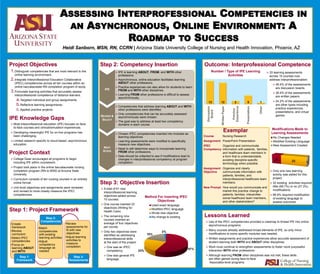
 33 learning assessments
across 10 courses now
address interprofessionalism.
 46.4% of the assessments
are discussion boards.
 36.4% of the assessments
are written papers.
 24.2% of the assessments
are other types including
practice experiences,
presentations, and virtual
games.
13 12 2 5 1
Discussion
Board
WrittenPaper
Practice
Experience
Presentation
Other
Number / Type of IPE Learning
Activities
9
23 1
Modifications Made to
Learning Assessments
No Changes Needed
Modified Existing Language
New Assessment Created
 Only one new learning
activity was added for this
project.
 32 existing activities required
little (69.7%) or no (27.3%)
modifications.
 96.9% required modification
of existing language to
assess outcomes
Exemplar
Course Nursing Research
Assignment PowerPoint Presentation
IPEC Organize and communicate
Competency information with patients, families,
and healthcare team members in
a form that is understandable,
avoiding discipline-specific
terminology when possible.
Assignment Organize and clearly
Objective communicate information with
patients, families, and
interprofessional healthcare team
members.
New Prompt How would you communicate and
market this practice change to
patients, families, interprofes-
sional healthcare team members,
and other stakeholders?

STTI_Assessing_Interprofessional_Competencies_Sanborn

  • 1.
    Project Context ASSESSING INTERPROFESSIONALCOMPETENCIES IN AN ASYNCHRONOUS, ONLINE ENVIRONMENT: A ROADMAP TO SUCCESS Heidi Sanborn, MSN, RN, CCRN | Arizona State University College of Nursing and Health Innovation, Phoenix, AZ IPE Knowledge Gaps Project Objectives 1.Distinguish competencies that are most relevant to the online learning environment. 2.Integrate Interprofessional Education Collaborative (IPEC) competencies across all ten courses within an online baccalaureate RN completion program of study. 3.Formulate learning activities that accurately assess interprofessional competence of distance learners. a.Targeted individual and group assignments. b.Reflective learning assignments. c.Applied practice projects.  College Dean encouraged all programs to begin including IPE within coursework.  Project took place in the online baccalaureate nursing completion program (RN to BSN) at Arizona State University.  Curriculum consists of ten nursing courses in an entirely online format.  Unit level objectives and assignments were reviewed and revised to more closely measure the IPEC competencies.  Most interprofessional education (IPE) focuses on face- to-face courses and clinical/simulation experiences.  Developing meaningful IPE for on-line programs has been challenging.  Limited research specific to cloud-based, asynchronous education. Lessons Learned  Use of the IPEC competencies provided a roadmap to thread IPE into online asynchronous programs.  Many courses already addressed broad elements of IPE, so only minor modifications to some specific modules was needed.  Written assignments and practice experiences allow accurate assessment of student learning both WITH and ABOUT other disciplines.  Work must continue to strengthen assessments to foster more purposeful interaction WITH other professions.  Although learning FROM other disciplines was not met, these skills are often gained during face-to-face Associates-level programs. Step 2: Competency Insertion Step 3: Objective Insertion  A total of 61 new interprofessional learning objectives added across 10 courses.  One course inserted 23 objectives (Writing for Health Care).  The remaining nine courses inserted an average of four objectives per course.  Only two objectives were identified as addressing interprofessional skills at the start of the project:  One was an IPEC competency.  One was general IPE language. Outcome: Interprofessional Competence  IPE is learning ABOUT, FROM, and WITH other professions.  Asynchronous, online education facilitates learning ABOUT other professions.  Practice experiences can also allow for students to learn FROM and WITH other disciplines.  Learning FROM other professions is difficult to assess asynchronously.  Competencies that address learning ABOUT and WITH other professions were identified.  Only competencies that can be accurately assessed asynchronously were chosen.  The goal was to address at least two competency domains in each course.  Chosen IPEC competencies inserted into modules as learning objectives.  Learning assessments were modified to specifically measure new objectives.  Need to still determine ways to incorporate learning FROM other professions.  Data should be collected to see if modifications lead to changes in interprofessional competency at program completion. NEXT STEPS IPE REVIEW & SELECT Step 1: Project Framework 57% 23% 18% 2% Method For Inserting IPEC Objectives Used exact language Modified IPEC language Wrote new objective No change to existing •Create framework •Review curriculum •Select IPEC competencies •Focus on learning ABOUT and WITH •Match competencies with existing learning activities •Adjust competency language as needed •Review assessments for fit with new objectives •Adjust learning activities to measure completion Step 3: Assessments Step 2: Competencies Step 1: Framework  33 learning assessments across 10 courses now address interprofessionalism.  46.4% of the assessments are discussion boards.  36.4% of the assessments are written papers.  24.2% of the assessments are other types including practice experiences, presentations, and virtual games. 13 12 2 5 1 Discussion Board WrittenPaper Practice Experience Presentation Other Number / Type of IPE Learning Activities 9 23 1 Modifications Made to Learning Assessments No Changes Needed Modified Existing Language New Assessment Created  Only one new learning activity was added for this project.  32 existing activities required little (69.7%) or no (27.3%) modifications.  96.9% required modification of existing language to assess outcomes Exemplar Course Nursing Research Assignment PowerPoint Presentation IPEC Organize and communicate Competency information with patients, families, and healthcare team members in a form that is understandable, avoiding discipline-specific terminology when possible. Assignment Organize and clearly Objective communicate information with patients, families, and interprofessional healthcare team members. New Prompt How would you communicate and market this practice change to patients, families, interprofes- sional healthcare team members, and other stakeholders?