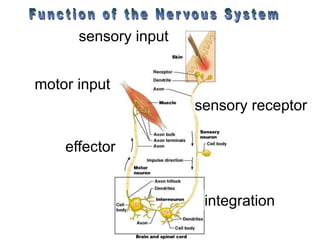
sensory receptor
sensory input
integration
motor input
effector
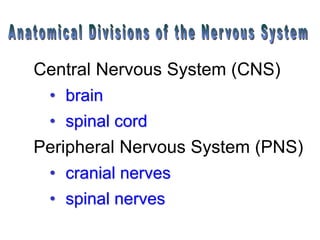
Central Nervous System (CNS)
• brain
• spinal cord
Peripheral Nervous System (PNS)
• cranial nerves
• spinal nerves
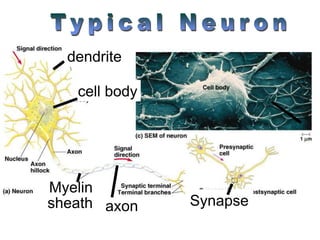
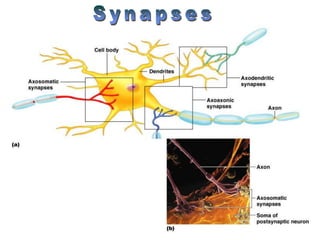
cell body
dendrite
Synapse
axon
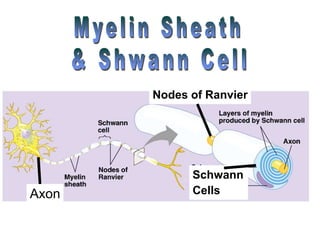
Myelin
sheath
Schwann
Cells
Axon
Nodes of Ranvier
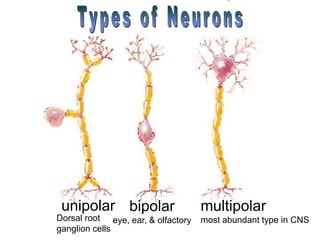
bipolar
eye, ear, & olfactory
unipolar multipolar
most abundant type in CNS
Dorsal root
ganglion cells
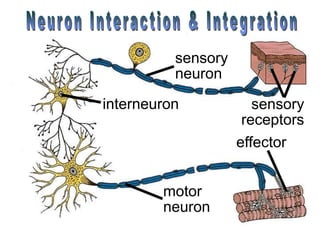
sensory
receptors
sensory
neuron
interneuron
motor
neuron
effector
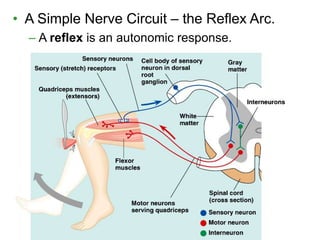
• A Simple Nerve Circuit – the Reflex Arc.
– A reflex is an autonomic response.
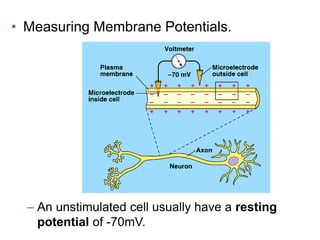
• Measuring Membrane Potentials.
– An unstimulated cell usually have a resting
potential of -70mV.
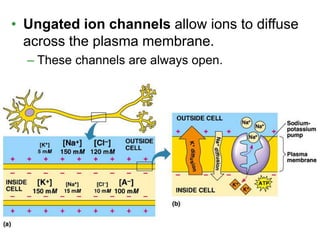
• Ungated ion channels allow ions to diffuse
across the plasma membrane.
– These channels are always open.
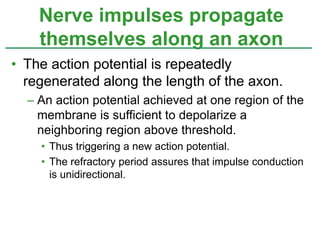
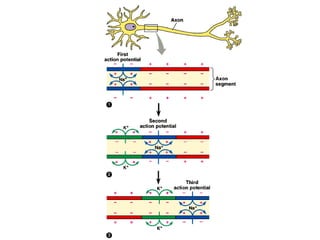
• The action potential is repeatedly
regenerated along the length of the axon.
– An action potential achieved at one region of the
membrane is sufficient to depolarize a
neighboring region above threshold.
• Thus triggering a new action potential.
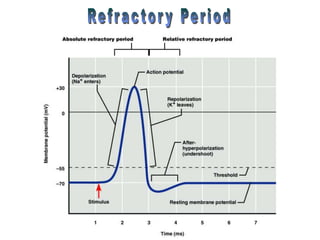
• The refractory period assures that impulse conduction
is unidirectional.
Nerve impulses propagate
themselves along an axon
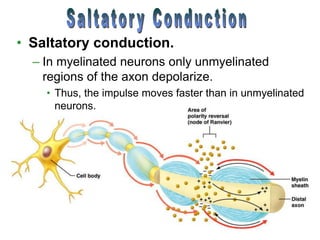
• Saltatory conduction.
– In myelinated neurons only unmyelinated
regions of the axon depolarize.
• Thus, the impulse moves faster than in unmyelinated
neurons.
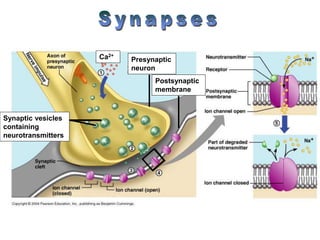
Presynaptic
neuron
Postsynaptic
membrane
Ca2+
Synaptic vesicles
containing
neurotransmitters
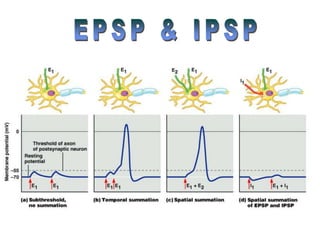
• Excitatory postsynaptic potentials (EPSP)
depolarize the postsynaptic neuron.
– The binding of neurotransmitter to postsynaptic
receptors open gated channels that allow Na+ to
diffuse into and K+ to diffuse out of the cell.
Neural integration occurs at the
cellular level
• Inhibitory postsynaptic potential (IPSP)
hyperpolarize the postsynaptic neuron.
– The binding of neurotransmitter to postsynaptic
receptors open gated channels that allow K+ to
diffuse out of the cell and/or Cl- to diffuse into the
cell.
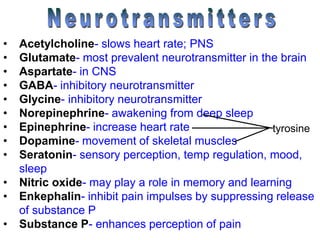
• Acetylcholine- slows heart rate; PNS
• Glutamate- most prevalent neurotransmitter in the brain
• Aspartate- in CNS
• GABA- inhibitory neurotransmitter
• Glycine- inhibitory neurotransmitter
• Norepinephrine- awakening from deep sleep
• Epinephrine- increase heart rate
• Dopamine- movement of skeletal muscles
• Seratonin- sensory perception, temp regulation, mood,
sleep
• Nitric oxide- may play a role in memory and learning
• Enkephalin- inhibit pain impulses by suppressing release
of substance P
• Substance P- enhances perception of pain
tyrosine

structure and function of Neurons (1).ppt

  • 2.
  • 3.
    Central Nervous System(CNS) • brain • spinal cord Peripheral Nervous System (PNS) • cranial nerves • spinal nerves
  • 5.
  • 6.
  • 7.
    bipolar eye, ear, &olfactory unipolar multipolar most abundant type in CNS Dorsal root ganglion cells
  • 8.
  • 9.
    • A SimpleNerve Circuit – the Reflex Arc. – A reflex is an autonomic response.
  • 10.
    • Measuring MembranePotentials. – An unstimulated cell usually have a resting potential of -70mV.
  • 11.
    • Ungated ionchannels allow ions to diffuse across the plasma membrane. – These channels are always open.
  • 13.
    • The actionpotential is repeatedly regenerated along the length of the axon. – An action potential achieved at one region of the membrane is sufficient to depolarize a neighboring region above threshold. • Thus triggering a new action potential. • The refractory period assures that impulse conduction is unidirectional. Nerve impulses propagate themselves along an axon
  • 15.
    • Saltatory conduction. –In myelinated neurons only unmyelinated regions of the axon depolarize. • Thus, the impulse moves faster than in unmyelinated neurons.
  • 16.
  • 17.
    • Excitatory postsynapticpotentials (EPSP) depolarize the postsynaptic neuron. – The binding of neurotransmitter to postsynaptic receptors open gated channels that allow Na+ to diffuse into and K+ to diffuse out of the cell. Neural integration occurs at the cellular level
  • 18.
    • Inhibitory postsynapticpotential (IPSP) hyperpolarize the postsynaptic neuron. – The binding of neurotransmitter to postsynaptic receptors open gated channels that allow K+ to diffuse out of the cell and/or Cl- to diffuse into the cell.
  • 21.
    • Acetylcholine- slowsheart rate; PNS • Glutamate- most prevalent neurotransmitter in the brain • Aspartate- in CNS • GABA- inhibitory neurotransmitter • Glycine- inhibitory neurotransmitter • Norepinephrine- awakening from deep sleep • Epinephrine- increase heart rate • Dopamine- movement of skeletal muscles • Seratonin- sensory perception, temp regulation, mood, sleep • Nitric oxide- may play a role in memory and learning • Enkephalin- inhibit pain impulses by suppressing release of substance P • Substance P- enhances perception of pain tyrosine