1
2
Structuralism Architecture Theory of Architecture
structuralism
In architecture
Theory of architecture
Abubeker fedlu 2015
3
Structuralism Architecture Theory of Architecture 2
Acknowledgment
I want to acknowledge those who helped during these project. I’d like
to thank Dire Dawa University and Department of Architecture. I also
want to thank my teacher AR Fethi Ramadan for giving me this
chance and for the way of teaching technique so that I can do
increase my knowledge and my working skills. Thanks ,too, my friends
and classmates for being such a supportive.
Thank You
Abubeker Fedlu
4
Structuralism Architecture Theory of Architecture 2
c o n t e n t s
Cover page
Preface
Acknowledgment
Introduction 1
Literature review 2
Analysis 4
Case studies 5
Understanding 9
Recommendation 10
Bibliography 11
Structuralism Architecture Theory of Architecture 5
Structuralism is a mode of thinking and a method of analysis
practiced in 20th-centurysocial sciences and humanities.
Methodologically, it analyses large-scale systems by examining
the relations and functions of the smallest constituent
elements of such systems, which range from human languages
and cultural practices to folktales and literary texts.
In Europe, structuralism is seen as a parallel movement to
American postmodern architecture. The first interpretations of
both movements came up in the 1960s. Through publications
and presentations by authors such as Charles Jencks, Robert
Venturi and Denise Scott Brown, postmodern architecture was
successful throughout the world for decades. While
postmodernism is concerned with an architectural style, many
aspects of architecture and urbanism are treated in the
structuralist movement.
Structuralism
STRUCTURALISM
Manifesto
One of the most influential manifestos for the Structuralist
movement was compiled by Aldo van Eyck in the architectural
magazine Forum 7/1959. It was drawn up as the programmed for
the International Congress of Architects in Otterlo in 1959. The
central aspect of this issue of Forum was a frontal attack on the
Dutch representatives of CIAM-Rationalism who were
responsible for the reconstruction work after World War II, (for
tactical reasons, planners like van Tijen, van Eastern, Merkelbach
and others were not mentioned). The magazine contains many
examples of and statements in favor of a more human form of
urban planning. This congress in 1959 marks the official start of
Structuralism, although earlier projects and buildings did exist.
Only since 1969 has the term "Structuralism" been used in
publications in relation to architecture
INTRODUCTION
Structuralism Architecture Theory of Architecture 6
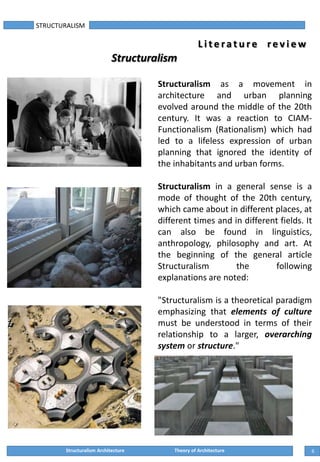
Structuralism as a movement in
architecture and urban planning
evolved around the middle of the 20th
century. It was a reaction to CIAM-
Functionalism (Rationalism) which had
led to a lifeless expression of urban
planning that ignored the identity of
the inhabitants and urban forms.
Structuralism in a general sense is a
mode of thought of the 20th century,
which came about in different places, at
different times and in different fields. It
can also be found in linguistics,
anthropology, philosophy and art. At
the beginning of the general article
Structuralism the following
explanations are noted:
"Structuralism is a theoretical paradigm
emphasizing that elements of culture
must be understood in terms of their
relationship to a larger, overarching
system or structure."
STRUCTURALISM
Structuralism
L i t e ra t u r e r e v i e w
Structuralism Architecture Theory of Architecture 2
STRUCTURALISM
Theoretical origins, principles and aspects
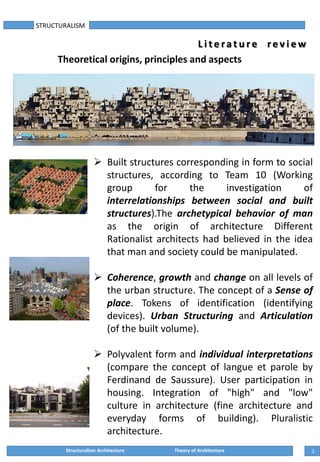
 Built structures corresponding in form to social
structures, according to Team 10 (Working
group for the investigation of
interrelationships between social and built
structures).The archetypical behavior of man
as the origin of architecture Different
Rationalist architects had believed in the idea
that man and society could be manipulated.
 Coherence, growth and change on all levels of
the urban structure. The concept of a Sense of
place. Tokens of identification (identifying
devices). Urban Structuring and Articulation
(of the built volume).
 Polyvalent form and individual interpretations
(compare the concept of langue et parole by
Ferdinand de Saussure). User participation in
housing. Integration of "high" and "low"
culture in architecture (fine architecture and
everyday forms of building). Pluralistic
architecture.
L i t e ra t u r e r e v i e w
Structuralism Architecture Theory of Architecture 2
STRUCTURALISM
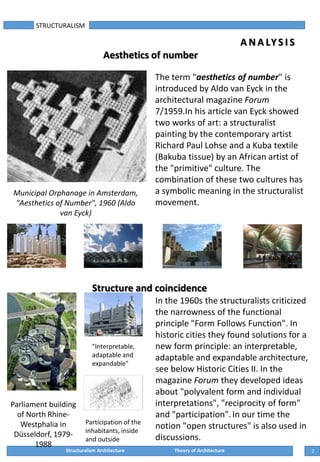
Aesthetics of number
The term "aesthetics of number" is
introduced by Aldo van Eyck in the
architectural magazine Forum
7/1959.In his article van Eyck showed
two works of art: a structuralist
painting by the contemporary artist
Richard Paul Lohse and a Kuba textile
(Bakuba tissue) by an African artist of
the "primitive" culture. The
combination of these two cultures has
a symbolic meaning in the structuralist
movement.
Municipal Orphanage in Amsterdam,
"Aesthetics of Number", 1960 (Aldo
van Eyck)
Structure and coincidence
In the 1960s the structuralists criticized
the narrowness of the functional
principle "Form Follows Function". In
historic cities they found solutions for a
new form principle: an interpretable,
adaptable and expandable architecture,
see below Historic Cities II. In the
magazine Forum they developed ideas
about "polyvalent form and individual
interpretations", "reciprocity of form"
and "participation".In our time the
notion "open structures" is also used in
discussions.
Parliament building
of North Rhine-
Westphalia in
Düsseldorf, 1979-
1988
Participation of the
inhabitants, inside
and outside
"Interpretable,
adaptable and
expandable"
A N A LY S I S
Structuralism Architecture Theory of Architecture 2
STRUCTURALISM
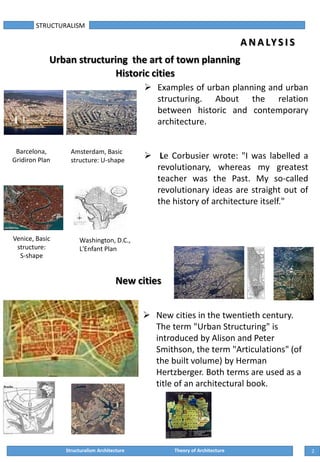
Urban structuring the art of town planning
 Examples of urban planning and urban
structuring. About the relation
between historic and contemporary
architecture.
 Le Corbusier wrote: "I was labelled a
revolutionary, whereas my greatest
teacher was the Past. My so-called
revolutionary ideas are straight out of
the history of architecture itself."
Amsterdam, Basic
structure: U-shape
Barcelona,
Gridiron Plan
Venice, Basic
structure:
S-shape
Washington, D.C.,
L'Enfant Plan
Historic cities
New cities
 New cities in the twentieth century.
The term "Urban Structuring" is
introduced by Alison and Peter
Smithson, the term "Articulations" (of
the built volume) by Herman
Hertzberger. Both terms are used as a
title of an architectural book.
A N A LY S I S
10
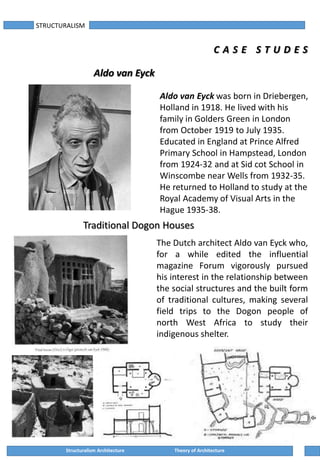
Aldo van Eyck was born in Driebergen,
Holland in 1918. He lived with his
family in Golders Green in London
from October 1919 to July 1935.
Educated in England at Prince Alfred
Primary School in Hampstead, London
from 1924-32 and at Sid cot School in
Winscombe near Wells from 1932-35.
He returned to Holland to study at the
Royal Academy of Visual Arts in the
Hague 1935-38.
STRUCTURALISM
Aldo van Eyck
C A S E S T U D E S
Traditional Dogon Houses
The Dutch architect Aldo van Eyck who,
for a while edited the influential
magazine Forum vigorously pursued
his interest in the relationship between
the social structures and the built form
of traditional cultures, making several
field trips to the Dogon people of
north West Africa to study their
indigenous shelter.
Structuralism Architecture Theory of Architecture
STRUCTURALISM
C A S E S T U D E S
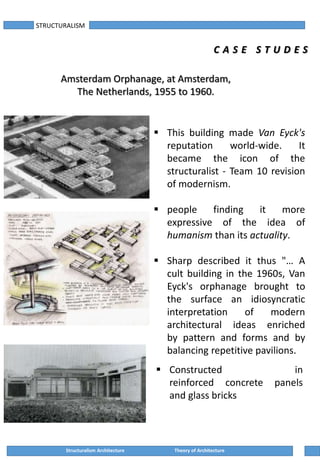
Amsterdam Orphanage, at Amsterdam,
The Netherlands, 1955 to 1960.
 This building made Van Eyck's
reputation world-wide. It
became the icon of the
structuralist - Team 10 revision
of modernism.
 people finding it more
expressive of the idea of
humanism than its actuality.
 Sharp described it thus "… A
cult building in the 1960s, Van
Eyck's orphanage brought to
the surface an idiosyncratic
interpretation of modern
architectural ideas enriched
by pattern and forms and by
balancing repetitive pavilions.
 Constructed in
reinforced concrete panels
and glass bricks
Structuralism Architecture Theory of Architecture
STRUCTURALISM
C A S E S T U D E S
Structuralism Architecture Theory of Architecture
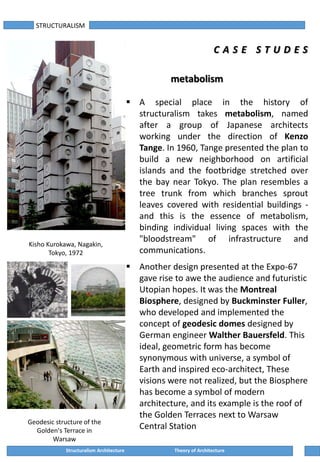
 A special place in the history of
structuralism takes metabolism, named
after a group of Japanese architects
working under the direction of Kenzo
Tange. In 1960, Tange presented the plan to
build a new neighborhood on artificial
islands and the footbridge stretched over
the bay near Tokyo. The plan resembles a
tree trunk from which branches sprout
leaves covered with residential buildings -
and this is the essence of metabolism,
binding individual living spaces with the
"bloodstream" of infrastructure and
communications.
Kisho Kurokawa, Nagakin,
Tokyo, 1972
metabolism
 Another design presented at the Expo-67
gave rise to awe the audience and futuristic
Utopian hopes. It was the Montreal
Biosphere, designed by Buckminster Fuller,
who developed and implemented the
concept of geodesic domes designed by
German engineer Walther Bauersfeld. This
ideal, geometric form has become
synonymous with universe, a symbol of
Earth and inspired eco-architect, These
visions were not realized, but the Biosphere
has become a symbol of modern
architecture, and its example is the roof of
the Golden Terraces next to Warsaw
Central Station
Geodesic structure of the
Golden's Terrace in
Warsaw
STRUCTURALISM
S T V s F U
Structuralism Architecture Theory of Architecture
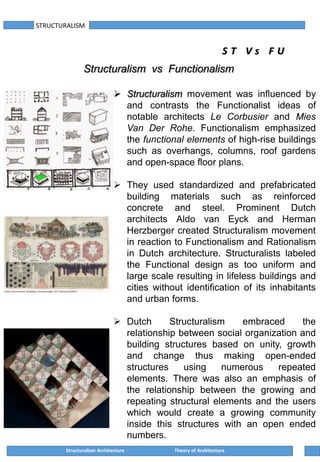
 Structuralism movement was influenced by
and contrasts the Functionalist ideas of
notable architects Le Corbusier and Mies
Van Der Rohe. Functionalism emphasized
the functional elements of high-rise buildings
such as overhangs, columns, roof gardens
and open-space floor plans.
 They used standardized and prefabricated
building materials such as reinforced
concrete and steel. Prominent Dutch
architects Aldo van Eyck and Herman
Herzberger created Structuralism movement
in reaction to Functionalism and Rationalism
in Dutch architecture. Structuralists labeled
the Functional design as too uniform and
large scale resulting in lifeless buildings and
cities without identification of its inhabitants
and urban forms.
 Dutch Structuralism embraced the
relationship between social organization and
building structures based on unity, growth
and change thus making open-ended
structures using numerous repeated
elements. There was also an emphasis of
the relationship between the growing and
repeating structural elements and the users
which would create a growing community
inside this structures with an open ended
numbers.
Structuralism vs Functionalism
STRUCTURALISM
U N D E R S T A N D I N G
Structuralism Architecture Theory of Architecture
What I have analyzed as structuralism in
architecture, and city-planning
characterized on social and cultural
ideas.
Those social and cultural things must be
symbolized through structure.
These structure may not be identical or
simply recognizable because as the
social and cultural beliefs differ from
each other.
Some times and mostly those structures
are complicated and patterned these
implies the social and cultural beliefs
and complicated and hared to
recognize. Above
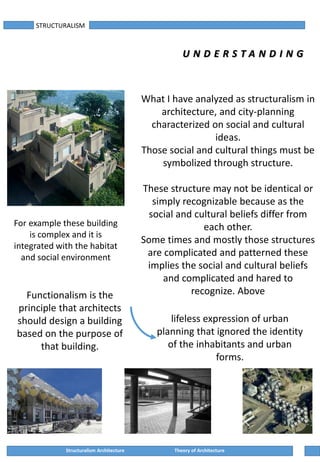
For example these building
is complex and it is
integrated with the habitat
and social environment
lifeless expression of urban
planning that ignored the identity
of the inhabitants and urban
forms.
Functionalism is the
principle that architects
should design a building
based on the purpose of
that building.
STRUCTURALISM
R E C O M M E N D A T I O N
Structuralism Architecture Theory of Architecture
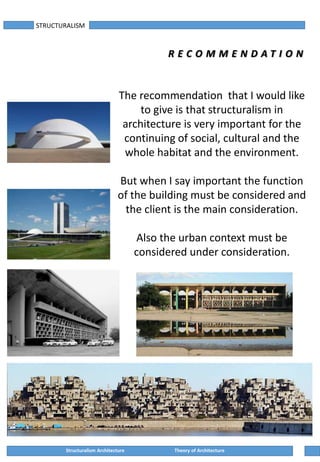
The recommendation that I would like
to give is that structuralism in
architecture is very important for the
continuing of social, cultural and the
whole habitat and the environment.
But when I say important the function
of the building must be considered and
the client is the main consideration.
Also the urban context must be
considered under consideration.
STRUCTURALISM
B I B L O G R A P H Y
Structuralism Architecture Theory of Architecture
 http://en.wikipedia.org/wiki/Fu
nctionalism_%28architecture%
29
 http://en.wikipedia.org/wiki/Ar
t_Nouveau
 http://en.wikipedia.org/wiki/H
alen_Estate
 http://en.wikipedia.org/wiki/H
erman_Hertzberger

Structuralism is a mode of thinking .pptx

  • 1.
  • 2.
    2 Structuralism Architecture Theoryof Architecture structuralism In architecture Theory of architecture Abubeker fedlu 2015
  • 3.
    3 Structuralism Architecture Theoryof Architecture 2 Acknowledgment I want to acknowledge those who helped during these project. I’d like to thank Dire Dawa University and Department of Architecture. I also want to thank my teacher AR Fethi Ramadan for giving me this chance and for the way of teaching technique so that I can do increase my knowledge and my working skills. Thanks ,too, my friends and classmates for being such a supportive. Thank You Abubeker Fedlu
  • 4.
    4 Structuralism Architecture Theoryof Architecture 2 c o n t e n t s Cover page Preface Acknowledgment Introduction 1 Literature review 2 Analysis 4 Case studies 5 Understanding 9 Recommendation 10 Bibliography 11
  • 5.
    Structuralism Architecture Theoryof Architecture 5 Structuralism is a mode of thinking and a method of analysis practiced in 20th-centurysocial sciences and humanities. Methodologically, it analyses large-scale systems by examining the relations and functions of the smallest constituent elements of such systems, which range from human languages and cultural practices to folktales and literary texts. In Europe, structuralism is seen as a parallel movement to American postmodern architecture. The first interpretations of both movements came up in the 1960s. Through publications and presentations by authors such as Charles Jencks, Robert Venturi and Denise Scott Brown, postmodern architecture was successful throughout the world for decades. While postmodernism is concerned with an architectural style, many aspects of architecture and urbanism are treated in the structuralist movement. Structuralism STRUCTURALISM Manifesto One of the most influential manifestos for the Structuralist movement was compiled by Aldo van Eyck in the architectural magazine Forum 7/1959. It was drawn up as the programmed for the International Congress of Architects in Otterlo in 1959. The central aspect of this issue of Forum was a frontal attack on the Dutch representatives of CIAM-Rationalism who were responsible for the reconstruction work after World War II, (for tactical reasons, planners like van Tijen, van Eastern, Merkelbach and others were not mentioned). The magazine contains many examples of and statements in favor of a more human form of urban planning. This congress in 1959 marks the official start of Structuralism, although earlier projects and buildings did exist. Only since 1969 has the term "Structuralism" been used in publications in relation to architecture INTRODUCTION
  • 6.
    Structuralism Architecture Theoryof Architecture 6 Structuralism as a movement in architecture and urban planning evolved around the middle of the 20th century. It was a reaction to CIAM- Functionalism (Rationalism) which had led to a lifeless expression of urban planning that ignored the identity of the inhabitants and urban forms. Structuralism in a general sense is a mode of thought of the 20th century, which came about in different places, at different times and in different fields. It can also be found in linguistics, anthropology, philosophy and art. At the beginning of the general article Structuralism the following explanations are noted: "Structuralism is a theoretical paradigm emphasizing that elements of culture must be understood in terms of their relationship to a larger, overarching system or structure." STRUCTURALISM Structuralism L i t e ra t u r e r e v i e w
  • 7.
    Structuralism Architecture Theoryof Architecture 2 STRUCTURALISM Theoretical origins, principles and aspects  Built structures corresponding in form to social structures, according to Team 10 (Working group for the investigation of interrelationships between social and built structures).The archetypical behavior of man as the origin of architecture Different Rationalist architects had believed in the idea that man and society could be manipulated.  Coherence, growth and change on all levels of the urban structure. The concept of a Sense of place. Tokens of identification (identifying devices). Urban Structuring and Articulation (of the built volume).  Polyvalent form and individual interpretations (compare the concept of langue et parole by Ferdinand de Saussure). User participation in housing. Integration of "high" and "low" culture in architecture (fine architecture and everyday forms of building). Pluralistic architecture. L i t e ra t u r e r e v i e w
  • 8.
    Structuralism Architecture Theoryof Architecture 2 STRUCTURALISM Aesthetics of number The term "aesthetics of number" is introduced by Aldo van Eyck in the architectural magazine Forum 7/1959.In his article van Eyck showed two works of art: a structuralist painting by the contemporary artist Richard Paul Lohse and a Kuba textile (Bakuba tissue) by an African artist of the "primitive" culture. The combination of these two cultures has a symbolic meaning in the structuralist movement. Municipal Orphanage in Amsterdam, "Aesthetics of Number", 1960 (Aldo van Eyck) Structure and coincidence In the 1960s the structuralists criticized the narrowness of the functional principle "Form Follows Function". In historic cities they found solutions for a new form principle: an interpretable, adaptable and expandable architecture, see below Historic Cities II. In the magazine Forum they developed ideas about "polyvalent form and individual interpretations", "reciprocity of form" and "participation".In our time the notion "open structures" is also used in discussions. Parliament building of North Rhine- Westphalia in Düsseldorf, 1979- 1988 Participation of the inhabitants, inside and outside "Interpretable, adaptable and expandable" A N A LY S I S
  • 9.
    Structuralism Architecture Theoryof Architecture 2 STRUCTURALISM Urban structuring the art of town planning  Examples of urban planning and urban structuring. About the relation between historic and contemporary architecture.  Le Corbusier wrote: "I was labelled a revolutionary, whereas my greatest teacher was the Past. My so-called revolutionary ideas are straight out of the history of architecture itself." Amsterdam, Basic structure: U-shape Barcelona, Gridiron Plan Venice, Basic structure: S-shape Washington, D.C., L'Enfant Plan Historic cities New cities  New cities in the twentieth century. The term "Urban Structuring" is introduced by Alison and Peter Smithson, the term "Articulations" (of the built volume) by Herman Hertzberger. Both terms are used as a title of an architectural book. A N A LY S I S
  • 10.
    10 Aldo van Eyckwas born in Driebergen, Holland in 1918. He lived with his family in Golders Green in London from October 1919 to July 1935. Educated in England at Prince Alfred Primary School in Hampstead, London from 1924-32 and at Sid cot School in Winscombe near Wells from 1932-35. He returned to Holland to study at the Royal Academy of Visual Arts in the Hague 1935-38. STRUCTURALISM Aldo van Eyck C A S E S T U D E S Traditional Dogon Houses The Dutch architect Aldo van Eyck who, for a while edited the influential magazine Forum vigorously pursued his interest in the relationship between the social structures and the built form of traditional cultures, making several field trips to the Dogon people of north West Africa to study their indigenous shelter. Structuralism Architecture Theory of Architecture
  • 11.
    STRUCTURALISM C A SE S T U D E S Amsterdam Orphanage, at Amsterdam, The Netherlands, 1955 to 1960.  This building made Van Eyck's reputation world-wide. It became the icon of the structuralist - Team 10 revision of modernism.  people finding it more expressive of the idea of humanism than its actuality.  Sharp described it thus "… A cult building in the 1960s, Van Eyck's orphanage brought to the surface an idiosyncratic interpretation of modern architectural ideas enriched by pattern and forms and by balancing repetitive pavilions.  Constructed in reinforced concrete panels and glass bricks Structuralism Architecture Theory of Architecture
  • 12.
    STRUCTURALISM C A SE S T U D E S Structuralism Architecture Theory of Architecture  A special place in the history of structuralism takes metabolism, named after a group of Japanese architects working under the direction of Kenzo Tange. In 1960, Tange presented the plan to build a new neighborhood on artificial islands and the footbridge stretched over the bay near Tokyo. The plan resembles a tree trunk from which branches sprout leaves covered with residential buildings - and this is the essence of metabolism, binding individual living spaces with the "bloodstream" of infrastructure and communications. Kisho Kurokawa, Nagakin, Tokyo, 1972 metabolism  Another design presented at the Expo-67 gave rise to awe the audience and futuristic Utopian hopes. It was the Montreal Biosphere, designed by Buckminster Fuller, who developed and implemented the concept of geodesic domes designed by German engineer Walther Bauersfeld. This ideal, geometric form has become synonymous with universe, a symbol of Earth and inspired eco-architect, These visions were not realized, but the Biosphere has become a symbol of modern architecture, and its example is the roof of the Golden Terraces next to Warsaw Central Station Geodesic structure of the Golden's Terrace in Warsaw
  • 13.
    STRUCTURALISM S T Vs F U Structuralism Architecture Theory of Architecture  Structuralism movement was influenced by and contrasts the Functionalist ideas of notable architects Le Corbusier and Mies Van Der Rohe. Functionalism emphasized the functional elements of high-rise buildings such as overhangs, columns, roof gardens and open-space floor plans.  They used standardized and prefabricated building materials such as reinforced concrete and steel. Prominent Dutch architects Aldo van Eyck and Herman Herzberger created Structuralism movement in reaction to Functionalism and Rationalism in Dutch architecture. Structuralists labeled the Functional design as too uniform and large scale resulting in lifeless buildings and cities without identification of its inhabitants and urban forms.  Dutch Structuralism embraced the relationship between social organization and building structures based on unity, growth and change thus making open-ended structures using numerous repeated elements. There was also an emphasis of the relationship between the growing and repeating structural elements and the users which would create a growing community inside this structures with an open ended numbers. Structuralism vs Functionalism
  • 14.
    STRUCTURALISM U N DE R S T A N D I N G Structuralism Architecture Theory of Architecture What I have analyzed as structuralism in architecture, and city-planning characterized on social and cultural ideas. Those social and cultural things must be symbolized through structure. These structure may not be identical or simply recognizable because as the social and cultural beliefs differ from each other. Some times and mostly those structures are complicated and patterned these implies the social and cultural beliefs and complicated and hared to recognize. Above For example these building is complex and it is integrated with the habitat and social environment lifeless expression of urban planning that ignored the identity of the inhabitants and urban forms. Functionalism is the principle that architects should design a building based on the purpose of that building.
  • 15.
    STRUCTURALISM R E CO M M E N D A T I O N Structuralism Architecture Theory of Architecture The recommendation that I would like to give is that structuralism in architecture is very important for the continuing of social, cultural and the whole habitat and the environment. But when I say important the function of the building must be considered and the client is the main consideration. Also the urban context must be considered under consideration.
  • 16.
    STRUCTURALISM B I BL O G R A P H Y Structuralism Architecture Theory of Architecture  http://en.wikipedia.org/wiki/Fu nctionalism_%28architecture% 29  http://en.wikipedia.org/wiki/Ar t_Nouveau  http://en.wikipedia.org/wiki/H alen_Estate  http://en.wikipedia.org/wiki/H erman_Hertzberger