More Related Content


Similar to STRUCTURAL ORGANISATION IN ANIMALS.pdf. chart


STRUCTURAL ORGANISATION IN ANIMALS.pdf. chart
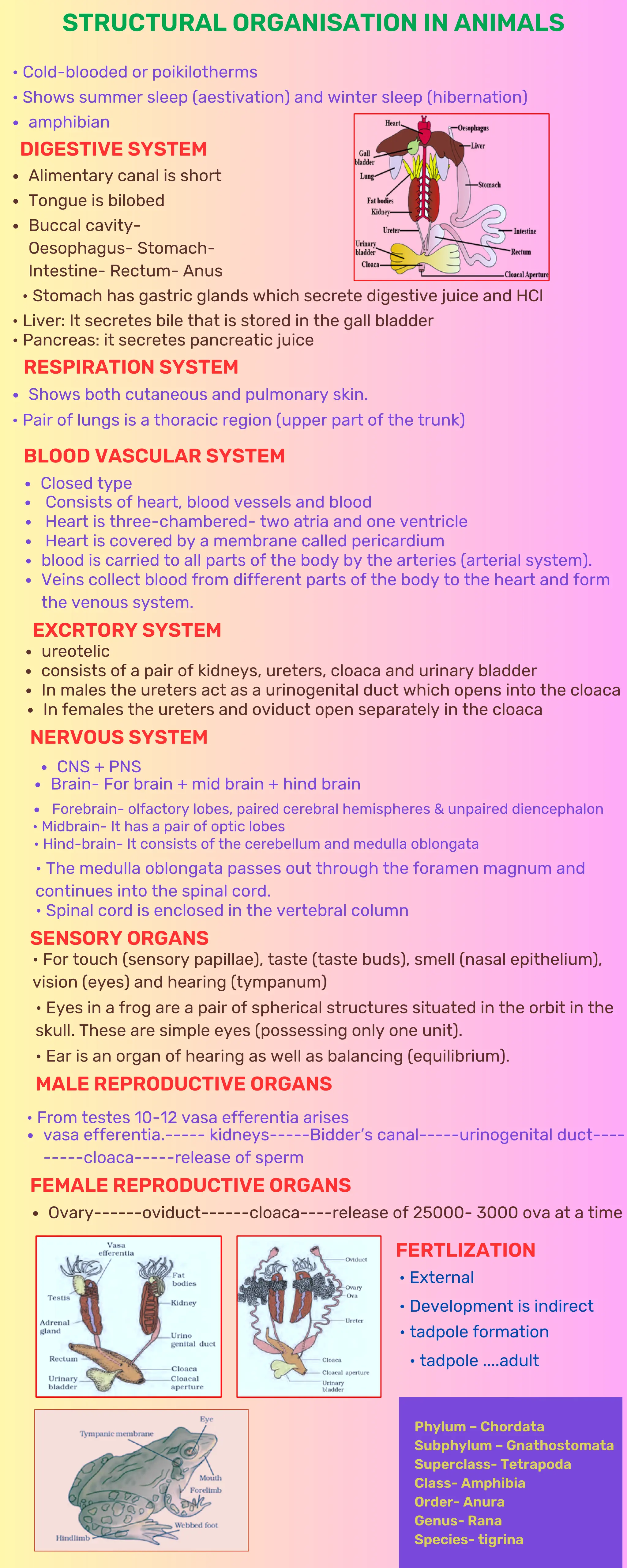
- 1. STRUCTURAL ORGANISATION INANIMALS • Cold-blooded or poikilotherms • Shows summer sleep (aestivation) and winter sleep (hibernation) amphibian DIGESTIVE SYSTEM Alimentary canal is short Tongue is bilobed Buccal cavity- Oesophagus- Stomach- Intestine- Rectum- Anus • Stomach has gastric glands which secrete digestive juice and HCl • Liver: It secretes bile that is stored in the gall bladder • Pancreas: it secretes pancreatic juice RESPIRATION SYSTEM Shows both cutaneous and pulmonary skin. • Pair of lungs is a thoracic region (upper part of the trunk) BLOOD VASCULAR SYSTEM Closed type Consists of heart, blood vessels and blood Heart is three-chambered- two atria and one ventricle Heart is covered by a membrane called pericardium blood is carried to all parts of the body by the arteries (arterial system). Veins collect blood from different parts of the body to the heart and form the venous system. EXCRTORY SYSTEM ureotelic consists of a pair of kidneys, ureters, cloaca and urinary bladder In males the ureters act as a urinogenital duct which opens into the cloaca In females the ureters and oviduct open separately in the cloaca NERVOUS SYSTEM CNS + PNS Brain- For brain + mid brain + hind brain Forebrain- olfactory lobes, paired cerebral hemispheres & unpaired diencephalon • Midbrain- It has a pair of optic lobes • Hind-brain- It consists of the cerebellum and medulla oblongata • The medulla oblongata passes out through the foramen magnum and continues into the spinal cord. • Spinal cord is enclosed in the vertebral column SENSORY ORGANS • For touch (sensory papillae), taste (taste buds), smell (nasal epithelium), vision (eyes) and hearing (tympanum) • Eyes in a frog are a pair of spherical structures situated in the orbit in the skull. These are simple eyes (possessing only one unit). • Ear is an organ of hearing as well as balancing (equilibrium). MALE REPRODUCTIVE ORGANS • From testes 10-12 vasa efferentia arises vasa efferentia.----- kidneys-----Bidder’s canal-----urinogenital duct---- -----cloaca-----release of sperm FEMALE REPRODUCTIVE ORGANS Ovary------oviduct------cloaca----release of 25000- 3000 ova at a time FERTLIZATION • External • Development is indirect • tadpole formation • tadpole ....adult Phylum – Chordata Subphylum – Gnathostomata Superclass- Tetrapoda Class- Amphibia Order- Anura Genus- Rana Species- tigrina