Download to read offline

![3. BG PROCEDURES (Biological Growth)
The evolutionary procedures considered in the following work by simulating the Biological Growth (BG)
of natural structures (Mattheck &Burkhardt 1990, Mattheck &Moldenhauer 1990). Such structures are known
to evolve by adapting themselves to the applied loads according to the axiom of uniform stress, which states
that in the optimal configuration the stress field distribution tends to be fairly regular over the structure
(Mattheck 1998). Thus, structural shape and topology are gradually modified in such a way that material is
added in the zones with high stress concentrations and removed from under-loaded zones (swelling).
The simplest form of a swelling law able to regulate such modifications is assumed as follows:
DFK
dt
dV
V
n
REF
n
SW =−⋅== )(
1
σσε&
being: SWε& the swelling strain rate; V the evolutionary time-dependent volume V=V(t); K an artificial constant;
σ the actual von Mises stress and REFσ its reference, or far-field, value; n a suitable exponent (n=1 for a
stress-based and n=2 for a energy-based criterion); DF the Driving Force of the evolutionary process. Based
on this law, the numerical simulation of the growth mechanism is obtained through three steps (Figure 2).
F
BASIC STEP
SWELLING STEP
UPDATE STEP
SW
VM(xi )
u SW(xi)
xi,k+1=xi,k+C u SW(xi)
P0
P0
PSW:∆εSW
SV,SW
SV,0
SV,0
L0=DESIGN CONSTRAINT
L0=DESIGN CONSTRAINT
L0=DESIGN CONSTRAINT
Figure 2. Fundamental steps of the BG evolutionary process.
(1) Basic Step. A finite element analysis is performed to obtain the stress distribution σ over the structure.
(2) Swelling Step. The Driving Forces are firstly computed. In particular, for structure in plane state the
following isotropic swelling strain increment vector T
2
1
]011[SWSW ε∆=∆e is considered for the time
increment ∆t. Based on such strain distribution, the load vector SW
f∆ equivalent to swelling is derived
and the corresponding incremental displacement vector SWu∆ is evaluated as follows:
∫ ∆=
V
SW
T
SW
dVeDBfÄ ⇒ SWsw
fuK ∆=∆ ⇒ SWsw fKu ∆=∆ −1
being B the compatibility matrix of the finite element, D the constitutive matrix of the material and K
the stiffness matrix of the structure. It is worth noting that, in this work, additional geometrical design
constraints are accounted directly by replacing the actual boundary conditions of the swelling model
in such a way that swelling displacements which violate the constraints are not allowed. This concept is
shown in Figure 2, where the cantilever beam is forced to maintain its initial length during the evolution.
(3) Update Step. The location ki,x of each node i=1,…,N of the finite element model at the current
generation k is updated according to the swelling displacements SWu∆ just obtained as follows:](https://image.slidesharecdn.com/structuralmorphologyoptimizationbyevolutionaryprocedures-140511035926-phpapp02/85/Structural-morphology-optimization-by-evolutionary-procedures-3-320.jpg)
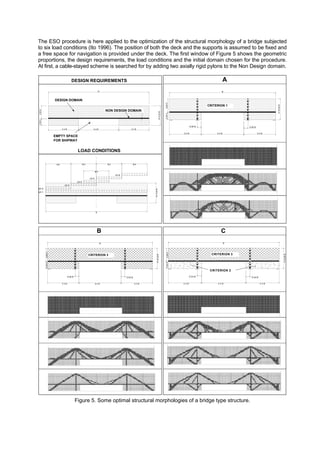

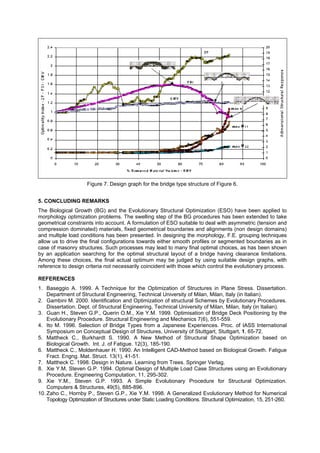

This paper explores optimization of structural morphologies using evolutionary procedures, focusing on two main approaches: biological growth simulation and evolutionary structural optimization (ESO). The study illustrates how these methods can effectively refine structural designs by removing inefficient material and adapting shapes based on stress distribution, with applications demonstrated through the optimization of a pylon and a bridge. The results highlight the importance of iterative processes in achieving optimal configurations, emphasizing the role of proper optimality indexes and design graphs.


