

Blockchain Cryptography for Devs
Elliptic Curves, ECC, ECDSA,
secp256k1, Hashes, Wallets, AES,
SCrypt, HMAC, BIP39, BIP44
Software University (SoftUni)
https://softuni.org
Svetlin Nakov
Blockchain Engineer
and Technical Trainer
2
 Software engineer, trainer, entrepreneur,
PhD, author of 12 books, blockchain expert
 3 successful tech educational initiatives (100,000+ students):
About Svetlin Nakov
3
 Technical advisor @ LockChain / LockTrip: https://locktrip.com
 Raised ~ 10.000 ETH in token sale (Sep-Nov 2017)
 Currently LOC token holders book hotels @ 20-30% better price
 Head of blockchain education (Jan-June 2018) @ Academy
School of Blockchain: https://academytoken.com
 Raised ~ 48M USD in token sale (Jan-Apr 2018)
 Tech advisor for blockchain crypto startups:
 Tokenize Exchange, Bountie, Weidex, IRIS Payments Solutions,
Aeternity Ventures
Nakov – Blockchain & Crypto Projects
4
 Elliptic Curve Cryptography (ECC)
 ECC Concepts, Elliptic Curves, the secp256k1 Curve
 Private Key  Public Key  Blockchain Address
 Sign / Verify Transactions in Ethereum
 Cryptographic Hash Functions: SHA256, SHA3, RIPEMD160, …
 HMAC and Key Derivation: HMAC, PBKDF2, SCrypt
 Blockchain Cryptography and Wallets: JSON / UTC, BIP39, BIP44
 Wallet Encryption: AES + Padding + CBC/CTR, SCrypt, HMAC
Table of Contents
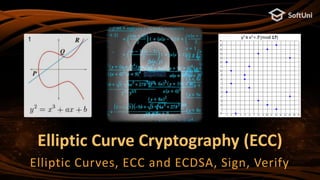
Elliptic Curve Cryptography (ECC)
Elliptic Curves, ECC and ECDSA, Sign, Verify
6
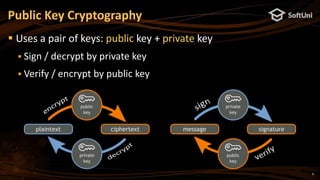
 Uses a pair of keys: public key + private key
 Sign / decrypt by private key
 Verify / encrypt by public key
Public Key Cryptography
7
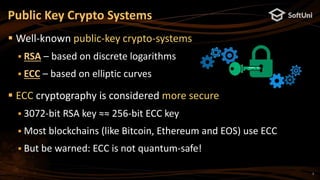
 Well-known public-key crypto-systems
 RSA – based on discrete logarithms
 ECC – based on elliptic curves
 ECC cryptography is considered more secure
 3072-bit RSA key ≈≈ 256-bit ECC key
 Most blockchains (like Bitcoin, Ethereum and EOS) use ECC
 But be warned: ECC is not quantum-safe!
Public Key Crypto Systems
8
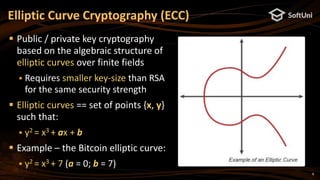
 Public / private key cryptography
based on the algebraic structure of
elliptic curves over finite fields
 Requires smaller key-size than RSA
for the same security strength
 Elliptic curves == set of points {x, y}
such that:
 y2 = x3 + ax + b
 Example – the Bitcoin elliptic curve:
 y2 = x3 + 7 (a = 0; b = 7)
Elliptic Curve Cryptography (ECC)
9
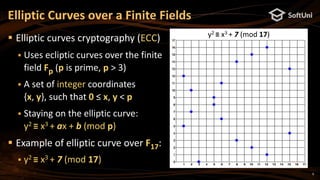
 Elliptic curves cryptography (ECC)
 Uses ecliptic curves over the finite
field Fp (p is prime, p > 3)
 A set of integer coordinates
{x, y}, such that 0 ≤ x, y < p
 Staying on the elliptic curve:
y2 ≡ x3 + ax + b (mod p)
 Example of elliptic curve over F17:
 y2 ≡ x3 + 7 (mod 17)
Elliptic Curves over a Finite Fields
y2 ≡ x3 + 7 (mod 17)
10
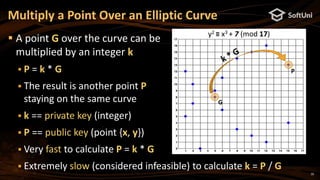
 A point G over the curve can be
multiplied by an integer k
 P = k * G
 The result is another point P
staying on the same curve
 k == private key (integer)
 P == public key (point {x, y})
 Very fast to calculate P = k * G
 Extremely slow (considered infeasible) to calculate k = P / G
Multiply a Point Over an Elliptic Curve
y2 ≡ x3 + 7 (mod 17)
G
P
11
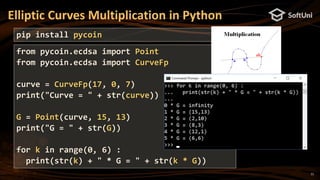
Elliptic Curves Multiplication in Python
from pycoin.ecdsa import Point
from pycoin.ecdsa import CurveFp
curve = CurveFp(17, 0, 7)
print("Curve = " + str(curve))
G = Point(curve, 15, 13)
print("G = " + str(G))
for k in range(0, 6) :
print(str(k) + " * G = " + str(k * G))
pip install pycoin
12
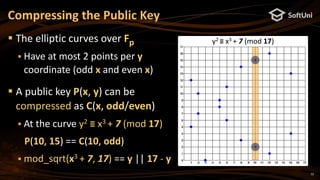
 The elliptic curves over Fp
 Have at most 2 points per y
coordinate (odd x and even x)
 A public key P(x, y) can be
compressed as C(x, odd/even)
 At the curve y2 ≡ x3 + 7 (mod 17)
P(10, 15) == C(10, odd)
 mod_sqrt(x3 + 7, 17) == y || 17 - y
Compressing the Public Key
y2 ≡ x3 + 7 (mod 17)
13
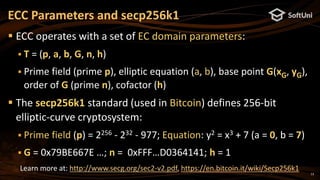
 ECC operates with a set of EC domain parameters:
 T = (p, a, b, G, n, h)
 Prime field (prime p), elliptic equation (a, b), base point G(xG, yG),
order of G (prime n), cofactor (h)
 The secp256k1 standard (used in Bitcoin) defines 256-bit
elliptic-curve cryptosystem:
 Prime field (p) = 2256 - 232 - 977; Equation: y2 = x3 + 7 (a = 0, b = 7)
 G = 0x79BE667E …; n = 0xFFF…D0364141; h = 1
ECC Parameters and secp256k1
Learn more at: http://www.secg.org/sec2-v2.pdf, https://en.bitcoin.it/wiki/Secp256k1
14
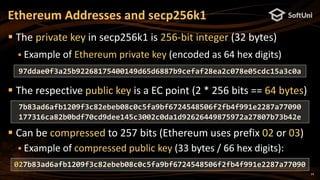
 The private key in secp256k1 is 256-bit integer (32 bytes)
 Example of Ethereum private key (encoded as 64 hex digits)
 The respective public key is a EC point (2 * 256 bits == 64 bytes)
 Can be compressed to 257 bits (Ethereum uses prefix 02 or 03)
 Example of compressed public key (33 bytes / 66 hex digits):
Ethereum Addresses and secp256k1
97ddae0f3a25b92268175400149d65d6887b9cefaf28ea2c078e05cdc15a3c0a
027b83ad6afb1209f3c82ebeb08c0c5fa9bf6724548506f2fb4f991e2287a77090
7b83ad6afb1209f3c82ebeb08c0c5fa9bf6724548506f2fb4f991e2287a77090
177316ca82b0bdf70cd9dee145c3002c0da1d92626449875972a27807b73b42e
15
 The blockchain address in Ethereum is 20 bytes
 Calculated as: last20bytes(keccak256(publicKeyFull))
 Example of Ethereum address (encoded as 40 hex digits):
 Note: some letters are capital to incorporate a checksum (EIP55)
 Digital signatures in secp256k1 are 64 bytes (2 * 32 bytes)
 A pair of two 256-bit numbers: [r, s]
 Calculated by the well-known ECDSA formulas (see RFC6979)
ECDSA, secp256k1 and Ethereum (2)
0xa44f70834a711F0DF388ab016465f2eEb255dEd0
16
Ethereum Key to Addresses – Example
pip install eth_keys
import eth_keys, binascii
privKey = eth_keys.keys.PrivateKey(binascii.unhexlify(
'97ddae0f3a25b92268175400149d65d6887b9cefaf28ea2c078e05cdc15a3c0a'))
print('Private key (64 hex digits):', privKey)
pubKey = privKey.public_key
print('Public key (plain, 128 hex digits):', pubKey)
pubKeyCompr = '0' + str(2 + int(pubKey) % 2) + str(pubKey)[2:66]
print('Public key (compressed, 66 hex digits):', pubKeyCompr)
address = pubKey.to_checksum_address()
print('Ethereum address:', address)
17
 Ethereum uses secp256k1-based ECDSA signatures
 ECDSA generates deterministically a random point R (see RFC6979)
 Ethereum signatures consists of 3 numbers: [v, r, s]
 v – the compressed Y coordinate of the point R (1 byte: 00 or 01)
 r – the X coordinate of the point R (256-bit integer, 32 bytes)
 s – 256-bit integer (32 bytes), calculated from the signer's private key +
message hash (Ethereum uses keccak256)
 Typically encoded as 130 hex digits (65 bytes), e.g. 0x…465c5cf4be401
 Given an Ethereum signature [v, r, s], the public key can be recovered
from [R, s, msgHash]  also the signer's Ethereum address
Ethereum Signatures
18
Sign Message in Ethereum – Example
import eth_keys, binascii
privKey = eth_keys.keys.PrivateKey(binascii.unhexlify(
'97ddae0f3a25b92268175400149d65d6887b9cefaf28ea2c078e05cdc15a3c0a'))
print('Private key (64 hex digits):', privKey)
signature = privKey.sign_msg(b'Message for signing')
print('Signature: [v = {0}, r = {1}, s = {2}]'.format(
hex(signature.v), hex(signature.r), hex(signature.s)))
print('Signature (130 hex digits):', signature)
19
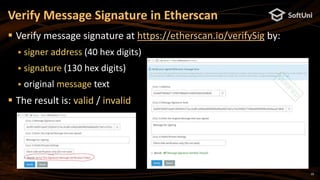
Verify Message Signature in Etherscan
 Verify message signature at https://etherscan.io/verifySig by:
 signer address (40 hex digits)
 signature (130 hex digits)
 original message text
 The result is: valid / invalid
20
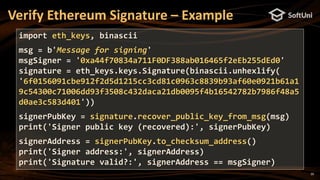
Verify Ethereum Signature – Example
import eth_keys, binascii
msg = b'Message for signing'
msgSigner = '0xa44f70834a711F0DF388ab016465f2eEb255dEd0'
signature = eth_keys.keys.Signature(binascii.unhexlify(
'6f0156091cbe912f2d5d1215cc3cd81c0963c8839b93af60e0921b61a1
9c54300c71006dd93f3508c432daca21db0095f4b16542782b7986f48a5
d0ae3c583d401'))
signerPubKey = signature.recover_public_key_from_msg(msg)
print('Signer public key (recovered):', signerPubKey)
signerAddress = signerPubKey.to_checksum_address()
print('Signer address:', signerAddress)
print('Signature valid?:', signerAddress == msgSigner)
Hashing and Hash Functions
Cryptographic Hash Functions
22
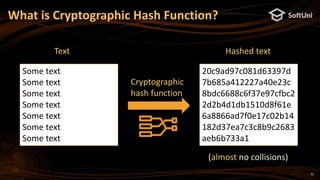
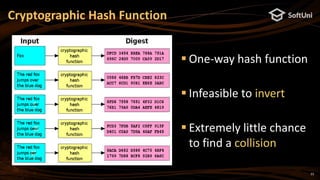
What is Cryptographic Hash Function?
Some text
Some text
Some text
Some text
Some text
Some text
Some text
20c9ad97c081d63397d
7b685a412227a40e23c
8bdc6688c6f37e97cfbc2
2d2b4d1db1510d8f61e
6a8866ad7f0e17c02b14
182d37ea7c3c8b9c2683
aeb6b733a1
Text Hashed text
Cryptographic
hash function
(almost no collisions)
23
Cryptographic Hash Function
 One-way hash function
 Infeasible to invert
 Extremely little chance
to find a collision
24
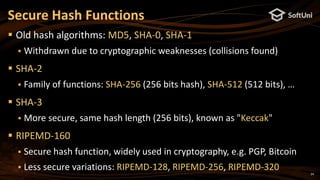
 Old hash algorithms: MD5, SHA-0, SHA-1
 Withdrawn due to cryptographic weaknesses (collisions found)
 SHA-2
 Family of functions: SHA-256 (256 bits hash), SHA-512 (512 bits), …
 SHA-3
 More secure, same hash length (256 bits), known as "Keccak"
 RIPEMD-160
 Secure hash function, widely used in cryptography, e.g. PGP, Bitcoin
 Less secure variations: RIPEMD-128, RIPEMD-256, RIPEMD-320
Secure Hash Functions
25
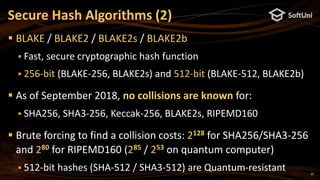
 BLAKE / BLAKE2 / BLAKE2s / BLAKE2b
 Fast, secure cryptographic hash function
 256-bit (BLAKE-256, BLAKE2s) and 512-bit (BLAKE-512, BLAKE2b)
 As of September 2018, no collisions are known for:
 SHA256, SHA3-256, Keccak-256, BLAKE2s, RIPEMD160
 Brute forcing to find a collision costs: 2128 for SHA256/SHA3-256
and 280 for RIPEMD160 (285 / 253 on quantum computer)
 512-bit hashes (SHA-512 / SHA3-512) are Quantum-resistant
Secure Hash Algorithms (2)
26
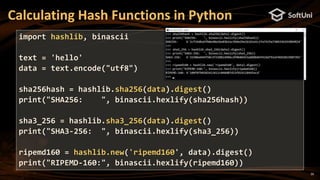
Calculating Hash Functions in Python
import hashlib, binascii
text = 'hello'
data = text.encode("utf8")
sha256hash = hashlib.sha256(data).digest()
print("SHA256: ", binascii.hexlify(sha256hash))
sha3_256 = hashlib.sha3_256(data).digest()
print("SHA3-256: ", binascii.hexlify(sha3_256))
ripemd160 = hashlib.new('ripemd160', data).digest()
print("RIPEMD-160:", binascii.hexlify(ripemd160))
HMAC and Key Derivation
MAC, HMAC, PBKDF2 and SCrypt
28
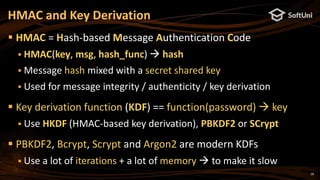
 HMAC = Hash-based Message Authentication Code
 HMAC(key, msg, hash_func)  hash
 Message hash mixed with a secret shared key
 Used for message integrity / authenticity / key derivation
 Key derivation function (KDF) == function(password)  key
 Use HKDF (HMAC-based key derivation), PBKDF2 or SCrypt
 PBKDF2, Bcrypt, Scrypt and Argon2 are modern KDFs
 Use a lot of iterations + a lot of memory  to make it slow
HMAC and Key Derivation
29
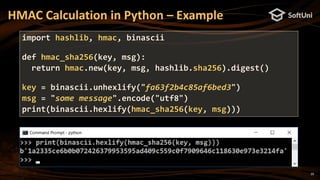
HMAC Calculation in Python – Example
import hashlib, hmac, binascii
def hmac_sha256(key, msg):
return hmac.new(key, msg, hashlib.sha256).digest()
key = binascii.unhexlify("fa63f2b4c85af6bed3")
msg = "some message".encode("utf8")
print(binascii.hexlify(hmac_sha256(key, msg)))
30
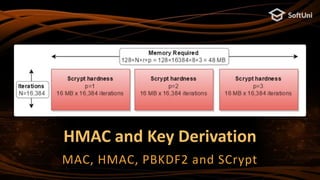
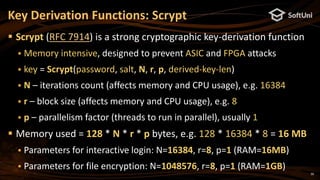
 Scrypt (RFC 7914) is a strong cryptographic key-derivation function
 Memory intensive, designed to prevent ASIC and FPGA attacks
 key = Scrypt(password, salt, N, r, p, derived-key-len)
 N – iterations count (affects memory and CPU usage), e.g. 16384
 r – block size (affects memory and CPU usage), e.g. 8
 p – parallelism factor (threads to run in parallel), usually 1
 Memory used = 128 * N * r * p bytes, e.g. 128 * 16384 * 8 = 16 MB
 Parameters for interactive login: N=16384, r=8, p=1 (RAM=16MB)
 Parameters for file encryption: N=1048576, r=8, p=1 (RAM=1GB)
Key Derivation Functions: Scrypt
31
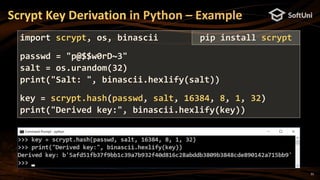
Scrypt Key Derivation in Python – Example
import scrypt, os, binascii
passwd = "p@$$w0rD~3"
salt = os.urandom(32)
print("Salt: ", binascii.hexlify(salt))
key = scrypt.hash(passwd, salt, 16384, 8, 1, 32)
print("Derived key:", binascii.hexlify(key))
pip install scrypt
Blockchain Cryptography and Wallets
Keys, Addresses, Signatures, Wallets
33
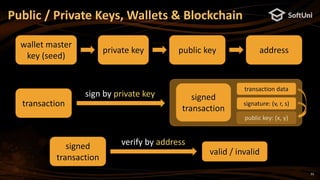
Public / Private Keys, Wallets & Blockchain
private key public key address
transaction
sign by private key
signed
transaction
valid / invalid
verify by address
wallet master
key (seed)
signed
transaction
transaction data
public key: (x, y)
signature: (v, r, s)
34
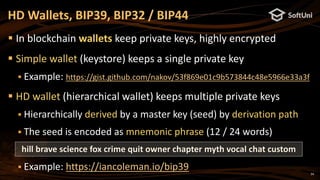
 In blockchain wallets keep private keys, highly encrypted
 Simple wallet (keystore) keeps a single private key
 Example: https://gist.github.com/nakov/53f869e01c9b573844c48e5966e33a3f
 HD wallet (hierarchical wallet) keeps multiple private keys
 Hierarchically derived by a master key (seed) by derivation path
 The seed is encoded as mnemonic phrase (12 / 24 words)
 Example: https://iancoleman.io/bip39
HD Wallets, BIP39, BIP32 / BIP44
hill brave science fox crime quit owner chapter myth vocal chat custom
35
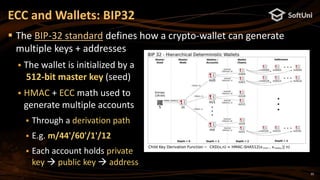
 The BIP-32 standard defines how a crypto-wallet can generate
multiple keys + addresses
 The wallet is initialized by a
512-bit master key (seed)
 HMAC + ECC math used to
generate multiple accounts
 Through a derivation path
 E.g. m/44'/60'/1'/12
 Each account holds private
key  public key  address
ECC and Wallets: BIP32
36
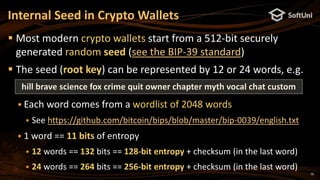
 Most modern crypto wallets start from a 512-bit securely
generated random seed (see the BIP-39 standard)
 The seed (root key) can be represented by 12 or 24 words, e.g.
 Each word comes from a wordlist of 2048 words
 See https://github.com/bitcoin/bips/blob/master/bip-0039/english.txt
 1 word == 11 bits of entropy
 12 words == 132 bits == 128-bit entropy + checksum (in the last word)
 24 words == 264 bits == 256-bit entropy + checksum (in the last word)
Internal Seed in Crypto Wallets
hill brave science fox crime quit owner chapter myth vocal chat custom
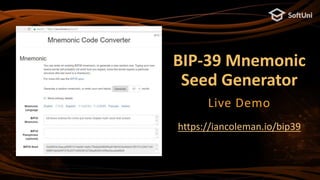
BIP-39 Mnemonic
Seed Generator
Live Demo
https://iancoleman.io/bip39
Wallet Encryption and AES
AES, CBC/CTR, Padding, Scrypt, HMAC
39
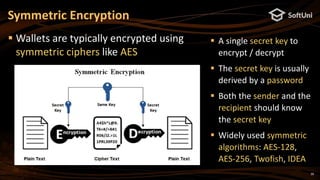
 A single secret key to
encrypt / decrypt
 The secret key is usually
derived by a password
 Both the sender and the
recipient should know
the secret key
 Widely used symmetric
algorithms: AES-128,
AES-256, Twofish, IDEA
Symmetric Encryption
 Wallets are typically encrypted using
symmetric ciphers like AES
40
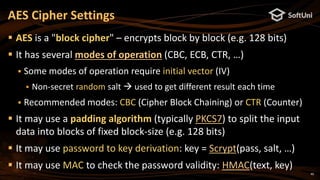
 AES is a "block cipher" – encrypts block by block (e.g. 128 bits)
 It has several modes of operation (CBC, ECB, CTR, …)
 Some modes of operation require initial vector (IV)
 Non-secret random salt  used to get different result each time
 Recommended modes: CBC (Cipher Block Chaining) or CTR (Counter)
 It may use a padding algorithm (typically PKCS7) to split the input
data into blocks of fixed block-size (e.g. 128 bits)
 It may use password to key derivation: key = Scrypt(pass, salt, …)
 It may use MAC to check the password validity: HMAC(text, key)
AES Cipher Settings
41
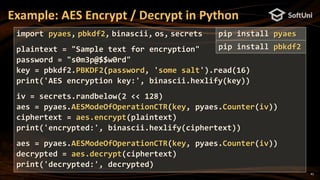
Example: AES Encrypt / Decrypt in Python
import pyaes, pbkdf2, binascii, os, secrets
plaintext = "Sample text for encryption"
password = "s0m3p@$$w0rd"
key = pbkdf2.PBKDF2(password, 'some salt').read(16)
print('AES encryption key:', binascii.hexlify(key))
iv = secrets.randbelow(2 << 128)
aes = pyaes.AESModeOfOperationCTR(key, pyaes.Counter(iv))
ciphertext = aes.encrypt(plaintext)
print('encrypted:', binascii.hexlify(ciphertext))
aes = pyaes.AESModeOfOperationCTR(key, pyaes.Counter(iv))
decrypted = aes.decrypt(ciphertext)
print('decrypted:', decrypted)
pip install pyaes
pip install pbkdf2
42
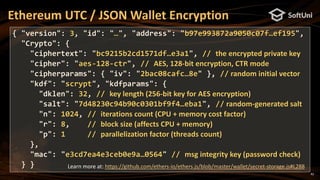
Ethereum UTC / JSON Wallet Encryption
{ "version": 3, "id": "…", "address": "b97e993872a9050c07f…ef195",
"Crypto": {
"ciphertext": "bc9215b2cd1571df…e3a1", // the encrypted private key
"cipher": "aes-128-ctr", // AES, 128-bit encryption, CTR mode
"cipherparams": { "iv": "2bac08cafc…8e" }, // random initial vector
"kdf": "scrypt", "kdfparams": {
"dklen": 32, // key length (256-bit key for AES encryption)
"salt": "7d48230c94b90c0301bf9f4…eba1", // random-generated salt
"n": 1024, // iterations count (CPU + memory cost factor)
"r": 8, // block size (affects CPU + memory)
"p": 1 // parallelization factor (threads count)
},
"mac": "e3cd7ea4e3ceb0e9a…0564" // msg integrity key (password check)
} } Learn more at: https://github.com/ethers-io/ethers.js/blob/master/wallet/secret-storage.js#L288
?
Blockchain Cryptography for Devs
License
 This course (slides, examples, demos, videos, homework, etc.)
is licensed under the "Creative Commons Attribution-
NonCommercial-ShareAlike 4.0 International" license
44
Trainings @ Software University (SoftUni)
 Software University – High-Quality Education,
Profession and Job for Software Developers
 softuni.bg
 Software University Foundation
 http://softuni.foundation/
 Software University @ Facebook
 facebook.com/SoftwareUniversity
 Software University Forums
 forum.softuni.bg

Blockchain Cryptography for Developers (Nakov @ BlockWorld 2018, San Jose)

  • 1.
    Blockchain Cryptography forDevs Elliptic Curves, ECC, ECDSA, secp256k1, Hashes, Wallets, AES, SCrypt, HMAC, BIP39, BIP44 Software University (SoftUni) https://softuni.org Svetlin Nakov Blockchain Engineer and Technical Trainer
  • 2.
    2  Software engineer,trainer, entrepreneur, PhD, author of 12 books, blockchain expert  3 successful tech educational initiatives (100,000+ students): About Svetlin Nakov
  • 3.
    3  Technical advisor@ LockChain / LockTrip: https://locktrip.com  Raised ~ 10.000 ETH in token sale (Sep-Nov 2017)  Currently LOC token holders book hotels @ 20-30% better price  Head of blockchain education (Jan-June 2018) @ Academy School of Blockchain: https://academytoken.com  Raised ~ 48M USD in token sale (Jan-Apr 2018)  Tech advisor for blockchain crypto startups:  Tokenize Exchange, Bountie, Weidex, IRIS Payments Solutions, Aeternity Ventures Nakov – Blockchain & Crypto Projects
  • 4.
    4  Elliptic CurveCryptography (ECC)  ECC Concepts, Elliptic Curves, the secp256k1 Curve  Private Key  Public Key  Blockchain Address  Sign / Verify Transactions in Ethereum  Cryptographic Hash Functions: SHA256, SHA3, RIPEMD160, …  HMAC and Key Derivation: HMAC, PBKDF2, SCrypt  Blockchain Cryptography and Wallets: JSON / UTC, BIP39, BIP44  Wallet Encryption: AES + Padding + CBC/CTR, SCrypt, HMAC Table of Contents
  • 5.
    Elliptic Curve Cryptography(ECC) Elliptic Curves, ECC and ECDSA, Sign, Verify
  • 6.
    6  Uses apair of keys: public key + private key  Sign / decrypt by private key  Verify / encrypt by public key Public Key Cryptography
  • 7.
    7  Well-known public-keycrypto-systems  RSA – based on discrete logarithms  ECC – based on elliptic curves  ECC cryptography is considered more secure  3072-bit RSA key ≈≈ 256-bit ECC key  Most blockchains (like Bitcoin, Ethereum and EOS) use ECC  But be warned: ECC is not quantum-safe! Public Key Crypto Systems
  • 8.
    8  Public /private key cryptography based on the algebraic structure of elliptic curves over finite fields  Requires smaller key-size than RSA for the same security strength  Elliptic curves == set of points {x, y} such that:  y2 = x3 + ax + b  Example – the Bitcoin elliptic curve:  y2 = x3 + 7 (a = 0; b = 7) Elliptic Curve Cryptography (ECC)
  • 9.
    9  Elliptic curvescryptography (ECC)  Uses ecliptic curves over the finite field Fp (p is prime, p > 3)  A set of integer coordinates {x, y}, such that 0 ≤ x, y < p  Staying on the elliptic curve: y2 ≡ x3 + ax + b (mod p)  Example of elliptic curve over F17:  y2 ≡ x3 + 7 (mod 17) Elliptic Curves over a Finite Fields y2 ≡ x3 + 7 (mod 17)
  • 10.
    10  A pointG over the curve can be multiplied by an integer k  P = k * G  The result is another point P staying on the same curve  k == private key (integer)  P == public key (point {x, y})  Very fast to calculate P = k * G  Extremely slow (considered infeasible) to calculate k = P / G Multiply a Point Over an Elliptic Curve y2 ≡ x3 + 7 (mod 17) G P
  • 11.
    11 Elliptic Curves Multiplicationin Python from pycoin.ecdsa import Point from pycoin.ecdsa import CurveFp curve = CurveFp(17, 0, 7) print("Curve = " + str(curve)) G = Point(curve, 15, 13) print("G = " + str(G)) for k in range(0, 6) : print(str(k) + " * G = " + str(k * G)) pip install pycoin
  • 12.
    12  The ellipticcurves over Fp  Have at most 2 points per y coordinate (odd x and even x)  A public key P(x, y) can be compressed as C(x, odd/even)  At the curve y2 ≡ x3 + 7 (mod 17) P(10, 15) == C(10, odd)  mod_sqrt(x3 + 7, 17) == y || 17 - y Compressing the Public Key y2 ≡ x3 + 7 (mod 17)
  • 13.
    13  ECC operateswith a set of EC domain parameters:  T = (p, a, b, G, n, h)  Prime field (prime p), elliptic equation (a, b), base point G(xG, yG), order of G (prime n), cofactor (h)  The secp256k1 standard (used in Bitcoin) defines 256-bit elliptic-curve cryptosystem:  Prime field (p) = 2256 - 232 - 977; Equation: y2 = x3 + 7 (a = 0, b = 7)  G = 0x79BE667E …; n = 0xFFF…D0364141; h = 1 ECC Parameters and secp256k1 Learn more at: http://www.secg.org/sec2-v2.pdf, https://en.bitcoin.it/wiki/Secp256k1
  • 14.
    14  The privatekey in secp256k1 is 256-bit integer (32 bytes)  Example of Ethereum private key (encoded as 64 hex digits)  The respective public key is a EC point (2 * 256 bits == 64 bytes)  Can be compressed to 257 bits (Ethereum uses prefix 02 or 03)  Example of compressed public key (33 bytes / 66 hex digits): Ethereum Addresses and secp256k1 97ddae0f3a25b92268175400149d65d6887b9cefaf28ea2c078e05cdc15a3c0a 027b83ad6afb1209f3c82ebeb08c0c5fa9bf6724548506f2fb4f991e2287a77090 7b83ad6afb1209f3c82ebeb08c0c5fa9bf6724548506f2fb4f991e2287a77090 177316ca82b0bdf70cd9dee145c3002c0da1d92626449875972a27807b73b42e
  • 15.
    15  The blockchainaddress in Ethereum is 20 bytes  Calculated as: last20bytes(keccak256(publicKeyFull))  Example of Ethereum address (encoded as 40 hex digits):  Note: some letters are capital to incorporate a checksum (EIP55)  Digital signatures in secp256k1 are 64 bytes (2 * 32 bytes)  A pair of two 256-bit numbers: [r, s]  Calculated by the well-known ECDSA formulas (see RFC6979) ECDSA, secp256k1 and Ethereum (2) 0xa44f70834a711F0DF388ab016465f2eEb255dEd0
  • 16.
    16 Ethereum Key toAddresses – Example pip install eth_keys import eth_keys, binascii privKey = eth_keys.keys.PrivateKey(binascii.unhexlify( '97ddae0f3a25b92268175400149d65d6887b9cefaf28ea2c078e05cdc15a3c0a')) print('Private key (64 hex digits):', privKey) pubKey = privKey.public_key print('Public key (plain, 128 hex digits):', pubKey) pubKeyCompr = '0' + str(2 + int(pubKey) % 2) + str(pubKey)[2:66] print('Public key (compressed, 66 hex digits):', pubKeyCompr) address = pubKey.to_checksum_address() print('Ethereum address:', address)
  • 17.
    17  Ethereum usessecp256k1-based ECDSA signatures  ECDSA generates deterministically a random point R (see RFC6979)  Ethereum signatures consists of 3 numbers: [v, r, s]  v – the compressed Y coordinate of the point R (1 byte: 00 or 01)  r – the X coordinate of the point R (256-bit integer, 32 bytes)  s – 256-bit integer (32 bytes), calculated from the signer's private key + message hash (Ethereum uses keccak256)  Typically encoded as 130 hex digits (65 bytes), e.g. 0x…465c5cf4be401  Given an Ethereum signature [v, r, s], the public key can be recovered from [R, s, msgHash]  also the signer's Ethereum address Ethereum Signatures
  • 18.
    18 Sign Message inEthereum – Example import eth_keys, binascii privKey = eth_keys.keys.PrivateKey(binascii.unhexlify( '97ddae0f3a25b92268175400149d65d6887b9cefaf28ea2c078e05cdc15a3c0a')) print('Private key (64 hex digits):', privKey) signature = privKey.sign_msg(b'Message for signing') print('Signature: [v = {0}, r = {1}, s = {2}]'.format( hex(signature.v), hex(signature.r), hex(signature.s))) print('Signature (130 hex digits):', signature)
  • 19.
    19 Verify Message Signaturein Etherscan  Verify message signature at https://etherscan.io/verifySig by:  signer address (40 hex digits)  signature (130 hex digits)  original message text  The result is: valid / invalid
  • 20.
    20 Verify Ethereum Signature– Example import eth_keys, binascii msg = b'Message for signing' msgSigner = '0xa44f70834a711F0DF388ab016465f2eEb255dEd0' signature = eth_keys.keys.Signature(binascii.unhexlify( '6f0156091cbe912f2d5d1215cc3cd81c0963c8839b93af60e0921b61a1 9c54300c71006dd93f3508c432daca21db0095f4b16542782b7986f48a5 d0ae3c583d401')) signerPubKey = signature.recover_public_key_from_msg(msg) print('Signer public key (recovered):', signerPubKey) signerAddress = signerPubKey.to_checksum_address() print('Signer address:', signerAddress) print('Signature valid?:', signerAddress == msgSigner)
  • 21.
    Hashing and HashFunctions Cryptographic Hash Functions
  • 22.
    22 What is CryptographicHash Function? Some text Some text Some text Some text Some text Some text Some text 20c9ad97c081d63397d 7b685a412227a40e23c 8bdc6688c6f37e97cfbc2 2d2b4d1db1510d8f61e 6a8866ad7f0e17c02b14 182d37ea7c3c8b9c2683 aeb6b733a1 Text Hashed text Cryptographic hash function (almost no collisions)
  • 23.
    23 Cryptographic Hash Function One-way hash function  Infeasible to invert  Extremely little chance to find a collision
  • 24.
    24  Old hashalgorithms: MD5, SHA-0, SHA-1  Withdrawn due to cryptographic weaknesses (collisions found)  SHA-2  Family of functions: SHA-256 (256 bits hash), SHA-512 (512 bits), …  SHA-3  More secure, same hash length (256 bits), known as "Keccak"  RIPEMD-160  Secure hash function, widely used in cryptography, e.g. PGP, Bitcoin  Less secure variations: RIPEMD-128, RIPEMD-256, RIPEMD-320 Secure Hash Functions
  • 25.
    25  BLAKE /BLAKE2 / BLAKE2s / BLAKE2b  Fast, secure cryptographic hash function  256-bit (BLAKE-256, BLAKE2s) and 512-bit (BLAKE-512, BLAKE2b)  As of September 2018, no collisions are known for:  SHA256, SHA3-256, Keccak-256, BLAKE2s, RIPEMD160  Brute forcing to find a collision costs: 2128 for SHA256/SHA3-256 and 280 for RIPEMD160 (285 / 253 on quantum computer)  512-bit hashes (SHA-512 / SHA3-512) are Quantum-resistant Secure Hash Algorithms (2)
  • 26.
    26 Calculating Hash Functionsin Python import hashlib, binascii text = 'hello' data = text.encode("utf8") sha256hash = hashlib.sha256(data).digest() print("SHA256: ", binascii.hexlify(sha256hash)) sha3_256 = hashlib.sha3_256(data).digest() print("SHA3-256: ", binascii.hexlify(sha3_256)) ripemd160 = hashlib.new('ripemd160', data).digest() print("RIPEMD-160:", binascii.hexlify(ripemd160))
  • 27.
    HMAC and KeyDerivation MAC, HMAC, PBKDF2 and SCrypt
  • 28.
    28  HMAC =Hash-based Message Authentication Code  HMAC(key, msg, hash_func)  hash  Message hash mixed with a secret shared key  Used for message integrity / authenticity / key derivation  Key derivation function (KDF) == function(password)  key  Use HKDF (HMAC-based key derivation), PBKDF2 or SCrypt  PBKDF2, Bcrypt, Scrypt and Argon2 are modern KDFs  Use a lot of iterations + a lot of memory  to make it slow HMAC and Key Derivation
  • 29.
    29 HMAC Calculation inPython – Example import hashlib, hmac, binascii def hmac_sha256(key, msg): return hmac.new(key, msg, hashlib.sha256).digest() key = binascii.unhexlify("fa63f2b4c85af6bed3") msg = "some message".encode("utf8") print(binascii.hexlify(hmac_sha256(key, msg)))
  • 30.
    30  Scrypt (RFC7914) is a strong cryptographic key-derivation function  Memory intensive, designed to prevent ASIC and FPGA attacks  key = Scrypt(password, salt, N, r, p, derived-key-len)  N – iterations count (affects memory and CPU usage), e.g. 16384  r – block size (affects memory and CPU usage), e.g. 8  p – parallelism factor (threads to run in parallel), usually 1  Memory used = 128 * N * r * p bytes, e.g. 128 * 16384 * 8 = 16 MB  Parameters for interactive login: N=16384, r=8, p=1 (RAM=16MB)  Parameters for file encryption: N=1048576, r=8, p=1 (RAM=1GB) Key Derivation Functions: Scrypt
  • 31.
    31 Scrypt Key Derivationin Python – Example import scrypt, os, binascii passwd = "p@$$w0rD~3" salt = os.urandom(32) print("Salt: ", binascii.hexlify(salt)) key = scrypt.hash(passwd, salt, 16384, 8, 1, 32) print("Derived key:", binascii.hexlify(key)) pip install scrypt
  • 32.
    Blockchain Cryptography andWallets Keys, Addresses, Signatures, Wallets
  • 33.
    33 Public / PrivateKeys, Wallets & Blockchain private key public key address transaction sign by private key signed transaction valid / invalid verify by address wallet master key (seed) signed transaction transaction data public key: (x, y) signature: (v, r, s)
  • 34.
    34  In blockchainwallets keep private keys, highly encrypted  Simple wallet (keystore) keeps a single private key  Example: https://gist.github.com/nakov/53f869e01c9b573844c48e5966e33a3f  HD wallet (hierarchical wallet) keeps multiple private keys  Hierarchically derived by a master key (seed) by derivation path  The seed is encoded as mnemonic phrase (12 / 24 words)  Example: https://iancoleman.io/bip39 HD Wallets, BIP39, BIP32 / BIP44 hill brave science fox crime quit owner chapter myth vocal chat custom
  • 35.
    35  The BIP-32standard defines how a crypto-wallet can generate multiple keys + addresses  The wallet is initialized by a 512-bit master key (seed)  HMAC + ECC math used to generate multiple accounts  Through a derivation path  E.g. m/44'/60'/1'/12  Each account holds private key  public key  address ECC and Wallets: BIP32
  • 36.
    36  Most moderncrypto wallets start from a 512-bit securely generated random seed (see the BIP-39 standard)  The seed (root key) can be represented by 12 or 24 words, e.g.  Each word comes from a wordlist of 2048 words  See https://github.com/bitcoin/bips/blob/master/bip-0039/english.txt  1 word == 11 bits of entropy  12 words == 132 bits == 128-bit entropy + checksum (in the last word)  24 words == 264 bits == 256-bit entropy + checksum (in the last word) Internal Seed in Crypto Wallets hill brave science fox crime quit owner chapter myth vocal chat custom
  • 37.
    BIP-39 Mnemonic Seed Generator LiveDemo https://iancoleman.io/bip39
  • 38.
    Wallet Encryption andAES AES, CBC/CTR, Padding, Scrypt, HMAC
  • 39.
    39  A singlesecret key to encrypt / decrypt  The secret key is usually derived by a password  Both the sender and the recipient should know the secret key  Widely used symmetric algorithms: AES-128, AES-256, Twofish, IDEA Symmetric Encryption  Wallets are typically encrypted using symmetric ciphers like AES
  • 40.
    40  AES isa "block cipher" – encrypts block by block (e.g. 128 bits)  It has several modes of operation (CBC, ECB, CTR, …)  Some modes of operation require initial vector (IV)  Non-secret random salt  used to get different result each time  Recommended modes: CBC (Cipher Block Chaining) or CTR (Counter)  It may use a padding algorithm (typically PKCS7) to split the input data into blocks of fixed block-size (e.g. 128 bits)  It may use password to key derivation: key = Scrypt(pass, salt, …)  It may use MAC to check the password validity: HMAC(text, key) AES Cipher Settings
  • 41.
    41 Example: AES Encrypt/ Decrypt in Python import pyaes, pbkdf2, binascii, os, secrets plaintext = "Sample text for encryption" password = "s0m3p@$$w0rd" key = pbkdf2.PBKDF2(password, 'some salt').read(16) print('AES encryption key:', binascii.hexlify(key)) iv = secrets.randbelow(2 << 128) aes = pyaes.AESModeOfOperationCTR(key, pyaes.Counter(iv)) ciphertext = aes.encrypt(plaintext) print('encrypted:', binascii.hexlify(ciphertext)) aes = pyaes.AESModeOfOperationCTR(key, pyaes.Counter(iv)) decrypted = aes.decrypt(ciphertext) print('decrypted:', decrypted) pip install pyaes pip install pbkdf2
  • 42.
    42 Ethereum UTC /JSON Wallet Encryption { "version": 3, "id": "…", "address": "b97e993872a9050c07f…ef195", "Crypto": { "ciphertext": "bc9215b2cd1571df…e3a1", // the encrypted private key "cipher": "aes-128-ctr", // AES, 128-bit encryption, CTR mode "cipherparams": { "iv": "2bac08cafc…8e" }, // random initial vector "kdf": "scrypt", "kdfparams": { "dklen": 32, // key length (256-bit key for AES encryption) "salt": "7d48230c94b90c0301bf9f4…eba1", // random-generated salt "n": 1024, // iterations count (CPU + memory cost factor) "r": 8, // block size (affects CPU + memory) "p": 1 // parallelization factor (threads count) }, "mac": "e3cd7ea4e3ceb0e9a…0564" // msg integrity key (password check) } } Learn more at: https://github.com/ethers-io/ethers.js/blob/master/wallet/secret-storage.js#L288
  • 43.
  • 44.
    License  This course(slides, examples, demos, videos, homework, etc.) is licensed under the "Creative Commons Attribution- NonCommercial-ShareAlike 4.0 International" license 44
  • 45.
    Trainings @ SoftwareUniversity (SoftUni)  Software University – High-Quality Education, Profession and Job for Software Developers  softuni.bg  Software University Foundation  http://softuni.foundation/  Software University @ Facebook  facebook.com/SoftwareUniversity  Software University Forums  forum.softuni.bg