Professional Development Day forRecent Art College Graduates & StudentsBlanchardstownThurs Jan 20ththe conditions and cultures    the processes     thinking of applying and matching Sarah Searsonwww.publicart.ie
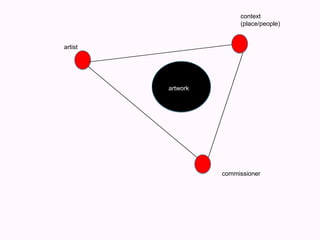
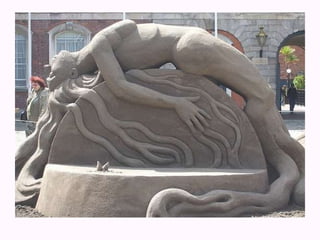
While most art should be considered ‘public art’, in general, we have come to understand this term to refer to artworks that are located within the public domain – outside of the traditional arts institution, such as the gallery, theatre or concert hall.	A critical feature of public art is understood as the interrelationship between the artist and the artwork, the context (location – site, place) and the public (people, audience /participants) and the commissioner/client.
'public art excludes no media, materials, process or form, the work can be permanent or temporary, it can be commissioned through funding programmes, such as the percent for art scheme or initiated by artists requiring no sanction. With a broadening concept of public – it can happen almost anytime, with anyone and virtually anywhere…even in galleries, museums and private settings.  Public art is always art'.Patricia C Philips. Former editor of Artforum
Working in the public realm has obvious benefits to artists. Presenting an art project to a wide public audience - some of whom may not necessarily visit gallery spaces - can provide openings for new interpretations of work and ideas.However working beyond the possible comfort zone of a traditional gallery or exhibition space also brings distinct challenges….to be forewarned is to be forearmed.Annette Moloney
context (place/people)artistartworkcommissioner
Systems or supporting structures for work in this area Structured Arts Council  European FundingLocal AuthoritiesPer Cent for Art –Local Authorities; government bodies; Regeneration Schemes: More ad hoc and self generated Organisations and AgenciesArts Events and FestivalsOff-site projects of galleries and museums
Public Art
The per cent for art scheme
Common per cent opportunities Local Authority – Housing, Roads (), Major engineering works Education – Colleges, Schools Heath Sector –Hospitals and health care More occasionally – Marine, Defence  on a much more ad hoc basis
Per cent for art  - some very basicsCapital developments
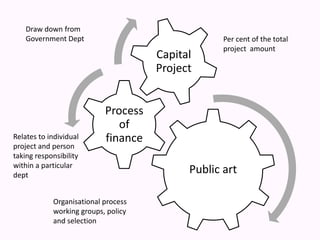
Draw down from Government Dept Per cent of the total project  amount Relates to individual project and person taking responsibility within a particular dept Organisational process  working groups, policy and selection
Problematic here – time and expertise Dependencies on goodwill and interest  Government Dept – funding for capital – and including a public art application
Agency, Department or Organisation funded for Capital development Usually there will be a lead person  – if there is no expertise or its not coming in at a high level, with policy or  clear direction it is easy for the process to be swamped Department in charge of project development (eg the housing dept)  and culture there is importantAs the project plans - location, time-line, and projected budgets are draw up.  The local authority will contact the department  of the environment (funding the capital development) at this very early stage a member of the project staff  informs the government dept of their intention to drawn down a per cent (capped) for art This means that a public art administrator or manager can plan for a new work or works if they intend to pool (merge) the monies from a few schemesCommissioning a work can now be planned for
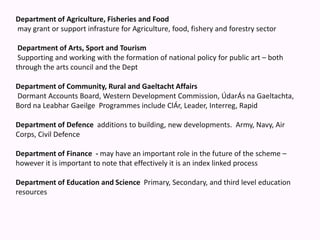
Department of Agriculture, Fisheries and Food  may grant or support infrasture for Agriculture, food, fishery and forestry sector   Department of Arts, Sport and Tourism  Supporting and working with the formation of national policy for public art – both through the arts council and the Dept Department of Community, Rural and Gaeltacht Affairs  Dormant Accounts Board, Western Development Commission, ÚdarÁs na Gaeltachta, Bord na Leabhar Gaeilge  Programmes include ClÁr, Leader, Interreg, Rapid  Department of Defence  additions to building, new developments.  Army, Navy, Air Corps, Civil Defence  Department of Finance  - may have an important role in the future of the scheme – however it is important to note that effectively it is an index linked process  Department of Education and Science  Primary, Secondary, and third level education resources
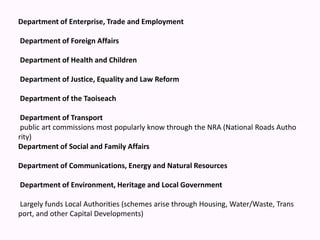
Department of Enterprise, Trade and Employment   Department of Foreign Affairs   Department of Health and Children   Department of Justice, Equality and Law Reform   Department of the Taoiseach   Department of Transport  public art commissions most popularly know through the NRA (National Roads Authority) Department of Social and Family Affairs  Department of Communications, Energy and Natural Resources   Department of Environment, Heritage and Local Government   Largely funds Local Authorities (schemes arise through Housing, Water/Waste, Transport, and other Capital Developments) 
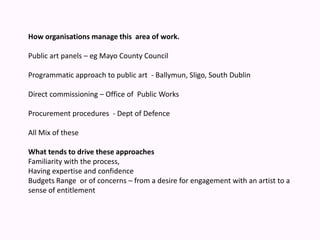
How organisations manage this  area of work.Public art panels – eg Mayo County Council Programmatic approach to public art  - Ballymun, Sligo, South Dublin Direct commissioning – Office of  Public Works Procurement procedures  - Dept of Defence All Mix of these What tends to drive these approaches Familiarity with the process, Having expertise and confidence Budgets Range  or of concerns – from a desire for engagement with an artist to a sense of entitlement
Understanding contexts
Key process and committees – and the  background people SPC – Special Policy Committee Local Area Committee Council Meeting Public art working group Public art selection groupSelection Panels Community RepresentationsPolitical  Representation Artistic Representation Area expertise  eg an architect, engineer or other associated person – such as head of school
Once there is a budget - how are these  budgets split out  Publications Launches Project management costs Some Staff costs Project budgets –the commission fundOther expertise Selection committeesMediation Education and OutreachEvaluationsTrends....
Some problems with in these organisation Not systemised or Often contested at dept levelsMore usual practice within the LA Lack of awareness No arts expertiseArchitect drivenEngineer driven Word of mouth Ethos and higher ownership when driven from the grass rootsNot looking for advice Committee (ised) hesitant less confident – not understanding context and processesDefined and direct through structured curatorial  programmes
If you can’t describe well or more importantly understand for whom this publicart work is for you shouldn’t apply? You don’t need to tell anyone – but you need to be clear, clarity help you make good artistic decisions.
    Reading the call for application and see the match between them and you.    What “they” might be looking for what “you” might be looking
 This there a goal, a plan, and a rationale    Have you made some sort of institutional commitment and links that are clear and intelligent   Is there are careful understanding of the cost    Is there a way that the organization and you can see the connection for you and your own practice. Have you told them why is it important to support this work.  Have they said why?Has your concept or project a clear way of sharing with others– are they supporting you here. Is there a clear time line and process line – can you see or imagine this  Have you or they included back up info that is clear and easy to access - files, images, a curatorial statement  books maps etc
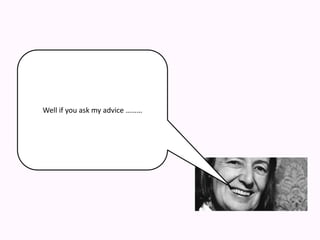
Well if you ask my advice ………
Be confident in your ideas - don’t be a scatter gun – think about why you are making application – the I really want it factor  does shine through. Do not be afraid – Do not be a pain.  Your work is important and your time is important and you a committed to working as an artist. Its perfectly ok and professional to email and check in with people. But be equal and fair with when and how you approach people.  Application forms  are not 'subject to interpretation‘ you cant leave bit out  - give them everything  askedfor. Your images really count  especially for emailed applications save your images in one document as a pdf , title your images well – either on the same page/ screen or as a title list as you prefer .
If your application comes in with information missing or too much extra information not asked  for it  becomes irritating   - remember they are often accessing  40 -200 application.  Not matter what a pain – roll with their conventions or don’t apply.Keep in mind the totally of the application – niggley silly  things like huge variants in fonts between your bio, cv statement or project outline etc -  can make you look amateur.  Over designed – fly covers and bits of visual junk – like too many lines, silly not useful images and boxes looks weak too.
They are asking a lot of me .. How can I get this project to work for me?
Your audiences are all the people interested in your work.  Think about your communication processes – this is the active process by which you increase the audiences and awareness for your work, make it match and be sensitive to who you are, what the project is and what your really interested in.  Your audiences include curators, writers, funders, but your foolish to forget a wider scope of people - directly or indirectly connected to your work – your work in this area is predominantly funded by public money – its important that you come a good communicator of your work or you work with people who are. This does not need to compromise you. Everybody you already know and work with is a member of your 'network’ and it is through this network that you will increase your confidence and reputation  – this can sound sado but keep it in the back of your mind.
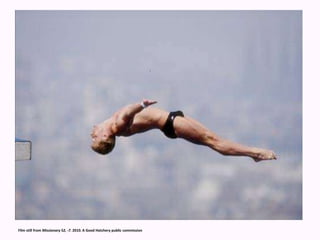
Film still from Missionary 52, -7. 2010. A Good Hatchery public commission 
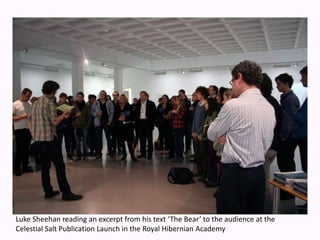
Luke Sheehan reading an excerpt from his text ‘The Bear’ to the audience at the Celestial Salt Publication Launch in the Royal Hibernian Academy
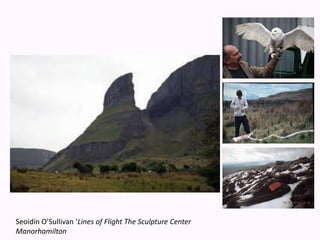
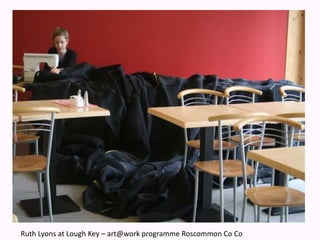
Seoidín O’Sullivan ‘Lines of Flight The Sculpture Center  Manorhamilton
In 1910 the eagle became extinct in Ireland through a process of industrialisation. This was largely because its habitat had been affected and it was seen as a threat to livelihoods by farmers trying to protect their livestock. This time period was also one of political turmoil and struggle within Ireland with land ownership being contested on a National scale. In 2004 the Golden Eagle was reintroduced, this was at a time when Ireland’s ecological footprint was at its largest. The Celtic tiger and a growing economy meant rapid development with little thought of environmental sustainability. The project ‘Mapping Flight’ looks at issues of land use and conflict from what supposedly seems like an apolitical starting point- the eagle. By developing a relationship with the Golden Eagle Trust, O’Sullivan introduced the students from St Mary’s, Manorhamilton, Leitrim and St. Clare’s, Brollagh, Fermanagh to this once extinct and now struggling bird of prey through drawing as well as kite making and flying. They worked closely on this project with Lorcan O’Toole project manager from ‘The Irish Golden Eagle Reintroduction Project’ following the movements of Conall, a golden eagle in Leitrim. The students built kites that they then flew at one of the sites that Conall was roosting on. During the project Conall was poisoned. The project responds poetically and critically through the collaboration with the creation of film, drawing and photographic work.
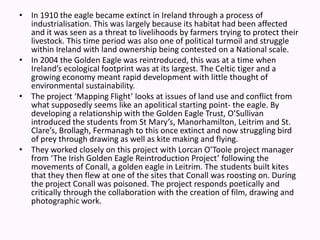
Ruth Lyons at Lough Key – art@work programme Roscommon Co Co
Amphibious Sound was created in the canteen of the Lough Key Forest Park Experience over the course of 5 weeks.70 Wetsuits, Lough Key Experience, Industrial Sewing machineI began to think of the dark waters as a metaphor for the submersion of history and water as the weight of time.The amphibious quality of the wetsuits means that they can transcend different realms.  In Amphibious Sound this transcendence is aligned with time travel, and a medium to explore to the past.Driving from the coastal surf schools in Bundoran, Strandhill, Dun Laoghaire and Tramore, returning to the view from the Lough Key Experience the still black lake seemed both beautiful and oppressive.Cutting and sewing the wetsuits into a large amphibious blanket, inspired many wandering conversations with both staff and visitors alike. An interesting recurring theme of conversation surrounded faith and the belief in or possible existence of things beyond our perception ranging from such broad issues as extraterrestrials, clairvoyants, healers, history, mythology and religion.The thick black blanket began to spread out into the restaurant to the rhythmic sound of the sewing machine. While the expansive blackness looked like the depths of the lake waters, I felt that the sensibility of the material allowed for a temporary exploration of an intangible depth in the same way that the centre offers visitors a mediated experience of history.
Interpreting what “they” are looking for.The key is to find a connection between the context, what the gallery, commissioner or organisation is looking for  and your artistic practice.It is possible to subvert or find ways of responding to a more traditional brief – if the particular commission is of interest.  They may not always know what they are looking for – if are confined that you have a good idea – make the proposal – its not a waste – you can re-cycle ideas.  Decisions will depend on the selection panel – and like all selection processs – it can be very much based on personalities  - they may or may not be open to your particular response, but artists have been successful in proposing a project outside the scope of the original brief. Spend as much time analysing what you think they are looking for – but don’t compromise your own work to the point it loses meaning or value to you.  If you are making compromises – be aware that you are, and why you are?
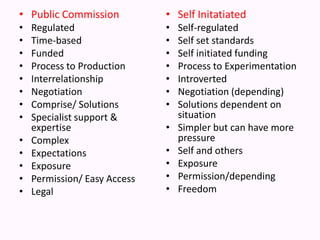
Public CommissionRegulatedTime-basedFundedProcess to ProductionInterrelationshipNegotiationComprise/ SolutionsSpecialist support & expertiseComplexExpectationsExposurePermission/ Easy AccessLegalSelf InitatiatedSelf-regulatedSelf set standardsSelf initiated fundingProcess to ExperimentationIntrovertedNegotiation (depending)Solutions dependent on situationSimpler but can have more pressureSelf and others ExposurePermission/dependingFreedom
WRITING PROPOSALS AND DEVELOPING IDEAS
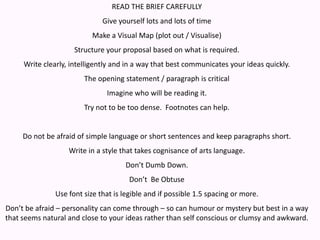
READ THE BRIEF CAREFULLY Give yourself lots and lots of time  Make a Visual Map (plot out / Visualise)Structure your proposal based on what is required.Write clearly, intelligently and in a way that best communicates your ideas quickly.The opening statement / paragraph is criticalImagine who will be reading it.Try not to be too dense.  Footnotes can help.Do not be afraid of simple language or short sentences and keep paragraphs short.Write in a style that takes cognisance of arts language.Don’t Dumb Down.Don’t  Be ObtuseUse font size that is legible and if possible 1.5 spacing or more.Don’t be afraid – personality can come through – so can humour or mystery but best in a way that seems natural and close to your ideas rather than self conscious or clumsy and awkward.
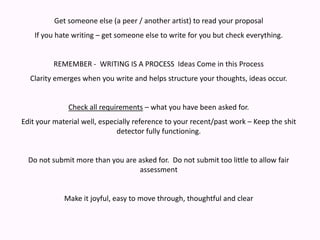
Get someone else (a peer / another artist) to read your proposalIf you hate writing – get someone else to write for you but check everything.REMEMBER -  WRITING IS A PROCESS  Ideas Come in this ProcessClarity emerges when you write and helps structure your thoughts, ideas occur.Check all requirements – what you have been asked for.Edit your material well, especially reference to your recent/past work – Keep the shit detector fully functioning.Do not submit more than you are asked for.  Do not submit too little to allow fair assessmentMake it joyful, easy to move through, thoughtful and clear
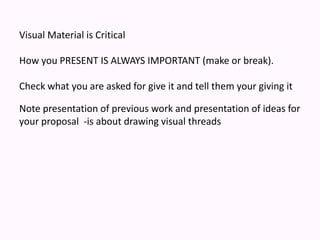
Visual Material is Critical How you PRESENT IS ALWAYS IMPORTANT (make or break).  Check what you are asked for give it and tell them your giving itNote presentation of previous work and presentation of ideas for your proposal  -is about drawing visual threads
Previous work.Make a selection of your best work and images. Eight to ten images of work or projects is likely to be sufficient. Make sure that this includes some of your most recent work. Label images clearly and/or provide a text document giving further information – title, date, short description of context and content.  Submission requirements might specify how material should be received -e.g. photographic print or on CD or slide.  But usually you have the option to choose the best way to present your material. You can use software or other publishers’ programmes to combine text and visuals. Video clips should be circa 1/3 minutes with a second copy of complete work (full duration) enclosed. A selection of printed material – catalogues, posters, booklets, programmes and reviews provide another level of back up material and again should be carefully selected and limited. References to websites can be given but don't expect assessors to look them up.
The visualisation of your proposal can win you a commission. Unless otherwise stated, it can be in any form to suit your proposal and practice and you should have scope to be both creative and clear here. Your proposal might include sketches, overlays, drawings, notes, photoshoppedimages, maquettes, CD, DVD etcPowerpoint presentations can be effective in organizing digital slides.  Photoshop can be great for visualisation of workLabel and title images throughout with small text – easy to read.DVD’s /video installations specify presentation preference for viewingConsider binding or putting material into a folder to support its flow and also to hold all together. Label all material and use text to further articulate.
Choose visual method to suit your ideas and make as clear but also aesthetically interesting as possible- software programmes, sketches, drawings, sample material, scanned images etc….Powerpoint presentations can be effective in organising digital slides.  Photoshop can be great for visualisation of workLabel and title images throughout with small text – easy to read.With DVD’s / installations explain installation/ presentation and line of descriptionBe inventive with image, layout, font, colours and manipulations and also remain clear and easy to view and read.Present material in folder or in a way that allows easy movement through the material of image, text and other materials
W r i t I n g   a   P r o p o s a l/ HEADINGSTitle:Description:  About your proposal/ concepts and thoughts behind it, research methodologies. what you want to do, what it will involve, theoretical underpinning of concepts.Context:   The context for this work – social, physical, geographic, multi-sited, virtual etc.Research & DevelopmentPeople (this might be collaborators or other expertise)Audience/ ParticipantsCosts:Materials/ Media – Location:MediationDocumentationEvaluationNetworks/ future possibilities for the project.  Maintenance (outlne as required)Technical details (specific as required).TimeframeVisuals might intersperse with your text in a way that makes it more lively and engaging.
artists statementsAn Artist’s Statement is usually about a specific body of work or your practice over a period of time or track a career.Ideally offers an insight and clarity about the concepts, processes, influences and sphere of work.Where is it used?applications for funding, commissions, residencies;  background information for websites, blogs, exhibition information points, catalogues, support material for projects.
artists statementsTake time:   Be honest:  Write, Read, EDIT, refine, Reread and ask someone else to readoffers insights is an important currency for your practice.Communicate and highlight properties and qualities of your work/practiceIt can run from 500 words to a tightly edited 70 word.It should be clearly informative about the conceptual elements of your work
What can be included in an artists statement?philosophical, sociological, or theoretical tenets of your workMedium and processes and techniquesHow the work is produced, process of realisation, this can include collaboratorsSpecific methodologies or contextsReference to timeHow the process has developedInteresting linkages, research and site of inspirations.
Considering binding proposals or make sure that the material holds well together.Consider how people access the information in books, DVD’s, programmes or catalogues Always make it simple and easy
technical issuesProviding enough technical information for the commissioners and selection panels to be assured that you can make and present the proposed artwork and that it will last with minimal maintenance for the required timescale.  This can apply to both permanent and temporary artworksWhere relevant it is good to address the following issues in a clear statement/s and where necessary with visualisations, drawings, samples of materials, professional statements such as an engineers.   Materials, Durability and Maintenance Structures / objects – can require specialist advice and documentationHealth and SafetyStructuresProcess Interaction with vulnerable adults, children, etc(sometimes a H+S statement will be required)
financeBudgetMake sure you stay within budget Unless you have proven funding from other sources if you do get letters of supportThe people reading your proposal – know how money works, what are the big budget areas and so on – get a bit of help with your finances or talk it through Breakdown of budgetArtist’s FeesOther professional fees – seeking quotesMaterial and Production Costs – with analysisTransport and installation costsInsurances Contingency Vat if relevant (need to check if fee is VAT inclusive)
Artists Feesartists' fees are tricky one Its difficult to provide any concrete guidance. Fees are generally not separated out from the total project budget and so artists have to estimate their own fee based on overall costs.One recommendation puts artists fees between 20 - 25% of the total budget.
However, in reality the artists fee often gets eaten up by the production costs and in some cases artists have come away with no fee or very little. Artists should ensure that they are paid properly for undertaking the project. Commissioners should be aware of looking after artists fees
Another difficulty in estimating fees is that different projects by their nature require different fee structures, for example, a project where the artist gives a lot of their time through research or process-based engagement may require more of the artists' time and smaller production costs so a more substantial artists' fee should be supported.In a few instances the commissioner separates the artists' fee from the production and other costs.
common bleeps	Not completing all aspects of the required submission process	Not submitting the proposal on time	Exceeding the defined budget	Proposing an idea you are not ready it’s a proposal that your heart is not in     Submitting a weakly presented proposal – poor visuals, scrappy materials, confused writing.
sources of information about public art and opportunitiesPublicart.iearts officerArts CouncilVAI – e-bulletinAN newsletter Create Rss feedsfacebookTwitter blogs Information sharing – on-line Peer networking

20th Jan 11 - Whats Next

  • 1.
    Professional Development DayforRecent Art College Graduates & StudentsBlanchardstownThurs Jan 20ththe conditions and cultures the processes thinking of applying and matching Sarah Searsonwww.publicart.ie
  • 2.
    While most artshould be considered ‘public art’, in general, we have come to understand this term to refer to artworks that are located within the public domain – outside of the traditional arts institution, such as the gallery, theatre or concert hall. A critical feature of public art is understood as the interrelationship between the artist and the artwork, the context (location – site, place) and the public (people, audience /participants) and the commissioner/client.
  • 3.
    'public art excludesno media, materials, process or form, the work can be permanent or temporary, it can be commissioned through funding programmes, such as the percent for art scheme or initiated by artists requiring no sanction. With a broadening concept of public – it can happen almost anytime, with anyone and virtually anywhere…even in galleries, museums and private settings.  Public art is always art'.Patricia C Philips. Former editor of Artforum
  • 4.
    Working in thepublic realm has obvious benefits to artists. Presenting an art project to a wide public audience - some of whom may not necessarily visit gallery spaces - can provide openings for new interpretations of work and ideas.However working beyond the possible comfort zone of a traditional gallery or exhibition space also brings distinct challenges….to be forewarned is to be forearmed.Annette Moloney
  • 5.
  • 6.
    Systems or supportingstructures for work in this area Structured Arts Council European FundingLocal AuthoritiesPer Cent for Art –Local Authorities; government bodies; Regeneration Schemes: More ad hoc and self generated Organisations and AgenciesArts Events and FestivalsOff-site projects of galleries and museums
  • 7.
  • 8.
    The per centfor art scheme
  • 9.
    Common per centopportunities Local Authority – Housing, Roads (), Major engineering works Education – Colleges, Schools Heath Sector –Hospitals and health care More occasionally – Marine, Defence on a much more ad hoc basis
  • 10.
    Per cent forart - some very basicsCapital developments
  • 11.
    Draw down fromGovernment Dept Per cent of the total project amount Relates to individual project and person taking responsibility within a particular dept Organisational process working groups, policy and selection
  • 12.
    Problematic here –time and expertise Dependencies on goodwill and interest Government Dept – funding for capital – and including a public art application
  • 13.
    Agency, Department orOrganisation funded for Capital development Usually there will be a lead person – if there is no expertise or its not coming in at a high level, with policy or clear direction it is easy for the process to be swamped Department in charge of project development (eg the housing dept) and culture there is importantAs the project plans - location, time-line, and projected budgets are draw up.  The local authority will contact the department  of the environment (funding the capital development) at this very early stage a member of the project staff  informs the government dept of their intention to drawn down a per cent (capped) for art This means that a public art administrator or manager can plan for a new work or works if they intend to pool (merge) the monies from a few schemesCommissioning a work can now be planned for
  • 14.
    Department of Agriculture, Fisheries and Food  may grant or support infrasture for Agriculture, food, fishery and forestry sector   Department of Arts, Sport and Tourism  Supporting and working with the formation of national policy for public art– both through the arts council and the Dept Department of Community, Rural and Gaeltacht Affairs  Dormant Accounts Board, Western Development Commission, ÚdarÁs na Gaeltachta, Bord na Leabhar Gaeilge  Programmes include ClÁr, Leader, Interreg, Rapid  Department of Defence  additions to building, new developments.  Army, Navy, Air Corps, Civil Defence  Department of Finance  - may have an important role in the future of the scheme – however it is important to note that effectively it is an index linked process  Department of Education and Science  Primary, Secondary, and third level education resources
  • 15.
  • 16.
    How organisations managethis area of work.Public art panels – eg Mayo County Council Programmatic approach to public art - Ballymun, Sligo, South Dublin Direct commissioning – Office of Public Works Procurement procedures - Dept of Defence All Mix of these What tends to drive these approaches Familiarity with the process, Having expertise and confidence Budgets Range or of concerns – from a desire for engagement with an artist to a sense of entitlement
  • 17.
  • 18.
    Key process andcommittees – and the background people SPC – Special Policy Committee Local Area Committee Council Meeting Public art working group Public art selection groupSelection Panels Community RepresentationsPolitical Representation Artistic Representation Area expertise eg an architect, engineer or other associated person – such as head of school
  • 19.
    Once there isa budget - how are these budgets split out Publications Launches Project management costs Some Staff costs Project budgets –the commission fundOther expertise Selection committeesMediation Education and OutreachEvaluationsTrends....
  • 20.
    Some problems within these organisation Not systemised or Often contested at dept levelsMore usual practice within the LA Lack of awareness No arts expertiseArchitect drivenEngineer driven Word of mouth Ethos and higher ownership when driven from the grass rootsNot looking for advice Committee (ised) hesitant less confident – not understanding context and processesDefined and direct through structured curatorial programmes
  • 22.
    If you can’tdescribe well or more importantly understand for whom this publicart work is for you shouldn’t apply? You don’t need to tell anyone – but you need to be clear, clarity help you make good artistic decisions.
  • 23.
    Reading the call for application and see the match between them and you. What “they” might be looking for what “you” might be looking
  • 24.
    This therea goal, a plan, and a rationale   Have you made some sort of institutional commitment and links that are clear and intelligent   Is there are careful understanding of the cost   Is there a way that the organization and you can see the connection for you and your own practice. Have you told them why is it important to support this work.  Have they said why?Has your concept or project a clear way of sharing with others– are they supporting you here. Is there a clear time line and process line – can you see or imagine this Have you or they included back up info that is clear and easy to access - files, images, a curatorial statement books maps etc
  • 25.
    Well if youask my advice ………
  • 26.
    Be confident inyour ideas - don’t be a scatter gun – think about why you are making application – the I really want it factor does shine through. Do not be afraid – Do not be a pain. Your work is important and your time is important and you a committed to working as an artist. Its perfectly ok and professional to email and check in with people. But be equal and fair with when and how you approach people. Application forms are not 'subject to interpretation‘ you cant leave bit out - give them everything askedfor. Your images really count especially for emailed applications save your images in one document as a pdf , title your images well – either on the same page/ screen or as a title list as you prefer .
  • 27.
    If your applicationcomes in with information missing or too much extra information not asked for it becomes irritating - remember they are often accessing 40 -200 application. Not matter what a pain – roll with their conventions or don’t apply.Keep in mind the totally of the application – niggley silly things like huge variants in fonts between your bio, cv statement or project outline etc - can make you look amateur. Over designed – fly covers and bits of visual junk – like too many lines, silly not useful images and boxes looks weak too.
  • 28.
    They are askinga lot of me .. How can I get this project to work for me?
  • 29.
    Your audiences areall the people interested in your work.  Think about your communication processes – this is the active process by which you increase the audiences and awareness for your work, make it match and be sensitive to who you are, what the project is and what your really interested in. Your audiences include curators, writers, funders, but your foolish to forget a wider scope of people - directly or indirectly connected to your work – your work in this area is predominantly funded by public money – its important that you come a good communicator of your work or you work with people who are. This does not need to compromise you. Everybody you already know and work with is a member of your 'network’ and it is through this network that you will increase your confidence and reputation – this can sound sado but keep it in the back of your mind.
  • 31.
    Film still fromMissionary 52, -7. 2010. A Good Hatchery public commission 
  • 32.
    Luke Sheehan readingan excerpt from his text ‘The Bear’ to the audience at the Celestial Salt Publication Launch in the Royal Hibernian Academy
  • 35.
    Seoidín O’Sullivan ‘Linesof Flight The Sculpture Center Manorhamilton
  • 36.
    In 1910 theeagle became extinct in Ireland through a process of industrialisation. This was largely because its habitat had been affected and it was seen as a threat to livelihoods by farmers trying to protect their livestock. This time period was also one of political turmoil and struggle within Ireland with land ownership being contested on a National scale. In 2004 the Golden Eagle was reintroduced, this was at a time when Ireland’s ecological footprint was at its largest. The Celtic tiger and a growing economy meant rapid development with little thought of environmental sustainability. The project ‘Mapping Flight’ looks at issues of land use and conflict from what supposedly seems like an apolitical starting point- the eagle. By developing a relationship with the Golden Eagle Trust, O’Sullivan introduced the students from St Mary’s, Manorhamilton, Leitrim and St. Clare’s, Brollagh, Fermanagh to this once extinct and now struggling bird of prey through drawing as well as kite making and flying. They worked closely on this project with Lorcan O’Toole project manager from ‘The Irish Golden Eagle Reintroduction Project’ following the movements of Conall, a golden eagle in Leitrim. The students built kites that they then flew at one of the sites that Conall was roosting on. During the project Conall was poisoned. The project responds poetically and critically through the collaboration with the creation of film, drawing and photographic work.
  • 37.
    Ruth Lyons atLough Key – art@work programme Roscommon Co Co
  • 38.
    Amphibious Sound wascreated in the canteen of the Lough Key Forest Park Experience over the course of 5 weeks.70 Wetsuits, Lough Key Experience, Industrial Sewing machineI began to think of the dark waters as a metaphor for the submersion of history and water as the weight of time.The amphibious quality of the wetsuits means that they can transcend different realms.  In Amphibious Sound this transcendence is aligned with time travel, and a medium to explore to the past.Driving from the coastal surf schools in Bundoran, Strandhill, Dun Laoghaire and Tramore, returning to the view from the Lough Key Experience the still black lake seemed both beautiful and oppressive.Cutting and sewing the wetsuits into a large amphibious blanket, inspired many wandering conversations with both staff and visitors alike. An interesting recurring theme of conversation surrounded faith and the belief in or possible existence of things beyond our perception ranging from such broad issues as extraterrestrials, clairvoyants, healers, history, mythology and religion.The thick black blanket began to spread out into the restaurant to the rhythmic sound of the sewing machine. While the expansive blackness looked like the depths of the lake waters, I felt that the sensibility of the material allowed for a temporary exploration of an intangible depth in the same way that the centre offers visitors a mediated experience of history.
  • 40.
    Interpreting what “they”are looking for.The key is to find a connection between the context, what the gallery, commissioner or organisation is looking for and your artistic practice.It is possible to subvert or find ways of responding to a more traditional brief – if the particular commission is of interest. They may not always know what they are looking for – if are confined that you have a good idea – make the proposal – its not a waste – you can re-cycle ideas. Decisions will depend on the selection panel – and like all selection processs – it can be very much based on personalities - they may or may not be open to your particular response, but artists have been successful in proposing a project outside the scope of the original brief. Spend as much time analysing what you think they are looking for – but don’t compromise your own work to the point it loses meaning or value to you. If you are making compromises – be aware that you are, and why you are?
  • 41.
    Public CommissionRegulatedTime-basedFundedProcess toProductionInterrelationshipNegotiationComprise/ SolutionsSpecialist support & expertiseComplexExpectationsExposurePermission/ Easy AccessLegalSelf InitatiatedSelf-regulatedSelf set standardsSelf initiated fundingProcess to ExperimentationIntrovertedNegotiation (depending)Solutions dependent on situationSimpler but can have more pressureSelf and others ExposurePermission/dependingFreedom
  • 42.
    WRITING PROPOSALS ANDDEVELOPING IDEAS
  • 43.
    READ THE BRIEFCAREFULLY Give yourself lots and lots of time Make a Visual Map (plot out / Visualise)Structure your proposal based on what is required.Write clearly, intelligently and in a way that best communicates your ideas quickly.The opening statement / paragraph is criticalImagine who will be reading it.Try not to be too dense. Footnotes can help.Do not be afraid of simple language or short sentences and keep paragraphs short.Write in a style that takes cognisance of arts language.Don’t Dumb Down.Don’t Be ObtuseUse font size that is legible and if possible 1.5 spacing or more.Don’t be afraid – personality can come through – so can humour or mystery but best in a way that seems natural and close to your ideas rather than self conscious or clumsy and awkward.
  • 45.
    Get someone else(a peer / another artist) to read your proposalIf you hate writing – get someone else to write for you but check everything.REMEMBER - WRITING IS A PROCESS Ideas Come in this ProcessClarity emerges when you write and helps structure your thoughts, ideas occur.Check all requirements – what you have been asked for.Edit your material well, especially reference to your recent/past work – Keep the shit detector fully functioning.Do not submit more than you are asked for. Do not submit too little to allow fair assessmentMake it joyful, easy to move through, thoughtful and clear
  • 46.
    Visual Material isCritical How you PRESENT IS ALWAYS IMPORTANT (make or break). Check what you are asked for give it and tell them your giving itNote presentation of previous work and presentation of ideas for your proposal -is about drawing visual threads
  • 47.
    Previous work.Make aselection of your best work and images. Eight to ten images of work or projects is likely to be sufficient. Make sure that this includes some of your most recent work. Label images clearly and/or provide a text document giving further information – title, date, short description of context and content. Submission requirements might specify how material should be received -e.g. photographic print or on CD or slide. But usually you have the option to choose the best way to present your material. You can use software or other publishers’ programmes to combine text and visuals. Video clips should be circa 1/3 minutes with a second copy of complete work (full duration) enclosed. A selection of printed material – catalogues, posters, booklets, programmes and reviews provide another level of back up material and again should be carefully selected and limited. References to websites can be given but don't expect assessors to look them up.
  • 48.
    The visualisation ofyour proposal can win you a commission. Unless otherwise stated, it can be in any form to suit your proposal and practice and you should have scope to be both creative and clear here. Your proposal might include sketches, overlays, drawings, notes, photoshoppedimages, maquettes, CD, DVD etcPowerpoint presentations can be effective in organizing digital slides. Photoshop can be great for visualisation of workLabel and title images throughout with small text – easy to read.DVD’s /video installations specify presentation preference for viewingConsider binding or putting material into a folder to support its flow and also to hold all together. Label all material and use text to further articulate.
  • 49.
    Choose visual methodto suit your ideas and make as clear but also aesthetically interesting as possible- software programmes, sketches, drawings, sample material, scanned images etc….Powerpoint presentations can be effective in organising digital slides. Photoshop can be great for visualisation of workLabel and title images throughout with small text – easy to read.With DVD’s / installations explain installation/ presentation and line of descriptionBe inventive with image, layout, font, colours and manipulations and also remain clear and easy to view and read.Present material in folder or in a way that allows easy movement through the material of image, text and other materials
  • 50.
    W r it I n g a P r o p o s a l/ HEADINGSTitle:Description: About your proposal/ concepts and thoughts behind it, research methodologies. what you want to do, what it will involve, theoretical underpinning of concepts.Context: The context for this work – social, physical, geographic, multi-sited, virtual etc.Research & DevelopmentPeople (this might be collaborators or other expertise)Audience/ ParticipantsCosts:Materials/ Media – Location:MediationDocumentationEvaluationNetworks/ future possibilities for the project. Maintenance (outlne as required)Technical details (specific as required).TimeframeVisuals might intersperse with your text in a way that makes it more lively and engaging.
  • 51.
    artists statementsAn Artist’sStatement is usually about a specific body of work or your practice over a period of time or track a career.Ideally offers an insight and clarity about the concepts, processes, influences and sphere of work.Where is it used?applications for funding, commissions, residencies; background information for websites, blogs, exhibition information points, catalogues, support material for projects.
  • 52.
    artists statementsTake time: Be honest: Write, Read, EDIT, refine, Reread and ask someone else to readoffers insights is an important currency for your practice.Communicate and highlight properties and qualities of your work/practiceIt can run from 500 words to a tightly edited 70 word.It should be clearly informative about the conceptual elements of your work
  • 53.
    What can beincluded in an artists statement?philosophical, sociological, or theoretical tenets of your workMedium and processes and techniquesHow the work is produced, process of realisation, this can include collaboratorsSpecific methodologies or contextsReference to timeHow the process has developedInteresting linkages, research and site of inspirations.
  • 54.
    Considering binding proposalsor make sure that the material holds well together.Consider how people access the information in books, DVD’s, programmes or catalogues Always make it simple and easy
  • 55.
    technical issuesProviding enoughtechnical information for the commissioners and selection panels to be assured that you can make and present the proposed artwork and that it will last with minimal maintenance for the required timescale. This can apply to both permanent and temporary artworksWhere relevant it is good to address the following issues in a clear statement/s and where necessary with visualisations, drawings, samples of materials, professional statements such as an engineers. Materials, Durability and Maintenance Structures / objects – can require specialist advice and documentationHealth and SafetyStructuresProcess Interaction with vulnerable adults, children, etc(sometimes a H+S statement will be required)
  • 56.
    financeBudgetMake sure youstay within budget Unless you have proven funding from other sources if you do get letters of supportThe people reading your proposal – know how money works, what are the big budget areas and so on – get a bit of help with your finances or talk it through Breakdown of budgetArtist’s FeesOther professional fees – seeking quotesMaterial and Production Costs – with analysisTransport and installation costsInsurances Contingency Vat if relevant (need to check if fee is VAT inclusive)
  • 57.
    Artists Feesartists' feesare tricky one Its difficult to provide any concrete guidance. Fees are generally not separated out from the total project budget and so artists have to estimate their own fee based on overall costs.One recommendation puts artists fees between 20 - 25% of the total budget.
  • 58.
    However, in realitythe artists fee often gets eaten up by the production costs and in some cases artists have come away with no fee or very little. Artists should ensure that they are paid properly for undertaking the project. Commissioners should be aware of looking after artists fees
  • 59.
    Another difficulty inestimating fees is that different projects by their nature require different fee structures, for example, a project where the artist gives a lot of their time through research or process-based engagement may require more of the artists' time and smaller production costs so a more substantial artists' fee should be supported.In a few instances the commissioner separates the artists' fee from the production and other costs.
  • 60.
    common bleeps Not completingall aspects of the required submission process Not submitting the proposal on time Exceeding the defined budget Proposing an idea you are not ready it’s a proposal that your heart is not in Submitting a weakly presented proposal – poor visuals, scrappy materials, confused writing.
  • 61.
    sources of informationabout public art and opportunitiesPublicart.iearts officerArts CouncilVAI – e-bulletinAN newsletter Create Rss feedsfacebookTwitter blogs Information sharing – on-line Peer networking