“ How Do the Arts  Build Communities?” Part 2 [email_address] www.tresser.com
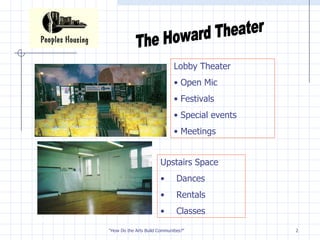
The Howard Theater Lobby Theater Open Mic  Festivals Special events Meetings Upstairs Space Dances Rentals Classes
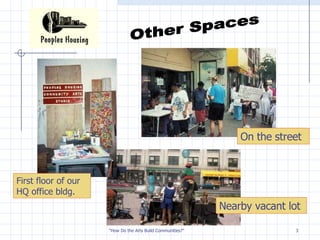
Other Spaces First floor of our HQ office bldg. On the street Nearby vacant lot
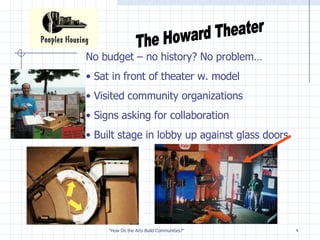
The Howard Theater No budget – no history? No problem… Sat in front of theater w. model Visited community organizations Signs asking for collaboration Built stage in lobby up against glass doors
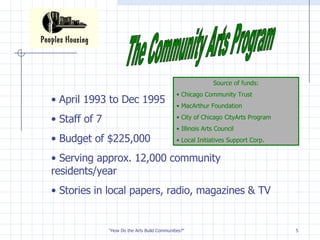
The Community Arts Program April 1993 to Dec 1995 Staff of 7 Budget of $225,000 Serving approx. 12,000 community residents/year Stories in local papers, radio, magazines & TV Source of funds: Chicago Community Trust MacArthur Foundation City of Chicago CityArts Program Illinois Arts Council Local Initiatives Support Corp.
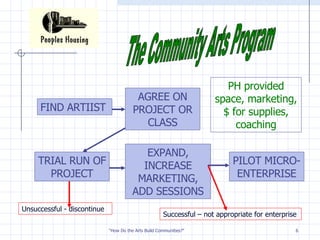
The Community Arts Program FIND ARTIIST AGREE ON PROJECT OR CLASS PH provided space, marketing, $ for supplies, coaching TRIAL RUN OF PROJECT EXPAND, INCREASE MARKETING, ADD SESSIONS PILOT MICRO-ENTERPRISE Unsuccessful - discontinue Successful – not appropriate for enterprise
The Community Arts Program EXAMPLES OF  COMMUNITY ARTS PROGRAMS
 
 
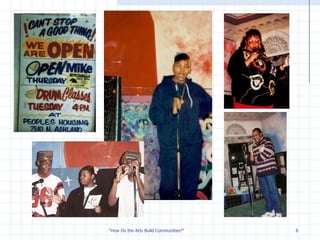
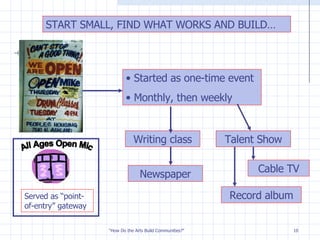
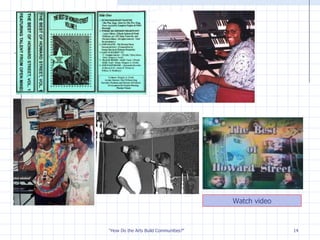
START SMALL, FIND WHAT WORKS AND BUILD… Started as one-time event Monthly, then weekly Talent Show Cable TV Record album Writing class Newspaper Served as “point-of-entry” gateway All Ages Open Mic
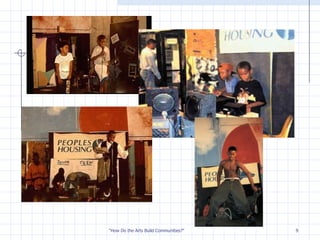
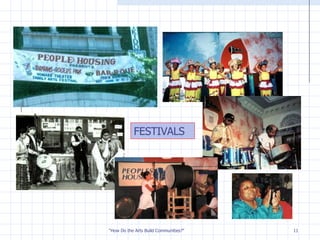
FESTIVALS
 
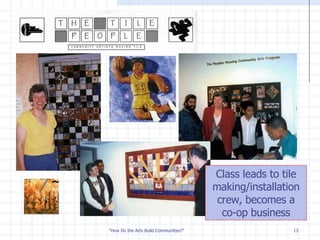
Class leads to tile making/installation crew, becomes a co-op business
Watch video
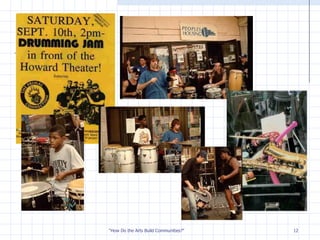
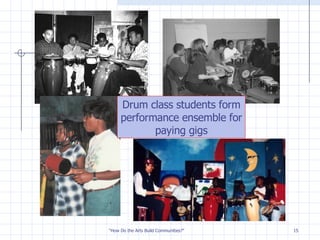
Drum class students form performance ensemble for paying gigs
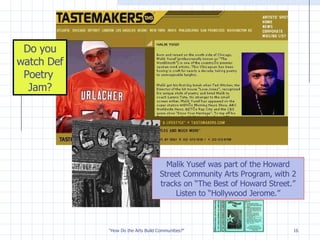
Do you watch Def Poetry  Jam? Malik Yusef was part of the Howard Street Community Arts Program, with 2 tracks on “The Best of Howard Street.” Listen to “Hollywood Jerome.”
CAP Operating Principles… Start where the people are. Seduce, recruit local artists.  Leverage mastery of space.  Make the path by walking it.  Listen, learn and lead.  Iteration, quick start, use seed funds.
ISSUES FOR CONSIDERATION http://www.xroadsproject.org 3 Premises Creativity is a muscle Art is information Communities are cultures
http://www.xroadsproject.org “ CRAFT” approach Contact Research Action Feedback Teaching
ISSUES FOR CONSIDERATION * DOES THE ARTIST HAVE SOMETHING SPECIAL TO OFFER? 1. ARTISTS BRING NEW WAYS OF THINKING AND DOING 2. ARTISTS PRACTICE COLLABORATION  AND TEAM BUILDING 3. ARTISTS CREATE SOMETHING FROM NOTHING AND HAVE VISION TO PRODUCE BEAUTY WHERE NONE IS OBVIOUS “ Imagination precedes implementation.”
ISSUES FOR CONSIDERATION * HOW CAN THE ARTS FOSTER ECONOMIC DEVELOPMENT? 1. ARTS PROGRAMS CONTRIBUTE TO  PUBLIC SAFETY, TRUST, CIVIC COHESION 2. DOING ART BUILDS MULTIPLE INTELLIGENCES AND DEVELOPS COLLABORATIVE AND LEADERSHIP SKILLS 3. ARTS AND ENTERTAINMENT PROGRAMS OFFER RICH OPPORTUNITIES FOR ECONOMIC DEVELOPMENT AND TRAINING FOR THE CREATIVE ECONOMY
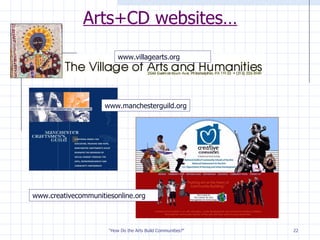
Arts+CD websites… www.villagearts.org www.manchesterguild.org www.creativecommunitiesonline.org
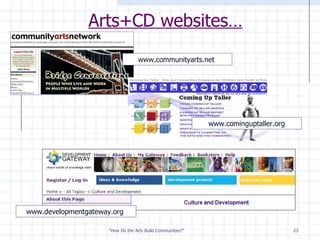
Arts+CD websites… www.developmentgateway.org   www.cominguptaller.org www.communityarts.net
[email_address] www.tresser.com Creativity is America's most precious natural resource. It's renewable, unlimited and universally available. Creativity is our heritage, our promise and the source of our prosperity. And, like a natural resource, creativity needs to be respected, conserved, stewarded and celebrated. But, like a natural resource, creativity can be polluted, squandered and blocked.  Tom Tresser is a consultant, producer, educator and trainer who can help individuals, companies and communities leverage and amplify their creative assets in order to solve problems, create economic value and trigger civic engagement.

Arts Build Communities Part 2

  • 1.
    “ How Dothe Arts Build Communities?” Part 2 [email_address] www.tresser.com
  • 2.
    The Howard TheaterLobby Theater Open Mic Festivals Special events Meetings Upstairs Space Dances Rentals Classes
  • 3.
    Other Spaces Firstfloor of our HQ office bldg. On the street Nearby vacant lot
  • 4.
    The Howard TheaterNo budget – no history? No problem… Sat in front of theater w. model Visited community organizations Signs asking for collaboration Built stage in lobby up against glass doors
  • 5.
    The Community ArtsProgram April 1993 to Dec 1995 Staff of 7 Budget of $225,000 Serving approx. 12,000 community residents/year Stories in local papers, radio, magazines & TV Source of funds: Chicago Community Trust MacArthur Foundation City of Chicago CityArts Program Illinois Arts Council Local Initiatives Support Corp.
  • 6.
    The Community ArtsProgram FIND ARTIIST AGREE ON PROJECT OR CLASS PH provided space, marketing, $ for supplies, coaching TRIAL RUN OF PROJECT EXPAND, INCREASE MARKETING, ADD SESSIONS PILOT MICRO-ENTERPRISE Unsuccessful - discontinue Successful – not appropriate for enterprise
  • 7.
    The Community ArtsProgram EXAMPLES OF COMMUNITY ARTS PROGRAMS
  • 8.
  • 9.
  • 10.
    START SMALL, FINDWHAT WORKS AND BUILD… Started as one-time event Monthly, then weekly Talent Show Cable TV Record album Writing class Newspaper Served as “point-of-entry” gateway All Ages Open Mic
  • 11.
  • 12.
  • 13.
    Class leads totile making/installation crew, becomes a co-op business
  • 14.
  • 15.
    Drum class studentsform performance ensemble for paying gigs
  • 16.
    Do you watchDef Poetry Jam? Malik Yusef was part of the Howard Street Community Arts Program, with 2 tracks on “The Best of Howard Street.” Listen to “Hollywood Jerome.”
  • 17.
    CAP Operating Principles…Start where the people are. Seduce, recruit local artists. Leverage mastery of space. Make the path by walking it. Listen, learn and lead. Iteration, quick start, use seed funds.
  • 18.
    ISSUES FOR CONSIDERATIONhttp://www.xroadsproject.org 3 Premises Creativity is a muscle Art is information Communities are cultures
  • 19.
    http://www.xroadsproject.org “ CRAFT”approach Contact Research Action Feedback Teaching
  • 20.
    ISSUES FOR CONSIDERATION* DOES THE ARTIST HAVE SOMETHING SPECIAL TO OFFER? 1. ARTISTS BRING NEW WAYS OF THINKING AND DOING 2. ARTISTS PRACTICE COLLABORATION AND TEAM BUILDING 3. ARTISTS CREATE SOMETHING FROM NOTHING AND HAVE VISION TO PRODUCE BEAUTY WHERE NONE IS OBVIOUS “ Imagination precedes implementation.”
  • 21.
    ISSUES FOR CONSIDERATION* HOW CAN THE ARTS FOSTER ECONOMIC DEVELOPMENT? 1. ARTS PROGRAMS CONTRIBUTE TO PUBLIC SAFETY, TRUST, CIVIC COHESION 2. DOING ART BUILDS MULTIPLE INTELLIGENCES AND DEVELOPS COLLABORATIVE AND LEADERSHIP SKILLS 3. ARTS AND ENTERTAINMENT PROGRAMS OFFER RICH OPPORTUNITIES FOR ECONOMIC DEVELOPMENT AND TRAINING FOR THE CREATIVE ECONOMY
  • 22.
    Arts+CD websites… www.villagearts.orgwww.manchesterguild.org www.creativecommunitiesonline.org
  • 23.
    Arts+CD websites… www.developmentgateway.org www.cominguptaller.org www.communityarts.net
  • 24.
    [email_address] www.tresser.com Creativityis America's most precious natural resource. It's renewable, unlimited and universally available. Creativity is our heritage, our promise and the source of our prosperity. And, like a natural resource, creativity needs to be respected, conserved, stewarded and celebrated. But, like a natural resource, creativity can be polluted, squandered and blocked. Tom Tresser is a consultant, producer, educator and trainer who can help individuals, companies and communities leverage and amplify their creative assets in order to solve problems, create economic value and trigger civic engagement.