STROKE
Dipanjan konar
(Final year BPT student)
Definition
A stroke is defined as a medical condition
that occurs when the blood supply to a
part of the brain is interrupted and
preventing oxygen from reaching brain
tissue.
Etiology:-
Types:-
STROKE
Ischemic
stroke(85%)
Haemorrhagi
c
stroke(15%)
Risk Factors:-
 Lifestyle risk factors
 Being overweight
 Physical inactivity
 Heavy drinking
 Use of illegal drugs
 Cigarette smoking
 Medical risk factors
 High blood pressure
 Diabetes
 Cardiovascular disease
 Other factors of stroke
 Age
 Sex
 Hormones
Modified etiology of stroke
The etiology of stroke can be modified through addressing and managing
various risk factors. Modified risk factors include:-
1. Hypertension
2. Diabetes
3. High cholesterol
4. Smoking
5. Obesity
6. Physical inactivity
7. Unhealthy diet
8. Alcohol consumption
Complications:-
Complications depend on how long the brain lacks blood flow and which
part is effected. Complication may include:-
 Loss of muscle movement, known as paralysis.
 Trouble talking or swallowing.
 Memory loss or trouble thinking.
 Emotional symptoms.
 Pain.
 Changes in behavior and self-care.
Major regions of stroke
 Anterior circulation
 MCA- Lateral frontal lobes, temporal
lobes, lateral anterior parietal lobes.
(Upper body, language)
 ACA- Medical and anterior frontal
lobes, medial parietal lobes.(Lower
body, pelvic floor musculature, sensory
integration)
 Ophthalmic artery- Eyes (option)
Cont…..
 Posterior circulation
 PCA- Occipital lobes, posterior
temporal lobes, posterior
parietal lobes, midbrain.
(Vision, balance, sensory
integration)
 PICA- Posterior inferior cerebellum,
posterior lateral medulla. (Facial
sensation, Pain sensation from body)
 Basilar artery- Locked in syndrome.
Wallenberg syndrome
 Wallenberg syndrome is the most prevalent posterior ischemic stroke syndrome.
 There are nearly 800,000 patients who suffer from acute stroke each year in the United States.
 Of these, 83% are ischemic strokes.
 Twenty percent of ischemic strokes occur in the posterior circulation.
 If clinicians assume that about half of these suffer from Wallenberg syndrome, it can be
estimated that there are more than 60,000 new cases of Wallenberg syndrome each year in the
United States.
 The condition shows a predominance for men in their sixth decade.
 Causes:
 Cerebral embolism (blood clot that travels to the brain)
 Vertebral artery dissection (which may be due to neck manipulation or injury)
 Marfan syndrome
 Ehler’s- Danlos syndrome
 Fibromuscular dysplasia
SYMPTOMS OF WALLENBERG SYNDROME
 Vertigo
 Nausea and vomiting
 Difficulty with balance and ambulation
 Difficulty maintaining sitting posture
 Blurry vision
 Horizontal or rotational nystagmus
 Reduction in facial pain & temperature sensation
 Contralateral reduction in trunk pain & temperature sensation
 Hoarseness
 Poor gag reflex
 Ataxia, both limb & gait
 Dysphonia (difficulty with sound production)
 Dysphagia (difficulty swallowing)
 Diplopia (double vision)
Benedikt Syndrome:-
Benedikt syndrome is defined as a midbrain stroke. It is
a rare type of posterior circulation stroke of the brain,
with a range of neurological symptoms affecting
the midbrain, cerebellum and other related structures.
 CN3, lemniscal tract, red nucleus.
Signs & Symptom :-
 Occulomotor palsy.
 Contralateral loss of vibration.
 Involuntary movement (tremor, ataxia)
 Causes:-
 Infraction
 Haemorrhage
 Tumour
 Tuberculosis
Pontine syndrome
DEFINATION:-
 A pontine stroke is a stroke that develops
in the blood vessels that supply your
pons, a structure in the brainstem that
controls unconscious functions like the
sleep-wake cycle and coordinating
movements.
 Basilar artery is most commonly effected.
SYMPTOM:-
 numbness or weakness in your face
and limbs
 confusion
 trouble seeing
 trouble walking
 Headache
Risk factors:-
 The risk of pontine stroke increases with age.
 high blood pressure
 diabetes
 dyslipidemia
 heart disease
Complications of
a pontine stroke:
swelling in your brain
pneumonia
seizures
depression
physical disability
LOCKED IN SYNDROME
 it’s a rare syndrome that effect the ability of individual to communicate and move their
body. Despite being physically paralyzed, the effected person remain conscious and
aware about surrounding.
 A part of the brainstem, the pons is damaged in locked in syndrome.
 Causes:
• Stroke
• Traumatic brain injury
• Degenerative diseases
• Drug overdose (barbiturates)
 Sign & Symptom :-
• Paralysis
• Loss of speech
• Loss of sensation
• Retention of cognitive function
• Retention of eye movement
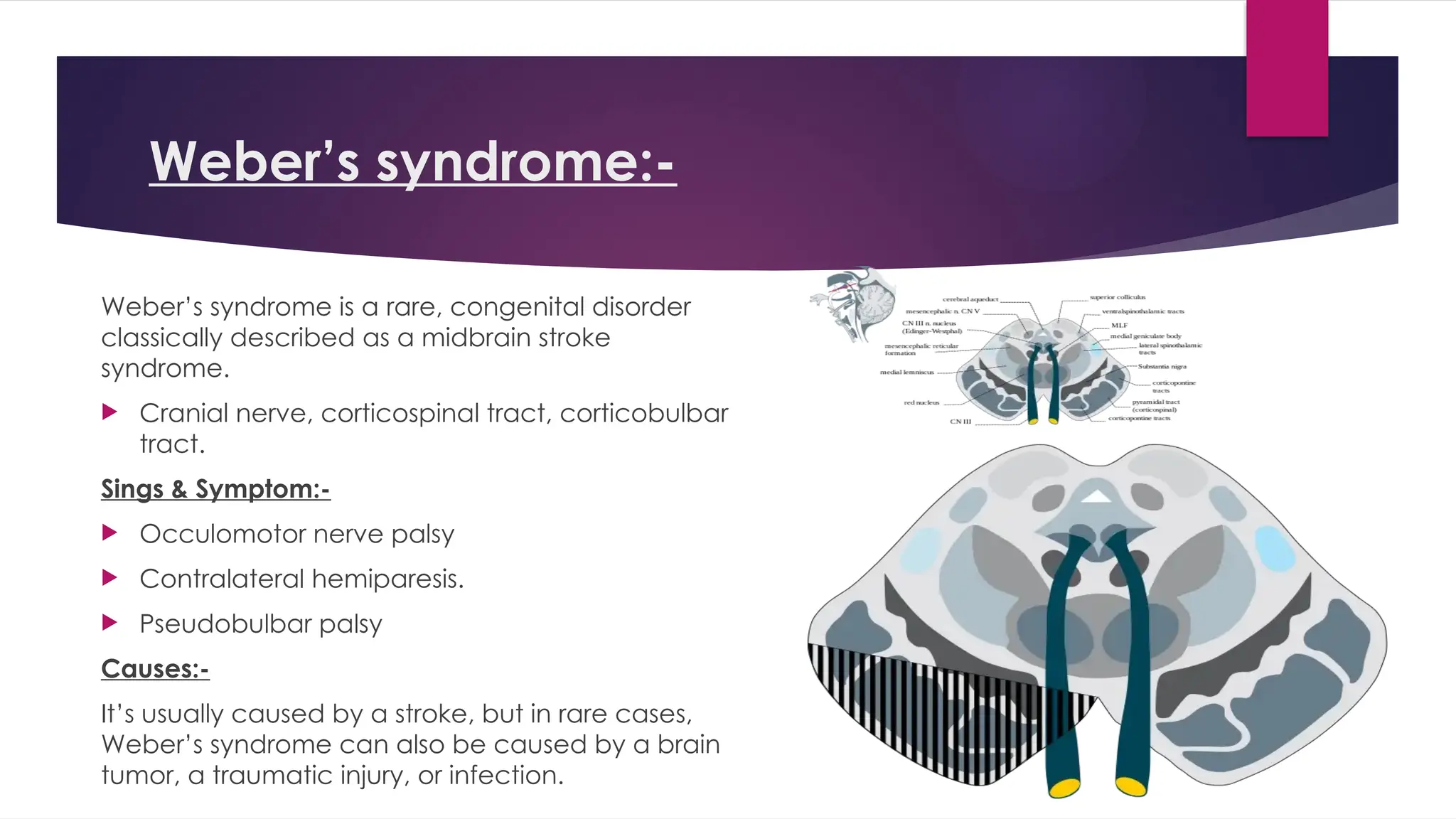
Weber’s syndrome:-
Weber’s syndrome is a rare, congenital disorder
classically described as a midbrain stroke
syndrome.
 Cranial nerve, corticospinal tract, corticobulbar
tract.
Sings & Symptom:-
 Occulomotor nerve palsy
 Contralateral hemiparesis.
 Pseudobulbar palsy
Causes:-
It’s usually caused by a stroke, but in rare cases,
Weber’s syndrome can also be caused by a brain
tumor, a traumatic injury, or infection.
CLAUDE SYNDROME
 Claude’s syndrome is caused by midbrain infraction as a result of occlusion of a branch of the
cerebral artery .
 This lesion is usually unilateral infarction of the red nucleus and cerebral peduncle, affecting several
structures in the mid brain including:
Structure damaged Effect
Corticospinal tract fibers Contralateral hemiparesis
Corticobulbar tract fibers Contralateral hemiplegia of lower
facial muscles , tongue and shoulder
Occulomotor nerve fibers Ipsilateral Occulomotor nerve palsy
with a drooping eyelid and fixed wide
pupil pointed down and out;
and probable diplopia.
PARINAUD’s SYNDROME
 Parinaud syndrome is also known as
sylvian aqueduct syndrome ,dorsal mid
brain syndrome
 Parinaud syndrome is classically described
by the triad of impaired upward gaze,
convergence retraction nystagmus, and
pupillary hyporeflexia.
 Causes:
• Brain tumors in midbrain
• Demyelination
• Stroke of upper brainstem.
 Sign and symptoms:
 Paralysis of upwards gaze
 Pseudo-Argyll Robertson pupils:
 Convergence-retraction nystagmus:
 Eyelid retraction (Collier's sign)
Millard-Gubler Syndrome:-
Millard–Gubler syndrome is a lesion of the pons.
It also known as ventral pontine syndrome.
 Obstruction of circumferential branches of
basilar artery.
 Effects in CN6 & CN7 (facial palsies)
 Sign & Symptom :-
 Contralateral hemiplegia.
 Ipsilateral facial weakness.
 Ipsilateral sixth nerve palsy.
Treatment:-
 Exercise
 Stretching, walking, and exercises specific to trouble spots.
 Manual Therapy
 Manual techniques on joints and muscles to improve circulation and reduce pain.
 Education
 More advantageous methods of performing daily activities
 Assistive device training
 Transfer training
Cont….
 Improve motor control
 Use several different techniques for sensory stimulation to facilitate movement.
 Learning theory approach
 Conductive education and motor relearning theory
 Functional electrical stimulation
 Help restore motor control, spasticity, and hemiplegia
 Biofeedback
 Other treatments include
 Tone management, Sensory re-education, Balance retraining, Fall prevention, Gait re-education,
Functional mobility training
Stroke and stroke syndrome for physiotherapy.pptx

Stroke and stroke syndrome for physiotherapy.pptx

  • 1.
  • 2.
    Definition A stroke isdefined as a medical condition that occurs when the blood supply to a part of the brain is interrupted and preventing oxygen from reaching brain tissue.
  • 3.
  • 4.
  • 5.
    Risk Factors:-  Lifestylerisk factors  Being overweight  Physical inactivity  Heavy drinking  Use of illegal drugs  Cigarette smoking  Medical risk factors  High blood pressure  Diabetes  Cardiovascular disease  Other factors of stroke  Age  Sex  Hormones
  • 6.
    Modified etiology ofstroke The etiology of stroke can be modified through addressing and managing various risk factors. Modified risk factors include:- 1. Hypertension 2. Diabetes 3. High cholesterol 4. Smoking 5. Obesity 6. Physical inactivity 7. Unhealthy diet 8. Alcohol consumption
  • 7.
    Complications:- Complications depend onhow long the brain lacks blood flow and which part is effected. Complication may include:-  Loss of muscle movement, known as paralysis.  Trouble talking or swallowing.  Memory loss or trouble thinking.  Emotional symptoms.  Pain.  Changes in behavior and self-care.
  • 8.
    Major regions ofstroke  Anterior circulation  MCA- Lateral frontal lobes, temporal lobes, lateral anterior parietal lobes. (Upper body, language)  ACA- Medical and anterior frontal lobes, medial parietal lobes.(Lower body, pelvic floor musculature, sensory integration)  Ophthalmic artery- Eyes (option)
  • 9.
    Cont…..  Posterior circulation PCA- Occipital lobes, posterior temporal lobes, posterior parietal lobes, midbrain. (Vision, balance, sensory integration)  PICA- Posterior inferior cerebellum, posterior lateral medulla. (Facial sensation, Pain sensation from body)  Basilar artery- Locked in syndrome.
  • 10.
    Wallenberg syndrome  Wallenbergsyndrome is the most prevalent posterior ischemic stroke syndrome.  There are nearly 800,000 patients who suffer from acute stroke each year in the United States.  Of these, 83% are ischemic strokes.  Twenty percent of ischemic strokes occur in the posterior circulation.  If clinicians assume that about half of these suffer from Wallenberg syndrome, it can be estimated that there are more than 60,000 new cases of Wallenberg syndrome each year in the United States.  The condition shows a predominance for men in their sixth decade.  Causes:  Cerebral embolism (blood clot that travels to the brain)  Vertebral artery dissection (which may be due to neck manipulation or injury)  Marfan syndrome  Ehler’s- Danlos syndrome  Fibromuscular dysplasia
  • 11.
    SYMPTOMS OF WALLENBERGSYNDROME  Vertigo  Nausea and vomiting  Difficulty with balance and ambulation  Difficulty maintaining sitting posture  Blurry vision  Horizontal or rotational nystagmus  Reduction in facial pain & temperature sensation  Contralateral reduction in trunk pain & temperature sensation  Hoarseness  Poor gag reflex  Ataxia, both limb & gait  Dysphonia (difficulty with sound production)  Dysphagia (difficulty swallowing)  Diplopia (double vision)
  • 12.
    Benedikt Syndrome:- Benedikt syndromeis defined as a midbrain stroke. It is a rare type of posterior circulation stroke of the brain, with a range of neurological symptoms affecting the midbrain, cerebellum and other related structures.  CN3, lemniscal tract, red nucleus. Signs & Symptom :-  Occulomotor palsy.  Contralateral loss of vibration.  Involuntary movement (tremor, ataxia)  Causes:-  Infraction  Haemorrhage  Tumour  Tuberculosis
  • 13.
    Pontine syndrome DEFINATION:-  Apontine stroke is a stroke that develops in the blood vessels that supply your pons, a structure in the brainstem that controls unconscious functions like the sleep-wake cycle and coordinating movements.  Basilar artery is most commonly effected. SYMPTOM:-  numbness or weakness in your face and limbs  confusion  trouble seeing  trouble walking  Headache Risk factors:-  The risk of pontine stroke increases with age.  high blood pressure  diabetes  dyslipidemia  heart disease
  • 14.
    Complications of a pontinestroke: swelling in your brain pneumonia seizures depression physical disability
  • 15.
    LOCKED IN SYNDROME it’s a rare syndrome that effect the ability of individual to communicate and move their body. Despite being physically paralyzed, the effected person remain conscious and aware about surrounding.  A part of the brainstem, the pons is damaged in locked in syndrome.  Causes: • Stroke • Traumatic brain injury • Degenerative diseases • Drug overdose (barbiturates)  Sign & Symptom :- • Paralysis • Loss of speech • Loss of sensation • Retention of cognitive function • Retention of eye movement
  • 16.
    Weber’s syndrome:- Weber’s syndromeis a rare, congenital disorder classically described as a midbrain stroke syndrome.  Cranial nerve, corticospinal tract, corticobulbar tract. Sings & Symptom:-  Occulomotor nerve palsy  Contralateral hemiparesis.  Pseudobulbar palsy Causes:- It’s usually caused by a stroke, but in rare cases, Weber’s syndrome can also be caused by a brain tumor, a traumatic injury, or infection.
  • 17.
    CLAUDE SYNDROME  Claude’ssyndrome is caused by midbrain infraction as a result of occlusion of a branch of the cerebral artery .  This lesion is usually unilateral infarction of the red nucleus and cerebral peduncle, affecting several structures in the mid brain including: Structure damaged Effect Corticospinal tract fibers Contralateral hemiparesis Corticobulbar tract fibers Contralateral hemiplegia of lower facial muscles , tongue and shoulder Occulomotor nerve fibers Ipsilateral Occulomotor nerve palsy with a drooping eyelid and fixed wide pupil pointed down and out; and probable diplopia.
  • 18.
    PARINAUD’s SYNDROME  Parinaudsyndrome is also known as sylvian aqueduct syndrome ,dorsal mid brain syndrome  Parinaud syndrome is classically described by the triad of impaired upward gaze, convergence retraction nystagmus, and pupillary hyporeflexia.  Causes: • Brain tumors in midbrain • Demyelination • Stroke of upper brainstem.  Sign and symptoms:  Paralysis of upwards gaze  Pseudo-Argyll Robertson pupils:  Convergence-retraction nystagmus:  Eyelid retraction (Collier's sign)
  • 19.
    Millard-Gubler Syndrome:- Millard–Gubler syndromeis a lesion of the pons. It also known as ventral pontine syndrome.  Obstruction of circumferential branches of basilar artery.  Effects in CN6 & CN7 (facial palsies)  Sign & Symptom :-  Contralateral hemiplegia.  Ipsilateral facial weakness.  Ipsilateral sixth nerve palsy.
  • 20.
    Treatment:-  Exercise  Stretching,walking, and exercises specific to trouble spots.  Manual Therapy  Manual techniques on joints and muscles to improve circulation and reduce pain.  Education  More advantageous methods of performing daily activities  Assistive device training  Transfer training
  • 21.
    Cont….  Improve motorcontrol  Use several different techniques for sensory stimulation to facilitate movement.  Learning theory approach  Conductive education and motor relearning theory  Functional electrical stimulation  Help restore motor control, spasticity, and hemiplegia  Biofeedback  Other treatments include  Tone management, Sensory re-education, Balance retraining, Fall prevention, Gait re-education, Functional mobility training