STRESS WITH
HEART ATTACK
Presented to –
Dr. Md. Ashrafur Rahman
Assistant professor
North South University
Department of Pharmaceutical Science
Group Members
• Ety Biswas - 1411584046
• Maleha Zaman Prima – 141 0435 046
• Tarzeena Haque – 141 1641 646
• Md. Tareq Chowdhury – 142 0250 046
• Anika Kabir – 141 1973 046
• Stanley Palma – 141 0022 046
What is heart attack?
Causes of heart attack
What is stress?
Common sources of stress
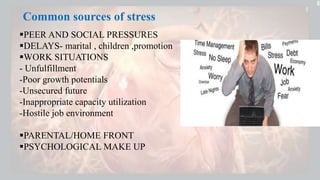
PEER AND SOCIAL PRESSURES
DELAYS- marital , children ,promotion
WORK SITUATIONS
- Unfulfillment
-Poor growth potentials
-Unsecured future
-Inappropriate capacity utilization
-Hostile job environment
PARENTAL/HOME FRONT
PSYCHOLOGICAL MAKE UP
Top Ten Stressful Life
Events
1. Spouse's death
2. Divorce
3 .Marriage separation
4. Jail term
5. Death of a close relative
6.Injury or illness
7. Marriage
8.Fired from job
9. Marriage reconciliation
10.Retirement
Common external causes of stress
 Major life changes
 Work
 Relationship difficulties
 Financial problems
 Being too busy
 Children and family
Common Internal causes of stress
 Inability to accept uncertainty
Pessimism
 Negative self-talk
 Unrealistic expectations
 Perfectionism
 Lack of assertiveness
STRESS HORMONES
 When a stressful situation is presented to us, our body produces a physiological response known as
the stress response and releases three major stress hormones which are :
 These hormones rouse the body for emergency action.
Adrenaline is commonly known as the
flight
flight or fight hormone.
Adrenaline
Cortisol
Norepinephrine
Cont…
Adrenaline and norepinephrine are largely responsible
for the immediate reactions we feel when stressed
such as we become more aware, awake, focused and
generally more responsive as they increase our heart rate
and blood pressure, relax smooth muscles in the airways
to improve breathing and boosts energy supplies.
Cortisol increases glucose in our bloodstream and
enhances the brain's use of glucose.
STRESS RESPONSE
Chronic stress exposes our body to
unhealthy, persistently elevated
levels of stress hormones.
This is how stress
response is protecting us
and it is usually self-
limiting. Once a perceived
threat has passed,
hormone levels return to
normal, but when
stressors are always
present, fight-or-flight
reaction stays turned on.
At that certain point,
stress stops being helpful
and start causing major
damage to our health.
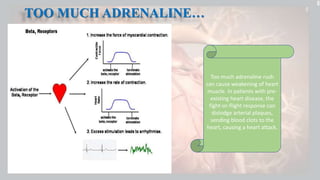
TOO MUCH ADRENALINE…
Too much adrenaline rush
can cause weakening of heart
muscle. In patients with pre-
existing heart disease, the
fight-or-flight response can
dislodge arterial plaques,
sending blood clots to the
heart, causing a heart attack.
TOO MUCH CORTISOL…
Fig: Web of factors involve in heart attack due to stress
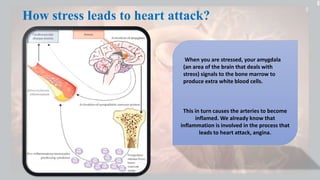
How stress leads to heart attack?
This in turn causes the arteries to become
inflamed. We already know that
inflammation is involved in the process that
leads to heart attack, angina.
When you are stressed, your amygdala
(an area of the brain that deals with
stress) signals to the bone marrow to
produce extra white blood cells.
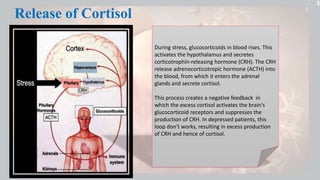
Release of Cortisol
During stress, glucocorticoids in blood rises. This
activates the hypothalamus and secretes
corticotrophin-releasing hormone (CRH). The CRH
release adrenocorticotropic hormone (ACTH) into
the blood, from which it enters the adrenal
glands and secrete cortisol.
This process creates a negative feedback in
which the excess cortisol activates the brain's
glucocorticoid receptors and suppresses the
production of CRH. In depressed patients, this
loop don't works, resulting in excess production
of CRH and hence of cortisol.
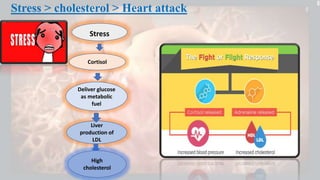
Stress > cholesterol > Heart attack
Stress
Cortisol
Deliver glucose
as metabolic
fuel
Liver
production of
LDL
High
cholesterol
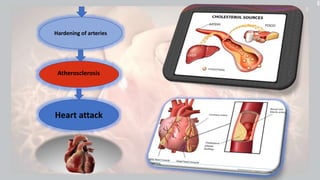
Hardening of arteries
Heart attack
Atherosclerosis
Stress Cardiomyopathy vs. Heart Attack
Stress Cardiomyopathy Heart attack
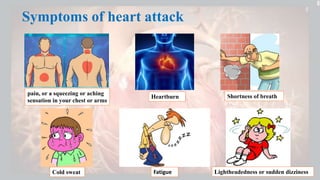
Symptoms of heart attack
pain, or a squeezing or aching
sensation in your chest or arms
Heartburn Shortness of breath
Cold sweat Fatigue Lightheadedness or sudden dizziness
Heart attack symptoms vary
• Not all people who have heart attacks have the same symptoms or have
the same severity of symptoms.
• Some people have mild pain; others have more severe pain.
• Some people have no symptoms; for others, the first sign may be sudden
cardiac arrest.
• Some heart attacks strike suddenly, but many people have warning signs
and symptoms hours, days or weeks in advance.
• The earliest warning might be recurrent chest pain or pressure (angina)
that's triggered by exertion and relieved by rest.
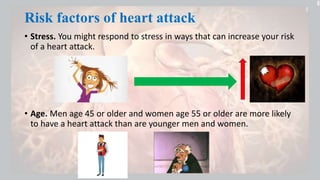
Risk factors of heart attack
• Stress. You might respond to stress in ways that can increase your risk
of a heart attack.
• Age. Men age 45 or older and women age 55 or older are more likely
to have a heart attack than are younger men and women.
Risk factors of heart attack
• Tobacco. This includes smoking and long-term exposure to
secondhand smoke.
• Obesity. Obesity is associated with high blood cholesterol
levels, high triglyceride levels, high blood pressure and
diabetes. Losing just 10 percent of your body weight can
lower this risk, however.
Risk factors of heart attack
• High blood cholesterol or triglyceride levels. A high level of low-density
lipoprotein (LDL) cholesterol (the "bad" cholesterol) is most likely to
narrow arteries. A high level of triglycerides, a type of blood fat related to
your diet, also ups your risk of heart attack.
• Diabetes. Not producing enough of a hormone secreted by your pancreas
(insulin) or not responding to insulin properly causes your body's blood
sugar levels to rise, increasing your risk of heart attack.
Treatment for Heart Attack with stress
Medication
Strategies for
Stress Relief
Mechanism Of Action
• Barbiturates acts on the channel modulatory site of
GABAA receptor and potentiate the GABA mediated
inhibitory effects by ‘increasing the duration of chloride
channel opening’.
• At higher concentration Barbiturates directly increased
chloride ion conduction i.e.; they exhibit a GABA
facilitatory action.
1. Sedative
Medications:
•Benzodiazepines
• Barbiturates
• Zolpidem
2. Beta Blockers
Drugs name:
Acebutolol (Sectral)
Bisoprolol (Zebeta)
Carvedilol (Coreg)
Propranolol (Inderal)
Beta blockers work by blocking the
effects of norepinephrine,
a stress hormone involved in the
fight-or-flight response.
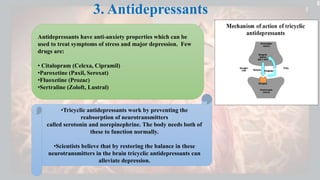
3. Antidepressants
.
Antidepressants have anti-anxiety properties which can be
used to treat symptoms of stress and major depression. Few
drugs are:
• Citalopram (Celexa, Cipramil)
•Paroxetine (Paxil, Seroxat)
•Fluoxetine (Prozac)
•Sertraline (Zoloft, Lustral)
•Tricyclic antidepressants work by preventing the
reabsorption of neurotransmitters
called serotonin and norepinephrine. The body needs both of
these to function normally.
•Scientists believe that by restoring the balance in these
neurotransmitters in the brain tricyclic antidepressants can
alleviate depression.
Consider Supplements
•Lemon balm: It is a member of the
mint family that has been studied for its
anti-anxiety effects.
•Omega-3 fatty acids: One study
showed that medical students who
received the supplements experienced
20% reduction in anxiety symptoms.
•Ashwagandha: It is an herb used in
Ayurvedic medicine to treat stress and
anxiety.
•Valerian: Valerian root is a popular
sleep aid due to its tranquilizing effect.
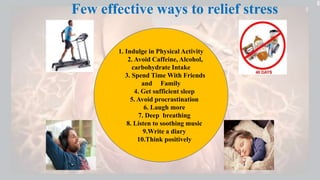
Few effective ways to relief stress
1. Indulge in Physical Activity
2. Avoid Caffeine, Alcohol,
carbohydrate Intake
3. Spend Time With Friends
and Family
4. Get sufficient sleep
5. Avoid procrastination
6. Laugh more
7. Deep breathing
8. Listen to soothing music
9.Write a diary
10.Think positively
Management of heart attack
Non-Pharmacological
Physical exercise:
The overall risk of myocardial infarction and sudden
cardiac death is reduced among those who regularly
exercise.
Management of heart attack
Rest (including holidays)
Counseling (spiritual, guidance, professional)
Management of heart attack
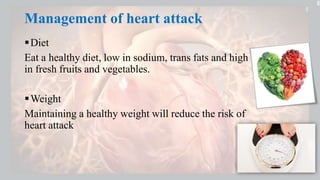
Diet
Eat a healthy diet, low in sodium, trans fats and high
in fresh fruits and vegetables.
Weight
Maintaining a healthy weight will reduce the risk of
heart attack
Management of heart attack
Pharmacological
Anxiolytics
Beta-blockers
Neuroleptics
Emotional effects of heart condition
Source – British Heart Foundation
https://www.bhf.org.uk/informationsupport/heart-matters-magazine/wellbeing/mental-health/mental-health-survey
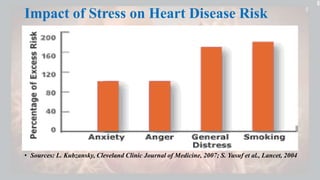
Impact of Stress on Heart Disease Risk
• Sources: L. Kubzansky, Cleveland Clinic Journal of Medicine, 2007; S. Yusuf et al., Lancet, 2004
Conclusion
Keep a sound heart in a sound body by reducing stress
References
• https://www.mayoclinic.org/healthy-lifestyle/stress-management/in-
depth/stress/art-20046037
• https://www.psychologytoday.com/intl/blog/the-athletes-
way/201301/cortisol-why-the-stress-hormone-is-public-enemy-no-1
• https://www.bhf.org.uk/informationsupport/heart-matters-
magazine/wellbeing/mental-health/mental-health-survey
• https://www.hsph.harvard.edu/news/magazine/winter09heart/
Stress with Heart Attack

Stress with Heart Attack

  • 1.
    STRESS WITH HEART ATTACK Presentedto – Dr. Md. Ashrafur Rahman Assistant professor North South University Department of Pharmaceutical Science
  • 2.
    Group Members • EtyBiswas - 1411584046 • Maleha Zaman Prima – 141 0435 046 • Tarzeena Haque – 141 1641 646 • Md. Tareq Chowdhury – 142 0250 046 • Anika Kabir – 141 1973 046 • Stanley Palma – 141 0022 046
  • 3.
  • 4.
  • 5.
  • 6.
    Common sources ofstress PEER AND SOCIAL PRESSURES DELAYS- marital , children ,promotion WORK SITUATIONS - Unfulfillment -Poor growth potentials -Unsecured future -Inappropriate capacity utilization -Hostile job environment PARENTAL/HOME FRONT PSYCHOLOGICAL MAKE UP
  • 7.
    Top Ten StressfulLife Events 1. Spouse's death 2. Divorce 3 .Marriage separation 4. Jail term 5. Death of a close relative 6.Injury or illness 7. Marriage 8.Fired from job 9. Marriage reconciliation 10.Retirement Common external causes of stress  Major life changes  Work  Relationship difficulties  Financial problems  Being too busy  Children and family Common Internal causes of stress  Inability to accept uncertainty Pessimism  Negative self-talk  Unrealistic expectations  Perfectionism  Lack of assertiveness
  • 8.
    STRESS HORMONES  Whena stressful situation is presented to us, our body produces a physiological response known as the stress response and releases three major stress hormones which are :  These hormones rouse the body for emergency action. Adrenaline is commonly known as the flight flight or fight hormone. Adrenaline Cortisol Norepinephrine
  • 9.
    Cont… Adrenaline and norepinephrineare largely responsible for the immediate reactions we feel when stressed such as we become more aware, awake, focused and generally more responsive as they increase our heart rate and blood pressure, relax smooth muscles in the airways to improve breathing and boosts energy supplies. Cortisol increases glucose in our bloodstream and enhances the brain's use of glucose.
  • 10.
    STRESS RESPONSE Chronic stressexposes our body to unhealthy, persistently elevated levels of stress hormones. This is how stress response is protecting us and it is usually self- limiting. Once a perceived threat has passed, hormone levels return to normal, but when stressors are always present, fight-or-flight reaction stays turned on. At that certain point, stress stops being helpful and start causing major damage to our health.
  • 11.
    TOO MUCH ADRENALINE… Toomuch adrenaline rush can cause weakening of heart muscle. In patients with pre- existing heart disease, the fight-or-flight response can dislodge arterial plaques, sending blood clots to the heart, causing a heart attack.
  • 12.
  • 13.
    Fig: Web offactors involve in heart attack due to stress
  • 14.
    How stress leadsto heart attack? This in turn causes the arteries to become inflamed. We already know that inflammation is involved in the process that leads to heart attack, angina. When you are stressed, your amygdala (an area of the brain that deals with stress) signals to the bone marrow to produce extra white blood cells.
  • 15.
    Release of Cortisol Duringstress, glucocorticoids in blood rises. This activates the hypothalamus and secretes corticotrophin-releasing hormone (CRH). The CRH release adrenocorticotropic hormone (ACTH) into the blood, from which it enters the adrenal glands and secrete cortisol. This process creates a negative feedback in which the excess cortisol activates the brain's glucocorticoid receptors and suppresses the production of CRH. In depressed patients, this loop don't works, resulting in excess production of CRH and hence of cortisol.
  • 16.
    Stress > cholesterol> Heart attack Stress Cortisol Deliver glucose as metabolic fuel Liver production of LDL High cholesterol
  • 17.
    Hardening of arteries Heartattack Atherosclerosis
  • 18.
    Stress Cardiomyopathy vs.Heart Attack Stress Cardiomyopathy Heart attack
  • 19.
    Symptoms of heartattack pain, or a squeezing or aching sensation in your chest or arms Heartburn Shortness of breath Cold sweat Fatigue Lightheadedness or sudden dizziness
  • 20.
    Heart attack symptomsvary • Not all people who have heart attacks have the same symptoms or have the same severity of symptoms. • Some people have mild pain; others have more severe pain. • Some people have no symptoms; for others, the first sign may be sudden cardiac arrest. • Some heart attacks strike suddenly, but many people have warning signs and symptoms hours, days or weeks in advance. • The earliest warning might be recurrent chest pain or pressure (angina) that's triggered by exertion and relieved by rest.
  • 21.
    Risk factors ofheart attack • Stress. You might respond to stress in ways that can increase your risk of a heart attack. • Age. Men age 45 or older and women age 55 or older are more likely to have a heart attack than are younger men and women.
  • 22.
    Risk factors ofheart attack • Tobacco. This includes smoking and long-term exposure to secondhand smoke. • Obesity. Obesity is associated with high blood cholesterol levels, high triglyceride levels, high blood pressure and diabetes. Losing just 10 percent of your body weight can lower this risk, however.
  • 23.
    Risk factors ofheart attack • High blood cholesterol or triglyceride levels. A high level of low-density lipoprotein (LDL) cholesterol (the "bad" cholesterol) is most likely to narrow arteries. A high level of triglycerides, a type of blood fat related to your diet, also ups your risk of heart attack. • Diabetes. Not producing enough of a hormone secreted by your pancreas (insulin) or not responding to insulin properly causes your body's blood sugar levels to rise, increasing your risk of heart attack.
  • 24.
    Treatment for HeartAttack with stress
  • 25.
    Medication Strategies for Stress Relief MechanismOf Action • Barbiturates acts on the channel modulatory site of GABAA receptor and potentiate the GABA mediated inhibitory effects by ‘increasing the duration of chloride channel opening’. • At higher concentration Barbiturates directly increased chloride ion conduction i.e.; they exhibit a GABA facilitatory action. 1. Sedative Medications: •Benzodiazepines • Barbiturates • Zolpidem
  • 26.
    2. Beta Blockers Drugsname: Acebutolol (Sectral) Bisoprolol (Zebeta) Carvedilol (Coreg) Propranolol (Inderal) Beta blockers work by blocking the effects of norepinephrine, a stress hormone involved in the fight-or-flight response.
  • 27.
    3. Antidepressants . Antidepressants haveanti-anxiety properties which can be used to treat symptoms of stress and major depression. Few drugs are: • Citalopram (Celexa, Cipramil) •Paroxetine (Paxil, Seroxat) •Fluoxetine (Prozac) •Sertraline (Zoloft, Lustral) •Tricyclic antidepressants work by preventing the reabsorption of neurotransmitters called serotonin and norepinephrine. The body needs both of these to function normally. •Scientists believe that by restoring the balance in these neurotransmitters in the brain tricyclic antidepressants can alleviate depression.
  • 28.
    Consider Supplements •Lemon balm:It is a member of the mint family that has been studied for its anti-anxiety effects. •Omega-3 fatty acids: One study showed that medical students who received the supplements experienced 20% reduction in anxiety symptoms. •Ashwagandha: It is an herb used in Ayurvedic medicine to treat stress and anxiety. •Valerian: Valerian root is a popular sleep aid due to its tranquilizing effect.
  • 29.
    Few effective waysto relief stress 1. Indulge in Physical Activity 2. Avoid Caffeine, Alcohol, carbohydrate Intake 3. Spend Time With Friends and Family 4. Get sufficient sleep 5. Avoid procrastination 6. Laugh more 7. Deep breathing 8. Listen to soothing music 9.Write a diary 10.Think positively
  • 30.
    Management of heartattack Non-Pharmacological Physical exercise: The overall risk of myocardial infarction and sudden cardiac death is reduced among those who regularly exercise.
  • 31.
    Management of heartattack Rest (including holidays) Counseling (spiritual, guidance, professional)
  • 32.
    Management of heartattack Diet Eat a healthy diet, low in sodium, trans fats and high in fresh fruits and vegetables. Weight Maintaining a healthy weight will reduce the risk of heart attack
  • 33.
    Management of heartattack Pharmacological Anxiolytics Beta-blockers Neuroleptics
  • 34.
    Emotional effects ofheart condition Source – British Heart Foundation https://www.bhf.org.uk/informationsupport/heart-matters-magazine/wellbeing/mental-health/mental-health-survey
  • 35.
    Impact of Stresson Heart Disease Risk • Sources: L. Kubzansky, Cleveland Clinic Journal of Medicine, 2007; S. Yusuf et al., Lancet, 2004
  • 36.
    Conclusion Keep a soundheart in a sound body by reducing stress
  • 37.
    References • https://www.mayoclinic.org/healthy-lifestyle/stress-management/in- depth/stress/art-20046037 • https://www.psychologytoday.com/intl/blog/the-athletes- way/201301/cortisol-why-the-stress-hormone-is-public-enemy-no-1 •https://www.bhf.org.uk/informationsupport/heart-matters- magazine/wellbeing/mental-health/mental-health-survey • https://www.hsph.harvard.edu/news/magazine/winter09heart/