Subject: STRESS MANAGEMENT
Scope of Presentation:
A. Introduction
B. Definition of Terms
C. Scope of Presentation
I. Causes of Stress
II. What Cause stress Overload
III. Unhealthy Ways of Coping with Stress
IV. Stress Management Strategies
V. Coping Strategies for Stress
VI. Stress Busters
Prepared by:
NICANDRO PEÑERO CANALEJA, MM, MBA, DIAP
Police Senior Superintendent (DSC) (B.S. CH.E)
Forensic Chemical Officer
STRESS MANAGEMENT
A. Introduction
The world today is full of tension. Wherever we go, people are tense
and nervous. Stress and tension are more common to them than the common cold.
Today, hospitals are full of patients who suffer from diseases due to stress. Stress is one of the
causes of a number of physical ailments. Stress keeps on accumulating in the minds of the
people until one day; it manifests itself in the form of an ailment.
The tension and stress, can cause a number of diseases including hypertension, heart attack,
and nervous break down, malfunctioning of the colon, pain in the back of the neck, asthma,
constipation, duodenal ulcers, migraine and certain forms of epilepsy. Stress and tension also
causes insomnia or sleeplessness.
Feeling like there are too many pressures and demands on you? Losing sleep worrying
about tests and schoolwork? Eating on the run because your schedule is just too busy? You’re
not alone. Everyone experiences stress at times – adults, teens and even kids.
The human body responds to stressors by activating the nervous system and specific
hormones. The hypothalamus signals the adrenal glands to produce more of the hormones
adrenaline and cortisol and release them into the bloodstream.
These hormones speed up:
1. Heart Rate
2. Breathing Rate
3. Blood Pressure
4. Metabolism
Blood vessels open wider to let more blood flow to large muscle groups, putting our muscles on alert. Pupils dilate
to improve vision. The liver releases some of its stored glucose to increase the body’s energy. And sweat is
produced to cool the body. All of these physical changes prepare a person to react quickly and effectively to
handle the pressure of the moment.
This natural reaction is known as the stress response. Working properly, the body’s stress response enhances a
person’s ability to perform well under pressure. But the stress response can also cause problems when it
overreacts or fails to turn off and reset itself properly.
Police work is high stress, and managing that work can produce a great deal of stress. Stress itself can be good or
bad. If it motivates you to complete a job and act in a responsible manner, “manageable” stress becomes a
positive factor in organizational life. If it leads to avoidance of work, a feeling of being overwhelmed by events, it
can become a strong negative force.
Individual stress is often created by a personality type attracted to police work that has been labeled type A . Type A
personalities tend to overcommit to themselves to a wide variety of tasks that they have to be doing something all
the time. They feel that they must be in control of all situations affecting them. They often have insomnia, but
they also accomplish a great deal of what they set out to do.
This is in contrast to type B personalities, who accomplish what they can, worry a bit about what they have control
over, and do not worry about what they cannot control. If the job is not finished on one day, this individual feels
that there are other days to finish the job.
Hans Selye, the recognized “father of stress” in his search for a new sex hormone, discovered by chance that
tissue damage is a nonspecific response to virtually all noxious stimuli. He called this phenomenon the “ general
adaptation syndrome” (GAS), which he later on termed as stress in his writings.
The GAS has three stages; alarm, resistance and exhaustion. In the alarm stage an outside
stressor mobilizes the internal stress system of the body. There are a number of physiological
and chemical reactions, such as increased pituitary and adrenaline secretions, noticeable
increases in respiration, heart rate, and blood pressure; and a heightening of the senses. If the
stressor continues, then the GAS moves into the resistance stage, during which the body calls
upon the needed organ or system to deal with stressor. However, while there may be a great deal
of resistance to one stressor during this second stage, there may be little, if any, resistance to
other, unrelated stressors. This helps explain why a person going through an emotional strain
may be particularly vulnerable to other illness or disease. Finally, if the stressor persists over a
long period of time, the reserves of the adaptive mechanisms during the second stage may
become drained, and exhaustion sets in. When this happens, there may be a return to the alarm
stage, and the cycle starts again with another organ or system, or the “automatic shutoff valve” of
death course. This GAS process, of course, can be very hard on the person and takes its toll on
the human body.
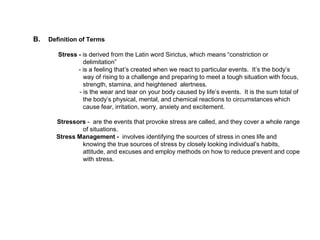
B. Definition of Terms
Stress - is derived from the Latin word Sirictus, which means “constriction or
delimitation”
- is a feeling that’s created when we react to particular events. It’s the body’s
way of rising to a challenge and preparing to meet a tough situation with focus,
strength, stamina, and heightened alertness.
- is the wear and tear on your body caused by life’s events. It is the sum total of
the body’s physical, mental, and chemical reactions to circumstances which
cause fear, irritation, worry, anxiety and excitement.
Stressors - are the events that provoke stress are called, and they cover a whole range
of situations.
Stress Management - involves identifying the sources of stress in ones life and
knowing the true sources of stress by closely looking individual’s habits,
attitude, and excuses and employ methods on how to reduce prevent and cope
with stress.
C. Scope of Presentation
I. Causes of Stress
Man’s way of life in the modern age is one of the main causes of stress. Somehow modern life
and stress seem to go together. The way we live, the way we work, the way we talk the way we
function everyday, contribute to the building up of stress. People rush about all the time, as though
they were carrying the entire burden of the world upon their shoulders.
We seem to be in a hurry all the time. It is not only when we are on our feet that we are seated
and at rest, our minds are rushing somewhere or the other. We may be waiting in an outer office
waiting for an appointment with a doctor or waiting for an interview call but we are hurrying and
rushing in our thoughts. This mental rush, this mental hurry, is one of the main causes of tension.
Causes of stress are multiple and varied but they can be classified in two (2) general groups;
External – Includes relatives getting sick or dying, jobs being lost or people criticizing or
becoming angry
Internal - Self generated.
The antecedents of stress are the so called stressors. These stressors which affect today’s employees
come from both outside and inside the organization and from the groups that employees are influenced by and
from the employees themselves.
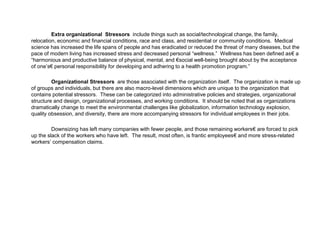
Extra organizational Stressors include things such as social/technological change, the family,
relocation, economic and financial conditions, race and class, and residential or community conditions. Medical
science has increased the life spans of people and has eradicated or reduced the threat of many diseases, but the
pace of modern living has increased stress and decreased personal “wellness.” Wellness has been defined as€ a
“harmonious and productive balance of physical, mental, and €social well-being brought about by the acceptance
of one’s€ personal responsibility for developing and adhering to a health promotion program.”
Organizational Stressors are those associated with the organization itself. The organization is made up
of groups and individuals, but there are also macro-level dimensions which are unique to the organization that
contains potential stressors. These can be categorized into administrative policies and strategies, organizational
structure and design, organizational processes, and working conditions. It should be noted that as organizations
dramatically change to meet the environmental challenges like globalization, information technology explosion,
quality obsession, and diversity, there are more accompanying stressors for individual employees in their jobs.
Downsizing has left many companies with fewer people, and those remaining workers€ are forced to pick
up the slack of the workers who have left. The result, most often, is frantic employees€ and more stress-related
workers’ compensation claims.
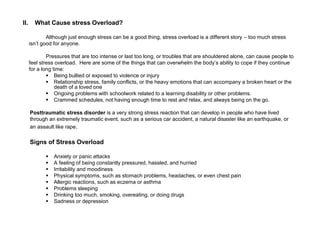
II. What Cause stress Overload?
Although just enough stress can be a good thing, stress overload is a different story – too much stress
isn’t good for anyone.
Pressures that are too intense or last too long, or troubles that are shouldered alone, can cause people to
feel stress overload. Here are some of the things that can overwhelm the body’s ability to cope if they continue
for a long time:
 Being bullied or exposed to violence or injury
 Relationship stress, family conflicts, or the heavy emotions that can accompany a broken heart or the
death of a loved one
 Ongoing problems with schoolwork related to a learning disability or other problems.
 Crammed schedules, not having enough time to rest and relax, and always being on the go.
Posttraumatic stress disorder is a very strong stress reaction that can develop in people who have lived
through an extremely traumatic event, such as a serious car accident, a natural disaster like an earthquake, or
an assault like rape.
Signs of Stress Overload
 Anxiety or panic attacks
 A feeling of being constantly pressured, hassled, and hurried
 Irritability and moodiness
 Physical symptoms, such as stomach problems, headaches, or even chest pain
 Allergic reactions, such as eczema or asthma
 Problems sleeping
 Drinking too much, smoking, overeating, or doing drugs
 Sadness or depression
Everyone experiences stress a little differently. Some people become angry and act out their stress or take it out on
others. Some people internalize it and develop eating disorders or substance abuse problems. And some people who
have a chronic illness may find that the symptoms of their illness flare up under an overload of stress.
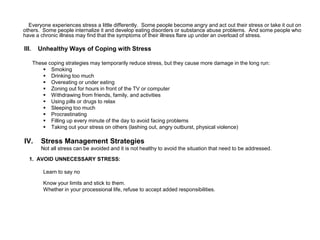
III. Unhealthy Ways of Coping with Stress
These coping strategies may temporarily reduce stress, but they cause more damage in the long run:
 Smoking
 Drinking too much
 Overeating or under eating
 Zoning out for hours in front of the TV or computer
 Withdrawing from friends, family, and activities
 Using pills or drugs to relax
 Sleeping too much
 Procrastinating
 Filling up every minute of the day to avoid facing problems
 Taking out your stress on others (lashing out, angry outburst, physical violence)
IV. Stress Management Strategies
Not all stress can be avoided and it is not healthy to avoid the situation that need to be addressed.
1. AVOID UNNECESSARY STRESS:
Learn to say no
Know your limits and stick to them.
Whether in your processional life, refuse to accept added responsibilities.
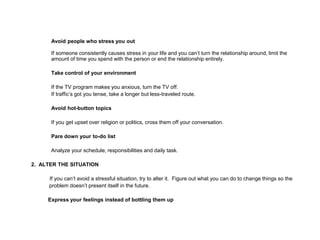
Avoid people who stress you out
If someone consistently causes stress in your life and you can’t turn the relationship around, limit the
amount of time you spend with the person or end the relationship entirely.
Take control of your environment
If the TV program makes you anxious, turn the TV off.
If traffic’s got you tense, take a longer but less-traveled route.
Avoid hot-button topics
If you get upset over religion or politics, cross them off your conversation.
Pare down your to-do list
Analyze your schedule, responsibilities and daily task.
2. ALTER THE SITUATION
If you can’t avoid a stressful situation, try to alter it. Figure out what you can do to change things so the
problem doesn’t present itself in the future.
Express your feelings instead of bottling them up
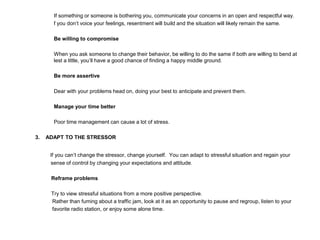
If something or someone is bothering you, communicate your concerns in an open and respectful way.
f you don’t voice your feelings, resentment will build and the situation will likely remain the same.
Be willing to compromise
When you ask someone to change their behavior, be willing to do the same if both are willing to bend at
lest a little, you’ll have a good chance of finding a happy middle ground.
Be more assertive
Dear with your problems head on, doing your best to anticipate and prevent them.
Manage your time better
Poor time management can cause a lot of stress.
3. ADAPT TO THE STRESSOR
If you can’t change the stressor, change yourself. You can adapt to stressful situation and regain your
sense of control by changing your expectations and attitude.
Reframe problems
Try to view stressful situations from a more positive perspective.
Rather than fuming about a traffic jam, look at it as an opportunity to pause and regroup, listen to your
favorite radio station, or enjoy some alone time.
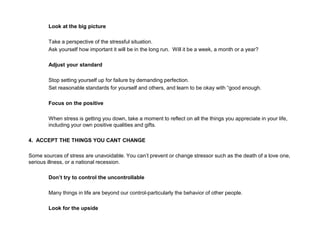
Look at the big picture
Take a perspective of the stressful situation.
Ask yourself how important it will be in the long run. Will it be a week, a month or a year?
Adjust your standard
Stop setting yourself up for failure by demanding perfection.
Set reasonable standards for yourself and others, and learn to be okay with “good enough.
Focus on the positive
When stress is getting you down, take a moment to reflect on all the things you appreciate in your life,
including your own positive qualities and gifts.
4. ACCEPT THE THINGS YOU CANT CHANGE
Some sources of stress are unavoidable. You can’t prevent or change stressor such as the death of a love one,
serious illness, or a national recession.
Don’t try to control the uncontrollable
Many things in life are beyond our control-particularly the behavior of other people.
Look for the upside
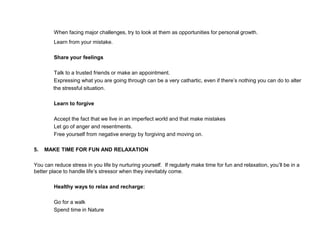
When facing major challenges, try to look at them as opportunities for personal growth.
Learn from your mistake.
Share your feelings
Talk to a trusted friends or make an appointment.
Expressing what you are going through can be a very cathartic, even if there’s nothing you can do to alter
the stressful situation.
Learn to forgive
Accept the fact that we live in an imperfect world and that make mistakes
Let go of anger and resentments.
Free yourself from negative energy by forgiving and moving on.
5. MAKE TIME FOR FUN AND RELAXATION
You can reduce stress in you life by nurturing yourself. If regularly make time for fun and relaxation, you’ll be in a
better place to handle life’s stressor when they inevitably come.
Healthy ways to relax and recharge:
Go for a walk
Spend time in Nature
Call a good friend
Sweat out tension with a good workout
Write in your journal
Take a long term
Light scented candles
Savor a warm cup of coffee or tea
Play with pet
Work in your garden
Get a message
Curl up with a good book
Listen to music
Watch a comedy
There are many methods of relaxation: each person must follow the one that best suits him or her. Here is a
simple, easy eleven-step method:
1. Lie on your back on the floor (or a carpet). Or sit on the floor in a comfortable posture. Or in a chair
with your feet gently touching the floor. Take a few deep breaths, exhaling each slowly, completely
emptying the lungs.
2. Imagine yourself in the loving, immediate and personal presence of the Lord (your Beloved). You are
sitting at His Lotus feet with your arms girding His ankles, your head resting on His feet. Say to yourself,
“ Here is true rest. Here is true relaxation. In thy presence, fears and frustrations, worries and anxieties,
depressions and disappointments, tensions and tribulations, vanish as mist before the rising sun. I am
relaxed. Relax… relax… relax”.
3. To relax a muscle, you must first tighten it and then let it go. As you let it go, it may, perhaps, help you
to utter the words, “ Let go, let go, let God!”
4. Turn your attention to the muscles around the eyes. Relax-relax-relax. Open the eyes and imagine that
the eyelids have become heavy. Let them drop on the eyes. Lift them and let them shut three times.
5. Move on to the muscles around the mouth. Tighten them and let go. Relax-relax-relax.
6. Relax your facial muscles. Clench your teeth, then relax, letting your face go limp. Relax-relax-relax.
7. Repeat the process throughout the body: neck, right shoulder, elbow, forearm, wrist, hand, fingers, left
shoulder, elbow, forearm, wrist, hand, fingers, back, chest, abdomen, buttocks, calves, ankles, feet and
toes. Push your toes down toward the carpet, stretch and relax. Pull your feet up toward the legs.
Stretch and relax. Relax-relax-relax.
8. Breath in and stretch your whole body, relax and exhale. Repeat this three times. Relax-relax-relax.
You are calm, relaxed, peaceful, serene. You are resting at the Lotus Feet of the Lord – calm relaxed,
peaceful and serene
9. You are now lighter than air moving upwards, upward, floating as a cloud – calm, relaxed, peaceful and
serene
10. You are in the presence of the Lord. Offer this simple prayer: “Thou art by me, a living and radiant
Presence, and I am relaxed, calm, peaceful and serene “ Repeat the prayer a few times. You are now
completely relaxed.
11. When you wish to close this exercise in relaxation, rub the palms of your hands together, place them
gently on the eyelids, and gently open the eyes.
6. ADOPT A HEALTHY LIFESTYLE
You can increase your resistance to stress by strengthening your physical health.
Exercise regularly
Physical activity plays a key role in reducing and preventing the effects of stress make time for at lest thirty
(30) minutes exercise three (3) times a week.
Eat a health diet
Well-nourished bodies are better prepared to cope with stress.
Start your day right with breakfast, and keep energy up you mind clear with balance, nutritious meals
throughout a day.
Reduce caffeine and sugar
Reducing the amount of coffee, soft drinks, chocolate and sugar snacks in your diet, you’ll fell more relaxed
and you’ll sleep better.
Avoid alcohol, cigarettes, and drugs
Self-medicating with alcohol or drugs may provide an easy escape from stress, but relief is only temporary.
Get enough sleep
Adequate sleep fuels your mind, as well as your body
Stress Management skills work best when they’re used regularly, not just when the pressure’s on. Knowing
how to “de-stress” and doing it when things are relatively calm can help you get through challenging circumstances
that may arise. Here are some things that can help keep stress under control.
V. Coping Strategies for Stress
a. Individual Coping strategies
1. Exercise. Today, it is not whether you win or lose, but whether you get some good exercise that
counts. People of all ages are walking, jogging, swimming, riding bicycles, or playing softball,
tennis, or racquetball in order to get some exercise to combat stress.
2. Relaxation. Whether a person simply takes it easy once in a while or uses specific relaxation
technique such as biofeedback or meditation, the intent is to eliminate the immediately stressful
situation or manage a prolonged stressful situation more effectively. Meditation involves muscle
and mental relaxation; the person slowly repeats a peaceful phrase or word or concentrates on a
mental picture in quite location.
3. Behavioral self-control. By deliberately managing the antecedents and the consequences of
their own behavior, people can achieve self-control. They can avoid people or situations that they
know will put them under stress. In other words, this strategy involves individuals’ controlling the
situation instead of letting the situation control them.
4. Cognitive therapy. Besides behavioral self-control techniques, a number of clinical psychologists
have entered the stress field in recent years with cognitive therapy techniques.
Participants were taught that much of their experienced strain (anxiety, tension, etc.) is caused by
their cognitions (“self-talks”). This part of the treatment program then, consisted of off-line lectures
and interactive discussions designed to help participants (a) recognize events at work
and what cognitions they elicit; (b) become aware of the effects of such cognitions on their
physiological and emotional responses; (c ) systematically evaluate the objective consequences of
events at work; and (d) replace self-defeating cognitions that unnecessarily arouse strain (e.g., “I’m
an incompetent worker who cannot handle the workload”) with more adaptive appraisals (e.g., “I
handle this workload as well as anyone else”.
5. Networking. One clear finding that has come out of social psychology research over the years is
that people need and will benefit from social support. Applied as a strategy to reduce job stress, this
would entail forming close associations with trusted empathetic coworkers and colleagues who are
good listeners and confidence builders. These friends are there when needed and provide support to
get the person through stressful situations. Today, such alliances, especially if deliberately sought
out and developed, are called networks.
b. Organizational Coping Strategies.
1. Create a supportive organization climate. Most large organizations today continue to be highly
formalized with accompanying inflexible, impersonal climates. A coping strategy would be to make
the structure more decentralized and organic, with participative decision making and upward
communication flows.
2. Enrich the design of tasks. Enriching jobs either by improving job content factors (such as
responsibility, recognition, and opportunities for achievement, advancement, and growth) or by
improving core job characteristics (such as skill variety, task, identity,, task significance, autonomy,
and feedback) may lead to motivational states or experienced meaningfulness, responsibility, and
knowledge of results.
3. Reduce conflict and clarify organizational roles. Role conflict and ambiguity was€ identified earlier as
a major individual earlier as a major individual stressor. It is up to management to reduce the conflict
and clarify organizational roles so that this cause of stress can be eliminated or reduced.
4. Plan and develop career paths and provide counseling. Traditionally, organizations have shown only
passing interest in the career planning and development of their employees. Individuals are left to
decide career moves and strategies on their own and, at most, get paternalistic advice once in a while
from a supervisor. The same is true for members of any large organization; the stress is created by
not knowing what their net move is€ or how they are going to make it.
V. Stress Busters
 Always remember that God is in charge of the Universe. He is the controller of individuals and
nations. And nothing can ever go wrong.
 Life is full of joy to the man who thinks positively and speaks positively.
 See that your face always wears a smile: smiles and tension can never go together. Whenever
you feel tension mounting up, just smile you will break the force of tension.
 In this transitory world, only the present moment belongs to you. The moment that is just over is
no longer yours. The moment to come may not belong to you at all. The present moment is best
utilized not in worrying over what may have happened or what is yet to happen, but in praising
God for the joy of living with Him.
 Never get upset, irritated or excited. Never lose your temper. Peace of mind is your richest
treasure. Let nothing, no one take it away from you.
 In every situation, do the very best you can and leave the result to the Lord.
 Take care to see that your tension does not accumulate. Therefore practice relaxing everyday
and learn to take your troubles to God.
 The foundation of a healthy body is a happy mind. Therefore, let nothing agitate you or disturb
your inner peace.
 Overcome stress by understanding what STRESS stands for
S – Smile. Keep on smiling
T - Tolerance. Grow in tolerance.
R – Relax. Never become a tense.
E – Easy. Take it easy, but not be lazy.
S – Service. Keep serving.
S – Silence. Practice silence and thereby turn to God.
 Let us not offer resistance to life. Resistance inevitably leads to wastage of energy which could be
used for constructive ends. Acceptance is not passive. To circumstances and not let them touch the
joy and peace of the soul.
 So many of our ills would be cured, if only we could change the pattern of our mind. Change the
mind and you will change the world.
 The Bhagavad Gita tells us, “Man is his own friend: man is his own foe!” We are our own friends and
we are our own enemies. No one outside of us can do us any harm. If we would be our own friends,
let us adopt a positive attitude towards life.
 Take care of your thoughts – as you think, so you become. Fill your mind with happy thoughts.
Uncluttered your mind of lust, hatred, greed, selfishness, miserliness, envy, jealousy, ill will,
resentment. Only then can you hope to be happy!
 It is not what happens to us that really matters, it is the way we react to what happens. And if we
react to what happens to us in the right way, we become masters of stress and we become creators
of valuable driving energy.
THANK
YOU
AND GODBLESS

Stress Management.ppt

  • 1.
    Subject: STRESS MANAGEMENT Scopeof Presentation: A. Introduction B. Definition of Terms C. Scope of Presentation I. Causes of Stress II. What Cause stress Overload III. Unhealthy Ways of Coping with Stress IV. Stress Management Strategies V. Coping Strategies for Stress VI. Stress Busters Prepared by: NICANDRO PEÑERO CANALEJA, MM, MBA, DIAP Police Senior Superintendent (DSC) (B.S. CH.E) Forensic Chemical Officer
  • 2.
    STRESS MANAGEMENT A. Introduction Theworld today is full of tension. Wherever we go, people are tense and nervous. Stress and tension are more common to them than the common cold. Today, hospitals are full of patients who suffer from diseases due to stress. Stress is one of the causes of a number of physical ailments. Stress keeps on accumulating in the minds of the people until one day; it manifests itself in the form of an ailment. The tension and stress, can cause a number of diseases including hypertension, heart attack, and nervous break down, malfunctioning of the colon, pain in the back of the neck, asthma, constipation, duodenal ulcers, migraine and certain forms of epilepsy. Stress and tension also causes insomnia or sleeplessness. Feeling like there are too many pressures and demands on you? Losing sleep worrying about tests and schoolwork? Eating on the run because your schedule is just too busy? You’re not alone. Everyone experiences stress at times – adults, teens and even kids. The human body responds to stressors by activating the nervous system and specific hormones. The hypothalamus signals the adrenal glands to produce more of the hormones adrenaline and cortisol and release them into the bloodstream. These hormones speed up: 1. Heart Rate 2. Breathing Rate 3. Blood Pressure 4. Metabolism
  • 3.
    Blood vessels openwider to let more blood flow to large muscle groups, putting our muscles on alert. Pupils dilate to improve vision. The liver releases some of its stored glucose to increase the body’s energy. And sweat is produced to cool the body. All of these physical changes prepare a person to react quickly and effectively to handle the pressure of the moment. This natural reaction is known as the stress response. Working properly, the body’s stress response enhances a person’s ability to perform well under pressure. But the stress response can also cause problems when it overreacts or fails to turn off and reset itself properly. Police work is high stress, and managing that work can produce a great deal of stress. Stress itself can be good or bad. If it motivates you to complete a job and act in a responsible manner, “manageable” stress becomes a positive factor in organizational life. If it leads to avoidance of work, a feeling of being overwhelmed by events, it can become a strong negative force. Individual stress is often created by a personality type attracted to police work that has been labeled type A . Type A personalities tend to overcommit to themselves to a wide variety of tasks that they have to be doing something all the time. They feel that they must be in control of all situations affecting them. They often have insomnia, but they also accomplish a great deal of what they set out to do. This is in contrast to type B personalities, who accomplish what they can, worry a bit about what they have control over, and do not worry about what they cannot control. If the job is not finished on one day, this individual feels that there are other days to finish the job. Hans Selye, the recognized “father of stress” in his search for a new sex hormone, discovered by chance that tissue damage is a nonspecific response to virtually all noxious stimuli. He called this phenomenon the “ general adaptation syndrome” (GAS), which he later on termed as stress in his writings.
  • 4.
    The GAS hasthree stages; alarm, resistance and exhaustion. In the alarm stage an outside stressor mobilizes the internal stress system of the body. There are a number of physiological and chemical reactions, such as increased pituitary and adrenaline secretions, noticeable increases in respiration, heart rate, and blood pressure; and a heightening of the senses. If the stressor continues, then the GAS moves into the resistance stage, during which the body calls upon the needed organ or system to deal with stressor. However, while there may be a great deal of resistance to one stressor during this second stage, there may be little, if any, resistance to other, unrelated stressors. This helps explain why a person going through an emotional strain may be particularly vulnerable to other illness or disease. Finally, if the stressor persists over a long period of time, the reserves of the adaptive mechanisms during the second stage may become drained, and exhaustion sets in. When this happens, there may be a return to the alarm stage, and the cycle starts again with another organ or system, or the “automatic shutoff valve” of death course. This GAS process, of course, can be very hard on the person and takes its toll on the human body.
  • 5.
    B. Definition ofTerms Stress - is derived from the Latin word Sirictus, which means “constriction or delimitation” - is a feeling that’s created when we react to particular events. It’s the body’s way of rising to a challenge and preparing to meet a tough situation with focus, strength, stamina, and heightened alertness. - is the wear and tear on your body caused by life’s events. It is the sum total of the body’s physical, mental, and chemical reactions to circumstances which cause fear, irritation, worry, anxiety and excitement. Stressors - are the events that provoke stress are called, and they cover a whole range of situations. Stress Management - involves identifying the sources of stress in ones life and knowing the true sources of stress by closely looking individual’s habits, attitude, and excuses and employ methods on how to reduce prevent and cope with stress.
  • 6.
    C. Scope ofPresentation I. Causes of Stress Man’s way of life in the modern age is one of the main causes of stress. Somehow modern life and stress seem to go together. The way we live, the way we work, the way we talk the way we function everyday, contribute to the building up of stress. People rush about all the time, as though they were carrying the entire burden of the world upon their shoulders. We seem to be in a hurry all the time. It is not only when we are on our feet that we are seated and at rest, our minds are rushing somewhere or the other. We may be waiting in an outer office waiting for an appointment with a doctor or waiting for an interview call but we are hurrying and rushing in our thoughts. This mental rush, this mental hurry, is one of the main causes of tension. Causes of stress are multiple and varied but they can be classified in two (2) general groups; External – Includes relatives getting sick or dying, jobs being lost or people criticizing or becoming angry Internal - Self generated. The antecedents of stress are the so called stressors. These stressors which affect today’s employees come from both outside and inside the organization and from the groups that employees are influenced by and from the employees themselves.
  • 7.
    Extra organizational Stressorsinclude things such as social/technological change, the family, relocation, economic and financial conditions, race and class, and residential or community conditions. Medical science has increased the life spans of people and has eradicated or reduced the threat of many diseases, but the pace of modern living has increased stress and decreased personal “wellness.” Wellness has been defined as€ a “harmonious and productive balance of physical, mental, and €social well-being brought about by the acceptance of one’s€ personal responsibility for developing and adhering to a health promotion program.” Organizational Stressors are those associated with the organization itself. The organization is made up of groups and individuals, but there are also macro-level dimensions which are unique to the organization that contains potential stressors. These can be categorized into administrative policies and strategies, organizational structure and design, organizational processes, and working conditions. It should be noted that as organizations dramatically change to meet the environmental challenges like globalization, information technology explosion, quality obsession, and diversity, there are more accompanying stressors for individual employees in their jobs. Downsizing has left many companies with fewer people, and those remaining workers€ are forced to pick up the slack of the workers who have left. The result, most often, is frantic employees€ and more stress-related workers’ compensation claims.
  • 8.
    II. What Causestress Overload? Although just enough stress can be a good thing, stress overload is a different story – too much stress isn’t good for anyone. Pressures that are too intense or last too long, or troubles that are shouldered alone, can cause people to feel stress overload. Here are some of the things that can overwhelm the body’s ability to cope if they continue for a long time:  Being bullied or exposed to violence or injury  Relationship stress, family conflicts, or the heavy emotions that can accompany a broken heart or the death of a loved one  Ongoing problems with schoolwork related to a learning disability or other problems.  Crammed schedules, not having enough time to rest and relax, and always being on the go. Posttraumatic stress disorder is a very strong stress reaction that can develop in people who have lived through an extremely traumatic event, such as a serious car accident, a natural disaster like an earthquake, or an assault like rape. Signs of Stress Overload  Anxiety or panic attacks  A feeling of being constantly pressured, hassled, and hurried  Irritability and moodiness  Physical symptoms, such as stomach problems, headaches, or even chest pain  Allergic reactions, such as eczema or asthma  Problems sleeping  Drinking too much, smoking, overeating, or doing drugs  Sadness or depression
  • 9.
    Everyone experiences stressa little differently. Some people become angry and act out their stress or take it out on others. Some people internalize it and develop eating disorders or substance abuse problems. And some people who have a chronic illness may find that the symptoms of their illness flare up under an overload of stress. III. Unhealthy Ways of Coping with Stress These coping strategies may temporarily reduce stress, but they cause more damage in the long run:  Smoking  Drinking too much  Overeating or under eating  Zoning out for hours in front of the TV or computer  Withdrawing from friends, family, and activities  Using pills or drugs to relax  Sleeping too much  Procrastinating  Filling up every minute of the day to avoid facing problems  Taking out your stress on others (lashing out, angry outburst, physical violence) IV. Stress Management Strategies Not all stress can be avoided and it is not healthy to avoid the situation that need to be addressed. 1. AVOID UNNECESSARY STRESS: Learn to say no Know your limits and stick to them. Whether in your processional life, refuse to accept added responsibilities.
  • 10.
    Avoid people whostress you out If someone consistently causes stress in your life and you can’t turn the relationship around, limit the amount of time you spend with the person or end the relationship entirely. Take control of your environment If the TV program makes you anxious, turn the TV off. If traffic’s got you tense, take a longer but less-traveled route. Avoid hot-button topics If you get upset over religion or politics, cross them off your conversation. Pare down your to-do list Analyze your schedule, responsibilities and daily task. 2. ALTER THE SITUATION If you can’t avoid a stressful situation, try to alter it. Figure out what you can do to change things so the problem doesn’t present itself in the future. Express your feelings instead of bottling them up
  • 11.
    If something orsomeone is bothering you, communicate your concerns in an open and respectful way. f you don’t voice your feelings, resentment will build and the situation will likely remain the same. Be willing to compromise When you ask someone to change their behavior, be willing to do the same if both are willing to bend at lest a little, you’ll have a good chance of finding a happy middle ground. Be more assertive Dear with your problems head on, doing your best to anticipate and prevent them. Manage your time better Poor time management can cause a lot of stress. 3. ADAPT TO THE STRESSOR If you can’t change the stressor, change yourself. You can adapt to stressful situation and regain your sense of control by changing your expectations and attitude. Reframe problems Try to view stressful situations from a more positive perspective. Rather than fuming about a traffic jam, look at it as an opportunity to pause and regroup, listen to your favorite radio station, or enjoy some alone time.
  • 12.
    Look at thebig picture Take a perspective of the stressful situation. Ask yourself how important it will be in the long run. Will it be a week, a month or a year? Adjust your standard Stop setting yourself up for failure by demanding perfection. Set reasonable standards for yourself and others, and learn to be okay with “good enough. Focus on the positive When stress is getting you down, take a moment to reflect on all the things you appreciate in your life, including your own positive qualities and gifts. 4. ACCEPT THE THINGS YOU CANT CHANGE Some sources of stress are unavoidable. You can’t prevent or change stressor such as the death of a love one, serious illness, or a national recession. Don’t try to control the uncontrollable Many things in life are beyond our control-particularly the behavior of other people. Look for the upside
  • 13.
    When facing majorchallenges, try to look at them as opportunities for personal growth. Learn from your mistake. Share your feelings Talk to a trusted friends or make an appointment. Expressing what you are going through can be a very cathartic, even if there’s nothing you can do to alter the stressful situation. Learn to forgive Accept the fact that we live in an imperfect world and that make mistakes Let go of anger and resentments. Free yourself from negative energy by forgiving and moving on. 5. MAKE TIME FOR FUN AND RELAXATION You can reduce stress in you life by nurturing yourself. If regularly make time for fun and relaxation, you’ll be in a better place to handle life’s stressor when they inevitably come. Healthy ways to relax and recharge: Go for a walk Spend time in Nature
  • 14.
    Call a goodfriend Sweat out tension with a good workout Write in your journal Take a long term Light scented candles Savor a warm cup of coffee or tea Play with pet Work in your garden Get a message Curl up with a good book Listen to music Watch a comedy There are many methods of relaxation: each person must follow the one that best suits him or her. Here is a simple, easy eleven-step method: 1. Lie on your back on the floor (or a carpet). Or sit on the floor in a comfortable posture. Or in a chair with your feet gently touching the floor. Take a few deep breaths, exhaling each slowly, completely emptying the lungs. 2. Imagine yourself in the loving, immediate and personal presence of the Lord (your Beloved). You are sitting at His Lotus feet with your arms girding His ankles, your head resting on His feet. Say to yourself, “ Here is true rest. Here is true relaxation. In thy presence, fears and frustrations, worries and anxieties, depressions and disappointments, tensions and tribulations, vanish as mist before the rising sun. I am relaxed. Relax… relax… relax”.
  • 15.
    3. To relaxa muscle, you must first tighten it and then let it go. As you let it go, it may, perhaps, help you to utter the words, “ Let go, let go, let God!” 4. Turn your attention to the muscles around the eyes. Relax-relax-relax. Open the eyes and imagine that the eyelids have become heavy. Let them drop on the eyes. Lift them and let them shut three times. 5. Move on to the muscles around the mouth. Tighten them and let go. Relax-relax-relax. 6. Relax your facial muscles. Clench your teeth, then relax, letting your face go limp. Relax-relax-relax. 7. Repeat the process throughout the body: neck, right shoulder, elbow, forearm, wrist, hand, fingers, left shoulder, elbow, forearm, wrist, hand, fingers, back, chest, abdomen, buttocks, calves, ankles, feet and toes. Push your toes down toward the carpet, stretch and relax. Pull your feet up toward the legs. Stretch and relax. Relax-relax-relax. 8. Breath in and stretch your whole body, relax and exhale. Repeat this three times. Relax-relax-relax. You are calm, relaxed, peaceful, serene. You are resting at the Lotus Feet of the Lord – calm relaxed, peaceful and serene 9. You are now lighter than air moving upwards, upward, floating as a cloud – calm, relaxed, peaceful and serene 10. You are in the presence of the Lord. Offer this simple prayer: “Thou art by me, a living and radiant Presence, and I am relaxed, calm, peaceful and serene “ Repeat the prayer a few times. You are now completely relaxed. 11. When you wish to close this exercise in relaxation, rub the palms of your hands together, place them gently on the eyelids, and gently open the eyes. 6. ADOPT A HEALTHY LIFESTYLE You can increase your resistance to stress by strengthening your physical health.
  • 16.
    Exercise regularly Physical activityplays a key role in reducing and preventing the effects of stress make time for at lest thirty (30) minutes exercise three (3) times a week. Eat a health diet Well-nourished bodies are better prepared to cope with stress. Start your day right with breakfast, and keep energy up you mind clear with balance, nutritious meals throughout a day. Reduce caffeine and sugar Reducing the amount of coffee, soft drinks, chocolate and sugar snacks in your diet, you’ll fell more relaxed and you’ll sleep better. Avoid alcohol, cigarettes, and drugs Self-medicating with alcohol or drugs may provide an easy escape from stress, but relief is only temporary. Get enough sleep Adequate sleep fuels your mind, as well as your body Stress Management skills work best when they’re used regularly, not just when the pressure’s on. Knowing how to “de-stress” and doing it when things are relatively calm can help you get through challenging circumstances that may arise. Here are some things that can help keep stress under control.
  • 17.
    V. Coping Strategiesfor Stress a. Individual Coping strategies 1. Exercise. Today, it is not whether you win or lose, but whether you get some good exercise that counts. People of all ages are walking, jogging, swimming, riding bicycles, or playing softball, tennis, or racquetball in order to get some exercise to combat stress. 2. Relaxation. Whether a person simply takes it easy once in a while or uses specific relaxation technique such as biofeedback or meditation, the intent is to eliminate the immediately stressful situation or manage a prolonged stressful situation more effectively. Meditation involves muscle and mental relaxation; the person slowly repeats a peaceful phrase or word or concentrates on a mental picture in quite location. 3. Behavioral self-control. By deliberately managing the antecedents and the consequences of their own behavior, people can achieve self-control. They can avoid people or situations that they know will put them under stress. In other words, this strategy involves individuals’ controlling the situation instead of letting the situation control them. 4. Cognitive therapy. Besides behavioral self-control techniques, a number of clinical psychologists have entered the stress field in recent years with cognitive therapy techniques. Participants were taught that much of their experienced strain (anxiety, tension, etc.) is caused by their cognitions (“self-talks”). This part of the treatment program then, consisted of off-line lectures and interactive discussions designed to help participants (a) recognize events at work
  • 18.
    and what cognitionsthey elicit; (b) become aware of the effects of such cognitions on their physiological and emotional responses; (c ) systematically evaluate the objective consequences of events at work; and (d) replace self-defeating cognitions that unnecessarily arouse strain (e.g., “I’m an incompetent worker who cannot handle the workload”) with more adaptive appraisals (e.g., “I handle this workload as well as anyone else”. 5. Networking. One clear finding that has come out of social psychology research over the years is that people need and will benefit from social support. Applied as a strategy to reduce job stress, this would entail forming close associations with trusted empathetic coworkers and colleagues who are good listeners and confidence builders. These friends are there when needed and provide support to get the person through stressful situations. Today, such alliances, especially if deliberately sought out and developed, are called networks. b. Organizational Coping Strategies. 1. Create a supportive organization climate. Most large organizations today continue to be highly formalized with accompanying inflexible, impersonal climates. A coping strategy would be to make the structure more decentralized and organic, with participative decision making and upward communication flows. 2. Enrich the design of tasks. Enriching jobs either by improving job content factors (such as responsibility, recognition, and opportunities for achievement, advancement, and growth) or by improving core job characteristics (such as skill variety, task, identity,, task significance, autonomy, and feedback) may lead to motivational states or experienced meaningfulness, responsibility, and knowledge of results.
  • 19.
    3. Reduce conflictand clarify organizational roles. Role conflict and ambiguity was€ identified earlier as a major individual earlier as a major individual stressor. It is up to management to reduce the conflict and clarify organizational roles so that this cause of stress can be eliminated or reduced. 4. Plan and develop career paths and provide counseling. Traditionally, organizations have shown only passing interest in the career planning and development of their employees. Individuals are left to decide career moves and strategies on their own and, at most, get paternalistic advice once in a while from a supervisor. The same is true for members of any large organization; the stress is created by not knowing what their net move is€ or how they are going to make it.
  • 20.
    V. Stress Busters Always remember that God is in charge of the Universe. He is the controller of individuals and nations. And nothing can ever go wrong.  Life is full of joy to the man who thinks positively and speaks positively.  See that your face always wears a smile: smiles and tension can never go together. Whenever you feel tension mounting up, just smile you will break the force of tension.  In this transitory world, only the present moment belongs to you. The moment that is just over is no longer yours. The moment to come may not belong to you at all. The present moment is best utilized not in worrying over what may have happened or what is yet to happen, but in praising God for the joy of living with Him.  Never get upset, irritated or excited. Never lose your temper. Peace of mind is your richest treasure. Let nothing, no one take it away from you.  In every situation, do the very best you can and leave the result to the Lord.  Take care to see that your tension does not accumulate. Therefore practice relaxing everyday and learn to take your troubles to God.  The foundation of a healthy body is a happy mind. Therefore, let nothing agitate you or disturb your inner peace.
  • 21.
     Overcome stressby understanding what STRESS stands for S – Smile. Keep on smiling T - Tolerance. Grow in tolerance. R – Relax. Never become a tense. E – Easy. Take it easy, but not be lazy. S – Service. Keep serving. S – Silence. Practice silence and thereby turn to God.  Let us not offer resistance to life. Resistance inevitably leads to wastage of energy which could be used for constructive ends. Acceptance is not passive. To circumstances and not let them touch the joy and peace of the soul.  So many of our ills would be cured, if only we could change the pattern of our mind. Change the mind and you will change the world.  The Bhagavad Gita tells us, “Man is his own friend: man is his own foe!” We are our own friends and we are our own enemies. No one outside of us can do us any harm. If we would be our own friends, let us adopt a positive attitude towards life.
  • 22.
     Take careof your thoughts – as you think, so you become. Fill your mind with happy thoughts. Uncluttered your mind of lust, hatred, greed, selfishness, miserliness, envy, jealousy, ill will, resentment. Only then can you hope to be happy!  It is not what happens to us that really matters, it is the way we react to what happens. And if we react to what happens to us in the right way, we become masters of stress and we become creators of valuable driving energy.
  • 23.