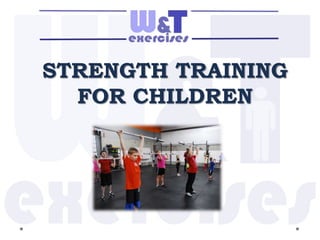
STRENGTH TRAINING
FOR CHILDREN
STRENGTH TRAINING FOR CHILDREN …
• Is a common topic associated with prejudices,
myths and false beliefs
• ‘’If children train strength will not grow …’’
-------------------------------------------------------------------
-
• Is scientifically proven that the strength
development in children can have very
positive effects:
o Increase bone mineralization (Yu et al. 2005)
o Hepatic lipid profile
o Cardiovascular efficiency
o Body composition
STRENGTH TRAINING IN CHILDREN:
OBJECTIVES
• According to García-Manso et al. (2005)
strength training for children can …
o Achieve a harmonious muscular development
o Getting a good posture
o Getting muscle adaptation that allows us to eliminate risk of
injury
o Create the foundations that allow future access to high-
performance sports
STRENGTH TRAINING IN CHILDREN:
PERIODIZATION
• Strength training should start planned from 7
years (Domínguez and Espeso, 2003)
• This age coincides with a sensitive phase in
which stimuli strength and resistance can have
positive effects on the child (Borzi, 1986);
Nadori, 1997; Hanh, 1998).
STRENGTH TRAINING IN CHILDREN:
RECOMMENDATIONS
• They are recommended natural basic
exercises of pushing, pulling, running,
climbing … to increase functional capacity and
body attitude
• It should avoid large training loads because:
o Connective tissues and bone-joint structures are not yet formed
and are weak
o There would be risk of injury or malformation
STRENGTH TRAINING IN CHILDREN:
RECOMMENDATIONS
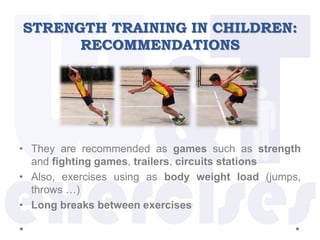
• They are recommended as games such as strength
and fighting games, trailers, circuits stations
• Also, exercises using as body weight load (jumps,
throws …)
• Long breaks between exercises
STRENGTH TRAINING IN CHILDREN:
RECOMMENDATIONS
• Regarding to whether or not is convenient to use
dumbbells in children, everything depends on their
use:
o Suitable exercises
o Proper training loads
o Correct technique
o Adequate training structure
• The light dumbbells can be a good tool to teach the
adequate technique and basic exercises
STRENGTH TRAINING IN CHILDREN:
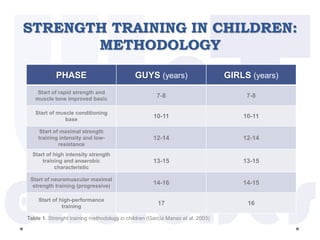
METHODOLOGY
PHASE GUYS (years) GIRLS (years)
Start of rapid strength and
muscle tone improved basic
7-8 7-8
Start of muscle conditioning
base
10-11 10-11
Start of maximal strength
training intensity and low-
resistance
12-14 12-14
Start of high intensity strength
training and anaerobic
characteristic
13-15 13-15
Start of neuromuscular maximal
strength training (progressive)
14-16 14-15
Start of high-performance
training
17 16
Table 1. Strenght training methodology in children (García Manso et al. 2003)
STRENGTH TRAINING IN CHILDREN:
REFERENCES
• DOMÍNGUEZ, P. Y ESPESO, E. (2003). Bases fisiológicas del
entrenamiento de la fuerza con niños y adolescentes. Revista
Internacional de Medicina y Ciencias de la Actividad Física y el Deporte
vol. 3 (9) pp. 61-68.
http://cdeporte.rediris.es/revista/revista9/artfuerza.htm.
• GARCÍA MANSO J.M.; CAMPOS J.; LIZAUR P.; ABELLA C.P. (2003).
El talento deportivo. Edit. Gymnos. Madrid.
• GROSSER, M.; STARISCHKA, S.; ZIMMERMANN E. Principios del
entrenamiento deportivo, Martínez Roca.
• MARCOS BECERRO, JF. (1989). El niño y el deporte. Edit. Santonja.
Madrid.
• NAVARRO, F.; OCA, A.; CASTAÑÓN, F.J. (2003). El entrenamiento del
nadador joven. Edit. Gymnos. Madrid.
• ULLOA, J. Entrenamiento de fuerza en edades tempranas. Documento
docente. Centro Superior del deporte. UNAM, México DF. 1997.
Strength training for children

Strength training for children

  • 1.
  • 2.
    STRENGTH TRAINING FORCHILDREN … • Is a common topic associated with prejudices, myths and false beliefs • ‘’If children train strength will not grow …’’ ------------------------------------------------------------------- - • Is scientifically proven that the strength development in children can have very positive effects: o Increase bone mineralization (Yu et al. 2005) o Hepatic lipid profile o Cardiovascular efficiency o Body composition
  • 3.
    STRENGTH TRAINING INCHILDREN: OBJECTIVES • According to García-Manso et al. (2005) strength training for children can … o Achieve a harmonious muscular development o Getting a good posture o Getting muscle adaptation that allows us to eliminate risk of injury o Create the foundations that allow future access to high- performance sports
  • 4.
    STRENGTH TRAINING INCHILDREN: PERIODIZATION • Strength training should start planned from 7 years (Domínguez and Espeso, 2003) • This age coincides with a sensitive phase in which stimuli strength and resistance can have positive effects on the child (Borzi, 1986); Nadori, 1997; Hanh, 1998).
  • 5.
    STRENGTH TRAINING INCHILDREN: RECOMMENDATIONS • They are recommended natural basic exercises of pushing, pulling, running, climbing … to increase functional capacity and body attitude • It should avoid large training loads because: o Connective tissues and bone-joint structures are not yet formed and are weak o There would be risk of injury or malformation
  • 6.
    STRENGTH TRAINING INCHILDREN: RECOMMENDATIONS • They are recommended as games such as strength and fighting games, trailers, circuits stations • Also, exercises using as body weight load (jumps, throws …) • Long breaks between exercises
  • 7.
    STRENGTH TRAINING INCHILDREN: RECOMMENDATIONS • Regarding to whether or not is convenient to use dumbbells in children, everything depends on their use: o Suitable exercises o Proper training loads o Correct technique o Adequate training structure • The light dumbbells can be a good tool to teach the adequate technique and basic exercises
  • 8.
    STRENGTH TRAINING INCHILDREN: METHODOLOGY PHASE GUYS (years) GIRLS (years) Start of rapid strength and muscle tone improved basic 7-8 7-8 Start of muscle conditioning base 10-11 10-11 Start of maximal strength training intensity and low- resistance 12-14 12-14 Start of high intensity strength training and anaerobic characteristic 13-15 13-15 Start of neuromuscular maximal strength training (progressive) 14-16 14-15 Start of high-performance training 17 16 Table 1. Strenght training methodology in children (García Manso et al. 2003)
  • 9.
    STRENGTH TRAINING INCHILDREN: REFERENCES • DOMÍNGUEZ, P. Y ESPESO, E. (2003). Bases fisiológicas del entrenamiento de la fuerza con niños y adolescentes. Revista Internacional de Medicina y Ciencias de la Actividad Física y el Deporte vol. 3 (9) pp. 61-68. http://cdeporte.rediris.es/revista/revista9/artfuerza.htm. • GARCÍA MANSO J.M.; CAMPOS J.; LIZAUR P.; ABELLA C.P. (2003). El talento deportivo. Edit. Gymnos. Madrid. • GROSSER, M.; STARISCHKA, S.; ZIMMERMANN E. Principios del entrenamiento deportivo, Martínez Roca. • MARCOS BECERRO, JF. (1989). El niño y el deporte. Edit. Santonja. Madrid. • NAVARRO, F.; OCA, A.; CASTAÑÓN, F.J. (2003). El entrenamiento del nadador joven. Edit. Gymnos. Madrid. • ULLOA, J. Entrenamiento de fuerza en edades tempranas. Documento docente. Centro Superior del deporte. UNAM, México DF. 1997.