Streams API
09/12/2015
youenn/calvaris
What is it?
• Enabling I/O processing
• Read chunks asynchronously
• Write chunks asynchronously
• Pipe from a stream to another
• Automatic transformations
• Any kind of chunk
• Strings
• ArrayBuffers
• Potatoes
• Any JSValue cocktail
What is it good for?
• Get me this video segment ASAP
• Without streams API: download it, then read it
• With the streams API + MSE: start downloading it and pipe it
to MSE
• Using SourceBuffer.appendStream
• Get me this WebSocket-like connection on HTTP
• ReadableStream/WritableStream to receive/send messages
• With HTTP/2, just one TCP/IP connection for both WebSocket-
like channels and regular HTTP content
• Any I/O use-case actually…
• Wrapping of all data sources in a single clean model
• HTTP, WebRTC, file system
What is in the spec?
• Stable
• ReadableStream
• Except pipe operations (related to WritableStream)
• Beta
• WritableStream
• Experimental
• TransformStream
• ReadableByteArrayStream
• May be almost merged with ReadableStream
What it is good for/bad for,
internals?
• Promise based
• Async is good but
• Still a bit expensive
• Use it for arrays, objects
• Probably not to pass one byte after one byte
Where will it be?
• Fetch API
• Retrieve data progressively
• Send data progressively
• MSE API
• Append stream
• WebRTC
• Plan to use it
ReadableStream API remarks
• ReadableStream : locked, cancel, getReader,
pipeThrough, pipeTo, tee.
• Underlying source : start, pull, cancel.
• Strategy : highWaterMark, size
• Controller: enqueue, close, error, desiredSize
• Reader : closed, cancel, read and releaseLock
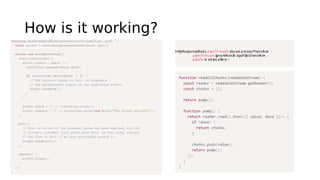
How is it working?
httpResponseBody.pipeThrough(decom pressorTransform )
.pipeThrough(ignoreNonIm ageFilesTransform )
.pipeTo(m ediaG allery);
Where is it?
• Chrome
• Shipped
• ReadableStream tied to the Fetch API response
• Ongoing
• ReadableStream created by scripts
• ReadableStream for progressive uploads using fetch
• Mozilla
• Will start 25/12/2015 (roughly)
• IE
• Support of an earlier version of stream/XHR as producer
• WebKit
• ReadableStream fully implemented
• pipeTo to be broken by the spec
• WritableStream fully implemented
Implementation Story
First Approach – Initial steps
• C++ implementation
• Regular WebIDL to bind API with JavaScriptCore
• Needed improved promise binding code
• Initial prototype supporting byte arrays
• Nicely working
• Not too complex
First Approach – second steps
• Support of any JavaScript value
• WebIDL
• Starting to add special cases in the binding generator
• Adding a lot of JS code in WebCore/bindings/js
• Storing JS values, making them not collectable
• Calling JS functions
• Handling of asynchronous behavior, JS promises
• Overall conclusion
• Code difficult to relate with the specification
• Difficult to keep proper reference counting
• Templates to add further specialization for byte array
Second Approach – JS Builtins
• JS Builtin is a JavaScriptCore feature
• Introduced a few years ago
• Promise code is mostly JS builtin
• Enable JS Builtin into WebCore
• Integrate it with WebIDL binding generator
• Streams API implementation
• WebIDL code
• JavaScript code
• Some limited C++ code
• 80 lines
• Except for automatically generated code
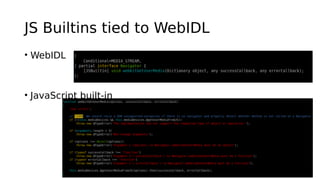
JS Builtins tied to WebIDL
• WebIDL
• JavaScript built-in
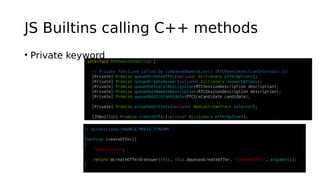
JS Builtins calling C++ methods
• Private keyword
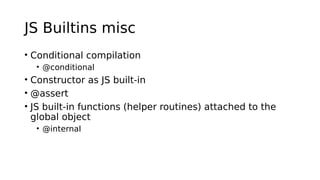
JS Builtins misc
• Conditional compilation
• @conditional
• Constructor as JS built-in
• @assert
• JS built-in functions (helper routines) attached to the
global object
• @internal
JS Builtins build
• Update CMakeLists.txt
• Add IDL file in WebCore_NON_SVG_IDL_FILES
• Add JS file(s) in WebCore_BUILTINS_SOURCES
• 1 file for WebIDL tied routines (stored in the prototype)
• 0/1/+ files for helper routines (stored in the global object)
• Update Source/WebCore/bindings/js/WebCoreBuiltins.h
and Source/WebCore/bindings/js/WebCoreBuiltins.cpp
• When adding a new JS built-in file
• To be automated soon hopefully
Overall experience
• Easier to write JS code then to write C++ binding code
• No more crashes, no more memory leaks, no more ref-
counting cycles
• Performances is not really an issue
• Apple made measurements on the Promise implementation
and saw some improvements
• Everything is nice, except…
• No JS built-in code debugger
• Back to console.log(“potato 1”);
• JS builtin security issues
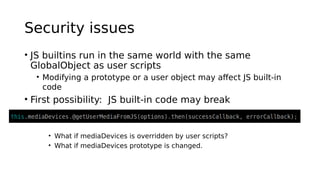
Security issues
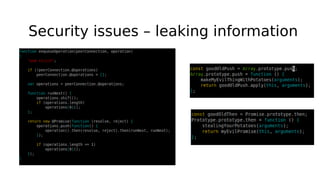
• JS builtins run in the same world with the same
GlobalObject as user scripts
• Modifying a prototype or a user object may affect JS built-in
code
• First possibility: JS built-in code may break
• What if mediaDevices is overridden by user scripts?
• What if mediaDevices prototype is changed.
Security issues – leaking information
Security issues – current rules
• Do not use functions under the control of the user
operations.push(…)
operations.@push(...)
• Do not use prototype of objects under the control of the user
function processValue(promise) {
promise.then(…)
}
function processValue(promise) {
promise.@then(…) // ok but it may break
}
function processValue(promise) {
@Promise.prototype. @then.@call(…) // ok but so unreadable
}
• Beware of Promise
• Might want to use InternalPromise if you are doing chaining
Security issues – we need something
better
• So easy to fall into that trap
• Not so easy to find the holes
• How can we improve the situation?
• Testing tool to catch these errors
• JS builtin check style?
• JS proxy object in Debug mode to control how are accessed objects
• Sanitizers
• Should we change the infrastructure?
• Run the built-ins in a more secure environment
• Chrome is doing that in a completely separate world
• Cannot pass promises, JS objects.... Between the worlds
• Input most welcome
Tentative conclusion
• Streams API is
• Very maintainable
• Fast enough (more study needed)
• But
• Potential security issues
• We fixed the ones we know of
• Need to improve JS built-in tooling
• Think about JS built-ins when adding WebCore/JSC
specific code
• Like in WebCore/bindings/js

Streams API (Web Engines Hackfest 2015)

  • 1.
  • 2.
    What is it? •Enabling I/O processing • Read chunks asynchronously • Write chunks asynchronously • Pipe from a stream to another • Automatic transformations • Any kind of chunk • Strings • ArrayBuffers • Potatoes • Any JSValue cocktail
  • 3.
    What is itgood for? • Get me this video segment ASAP • Without streams API: download it, then read it • With the streams API + MSE: start downloading it and pipe it to MSE • Using SourceBuffer.appendStream • Get me this WebSocket-like connection on HTTP • ReadableStream/WritableStream to receive/send messages • With HTTP/2, just one TCP/IP connection for both WebSocket- like channels and regular HTTP content • Any I/O use-case actually… • Wrapping of all data sources in a single clean model • HTTP, WebRTC, file system
  • 4.
    What is inthe spec? • Stable • ReadableStream • Except pipe operations (related to WritableStream) • Beta • WritableStream • Experimental • TransformStream • ReadableByteArrayStream • May be almost merged with ReadableStream
  • 5.
    What it isgood for/bad for, internals? • Promise based • Async is good but • Still a bit expensive • Use it for arrays, objects • Probably not to pass one byte after one byte
  • 6.
    Where will itbe? • Fetch API • Retrieve data progressively • Send data progressively • MSE API • Append stream • WebRTC • Plan to use it
  • 7.
    ReadableStream API remarks •ReadableStream : locked, cancel, getReader, pipeThrough, pipeTo, tee. • Underlying source : start, pull, cancel. • Strategy : highWaterMark, size • Controller: enqueue, close, error, desiredSize • Reader : closed, cancel, read and releaseLock
  • 8.
    How is itworking? httpResponseBody.pipeThrough(decom pressorTransform ) .pipeThrough(ignoreNonIm ageFilesTransform ) .pipeTo(m ediaG allery);
  • 9.
    Where is it? •Chrome • Shipped • ReadableStream tied to the Fetch API response • Ongoing • ReadableStream created by scripts • ReadableStream for progressive uploads using fetch • Mozilla • Will start 25/12/2015 (roughly) • IE • Support of an earlier version of stream/XHR as producer • WebKit • ReadableStream fully implemented • pipeTo to be broken by the spec • WritableStream fully implemented
  • 10.
  • 11.
    First Approach –Initial steps • C++ implementation • Regular WebIDL to bind API with JavaScriptCore • Needed improved promise binding code • Initial prototype supporting byte arrays • Nicely working • Not too complex
  • 12.
    First Approach –second steps • Support of any JavaScript value • WebIDL • Starting to add special cases in the binding generator • Adding a lot of JS code in WebCore/bindings/js • Storing JS values, making them not collectable • Calling JS functions • Handling of asynchronous behavior, JS promises • Overall conclusion • Code difficult to relate with the specification • Difficult to keep proper reference counting • Templates to add further specialization for byte array
  • 13.
    Second Approach –JS Builtins • JS Builtin is a JavaScriptCore feature • Introduced a few years ago • Promise code is mostly JS builtin • Enable JS Builtin into WebCore • Integrate it with WebIDL binding generator • Streams API implementation • WebIDL code • JavaScript code • Some limited C++ code • 80 lines • Except for automatically generated code
  • 14.
    JS Builtins tiedto WebIDL • WebIDL • JavaScript built-in
  • 15.
    JS Builtins callingC++ methods • Private keyword
  • 16.
    JS Builtins misc •Conditional compilation • @conditional • Constructor as JS built-in • @assert • JS built-in functions (helper routines) attached to the global object • @internal
  • 17.
    JS Builtins build •Update CMakeLists.txt • Add IDL file in WebCore_NON_SVG_IDL_FILES • Add JS file(s) in WebCore_BUILTINS_SOURCES • 1 file for WebIDL tied routines (stored in the prototype) • 0/1/+ files for helper routines (stored in the global object) • Update Source/WebCore/bindings/js/WebCoreBuiltins.h and Source/WebCore/bindings/js/WebCoreBuiltins.cpp • When adding a new JS built-in file • To be automated soon hopefully
  • 18.
    Overall experience • Easierto write JS code then to write C++ binding code • No more crashes, no more memory leaks, no more ref- counting cycles • Performances is not really an issue • Apple made measurements on the Promise implementation and saw some improvements • Everything is nice, except… • No JS built-in code debugger • Back to console.log(“potato 1”); • JS builtin security issues
  • 19.
    Security issues • JSbuiltins run in the same world with the same GlobalObject as user scripts • Modifying a prototype or a user object may affect JS built-in code • First possibility: JS built-in code may break • What if mediaDevices is overridden by user scripts? • What if mediaDevices prototype is changed.
  • 20.
    Security issues –leaking information
  • 21.
    Security issues –current rules • Do not use functions under the control of the user operations.push(…) operations.@push(...) • Do not use prototype of objects under the control of the user function processValue(promise) { promise.then(…) } function processValue(promise) { promise.@then(…) // ok but it may break } function processValue(promise) { @Promise.prototype. @then.@call(…) // ok but so unreadable } • Beware of Promise • Might want to use InternalPromise if you are doing chaining
  • 22.
    Security issues –we need something better • So easy to fall into that trap • Not so easy to find the holes • How can we improve the situation? • Testing tool to catch these errors • JS builtin check style? • JS proxy object in Debug mode to control how are accessed objects • Sanitizers • Should we change the infrastructure? • Run the built-ins in a more secure environment • Chrome is doing that in a completely separate world • Cannot pass promises, JS objects.... Between the worlds • Input most welcome
  • 23.
    Tentative conclusion • StreamsAPI is • Very maintainable • Fast enough (more study needed) • But • Potential security issues • We fixed the ones we know of • Need to improve JS built-in tooling • Think about JS built-ins when adding WebCore/JSC specific code • Like in WebCore/bindings/js