Using MongoDB with node.js
              Jonathan Altman
                  @async_io
               http://async.io/
        http://github.com/jonathana
              MongoDC 2011
what is node.js?
•   A non-browser Javascript toolkit/framework
    started by Ryan Dahl
•   Available for *nix-based systems: Linux, OS X, OpenSolaris, and now Windows
•   Built on top of Google’s V8 Javascript engine
•   Compatible with many common Javascript libraries out of the box via CommonJS
    support (http://www.commonjs.org/)
•   A batteries-included framework: HTTP and socket support baked into the core of the
    framework
•   A framework that is easy to build tooling on top of
•   Most importantly: asynchronous from the ground up


                                            2
what is node.js?
•   A non-browser Javascript toolkit/framework started by Ryan Dahl

•   Available for *nix-based systems: Linux, OS X,
    OpenSolaris, and now Windows
•   Built on top of Google’s V8 Javascript engine
•   Compatible with many common Javascript libraries out of the box via CommonJS
    support (http://www.commonjs.org/)
•   A batteries-included framework: HTTP and socket support baked into the core of the
    framework
•   A framework that is easy to build tooling on top of
•   Most importantly: asynchronous from the ground up


                                            3
what is node.js?
•   A non-browser Javascript toolkit/framework started by Ryan Dahl
•   Available for *nix-based systems: Linux, OS X, OpenSolaris, and now Windows

•   Built on top of Google’s V8 Javascript engine
•   Compatible with many common Javascript libraries out of the box via
    CommonJS support (http://www.commonjs.org/)
•   A batteries-included framework: HTTP and socket support baked into the
    core of the framework
•   A framework that is easy to build tooling on top of
•   Most importantly: asynchronous from the ground up


                                        4
what is node.js?
•   A non-browser Javascript toolkit/framework started by Ryan Dahl
•   Available for *nix-based systems: Linux, OS X, OpenSolaris, and now Windows
•   Built on top of Google’s V8 Javascript engine

•   Compatible with many common Javascript libraries out of
    the box via CommonJS support (http://www.commonjs.org/)
•   A batteries-included framework: HTTP and socket support baked into the
    core of the framework
•   A framework that is easy to build tooling on top of
•   Most importantly: asynchronous from the ground up


                                         5
what is node.js?
•   A non-browser Javascript toolkit/framework started by Ryan Dahl
•   Available for *nix-based systems: Linux, OS X, OpenSolaris, and now Windows
•   Built on top of Google’s V8 Javascript engine
•   Compatible with many common Javascript libraries out of the box via CommonJS
    support (http://www.commonjs.org/)

•   A batteries-included framework: HTTP and socket
    support baked into the core of the framework
•   A framework that is easy to build tooling on top of
•   Most importantly: asynchronous from the ground up


                                            6
what is node.js?
•   A non-browser Javascript toolkit/framework started by Ryan Dahl

•   Available for *nix-based systems: Linux, OS X, OpenSolaris, and now Windows

•   Built on top of Google’s V8 Javascript engine

•   Compatible with many common Javascript libraries out of the box via CommonJS
    support (http://www.commonjs.org/)

•   A batteries-included framework: HTTP and socket support baked into the core of
    the framework

•   A framework that is easy to build tooling on top of
•   Most importantly: asynchronous from the ground up


                                            7
what is node.js?
•   A non-browser Javascript toolkit/framework started by Ryan Dahl
•   Available for *nix-based systems: Linux, OS X, OpenSolaris, and now Windows
•   Built on top of Google’s V8 Javascript engine
•   Compatible with many common Javascript libraries out of the box via CommonJS
    support (http://www.commonjs.org/)
•   A batteries-included framework: HTTP and socket support baked into the core of the
    framework
•   A framework that is easy to build tooling on top of

•   Most importantly: asynchronous from the ground up

                                            8
getting started with node
• Longer than we have time for today
• I have some node.js resources pulled together at the
    end of the presentation
•   But (shameless plug) may I recommend http://
    www.slideshare.net/async_io/dcjq-nodejs-presentation
    as a good starting point?
why node with MongoDB?
• Both toolkits heavily leverage Javascript for their
  capabilities
• Commonality of programming language
• MongoDB’s speed/programming model is highly
  compatible with node’s asynchronous model
• Mostly compatible data types, but more on that later
using MongoDB in node.js
• connect-mongodb: web framework middleware for
  a MongoDB-backed session
• node-mongodb-native: native node driver for
  MongoDB
• mongoose: Javascript<->MongoDB object mapper
• mongolia: “non-magic” layer on the mongodb native
  driver
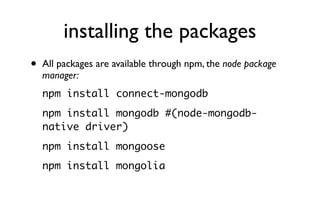
installing the packages
•   All packages are available through npm, the node package
    manager:
    npm install connect-mongodb
    npm install mongodb #(node-mongodb-
    native driver)
    npm install mongoose
    npm install mongolia
connect-mongodb
•   Provides MongoDB-backed session storage for the
    connect/express web development stack
•   connect: Middleware layer for node.js (think python WSGI
    or ruby’s rack for node)
•   Express: “Sinatra inspired web development framework for
    node.js -- insanely fast, flexible, and sexy”
•   We are going to examine use with Express
• npm    install express
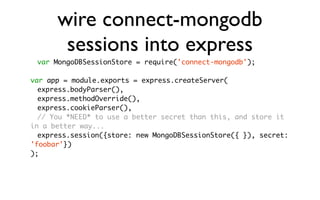
wire connect-mongodb
       sessions into express
 var MongoDBSessionStore = require('connect-mongodb');

var app = module.exports = express.createServer(
	 express.bodyParser(),
	 express.methodOverride(),
	 express.cookieParser(),
	 // You *NEED* to use a better secret than this, and store it
in a better way...
	 express.session({store: new MongoDBSessionStore({ }), secret:
'foobar'})
);
get/set values from session
  req.session.pageRenders = req.session.pageRenders || 0;
req.session.pageRenders++;

// increment some view counts
if ( !req.session.viewCount)

   { req.session.viewCount = {};}

if ( !req.session.viewCount.hasOwnProperty(calledPage) )

 { req.session.viewCount[calledPage] = 0; }

req.session.viewCount[calledPage] += 1;
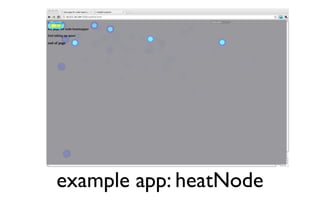
example app: heatNode
how much magic do you
       want?
    node MongoDB database drivers
node-mongodb-native driver
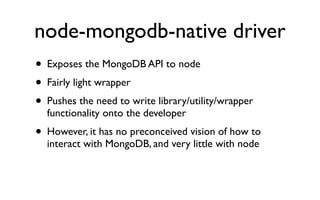
• Exposes the MongoDB API to node
• Fairly light wrapper
• Pushes the need to write library/utility/wrapper
  functionality onto the developer
• However, it has no preconceived vision of how to
  interact with MongoDB, and very little with node
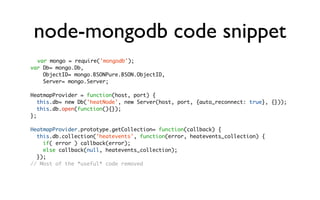
node-mongodb code snippet
  var mongo = require('mongodb');
var Db= mongo.Db,
    ObjectID= mongo.BSONPure.BSON.ObjectID,
    Server= mongo.Server;

HeatmapProvider = function(host, port) {
   this.db= new Db('heatNode', new Server(host, port, {auto_reconnect: true}, {}));
   this.db.open(function(){});
};

HeatmapProvider.prototype.getCollection= function(callback) {
  this.db.collection('heatevents', function(error, heatevents_collection) {
    if( error ) callback(error);
    else callback(null, heatevents_collection);
  });
// Most of the *useful* code removed
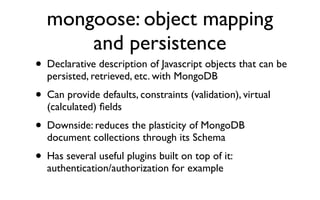
mongoose: object mapping
        and persistence
• Declarative description of Javascript objects that can be
    persisted, retrieved, etc. with MongoDB
• Can provide defaults, constraints (validation), virtual
    (calculated) fields
•   Downside: reduces the plasticity of MongoDB
    document collections through its Schema
• Has several useful plugins built on top of it:
    authentication/authorization for example
using mongoose
•    Define a schema:
var mongoose = require('mongoose'),
	 Schema = mongoose.Schema;

var HeatEvent = new Schema({
	 type	 	 : { type: String, enum: ['click']}
	 , eventStamp	 : { type: Date,	 default: Date.now }
	 , payload	 : {
	 	 clickTarget	: String
	 	 , pageUrl	 : { type: String, index: true }
	 	 , clickPoint	 : {
	 	 	 X	 : Number
	 	 	 , Y	 : Number
	 	 }
	 }
});
HeatEvent.index({ 'type': 1, 'payload.pageUrl': 1});

var db = mongoose.connect('mongodb://localhost/heatNode');
module.exports = db.model('heatEvent', HeatEvent);
what did that schema buy us?
•   CRUD and various other operations pre-built
•   Constraints/Validation: built-in validation like this:
    : type		   : { type: String, enum: ['click']}

    or define your own callbacks
•   Defaults: ,   eventStamp	 : { type: Date,	
                                             default: Date.now }


•   Synthetic fields: map non-persisted values into/out of other
    persisted fields in the schema
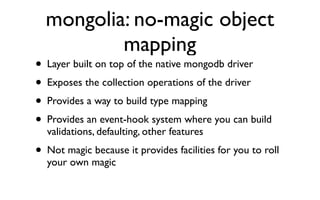
mongolia: no-magic object
          mapping
• Layer built on top of the native mongodb driver
• Exposes the collection operations of the driver
• Provides a way to build type mapping
• Provides an event-hook system where you can build
  validations, defaulting, other features
• Not magic because it provides facilities for you to roll
  your own magic
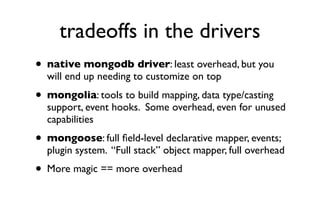
tradeoffs in the drivers
• native mongodb driver: least overhead, but you
    will end up needing to customize on top
• mongolia: tools to build mapping, data type/casting
    support, event hooks. Some overhead, even for unused
    capabilities
• mongoose: full field-level declarative mapper, events;
    plugin system. “Full stack” object mapper, full overhead
•   More magic == more overhead
more info on node.js and
       resources
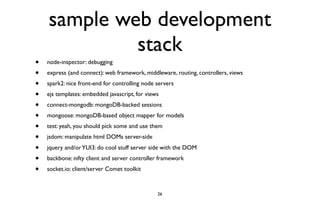
sample web development
             stack
•   node-inspector: debugging
•   express (and connect): web framework, middleware, routing, controllers, views
•   spark2: nice front-end for controlling node servers
•   ejs templates: embedded javascript, for views
•   connect-mongodb: mongoDB-backed sessions
•   mongoose: mongoDB-based object mapper for models
•   test: yeah, you should pick some and use them
•   jsdom: manipulate html DOMs server-side

•   jquery and/or YUI3: do cool stuff server side with the DOM
•   backbone: nifty client and server controller framework
•   socket.io: client/server Comet toolkit


                                                26
more from me on node.js
      and MongoDB:
• A longer presentation I did on what node.js is, and
  getting it up and running: http://www.slideshare.net/
  async_io/dcjq-nodejs-presentation
• Heatmapper app I built with node and MongoDB:
  https://github.com/jonathana/heatNode
more info on the packages:
• connect-mongodb: https://github.com/masylum/
  connect-mongodb
• node-mongodb-native: https://github.com/
  christkv/node-mongodb-native
• mongolia: https://github.com/masylum/mongolia
• mongoose: http://mongoosejs.com/ and https://
  github.com/learnboost/mongoose/
appendix: Resources
•   Ryan Dahl: (http://tinyclouds.org/, https://github.com/ry)
•   Ryan’s jsconf 2009 presentation: http://s3.amazonaws.com/four.livejournal/20091117/
    jsconf.pdf
•   Simon Willison’s blog post re: node.js: http://simonwillison.net/2009/Nov/23/node/
•   node.js home: http://nodejs.org/, git repo: https://github.com/joyent/node/
•   node modules: https://github.com/joyent/node/wiki/modules
•   Isaac Schlueter: (npm and nave) https://github.com/isaacs/, http://blog.izs.me/
•   Dav Glass’ mind-bending demonstration of using YUI server-side: http://
    developer.yahoo.com/yui/theater/video.php?v=glass-node
•   Nice list of some apps built using node.js + express: http://expressjs.com/
    applications.html


                                             29

Mongo and node mongo dc 2011

  • 1.
    Using MongoDB withnode.js Jonathan Altman @async_io http://async.io/ http://github.com/jonathana MongoDC 2011
  • 2.
    what is node.js? • A non-browser Javascript toolkit/framework started by Ryan Dahl • Available for *nix-based systems: Linux, OS X, OpenSolaris, and now Windows • Built on top of Google’s V8 Javascript engine • Compatible with many common Javascript libraries out of the box via CommonJS support (http://www.commonjs.org/) • A batteries-included framework: HTTP and socket support baked into the core of the framework • A framework that is easy to build tooling on top of • Most importantly: asynchronous from the ground up 2
  • 3.
    what is node.js? • A non-browser Javascript toolkit/framework started by Ryan Dahl • Available for *nix-based systems: Linux, OS X, OpenSolaris, and now Windows • Built on top of Google’s V8 Javascript engine • Compatible with many common Javascript libraries out of the box via CommonJS support (http://www.commonjs.org/) • A batteries-included framework: HTTP and socket support baked into the core of the framework • A framework that is easy to build tooling on top of • Most importantly: asynchronous from the ground up 3
  • 4.
    what is node.js? • A non-browser Javascript toolkit/framework started by Ryan Dahl • Available for *nix-based systems: Linux, OS X, OpenSolaris, and now Windows • Built on top of Google’s V8 Javascript engine • Compatible with many common Javascript libraries out of the box via CommonJS support (http://www.commonjs.org/) • A batteries-included framework: HTTP and socket support baked into the core of the framework • A framework that is easy to build tooling on top of • Most importantly: asynchronous from the ground up 4
  • 5.
    what is node.js? • A non-browser Javascript toolkit/framework started by Ryan Dahl • Available for *nix-based systems: Linux, OS X, OpenSolaris, and now Windows • Built on top of Google’s V8 Javascript engine • Compatible with many common Javascript libraries out of the box via CommonJS support (http://www.commonjs.org/) • A batteries-included framework: HTTP and socket support baked into the core of the framework • A framework that is easy to build tooling on top of • Most importantly: asynchronous from the ground up 5
  • 6.
    what is node.js? • A non-browser Javascript toolkit/framework started by Ryan Dahl • Available for *nix-based systems: Linux, OS X, OpenSolaris, and now Windows • Built on top of Google’s V8 Javascript engine • Compatible with many common Javascript libraries out of the box via CommonJS support (http://www.commonjs.org/) • A batteries-included framework: HTTP and socket support baked into the core of the framework • A framework that is easy to build tooling on top of • Most importantly: asynchronous from the ground up 6
  • 7.
    what is node.js? • A non-browser Javascript toolkit/framework started by Ryan Dahl • Available for *nix-based systems: Linux, OS X, OpenSolaris, and now Windows • Built on top of Google’s V8 Javascript engine • Compatible with many common Javascript libraries out of the box via CommonJS support (http://www.commonjs.org/) • A batteries-included framework: HTTP and socket support baked into the core of the framework • A framework that is easy to build tooling on top of • Most importantly: asynchronous from the ground up 7
  • 8.
    what is node.js? • A non-browser Javascript toolkit/framework started by Ryan Dahl • Available for *nix-based systems: Linux, OS X, OpenSolaris, and now Windows • Built on top of Google’s V8 Javascript engine • Compatible with many common Javascript libraries out of the box via CommonJS support (http://www.commonjs.org/) • A batteries-included framework: HTTP and socket support baked into the core of the framework • A framework that is easy to build tooling on top of • Most importantly: asynchronous from the ground up 8
  • 9.
    getting started withnode • Longer than we have time for today • I have some node.js resources pulled together at the end of the presentation • But (shameless plug) may I recommend http:// www.slideshare.net/async_io/dcjq-nodejs-presentation as a good starting point?
  • 10.
    why node withMongoDB? • Both toolkits heavily leverage Javascript for their capabilities • Commonality of programming language • MongoDB’s speed/programming model is highly compatible with node’s asynchronous model • Mostly compatible data types, but more on that later
  • 11.
    using MongoDB innode.js • connect-mongodb: web framework middleware for a MongoDB-backed session • node-mongodb-native: native node driver for MongoDB • mongoose: Javascript<->MongoDB object mapper • mongolia: “non-magic” layer on the mongodb native driver
  • 12.
    installing the packages • All packages are available through npm, the node package manager: npm install connect-mongodb npm install mongodb #(node-mongodb- native driver) npm install mongoose npm install mongolia
  • 13.
    connect-mongodb • Provides MongoDB-backed session storage for the connect/express web development stack • connect: Middleware layer for node.js (think python WSGI or ruby’s rack for node) • Express: “Sinatra inspired web development framework for node.js -- insanely fast, flexible, and sexy” • We are going to examine use with Express • npm install express
  • 14.
    wire connect-mongodb sessions into express var MongoDBSessionStore = require('connect-mongodb'); var app = module.exports = express.createServer( express.bodyParser(), express.methodOverride(), express.cookieParser(), // You *NEED* to use a better secret than this, and store it in a better way... express.session({store: new MongoDBSessionStore({ }), secret: 'foobar'}) );
  • 15.
    get/set values fromsession req.session.pageRenders = req.session.pageRenders || 0; req.session.pageRenders++; // increment some view counts if ( !req.session.viewCount) { req.session.viewCount = {};} if ( !req.session.viewCount.hasOwnProperty(calledPage) ) { req.session.viewCount[calledPage] = 0; } req.session.viewCount[calledPage] += 1;
  • 16.
  • 17.
    how much magicdo you want? node MongoDB database drivers
  • 18.
    node-mongodb-native driver • Exposesthe MongoDB API to node • Fairly light wrapper • Pushes the need to write library/utility/wrapper functionality onto the developer • However, it has no preconceived vision of how to interact with MongoDB, and very little with node
  • 19.
    node-mongodb code snippet var mongo = require('mongodb'); var Db= mongo.Db, ObjectID= mongo.BSONPure.BSON.ObjectID, Server= mongo.Server; HeatmapProvider = function(host, port) { this.db= new Db('heatNode', new Server(host, port, {auto_reconnect: true}, {})); this.db.open(function(){}); }; HeatmapProvider.prototype.getCollection= function(callback) { this.db.collection('heatevents', function(error, heatevents_collection) { if( error ) callback(error); else callback(null, heatevents_collection); }); // Most of the *useful* code removed
  • 20.
    mongoose: object mapping and persistence • Declarative description of Javascript objects that can be persisted, retrieved, etc. with MongoDB • Can provide defaults, constraints (validation), virtual (calculated) fields • Downside: reduces the plasticity of MongoDB document collections through its Schema • Has several useful plugins built on top of it: authentication/authorization for example
  • 21.
    using mongoose • Define a schema: var mongoose = require('mongoose'), Schema = mongoose.Schema; var HeatEvent = new Schema({ type : { type: String, enum: ['click']} , eventStamp : { type: Date, default: Date.now } , payload : { clickTarget : String , pageUrl : { type: String, index: true } , clickPoint : { X : Number , Y : Number } } }); HeatEvent.index({ 'type': 1, 'payload.pageUrl': 1}); var db = mongoose.connect('mongodb://localhost/heatNode'); module.exports = db.model('heatEvent', HeatEvent);
  • 22.
    what did thatschema buy us? • CRUD and various other operations pre-built • Constraints/Validation: built-in validation like this: : type : { type: String, enum: ['click']} or define your own callbacks • Defaults: , eventStamp : { type: Date, default: Date.now } • Synthetic fields: map non-persisted values into/out of other persisted fields in the schema
  • 23.
    mongolia: no-magic object mapping • Layer built on top of the native mongodb driver • Exposes the collection operations of the driver • Provides a way to build type mapping • Provides an event-hook system where you can build validations, defaulting, other features • Not magic because it provides facilities for you to roll your own magic
  • 24.
    tradeoffs in thedrivers • native mongodb driver: least overhead, but you will end up needing to customize on top • mongolia: tools to build mapping, data type/casting support, event hooks. Some overhead, even for unused capabilities • mongoose: full field-level declarative mapper, events; plugin system. “Full stack” object mapper, full overhead • More magic == more overhead
  • 25.
    more info onnode.js and resources
  • 26.
    sample web development stack • node-inspector: debugging • express (and connect): web framework, middleware, routing, controllers, views • spark2: nice front-end for controlling node servers • ejs templates: embedded javascript, for views • connect-mongodb: mongoDB-backed sessions • mongoose: mongoDB-based object mapper for models • test: yeah, you should pick some and use them • jsdom: manipulate html DOMs server-side • jquery and/or YUI3: do cool stuff server side with the DOM • backbone: nifty client and server controller framework • socket.io: client/server Comet toolkit 26
  • 27.
    more from meon node.js and MongoDB: • A longer presentation I did on what node.js is, and getting it up and running: http://www.slideshare.net/ async_io/dcjq-nodejs-presentation • Heatmapper app I built with node and MongoDB: https://github.com/jonathana/heatNode
  • 28.
    more info onthe packages: • connect-mongodb: https://github.com/masylum/ connect-mongodb • node-mongodb-native: https://github.com/ christkv/node-mongodb-native • mongolia: https://github.com/masylum/mongolia • mongoose: http://mongoosejs.com/ and https:// github.com/learnboost/mongoose/
  • 29.
    appendix: Resources • Ryan Dahl: (http://tinyclouds.org/, https://github.com/ry) • Ryan’s jsconf 2009 presentation: http://s3.amazonaws.com/four.livejournal/20091117/ jsconf.pdf • Simon Willison’s blog post re: node.js: http://simonwillison.net/2009/Nov/23/node/ • node.js home: http://nodejs.org/, git repo: https://github.com/joyent/node/ • node modules: https://github.com/joyent/node/wiki/modules • Isaac Schlueter: (npm and nave) https://github.com/isaacs/, http://blog.izs.me/ • Dav Glass’ mind-bending demonstration of using YUI server-side: http:// developer.yahoo.com/yui/theater/video.php?v=glass-node • Nice list of some apps built using node.js + express: http://expressjs.com/ applications.html 29