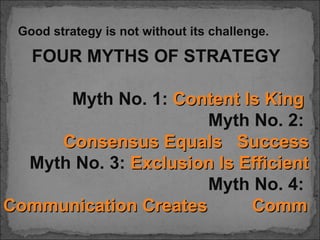

Good strategy is not without its challenge.

   FOUR MYTHS OF STRATEGY

      Myth No. 1: Content Is King
                      Myth No. 2:
     Consensus Equals Success
  Myth No. 3: Exclusion Is Efficient
                      Myth No. 4:
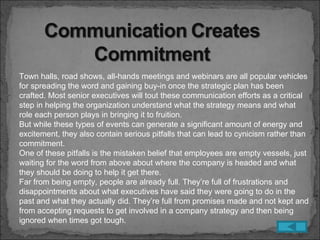
Communication Creates       Commitm
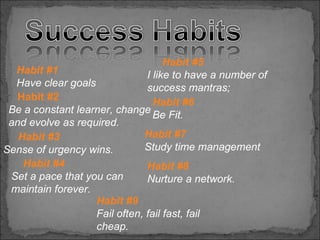
Habit #5
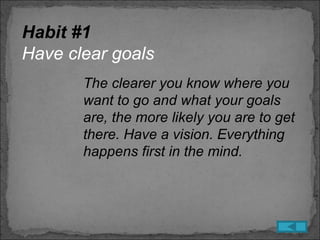
  Habit #1                     I like to have a number of
  Have clear goals             success mantras;
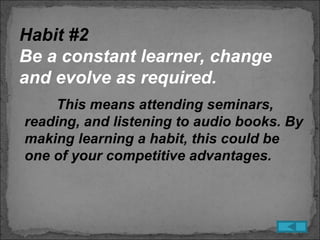
   Habit #2                      Habit #6
 Be a constant learner, change Be Fit.
 and evolve as required.
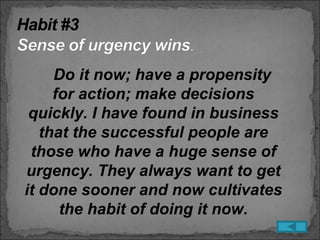
   Habit #3                   Habit #7
Sense of urgency wins.        Study time management
    Habit #4                   Habit #8
 Set a pace that you can       Nurture a network.
 maintain forever.
                   Habit #9
                   Fail often, fail fast, fail
                   cheap.
THE
 END…
THANK

YOU!!!
Most executives believe that if you get the content of your strategy right, the
success of that strategy is a foregone conclusion. They assume that the
substance of the strategy must be composed of realistic objectives and the
most accurate and valid information.
In their quest to create a strategy that can credibly stand up to the scrutiny of
these criteria — and senior management approval — companies often employ
outside experts, such as consulting and marketing firms, to analyze, research
and benchmark their industry, competitors and markets. In addition, they use
tools such as a SWOT (strengths, weaknesses, opportunities and threats)
analysis to help create objectives that address both the past performance and
current circumstances of the company. Sounds reasonable. And therein lies the
problem.
In the eyes of many leaders, the ultimate
level of buy-in for a strategic plan is simply
consensus. The belief behind this myth is
that if everyone feels pretty good about the
plan and has no strong objections, it’s
about the best that can be hoped for.
The typical strategic planning process is an exclusive affair. Executives
often believe that the fewer people involved in the process, the easier it will
be. As such, they often limit participation to a small group of business unit
heads or the strategy development group.
Town halls, road shows, all-hands meetings and webinars are all popular vehicles
for spreading the word and gaining buy-in once the strategic plan has been
crafted. Most senior executives will tout these communication efforts as a critical
step in helping the organization understand what the strategy means and what
role each person plays in bringing it to fruition.
But while these types of events can generate a significant amount of energy and
excitement, they also contain serious pitfalls that can lead to cynicism rather than
commitment.
One of these pitfalls is the mistaken belief that employees are empty vessels, just
waiting for the word from above about where the company is headed and what
they should be doing to help it get there.
Far from being empty, people are already full. They’re full of frustrations and
disappointments about what executives have said they were going to do in the
past and what they actually did. They’re full from promises made and not kept and
from accepting requests to get involved in a company strategy and then being
ignored when times got tough.
Habit #1
Have clear goals
       The clearer you know where you
       want to go and what your goals
       are, the more likely you are to get
       there. Have a vision. Everything
       happens first in the mind.
Habit #2
Be a constant learner, change
and evolve as required.
    This means attending seminars,
reading, and listening to audio books. By
making learning a habit, this could be
one of your competitive advantages.
Do it now; have a propensity
     for action; make decisions
 quickly. I have found in business
   that the successful people are
 those who have a huge sense of
urgency. They always want to get
it done sooner and now cultivates
      the habit of doing it now.
you need to figure out what gives
   you strength and energy.
Habit #5
Success Mantras;
Get your head in the game

Steady your reactions.

 Narrow your objectives.

 Know and stick to your moral compass.
Habit #6
Be Fit.
    fitness gives energy
and energy is what allows
  us to get things done.
Habit #7
Study time management. OK - a
plug for my ebook, book and cd.

   We all have the same amount
of time; it is a matter of how we
use it and how much we get
done.
Habit #8
Nurture a network.
   Reviewing the address book,
keeping in touch with people and
trying to add value to them. The
more we nurture this company,
the more we can get things done.
Habit #9
Fail often, fail fast, fail cheap.
    In order to move forward,
sometimes we have to fail.
Don't let failure stand in the
way of trying to move forward.
You are not a failure if you fail;
you are a failure if you don’t try.
Think about and decide
what your success habits
will be. Today is the first
  day of the rest of your
           life.

Strategy vs. Tactics

  • 2.
    Good strategy isnot without its challenge. FOUR MYTHS OF STRATEGY Myth No. 1: Content Is King Myth No. 2: Consensus Equals Success Myth No. 3: Exclusion Is Efficient Myth No. 4: Communication Creates Commitm
  • 3.
    Habit #5 Habit #1 I like to have a number of Have clear goals success mantras; Habit #2 Habit #6 Be a constant learner, change Be Fit. and evolve as required. Habit #3 Habit #7 Sense of urgency wins. Study time management Habit #4 Habit #8 Set a pace that you can Nurture a network. maintain forever. Habit #9 Fail often, fail fast, fail cheap.
  • 5.
  • 6.
    Most executives believethat if you get the content of your strategy right, the success of that strategy is a foregone conclusion. They assume that the substance of the strategy must be composed of realistic objectives and the most accurate and valid information. In their quest to create a strategy that can credibly stand up to the scrutiny of these criteria — and senior management approval — companies often employ outside experts, such as consulting and marketing firms, to analyze, research and benchmark their industry, competitors and markets. In addition, they use tools such as a SWOT (strengths, weaknesses, opportunities and threats) analysis to help create objectives that address both the past performance and current circumstances of the company. Sounds reasonable. And therein lies the problem.
  • 7.
    In the eyesof many leaders, the ultimate level of buy-in for a strategic plan is simply consensus. The belief behind this myth is that if everyone feels pretty good about the plan and has no strong objections, it’s about the best that can be hoped for.
  • 8.
    The typical strategicplanning process is an exclusive affair. Executives often believe that the fewer people involved in the process, the easier it will be. As such, they often limit participation to a small group of business unit heads or the strategy development group.
  • 9.
    Town halls, roadshows, all-hands meetings and webinars are all popular vehicles for spreading the word and gaining buy-in once the strategic plan has been crafted. Most senior executives will tout these communication efforts as a critical step in helping the organization understand what the strategy means and what role each person plays in bringing it to fruition. But while these types of events can generate a significant amount of energy and excitement, they also contain serious pitfalls that can lead to cynicism rather than commitment. One of these pitfalls is the mistaken belief that employees are empty vessels, just waiting for the word from above about where the company is headed and what they should be doing to help it get there. Far from being empty, people are already full. They’re full of frustrations and disappointments about what executives have said they were going to do in the past and what they actually did. They’re full from promises made and not kept and from accepting requests to get involved in a company strategy and then being ignored when times got tough.
  • 10.
    Habit #1 Have cleargoals The clearer you know where you want to go and what your goals are, the more likely you are to get there. Have a vision. Everything happens first in the mind.
  • 11.
    Habit #2 Be aconstant learner, change and evolve as required. This means attending seminars, reading, and listening to audio books. By making learning a habit, this could be one of your competitive advantages.
  • 12.
    Do it now;have a propensity for action; make decisions quickly. I have found in business that the successful people are those who have a huge sense of urgency. They always want to get it done sooner and now cultivates the habit of doing it now.
  • 13.
    you need tofigure out what gives you strength and energy.
  • 14.
    Habit #5 Success Mantras; Getyour head in the game Steady your reactions. Narrow your objectives. Know and stick to your moral compass.
  • 15.
    Habit #6 Be Fit. fitness gives energy and energy is what allows us to get things done.
  • 16.
    Habit #7 Study timemanagement. OK - a plug for my ebook, book and cd. We all have the same amount of time; it is a matter of how we use it and how much we get done.
  • 17.
    Habit #8 Nurture anetwork. Reviewing the address book, keeping in touch with people and trying to add value to them. The more we nurture this company, the more we can get things done.
  • 18.
    Habit #9 Fail often,fail fast, fail cheap. In order to move forward, sometimes we have to fail. Don't let failure stand in the way of trying to move forward. You are not a failure if you fail; you are a failure if you don’t try.
  • 19.
    Think about anddecide what your success habits will be. Today is the first day of the rest of your life.